Isaiah 1:24

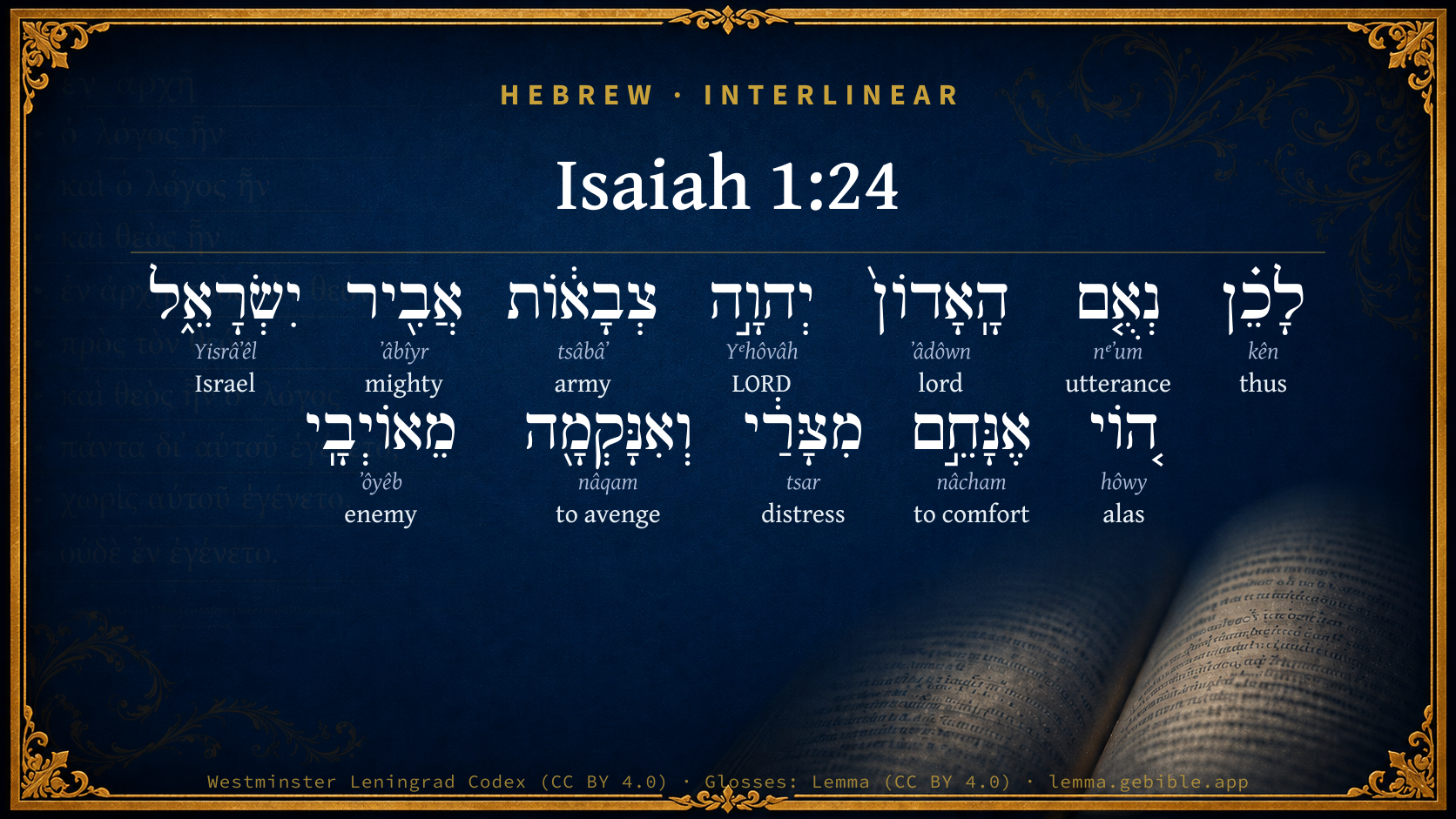
Hebrew (Westminster Leningrad Codex) Isaiah 1:24 appears in the Hebrew Old Testament. The text above is from the Westminster Leningrad Codex. Each word links to its Strong’s number, a concise gloss, and parsing drawn from the Open Scriptures Hebrew Bible morphology. Click any word for its full Brown-Driver-Briggs (BDB) entry.
Download image
Cite this verse

Isaiah 1:24 (World English Bible). Public Domain. Lemma interlinear Bible study tool, https://lemma.gebible.app/v/isaiah/1/24.

Show BibTeX & RIS
BibTeX
RIS
English Translation
Therefore the Lord, Yahweh of Hosts, The Mighty One of Israel, says: "Ah, I will get relief from my adversaries, And avenge myself of my enemies;
World English Bible · Public Domain
Download a study sheet

One document with this verse’s original text, its word-by-word gloss line, the meaning frame, cross-references with their text, attributed commentary, and full source and license credits — printable, and it pastes into notes with its structure intact.

This verse Autodidact and up

Study sheet (.html) Plain text (.txt)

A passage Seminary Student

Up to 50 verses in one chapter. A passage sheet keeps up to 6 commentary sources and 12 cross-references per verse, in the order this page ranks them, and says so on the sheet whenever that leaves anything out. Ask for a single verse and you get the Autodidact verse sheet above.

Everything on this page stays free to read, with no account — the sheet is a download of what is already on screen, not access to it.

Want to remove ads? Support Godless Engineer
Compare translations 3

The same verse in 3 English versions, stacked beneath the original-language interlinear above. Click any original word for its lexicon entry.

Each is an independent rendering of the whole verse — the interlinear is not word-aligned to these translations.

Highlighted words mark where these versions differ — a whole-verse word diff, not a word-by-word alignment.

  • World English Bible Public Domain
    Therefore the Lord, Yahweh of Hosts, The Mighty One of Israel, says: "Ah, I will get relief from my adversaries, And avenge myself of my enemies;
  • King James Version Public Domain
    Therefore saith the LORD, the LORD of hosts, the mighty One of Israel, Ah, I will ease me of mine adversaries, and avenge me of mine enemies:
  • unfoldingWord Literal Text CC BY-SA 4.0
    Therefore—the declaration of the Lord, Yahweh of Armies, the Mighty One of Israel: “Woe! I will be relieved of my adversaries, and I will be avenged of my enemies.

unfoldingWord Literal Text — © unfoldingWord, licensed CC BY-SA 4.0. Word-aligned USFM3 via Door43 (git.door43.org/unfoldingWord/en_ult).

Versions to compare (up to 4)

3 of 4 selected

Show all 18 translations

Every available English version of this verse, each an independent rendering of the whole verse.

  • World English Bible Public Domain
    Therefore the Lord, Yahweh of Hosts, The Mighty One of Israel, says: "Ah, I will get relief from my adversaries, And avenge myself of my enemies;
  • Berean Standard Bible Public Domain
    Therefore the Lord GOD of Hosts, the Mighty One of Israel, declares: “Ah, I will be relieved of My foes and avenge Myself on My enemies.
  • Majority Standard Bible Public Domain
    Therefore the Lord GOD of Hosts, the Mighty One of Israel, declares: “Ah, I will be relieved of My foes and avenge Myself on My enemies.
  • King James Version Public Domain
    Therefore saith the LORD, the LORD of hosts, the mighty One of Israel, Ah, I will ease me of mine adversaries, and avenge me of mine enemies:
  • American Standard Version (1901) Public Domain
    Therefore saith the Lord, Jehovah of hosts, the Mighty One of Israel, Ah, I will ease me of mine adversaries, and avenge me of mine enemies;
  • Revised Version (1885) Public Domain
    Therefore saith the Lord, the LORD of hosts, the Mighty One of Israel, Ah, I will ease me of mine adversaries, and avenge me of mine enemies:
  • Geneva Bible (1599) Public Domain
    Therefore sayth the Lord God of hostes, the mightie one of Israel, Ah, I will ease me of mine aduersaries, and auenge me of mine enemies.
  • Douay-Rheims (1899) Public Domain
    Therefore saith the Lord the God of hosts, the mighty one of Israel: Ah! I will comfort myself over my adversaries: and I will be revenged of my enemies.
  • Young's Literal Translation Public Domain
    Therefore -- the affirmation of the Lord -- Jehovah of Hosts, the Mighty One of Israel: Ah, I am eased of Mine adversaries, And I am avenged of Mine enemies,
  • Literal Standard Version CC BY-SA 4.0
    Therefore—a declaration of the Lord—YHWH of Hosts, the Mighty One of Israel: “Oh, I relieve Myself from My adversaries, || And avenge Myself against My enemies,
  • Unlocked Literal Bible CC BY-SA 4.0
    Therefore this is the declaration of the Lord Yahweh of hosts, the Mighty One of Israel: “Woe to them! I will take vengeance against my adversaries, and avenge myself against my enemies;
  • unfoldingWord Literal Text CC BY-SA 4.0
    Therefore—the declaration of the Lord, Yahweh of Armies, the Mighty One of Israel: “Woe! I will be relieved of my adversaries, and I will be avenged of my enemies.
  • Darby Bible Public Domain
    Therefore saith the Lord, Jehovah of hosts, the Mighty One of Israel: Ah! I will ease me of mine adversaries, and avenge me of mine enemies.
  • World Messianic Bible Public Domain
    Therefore the Lord, GOD of Hosts, the Mighty One of Israel, says: “Ah, I will get relief from my adversaries, and avenge myself on my enemies.
  • Webster's Bible Public Domain
    Therefore saith the Lord, the LORD of hosts, the mighty One of Israel, Ah, I will ease me of my adversaries, and avenge me of my enemies:
  • Free Bible Version CC BY-SA 4.0
    So this is what the Lord says, the Lord Almighty, the Mighty One of Israel: Ha! I will take satisfaction in punishing my enemies, by paying back those who hate me!
  • Bible in Basic English Public Domain
    For this reason the Lord, the Lord of armies, the Strong One of Israel, has said, I will put an end to my haters, and send punishment on those who are against me;
  • JPS Tanakh (1917) Public Domain
    Therefore saith the Lord, the LORD of hosts, the Mighty One of Israel: Ah, I will ease Me of Mine adversaries, and avenge Me of Mine enemies;

Literal Standard Version (2020), Covenant Press — licensed CC BY-SA 4.0. Text via the HelloAO Bible API (eBible.org). Unlocked Literal Bible (unfoldingWord) — licensed CC BY-SA 4.0. Text via the HelloAO Bible API (eBible.org). unfoldingWord Literal Text — © unfoldingWord, licensed CC BY-SA 4.0. Word-aligned USFM3 via Door43 (git.door43.org/unfoldingWord/en_ult). Free Bible Version, Dr. Jonathan Gallagher — licensed CC BY-SA 4.0. Text via the HelloAO Bible API (eBible.org).

Word by word

More ways to search: Search by grammar → Find every occurrence → Compare this word →

Practice this passage: Drill this verse → Learn its vocabulary →

אֲבִ֖יר
ʼâbîyr
H46
“mighty of”
Adjective, Adjective, Masculine, Singular, Construct
Part of Speech
Adjective
Type
Adjective
Gender
Masculine
Number
Singular
State
Construct
Full BDB Definition

Origin: from H82

TWOT: 13c

strong, mighty - used only to describe God - the Strong - old name for God (poetic)
  1. לָכֵ֗ן kên H3651 “to/for · thus” Preposition + Adverb
  2. נְאֻ֤ם nᵉʼum H5002 “utterance of” Noun, Common, Masculine, Singular, Construct
  3. הָֽאָדוֹן֙ ʼâdôwn H113 “the · lord” Particle, Definite Article + Noun, Common, Masculine, Singular, Absolute
  4. יְהוָ֣ה Yᵉhôvâh H3068 “LORD” Noun, Proper
  5. צְבָא֔וֹת tsâbâʼ H6635 “armies” Noun, Common, Both, Plural, Absolute
  6. יִשְׂרָאֵ֑ל Yisrâʼêl H3478 “Israel” Noun, Proper
  7. ה֚וֹי hôwy H1945 “alas” Particle, Interjection
  8. אֶנָּחֵ֣ם nâcham H5162 “to comfort” Verb, Niphal, Imperfect, 1st Person, Common, Singular
  9. מִצָּרַ֔י tsar H6862 “from · distresses · my” Preposition + Noun, Common, Masculine, Plural, Construct + Suffix, Personal, 1st Person, Common, Singular
  10. וְאִנָּקְמָ֖ה nâqam H5358 “and · to avenge” Conjunction + Verb, Niphal, Cohortative, 1st Person, Common, Singular
  11. מֵאוֹיְבָֽי ʼôyêb H341 “from · enemy · me” Preposition + Verb, Qal, Participle Active, Masculine, Plural, Construct + Suffix, Personal, 1st Person, Common, Singular

About this verse

These counts appear in no published source. They are computed here, from the morphology-tagged text and Lemma’s own curated glosses. What Lemma adds →

12
words
12
distinct lemmas
Prophets
section

Notable vocabulary

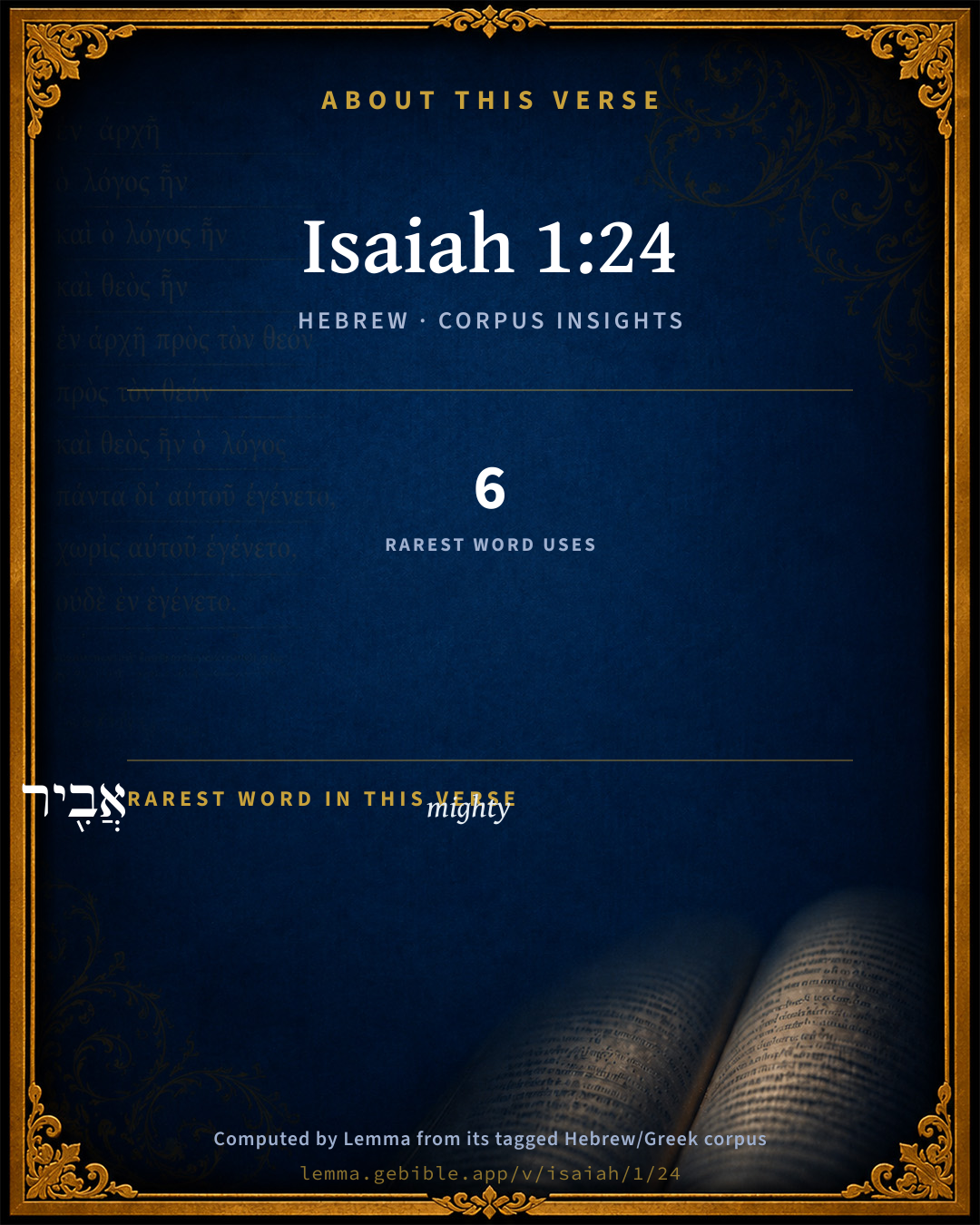
The rarest word here is אֲבִ֖יר mighty H46 — appearing just 6 times in the whole Hebrew Bible.

Shared distinctive vocabulary

אֲבִ֖יר mighty H46 occurs in 6 verses of the Hebrew Bible. Also found in:

Grammatical profile

  • 3 verbs
  • 6 nouns
  • 1 adjective
  • 1 adverb
  • 1 particle

Verb forms

  • אֶנָּחֵ֣ם Niphal · Imperfect
  • וְאִנָּקְמָ֖ה Niphal · Cohortative
  • מֵאוֹיְבָֽי Qal · Participle Active

Hebrew & Septuagint length

In English translation the verse runs 26 words from the Hebrew and 33 from the Septuagint (LXX English) — closely comparable.

A rough comparison of the two English renderings, which tokenize alike — not a word-level alignment.

Word counts can differ between the Hebrew and the Greek without any difference in meaning — e.g. the Hebrew direct-object marker אֵת has no separate Greek word, and Greek often adds the article ὁ.

Cross-references

16

Topical passages linked to Isaiah 1:24 in the Treasury of Scripture Knowledge — connected by theme and wording, ordered by reader-vote popularity; previews shown in the World English Bible.

  • Isaiah 60:16 You shall also suck the milk of the nations, and shall suck the breast of kings; and you shall know that I, Yahweh, am your Savior, and your Redeemer, the Mighty One of Jacob.
  • Deuteronomy 28:63 It shall happen that as Yahweh rejoiced over you to do you good, and to multiply you, so Yahweh will rejoice over you to cause you to perish, and to destroy you; and you shall be plucked from off the land where you go in to possess it.
  • Isaiah 49:26 I will feed those who oppress you with their own flesh; and they shall be drunken with their own blood, as with sweet wine: and all flesh shall know that I, Yahweh, am your Savior, and your Redeemer, the Mighty One of Jacob.
  • Psalms 132:2 How he swore to Yahweh, And vowed to the Mighty One of Jacob:
  • Isaiah 35:4 Tell those who are of a fearful heart, Be strong, don't be afraid: behold, your God will come [with] vengeance, [with] the recompense of God; he will come and save you.
  • Isaiah 61:2 to proclaim the year of Yahweh's favor, and the day of vengeance of our God; to comfort all who mourn;
  • Ezekiel 5:13 Thus shall my anger be accomplished, and I will cause my wrath toward them to rest, and I shall be comforted; and they shall know that I, Yahweh, have spoken in my zeal, when I have accomplished my wrath on them.
  • Deuteronomy 32:43 Rejoice, you nations, [with] his people: For he will avenge the blood of his servants, Will render vengeance to his adversaries, Will make expiation for his land, for his people.
  • Proverbs 1:25–26 But you have ignored all my counsel, And wanted none of my reproof;
  • Isaiah 30:29 You shall have a song as in the night when a holy feast is kept; and gladness of heart, as when one goes with a pipe to come to the mountain of Yahweh, to the Rock of Israel.
  • Ezekiel 16:42 So will I cause my wrath toward you to rest, and my jealousy shall depart from you, and I will be quiet, and will be no more angry.
  • Ezekiel 21:17 I will also strike my hands together, and I will cause my wrath to rest: I, Yahweh, have spoken it.
  • Hebrews 10:13 from that time waiting until his enemies are made the footstool of his feet.
  • Revelation 18:8 Therefore in one day her plagues will come: death, mourning, and famine; and she will be utterly burned with fire; for the Lord God who has judged her is strong.
  • Isaiah 63:4 For the day of vengeance was in my heart, and the year of my redeemed is come.
  • Jeremiah 50:34 Their Redeemer is strong; Yahweh of Hosts is his name: he will thoroughly plead their cause, that he may give rest to the earth, and disquiet the inhabitants of Babylon.

Cross-references courtesy of OpenBible.info (CC BY 4.0).

Hebrew and Greek witnesses Masoretic Hebrew ↔ Greek Septuagint

The same verse in the two great witnesses to the Old Testament, shown verse-for-verse.

These are two independent witnesses, not word-aligned to each other, and the Septuagint is shown in lemma (dictionary) form.

Hebrew Isaiah 1:24 Masoretic · Westminster Leningrad Codex

לָכֵ֗ן נְאֻ֤ם הָֽאָדוֹן֙ יְהוָ֣ה צְבָא֔וֹת אֲבִ֖יר יִשְׂרָאֵ֑ל ה֚וֹי אֶנָּחֵ֣ם מִצָּרַ֔י וְאִנָּקְמָ֖ה מֵאוֹיְבָֽי

Therefore the Lord, Yahweh of Hosts, The Mighty One of Israel, says: "Ah, I will get relief from my adversaries, And avenge myself of my enemies;

World English Bible · Public Domain

Greek LXX Isaiah 1:24 Septuagint · lemma form

διά οὗτος ὅδε λέγω ὁ δεσπότης κύριος σαβαωθ οὐαί ὁ ἰσχύω ἰσραήλ οὐ παύω γάρ ἐγώ ὁ θυμός ἐν ὁ ὑπεναντίος καί κρίσις ἐκ ὁ ἐχθρός ἐγώ ποιέω

Therefore thus says the Lord, the Lord of hosts, Woe to the mighty men of Israel; for my wrath shall not cease against my adversaries, and I will execute judgment on my enemies.

LXX2012 (modern English Septuagint) · Public Domain

Hebrew: Westminster Leningrad Codex (CC BY 4.0). Greek: Septuagint (public domain); English from LXX2012 (modern English Septuagint) (Public Domain). How the Septuagint differs from the Hebrew →

Targum (Aramaic paraphrase)

1

The Targum is the ancient Jewish Aramaic paraphrase of the Hebrew Scriptures — an interpretive translation, not the Hebrew text itself. Onkelos (literal) and Pseudo-Jonathan (expansive) render the Torah, and Jonathan the Prophets. Coverage is partial: where no permissively-licensed English translation exists for a verse, only the Aramaic is shown. This is verse-level text, not a word-by-word alignment to the Hebrew.

  1. Targum Jonathan Prophets (Joshua–Malachi)
    בְּכֵן אֲמַר רִבּוֹן עַלְמָא יְיָ צְבָאוֹת תַּקִיפָא דְיִשְׂרָאֵל קַרְתָּא יְרוּשְׁלֵם אֲנָא עֲתִיד לְנַחֲמוּתָהּ בְּרַם וַי לְרַשִׁיעַיָא כַּד אִתְגְלֵי לְמֶעְבַּד פּוּרְעֲנוּת דִין מְסַנְאֵי עַמִי וְאָתִיב נְקָמָא לִבְעֵיל דְבָבִי:

    Therefore saith the Lord of the world, the Lord of hosts, the Mighty One of Israel, The city of Jerusalem, I will comfort her; but woe to the wicked, when I shall reveal myself, to render just recompense to the enemies of my people, and render vengeance to my enemies.

    Targum Jonathan — Aramaic: “Mikraot Gedolot” (public domain). English: “Sefaria Community Translation” (CC0 1.0 (public-domain dedication)); “London "Chaldee Paraphrase," 1871” (public domain). Text via Sefaria.

Commentary

Notes on Isaiah 1:24 from classic Christian and Jewish commentators (each source and its license shown beneath its notes). The classic Christian expositions comment on the surrounding passage and are grouped to its opening verse, so a note may address several verses; the Jewish commentaries on the Tanakh (Rashi and others) are per-verse, so they appear only where the commentator wrote on this verse.

Lemma curates 59 commentaries, every one of them public domain or Creative Commons licensed, each selected and text-cleaned for this edition rather than reprinted as found. About our sources →

Trapp's Complete Commentary

John Trapp

Isa 1:24 Therefore saith the Lord, the LORD of hosts, the mighty One of Israel, Ah, I will ease me of mine adversaries, and avenge me of mine enemies:

Ver. 24. Therefore thus saith the Lord.] Dominator, Dεσποτης, Dυναστης, the great housekeeper of the world. {a}

The Lord of hosts.] Heb., Jehovah of armies.

The mighty One of Israel.] Able enough to deal with them, and to punish their facinus maioris abollae.

Ah.] Some {b} render it Heu, alas, to show that God punisheth nolens et doleus - unwillingly and with grief. {as Lam 3:33} Others make it to be an expression of joy, {c} to show what content he will take in punishing the obstinate; and so it followeth.

I will ease me; I will avenge me.] As it is an ease to a full stomach to disgorge, and as to a vindictive person revenge is very sweet.

“ Est vindicta bonum vita iucundius ipsa. ”

So - but in a way of justice - God delighteth {d} in the destruction of his stubborn enemies. {Deu 28:63 Eze 5:13 Pro 1:26}

Mine adversaries.] Such as, by a specialty, are corrupt judges, as Calvin here noteth.

{a} הארוז.

{b} Heu dolentis. - Luther.

{c} Ah exultantis. Oecolamp.

{d} Animumque explesse iuvabit.

John Trapp, A Commentary or Exposition upon All the Books of the Old and New Testament (1647–1656) — public domain. Text from a community e-Sword module.

The Biblical Illustrator

Joseph S. Exell

Isa_1:24

Ah, I will ease Me of Mine adversaries

Gods enemies and His treatment of them

I.

WICKED PEOPLE, ESPECIALLY WICKED RULERS THAT ARE CRUEL AND OPPRESSIVE, ARE GODS ENEMIES.

II. THEY ARE A SUDDEN TO THE GOD OF HEAVEN. This is implied in His easing Himself of them.

III. GOD WILL FIND OUT TIME AND WAY TO EASE HIMSELF OF THIS BURDEN. (M. Henry.)

Salvation through judgment

Salvation through judgment is still and ever the only means of reproving and preserving the congregation that takes its name from Jerusalem. (F. Delitzsch, D. D.)

The Biblical Illustrator, edited by Joseph S. Exell (c. 1880s–1900s) — public domain. Text from a community e-Sword module.

Joseph Benson's Commentary

Isa 1:24. Ah, I will ease me, &c. — This is an expression borrowed from men’s passions, who find some sort of ease and rest in their minds upon venting their anger on just occasions, or in bringing offenders to condign punishment. Thus God, speaking after the manner of men, represents himself as feeling satisfaction in executing justice upon obstinate and incorrigible offenders. Compare Eze 5:13; Eze 16:42; Eze 21:17. But let it be observed, God is never said to take pleasure in the punishment of any, but those who have filled up the measure of their iniquities.

Joseph Benson's Commentary on the Old and New Testaments (1811–1818) — public domain. Text from a community e-Sword module.

Whedon's Commentary on the Bible

Daniel D. Whedon

24. But there is a Judge who sees all this, and who will recompense according to what he sees.

The Lord of hosts — He commands from heaven to smite and to protect: in the one case as it deserves; in the other, as it needs. The term “The Lord,” here, is from an unusual Hebrew word, האדונ, Ha Adon, used in Exo_33:17; Exo_34:23; Isa_1:24; Isa_3:1; Isa_10:16; Isa_10:23; Isa_19:4. “It designates God as the supreme administrator and judge. They (the people) had “appeared before” him, (Isa_1:12,) much as if they were patronizing one whom they were willing to please with a grand pageant, but one who had no real control over them; (compare Psa_12:5, Adon;) and, after trampling his courts, had gone forth to oppress their fellow men. He will now prove himself to be what he was called, (KAY, Com., in loco,) the Mighty One of Israel, and this name is analogous to “Mighty God of Jacob” in Gen_49:24, which passage helps us to the meaning of this. In this verse, He shows who is master, and who can bring proud and rebellious Israel through sharp pangs of punishment to repentance, and give exaltation to the crushed few who were his real friends. Isaiah, and those he represents in his own times and in all ages, are his real friends. Is not this principle involved… in the remaining words of this verse?

Ah — The connexion requires this word to be used here in a tone of menace, as in Isa_1:4, it must needs be in a tone of grief. Or, it may be of grief here also, and so the meaning be, “Alas, that I must ease or comfort myself by using severity on the guilty, unfaithful ones of Israel.” This softens the metaphor in this passage, and others of like import, called anthropopathia, that is, speaking or feeling as men speak and feel. This figure is constantly used in the Bible. It is necessarily so used. The pure essence of God’s being is impossible for men to apprehend. His mode of thinking and feeling is therefore expressed in our own way of thinking and feeling. Lowth says: “This very necessity leads to beauty, as does all metaphoric language. When images are taken from the superior faculties of man, from the purer and more generous affections of human nature, and applied to God, we are apt to acquiesce in the notion — we overlook the metaphor and take it as a proper attribute; but when the idea is gross and offensive, as in this passage of Isaiah, where the impatience of anger and the pleasure of revenge are attributed to God, we are immediately shocked at the application; the impropriety strikes us at once: and the mind, casting about for something in the divine nature analogous to the image, lays hold on some great, obscure, vague idea, which it endeavours in vain to comprehend, and is lost in immensity and astonishment.” — LOWTH, Isaiah, in loco. But no mischiefs need result from the use of this figure, if it be considered that the inspired writer is predicting only the incomprehensible ethical action of God in the case, not the manner of the action. All the imprecatory psalms, the lxixth and cixth, for example, have their explanation on this basis.

Daniel D. Whedon (gen. ed.), Commentary on the Old and New Testaments (1874–1909) — public domain. Text from a community e-Sword module.

The Preacher's Complete Homiletical Commentary

Joseph S. Exell (gen. ed.)

A TERRIBLE RESOLVE

Isa_1:24. Therefore thus saith the Lord, the Lord of hosts, the Mighty One of Israel, Ah, I will ease me of mine adversaries, and avenge me of mine enemies.

Concerning many men, we may offer Christ’s prayer, “Father, forgive them; for they know not what they do.” They sin in ignorance, or rather without thought of their character and relation to God, and of the doom which they are bringing upon themselves. There may be such persons before me now. Acting, then, the part of a true and faithful friend, I warn you—

I. That God counts you as His enemies. By cherishing your sins you defy His authority, and place yourself in a position of hostility to Him [445]

[445] If a king warns a city of traitors, and calls upon them to search them out and send them away, and they never regard the message, but willingly give them harbour and entertainment, it is a sign they are disaffected to him: to cherish a sin after warning is open defiance of God.—Manton, 1620–1667.

II. That God feels Himself injured, oppressed, and as it were hemmed in by your iniquities. Note this most suggestive phrase, “I will ease me of mine adversaries,” and see outline on Isa_1:14. God’s laws are His territories, and by your transgressions you invade them. Your sins are trespasses. God feels towards you as the French feel towards the Germans who have taken possession of and settled down in Alsace and Lorraine; you put upon God an indignity which He cannot and will not bear.

III. That while God endures your trespasses for a time, in the merciful hope that by His forbearance you may be lead to repentance, He will not restrain His anger for ever, but will presently give free vent to it [448] and sweep you into that place where, though you may retain the disposition to sin against Him, you will not have the power.

[448] At this first step we might reason on the testimony if we pleased, instead of accepting it, and raise the objection that to imagine passion in God, especially so turbid a passion as anger, conflicts with our notions of His character, and degrades Him in our apprehensions. Beware! remember that in forming an estimate of the character and proceedings of God, we are but little children forming an estimate of the character and proceedings of a man of matured experience. Were it not more reasonable, as well as more reverent, to accept what He says, and to leave Him afterwards to clear up any mystery which may envelope His nature? I can indeed conceive in Him nothing turbid, impetuous, or impulsive, such as sullies the clearness of the human will. But this I can conceive, that there is in Him some high perfection (more incomprehensible to my finite capacity than the speculations of an astronomer to a peasant child), of which anger is the most adequate exponent to my mind, and which I must be content to think of and speak of as anger, or else to remain in total ignorance of it. And this also I can—not only conceive, but most readily assent to, that in an absolutely perfect nature there should be an utter abhorrence of, and antipathy to, moral evil, most justly represented to simple minds by the terms “anger,” “curse.” We have never seen a perfect character; no perfect character, save one, ever moved upon the earth: but the righteous man, who is striving after and approximating to perfection, has often crossed our path; and surely we have marked in him, that the more righteous he is, the more doth he abhor (in the language of Holy Scripture) everything that is evil. What is the effect upon one who breathes habitually the atmosphere of communion with God, of catching in the current tidings of the day the intelligence of some awful outburst of depravity? When such an one passes on an errand of mercy through the crowded alleys of a great city, and the shouts of malignant execration and profaneness ring in his ear, or scenes of impurity are paraded before his eye, with what feeling does he encounter these symptoms of human degradation? Are they not like a foul odour to his nostrils, or a jarring note to his ear, or an abortion to his sight? Does he not turn away with loathing, and recoil from such scenes and such sounds with an antipathy strong in proportion to his goodness? And is it, then, so hard to conceive that in perfect goodness there may be a recoil from moral evil, something similar in kind to this, though infinitely stronger in degree? And is not such a recoil righteous, and a token of righteousness?—Goulburn.

Application.—Nowconsider—

1. That this is not the resolve of some feeble being destitute of resources for the accomplishment of his purposes. He who thus solemnly warns you is “the Lord of hosts, the Mighty One of Israel.”

2. Whether you have resources that will enable you to cope with this adversary whose indignation you have aroused (Luk_14:31). If not, consider—

3. What is the course that wisdom would suggest to you in your present circumstances (Luk_14:32) [451]

[451] Let us take heed, for mercy is like a rainbow, which God set in the clouds to remember mankind: it shines here as long as it is not hindered; but we must never look for it after it is night, and it shines not in the other world. If we refuse mercy here, we shall have justice there.—Jeremy Taylor, 1612–1667.

THE PURPOSE OF PUNISHMENT

Isa_1:24-27. Therefore thus saith the Lord, the Lord of hosts, the Mighty One of Israel, Ah, I will ease me of mine adversaries, and avenge me of mine enemies: and I will turn mine hand upon thee, and purely purge away thy dross, and take away all thy tin: and I will restore thy judges as at the first, and thy counsellors as at the beginning: afterwards thou shalt be called, The city of righteousness, The faithful city. Zion shall be redeemed with judgment, and her converts with righteousness.

The denunciation of the iniquity of Jerusalem (Isa_1:21-23) is followed by a solemn announcement of God’s determination to punish it.

I. God will certainly punish sin. “Ah, I will ease me of mine adversaries, and avenge me of mine enemies.” See preceding outline, and that on Isa_1:20.

II. In punishing sin God is not moved by any vindictive purpose. True, He speaks here of taking vengeance upon His enemies, but these words coming from the lips of Jehovah must not be interpreted as we should have to interpret them if they came from the lips of a Ghengis Khan or a Tippoo Saib. We must remember that this is the utterance of the Mighty One of Israel, who is infinitely uplifted above every unholy passion. Whatever misconstruction this phrase, taken alone, might be open to, is entirely obviated by the declarations which follow it, which teach us—

III. That God’s aim even in the severest chastisements is the reformation of the offenders, and their restoration to true blessedness. For what purpose will He turn His hand upon Jerusalem? Not that He may destroy her, but that He may purify her, as silver is purified in the furnace; and through this painful process she is caused to pass, that she may be restored to her former dignity and blessedness. It is for these purposes that God chastises nations and individuals to-day.

Application.—

1. Those who are living sinful lives may certainly expect severe judgments. Sin and sorrow are inseparably linked, and God is solemnly pledged not to “clear” the guilty.

2. Those on whom judgments on account of sin have fallen should neither despise them nor be driven by them to despair (Heb_12:5). These are two great evils. Indifference to chastisement brings on still severer strokes [454] God will break the stubborn sinners who refuse to bend (Isa_1:28) (β). Despair defeats the very object for which our chastisements are sent, and is itself a grievous offence against God. Instead of yielding to despair, we should be filled with hope, for God has loving purposes towards us, and our prayer should be, not that the afflictions should be removed, but that God’s purposes in them should be fulfilled. It is worth while to go into the furnace, if thereby we may be cleansed from the dross by which we are defiled.

[454] The physician, when he findeth that the potion which he hath given his patient will not work, he seconds it with one more violent; but if he perceive the disease to be settled, then he puts him into a course of physic, so that medicè miserè (he shall have at present but small comfort of his life). And thus doth the surgeon too: if a gentle plaster will not serve, then he applies that which is more corroding, and, to prevent a gangrene, he makes use of his cauterising knife, and takes off the joint or member that is so ill affected. Even so God, when men profit not by such crosses as He hath formerly exercised them with, when they are not bettered by lighter afflictions, then He sends heavier, and proceeds from milder to sharper courses. If the dross of their sin will not come off, He will throw them into the melting-pot again and again, crush them harder in the press, and lay on such irons as shall enter more deeply into their souls. If He strikes and they grieve not, if they be so foolish that they will not know the judgment of their God, He will bring seven times more plagues upon them—cross upon cross, loss upon loss, trouble upon trouble, one sorrow on the neck of another—till they are, in a manner, wasted and consumed.—Firmicus.

This we may rest satisfied of, that whensoever God’s hand is upon us, we must either yield a voluntary, or be forced to a violent, submission. If our stubbornness is such that we will not bend, it is certain that our weakness is also such that we must needs break. If God’s message will not win upon Pharaoh, His plagues shall compel him; and therefore, when He sent Moses to him, He put a rod into his hand, as well as a word into his mouth. When God fully purposes to afflict a man, he is like a bird in a net, the more he strives and flutters, the more he is entangled; for the Supreme Judge of all things is resolved to go through with His great work of judgment, and to make all obstinate, sturdy sinners know, that He has power to constrain where His goodness will not persuade.—South, 1633–1716.

The Preacher's Complete Homiletical Commentary (gen. ed. Joseph S. Exell; Funk & Wagnalls, c. 1892) — public domain (pre-1929). A full-Bible homiletical/sermon-outline anthology covering 65 of 66 books (2 John is absent from the source module). Text from a community e-Sword module.

Tyndale Open Study Notes

Tyndale Open Resources

1:24 The Lord of Heaven’s Armies, the Mighty One of Israel, was usually Israel’s protector (31:5). However, in this context, God was coming to take revenge against his own people, who by their wickedness had become his enemies and foes.

Tyndale Open Study Notes — © Tyndale Open Resources, licensed CC BY-SA 4.0. Text via the HelloAO Bible API.

Geneva Bible (1599)

Geneva Bible translators

When God will show himself merciful to his Church, he calleth himself, The Holy one of Israel, but when he hath to do with his enemies, he is called Mighty, as against whom no power is able to resist.

I will take vengeance of mine adversaries the Jews, and so satisfy my desire by punishing them. Which thing yet he doeth with a grief, because of his Covenant.

Geneva Bible (1599) marginal notes — public domain. Text via Bolls.life.

Jamieson, Fausset & Brown

Robert Jamieson, A. R. Fausset & David Brown

Lord . . . Lord--Adonai, JEHOVAH.

mighty One of Israel--mighty to take vengeance, as before, to save.

Ah--indignation.

ease me--My long tried patience will find relief in at last punishing the guilty (Eze 5:13). God's language condescends to human conceptions.

Jamieson, Fausset & Brown — Commentary Critical and Explanatory on the Whole Bible (1871) — public domain (CC PDM 1.0). Text via the HelloAO Bible API.

Adam Clarke's Commentary

Verse 24. Ah, I will ease me - "Aha! I will be eased"] Anger, arising from a sense of injury and affront, especially from those who, from every consideration of duty and gratitude, ought to have behaved far otherwise, is an uneasy and painful sensation: and revenge, executed to the full on the offenders, removes that uneasiness, and consequently is pleasing and quieting, at least for the present. Ezekiel, Eze 5:13, introduces God expressing himself in the same manner: -

"And mine anger shall be fully accomplished;

And I will make my fury rest upon them;

And I will give myself ease."

This is a strong instance of the metaphor called anthropopathia, by which, throughout the Scriptures, as well the historical as the poetical parts, the sentiments sensations, and affections, the bodily faculties qualities, and members, of men, and even of brute animals, are attributed to God, and that with the utmost liberty and latitude of application. The foundation of this is obvious; it arises from necessity; we have no idea of the natural attributes of God, of his pure essence, of his manner of existence, of his manner of acting: when therefore we would treat on these subjects, we find ourselves forced to express them by sensible images. But necessity leads to beauty; this is true of metaphor in general, and in particular of this kind of metaphor, which is used with great elegance and sublimity in the sacred poetry; and what is very remarkable, in the grossest instances of the application of it, it is generally the most striking and the most sublime. The reason seems to be this: when the images are taken from the superior faculties of the human nature, from the purer and more generous affections, and applied to God, we are apt to acquiesce in the notion; we overlook the metaphor, and take it as a proper attribute; but when the idea is gross and offensive as in this passage of Isaiah, where the impatience of anger and the pleasure of revenge is attributed to God, we are immediately shocked at the application; the impropriety strikes us at once, and the mind, casting about for something in the Divine nature analogous to the image, lays hold on some great, obscure, vague idea, which she endeavours to comprehend, and is lost in immensity and astonishment. See De Sacr. Poesi. Hebr. Praeel. xvi. sub. fin., where this matter is treated and illustrated by examples.

Adam Clarke's Commentary on the Bible (1810–1826) — public domain. Text from a community e-Sword/MySword module.

Ellicott's Commentary for English Readers

(24) Therefore saith the Lord.—The word for “saith” (literally, whisper) is that which always indicates the solemn utterance of an oracle. The solemnity is emphasised by the exceptional accumulation of Divine names. He who speaks is the Eternal, the Lord of the armies of earth and heaven, the Hero, the Mighty One, of Israel. The latter name is found also in Isa_49:26; Isa_60:16; Gen_49:24; Psa_132:2; Psa_132:5, and not elsewhere.

Ah, I will ease me of mine adversaries.—In bold, anthropomorphic language, which reminds us of Psa_78:65, Jehovah is represented as waking out of slumber, and rising up to judgment. The words “ease” and “avenge” in the Hebrew have nearly the same sound (nicham and niqqam), and come from the same root, the primary thought being that of the deep breath which a man draws in the act of throwing off a burden. The weariness and impatience of Isa_1:14, the long-suffering that waited, had come to an end at last (comp. Isa_5:11; Isa_5:13), and the day of vengeance had come. The punishment was, however, to be reformatory, and not merely penal.

A Bible Commentary for English Readers, edited by Charles John Ellicott (1878–1897) — public domain. Text from a community e-Sword module.

The Cambridge Bible for Schools and Colleges

gen. ed. J. J. S. Perowne

24. Such men are adversaries and enemies of Jehovah, thwarting His wishes and purposes for His people. the Lord] “the Master” or the Sovereign. The title, used absolutely as here (hâ-’Adôn), is almost peculiar to Isaiah, and is used by him only in introducing a threat (ch. Isa_3:1, Isa_10:16; Isa_10:33, Isa_19:4; cf. Exo_23:17; Exo_34:23).

the mighty One of Israel] Israel’s Strong One, a rare word in Hebr., first found in Gen_49:24. See on ch. Isa_10:13. ease me] Better: appease myself, and so again, avenge myself. By a bold anthropopathy the divine Being is compared to a man thirsting for vengeance.

25 resumes the first figure of Isa_1:22, the judgment on Zion being likened to the smelting of impure ore. turn (or bring back) my hand] not in mercy, but, as usual, in judgment.

purely] R.V. throughly, lit. “as with lye,” i.e. potash, which was used as a flux to facilitate the separation of the metals. The grammar is still suspicious. Some, by transposing two consonants, obtain the sense “in the furnace.”

The Cambridge Bible for Schools and Colleges (gen. ed. J. J. S. Perowne; Cambridge University Press, 1878–1918) — public domain. Text from a community e-Sword module.

John Gill's Exposition

Therefore, saith the Lord, the Lord of hosts, the mighty One of Israel,.... All these names and titles, which are expressive of the majesty, power, and authority of God, are used to give the greater solemnity and weight to what follows; and to show that he is able to accomplish what he determines and threatens to do.

Ah! which is a particle, either expressive of grief at their wretched and miserable condition, or of indignation at their provoking sins and transgressions:

I will ease me of mine adversaries; or, "I will take comfort (n) of" them, by destroying them; expressing the pleasure and satisfaction he should take in avenging his justice on them: they had been a trouble to him, and had wearied him with their sins, and now he will ease himself of them by removing them. The Targum is,

"I will comfort the city of Jerusalem;''

not taking the sense of the words:

and avenge me of mine enemies; the Jews, who were enemies to Christ and his Gospel, and would not have him to reign over them, and which was the cause of the destruction of their city, temple, and nation; see Luk 19:14.

(n) "consolationem capiam", Vatablus, Junius & Tremellius, Piscator. "Consolabor me", Cocceius.

John Gill's Exposition of the Whole Bible (1746–1763) — public domain (CC PDM 1.0). Text via the HelloAO Bible API.

Albert Barnes' Notes on the Bible

Therefore saith the Lord ... - The prophet having stated the guilt of the nation, proceeds to show the consequences of their crimes; or to foretell what would happen. The name of God is repeated, to attract attention; to fill the mind with awe; and to give emphasis to the solemn sentence which was about to be uttered.

The Lord - אדון 'âdôn. This word properly denotes master, lord, owner. Gen 24:9 : “lord over his whole house.” 1Ki 16:24 : “owner of the hill Samaria.” It is applied here to Yahweh, not as a special title, or as one of the names which he assumes to himself, but as owner, proprietor, master, ruler of the nation. The word, when applied to God as one of his special titles, has the form of an ancient plural termination, אדני 'ădonāy. The root is probably דוּן dôn, to judge, which in ancient times was also closely connected with the idea of ruling.

The Lord of hosts - Yahweh - ruling in the hosts of heaven, and therefore able to accomplish his threatenings; note, Isa 1:9.

The mighty One of Israel - He who had been their defender in the days of their peril; who had manifested his mighty power in overthrowing their enemies; and who had shown, therefore, that he was able to inflict vengeance on them.

Ah - הוי hôy. This is an expression of threatening. It is that which is used when an affront is offered, and there is a purpose of revenge; see Isa 1:4.

I will ease me - This refers to what is said in Isa 1:14, where God is represented as burdened with their crimes. The Hebrew word is, I will be consoled, or comforted - that is, by being delivered from my foes - אנחם 'enâchem from נחם nâcham, in Niphil, to suffer pain, to be grieved; and hence, to have pity, to show compassion. In Piel, to console or comfort one’s-self; to take revenge. The idea included in the word is that of grief or distress, either in beholding the sufferings of others, or from some injury received from others. Hence, in Piel, it denotes to obtain relief from that distress, either by aiding the distressed object, or by taking revenge. In both instances, the mind, by a law of its nature, finds relief. The passion expends itself on its proper object, and the mind is at ease. It is used here in the latter sense. It is an instance where God uses the language which people employ to denote passion, and where they obtain relief by revenge. When applied to God, it is to be understood in accordance with his nature, as implying simply, that he would punish them; compare the note at Isa 1:13. It means that he had been pained and grieved by their crimes; his patience had been put to its utmost trial; and now he would seek relief from this by inflicting due punishment on them. An expression explaining this may be seen in Eze 5:13; ‘Then shall mine anger be accomplished, and I will cause my fury to rest upon them, and I will be comforted.’ Also, Deu 28:63 : ‘As the Lord rejoiced over you, to do you good; so the Lord will rejoice over you, to destroy you.’

Mine adversaries - The enemies to his law and government among the rebellious Jews. The expression in this verse is a remarkable instance of God’s adapting himself to our apprehension, by using our language. Instances occur often in the Scriptures where language expressive of human passions is applied to God; and as human language must be employed in revelation, it was indispensable. But those expressions are not to be understood as they are when applied to the passions of mankind. In God, they are consistent with all that is pure, and glorious, and holy, and should be so understood. The Chaldee renders this verse, ‘I will console the city of Jerusalem; but woe to the impious, when I shall be revealed to take vengeance on the enemies of my people.’ But this is manifestly a false interpretation; and shows how reluctant the Jews were to admit the threatenings against themselves.

Albert Barnes' Notes on the Bible (1834–1885) — public domain. Text from a community e-Sword/MySword module.

Haydock's Catholic Bible Commentary

Ah! God punishes with regret. (Menochius) --- Comfort. I will take complete vengeance under Joathan, (4 Kings xv. 37.) Achaz, &c.

George Leo Haydock (1774–1849), Haydock's Catholic Family Bible and Commentary, 1859 edition — public domain. Excludes Psalms (Douay-Rheims chapter numbering differs from Protestant) and Deuterocanonical books (Catholic canon only).

Matthew Poole's English Annotations

I will ease me, Heb. I will comfort myself; ease my mind, and satisfy my justice, by taking vengeance, as the next clause explains this. The same expression is used in the same sense Eze 5:13.

Of mine adversaries; of the Israelites, who, though they have called themselves my children and friends, yet by their temper and carriage towards me have showed themselves to be mine enemies.

Matthew Poole's English Annotations on the Holy Bible (1683–1685) — public domain. Text from a community e-Sword/MySword module.

The Pulpit Commentary

THE DECLARATION OF GOD"S JUDGMENT. It is foreknown to God that Israel will not repent. He therefore fulminates his judgment; which, however, is still conditional, so far as individuals are con-corned. His vengeance will fall upon the land; but the result will be twofold. Destruction will come upon the unrighteous and the sinners (ver. 28) they will be "consumed" (ver. 28), and "confounded" (ver. 29); but there will be some on whom the punishment will have a purifying power, whose dross it will purge away, and whom it will convert to God (vers. 25, 27). From these will rise up a new Jerusalem a "city of righteousness," a "faithful stronghold" (ver. 26).

The Lord, the Lord of hosts. In the original, Ha-Adon, Jehovah Sabaoth i.e. "The Lord" (or "Master" of men and angels), "the Self-Existing One of the hosts of heaveni.e., their God, the only proper object of their worship. It gives peculiar weight and significance to this prophecy, that it is introduced by a triple designation of the Divine Being. The Mighty One of Israel. A very unusual designation, only found here and, with the modification of "Jacob" for "Israel, "in the following places: Isa_49:26 Isa_60:16 Gen_49:24 Psa_132:2, Psa_132:5. God"s might would be shown alike in his vengeance on his enemies, and in his purification of a remnant to serve him. I will ease me of mine adversaries; literally, I will comfort me; i.e. I will rid myself of them, and so obtain the only comfort that they will allow me to receive from them Eze_5:13, "I will cause my fury to rest upon them, and I will be comforted").

Vers. 24-31. Sentence passed.

I THE JUDGE. He is "Jehovah of hosts, the Strong One of Israel." He saith, By the strength of my hand I have done it". (Isa_10:13) He has power to carry out his sentences. The holy fire of his indignation breaks forth like a volcanic flood. From one point of view evil men must be conceived as the enemies of God, and their punishment as his vengeance. If alone dwelt upon, such a representation becomes false, because it ignores the aspect of Divine love, which converts this holy vengeance into a remedial process. Human vengeance would extinguish the sinner and the sin in one act; Divine vengeance would save the sinner by extinguishing the sin.

II THE PURPOSE OF JUDGMENT.

1. It is separation. The dross and the lead are to be detached from the silver. Human nature is a mixture. There are two extremes to be avoided in thinking of it one that it is all evil, the other that it is all pure. Pessimism enervates, and optimism hoodwinks us. The Bible always takes the middle view. Things are bad enough with us, but they might be worse. We are sunk low enough, but cannot sink out of sight of our spiritual end, nor beyond the redeeming power of God. The separation of the gross and base element from the spiritual in men involves a fiery process. This fire is always burning in the heart of mankind, sometimes breaking out into flame and fume of war or pestilence, to remind of its presence. God has in constant operation his purgatory for souls. It is this truth which only can reconcile us to the presence of suffering. As mere pain it seems intolerable; as the means to the removal of evil it is blessed.

2. It is restoration. The better on golden age is ever ready to begin; good judges and rulers will again be given to the city, and it will deserve the title of Righteous and Faithful once more. When we see clearly the abuses that exist, and the necessity of fiery suffering for the renewal of purity, we have grasped a hope that cannot fail. God is ever remaking and recasting life. Not a day passes but some rust gathers, some disintegration of solid structure takes place. It may appear in any and every day that society is becoming hopelessly choked in its vices; or that we ourselves are slipping down into moral ruin. Yet in a happier morning mood it seems that all is mending with ourselves and the world. God"s holiness is the vital sap of human life, and when we die to hope of ourselves, we live anew in him. Conversion, if real, will take place, not once, but many times in a life. The heliotrope turns every morning by a fresh effort to the sun. The result of many such personal acts is seen now and again in times of religious revival, when the multitude turns as one man, saying, "Let us walk in the light of Jehovah!

III THE PERDITION OF THE OBSTINATE. One will may defeat the remedial purposes of God. If man says, "I will be joined to my idols and my sins, "no fire, no earthquake has power to dislodge him. If we will not relax our hold on the evil object, we must share its fate. To fix our affections on objects unworthy of our choice is to bring on ourselves shame and self-contempt. The terebinth trees and the pleasant gardens, the seats of ancient idolatry, are typical of all scenes of spurious enjoyment. The voluptuary, the mammon-worshipper, the votary of ambition, create around them a world of objects, fascinating, but unreal. The terebinth shall wither; the garden, parched for want of water, shall lose all its charm. The man who seemed but now the very type of force, shall feel himself slack as tow, and his life-work the spark that sets it on fire. So both shall irretrievably be consumed. What are the "terebinth trees and pleasant gardens" of our idolatry? Each man"s soul must answer. Any and every pleasure is good under right conditions; pernicious else. Everything that is naturally precious to the human heart should be precious to each one of us. In the soul lies the only test. In the way that objects react upon our finest feeling we know whether they are objects for our personal pursuit or no: idols that must degrade us to their level, or symbols and sacraments of God. It is in the life of imagination and association that we differ. Any scene supposed to be holy may become an idolatrous pleasure-garden to the ill-ordered fancy; and the soul that lives in God, seeking ever the true amidst the false, will ever convert the terebinth tree of ill repute into an altar of pure religion. The world is to us what our will permits it to seem. Wedded to the sensual, we must perish from the spiritual; united to the spiritual, the sensual becomes transformed and acquires new associations. J.

Vers. 24, 25. Hope in God"s refinings.

Cheyne translates, "Ha! I will appease me through mine adversaries, and avenge me on mine enemies, and will bring back my hand upon thee, smelting out as with lye thy dross, and will take away all thy lead-alloy." The "lye" referred to is potash, which was used as a flux in purifying metals. Calamities, diseases, bereavements, failures, anxieties, are God"s refining forces, but their influence for good depends on the state and condition of those to whom they come.

I CALAMITIES OF LIFE TO MEN STANDING ALONE. Without any faith in God, or idea of the gracious meaning there is in earthly trouble. How such men fret and chafe, and question why they have to suffer, and give way to rebellious thoughts! Too often troubles only harden them, and drive them further still from God.

II CALAMITIES OF LIFE TO MEN UNDER GOD"S WRATH. These must take intense and severe forms. They must first crush and humble, breaking down proud wills and rebellious spirits. They must first look like overwhelming judgments, and then, if men will respond to them, they shall seem to be gracious chastisements and refinings.

III CALAMITIES OF LIFE TO MEN UNDER GOD"S MERCY. This opens the whole subject of God"s refining and purifying of his people. We all have so much tin and dross mingled with our gold, and it is so good of God that he will not let the dross stay. With his "fires" and his "lye" he will graciously refine us, until all the dross is got away, and his image shines clear on our purified gold. And God"s dealings with individuals may be illustrated by his dealings with nations, and especially with his own favored nation. R.T.

The Pulpit Commentary (1880–1919), ed. H.D.M. Spence-Jones & Joseph S. Exell — public domain. Text from a community e-Sword module.

Keil & Delitzsch

C. F. Keil & F. Delitzsch

"Therefore, saying of the Lord, of Jehovah of hosts, of the Strong One of Israel: Ah! I will relieve myself on mine adversaries, and will avenge myself upon mine enemies." Salvation through judgment was the only means of improvement and preservation left to the congregation, which called itself by the name of Jerusalem. Jehovah would therefore afford satisfaction to His holiness, and administer a judicial sifting to Jerusalem. There is no other passage in Isaiah in which we meet with such a crowding together of different names of God as we do here (compare Isa 19:4; Isa 3:1; Isa 10:16, Isa 10:33; Isa 3:15). With three names, descriptive of the irresistible omnipotence of God, the irrevocable decree of a sifting judgment is sealed. The word נאּם, which is used here instead of אמר and points back to a verb נאם, related to נהם and המה, corresponds to the deep, earnest pathos of the words. These verbs, which are imitations of sounds, all denote a dull hollow groaning. The word used here, therefore, signifies that which is spoken with significant secrecy and solemn softness. It is never written absolutely, but is always followed by the subject who speaks (saying of Jehovah it is, i.e., Jehovah says). We meet with it first of all in Gen 22:16. In the prophetic writings it occurs in Obadiah and Joel, but most frequently in Jeremiah and Ezekiel. It is generally written at the close of the sentence, or parenthetically in the middle; very rarely at the commencement, as it is here and in Sa1 2:30 and Psa 110:1. The "saying" commences with hoi (ah!), the painfulness of pity being mingled with the determined outbreak of wrath. By the side of the niphal nikkam min (to be revenged upon a person) we find the niphal nicham (lit. to console one's self). The two words are derived from kindred roots. The latter is conjugated with ĕ in the preformative syllable, the former with i, according to the older system of vowel-pointing adopted in the East.

(Note: The so-called Assyrian mode of pointing, which was entirely supplanted, with the exception of a few relics, by the Tiberian mode which now lies before us, has no seghol (see DMZ. xviii. 322). According to Luzzatto (Proleg. p. 200), they wrote ektol instead of iktol, to avoid confounding it with יקטל, which was pronounced iktol, and not yiktol.)

Jehovah would procure Himself relief from His enemies by letting out upon them the wrath with which He had hitherto been burdened (Eze 5:13). He now calls the masses of Jerusalem by their right name.

Keil & Delitzsch — Biblical Commentary on the Old Testament (1861–1891) — public domain (CC PDM 1.0). Text via the HelloAO Bible API. (Old Testament only.)

J. A. Alexander on Isaiah

Joseph Addison Alexander

To this description of the general corruption the Prophet now adds a promise of purgation, which is at the same time a threatening of sorer judgments, as the appointed means by which the church was to be restored to her original condition, vs. 24-31. In this verse the destruction of God’s enemies is represented as a necessary satisfaction to His justice. “Therefore,” because the very fountains of justice have thus become corrupt, “saith the Lord”, the word properly so rendered, “Jehovah of Hosts,” the eternal Sovereign, “the mighty one of Israel,” the almighty God who is the God of Israel, “Ah,” an interjection expressing both displeasure and concern, “I will comfort myself” ease or relieve myself, “of my adversaries,” literally, from them, (i.e., by ridding myself of them), “and I will avenge myself of mine enemies,” not foreign foes, of whom there is no mention in the context, but the enemies of God among the Jews themselves.

Joseph Addison Alexander, The Prophecies of Isaiah (1846–1847; New York: Scribner, 1870–1878) — public domain. Text from a community e-Sword module.

unfoldingWord translationNotes

Door43 World Missions Community

General Information:

Isaiah begins to speak Yahweh's words to the people of Judah in the form of a poem. (See: Parallelism)

Therefore

"For that reason"

this is the declaration of the Lord Yahweh of hosts, the Mighty One of Israel

Yahweh speaks of himself by name to express the certainty of what he is declaring. AT: "this is what the Lord Yahweh of hosts, the Mighty One of Israel, has declared" or "this is what I, Yahweh, the Mighty One of Israel, have declared" (See: First, Second, or Third Person)

I will take vengeance against my adversaries, and avenge myself against my enemies

Both of these phrases mean basically the same thing. The words "take vengeance against my adversaries" speak more of Yahweh doing whatever he needs to do to those who work against him so he can be happy. The words "avenge myself against my enemies" speak more of Yahweh justly punishing his enemies. AT: "I will punish those who opposed me" or "I will do what pleases me to those who work against me, and I will justly punish my enemies" (See: Parallelism)

I will turn my hand against you

Here "hand" refers to God's power which he would use to punish his people. AT: "I will begin to use all my power against you" (See: Metonymy)

refine away your dross as with lye

Here the process in which God removes his people's sin is spoken of as if her were separating metal from the bad things mixed with it. The words "as with lye" adds another metaphor, because lye is used in soap, not in refining metal. AT: "and like fire removing the dirt from silver, I will remove all the evil from among you" (See: Metaphor)

dross

This is the dirt and other things that people remove from metals so the metal will be pure.

translationWords

lord

Yahweh of hosts

might

Israel

avenge

adversary

hand

unfoldingWord translationNotes — © Distant Shores Media and the Door43 World Missions Community, licensed CC BY-SA 4.0. Source: git.door43.org/Door43/en_tn.

Rashi

Rabbi Shlomo Yitzchaki (Rashi)

says the Master Who possesses everything, and in Whose power it is to uproot you from your land and to settle others in it.

the Mighty One of Israel the strength of Israel.

Oh Heb. הוי. An expression of preparation and announcement, and similar to this is (Zech. 2:10): “Ho, ho, (הוי הוי) flee from the land of the north.” And let all know that I will console Myself of My adversaries, who angered Me with their deeds.

Rashi on the Tanakh — English translations: “The Judaica Press complete Tanach with Rashi, translated by A. J. Rosenberg” (CC BY 4.0); “Pentateuch with Rashi's commentary by M. Rosenbaum and A.M. Silbermann, 1929-1934” (public domain); “The Metsudah Tanach series, Lakewood, N.J” (CC BY 4.0); and “The Book of Joshua, Metsudah Publications, 1997” (CC BY 4.0). Text via Sefaria.

Ibn Ezra

Rabbi Abraham ibn Ezra

נאום The word of. A noun (comp. Jer. 23:31). To use נֻם instead of נאום is a blunder, נעל ים). for א cannot be omitted.

The Lord. This is added because the judges appear as the lords of the earth.

The Lord of hosts. He is truly the Lord, and the hosts of the universe are His witnesses. Why the name of God is joined, in the construct state, to צבאות, though being a proper noun, is explained in the Book of Samuel.

The mighty One of Israel, and The Lord of hosts compose a parallelism, in which Israel on earth beneath corresponds to the hosts of heaven above, for the Israelites are likewise called the hosts of God (comp. Exod. 12:41).

אוי ═ חוי Woe. Woe unto them when I shall do the following thing.

I will ease me of mine adversaries. I will find comfort for their having provoked me. An anthropomorphism.

Ibn Ezra on the Tanakh — English translations: “Sefaria Community Translation” (CC0 1.0 (public-domain dedication)); “Yalkut, Sifsei Chachomim Chumash, Metsudah Publications, 2009” (CC BY 4.0); and “Commentary of Ibn Ezra on Isaiah - trans. by M. Friedlander, 1873” (public domain). Text via Sefaria.

Lesson kit

Teaching starters — assembled from the data on this page, not authored interpretation. Every prompt links to the verse data it draws on. Edit before teaching.

Isaiah, in the Prophets, opens this verse with 12 words (12 distinct Hebrew lemmas). Its most distinctive word is ʼâbîyr (“mighty”). A historical commentator’s framing appears above. Read the whole chapter for the surrounding context.

Discussion questions

  1. How does “mighty” (ʼâbîyr) shape what this verse is saying?
  2. Genesis 49:24 shares the word «mighty» with this verse. How do the two illuminate each other?
  3. These translations render this verse differently. What is at stake in choosing one wording over another?
  4. The verb «אֶנָּחֵ֣ם» is Niphal Imperfect. How does its form color the action?
  5. Reading how Trapp's Complete Commentary and The Biblical Illustrator read this verse, where do the two commentators agree and where do they part?

Things to notice

Reading settings

Reading text

Shown beneath each verse's original-language words.

Old Testament
Old Testament edition

Read the OT as the Masoretic Hebrew (MT) or the Greek Septuagint (LXX).

English shown for the Greek Septuagint (in the Hebrew ↔ Greek comparison).

Comparing translations? Open the Compare panel on any verse page to stack up to four side by side.