Psalms 110:4

Hebrew (Westminster Leningrad Codex) Psalms 110:4 appears in the Hebrew Old Testament. The text above is from the Westminster Leningrad Codex. Each word links to its Strong’s number, a concise gloss, and parsing drawn from the Open Scriptures Hebrew Bible morphology. Click any word for its full Brown-Driver-Briggs (BDB) entry.
Download image
Cite this verse

Psalms 110:4 (World English Bible). Public Domain. Lemma interlinear Bible study tool, https://lemma.gebible.app/v/psalms/110/4.

Show BibTeX & RIS
BibTeX
RIS
English Translation
Yahweh has sworn, and will not change his mind: "You are a priest forever in the order of Melchizedek."
World English Bible · Public Domain
Download a study sheet

One document with this verse’s original text, its word-by-word gloss line, the meaning frame, cross-references with their text, attributed commentary, and full source and license credits — printable, and it pastes into notes with its structure intact.

This verse Autodidact and up

Study sheet (.html) Plain text (.txt)

A passage Seminary Student

Up to 50 verses in one chapter. A passage sheet keeps up to 6 commentary sources and 12 cross-references per verse, in the order this page ranks them, and says so on the sheet whenever that leaves anything out. Ask for a single verse and you get the Autodidact verse sheet above.

Everything on this page stays free to read, with no account — the sheet is a download of what is already on screen, not access to it.

Want to remove ads? Support Godless Engineer
Compare translations 3

The same verse in 3 English versions, stacked beneath the original-language interlinear above. Click any original word for its lexicon entry.

Each is an independent rendering of the whole verse — the interlinear is not word-aligned to these translations.

Highlighted words mark where these versions differ — a whole-verse word diff, not a word-by-word alignment.

  • World English Bible Public Domain
    Yahweh has sworn, and will not change his mind: "You are a priest forever in the order of Melchizedek."
  • King James Version Public Domain
    The LORD hath sworn, and will not repent, Thou art a priest for ever after the order of Melchizedek.
  • unfoldingWord Literal Text CC BY-SA 4.0
    Yahweh has sworn, and will not revoke: “You a priest forever, after the manner of Melchizedek.”

unfoldingWord Literal Text — © unfoldingWord, licensed CC BY-SA 4.0. Word-aligned USFM3 via Door43 (git.door43.org/unfoldingWord/en_ult).

Versions to compare (up to 4)

3 of 4 selected

Show all 18 translations

Every available English version of this verse, each an independent rendering of the whole verse.

  • World English Bible Public Domain
    Yahweh has sworn, and will not change his mind: "You are a priest forever in the order of Melchizedek."
  • Berean Standard Bible Public Domain
    The LORD has sworn and will not change His mind: “You are a priest forever in the order of Melchizedek.”
  • Majority Standard Bible Public Domain
    The LORD has sworn and will not change His mind: “You are a priest forever in the order of Melchizedek.”
  • King James Version Public Domain
    The LORD hath sworn, and will not repent, Thou art a priest for ever after the order of Melchizedek.
  • American Standard Version (1901) Public Domain
    Jehovah hath sworn, and will not repent: Thou art a priest for ever After the order of Melchizedek.
  • Revised Version (1885) Public Domain
    The LORD hath sworn, and will not repent, Thou art a priest for ever after the order of Melchizedek.
  • Geneva Bible (1599) Public Domain
    The Lord sware and wil not repent, Thou art a Priest for euer after ye order of Melchi-zedek.
  • Douay-Rheims (1899) Public Domain
    The Lord hath sworn, and he will not repent: Thou art a priest for ever according to the order of Melchisedech.
  • Young's Literal Translation Public Domain
    Jehovah hath sworn, and doth not repent, `Thou `art' a priest to the age, According to the order of Melchizedek.'
  • Literal Standard Version CC BY-SA 4.0
    YHWH has sworn, and does not relent, “You [are] a priest for all time, || According to the order of Melchizedek.”
  • Unlocked Literal Bible CC BY-SA 4.0
    Yahweh has sworn, and will not change: “You are a priest forever, after the manner of Melchizedek.”
  • unfoldingWord Literal Text CC BY-SA 4.0
    Yahweh has sworn, and will not revoke: “You a priest forever, after the manner of Melchizedek.”
  • Darby Bible Public Domain
    Jehovah hath sworn, and will not repent, Thou art priest for ever after the order of Melchisedek.
  • World Messianic Bible Public Domain
    The LORD has sworn, and will not change his mind: “You are a priest forever in the order of Melchizedek.”
  • Webster's Bible Public Domain
    The LORD hath sworn, and will not repent, Thou art a priest for ever after the order of Melchisedek.
  • Free Bible Version CC BY-SA 4.0
    The Lord has made a vow he will not break: “You are a priest forever, following the order of Melchizedek.”
  • Bible in Basic English Public Domain
    The Lord has made an oath, and will not take it back. You are a priest for ever, after the order of Melchizedek.
  • JPS Tanakh (1917) Public Domain
    The LORD hath sworn, and will not repent: 'Thou art a priest for ever after the manner of Melchizedek.'

Literal Standard Version (2020), Covenant Press — licensed CC BY-SA 4.0. Text via the HelloAO Bible API (eBible.org). Unlocked Literal Bible (unfoldingWord) — licensed CC BY-SA 4.0. Text via the HelloAO Bible API (eBible.org). unfoldingWord Literal Text — © unfoldingWord, licensed CC BY-SA 4.0. Word-aligned USFM3 via Door43 (git.door43.org/unfoldingWord/en_ult). Free Bible Version, Dr. Jonathan Gallagher — licensed CC BY-SA 4.0. Text via the HelloAO Bible API (eBible.org).

Word by word

More ways to search: Search by grammar → Find every occurrence → Compare this word →

Practice this passage: Drill this verse → Learn its vocabulary →

מַלְכִּי
Malkîy-Tsedeq
H4442
“Melchizedek”
Noun, Proper
Part of Speech
Noun
Type
Proper
Full BDB Definition

Origin: from H4428 and H6664

TWOT: 1199i

Melchizedek = "my king is Sedek" - king of Salem and priest of the Most High God to whom Abram paid tithe after the battle he fought to free Lot; 'the order of Melchizedek' the order of the priesthood to which Christ belongs
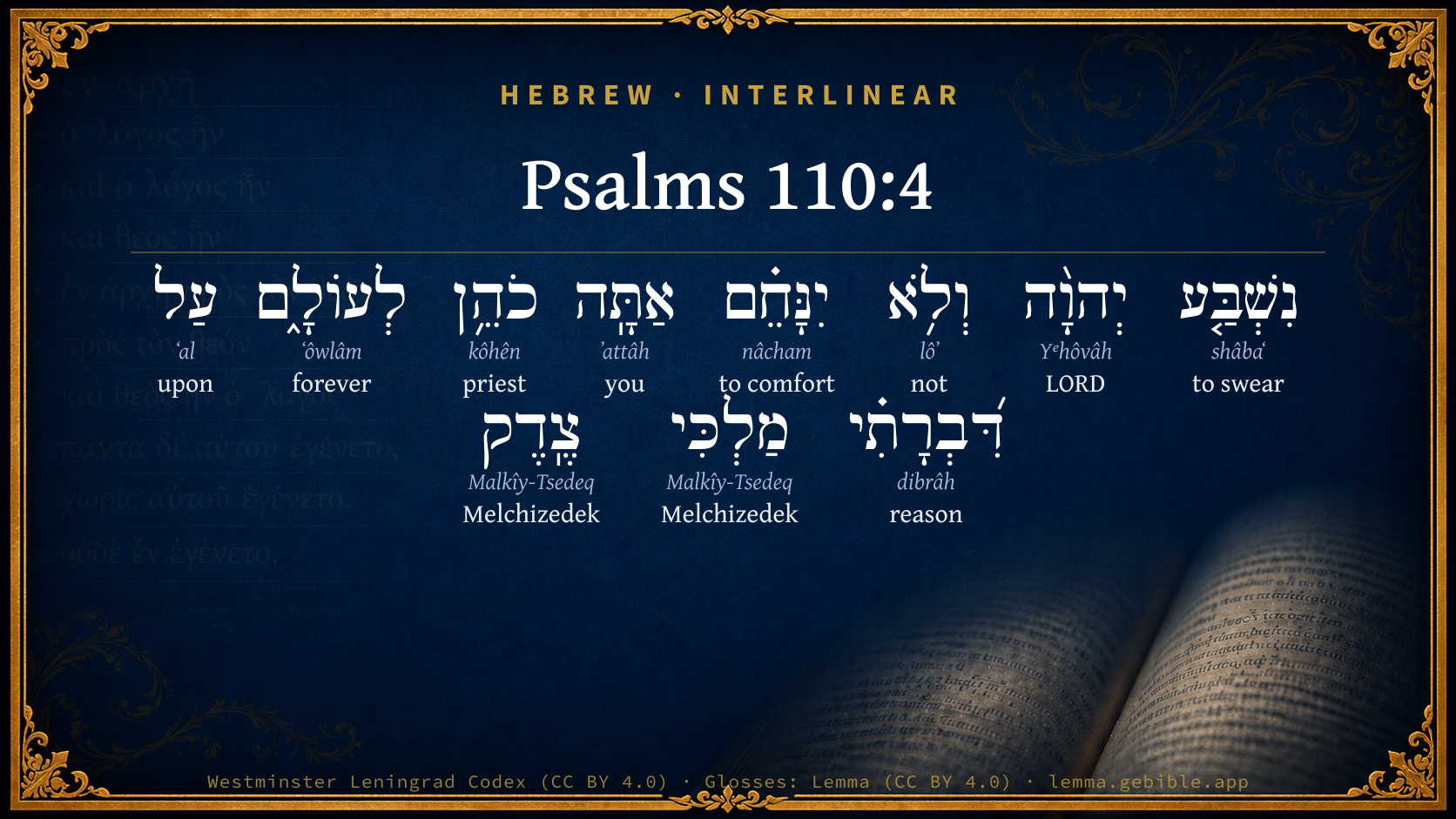
  1. נִשְׁבַּ֤ע shâbaʻ H7650 “to swear” Verb, Niphal, Perfect, 3rd Person, Masculine, Singular
  2. יְהוָ֨ה Yᵉhôvâh H3068 “LORD” Noun, Proper
  3. וְלֹ֥א lôʼ H3808 “and · not” Conjunction + Particle, Negative
  4. יִנָּחֵ֗ם nâcham H5162 “to comfort” Verb, Niphal, Imperfect, 3rd Person, Masculine, Singular
  5. אַתָּֽה ʼattâh H859 “you” Pronoun, Personal, 2nd Person, Masculine, Singular
  6. כֹהֵ֥ן kôhên H3548 “priest” Noun, Common, Masculine, Singular, Absolute
  7. לְעוֹלָ֑ם ʻôwlâm H5769 “to/for · forever” Preposition + Noun, Common, Masculine, Singular, Absolute
  8. עַל ʻal H5921 “upon” Preposition
  9. דִּ֝בְרָתִ֗י dibrâh H1700 “reason of” Noun, Common, Feminine, Singular, Construct
  10. צֶֽדֶק Malkîy-Tsedeq H4442 “Melchizedek” Noun, Proper

About this verse

These counts appear in no published source. They are computed here, from the morphology-tagged text and Lemma’s own curated glosses. What Lemma adds →

11
words
10
distinct lemmas
Wisdom
section

Notable vocabulary

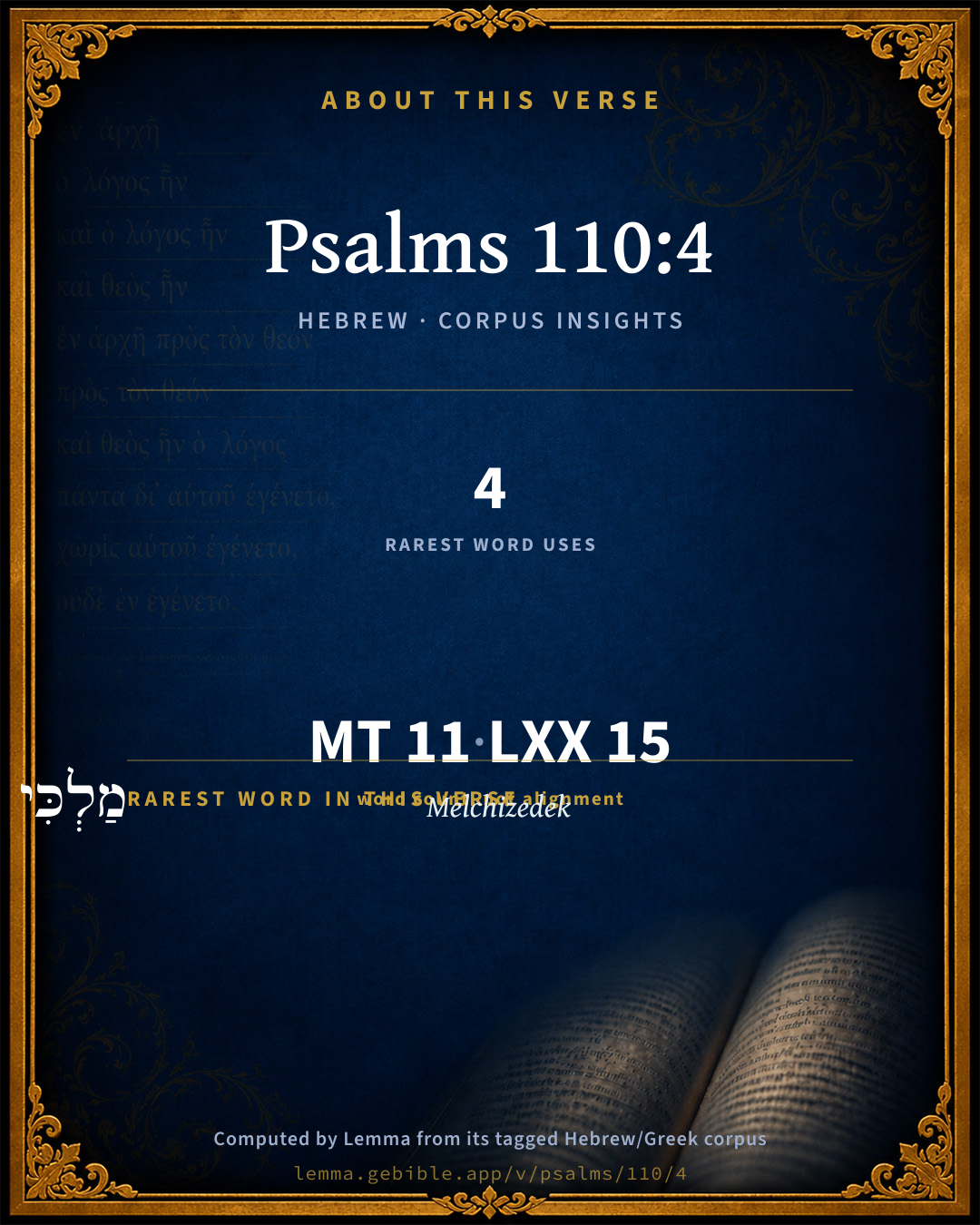
The rarest word here is מַלְכִּי Melchizedek H4442 — appearing just 4 times in the whole Hebrew Bible.

Shared distinctive vocabulary

מַלְכִּי Melchizedek H4442 occurs in 2 verses of the Hebrew Bible. Also found in:

Grammatical profile

  • 2 verbs
  • 6 nouns
  • 1 pronoun
  • 1 preposition
  • 1 particle

Verb forms

  • נִשְׁבַּ֤ע Niphal · Perfect
  • יִנָּחֵ֗ם Niphal · Imperfect

Repetition

A word recurs within this verse — often emphatic in Hebrew:

  • מַלְכִּי Melchizedek H4442 ×2

Hebrew & Septuagint length

In English translation the verse runs 19 words from the Hebrew and 18 from the Septuagint (LXX English) — closely comparable.

A rough comparison of the two English renderings, which tokenize alike — not a word-level alignment.

Word counts can differ between the Hebrew and the Greek without any difference in meaning — e.g. the Hebrew direct-object marker אֵת has no separate Greek word, and Greek often adds the article ὁ.

In the original languages it is 11 Hebrew tokens and 15 Greek tokens — but the two are counted differently (Hebrew bundles its prefixes and suffixes into one token; the Greek is in lemma form), so that isn’t a like-for-like length.

Cross-references

13

Topical passages linked to Psalms 110:4 in the Treasury of Scripture Knowledge — connected by theme and wording, ordered by reader-vote popularity; previews shown in the World English Bible.

  • Hebrews 7:17 for it is testified, "You are a priest forever, According to the order of Melchizedek."
  • Hebrews 5:6 As he says also in another place, "You are a priest forever, After the order of Melchizedek."
  • Hebrews 7:21 (for they indeed have been made priests without an oath), but he with an oath by him that says of him, "The Lord swore and will not change his mind, 'You are a priest forever, According to the order of Melchizedek'".
  • Genesis 14:18 Melchizedek king of Salem brought forth bread and wine: and he was priest of God Most High.
  • Hebrews 6:20–7:3 where as a forerunner Jesus entered for us, having become a high priest forever after the order of Melchizedek.
  • Hebrews 7:11 Now if there was perfection through the Levitical priesthood (for under it the people have received the law), what further need was there for another priest to arise after the order of Melchizedek, and not be called after the order of Aaron?
  • Hebrews 7:28 For the law appoints men as high priests who have weakness, but the word of the oath which came after the law appoints a Son forever who has been perfected.
  • Numbers 23:19 God is not a man, that he should lie, Neither the son of man, that he should repent: Has he said, and will he not do it? Or has he spoken, and will he not make it good?
  • Zechariah 6:13 even he shall build the temple of Yahweh; and he shall bear the glory, and shall sit and rule on his throne; and he shall be a priest on his throne; and the counsel of peace shall be between them both.
  • Revelation 1:6 and he made us to be a Kingdom, priests to his God and Father; to him be the glory and the dominion forever and ever. Amen.
  • Hebrews 6:13–18 For when God made a promise to Abraham, since he could swear by none greater, he swore by himself,
  • Psalms 89:34–36 I will not break my covenant, Nor alter what my lips have uttered.
  • Psalms 132:11 Yahweh has sworn to David in truth. He will not turn from it: "I will set the fruit of your body on your throne.

Cross-references courtesy of OpenBible.info (CC BY 4.0).

Hebrew and Greek witnesses Masoretic Hebrew ↔ Greek Septuagint

The same verse in the two great witnesses to the Old Testament, shown verse-for-verse.

You’re reading Greek Psalm 109 (Hebrew Psalm 110). The Septuagint counts the superscription, so verse numbers can differ from the Hebrew — chapter-level alignment, not verse-by-verse. Numbering follows Rahlfs.

These are two independent witnesses, not word-aligned to each other, and the Septuagint is shown in lemma (dictionary) form.

Hebrew Psalms 110:4 Masoretic · Westminster Leningrad Codex

נִשְׁבַּ֤ע יְהוָ֨ה וְלֹ֥א יִנָּחֵ֗ם אַתָּֽה כֹהֵ֥ן לְעוֹלָ֑ם עַל דִּ֝בְרָתִ֗י מַלְכִּי צֶֽדֶק

Yahweh has sworn, and will not change his mind: "You are a priest forever in the order of Melchizedek."

World English Bible · Public Domain

Greek LXX Greek Psalm 109:4 Septuagint · lemma form

ὄμνυμι κύριος καί οὐ μεταμελέω σύ εἰμί ἱερεύς εἰς ὁ αἰών κατά ὁ τάξις μελχισεκεκ

The Lord swore, and will not repent, You are a priest for ever, after the order of Melchisedec.

LXX2012 (modern English Septuagint) · Public Domain

On this verse, J. A. Alexander on Psalms discusses the Septuagint’s reading. Read the note in Commentary ↓

Hebrew: Westminster Leningrad Codex (CC BY 4.0). Greek: Septuagint (public domain); English from LXX2012 (modern English Septuagint) (Public Domain). How the Septuagint differs from the Hebrew →

Commentary

Notes on Psalms 110:4 from classic Christian and Jewish commentators (each source and its license shown beneath its notes). The classic Christian expositions comment on the surrounding passage and are grouped to its opening verse, so a note may address several verses; the Jewish commentaries on the Tanakh (Rashi and others) are per-verse, so they appear only where the commentator wrote on this verse.

Lemma curates 59 commentaries, every one of them public domain or Creative Commons licensed, each selected and text-cleaned for this edition rather than reprinted as found. About our sources →

Trapp's Complete Commentary

John Trapp

Psa 110:4 The LORD hath sworn, and will not repent, Thou [art] a priest for ever after the order of Melchizedek.

Ver. 4. The Lord hath sworn, &c.] Christ’s priestly office, as well as his kingly, is here described, whereof how many and how great mysteries there are, see Heb. vii., with the notes. The Church is collected and conserved not only by Christ’s kingly power, but also by his priestly mediation.

Thou art a priest] 1. To expiate. 2. To intercede.

After the order of Melchisedek] Who whether he were Shem, or some other, is not easy to determine. Melchisedek was a king and a priest. Christ was more, a priest, a prophet, and a king. These offices have met double in some others; as Melchisedek was king and priest, Samuel a priest and a prophet, David a king and a prophet; but never met all three in any but in Christ alone.

John Trapp, A Commentary or Exposition upon All the Books of the Old and New Testament (1647–1656) — public domain. Text from a community e-Sword module.

The Biblical Illustrator

Joseph S. Exell

Psa_110:4

Thou art a priest for ever after the order of Melchizedek.

Christ, our Priest

I. Divine authorization to priesthood.

1. The Divine oath has a reference to Christ, for it is the Divine authorization of His priestly office. What spiritual power resides in this mandate of God! It not only creates this office, with all its heavy duties and responsibilities, but it gives it full and free scope for the play of its functions.

2. The oath has also a reference to the sinner, the warrant for his approach to God. What stronger assurance of Gods willingness to pardon, nay, rather, heart yearning anxiety to bring us into a justified state?

II. The office to which the Son was called--Priesthood. Christ, in His struggle with the powers of hell and darkness, was not an overborne subject, He was not a conquered victim, but He was in very truth an active, official, priestly agent), working out and bringing in, amidst sweat and agony and blood, that righteousness which is unto all and upon all them that believe.

III. The duration of Christs Priesthood.

1. Christ was Priest on earth. His whole life, from the manger to the cross, was an offering--a sacrificial oblation of sweet-smelling savour to God.

2. He is now a Priest in heaven. (S. McComb.)

The order of Melchizedek

I. Christ is a priest after the order of Melchizedek.

1. That order was unique.

(1) In its loneliness, Melchizedek stood alone. He was the one true priest before the Mosaic dispensation. Christ is the one true priest after it, and He stands alone.

(2) In that it was underived and untransmitted. Melchizedek did not follow, nor was he succeeded by, a priestly line. So Christs priesthood is not after the order of a carnal commandment; nor does it pass over to another.

(3) In its efficacy.

2. That order was righteous. His very name, King of righteousness, is significant of that. But in a far more real and valuable sense is this so with Christ.

(1) He is absolutely righteous in Himself. As such He was predicted (Isa_53:11; Jer_23:5). As such He was by the confession of both friends and foes (Luk_23:4; 1Pe_2:23).

(2) As the King of righteousness, He makes His subjects righteous (Isa_53:11). By cleansing away their unrighteousness and imparting His Holy Spirit, and encouraging and directing their holy lives.

3. That order was peaceful. He was King of Salem which is King of peace. Christ is

(1) absolutely peaceful in Himself. As such He was predicted and acknowledged. The Prince of peace. He shall not cry, etc.

(2) As King of peace Christ gives peace, promotes it, and reigns over peaceful subjects. My peace I leave with you, etc.

4. That order was royal. He was king as well as priest. So is Christ a priest upon His throne. Christ rules from His Cross: I, if I be lifted up, etc. And adoring Christendom says, Thou art the King of glory, O Christ, because when Thou hadst overcome the sharpness of death Thou didst open the kingdom of heaven to all believers.

5. That order was superior.

(1) In its antiquity. It was before the authorized priesthood of Aaron. So Christ is the Lamb slain from before the foundation of the world.

(2) In its perpetuity. For ever. Christ continueth ever, and ever liveth to make intercession.

(3) In its universality. Christ is a propitiation for our sins, and not for ours only, but also for the sins of the whole world.

II. Christs appointment to this priesthood is held under Divine authority, The Lord hath sworn, and will not repent. Persons occupying important offices must show their credentials. (J. W. Burn.)

The Biblical Illustrator, edited by Joseph S. Exell (c. 1880s–1900s) — public domain. Text from a community e-Sword module.

Joseph Benson's Commentary

Psa 110:4. The Lord hath sworn — He did not swear in constituting the Aaronical priesthood, Heb 7:21, but did here, that it might appear to all mankind that this priesthood was made irrevocable, which that of Aaron was not. Thou art a priest — As well as a king. Those offices, which were divided before between two families, are both united and invested in thee, both being absolutely necessary for the establishment of thy kingdom, which is of a nature totally different from the kingdoms of this world, being spiritual and heavenly, and therefore requires such a king as is also a minister of holy things. For ever — Not to be interrupted or translated to another person, as the priesthood of Aaron was upon the death of the priest, but to be continued to thee for ever. After the order of Melchisedek — Or, after the manner, &c.; that is, so as he was a priest and also a king, and both without any successor and without end, in the sense intended, Heb 7:3.

Joseph Benson's Commentary on the Old and New Testaments (1811–1818) — public domain. Text from a community e-Sword module.

J. A. Alexander on Psalms

Joseph Addison Alexander

4. (Psa 110:4) Sworn hath Jehovah, and will not repent, Thou (shalt be) a priest forever, after the order of Melchizedek. The declaration in the last clause of Psa 110:3 is here repeated in another form, and with a statement of the ground or reason upon which it rests. What was there poetically represented as the perpetual youth of the Messiah is here more solemnly described as a perpetual priesthood, indissolubly blended with a perpetual kingship, both secured by the oath of God himself. He will not repent, there is no fear or even possibility of his breaking or retracting this engagement, for such it is, and not a mere declaratory attestation of the present fact or general truth, as it might seem to be from the common version, not only here but in Heb 5:6; Heb 7:17; Heb 7:21, in every one of which places the Greek conforms exactly to the Septuagint version and the Hebrew text, the art being constantly supplied by the translators. That the clause is a promise, and as such relates directly to the future, is clear from the whole tenor of the psalm as a prophetic one, as well as from the oath, which is not used in Scripture to attest mere matters of fact, but to confirm the divine promise and threatenings. The indefinite expression, a priest, is intended to describe the office in itself considered, without reference to temporary distinctions and gradations. It therefore comprehends whatever appertained to the office of the High Priest, as the head and representative of all the rest. After the order, i.e. according to the manner, character, or institution. It is remarkable that this phrase (like in Psa 110:3) is almost peculiar to this psalm and the book of Ecclesiastes, being found besides in only one place (Job 5:8). In all the direct quotations of the verse in Hebrews, the Septuagint version of this word is retained. But in one of the more indirect citations (Heb 7:15) another word is substituted, shewing that the essential idea is that of likeness or resemblance. This likeness consists primarily in the union of the regal and sacerdotal offices. See Gen 14:18. The meaning of the verse in its original connection is, that this royal conqueror is also a priest, who makes atonement for the sins of his people, and thus enables and disposes them to make the dedication of themselves described in the preceding verse. The perpetuity of this relation, and its confirmation by the oath of God, are attendant circumstances but essential, and as such insisted on by the apostle, Heb 7:20-24. The coincidences founded on the meaning of the names Melchizedek and Salem (Heb 7:2), and on the want of hierarchical succession in both cases (Heb 7:3), are perfectly legitimate, but not essential to the understanding of the verse in its original connection. The inspired commentary on this sentence, which occupies the whole seventh chapter of Hebrews, is not intended merely to explain its meaning, but also to make use of its terms, and the associations coupled with them, as a vehicle of other kindred truths, belonging to the Christian revelation, and not necessarily suggested by the psalm o its original readers.

Joseph Addison Alexander, The Psalms Translated and Explained (1850) — public domain. Text from a community e-Sword module.

Tyndale Open Study Notes

Tyndale Open Resources

110:4 The Lord had made an unbreakable oath and covenant, so his apparent rejection of David’s dynasty (89:38) in the Exile had led to a crisis. The placement of Ps 110 in Book Five reaffirms the future of the dynasty: David’s descendant must conform to God’s standard of integrity (Ps 101). His ministry will be transformed as he serves under God’s kingship (Pss 93–100). • You are a priest forever: The role of God’s messianic ruler changes. The priestly kingship of David and his descendants extended to serving as patrons of the Temple. David had the Ark brought to Jerusalem (2 Sam 6:15) and arranged for the Temple service (1 Chr 6:31-48; 15:11-26; 16:4-42; 23:4-32; 25:1). Solomon supervised the Temple construction (1 Kgs 5:1–7:51). Even so, Israel’s kingship was separate from its priesthood. In the messianic kingdom, the king would also minister as priest, as Melchizedek, king of Salem (Gen 14:18), had done. The New Testament develops the ministry of Jesus Christ as a fulfillment of this new order (see Heb 5:6-10; 6:20–7:25).

Tyndale Open Study Notes — © Tyndale Open Resources, licensed CC BY-SA 4.0. Text via the HelloAO Bible API.

Geneva Bible (1599)

Geneva Bible translators

As Melchizedek the figure of Christ was both a King and Priest, so this effect cannot be accomplished on any king save only Christ, Heb. 7:26.

Geneva Bible (1599) marginal notes — public domain. Text via Bolls.life.

Adam Clarke's Commentary

Verse 4. The Lord hath sworn] Has most firmly purposed, and will most certainly perform it, feeling himself bound by his purpose, as an honest man would by his oath.

And will not repent] Will never change this purpose; it is perfectly without condition, and without contingency. Nothing is left here to the will of man or angel. Christ shall be incarnated, and the Gospel of his salvation shall be preached over the whole earth. This is an irresistible decree of that God who loves mankind.

Thou art a priest for ever] The word כהן cohen signifies, not only a priest, but also a prince; as, in the patriarchal times, most heads of families had and exercised both political and sacerdotal authority over all their descendants. Every priest had a threefold office:

1. He was an instructor of the family or tribe over which he presided.

2. He offered sacrifices for the sins of the people, to reconcile them to God, and give them access to his presence.

3. He was their mediator, and interceded for them. So is Christ, the grand, the universal Instructor, by his word and Spirit; the Lamb of God, who, by his sacrificial offering of himself, takes away the sin of the world, and still continues to exhibit himself before the throne in his sacrificial character; and also the great Mediator between God and man: and in these characters he is a PRIEST for ever. He will instruct, apply the sacrificial offering, and intercede for man, till time shall be no more.

After the order of Melchizedek.] For the elucidation of this point, the reader is requested to refer to the notes on Ps 14:18-19, See Clarke on Ge 14:18; "Ge 14:19" and to the observations at the end of that chapter, See Clarke on Ge 14:24, where the subject, relative to the person, name, and office of this ancient king, is fully discussed; and it will be necessary to read that note, c., as if appended to this place.

Melchizedek was king of Salem, that is, king of Jerusalem for Salem was its ancient name: but שלם salem signifies peace, and צדק tsedek, righteousness. Christ is styled the Prince of peace; and he is the king that rules in the empire of righteousness; and all peace and righteousness proceed from him, Heb 7:2.

He is priest after the order of Melchizedek-after his pattern; in the same kind or manner of way in which this ancient king was priest.

Calmet properly observes that there were three orders of priesthood.

1. That of royalty. All ancient kings being, in virtue of their office, priests also. This seems to have been considered as the natural right of royalty, as it obtained in almost every nation of the earth, from the beginning of the world down to the end of the Roman empire.

2. That of the first-born. This right appertained naturally to Reuben, as the first-born in the family of Jacob.

3. That of the Levites, instituted by God himself, and taken from Reuben, because of his transgression. The Levitical priesthood ended with the Jewish polity; and that also of the first-born, which had been absorbed in it.

This order, therefore, was not perpetual; it was intended to last only for a time. But that of royalty is perpetual, though not now in general use, because founded in what is called natural right. It is, therefore, according to this most ancient order, that Christ is a Priest for ever. The kings of England as heads of the Church appointing all bishops, continue to assume, in a certain way, this original right.

Melchizedek is said to be "without father without mother, without beginning of days, or end of life." We have no account of his parents; nothing of his birth; nothing of his death. Christ, as to his Divine nature, is without father or mother, and without beginning of days; nor can he have any end. Other priests could not continue by reason of death; but he is the Eternal, he cannot die, and therefore can have no successor: "He is a priest FOR EVER." Therefore, as Melchizedek was a priest and a king, and had no successor, so shall Christ be: of the increase and government of his kingdom there shall be no end.

Melchizedek was priest of the Most High God; and consequently not of one people or nation, but of the universe. Aaron was priest of one people, and for a time only; JESUS is priest of all mankind, and for ever. He tasted death for every man; he is the King eternal; he has the keys of hell and of death. As God is the King and Governor of all human beings, Christ, being the priest of the Most High God, must also be the priest for and over all whom this most high God made and governs; and therefore he is the priest, the atoning sacrifice, of the whole human race. In this the main similitude consists between the order of Melchizedek and that of Christ.

Adam Clarke's Commentary on the Bible (1810–1826) — public domain. Text from a community e-Sword/MySword module.

John Calvin's Commentaries

4 Jehovah hath sworn This verse is a satisfactory proof that the person here spoken of is none other than Christ. When the Jews, with the view of mystifying this prediction, render the term כוהן, chohen, a prince, their translation is at once feeble and frivolous. I acknowledge, indeed, that those of noble descent or of royal blood are in Hebrew denominated כהנים, chohanim; but would it have been saying any thing to the honor of Christ for David merely to give to him the title of a chief, which is inferior to that of royal dignity? Besides, what would be the import of saying that he was a prince for ever, and according to the manner of Melchizedek? There can be no question then, that the Holy Ghost here refers to something specific and peculiar, as distinguishing and separating this king from all other kings. This, too, is the well known title with which Melchizedek was honored by Moses, (Genesis 14:18) I grant, indeed, that anciently among heathen nations kings were wont to exercise the priestly office; but Melchizedek is called “the priest of the most high God,” in consequence of his devoutly worshipping the only true God. Among his own people, however, God did not permit the blending of these offices. Hence Uzziah, David’s legitimate successor, was struck with leprosy because he attempted to offer incense to God, (2 Chronicles 26:21.) The circumstances connected with the lineage of David were vastly different from those relating to Melchizedek. What these are it is not difficult to ascertain, inasmuch as in this new King the holy office of the priesthood shall be united with the crown and the throne. For assuredly the imperial majesty was not so conspicuous in such an obscure prince as Melchizedek, as on that account to warrant his being held out as an example above all others. Salem, the sole seat of his throne, and where he reigned by sufferance, was at that time a small obscure town, so that with regard to him there was nothing deserving of notice saving the conjunction of the crown and the priesthood. Ambitious of procuring greater reverence for their persons, heathen kings aspired after the honor of the sacerdotal office; but it was by divine authority that Melchizedek was invested with both these functions.

All dubiety as to this being the meaning of David ought to be banished from our minds by the authority of the Apostle. And although the Jews may maintain the contrary as obstinately as they please, yet reason manifestly declares that the beauty of holiness, to which I formerly adverted, is here very clearly described. To this a decisive and peculiar mark is appended, which elevates Christ above all other kings with regard to the dignity of the priesthood, and which at the same time tends to point out the difference between his priesthood and that of Levi. In connection with his sacerdotal office, mention is made of God’s oath, who was not wont to mingle his venerable name with matters of minor importance; but, on the contrary, to teach us by his own example to swear deliberately and reverently, and never unless in weighty and important matters. Admitting, then, that God had sworn that the Messiah would be the prince and governor of his people, according as Melchizedek was, this would have been nothing else than an unbecoming profanation of his name. When, however, it is quite apparent that something unusual and peculiar was denoted in this place, we may therefore conclude that the priesthood of Christ is invested with great importance, seeing that it is ratified by the oath of God. And, in fact, it is the very turning point upon which our salvation depends; because, but for our reliance on Christ our Mediator, we would be all debarred from entering into God’s presence. In prayer, too, nothing is more needful for us than sure confidence in God, and therefore he not only invites us to come to him, but also by an oath hath appointed an advocate for the purpose of obtaining acceptance for us in his sight. As for those who shut the door against themselves, they subject themselves to the guilt of impeaching him with being a God of untruth and of perjury. It is in this way that the Apostle argues the disannulling of the Levitical priesthood; because, while that remained entire, God would not have sworn that there should be a new order of priesthood unless some change had been contemplated. What is more, when he promises a new priest, it is certain that he would be one who would be superior to all others, and would also abolish the then existing order.

Some translate the term דברתי, diberathi, according to my word, an interpretation which I am not disposed entirely to reject, inasmuch as David would be represented as affirming that the priesthood of Melchizedek is founded upon the call and commandment of God. But as the letter י, yod, is frequently redundant, I, in common with the majority of interpreters, prefer translating it simply manner. Moreover, as not a few of the fathers have misapprehended the comparison between Christ and Melchizedek, we must learn from the Apostle what that resemblance is; from which will be readily seen the error into which they fell respecting it. For can there be any thing more absurd than to overlook all the mysteries about which the Spirit, by the mouth of the Apostle, hath spoken, and attend only to such as he has omitted? Such persons argue solely about the bread and wine, which they maintain were offered both by Melchizedek and Christ. But Melchizedek offered bread and wine, not as a sacrifice to God, but to Abraham as a repast to refresh him on his march. “In the holy Supper there is not an offering of bread and wine as they erroneously imagine, but a mutual participation of it among the faithful. As to the passage under review, the similitude refers principally to the perpetuity of his priesthood, as is obvious from the particle לעולם, leolam, that is to say, for ever. Melchizedek is described by Moses as if he were a celestial individual; and, accordingly, David, in instituting a resemblance between Christ and him, designs to point out the perpetuity of his priestly office. Whence it follows, (a point which is handled by the Apostle,) that as death did not intercept the exercise of his office, he has no successor. And this circumstance demonstrates the accursed sacrilege of the Popish mass; for, if the Popish priests will assume the prerogative of effecting a reconciliation between God and men, they must of necessity denude Christ of the peculiar and distinguishing honor which his Father has conferred upon him.

John Calvin's Commentaries (1540-1563) — public domain. Text from the Calvin Translation Society English edition (1840s-50s) via the Christian Classics Ethereal Library (ccel.org). Calvin's coverage is partial (roughly two-thirds of the Bible); uncommented books and verses are honest gaps, never fabricated. The 19th-century editor's footnotes and remarks are omitted so the notes are faithfully Calvin's own voice.

Ellicott's Commentary for English Readers

(4) After the order of Melchizedek.—This follows the LXX. and Vulg. Better, after the manner of since there could have been with the psalmist no intention of contrasting this priesthood with that of Aaron, as there naturally was when the Aaronic order had come to an end or was visibly doomed to extinction.

The previous history of Israel itself offered no example of the formal union of kingly and priestly offices in one person. It first appears in idea in Zec_6:12-13; in actual fact in the pontificate of Jonathan (1Ma_10:21). It is true that the royal and priestly functions were sometimes united, especially in the case of David, and in 2Sa_8:18, David’s sons are called “priests” (in English version, “chief rulers;” margin, or princes). It was therefore necessary to go back to Melchizedek, in whom history recognised this sanctioned and formal union (Gen_14:18). For the various points brought out in the Epistle to the Hebrews 6, 7, see New Testament Commentary.

A Bible Commentary for English Readers, edited by Charles John Ellicott (1878–1897) — public domain. Text from a community e-Sword module.

The Cambridge Bible for Schools and Colleges

gen. ed. J. J. S. Perowne

4. The priesthood of the king.

Jehovah hath sworn, and will not repent] The king is also priest by an immutable Divine decree. The immutability of this decree is affirmed in the most solemn manner possible. The ‘oath’ of Him who cannot lie is no stronger than His word; He who knows all things from the beginning cannot repent or change His purpose (Num_23:19; 1Sa_15:29), though man’s failure or change may necessitate a temporary interruption of His purpose which appears to finite man in the light of a ‘repentance.’ But He who is absolutely true and unchanging condescends for man’s sake to confirm His word by an oath. Cp. Amo_6:8; Psa_132:11.

Thou art a priest for ever after the order (or, manner) of Melchizedek] Melchizedek, king of Salem, and priest of God Most High (El Elyôn), appears in Gen_14:18 ff. as the representative of a true faith in the primitive world. He was a type of that union of civil and religious life, which must be the ideal of the perfect state. The thought here affirmed is that the new king of Jerusalem must hold a position in no way inferior to that of the ancient king of Salem. As the representative of “a kingdom of priests and an holy nation” (Exo_19:6) he had a priestly character. As the representative of God to the people and of the people to God he had a mediatorial office. David, when he brought up the Ark into the city of David, laid aside his royal robes and wore the dress of a priest (2Sa_6:14): both he and Solomon exercised priestly functions in offering sacrifice, or at least in directing the sacrifices, if they did not actually offer them (2Sa_6:17-18; 1Ki_8:62 ff.), and in blessing the people (2Sa_6:18; 1Ki_8:14; 1Ki_8:55); Solomon deposed and appointed a high-priest (1Ki_2:27; 1Ki_2:35). David’s sons, in whatever sense the term may have been used, were styled priests (2Sa_8:18). But the priesthood of the king is here implicitly distinguished from the hereditary priesthood of the family of Aaron, as a priesthood ‘after the manner of Melchizedek.’

For ever, as applied to an individual, may be a relative term, as in 1Ma_14:41, quoted above, p. 663. Cp. 1Sa_1:22. But the promise of an eternal priesthood corresponds rather to the promise of eternal dominion in 2Sa_7:13; 2Sa_7:10; 2Sa_7:25; 2Sa_7:29. Made to an individual, it is realised in his descendants. Jeremiah speaks of the priestly right of access to God which is to be conferred upon the Messianic prince (Jer_30:21); and the union of civil and religious life was symbolised under the altered circumstances of the return from Babylon by the coronation of Joshua (Zec_6:12-13).

The author of the Epistle to the Hebrews dwells upon this verse in his exposition of the typical significance of the priesthood of Melchizedek, quoting it to illustrate the divine appointment of Christ to his high-priestly office, and the eternal duration and unique character of that office (Heb_5:6; Heb_6:20; Heb_7:17; Heb_7:21).

The Cambridge Bible for Schools and Colleges (gen. ed. J. J. S. Perowne; Cambridge University Press, 1878–1918) — public domain. Text from a community e-Sword module.

John Gill's Exposition

The Lord hath sworn, and will not repent,.... What he swore about, and did not repent of, was the priesthood of Christ, as follows; and which shows the importance of it, since when Jehovah swears, as it is by himself, because he can swear by no greater; so it is about matters of great moment only that are sworn to by the Lord, as this of the priesthood of Christ was; which was concerned in things pertaining to God and his glory, as well as in making reconciliation for the sins of his people: and it shows the truth, and was for the confirmation of it; since doubts might arise whether the Aaronic priesthood was changed, seeing it was given to Phinehas for an everlasting priesthood; and since so great a person as the Son of God is said to be a priest; and since, in the human nature, he was of the tribe of Judah, of which tribe nothing was said concerning the priesthood: and this oath was not so much for Christ's sake, to establish the priesthood with him, and assure him of it, as for the sake of his people; who, by two immutable things, the word and oath of God, might have strong consolation from it; and it clearly shows the validity of his priesthood; that he was called of God to this office, and invested with it, and consecrated in it with an oath; and which is expressive of the singularity of it, and of the dignity and preference of the priesthood of Christ to that of Aaron's, Heb 7:20. What follows was said, and this oath was made, in the council of peace, when Christ was called to this office, and he accepted of it, Psa 40:6, and of this the Lord never repented; as he never does of any of his acts of grace, Num 23:19.

Thou art a priest for ever after the order of Melchizedek; or, "according to the word of Melchizedek" (z); that is, according to what is said of him; there being an agreement between the things said of one and of the other; so the Syriac version, "according to the likeness of Melchizedek", see Heb 7:15 of him no mention is made elsewhere, but in Gen 14:18 and in the epistle to the Hebrews. Various are the opinions of men concerning him: some think he was not a man, but an angel that appeared to Abraham: others, a divine power, superior to Christ, who were called "Melchizedecians": and others, that he was the Holy Ghost; and others, the Son of God himself, in an human form. On the other hand, some take him to be a mere man. The general notion of the Jews is, that he was Shem, the son of Noah; others, that he was a Canaanitish king, of the posterity of Ham: but others do not think it proper or lawful to inquire who he was, or from whom he descended; this being purposely hidden from men, that he might be more clearly a type of Christ. That there is a likeness between them is certain; the signification of his name, a title of office, King of righteousness, and King of peace, agrees with Christ the Lord, our righteousness and our peace: his being without father, mother, descent, beginning of days, and end of life, agree with the divinity, humanity, and eternity of Christ; and who is likewise King and Priest, as he was; and who blesses his people, as he did Abraham; and refreshes them with bread and wine, as he did Abraham's soldiers; See Gill on Heb 7:2. See Gill on Heb 7:3. Now Christ is a Priest like him; whose office is to offer sacrifice, which he has done, even himself, for the atonement of the sins of his people; to make intercession for them, which he ever lives to do; to introduce their persons to his Father, and present their petitions to him; and to call for every blessing for them, and answer all charges against them: in which office he continues for ever; there never will be any change in his priesthood, as there has been in Aaron's; nor will he ever have any successor: his priesthood is unchangeable, or does not pass from one to another, Heb 7:24, the efficacy of his blood and sacrifice always continues, and intercession is ever made by him, and the glory of his mediation is ever given him. The apostle produces this passage in proof of the change of the Aaronic priesthood, and so of the law, Heb 7:11 and about the time Christ appeared as the high priest, the legal priesthood sensibly declined, and which the Jews themselves own; for they say,

"after the death of Ishmael Ben Phabi, the splendour of the priesthood ceased (a);''

which man was made priest by Valerius Gratus, governor of Judea, under Tiberius Caesar (b),

(z) "super meum verbum", Montanus; "juxta verbum", Vatablus. (a) Misn. Sotah, c. 9. s. 15. (b) Joseph. Antiqu. l. 18. c. 2. s. 2. Vid. ib. l. 20. c. 7. s. 8.

John Gill's Exposition of the Whole Bible (1746–1763) — public domain (CC PDM 1.0). Text via the HelloAO Bible API.

Albert Barnes' Notes on the Bible

The Lord hath sworn - He has confirmed the appointment of the Messiah by a solemn oath, or as by an oath. That is, It is as sure and fixed as if he had taken an oath. Compare Heb 6:13. The “time,” so to speak, if the word time can be applied to transactions in a past eternity, was that when he was designated in the divine purpose as Messiah; in the eternal counsels of God. Compare Psa 2:7.

And will not repent - Will not change his purpose.

Thou art a priest forever after the order of Melchizedek - The word rendered “order” here means properly a word, a thing, a matter; hence, a way or manner. The meaning here is, that he would be a priest “after the manner” of Melchizedek; or, such a priest as he was. He would not be of the tribe of Levi; he would not be in the regular line of the priesthood, but he would resemble, in the characteristics of his office, this ancient priest-king, combining in himself the two functions of priest and king; as a priest, standing alone; not deriving his authority from any line of predecessors; and having no successors. See this verse explained at length, in its application to the Messiah, in the notes at Heb 5:6 (note), Heb 5:10 (note); Heb 7:1-3 (note). The passage as it stands here, and as looked at without any reference to the use made of it in the New Testament, would imply these things:

(1) That he who was spoken of would be, in a proper sense, a priest.

(2) that he would have a perpetual or permanent priesthood - “forever.”

(3) that he would not be of the established line of priests in the tribe of Levi, but that his appointment would be unusual and extraordinary.

(4) that the appointment would come directly from God, and would not be “derived” from those who went before him.

(5) that as a priest he would “resemble” Melchizedek, according to the record which was found of Melchizedek in Genesis.

(6) that as Melchizedek was a priest of the Most High God, so he would be.

(7) that as Melchizedek combined in himself the functions of both priest and king, so these would be found in him.

(8) that as Melchizedek had no successors in office, so he would have none.

How far these things were applicable to the Lord Jesus Christ, and with what propriety the passage might be applied to him, may be seen by examining the Epistle to the Hebrews, Heb. 5–7.

Albert Barnes' Notes on the Bible (1834–1885) — public domain. Text from a community e-Sword/MySword module.

Matthew Poole's English Annotations

Hath sworn; which he did not in the Aaronical priesthood, Heb 7:21, but did it here, partly because the thing was new and strange, and might seem incredible, because God had already erected another, and that an everlasting priesthood, Num 25:13, and given it to Aaron and his posterity for ever, and therefore this needed all possible assurance; and partly that his priesthood might be established upon better promises, as is said, Heb 8:6, and made sure and irrevocable, and such that God neither could nor would repent of it, as it follows.

Thou art, to wit, by my order and constitution; thou shalt be so, and I do hereby make thee so.

A Priest, as well as a King. Those offices which were divided before between two families, are both united and invested in thee, both being absolutely necessary for the discharge of thine office, and for the establishment of thy kingdom, which is of another kind than the kingdoms of the world, spiritual and heavenly, and therefore needs such a King as is also a minister of holy things. This word plainly discovers that this Psalm cannot be understood of David, as some of the Jews would have it, but only of the Messias. And although this word cohen be sometimes used of a prince or great person in the state, as the Jews object, yet it cannot be so understood here, partly, because it signifies a priest in Gen 14:18, from whence this expression is borrowed; partly, because that word is never used of a sovereign prince or king, (such as the Jews confess the Messiahs to be,) but only of inferior princes or ministers of state, as Gen 41:45; 2Sa 8:18; partly, because such an inconsiderable assertion would never have been ushered in by so solemn an oath, especially after far greater things had been said of him in the same kind, Psa 110:1-3 and partly, because the Messias is called a Priest, Zec 6:13; compare Jer 23:21; 35:15,18. For ever; not to be interrupted or translated to another person, as the priesthood of Aaron was upon the death of the priest, but to be continued to thee for ever.

After the order of Melchizedek, or, after the manner, &c.; so as he was a priest and also a king, and both without any successor and without end, in the sense intended, Heb 7:3.

Matthew Poole's English Annotations on the Holy Bible (1683–1685) — public domain. Text from a community e-Sword/MySword module.

The Treasury of David

Charles H. Spurgeon

Ver. 4. We have now reached the heart of the psalm, which is also the very centre and soul of our faith. Our Lord Jesus is a Priest King by the ancient oath of Jehovah: "he glorified not himself to be made an high priest, "but was ordained there unto from of old, and was called of God an high priest after the order of Melchizedek. It must be a solemn and a sure matter which leads the Eternal to swear, and with him an oath fixes and settles the decree for ever; but in this case, as if to make assurance a thousand times sure, it is added, " and will mot repent." It is done, and done for ever and ever; Jesus is sworn in to be the priest of his people, and he must abide so even to the end, because his commission is sealed by the unchanging oath of the immutable Jehovah. If his priesthood could be revoked, and his authority removed, it would be the end of all]lope and life for the people whom he loves; but this sure rock is the basis of our security the oath of God establishes our glorious Lord both in his priesthood and in his throne. It is the Lord who has constituted him a priest for ever, he has done it by oath, that oath is without repentance, is taking effect now, and will stand throughout all ages: hence our security in him is placed beyond all question.

The declaration runs in the present tense as being the only time with the Lord, and comprehending all other times. "Thou art, "i.e., thou wast and art and art to come, in all ages a priestly King. The order of Melchizedek's priesthood was the most ancient and primitive, the most free from ritual and ceremony, the most natural and simple, and at the same time the most honourable. That ancient patriarch was the father of his people, and at the same time ruled and taught them; he swayed both the sceptre and the censer, reigned in righteousness, and offered sacrifice before the Lord. There has never arisen another like to him since his days, for whenever the kings of Judah attempted to seize the sacerdotal office they were driven back to their confusion: God would have no king priest save Iris son. Melchizedek's office was exceptional none preceded or succeeded him; he comes upon the page of history mysteriously; no pedigree is given, no date of birth, or mention of death; he blesses Abraham, receives tithe and vanishes from the scene amid honours which show that he was greater than the founder of the chosen nation. He is seen but once, and that once suffices. Aaron and his seed came and went; their imperfect sacrifice continued for many generations, because it had no finality in it, and could never make the comers thereunto perfect. Our Lord Jesus, like Melchizedek, stands forth before us as a priest of divine ordaining; not made a priest by fleshly birth, as the sons of Aaron: he mentions neither father, mother, nor descent, as his right to the sacred office; he stands upon his personal merits, by himself alone; as no man came before him in his work, so none can follow after; his order begins and ends in his own person, and in himself it is eternal, "having neither beginning of days nor end of years The King Priest has been here and left his blessing upon the believing, and now he sits in glory in his complete character, stoning for us by the merit of his blood, and exercising all power on our behalf."

"O may we ever hear thy voice

In mercy to us speak,

And in our Priest we will rejoice,

Thou great Melchizedek."

The last verses of this psalm we understand to refer to the future victories of the Priest King. He shall not forever sit in waiting posture, but shall come into the fight to end the weary war by his own victorious presence. He will lead the final charge in person; his own right hand and his holy arm shall get unto him the victory.

Ver. 4. The LORD hath sworn, and will not repent, etc. It should be diligently considered, that God has consecrated Christ, priest by an oath, and that this was done for our sakes; First, That we might know how exceedingly momentous was this transaction, and the more reverently and with the stronger faith believe it. Secondly, That we might acknowledge the goodness of God, who, being most truthful in himself, and concerning whose faithfulness it is the greatest crime to doubt, nevertheless has been pleased to speak to us not only with a bare word, but also, after the manner of men, to confirm his decree by an oath. Rivetus.

Ver. 4. Sworn, and will not repent, Thou art a priest for ever. God might have made the levitical priest by oath, and yet he might have been changed, but if he had made him by oath to be a priest for ever, then he could not have repented, that is, changed; but he must of necessity have been a priest for ever. Therefore you must take special notice, that God did not only swear that Christ should be a priest, or that he should be a priest for a long time, but a priest "for ever; "so that there should never be any priest joined with him, or come after him. So that if we consider the oath, and the thing confirmed by this oath, two things will be manifest:

1. That Christ's priesthood is personal, and settled in one single person for ever; so that he can have no fellow nor copartner, nor any successor in his priesthood.

2. That, by this oath, God did limit his own supreme and absolute power in this particular; and took away the use and exercise of it, and that for ever.

For now he hath no power to make Christ no priest, or take away his priesthood at will and pleasure: and in this God discovered his unspeakable love unto Christ, in that he did so much honour him, and so highly reward him. By this he also displayed his abundant mercy to man; for by this oath known unto man, he signifies that man shall never be destitute of a powerful and effectual priest, able for ever to save; and this doth minister unto sinful man most sweet and heavenly comfort. George Lawson, 1662.

Ver. 4. The form and manner of our Saviour's investiture or consecration was most honourable and glorious, God the Father performing the rites; which were not imposition of hands, and breathing on him the Holy Ghost, but a solemn testimony, with a protestation, "Thou art a priest": ceremonies never used by any but God, nor in the investiture of any but Christ, nor in his investiture into any office but the priesthood. At his coronation we hear nothing, but the Lord said, "Sit thou on my right hand": the rule of the whole world is imposed upon our Saviour by command; and even in this did Christ show his obedience to his Father, that he took upon him the government of his church. But at the consecration of Christ we have a great deal more of ceremony and solemnity, God his Father taketh an oath, and particularly expresses the nature and condition of his office, a priesthood for ever after the order of Melchizedek: and he confirmeth it unto him for ever, saying, "Thou art a priest for ever." Daniel Featley, in "Claris Mystica". 1636.

Ver. 4. What doctrine doth the Scripture afford more comfortable to a drooping soul than this, that God hath sworn his Son a priest for ever, to sanctify our persons, and purge our sins, and tender all our petitions to his Father? What sin is so heinous, for which such a priest cannot satisfy by the oblation of himself? what cause so desperate, in which such an advocate if he will plead, may not prevail? We may be sure God will not be hard to be intreated of us, who himself hath appointed us such an intercessor, to whom he can deny nothing; and to that end hath appointed him to sit at his right hand to make intercession for us. Abraham Wright.

Ver. 4. And will not repent. The meaning of this phrase is, that the priesthood of Christ is not like that of Aaron, which was after a time to expire, and is now actually with all the ceremonial law abolished, but a priesthood never to be altered or changed. Daniel Featley.

Ver. 4. Thou art a priest. The reasons which moved our Lord to take upon him the office of priest are conceived to be these.

1. Because the salvation and redemption of mankind, wrought by the sacrifice of his priesthood., being a most noble work, and not inferior to the creation, it was not fit that any should have the honour of it, but the Son of God.

2. Neither was it agreeable that any should offer him, who was the only sacrifice that could expiate the sins of the whole world, but himself: therefore by offering himself he added infinite worth to the sacrifice, and great honour to the priesthood of the Gospel.

For, as the gold sanctifieth not the altar, but the altar the gold; so it may be truly said without impeachment to the dignity of that calling, that Christ was rather an honour to the priesthood, than the priesthood an addition to him. For what got he by the priesthood which cost him his life? What preferment could it be to him, to take upon him an office, whereby he was to abase himself below himself, and be put to an ignominious and accursed death? What were we vile miscreants, conceived and born in original sin, and soiled with the filth of numberless actual transgressions, that to purge and cleanse our polluted souls and defiled consciences, the second person in the Trinity should be made a Priest? It was wonderful humility in him to wash his disciples feet; but in his divine person to wash our unclean souls, is as far above human conceit, as it seemeth below divine majesty. There is nothing so impure as a foul conscience; no matter so filthy, no corruption so rotten and unsavoury as is found in the sores of an exulcerated mind: yet the Son of God vouchsafed to wash and bathe them in his own blood. O bottomless depth of humility and mercy! Other priests were appointed by men for the service of God, but he the blood of beasts to save men, but he shed his own blood to save us, more like beasts than men: other priests offered sacrifice for themselves, he offered himself for a sacrifice: other priests were fed by the sacrifices which the people brought, but he feeds us with the sacrifice of his own body and blood: lastly, others were appointed priests but for a time, he was ordained a priest for ever. Daniel Featley.

Ver. 4. Thou art a priest. This word, "Thou art", is "verbum constitutivum", a "constituting word", whereon the priesthood of Christ was founded. And it may be considered,

1. As declarative of God's eternal decree, with the covenant between the Father and the Son, whereby he was designed unto this office.

2. As demonstrative of his mission, or his actual sending to the discharge of his office. These words are the symbol and solemn sign of God's conferring that honour upon him, which gave him his instalment.

3. As predictive, for there is included in them a supposition that God would prepare a body for him, wherein he might exercise his priesthood, and which he might offer up unto him. John Owen.

Ver. 4. Melchizedek. Some heretics of old affirmed that he was the Holy Ghost. Others, that he was an angel. Others, that he was Shem, the son of Noah. Others, that he was a Canaanite, extraordinarily raised up by God to be a priest of the Gentiles. Others, that he was Christ himself, manifested by a special dispensation and privilege unto Abraham in the flesh, who is said to have seen his day, and rejoiced, Joh 8:56. Difference there is also about Salem, the place of which he was king. Some take it for Jerusalem, as Josephus and most of the ancients. Others for a city in the half tribe of Manasseh, within the river Jordan, where Hierom reports that some ruins of the palace of Melchizedek were in his days conceived to remain. Tedious I might be in insisting on this point who Melchizedek was. But when I find the Holy Ghost purposely concealing his name, genealogy, beginning, ending, and descent, and that to special purpose, I cannot but wonder that men should toil themselves in the dark to find out that of which they have not the least ground of solid conjecture, and the inevidence whereof is expressly recorded, to make Melchizedek thereby the fitter type of Christ's everlasting priesthood. Edward Reynolds.

Ver. 4. Melchizedek. These things concerning are certain: First, That he was a mere man, and no more; for,

1. "Every high priest" was to be "taken from among men, " Heb 5:1; so that the Son of God himself could not have been a priest had he not assumed our nature:

2. That if he were more than a man, there would be no mystery in his being introduced in Scripture as, "without father, without mother, without pedigree, "for none but men have such:

3. Without this conception of him there is no force in the apostle's argument against the Jews.

Secondly, That he came not to his office by the right of primogeniture (which includes a genealogy) or by any way of succession, but was raised up and immediately called of God thereunto; for in that respect Christ is said to be a priest after his order. Thirdly, That he had no successor on the earth, nor could have; for there was no law to constitute an order of succession, and he was a priest only after an extraordinary call. These things belong unto faith in this matter, and no more... The first personal instituted type of Christ was a priest; this was Melchizedek. There were before real instituted types of his work, as sacrifices; and there were moral types of his person, as Adam, Abel, and Noah, which represented him in sundry things; but the first person who was solemnly designed to teach and represent him, by what he was and did, was a priest. And that which God taught herein was, that the foundation of all that the Lord Christ had to do in and for the church was laid in his priestly office, whereby he made atonement and reconciliation for sin. Everything else that he doth is built on the supposition of his priesthood. And we must begin in the application where God begins in the exhibition. An interest in the effects of the priestly office of Christ is that which in the first place we ought to look after. This being attained, we shall be willing to be taught and ruled by him. It may not be amiss to observe the likeness between Melchizedek and Christ. As for our Lord;

1. He was said to be, and he really was, and he only, first the king of righteousness, and then the king of peace, seeing he alone brought in everlasting righteousness and made peace with God for sinners. In his kingdom alone are these things to be found.

2. He was really and truly the priest of the most high God; and properly he was so alone. He offered that sacrifice, and made that atonement, which was signified by all the sacrifices offered by holy men from the foundation of the world.

3. He blesseth all the faithful, as Abraham, the father of the faithful, was blessed by Melchizedek. In him were they to be blessed, by him are they blessed, through him delivered from the curse, and all the fruits of it; nor are they partakers of any blessing but from him.

4. He receive, all the homage of his people, all their grateful acknowledgments of the love and favour of God, in the conquest of their spiritual adversaries, and deliverance from them, as Melchizedek received the tenth of the spoils from Abraham.

5. He was really without progenitors or predecessors in his office; nor would I exclude that mystical sense from the intention of the place, that he was without father as to his human nature, and without mother as to his divine.

6. He was a priest without genealogy, or derivation of his pedigree from the loins of Aaron, or any other that ever was a priest in the world, and moreover, mysteriously, was of a generation which none can declare.

7. He had, in his divine person, as the high priest of the church, neither beginning of days nor end of life, as no such thing is reported of Melchizedek; for the death which he underwent, in the discharge of his office, being not the death of his whole person, but of his human nature only, no interruption of his endless office did ensue thereon. For although the person of the Son of God died, whence God is said to "redeem his church with his own blood, "Ac 20:28; yet he died not in his whole person: but in his divine nature was still alive. Absolutely, therefore, and in respect of his office, he had neither beginning of days nor end of life.

8. He was really the Son of God, as Melchizedek in many circumstances was made like to the Son of God.

9. He alone abideth a priest forever; whereof we must particularly treat afterwards. Condensed from John Owen.

Ver. 4. The eternal priesthood of Christ. On what its perpetuity is founded and the blessed results flowing therefrom.

Ver. 4. These words offer three points of special observation.

1. The ceremony used at the consecration of our Lord: "The Lord sware."

2. The office conferred upon him by this rite or ceremony: "Thou art a priest."

3. The prerogatives of his office; which office is here declared to be,

(a) Perpetual, "for ever".

(b) Regular, "after the order".

(c) Royal, "of Melchizedek".

Daniel Featley.

Ver. 4. Melchizedek: a fruitful subject. See notes.

Psalms 110:5*

Charles H. Spurgeon's The Treasury of David (1869–1885) — public domain. Psalms only. Text from a community e-Sword/MySword module.

Whedon's Commentary on the Bible

Daniel D. Whedon

4. This contains the grand central revelation of this psalm, the doctrine of the union of priest and king in him whom David calls, (Psa_110:1,) “my Lord.”

The Lord hath sworn—Jehovah hath sworn. A solemn introduction to the glorious oracle about to be uttered.

Will not repent— Will not alter his purpose or change his mind. In some things, made conditional from the beginning, he might reverse or modify his administration, as in Gen_6:6; 1Sa_15:11; 1Sa_15:29; Jer_18:8, but this fundamental plan of redemption cannot be reversed.

Thou art a priest for ever after the order of Melchizedek—The oracle and the decree stand against the whole economy of Moses, which carefully and positively separated the two offices, and are in advance of all revelation concerning Messiah hitherto given. It is the central doctrine and mystery of the redemptive scheme, now first announced. Melchizedek, a primitive patriarch, was both priest and king, (Gen_14:18;) the type of Christ existed before the Aaronic priesthood, as the great Prototype did at its close. The whole is explained and enforced by the author of the Epistle to the Hebrews, chapter 7, where see notes.

For ever—Hebrew, To eternity. The subject demands the fullest import of the word. After the order, means according to the rank, or grade, of which Melchizedek is the type, in contrast with the order of Aaron.

Daniel D. Whedon (gen. ed.), Commentary on the Old and New Testaments (1874–1909) — public domain. Text from a community e-Sword module.

The Pulpit Commentary

The Lord hath sworn, and he will not repent. "A fresh revelation" (Cheyne). David, admitted into the councils of the Most High, has been made aware that the Messiah is, by God"s decree, to be both King and Priest. God has "sworn" this, and will certainly not draw back from his oath. Thou art a priest forever after the order of Melchizedek. Not, like ordinary priests, a priest for a few years, or for a lifetime, but a priest forever and ever ( seeing "he ever liveth to make intercession for us". (Heb_7:25) And a priest "after the order of Melchizedek." Not, that is, after the order of Aaron, who was a priest and nothing more, but after that of Melchizedek, the elder priesthood, which combined the offices of priest and king. (see Heb_5:6-10 Heb_7:1-10, Heb_7:20-28)

Melchizedek.

This name meets us first in Gen_14:18; then in the text; then it is referred to in Zec_6:13, where it is said Messiah shall be a priest upon his throne, and then in Heb 7. The record in Genesis is but brief, but the recurrence of the name leads to the inquiry as to the meaning and significance of that early record. The Epistle to the Hebrews supplies the answer. Note

I THE FACTS CONNECTED WITH MELCHIZEDEK. He is mentioned in the account of Abraham"s intervention on behalf of the inhabitants of the district in which Abraham"s nephew Lot lived. He was probably a Canaanitish chief, lived at Salem that is, Jerusalem; was evidently a man of much distinction. He was "great" because of the combined high office he held; he was both priest and king. But yet more from his character peaceful, righteous.

II His RELATIONSHIP TO CHRIST. From this psalm and from Hebrews 7 we learn that he did bear such relationship. He was a type of Christ:

1. In the mystery of his person. We read of no predecessor or progenitor, nor of any successor. Human records are silent on all these points. And so with our Lord is the mystery of godliness.

2. In his priesthood. It is to this that the writer of the Epistle to the Hebrews mainly refers, and argues from Christ being a Priest after the order of Melchizedek, that therefore his Priesthood was far superior to that of Aaron; for Melchizedek was like Christ, and greater than Aaron in antiquity, catholicity, independence, perpetuity, and spirituality of his priesthood.

3. In his kingly character. No king could be a priest, no priest a king, in the Jewish dispensation; but Melchizedek and Christ were both.

4. In the effects of his administration. Righteousness and peace.

5. In his ministry of blessing.

CONCLUSION. Abraham shows us our duty to Christ, in self-dedication; this the meaning of the tithe offering. S.C.

The priesthoods of David and Messiah.

It cannot be safely asserted that this psalm belongs exclusively to Messiah. Every Messianic reference in the Old Testament probably has a first and local application. This psalm refers, then, to David, and through him to Messiah. If this be so, the application of the Melchizedek type of priest to David may help us in tracing the application of the same type to Messiah. The points dwelt on by the writer of the Epistle to the Hebrews (Heb_7:1-22) are not prominent in this psalm. The point here is, that the Aaronic priesthood was only a priesthood; but the priesthood of Melchizedek was a royal priesthood.

I DAVID"S PRIESTHOOD WAS OF MELCHIZEDEK"S KIND. Priesthood is but ministry; only it is ministry in sacred and Divine things, The essential idea of a priest is one who represents God on earth in some particular sphere. So a king who is loyal to Jehovah, and represents him in the political and national spheres, is properly a priest; just as the man who represents Jehovah in the moral and religious spheres is called a priest. Evidently Melchizedek was the Divine representative for his day and his country, just as Abraham was for his tribe; and so he is called a king-priest. It is noticed that David, and perhaps all the kings of Israel, assumed certain priestly functions. "David himself, as at the bringing up of the ark, and Solomon, as at the consecration of the temple, had some shadow of the priestly office.

II MESSIAH"S PRIESTHOOD WAS OF MELCHIZEDEK"S KIND. It was united with king ship, as it was in the case of Melchizedek; and we only regard Messiah aright when we fully recognize his authority to atone, and his authority to rule; his relation to the whole sphere of our worship, and his relation to our entire commonplace life and relations.

1. See the likenesses between Melchizedek and Messiah as priests, or as Divine peacemakers, ministrants of Divine reconciliation. (2Co_5:18-21) Of Jesus it is said, "He is our Peace.

2. See the likenesses between Melchizedek and Messiah as kings, or as Divine rulers, ministrants of Divine order, in the common family, social political, and national relations of life. Perhaps it may be said with truth that, in regard to Messiah, as in regard to David, the governmental priesthood is more prominent than the sacrificial priesthood. The royalty of Melchizedek is certainly the chief point of reference to the psalmist. The Lord Jesus is our King-Priest forever. R.T.

The Pulpit Commentary (1880–1919), ed. H.D.M. Spence-Jones & Joseph S. Exell — public domain. Text from a community e-Sword module.

John Wesley's Explanatory Notes

Sworn - That this priesthood might be made sure and irrevocable.

John Wesley, Explanatory Notes Upon the Whole Bible (1754–1765) — public domain. Text via the GEBible commentary corpus.

Scofield Reference Notes

C. I. Scofield

repent

(See Scofield "Zec 8:14").

The Scofield Reference Bible (1917 edition), notes by C. I. Scofield — public domain. Text from a community e-Sword module.

unfoldingWord translationNotes

Door43 World Missions Community

You are

Yahweh is speaking to the lord, the one David calls "my master" in Psalms 110:1.

will not change

This means that he will not change what he has said. AT: "will not change his mind" or "will not change what he has said" (See: Assumed Knowledge and Implicit Information)

after the manner of Melchizedek

The idea of being priest is understood from the previous phrase. It can be stated clearly here. AT: "after the manner that Melchizedek was priest" or "in the same way that Melchizedek was priest" (See: Ellipsis)

translationWords

oath

priest

eternity

Melchizedek

unfoldingWord translationNotes — © Distant Shores Media and the Door43 World Missions Community, licensed CC BY-SA 4.0. Source: git.door43.org/Door43/en_tn.

Rashi

Rabbi Shlomo Yitzchaki (Rashi)

The Lord swore and will not repent Since Abraham was afraid lest he be punished for the troops that he had killed, it was said to him (Gen. 15:1): “Fear not, Abraham, etc.”

and will not repent over the good that He spoke about you.

you are a priest forever because of the speech of Malchizedek From you will emerge the priesthood and the kingship that your children will inherit from Shem your progenitor, the priesthood and the kingship, which were given to him. דִבְרָתִי מלכי-צדק. The “yud” is superfluous, like (Lam. 1:1): “the city that was once so populous (רבתי).” Because of the speech of Malchizedek, because of the command of Malchizedek. You are a priest, Heb. כהן. The word כהן bears the connotation of priesthood and rulership, as (II Sam. 8:18): “and David’s sons were chief officers.”

Rashi on the Tanakh — English translations: “The Judaica Press complete Tanach with Rashi, translated by A. J. Rosenberg” (CC BY 4.0); “Pentateuch with Rashi's commentary by M. Rosenbaum and A.M. Silbermann, 1929-1934” (public domain); “The Metsudah Tanach series, Lakewood, N.J” (CC BY 4.0); and “The Book of Joshua, Metsudah Publications, 1997” (CC BY 4.0). Text via Sefaria.

Lesson kit

Teaching starters — assembled from the data on this page, not authored interpretation. Every prompt links to the verse data it draws on. Edit before teaching.

Psalms, in the Wisdom, opens this verse with 11 words (10 distinct Hebrew lemmas). Its most distinctive word is Malkîy-Tsedeq (“Melchizedek”). A historical commentator’s framing appears above. Read the whole chapter for the surrounding context.

Discussion questions

  1. The word Malkîy-Tsedeq carries the sense “Melchizedek.” How does it shape the verse?
  2. Genesis 14:18 shares the word «Melchizedek» with this verse. How do the two illuminate each other?
  3. “Melchizedek” occurs 2× in this one verse. What is the effect of the repetition?
  4. The translations on this page render this verse differently — a whole-verse word diff, not a word-by-word alignment. What might account for the different wordings?
  5. The verb «נִשְׁבַּ֤ע» is Niphal Perfect. How does its form color the action?
  6. Reading how Trapp's Complete Commentary and The Biblical Illustrator read this verse, where do the two commentators agree and where do they part?

Things to notice

Reading settings

Reading text

Shown beneath each verse's original-language words.

Old Testament
Old Testament edition

Read the OT as the Masoretic Hebrew (MT) or the Greek Septuagint (LXX).

English shown for the Greek Septuagint (in the Hebrew ↔ Greek comparison).

Comparing translations? Open the Compare panel on any verse page to stack up to four side by side.