
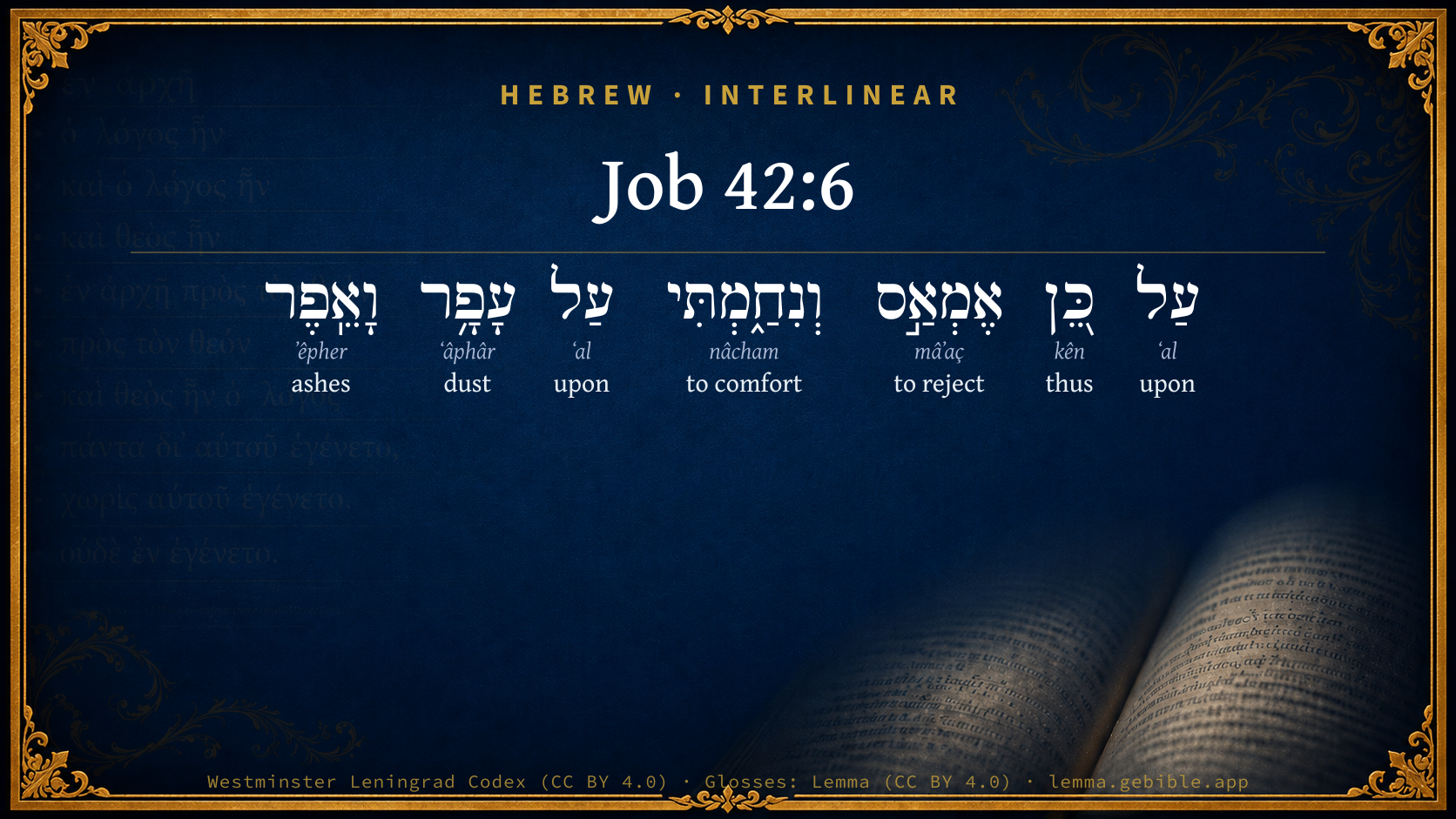
Job 42:6

Hebrew (Westminster Leningrad Codex) Job 42:6 appears in the Hebrew Old Testament. The text above is from the Westminster Leningrad Codex. Each word links to its Strong’s number, a concise gloss, and parsing drawn from the Open Scriptures Hebrew Bible morphology. Click any word for its full Brown-Driver-Briggs (BDB) entry.
Download image
Cite this verse

Job 42:6 (World English Bible). Public Domain. Lemma interlinear Bible study tool, https://lemma.gebible.app/v/job/42/6.

Show BibTeX & RIS
BibTeX
RIS
English Translation
Therefore I abhor myself, And repent in dust and ashes."
World English Bible · Public Domain
Download a study sheet

One document with this verse’s original text, its word-by-word gloss line, the meaning frame, cross-references with their text, attributed commentary, and full source and license credits — printable, and it pastes into notes with its structure intact.

This verse Autodidact and up

Study sheet (.html) Plain text (.txt)

A passage Seminary Student

Up to 50 verses in one chapter. A passage sheet keeps up to 6 commentary sources and 12 cross-references per verse, in the order this page ranks them, and says so on the sheet whenever that leaves anything out. Ask for a single verse and you get the Autodidact verse sheet above.

Everything on this page stays free to read, with no account — the sheet is a download of what is already on screen, not access to it.

Want to remove ads? Support Godless Engineer
Compare translations 3

The same verse in 3 English versions, stacked beneath the original-language interlinear above. Click any original word for its lexicon entry.

Each is an independent rendering of the whole verse — the interlinear is not word-aligned to these translations.

Highlighted words mark where these versions differ — a whole-verse word diff, not a word-by-word alignment.

  • World English Bible Public Domain
    Therefore I abhor myself, And repent in dust and ashes."
  • King James Version Public Domain
    Wherefore I abhor myself, and repent in dust and ashes.
  • unfoldingWord Literal Text CC BY-SA 4.0
    Therefore I despise, and I repent in dust and ashes.”

unfoldingWord Literal Text — © unfoldingWord, licensed CC BY-SA 4.0. Word-aligned USFM3 via Door43 (git.door43.org/unfoldingWord/en_ult).

Versions to compare (up to 4)

3 of 4 selected

Show all 18 translations

Every available English version of this verse, each an independent rendering of the whole verse.

  • World English Bible Public Domain
    Therefore I abhor myself, And repent in dust and ashes."
  • Berean Standard Bible Public Domain
    Therefore I retract my words, and I repent in dust and ashes.”
  • Majority Standard Bible Public Domain
    Therefore I despise myself, and I repent in dust and ashes.”
  • King James Version Public Domain
    Wherefore I abhor myself, and repent in dust and ashes.
  • American Standard Version (1901) Public Domain
    Wherefore I abhor `myself', And repent in dust and ashes.
  • Revised Version (1885) Public Domain
    Wherefore I abhor myself, and repent in dust and ashes.
  • Geneva Bible (1599) Public Domain
    Therefore I abhorre my selfe, and repent in dust and ashes.
  • Douay-Rheims (1899) Public Domain
    Therefore I reprehend myself, and do penance in dust and ashes.
  • Young's Literal Translation Public Domain
    Therefore do I loathe `it', And I have repented on dust and ashes.
  • Literal Standard Version CC BY-SA 4.0
    Therefore I loathe [it], || And I have sighed on dust and ashes.”
  • Unlocked Literal Bible CC BY-SA 4.0
    So I despise myself; I repent in dust and ashes.”
  • unfoldingWord Literal Text CC BY-SA 4.0
    Therefore I despise, and I repent in dust and ashes.”
  • Darby Bible Public Domain
    Wherefore I abhor [myself], and repent in dust and ashes.
  • World Messianic Bible Public Domain
    Therefore I abhor myself, and repent in dust and ashes.”
  • Webster's Bible Public Domain
    Wherefore I abhor myself, and repent in dust and ashes.
  • Free Bible Version CC BY-SA 4.0
    That is why I'm sorry for what I said, and I repent in dust and ashes.”
  • Bible in Basic English Public Domain
    For this cause I give witness that what I said is false, and in sorrow I take my seat in the dust.
  • JPS Tanakh (1917) Public Domain
    Wherefore I abhor my words, and repent, seeing I am dust and ashes.

Literal Standard Version (2020), Covenant Press — licensed CC BY-SA 4.0. Text via the HelloAO Bible API (eBible.org). Unlocked Literal Bible (unfoldingWord) — licensed CC BY-SA 4.0. Text via the HelloAO Bible API (eBible.org). unfoldingWord Literal Text — © unfoldingWord, licensed CC BY-SA 4.0. Word-aligned USFM3 via Door43 (git.door43.org/unfoldingWord/en_ult). Free Bible Version, Dr. Jonathan Gallagher — licensed CC BY-SA 4.0. Text via the HelloAO Bible API (eBible.org).

Word by word

More ways to search: Search by grammar → Find every occurrence → Compare this word →

Practice this passage: Drill this verse → Learn its vocabulary →

About this verse

These counts appear in no published source. They are computed here, from the morphology-tagged text and Lemma’s own curated glosses. What Lemma adds →

7
words
6
distinct lemmas
Wisdom
section

Notable vocabulary

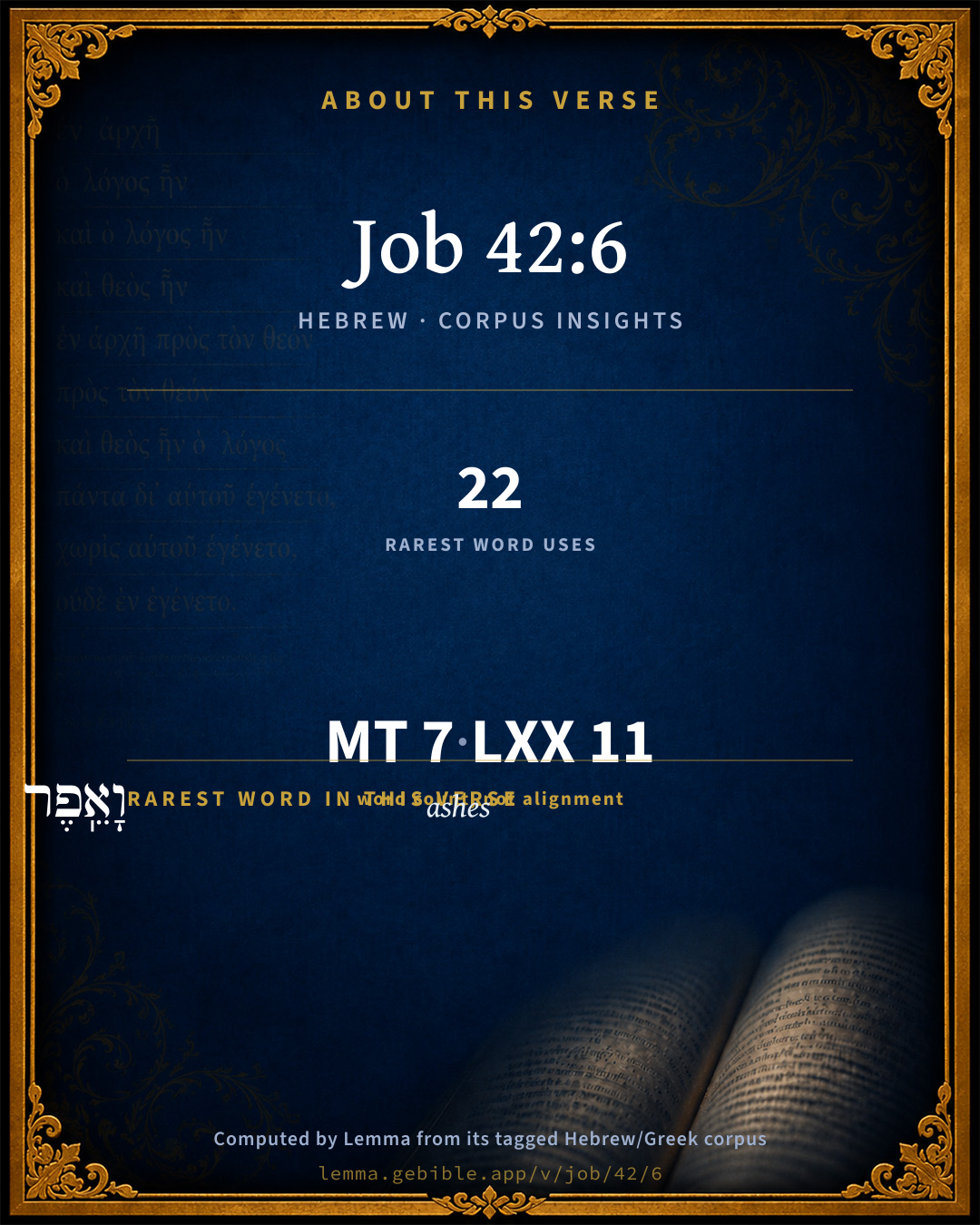
The rarest word here is וָאֵֽפֶר ashes H665 — appearing just 22 times in the whole Hebrew Bible.

Shared distinctive vocabulary

וָאֵֽפֶר ashes H665 occurs in 22 verses of the Hebrew Bible. Also found in:

Grammatical profile

  • 2 verbs
  • 2 nouns
  • 2 prepositions
  • 1 particle

Verb forms

  • אֶמְאַ֣ס Qal · Imperfect
  • וְנִחַ֑מְתִּי Niphal · Sequential Perfect

Repetition

A word recurs within this verse — often emphatic in Hebrew:

Hebrew & Septuagint length

In English translation the verse runs 10 words from the Hebrew and 16 from the Septuagint (LXX English) — the Septuagint runs noticeably longer here. See the side-by-side →

A rough comparison of the two English renderings, which tokenize alike — not a word-level alignment.

Word counts can differ between the Hebrew and the Greek without any difference in meaning — e.g. the Hebrew direct-object marker אֵת has no separate Greek word, and Greek often adds the article ὁ.

In the original languages it is 7 Hebrew tokens and 11 Greek tokens — but the two are counted differently (Hebrew bundles its prefixes and suffixes into one token; the Greek is in lemma form), so that isn’t a like-for-like length.

Cross-references

22

Topical passages linked to Job 42:6 in the Treasury of Scripture Knowledge — connected by theme and wording, ordered by reader-vote popularity; previews shown in the World English Bible.

  • Ezra 9:6 and I said, my God, I am ashamed and blush to lift up my face to you, my God; for our iniquities are increased over our head, and our guiltiness is grown up to the heavens.
  • 1 Timothy 1:13–16 although I was before a blasphemer, a persecutor, and insolent. However, I obtained mercy, because I did it ignorantly in unbelief.
  • James 4:7–10 Be subject therefore to God. But resist the devil, and he will flee from you.
  • Job 40:3–4 Then Job answered Yahweh,
  • Job 30:19 He has cast me into the mire. I have become like dust and ashes.
  • Daniel 9:3 I set my face to the Lord God, to seek by prayer and petitions, with fasting and sackcloth and ashes.
  • Esther 4:1–3 Now when Mordecai knew all that was done, Mordecai tore his clothes, and put on sackcloth with ashes, and went out into the midst of the city, and cried with a loud and a bitter cry;
  • Job 2:8 He took for himself a potsherd to scrape himself with, and he sat among the ashes.
  • Psalms 51:17 The sacrifices of God are a broken spirit. A broken and contrite heart, O God, you will not despise.
  • Jeremiah 31:19 Surely after that I was turned, I repented; and after that I was instructed, I struck on my thigh: I was ashamed, yes, even confounded, because I did bear the reproach of my youth.
  • Ezekiel 16:63 that you may remember, and be confounded, and never open your mouth any more, because of your shame, when I have forgiven you all that you have done, says the Lord Yahweh.
  • Ezekiel 20:43 There shall you remember your ways, and all your doings, in which you have polluted yourselves; and you shall loathe yourselves in your own sight for all your evils that you have committed.
  • Ezekiel 36:31 Then shall you remember your evil ways, and your doings that were not good; and you shall loathe yourselves in your own sight for your iniquities and for your abominations.
  • Jonah 3:6–10 The news reached the king of Nineveh, and he arose from his throne, and took off his royal robe, covered himself with sackcloth, and sat in ashes.
  • Matthew 11:21 "Woe to you, Chorazin! Woe to you, Bethsaida! For if the mighty works had been done in Tyre and Sidon which were done in you, they would have repented long ago in sackcloth and ashes.
  • Luke 10:13 "Woe to you, Chorazin! Woe to you, Bethsaida! For if the mighty works had been done in Tyre and Sidon which were done in you, they would have repented long ago, sitting in sackcloth and ashes.
  • Luke 15:18–19 I will get up and go to my father, and will tell him, "Father, I have sinned against heaven, and in your sight.
  • 1 Corinthians 15:8–9 and last of all, as to the child born at the wrong time, he appeared to me also.
  • Isaiah 5:5 Now I will tell you what I will do to my vineyard. I will take away its hedge, and it will be eaten up. I will break down its wall of it, and it will be trampled down.
  • Isaiah 58:5 Is such the fast that I have chosen? the day for a man to afflict his soul? Is it to bow down his head as a rush, and to spread sackcloth and ashes under him? will you call this a fast, and an acceptable day to Yahweh?
  • 1 Kings 21:27 It happened, when Ahab heard those words, that he tore his clothes, and put sackcloth on his flesh, and fasted, and lay in sackcloth, and went softly.
  • Job 9:31 Yet you will plunge me in the ditch. My own clothes shall abhor me.

Cross-references courtesy of OpenBible.info (CC BY 4.0).

Hebrew and Greek witnesses Masoretic Hebrew ↔ Greek Septuagint

The same verse in the two great witnesses to the Old Testament, shown verse-for-verse.

Here the Septuagint runs noticeably longer than the Hebrew — LXX2012 (modern English Septuagint) 16 words vs World English Bible 10. A rough length comparison of the two English translations, not a word-level alignment — read both below.

These are two independent witnesses, not word-aligned to each other, and the Septuagint is shown in lemma (dictionary) form.

Hebrew Job 42:6 Masoretic · Westminster Leningrad Codex

עַל כֵּ֭ן אֶמְאַ֣ס וְנִחַ֑מְתִּי עַל עָפָ֥ר וָאֵֽפֶר

Therefore I abhor myself, And repent in dust and ashes."

World English Bible · Public Domain

Greek LXX Job 42:6 Septuagint · lemma form

διό φαυλίζω ἐμαυτοῦ καί τήκω ἡγέομαι δέ ἐμαυτοῦ γῆ καί σποδός

Therefore I have counted myself vile, and have fainted: and I esteem myself dust and ashes.

LXX2012 (modern English Septuagint) · Public Domain

On this verse, Haydock's Catholic Bible Commentary discusses the Septuagint’s reading. Read the note in Commentary ↓

Hebrew: Westminster Leningrad Codex (CC BY 4.0). Greek: Septuagint (public domain); English from LXX2012 (modern English Septuagint) (Public Domain). How the Septuagint differs from the Hebrew →

Commentary

Notes on Job 42:6 from classic Christian and Jewish commentators (each source and its license shown beneath its notes). The classic Christian expositions comment on the surrounding passage and are grouped to its opening verse, so a note may address several verses; the Jewish commentaries on the Tanakh (Rashi and others) are per-verse, so they appear only where the commentator wrote on this verse.

Lemma curates 59 commentaries, every one of them public domain or Creative Commons licensed, each selected and text-cleaned for this edition rather than reprinted as found. About our sources →

Trapp's Complete Commentary

John Trapp

Job 42:6 Wherefore I abhor [myself], and repent in dust and ashes.

Ver. 6. Wherefore I abhor myself] Aspernor illa, so Tremellius. I utterly dislike those my former base and bald conceits of thee, my hard and unsavoury speeches, mine impatient and imprudent carriages. Horreo quicquid de meo est, ut meus sim, as Bernard expresseth it. Reprobo meipsum, so Brentius; I do utterly reject myself, I condemn mine own folly: I eat those words of discontent at thy righteous proceedings. Digna sane quae per iugulum redeant. Abiecio vitam meam, so Mercer and Lavater render it. I cast away my life, and look upon it as lost, if thou shouldest take the forfeiture: I humbly put myself into the hands of justice, yet in hope of mercy, Displiceo mihimetipsi, ac pervelim ut aliter dixissem ae fecissem (Lavat.).

I repent in dust and ashes] As in an express and public penance. I throw myself here upon the ground, I put my mouth in the dust, Lam 3:24 Jer 6:26; Jer 25:34. Canitiem immundo perfusam pulvere turpi (Virg. Aeneid, l. 12), I sprinkle dust and ashes upon mine head, in token that I have deserved to be as far underground as now I am above ground; I repent my presumptuous misbehaviour with as lowly a spirit as ever I sinned with a high. Lo, this was poenitentiam agere, quod est pro malo bonum reponere, saith Brentius. This was true repentance, to change evil for good; as piety for blasphemy, chastity for fornication, charity for envy, humility for pride, Christ for Satan. And reformation is the best repentance, saith Luther. Such as so repent are sure of comfort. The word here rendered I repent, signifieth also to take comfort, as Eze 32:31. It is repentance unto life, Act 11:18, and such as accompanieth salvation, Heb 6:9. Neither is it wrought in any man but by a saving sight of Almighty God in his greatness and goodness; such as may make him at once to tremble and trust, as Job did here, as Isaiah, Isa 6:1; Isa 6:5.

John Trapp, A Commentary or Exposition upon All the Books of the Old and New Testament (1647–1656) — public domain. Text from a community e-Sword module.

Joseph Benson's Commentary

Job 42:6. Wherefore I abhor myself, &c. — The more we see of the glory and majesty of God, the more we shall see of the vileness and odiousness of sin, and of ourselves because of sin; and the more we shall abase and abhor ourselves for it; and repent in dust and ashes — Namely, sitting in dust and ashes. Job’s afflictions had brought him to the ashes, Job 2:8, He sat down among the ashes; but now a sense of his sins brought him thither. Observe, reader, true penitents mourn for their sins as heartily as ever they did for any outward afflictions; for they are brought to see more evil in their sins than in their troubles; and even those who have no gross enormities to repent of, yet ought to be greatly distressed in their souls for the workings of pride, self-will, peevishness, discontent, and anger, within them, and for all their hasty, unadvised speeches; for these they ought to be pricked in their hearts, and in bitterness, like Job. Observe, also, that self- loathing is always the companion of true repentance. They shall loathe themselves for the evils they have committed, Eze 6:9. It is not sufficient that we be angry at ourselves for the wrong and damage we have, by sin, done to our own souls; but we must abhor ourselves, as having, by sin, made ourselves odious to the pure and holy God, who cannot look upon iniquity but with abhorrence. If sin in general be truly an abomination to us, sin in ourselves will especially be so; the nearer it is to us, the more loathsome it will appear to be, and the more we shall loathe ourselves on account of it. We shall conclude our observations on the poetical part of this book with Dr. Young’s excellent paraphrase on the four preceding verses:

“Thou canst accomplish all things,

Lord of might;

And every thought is naked to thy sight.

But, O! thy ways are wonderful, and lie

Beyond the deepest reach of mortal eye.

Oft have I heard of thine almighty power;

But never saw thee till this dreadful hour.

O’erwhelm’d with shame, the Lord of life I see,

Abhor myself, and give my soul to thee.

Nor shall my weakness tempt thine anger more;

Man was not made to question, but adore.”

Joseph Benson's Commentary on the Old and New Testaments (1811–1818) — public domain. Text from a community e-Sword module.

Jamieson, Fausset & Brown

Robert Jamieson, A. R. Fausset & David Brown

myself--rather "I abhor," and retract the rash speeches I made against thee (Job 42:3-4) [UMBREIT].

Jamieson, Fausset & Brown — Commentary Critical and Explanatory on the Whole Bible (1871) — public domain (CC PDM 1.0). Text via the HelloAO Bible API.

Adam Clarke's Commentary

Verse 6. I abhor myself] Compared with thine, my strength is weakness; my wisdom, folly; and my righteousness, impurity.

"I loathe myself when thee I see;

And into nothing fall."

Repent] I am deeply distressed on account of the imaginations of my heart, the words of my tongue, and the acts of my life. I roll myself in the dust, and sprinkle ashes upon my head. Job is now sufficiently humbled at the feet of Jehovah; and having earnestly and piously prayed for instruction, the Lord, in a finishing speech, which appears to be contained in Job 40:1-14, perfects his teaching on the subject of the late controversy, which is concluded with, "When thou canst act like the Almighty," which is, in effect, what the questions and commands amount to in the preceding verses of that chapter, "then will I also confess unto thee, that thy own right hand can save thee." In the fifth verse of the fortieth chapter, Job says, "ONCE have I spoken." This must refer to the declaration above, in the beginning of this chapter, (xlii.) And he goes on to state, Job 40:5: "Yea, TWICE; but I will proceed no farther." This second time is that in which he uses these words: after which he spoke no more; and the Lord concluded with the remaining part of these fourteen verses, viz., from Job 40:7-14, inclusive. Then the thread of the story, in the form of a narration is resumed at Job 42:7.

Adam Clarke's Commentary on the Bible (1810–1826) — public domain. Text from a community e-Sword/MySword module.

The Cambridge Bible for Schools and Colleges

gen. ed. J. J. S. Perowne

6. The effect of this deeper knowledge of God upon Job’s heart.

I abhor myself] The word myself is not expressed; what has to be supplied as the object of “abhor” is rather it, that is, my former language and demeanour. The word means, I retract, or repudiate.

The Cambridge Bible for Schools and Colleges (gen. ed. J. J. S. Perowne; Cambridge University Press, 1878–1918) — public domain. Text from a community e-Sword module.

John Gill's Exposition

And it was so,.... What follows came to pass:

that after the Lord had spoken these words unto Job; which he spake to him out of the whirlwind, and after he had heard Job's confession, and the declaration he made of his humiliation and repentance:

the Lord said to Eliphaz the Temanite; who with his two friends were still present and heard the speeches of the Lord to Job, and the acknowledgment he had made of sin; though some (o) think that, when the dispute ended between Job and them, they returned to their own country, where Eliphaz is now supposed to be, and was bid with his two friends to go to Job again, which they did, as is concluded from the following verses: but no doubt they stayed and heard what Elihu had to say; and the voice of the Lord out of the whirlwind would command their attention and stay; and very desirous they must be to know how the cause would go, for or against Job; the latter of which they might expect from the appearance of things. Now the Lord directs his speech to Eliphaz, he being perhaps the principal man, on account of his age, wisdom and wealth, and being the man that led the dispute, began it, and formed the plan to go upon, and was the most severe on Job of any of them; wherefore the Lord said to him,

my wrath is kindled against thee, and against thy two friends; who were Bildad the Shuhite, and Zophar the Naamathite; who gave into the same sentiments with Eliphaz, and went upon the same plan, speaking wrong things of God, charging Job falsely, and condemning him; which provoked the Lord, and caused his wrath to be kindled like fire against them, of which there were some appearances and breakings forth in his words and conduct towards them;

for ye have not spoken of me the thing that is right, as my servant Job hath; they had said many right things of God, and Job had said many wrong ones of him, and yet upon the whole Job had said more corrcet things of God than they; their notion, and which they had expressed, was, that God deals with men in this life according to their outward behaviour; that God did not afflict good men, at least not sorely, nor long; and that wicked men were always punished now: from whence they drew this inference, that Job, being so long and so greatly afflicted, must be a bad man, or God would never have dealt with him after this manner. Job, on the other hand, affirmed, that wicked men enjoyed great prosperity, which good men did not; and therefore the love and hatred of God were not known by these things; and men's characters were not to be judged of by these outward things; in which he was doubtless right: some render the words "have not spoken unto me" (p), before him, in his presence; for they were all before God, and to him they all appealed, and he heard and observed all that was said, and now passed judgment. No notice is taken of Elihu, nor blame laid on him; he acting as a moderator, taking neither the part of Job, nor of his friends, but blaming both: nor did he pretend to charge Job with any sins of his former life as the cause of his calamities; only takes up some indecent, unguarded, and extravagant expressions of his in the heat of this controversy, and rebukes him for them; and throughout the whole vindicates the justice of God in his dealings with him.

(o) Vid. Spanhem. Hist. Jobi, c. 8. s. 1, 2. (p) "ad me", Mercerus, Drusius, Cocceius; "coram me", V. L. "apud me", Tigurine version.

John Gill's Exposition of the Whole Bible (1746–1763) — public domain (CC PDM 1.0). Text via the HelloAO Bible API.

Albert Barnes' Notes on the Bible

Wherefore I abhor myself - I see that I am a sinner to be loathed and abhorred. Job, though he did not claim to be perfect, had yet unquestionably been unduly exalted with the conception of his own righteousness, and in the zeal of his argument, and under the excitement of his feelings when reproached by his friends, had indulged in indefensible language respecting his own integrity. He now saw the error and folly of this, and desired to take the lowest place of humiliation. Compared with a pure and holy God, he saw that he was utterly vile and loathsome, and was not unwilling now to confess it. “And repent.” Of the spirit which I have evinced; of the language used in self-vindication; of the manner in which I have spoken of God. Of the general sentiments which he had maintained in regard to the divine administration as contrasted with those of his friends he had no occasion to repent, for they were correct Job 42:8, nor had he occasion to repent “as if” he had never been a true penitent or a pious man. But he now saw that in the spirit which he had evinced under his afflictions, and in his argument, there was much to regret; and he doubtless saw that there had been much in his former life which had furnished occasion for bringing these trials upon him, over which he ought now to mourn.

In dust and ashes - In the most lowly manner, and with the most expressive symbols of humiliation. It was customary in times of grief, whether in view of sin or from calamity, to sit down in ashes (see the notes at Job 2:8; compare Dan 9:3; Jon 3:6; Mat 11:21); or on such an occasion the sufferer and the penitent would strew ashes over himself; compare Isa 58:5. The philosophy of this was - like the custom of wearing “black” for mourning apparel - that the external appearance ought to correspond with the internal emotions, and that deep sorrow would be appropriately expressed by disfiguring the outward aspect as much as possible. The sense here is, that Job meant to give expression to the profoundest and sincerest feelings of penitence for his sins. From this effect produced on his mind by the address of the Almighty, we may learn the following lessons:

(1) That a correct view of the character and presence of God is adapted to produce humility and penitence; compare Job 40:4-5. This effect was produced on the mind of Peter when, astonished by a miracle performed by the Savior which none but a divine being could have done, he said, “Depart from me, for I am a sinful man, O Lord;” Luk 5:8. The same effect; was produced on the mind of Isaiah after he had seen Yahweh of Hosts in the temple: “Then said I, Wo is me, for I am undone; because I am a man of unclean lips, and I dwell in the midst of a people of unclean lips; for mine eyes have seen the king, the Lord of Hosts;” Isa 6:5. No man can have any elevated views of his own importance or purity, who has right apprehensions of the holiness of his Creator.

(2) Such a view of the presence of God will produce what no argument can in causing penitence and humility. The friends of Job had reasoned with him in vain to secure just this state of mind; they had endeavored to convince him that he was a great sinner, and “ought” to exercise repentance. But he met argument with argument; and all their arguments, denunciations, and appeals, made no impression on his mind. When, however, God manifested himself to him, he was melted into contrition, and was ready to make the most penitent and humble confession. So it is now. The arguments of a preacher or a friend often make no impression on the mind of a sinner. He can guard himself against them. He can meet argument with argument, or can coolly turn the ear away. But he has no such power to resist God, and when “he” manifests himself to the soul, the heart is subdued, and the proud and self-confident unbeliever becomes humbled, and sues for mercy.

(3) A good man will be willing to confess that he is vile, when he has any clear views of God. He will be so affected with a sense of the majesty and holiness of his Maker, that he will be overwhelmed with a sense of his own unworthiness.

(4) The most holy men may have occasion to repent of their presumptuous manner of speaking of God. We all err in the same way in which Job did. We reason about God with irreverence; we speak of his government as if we could comprehend it; we discourse of him as if he were an equal; and when we come to have any just views of him, we see that there has been much improper boldness, much self-confidence, much irreverence of thought and manner, in our estimation of the divine wisdom and plans. The bitter experience of Job should lead us to the utmost carefulness in the manner in which we speak of our Maker.

Albert Barnes' Notes on the Bible (1834–1885) — public domain. Text from a community e-Sword/MySword module.

Haydock's Catholic Bible Commentary

Reprehend. Hebrew and Septuagint, "vilify." (Haydock) --- I recall the obscure expression which has occasioned my friends to mistake. (Du Hamel) --- Penance. Hebrew, "groan." Septuagint, "pine away, I look upon myself as dust and ashes." Such are the sentiments which every one will entertain the nearer he approaches to the divine Majesty. (Haydock) --- I no longer assert my innocence, but wait patiently in my present forlorn condition, till thou shalt be pleased to dispose of me. How much would the reputation and authority of Job sink, if some of his assertions had been destitute of truth, particularly as the sacred author does not mention which they were! But God exculpates his servant, ver. 8. (Houbigant) --- Chaldean, "I have despised my riches, and I am comforted with respect to my children, who are now reduced to dust and ashes." I find a consolation in submitting patiently to my sufferings, which I may have deserved on account of my unguarded speeches. (Calmet) --- Job waits not for God’s answer, ver. 4. He at once feels an interior light, and is resigned. (Haydock) --- He had defended the truth against men: now, with more resignation, he is content to suffer, and does penance for himself and others. (Worthington)

George Leo Haydock (1774–1849), Haydock's Catholic Family Bible and Commentary, 1859 edition — public domain. Excludes Psalms (Douay-Rheims chapter numbering differs from Protestant) and Deuterocanonical books (Catholic canon only).

Matthew Poole's English Annotations

I abhor, i.e. dislike, and detest, and loathe

myself, or my former words and carriage. One of these or some like supplement is necessary to complete the sense, and is clearly gathered from the following words.

In dust and ashes; sitting in dust and ashes; which hitherto I have done in token of my grief for my affliction; but now I desire and resolve to do in testimony of my penitence for my sins.

Matthew Poole's English Annotations on the Holy Bible (1683–1685) — public domain. Text from a community e-Sword/MySword module.

Whedon's Commentary on the Bible

Daniel D. Whedon

6. I abhor myself — אמאס. As in Job_7:16, (which see,) the object of the verb abhor is not given. Hengstenberg conceives the object of his loathing (“despising,” or “recantation,” thus Zockler and Hitzig) to be his earlier speeches. The Septuagint and Vulgate, with more reason, supply myself, the former of which adds, by way of explanation, ετακην, I am dissolving, (compare Job_19:27,) such is the violence of his emotion.

In dust and ashes — “In a sense that is absolutely proper the book forms a περιοδος, a period or circuit.” — Vilmar. The trial found Job a spiritual monarch seated upon his throne of ashes — resigned, submissive to the will of God. “He sat down among the ashes.” Job_2:8. Now, as the purifying fires have burned their utmost, we find him brought around to his former ground of supremacy. The last recorded words — “ashes” — that fall from his lips are of the deepest significance — the same Hebrew word, epher, being employed as in Job_2:8. The allotment of the divine will he accepts, though it be but dust and ashes. Hengstenberg interprets it: “I, who have sat until now in dust and ashes because of grief on account of my misfortunes, will continue so to do, but from another reason, because of grief on account of my sin.” “Here,” says the quaint Thomas Adams, “we may consider three degrees of mortification — the sickness, the death, and the burial of sin. ‘I abhor myself’ — there sin is sick and wounded; ‘I repent’ — there it is wounded and dead; ‘in dust and ashes’ — there it is dead and buried.” — Sermon in loc., entitled, “The Sinner’s Mourning Habit.” See also University Sermons of W.H. Mill — “Job Penitent.”

Daniel D. Whedon (gen. ed.), Commentary on the Old and New Testaments (1874–1909) — public domain. Text from a community e-Sword module.

The Pulpit Commentary

Wherefore I abhor myself; or, I loathe my words (see the Revised Version). And repent in dust and ashes. Job was still sitting on the ash-heap on which he had thrown himself when his disease first smote him. (Job_2:8) He had thrown himself on it in grief and de, pair; he will remain seated on it in compunction and penitence. His self-humiliation is now complete. He does not retract what he has said concerning his essential integrity, but he admits that his words have been overbold, and his attitude towards God one unbefitting a creature. God accepts his submission, and proceeds to vindicate him to his "friends," and to visit them with condemnation.

The Pulpit Commentary (1880–1919), ed. H.D.M. Spence-Jones & Joseph S. Exell — public domain. Text from a community e-Sword module.

Scofield Reference Notes

C. I. Scofield

Wherefore I abhor myself

The problem, of which the book of Job is the profound discussion, finds here its solution. Brought into the presence of God, Job is revealed to himself. In no sense a hypocrite, but godly and possessing a faith which all his afflictions could not shake, Job was yet self-righteous and lacking in humility. Chapter 29 fully discloses this. But in the presence of God he anticipates, as it were, the experience of Paul. Php 3:4-9 and the problem is solved. The godly are afflicted that they may be brought to self-knowledge and self-judgment. Such afflictions are not penal for their sins, but remedial and purifying. The book of Job affords a sublime illustration of the truth announced in; 1Co 11:31; 1Co 11:32; Heb 12:7-11. Best of all, such self-knowledge and self-judgment is the prelude to greater fruitfulness.; Job 42:7-17; Joh 15:2. Cf.; Jos 5:13; Jos 5:14; Eze 1:28; Eze 2:1-3; Dan 10:5-11; Rev 1:17-19.

repent (See Scofield "Zec 8:14") .

The Scofield Reference Bible (1917 edition), notes by C. I. Scofield — public domain. Text from a community e-Sword module.

Rashi

Rabbi Shlomo Yitzchaki (Rashi)

Therefore Since I merited to see Your Shechinah. I despise I despise my life. on dust and ashes if I were resting in the grave, to return to dust and ashes whence I was taken.

Rashi on the Tanakh — English translations: “The Judaica Press complete Tanach with Rashi, translated by A. J. Rosenberg” (CC BY 4.0); “Pentateuch with Rashi's commentary by M. Rosenbaum and A.M. Silbermann, 1929-1934” (public domain); “The Metsudah Tanach series, Lakewood, N.J” (CC BY 4.0); and “The Book of Joshua, Metsudah Publications, 1997” (CC BY 4.0). Text via Sefaria.

Lesson kit

Teaching starters — assembled from the data on this page, not authored interpretation. Every prompt links to the verse data it draws on. Edit before teaching.

Job, in the Wisdom, opens this verse with 7 words (6 distinct Hebrew lemmas). Its most distinctive word is ʼêpher (“ashes”). The Greek Septuagint runs longer here. A historical commentator’s framing appears above. Read the whole chapter for the surrounding context.

Discussion questions

  1. What does “ashes” (ʼêpher) contribute to the verse as a whole?
  2. How does Genesis 18:27, which shares the word «ashes», read alongside this verse?
  3. What does the repetition of “upon” (2× in this one verse) do in this verse?
  4. The Septuagint runs longer here than the Hebrew. What might account for the difference?
  5. These translations render this verse differently. What is at stake in choosing one wording over another?
  6. «אֶמְאַ֣ס» is a Qal Imperfect verb. How does that grammatical form shape the action described?
  7. Compare how Trapp's Complete Commentary and Joseph Benson's Commentary read this verse. Where do they agree or differ?

Things to notice

Reading settings

Reading text

Shown beneath each verse's original-language words.

Old Testament
Old Testament edition

Read the OT as the Masoretic Hebrew (MT) or the Greek Septuagint (LXX).

English shown for the Greek Septuagint (in the Hebrew ↔ Greek comparison).

Comparing translations? Open the Compare panel on any verse page to stack up to four side by side.