Psalms 69:20

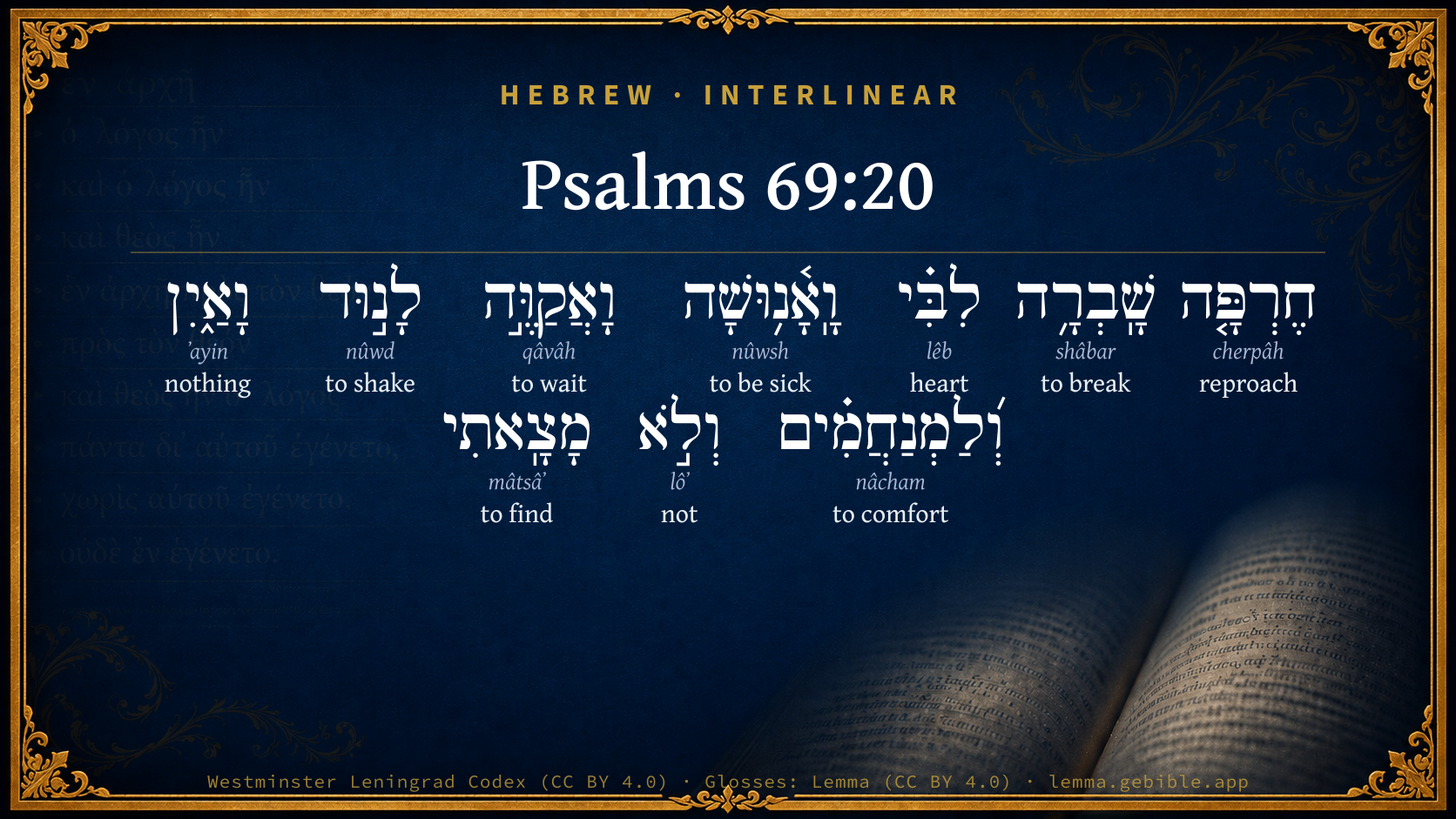
Hebrew (Westminster Leningrad Codex) Psalms 69:20 appears in the Hebrew Old Testament. The text above is from the Westminster Leningrad Codex. Each word links to its Strong’s number, a concise gloss, and parsing drawn from the Open Scriptures Hebrew Bible morphology. Click any word for its full Brown-Driver-Briggs (BDB) entry.
Download image
Cite this verse

Psalms 69:20 (World English Bible). Public Domain. Lemma interlinear Bible study tool, https://lemma.gebible.app/v/psalms/69/20.

Show BibTeX & RIS
BibTeX
RIS
English Translation
Reproach has broken my heart, and I am full of heaviness. I looked for some to take pity, but there was none; For comforters, but I found none.
World English Bible · Public Domain
Highlights
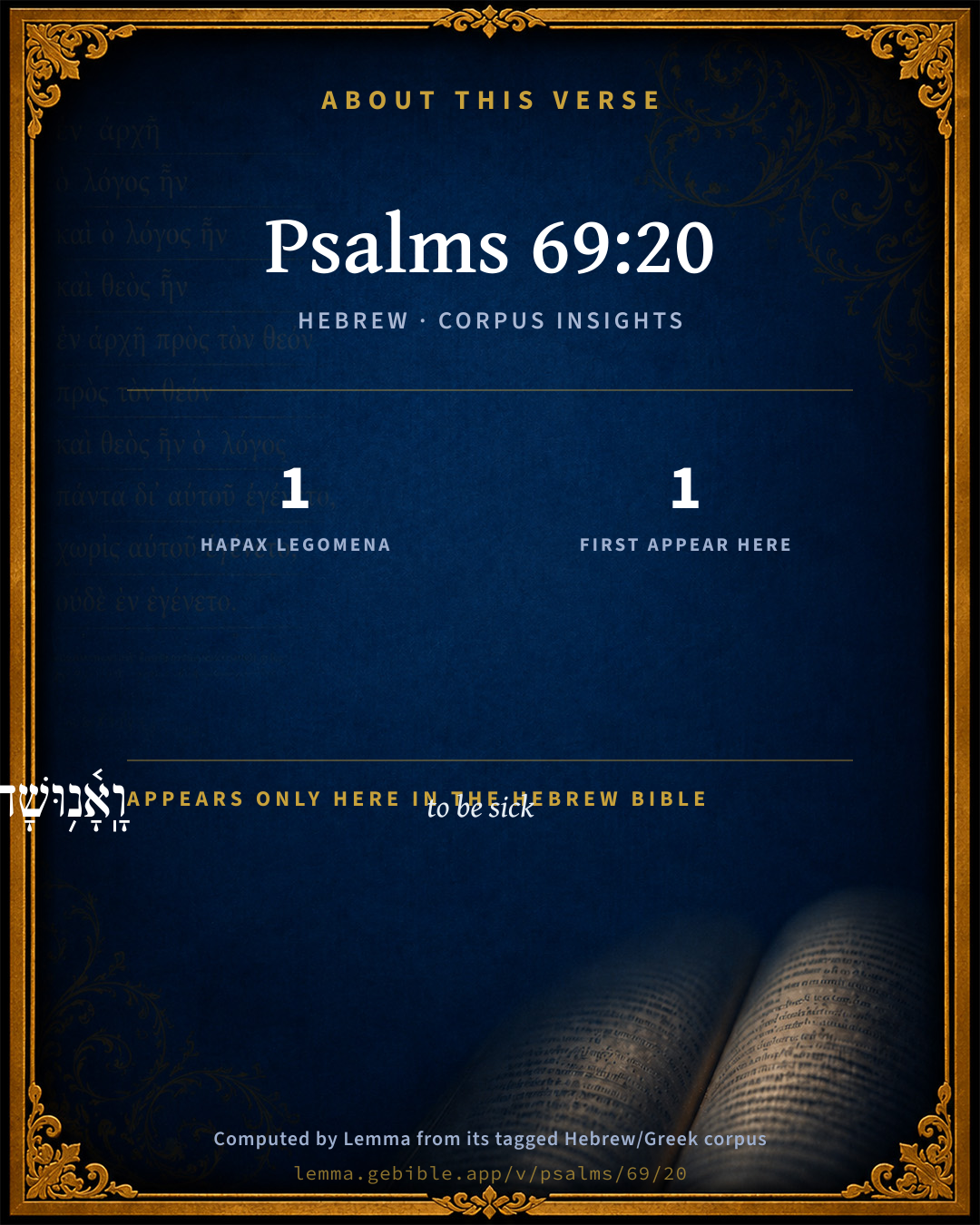
  • 1 hapax legomenon — only here in the Hebrew Bible
  • 1 first appearance in the Hebrew Bible
Full analysis ↓
Download a study sheet

One document with this verse’s original text, its word-by-word gloss line, the meaning frame, cross-references with their text, attributed commentary, and full source and license credits — printable, and it pastes into notes with its structure intact.

This verse Autodidact and up

Study sheet (.html) Plain text (.txt)

A passage Seminary Student

Up to 50 verses in one chapter. A passage sheet keeps up to 6 commentary sources and 12 cross-references per verse, in the order this page ranks them, and says so on the sheet whenever that leaves anything out. Ask for a single verse and you get the Autodidact verse sheet above.

Everything on this page stays free to read, with no account — the sheet is a download of what is already on screen, not access to it.

Want to remove ads? Support Godless Engineer
Compare translations 3

The same verse in 3 English versions, stacked beneath the original-language interlinear above. Click any original word for its lexicon entry.

Each is an independent rendering of the whole verse — the interlinear is not word-aligned to these translations.

Highlighted words mark where these versions differ — a whole-verse word diff, not a word-by-word alignment.

  • World English Bible Public Domain
    Reproach has broken my heart, and I am full of heaviness. I looked for some to take pity, but there was none; For comforters, but I found none.
  • King James Version Public Domain
    Reproach hath broken my heart; and I am full of heaviness: and I looked for some to take pity, but there was none; and for comforters, but I found none.
  • unfoldingWord Literal Text CC BY-SA 4.0
    Reproach has broken my heart, and I am sick. Though I waited for sympathy, yet there was none, and for comforters, yet I did not find.

unfoldingWord Literal Text — © unfoldingWord, licensed CC BY-SA 4.0. Word-aligned USFM3 via Door43 (git.door43.org/unfoldingWord/en_ult).

Versions to compare (up to 4)

3 of 4 selected

Show all 18 translations

Every available English version of this verse, each an independent rendering of the whole verse.

  • World English Bible Public Domain
    Reproach has broken my heart, and I am full of heaviness. I looked for some to take pity, but there was none; For comforters, but I found none.
  • Berean Standard Bible Public Domain
    Insults have broken my heart, and I am in despair. I looked for sympathy, but there was none, for comforters, but I found no one.
  • Majority Standard Bible Public Domain
    Insults have broken my heart, and I am in despair. I looked for sympathy, but there was none, for comforters, but I found no one.
  • King James Version Public Domain
    Reproach hath broken my heart; and I am full of heaviness: and I looked for some to take pity, but there was none; and for comforters, but I found none.
  • American Standard Version (1901) Public Domain
    Reproach hath broken my heart; and I am full of heaviness: And I looked for some to take pity, but there was none; And for comforters, but I found none.
  • Revised Version (1885) Public Domain
    Reproach hath broken my heart; and I am full of heaviness: and I looked for some to take pity, but there was none; and for comforters, but I found none.
  • Geneva Bible (1599) Public Domain
    Rebuke hath broken mine heart, and I am full of heauinesse, and I looked for some to haue pitie on me, but there was none: and for comforters, but I found none.
  • Douay-Rheims (1899) Public Domain
    Thou knowest my reproach, and my confusion, and my shame.
  • Young's Literal Translation Public Domain
    Reproach hath broken my heart, and I am sick, And I look for a bemoaner, and there is none, And for comforters, and I have found none.
  • Literal Standard Version CC BY-SA 4.0
    Reproach has broken my heart, and I am sick, || And I look for a bemoaner, and there is none, || And for comforters, and I have found none.
  • Unlocked Literal Bible CC BY-SA 4.0
    Rebuke has broken my heart; I am full of heaviness; I looked for someone to take pity, but there was none; I looked for comforters, but I found none.
  • unfoldingWord Literal Text CC BY-SA 4.0
    Reproach has broken my heart, and I am sick. Though I waited for sympathy, yet there was none, and for comforters, yet I did not find.
  • Darby Bible Public Domain
    Reproach hath broken my heart, and I am overwhelmed: and I looked for sympathy, but there was none; and for comforters, but I found none.
  • World Messianic Bible Public Domain
    Reproach has broken my heart, and I am full of heaviness. I looked for some to take pity, but there was none; for comforters, but I found none.
  • Webster's Bible Public Domain
    \\69:19\\Thou hast known my reproach, and my shame, and my dishonor: my adversaries are all before thee.
  • Free Bible Version CC BY-SA 4.0
    Insults have broken my heart—I am so sick there is no cure. I looked for some sympathy, but there was no one! Nobody showed me any compassion.
  • Bible in Basic English Public Domain
    My heart is broken by bitter words, I am full of grief; I made a search for some to have pity on me, but there was no one; I had no comforter.
  • JPS Tanakh (1917) Public Domain
    (69-21) Reproach hath broken my heart; and I am sore sick; and I looked for some to show compassion, but there was none; and for comforters, but I found none.

Literal Standard Version (2020), Covenant Press — licensed CC BY-SA 4.0. Text via the HelloAO Bible API (eBible.org). Unlocked Literal Bible (unfoldingWord) — licensed CC BY-SA 4.0. Text via the HelloAO Bible API (eBible.org). unfoldingWord Literal Text — © unfoldingWord, licensed CC BY-SA 4.0. Word-aligned USFM3 via Door43 (git.door43.org/unfoldingWord/en_ult). Free Bible Version, Dr. Jonathan Gallagher — licensed CC BY-SA 4.0. Text via the HelloAO Bible API (eBible.org).

Word by word

More ways to search: Search by grammar → Find every occurrence → Compare this word →

Practice this passage: Drill this verse → Learn its vocabulary →

וָֽאָ֫נ֥וּשָׁה
nûwsh
H5136
“and · to be sick”
Conjunction + Verb, Qal, Sequential Imperfect, 1st Person, Common, Singular + Suffix, h
Part of Speech
Conjunction + Verb
Stem
Qal
Form
Sequential Imperfect
Person
1st Person
Gender
Common
Number
Singular
Full BDB Definition

Origin: a primitive root

TWOT: 1334

(Qal) to be sick
  1. חֶרְפָּ֤ה cherpâh H2781 “reproach” Noun, Common, Feminine, Singular, Absolute
  2. שָֽׁבְרָ֥ה shâbar H7665 “to break” Verb, Qal, Perfect, 3rd Person, Feminine, Singular
  3. לִבִּ֗י lêb H3820 “heart · my” Noun, Common, Masculine, Singular, Construct + Suffix, Personal, 1st Person, Common, Singular
  4. וָאֲקַוֶּ֣ה qâvâh H6960 “and · to wait” Conjunction + Verb, Piel, Sequential Imperfect, 1st Person, Common, Singular
  5. לָנ֣וּד nûwd H5110 “to shake” Preposition + Verb, Qal, Infinitive Construct
  6. וָאַ֑יִן ʼayin H369 “and · nothing” Conjunction + Particle, Negative
  7. וְ֝לַמְנַחֲמִ֗ים nâcham H5162 “and · to/for the · comforting” Conjunction + Preposition, Determined + Verb, Piel, Participle Active, Masculine, Plural, Absolute
  8. וְלֹ֣א lôʼ H3808 “and · not” Conjunction + Particle, Negative
  9. מָצָֽאתִי mâtsâʼ H4672 “to find” Verb, Qal, Perfect, 1st Person, Common, Singular

About this verse

These counts appear in no published source. They are computed here, from the morphology-tagged text and Lemma’s own curated glosses. What Lemma adds →

10
words
10
distinct lemmas
Wisdom
section

Notable vocabulary

1 hapax legomenon — a word that appears only here in the entire Hebrew Bible:

  • וָֽאָ֫נ֥וּשָׁה to be sick H5136

First appearance in Scripture

This word makes its first canonical appearance in the Hebrew Bible here:

  • וָֽאָ֫נ֥וּשָׁה to be sick H5136

Shared distinctive vocabulary

לָנ֣וּד to shake H5110 occurs in 24 verses of the Hebrew Bible. Also found in:

Grammatical profile

  • 6 verbs
  • 2 nouns
  • 2 particles

Verb forms

  • שָֽׁבְרָ֥ה Qal · Perfect
  • וָֽאָ֫נ֥וּשָׁה Qal · Sequential Imperfect
  • וָאֲקַוֶּ֣ה Piel · Sequential Imperfect
  • לָנ֣וּד Qal · Infinitive Construct
  • וְ֝לַמְנַחֲמִ֗ים Piel · Participle Active
  • מָצָֽאתִי Qal · Perfect

Hebrew & Septuagint length

In English translation the verse runs 28 words from the Hebrew and 31 from the Septuagint (LXX English) — closely comparable.

A rough comparison of the two English renderings, which tokenize alike — not a word-level alignment.

Word counts can differ between the Hebrew and the Greek without any difference in meaning — e.g. the Hebrew direct-object marker אֵת has no separate Greek word, and Greek often adds the article ὁ.

Cross-references

15

Topical passages linked to Psalms 69:20 in the Treasury of Scripture Knowledge — connected by theme and wording, ordered by reader-vote popularity; previews shown in the World English Bible.

  • Isaiah 63:5 I looked, and there was none to help; and I wondered that there was none to uphold: therefore my own arm brought salvation to me; and my wrath, it upheld me.
  • Job 16:2 "I have heard many such things. Miserable comforters are you all!
  • Psalms 142:4 Look on my right, and see; For there is no one who is concerned for me. Refuge has fled from me. No one cares for my soul.
  • Mark 14:50 They all left him, and fled.
  • Matthew 26:56 But all this has happened, that the Scriptures of the prophets might be fulfilled." Then all the disciples left him, and fled.
  • John 12:27 "Now my soul is troubled. What shall I say? 'Father, save me from this time?' But for this cause I came to this time.
  • John 16:32 Behold, the time is coming, yes, and has now come, that you will be scattered, everyone to his own place, and you will leave me alone. Yet I am not alone, because the Father is with me.
  • 2 Timothy 4:16–17 At my first defense, no one came to help me, but all left me. May it not be held against them.
  • Job 19:21–22 "Have pity on me, have pity on me, you my friends; For the hand of God has touched me.
  • Psalms 42:6 My God, my soul is in despair within me. Therefore I remember you from the land of the Jordan, The heights of Hermon, from the hill Mizar.
  • Psalms 42:10 As with a sword in my bones, my adversaries reproach me, While they continually ask me, "Where is your God?"
  • Psalms 123:4 Our soul is exceedingly filled with the scoffing of those who are at ease, With the contempt of the proud.
  • Matthew 26:37–38 He took with him Peter and the two sons of Zebedee, and began to be sorrowful and severely troubled.
  • Mark 14:37 He came and found them sleeping, and said to Peter, "Simon, are you sleeping? Couldn't you watch one hour?
  • Hebrews 11:36 Others were tried by mocking and scourging, yes, moreover by bonds and imprisonment.

Cross-references courtesy of OpenBible.info (CC BY 4.0).

Hebrew and Greek witnesses Masoretic Hebrew ↔ Greek Septuagint

The same verse in the two great witnesses to the Old Testament, shown verse-for-verse.

You’re reading Greek Psalm 68 (Hebrew Psalm 69). The Septuagint counts the superscription, so verse numbers can differ from the Hebrew — chapter-level alignment, not verse-by-verse. Numbering follows Rahlfs.

These are two independent witnesses, not word-aligned to each other, and the Septuagint is shown in lemma (dictionary) form.

Hebrew Psalms 69:20 Masoretic · Westminster Leningrad Codex

חֶרְפָּ֤ה שָֽׁבְרָ֥ה לִבִּ֗י וָֽאָ֫נ֥וּשָׁה וָאֲקַוֶּ֣ה לָנ֣וּד וָאַ֑יִן וְ֝לַמְנַחֲמִ֗ים וְלֹ֣א מָצָֽאתִי

Reproach has broken my heart, and I am full of heaviness. I looked for some to take pity, but there was none; For comforters, but I found none.

World English Bible · Public Domain

Greek LXX Greek Psalm 68:20 Septuagint · lemma form

σύ γάρ γιγνώσκω ὁ ὀνειδισμός ἐγώ καί ὁ αἰσχύνη ἐγώ καί ὁ ἐντροπή ἐγώ ἐναντίον σύ πᾶς ὁ θλίβω ἐγώ

My soul has waited for reproach and misery; and I waited for one to grieve with me, but there was none; and for one to comfort me, but I found none.

LXX2012 (modern English Septuagint) · Public Domain

Hebrew: Westminster Leningrad Codex (CC BY 4.0). Greek: Septuagint (public domain); English from LXX2012 (modern English Septuagint) (Public Domain). How the Septuagint differs from the Hebrew →

Commentary

Notes on Psalms 69:20 from classic Christian and Jewish commentators (each source and its license shown beneath its notes). The classic Christian expositions comment on the surrounding passage and are grouped to its opening verse, so a note may address several verses; the Jewish commentaries on the Tanakh (Rashi and others) are per-verse, so they appear only where the commentator wrote on this verse.

Lemma curates 59 commentaries, every one of them public domain or Creative Commons licensed, each selected and text-cleaned for this edition rather than reprinted as found. About our sources →

Trapp's Complete Commentary

John Trapp

Psa 69:20 Reproach hath broken my heart; and I am full of heaviness: and I looked [for some] to take pity, but [there was] none; and for comforters, but I found none.

Ver. 20. Reproach hath broken mine heart, &c.] He knew his own innocence, and yet it much grieved him to be so defamed; for he knew that a good man should be as much as might be not only without fault, but without suspicion of a fault, as Augustus Caesar was wont to say of his house. Howsoever, it is happy that a true Christian hath always his cordial by him, 2Co 1:12. Our rejoicing is this, the testimony of our conscience.

And I looked for some to take pity] Heb. to lament with me, or to shake the head over me as mourners use to do, to run to my comfort, and to condole with me. David’s friends failed him in this office also. But that was not all.

John Trapp, A Commentary or Exposition upon All the Books of the Old and New Testament (1647–1656) — public domain. Text from a community e-Sword module.

The Biblical Illustrator

Joseph S. Exell

Psa_69:20

Reproach hath broken my heart, and I am full of heaviness: and I looked for some to take pity, but there was none; and for comforters, but I found none.

My broken-hearted Lord

Did it ever occur to you that there is a vivid contrast between Jesus in His death and that of the noble army of martyrs who died for Him? Jesus shrank from death, was perturbed, agitated and dismayed, as the martyrs were not. Their fortitude was such that they extorted from the lips of dark pagans the exclamation, See how these Christians die. And their bodily agonies were quite as excruciating as were those of our Lord. Rome sharpened all her devices for cruelty in the tortures she inflicted on the Christian confessors. Now, wherefore this difference between the attitude of Jesus and the martyrs, He so distressed, they so dauntless? Compare Pauls exultant word when in near prospect of the bloody axe which was soon to smite his life down to the ground, I am ready, henceforth there is laid up for me a crown; compare that with the agonized cry of Jesus in Gethsemane, Oh, My Father, if it be possible, let this cup pass from Me. The grass was bedewed with His tears; and flecked with His bloody sweat. The history of man had not witnessed such a dismay. But all this shows that there was some deep mental struggle, some mysterious foreboding, unusual with suffering man. Evidently His sufferings held their seat in, the mysterious pavilion of His nature. His death was to be the equivalent for the sins of guilty millions, so that the real tragedy of Calvary was impervious to human scrutiny, and was chiefly enacted in the internal agitations of the incarnated God. Hence this startling passage, Reproach hath broken my heart. It opens a field of wonders in explanation of the physical cause of our Redeemers death. He died on the cross but not by the cross. He died of a broken heart. In proof see--

I. Our Lords own testimony respecting His death. He said that it was purely voluntary. How could that have been if He had died as the result of His crucifixion?

II. There was not time for death by crucifixion. No vital organ of the body was touched by the tortures of the cross. Hence death came with terrible slowness. But our Lord suffered on the cross for fewer hours than others have for days.

III. The soldiers spear proves that Jesus did not die the ordinary death of the crucified. The highest medical authorities tell us that no other mode of death but rupture of the heart can account for the separation into its primitive parts of the blood which flowed from our Lords pierced side, while that blood yet continues in the body. Nor could He have died from mental fainting and exhaustion. Our Lord was, evidently, physically strong, and He was in perfect health.

IV. What was it broke His heart? The text says it was reproach. No praise is more poignant than that of reproach. To a mind such as that of Jesus it becomes the sorrow of sorrows. But when God inflicts it, in vindication of justice and law, as He did upon Jesus, then what sorrow could be like that? Hence the bitter cry, My God, My God, etc. Oh, how should we hate the sin which thus broke the heart of our Lord. (Thomas Armitage, D. D.)

Self-reproach

1. If we are not on our guard, seasons of leisure may easily degenerate into seasons of unwholesome brooding and unprofitable unhappiness. The wakeful hours of the night are specially liable to this peril; the soul then almost involuntarily becomes the prey of introspection and self-scorn. Every foolish thing that we ever did, every foolish word that we ever spoke, comes to light again to mock and threaten us. It is all deeply distressing. It is the hour and the power of darkness; the sins and follies of years flash upon us in a judgment night.

2. Much may be done to check the morbid element of our reflective and introspective hours. It is a wise thing to keep the soul interested in large thoughts and causes, to preserve a general intellectual and spiritual sanity by entering heartily into the facts and interests of practical life. But when these dark moods threaten to prevail, is not the grand specific a profound faith in the reality of the Divine grace and forgiveness? I believe in the forgiveness of sins. Surely the doleful hours of self-reproach are signs of our defective trust in the Divine promise and faithfulness! If our sins are cast into the depths of the sea, to be remembered against us no more for ever, why are we dredging in the depths, bringing up mire, and dirt, and obscure, slimy things far better left in the land of darkness and forgetfulness? (W. L. Watkinson.)

The Biblical Illustrator, edited by Joseph S. Exell (c. 1880s–1900s) — public domain. Text from a community e-Sword module.

J. A. Alexander on Psalms

Joseph Addison Alexander

21. (Psa 69:20). Reproach, including calumny and insult, hath broken my heart, a common figure for extreme distress, and I am sick, sick at heart or sick in spirit, but without excluding the idea of corporeal suffering, as the effect, or as a part, of his distress; and I have waited for pity, literally mourning., i.e. sympathy, condolence, on the part of my cruel enemies, and it is not, or there is none, and for comforters, (those) comforting, and have not found (them). With the phrase, I am sick, compare Psa 6:2.

Joseph Addison Alexander, The Psalms Translated and Explained (1850) — public domain. Text from a community e-Sword module.

Geneva Bible (1599)

Geneva Bible translators

He showeth that it is in vain to put our trust in men in our great necessities, but that our comfort only dependeth of God: for man rather increaseth our sorrows, than diminisheth them, John 19:29.

Geneva Bible (1599) marginal notes — public domain. Text via Bolls.life.

John Calvin's Commentaries

20. Reproach hath broken my heart, and I am afflicted. He expresses more distinctly not only that he was confounded, or ashamed at the sad aspect which he presented of having been deserted, but that he was well nigh overwhelmed with sorrow by lying so long under reproach and shame. Whence it is evident that he did not overcome this sorrow without a struggle; and that the reason why he so firmly withstood the waves of temptations was, not because they did not reach his heart, but because, being sorely smitten, he made resistance with a corresponding degree of intrepidity. He states, as an additional aggravation of his distress, that every office of humanity was withheld from him: that there was nobody who had compassion upon him, or to whom he could disburden his griefs. Some take the word נוד, nud, for to tell or recount; and undoubtedly when we pour out our complaints to our friends, it affords some alleviation to our distress. Thus he employs as an argument for obtaining mercy from God, the consideration that he was deprived of all aid and comfort from his fellow-men.

John Calvin's Commentaries (1540-1563) — public domain. Text from the Calvin Translation Society English edition (1840s-50s) via the Christian Classics Ethereal Library (ccel.org). Calvin's coverage is partial (roughly two-thirds of the Bible); uncommented books and verses are honest gaps, never fabricated. The 19th-century editor's footnotes and remarks are omitted so the notes are faithfully Calvin's own voice.

Ellicott's Commentary for English Readers

(20) I am full of heaviness.—Rather, I am sick. The word here used (with its cognates), as well as that rendered pity in the next clause, are favourite words with Jeremiah, as also are the figures of the next verse. (See Jer_8:14; Jer_9:15; Jer_23:15.)

A Bible Commentary for English Readers, edited by Charles John Ellicott (1878–1897) — public domain. Text from a community e-Sword module.

The Cambridge Bible for Schools and Colleges

gen. ed. J. J. S. Perowne

20. hath broken my heart] Cp. Jer_23:9.

I am full of heaviness] Or, as R.V. marg., sore sick. A cognate word is frequently used in Jer., e.g. Jer_15:18, A.V. incurable.

and I looked &c.] Or, and I waited for some to sympathise, but there was no one.

The Cambridge Bible for Schools and Colleges (gen. ed. J. J. S. Perowne; Cambridge University Press, 1878–1918) — public domain. Text from a community e-Sword module.

John Gill's Exposition

Reproach hath broken my heart,.... This was his case when his soul was exceeding sorrowful unto death, and his heart like wax melted in the midst of his bows is, Mat 26:38;

and I am full of heaviness; as he was in the garden, Mar 14:33; or, "very sick, yea, incurably sick", as the word (g) signifies; see Sa2 12:15. For what cure is there for a broken heart?

and I looked for some to take pity, but there was none; and for comforters, but I found none: his disciples forsook him and fled; the priests, scribes, and common people, that attended him at the cross, mocking him; the thieves that were crucified with him reviled him; and his Father hid his face from him; only a few women stood afar off and lamented.

(g) "adeo ut afficiar aegritudine", Junius & Tremellius, Piscator; "dolui vel aegritudine affectus sum", Gejerus.

John Gill's Exposition of the Whole Bible (1746–1763) — public domain (CC PDM 1.0). Text via the HelloAO Bible API.

Albert Barnes' Notes on the Bible

Reproach hath broken my heart - The reproaches, the calumnies, the aspersions, the slanders of others, have crushed me. I am not able to bear up under them; I fail under the burden. Distress may become so great that life may sink under it, for many die of what is called “a broken heart.” Undeserved reproaches will be as likely to produce this result on a sensitive heart as any form of suffering; and there are thousands who are crushed to the earth by such reproaches.

And I am full of heaviness - Or, I am sick; I am weak; I am ill at ease. My strength is gone.

And I looked for some to take pity - Margin, “to lament with me.” The meaning of the Hebrew word is to pity; to commiserate; to show compassion. Job 2:11; Job 42:11; Isa 51:19; Jer 16:5.

But there was none - There was no one whose heart seemed to be touched with compassion in the case; none who sympathized with me.

And for comforters - For those who would show sympathy for me; who would evince a friendly feeling in my distress.

But I found none - He felt that he was utterly forsaken by mankind. There is no feeling of desolation like that.

Albert Barnes' Notes on the Bible (1834–1885) — public domain. Text from a community e-Sword/MySword module.

Matthew Poole's English Annotations

Hath broken my heart: for reproach is most grievous to the most generous and noble souls; and besides, this was the highest degree and the worst kind of reproach, being cast upon him for God’s sake, and upon God also for his sake.

None, i.e. few or none, as that word is frequently used, both in sacred and profane writers. For whether you understand it of David, or of Christ, there were some who pitied both of them.

Matthew Poole's English Annotations on the Holy Bible (1683–1685) — public domain. Text from a community e-Sword/MySword module.

The Treasury of David

Charles H. Spurgeon

Ver. 20. Reproach hath broken my heart. There is no hammer like it. Our Lord died of a broken heart, and reproach had done the deed. Intense mental suffering arises from slander; and in the case of the sensitive nature of the immaculate Son of Man, it sufficed to lacerate the heart till it broke. "Then burst his mighty heart."

And I am full of heaviness. Calumny and insult bowed him to the dust; he was sick at heart. The heaviness of our Lord in the garden is expressed by many and forcible words in the four gospels, and each term goes to show that the agony was beyond measure great; he was filled with misery, like a vessel which is full to the brim.

And I looked for some to take pity, but there was none. "Deserted in his utmost need by those his former bounty fed." Not one to say him a kindly word, or drop a sympathetic tear. Amongst ten thousand foes there was not one who was touched by the spectacle of his misery; not one with a heart capable of humane feeling towards him.

And for comforters, but I found none. His dearest ones had sought their own safety, and left their Lord alone. A sick man needs comforters, and a persecuted man needs sympathy; but our blessed Surety found neither on that dark and doleful night when the powers of darkness had their hour. A spirit like that of our Lord feels acutely desertion by beloved and trusted friends, and yearns for real sympathy. This may be seen in the story of Gethsemane: --

"Backwards and forwards thrice he ran.

As if he sought some help from man;

Or wished, at least, they would condole--

It was all they could--his tortured soul."

"What ever he sought for, there was none;

Our Captain fought the field alone.

Soon as the chief to battle led,

That moment every soldier fled."

Ver. 20. Reproach hath broken my heart. Mental emotions and passions are well known by all to affect the actions of the heart, in the way of palpitation, fainting, etc. That these emotions and passions, when in overwhelming excess, occasionally, though rarely, produce laceration or rupture of the walls of the heart, is stated by most medical authorities who have written on the affections of this organ; and our poets even allude to this effect as an established fact.

"The grief that does not speak,

Whispers the over fraught heart, and bids it break."

But, if ever human heart was riven and ruptured by the mere amount of mental agony that was endured, it would surely, we might even argue, a priori, be that of our Redeemer, when, during those dark and dreadful hours on the cross, he, "being made a curse for us, ""bore our griefs, and carried our sorrows, "and suffered for sin the malediction of God and man, "full of anguish, "and now "exceeding sorrowful even unto death." There are theological as well as medical arguments in favour of the opinion that Christ, in reality, died from a ruptured or broken heart. If the various wondrous prophecies and minute predictions in Psalms 22 and 69, regarding the circumstances connected with Christ's death, be justly held as literally true, such as, "They pierced my hands and my feet, ""They part my garments among them, and cast lots upon my vesture, "etc., why should we regard as merely metaphorical, and not as literally true, also, the declarations in the same Psalms, Reproach hath broken my heart, "My heart is like wax, it is melted in the midst of my bowels, " Sir James Young Simpson (1811-1870), in W. Stroud's "Treatise on the Physical Cause of the Death of Christ."

Ver. 20. I looked for some to take pity, but there was none. Even under ordinary circumstances we yearn for sympathy. Without it, the heart will contract and droop, and shut like a flower in an unkindly atmosphere, but it will open again amidst the sounds of frankness and the scenes of love. When we are in trouble, this want is in proportion still more pressing; and, for the sorrowful heart to feel alone, is a grief greater than nature can sustain. A glance of sympathy seems to help it more than the gift of untold riches; and a loving look, even from a little child who is sorry for us, or a simple word from some homely friend, will sometimes brace the spirit to new exertions, and seem almost to waken life within the grasp of death. Charles Stanford, in "Central Truths." 1859.

Ver. 20. The Saviour's broken heart.

Broken hearts, such as are sentimental, caused by disappointed pride, penitence, persecution, sympathy, etc.

Psalms 69:21*

Charles H. Spurgeon's The Treasury of David (1869–1885) — public domain. Psalms only. Text from a community e-Sword/MySword module.

Whedon's Commentary on the Bible

Daniel D. Whedon

20. To take pity—To bemoan me, or lament with me. The passage is elliptical, but the idea is clearly that he expected sympathy—some one to sorrow with him—and found none. For this sense of the word see Job_2:11; Job_42:11; also Jer_48:17, where it is rendered mourn and bemoan. David was cut off from the sympathy of kindness; but more emphatically so was Messiah in his sufferings, who is here typified. See Joh_16:32; Isa_53:3; Isa_63:5

Daniel D. Whedon (gen. ed.), Commentary on the Old and New Testaments (1874–1909) — public domain. Text from a community e-Sword module.

The Pulpit Commentary

Reproach hath broken my heart. (comp. vers. 7, 9, 19). Some of his enemies" reproaches were, no doubt, based on David"s old misdoings. These, which he could not rebut, would cause him the severest pain. And I am full of heaviness; or, "full of sickness;" "very sick" (Kay); "sick to death" (Delitzsch). And I looked for some to take pity, but there was none; and for comforters, but I found none. It is questioned whether David was ever without friends to pity and comfort him, and suggested that at this point he passes from narrative to prophecy, and describes, not his own condition, but that of the Messiah, whom he typified, speaking as he was moved by the Holy Ghost. Jesus was certainly left without pity or comfort, when "all the disciples forsook him, and fled". (Mat_26:56)

The Pulpit Commentary (1880–1919), ed. H.D.M. Spence-Jones & Joseph S. Exell — public domain. Text from a community e-Sword module.

unfoldingWord translationNotes

Door43 World Missions Community

broken my heart

This idiom means a person is extremely sad. AT: "offended me deeply" (See: Idiom)

I am full of heaviness

The writer's great sadness is spoken of as if he was full of a heavy weight. AT: "I am heavy with sorrow" (See: Metaphor)

to take pity

to feel sorrow or sadness

They gave me poison for my food

This is probably figurative. The food that people gave to the writer was so bad that it tasted like poison. AT: "They gave me food that tasted like poison" (See: Metaphor)

translationWords

rebuke

heart

comfort

unfoldingWord translationNotes — © Distant Shores Media and the Door43 World Missions Community, licensed CC BY-SA 4.0. Source: git.door43.org/Door43/en_tn.

Lesson kit

Teaching starters — assembled from the data on this page, not authored interpretation. Every prompt links to the verse data it draws on. Edit before teaching.

Psalms, in the Wisdom, opens this verse with 10 words (10 distinct Hebrew lemmas). Its most distinctive word is nûwsh (“to be sick”). A historical commentator’s framing appears above. Read the whole chapter for the surrounding context.

Discussion questions

  1. What does “to be sick” (nûwsh) contribute to the verse as a whole?
  2. 1 word here appears nowhere else in the Hebrew Bible. Why might the author reach for such rare wording?
  3. This is the first place “to be sick” appears in Scripture (first appears here). What does its debut here establish?
  4. How does Genesis 4:12, which shares the word «to shake», read alongside this verse?
  5. The translations on this page render this verse differently — a whole-verse word diff, not a word-by-word alignment. What might account for the different wordings?
  6. «שָֽׁבְרָ֥ה» is a Qal Perfect verb. How does that grammatical form shape the action described?
  7. Compare how Trapp's Complete Commentary and The Biblical Illustrator read this verse. Where do they agree or differ?

Things to notice

  • 1 word in this verse appears nowhere else in the Hebrew Bible.
  • 1 word makes its first canonical appearance in Scripture here.
  • These translations choose different wording for 14 words in this verse.
  • 10 distinct Hebrew lemmas span 10 words in this verse.

Reading settings

Reading text

Shown beneath each verse's original-language words.

Old Testament
Old Testament edition

Read the OT as the Masoretic Hebrew (MT) or the Greek Septuagint (LXX).

English shown for the Greek Septuagint (in the Hebrew ↔ Greek comparison).

Comparing translations? Open the Compare panel on any verse page to stack up to four side by side.