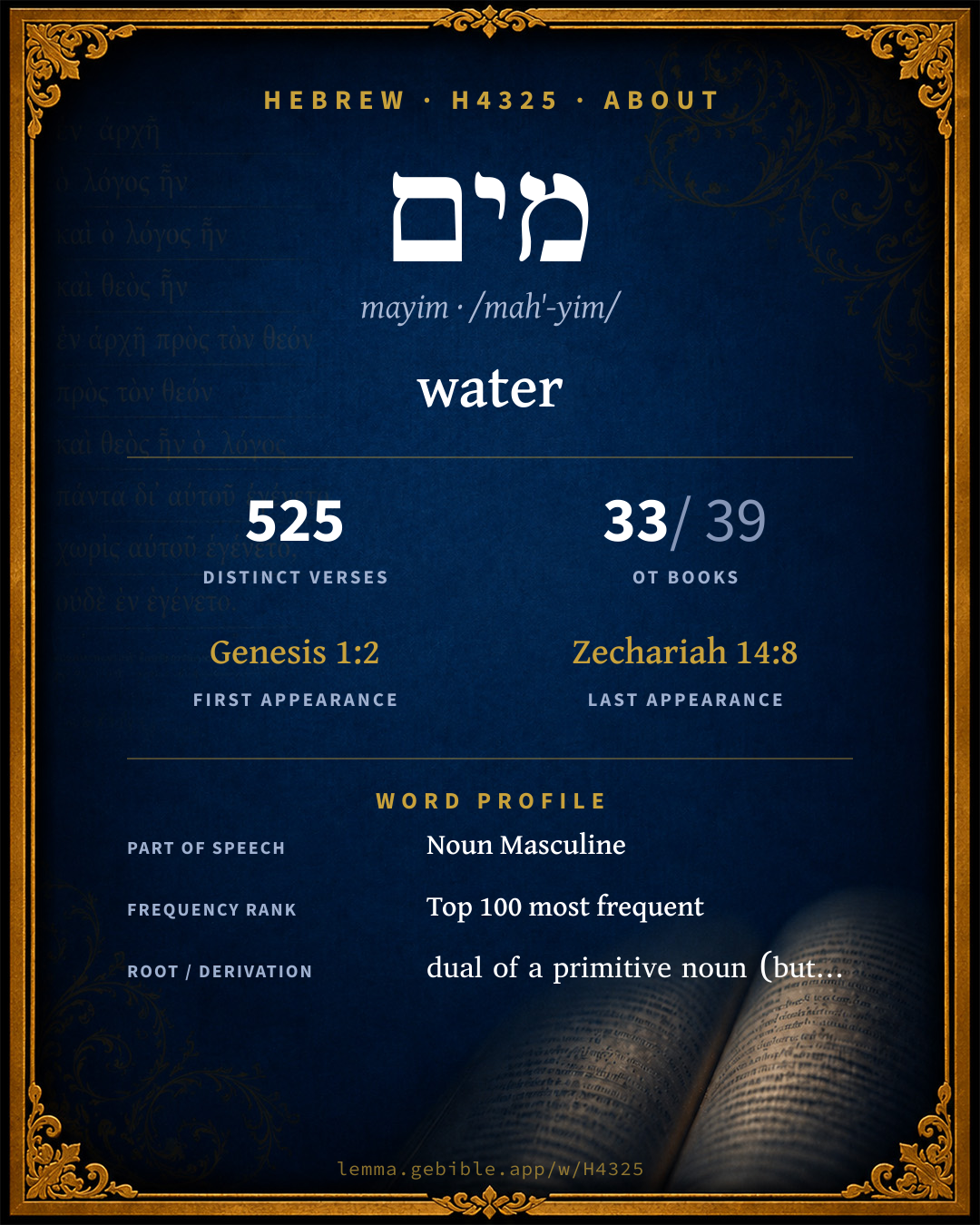
מַי
water
‘water’ is one of 4 main senses fuller range ↓
Full lexicon entry — Brown-Driver-Briggs (BDB)
From Brown-Driver-Briggs (BDB)
Where this word appears
See every Absolute-state word in the Hebrew Bible →
Grammar key — what these labels mean
Part of speech
- Noun
- A naming word — a person, place, thing, or idea.
Noun type
- Common
- A common noun — a general class of person, place, or thing (“king,” “city,” “water”), not a specific name.
State
- Absolute
- The independent form of a noun, not bound to a following word.
- Construct
- A noun bound to a following noun in a possessive / “of” relationship (the construct chain).
Gender
- Masculine
- Grammatically masculine.
Number
- Plural
- More than one (in Hebrew, generally three or more).
- Singular
- One.
17 verses where H4325 appears in the Construct state in the Book of Numbers. Filtered view — show all forms. Click any verse to open its interlinear word-by-word view. Verse text shown in the World English Bible for context — . Each verse’s Hebrew form is shown with its reference; the English is not keyword-highlighted, since the data carries no word-level English alignment. Use “Compare translations” on any verse to read it across multiple English versions. This concordance covers the Hebrew Bible; Septuagint (Greek Old Testament) occurrences are not indexed here.
Numbers
- Numbers 5:18 מֵ֥י n c mp cs The priest shall set the woman before Yahweh, and let the hair of the woman's head go loose, and put the meal offering of memorial in her hands, which is the meal offering of jealousy. The priest shall have in his hand the water of bitterness that brings a curse.
- Numbers 5:19 מִ/מֵּ֛י prep + n c mp cs The priest shall cause her to swear, and shall tell the woman, 'If no man has lain with you, and if you haven't gone aside to uncleanness, being under your husband, be free from this water of bitterness that brings a curse.
- Numbers 5:23 מֵ֥י n c mp cs "The priest shall write these curses in a book, and he shall blot them out into the water of bitterness.
- Numbers 5:24 מֵ֥י הַ/מַּ֥יִם n c mp cs ptcl def.art + n c mp He shall make the woman drink the water of bitterness that causes the curse; and the water that causes the curse shall enter into her and become bitter.
- Numbers 8:7 מֵ֣י n c mp cs Thus shall you do to them, to cleanse them: sprinkle the water of cleansing on them, let them shave their whole bodies with a razor, and let them wash their clothes, and cleanse themselves.
- Numbers 19:9 לְ/מֵ֥י prep + n c mp cs A man who is clean shall gather up the ashes of the heifer, and lay them up outside of the camp in a clean place; and it shall be kept for the congregation of the children of Israel for a water for impurity: it is a sin-offering.
- Numbers 19:13 מֵ֨י n c mp cs Whoever touches a dead person, the body of a man who has died, and doesn't purifies himself, defiles the tent of Yahweh; and that soul shall be cut off from Israel: because the water for impurity was not sprinkled on him, he shall be unclean; his uncleanness is yet on him.
- Numbers 19:20 מֵ֥י n c mp cs But the man who shall be unclean, and shall not purify himself, that soul shall be cut off from the midst of the assembly, because he has defiled the sanctuary of Yahweh: the water for impurity has not been sprinkled on him; he is unclean.
- Numbers 19:21 מֵֽי בְּ/מֵ֣י n c mp cs prep + n c mp cs It shall be a perpetual statute to them: and he who sprinkles the water for impurity shall wash his clothes, and he who touches the water for impurity shall be unclean until even.
- Numbers 20:8 מֵימָ֑י/ו מַ֨יִם֙ n c mp cs + sfx pers 3ms n c mp Take the rod, and assemble the congregation, you, and Aaron your brother, and speak you to the rock before their eyes, that it give forth its water; and you shall bring forth to them water out of the rock; so you shall give the congregation and their cattle drink.
- Numbers 20:13 מֵ֣י n c mp cs These are the waters of Meribah; because the children of Israel strove with Yahweh, and he was sanctified in them.
- Numbers 20:17 מֵ֣י n c mp cs Please let us pass through your land: we will not pass through field or through vineyard, neither will we drink of the water of the wells: we will go along the king's highway; we will not turn aside to the right hand nor to the left, until we have passed your border.
- Numbers 20:19 מֵימֶ֤י/ךָ n c mp cs + sfx pers 2ms The children of Israel said to him, We will go up by the highway; and if we drink of your water, I and my cattle, then will I give the price of it: let me only, without [doing] anything [else], pass through on my feet.
- Numbers 20:24 לְ/מֵ֥י prep + n c mp cs Aaron shall be gathered to his people; for he shall not enter into the land which I have given to the children of Israel, because you rebelled against my word at the waters of Meribah.
- Numbers 21:22 מֵ֣י n c mp cs Let me pass through your land: we will not turn aside into field, or into vineyard; we will not drink of the water of the wells: we will go by the king's highway, until we have passed your border.
- Numbers 27:14 בַ/מַּ֖יִם מֵֽי prep det + n c mp n c mp cs because you rebelled against my word in the wilderness of Zin, in the strife of the congregation, to sanctify me at the waters before their eyes. (These are the waters of Meribah of Kadesh in the wilderness of Zin.)
- Numbers 31:23 בְּ/מֵ֥י בַ/מָּֽיִם prep + n c mp cs prep det + n c mp everything that may abide the fire, you shall make to go through the fire, and it shall be clean; nevertheless it shall be purified with the water for impurity: and all that doesn't withstand the fire you shall make to go through the water.
About this entry
At a glance — auto-summarized from this page’s data, not written by a person. Every figure links to its source below. This summary describes the numbers; it doesn’t interpret them.
מים (mayim) is a Hebrew noun most often rendered “water.” Not a single-sense word: explore its full sense range. With 525 verses in 33 books, it is one of the most common word in the Hebrew Bible. It first appears in Genesis 1:2. It clusters with מידבא, מי הירקון and מי זהב under a shared root. For the data behind this summary, explore the sense tree and the renderings breakdown below.
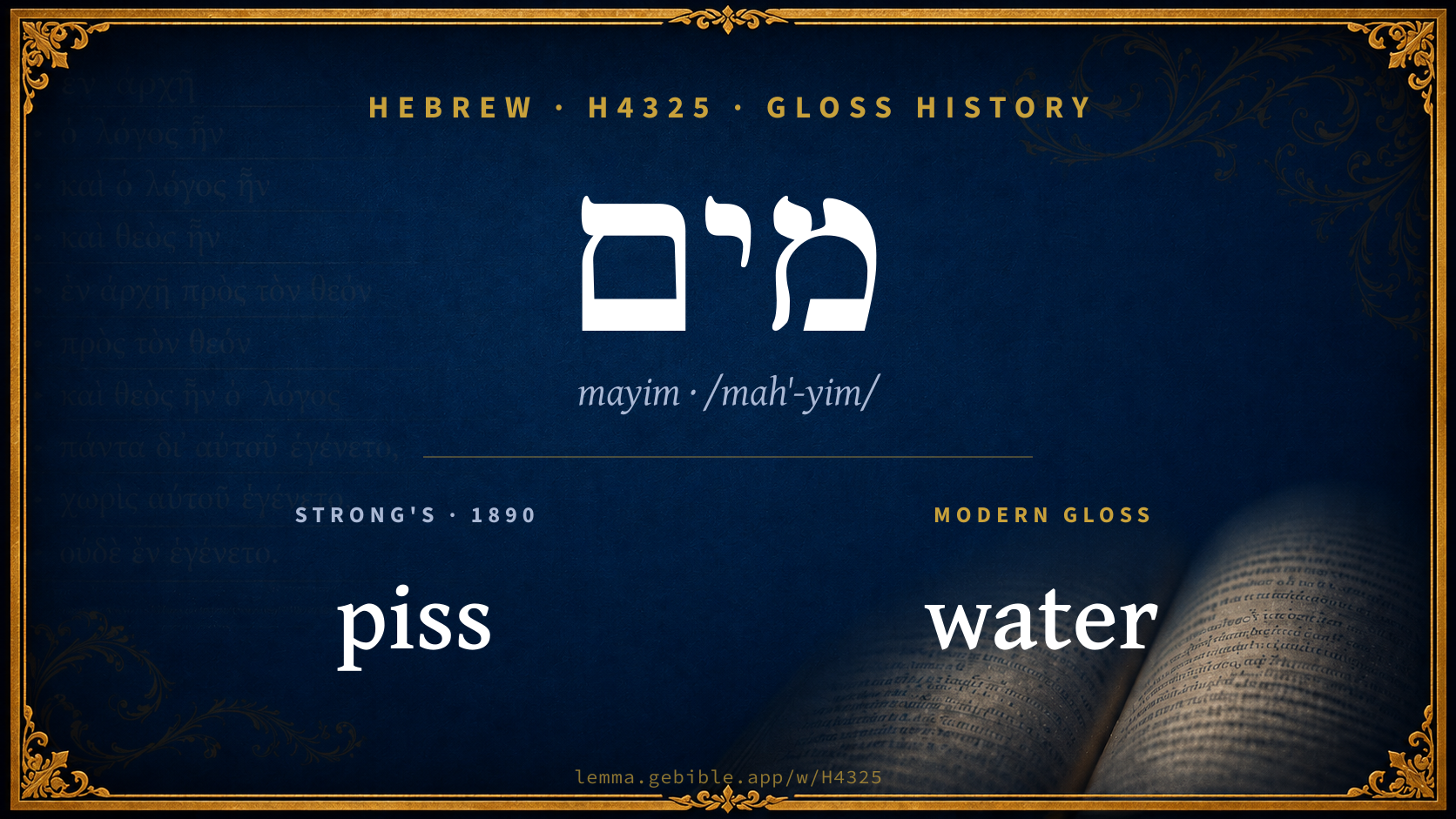
Gloss history
Strong's 1890 vs modern scholarship
About this word
Strong's H4325 catalogs a Hebrew word from the Hebrew Old Testament.
These counts are not copied from any lexicon or concordance. They are computed here, from the morphology-tagged Hebrew Old Testament. What Lemma adds →
- 525
- distinct verses
- The word appears in 525 distinct verses.
- 33 / 39
- OT books
- The word appears in 33 of 39 Old Testament books.
- #85
- by frequency
- Top 100 most frequent Hebrew words (rank 85 of 8,640 Hebrew words by occurrence).
View all 525 occurrences in the concordance →
By section of the Old Testament
By traditional corpus
Conventional, traditional groupings — biblical authorship is debated, so this is a traditional corpus grouping, not an authorship claim. Each share is this word’s portion of its verses in that division of the Hebrew canon. Each figure is a share of the word’s 525 distinct verses.
- Prophets (Nevi'im) 226 verses · 43%
- Torah (Pentateuch) 180 verses · 34%
- Writings (Ketuvim) 119 verses · 23%
How translations render this word
Counts come from each version’s own published word-to-Strong’s tagging or interlinear alignment — an approximate guide to how each version renders this word, not a word-level alignment the data otherwise carries. Because each total is that version’s own tagged count, the per-version totals vary from one another and need not match the appearance or distinct-verse counts above. These counts may also differ from a printed concordance because Lemma counts each distinctly tagged rendering and does not collapse phrase taggings into a single head-word total. This is a fixed set of word-tagged versions (KJV, ASV, BSB, ULT) and does not change with the reading translation you choose elsewhere. Each version’s license is shown beside its name below (and on Sources).
- King James Version: Water 252×, Waters 224×, Himself in water 12×
- American Standard Version: Water 224×, Waters 204×, Himself in water 13×
- Berean Standard Bible: Water 292×, Waters 162×, Like water 14×
- unfoldingWord Literal Text: Water 286×, Waters 175×, Waters of 51×
King James Version Public Domain
Renders H4325 across 578 tagged occurrences — most commonly:
Plus other, less common renderings. Plus 59 renderings that appear only once — usually multi-word phrases or single function words the recovered tagging swept in, not distinct renderings. Not rendered by a distinct English word in 4 further occurrences.
American Standard Version Public Domain
Renders H4325 across 575 tagged occurrences — most commonly:
Plus other, less common renderings. Plus 97 renderings that appear only once — usually multi-word phrases or single function words the recovered tagging swept in, not distinct renderings. Not rendered by a distinct English word in 1 further occurrence.
Berean Standard Bible Public Domain
Renders H4325 across 532 tagged occurrences — most commonly:
Plus 48 renderings that appear only once — usually multi-word phrases or single function words the recovered tagging swept in, not distinct renderings. Not rendered by a distinct English word in 43 further occurrences.
unfoldingWord Literal Text CC BY-SA 4.0
Renders H4325 across 606 tagged occurrences — most commonly:
Plus other, less common renderings. Plus 22 renderings that appear only once — usually multi-word phrases or single function words the recovered tagging swept in, not distinct renderings.
25 senses and sub-senses in the full BDB
What do BDB’s symbols mean?
BDB uses these scholarly abbreviations:
| Symbol | Meaning |
|---|---|
| 𝔊 | the Septuagint (the ancient Greek translation, LXX) |
| 𝔙 | the Vulgate (the Latin translation) |
| 𝔖 | the Syriac version (the Peshitta) |
| 𝔗 | the Targum (the Aramaic translation) |
| ψ | the Psalms |
| √ | root (the underlying root or stem) |
| ‖ | parallel passage (a synonymous or contrasted parallel) |
| † | the dagger: every passage where the word occurs is cited |
The 25 senses and sub-senses the full Brown-Driver-Briggs lexicon distinguishes for this word, in lexicon order (not ranked by frequency), with BDB’s own verbatim wording and sub-sense lettering. Shown in Hebrew script with BDB’s own scholarly abbreviations. The condensed entry is in the Lexicon Entry tab. See also the Forms in the corpus table below.
- 1.
- a. water, of a spring or well (עַיִן, בְּאֵר) Gn 16:7; 24:11, 13(×2), 43 Ex 15:27(×2) (J), Gn 21:19, 25 Nu 20:17; 21:16 (E), etc.; for drinking, also Am 4:8; 8:11 Jon 3:7 + often; out of rock Ex 17:6 (E), Nu 20:8(×2), 10, 11 (P), Dt 8:15 etc.; מֵי מְרִיבָה (RSSem. i. 165. 2nd ed. 181) Nu 20:13, 24; 27:14 (P), Dt 33:8 ψ 81:8 106:32; cf. Dt 32:51 Ez 47:19; 48:28; for washing (hands, feet, person) Gn 18:4; 24:32; 43:24 (J), 2 K 3:11, Ex 29:4; 30:20 Lv 15:5, 6 + (P); (victims) Lv 1:9, 13; 8:21 (P); (vessels) Lv 6:21; 11:32, 34 (P); (garments) Lv 15:17 Nu 19:8 (P); for cooking Ex 12:9 (P), cf. Is 64:1 Ez 24:3 (symbol.); for purification Nu 8:7 (מֵי חַטָּאת), 19:9 (מֵי נִדָּה), cf. v 13, 18, 20, 21, 20:13; 31:23(×2) (all P), Ez 36:25 (fig.). e.g. Genesis 16:7
- b. of a river, Nile Ex 2:10; 4:9(×2) (J), Je 2:18 etc.; Jordan Jos 3:8 (D), v 15, 16 (JE), etc.; Euphrates Is 8:7 (fig.), Je 2:18; Ezek.’s river Ez 47:1(×2), 2 +, etc.; of streams, canals, etc., especially as condition of fertility Dt 8:7; 10:7 Is 1:30 Pr 30:16 2 K 3:17 +, etc. e.g. Exodus 2:10
- c. of sea Am 5:8; 9:6; Red Sea Ex 15:8, 10, 19 (song), 14:21, 22, 26 + (P), Jos 2:10 (D), etc. e.g. Amos 5:8
- d. of flood Gn 7:7, 10; 8:3, 7, 8, 9, 11 (J), 6:17; 7:6, 17, 18(×2) 19; 8:5; 9:11, 15 (P); so מֵי־נֹחַ Is 54:9(×2) waters of Noah. e.g. Genesis 7:7
- e. subterranean Ex 20:4 (E), Dt 4:18; 5:8, cf. Jb 26:5 ψ 136:6. e.g. Exodus 20:4
- f. in clouds Je 10:13 Jb 26:8 ψ 29:3(×2) 104:3; 148:4, etc. e.g. Jeremiah 10:13
- g. of rain Ju 5:4 2 S 21:10 Dt 11:11 ψ 65:10 Jb 5:10 (‖ מָטָר), etc. e.g. Judges 5:4
- h. of dew Ju 6:38. e.g. Judges 6:38
- i. primæval deep Gn 1:2, 6 (P). e.g. Genesis 1:2
- 2. c. nomm. pr. loc. (q.v.), to denote springs, streams, or seas belonging to, near, such places: מֵימֵי מִצְרַיִם Ex 7:19; 8:2; מֵי מְרִיבָה (v. supr. 1 a); מֵי מֵרוֹם Jos 11:5, 7; מֵי עֵין־שֶׁמֶשׁ Jos 15:7; מֵי נֶפְתּוֹחַ 15:9; 18:15; מֵי יְרִיחוֹ 16:1; מֵי מְגִּדּוֹ Ju 5:19; מֵי נִמְרִ(יִ)ם Is 15:6 Je 48:34; מֵי דִימוֹן Is 15:9; cf. מֵי הַשִּׁלֹּחַ Is 8:6; מֵימֵי גִּיחוֹן הָעֶלְיוֹן 2 Ch 32:30; cf. also n. pr. loc. מִשְׂרְפוֹת מַיִם Jos 11:8; 13:6. e.g. Exodus 7:19
- 3. special uses are: מֵי רַגְלַיִם water of the feet = urine 2 K 18:27 = Is 36:12; cf. בְּמֵי מַדְמֵנָה Is 25:10 Kt in water of a dunghill (> Qr בְּמוֹ); מַיִם לַחַץ water (which is) distress, because drunk in imprisonment 1 K 22:27 (‖ לֶחֶם לַחַץ) = 2 Ch 18:26; בְּמֵי־שָׁ֑לֶג in snow-water Jb 9:30 Qr (Kt במו; Me Hoffm Siegfr כְּמוֹ), מֵימֵי שֶׁלֶג 24:19; מַיִם קְדשִׁים †Nu 5:17 holy water (cf. RSSem. 165, 2nd ed. 181, but text dubious, v. Di); מֵי הַמָּרִים bitter water †Nu 5:18, 19, 23, 24; cf. Ex 15:23 (בִּי מָרִים הֵם), opp. וַיִּמְתְּקוּ הַמַּיִם v 25 and the waters were sweetened; מֵי חַטָּאת, מֵי נִדָּה v. supr. 1 a; מַיִם חַיִּים living (i.e. running) water Lv 14:5, 6, 50, 51, 52 Nu 19:17, also (fig.) Zc 14:8 (cf. Ez 47), and (fig.) Je 2:13; 17:13. See also infr. (cf. Nu 21:17, 18; v. RSSem. i. 127, 157; 2nd ed. 135, 176). e.g. 2 Kings 18:27
- 4. among fig. uses are:
- a. of danger or distress Is 43:2 ψ 66:12; 69:2 La 3:54; usually many waters 2 S 22:17 = ψ 18:17, cf. Jb 22:11 ψ 32:6; 144:7, or deep waters ψ 69:3, 15, cf. v 16; also מֵי־רֹאשׁ water of gall Je 8:14; 9:14; 23:15. e.g. Isaiah 43:2
- b. פֶּרֶץ מַיִם 2 S 5:20 = 1 Ch 14:11 of outbursting force. e.g. 2 Samuel 5:20
- c. שְׁאוֹן מַיִם Is 17:12, 13 or rushing nations. e.g. Isaiah 17:12
- d. of what is impetuous, violent, overwhelming Is 28:2, 17 Ho 10:7 Jb 27:20 ψ 124:4, 5; 88:18; sim. of impetuousness פַּחַז כַּמַּיִם Gn 49:4. e.g. Isaiah 28:2
- e. (as running away) of heart in timidity Jos 7:5, cf. ψ 22:15, of knees Ez 7:17; 21:12. e.g. Joshua 7:5
- f. of transitoriness Jb 11:16; 24:18 ψ 58:8. e.g. Job 11:16
- g. of refreshment Is 32:2; 49:10; spiritual 12:3. e.g. Isaiah 32:2
- h. מֵי מְנֻחוֹת ψ 23:2 in fig. of rest and peace, cf. Je 31:9. e.g. Psalms 23:2
- i. of reckless bloodshed (poured out like water) ψ 79:3; cf. pouring away (and not eating) blood Dt 12:16, 24; 15:23. e.g. Psalms 79:3
- j. בְּאֵר מַיִם חַיִּים Ct 4:15 fig. of bride; מַיִם מִבּוֹרֶ֑ךָ Pr 5:15 of enjoyment of one’s own wife; of harlotry מַיִם גְּנוּבִים Pr 9:17 stolen waters. e.g. Song of Solomon 4:15
- k. of outpoured wrath of י׳ Ho 5:10. e.g. Hosea 5:10
- l. of abundant justice Am 5:24. e.g. Amos 5:24
- m. of outpoured feelings Jb 3:24; שִׁפְכִי כַמַּיִם לִבֵּךְ La 2:19.—Is 48:1 read prob. מִמְּעֵי for MT מִמֵּי, so Secker Du CheHpt Skinner, cf. Di. e.g. Job 3:24
Senses from the full Brown-Driver-Briggs lexicon (Brown, Driver, Briggs; Oxford 1906 — public domain), digitized via Sefaria, supplemented by the OpenScriptures HebrewLexicon (CC BY 4.0). Full attribution on Sources.
Word origin
n.m. 2 S 14:14 only pl. מַ֫יִם waters, water (NH id.; MI 23 [ין]מ; SI 5 המים; Aramaic מַיָּא, מַיִּין, ܡܰܝܴ̈ܐ; Assyrian mû, pl. mê, also mâmu DlHWB 394; Arabic مَآءٌ; Ethiopic ማይ, pl. ማያት; Sab. [מו], מום, pl. מון, Min. [מה], pl. מהן DHM6th Or. Congr. (Leiden) ii. 1, 451 f. (v. on these forms BaZMG xiii, 1888, 341 ff.));—מַ֫יִם (מָ֑יִם) Gn 1:2 +; הַמַּ֫יְמָה Ex 7:15; 8:16; cstr. מֵי Gn 7:7 + 71 times; מֵימֵי Ex 4:9 + 10 times + Qr 2 K 18:27 = Is 36:12; sf. מֵימַי Ho 2:7 + 1 S 25:11 (but read here יֵינִי 𝔊 Ew Th We Klo Dr Kit Bu); מֵימֶ֫יךָ Ex 23:25 + 3 times; מֵימָיו Nu 20:8 + 6 times; מֵימֶיהָ Je 6:7; 50:38; מֵימֵינוּ La 5:4; מֵימֵיהֶם Ex 7:19 + 4 times;—waters, water (c. adj. pl. Gn 26:19 Ex 15:10 Lv 14:5, 6, 50 + often, so always c. adj.; also c. pt. pl. Nu 5:18, 19, 24 2 K 3:20 +; c. pron. pl. Nu 20:13; 27:14 2 K 2:21 +; cf. sf. Jos 4:18; before pl. vb. Gn 1:9, 20, 21; 7:17 + often; after pl. vb. Jos 3:13 Is 28:17 Pr 9:17 Ez 31:4 +; rarely c. sg. vb.; before, Gn 9:15 Lv 11:34 Nu 20:2; 24:7; 33:14 2 K 3:9; after, Nu 19:13, 20);—
— Brown-Driver-Briggs (Oxford 1906, public domain), digitized via Sefaria, supplemented by the OpenScriptures HebrewLexicon (CC BY 4.0). See Sources.
Origin: dual of a primitive noun (but used in a singular sense)
Jastrow Dictionary
A second Hebrew/Aramaic lexicon for comparison, covering Aramaic and post-biblical (Talmudic, Targumic, Midrashic) usage that the biblical-Hebrew BDB does not. Matched by lemma rather than by Strong’s number, so a lemma may carry more than one Jastrow headword (shown separately below), and the entries cover usage well beyond the Bible.
מַיִם
- water, fluid; secretion; solution. Constr. מֵי; pl. מֵימוֹת, constr. מֵימֵי. Snh. 108ᵃ גלגל העין שדומה למ׳ the eye-ball which (in restlessness) resembles water, v. גַּלְגַּל. Par. VIII, 9 המ׳ המוכים וכ׳ smitten waters (springs or lakes formed through a catastrophe, v. Snh. l. c.). Ib. המ׳ המכזבים, v. כָּזַב; a. v. fr.—מ׳ ראשונים, מ׳ אחרונים &c., v. respective determinants.—מֵי פירות juice of fruits (wine, date-honey, &c.). Pes. 35ᵃ sq.; a. fr.—מֵי רגלים urin. Ker. 6ᵃ; a. fr.—בֵּית המ׳ urinary. Meg. III, 2; Y. Ber. II, 4ᶜ bot.—Ḥag. 3ᵃ מֵימֶיךָ אנו שותין we drink thy water, i.e. we depend on thy teaching; B. Mets. 84ᵇ מֵימֵיהֶן אנו שותין; Hor. 14ᵃ; a. e.—Taan. 16ᵃ כל מימות וכ׳ all the waters of the world; a. fr.
A Dictionary of the Targumim, the Talmud Babli and Yerushalmi, and the Midrashic Literature (Marcus Jastrow; London, Luzac, 1903) — Public Domain. Digitized via Sefaria. Digitized via Sefaria. Full attribution on Sources.
Forms in the corpus
The 158 distinct written forms H4325 takes in the Hebrew Bible, most frequent first — each parse links to that state’s occurrences in the concordance. Hebrew forms include their vowel points and cantillation, so a single lemma takes many written forms.
The 60 most common forms are shown; 98 rarer forms follow in the full concordance.
Same root — word family
Other BDB entries built from the same root as H4325, grouped by Strong’s listed origin. These share a root / origin per the lexicon — not necessarily a shared meaning. Each links to that word’s own entry.
Proper names from this root
People and places named from this root — a name, not an additional meaning of the word.
- מידבא Mêydᵉbâʼ H4311 Medeba
- מי הירקון Mêy hay-Yarqôwn H4313 Me-jarkon
- מי זהב Mêy Zâhâb H4314 Mezahab
Compare all same-root words → 3 of the same-root words are proper names (people or places). They share a root, not necessarily a meaning.
Septuagint verse parallels
This word appears in 494 verses that also exist in the Greek Old Testament (Septuagint), out of the 525 Hebrew verses it occurs in. You can read those verses in Greek by switching the Old Testament edition to the Septuagint.
Read these verses in the Septuagint
- Genesis 1:2
- Exodus 2:10
- Leviticus 1:9
- Numbers 5:17
- Deuteronomy 2:6
- Joshua 2:10
- Judges 1:15
- 1 Samuel 7:6
- 2 Samuel 5:20
- 1 Kings 13:8
- 2 Kings 2:8
- 1 Chronicles 11:17
This is a verse-level parallel only — the same verses exist in both the Hebrew and Greek Old Testaments. No word-level Hebrew↔Greek correspondence is claimed: the data carries no such alignment, so no Greek word is shown as this Hebrew word’s translation. Coverage is not total — the Septuagint omits the deuterocanon and renumbers the Psalms, so some Hebrew verses have no direct Greek parallel.