Isaiah 17:12

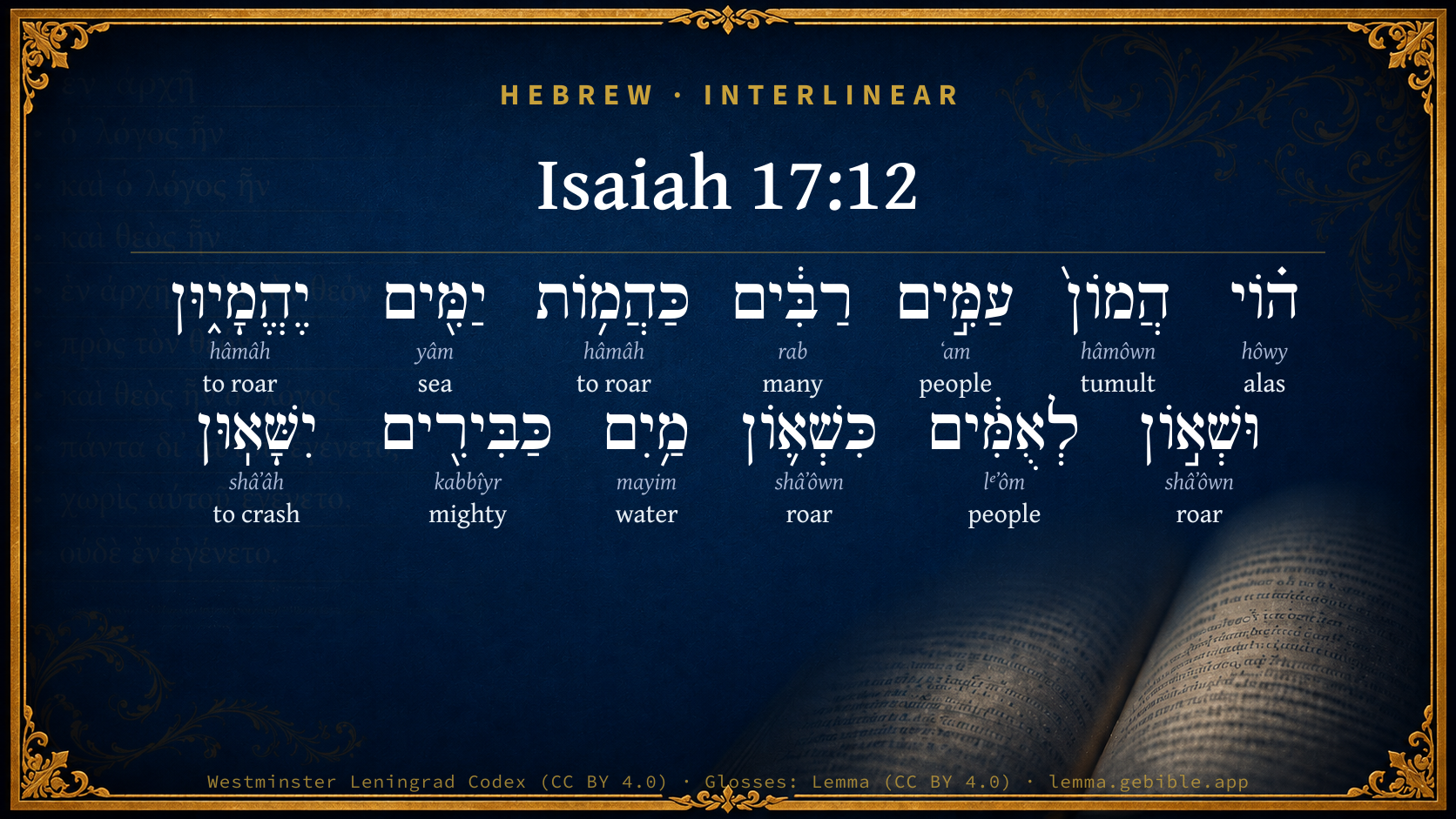
Hebrew (Westminster Leningrad Codex) Isaiah 17:12 appears in the Hebrew Old Testament. The text above is from the Westminster Leningrad Codex. Each word links to its Strong’s number, a concise gloss, and parsing drawn from the Open Scriptures Hebrew Bible morphology. Click any word for its full Brown-Driver-Briggs (BDB) entry.
Download image
Cite this verse

Isaiah 17:12 (World English Bible). Public Domain. Lemma interlinear Bible study tool, https://lemma.gebible.app/v/isaiah/17/12.

Show BibTeX & RIS
BibTeX
RIS
English Translation
Ah, the uproar of many peoples, who roar like the roaring of the seas; and the rushing of nations, that rush like the rushing of mighty waters!
World English Bible · Public Domain
Download a study sheet

One document with this verse’s original text, its word-by-word gloss line, the meaning frame, cross-references with their text, attributed commentary, and full source and license credits — printable, and it pastes into notes with its structure intact.

This verse Autodidact and up

Study sheet (.html) Plain text (.txt)

A passage Seminary Student

Up to 50 verses in one chapter. A passage sheet keeps up to 6 commentary sources and 12 cross-references per verse, in the order this page ranks them, and says so on the sheet whenever that leaves anything out. Ask for a single verse and you get the Autodidact verse sheet above.

Everything on this page stays free to read, with no account — the sheet is a download of what is already on screen, not access to it.

Want to remove ads? Support Godless Engineer
Compare translations 3

The same verse in 3 English versions, stacked beneath the original-language interlinear above. Click any original word for its lexicon entry.

Each is an independent rendering of the whole verse — the interlinear is not word-aligned to these translations.

Highlighted words mark where these versions differ — a whole-verse word diff, not a word-by-word alignment.

  • World English Bible Public Domain
    Ah, the uproar of many peoples, who roar like the roaring of the seas; and the rushing of nations, that rush like the rushing of mighty waters!
  • King James Version Public Domain
    Woe to the multitude of many people, which make a noise like the noise of the seas; and to the rushing of nations, that make a rushing like the rushing of mighty waters!
  • unfoldingWord Literal Text CC BY-SA 4.0
    Woe to the multitude of many peoples! Like the raging of the seas, they rage. And the roar of peoples! Like the roar of mighty waters, they roar.

unfoldingWord Literal Text — © unfoldingWord, licensed CC BY-SA 4.0. Word-aligned USFM3 via Door43 (git.door43.org/unfoldingWord/en_ult).

Versions to compare (up to 4)

3 of 4 selected

Show all 18 translations

Every available English version of this verse, each an independent rendering of the whole verse.

  • World English Bible Public Domain
    Ah, the uproar of many peoples, who roar like the roaring of the seas; and the rushing of nations, that rush like the rushing of mighty waters!
  • Berean Standard Bible Public Domain
    Alas, the tumult of many peoples; they rage like the roaring seas and clamoring nations; they rumble like the crashing of mighty waters.
  • Majority Standard Bible Public Domain
    Alas, the tumult of many peoples; they rage like the roaring seas and clamoring nations; they rumble like the crashing of mighty waters.
  • King James Version Public Domain
    Woe to the multitude of many people, which make a noise like the noise of the seas; and to the rushing of nations, that make a rushing like the rushing of mighty waters!
  • American Standard Version (1901) Public Domain
    Ah, the uproar of many peoples, that roar like the roaring of the seas; and the rushing of nations, that rush like the rushing of mighty waters!
  • Revised Version (1885) Public Domain
    Ah, the uproar of many peoples, which roar like the roaring of the seas; and the rushing of nations, that rush like the rushing of mighty waters!
  • Geneva Bible (1599) Public Domain
    Ah, the multitude of many people, they shall make a sounde like the noyse of the sea: for the noyse of the people shall make a sounde like the noyse of mightie waters.
  • Douay-Rheims (1899) Public Domain
    Woe to the multitude of many people, like the multitude of the roaring sea: and the tumult of crowds, like the noise of many waters.
  • Young's Literal Translation Public Domain
    Wo `to' the multitude of many peoples, As the sounding of seas they sound; And `to' the wasting of nations, As the wasting of mighty waters they are wasted.
  • Literal Standard Version CC BY-SA 4.0
    Woe [to] the multitude of many peoples, || They sound as the sounding of seas; And the roaring of nations, || As the roaring of mighty waters [that] make a crashing.
  • Unlocked Literal Bible CC BY-SA 4.0
    Woe! The uproar of many peoples, that roar like the roaring of the seas, and the rushing of nations, that rush like the rushing of mighty waters!
  • unfoldingWord Literal Text CC BY-SA 4.0
    Woe to the multitude of many peoples! Like the raging of the seas, they rage. And the roar of peoples! Like the roar of mighty waters, they roar.
  • Darby Bible Public Domain
    Ha! a tumult of many peoples! they make a noise as the noise of the seas; -- and the rushing of nations! they rush as the rushing of mighty waters.
  • World Messianic Bible Public Domain
    Ah, the uproar of many peoples who roar like the roaring of the seas; and the rushing of nations that rush like the rushing of mighty waters!
  • Webster's Bible Public Domain
    Woe to the multitude of many people, who make a noise like the noise of the seas; and to the rushing of nations, that make a rushing like the rushing of mighty waters!
  • Free Bible Version CC BY-SA 4.0
    Disaster is coming to the many nations that growl, growling like the raging sea! Disaster is coming to the peoples who roar, roaring like thundering waters!
  • Bible in Basic English Public Domain
    Ah! the voice of peoples, like the loud sounding of the seas, and the thundering of great nations rushing on like the bursting out of waters!
  • JPS Tanakh (1917) Public Domain
    Ah, the uproar of many peoples, that roar like the roaring of the seas; and the rushing of nations, that rush like the rushing of mighty waters!

Literal Standard Version (2020), Covenant Press — licensed CC BY-SA 4.0. Text via the HelloAO Bible API (eBible.org). Unlocked Literal Bible (unfoldingWord) — licensed CC BY-SA 4.0. Text via the HelloAO Bible API (eBible.org). unfoldingWord Literal Text — © unfoldingWord, licensed CC BY-SA 4.0. Word-aligned USFM3 via Door43 (git.door43.org/unfoldingWord/en_ult). Free Bible Version, Dr. Jonathan Gallagher — licensed CC BY-SA 4.0. Text via the HelloAO Bible API (eBible.org).

Word by word

More ways to search: Search by grammar → Find every occurrence → Compare this word →

Practice this passage: Drill this verse → Learn its vocabulary →

יִשָּׁאֽוּן
shâʼâh
H7582
“to crash”
Verb, Niphal, Imperfect, 3rd Person, Masculine, Plural + Suffix, n
Part of Speech
Verb
Stem
Niphal
Form
Imperfect
Person
3rd Person
Gender
Masculine
Number
Plural
Full BDB Definition

Origin: a primitive root

TWOT: 2301

crash, make a din or crash, crash into ruins, be in ruins, be desolated - (Qal) to crash into ruins - (Niphal) - to be ruined - to crash - to be left (a desolation) - (Hiphil) - to cause to crash - to cause to be desolated
  1. ה֗וֹי hôwy H1945 “alas” Particle, Interjection
  2. הֲמוֹן֙ hâmôwn H1995 “tumult of” Noun, Common, Masculine, Singular, Construct
  3. עַמִּ֣ים ʻam H5971 “peoples” Noun, Common, Masculine, Plural, Absolute
  4. רַבִּ֔ים rab H7227 “many” Adjective, Adjective, Masculine, Plural, Absolute
  5. כַּהֲמ֥וֹת hâmâh H1993 “like/as · to roar” Preposition + Verb, Qal, Infinitive Construct
  6. יַמִּ֖ים yâm H3220 “seas” Noun, Common, Masculine, Plural, Absolute
  7. יֶהֱמָי֑וּן hâmâh H1993 “to roar” Verb, Qal, Imperfect, 3rd Person, Masculine, Plural + Suffix, n
  8. וּשְׁא֣וֹן shâʼôwn H7588 “and · roar of” Conjunction + Noun, Common, Masculine, Singular, Construct
  9. לְאֻמִּ֔ים lᵉʼôm H3816 “peoples” Noun, Common, Masculine, Plural, Absolute
  10. כִּשְׁא֛וֹן shâʼôwn H7588 “like/as · roar of” Preposition + Noun, Common, Masculine, Singular, Construct
  11. מַ֥יִם mayim H4325 “water(s)” Noun, Common, Masculine, Plural, Absolute
  12. כַּבִּירִ֖ים kabbîyr H3524 “mighty” Adjective, Adjective, Masculine, Plural, Absolute

About this verse

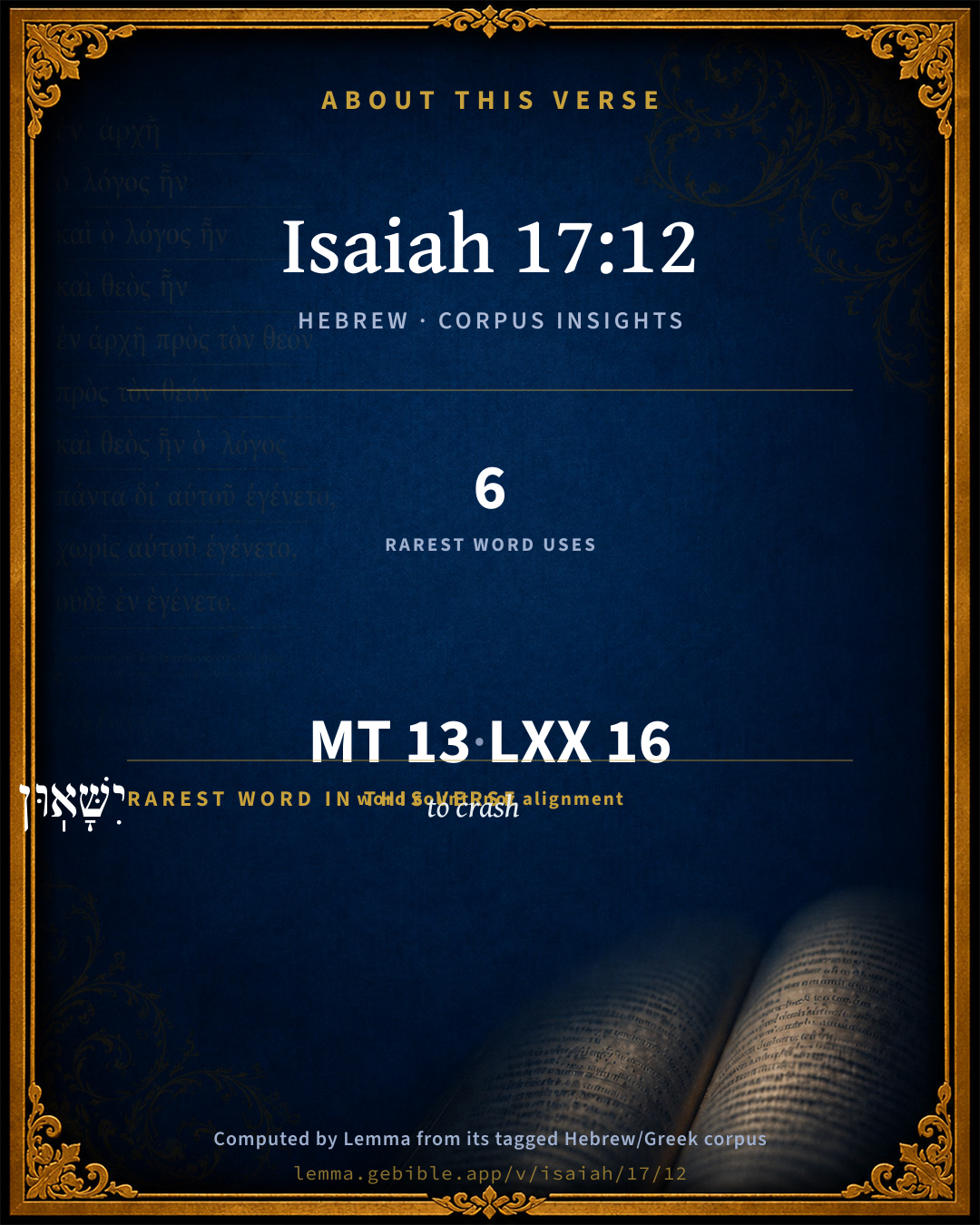
These counts appear in no published source. They are computed here, from the morphology-tagged text and Lemma’s own curated glosses. What Lemma adds →

13
words
11
distinct lemmas
Prophets
section

Notable vocabulary

The rarest word here is יִשָּׁאֽוּן to crash H7582 — appearing just 6 times in the whole Hebrew Bible.

Shared distinctive vocabulary

יִשָּׁאֽוּן to crash H7582 occurs in 5 verses of the Hebrew Bible. Also found in:

Grammatical profile

  • 3 verbs
  • 7 nouns
  • 2 adjectives
  • 1 particle

Verb forms

  • כַּהֲמ֥וֹת Qal · Infinitive Construct
  • יֶהֱמָי֑וּן Qal · Imperfect
  • יִשָּׁאֽוּן Niphal · Imperfect

Repetition

Words recur within this verse — often emphatic in Hebrew:

  • כַּהֲמ֥וֹת to roar H1993 ×2
  • וּשְׁא֣וֹן roar H7588 ×2

Hebrew & Septuagint length

In English translation the verse runs 27 words from the Hebrew and 26 from the Septuagint (LXX English) — closely comparable.

A rough comparison of the two English renderings, which tokenize alike — not a word-level alignment.

Word counts can differ between the Hebrew and the Greek without any difference in meaning — e.g. the Hebrew direct-object marker אֵת has no separate Greek word, and Greek often adds the article ὁ.

In the original languages it is 13 Hebrew tokens and 16 Greek tokens — but the two are counted differently (Hebrew bundles its prefixes and suffixes into one token; the Greek is in lemma form), so that isn’t a like-for-like length.

Cross-references

14

Topical passages linked to Isaiah 17:12 in the Treasury of Scripture Knowledge — connected by theme and wording, ordered by reader-vote popularity; previews shown in the World English Bible.

  • Psalms 18:4 The cords of death surrounded me. The floods of ungodliness made me afraid.
  • Jeremiah 6:23 They lay hold on bow and spear; they are cruel, and have no mercy; their voice roars like the sea, and they ride on horses, everyone set in array, as a man to the battle, against you, daughter of Zion.
  • Luke 21:25 There will be signs in the sun, moon, and stars; and on the earth anxiety of nations, in perplexity for the roaring of the sea and the waves;
  • Ezekiel 43:2 Behold, the glory of the God of Israel came from the way of the east: and his voice was like the sound of many waters; and the earth shined with his glory.
  • Revelation 17:1 One of the seven angels who had the seven bowls came and spoke with me, saying, "Come here. I will show you the judgment of the great prostitute who sits on many waters,
  • Revelation 17:15 He said to me, "The waters which you saw, where the prostitute sits, are peoples, multitudes, nations, and languages.
  • Psalms 29:3 Yahweh's voice is on the waters. The God of glory thunders, even Yahweh on many waters.
  • Psalms 46:1–3 God is our refuge and strength, A very present help in trouble.
  • Psalms 65:6–7 Who by his power forms the mountains, Having armed yourself with strength;
  • Isaiah 5:26–30 He will lift up a banner to the nations from far, And he will whistle for them from the end of the earth. Behold, they will come speedily and swiftly.
  • Isaiah 8:7–8 now therefore, behold, the Lord brings up on them the waters of the River, strong and many, [even] the king of Assyria and all his glory: and it shall come up over all its channels, and go over all its banks;
  • Isaiah 28:17 I will make justice the line, and righteousness the plummet; and the hail shall sweep away the refuge of lies, and the waters shall overflow the hiding-place.
  • Psalms 93:3–4 The floods have lifted up, Yahweh, The floods have lifted up their voice. The floods lift up their waves.
  • Isaiah 9:5 For all the armor of the armed man in the tumult, and the garments rolled in blood, shall be for burning, for fuel of fire.

Cross-references courtesy of OpenBible.info (CC BY 4.0).

Hebrew and Greek witnesses Masoretic Hebrew ↔ Greek Septuagint

The same verse in the two great witnesses to the Old Testament, shown verse-for-verse.

These are two independent witnesses, not word-aligned to each other, and the Septuagint is shown in lemma (dictionary) form.

Hebrew Isaiah 17:12 Masoretic · Westminster Leningrad Codex

ה֗וֹי הֲמוֹן֙ עַמִּ֣ים רַבִּ֔ים כַּהֲמ֥וֹת יַמִּ֖ים יֶהֱמָי֑וּן וּשְׁא֣וֹן לְאֻמִּ֔ים כִּשְׁא֛וֹן מַ֥יִם כַּבִּירִ֖ים יִשָּׁאֽוּן

Ah, the uproar of many peoples, who roar like the roaring of the seas; and the rushing of nations, that rush like the rushing of mighty waters!

World English Bible · Public Domain

Greek LXX Isaiah 17:12 Septuagint · lemma form

οὐαί πλῆθος ἔθνος πολύς ὡς θάλασσα κυμαίνω οὕτως ταράσσω καί νῶτος ἔθνος πολύς ὡς ὕδωρ ἠχέω

Woe to the multitude of many nations, as the swelling sea, so shall you⌃ be confounded; and the force of many nations shall sound like water;

LXX2012 (modern English Septuagint) · Public Domain

Hebrew: Westminster Leningrad Codex (CC BY 4.0). Greek: Septuagint (public domain); English from LXX2012 (modern English Septuagint) (Public Domain). How the Septuagint differs from the Hebrew →

Targum (Aramaic paraphrase)

1

The Targum is the ancient Jewish Aramaic paraphrase of the Hebrew Scriptures — an interpretive translation, not the Hebrew text itself. Onkelos (literal) and Pseudo-Jonathan (expansive) render the Torah, and Jonathan the Prophets. Coverage is partial: where no permissively-licensed English translation exists for a verse, only the Aramaic is shown. This is verse-level text, not a word-by-word alignment to the Hebrew.

  1. Targum Jonathan Prophets (Joshua–Malachi)
    וַי הֲמוֹן עַמְמִין סַגִיאִין דִי כְמַהֲמֵי יַמָא הָמָן וְאִתְרְגוּשַׁת מַלְכְּוָן דִכְאִתְרְגוּשַׁת מַיִין תַּקִיפִין מִתְרַגְשִׁין:

    Woe to the multitude of many people, which make a noise like the noise of the sea, and to the tumultuous assembly of kings, which roar like the roaring of mighty waters.

    Targum Jonathan — Aramaic: “Mikraot Gedolot” (public domain). English: “Sefaria Community Translation” (CC0 1.0 (public-domain dedication)); “London "Chaldee Paraphrase," 1871” (public domain). Text via Sefaria.

Commentary

Notes on Isaiah 17:12 from classic Christian and Jewish commentators (each source and its license shown beneath its notes). The classic Christian expositions comment on the surrounding passage and are grouped to its opening verse, so a note may address several verses; the Jewish commentaries on the Tanakh (Rashi and others) are per-verse, so they appear only where the commentator wrote on this verse.

Lemma curates 59 commentaries, every one of them public domain or Creative Commons licensed, each selected and text-cleaned for this edition rather than reprinted as found. About our sources →

Matthew Henry's Commentary

These verses read the doom of those that spoil and rob the people of God. If the Assyrians and Israelites invade and plunder Judah, if the Assyrian army take God's people captive and lay their country waste, let them know that ruin will be their lot and portion. They are here brought in, 1. Triumphing over the people of God. They relied upon their numbers. The Assyrian army was made up out of divers nations: it was the multitude of many people (Isa 17:12), by which weight they hoped to carry the cause. They were very noisy, like the roaring of the seas; they talked big, hectored, and threatened, to frighten God's people from resisting them, and all their allies from sending in to their aid. Sennacherib and Rabshakeh, in their speeches and letters, made a mighty noise to strike a terror upon Hezekiah and his people; the nations that followed them made a rushing like the rushing of many waters, and those mighty ones, that threaten to bear down all before them and carry away every thing that stands in their way. The floods have lifted up their voice, have lifted up their waves; such is the tumult of the people, and the heathen, when they rage, Psa 2:1; Psa 93:3. 2. Triumphed over by the judgments of God. They thought to carry their point by dint of noise; but woe to them (Isa 17:12), for he shall rebuke them, that is, God shall, one whom they little think of, have no regard to, stand in no awe of; he shall give them a check with an invisible hand, and then they shall flee afar off. Sennacherib, and Rabshakeh, and the remains of their forces, shall run away in a fright, and shall be chased by their own terrors, as the chaff of the mountains which stand bleak before the wind, and like a rolling thing before the whirlwind, like thistle-down (so the margin); they make themselves as chaff before the wind (Psa 35:5) and then the angel of the Lord (as it follows there), the same angel that slew many of them, shall chase the rest. God will make them like a wheel, or rolling thing, and then persecute them with his tempest and make them afraid with his storm, Psa 83:13, Psa 83:15. Note, God can dispirit the enemies of his church when they are most courageous and confident, and dissipate them when they seem most closely consolidated. This shall be done suddenly (Isa 17:14): At evening-tide they are very troublesome, and threaten trouble to the people of God; but before the morning they are not. At sleeping time they are cast into a deep sleep, Psa 26:5, Psa 26:6. It was in the night that the angel routed the Assyrian army. God can in a moment break the power of his church's enemies, even when it appears most formidable; and this is written for the encouragement of the people of God in all ages, when they find themselves an unequal match for their enemies; for this is the portion of those that spoil us, they shall themselves be spoiled. God will plead his church's cause, and those that meddle do it to their own hurt.

Matthew Henry's Commentary on the Whole Bible (1708–1710) — public domain (CC PDM 1.0). Text via the HelloAO Bible API.

Jamieson, Fausset & Brown

Robert Jamieson, A. R. Fausset & David Brown

SUDDEN DESTRUCTION OF A GREAT ARMY IN JUDEA (namely that of the Assyrian Sennacherib), AND ANNOUNCEMENT OF THE EVENT TO THE ETHIOPIAN AMBASSADORS. (Isa. 17:12-18:7)

Woe . . . multitude--rather, "Ho (Hark)! a noise of," &c. The prophet in vision perceives the vast and mixed Assyrian hosts (Hebrew, "many peoples," see on Isa 5:26): on the hills of Judah (so "mountains," Isa 17:13): but at the "rebuke" of God, they shall "flee as chaff."

to the rushing . . . that make--rather, "the roaring . . . roareth" (compare Isa 8:7; Jer 6:23).

Jamieson, Fausset & Brown — Commentary Critical and Explanatory on the Whole Bible (1871) — public domain (CC PDM 1.0). Text via the HelloAO Bible API.

Ellicott's Commentary for English Readers

(12) Woe to the multitude of many people.—The three Isa_17:12-14 stand as an isolated fragment, probably placed here as beginning like Isa_18:1. They may have been connected with the progress of Sennacherib’s army. In the “rushing of mighty waters” to describe the march of an army we have a parallel to Isa_8:7-8.

A Bible Commentary for English Readers, edited by Charles John Ellicott (1878–1897) — public domain. Text from a community e-Sword module.

The Cambridge Bible for Schools and Colleges

gen. ed. J. J. S. Perowne

12. ‘Isaiah on his “watch-tower” hears, and we seem to hear with him, the ocean-like roar of the advancing Assyrian hosts’ (Cheyne). Whether the invaders are already in the land, or are present only to the imagination of the prophet, it is impossible to determine. The first half of the verse should be rendered: Ah, the roar of many peoples, that roar like the roaring of seas. The “many peoples” are the varied subject nationalities that furnished contingents to the Assyrian army. The comparison of such tumultuous masses of men to the noise of waters is frequent in the O.T.: cf. ch. Isa_5:30, Isa_8:7; Jer_6:23; Jer_46:7 f.; Psa_65:7.

Ch. Isa_17:12-14. The sudden annihilation of the Assyrians

These verses are regarded by some critics as the continuation of ch. Isa_17:1-11, by others as the introduction to ch. 18. Since the reference here is undoubtedly to the Assyrians, the first view has nothing to commend it, the transition being too sudden and abrupt. The second view, in spite of identity of subject and a certain similarity in form with ch. 18, is also improbable because of the well-marked conclusion in Isa_17:14 and the completeness of ch. 18 in itself. It is better, therefore, to treat the passage as a short independent oracle springing from the same historical situation as the following chapter.

The Cambridge Bible for Schools and Colleges (gen. ed. J. J. S. Perowne; Cambridge University Press, 1878–1918) — public domain. Text from a community e-Sword module.

Trapp's Complete Commentary

John Trapp

Isa 17:12 Woe to the multitude of many people, [which] make a noise like the noise of the seas; and to the rushing of nations, [that] make a rushing like the rushing of mighty waters!

Ver. 12. Woe to the multitude of many people.] Met to make up Sennacherib’s army. Or, Oh the multitude, &c. The prophet wondereth, {a} as it were, at the huge multitude of the enemies, and their horrible noise.

Like the rushing of many waters.] Ob impetum et fremitum.

{a} Mihi hoc loco admirantis videtur. - Oecolamp.

John Trapp, A Commentary or Exposition upon All the Books of the Old and New Testament (1647–1656) — public domain. Text from a community e-Sword module.

The Biblical Illustrator

Joseph S. Exell

Isa_17:12-14

Woe to the multitude of many people

A short triumph

These verses read the doom of those that spoil and rob the people of God.

If the Syrians and Israelites invade and plunder Judah--if the Assyrian army take Gods people captive, and lay their countrywaste,--let them know that ruin will be their portion. They are here brought in--

I. TRIUMPHING OVER THE PEOPLE OF GOD. They rely upon their numbers. They are very noisy, like the noise of the seas; they talk big, hector and threaten.

II. TRIUMPHED OVER BY THE JUDGMENTS OF GOD. God can dispirit the enemies of His Church, when they are most courageous and confident, and dissipate them when they seem most closely consolidated. This shall be done suddenly (Isa_17:14). (M. Henry.)

The punishment of the wicked

I. THE STRIKING CONTRASTS WHICH THE DAY OF VISITATION REVEALS RESPECTING THE CONDUCT AND POSITION OF THE WICKED. Verse 12 shows us the vast and varied host in fancied security; we have a magnificent picture of a state of might, pomp, vainglory, self-confidence; but ere we reach the end of Isa_17:13, we see it scattered. We see the same contrast in everyday life; wicked men secure, strong, boastful--the next moment utterly cast down (Psa_73:18-20); or, by the near approach of death, transformed into the subjects of a pitiable despair.

II. THE RESISTLESS EXECUTION OF THE SENTENCE OF DOOM.

III. THE SWIFTNESS WITH WHICH THE SENTENCE OF DOOM IS EXECUTED (Isa_17:14). It is true that the punishment of the wicked often seems to be delayed (Ecc_8:11); but--

1. Sin and punishment are inseparable.

2. Whenever the punishment comes it is sudden. Such is the blinding and delusive power of cherished sin that its penalty always finds the sinner unprepared to receive it; it is always a surprise and a shock to him. Conclusion--

(1) Nations and armies cannot successfully evade the penalties of their sins; how much less can the individual sinner do so!

(2) The certainty of the punishment of all unrepented sin should lead us seriously to reflect upon the attitude we are assuming before God.

(3) The subject should lead to repentance, but not to despair (Psa_130:7). (W. Manning.)

The Biblical Illustrator, edited by Joseph S. Exell (c. 1880s–1900s) — public domain. Text from a community e-Sword module.

Joseph Benson's Commentary

Isa 17:12-14. Wo, &c. — “We have here the third member of this prophetic discourse, and the first part of the section concerning the unexpected overthrow of the Assyrians. After the prophet had exhibited the divine judgments upon the Syrians, (Isa 17:1-3,) and upon the Ephraimites, (Isa 17:4-11,) he immediately beholds the Assyrians themselves, after they had destroyed both those states, (that is, eight years after,) advancing against the Jews, that they might oppress and subject to them their state also. But, at the same time, he sees their grievous and sudden fall, that is, the fall of Sennacherib; for almost all ancient and modern interpreters are agreed that this prophecy refers to him.” Wo to the multitude of many people — Combined against Judah, namely, the Assyrians, whose army consisted of vast numbers, and of men of several nations. Which make a noise like the noise of the seas — Which invade my land and people with great force and fury, as the sea assaults the shore, or pours itself upon the land, when it has made a breach in the banks which before confined it. And to the rushing of nations — Hebrew, לאמים שׁאון, tumultuatio populorum, the noise, rage, and impetuous fury of the people of different countries united in one mighty overwhelming army. Bishop Lowth translates the clause, And to the roaring of the nations, who make a roaring like the roaring of mighty waters. Like the roaring of mighty waters do the nations roar. And he observes that, “though this simile is taken from a common appearance, it is wrought up with such an elegant boldness and inexpressible propriety, that we are at a loss whether we should admire most the judgment or sublimity of the sacred writer.”

But God shall rebuke them — Not in words, but in deeds; shall discomfit and overthrow them. But the Hebrew, וגער בו ונס, should rather be rendered, But God rebukes him, and he flees from far, namely, Sennacherib, who is here immediately pointed out, one hundred and eighty- five thousand of his army being smitten with instantaneous death. The prophet’s idea seems to have been taken from God’s rebuke of the sea, when the Israelites passed through out of Egypt. And they shall be chased as the chaff of the mountains — The Jews used to thrash and winnow their corn on hills and places exposed to the wind, which dispersed and blew away the chaff; and like a rolling thing — Which is moved by the slightest touch, and much more by a violent wind. The word, which is גלגל, is rendered thistle-down in the margin, and gossamer, which is the down of any plants, by Bishop Lowth. The metaphor shows with what ease God overcomes his enemies. And behold at even-tide trouble — Great terror and consternation among God’s people for fear of their enemies; and before the morning he is not — Their enemies are cut off by the hand of God. The prophet here evidently “alludes to the time and circumstances of the judgment which was inflicted on the Assyrian by night, and indeed in one night. At even-tide the Jews were certainly in great terror, perplexity, and perturbation, when besieged by the Assyrians: in the morning, behold these their enemies were all dead corpses. Such is the sudden and unexpected deliverance which God sometimes grants to his people, when their enemies are ready to devour them: weeping may endure for a night, but joy cometh in the morning. This is the portion of them that spoil us, &c. — This is a triumphant conclusion, uttered by the prophet in the name of God’s people. “It holds good in all ages of the church; none can endeavour to remove this stone from its place, but they will find hurt to themselves, Zec 12:3. In this one example we see the fall of all the great empires and kingdoms of the world which oppose the kingdom of Christ, and the event of all the attempts of Satan tending to its destruction: in the evening, confusion; in the morning, serenity, arising by divine grace on the church.” See Vitringa.

Joseph Benson's Commentary on the Old and New Testaments (1811–1818) — public domain. Text from a community e-Sword module.

The Preacher's Complete Homiletical Commentary

Joseph S. Exell (gen. ed.)

THE PUNISHMENT OF THE WICKED

Isa_17:12. Woe to the multitude, &c.

These verses appear to have no connection with the prophecies that precede or follow them, but they seem to indicate the character and result of the great invasion of Sennacherib. As a description of that event, they are most beautiful and graphic, sufficient to create terror in the most thoughtless and boastful sinners. For they remind them of the ease with which the overthrow of the rebellious is effected when God visits them in the midst of their pride and self-confidence. In regard to the punishment here depicted, think—I. Of the striking contrasts which the day of visitation reveals respecting the conduct and the position of the wicked. Isa_17:12 shows us the vast and varied host in fancied security; we have a magnificent picture of a state of might, pomp, vainglory, self-confidence; but ere we reach the end of Isa_17:13, we see it scattered! Even while it gloried in its strength, the storm that was to scatter it had already gathered over it. We see the same contrast in everyday life; wicked men secure, strong, boastful—the next moment utterly cast down (Psa_73:18-20); or, by the near approach of death, transformed into the subjects of a pitiable despair (P. D., 684). II. Of the resistless execution of the sentence of doom. In pursuit of their wicked schemes, sinners are often led to a daring defiance of all who threaten their progress, even of God Himself; e.g., Pharaoh (Exo_5:2), Sennacherib (2Ki_18:17, &c.). But how sharp is the rebuke which God administers; with what terrible energy are His decrees executed! The profane boasters become as chaff, as gossamer before the whirlwind (H. E. I., 2298). III. Of the swiftness with which the sentence of doom is executed (Isa_17:14). The morning dawns upon their noise and pomp, but fast as the beams of light does their judgment overtake them; trouble comes at the eventide, and by the next morning they are not (P. D., 3413). It is true that the punishment of the wicked often seems to be delayed (Ecc_8:11); but—

1. Sin and punishment are inseparable (H. E. I., 4603–4610); and,

2. Whenever the punishment comes it is sudden. Such is the blinding and delusive power of cherished sin that its penalty always finds the sinner unprepared to receive it; it is always a surprise and a shock to him.

1. Nations and armies cannot successfully evade the penalties of their sins; how much less can the individual sinner do so!

2. The certainty of the punishment of all unrepented sin should lead us seriously to reflect upon the attitude we are assuming before God.

3. The subject should lead to repentance, but not to despair (Psa_130:7; Joh_3:16-17).—William Manning.

The Preacher's Complete Homiletical Commentary (gen. ed. Joseph S. Exell; Funk & Wagnalls, c. 1892) — public domain (pre-1929). A full-Bible homiletical/sermon-outline anthology covering 65 of 66 books (2 John is absent from the source module). Text from a community e-Sword module.

Lange's Commentary on the Holy Scriptures

ד) The World-Power (Assyria) Rises and Falls

Isa_17:12-14

12          18Woe to the 19multitude of many people,

Which make a noise like the noise of the seas;

20And to the rushing of nations,

That make a rushing like the rushing of 21mighty waters!

13     22The nations shall rush like the rushing of mighty waters:

23But God shall rebuke them, and they shall flee far off,

And shall be chased as the chaff of the mountains before the wind,

And like 24a25 rolling thing before the whirlwind.

14     26And behold at eveningtide trouble;

And before the morning he is not.

This is the portion of them that spoil us,

And the lot of them that rob us.

TEXTUAL AND GRAMMATICAL

All expositors notice how suitably the Prophet here fits the sound to the subject. “And it waves and seethes and roars and hisses,”—one not only sees, one hears, too, the nation-waves rolling in.

Isa_17:12. הָמָה, comp. Isa_16:11; Isa_51:15.—הָמוֹן, comp. Isa_13:4; Isa_33:3; Isa_60:5.—שָׁאָה Niph. only here. שָׁאוֹז comp. on Isa_13:4; Isa_24:8; Isa_25:5; Isa_66:6.—כַּבִּיר comp. Isa_10:13; Isa_16:14; Isa_28:2.

Isa_17:13. On גער בו comp. Isa_5:26. גָּעַר in Isa. again only Isa_54:9.—The construction with בְּ (as of a verb. dimicandi) like Gen_37:10; Nah_1:4, and often.—ממרחק “far away;” like מִקֶּדֶם “eastward,” Gen_11:2.—Pual רֻדַּף occurs only here, as also the noun מֻרְדָּף derived from the Hophal is found only in Isa_14:6.

Isa_17:14. וְ before הנה, [“nothing is more common in Hebrew idiom than the use of and after specifications of time (see Gesen., § 152 a)—J. A. A., Green, § 287, 3].—בלהה in Isaiah only here.—שָׁסָה, Isa_10:13; Isa_42:22. שֹׁסִים, as Drechsler remarks, is, so to speak, term. techincus for the oppressors of the Theocracy: Jdg_2:14; Jer_50:11; 2Ki_17:20, and often.—גורל with לְ is the lot assigned to the בוזזים (Isa_42:22; Isa_42:24).

EXEGETICAL AND CRITICAL

1. The Prophet sees and hears in spirit the tumult of approaching nations, which he compares to the roar of mighty waters. But at the chiding of the Lord they vanish like chaff or whirlwinds of dust before the wind (Isa_17:12-13). The evening when that tumult approaches is one of terror; but only the next morning and all has vanished without a trace left. This, he says, shall be the lot of those that come to rob us (Isa_17:14).

2. Woe—rob us.

Isa_17:12-14. הוי (comp. on Isa_1:4), “woe,” need not be taken in any other sense than the usual one. For the crowding on of countless hordes of nations might well, in the first moment, occasion a cry of woe, even if it is afterwards changed into a cry of joy. It is evident that the Prophet by this swelling billow of nations means the nations led by the Assyrian world-power.—The expression “the chaff before the wind” recalls Psa_35:5.—But the phrase “chaff of the mountains,” is not found elsewhere. The chaff which is blown away from an elevation exposed to the wind (threshing floors were made on elevations for the sake of the stronger breeze: comp. Herz. R. Encycl. III p. 504 sq.). גלגל is not merely a wheel (Isa 17:28), or the whirlwind, but also that which is whirled upwards by the wind (Psa_83:14). At evening time, as night comes on, the invasion of the enemy is more dangerous and terrible than by day. But the evening of terror is quickly changed into a morning of joy. That became literally true by the sudden destruction of the power of Sennacherib in one night, 2Ki_19:35.

In conclusion the Prophet generalizes the thought just expressed: finally it ever happens so to the enemies of the Lord and of His people. It cannot be doubted that “our plunderers”, and “our spoilers” include also the Syrians and Ephraimites. We learn from this, from what point of view we must contemplate the connection of Isa_17:12-14 with what precedes. The Prophet would show that all enemies of the kingdom of God must finally succumb, that there is therefore no reason to fear them.

Isa_17:12-14 stand in no clearly marked connection with what precedes, and the Isa_17:1-11 form in themselves a disconnected whole, like the following prophecies, Isa_18:1-7 and Isa_19:1-25. Thus the conjecture presents itself that these Isa_17:12-14, are a supplement added later that has the double object: 1) to make Isaiah 17 conform to the two following by the mention of Assyria; 2) to restore a closer connection with Isaiah 18 and to prepare for the understanding of the passage Isa_18:5-6. For without these verses Isa_18:6 would apparently connect with nothing. At the same time—and this is an additional gain, accompanying the two main objects— Isaiah 17 is completed by the mention of Assyria. For Syria, Ephraim, Assyria were then the chief enemies of Judah. Only the mention of Assyria made it possible for the Prophet to conclude with the generalization of. Isa_17:14 b.

Footnotes:

[18]Woe! a tumult of many nations! they make, etc.

[19]Or, noise.

[20]And a rushing of peoples! they are rushing like, etc.

[21]Or, many.

[22]Peoples are rushing like, etc.

[23]But he rebukes it, and it flees, etc, and is chased, etc.

[24]Or, thistle-down.

[25]whirling dust before the storm.

[26]At evening time behold horror.

Lange's Commentary on the Holy Scriptures (Critical, Doctrinal, and Homiletical), ed. John Peter Lange, English translation edited by Philip Schaff (1864–1880) — public domain. Text from a community e-Sword module.

Tyndale Open Study Notes

Tyndale Open Resources

17:12-14 God was present with Judah during the crisis.

17:12 At times, the sea represents opposition to God (see Job 7:12; 26:12; Pss 46:3; 93:3).

Tyndale Open Study Notes — © Tyndale Open Resources, licensed CC BY-SA 4.0. Text via the HelloAO Bible API.

Geneva Bible (1599)

Geneva Bible translators

The Prophet lamenteth, considering the horrible plague that was prepared against Israel by the Assyrians, which were infinite in number, and gathered of many nations.

Geneva Bible (1599) marginal notes — public domain. Text via Bolls.life.

Adam Clarke's Commentary

Verse 12. Wo to the multitude] The three last verses of this chapter seem to have no relation to the foregoing prophecy, to which they are joined. It is a beautiful piece, standing singly and by itself; for neither has it any connexion with what follows: whether it stands in its right place, or not, I cannot say. It is a noble description of the formidable invasion and the sudden overthrow of Sennacherib; which is intimated in the strongest terms and the most expressive images, exactly suitable to the event.

Like the rushing of mighty waters!] Five words, three at the end of the twelfth verse, and two at the beginning of the thirteenth, are omitted in eight MSS., with the Syriac; that is, in effect, the repetition contained in the first line of Isa 17:13 in this translation, is not made. After having observed that it is equally easy to account for the omission of these words by a transcriber if they are genuine, or their insertion if they are not genuine, occasioned by his carrying his eye backwards to the word לאמים leammim, or forwards to ישאון yeshaon, I shall leave it to the reader's judgment to determine whether they are genuine or not. Instead of כהמות cahamoth, "as the roaring," five MSS. and the Vulgate have כהמון kehamon, "as the multitude."

Adam Clarke's Commentary on the Bible (1810–1826) — public domain. Text from a community e-Sword/MySword module.

John Gill's Exposition

Woe to the multitude of many people,..... Not as lamenting the people of the Jews with Hezekiah, as if they were the words of the prophet bemoaning their condition, saying, "O the multitude", &c. nor intending the Syrians and Israelites joined together against Judah; but the Assyrian army under Sennacherib, which consisted of people of many nations, and was very numerous, who are either threatened or called unto. A new subject is here begun, though a short one.

which make a noise like the noise of the seas; in a storm, when they foam and rage, and overflow the banks; this may refer both to the noise made by the march of such a vast army, the rattling of their armour and chariot wheels, and prancing of their horses; and to the hectoring, blustering, and blasphemous speeches of Sennacherib and Rabshakeh:

and to the rushing of nations, or "rushing nations",

that make a rushing like the rushing of mighty, waters; which denotes the fury and force with which they come, threatening to bear down all before them, as an inundation of water does.

John Gill's Exposition of the Whole Bible (1746–1763) — public domain (CC PDM 1.0). Text via the HelloAO Bible API.

Albert Barnes' Notes on the Bible

Wo to the multitude ... - The word ‘woe’ (הוי hôy) may be either an interjection simply directing the attention to them, or it may be a word indicating approaching calamity and judgment (see the note at Isa 5:6). Gesenius supposes that it is rather the language of compassion, on account of the evil which they threatened to bring upon the people of God, like 1Ki 13:30, ‘Ah! wo, my brother!’

The multitude of many people - Or, the tumult of many nations - a description of the noise attending an invading army made up of many nations mingled together, such as was that of Sennacherib.

Which make a noise ... - This is a beautiful description of a vast army, and of the shouting, the tumult, the din, which attends its march. The same comparison occurs in Jer 6:23; Psa 65:7 (see Eze 43:2; Rev 1:15; Rev 14:2; Rev 19:6).

And to the rushing of nations - The rushing of mighty armies to conquest.

Albert Barnes' Notes on the Bible (1834–1885) — public domain. Text from a community e-Sword/MySword module.

Haydock's Catholic Bible Commentary

Multitude, &c. This and all that follows to the end of the chapter, relates to the Assyrian army under Sennacherib, (Challoner) or rather to that of Israel and its allies. (Calmet) --- After the Assyrians had afflicted Israel, they were also punished. (Worthington)

George Leo Haydock (1774–1849), Haydock's Catholic Family Bible and Commentary, 1859 edition — public domain. Excludes Psalms (Douay-Rheims chapter numbering differs from Protestant) and Deuterocanonical books (Catholic canon only).

Matthew Poole's English Annotations

This is a new prophecy, added for the present support and comfort of God’s people.

The multitude of many people, combined together against Judah. It matters not whether you understand this of the Syrians and Israelites who were united against Judah, or of the Assyrians, whose army consisted of vast numbers, and of men of several nations. The following words agree to either of them.

Which make a noise like the noise of the seas; which invade my land and people with great force and fury, as the sea doth, either in its own channel, or when it enters into the land by a breach.

Matthew Poole's English Annotations on the Holy Bible (1683–1685) — public domain. Text from a community e-Sword/MySword module.

Dummelow's Commentary on the Holy Bible

J. R. Dummelow

Discomfiture of the Assyrians

A short prophecy, in which Isaiah foretells sudden disaster for the Assyrian invaders; it is parallel to Isa_14:24-27,; belongs to the same period.

12-13. The Assyrian hosts advance against Judah, but are suddenly dispersed in a single night.

12. Read, 'Ah, the uproar of many peoples, which roar like the roaring of the seas; and the rushing,' etc. Many people] The Assyrian army was recruited from many nations.

13. Rolling thing] RV 'whirling dust': cp. Psa_83:13.

14. Specially fulfilled in the destruction of Sennacherib's army (Isa_37:36).

J. R. Dummelow, A Commentary on the Holy Bible (Macmillan, 1909) — public domain. Text from a community e-Sword module.

Whedon's Commentary on the Bible

Daniel D. Whedon

12. Woe — The word is more properly, Ho, or Ha; a word of surprise; something suddenly turning up to the attention, and wholly absorbing it. The scene is now changed, as in Isa_8:5-10, to the fate of the destroying world-power. Assyria itself is broken.

Multitude of many people — Ho! The uproar of many nations yonder! Avengers they are of backslidden Israel, coming to execute judgment on peoples this way; but destruction, also, is ultimately destined upon them.

These last verses are seemingly separated from the preceding; the leap of thought here is considerable; but, as heretofore noticed of Isaiah, such abruptness is not unusual. In this case, the scene is as if, on a pause at the conclusion at the eleventh verse, the prophet’s thought respecting the instrument to crush Damascus and Israel had darted like lightning through Assyria in all the extent of her provinces, over her territories, and through all destinies attending these, and was arrested, as in vision they were seen generally mustering for a final judgment and overthrow, with the words following: —

“Hark! The noise of many nations! Like the noise of the sea, they make a noise! And the rush of peoples! Like the rush of mighty waters they are rushing! Nations, like the rush of many waters, rush; and he (God) rebukes it, and it flees from afar, and is chased like the chaff (or thistle-down) of hills before the wind, and like a rolling thing (probably rolling dust) before a whirlwind.”

The translation is Alexander’s. Delitzsch says, “The many surging nations (or sub-kingdoms of Assyria) are kneaded together, as it were, into one mass. It costs God simply a threatening word, and this mass flies all apart, and falls into dust, and whirls about in all directions, like the chaff of threshingfloors in high places, or like dust whirled up by the storm.” All literature may be challenged to show a passage of greater power.

Daniel D. Whedon (gen. ed.), Commentary on the Old and New Testaments (1874–1909) — public domain. Text from a community e-Sword module.

The Pulpit Commentary

Vers. 12-14. A PROPHECY AGAINST ASSYRIA. This passage is, apparently, out of place. At any rate, it is quite unconnected with what precedes, and almost equally so with what follows. Still, it must be borne in mind that, until the destruction of Sennacherib"s army, Isaiah has the thought of the Assyrians, as the pressing danger, always before him, and continually reverts to it, often abruptly, and without preparation. (see Isa_5:26-30 Isa_7:17-25 Isa_8:5-8 Isa_10:5-19, 24-34 14:24-27) The present prophecy seems, more distinctly than any other in the purely prophetical chapters, to point to the miraculous destruction of the hoot which Sennacherib was about to bring against Jerusalem.

Woe to the multitude of many people; rather, Ho for the tumult of many peoples! The advance of an army composed of soldiers from many nations is descried. They advance with noise and tumult a tumult compared with that of "seas that are tumultuous." Under the circumstances of the time, it is reasonable to suppose the Assyrians to be intended. (comp. Isa_22:6, Isa_22:7) The rushing sound of the advance is borne in strongly upon the prophet"s mind, and made the subject of three consecutive clauses.

Vers. 12-14. Sounds from afar.

In the distance the prophet hears a vague tumult, like that of the sea with its roaring, incoming tide. It is the noise of the invading host. Readers will recollect the powerful passage describing the eve of the battle of Waterloo the dull distant sound repeated until the conviction flashes, "It is it is the cannon"s opening roar!" So does the prophet listen to the uproar of the advancing Assyrians.

I THE POETIC REPRESENTATION. It is one of sublimity and terror, appealing through the sense of hearing to the imagination, and calling up indefinable alarm and sorrow. He hears in the distance the gathering of a multitude of nations, represented by the imperial name of Asshur. These hosts spread out in long line like the rolling wave, one excited surging mass, threatening to carry everything before it into destruction. Such an image may represent any great movement which seems at any time to threaten the spiritual life of a Church, of a nation. Never was there a time when anxious listeners did not hear such rising sounds in the distance; the statesman trembling for the welfare of institutions, the believer for the stability of faith. Is there just cause for alarm? Let the prophet answer.

II THE PROPHECY OF JUDGMENT. Remarkable is the picture of the sudden change. The power of the Divine Word is instantaneously felt. "It costs God simply a threatening word, and the mass all flies apart, and falls into dust, and whirls about in all directions; like the chaff of threshing-floors in high situations, or like dust whirled up by the storm." In the evening the destruction of the Assyrians begins, and in the morning they are completely destroyed. And the oracle ends with an expression of triumph over this portion and lot of the spoiler and the plunderer.

LESSONS.

1. The Church, Christianity, religion, civilization, seem in every age to be threatened; yet they are ever safe. Force, numbers, armies, have but the show of strength when confronted with the spiritual world.

2. God is ever in his heaven cannot and will not desert his place.

3. His judgments and rebukes are the expression of the eternal truth of things, and must prevail. J.

Vers. 12-14. The overthrow of the enemies of God.

I THAT THE ENEMIES OF GOD"S PEOPLE ARE THE ENEMIES OF GOD HIMSELF. "God will rebuke" those who come up against his people to spoil and to rob them. Those who assail Israel come beneath his ban, and are subject to his "woe." Jesus Christ taught nothing more plainly or emphatically than that they who befriended his disciples were, in his estimation, befriending him. (Mat_10:40-42 Mat_25:40) It is equally true that those who oppose his friends and disciples are accounted his own enemies. Woe unto him that puts a stumbling-block in the way of any of his "little ones!" To wrong them is to aggrieve him.

II THAT THEIR WORST SUCCESS IS IN DESPOILING THE HOLY OF THEIR HERITAGE. There is nothing worse that can be said of them than that they are "those that spoil, that rob us." But the worst despoiling is that which robs the wise and good of their highest heritage, of the excellency which they have in Christ of peace, of joy, of spiritual integrity, of moral beauty, of helpfulness, of hope.

III THAT THEY MAKE THEIR ASSAULT WITH EVERY CONFIDENCE OF SUCCESS. The enemies of Israel came on with a "noise like the noise of the seas," like the "rushing of mighty waters," i.e. with the dash and daring of those that are bent on carrying everything before them. Sin is often arrogantly confident; it has no belief in the inviolable purity, in the impregnable uprightness, of the people of God. It says with a sneer that every man has his price. It believes that its weapon will pierce any shield, however firm; will slay any soul, however strong. It goes, Goliath-like, confidently to the encounter; the noise of its impudent assurance is in the air.

IV THAT THEY ARE LIABLE TO BE UTTERLY AND IMMEDIATELY OVERTHROWN. When God rebukes them they "flee far off, and are chased as the chaff of the mountains before the wind," etc. "At evening-tide is trouble, and before the morning he is not." So absolutely, so speedily, is the enemy destroyed. Does it accord with our observation that evil is thus suddenly and irremediably cast down? The truth is:

1. That when the fatal blow fails it strikes that which is ripe for destruction. The last blow of the hammer seems to do the work; but, in fact, it succeeds only because all the preceding ones have loosened the particles and made the final stroke effective. So when the decisive judgment comes down from Heaven, it brings irrecoverable ruin because long years of folly and of sin have been preparing for the disaster which ensues.

2. That when God"s judgment once overtakes the sinner, it is often found to be that from which there is no escape or recovery. The empire is hopelessly dissolved; the "house" is utterly ruined; the family is scattered, never to be reunited; the fortune is dissipated, never to be repaired; the reputation is blasted, and no labors or severities can restore it; poverty, shame, death, appear and will take no denial; at evening-tide is trouble, and before the morning the worst has happened.

(1) Take care to be on God"s side; be able to say, "The Lord is on my side," or there will be irretrievable disaster at the end.

(2) Remember that Christ identifies himself with his friends. True as it is that those who assail his people will be rebuked of him, it is equally true that they who espouse the cause of his disciples will win his approving smile and his large reward. C.

The Pulpit Commentary (1880–1919), ed. H.D.M. Spence-Jones & Joseph S. Exell — public domain. Text from a community e-Sword module.

John Wesley's Explanatory Notes

Woe - This is a new prophecy, added for the comfort of God's people. Many - Combined together against Judah. Seas - Who invade my land and people with great force, as the sea does when it enters into the land by a breach.

John Wesley, Explanatory Notes Upon the Whole Bible (1754–1765) — public domain. Text via the GEBible commentary corpus.

Keil & Delitzsch

C. F. Keil & F. Delitzsch

Fourth turn: "Woe to the raoring of many nations: like the roaring of seas they roar; and to the rumbling of nations, like the rumbling of mighty waters they rumble! Nations, like the rumbling of many waters they rumble; and He threatens it: then it flies far away, and is chased like chaff of the mountains before the wind, and like a cloud of dust before the gale. At eventide, behold consternation; and before the morning dawn it is destroyed: this the portion of our plunderers, and the lot of our robbers." It is the destruction of Asshur that the prophet is predicting here (as in Isa 14:24-27; Isa 29:5-8, etc.), though not of Asshur as Asshur, but of Asshur as the imperial kingdom, which embraced a multitude of nations (Isa 22:6; Isa 8:9, Isa 8:10; Isa 14:26; Isa 29:7, Isa 29:8) all gathered together under the rule of one will, to make a common attack upon the church of God. The connection between this fourth turn and the third is precisely the same as between Isa 8:9, Isa 8:10, and Isa 8:6-8. The exclamation of woe (hoi) is an expression of pain, as in Isa 10:1; and this is followed by a proclamation of the judgment of wrath. The description of the rolling wave of nations is as pictorial as the well-known illi inter sese, etc., of the Cyclops in Virgil. "It spreads and stretches out, as if it would never cease to roll, and roar, and surge, and sweep onward in its course" (Drechsler). In the expression "it" (bo) in Isa 17:13, the many surging nations are kneaded together, as it were, into one mass. It costs God simply a threatening word; and this mass all flies apart (mimmerchâk like mērâchōk, Isa 23:7), and falls into dust, and whirls about in all directions, like the chaff of threshing-floors in high situations, or like dust whirled up by the storm. The judgment commences in the evening, and rages through the night; and before the morning dawns, the army of nations raised by the imperial power is all destroyed (compare Isa 29:7, Isa 29:8, and the fulfilment in Isa 37:36). The fact that the oracle concerning Damascus in its fourth stage takes so comprehensive and, so far as Israel is concerned, so promising a form, may be explained on the ground that Syria was the forerunner of Asshur in the attack upon Israel, and that the alliance between Israel and Syria became the occasion of the complications with Asshur. If the substance of the massâ Dammesek (the oracle concerning Damascus) had been restricted to the prophecy contained in the name Mahershalal, the element of promise so characteristic of the prophecies against the nations of the world would be entirely wanting. But the shout of triumph, "This is the portion," etc., supplied a terminal point, beyond which the massa could not go without the sacrifice of its unity. We are therefore warranted in regarding Isa 18:1-7 as an independent prophecy, notwithstanding its commencement, which apparently forms a continuation of the fourth strophe of Isa 17:1-14.

Keil & Delitzsch — Biblical Commentary on the Old Testament (1861–1891) — public domain (CC PDM 1.0). Text via the HelloAO Bible API. (Old Testament only.)

J. A. Alexander on Isaiah

Joseph Addison Alexander

“Hark! the noise of many nations! Like the noise of the sea they make a noise. And the rush of peoples! Like the rush of mighty waters they are rushing.” The diversity of judgments, as to the connection of these verses (12-14) with the context, has been already stated in the introduction. On the whole, the safest ground to assume is that already stated in the introduction, viz. that the two chapters form a single prophecy or prophetic picture of the doom awaiting all the enemies of Judah, with particular allusion to particular enemies in certain parts. To the poetical images of this verse a beautiful parallel is found in Ovid’s Metamorphoses: Qualia fluctus Aequorei faciunt, si quis procul audiat ipsos, Tale sonat populus.

Joseph Addison Alexander, The Prophecies of Isaiah (1846–1847; New York: Scribner, 1870–1878) — public domain. Text from a community e-Sword module.

unfoldingWord translationNotes

Door43 World Missions Community

The uproar of many peoples, that roar like the roaring of the seas

An uproar is a very loud noise. AT: "The sound of many people, that is very loud like the seas" (See: Simile)

the rushing of nations, that rush like the rushing of mighty waters

The enemy armies appear to be a powerful force that no one can stop. AT: "the nations come rushing in like the mighty waters" (See: Simile)

the rushing of nations

The word "nations" refers to the armies of those nations. AT: "the rushing of the enemy armies" (See: Synecdoche)

before the wind like chaff on the mountains ... like weeds whirling before a storm

These two phrases mean the same thing. The enemy armies seem powerful but God will easily stop them and send them away. AT: "like chaff on the mountains that the wind blows away ... like weeds that whirl and blow away as a storm approaches" (See: Parallelism and Simile)

This is the portion of those

What happens to them is spoken of as if it is a portion that they inherit. AT: "This is what happens to those" (See: Metaphor)

loot us ... rob us

The word "us" refers to Isaiah and the people of Judah.

translationWords

woe

people group

nation

water

God

rebuke

die

unfoldingWord translationNotes — © Distant Shores Media and the Door43 World Missions Community, licensed CC BY-SA 4.0. Source: git.door43.org/Door43/en_tn.

Rashi

Rabbi Shlomo Yitzchaki (Rashi)

Woe to a multitude of many peoples This is a principle followed throughout all generations; the scourge by which Israel is punished, shall eventually suffer. Therefore, the prophets who prophesy Israel’s retribution through the nations, juxtapose after it the retribution of the nation by which Israel was punished.

a multitude of many peoples The armies of Sennacherib.

they rush an expression of rushing and roaring.

Rashi on the Tanakh — English translations: “The Judaica Press complete Tanach with Rashi, translated by A. J. Rosenberg” (CC BY 4.0); “Pentateuch with Rashi's commentary by M. Rosenbaum and A.M. Silbermann, 1929-1934” (public domain); “The Metsudah Tanach series, Lakewood, N.J” (CC BY 4.0); and “The Book of Joshua, Metsudah Publications, 1997” (CC BY 4.0). Text via Sefaria.

Ibn Ezra

Rabbi Abraham ibn Ezra

Woe to the multitude of many people, that is, to the king of Assyria and his army, coming against Zion.

ישאון That make a rushing. It is of the same root (שאה) as שאון noise. The נ in שאון is not radical; the form of the noun is like that of זדון pride (Prov. 11:2)

Ibn Ezra on the Tanakh — English translations: “Sefaria Community Translation” (CC0 1.0 (public-domain dedication)); “Yalkut, Sifsei Chachomim Chumash, Metsudah Publications, 2009” (CC BY 4.0); and “Commentary of Ibn Ezra on Isaiah - trans. by M. Friedlander, 1873” (public domain). Text via Sefaria.

Lesson kit

Teaching starters — assembled from the data on this page, not authored interpretation. Every prompt links to the verse data it draws on. Edit before teaching.

Isaiah, in the Prophets, opens this verse with 13 words (11 distinct Hebrew lemmas). Its most distinctive word is shâʼâh (“to crash”). A historical commentator’s framing appears above. Read the whole chapter for the surrounding context.

Discussion questions

  1. The word shâʼâh carries the sense “to crash.” How does it shape the verse?
  2. 2 Kings 19:25 shares the word «to crash» with this verse. How do the two illuminate each other?
  3. “to roar” occurs 2× in this one verse. What is the effect of the repetition?
  4. These translations render this verse differently; the difference is in the English rendering, not the original. What questions does that raise?
  5. The verb «כַּהֲמ֥וֹת» is Qal Infinitive Construct. How does its form color the action?
  6. Reading how Matthew Henry's Commentary and Jamieson, Fausset & Brown read this verse, where do the two commentators agree and where do they part?

Things to notice

Reading settings

Reading text

Shown beneath each verse's original-language words.

Old Testament
Old Testament edition

Read the OT as the Masoretic Hebrew (MT) or the Greek Septuagint (LXX).

English shown for the Greek Septuagint (in the Hebrew ↔ Greek comparison).

Comparing translations? Open the Compare panel on any verse page to stack up to four side by side.