

Job 11:16

Hebrew (Westminster Leningrad Codex) Job 11:16 appears in the Hebrew Old Testament. The text above is from the Westminster Leningrad Codex. Each word links to its Strong’s number, a concise gloss, and parsing drawn from the Open Scriptures Hebrew Bible morphology. Click any word for its full Brown-Driver-Briggs (BDB) entry.
Download image
Cite this verse

Job 11:16 (World English Bible). Public Domain. Lemma interlinear Bible study tool, https://lemma.gebible.app/v/job/11/16.

Show BibTeX & RIS
BibTeX
RIS
English Translation
For you shall forget your misery; You shall remember it as waters that are passed away,
World English Bible · Public Domain
Download a study sheet

One document with this verse’s original text, its word-by-word gloss line, the meaning frame, cross-references with their text, attributed commentary, and full source and license credits — printable, and it pastes into notes with its structure intact.

This verse Autodidact and up

Study sheet (.html) Plain text (.txt)

A passage Seminary Student

Up to 50 verses in one chapter. A passage sheet keeps up to 6 commentary sources and 12 cross-references per verse, in the order this page ranks them, and says so on the sheet whenever that leaves anything out. Ask for a single verse and you get the Autodidact verse sheet above.

Everything on this page stays free to read, with no account — the sheet is a download of what is already on screen, not access to it.

Want to remove ads? Support Godless Engineer
Compare translations 3

The same verse in 3 English versions, stacked beneath the original-language interlinear above. Click any original word for its lexicon entry.

Each is an independent rendering of the whole verse — the interlinear is not word-aligned to these translations.

Highlighted words mark where these versions differ — a whole-verse word diff, not a word-by-word alignment.

  • World English Bible Public Domain
    For you shall forget your misery; You shall remember it as waters that are passed away,
  • King James Version Public Domain
    Because thou shalt forget thy misery, and remember it as waters that pass away:
  • unfoldingWord Literal Text CC BY-SA 4.0
    for you will forget trouble; as waters pass by, you will remember.

unfoldingWord Literal Text — © unfoldingWord, licensed CC BY-SA 4.0. Word-aligned USFM3 via Door43 (git.door43.org/unfoldingWord/en_ult).

Versions to compare (up to 4)

3 of 4 selected

Show all 18 translations

Every available English version of this verse, each an independent rendering of the whole verse.

  • World English Bible Public Domain
    For you shall forget your misery; You shall remember it as waters that are passed away,
  • Berean Standard Bible Public Domain
    For you will forget your misery, recalling it only as waters gone by.
  • Majority Standard Bible Public Domain
    For you will forget your misery, recalling it only as waters gone by.
  • King James Version Public Domain
    Because thou shalt forget thy misery, and remember it as waters that pass away:
  • American Standard Version (1901) Public Domain
    For thou shalt forget thy misery; Thou shalt remember it as waters that are passed away,
  • Revised Version (1885) Public Domain
    For thou shalt forget thy misery; thou shalt remember it as waters that are passed away:
  • Geneva Bible (1599) Public Domain
    But thou shalt forget thy miserie, and remember it as waters that are past.
  • Douay-Rheims (1899) Public Domain
    Thou shalt also forget misery, and remember it only as waters that are passed away.
  • Young's Literal Translation Public Domain
    For thou dost forget misery, As waters passed away thou rememberest.
  • Literal Standard Version CC BY-SA 4.0
    For you forget misery, || As waters passed away you remember.
  • Unlocked Literal Bible CC BY-SA 4.0
    You would forget your misery; you would remember it only like waters that have flowed away.
  • unfoldingWord Literal Text CC BY-SA 4.0
    for you will forget trouble; as waters pass by, you will remember.
  • Darby Bible Public Domain
    For thou shalt forget misery; as waters that are passed away shalt thou remember it;
  • World Messianic Bible Public Domain
    for you will forget your misery. You will remember it like waters that have passed away.
  • Webster's Bible Public Domain
    Because thou shalt forget thy misery, and remember it as waters that pass away:
  • Free Bible Version CC BY-SA 4.0
    You will forget your misery, remembering it only as water under the bridge.
  • Bible in Basic English Public Domain
    For your sorrow will go from your memory, like waters flowing away:
  • JPS Tanakh (1917) Public Domain
    For thou shalt forget thy misery; thou shalt remember it as waters that are passed away;

Literal Standard Version (2020), Covenant Press — licensed CC BY-SA 4.0. Text via the HelloAO Bible API (eBible.org). Unlocked Literal Bible (unfoldingWord) — licensed CC BY-SA 4.0. Text via the HelloAO Bible API (eBible.org). unfoldingWord Literal Text — © unfoldingWord, licensed CC BY-SA 4.0. Word-aligned USFM3 via Door43 (git.door43.org/unfoldingWord/en_ult). Free Bible Version, Dr. Jonathan Gallagher — licensed CC BY-SA 4.0. Text via the HelloAO Bible API (eBible.org).

Word by word

More ways to search: Search by grammar → Find every occurrence → Compare this word →

Practice this passage: Drill this verse → Learn its vocabulary →

About this verse

These counts appear in no published source. They are computed here, from the morphology-tagged text and Lemma’s own curated glosses. What Lemma adds →

7
words
7
distinct lemmas
Wisdom
section

Shared distinctive vocabulary

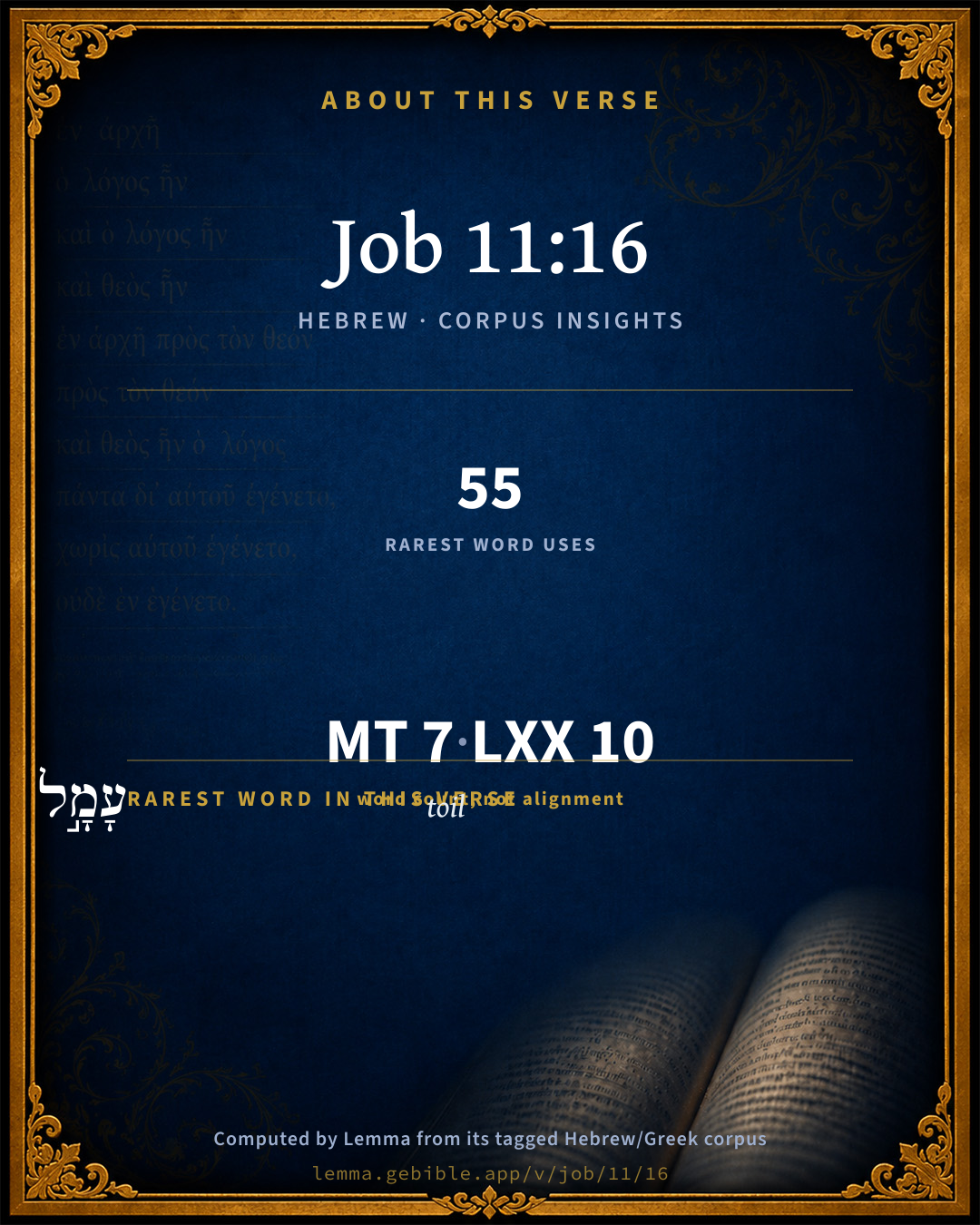
עָמָ֣ל toil H5999 occurs in 54 verses of the Hebrew Bible. Also found in:

Grammatical profile

  • 3 verbs
  • 2 nouns
  • 1 pronoun
  • 1 conjunction

Verb forms

  • תִּשְׁכָּ֑ח Qal · Imperfect
  • עָבְר֣וּ Qal · Perfect
  • תִזְכֹּֽר Qal · Imperfect

Hebrew & Septuagint length

In English translation the verse runs 16 words from the Hebrew and 18 from the Septuagint (LXX English) — closely comparable.

A rough comparison of the two English renderings, which tokenize alike — not a word-level alignment.

Word counts can differ between the Hebrew and the Greek without any difference in meaning — e.g. the Hebrew direct-object marker אֵת has no separate Greek word, and Greek often adds the article ὁ.

In the original languages it is 7 Hebrew tokens and 10 Greek tokens — but the two are counted differently (Hebrew bundles its prefixes and suffixes into one token; the Greek is in lemma form), so that isn’t a like-for-like length.

Cross-references

12

Topical passages linked to Job 11:16 in the Treasury of Scripture Knowledge — connected by theme and wording, ordered by reader-vote popularity; previews shown in the World English Bible.

  • Isaiah 65:16 so that he who blesses himself in the earth shall bless himself in the God of truth; and he who swears in the earth shall swear by the God of truth; because the former troubles are forgotten, and because they are hid from my eyes.
  • Ecclesiastes 5:20 For he shall not often reflect on the days of his life; because God occupies him with the joy of his heart.
  • Isaiah 54:4 Don't be afraid; for you shall not be ashamed: neither be confounded; for you shall not be disappointed: for you shall forget the shame of your youth; and the reproach of your widowhood shall you remember no more.
  • Isaiah 54:9 For this is [as] the waters of Noah to me; for as I have sworn that the waters of Noah shall no more go over the earth, so have I sworn that I will not be angry with you, nor rebuke you.
  • John 16:21 A woman, when she gives birth, has sorrow, because her time has come. But when she has delivered the child, she doesn't remember the anguish any more, for the joy that a human being is born into the world.
  • Genesis 41:51 Joseph called the name of the firstborn Manasseh, "For," he said, "God has made me forget all my toil, and all my father's house."
  • Isaiah 12:1–2 In that day you will say, "I will give thanks to you, Yahweh; for though you were angry with me, your anger has turned away and you comfort me.
  • Revelation 7:14–17 I told him, "My lord, you know." He said to me, "These are those who came out of the great tribulation. They washed their robes, and made them white in the Lamb's blood.
  • Genesis 9:11 I will establish my covenant with you; neither will all flesh be cut off any more by the waters of the flood; neither will there any more be a flood to destroy the earth."
  • Job 6:15 My brothers have dealt deceitfully as a brook, As the channel of brooks that pass away;
  • Job 22:11 Or darkness, so that you can not see, And floods of waters cover you.
  • Proverbs 31:7 Let him drink, and forget his poverty, And remember his misery no more.

Cross-references courtesy of OpenBible.info (CC BY 4.0).

Hebrew and Greek witnesses Masoretic Hebrew ↔ Greek Septuagint

The same verse in the two great witnesses to the Old Testament, shown verse-for-verse.

These are two independent witnesses, not word-aligned to each other, and the Septuagint is shown in lemma (dictionary) form.

Hebrew Job 11:16 Masoretic · Westminster Leningrad Codex

כִּי אַ֭תָּה עָמָ֣ל תִּשְׁכָּ֑ח כְּמַ֖יִם עָבְר֣וּ תִזְכֹּֽר

For you shall forget your misery; You shall remember it as waters that are passed away,

World English Bible · Public Domain

Greek LXX Job 11:16 Septuagint · lemma form

καί ὁ κόπος ἐπιλανθάνω ὥσπερ κῦμα παραἔρχομαι καί οὐ πτοέω

And you shall forget trouble, as a wave that has passed by; and you shall not be scared.

LXX2012 (modern English Septuagint) · Public Domain

Hebrew: Westminster Leningrad Codex (CC BY 4.0). Greek: Septuagint (public domain); English from LXX2012 (modern English Septuagint) (Public Domain). How the Septuagint differs from the Hebrew →

Commentary

Notes on Job 11:16 from classic Christian and Jewish commentators (each source and its license shown beneath its notes). The classic Christian expositions comment on the surrounding passage and are grouped to its opening verse, so a note may address several verses; the Jewish commentaries on the Tanakh (Rashi and others) are per-verse, so they appear only where the commentator wrote on this verse.

Lemma curates 59 commentaries, every one of them public domain or Creative Commons licensed, each selected and text-cleaned for this edition rather than reprinted as found. About our sources →

Trapp's Complete Commentary

John Trapp

Job 11:16 Because thou shalt forget [thy] misery, [and] remember [it] as waters [that] pass away:

Ver. 16. Because thou shalt forget thy misery] There being no fear left, or footstep thereof remaining to renew thy grief, Gen 41:30. Remember thy former trouble thou shall, with thankfulness for a better condition now, but not otherwise; all the marks of former affliction shall be worn out. See Isa 65:13; Isa 65:16, so that thou shalt discount all the evil thou hast endured.

And remember it as waters that pass away] As a land flood soon gone, as a light cloud quickly over; or as Noah’s flood, which that good man thought upon, when it was past, with thankfulness to God, offering sacrifice for his safety. So shalt thou, Job; and as a man seldom thinketh how much water passeth by his habitation by day and by night, or if he do, yet it is no trouble to his mind, no more shall the remembrance of former miseries be to thine.

John Trapp, A Commentary or Exposition upon All the Books of the Old and New Testament (1647–1656) — public domain. Text from a community e-Sword module.

The Biblical Illustrator

Joseph S. Exell

Job_11:16

Thou shalt forget thy misery, and remember it as waters that pass away.

Comfort from the future

Jobs misery was extreme, and it seemed as if he could never forget it. He never did forget the fact of it, but he did forget the pain of it. Nothing better can happen to our misery than that it should be forgotten in the sense referred to in our text; for then, evidently, it will be clean gone from us. It will be as it is when even the scent of the liquor has gone out of the cask, even when the flavour of the bitter drug lingers no longer in the medicine glass, but has altogether disappeared. If you look carefully at the connection of our text, I do not doubt that you will experience this blessed forgetfulness. When we are in pain of body, and depression of spirit, we imagine that we never shall forget such misery as we are enduring. And yet, by and by, God turns towards us the palm of His hand, and we see that it is full of mercy, we are restored to health, or uplifted from depression of spirit, and we wonder that we ever made so much of our former suffering or depression. We remember it no more, except as a thing that has passed and gone, to be recollected with gratitude.

I. I am not going to limit the application of the text to Job and his friends, for it has also a message for many of us at the present time; and I shall take it, first, with reference to the common troubles of life which affect believing men and women. These troubles of life happen to us all more or less. They come to one in one shape, and perhaps life thinks that he is the only man who has any real misery; yet they also come to others, though possibly in another form. The Lord of the pilgrims was a man of sorrows and acquainted with grief; and His disciples must expect to fare even as their Master fared while here below; it is enough for the servant if he be as his lord. You, who are just now enduring misery, should seek to be comforted under it. Perhaps you will ask me, Where can we get any comfort? Well, if you cannot draw any from your present experience, seek to gather some from the past. You have been miserable before, but you have been delivered and helped. There has come to you a most substantial benefit from everything which you have been called to endure. Let us gather consolation also from the future. If, as the apostle truly says, No chastening for the present seemeth to be joyous, but grievous, recollect how he goes on to say, Nevertheless afterward it yieldeth the peaceable fruit of righteousness unto them which are exercised thereby. Thou shalt forget thy misery, and remember it as waters that pass away. How will that be?

1. Well, first, by the lapse of time. Time is a wonderful healer.

2. Ay, but there is something better than the lapse of years, and that is when, during a considerable time, you are left without trial. That is a sharp pain you are now enduring; but what if you should have years of health afterwards? Remember how Job forgot his misery when, in a short time, he had double as much of all that he possessed as he had before. There is wonderfully smooth sailing on ahead for some of you when you are once over this little stretch of broken water.

3. And besides the lapse of time, and an interval of rest and calm, it may be--it probably is the fact with Gods people--that He has in store for you some great mercies. When the Lord turns your captivity, you will be like them that dream; and you know what happens to men who dream. They wake up; their dream is all gone, they have completely forgotten it. So will it be with your sorrow. Be of good courage in these dark, dull times, for, mayhap this text is Gods message to thy soul, Thou shalt forget thy misery, and remember it as waters that pass away. It has bee so with many, many, many believers in the past. What do you think of Joseph sold for a slave, Joseph falsely accused, Joseph shut up in prison? But when Joseph found out that all that trial was the way to make him ruler over all the land of Egypt, and that he might be the means of saving other nations from famine, and blessing his fathers house, I do not wonder that he called his elder son Manasseh. What does that name mean? Forgetfulness--for God, said he, hath made me forget all my toil, and all my fathers house.

II. I should be greatly rejoiced if, in the second place, I might speak a cheering word to poor souls under distress on account of sin.

1. Well, now, I exhort you, first of all, to look to Christ, and lean on Christ. Trust in His atoning sacrifice, for there alone can a troubled soul find rest. There was never a man yet who, with all his heart, did seek the Lord Jesus Christ, but sooner or later found Him; and if you have been long in seeking, I lay it to the fact that you have not sought with a prepared heart, a thoroughly earnest heart, or else you would have found Him. But, perhaps, taking Zophars next expression, you have not stretched out your hands toward the Lord, giving yourself up to Him like a man who holds up his hands to show that he surrenders. Further, you may and you shall forget your misery, provided you fulfil one more condition mentioned by Zophar, and that is, that you are not harbouring any sin: If iniquity be in thine hand, put it far away, and let not wickedness dwell in thy tabernacles. Oh! you say, but how am I to do it? Christ will help you. Trust Him to help you. Oh, do see that you let not wickedness dwell in your tabernacles, you who are the people of God, and you who wish to be His, if you would have Zophars words to Job fulfilled in your experience, Then shalt thou lift up thy face without spot; yea, thou shalt be stedfast, and shalt not fear: because thou shalt forget thy misery, and remember it as waters that pass away.

III. Now let me tell you how sweetly God can make a sinner forget his misery.

1. The moment a sinner believes in Jesus Christ with true heart and repentant spirit, God makes him forget his misery, first, by giving him a full pardon.

2. Next, he rejoices in all the blessings that God gives with His grace.

IV. This text will come true to the sickening, declining, soon-departing believer. If thou hast believed in the Lord Jesus Christ, and if thou art resting alone upon Him, recollect that, in a very short time, thou shalt forget thy misery, and remember it as waters that pass away. In a very, very, very short time, your suffering and sadness will all be over. I suppose the expression, waters that pass away, signifies those rivers which are common in the East, and which we meet with so abundantly in the south of France. They are rivers with very broad channels, but I have often looked in vain for a single drop of water in them. Then, perhaps you ask, what is the use of such rivers? Well, at certain times, the mountain torrents come rushing down, bearing great rocks, and stones, and trees before them, and then, after they have surged along the river bed for several days, they altogether disappear in the sea. Such will all the sorrows of fife and the sorrows even of death soon be to you, and to me also. They will all have passed away, and all will be over with us here. And then, you know, those waters that have passed away will never come back again. Thank God, we shall recollect our sorrows in heaven only to praise God for the grace that sustained us under them; but we shall not remember them as a person does who has cut his finger, and who still bears the scar in his flesh. We shall not recollect them as one does who has been wounded, and who carries the bullet somewhere about him. In heaven, you shall not have a trace of earths sorrow; you shall not have, in your glorified body, or in your perfectly sanctified soul and spirit, any trace of any spot, or wrinkle, or any such thing. (C. H. Spurgeon.)

The Biblical Illustrator, edited by Joseph S. Exell (c. 1880s–1900s) — public domain. Text from a community e-Sword module.

Joseph Benson's Commentary

Job 11:16. Because thou shalt forget thy misery — Thy happiness shall be so great that it shall blot out the remembrance of thy past miseries; and remember it as waters that pass away — Thou shalt remember it no more than men remember either a land-flood, which, as it comes, so it goes away suddenly, and leaves few or no marks or memorials behind it; or the waters of a river, which pass by in constant succession.

Joseph Benson's Commentary on the Old and New Testaments (1811–1818) — public domain. Text from a community e-Sword module.

Whedon's Commentary on the Bible

Daniel D. Whedon

b. Then the sorrows of the present shall be forgotten in the brightness of future life, Job_11:16-17.

16. Waters that pass away — He probably alluded to Job’s figure, (Job_6:15-17.) His grief, now so tumultuous, shall subside as completely as the waters of the mountain torrents. Of the wadies, or beds of such torrents, which are perfectly dry in the summer, Wilson, in his Lands of the Bible, enumerates eighty-five; while Ritter in his Geography speaks of as many as two hundred. Note Job_6:16. The figure is strikingly appropriate. Affliction is not like the river that flows on forever, but is like a torrent that rages for a brief winter day, and vanishes with the rising of the summer sun. God’s love has ordained that “the excess of grief makes it soon mortal.” But we are not to forget the law of the human mind, that leads it to take pleasure in remembering sorrows when they have once gone beyond the power of return. The joys of heaven will be heightened by the remembrance of life’s troubles, and the retrospective vision will be none the less bright that we can still see the rivers through which we have passed, (Isa_43:2,) though they be but dim lines in the distant vista. A few lines in the spectrum suffice to tell the make of clouds and storms as they still sweep over the surface of the sun. Thus shall the clouds and storms of life appear when once we have entered our heavenly home.

Daniel D. Whedon (gen. ed.), Commentary on the Old and New Testaments (1874–1909) — public domain. Text from a community e-Sword module.

Jamieson, Fausset & Brown

Robert Jamieson, A. R. Fausset & David Brown

Just as when the stream runs dry (Job 6:17), the danger threatened by its wild waves is forgotten (Isa 65:16) [UMBREIT].

Jamieson, Fausset & Brown — Commentary Critical and Explanatory on the Whole Bible (1871) — public domain (CC PDM 1.0). Text via the HelloAO Bible API.

Adam Clarke's Commentary

Verse 16. Because thou shalt forget thy misery] Thou shalt have such long and complete rest, that thou shalt scarcely remember thy labour.

As waters that pass away] Like as the mountain floods, which sweep every thing before them, houses, tents, cattle, and the produce of the field, and are speedily absorbed by the sandy plains over which they run, so shalt thou remember thy sufferings: they were wasting and ruinous for the time, but were soon over and gone.

Adam Clarke's Commentary on the Bible (1810–1826) — public domain. Text from a community e-Sword/MySword module.

The Cambridge Bible for Schools and Colleges

gen. ed. J. J. S. Perowne

16. because thou shalt forget] Or, for thou shalt forget trouble.

that pass away] that are passed away.

The Cambridge Bible for Schools and Colleges (gen. ed. J. J. S. Perowne; Cambridge University Press, 1878–1918) — public domain. Text from a community e-Sword module.

John Gill's Exposition

Because thou shall forget thy misery,.... Former afflictions and distresses; having an abundance of prosperity and happiness, and long continued; and so, in process of time, the miseries and distresses before endured are forgotten; thus it was with Joseph in his advanced state, and therefore he called one of his sons Manasseh, Gen 41:51; and as it is with convinced and converted persons and believers in Christ, who, under first convictions and awakenings, are filled with sorrow and distress, on a view of their miserable estate by nature; but when Christ is revealed to them as their Saviour and Redeemer, and the love of God is shed abroad in their hearts, and they have faith and hope in Jesus, and a comfortable view of heaven and happiness, and eternal life, by him, they forget their spiritual poverty, and remember their misery no more, unless it be to magnify the riches of the grace of God; see Pro 31:6;

and remember it as waters that pass away; either the waters of the stream in a river, which, when gone, are seen and remembered no more or as waters occasioned by floods in the winter season, which when over, and summer is come, are gone and are no more discerned; and as they pass from the places where they were, so from the minds of men: or it may be respect is had to the waters of Noah's flood, which, according to the divine promise and oath, should no more go over the earth, Gen 9:15; and being past and gone, and no fear or danger of their returning, are forgotten.

John Gill's Exposition of the Whole Bible (1746–1763) — public domain (CC PDM 1.0). Text via the HelloAO Bible API.

Albert Barnes' Notes on the Bible

And remember it as waters that pass away - As calamity that has completely gone by, or that has rolled on and will return no more. The comparison is beautiful. The water of the river is borne by us, and returns no more. The rough, the swollen, the turbid stream, we remember as it foamed and dashed along, threatening to sweep everything away; but it went swiftly by, and will never come back. So with afflictions. They are soon gone. The most intense pain soon subsides. The days of sorrow pass quickly away. There is an outer limit of suffering, and even ingenuity cannot prolong it far. The man disgraced, and whose life is a burden, will soon die. On the checks of the solitary prisoner doomed to the dungeon for life, a “mortal paleness” will soon settle down, and the comforts of approaching death will soothe the anguish of his sad heart. The rack of torture cheats itself of its own purpose, and the exhausted sufferer is released. “The excess (of grief) makes it soon mortal.” “No sorrow but killed itself much sooner.” Shakespeare. When we look back upon our sorrows, it is like thinking of the stream that was so much swollen, and was so impetuous. Its waters rolled on, and they come not back again; and there is a kind of pleasure in thinking of that time of danger, of that flood that was then so fearful, and that has now swept on to come back no more. So there is a kind of peaceful joy in thinking of the days of sorrow that are now fled forever; in the assurance that those sad times will never, never recur again.

Albert Barnes' Notes on the Bible (1834–1885) — public domain. Text from a community e-Sword/MySword module.

Matthew Poole's English Annotations

Thou shalt be free from fear, because thy great and settled prosperity shall banish out of thy mind all those sad and irksome thoughts of thy former calamities, which naturally engender fears of the continuance or return of them. Persons blessed with eminent deliverances, and a happy settlement, are frequently said in Scripture to

forget their former sorrows, as Gen 41:51; Isa 54:4; Joh 16:21; not that they simply forget them, but because they have no sad or frightful remembrance of them; for remembering and forgetting in Scripture do not simply note acts of the mind, but also affections and practices suitable to them, as is well known.

Remember it as waters that pass away; thou shalt remember them no more than men remember either a land-flood, which as it comes, so it goes away, suddenly, and leaves few or no footsteps or memorials behind it; or the waters of a river, which as soon as they are out of sight are out of mind, because of the new waters which immediately come in their stead.

Matthew Poole's English Annotations on the Holy Bible (1683–1685) — public domain. Text from a community e-Sword/MySword module.

The Pulpit Commentary

Because thou shalt forget thy misery. All thy past misery shall be clean swept away from thy remembrance, because of the happy condition whereto thou shalt be raised (see vers. 18, 19). "Sorrow"s memory" is not always "a sorrow still." And remember it as waters that pass away; i.e. remember it no more than a man remembers the shower that has passed away or the pool that is dried up.

The Pulpit Commentary (1880–1919), ed. H.D.M. Spence-Jones & Joseph S. Exell — public domain. Text from a community e-Sword module.

John Wesley's Explanatory Notes

As waters - Thou shalt remember it no more, than men remember a land-flood, which as it comes, so it goes away suddenly.

John Wesley, Explanatory Notes Upon the Whole Bible (1754–1765) — public domain. Text via the GEBible commentary corpus.

Keil & Delitzsch

C. F. Keil & F. Delitzsch

16 For thou shalt forget thy grief,

Shalt remember it as waters that flow by.

17 And thy path of life shall be brighter than mid-day;

If it be dark, it shall become as morning.

18 And thou shalt take courage, for now there is hope;

And thou shalt search, thou shalt lie down in safety.

19 And thou liest down without any one making thee afraid;

And many shall caress thy cheeks.

20 But the eyes of the wicked languish,

And refuge vanisheth from them,

And their hope is the breathing forth of the soul.

The grief that has been surmounted will then leave no trace in the memory, like water that flows by (not: water that flows away, as Olshausen explains it, which would be differently expressed; comp. Job 20:28 with Sa2 14:14). It is not necessary to change אתּה כּי into עתּה כּי (Hirzel); אתה, as in Job 11:13, strengthens the force of the application of this conclusion of his speech. Life (חלד, from חלד to glide away, slip, i.e., pass away unnoticed,

(Note: Vid., Hupfeld on Psa 17:14, and on the other hand Bttcher, infer. 275 s., who, taking חלד in the sense of rooting into, translates: "the mildew springs up more brilliant than mid-day." But whatever judgment one may form of the primary idea of חלד, this meaning of חלד is too imaginary.)

as αἰών, both life-time, Psa 39:6, and the world, Psa 49:2, here in the former sense), at the end of which thou thoughtest thou wert already, and which seemed to thee to run on into dismal darkness, shall be restored to thee (יקום with Munach on the ult. as Job 31:14, not on the penult.) brighter than noon-day (מן, more than, i.e., here: brighter than, as e.g., Mic 7:4, more thorny than); and be it ever so dark, it shall become like morning. Such must be the interpretation of תּעפה. It cannot be a substantive, for it has the accent on the penult.; as a substantive it must have been pointed תּעוּפה (after the form תּקוּדה, תּקוּמה, and the like). It is one of the few examples of the paragogic strengthened voluntative in the third pers., like Psa 20:4; Isa 5:19

(Note: In other instances, as תּרנּה, Pro 1:20; Pro 8:3, and ותּעגּבה, Eze 23:20, the ah is not the cohortative form, but either paragogic without special meaning or (so that the fut. has a double feminine form) as feminine termination, as is evident in Job 22:21, where the ah is combined with the inflection.)

(Ges. 48, 3); the cohortative form of the future is used with or without אם (vid., on Psa 73:16) in hypothetical antecedent clauses (Ges. 128, 1). Translate therefore: should it become dark (accordingly correctly accented with Rebia mugrasch), from עוּף, to envelope one's self, to darken (whence עפתה, Job 10:22), not: shouldst thou become dark (Schlottm.). The feminine forms are instead of the neuter, like תּמטיר, it rains, Amo 4:7; חשׁכה, it becomes dark, Mic 3:6 (Ges. 137, 2).

The fut. is followed by perff. consecutiva in Job 11:18 : And thou shalt take confidence, for there is ground for hope for thee; ישׁ, with the force of real and lasting existence. וחפרתּ is also perf. consec., and is rightly accented as such. If it were to be interpreted et si erubueris pudore tranquille cubabis, it would require the accent on the penult., since it would be a perf. hypotheticum. But although the seeming antithesis of וחפרת and לבטח (comp. Job 6:20) appears to favour this interpretation, it is nevertheless inadmissible, since it introduces a sadness into the promise: granted that thou shouldest be put to shame at this or that prospect; whereas, if חפר be taken in the sense of scrutari, as it is used by our poet (Job 3:21; Job 39:29) (not with Bttch., who comp. Ecc 5:11, in the signification fodere = to labour in the field, in which meaning it is not common), the tone of sadness is removed, and the accentuation is duly observed: and thou shalt search about (i.e., examine the state of thy household, which is expressed by וּפקדתּ in Job 5:24), thou shalt lay thyself down in peace (i.e., because thou findest everything in a prosperous condition, and hast no anxiety). This felling of security against every harm that may befall one's person or property, gained from trust in God, is expressed (Job 11:19) under the figure of the peaceful situation of a herd when removed from danger, - a figure which is borrowed from Lev 26:6, and is frequently repeated in the prophets (Isa 17:2; Zep 3:13). The promises of Zophar culminate in a future exaltation which shall command reverence and inspire trust: et mulcebunt faciem tuam multi. פּני חלּה, to approach any one in humble entreaty, generally used in reference to God; less frequently, as here and Psa 45:13; Pro 19:6, in reference to men in high positions. The end of the wicked, on the other hand, is told in Job 11:20. Zophar here makes use of the choicest expressions of the style of the prophetic psalms: כּלה, otherwise frequently used of those who pine away with longing, here and Job 17:5 of eyes that languish with unsatisfied longing; מנּהם (Aram. מנּהוןּ), poetic for מהם; נפשׁ מפּח, after the phrase נפשׁ נפח, he breathes forth his soul (Jer 15:9, comp. Job 31:39). The meaning is not that death is their only hope, but that every expectation remains unfulfilled; giving up the ghost is that whither all their disappointed hopes tend.

That Zophar, in the mind of the poet, is the youngest of the three speakers, may be concluded from his introducing him last of all, although he is the most impetuous. Zophar manifests a still greater inability than the other two to bring Job to a right state of mind. His standpoint is the same as that of the others; like them, he regards the retributive justice of God as the principle on which alone the divine government in the world is exercised, and to which every act of this government is to be attributed, and it may indeed be assumed to be at work even when the relation of circumstances is mysterious and impenetrably dark to us. This limited view which the friends take of the matter readily accounts for the brevity of their speeches in comparison with Job's. This one locus communis is their only theme, which they reiterate constantly in some new and modified form; while the mind of Job is an exhaustless fountain of thought, suggested by the direct experiences of the past. Before the present dispensation of suffering came upon Job, he enjoyed the peace of true godliness, and all his thoughts and feelings were under the control of a consciousness, made certain by his experience, that God makes himself known to those who fear Him. Now, however, his nature, hitherto kept in subjection by divine grace, is let loose in him; the powers of doubt, mistrust, impatience, and despondency have risen up; his inner life is fallen into the anarchy of conflict; his mind, hitherto peaceful and well-disciplined, is become a wild chaotic confusion; and hence his speeches, in comparison with those of the friends, are as roaring cataracts to small confined streams. But in this chaos lie the elements of a new creation; the harsh pertinacity with which the friends maintain their one dogma only tends to give an impulse to it. The new truth, the solution of the mystery, springs from this spiritual battle Job has to fight, from which, although not scathless, he still shall come forth as conqueror.

Is the dogma of the friends, then, so pure a doctrine (זך לקח) as that which, according to Zophar's words, Job claims for himself? On Zophar's side it is maintained that God always acts in accordance with justice, and Job maintains that God does not always so act. The maxim of the friends is false in the exclusiveness with which they maintain it; the conclusion to which they are urged gives evidence of the fallacy of the premises: they must condemn Job, and consequently become unjust, in order to rescue the justice of God. Job's maxim, on the other hand, is true; but it is so unconnected as it stands, that it may be turned over any moment and changed into a falsehood. For that God does not act everywhere as the Just One is a truth, but that He sometimes acts unjustly is blasphemy. Between these two Job hangs in suspense. For the stedfast consciousness of his innocence proves to him that God does not always act as the Just One; shall he therefore suppose that God deals unjustly with him? From this blasphemous inversion of his maxim, Job seeks refuge in the absolute power of God, which makes that just which is unjust according to the clearest human consciousness. This is the feeble thread on which Job's piety hangs. Should this be cut, it would be all over with him. The friends do their best to cut it in twain. Zophar's speech is like a sword-thrust at it.

For while Eliphaz and Bildad with cautious gentleness describe suffering more as chastisement than as punishment, Zophar proceeds more boldly, and demands of Job that he should humble himself, as one who has incurred punishment from God. Of sin on Job's part which may have called down the divine judgment, Zophar knows as little as Job himself. But he wishes that God would grant Job some revelation of His infinite wisdom, since he refuses to humble himself. Then he would confess his folly, and see that God not only does not punish him unjustly, but even allows much of his guilt to go unpunished. Job is therefore to turn penitently to God, and to put away that evil which is the cause of his suffering, in order that he may be heard. Then shall his hopeless condition become bright with hope; whereas, on the other hand, the downfall of the wicked is beyond recovery. Ewald aptly remarks that thus even the concluding words of the speeches of the friends are always somewhat equivocal. "Eliphaz just adds a slight caution, Bildad introduces the contrast in a few words, and Zophar adds but a word; all these seem to be as the forerunners of a multitude of similar harsh threatenings, ch. 15, 18, 20."

What impression will this harsh treatment of Zophar's produce on Job? Job is to humble himself as a sinner who is undergoing the punishment of his sin, though the measure of it is far below the degree of his guilt; and while he does not deny his sinful weaknesses, he is nevertheless convinced that he is righteous, and having as such experienced the favour of God, cannot become an object of punishment. Brentius discriminatingly observes here: Videntur et Sophar et reliqui amici Hiob prorsus ignorare quid sit aut efficiat Evangelion et fides in promissionem Dei; sic argumentantur contra Hiobem, quasi nullus unquam possit coram Deo fide justificari. The language is rather too much in accordance with the light of the New Testament; but it is true that the friends know nothing whatever of the condition of a truly righteous man, over whom the law with its curse, or the retributive justice of God, has no power. The interpretation of affliction in accordance with the recognition of this principle is strange to them; and this is just the issue which is developed by the drama in the case of Job - the idea which comes to light in the working out of the plot. Even Job does not perceive the solution of the mystery, but, in the midst of the conflict, is in a state of ignorance which excites compassion; the ignorance of the friends arising from their shallowness of understanding, on the contrary, creates aversion. When Zophar, therefore, wishes that God would grant Job some revelation of His infinite wisdom, it is indeed true that Job is greatly in need of it; but it is self-deceiving pride which leads Zophar to imagine that he has no need of it himself. For this Wisdom which has decreed the suffering of Job is hidden from his also; and yet he does not treat the suffering of his friend as a divine mystery. He explains it as the working of the retributive justice of God; but since he endeavours thus to explain the mystery, he injures his cause, and if possible injures also the slender thread by which Job's faith hangs. For should Job regard his sufferings as a just divine retribution, he could then no longer believe on God as the Just One.

Keil & Delitzsch — Biblical Commentary on the Old Testament (1861–1891) — public domain (CC PDM 1.0). Text via the HelloAO Bible API. (Old Testament only.)

Rashi

Rabbi Shlomo Yitzchaki (Rashi)

and you shall forget all your trouble.

like water that has passed and gone by, so shall be the entire memory of your trouble.

Rashi on the Tanakh — English translations: “The Judaica Press complete Tanach with Rashi, translated by A. J. Rosenberg” (CC BY 4.0); “Pentateuch with Rashi's commentary by M. Rosenbaum and A.M. Silbermann, 1929-1934” (public domain); “The Metsudah Tanach series, Lakewood, N.J” (CC BY 4.0); and “The Book of Joshua, Metsudah Publications, 1997” (CC BY 4.0). Text via Sefaria.

Lesson kit

Teaching starters — assembled from the data on this page, not authored interpretation. Every prompt links to the verse data it draws on. Edit before teaching.

Job, in the Wisdom, opens this verse with 7 words (7 distinct Hebrew lemmas). Its most distinctive word is ʻâmâl (“toil”). A historical commentator’s framing appears above. Read the whole chapter for the surrounding context.

Discussion questions

  1. How does “toil” (ʻâmâl) shape what this verse is saying?
  2. Genesis 41:51 shares the word «toil» with this verse. How do the two illuminate each other?
  3. These translations render this verse differently; the difference is in the English rendering, not the original. What questions does that raise?
  4. The verb «תִּשְׁכָּ֑ח» is Qal Imperfect. How does its form color the action?
  5. Reading how Trapp's Complete Commentary and The Biblical Illustrator read this verse, where do the two commentators agree and where do they part?

Things to notice

Reading settings

Reading text

Shown beneath each verse's original-language words.

Old Testament
Old Testament edition

Read the OT as the Masoretic Hebrew (MT) or the Greek Septuagint (LXX).

English shown for the Greek Septuagint (in the Hebrew ↔ Greek comparison).

Comparing translations? Open the Compare panel on any verse page to stack up to four side by side.