
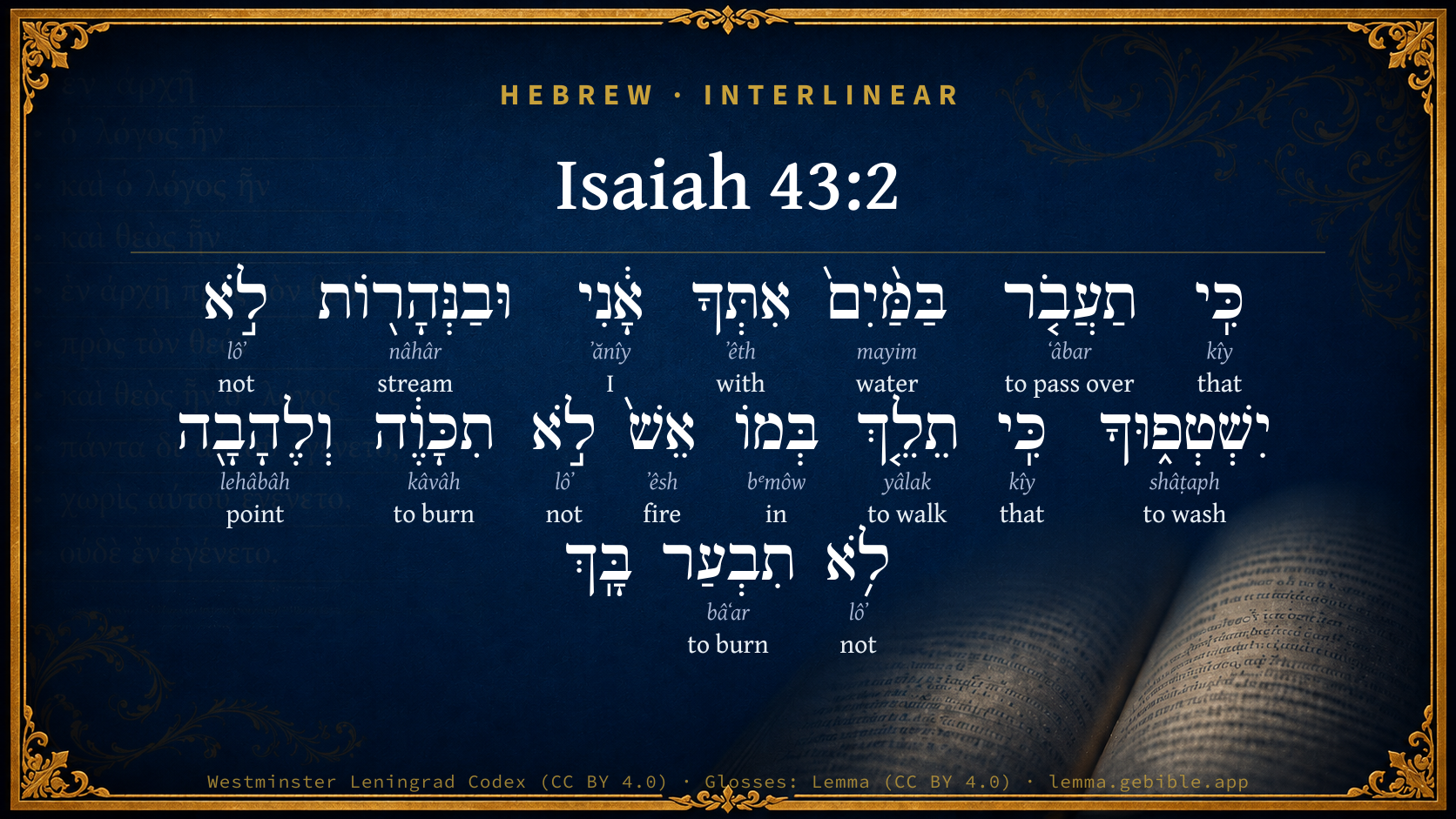

Isaiah 43:2

Hebrew (Westminster Leningrad Codex) Isaiah 43:2 appears in the Hebrew Old Testament. The text above is from the Westminster Leningrad Codex. Each word links to its Strong’s number, a concise gloss, and parsing drawn from the Open Scriptures Hebrew Bible morphology. Click any word for its full Brown-Driver-Briggs (BDB) entry.
Download image
Cite this verse

Isaiah 43:2 (World English Bible). Public Domain. Lemma interlinear Bible study tool, https://lemma.gebible.app/v/isaiah/43/2.

Show BibTeX & RIS
BibTeX
RIS
English Translation
When you pass through the waters, I will be with you; and through the rivers, they shall not overflow you: when you walk through the fire, you shall not be burned, neither shall the flame kindle on you.
World English Bible · Public Domain
Download a study sheet

One document with this verse’s original text, its word-by-word gloss line, the meaning frame, cross-references with their text, attributed commentary, and full source and license credits — printable, and it pastes into notes with its structure intact.

This verse Autodidact and up

Study sheet (.html) Plain text (.txt)

A passage Seminary Student

Up to 50 verses in one chapter. A passage sheet keeps up to 6 commentary sources and 12 cross-references per verse, in the order this page ranks them, and says so on the sheet whenever that leaves anything out. Ask for a single verse and you get the Autodidact verse sheet above.

Everything on this page stays free to read, with no account — the sheet is a download of what is already on screen, not access to it.

Want to remove ads? Support Godless Engineer
Compare translations 3

The same verse in 3 English versions, stacked beneath the original-language interlinear above. Click any original word for its lexicon entry.

Each is an independent rendering of the whole verse — the interlinear is not word-aligned to these translations.

Highlighted words mark where these versions differ — a whole-verse word diff, not a word-by-word alignment.

  • World English Bible Public Domain
    When you pass through the waters, I will be with you; and through the rivers, they shall not overflow you: when you walk through the fire, you shall not be burned, neither shall the flame kindle on you.
  • King James Version Public Domain
    When thou passest through the waters, I will be with thee; and through the rivers, they shall not overflow thee: when thou walkest through the fire, thou shalt not be burned; neither shall the flame kindle upon thee.
  • unfoldingWord Literal Text CC BY-SA 4.0
    When you pass through the waters, I with you, and through the rivers, they will not overwhelm you. When you walk through the fire, you will not be burned, and the flame will not burn you up.

unfoldingWord Literal Text — © unfoldingWord, licensed CC BY-SA 4.0. Word-aligned USFM3 via Door43 (git.door43.org/unfoldingWord/en_ult).

Versions to compare (up to 4)

3 of 4 selected

Show all 18 translations

Every available English version of this verse, each an independent rendering of the whole verse.

  • World English Bible Public Domain
    When you pass through the waters, I will be with you; and through the rivers, they shall not overflow you: when you walk through the fire, you shall not be burned, neither shall the flame kindle on you.
  • Berean Standard Bible Public Domain
    When you pass through the waters, I will be with you; and when you go through the rivers, they will not overwhelm you. When you walk through the fire, you will not be scorched; the flames will not set you ablaze.
  • Majority Standard Bible Public Domain
    When you pass through the waters, I will be with you; and when you go through the rivers, they will not overwhelm you. When you walk through the fire, you will not be scorched; the flames will not set you ablaze.
  • King James Version Public Domain
    When thou passest through the waters, I will be with thee; and through the rivers, they shall not overflow thee: when thou walkest through the fire, thou shalt not be burned; neither shall the flame kindle upon thee.
  • American Standard Version (1901) Public Domain
    When thou passest through the waters, I will be with thee; and through the rivers, they shall not overflow thee: when thou walkest through the fire, thou shalt not be burned, neither shall the flame kindle upon thee.
  • Revised Version (1885) Public Domain
    When thou passest through the waters, I will be with thee; and through the rivers, they shall not overflow thee: when thou walkest through the fire, thou shalt not be burned; neither shall the flame kindle upon thee.
  • Geneva Bible (1599) Public Domain
    When thou passest through the waters, I wil be with thee, and through the floods, that they doe not ouerflowe thee. When thou walkest through the very fire, thou shalt not be burnt, neither shall the flame kindle vpon thee.
  • Douay-Rheims (1899) Public Domain
    When thou shalt pass through the waters, I will be with thee, and the rivers shall not cover thee: when thou shalt walk in the fire, thou shalt not be burnt, and the flames shall not burn in thee:
  • Young's Literal Translation Public Domain
    When thou passest into waters, I `am' with thee, And into floods, they do not overflow thee, When thou goest into fire, thou art not burnt, And a flame doth not burn against thee.
  • Literal Standard Version CC BY-SA 4.0
    When you pass into waters, I [am] with you, || And into floods, they do not overflow you, || When you go into fire, you are not burned, || And a flame does not burn against you.
  • Unlocked Literal Bible CC BY-SA 4.0
    When you pass through the waters, I will be with you; and through the rivers, they will not overwhelm you. When you walk through the fire you will not be burned, and the flames will not destroy you.
  • unfoldingWord Literal Text CC BY-SA 4.0
    When you pass through the waters, I with you, and through the rivers, they will not overwhelm you. When you walk through the fire, you will not be burned, and the flame will not burn you up.
  • Darby Bible Public Domain
    When thou passest through the waters, I [will be] with thee; and through the rivers, they shall not overflow thee; when thou walkest through the fire, thou shalt not be burned, neither shall the flame kindle upon thee.
  • World Messianic Bible Public Domain
    When you pass through the waters, I will be with you, and through the rivers, they will not overflow you. When you walk through the fire, you will not be burned, and flame will not scorch you.
  • Webster's Bible Public Domain
    When thou passest through the waters, I will be with thee; and through the rivers, they shall not overflow thee: when thou walkest through the fire, thou shalt not be burned; neither shall the flame kindle upon thee.
  • Free Bible Version CC BY-SA 4.0
    When you walk through the water, I will be with you; and when you go through the rivers, they won't flood over you. When you walk through fire, you will not be burned; the flames will not set you on fire.
  • Bible in Basic English Public Domain
    When you go through the waters, I will be with you; and through the rivers, they will not go over you: when you go through the fire, you will not be burned; and the flame will have no power over you.
  • JPS Tanakh (1917) Public Domain
    When thou passest through the waters, I will be with thee, and through the rivers, they shall not overflow thee; when thou walkest through the fire, thou shalt not be burned, neither shall the flame kindle upon thee.

Literal Standard Version (2020), Covenant Press — licensed CC BY-SA 4.0. Text via the HelloAO Bible API (eBible.org). Unlocked Literal Bible (unfoldingWord) — licensed CC BY-SA 4.0. Text via the HelloAO Bible API (eBible.org). unfoldingWord Literal Text — © unfoldingWord, licensed CC BY-SA 4.0. Word-aligned USFM3 via Door43 (git.door43.org/unfoldingWord/en_ult). Free Bible Version, Dr. Jonathan Gallagher — licensed CC BY-SA 4.0. Text via the HelloAO Bible API (eBible.org).

Word by word

More ways to search: Search by grammar → Find every occurrence → Compare this word →

Practice this passage: Drill this verse → Learn its vocabulary →

תִכָּוֶ֔ה
kâvâh
H3554
“to burn”
Verb, Niphal, Imperfect, 2nd Person, Masculine, Singular
Part of Speech
Verb
Stem
Niphal
Form
Imperfect
Person
2nd Person
Gender
Masculine
Number
Singular
Full BDB Definition

Origin: a primitive root

TWOT: 961

to burn, scorch, brand - (Niphal) to be burned, be scorched
  1. כִּֽי kîy H3588 “that” Conjunction
  2. תַעֲבֹ֤ר ʻâbar H5674 “to pass over” Verb, Qal, Imperfect, 2nd Person, Masculine, Singular
  3. בַּמַּ֨יִם֙ mayim H4325 “in/at the · water(s)” Preposition, Determined + Noun, Common, Masculine, Plural, Absolute
  4. אִתְּךָ ʼêth H854 “with · you” Preposition + Suffix, Personal, 2nd Person, Masculine, Singular
  5. אָ֔נִי ʼănîy H589 “I” Pronoun, Personal, 1st Person, Common, Singular
  6. וּבַנְּהָר֖וֹת nâhâr H5104 “and · in/at the · streams” Conjunction + Preposition, Determined + Noun, Common, Masculine, Plural, Absolute
  7. לֹ֣א lôʼ H3808 “not” Particle, Negative
  8. יִשְׁטְפ֑וּךָ shâṭaph H7857 “to wash · you” Verb, Qal, Imperfect, 3rd Person, Masculine, Plural + Suffix, Personal, 2nd Person, Masculine, Singular
  9. כִּֽי kîy H3588 “that” Conjunction
  10. תֵלֵ֤ךְ yâlak H3212 “to walk” Verb, Qal, Imperfect, 2nd Person, Masculine, Singular
  11. בְּמוֹ bᵉmôw H1119 “in” Preposition
  12. אֵשׁ֙ ʼêsh H784 “fire” Noun, Common, Both, Singular, Absolute
  13. לֹ֣א lôʼ H3808 “not” Particle, Negative
  14. וְלֶהָבָ֖ה lehâbâh H3852 “and · point” Conjunction + Noun, Common, Feminine, Singular, Absolute
  15. לֹ֥א lôʼ H3808 “not” Particle, Negative
  16. תִבְעַר bâʻar H1197 “to burn” Verb, Qal, Imperfect, 3rd Person, Feminine, Singular

About this verse

These counts appear in no published source. They are computed here, from the morphology-tagged text and Lemma’s own curated glosses. What Lemma adds →

18
words
14
distinct lemmas
Prophets
section

Notable vocabulary

The rarest word here is תִכָּוֶ֔ה to burn H3554 — appearing just 2 times in the whole Hebrew Bible.

Shared distinctive vocabulary

תִכָּוֶ֔ה to burn H3554 occurs in 2 verses of the Hebrew Bible. Also found in:

Grammatical profile

  • 5 verbs
  • 4 nouns
  • 1 pronoun
  • 3 prepositions
  • 2 conjunctions
  • 3 particles

Verb forms

  • תַעֲבֹ֤ר Qal · Imperfect
  • יִשְׁטְפ֑וּךָ Qal · Imperfect
  • תֵלֵ֤ךְ Qal · Imperfect
  • תִכָּוֶ֔ה Niphal · Imperfect
  • תִבְעַר Qal · Imperfect

Repetition

Words recur within this verse — often emphatic in Hebrew:

  • לֹ֣א not H3808 ×3
  • כִּֽי that H3588 ×2

Hebrew & Septuagint length

In English translation the verse runs 38 words from the Hebrew and 34 from the Septuagint (LXX English) — closely comparable.

A rough comparison of the two English renderings, which tokenize alike — not a word-level alignment.

Word counts can differ between the Hebrew and the Greek without any difference in meaning — e.g. the Hebrew direct-object marker אֵת has no separate Greek word, and Greek often adds the article ὁ.

In the original languages it is 18 Hebrew tokens and 25 Greek tokens — but the two are counted differently (Hebrew bundles its prefixes and suffixes into one token; the Greek is in lemma form), so that isn’t a like-for-like length.

Cross-references

32

Topical passages linked to Isaiah 43:2 in the Treasury of Scripture Knowledge — connected by theme and wording, ordered by reader-vote popularity; previews shown in the World English Bible.

  • Isaiah 41:10 Don't you be afraid, for I am with you; don't be dismayed, for I am your God; I will strengthen you; yes, I will help you; yes, I will uphold you with the right hand of my righteousness.
  • Joshua 1:9 Haven't I commanded you? Be strong and of good courage; don't be afraid, neither be dismayed: for Yahweh your God is with you wherever you go.
  • Psalms 66:12 You allowed men to ride over our heads. We went through fire and through water, But you brought us to the place of abundance.
  • Psalms 23:4 Even though I walk through the valley of the shadow of death, I will fear no evil, for you are with me. Your rod and your staff, they comfort me.
  • Daniel 3:25–27 He answered, Look, I see four men loose, walking in the midst of the fire, and they have no hurt; and the aspect of the fourth is like a son of the gods.
  • 2 Corinthians 12:9–10 He has said to me, "My grace is sufficient for you, for my power is made perfect in weakness." Most gladly therefore I will rather glory in my weaknesses, that the power of Christ may rest on me.
  • Psalms 91:15 He will call on me, and I will answer him. I will be with him in trouble. I will deliver him, and honor him.
  • 1 Peter 4:12–13 Beloved, don't be astonished at the fiery trial which has come upon you, to test you, as though a strange thing happened to you.
  • Deuteronomy 31:6–8 Be strong and of good courage, don't be afraid, nor be scared of them: for Yahweh your God, he it is who does go with you; he will not fail you, nor forsake you.
  • Psalms 91:3–5 For he will deliver you from the snare of the fowler, And from the deadly pestilence.
  • Joshua 1:5 There shall not any man be able to stand before you all the days of your life. As I was with Moses, so I will be with you; I will not fail you, nor forsake you.
  • Psalms 66:10 For you, God, have tested us. You have refined us, as silver is refined.
  • Exodus 14:29 But the children of Israel walked on dry land in the midst of the sea, and the waters were a wall to them on their right hand, and on their left.
  • Matthew 1:23 "Behold, the virgin shall be with child, And shall bring forth a son. They shall call his name Immanuel;" Which is, being interpreted, "God with us."
  • Hebrews 11:29 By faith, they passed through the Red sea as on dry land. When the Egyptians tried to do so, they were swallowed up.
  • Matthew 7:25–27 The rain came down, the floods came, and the winds blew, and beat on that house; and it didn't fall, for it was founded on the rock.
  • Psalms 46:4–7 There is a river, the streams of which make the city of God glad, The holy place of the tents of the Most High.
  • 1 Corinthians 3:13–15 each man's work will be revealed. For the Day will declare it, because it is revealed in fire; and the fire itself will test what sort of work each man's work is.
  • 2 Timothy 4:17 But the Lord stood by me, and strengthened me, that through me the message might be fully proclaimed, and that all the Gentiles might hear; and I was delivered out of the mouth of the lion.
  • Isaiah 29:6 She shall be visited of Yahweh of Hosts with thunder, and with earthquake, and great noise, with whirlwind and tempest, and the flame of a devouring fire.
  • Joshua 3:15–17 and when those who bore the ark were come to the Jordan, and the feet of the priests who bore the ark were dipped in the brink of the water (for the Jordan overflows all its banks all the time of harvest),
  • Isaiah 8:7–10 now therefore, behold, the Lord brings up on them the waters of the River, strong and many, [even] the king of Assyria and all his glory: and it shall come up over all its channels, and go over all its banks;
  • Isaiah 41:14 Don't be afraid, you worm Jacob, and you men of Israel; I will help you, says Yahweh, and your Redeemer is the Holy One of Israel.
  • Zechariah 13:9 I will bring the third part into the fire, And will refine them as silver is refined, And will test them like gold is tested. They will call on my name, and I will hear them. I will say, 'It is my people;' And they will say, 'Yahweh is my God.'"
  • Malachi 3:2–3 "But who can endure the day of his coming? And who will stand when he appears? For he is like a refiner's fire, and like launderer's soap;
  • Isaiah 11:15–16 Yahweh will utterly destroy the tongue of the Egyptian sea; and with his scorching wind will he wave his hand over the River, and will strike it into seven streams, and cause men to march over in sandals.
  • 2 Timothy 4:22 The Lord Jesus Christ be with your spirit. Grace be with you. Amen.
  • Isaiah 30:27 Behold, the name of Yahweh comes from far, burning with his anger, and in thick rising smoke: his lips are full of indignation, and his tongue is as a devouring fire;
  • Malachi 4:1 "For, behold, the day comes, it burns as a furnace; and all the proud, and all who work wickedness, will be stubble; and the day that comes will burn them up," says Yahweh of Hosts, "that it shall leave them neither root nor branch.
  • Luke 21:12–18 But before all these things, they will lay their hands on you and will persecute you, delivering you up to synagogues and prisons, bringing you before kings and governors for my name's sake.
  • Amos 9:8–9 Behold, the eyes of the Lord Yahweh are on the sinful kingdom, and I will destroy it from off the surface of the earth; except that I will not utterly destroy the house of Jacob," says Yahweh.
  • Hebrews 11:33–38 who, through faith subdued kingdoms, worked out righteousness, obtained promises, stopped the mouths of lions,

Cross-references courtesy of OpenBible.info (CC BY 4.0).

Hebrew and Greek witnesses Masoretic Hebrew ↔ Greek Septuagint

The same verse in the two great witnesses to the Old Testament, shown verse-for-verse.

These are two independent witnesses, not word-aligned to each other, and the Septuagint is shown in lemma (dictionary) form.

Hebrew Isaiah 43:2 Masoretic · Westminster Leningrad Codex

כִּֽי תַעֲבֹ֤ר בַּמַּ֨יִם֙ אִתְּךָ אָ֔נִי וּבַנְּהָר֖וֹת לֹ֣א יִשְׁטְפ֑וּךָ כִּֽי תֵלֵ֤ךְ בְּמוֹ אֵשׁ֙ לֹ֣א תִכָּוֶ֔ה וְלֶהָבָ֖ה לֹ֥א תִבְעַר בָּֽךְ

When you pass through the waters, I will be with you; and through the rivers, they shall not overflow you: when you walk through the fire, you shall not be burned, neither shall the flame kindle on you.

World English Bible · Public Domain

Greek LXX Isaiah 43:2 Septuagint · lemma form

καί ἐάν διαβαίνω διά ὕδωρ μετά σύ εἰμί καί ποταμός οὐ συνκλύζω σύ καί ἐάν διαἔρχομαι διά πῦρ οὐ μή κατακαίω φλόξ οὐ κατακαίω σύ

And if you pass through water, I am with you; and the rivers shall not overflow you: and if you go through fire, you shall not be burned; the flame shall not burn you.

LXX2012 (modern English Septuagint) · Public Domain

Hebrew: Westminster Leningrad Codex (CC BY 4.0). Greek: Septuagint (public domain); English from LXX2012 (modern English Septuagint) (Public Domain). How the Septuagint differs from the Hebrew →

Targum (Aramaic paraphrase)

1

The Targum is the ancient Jewish Aramaic paraphrase of the Hebrew Scriptures — an interpretive translation, not the Hebrew text itself. Onkelos (literal) and Pseudo-Jonathan (expansive) render the Torah, and Jonathan the Prophets. Coverage is partial: where no permissively-licensed English translation exists for a verse, only the Aramaic is shown. This is verse-level text, not a word-by-word alignment to the Hebrew.

  1. Targum Jonathan Prophets (Joshua–Malachi)
    אֲרֵי בְקַדְמֵיתָא כַּד עֲבַרְתּוּן בְיַמָא דְסוּף מֵימְרִי הֲוָה בְּסַעְדְכוֹן פַּרְעֹה וּמִצְרָאֵי דְסַגִיאִין כְּמֵי נַהֲרָא לָא יְכִילוּ לְכוֹן וְאַף בְּתִנְיָנֵיתָא כַּד תַּהֲכוּן לְבֵינֵי עַמְמַיָא דְתַקִיפוּן כְּאֶשְׁתָּא לָא יִכְלוּן לְכוֹן וּמַלְכְּוָן דַחֲסִינָן כְּשַׁלְהוֹבִיתָא לָא יְשֵׁיצוּן יַתְכוֹן:

    For at first when ye did pass the Red Sea my Word was your support. Pharaoh and the Egyptians, who were as many as the waters of the river, did not prevail against you. And again, when ye came amongst nations, who were as mighty as fire, they did not prevail against you; and kingdoms, which were strong as a flame, did not destroy you;

    Targum Jonathan — Aramaic: “Mikraot Gedolot” (public domain). English: “Sefaria Community Translation” (CC0 1.0 (public-domain dedication)); “London "Chaldee Paraphrase," 1871” (public domain). Text via Sefaria.

Commentary

Notes on Isaiah 43:2 from classic Christian and Jewish commentators (each source and its license shown beneath its notes). The classic Christian expositions comment on the surrounding passage and are grouped to its opening verse, so a note may address several verses; the Jewish commentaries on the Tanakh (Rashi and others) are per-verse, so they appear only where the commentator wrote on this verse.

Lemma curates 59 commentaries, every one of them public domain or Creative Commons licensed, each selected and text-cleaned for this edition rather than reprinted as found. About our sources →

Trapp's Complete Commentary

John Trapp

Isa 43:2 When thou passest through the waters, I [will be] with thee; and through the rivers, they shall not overflow thee: when thou walkest through the fire, thou shalt not be burned; neither shall the flame kindle upon thee.

Ver. 2. When thou passest through the waters.] Fire and water, we say, have no mercy when once they get above us; extreme calamities are hereby denoted. {Psa 66:12} But God’s gracious presence kept the bush from burning - burn it did, but was not consumed, through "the good will of him that dwelt in it" saith Moses {Deu 33:16} - the Israelites in the Red Sea from drowning. {Exo 14:28-29} His presence made the fiery furnace a gallery of pleasure; the lion’s den a house of defence; the Leonine prison a delectable orchard, as that Italian martyr phrased it; the fiery trial a bed of roses, as another, Tua praesentia, Domine, Laurentio ipsam craticulam dulcem feeit. Jerome of Prague and other martyrs sang in the very flames. Blessed Bilney, being condemned to be burned for the testimony of Jesus, when he was comforted by some against the extremity of the fire, put his hand toward the flame of the candle burning before them, and feeling the heat thereof, Oh, said he, I feel by experience, and have learned by philosophy, that fire by God’s ordinance is naturally hot. But yet I am persuaded by God’s Holy Word, and by the experience of some spoken of in the same, that in the flame they felt no heat, and in the fire no consumption. I constantly believe, that howsoever the stubble of this my body shall be wasted by it, yet my soul and spirit shall be purged thereby; a pain for the time, wherein notwithstanding followeth joy unspeakable; and here he much treated on this text, "Fear not, when thou passest through the waters," &c. So that some of his friends there present took such sweet benefit therein that they caused the whole said sentence to be fair written in tables, and some in their books, the comfort whereof in varions of them was never taken from them to their dying day. {a}

{a} Acts and Mon., fol. 923.

John Trapp, A Commentary or Exposition upon All the Books of the Old and New Testament (1647–1656) — public domain. Text from a community e-Sword module.

The Biblical Illustrator

Joseph S. Exell

Isa_43:2

When thou passest through the waters

Through water and fire.

I. Notice the frank and matter-of-course way in which your AFFLICTIONS AND TRIALS are mentioned. The waters, the rivers, the fire, the flame; it takes it for granted that you will meet with some or all of them before you have finished your course, and they are mentioned in a way, too, that will not suffer you to think lightly of them. Waters, many of them, and may be deep; rivers, rushing calamities that threaten to carry you away; fire and flame! hard words these, and I gather that your tribulations, Jacob, are great, various, and sure.

II. But the words, When thou passest,--And when thou walkest, clearly intimate that JACOB IS TRAVELLING, MOVING FROM ONE POINT TO ANOTHER. We may be quite sure that the waters, rivers, fire, flame we read of:here have reference only to such of them as are met with on Jacobs proper track. If these perilous possibilities do not confront him on the way of duty; and if he makes a voluntary circumbendibus, to serve only his own pleasure, so that he confronts them; then, such waters and such fires are very likely to destroy him. Lot goes and settles down in Sodom; he had no more business there than has flour in a soot-bag; and the fire burnt him. The waters overflowed Jonah to some purpose; but that was because he went where he liked, and not where he ought.

III. Not only shall Jacob be safe in the flood, and brought through the fire; not only shall both flood and fire become vanquished perils living only in the victors memory, but THE PASSING THROUGH THEM SHALL DO GOOD TO JACOB! He shall be a nobler soul for being tossed by waves; he shall be a purer being for being tried by fire, and like the finely tempered steel which was first in the red-hot furnace, and was then plunged into the ice-cold cistern, and so became the keen, invincible blade: so the trial, afflictions, testings of the Christian do mould and temper and shape and brighten Jacobs character, and ennoble after the Christly pattern his moral manhood, which is the glory of his immortal soul! Note two things to be remembered in the day of the flood and fire.

1. Thy God has promised to be ever at thy side.

2. This gracious God, who controls the waters and restrains the fires end conducts His people through them both, reveals Himself here as the Lord that created thee, O Jacob; and He that formed thee, O Israel. He made thee, O Jacob; then He knows thee, knows thy frame; remembereth that thou art dust,--will not put upon thee more than thou canst bear, neither will He forsake the work of His hands. He raised us from the ruins of the fall, made us temples for Himself to dwell in. Then He will never suffer the structures He has erected at so much care and cost to be thrown down by violence, swept away by turbulent waters, or devoured by the ruthless flame. Thou art mine! He says. It is the language of complacency and delight. Thou art mine! My property! My charge! My joy! My jewel! And I will guard My own! Surely with such a text as this to fall back upon, O thou redeemed one, thou wilt not doubt or fear. (J. J. Wray.)

Divine convoy

I. THE PATHWAY THAT THE PEOPLE OF GOD TREAD. Through waters, rivers, fires, and flames. It is through much tribulation we must enter into the kingdom.

1. If I look at the temporalities first, the wilderness through which we pass is full of troubles. Thorns and thistles has it brought forth ever since the curse was pronounced upon it; and you can scarcely look into a circle of your acquaintance without finding sicknesses, sorrows, losses, cares, broils, contentions, all the fruits of sin, constantly presented to your view. Is not this, then, a tribulated path?

2. Mark, among the tribulations, the rigour of a fiery law.

3. In this unceasing warfare the flesh hateth against the spirit and the spirit against the flesh.

4. Look at the grand adversary of souls, and his fiery temptations. That is another fire to pass through--Satans suggestions.

II. THE UPHOLDING POWER. I will be with thee. Good company at all events. Was He not with all the worthies recorded in the Old Testament Scriptures, in their sharp conflicts, giving them all the victory? There are two views that may be taken of this precious promise. There is such a thing as God being with His people, and they not knowing it; and there is such a thing as their sensible enjoyment of it. There are two things to be considered. The immutable faithfulness of God has bound Him never to desert the objects of His love. But there have been many instances in which people have been groping in the dark; it has been a long while before they could find Him; and in many instances they have been ready to say, My prayer is shut out; and led to exclaim, Hath God in anger shut up His tender mercies? Will His compassion fail?

III. THE TERMINUS. Heavenly rest--not a wave of trouble shall roll across this peaceful breast. (J. Irons.)

Gods presence in crisis moments

It is surprising to note how the facts of this peoples history have impressed themselves upon the language and thought of Christendom.

I. THAT SPIRITUAL EXPERIENCE IS THE SAME IN ALL AGES. These words were written by the prophet of the Exile, who could speak of himself and his comrades as passing through the waters. He shows in this way that he realises that the exiles are one in experience with their ancestors who passed through the waters of the Red Sea and the Jordan. Though their circumstances were different, the variation in outward detail was insignificant. The same parts of their nature were tested, and the same virtues were disciplined. Thus this prophet becomes the link between us, who are the disciples of Christ, and the Israelites who crossed the Jordan.

II. THAT IN EVERY LIFE THERE ARE A FEW BRIEF BUT INTENSE TRIALS. There was the long and weary strain of desert life to be constantly borne. The passage of the sea and the river came but twice, and then lasted but a few hours, though the agony for the time was intense. They entered the sea in a night of awful storm, because the terror of their enemies was upon them. They entered the river in broad daylight in utter trust of God, knowing that only thus could the enjoyment of Canaans goodly land be theirs. One was a struggle of fear, the other the yielding of all to God in simple faith. In the Christian life peace only comes after this second struggle.

III. THAT LIFE BEFORE AND AFTER SUCH A CRISIS IS WHOLLY DIFFERENT. The Red Sea was the boundary line between bondage and freedom; the Jordan between wandering and rest, between hope and possession. It seems as though such struggles were the birth-throes of a new life. To pass on to a higher plane such struggle must be encountered. It was such a trial as God called upon Job to pass through.

IV. THAT ONE SUCH CRISIS IS DEATH. In the life of Christ it would appear that the temptation connected with His baptism was His Red Sea, just as St. Paul tells us that the sea was Israels baptism: They were all baptized into Moses in the cloud and in the sea. We know that this temptation was one of the crises of our Saviours life. Then the devil leaveth Him for a season, not to return with like power until he meets Him again at Gethsemane. This was Christs Jordan. Not until this was passed was His sorrow vanquished or His labour finished. When Christian reached this river he was dazed and despondent, and began to look this way and that to see if he could not escape the river. Truly, death is the last and not the least enemy.

V. THAT HUMAN FRIENDSHIP CAN AVAIL BUT LITTLE HERE. Friends may say, I am with you in sympathy; but they can render no help. Viewing the struggle, they may long to share it, but here they must leave their friends in the hands of God.

VI. THAT GOD IS WITH US IN ALL SUCH CRISIS MOMENTS. Hopefuls comforting words did Christian little good. But he heard a voice say, When thou passest through the waters, I will be with thee; and through the rivers, they shall not overflow thee. Indeed, that is His name, Immanuel, God with us. And Christ has said, Lo, I am with you alway, even unto the end. If God has brought us through the sea, if He has commenced the good work within us, He will bring us through the Jordan, and thus complete what He has begun. In virtue of such a precious promise we need have no fear. (R. C. Ford, M. A.)

The floods and the flames

I. CONTEMPLATE THE SCENES THROUGH WHICH THE PEOPLE OF GOD ARE CALLED TO PASS. No metaphor is more frequent in the Bible than that by which sudden calamities are represented by a deluge of waters (Psa_42:7; Psa_69:1; Psa_96:2).

1. All must pass through--

(1) The waters of temptation (Jam_1:12).

(2) The waters of affliction, in circumstances, person, mind, family.

(3) The river of death. How wilt thou do in the swellings of Jordan?

2. We are all familiar with affliction under the image of fire (Ps 1Co_3:13; Isa_48:10; 1Pe_4:12). It is the tendency of fire to--

(1) Consume (Mal_4:1). Affliction, like a fire, will tend to consume our corruptions, whilst we ourselves remain uninjured.

(2) Melt. All metals can be melted, and receive whatever stamp the artificer may impress.

(3) Try. Place any substance in the fire, and its nature and properties are made manifest. Thus Abraham was tried; Job (Job_23:10); Israel Deu_8:2); Hezekiah.

(4) Purify and refine (Isa_1:25; Mal_3:2-3).

II. CONSIDER THE PROMISES MADE TO THE PEOPLE OF GOD WHEN PASSING THROUGH THESE SCENES.

1. The Divine presence. We naturally look for sympathy in the day of trouble (Job_6:14): Sometimes friends who are with us in sunshine forsake us in storm (Job_19:21; Act_28:15, with 2Ti_4:16). But God will never forsake us.

2. Divine protection. The rivers shall not overflow, etc. (Jos_1:9; Act_23:11; Deu_33:25).

3. Divine deliverance. We are not always to be fording rivers, struggling with floods, or walking through fires. We are to leave them all behind. The rest of Canaan compensated for all the toils of the wilderness (Rom_8:18). (Clergymans Magazine.)

The godly in trouble

1. The godly have the best company in the worst places in which their lot is east. When thou passest through the waters, I will be with thee.

2. The godly have special help in their times of deepest trouble. And through the rivers, they shall not overflow thee.

3. The godly are the subjects of miracles of mercy in seasons of greatest distress. When thou walkest through the fire, thou shalt not be burned. (C. H.Spurgeon.)

Gods people not exempt from trouble

If God has a favoured people whom He has chosen, upon whom His distinguishing grace has lighted to make them great and honourable, you would suppose that the verse would run thus: Thou shalt not go through the waters, for I will be with thee to keep thee out of them; neither shalt thou pass through the rivers, for I have bridged them on thy behalf. Thou shalt never go through the fire, and therefore thou shalt not be burned; neither shall there be any fear that the flame shall kindle upon thee, for it shall not come near thee. There is no such word of promise; it would be contrary to the whole tenor of the covenant, which ever speaks of a rod, and of the chosen passing under it. (C. H.Spurgeon.)

Light on the billows crest

There is a story of a shipwreck which tells how the crew and passengers had to leave the broken vessel and take to the boats. The sea was rough, and great care in rowing and steering was necessary, in order to guard the heavily laden boats, not from the ordinary waves, which they rode over easily, but from the great cross seas. Night was approaching, and the hearts of all sank as they asked what they should do in the darkness when they would no longer be able to see these terrible waves. To their great joy, however, when it grew dark, they discovered that they were in phosphorescent waters, and that each dangerous wave rolled up crested with light which made it as clearly visible as if it were midday. So it is that lifes dreaded experiences when we meet them carry in themselves the light which takes away the peril and the terror. (J. R. Miller, D. D.)

Comfort found in God

During the sixteen weeks in which Sir Bartle Frere was dying, though he was nearly always in great pain, not one murmur escaped him. Just at the end he said, I have looked down into the great abyss, but God has never left me through it all. Name that Name when I am in pain, he once said to his wife; it calls me back. (Quiver.)

A heartening presence

An exceedingly nervous man was once sentenced to twenty-four hours imprisonment in the dungeon of an old prison. Full of fear he sank to the floor. His brain throbbed as with fever, and mocking voices seemed to sound. He felt terror would drive him mad. Suddenly, overhead, he heard the prison chaplains voice calling his name. Are you there? he gasped. Yes, and I am going to stay till you come out. God bless you, he said; I do not mind it at all now, with you there. When thou passest through the waters, I will be with thee. (J. R. Miller, D. D.)

Triumphant dying

In her last days Mrs. Booth, of the Salvation Army, sent this message to her friends,--it is a triumphant death-song: The waters are rising, but so am I. I am not going under, but over. Do not be concerned about your dying. Only go on living well, and the dying will be all right.

When thou walkest through the fire

Fire

Walking through the fire here is put for the severest form of trouble. You have, in the commencement of the verse, trouble described as passing through the water. This represents the overwhelming influence of trial, in which the soul is sometimes so covered that it becomes like a man sinking in the waves. When thou goest through the rivers,--those mountain torrents which with terrific force are often sufficient to carry a man away. This expresses the force of trouble, the power with which it sometimes lifts a man from the foothold of his stability, and carries him before it. When thou passest through the rivers, they shall not overflow thee. But going through the fire expresses not so much the overwhelming character and the upsetting power of trouble as the actual consuming and destructive power of trouble and temptation. The metaphor is more vivid, not to say more terrific, than that which is employed in the first sentence, and yet, vivid and awful though it be, it is certainly not too strong a figure to be used as the emblem of the temptations and afflictions through which the Church and people of God have been called to pass.

I. THIS TERRIBLE PATHWAY. The sacramental host of Gods elect has never had an easy road along which to journey. I see the fields on fire, the prairie is in a blaze, the very heavens are like a furnace, and the clouds seem rather to be made of fire than water. Across that prairie lies the pathway to heaven, beneath that blazing sky the whole Church of God must make its perpetual journey. It started at the first in fire, and its very glory at the last shall take place in the midst of the fiery passing away of all things. When first there was a Church of God on earth, in the person of Abel, it was persecuted. Since that day, what tongue can tell the sufferings of the people of God! It hath fared well with the Church when she hath been persecuted, and her pathway hath been through fire. Her feet are shod with iron and brass. She ought not to tread on paths strewn with flowers; it is her proper place to suffer.

II. There is AN AWFUL DANGER. The promise of the text is based on a prophecy that follows it. The chapter tells us how God taught His people by terrible things in the past, and how He hath terrible lessons to teach them in the future. The Church has had very painful experience that persecution is a fire which does burn. How many ministers of Christ, when the day of tribulation came, forsook their flocks and fled. Again: I see iniquity raging on every side. Its flames are fanned by every wind of fashion- And fresh victims are being constantly drawn in. It spreads to every class. Not the palace nor the hovel is safe. We may give the alarm to you, young man, who are in the midst of ribald companions. I may cry fire! to you who are compelled to live in a house where you are perpetually tempted to evil. I may cry fire! to you who are marked each day, and have to bear the sneer of the ungodly,--fire! to you who are losing your property and suffering in the flesh, for many have perished thereby. We ought not to look upon our dangers with contempt; they are dangers, they are trials. We ought to look upon our temptations as fires.

III. Here is A DOUBLE INSURANCE. It strikes me that in the second clause we have the higher gradation of a climax. Thou shalt not be burned, to the destruction of thy life, nor even scorched to give thee the most superficial injury, for the flames shall not kindle upon thee. Juat as when the three holy children came out of the fiery furnace it is said, Upon their bodies the fire had no power, nor was a hair of their head singed; neither were their coats changed, nor had the smell of fire passed on them; so the text seems to me to teach that the Christian Church under all its trials has not been consumed; but more than that--it has not lost anything by its trials. Upon the entire Church, at the last, there shall not be even the smell of fire. (C. H. Spurgeon.)

Fire harmful and harmless

When Jehovah was angry the fire burned Israel (Isa_42:25), but now with Jehovah on its side it is invulnerable in the severest trials. (Prof. J. Skinner, D. D.)

The Biblical Illustrator, edited by Joseph S. Exell (c. 1880s–1900s) — public domain. Text from a community e-Sword module.

Tyndale Open Study Notes

Tyndale Open Resources

43:2 Conquering forces could be compared to flooding rivers (see 8:8). • I will be with you: God is committed to being with his people to protect and care for them (see 7:14; 41:10; 43:5; 45:14). • Israel experienced God’s judgment as the fire of oppression during the Exile.

Tyndale Open Study Notes — © Tyndale Open Resources, licensed CC BY-SA 4.0. Text via the HelloAO Bible API.

Geneva Bible (1599)

Geneva Bible translators

By water and fire he meaneth all kind of troubles and perils.

Geneva Bible (1599) marginal notes — public domain. Text via Bolls.life.

Jamieson, Fausset & Brown

Robert Jamieson, A. R. Fausset & David Brown

rivers . . . not overflow thee--so in passing Jordan, though at its "overflow," when its "swellings" were especially dangerous (Jos 3:15; Jer 12:5).

waters . . . fire--a proverbial phrase for the extremest perils (Psa 66:12; also Psa 138:7). Literally fulfilled at the Red Sea (Exo 14:21-22), and in the case of the three youths cast into the fiery furnace for conscience' sake (Dan 3:25, Dan 3:27).

Jamieson, Fausset & Brown — Commentary Critical and Explanatory on the Whole Bible (1871) — public domain (CC PDM 1.0). Text via the HelloAO Bible API.

Ellicott's Commentary for English Readers

(2) When thou passest through the waters . . .—The two contrasted forms of elemental perils are used, as elsewhere, proverbially for all forms of danger (Psa_66:12).

A Bible Commentary for English Readers, edited by Charles John Ellicott (1878–1897) — public domain. Text from a community e-Sword module.

The Cambridge Bible for Schools and Colleges

gen. ed. J. J. S. Perowne

2. When Jehovah was angry the fire burned Israel (ch. Isa_42:25), but now with Jehovah on its side, it is invulnerable in the severest trials. “Water” and “fire” are common images of extreme peril; the former in Psa_32:6; Psa_42:7; Psa_124:4 f.; the latter in ch. Isa_42:25 (cf. Dan_3:17; Dan_3:27); both together Psa_66:12. For burned render scorched (Pro_6:28).

The Cambridge Bible for Schools and Colleges (gen. ed. J. J. S. Perowne; Cambridge University Press, 1878–1918) — public domain. Text from a community e-Sword module.

John Gill's Exposition

When thou passest through the waters; I will be with thee,.... The Targum and Jarchi apply this to the Israelites' passage through the waters of the Red sea, as a thing past; and Kimchi to Sennacherib's army, compared to the waters of a river strong and many, Isa 8:7. Jerom says, that the Jewish writers by "waters" would have the Egyptians understood; by the "rivers", the Babylonians; by "fire", the Macedonians; and by the "flame", the Romans; which is not amiss; but rather the afflictions of God's people in general are meant by waters, as by rivers also, in the next clause:

and through the rivers, they shall not overflow thee; because of the variety and multitude of them, as persecutions from men, those proud waves that go over them; the temptations of Satan, that enemy who comes in like a flood, and various others; and because of the rapidity and force of them, and their overflowing and overwhelming nature: now there are paths through which the people of God pass: their way lies through them to eternal glory; and though they are of some continuance, yet have an end, as paths have; and having a good guide, and sufficient strength given them, they wade through them safely; for they do not and shall not "overflow" them, so as to cause their faith utterly to fail, or to separate them from the love of God, or so as to destroy them; for though they come nigh them, and upon them, and may greatly affect and distress them, yet shall not hurt them, but turn to their advantage; for their God is with them, to sympathize with them, to comfort and revive them, to teach and instruct them by their afflictions, and to sanctify them to them, as well as to support and bear them up under them, and to deliver out of them:

when thou walkest through the fire, thou shalt not be burnt: neither shall the flame kindle upon thee; afflictions are compared to fire and flames, because very grievous and troublesome to the flesh; and because of the apprehensions of God's wrath in them sometimes; and because of their trying nature; grace is tried by them as gold and silver in the fire; but yet the saints are not consumed by them, they lose nothing but their dross; their principles and profession are tried, and they are supported through all; which has been abundantly verified in the martyrs of Jesus; see Psa 66:12.

John Gill's Exposition of the Whole Bible (1746–1763) — public domain (CC PDM 1.0). Text via the HelloAO Bible API.

Albert Barnes' Notes on the Bible

When thou passest through the waters - This is a general promise, and means that whenever and wherever they should pass through water or fire, he would protect them. It had been true in their past history as a people; and the assurance is here given in order that they might be comforted in view of the calamities which they were then suffering in Babylon. Fire and water are often used in the Scriptures to denote calamity - the latter because it overwhelms; the former because it consumes; see Psa 69:1 - ‘The waters are come into my soul;’ also Psa 73:10; Psa 124:4-5; Psa 66:12 - ‘We went through fire and through water.’

I will be with thee - (Compare the note at Isa 41:10).

And through the rivers - Also expressive of calamity and danger - like attempting to ford deep and rapid streams.

They shall not overflow thee - As was the case with the Jordan when they crossed it under the guidance of Joshua, and a pathway was made for the armies of Israel.

When thou walkest through the fire - This is expressive of calamity and danger in general like passing through fire. Yet it had a literal fulfillment in the case of the three pious Jews who were cast by Nebuchadnezzar into the burning furnace Dan 3:25, Dan 3:27.

Neither shall the flame kindle upon thee - It shall not only not consume thee, but it shall hog even burn, or injure thee (see Dan 3:27). The Chaldee Paraphrase refers this verse to the passage through the Red Sea, and to the protection which God gave his people there. It is rendered, ‘In the beginning, when you passed through the Red Sea, my word was your aid. Pharaoh and Egypt, who were mighty like the waters of a river, were not able to prevail against you. And when thou didst go among a people who were formidable like fire, they could not prevail against you, and the kingdoms which were strong like flame could not consume you.’ It is, however, to be understood rather as a promise pertaining to the future; though the language is mainly derived, undoubtedly, from God’s protecting them in their perils in former times.

Albert Barnes' Notes on the Bible (1834–1885) — public domain. Text from a community e-Sword/MySword module.

Haydock's Catholic Bible Commentary

Waters. In every emergency, God will protect thee, (Calmet) as he did the three children. [Daniel iii.] (Haydock) --- He will suffer none to perish, without their own fault. Hence the Church still continues pure. (Worthington)

George Leo Haydock (1774–1849), Haydock's Catholic Family Bible and Commentary, 1859 edition — public domain. Excludes Psalms (Douay-Rheims chapter numbering differs from Protestant) and Deuterocanonical books (Catholic canon only).

Matthew Poole's English Annotations

Though I will chastise thee for thy sins, yet I will not suffer thine enemies utterly to destroy thee: compare Jer 30:11.

Matthew Poole's English Annotations on the Holy Bible (1683–1685) — public domain. Text from a community e-Sword/MySword module.

The Pulpit Commentary

Through the waters... through the rivers; i.e. through troubles of any kind. (comp. Psa_66:12, "We went through fire and through water: but thou broughtest us out into a wealthy place There were, perhaps, special troubles to be endured connected with the final Babylonian struggle. There were certainly others connected with the tedious and dangerous journey from Babylonia to Palestine. (Ezr_8:22, Ezr_8:31) There were others, again, after the Holy Land was reached, arising out of the jealousy and ill will of neighbouring nations. (Ezr 4 and Ezr 5 Ne 4-6) Neither shall the flame kindle upon thee. The literal fulfilment in the persons of the "three children" (Dan_3:27) will be obvious to every reader. But the prophecy has, no doubt, a far wider scope.

MILIES BY W.M. STATHAM Ver. 2. God, in trouble.

"When thou passest through the waters, I will be with thee: and through the rivers, they shall not overflow thee." When. Then it is certain that such experiences will come. It is only a question of time. Tribulation is common to all the children. "The same sufferings," says the apostle, "are accomplished in your brethren which are in the world." When? We do not always know when the desolating floods of life are coming, but presently they will rise to our breast and to our throat deep waters.

I TRIBULATION DOES NOT DESTROY PROGRESS. We pass through these waters; they are part of the way in which the Lord our God is leading us. "Ever onward" is our motto. We are "a day"s march nearer home," even in the days of desolation and distress. We need not hope to escape the waters. No detour will take us out of the way of the floods.

II TRIBULATION BRINGS CHRIST NEAR. "I will be with thee." A brief sentence. But it is enough. We have but to study the little word I" It speaks of One who has all power in heaven and in earth; One who is human and Divine. A presence that is what we want. Theologians talk of a "real presence." How can a presence be unreal? We do not talk of real sunlight, or real bread, or real air! This is the presence of One who understands all, and whose infinite pity accompanies the infinite peace.

III TRIBULATION DOES NOT DESTROY. "The rivers, they shall not overflow thee." It is life the Saviour seeks for us, not death. Neither faith nor hope shall be destroyed. And if these water floods be death which they are so often taken to mean then they do not destroy. No; we pass through them to the laud beyond. W.M.S.

Succor in sorrow.

It is bad indeed for us when our best friends become our worst enemies. Fire and water are two of our best friends so long as we have them under control: they warm, cleanse, nourish, fertilize, convey. But when they gain the mastery" over us they overturn and. consume, they injure and destroy both property and life; they thus become striking illustrations as well as fruitful sources of trial and distress.

I THE GREATER AFFLICTIONS OF HUMAN LIFE. The terms of the text point to the larger rather than the lesser troubles through which we pass; though even the vexations and annoyances to which we are daily subject are experiences in which we need to summon our higher principles if we would act rightly and live acceptably to God our Saviour. But it is the sterner sorrows, the more serious calamities, which most imperatively demand all the resources at our command. We pass through the waters, we walk through the fire:

1. When heavy losses reduce our possessions and make us face narrowness of means, hard toil, or dependence on the charity of men.

2. When grievous disappointment overtakes us, extinguishing the bright hopes by which our path had been lighted and our hearts had been animated and sustained.

3. When sickness assails us, and our strength fails, and we lie long on the couch of helplessness or pain.

4. When bereavement throws its dark shadow on our homeward way.

5. When the .failure of those from whom we looked for good or even great things sends a pang through our soul.

II THE TRUE REFUGE OF THE SORROWFUL. "God is our Refuge... a very present Help in trouble." He is "the Lord our God... our Saviour." We may count on:

1. His sympathizing presence. "I will be with thee." Our Divine Friend will be with us, so that we shall be able to feel that he is looking upon us with tender and pitiful regard.

2. His limiting power. The rivers may rise high, but they shall "not overflow" the man whom God is befriending. His hand is on the adverse forces which oppress us, and there is a mark beyond which he will see that they do not come.

3. His sustaining grace. The fire may rage around his children, but such will be the resisting strength within that they "will not be burned." Their faith and love will not fail; they will triumph, in spirit, over the worst distresses.

III THE CONDITIONS WHICH GOD REQUIRES. It is not every man, however he may stand with the Supreme, who may confidently count on this Divine succour. There must be:

1. Acceptance with God. God must be our God; Jesus Christ our Saviour; his service our portion. God makes no such promise as this to those who stand stubbornly aloof in waywardness or rebelliousness of spirit. It is his children who have a place of refuge. (Pro_14:26) There must be also:

2. Submission of heart to his will.

3. Appeal for his help. "Call upon me in the day of trouble; I will deliver thee," etc.. C. (Psa_50:15)

Safety for the soul in times of trouble.

The first figure in this verse is a very familiar one; the second needs such explanations as are given by writers on Eastern customs. It seems that the setting of the grass and undergrowth on fire, in the East, was commonly practised to annoy enemies, and it sometimes occasioned great terror and distress. Hawkesworth relates that the wild inhabitants of New South Wales endeavoured to destroy some tents and stores belonging to Captain Cook"s ship, when he was repairing it, by setting fire to the long grass of that country. This passage has been treasured up by suffering people in all ages, as a hymn is treasured which has suggestive figures (e.g. "Rock of ages, cleft for me"). The strength, the almost extravagance, of the poetical figures, are found specially helpful in meditative moods. From this assurance we note three things.

I GOD DOES NOT REMOVE OUR TROUBLES. If the providences bring round to us a "passing through the waters," or a "walking through the fires," special grace will not prevent us or change our allotment or our circumstances. Through the waters and the fires we have to go. There were such reasons for the captivity of Israel, that special grace would not interfere with the chastisement. St. Paul may pray to have his affliction removed, but the prayer could not be answered.

II GOD ASSURES HIS PRESENCE IN THE TROUBLE. And it is easier to bear when two are under the load, and One has "everlasting strength." God"s presence in the fires may be illustrated by the fourth form which stood beside the Hebrew youths in the fiery furnace. God"s presence in the waters, by the following incident. When the steamship Massachusetts was wrecked in Long Island Sound, there were two mothers, each with a child, who were noticeable for their respectful calmness during the hours of greatest peril and anxiety, when it seemed as if the vessel must shortly go to pieces. A passenger from Philadelphia says that his attention was first called to them by their voices in singing. Going towards them, he found a little boy standing there with his life-preserver on, and the little fellow was just joining with his mother in singing a hymn of trust and confidence. And when rescue came, and the passengers were safely on another vessel, those same sweet voices were again heard, this time in a ringing strain of praise for their deliverance.

III GOD KEEPS THE TROUBLE WITHIN CAREFUL LIMITATIONS. His concern is about those who have to suffer, not about the trouble, or the circumstances that make the trouble. It may reach our circumstances; it may even reach our bodies; but God says, No further." Job was ruined; Job was diseased; but God"s hedge was round Job himself, and nobody and nothing could touch him. Waters nor fires can ever reach us, to injure or destroy the life in us which God has quickened. R.T.

The Pulpit Commentary (1880–1919), ed. H.D.M. Spence-Jones & Joseph S. Exell — public domain. Text from a community e-Sword module.

J. A. Alexander on Isaiah

Joseph Addison Alexander

“When thou passest through the waters; I will be with thee; and through the rivers, they shall not overflow thee: when thou walkest through the fire, thou shalt not be scorched, and the flame shall not burn thee.” Fire and water are common figures for calamity and danger (see Psa 66:12). It is the genius of the language to delight in short independent clauses, where we use more involved and complicated periods. ‘For thou shalt pass through the waters, I will be with thee,’ is the idiomatic Hebrew mode of saying, ‘If or when thou passest, etc.’ The last clause might be rendered, ‘when thou walkest in the fire,’ the preposition ‘through’ being used even in the first clause only because the English idiom requires it after ‘pass’. The common version of the last words, ‘shall not kindle upon thee,’ is of doubtful authority, and seems to introduce a needless anticlimax, as burning is much more than kindling. The application of this promise to individual believers is an accommodation, but one justified by the natural relation between the body and its several members.

Joseph Addison Alexander, The Prophecies of Isaiah (1846–1847; New York: Scribner, 1870–1878) — public domain. Text from a community e-Sword module.

unfoldingWord translationNotes

Door43 World Missions Community

General Information:

Yahweh continues speaking to the people of Israel.

When you pass through the waters ... the flames will not destroy you

Yahweh speaks of suffering and difficult experiences as if they are deep waters and fires through which the people walk. The words "waters" and "flames" form a merism and emphasize any difficult circumstance. (See: Metaphor and Merism)

When you pass through the waters, I will be with you; and through the rivers, they will not overwhelm you

These two statements mean basically the same thing and emphasize that the people will experience no harm because Yahweh is with them. (See: Parallelism)

you will not be burned

This can be stated in active form. AT: "it will not burn you" (See: Active or Passive)

I have given Egypt as your ransom, Cush and Seba in exchange for you

These two phrases share similar meanings and emphasize that Yahweh will allow Israel's enemy to conquer these nations instead of Israel. (See: Parallelism)

Seba

This is the name of a nation. (See: How to Translate Names)

translationWords

water

God

Holy One

Savior

Egypt

ransom

Ethiopia

unfoldingWord translationNotes — © Distant Shores Media and the Door43 World Missions Community, licensed CC BY-SA 4.0. Source: git.door43.org/Door43/en_tn.

Rashi

Rabbi Shlomo Yitzchaki (Rashi)

When you pass through water When you passed through the Reed Sea, I was with you.

and in rivers, they shall not overflow you You dwelt among the Egyptians and the heathens (peoples [: mss.]) numerous as the waters of a river, and they could not prevail against you to destroy you.

when you go amidst fire In the future, “For behold, a sun is coming, burning like an oven” (Malachi 3:19), for I will cause the sun to burn upon the wicked, “and the coming sun shall burn them.” There, too, you shall not be burnt.

a flame which shall burn the heathens ([mss.:] the nations), as it is said (supra 33:12): “And the peoples shall be as the burnings of lime.” That too shall not burn amidst you.

Rashi on the Tanakh — English translations: “The Judaica Press complete Tanach with Rashi, translated by A. J. Rosenberg” (CC BY 4.0); “Pentateuch with Rashi's commentary by M. Rosenbaum and A.M. Silbermann, 1929-1934” (public domain); “The Metsudah Tanach series, Lakewood, N.J” (CC BY 4.0); and “The Book of Joshua, Metsudah Publications, 1997” (CC BY 4.0). Text via Sefaria.

Ibn Ezra

Rabbi Abraham ibn Ezra

When thou passest through the waters, etc. The peoples are in Scripture compared with rivers and also with fire; comp. A fire is gone out of Heshbon (Num. 21:28). By the waters and the fire the armies of Persia and Media are meant, that were to conquer Babylon.

Ibn Ezra on the Tanakh — English translations: “Sefaria Community Translation” (CC0 1.0 (public-domain dedication)); “Yalkut, Sifsei Chachomim Chumash, Metsudah Publications, 2009” (CC BY 4.0); and “Commentary of Ibn Ezra on Isaiah - trans. by M. Friedlander, 1873” (public domain). Text via Sefaria.

Lesson kit

Teaching starters — assembled from the data on this page, not authored interpretation. Every prompt links to the verse data it draws on. Edit before teaching.

Isaiah, in the Prophets, opens this verse with 18 words (14 distinct Hebrew lemmas). Its most distinctive word is kâvâh (“to burn”). A historical commentator’s framing appears above. Read the whole chapter for the surrounding context.

Discussion questions

  1. How does “to burn” (kâvâh) shape what this verse is saying?
  2. Proverbs 6:28 shares the word «to burn» with this verse. How do the two illuminate each other?
  3. “not” occurs 3× in this one verse. What is the effect of the repetition?
  4. These translations render this verse differently; the difference is in the English rendering, not the original. What questions does that raise?
  5. The verb «תַעֲבֹ֤ר» is Qal Imperfect. How does its form color the action?
  6. Reading how Trapp's Complete Commentary and The Biblical Illustrator read this verse, where do the two commentators agree and where do they part?

Things to notice

Reading settings

Reading text

Shown beneath each verse's original-language words.

Old Testament
Old Testament edition

Read the OT as the Masoretic Hebrew (MT) or the Greek Septuagint (LXX).

English shown for the Greek Septuagint (in the Hebrew ↔ Greek comparison).

Comparing translations? Open the Compare panel on any verse page to stack up to four side by side.