Numbers 5:24

Hebrew (Westminster Leningrad Codex) Numbers 5:24 appears in the Hebrew Old Testament. The text above is from the Westminster Leningrad Codex. Each word links to its Strong’s number, a concise gloss, and parsing drawn from the Open Scriptures Hebrew Bible morphology. Click any word for its full Brown-Driver-Briggs (BDB) entry.
Download image
Cite this verse

Numbers 5:24 (World English Bible). Public Domain. Lemma interlinear Bible study tool, https://lemma.gebible.app/v/numbers/5/24.

Show BibTeX & RIS
BibTeX
RIS
English Translation
He shall make the woman drink the water of bitterness that causes the curse; and the water that causes the curse shall enter into her and become bitter.
World English Bible · Public Domain
Download a study sheet

One document with this verse’s original text, its word-by-word gloss line, the meaning frame, cross-references with their text, attributed commentary, and full source and license credits — printable, and it pastes into notes with its structure intact.

This verse Autodidact and up

Study sheet (.html) Plain text (.txt)

A passage Seminary Student

Up to 50 verses in one chapter. A passage sheet keeps up to 6 commentary sources and 12 cross-references per verse, in the order this page ranks them, and says so on the sheet whenever that leaves anything out. Ask for a single verse and you get the Autodidact verse sheet above.

Everything on this page stays free to read, with no account — the sheet is a download of what is already on screen, not access to it.

Want to remove ads? Support Godless Engineer
Compare translations 3

The same verse in 3 English versions, stacked beneath the original-language interlinear above. Click any original word for its lexicon entry.

Each is an independent rendering of the whole verse — the interlinear is not word-aligned to these translations.

Highlighted words mark where these versions differ — a whole-verse word diff, not a word-by-word alignment.

  • World English Bible Public Domain
    He shall make the woman drink the water of bitterness that causes the curse; and the water that causes the curse shall enter into her and become bitter.
  • King James Version Public Domain
    And he shall cause the woman to drink the bitter water that causeth the curse: and the water that causeth the curse shall enter into her, and become bitter.
  • unfoldingWord Literal Text CC BY-SA 4.0
    And he shall make the woman drink the water of bitterness that brings a curse, and the water that brings a curse to bitterness will go in her.

unfoldingWord Literal Text — © unfoldingWord, licensed CC BY-SA 4.0. Word-aligned USFM3 via Door43 (git.door43.org/unfoldingWord/en_ult).

Versions to compare (up to 4)

3 of 4 selected

Show all 18 translations

Every available English version of this verse, each an independent rendering of the whole verse.

  • World English Bible Public Domain
    He shall make the woman drink the water of bitterness that causes the curse; and the water that causes the curse shall enter into her and become bitter.
  • Berean Standard Bible Public Domain
    He is to have the woman drink the bitter water that brings a curse, and it will enter her and cause her bitter suffering.
  • Majority Standard Bible Public Domain
    He is to have the woman drink the bitter water that brings a curse, and it will enter her and may cause her bitter suffering.
  • King James Version Public Domain
    And he shall cause the woman to drink the bitter water that causeth the curse: and the water that causeth the curse shall enter into her, and become bitter.
  • American Standard Version (1901) Public Domain
    and he shall make the woman drink the water of bitterness that causeth the curse; and the water that causeth the curse shall enter into her `and become' bitter.
  • Revised Version (1885) Public Domain
    and he shall make the woman drink the water of bitterness that causeth the curse: and the water that causeth the curse shall enter into her and become bitter.
  • Geneva Bible (1599) Public Domain
    And shall cause the woman to drinke ye bitter and cursed water, and the cursed water, turned into bitternesse, shall enter into her.
  • Douay-Rheims (1899) Public Domain
    And he shall give them her to drink. And when she hath drunk them up,
  • Young's Literal Translation Public Domain
    and hath caused the woman to drink the bitter waters which cause the curse, and the waters which cause the curse have entered into her for bitter things.
  • Literal Standard Version CC BY-SA 4.0
    and has caused the woman to drink the bitter waters which cause the curse, and the waters which cause the curse have entered into her for bitter things.
  • Unlocked Literal Bible CC BY-SA 4.0
    The priest must make the woman drink the bitter water that brings the curse. The water that brings the curse will enter her and become bitter.
  • unfoldingWord Literal Text CC BY-SA 4.0
    And he shall make the woman drink the water of bitterness that brings a curse, and the water that brings a curse to bitterness will go in her.
  • Darby Bible Public Domain
    and he shall cause the woman to drink the bitter water that bringeth the curse, that the water that bringeth the curse may enter into her for bitterness.
  • World Messianic Bible Public Domain
    He shall make the woman drink the water of bitterness that causes the curse; and the water that causes the curse shall enter into her and become bitter.
  • Webster's Bible Public Domain
    And he shall cause the woman to drink the bitter water that causeth the curse: and the water that causeth the curse shall enter into her, and become bitter.
  • Free Bible Version CC BY-SA 4.0
    He shall make the woman drink the bitter water that curses, and it will cause her bitter pain if she is guilty.
  • Bible in Basic English Public Domain
    And he will give to the woman the bitter water for drink; and the bitter water causing the curse will go into her.
  • JPS Tanakh (1917) Public Domain
    And he shall make the woman drink the water of bitterness that causeth the curse; and the water that causeth the curse shall enter into her and become bitter.

Literal Standard Version (2020), Covenant Press — licensed CC BY-SA 4.0. Text via the HelloAO Bible API (eBible.org). Unlocked Literal Bible (unfoldingWord) — licensed CC BY-SA 4.0. Text via the HelloAO Bible API (eBible.org). unfoldingWord Literal Text — © unfoldingWord, licensed CC BY-SA 4.0. Word-aligned USFM3 via Door43 (git.door43.org/unfoldingWord/en_ult). Free Bible Version, Dr. Jonathan Gallagher — licensed CC BY-SA 4.0. Text via the HelloAO Bible API (eBible.org).

Word by word

More ways to search: Search by grammar → Find every occurrence → Compare this word →

Practice this passage: Drill this verse → Learn its vocabulary →

הַמָּרִ֖ים
mar
H4751
“the · bitter”
Particle, Definite Article + Adjective, Adjective, Masculine, Plural, Absolute
Part of Speech
Particle + Adjective
Type
Adjective
Gender
Masculine
Number
Plural
State
Absolute
Full BDB Definition

Origin: from H4843

TWOT: 1248a , 1248c

bitter, bitterness (adjective) - of water or food - of harlot's end, end of wickedness, cry (figuratively) - of pain (substantive) - bitterly (adverb)
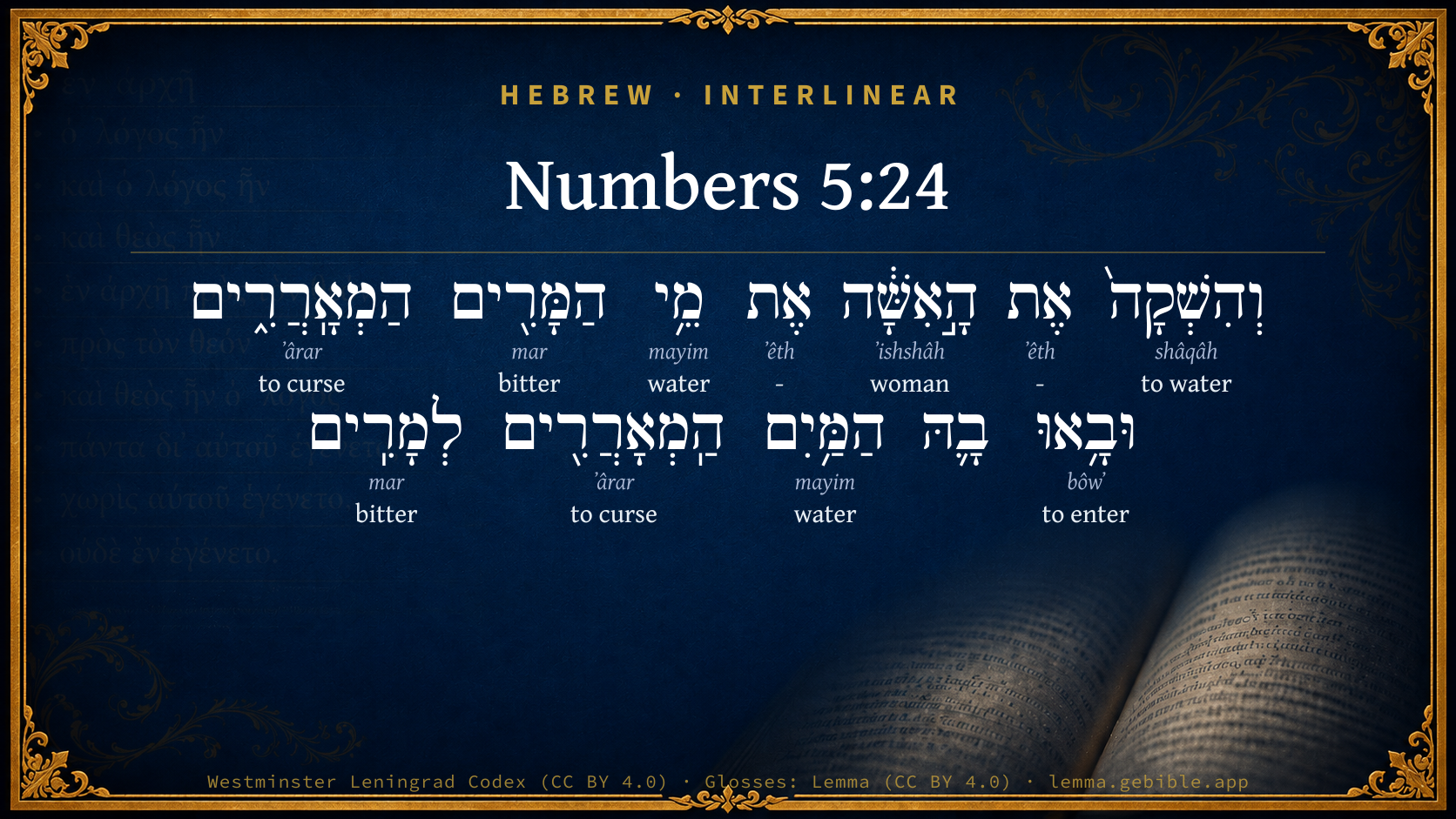
  1. וְהִשְׁקָה֙ shâqâh H8248 “and · to water” Conjunction + Verb, Hiphil, Sequential Perfect, 3rd Person, Masculine, Singular
  2. אֶת ʼêth H853 “-” Particle, Direct Object
  3. הָ֣אִשָּׁ֔ה ʼishshâh H802 “the · woman” Particle, Definite Article + Noun, Common, Feminine, Singular, Absolute
  4. אֶת ʼêth H853 “-” Particle, Direct Object
  5. מֵ֥י mayim H4325 “water(s) of” Noun, Common, Masculine, Plural, Construct
  6. הַמְאָֽרֲרִ֑ים ʼârar H779 “the · cursing” Particle, Definite Article + Verb, Piel, Participle Active, Masculine, Plural, Absolute
  7. וּבָ֥אוּ bôwʼ H935 “and · to enter” Conjunction + Verb, Qal, Sequential Perfect, 3rd Person, Common, Plural
  8. הַמַּ֥יִם mayim H4325 “the · water(s)” Particle, Definite Article + Noun, Common, Masculine, Plural, Absolute
  9. הַֽמְאָרֲרִ֖ים ʼârar H779 “the · cursing” Particle, Definite Article + Verb, Piel, Participle Active, Masculine, Plural, Absolute
  10. לְמָרִֽים mar H4751 “to/for · bitter” Preposition + Adjective, Adjective, Masculine, Plural, Absolute

About this verse

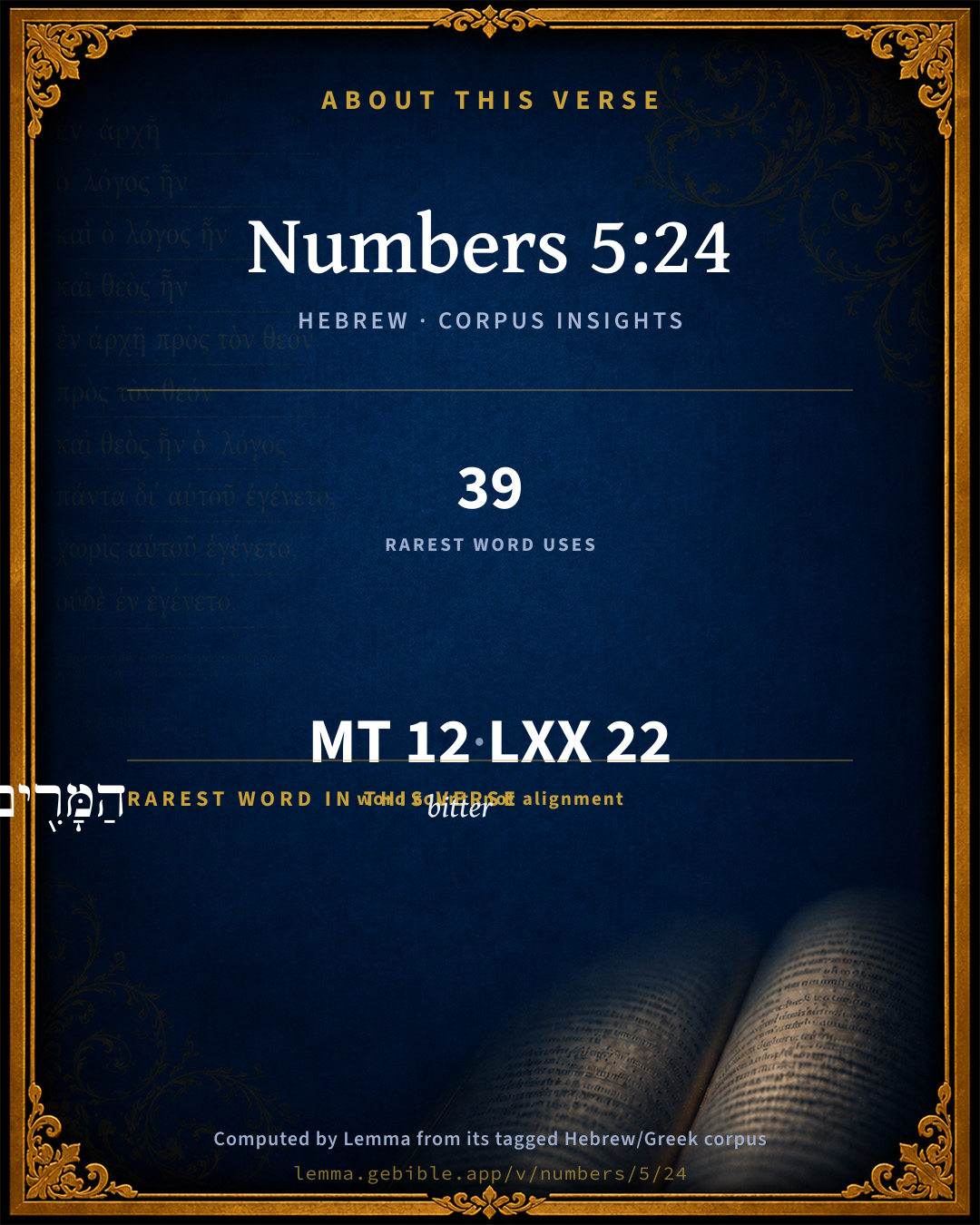
These counts appear in no published source. They are computed here, from the morphology-tagged text and Lemma’s own curated glosses. What Lemma adds →

12
words
7
distinct lemmas
Pentateuch
section

Shared distinctive vocabulary

הַמָּרִ֖ים bitter H4751 occurs in 36 verses of the Hebrew Bible. Also found in:

Grammatical profile

  • 4 verbs
  • 3 nouns
  • 2 adjectives
  • 1 preposition
  • 2 particles

Verb forms

  • וְהִשְׁקָה֙ Hiphil · Sequential Perfect
  • הַמְאָֽרֲרִ֑ים Piel · Participle Active
  • וּבָ֥אוּ Qal · Sequential Perfect
  • הַֽמְאָרֲרִ֖ים Piel · Participle Active

Repetition

Words recur within this verse — often emphatic in Hebrew:

  • מֵ֥י water H4325 ×2
  • הַמָּרִ֖ים bitter H4751 ×2
  • הַמְאָֽרֲרִ֑ים to curse H779 ×2

Hebrew & Septuagint length

In English translation the verse runs 28 words from the Hebrew and 31 from the Septuagint (LXX English) — closely comparable.

A rough comparison of the two English renderings, which tokenize alike — not a word-level alignment.

Word counts can differ between the Hebrew and the Greek without any difference in meaning — e.g. the Hebrew direct-object marker אֵת has no separate Greek word, and Greek often adds the article ὁ.

In the original languages it is 12 Hebrew tokens and 22 Greek tokens — but the two are counted differently (Hebrew bundles its prefixes and suffixes into one token; the Greek is in lemma form), so that isn’t a like-for-like length.

Cross-references

2

Topical passages linked to Numbers 5:24 in the Treasury of Scripture Knowledge — connected by theme and wording, ordered by reader-vote popularity; previews shown in the World English Bible.

  • Zechariah 5:3–4 Then he said to me, "This is the curse that goes out over the surface of the whole land; for everyone who steals shall be cut off according to it on the one side; and everyone who swears falsely shall be cut off according to it on the other side.
  • Malachi 3:5 I will come near to you to judgment; and I will be a swift witness against the sorcerers, and against the adulterers, and against the perjurers, and against those who oppress the hireling in his wages, the widow, and the fatherless, and who deprive the foreigner of justice, and don't fear me," says Yahweh of Hosts.

Cross-references courtesy of OpenBible.info (CC BY 4.0).

Hebrew and Greek witnesses Masoretic Hebrew ↔ Greek Septuagint

The same verse in the two great witnesses to the Old Testament, shown verse-for-verse.

These are two independent witnesses, not word-aligned to each other, and the Septuagint is shown in lemma (dictionary) form.

Hebrew Numbers 5:24 Masoretic · Westminster Leningrad Codex

וְהִשְׁקָה֙ אֶת הָ֣אִשָּׁ֔ה אֶת מֵ֥י הַמָּרִ֖ים הַמְאָֽרֲרִ֑ים וּבָ֥אוּ בָ֛הּ הַמַּ֥יִם הַֽמְאָרֲרִ֖ים לְמָרִֽים

He shall make the woman drink the water of bitterness that causes the curse; and the water that causes the curse shall enter into her and become bitter.

World English Bible · Public Domain

Greek LXX Numbers 5:24 Septuagint · lemma form

καί ποτίζω ὁ γυνή ὁ ὕδωρ ὁ ἐλεγμός ὁ ἐπι καταἀράομαι καί εἰςἔρχομαι εἰς αὐτός ὁ ὕδωρ ὁ ἐπι καταἀράομαι ὁ ἐλεγμός

And he shall cause the woman to drink the water of the conviction that brings the curse; and the water of the conviction that brings the curse shall enter into her.

LXX2012 (modern English Septuagint) · Public Domain

Hebrew: Westminster Leningrad Codex (CC BY 4.0). Greek: Septuagint (public domain); English from LXX2012 (modern English Septuagint) (Public Domain). How the Septuagint differs from the Hebrew →

Targum (Aramaic paraphrase)

2

The Targum is the ancient Jewish Aramaic paraphrase of the Hebrew Scriptures — an interpretive translation, not the Hebrew text itself. Onkelos (literal) and Pseudo-Jonathan (expansive) render the Torah, and Jonathan the Prophets. Coverage is partial: where no permissively-licensed English translation exists for a verse, only the Aramaic is shown. This is verse-level text, not a word-by-word alignment to the Hebrew.

  1. Targum Onkelos Torah (Genesis–Deuteronomy)
    וְיַשְׁקֵי יָת אִתְּתָא יָת מַיָא מְרִירַיָא מְלַטְטַיָא וְיֵעֲלוּן בַּהּ מַיָא מְלַטְטַיָא לִמְרִירוּ

    (no public-domain English translation for this verse)

    Targum Onkelos — Aramaic: “Onkelos Genesis” (public domain); “Onkelos Exodus” (public domain); “Onkelos Leviticus” (public domain); “Onkelos Numbers” (public domain); “Onkelos Deuteronomy” (public domain). English: “Sefaria Community Translation” (CC0 1.0 (public-domain dedication)); “J.W. Etheridge. The Targums of Onkelos and Jonathan Ben Uzziel on the Pentateuch. London: Longmans, Green, 1862” (public domain). Text via Sefaria.

  2. Targum Pseudo-Jonathan Torah (Genesis–Deuteronomy)
    וְיַשְׁקֵי יַת אִתְּתָא יַת מַיָא מְרִירַיְתָא בְּדוּקַיָא וְיֵעָלוּן בָּהּ מַיָא בְּדוּקַיָא לִלְוָט

    and cause the woman to drink the bitter trial water: the trial water of malediction shall be received by her.

    Targum Pseudo-Jonathan — Aramaic: “Targum Jonathan on Genesis” (public domain); “Targum Jonathan on Exodus” (public domain); “Targum Jonathan on Leviticus” (public domain); “Targum Jonathan on Numbers” (public domain); “Targum Jonathan on Deuteronomy” (public domain). English: “The Targum of Jonathan ben Uzziel, trans. J. W. Etheridge, London, 1862” (public domain). Text via Sefaria.

Commentary

Notes on Numbers 5:24 from classic Christian and Jewish commentators (each source and its license shown beneath its notes). The classic Christian expositions comment on the surrounding passage and are grouped to its opening verse, so a note may address several verses; the Jewish commentaries on the Tanakh (Rashi and others) are per-verse, so they appear only where the commentator wrote on this verse.

Lemma curates 59 commentaries, every one of them public domain or Creative Commons licensed, each selected and text-cleaned for this edition rather than reprinted as found. About our sources →

Adam Clarke's Commentary

Verse 24. The bitter water that causeth the curse] Though the rabbins think that the priest put some bitter substance in the water, yet as nothing of the kind is intimated by Moses, we may consider the word as used here metaphorically for affliction, death, c. These waters were afflicting and deadly to her who drank them, being guilty. In this sense afflictions are said to be bitter, Isa 38:17 so also is death, 1Sa 15:32: Ec 7:26.

Adam Clarke's Commentary on the Bible (1810–1826) — public domain. Text from a community e-Sword/MySword module.

The Cambridge Bible for Schools and Colleges

gen. ed. J. J. S. Perowne

24. and become bitter] lit. ‘for bitterness,’ i.e. proving injurious.

The Cambridge Bible for Schools and Colleges (gen. ed. J. J. S. Perowne; Cambridge University Press, 1878–1918) — public domain. Text from a community e-Sword module.

John Gill's Exposition

And he shall cause the woman to drink the bitter water that causeth the curse,..... Having the curse imprecated upon herself, if guilty, scraped into it; and this she was obliged to drink, whether she would or not; so it is said, if the roll is blotted out, and she says I am defiled, the water is poured out, and her offering is scattered in the place of ashes; if the roll is blotted out, and she says I will not drink, then force her, and make her drink whether she will or no (z):

and the water that causeth the curse shall enter into her, and become bitter; produce the sad and bitter effects mentioned.

(z) Misnah, ut supra, (Sotah) c. 3. sect. 3.

John Gill's Exposition of the Whole Bible (1746–1763) — public domain (CC PDM 1.0). Text via the HelloAO Bible API.

Haydock's Catholic Bible Commentary

Up. Hebrew, "and the water, which causeth the malediction, shall enter into her, bitter." According to Josephus, the jealous husband threw first a handful of the gomer of barley flour, upon the altar, and gave the rest to the priest; and after the other ceremonies were finished, the woman drunk the water, and either had a son within ten months, or died with the marks of infamy. (B. [Antiquities?] iii. 11. Edit. Bern.) Some Rabbins say she became livid and rotten, though she might linger on part of the year. (Sotæ iii.) But if she proved innocent, she acquired fresh beauty and health, and was delivered with ease of a son. (Maimonides) (Haydock)

George Leo Haydock (1774–1849), Haydock's Catholic Family Bible and Commentary, 1859 edition — public domain. Excludes Psalms (Douay-Rheims chapter numbering differs from Protestant) and Deuterocanonical books (Catholic canon only).

Matthew Poole's English Annotations

To drink, to wit, after the jealousy-offering was offered, as is affirmed, Num 5:26.

Matthew Poole's English Annotations on the Holy Bible (1683–1685) — public domain. Text from a community e-Sword/MySword module.

Whedon's Commentary on the Bible

Daniel D. Whedon

24. Shall cause the woman to drink — This verse is proleptical. The drinking is not twice, but only once, in Num_5:27. The eating or drinking anything symbolizes its full acceptance. So the prophets, Jer_15:16; Eze_3:1-3; and Jesus Christ, Joh_4:14; Joh_6:50.

Daniel D. Whedon (gen. ed.), Commentary on the Old and New Testaments (1874–1909) — public domain. Text from a community e-Sword module.

The Pulpit Commentary

He shall cause the woman to drink. This is said by anticipation, because she did not really drink it until after the offering (verse 26).

The Pulpit Commentary (1880–1919), ed. H.D.M. Spence-Jones & Joseph S. Exell — public domain. Text from a community e-Sword module.

John Wesley's Explanatory Notes

To drink - That is, after the jealousy-offering was offered.

John Wesley, Explanatory Notes Upon the Whole Bible (1754–1765) — public domain. Text via the GEBible commentary corpus.

unfoldingWord translationNotes

Door43 World Missions Community

General Information:

Verse 24 explains in a general way what the priest must do and what is expected to happen when the woman drinks the water. Verse 25 and 26 explains in detail how the priest is to do this work. The priest gives the water to the woman and she drinks it only once.

a representative offering

The handful of the grain offering represents the whole grain offering. This means the whole offering belongs to Yahweh.

grain offering of jealousy

"a grain offering for jealousy." See how you translated this in Numbers 5:15.

translationWords

curse

grain offering

jealous

Yahweh

altar

unfoldingWord translationNotes — © Distant Shores Media and the Door43 World Missions Community, licensed CC BY-SA 4.0. Source: git.door43.org/Door43/en_tn.

Rashi

Rabbi Shlomo Yitzchaki (Rashi)

והשקה את האשה AND HE SHALL CAUSE THE WOMAN TO DRINK [THE BITTER WATER] — This was not the actual order of the proceedings, because really he offered her meal-offering first (before giving her the water to drink; cf. v. 26, 27), but Scripture here merely informs you that when he afterwards gives her the water to drink it will become bitter in her belly (cf. Sotah 19a). — Since only the thigh and the belly are mentioned (vv. 21. 22), I might conclude that only these are affected (see Sifrei Bamidbar 18); whence do we know that this applies also to the rest of the body? Because Scripture states here, “[and the water … shall come] into her [and become bitter]” — into all of her body! But if so, why does Scripture explicitly mention only the thigh and the belly? Because they (these two) were the first to begin the sin, therefore it (Scripture) makes the punishment begin with them (and for this reason Scripture mentions them explicitly, but, as a matter of fact, it extends to the whole body as is implied in the word בה (Sifrei Bamidbar 18).

למרים (The text is more lit., “and the waters shall enter into her as bitter”) — i.e. to become bad and bitter for her.

Rashi on the Tanakh — English translations: “The Judaica Press complete Tanach with Rashi, translated by A. J. Rosenberg” (CC BY 4.0); “Pentateuch with Rashi's commentary by M. Rosenbaum and A.M. Silbermann, 1929-1934” (public domain); “The Metsudah Tanach series, Lakewood, N.J” (CC BY 4.0); and “The Book of Joshua, Metsudah Publications, 1997” (CC BY 4.0). Text via Sefaria.

Lesson kit

Teaching starters — assembled from the data on this page, not authored interpretation. Every prompt links to the verse data it draws on. Edit before teaching.

Numbers, in the Pentateuch, opens this verse with 12 words (7 distinct Hebrew lemmas). Its most distinctive word is mar (“bitter”). A historical commentator’s framing appears above. Read the whole chapter for the surrounding context.

Discussion questions

  1. The word mar carries the sense “bitter.” How does it shape the verse?
  2. How does Genesis 27:34, which shares the word «bitter», read alongside this verse?
  3. What does the repetition of “water” (2× in this one verse) do in this verse?
  4. The translations on this page render this verse differently — a whole-verse word diff, not a word-by-word alignment. What might account for the different wordings?
  5. «וְהִשְׁקָה֙» is a Hiphil Sequential Perfect verb. How does that grammatical form shape the action described?
  6. Compare how Adam Clarke's Commentary and The Cambridge Bible for Schools and Colleges read this verse. Where do they agree or differ?

Things to notice

Reading settings

Reading text

Shown beneath each verse's original-language words.

Old Testament
Old Testament edition

Read the OT as the Masoretic Hebrew (MT) or the Greek Septuagint (LXX).

English shown for the Greek Septuagint (in the Hebrew ↔ Greek comparison).

Comparing translations? Open the Compare panel on any verse page to stack up to four side by side.