Ezekiel 19:10

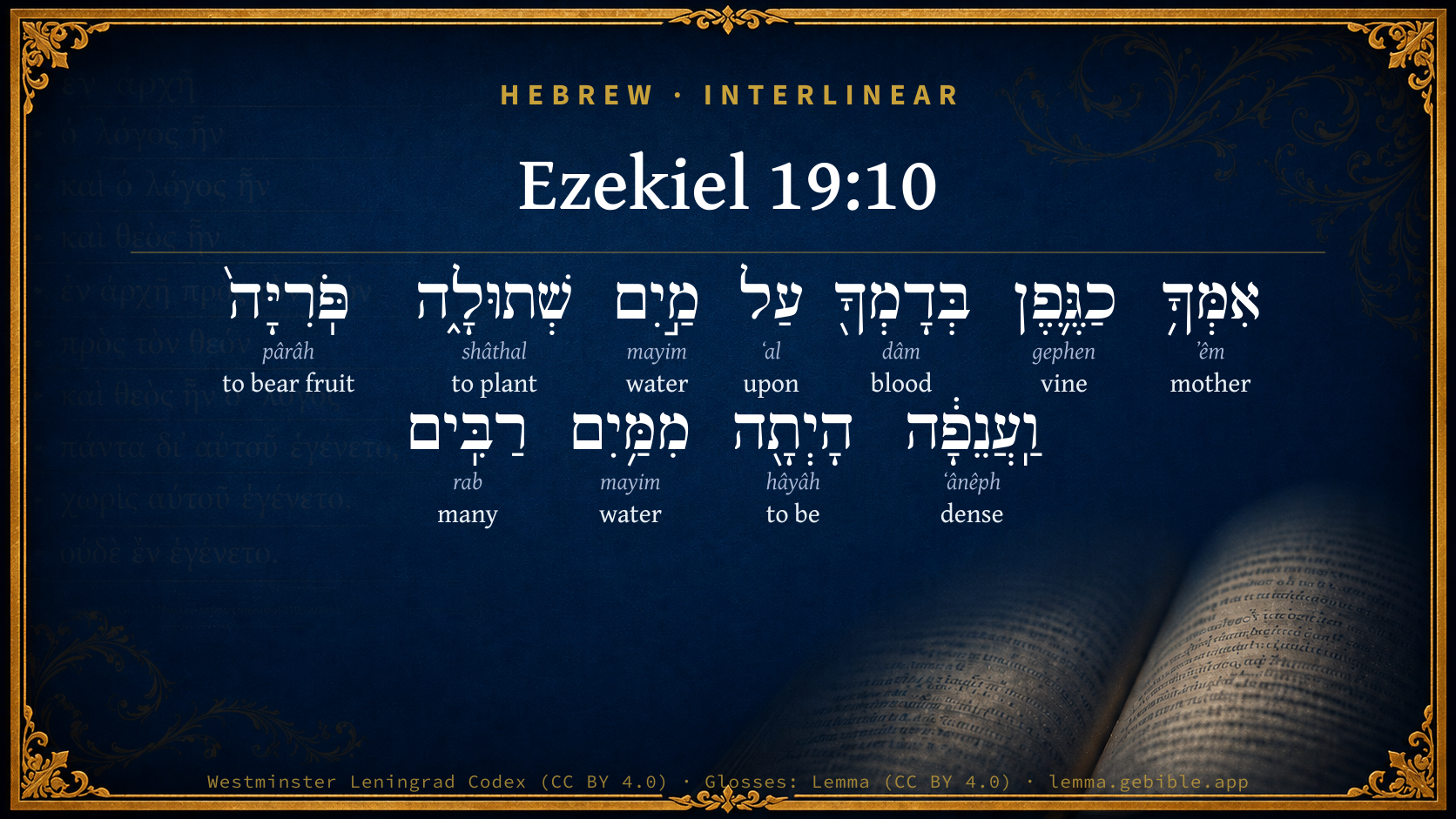
Hebrew (Westminster Leningrad Codex) Ezekiel 19:10 appears in the Hebrew Old Testament. The text above is from the Westminster Leningrad Codex. Each word links to its Strong’s number, a concise gloss, and parsing drawn from the Open Scriptures Hebrew Bible morphology. Click any word for its full Brown-Driver-Briggs (BDB) entry.
Download image
Cite this verse

Ezekiel 19:10 (World English Bible). Public Domain. Lemma interlinear Bible study tool, https://lemma.gebible.app/v/ezekiel/19/10.

Show BibTeX & RIS
BibTeX
RIS
English Translation
Your mother was like a vine, in your blood, planted by the waters: it was fruitful and full of branches by reason of many waters.
World English Bible · Public Domain
Highlights
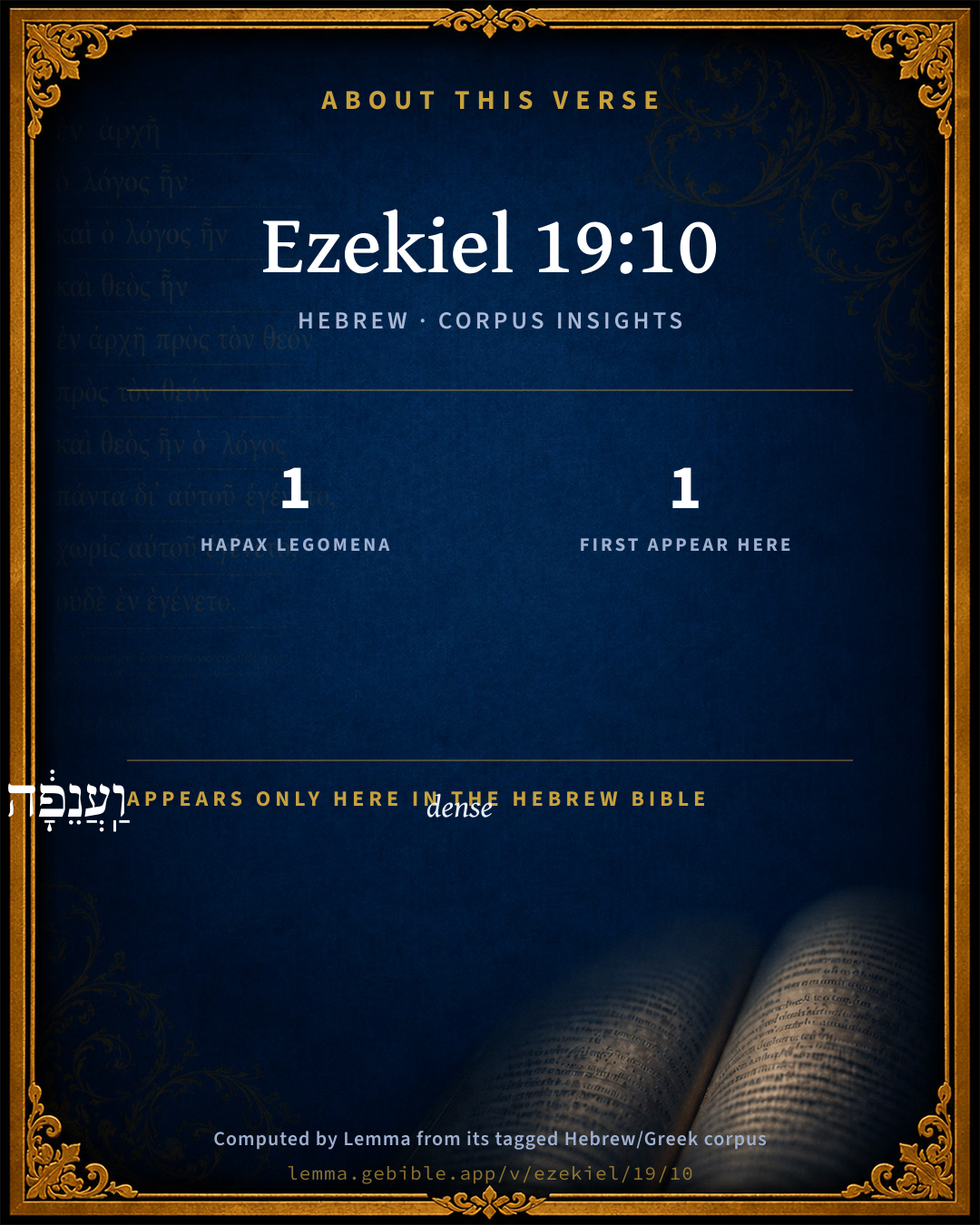
  • 1 hapax legomenon — only here in the Hebrew Bible
  • 1 first appearance in the Hebrew Bible
Full analysis ↓
Download a study sheet

One document with this verse’s original text, its word-by-word gloss line, the meaning frame, cross-references with their text, attributed commentary, and full source and license credits — printable, and it pastes into notes with its structure intact.

This verse Autodidact and up

Study sheet (.html) Plain text (.txt)

A passage Seminary Student

Up to 50 verses in one chapter. A passage sheet keeps up to 6 commentary sources and 12 cross-references per verse, in the order this page ranks them, and says so on the sheet whenever that leaves anything out. Ask for a single verse and you get the Autodidact verse sheet above.

Everything on this page stays free to read, with no account — the sheet is a download of what is already on screen, not access to it.

Want to remove ads? Support Godless Engineer
Compare translations 3

The same verse in 3 English versions, stacked beneath the original-language interlinear above. Click any original word for its lexicon entry.

Each is an independent rendering of the whole verse — the interlinear is not word-aligned to these translations.

Highlighted words mark where these versions differ — a whole-verse word diff, not a word-by-word alignment.

  • World English Bible Public Domain
    Your mother was like a vine, in your blood, planted by the waters: it was fruitful and full of branches by reason of many waters.
  • King James Version Public Domain
    Thy mother is like a vine in thy blood, planted by the waters: she was fruitful and full of branches by reason of many waters.
  • unfoldingWord Literal Text CC BY-SA 4.0
    Your mother was like a vine planted in your blood beside the water. it was fruitful and full of branches because of the abundance of water.

unfoldingWord Literal Text — © unfoldingWord, licensed CC BY-SA 4.0. Word-aligned USFM3 via Door43 (git.door43.org/unfoldingWord/en_ult).

Versions to compare (up to 4)

3 of 4 selected

Show all 18 translations

Every available English version of this verse, each an independent rendering of the whole verse.

  • World English Bible Public Domain
    Your mother was like a vine, in your blood, planted by the waters: it was fruitful and full of branches by reason of many waters.
  • Berean Standard Bible Public Domain
    Your mother was like a vine in your vineyard, planted by the water; it was fruitful and full of branches because of the abundant waters.
  • Majority Standard Bible Public Domain
    Your mother was like a vine in your vineyard, planted by the water; it was fruitful and full of branches because of the abundant waters.
  • King James Version Public Domain
    Thy mother is like a vine in thy blood, planted by the waters: she was fruitful and full of branches by reason of many waters.
  • American Standard Version (1901) Public Domain
    Thy mother was like a vine, in thy blood, planted by the waters: it was fruitful and full of branches by reason of many waters.
  • Revised Version (1885) Public Domain
    Thy mother was like a vine, in thy blood, planted by the waters: she was fruitful and full of branches by reason of many waters.
  • Geneva Bible (1599) Public Domain
    Thy mother is like a vine in thy blood, planted by the waters: she brought foorth fruite and branches by the abundant waters,
  • Douay-Rheims (1899) Public Domain
    Thy mother is like a vine in thy blood planted by the water: her fruit and her branches have grown out of many waters.
  • Young's Literal Translation Public Domain
    Thy mother `is' as a vine in thy blood by waters planted, Fruitful and full of boughs it hath been, Because of many waters.
  • Literal Standard Version CC BY-SA 4.0
    Your mother, like the vine in your blood, || Is being planted by waters, || She was bearing fruit and full of boughs, || Because of many waters.
  • Unlocked Literal Bible CC BY-SA 4.0
    Your mother was like a vine planted in your blood beside the water. it was fruitful and full of branches because of the abundance of water.
  • unfoldingWord Literal Text CC BY-SA 4.0
    Your mother was like a vine planted in your blood beside the water. it was fruitful and full of branches because of the abundance of water.
  • Darby Bible Public Domain
    Thy mother was as a vine, in thy rest, planted by the waters: it was fruitful and full of branches by reason of many waters.
  • World Messianic Bible Public Domain
    “‘Your mother was like a vine in your blood, planted by the waters. It was fruitful and full of branches by reason of many waters.
  • Webster's Bible Public Domain
    Thy mother is like a vine in thy blood, planted by the waters: she was fruitful and full of branches by reason of many waters.
  • Free Bible Version CC BY-SA 4.0
    Your mother was like a vine planted in your vineyard at the waterside. It produced a lot of fruit and had many branches because it had plenty of water.
  • Bible in Basic English Public Domain
    Your mother was in comparison like a vine, planted by the waters: she was fertile and full of branches because of the great waters.
  • JPS Tanakh (1917) Public Domain
    Thy mother was like a vine, in thy likeness, planted by the waters; she was fruitful and full of branches by reason of many waters.

Literal Standard Version (2020), Covenant Press — licensed CC BY-SA 4.0. Text via the HelloAO Bible API (eBible.org). Unlocked Literal Bible (unfoldingWord) — licensed CC BY-SA 4.0. Text via the HelloAO Bible API (eBible.org). unfoldingWord Literal Text — © unfoldingWord, licensed CC BY-SA 4.0. Word-aligned USFM3 via Door43 (git.door43.org/unfoldingWord/en_ult). Free Bible Version, Dr. Jonathan Gallagher — licensed CC BY-SA 4.0. Text via the HelloAO Bible API (eBible.org).

Word by word

More ways to search: Search by grammar → Find every occurrence → Compare this word →

Practice this passage: Drill this verse → Learn its vocabulary →

וַֽעֲנֵפָ֔ה
ʻânêph
H6058
“and · dense”
Conjunction + Adjective, Adjective, Feminine, Singular, Absolute
Part of Speech
Conjunction + Adjective
Type
Adjective
Gender
Feminine
Number
Singular
State
Absolute
Full BDB Definition

Origin: from the same as H6057

TWOT: 1657b

full of branches, dense
  1. אִמְּךָ֥ ʼêm H517 “mother · your” Noun, Common, Feminine, Singular, Construct + Suffix, Personal, 2nd Person, Masculine, Singular
  2. כַגֶּ֛פֶן gephen H1612 “like/as the · vine” Preposition, Determined + Noun, Common, Both, Singular, Absolute
  3. בְּדָמְךָ֖ dâm H1818 “in/at · blood · your” Preposition + Noun, Common, Masculine, Singular, Construct + Suffix, Personal, 2nd Person, Masculine, Singular
  4. עַל ʻal H5921 “upon” Preposition
  5. מַ֣יִם mayim H4325 “water(s)” Noun, Common, Masculine, Plural, Absolute
  6. שְׁתוּלָ֑ה shâthal H8362 “planted” Verb, Qal, Participle Passive, Feminine, Singular, Absolute
  7. פֹּֽרִיָּה֙ pârâh H6509 “bearing fruit” Verb, Qal, Participle Active, Feminine, Singular, Absolute
  8. הָיְתָ֖ה hâyâh H1961 “to be” Verb, Qal, Perfect, 3rd Person, Feminine, Singular
  9. מִמַּ֥יִם mayim H4325 “from · water(s)” Preposition + Noun, Common, Masculine, Plural, Absolute
  10. רַבִּֽים rab H7227 “many” Adjective, Adjective, Masculine, Plural, Absolute

About this verse

These counts appear in no published source. They are computed here, from the morphology-tagged text and Lemma’s own curated glosses. What Lemma adds →

11
words
10
distinct lemmas
Prophets
section

Notable vocabulary

1 hapax legomenon — a word that appears only here in the entire Hebrew Bible:

  • וַֽעֲנֵפָ֔ה dense H6058

First appearance in Scripture

This word makes its first canonical appearance in the Hebrew Bible here:

  • וַֽעֲנֵפָ֔ה dense H6058

Shared distinctive vocabulary

שְׁתוּלָ֑ה to plant H8362 occurs in 10 verses of the Hebrew Bible. Also found in:

Grammatical profile

  • 3 verbs
  • 5 nouns
  • 2 adjectives
  • 1 preposition

Verb forms

  • שְׁתוּלָ֑ה Qal · Participle Passive
  • פֹּֽרִיָּה֙ Qal · Participle Active
  • הָיְתָ֖ה Qal · Perfect

Repetition

A word recurs within this verse — often emphatic in Hebrew:

  • מַ֣יִם water H4325 ×2

Hebrew & Septuagint length

In English translation the verse runs 25 words from the Hebrew and 28 from the Septuagint (LXX English) — closely comparable.

A rough comparison of the two English renderings, which tokenize alike — not a word-level alignment.

Word counts can differ between the Hebrew and the Greek without any difference in meaning — e.g. the Hebrew direct-object marker אֵת has no separate Greek word, and Greek often adds the article ὁ.

Cross-references

12

Topical passages linked to Ezekiel 19:10 in the Treasury of Scripture Knowledge — connected by theme and wording, ordered by reader-vote popularity; previews shown in the World English Bible.

  • Psalms 80:8–11 You brought a vine out of Egypt. You drove out the nations, and planted it.
  • Deuteronomy 8:7 For Yahweh your God brings you into a good land, a land of brooks of water, of springs and springs, flowing forth in valleys and hills;
  • Numbers 24:6–7 As valleys are they spread forth, As gardens by the river-side, As lign-aloes which Yahweh has planted, As cedar trees beside the waters.
  • Matthew 21:33–41 "Hear another parable. There was a man who was a master of a household, who planted a vineyard, set a hedge about it, dug a winepress in it, built a tower, leased it out to farmers, and went into another country.
  • Deuteronomy 8:9 a land in which you shall eat bread without scarceness, you shall not lack anything in it; a land whose stones are iron, and out of whose hills you may dig copper.
  • Psalms 89:25–29 I will set his hand also on the sea, And his right hand on the rivers.
  • Isaiah 5:1–4 Let me sing for my well beloved a song of my beloved about his vineyard. My beloved had a vineyard on a very fruitful hill.
  • Ezekiel 15:2–8 Son of man, what is the vine tree more than any tree, the vine-branch which is among the trees of the forest?
  • Ezekiel 17:6 It grew, and became a spreading vine of low stature, whose branches turned toward him, and the roots of it were under him: so it became a vine, and brought forth branches, and shot forth sprigs.
  • Ezekiel 19:2 and say, What was your mother? A lioness: she couched among lions, in the midst of the young lions she nourished her cubs.
  • Hosea 2:2 Contend with your mother! Contend, for she is not my wife, Neither am I her husband; And let her put away her prostitution from her face, And her adulteries from between her breasts;
  • Hosea 2:5 For their mother has played the prostitute. She who conceived them has done shamefully; For she said, 'I will go after my lovers, Who give me my bread and my water, My wool and my flax, My oil and my drink.'

Cross-references courtesy of OpenBible.info (CC BY 4.0).

Hebrew and Greek witnesses Masoretic Hebrew ↔ Greek Septuagint

The same verse in the two great witnesses to the Old Testament, shown verse-for-verse.

These are two independent witnesses, not word-aligned to each other, and the Septuagint is shown in lemma (dictionary) form.

Hebrew Ezekiel 19:10 Masoretic · Westminster Leningrad Codex

אִמְּךָ֥ כַגֶּ֛פֶן בְּדָמְךָ֖ עַל מַ֣יִם שְׁתוּלָ֑ה פֹּֽרִיָּה֙ וַֽעֲנֵפָ֔ה הָיְתָ֖ה מִמַּ֥יִם רַבִּֽים

Your mother was like a vine, in your blood, planted by the waters: it was fruitful and full of branches by reason of many waters.

World English Bible · Public Domain

Greek LXX Ezekiel 19:10 Septuagint · lemma form

ὁ μήτηρ σύ ὡς ἄμπελος ὡς ἄνθος ἐν ῥόα ἐν ὕδωρ φυτεύω ὁ καρπός αὐτός καί ὁ βλαστός αὐτός γίγνομαι ἐκ ὕδωρ πολύς

Your mother was as a vine and as a blossom on a pomegranate tree, planted by water: her fruit and her shoot abounded by reason of much water.

LXX2012 (modern English Septuagint) · Public Domain

On this verse, Joseph Benson's Commentary discusses the Septuagint’s reading. Read the note in Commentary ↓

Hebrew: Westminster Leningrad Codex (CC BY 4.0). Greek: Septuagint (public domain); English from LXX2012 (modern English Septuagint) (Public Domain). How the Septuagint differs from the Hebrew →

Targum (Aramaic paraphrase)

1

The Targum is the ancient Jewish Aramaic paraphrase of the Hebrew Scriptures — an interpretive translation, not the Hebrew text itself. Onkelos (literal) and Pseudo-Jonathan (expansive) render the Torah, and Jonathan the Prophets. Coverage is partial: where no permissively-licensed English translation exists for a verse, only the Aramaic is shown. This is verse-level text, not a word-by-word alignment to the Hebrew.

  1. Targum Jonathan Prophets (Joshua–Malachi)
    כְּנִשְׁתָּא דְיִשְׂרָאֵל בְּמַעְבְּדָה אוֹרַיְתָא דַמְיָא כְגוּפַן דִשְׁתִילָא עַל מַבּוּעַ דְמַיָן דְנוֹפָהּ שַׁפִּיר וְסוֹכָהּ מַטְלָן הִיא שְׁתִילָה עַל מַיִין סַגִיאִין:

    (no public-domain English translation for this verse)

    Targum Jonathan — Aramaic: “Mikraot Gedolot” (public domain). English: “Sefaria Community Translation” (CC0 1.0 (public-domain dedication)); “London "Chaldee Paraphrase," 1871” (public domain). Text via Sefaria.

Commentary

Notes on Ezekiel 19:10 from classic Christian and Jewish commentators (each source and its license shown beneath its notes). The classic Christian expositions comment on the surrounding passage and are grouped to its opening verse, so a note may address several verses; the Jewish commentaries on the Tanakh (Rashi and others) are per-verse, so they appear only where the commentator wrote on this verse.

Lemma curates 59 commentaries, every one of them public domain or Creative Commons licensed, each selected and text-cleaned for this edition rather than reprinted as found. About our sources →

Matthew Henry's Commentary

Jerusalem, the mother-city, is here represented by another similitude; she is a vine, and the princes are her branches. This comparison we had before, Eze 15:1. Jerusalem is as a vine; the Jewish nation is so: Like a vine in they blood (Eze 19:10), the blood-royal, like a vine set in blood and watered with blood, which contributes very much to the flourishing and fruitfulness of vines, as if the blood which had been shed had been designed for the fattening and improving of the soil, in such plenty was it shed; and for a time it seemed to have that effect, for she was fruitful and full of branches by reason of the waters, the many waters near which she was planted. Places of great wickedness may prosper for a while; and a vine set in blood may be full of branches. Jerusalem was full of able magistrates, men of sense, men of learning and experience, that were strong rods, branches of this vine of uncommon bulk and strength, or poles for the support of this vine, for such magistrates are. The boughs of this vine had grown to such maturity that they were fit to make white staves of for the sceptres of those that bore rule, Eze 19:11. And those are strong rods that are fit for sceptres, men of strong judgments and strong resolutions that are fit for magistrates. When the royal family of Judah was numerous, and the courts of justice were filled with men of sense and probity, then Jerusalem's stature was exalted among thick branches; when the government is in good able hands a nation is thereby made considerable Then she was not taken for a weak and lowly vine, but she appeared in her height, a distinguished city, with the multitude of her branches. Tanquam lenta solent inter viburna cupressi - Midst humble withies thus the cypress soars. "In thy quietness" (so some read that, Eze 19:10, which we translate in thy blood) "thou wast such a vine as this." When Zedekiah was quiet and easy under the king of Babylon's yoke his kingdom flourished thus. See how slow God is to anger, how he defers his judgments, and waits to be gracious. 2. This vine is now quite destroyed. Nebuchadnezzar, being highly provoked by Zedekiah's treachery, plucked it up in fury (Eze 19:12), ruined the city and kingdom, and cut off all the branches of the royal family that fell in his way. The vine was cut off close to the ground, though not plucked up by the roots. The east wind dried up the fruit that was blasted. The young people fell by the sword, or were carried into captivity. The aspect of it had nothing that was pleasing, the prospect nothing that was promising. Her strong rods were broken and withered; her great men were cut off, judges and magistrates deposed. The vine itself is planted in the wilderness, Eze 19:13. Babylon was as a wilderness to those of the people that were carried captives thither; the land of Judah was as a wilderness to Jerusalem, now that the whole country was ravaged and laid waste by the Chaldean army - a fruitful land turned into barrenness. "It is burnt with fire (Psa 80:16) and that fire has gone out of a rod of her branches (Eze 19:14); the king himself, by rebelling against the king of Babylon, has given occasion to all this mischief. She may thank herself for the fire that consumes her; she has by her wickedness made herself like tinder to the sparks of God's wrath, so that her own branches serve as fuel for her own consumption; in them the fire is kindled which devoured the fruit, the sins of the elder being the judgments which destroy the younger; her fruit is burned with her own branches, so that she has no strong rod to be a sceptre to rule, none to be found now that are fit for the government or dare take this ruin under their hand, as the complaint is (Isa 3:6, Isa 3:7), none of the house of David left that have a right to rule, no wise men, or men of sense, that are able to rule." It goes ill with any state, and is likely to go worse, when it is thus deprived of the blessings of government and has no strong rods for sceptres. Woe unto thee, O land! when thy king is a child, for it is as well to have no rod as not a strong rod. Those strong rods, we have reason to fear, had been instruments of oppression, assistant to the king in catching the prey and devouring men, and now they are destroyed with him. Tyranny is the inlet to anarchy; and, when the rod of government is turned into the serpent of oppression, it is just with God to say, "There shall be no strong rod to be a sceptre to rule; but let men be as are the fishes of the sea, where the greater devour the less." Note, This is a lamentation and shall be for a lamentation. The prophet was bidden (Eze 19:1) to take up a lamentation; and, having done so, he leaves it to be made use of by others. "It is a lamentation to us of this age, and, the desolations continuing long, it shall be for a lamentation to those that shall come after us; the child unborn will rue the destruction made of Judah and Jerusalem by the present judgments. They were a great while in coming; the bow was long in the drawing; but now that they have come they will continue, and the sad effects of them will be entailed upon posterity." Note, Those who fill up the measure of their fathers' sins are laying up in store for their children's sorrows and furnishing them with matter for lamentation; and nothing is more so than the overthrow of government.

Matthew Henry's Commentary on the Whole Bible (1708–1710) — public domain (CC PDM 1.0). Text via the HelloAO Bible API.

Trapp's Complete Commentary

John Trapp

Eze 19:10 Thy mother [is] like a vine in thy blood, planted by the waters: she was fruitful and full of branches by reason of many waters.

Ver. 10. Thy mother is like a vine in thy blood.] The same lamentation is here continued, though under another parable - viz., of a wasted vine. Jerusalem was once a generous fruitful spreading vine. It began to be so again in some sort under Zedekiah, if he could have been contented. See on Eze 17:5; Eze 17:8.

John Trapp, A Commentary or Exposition upon All the Books of the Old and New Testament (1647–1656) — public domain. Text from a community e-Sword module.

Joseph Benson's Commentary

Eze 19:10-14. Thy mother is like a vine — Here another similitude is made use of, and the Jewish nation is compared, as it frequently is in other places, to a vine. In thy blood — So the Hebrew and Vulgate; but the LXX. read, ως ανθος εν ροα, as a flower on a pomegranate-tree; and Bishop Newcome, who supposes the LXX. to have read כרמן, and not בדמךְ, renders the clause, like a pomegranate, planted by the waters, &c. — “The Jewish nation, whence the royal family had their original, was like a fruitful vine in a very flourishing condition.” And she had strong rods, &c. — From her sprung valiant princes, fit to sway the sceptre. A rod or sceptre is an emblem of authority. Her stature was exalted among the thick branches — Among the neighbouring kings and princes: see 2Ch 32:23. The increase of the nation’s power is expressed by this. But she was plucked up in fury — God, in his anger, removed her out of her own land. She was cast down to the ground — She was reduced to a contemptible state. The east wind dried up her fruit — The Chaldean forces ravaged and depopulated the country; her strong rods were broken — Her kings and princes were subdued, and made captives. The fire consumed them — The divine anger brought them to destruction, as fire consumes the branches of a tree when it is withered. And now she is planted in the wilderness — A great part of her people are carried captive, where their condition is as much different from what it was formerly, as the condition of a tree is when it is removed out of a rich soil into a dry and barren ground. The Jews suffered several captivities before that final one which ended in the destruction of their temple and government. And fire is gone out of a rod of her branches — This is spoken of Zedekiah’s breaking his oath of fidelity to the king of Babylon, which was the occasion of the destruction of the royal family, and the entire ruin of the government. This is a lamentation, &c. — This is matter of present lamentation, and shall be so to after ages.

Joseph Benson's Commentary on the Old and New Testaments (1811–1818) — public domain. Text from a community e-Sword module.

The Preacher's Complete Homiletical Commentary

Joseph S. Exell (gen. ed.)

EXEGETICAL NOTES.—Eze_19:10-14. The prophet laments for the destruction of the kingdom, and banishment of the people, under the parable of a wasted vine.

Eze_19:10. “Like a vine in thy blood.” The royal vine of Judah was torn up when Jehoiachin was carried captive to Babylon. That vine was planted afresh in the person of Zedekiah, so that the life of the whole plant depended upon him. The very sap of that royal tree was his blood. Some render, “in thy likeness;” but this is forced, and gives no suitable meaning.

Eze_19:11. “Strong rods.” “These represent princes of the royal house. In her prosperous state, the Jewish kingdom, so far from resembling one of those vines which creep upon the ground, was comparable to one trained up by the side of a wall, or supported by a tree. Some of these are carried to a great height, such as that mentioned by Schulz, the stem of which was a foot and a-half in diameter, and about thirty feet high, while its branches formed a tent of upwards of fifty feet square.”—(Henderson.) “Thick branches.” The branches of forest trees. The once lowly vine now appears towering above oaks and cedars, yet is still without fruit (Eze_15:6).

Eze_19:12. “But she was plucked up in fury, she was cast down to the ground.” “Without the intervention of anything further, there follows its splendid growth, like a lightning flash from the clear heavens, the complete overthrow of the vine, i.e. of Jerusalem—Judah, the birth-place of kings, and therewith the Davidic kingdom. While Eze_19:2-9 bewailed the existing kings, both as bearers of the Davidic royalty, and at the same time as suggestive, by their fate, to the actual king; now Zedekiah, as he with whom the Davidic kingdom is subverted, becomes the subject of the lament, just as if everything had already happened.”—(Lange).

Eze_19:13. “And now she is planted in the wilderness.” Figuratively describes the captivity, when David’s stock was transplanted into the “wilderness” of Babylonia (Eze_20:35).

Eze_19:14. “And fire is gone out of a rod of her branches, which hath devoured her fruit.” Zedekiah was the vain-glorious rod of this vine. The very rod itself supplied the fire which burned up the whole tree. “It was his revolt from Nebuchadnezzar which caused that monarch to march his army into Judea, take Jerusalem, and carry the Jews captive to Babylon. Thus an end was put to the vine and its branches—a consummation which every Jewish patriot must deeply have bewailed.”—(Henderson.) “This is for a lamentation, and shall be for a lamentation.” “The lamentation is (properly was, with prophetic anticipation of the future) for a lamentation: it is not the fancy of a gloomy seer, but the prediction of a lamentation, which will actually flow in a thousand voices from the mouth of the people. What Ezekiel here pronounces, the people will too soon be compelled to repeat after him. His lamentation is, as it were, the sowing, out of which a rich harvest of lamentation grows. At present the sky is full of joyous music to the people; but very soon it will be said: “My harp is turned to mourning, and my flute to the voice of weeping.”—(Hengstenberg.)

HOMILETICS

LAMENTATION FOR THE KINGDOM OF JUDAH

Two things concerning the fate of the kingdom of Judah, most of all, sorely touched the prophet’s mind and heart.

I. It was fallen from a high estate. Judah was once a goodly vine, and blest above all others. She was the planting of the Lord. Her elevation to the greatest privileges serves sadly to reveal the depth of her fall.

II. It was doomed to destruction. The destruction was sudden and overwhelming. For immediately before she was full of happiness and splendour, great among the nations, and wielding the rod of power. Their destruction was brought about by the wrath of God. “She was plucked up in fury” (Eze_19:12). When nations cease to acknowledge God, He turns the glory and growth of centuries into a desert. National sins spread like fire, and wrap whole kingdoms in the flames of destruction. The end of sin is “lamentation”—for individuals, for nations. Judah’s kingdom fell, like others before and after it, because it failed to maintain righteousness. There is only one king who can deliver the nations and reign over them for ever and ever. “The Messianic hope was bound up with the Davidic kingdom, whose subversion is here illustrated, and its fulfilment is shown in this, that He who appeared in the world, declared, not without reference to this chapter,’ I am the true vine’ ” (Lange).

(Eze_19:10-11.)

1. States and kingdoms, ruined in times of war and trouble, flourish again in times of quiet and silence. Tyranny, oppression, wars, pull down, root up, destroy; but when there is peace and rest, it is otherwise. “They built and prospered,” and why? they had “rest on every side.” When roaring lions are taken away, and men of peaceable and quiet spirits succeed, then the vine grows, then the land prospers, then breaches are repaired.

2. It is through the goodness and blessing of God that wasted kingdoms do become as vines, and flourish again. “Thy mother is like a vine, fruitful and full of branches by reason of many waters.” God watered the kingdom with blessings; He gave peace, He gave the poor strength to labour, He rained upon them, and gave sap to the vine, that she was fruitful. When God lays waste his vineyards, then He commands “the clouds that they rain no rain upon it” (Isa_5:6); but when He causes it to flourish, then He calls forth the rain, He moistens the spirits of men of all sorts, to contribute their help, thoughts and counsels for the good of the kingdom. He stirs up the spirits of men to be doing for the public; He gives people planted by Him many waters, many blessings.

3. When mercies are multiplied, men are apt to abuse them, and swell with the enjoyment of them. This metaphysical vine, the kingdom of Judah, had “strong rods her stature was exalted among the thick branches, and she appeared in her height with the multitude of her branches.” She grew up again to a height, greatness. She had a multitude of branches, variety of mercies, and these swelled her so, that she became proud, insolent, and despised others. Prosperity is a dangerous thing, and hath hazarded many. The Babylonian kingdom was so rich, great, populous, and plentiful that it was called “the lady of kingdoms,” and she herself said, “I shall be a lady for ever.” She prided herself in her prosperity (Isa_47:5; Isa_47:7), so spiritual Babylon (Rev_18:7). “I sit a queen, and am no widow, and shall see no sorrow.” After Hezekiah had received many mercies, “his heart was lifted up” (2Ch_32:23-25). Rehoboam, when he was strengthend in the kingdom, “forsook the law of the Lord, and all Israel with him; “here was a sad effect of prosperity (2Ch_12:1). This people were seldom the better for mercies and blessings bestowed upon them; “I spoke unto thee in thy prosperity, but thou saidst, I will not hear. This hath been thy manner from thy youth, that thou obeyest not my voice” (Jer_22:21). She had forgotten the caution the Lord gave her in the days of her infancy (Deu_8:11-14).—(Greenhill).

(Eze_19:13).

“And now she is planted in the wilderness.” This wilderness was Babylon, which was a fruitful, pleasant, and well-watered country; the city and land were the “glory of kingdoms (Isa_13:19). It had variety of rivers (Psa_137:1). Now if this were the nature of the country, how is it here called a wilderness? It is so called, not in respect of itself, but in reference to the Jews, who being captives therein, were as in a wilderness. In a wilderness, a man is destitute of all comforts and exposed to many dangers; so were the Jews in Babylon.

1. They were destitute of comforts. They came naked into Babylon, where they were amongst a people of a barbarous and unknown tongue, that knew nothing of God; there they had no form of a Church or State; they had no life, but were as dry bones (Eze_37:11). There they were captives; Babylon was a prison unto them, and prisons of what kind soever are not pleasing. Prisoners endure much hunger and thirst, and doubtless so did the Jews in Babylon. Though there were plenty, yet they had little enough, and therefore it was a “dry and thirsty land” to them.

2. They were exposed to many dangers. They were amongst those that mocked and hated them. The Babylonians were “bitter and hasty, terrible and dreadful” (Hab_1:6-7). They were like wild beasts in the wilderness, and sought, upon all occasions, to make a prey of the poor captive Jews. They got the three children into the fiery furnace, Daniel into the lion’s den, and Haman attempted the total ruin of them. “She is planted.” Before (Eze_19:12), it is said, “the fire consumed them.” What is consumed in the fire is burnt to ashes, and how can that be planted? He doth not say the whole vine was burnt, but her “strong rods” were broken off and burnt; some were burnt and consumed by famine, some by the plague, some by the sword (2Ch_36:17). “The king of the Chaldees slew their young men with the sword;” but “they that escaped the sword he carried away to Babylon, where they were servants to him and his sons” (2Ch_36:20). If it should be granted that the whole vine was dried up, withered, and burnt to ashes, yet these words may bear a good and sound sense, viz., thus:—they may be understood of Jehoiachin and those that were with him in Babylon at that time when they were spoken; for the words run in the present tense, “she is planted,” not, she shall be planted, for Zedekiah and those that escaped the sword were carried alter this prophecy to Babylon.—(Greenhill.)

The Preacher's Complete Homiletical Commentary (gen. ed. Joseph S. Exell; Funk & Wagnalls, c. 1892) — public domain (pre-1929). A full-Bible homiletical/sermon-outline anthology covering 65 of 66 books (2 John is absent from the source module). Text from a community e-Sword module.

Keil & Delitzsch

C. F. Keil & F. Delitzsch

Destruction of the Kingdom, and Banishment of the People

Eze 19:10. Thy mother was like a vine, planted by the water in thy repose; it became a fruitful and rich in tendrils from many waters. Eze 19:11. And it had strong shoots for rulers' sceptres; and its growth ascended among the clouds, and was visible in its height in the multitude of its branches. Eze 19:12. Then it was torn up in fury, cast to the ground, and the east wind dried up its fruit; its strong shoots were broken off, and withered; fire devoured them. Eze 19:13. And now it is planted in the desert, in a dry and thirsty land. Eze 19:14. There goeth out fire from the shoot of its branches, devoureth its fruit, so that there is no more a strong shoot upon it, a sceptre for ruling. - A lamentation it is, and it will be for lamentation. - From the lamentable fate of the princes transported to Egypt and Babylon, the ode passes to a description of the fate, which the lion-like rapacity of the princes is preparing for the kingdom and people. Israel resembled a vine planted by the water. The difficult word בּדמך we agree with Hvernick and Kliefoth in tracing to the verb דּמה, to rest (Jer 14:17), and regard it as synonymous with בּדמי in Isa 38:10 : "in thy repose," i.e., in the time of peaceful, undisturbed prosperity. For neither of the other renderings, "in thy blood" and "in thy likeness," yields a suitable meaning. The latter explanation, which originated with Raschi and Kimchi, is precluded by the fact that Ezekiel always uses the word דּמוּת to express the idea of resemblance. - For the figure of the vine, compare Psa 80:9. This vine sent out strong shoots for rulers' sceptres; that is to say, it brought forth powerful kings, and grew up to a great height, even into the clouds. עבתים signifies "cloud," lit., thicket of clouds, not only here, but in Eze 31:3, Eze 31:10,Eze 31:14. The rendering "branches" or "thicket of foliage" is not suitable in any of these passages. The form of the word is not to be taken as that of a new plural of עבות, the plural of עב, which occurs in Sa2 23:4 and Psa 77:18; but is the plural of עבות, an interlacing or thicket of foliage, and is simply transferred to the interlacing or piling up of the clouds. The clause 'ויּרא וגו, and it appeared, was seen, or became visible, simply serves to depict still further the glorious and vigorous growth, and needs no such alteration as Hitzig proposes. This picture is followed in Eze 19:12., without any particle of transition, by a description of the destruction of this vine. It was torn up in fury by the wrath of God, cast down to the ground, so that its fruit withered (compare the similar figures in Eze 17:10). מטּה עזּהּ is used collectively, as equivalent to מטּות עז (Eze 19:11); and the suffix in אכלתהוּ is written in the singular on account of this collective use of מטּה. The uprooting ends in the transplanting of the vine into a waste, dry, unwatered land, - in other words, in the transplanting of the people, Israel, into exile. The dry land is Babylon, so described as being a barren soil in which the kingdom of God could not flourish. According to Eze 19:14, this catastrophe is occasioned by the princes. The fire, which devours the fruit of the vine so that it cannot send out any more branches, emanates ממּטּה בדּיה, from the shoot of its branches, i.e., from its branches, which are so prolific in shoots. מטּה is the shoot which grew into rulers' sceptres, i.e., the royal family of the nation. The reference is to Zedekiah, whose treacherous breach of covenant (Eze 17:15) led to the overthrow of the kingdom and of the earthly monarchy. The picture from Eze 19:12 onwards is prophetic. The tearing up of the vine, and its transplantation into a dry land, had already commenced with the carrying away of Jeconiah; but it was not completed till the destruction of Jerusalem and the carrying away of Zedekiah, which were still in the future at the time when these words were uttered. - The clause 'קינה היא does not contain a concluding historical notice, as Hהvernick supposes, but simply the finale of the lamentation, indicating the credibility of the prediction which it contains. ותּהי is prophetic, like the perfects from ותּתּשׁ in Eze 19:12 onwards; and the meaning is this: A lamentation forms the substance of the whole chapter; and it will lead to lamentation, when it is fulfilled.

Keil & Delitzsch — Biblical Commentary on the Old Testament (1861–1891) — public domain (CC PDM 1.0). Text via the HelloAO Bible API. (Old Testament only.)

Tyndale Open Study Notes

Tyndale Open Resources

19:10 The vine is evidently Judah, whom the Lord had planted under optimum conditions.

Tyndale Open Study Notes — © Tyndale Open Resources, licensed CC BY-SA 4.0. Text via the HelloAO Bible API.

Geneva Bible (1599)

Geneva Bible translators

He speaketh this in the reproach of this wicked king, in whose blood, that is, in the race of his predecessors, Jerusalem should have been blessed, according to God’s promise, and flourished as a fruitful vine.

Geneva Bible (1599) marginal notes — public domain. Text via Bolls.life.

Jamieson, Fausset & Brown

Robert Jamieson, A. R. Fausset & David Brown

A new metaphor taken from the vine, the chief of the fruit-bearing trees, as the lion is of the beasts of prey (see Eze 17:6).

in thy blood--"planted when thou wast in thy blood," that is, in thy very infancy; as in Eze 16:6, when thou hadst just come from the womb, and hadst not yet the blood washed from thee. The Jews from the first were planted in Canaan to take root there [CALVIN]. GROTIUS translates as the Margin, "in thy quietness," that is, in the period when Judah had not yet fallen into her present troubles. English Version is better. GLASSIUS explains it well, retaining the metaphor, which CALVIN'S explanation breaks, "in the blood of thy grapes," that is, in her full strength, as the red wine is the strength of the grape. Gen 49:11 is evidently alluded to.

many waters--the well-watered land of Canaan (Deu 8:7-9).

Jamieson, Fausset & Brown — Commentary Critical and Explanatory on the Whole Bible (1871) — public domain (CC PDM 1.0). Text via the HelloAO Bible API.

Adam Clarke's Commentary

Verse 10. Thy mother (Jerusalem) is like a vine in thy blood] Of this expression I know not what to make. Some think the meaning is "A vine planted by the waters to produce the blood of the grape." See De 32:14. Others, for בדמך bedamecha, in thy blood, would read ברמון berimmon, in or at a pomegranate; like a vine planted by or beside a pomegranate-tree, by which it was to be supported. And so the Septuagint and Arabic appear to have read. Calmet reads כרמך carmecha, thy vineyard, instead of בדמך bedamecha, in thy blood. Here is no change but a resh for a daleth. This reading is supported by one of Kennicott's and one of De Rossi's MSS.: "Thy mother is like a vine in thy vineyard, planted by the waters." Though this is rather an unusual construction yet it seems the best emendation. Of the textual reading no sense can be made. There is a corruption somewhere.

Full on branches] Many princes. See next verse.

Adam Clarke's Commentary on the Bible (1810–1826) — public domain. Text from a community e-Sword/MySword module.

John Calvin's Commentaries

Here Ezekiel places before our eyes the twofold state of the Jews, that they may acknowledge themselves fallen into extreme misery, because they had provoked God. For they did not sufficiently consider their present state, unless the former dignity and happiness with which they were adorned was brought to their remembrance. Now, in some way they had grown callous to all evils: although scarcely anything remained safe but Jerusalem, they did not look back, but were just as wanton as when their affairs were prosperous. Since they had not yet been humbled by so many slaughters, the Prophet, therefore, on the one hand, reminds them of their former condition, and then shows them how they had fallen. This comparison, then, thought to prick their consciences sharply, that they may at length feel that God was hostile to them. We now understand the Prophet’s intention in saying, that the people’s mother was at first like a flourishing and fruit-bearing vine. It is not surprising that he says, the vine was planted near the waters: for there the vines do not require lofty and dry situations, as in cold climates, but rather seek their nourishment from water, as we gather from many passages of Scripture. The Prophet, therefore, stays, that the people at, the beginning was like a vine planted in a mild and choice situation. He says, that the vine was flourishing, or branching, and fruitful, since it drew its juices from the waters.

Respecting the word “blood,” I think those who take it for vigor are mistaken; it rather refers to birth: he says, the mother of the people in her blood, that is, in bringing forth the people. Thus Ezekiel recalls the Jews to their first origin, as we previously saw the word used in this sense. When you was in thy blood, meaning, when you was born, as we know this to be the state of the young offspring, as the metaphor was explained in the sixteenth chapter. Live in thy blood, said God, (Ezekiel 16:6,) since the Jews were still defiled through not being cleansed from pollution. In fine, blood is taken for birth, as if it had been said, that the Jews, when first brought to light, were planted so as to take root, since God led them into the land of Canaan. Here he says they were brought to light when God restored them. He omits the intervening space of time which we saw elsewhere, because he passes directly from the end to the beginning. On the whole, he means that the Jews at their nativity were placed in the land of Canaan, which was very fruitful, so that they should bring forth their own fruit, that is, spend their time happily, and enjoy an abundance of all things. Now we understand the meaning of the phrase, the mother of the people was planted near the waters, as a flourishing and fruitful vine

John Calvin's Commentaries (1540-1563) — public domain. Text from the Calvin Translation Society English edition (1840s-50s) via the Christian Classics Ethereal Library (ccel.org). Calvin's coverage is partial (roughly two-thirds of the Bible); uncommented books and verses are honest gaps, never fabricated. The 19th-century editor's footnotes and remarks are omitted so the notes are faithfully Calvin's own voice.

Ellicott's Commentary for English Readers

(10) A vine in thy blood.—The figure here changes to the more common one of a vine, yet by no means the “vine of low stature” of Eze_17:6; it is rather a strong and goodly vine. The phrase “in thy blood” is obscure, and has occasioned much perplexity to the commentators. Some of the ancient versions and some manuscripts have modified the text; but the meaning seems to be, if the text is taken as it stands, “Thy mother is like a vine living in the blood (i.e., in the life) of her children.” This would then be a statement amplified in the following, “fruitful and full of branches.” The general sense is plain: Israel is described as having been planted a strong and fruitful vine, with every advantage for growth and full development.

A Bible Commentary for English Readers, edited by Charles John Ellicott (1878–1897) — public domain. Text from a community e-Sword module.

The Cambridge Bible for Schools and Colleges

gen. ed. J. J. S. Perowne

10. is like a vine] was like, in contrast to “but now she is planted in the wilderness” (Eze_19:13). The “prince” of Israel is addressed, not any individual prince, but the kingship or royalty by whomsoever represented. The mother, as before, is the people or nationality of Israel.

in thy blood] R.V. marg. refers to ch. Eze_16:6, not wisely. LXX. read “on a pomegranate” (brmn for bdmk). Ew. suggests: “a vine of Carmel,” Ges. “a vine of thy vineyard;” Corn. as usual “zu streichen.” Others: “in thy likeness” “in thy thought,” “in thy rest”—all without sense. More tolerable: “in her height” (rumah), Eze_19:11.

10–14. The fate of Zedekiah and his country, on which he has brought ruin

Israel was once a spreading vine by great waters; her branches rose into the clouds, and her rods were rulers’ sceptres—a powerful race of kings rose out of her. Now she is torn up and thrown down, carried into the wilderness, and planted in a dry and barren soil. A fire also has gone out from one of her strong rods which has consumed her. Her last prince, Zedekiah, has finally broken the state to pieces (cf. ch. 17).

The Cambridge Bible for Schools and Colleges (gen. ed. J. J. S. Perowne; Cambridge University Press, 1878–1918) — public domain. Text from a community e-Sword module.

John Gill's Exposition

Thy mother is like a vine in thy blood,.... Another simile is here made use of, relating to the same persons; the same that were compared to a lioness are here compared to a vine, as the people of the Jews frequently are, Psa 80:8; the same person is here addressed, the then reigning prince, Zedekiah, whose mother, the Jewish people, from whence he sprung, had been in times past, and still was, like a vine; and especially with respect to his blood, the royal family from, chore he descended: the allusion is to the use of blood laid to the roots of vines, by which they became more fruitful. It may have regard; as Calvin thinks, to the original of the Jewish nation, who, when in their blood, or as soon as they were born, that is, as soon as they became a nation, were at first like a flourishing vine. Some render the words, "in thy likeness"; so Jarchi, Kimchi, and Ben Melech; to which the Targum agrees,

"the congregation of Israel, when it did according to the law, was like to a vine, &c.''

planted by the waters; for in those hot countries vines required water, and thrived the better for bring near to them, or for being in watery places; this may denote the many privileges, blessings, laws, and ordinances, which were for the advantage of the Jewish people; both in their civil and ecclesiastical state:

she was fruitful and full of branches, by reason of many waters; grew populous, rich, and wealthy.

John Gill's Exposition of the Whole Bible (1746–1763) — public domain (CC PDM 1.0). Text via the HelloAO Bible API.

Albert Barnes' Notes on the Bible

Thy mother - Judah or Jerusalem. Jehoiachin is still addressed.

In thy blood - Blood is equivalent to “life” Gen 9:4. The clause is equivalent to “Thy mother is a vine, living in thy blood,” i. e., in the life of thee and of thy children. The excellency of a vine is in her fruitful branches; the glory of a mother in her noble children. Jeremiah was to write Jehoiachin childless (see the note at Jer 22:30); Ezekiel here takes a general view of the king and princes of the blood royal.

Albert Barnes' Notes on the Bible (1834–1885) — public domain. Text from a community e-Sword/MySword module.

Haydock's Catholic Bible Commentary

Blood. She has given birth to many kings. (Menochius) --- The original may be inaccurate, and perhaps should be, "a vine-tree or branch:" (Calmet) cormoc instead of bedammecha. Septuagint read kerimmon, "like a rose-flower," planted, &c. (Haydock) --- He speaks of Sedecias more obscurely. (Calmet) --- The kingdom had flourished under David and Solomon. It afterwards lost its splendour under wicked kings, and all the tribes were removed. (Worthington)

George Leo Haydock (1774–1849), Haydock's Catholic Family Bible and Commentary, 1859 edition — public domain. Excludes Psalms (Douay-Rheims chapter numbering differs from Protestant) and Deuterocanonical books (Catholic canon only).

Matthew Poole's English Annotations

The 10th verse begins the second part of the chapter.

Thy mother, O thou prince of Israel: see Eze 19:2.

Is like a vine; frequently so compared, Psa 80:8,14,15; Isa 3:14; 5:2; 27:2.

In thy blood; either when thou wast first born, as Eze 16:6; or, the royal line, thy kingly race; or, in the rigour of thy strength.

Planted by the waters, in a very fruitful soil.

She was fruitful, and accordingly she did thrive, and brought forth much fruit: see Eze 17:8. Though she lost many thousands carried away, yet more were born, bred up, and trained up to useful arts and employments, say some; but this too general. The royal family did spring like a vine well watered.

Full of branches; full of children; when Josiah died he left four behind him, beside other branches of the royal line.

Matthew Poole's English Annotations on the Holy Bible (1683–1685) — public domain. Text from a community e-Sword/MySword module.

Whedon's Commentary on the Bible

Daniel D. Whedon

10. Like a vine in thy blood — This phrase is exceptionally corrupt and has been translated “on a pomegranate,” “a vine of Carmel,” “in thy likeness,” “in [the time of] thy rest,” etc. Davidson prefers “in her height.” Orelli and Toy think the best suggestion is that of Calmet, who translates, “as a vine of thy vineyard;” Plumptre, “in thy life, thy freshness.” On the figure of speech used see notes Eze_17:6-10.

Daniel D. Whedon (gen. ed.), Commentary on the Old and New Testaments (1874–1909) — public domain. Text from a community e-Sword module.

The Pulpit Commentary

Another parable comes close upon the heels of the first. Thy mother; sc. Judah or Jerusalem, as the mother of Jehoiachin, who is still in Ezekiel"s thoughts, and is addressed by him. In thy blood. (For the comparison of the vine, see Eze_17:6) No satisfactory meaning can be got out of the words, the nearest being "in thy life, thy freshness," the sap of the vine being thought of as its blood; and critics have been driven to conjectural readings or renderings. The Jewish interpreters, Targum, Rashi, Kimchi, and margin of Revised Version, give, "in thy likeness," sc. "like thee;" Keil, "in thy repose," sc. in the period of quiet prosperity. Hitzig boldly adopts a reading which gives, "a vine climbing on the pomegranate;" but(?). The many waters reproduce the imagery of Eze_17:5.

Vers. 10-14. The parable of the destruction of the vine.

The Jews have often been compared to a vine well cared for by God, and the same comparison, on our Lord"s authority, may be applied to Christians. In the present case we have a description first of the prosperity of the vine, and then of the devastating ruin of it.

I THE PROSPERITY OF THE VINE.

1. It was planted by the waters. Thus it was well nourished and refreshed. God cares for his children, and supplies their wants. The river of the water of life is for their refreshment. They cannot charge their sin to any failing in God"s grace.

2. It was fruitful. The early history of Israel shows that the people of God could give some return in service and holy living. God"s people have borne fruit in works of zeal and charity. This fruitfulness is what is most looked for in the vine. (Joh_15:5)

3. It was well developed. "Full of branches." Israel grew in population. The Church has grown in numbers. External prosperity has been seen in the visible enlargment of Christendom.

4. It was influential. Its branches were so great that they became strong rods for sceptres. Israel exerted royal influence. The Church has been high in power. Weakness and limitation of influence cannot he pleaded as excuses for the neglect of her mission.

5. It was honoured. "Her stature was exalted among the thick branches." The vine grew in height as well as in the breadth of her extending branches. Israel stood high. The Church has received her full mead of honour.

II THE RUIN OF THE VINE. All this former excellence did not prevent a furious vengeance from falling upon the vine. Israel"s glorious history did not save her from the doom of her sins. The past of the Church will be no shield from the judgment which must fall on her present or future faithlessness. The vine was grievously hurt.

1. It was plucked up. Israel was driven into exile. The sinner will lose his old privileges.

2. It was cast to the ground. In place of the previous exaltation of its lordly branches, there is to be a shameful humiliation as they are torn down and strewn over the ground.

3. Its fruit was dried up. Old good deeds are forgotten in later sin. When the soul is down in shame and mire, there is no longer power or opportunity to perform the old useful service.

4. Its sceptre-like rods were destroyed broken, withered, and consumed by fire. Power departs with the loss of the old position and prosperity The fallen Church loses influence.

5. It is planted in the wilderness. The poor plant is left there to languish for lack of water and nourishing soil. The doom of sin is to shrivel up and fade away in a spiritual wilderness.

6. The worst fate comes from the vine upon itself. The fire proceeds from a rod of her own branches. The royal family of Israel brought down destruction on the nation. The sins of the Church produce its desolation. The fire of judgment that consumes each sinner springs from his own evil heart.

Vers. 10-14. The downfall of the city.

The transition is a bold one, from the figure of the lioness"s whelps to that of the vine with its pride of growth and its clusters of fruit, and anon as withered and. scorched and ready to perish. Little is there of tenderness or of sympathy in the prophet"s view of the degenerate scions of the royal house of Judah. But when he comes to speak of Jerusalem, a sweeter similitude rises before his vision; it is the vine that grew and flourished on the sunny slopes of Judah, in all its fairness and fruitfulness, now, alas! to be plucked up, cast down, broken, withered, and consumed with fire.

I JERUSALEM IN HER GLORY.

1. The city was well placed upon her hills; as the vine by the waters thatnourish and cheer the noble plant in the heat and drought of summer.

2. The city was noble of aspect; even as the vine of exalted stature, as sheappears in her height with the multitude of her branches.

3. The city was strong in her sway; as the vine with her vigorous and pliantrods "for the sceptics of them that bear rule.

4. The city was fruitful in great men and great thinkers and great deeds; even as the vine that beat"s abundant clusters of rich grapes. There is fondness and pride in these references to the sacred and beloved metropolis.

II JERUSALEM IN HER DESOLATION. It would seem that Ezekiel, foreseeing what is about to come to pass, speaks of the ruin of the city as if already accomplished. The vine in its wealth of foliage and of fruit is the picture of the memory; the vine in its destruction is the sad vision of the immediate future, and the foreboding seems a fact.

1. The city itself is besieged, taken, and dismantled.

2. The chief inhabitants are either slain or led away into banishment.

3. The princes are deprived of their power.

4. The city"s prosperity and pride, wealth and prowess, are all at an end.

III JERUSALEM LAMENTED. The spectacle of a famous metropolis, the seat of historic government and of a consecrated temple, reduced to helplessness and disgrace, is a spectacle not to be beheld without emotion. We are reminded of the language in which an English poet represents the Roman conqueror, centuries afterwards, lamenting the sad but inevitable fate of Jerusalem:

It moves me, Romans; Confounds the counsel of my firm philosophy, That Ruin"s merciless ploughshare should pass o"er And barren salt be sown on you proud city!

APPLICATION.

1. The transitoriness and mutability of earthly greatness are very impressively brought before us in this passage. Sic transit gloria mundi.

2. Eminence and privilege are no security against the operation ofrighteous law.

3. Repentance and obedience are the only means by which it may be hopedthat advantages will be retained, and further opportunities of useful service afforded. T.

Vers. 10-14. A nation"s rise and fall.

If the emblem chosen to represent the Hebrew kings was a lion, "the lion of the tribe of Judah," the emblem of the nation was a vine. The vine was indigenous in the land; the whole territory was a vineyard. As the vine is chief among trees for fruitfulness, so Israel, on account of superior advantage, was expected to be chief among the nations for spiritual productiveness. The fruits of piety and righteousness ought to have abounded on every branch.

I HER FAME.

1. It was a vine of the noblest quality. Her sap was rich; like Blood. She was of the choicest sort. Abraham was the parent stock, and Abraham was the highest kind of man friend of God.

2. This vine was well situated. Of all lands God had chosen Canaan for the abode of his people. It had been chosen by unerring Wisdom, and prepared by omnipotent power. It lay central among the nations; it had natural excellence; it was the glory of all lands. Sharon and Carmel and Lebanon are still the synonyms for splendid fertility.

3. This vine actually flourished. "Her stature was exalted." "She had strong rods." Prosperity was not only possible; it was matter of fact. The vine bare prolifically. During the reigns of David and Solomon the people enjoyed an enviable prosperity. Wealth increased. Knowledge spread. Religion flourished. The people thronged to offer sacrifices. The sabbath was a delight. A magnificent temple was erected. The Jewish empire grew. Surrounding nations honoured the people that God had so signally blessed. Peace abounded in the land. There was contentment, order, plenty, national fame. Such rapid progress had never been known. What had been thus gained could have been maintained. The vine that has so nobly borne fruit can bear fruit still.

II HER FOLLY. The fault of Israel is here rather implied than expressed. Her sin was unfruitfulness. Instead of pruning the rank branches of this vine, the husbandmen allowed them to grow; and soon all the strength of the tree ran out in branch and leaf. Instead of caring for clusters of holy fruit, "she had strong rods for the sceptres of them that bare rule." The nation was bent rather upon display, showy magnificence, military glory, than upon the works of righteousness and religion. The rank and luxuriant growths of idolatry took the place of fruitful piety. There was a fever of self-exaltation. The people imagined they could live upon their past fame. The kings became incarnations of selfishness, and the people, like a flock of sheep, eagerly followed the base example. Unfruitfulness was her folly and her curse. A vine is worse than useless unless it bears fruit; and Israel was worse than useless in the world when she threw aside her loyalty to God.

III HER FALL. "She was plucked up in fury." A storm swept over her, which rooted her out of the ground. Here is depicted:

1. The vines prostrate state. It was laid low. This is a graphic description of Israel"s defeat in war. In David"s day, no neighbouring king dared to whisper any defiance to Israel; now every surrounding army had made raids upon her territory and despoiled her possessions. The capitals, Jerusalem and Samaria, had been besieged and captured.

2. Demolition of the strong branches. The royal sceptre was broken. At this moment the king was a vassal, under tribute to the King of Babylon. Kingly rule was only a shadow and a pretence. Every strong arm in Judaea was withered.

3. The element of destruction had issued out of itself. "A fire is gone out of a rod of her branches, which hath devoured her fruit." This language implies that it was the sin of her kings that brought about this terrible downfall. Had it not been for internal vice and folly, no foreign foe could have done Israel harm. For the arm of Jehovah was round about her. Sin has always the seed of punishment within itself. The fire came from within.

4. Yet there is a circumstance of hope. The vine is not left prostrate unrooted. The Divine Husbandman has intentions of future kindness. The vine shall again be planted in the land of Israel; meanwhile "it is planted in the wilderness, in a dry and thirsty ground." This precludes despair. This preservation of the vine nourishes hope. But compared with former favours and privileges, this captivity is a barren wilderness. Bare preservation of life is all that can there be expected. Such disaster is fitting theme for human lamentation. What material for sorrow is supplied by wanton guilt! D.

Vers. 10-14. National prosperity and national ruin.

mother is like a vine in thy blood, planted by the waters," etc. This paragraph completes the lamentation for the princes of Israel. The figure is changed from the lioness and the young lions to the vine and its branches and fruit. This similitude is frequently used in the sacred Scriptures to represent the people of Israel. (Eze 15; 17:5-10; Psa_80:8-16; Isa_5:1-7; Jer_2:21) The parable before us presents two pictures.

I A PICTURE OF NATIONAL PROSPERITY. (Vers. 10, 11.)

1. Some features of national prosperity.

(1) Favourable circumstances. "A vine planted by the waters." Palestine, the land of the chosen people, was very favourably situated in many respects. It was almost completely surrounded by natural fortifications. On their northern frontier were the ranges of Lebanon; from their southern frontier "stretched that "great and terrible wilderness," which roiled like a sea between the valley of the Nile and the valley of the Jordan." On the east they were guarded by the eastern desert and by "the vast fissure of the Jordan valley;" and on the west by the Mediterranean, which, "when Israel first settled in Palestine, was not yet the thoroughfare it was rather the boundary and the terror of the Eastern nations." And to the Western world the coast of Palestine opposed an inhospitable front, Moreover, the land in which this vine was planted was remarkable for its fertility. (cf. Num_13:27; Deu_8:7-9) Palestine, says Dean Stanley, "not merely by its situation, but by its comparative fertility, might well be considered the prize of the Eastern world, the possession of which was the mark of God"s peculiar favour; the spot for which the nations would contend; as on a smaller scale the Bedouin tribes for some "diamond of the desert," some "palm-grove islanded amid the waste." And a land of which the blessings were so evidently the gift of God, not as in Egypt of man"s Inborn"; which also, by reason of its narrow extent, was so constantly within reach and sight of the neighbouring desert, was eminently calculated to raise the thoughts of the nation to the Supreme Giver of all these blessings, and to bind it by the dearest ties to the land which he had so manifestly favoured.

(2) Efficient rulers. "She had strong rods for the sceptre of them that bare rule." "There grew up in Jerusalem-Judah strong shoots of David, able to." (Gen_49:10) All her kings were not eminent either for capability or character; but some of them certainly were; e.g. David, Solomon, Asa. Jehoshaphat, Uzziah, Hezekiah, Josiah.

(3) Manifest progress. "She was fruitful and full of branches by reason of many waters Her stature was exalted among the thick branches, and she appeared in her height with the multitude el her branches." In the time of David and Solomon great was the prosperity of the nation. (cf. 1Ch_14:17 1Ch_29:26-28 2Ch 9) Even under Zedekiah (as we pointed out on Eze_17:5, Eze_17:6) an encouraging measure of progress and prosperity might have been attained if he had remained faithful to his engagements with the King of Babylon.

2. The great source of national prosperity. "She was fruitful and full of branches by reason of many waters." "The many waters," says Hengstenberg, "signify the Divine blessing which ruled over Israel, the rich influx of grace." The Israelites in a special sense owed their national existence and power and prosperity to Jehovah their God. And in all times and places true and lasting national prosperity can only be attained by compliance with the Law of God and realization of his blessing. "Righteousness exalteth a nation," etc.; "The throne is established by righteousness;" "The God of Israel, he giveth strength and power unto his people." He also "bringeth princes to nothing; he maketh the judges of the earth as vanity.

II A PICTURE OF NATIONAL RUIN. (Vers. 12-14.) Schroder calls attention to the sudden transition from the description of the prosperity of this vine to the declaration of its destruction. "Without the intervention of anything further, there follows its splendid growth, like a lightning-flash from the clear heavens, the complete overthrow of the vine, i.e. of Jerusalem-Judah, the birthplace of kings, and therewith the Davidic kingdom.

1. Some features of this ruin.

(1) Favourable circumstances are exchanged for adverse ones. Formerly she was" planted by the waters;" and now she is "planted in the wilderness, in a dry and thirsty land." The expression is figurative, setting forth their exile as a condition opposed to their growth and prosperity. "Such a wilderness may even be in the midst of a cultivated land." In some respects, "Babylon was as a wilderness to those of the people that were carried captive thither." They had lost their national life, their ancestral estates, many of their religious privileges, etc.

(2) Efficient rulers are no more. "Her strong rods were broken and withered; the fire consumed them She hath no strong rod to be a sceptre to rule." The words, perhaps, refer to Zedekiah and his miserable overthrow. (2Ki_25:4-7) And there was no one to retrieve their fallen fortunes, or to reign efficiently over the remnant of them that was left in the land. (cf. Isa_3:6-8)

(3) Manifest progress is exchanged for desolation and ruin. "She was plucked up in fury, she was cast down to the ground, and the east wind dried up her fruit And fire is gone out of a rod of her branches, which hath devoured her fruit." The commentary on these clauses we have in 2Ki_25:8-26; 2Ch_36:17-20; and in Lamentations.

1. The instrument of this ruin. "The east wind dried up her fruit". (cf. Eze_17:10; Hos_13:15) The east wind points to the Chaldeans as the instrument of the Divine judgment. The figure is appropriate, both because the Chaldeans dwelt in the east, and because the east wind is often injurious to vegetable life.

2. The cause of this ruin. "Fire is gone out of a rod of her branches, which hath devoured her fruit." "The fire goes out from the chief stem of the branches: it does not take its rise from the Chaldees, but proceeds from the royal family itself, which by its crimes called down the Divine vengeance." It was Zedekiah, by his base treachery towards Nebuchadnezzar, that at last brought on the ruin. (Eze_17:15-21) "The desolation of kingdoms," says Greenhill, "usually have been by their own kings and rulers, by those they have brought forth and set up; their follies, cruelties, treacheries, have fired and consumed their kingdoms.

CONCLUSION.

1. Prosperity, both individual and national, is of God.

2. Ruin, both individual and national, is self-caused. "The fire of one"s own unrighteousness kindles the wrathful judgment of God." "Men first become parched, then the rite consumes them." "O Israel, thou hast destroyed thyself!

3. Sin invariably leads to sorrow. It first causes lamentation to the good, and then leads to general lamentation. Sin may be committed amidst mirth and music, but it will speedily had to mourning and woe. "This is a lamentation, and shall be for a lamentation. W.J.

The Pulpit Commentary (1880–1919), ed. H.D.M. Spence-Jones & Joseph S. Exell — public domain. Text from a community e-Sword module.

John Wesley's Explanatory Notes

Thy mother - O thou prince of Israel. By the waters - In a very fruitful soil. Full of branches - Full of children; when Josiah died, he left four behind him, beside other branches of the royal line.

John Wesley, Explanatory Notes Upon the Whole Bible (1754–1765) — public domain. Text via the GEBible commentary corpus.

Kretzmann's Popular Commentary

Paul E. Kretzmann

Concerning the Mother of Kings

v. 10. Thy mother, that of the royal family and of Israel and Jerusalem in general, is like a vine in thy blood, planted by the waters, or "planted in peaceful security"; for this was originally Israel’s condition. She was fruitful and full of branches by reason of many waters, in a position where the richest and strongest growth was possible, for Canaan was a land flowing with milk and honey, and Israel had the Lord’s promise of blessings.

v. 11. And she had strong rods, powerful branches, for the scepters of them that bare rule, assuring all members of the royal race a safe position as long as they adhered to the Word of the Lord; and her stature was exalted among the thick branches, or "to the heavy clouds above," and she appeared in her height with the multitude of her branches, occupying a mighty position among the nations.

v. 12. But she was plucked up in fury, the prophecy representing the punishment as having been accomplished, she was cast down to the ground, and the east wind dried up her fruit, the figure, of course, referring to the overthrow of Judah by the power of Babylon; her strong rods were broken and withered, namely, when her best citizens were carried into captivity; the fire consumed them, in the Lord’s judgment of condemnation.

v. 13. And now, when the exile has begun, she is planted in the wilderness, in a condition in which Israel would not be able to prosper, in a dry and thirsty ground, far from the blessings of the mother country.

v. 14. And fire is gone out of a rod of her branches, literally, "of its boughs," the destruction proceeding from within, which hath devoured her fruit, ruining all the blessings which had been vouchsafed to Israel and Judah by the Lord, so that she hath no strong rod to be a scepter to rule, no more kings of the house of David were now to rule the nation. This is a lamentation, the elegy presenting the conditions as they now produced sorrow in the heart of the prophet, and shall be for a lamentation, namely, by the further fulfillment of the Lord’s threats. It is a matter of true wisdom to heed the Lord’s warnings in time, lest the proper appreciation of His seriousness come too late.

Paul E. Kretzmann, Popular Commentary of the Bible (1921–1924) — public domain. Text from a community e-Sword module.

unfoldingWord translationNotes

Door43 World Missions Community

General Information:

Yahweh speaks of the nation of Israel as though it was the mother of the leaders of Israel. Here he begins to tell a story where she is a prosperous vine. (See: Metaphor)

a vine planted in your blood

Possible meanings are that "blood" represents 1) the violence of the kings of Judah who had murdered people. AT: "a vine planted by means of violence" or 2) The plentiful wine of Judah which had become a symbol of prosperity. AT: "a vine planted in your prosperity" (See: Metonymy and Symbolic Language)

strong branches that were used for rulers' scepters

This can be stated in active form. AT: "branches strong enough that people used them for rulers' scepters" (See: Active or Passive)

its height was seen by the greatness of its foliage

This can be stated in active form. AT: "people could see how tall it was by the greatness of its foliage" (See: Active or Passive)

translationWords

vine

rule

scepter

exalt

unfoldingWord translationNotes — © Distant Shores Media and the Door43 World Missions Community, licensed CC BY-SA 4.0. Source: git.door43.org/Door43/en_tn.

Rashi

Rabbi Shlomo Yitzchaki (Rashi)

Your mother is like a vine This is still part of the lamentation.

in your likeness Heb. בְּדַמְךָ, a term denoting a likeness and an analogy; i.e., you are like one whose mother was like a vine planted by water.

fruitful Heb. פֹּרִיָה, like (Deut. 29:17): “that bears (פּוֹרָה) gall,” [a word meaning:] produces fruit.

from many waters Through many waters.

Rashi on the Tanakh — English translations: “The Judaica Press complete Tanach with Rashi, translated by A. J. Rosenberg” (CC BY 4.0); “Pentateuch with Rashi's commentary by M. Rosenbaum and A.M. Silbermann, 1929-1934” (public domain); “The Metsudah Tanach series, Lakewood, N.J” (CC BY 4.0); and “The Book of Joshua, Metsudah Publications, 1997” (CC BY 4.0). Text via Sefaria.

Lesson kit

Teaching starters — assembled from the data on this page, not authored interpretation. Every prompt links to the verse data it draws on. Edit before teaching.

Ezekiel, in the Prophets, opens this verse with 11 words (10 distinct Hebrew lemmas). Its most distinctive word is ʻânêph (“dense”). A historical commentator’s framing appears above. Read the whole chapter for the surrounding context.

Discussion questions

  1. The word ʻânêph carries the sense “dense.” How does it shape the verse?
  2. This verse holds 1 word here found nowhere else in the Hebrew Bible. What might the rare word draw attention to?
  3. The word “dense” first appears here in Scripture. What is being introduced at this debut?
  4. Psalms 1:3 shares the word «to plant» with this verse. How do the two illuminate each other?
  5. “water” occurs 2× in this one verse. What is the effect of the repetition?
  6. These translations render this verse differently. What is at stake in choosing one wording over another?
  7. The verb «שְׁתוּלָ֑ה» is Qal Participle Passive. How does its form color the action?
  8. Reading how Matthew Henry's Commentary and Trapp's Complete Commentary read this verse, where do the two commentators agree and where do they part?

Things to notice

  • 1 word in this verse appears nowhere else in the Hebrew Bible.
  • 1 word makes its first canonical appearance in Scripture here.
  • These translations choose different wording for 7 words in this verse.
  • “water” occurs 2× in this single verse.
  • 10 distinct Hebrew lemmas span 11 words in this verse.

Reading settings

Reading text

Shown beneath each verse's original-language words.

Old Testament
Old Testament edition

Read the OT as the Masoretic Hebrew (MT) or the Greek Septuagint (LXX).

English shown for the Greek Septuagint (in the Hebrew ↔ Greek comparison).

Comparing translations? Open the Compare panel on any verse page to stack up to four side by side.