Isaiah 51:10

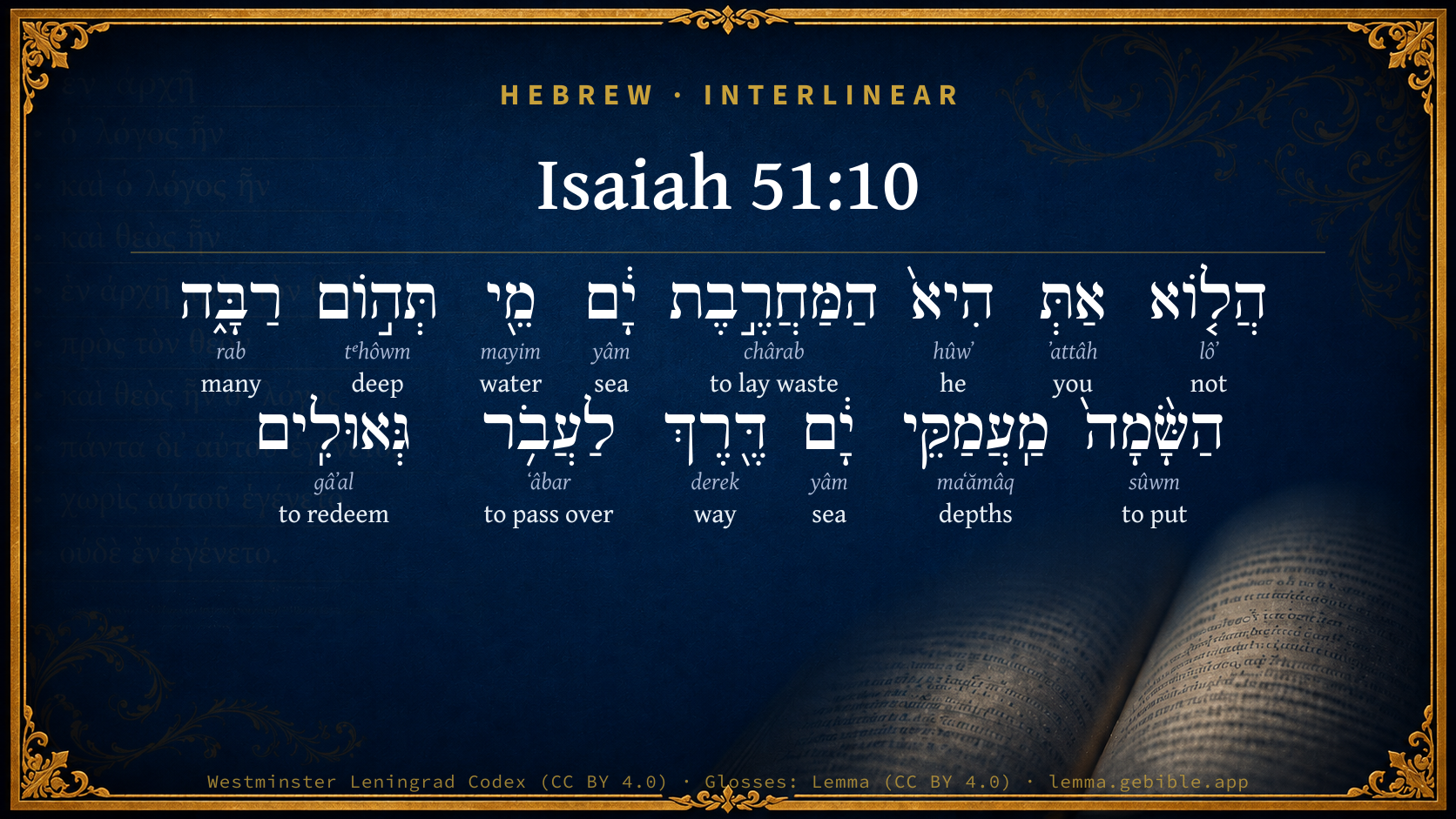
Hebrew (Westminster Leningrad Codex) Isaiah 51:10 appears in the Hebrew Old Testament. The text above is from the Westminster Leningrad Codex. Each word links to its Strong’s number, a concise gloss, and parsing drawn from the Open Scriptures Hebrew Bible morphology. Click any word for its full Brown-Driver-Briggs (BDB) entry.
Download image
Cite this verse

Isaiah 51:10 (World English Bible). Public Domain. Lemma interlinear Bible study tool, https://lemma.gebible.app/v/isaiah/51/10.

Show BibTeX & RIS
BibTeX
RIS
English Translation
Isn't it you who dried up the sea, the waters of the great deep; who made the depths of the sea a way for the redeemed to pass over?
World English Bible · Public Domain
Download a study sheet

One document with this verse’s original text, its word-by-word gloss line, the meaning frame, cross-references with their text, attributed commentary, and full source and license credits — printable, and it pastes into notes with its structure intact.

This verse Autodidact and up

Study sheet (.html) Plain text (.txt)

A passage Seminary Student

Up to 50 verses in one chapter. A passage sheet keeps up to 6 commentary sources and 12 cross-references per verse, in the order this page ranks them, and says so on the sheet whenever that leaves anything out. Ask for a single verse and you get the Autodidact verse sheet above.

Everything on this page stays free to read, with no account — the sheet is a download of what is already on screen, not access to it.

Want to remove ads? Support Godless Engineer
Compare translations 3

The same verse in 3 English versions, stacked beneath the original-language interlinear above. Click any original word for its lexicon entry.

Each is an independent rendering of the whole verse — the interlinear is not word-aligned to these translations.

Highlighted words mark where these versions differ — a whole-verse word diff, not a word-by-word alignment.

  • World English Bible Public Domain
    Isn't it you who dried up the sea, the waters of the great deep; who made the depths of the sea a way for the redeemed to pass over?
  • King James Version Public Domain
    Art thou not it which hath dried the sea, the waters of the great deep; that hath made the depths of the sea a way for the ransomed to pass over?
  • unfoldingWord Literal Text CC BY-SA 4.0
    it not you, the one having dried up the sea, the waters of the great deep, he made the depths of the sea a way for the redeemed to pass through?

unfoldingWord Literal Text — © unfoldingWord, licensed CC BY-SA 4.0. Word-aligned USFM3 via Door43 (git.door43.org/unfoldingWord/en_ult).

Versions to compare (up to 4)

3 of 4 selected

Show all 18 translations

Every available English version of this verse, each an independent rendering of the whole verse.

  • World English Bible Public Domain
    Isn't it you who dried up the sea, the waters of the great deep; who made the depths of the sea a way for the redeemed to pass over?
  • Berean Standard Bible Public Domain
    Was it not You who dried up the sea, the waters of the great deep, who made a road in the depths of the sea for the redeemed to cross over?
  • Majority Standard Bible Public Domain
    Was it not You who dried up the sea, the waters of the great deep, who made a road in the depths of the sea for the redeemed to cross over?
  • King James Version Public Domain
    Art thou not it which hath dried the sea, the waters of the great deep; that hath made the depths of the sea a way for the ransomed to pass over?
  • American Standard Version (1901) Public Domain
    Is it not thou that driedst up the sea, the waters of the great deep; that madest the depths of the sea a way for the redeemed to pass over?
  • Revised Version (1885) Public Domain
    Art thou not it which dried up the sea, the waters of the great deep; that made the depths of the sea a way for the redeemed to pass over?
  • Geneva Bible (1599) Public Domain
    Art not thou the same, which hath dried the Sea, euen the waters of the great deepe, making the depth of the Sea a way for the redeemed to passe ouer?
  • Douay-Rheims (1899) Public Domain
    Hast not thou dried up the sea, the water of the mighty deep, who madest the depth of the sea a way, that the delivered might pass over?
  • Young's Literal Translation Public Domain
    Art not Thou it that is drying up a sea, Waters of a great deep? That hath made deep places of a sea A way for the passing of the redeemed?
  • Literal Standard Version CC BY-SA 4.0
    Are You not it that is drying up a sea, || Waters of a great deep? That has made deep places of a sea || A way for the passing of the redeemed?
  • Unlocked Literal Bible CC BY-SA 4.0
    Did you not dry up the sea, the waters of the great deep, and make the depths of the sea into a way for the redeemed to pass through?
  • unfoldingWord Literal Text CC BY-SA 4.0
    it not you, the one having dried up the sea, the waters of the great deep, he made the depths of the sea a way for the redeemed to pass through?
  • Darby Bible Public Domain
    Is it not thou that dried up the sea, the waters of the great deep; that made the depths of the sea a way for the redeemed to pass over?
  • World Messianic Bible Public Domain
    Isn’t it you who dried up the sea, the waters of the great deep; who made the depths of the sea a way for the redeemed to pass over?
  • Webster's Bible Public Domain
    Art thou not that which hath dried the sea, the waters of the great deep; that hath made the depths of the sea a way for the ransomed to pass over?
  • Free Bible Version CC BY-SA 4.0
    Weren't you the one who dried up the sea, making a way through the deep waters for the redeemed to cross over?
  • Bible in Basic English Public Domain
    Did you not make the sea dry, the waters of the great deep? did you not make the deep waters of the sea a way for the Lord's people to go through?
  • JPS Tanakh (1917) Public Domain
    Art thou not it that dried up the sea, the waters of the great deep; that made the depths of the sea a way for the redeemed to pass over?

Literal Standard Version (2020), Covenant Press — licensed CC BY-SA 4.0. Text via the HelloAO Bible API (eBible.org). Unlocked Literal Bible (unfoldingWord) — licensed CC BY-SA 4.0. Text via the HelloAO Bible API (eBible.org). unfoldingWord Literal Text — © unfoldingWord, licensed CC BY-SA 4.0. Word-aligned USFM3 via Door43 (git.door43.org/unfoldingWord/en_ult). Free Bible Version, Dr. Jonathan Gallagher — licensed CC BY-SA 4.0. Text via the HelloAO Bible API (eBible.org).

Word by word

More ways to search: Search by grammar → Find every occurrence → Compare this word →

Practice this passage: Drill this verse → Learn its vocabulary →

מַֽעֲמַקֵּי
maʻămâq
H4615
“depths of”
Noun, Common, Masculine, Plural, Construct
Part of Speech
Noun
Type
Common
Gender
Masculine
Number
Plural
State
Construct
Full BDB Definition

Origin: from H6009

TWOT: 1644e

depths
  1. הֲל֤וֹא lôʼ H3808 “not” Particle, Interrogative + Particle, Negative
  2. אַתְּ ʼattâh H859 “you” Pronoun, Personal, 2nd Person, Feminine, Singular
  3. הִיא֙ hûwʼ H1931 “he” Pronoun, Personal, 3rd Person, Feminine, Singular
  4. הַמַּחֲרֶ֣בֶת chârab H2717 “the · laying waste” Particle, Definite Article + Verb, Hiphil, Participle Active, Feminine, Singular, Absolute
  5. יָ֔ם yâm H3220 “sea” Noun, Common, Masculine, Singular, Absolute
  6. מֵ֖י mayim H4325 “water(s) of” Noun, Common, Masculine, Plural, Construct
  7. תְּה֣וֹם tᵉhôwm H8415 “deep” Noun, Common, Both, Singular, Absolute
  8. רַבָּ֑ה rab H7227 “many” Adjective, Adjective, Feminine, Singular, Absolute
  9. הַשָּׂ֨מָה֙ sûwm H7760 “to put” Particle, Interrogative + Verb, Qal, Perfect, 3rd Person, Feminine, Singular
  10. יָ֔ם yâm H3220 “sea” Noun, Common, Masculine, Singular, Absolute
  11. דֶּ֖רֶךְ derek H1870 “way” Noun, Common, Both, Singular, Absolute
  12. לַעֲבֹ֥ר ʻâbar H5674 “to pass over” Preposition + Verb, Qal, Infinitive Construct
  13. גְּאוּלִֽים gâʼal H1350 “redeemed” Verb, Qal, Participle Passive, Masculine, Plural, Absolute

About this verse

These counts appear in no published source. They are computed here, from the morphology-tagged text and Lemma’s own curated glosses. What Lemma adds →

14
words
13
distinct lemmas
Prophets
section

Notable vocabulary

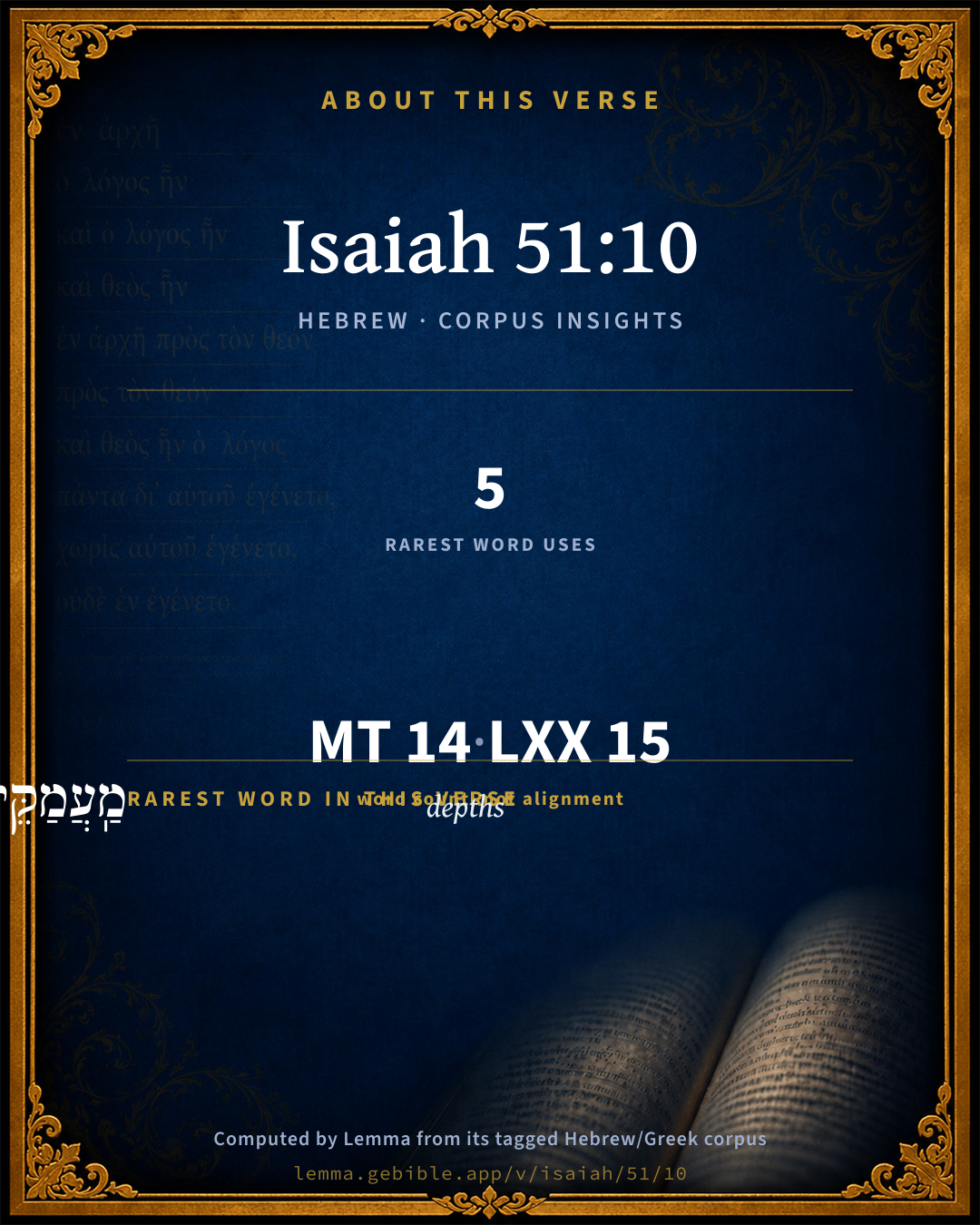
The rarest word here is מַֽעֲמַקֵּי depths H4615 — appearing just 5 times in the whole Hebrew Bible.

Shared distinctive vocabulary

מַֽעֲמַקֵּי depths H4615 occurs in 5 verses of the Hebrew Bible. Also found in:

Grammatical profile

  • 4 verbs
  • 6 nouns
  • 1 adjective
  • 2 pronouns
  • 1 particle

Verb forms

  • הַמַּחֲרֶ֣בֶת Hiphil · Participle Active
  • הַשָּׂ֨מָה֙ Qal · Perfect
  • לַעֲבֹ֥ר Qal · Infinitive Construct
  • גְּאוּלִֽים Qal · Participle Passive

Repetition

A word recurs within this verse — often emphatic in Hebrew:

Hebrew & Septuagint length

In English translation the verse runs 29 words from the Hebrew and 32 from the Septuagint (LXX English) — closely comparable.

A rough comparison of the two English renderings, which tokenize alike — not a word-level alignment.

Word counts can differ between the Hebrew and the Greek without any difference in meaning — e.g. the Hebrew direct-object marker אֵת has no separate Greek word, and Greek often adds the article ὁ.

In the original languages it is 14 Hebrew tokens and 15 Greek tokens — but the two are counted differently (Hebrew bundles its prefixes and suffixes into one token; the Greek is in lemma form), so that isn’t a like-for-like length.

Cross-references

7

Topical passages linked to Isaiah 51:10 in the Treasury of Scripture Knowledge — connected by theme and wording, ordered by reader-vote popularity; previews shown in the World English Bible.

  • Isaiah 43:16 Thus says Yahweh, who makes a way in the sea, and a path in the mighty waters;
  • Exodus 14:21–22 Moses stretched out his hand over the sea, and Yahweh caused the sea to go back by a strong east wind all the night, and made the sea dry land, and the waters were divided.
  • Exodus 15:13 "You, in your loving kindness, have led the people that you have redeemed. You have guided them in your strength to your holy habitation.
  • Isaiah 50:2 Why, when I came, was there no man? when I called, was there none to answer? Is my hand shortened at all, that it can't redeem? or have I no power to deliver? Behold, at my rebuke I dry up the sea, I make the rivers a wilderness: their fish stink, because there is no water, and die for thirst.
  • Isaiah 63:11–12 Then he remembered the days of old, Moses [and] his people, [saying], Where is he who brought them up out of the sea with the shepherds of his flock? where is he who put his holy Spirit in the midst of them?
  • Psalms 74:13 You divided the sea by your strength. You broke the heads of the sea monsters in the waters.
  • Isaiah 42:15 I will lay waste mountains and hills, and dry up all their herbs; and I will make the rivers islands, and will dry up the pools.

Cross-references courtesy of OpenBible.info (CC BY 4.0).

Hebrew and Greek witnesses Masoretic Hebrew ↔ Greek Septuagint

The same verse in the two great witnesses to the Old Testament, shown verse-for-verse.

These are two independent witnesses, not word-aligned to each other, and the Septuagint is shown in lemma (dictionary) form.

Hebrew Isaiah 51:10 Masoretic · Westminster Leningrad Codex

הֲל֤וֹא אַתְּ הִיא֙ הַמַּחֲרֶ֣בֶת יָ֔ם מֵ֖י תְּה֣וֹם רַבָּ֑ה הַשָּׂ֨מָה֙ מַֽעֲמַקֵּי יָ֔ם דֶּ֖רֶךְ לַעֲבֹ֥ר גְּאוּלִֽים

Isn't it you who dried up the sea, the waters of the great deep; who made the depths of the sea a way for the redeemed to pass over?

World English Bible · Public Domain

Greek LXX Isaiah 51:10 Septuagint · lemma form

ὁ ἐρημόω θάλασσα ὕδωρ ἄβυσσος πλῆθος ὁ τίθημι ὁ βάθος ὁ θάλασσα ὁδός διάβασις ῥύομαι

Are you not it that dried the sea, the water, even the abundance of the deep; that made the depths of the sea a way of passage for the delivered and redeemed?

LXX2012 (modern English Septuagint) · Public Domain

Hebrew: Westminster Leningrad Codex (CC BY 4.0). Greek: Septuagint (public domain); English from LXX2012 (modern English Septuagint) (Public Domain). How the Septuagint differs from the Hebrew →

Targum (Aramaic paraphrase)

1

The Targum is the ancient Jewish Aramaic paraphrase of the Hebrew Scriptures — an interpretive translation, not the Hebrew text itself. Onkelos (literal) and Pseudo-Jonathan (expansive) render the Torah, and Jonathan the Prophets. Coverage is partial: where no permissively-licensed English translation exists for a verse, only the Aramaic is shown. This is verse-level text, not a word-by-word alignment to the Hebrew.

  1. Targum Jonathan Prophets (Joshua–Malachi)
    הֲלָא בְדִילָךְ כְּנִשְׁתָּא דְיִשְׂרָאֵל אַחְרְבֵית יַמָא מֵי תְהוֹם רַבָּה שַׁוֵיתִי עוּמְקֵי יַמָא אוֹרַח לְמֵיגָז מְשֵׁיזְבַיָא:

    Was it not for thy sake, O congregation of Israel, that I dried up the sea, the water of the great deep, I made the depth of the sea a way for the ransomed to pass over?

    Targum Jonathan — Aramaic: “Mikraot Gedolot” (public domain). English: “Sefaria Community Translation” (CC0 1.0 (public-domain dedication)); “London "Chaldee Paraphrase," 1871” (public domain). Text via Sefaria.

Commentary

Notes on Isaiah 51:10 from classic Christian and Jewish commentators (each source and its license shown beneath its notes). The classic Christian expositions comment on the surrounding passage and are grouped to its opening verse, so a note may address several verses; the Jewish commentaries on the Tanakh (Rashi and others) are per-verse, so they appear only where the commentator wrote on this verse.

Lemma curates 59 commentaries, every one of them public domain or Creative Commons licensed, each selected and text-cleaned for this edition rather than reprinted as found. About our sources →

Trapp's Complete Commentary

John Trapp

Isa 51:10 [Art] thou not it which hath dried the sea, the waters of the great deep; that hath made the depths of the sea a way for the ransomed to pass over?

Ver. 10. Art not thou it which hath dried the sea?] And canst not thou do as much again for thy poor people? This is an excellent way of arguing with God in prayer - viz., from his ancient acts.

John Trapp, A Commentary or Exposition upon All the Books of the Old and New Testament (1647–1656) — public domain. Text from a community e-Sword module.

Jamieson, Fausset & Brown

Robert Jamieson, A. R. Fausset & David Brown

it--the arm.

Art not Thou the same Almighty power that . . . ? dried the sea--the Red Sea (Isa 43:16; Exo 14:21).

Jamieson, Fausset & Brown — Commentary Critical and Explanatory on the Whole Bible (1871) — public domain (CC PDM 1.0). Text via the HelloAO Bible API.

The Cambridge Bible for Schools and Colleges

gen. ed. J. J. S. Perowne

10. the great deep] (Gen_7:11; Amo_7:4; Psa_36:6) is the primeval ocean of Gen_1:2, out of which the dry land appeared. The Hebrew (tìhôm) is connected etymologically with Tiâmat, the name of the Chaos-monster in the Babylonian creation tablets.

a way for the ransomed to pass over] The reference to the Exodus is here unmistakeable. The transition is explained by the fact that every exhibition of Jehovah’s power over the sea was regarded as a repetition on a smaller scale of the original miracle of creation. Both alike are illustrations of what the “arm of the Lord” can do, and of the great miracle of redemption to which the prophet looks forward.

The Cambridge Bible for Schools and Colleges (gen. ed. J. J. S. Perowne; Cambridge University Press, 1878–1918) — public domain. Text from a community e-Sword module.

John Gill's Exposition

Art thou not it which hath dried the sea, the waters of the great deep,.... That is, the Red sea, and the deep waters of it; as it did, by causing a strong east wind to blow, which drove the sea back, and made it a dry land, in the midst of which the children of Israel walked as on dry land, Exo 14:21 and the same arm and mighty power can and will dry up the waters of the river Euphrates, to prepare the way of the kings of the east, Rev 16:12,

that hath made the depths of the sea a way for the ransomed to pass over? divided the waters of the sea, made a path through them for the Israelites that were redeemed out of Egyptian bondage and slavery, to pass over, and so to go to Canaan's land.

John Gill's Exposition of the Whole Bible (1746–1763) — public domain (CC PDM 1.0). Text via the HelloAO Bible API.

Albert Barnes' Notes on the Bible

Art thou not it - Art thou not still the same? The ground of the appeal is, that the same arm that dried up the sea, and made a path for the Jewish people, was still able to interpose and rescue them.

Which hath dried the sea - The Red Sea when the children of Israel passed over Exo 14:21. This is the common illustration to which the Hebrew prophets and poets appeal, when they wish to refer to the interposition of God in favor of their nation (compare Ps. 105; see the notes at Isa 43:16).

For the ransomed to pass over - Those who had been ransomed from Egypt. The word rendered ‘ransomed’ is that which is commonly rendered ‘redeemed.’ The argument in this verse is, that he who had overcome all the obstacles in the way of their deliverance from Egypt, was able also to overcome all the obstacles in the way of their deliverance from Babylon; and that he who had thus interposed might be expected again to manifest his mercy, and save them again from oppression. The principle involved in the argument is as applicable now as it was then. All God’s past interpositious - and especially the great and wonderful interposition when be gave his Son for his church - constitute an argument that be will still continue to regard the interests of his people, and will interpose in their behalf and save them.

Albert Barnes' Notes on the Bible (1834–1885) — public domain. Text from a community e-Sword/MySword module.

Haydock's Catholic Bible Commentary

CHAPTER LI.

George Leo Haydock (1774–1849), Haydock's Catholic Family Bible and Commentary, 1859 edition — public domain. Excludes Psalms (Douay-Rheims chapter numbering differs from Protestant) and Deuterocanonical books (Catholic canon only).

Matthew Poole's English Annotations

Art thou not it which hath dried the sea? art not thou the same God, and as potent now as then thou wast?

For the ransomed; for thy people, whom thou didst redeem and bring out of Egypt.

Matthew Poole's English Annotations on the Holy Bible (1683–1685) — public domain. Text from a community e-Sword/MySword module.

The Pulpit Commentary

Art thou not it which hath dried the sea? rather, was it not thou that didst dry up the sea?. (comp. Exo_14:21, Exo_14:22) The waters of the Red Sea are called those of "the great deep," because they are a portion of the circumambient ocean, not a tideless land-locked basin, like the Mediterranean. That hath made; rather, that madest. The allusion is to the single occasion of the passage of the Red Sea by the Israelites. Ver. 11. The redeemed of the Lord (see the comment on Isa_35:10. where the same passage occurs with scarcely any variation). Isaiah is not averse to repetitions. (see Isa_5:25 Isa_9:12, Isa_9:17, 21 10:4 11:1 65:25 48:22 57:21, etc.)

The Pulpit Commentary (1880–1919), ed. H.D.M. Spence-Jones & Joseph S. Exell — public domain. Text from a community e-Sword module.

J. A. Alexander on Isaiah

Joseph Addison Alexander

“Art not thou the same that dried the sea, the waters of the great deep, that placed the depths of the sea (as) a way for the passage of redeemed ones?” The allusion to the overthrow of Egypt is carried out and completed by a distinct mention of the miraculous passage of the Red Sea. The interrogative form of the sentence is equivalent to a direct affirmation that it is the same arm, or in other words, that the same power which destroyed the Egyptians for the sake of Israel still exists, and may again be exerted for a similar purpose. The confidence that this will be done is expressed somewhat abruptly in the next verse.

Joseph Addison Alexander, The Prophecies of Isaiah (1846–1847; New York: Scribner, 1870–1878) — public domain. Text from a community e-Sword module.

Scofield Reference Notes

C. I. Scofield

ransomed

Heb. "goel,: Redemp. (Kinsman type). (See Scofield "Isa 59:20")

The Scofield Reference Bible (1917 edition), notes by C. I. Scofield — public domain. Text from a community e-Sword module.

Ibn Ezra

Rabbi Abraham ibn Ezra

Which hath dried the sea. This refers to the division of the Red Sea. מי תהום רבה The waters of the great deep. Repeat הטחרבת which hath dried before these words.

השמה That hath made. It is in form similar to השבה that hath returned (Ruth 2:6). The second part of the verse is a mere repetition of the idea contained in the first.

Ibn Ezra on the Tanakh — English translations: “Sefaria Community Translation” (CC0 1.0 (public-domain dedication)); “Yalkut, Sifsei Chachomim Chumash, Metsudah Publications, 2009” (CC BY 4.0); and “Commentary of Ibn Ezra on Isaiah - trans. by M. Friedlander, 1873” (public domain). Text via Sefaria.

Lesson kit

Teaching starters — assembled from the data on this page, not authored interpretation. Every prompt links to the verse data it draws on. Edit before teaching.

Isaiah, in the Prophets, opens this verse with 14 words (13 distinct Hebrew lemmas). Its most distinctive word is maʻămâq (“depths”). A historical commentator’s framing appears above. Read the whole chapter for the surrounding context.

Discussion questions

  1. How does “depths” (maʻămâq) shape what this verse is saying?
  2. Psalms 69:2 shares the word «depths» with this verse. How do the two illuminate each other?
  3. “sea” occurs 2× in this one verse. What is the effect of the repetition?
  4. These translations render this verse differently; the difference is in the English rendering, not the original. What questions does that raise?
  5. The verb «הַמַּחֲרֶ֣בֶת» is Hiphil Participle Active. How does its form color the action?
  6. Reading how Trapp's Complete Commentary and Jamieson, Fausset & Brown read this verse, where do the two commentators agree and where do they part?

Things to notice

Reading settings

Reading text

Shown beneath each verse's original-language words.

Old Testament
Old Testament edition

Read the OT as the Masoretic Hebrew (MT) or the Greek Septuagint (LXX).

English shown for the Greek Septuagint (in the Hebrew ↔ Greek comparison).

Comparing translations? Open the Compare panel on any verse page to stack up to four side by side.