
Song of Solomon 4:15

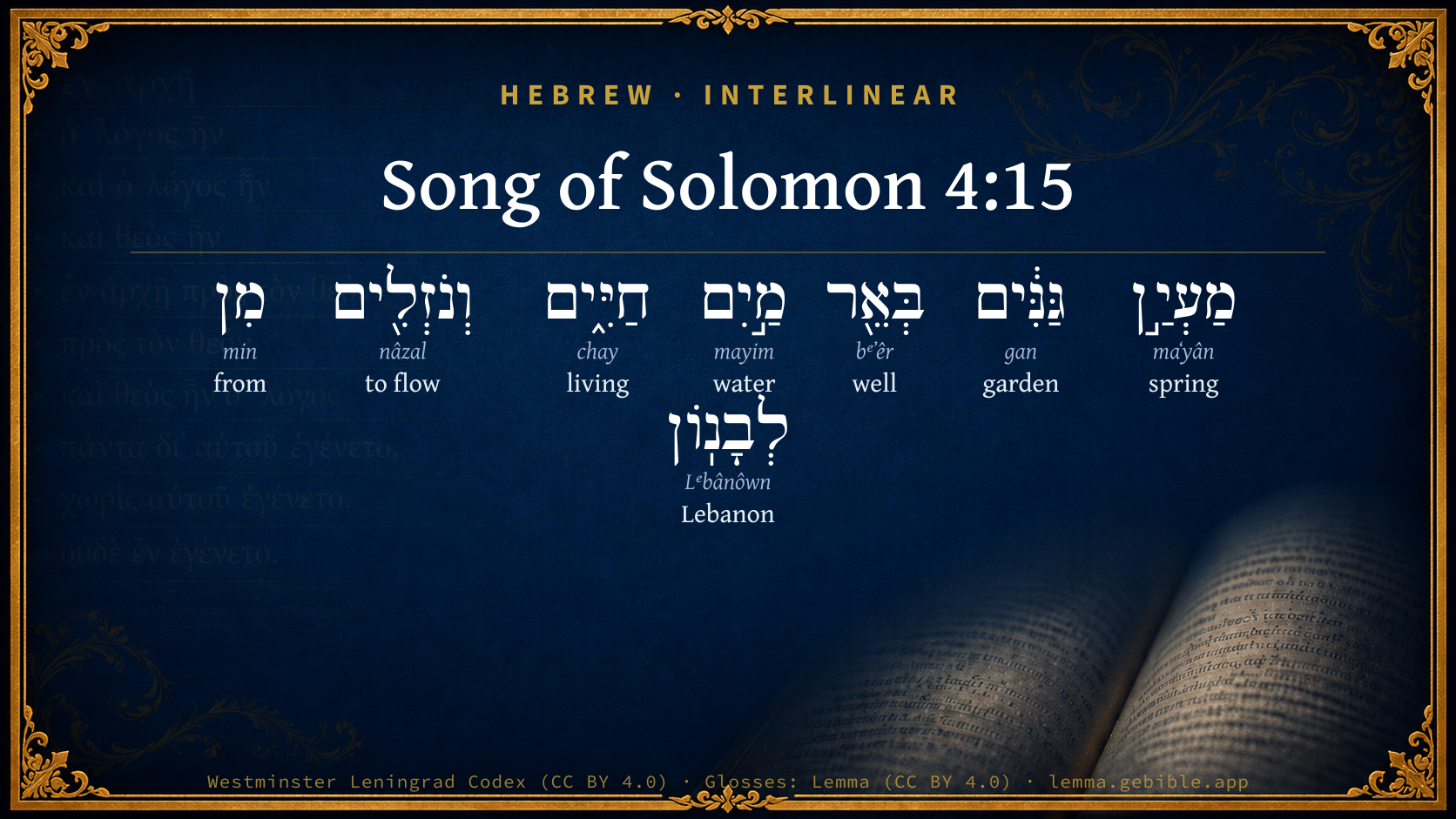
Hebrew (Westminster Leningrad Codex) Song of Solomon 4:15 appears in the Hebrew Old Testament. The text above is from the Westminster Leningrad Codex. Each word links to its Strong’s number, a concise gloss, and parsing drawn from the Open Scriptures Hebrew Bible morphology. Click any word for its full Brown-Driver-Briggs (BDB) entry.
Download image
Cite this verse

Song of Solomon 4:15 (World English Bible). Public Domain. Lemma interlinear Bible study tool, https://lemma.gebible.app/v/song-of-solomon/4/15.

Show BibTeX & RIS
BibTeX
RIS
English Translation
A fountain of gardens, A well of living waters, Flowing streams from Lebanon. Beloved
World English Bible · Public Domain
Download a study sheet

One document with this verse’s original text, its word-by-word gloss line, the meaning frame, cross-references with their text, attributed commentary, and full source and license credits — printable, and it pastes into notes with its structure intact.

This verse Autodidact and up

Study sheet (.html) Plain text (.txt)

A passage Seminary Student

Up to 50 verses in one chapter. A passage sheet keeps up to 6 commentary sources and 12 cross-references per verse, in the order this page ranks them, and says so on the sheet whenever that leaves anything out. Ask for a single verse and you get the Autodidact verse sheet above.

Everything on this page stays free to read, with no account — the sheet is a download of what is already on screen, not access to it.

Want to remove ads? Support Godless Engineer
Compare translations 3

The same verse in 3 English versions, stacked beneath the original-language interlinear above. Click any original word for its lexicon entry.

Each is an independent rendering of the whole verse — the interlinear is not word-aligned to these translations.

Highlighted words mark where these versions differ — a whole-verse word diff, not a word-by-word alignment.

  • World English Bible Public Domain
    A fountain of gardens, A well of living waters, Flowing streams from Lebanon. Beloved
  • King James Version Public Domain
    A fountain of gardens, a well of living waters, and streams from Lebanon.
  • unfoldingWord Literal Text CC BY-SA 4.0
    a fountain of gardens, a well of living waters, and flowing streams from Lebanon.

unfoldingWord Literal Text — © unfoldingWord, licensed CC BY-SA 4.0. Word-aligned USFM3 via Door43 (git.door43.org/unfoldingWord/en_ult).

Versions to compare (up to 4)

3 of 4 selected

Show all 18 translations

Every available English version of this verse, each an independent rendering of the whole verse.

  • World English Bible Public Domain
    A fountain of gardens, A well of living waters, Flowing streams from Lebanon. Beloved
  • Berean Standard Bible Public Domain
    You are a garden spring, a well of fresh water flowing down from Lebanon.
  • Majority Standard Bible Public Domain
    You are a garden spring, a well of fresh water flowing down from Lebanon.
  • King James Version Public Domain
    A fountain of gardens, a well of living waters, and streams from Lebanon.
  • American Standard Version (1901) Public Domain
    `Thou art' a fountain of gardens, A well of living waters, And flowing streams from Lebanon.
  • Revised Version (1885) Public Domain
    Thou art a fountain of gardens, a well of living waters, and flowing streams from Lebanon.
  • Geneva Bible (1599) Public Domain
    O fountaine of the gardens, O well of liuing waters, and the springs of Lebanon.
  • Douay-Rheims (1899) Public Domain
    The fountain of gardens: the well of living waters, which run with a strong stream from Libanus.
  • Young's Literal Translation Public Domain
    A fount of gardens, a well of living waters, And flowings from Lebanon!
  • Literal Standard Version CC BY-SA 4.0
    A fount of gardens, a well of living waters, || And flowings from Lebanon!
  • Unlocked Literal Bible CC BY-SA 4.0
    You are a garden spring, a well of fresh water, streams flowing down from Lebanon.
  • unfoldingWord Literal Text CC BY-SA 4.0
    a fountain of gardens, a well of living waters, and flowing streams from Lebanon.
  • Darby Bible Public Domain
    A fountain in the gardens, A well of living waters, Which stream from Lebanon.
  • World Messianic Bible Public Domain
    a fountain of gardens, a well of living waters, flowing streams from Lebanon.
  • Webster's Bible Public Domain
    A fountain of gardens, a well of living waters, and streams from Lebanon.
  • Free Bible Version CC BY-SA 4.0
    You are a garden fountain, a well of living water, a flowing stream from Lebanon.
  • Bible in Basic English Public Domain
    You are a fountain of gardens, a spring of living waters, and flowing waters from Lebanon.
  • JPS Tanakh (1917) Public Domain
    Thou art a fountain of gardens, a well of living waters, and flowing streams from Lebanon.

Literal Standard Version (2020), Covenant Press — licensed CC BY-SA 4.0. Text via the HelloAO Bible API (eBible.org). Unlocked Literal Bible (unfoldingWord) — licensed CC BY-SA 4.0. Text via the HelloAO Bible API (eBible.org). unfoldingWord Literal Text — © unfoldingWord, licensed CC BY-SA 4.0. Word-aligned USFM3 via Door43 (git.door43.org/unfoldingWord/en_ult). Free Bible Version, Dr. Jonathan Gallagher — licensed CC BY-SA 4.0. Text via the HelloAO Bible API (eBible.org).

Word by word

More ways to search: Search by grammar → Find every occurrence → Compare this word →

Practice this passage: Drill this verse → Learn its vocabulary →

About this verse

These counts appear in no published source. They are computed here, from the morphology-tagged text and Lemma’s own curated glosses. What Lemma adds →

8
words
8
distinct lemmas
Wisdom
section

Notable vocabulary

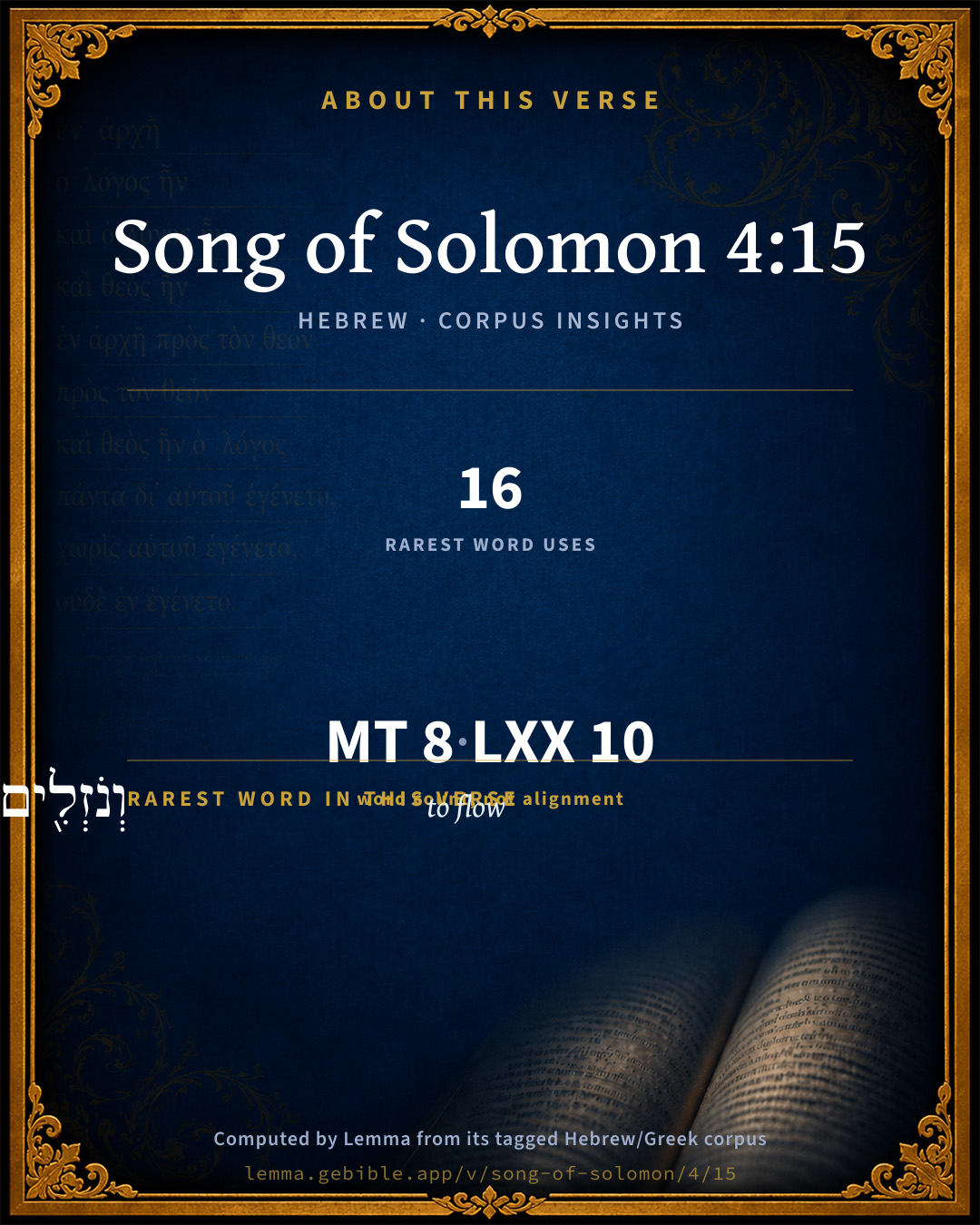
The rarest word here is וְנֹזְלִ֖ים to flow H5140 — appearing just 16 times in the whole Hebrew Bible.

Shared distinctive vocabulary

וְנֹזְלִ֖ים to flow H5140 occurs in 16 verses of the Hebrew Bible. Also found in:

Grammatical profile

  • 1 verb
  • 5 nouns
  • 1 adjective
  • 1 preposition

Verb forms

  • וְנֹזְלִ֖ים Qal · Participle Active

Hebrew & Septuagint length

In English translation the verse runs 14 words from the Hebrew and 15 from the Septuagint (LXX English) — closely comparable.

A rough comparison of the two English renderings, which tokenize alike — not a word-level alignment.

Word counts can differ between the Hebrew and the Greek without any difference in meaning — e.g. the Hebrew direct-object marker אֵת has no separate Greek word, and Greek often adds the article ὁ.

In the original languages it is 8 Hebrew tokens and 10 Greek tokens — but the two are counted differently (Hebrew bundles its prefixes and suffixes into one token; the Greek is in lemma form), so that isn’t a like-for-like length.

Cross-references

11

Topical passages linked to Song of Solomon 4:15 in the Treasury of Scripture Knowledge — connected by theme and wording, ordered by reader-vote popularity; previews shown in the World English Bible.

  • John 4:10 Jesus answered her, "If you knew the gift of God, and who it is who says to you, 'Give me a drink,' you would have asked him, and he would have given you living water."
  • John 4:14 but whoever drinks of the water that I will give him will never thirst again; but the water that I will give him will become in him a well of water springing up to eternal life."
  • John 7:38 He who believes in me, as the Scripture has said, from within him will flow rivers of living water."
  • Jeremiah 2:13 For my people have committed two evils: they have forsaken me, the spring of living waters, and hewed them out cisterns, broken cisterns, that can hold no water.
  • Psalms 36:8–9 They shall be abundantly satisfied with the abundance of your house. You will make them drink of the river of your pleasures.
  • Psalms 46:4 There is a river, the streams of which make the city of God glad, The holy place of the tents of the Most High.
  • Ecclesiastes 2:6 I made myself pools of water, to water from it the forest where trees were reared.
  • Song of Solomon 4:12 A locked up garden is my sister, my bride; A locked up spring, A sealed fountain.
  • Jeremiah 17:13 Yahweh, the hope of Israel, all who forsake you shall be disappointed. Those who depart from me shall be written in the earth, because they have forsaken Yahweh, the spring of living waters.
  • Jeremiah 18:13–14 Therefore thus says Yahweh: Ask you now among the nations, who has heard such things; the virgin of Israel has done a very horrible thing.
  • Revelation 22:1 He showed me a river of water of life, clear as crystal, proceeding out of the throne of God and of the Lamb,

Cross-references courtesy of OpenBible.info (CC BY 4.0).

Hebrew and Greek witnesses Masoretic Hebrew ↔ Greek Septuagint

The same verse in the two great witnesses to the Old Testament, shown verse-for-verse.

These are two independent witnesses, not word-aligned to each other, and the Septuagint is shown in lemma (dictionary) form.

Hebrew Song of Solomon 4:15 Masoretic · Westminster Leningrad Codex

מַעְיַ֣ן גַּנִּ֔ים בְּאֵ֖ר מַ֣יִם חַיִּ֑ים וְנֹזְלִ֖ים מִן לְבָנֽוֹן

A fountain of gardens, A well of living waters, Flowing streams from Lebanon. Beloved

World English Bible · Public Domain

Greek LXX Song of Solomon 4:15 Septuagint · lemma form

πηγή κῆπος φρέαρ ὕδωρ ζάω καί ῥοιζέω ἀπό ὁ λίβανος

a fountain of a garden, and a well of water springing and gurgling from Libanus.

LXX2012 (modern English Septuagint) · Public Domain

On this verse, The Cambridge Bible for Schools and Colleges discusses the Septuagint’s reading. Read the note in Commentary ↓

Hebrew: Westminster Leningrad Codex (CC BY 4.0). Greek: Septuagint (public domain); English from LXX2012 (modern English Septuagint) (Public Domain). How the Septuagint differs from the Hebrew →

Commentary

Notes on Song of Solomon 4:15 from classic Christian and Jewish commentators (each source and its license shown beneath its notes). The classic Christian expositions comment on the surrounding passage and are grouped to its opening verse, so a note may address several verses; the Jewish commentaries on the Tanakh (Rashi and others) are per-verse, so they appear only where the commentator wrote on this verse.

Lemma curates 59 commentaries, every one of them public domain or Creative Commons licensed, each selected and text-cleaned for this edition rather than reprinted as found. About our sources →

The Cambridge Bible for Schools and Colleges

gen. ed. J. J. S. Perowne

15. a fountain of gardens, &c.] Some take these words as vocatives, but more probably thou art is to be understood as in R.V. Budde would read ‘my garden’ (gannî) for ‘gardens’ (gannîm), and would translate, “The fountain of my garden is a well of living waters.” This is supported by the reading of the LXX, for they, from their having πηγὴ κήπου καὶ would seem to have read not gannîm but gannô, i.e. ‘his garden,’ the Heb. letter waw being the sign for both his and and. But that would give no meaning here. The probability therefore is that the reading the Greek translators really had before them was gannî, i and o being hardly distinguishable in the writing then in use. Moreover, it would give a better arrangement of the text. In Son_4:12 the bride is compared to a garden and a spring. Son_4:13-14 expand and particularise the garden simile. By Budde’s reading Son_4:15 becomes a similar expansion of the spring simile. We should then read, thou art the fountain of my garden, a well of living, i.e. flowing, waters, and rushing Lebanon streams. She is the source of all the joy and refreshment of his existence, just as a fountain is the cause of all the coolness and shade of the garden which it waters.

The Cambridge Bible for Schools and Colleges (gen. ed. J. J. S. Perowne; Cambridge University Press, 1878–1918) — public domain. Text from a community e-Sword module.

Trapp's Complete Commentary

John Trapp

Son 4:15 A fountain of gardens, a well of living waters, and streams from Lebanon.

Ver. 15. A fountain of gardens, a well, &c.] Or, O fountain of the gardens, &c. For they do best in mine opinion that make this to be the Church’s speech to Christ, grounded upon his former commendation of her. And it is as if she should say, Callest thou me, Lord, a garden enclosed, a spring shut up, a fountain sealed? True it is I am the garden which thine own right band hath planted, walled, watered, &c., but for all that I am or have, the entire praise belongs to thee alone. All my plenty of spiritual graces, all my perennity of spiritual comforts, all my pleasance and sweetness, is derived from thee, no otherwise than the streams of Jordan are from Mount Lebanon; "all my springs are in thee," as in their well head. Certam est nos facere quod facimus, sed ille facit, ut faciamus, saith Augustine. True it is that we do what we do; but it is as true that Christ maketh us to do what we do; for "without him we can do nothing"; {Joh 15:5} "in him is our fruit found": {Hos 14:8} it is he that "works all our works in us." {Isa 26:12} Hence it is that the Church is nowhere in all this book described by the beauty of her hands or fingers, because he alone doth all for her. The Church of Rome, that will needs hammer out her own happiness (like the spider climbing up by a thread of her own weaving, and boasting with her in the emblem, Mihi soli debeo I own to myself alone.), shows thereby of what spirit she is. That wretched monk died blasphemously who said, Redde mihi aeternam vitam quam debes, Pay me heaven which thou owest me. And what an arrogant speech was that of Vega, Caelum gratis non accipiam, I will not have heaven of free cost? Haec ego feci, haec ego feci, shows men to be no better than mere faeces, said Luther wittily. This I have done, and that I have done, speaks them dregs, and dogs that shall stand without doors. {Rev 22:15} Hear a child of our Church speaking thus of himself: {a}

“ Fabricius studuit bene de pietate mereri;

Sed quicquid potuit, gloria, Christe, tua est. ”

This was matrissare, to be like his mother, whose motto hath ever been, Non nobis Domine, - "Not unto us, Lord, not unto us, but to thy name give the praise." {Psa 115:1} If I be thy garden, thou art my fountain, from whence, unless I be continually watered, all will be soon withered, and I shall be as one that inhabiteth the parched places in the wilderness, in a salt land, and not inhabited. {Jer 17:6} In the island of St Thomas (on the back side of Africa), in the midst of it is a hill, and over that a continual cloud, wherewith the whole island is watered, {b} Such is the Lord Christ to his Church, {Hos 14:5-7} which therefore, as Gideon’s fleece, must needs be wet and moist, when all the earth besides is dry and desolate, as the mountains of Gilboa, or as St David’s in Wales, which is said to be a place neither pleasant, fertile, nor safe.

A well of living.] Or, A pit of living and life giving waters, {c} Christus et coelum non patiuntur hyperbolen, A man cannot say too much in commendation of Christ and his kingdom; hence the Church here cannot satisfy herself. A fountain she calls him, a well, a stream, such as "makes glad the city of God," even that "pure river of the water of life proceeding out of God’s throne." {Rev 22:1 Eze 47:6} Gregory makes this fountain to be the Scriptures, which, he saith, are like both to a fountain and to a pit. Some things in them are plain and open, and may be compared to a spring which runs in an open and eminent place. Other things therein are dark and deep, and like unto a pit, that a man must dive into, and draw out with hard labour.

And streams from Lebanon.] Watering the whole Church (as Jordan did the Holy Land), and tasting no doubt of that sweetness mentioned before; {Son 4:11} even as we see by experience, saith one, that the waters that come out of the hills of some of the islands of Molucca taste of the cinnamon, cloves, &c., that grow there.

{a} Georg. Fab. Chemnicensis de seipso.

{b} Abbot’s Georg., 251.

{c} Godw. Catal. Giral. Camb. Puteus effosus ubi est aqua viva scaturiens et clara. - Merc.

John Trapp, A Commentary or Exposition upon All the Books of the Old and New Testament (1647–1656) — public domain. Text from a community e-Sword module.

The Biblical Illustrator

Joseph S. Exell

Son_4:15

A fountain of gardens, a well of living waters, and streams from Lebanon.

The Church a garden

Again and again the Church is represented as a garden, all up and down the Word of God, and it is a figure specially suggestive at this season of the year, when the parks and the orchards have put forth their blossom and the air is filled with bird-voices.

1. It is a garden because of the rare plants in it. Sometimes you will find the violet, inconspicuous, but sweet as heaven--Christian souls, with no pretence, but of much usefulness, comparatively unknown on earth, but to be glorious in celestial spheres. In this garden of the Lord I find the Mexican cactus, loveliness within, thorns without, men with great sharpness of behaviour and manner, but within them the peace of God, the love of God, the grace of God. They are hard men to handle, ugly men to touch, very apt to strike back when you strike them, yet within them all loveliness and attraction, while outside so completely unfortunate. But I remember in boyhood that we had in our fathers garden what we called the Giant of Battle--a peculiar rose, very red and very fiery. Suggestive flower, it was called the Giant of Battle. And so in the garden of the Lord we find that kind of flower--the Pauls and Martin Luthers, the Wycliffes, the John Knoxcs--Giants of Battle. What in other men is a spark, in them is a conflagration; when they pray, their prayers take fire. When they suffer, they sweat great drops of blood; when they preach, it is a pentecost; when they fight, it is a Thermopylae; when they die, it is martyrdom--Giants of Battle. But I find also in the Church of God a plant that I shall call the snowdrop. Very beautiful but cold; it is very pure, pure as the snowdrop, beautiful as the snowdrop, and cold as the snowdrop. I would rather have one Giant of Battle than 5000 snowdrops. You have seen in some places, perhaps, a century-plant. You look at it and say, This flower has been gathering up its beauty for a whole century, and it will not bloom again for another hundred years. Well, I have to tell you that in this garden of the Church, spoken of in my text, there is a century-plant. It has gathered up its bloom from all the ages of eternity, and nineteen centuries ago it put forth its glory. It is not only a century-plant but a passion-flower--the passion-flower of Christ; a crimson flower, blood at the root, and blood on the leaves, the passion-flower of Jesus, the century-plant of eternity. Come, O winds from the north, and winds from the south, and winds from the east, and winds from the west, and scatter the perfume of this flower through all nations. Thou, the Christ of all the ages, hast garments smelling of myrrh and aloes and cassia, out of the ivory palaces.

2. The Church of Christ is appropriately compared to a garden because of its thorough irrigation. There can be no luxuriant garden without plenty of water. I saw a garden in the midst of the desert, amid the Rocky Mountains. I said, How is it possible you have so many flowers, so much rich fruit, in a desert for miles around? I suppose some of you have seen those gardens. Well, they told me they had aqueducts and pipes reaching up to the hills, and the snows melted on the Sierra Nevada and the Rocky Mountains, and then poured down in water to those aqueducts, and it kept the fields in great luxuriance. And I thought to myself--how like the garden of Christ! All around it the barrenness of sin and the barrenness of the world, but our eyes are unto the hills, from whence cometh our help. There is a river the streams whereof shall make glad the city of our God, the fountain of gardens and streams from Lebanon. Water to slake the thirst, water to refresh the fainting, water to wash the unclean, water to toss up in fountains under the sun of righteousness, until you can see the rainbow around the throne. I wandered in a royal garden of choicest plants, and I saw the luxuriance of those gardens were helped by the abundant supply of water. I came to it on a day when strangers were not admitted, but, by a strange coincidence, at the moment I got in the kings chariot passed, and the gardener went up on the hill and turned on the water, and it came flashing down the broad stairs of stone until sunlight and wave in gleesome wrestle tumbled at my feet. And so it is with this garden of Christ. Everything comes from above--pardon from above, peace from above, comfort from above, sanctification from above. Streams from Lebanon--oh! the consolation in this thought. How many have tried all the fountains of this worlds pleasure, but never tasted of the stream from Lebanon! How many have revelled in other gardens, to their souls ruin, but never plucked one flower from the garden of our God! I swing open all the gates of the garden and invite you in, whatever your history, whatever your sins, whatever your temptations, whatever your trouble. The invitation comes no more to one than to all: Whosoever will, let him come. ( T. De Witt Talmage.)

The Biblical Illustrator, edited by Joseph S. Exell (c. 1880s–1900s) — public domain. Text from a community e-Sword module.

Joseph Benson's Commentary

Son 4:15. A well of living waters — Though my spouse be in some sort a fountain shut up, yet that is not so to be understood as if she kept her waters to herself, for she is like a fountain of living or running water, which flows into gardens, and makes its flowers and plants to flourish. The church conveys those waters of life, which she receives from Christ, to particular believers. And streams from Lebanon — Like those sweet and refreshing rivers which flow down from mount Lebanon, of which Jordan is one.

Joseph Benson's Commentary on the Old and New Testaments (1811–1818) — public domain. Text from a community e-Sword module.

Geneva Bible (1599)

Geneva Bible translators

The Church confesseth that all her glory and beauty cometh of Christ, who is the true fountain of all grace.

Geneva Bible (1599) marginal notes — public domain. Text via Bolls.life.

Adam Clarke's Commentary

Verse 15. A fountain of gardens] Perhaps גנים gannim, "gardens," was originally ציים chaiyim, "lives," a living fountain, a continual spring. See Houbigant. But this is expressed afterwards; though there would be nothing improper in saying, "a living fountain, a well of living waters, and streams from Mount Lebanon." A fountain of gardens may mean one so abundant as to be sufficient to supply many gardens, to water many plots of ground, an exuberant fountain. This is the allusion; the reference is plain enough.

Adam Clarke's Commentary on the Bible (1810–1826) — public domain. Text from a community e-Sword/MySword module.

Haydock's Catholic Bible Commentary

Libanus. The law of the gospel was proclaimed by the apostles, who were Jews. They explained the pure doctrine of the Scriptures, and converted many.

George Leo Haydock (1774–1849), Haydock's Catholic Family Bible and Commentary, 1859 edition — public domain. Excludes Psalms (Douay-Rheims chapter numbering differs from Protestant) and Deuterocanonical books (Catholic canon only).

Matthew Poole's English Annotations

These are the words either,

1. Of the bride, who returns this answer to the Bridegroom. Thou callest me a fountain, but in truth thou only art that fountain from whence I derive all my streams of comfort; or rather,

2. Of the Bridegroom, who hath hitherto been speaking to and of the church, and still continues his speech. He seems to add this by way of correction to or exposition of what he said, Son 1:12. Though my spouse be in some sort a fountain shut up or sealed, yet that is not so to be understood as if she kept her waters to herself, for she is like a fountain or well of living or running water, which floweth into gardens, and maketh tho flowers and plants to grow and flourish. The church conveyeth those waters of life which she receiveth from Christ unto particular believers and congregations.

Streams from Lebanon; like those sweet and refreshing rivers which flow down from Mount Lebanon, of which Jordan is one.

Matthew Poole's English Annotations on the Holy Bible (1683–1685) — public domain. Text from a community e-Sword/MySword module.

Whedon's Commentary on the Bible

Daniel D. Whedon

15. Well of living waters — The fountain which was “sealed,” now diffuses in the garden to which its “waters” are conveyed, life to all verdure, beauty to every flower, and flavour to all fruits. It is a source of “living waters,” like the pure, perennial streams of Lebanon. From Lebanon flow Abana and Pharpar, the rivers which give Damascus its life and beauty.

Daniel D. Whedon (gen. ed.), Commentary on the Old and New Testaments (1874–1909) — public domain. Text from a community e-Sword module.

The Pulpit Commentary

Thou art a fountain of gardens, a well of living waters, and flowing streams from Lebanon. Referring, of course, to the clear, cool streams coming down from the snowy heights. The sweet freshness of the country maiden suggested this. May we not see a symbol of the spiritual life in such language? (cf. Joh_7:38) Ethically, at least, the blending of the freshness of a mountain stream with the luxuriance and fragrance of a cultivated garden is very suggestive. To an Eastern monarch, such purity and modesty as Solomon found in his bride must have been a rare excellence which might well be made typical.

The Pulpit Commentary (1880–1919), ed. H.D.M. Spence-Jones & Joseph S. Exell — public domain. Text from a community e-Sword module.

John Wesley's Explanatory Notes

Living water - Though my spouse be in some sort a fountain shut up, yet that is not so to be understood as if she kept her waters to herself, for she is like a fountain of living or running water, which flows into gardens, and makes its flowers and plants to flourish. The church conveys those waters of life which she receives from Christ to particular believers. Streams - Like those sweet and refreshing rivers which flow down from mount Lebanon, of which Jordan is one.

John Wesley, Explanatory Notes Upon the Whole Bible (1754–1765) — public domain. Text via the GEBible commentary corpus.

unfoldingWord translationNotes

Door43 World Missions Community

General Information:

The man continues to praise the woman.

You are a garden spring

"You are a spring in a garden." A garden spring gives sweet, clean water that people enjoy drinking. The man enjoys being close to the woman. (See: Metaphor)

fresh water

water that is good to drink

streams flowing down from Lebanon

Because Lebanon had mountains covered with trees, the streams from Lebanon were clean and cool.

Awake, north wind; come, south wind; blow

The woman speaks to the north wind and the south wind as though they were people. AT: "I wish the north wind and south wind would come and blow" (See: Personification)

Awake, north wind

"North wind, start blowing"

blow on my garden

The garden is a metaphor for her body, which she has covered with sweet-smelling oils (Song of Songs 4:14). (See: Metaphor)

may give off their fragrance

"may send out their good smells"

May my beloved ... choice fruit

The woman is inviting the man to make love to her. (See: Metaphor)

my beloved

This phrase refers to the man whom the woman loves. In some languages it may be more natural for her to refer to him as "my lover." See how you translated this in Song of Songs 1:13. AT: "my dear one" or "my lover"

choice fruit

"wonderful fruit"

translationWords

fountain

Lebanon

beloved

fruit

unfoldingWord translationNotes — © Distant Shores Media and the Door43 World Missions Community, licensed CC BY-SA 4.0. Source: git.door43.org/Door43/en_tn.

Rashi

Rabbi Shlomo Yitzchaki (Rashi)

A garden fountain All this refers back to, “your arid fields” and he praises them (comparing them to) a fountain that waters them, and this figure of speech symbolizes the immersions of purity which the daughters of Israel immerse themselves.

and flowing streams from Lebanon from a place of cleanliness, without the murkiness of mud.

Rashi on the Tanakh — English translations: “The Judaica Press complete Tanach with Rashi, translated by A. J. Rosenberg” (CC BY 4.0); “Pentateuch with Rashi's commentary by M. Rosenbaum and A.M. Silbermann, 1929-1934” (public domain); “The Metsudah Tanach series, Lakewood, N.J” (CC BY 4.0); and “The Book of Joshua, Metsudah Publications, 1997” (CC BY 4.0). Text via Sefaria.

Lesson kit

Teaching starters — assembled from the data on this page, not authored interpretation. Every prompt links to the verse data it draws on. Edit before teaching.

Song of Solomon, in the Wisdom, opens this verse with 8 words (8 distinct Hebrew lemmas). Its most distinctive word is nâzal (“to flow”). A historical commentator’s framing appears above. Read the whole chapter for the surrounding context.

Discussion questions

  1. How does “to flow” (nâzal) shape what this verse is saying?
  2. How does Exodus 15:8, which shares the word «to flow», read alongside this verse?
  3. These translations render this verse differently; the difference is in the English rendering, not the original. What questions does that raise?
  4. «וְנֹזְלִ֖ים» is a Qal Participle Active verb. How does that grammatical form shape the action described?
  5. Compare how The Cambridge Bible for Schools and Colleges and Trapp's Complete Commentary read this verse. Where do they agree or differ?

Things to notice

Reading settings

Reading text

Shown beneath each verse's original-language words.

Old Testament
Old Testament edition

Read the OT as the Masoretic Hebrew (MT) or the Greek Septuagint (LXX).

English shown for the Greek Septuagint (in the Hebrew ↔ Greek comparison).

Comparing translations? Open the Compare panel on any verse page to stack up to four side by side.