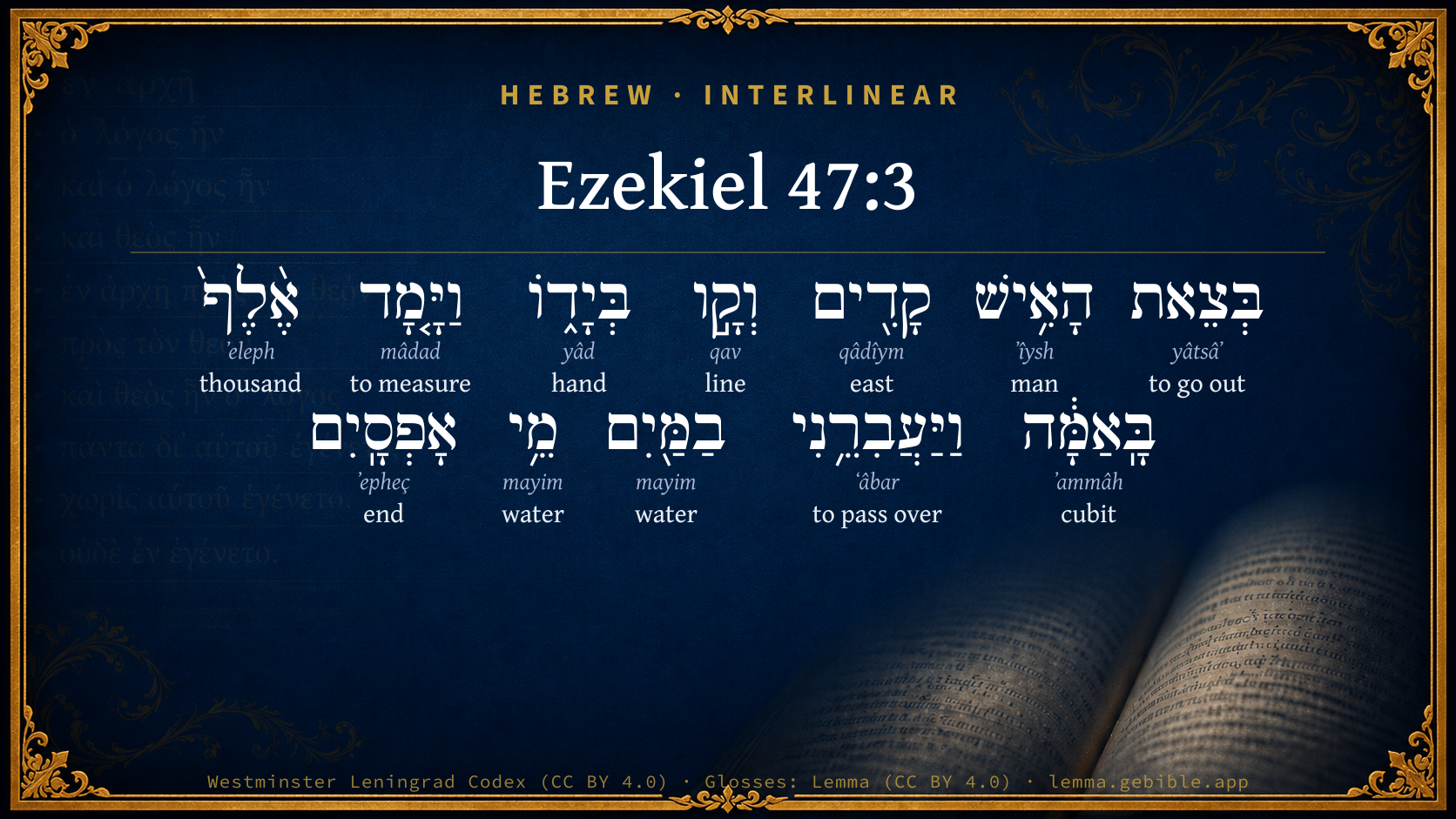
Ezekiel 47:3

Hebrew (Westminster Leningrad Codex) Ezekiel 47:3 appears in the Hebrew Old Testament. The text above is from the Westminster Leningrad Codex. Each word links to its Strong’s number, a concise gloss, and parsing drawn from the Open Scriptures Hebrew Bible morphology. Click any word for its full Brown-Driver-Briggs (BDB) entry.
Download image
Cite this verse

Ezekiel 47:3 (World English Bible). Public Domain. Lemma interlinear Bible study tool, https://lemma.gebible.app/v/ezekiel/47/3.

Show BibTeX & RIS
BibTeX
RIS
English Translation
When the man went forth eastward with the line in his hand, he measured one thousand cubits, and he caused me to pass through the waters, waters that were to the ankles.
World English Bible · Public Domain
Download a study sheet

One document with this verse’s original text, its word-by-word gloss line, the meaning frame, cross-references with their text, attributed commentary, and full source and license credits — printable, and it pastes into notes with its structure intact.

This verse Autodidact and up

Study sheet (.html) Plain text (.txt)

A passage Seminary Student

Up to 50 verses in one chapter. A passage sheet keeps up to 6 commentary sources and 12 cross-references per verse, in the order this page ranks them, and says so on the sheet whenever that leaves anything out. Ask for a single verse and you get the Autodidact verse sheet above.

Everything on this page stays free to read, with no account — the sheet is a download of what is already on screen, not access to it.

Want to remove ads? Support Godless Engineer
Compare translations 3

The same verse in 3 English versions, stacked beneath the original-language interlinear above. Click any original word for its lexicon entry.

Each is an independent rendering of the whole verse — the interlinear is not word-aligned to these translations.

Highlighted words mark where these versions differ — a whole-verse word diff, not a word-by-word alignment.

  • World English Bible Public Domain
    When the man went forth eastward with the line in his hand, he measured one thousand cubits, and he caused me to pass through the waters, waters that were to the ankles.
  • King James Version Public Domain
    And when the man that had the line in his hand went forth eastward, he measured a thousand cubits, and he brought me through the waters; the waters were to the ankles.
  • unfoldingWord Literal Text CC BY-SA 4.0
    As the man was going toward the east, there was a measuring line in his hand; he measured off one thousand cubits and brought me through the water to ankle-deep water.

unfoldingWord Literal Text — © unfoldingWord, licensed CC BY-SA 4.0. Word-aligned USFM3 via Door43 (git.door43.org/unfoldingWord/en_ult).

Versions to compare (up to 4)

3 of 4 selected

Show all 18 translations

Every available English version of this verse, each an independent rendering of the whole verse.

  • World English Bible Public Domain
    When the man went forth eastward with the line in his hand, he measured one thousand cubits, and he caused me to pass through the waters, waters that were to the ankles.
  • Berean Standard Bible Public Domain
    As the man went eastward with a measuring line in his hand, he measured off a thousand cubits and led me through ankle-deep water.
  • Majority Standard Bible Public Domain
    As the man went eastward with a measuring line in his hand, he measured off a thousand cubits and led me through ankle-deep water.
  • King James Version Public Domain
    And when the man that had the line in his hand went forth eastward, he measured a thousand cubits, and he brought me through the waters; the waters were to the ankles.
  • American Standard Version (1901) Public Domain
    When the man went forth eastward with the line in his hand, he measured a thousand cubits, and he caused me to pass through the waters, waters that were to the ankles.
  • Revised Version (1885) Public Domain
    When the man went forth eastward with the line in his hand, he measured a thousand cubits, and he caused me to pass through the waters, waters that were to the ankles.
  • Geneva Bible (1599) Public Domain
    And when the man that had the line in his hand, went foorth Eastward, he measured a thousand cubites, and he brought me through the waters: the waters were to the ancles.
  • Douay-Rheims (1899) Public Domain
    And when the man that had the line in his hand went out towards the east, he measured a thousand cubits: and he brought me through the water up to the ankles.
  • Young's Literal Translation Public Domain
    In the going out of the man eastward, and a line in his hand, then he measureth a thousand by the cubit, and he causeth me to pass over into water -- water to the ankles.
  • Literal Standard Version CC BY-SA 4.0
    In the going out of the man eastward—and a line in his hand—then he measures one thousand by the cubit, and he causes me to pass over into the waters—waters [to my] ankles.
  • Unlocked Literal Bible CC BY-SA 4.0
    As the man was going toward the east, there was a measuring line in his hand; he measured off one thousand cubits and brought me through the water to ankle-deep water.
  • unfoldingWord Literal Text CC BY-SA 4.0
    As the man was going toward the east, there was a measuring line in his hand; he measured off one thousand cubits and brought me through the water to ankle-deep water.
  • Darby Bible Public Domain
    When the man went forth eastward, a line was in his hand; and he measured a thousand cubits, and he caused me to pass through the waters: the waters were to the ankles.
  • World Messianic Bible Public Domain
    When the man went out eastward with the line in his hand, he measured one thousand cubits, and he caused me to pass through the waters, waters that were to the ankles.
  • Webster's Bible Public Domain
    And when the man that had the line in his hand went forth eastward, he measured a thousand cubits, and he brought me through the waters; the waters were to the ankles.
  • Free Bible Version CC BY-SA 4.0
    The man walked east holding a measuring line He measured a thousand cubits and led me through the water which came up to my ankles.
  • Bible in Basic English Public Domain
    And the man went out to the east with the line in his hand, and after measuring a thousand cubits, he made me go through the waters, which came over my feet.
  • JPS Tanakh (1917) Public Domain
    When the man went forth eastward with the line in his hand, he measured a thousand cubits, and he caused me to pass through the waters, waters that were to the ankles.

Literal Standard Version (2020), Covenant Press — licensed CC BY-SA 4.0. Text via the HelloAO Bible API (eBible.org). Unlocked Literal Bible (unfoldingWord) — licensed CC BY-SA 4.0. Text via the HelloAO Bible API (eBible.org). unfoldingWord Literal Text — © unfoldingWord, licensed CC BY-SA 4.0. Word-aligned USFM3 via Door43 (git.door43.org/unfoldingWord/en_ult). Free Bible Version, Dr. Jonathan Gallagher — licensed CC BY-SA 4.0. Text via the HelloAO Bible API (eBible.org).

Word by word

More ways to search: Search by grammar → Find every occurrence → Compare this word →

Practice this passage: Drill this verse → Learn its vocabulary →

וְקָ֣ו
qav
H6957
“and · line”
Conjunction + Noun, Common, Masculine, Singular, Absolute
Part of Speech
Conjunction + Noun
Type
Common
Gender
Masculine
Number
Singular
State
Absolute
Full BDB Definition

Origin: from H6960 [compare H6961 ]

TWOT: 1992 , 1994a

cord, line, measuring-line - cord - measuring-line - (BDB) onomatapoetic mimicry of Isaiah's words, perhaps senseless
  1. בְּצֵאת yâtsâʼ H3318 “in/at · to go out” Preposition + Verb, Qal, Infinitive Construct
  2. הָאִ֥ישׁ ʼîysh H376 “the · man” Particle, Definite Article + Noun, Common, Masculine, Singular, Absolute
  3. קָדִ֖ים qâdîym H6921 “east” Noun, Common, Masculine, Singular, Absolute
  4. בְּיָד֑וֹ yâd H3027 “in/at · hand · his” Preposition + Noun, Common, Both, Singular, Construct + Suffix, Personal, 3rd Person, Masculine, Singular
  5. וַיָּ֤מָד mâdad H4058 “and · to measure” Conjunction + Verb, Qal, Sequential Imperfect, 3rd Person, Masculine, Singular
  6. אֶ֨לֶף֙ ʼeleph H505 “thousand” Adjective, Cardinal number, Both, Singular, Absolute
  7. בָּֽאַמָּ֔ה ʼammâh H520 “in/at the · cubit” Preposition, Determined + Noun, Common, Feminine, Singular, Absolute
  8. וַיַּעֲבִרֵ֥נִי ʻâbar H5674 “and · to pass over · me” Conjunction + Verb, Hiphil, Sequential Imperfect, 3rd Person, Masculine, Singular + Suffix, Personal, 1st Person, Common, Singular
  9. בַמַּ֖יִם mayim H4325 “in/at the · water(s)” Preposition, Determined + Noun, Common, Masculine, Plural, Absolute
  10. מֵ֥י mayim H4325 “water(s) of” Noun, Common, Masculine, Plural, Construct
  11. אָפְסָֽיִם ʼepheç H657 “ends” Noun, Common, Masculine, Dual, Absolute

About this verse

These counts appear in no published source. They are computed here, from the morphology-tagged text and Lemma’s own curated glosses. What Lemma adds →

12
words
11
distinct lemmas
Prophets
section

Notable vocabulary

The rarest word here is וְקָ֣ו line H6957 — appearing just 20 times in the whole Hebrew Bible.

Shared distinctive vocabulary

וְקָ֣ו line H6957 occurs in 14 verses of the Hebrew Bible. Also found in:

Grammatical profile

  • 3 verbs
  • 8 nouns
  • 1 adjective

Verb forms

  • בְּצֵאת Qal · Infinitive Construct
  • וַיָּ֤מָד Qal · Sequential Imperfect
  • וַיַּעֲבִרֵ֥נִי Hiphil · Sequential Imperfect

Repetition

A word recurs within this verse — often emphatic in Hebrew:

  • בַמַּ֖יִם water H4325 ×2

Hebrew & Septuagint length

In English translation the verse runs 32 words from the Hebrew and 28 from the Septuagint (LXX English) — closely comparable.

A rough comparison of the two English renderings, which tokenize alike — not a word-level alignment.

Word counts can differ between the Hebrew and the Greek without any difference in meaning — e.g. the Hebrew direct-object marker אֵת has no separate Greek word, and Greek often adds the article ὁ.

Cross-references

9

Topical passages linked to Ezekiel 47:3 in the Treasury of Scripture Knowledge — connected by theme and wording, ordered by reader-vote popularity; previews shown in the World English Bible.

  • Ezekiel 40:3 He brought me there; and, behold, there was a man, whose appearance was like the appearance of brass, with a line of flax in his hand, and a measuring reed; and he stood in the gate.
  • Zechariah 2:1 I lifted up my eyes, and saw, and, behold, a man with a measuring line in his hand.
  • Luke 24:49 Behold, I send forth the promise of my Father on you. But wait in the city of Jerusalem until you are clothed with power from on high."
  • Acts 2:4 They were all filled with the Holy Spirit, and began to speak with other languages, as the Spirit gave them the ability to speak.
  • Acts 2:33 Being therefore exalted by the right hand of God, and having received from the Father the promise of the Holy Spirit, he has poured out this, which you now see and hear.
  • Acts 10:45–46 They of the circumcision who believed were amazed, as many as came with Peter, because the gift of the Holy Spirit was also poured out on the Gentiles.
  • Acts 11:16–18 I remembered the word of the Lord, how he said, 'John indeed baptized in water, but you will be baptized in the Holy Spirit.'
  • Revelation 11:1 A reed like a rod was given to me. Someone said, "Rise, and measure God's temple, and the altar, and those who worship in it.
  • Revelation 21:15 He who spoke with me had for a measure, a golden reed, to measure the city, its gates, and its walls.

Cross-references courtesy of OpenBible.info (CC BY 4.0).

Hebrew and Greek witnesses Masoretic Hebrew ↔ Greek Septuagint

The same verse in the two great witnesses to the Old Testament, shown verse-for-verse.

These are two independent witnesses, not word-aligned to each other, and the Septuagint is shown in lemma (dictionary) form.

Hebrew Ezekiel 47:3 Masoretic · Westminster Leningrad Codex

בְּצֵאת הָאִ֥ישׁ קָדִ֖ים וְקָ֣ו בְּיָד֑וֹ וַיָּ֤מָד אֶ֨לֶף֙ בָּֽאַמָּ֔ה וַיַּעֲבִרֵ֥נִי בַמַּ֖יִם מֵ֥י אָפְסָֽיִם

When the man went forth eastward with the line in his hand, he measured one thousand cubits, and he caused me to pass through the waters, waters that were to the ankles.

World English Bible · Public Domain

Greek LXX Ezekiel 47:3 Septuagint · lemma form

καθώς ἔξοδος ἀνήρ ἐκ ἐναντίος καί μέτρον ἐν ὁ χείρ αὐτός καί διαμετρέω χίλιοι ἐν ὁ μέτρον καί διαἔρχομαι ἐν ὁ ὕδωρ ὕδωρ ἄφεσις

in the direction in which a man went forth opposite; and there was a measuring line in his hand, and he measured a thousand cubits with the measure;

LXX2012 (modern English Septuagint) · Public Domain

On this verse, The Pulpit Commentary discusses the Septuagint’s reading. Read the note in Commentary ↓

Hebrew: Westminster Leningrad Codex (CC BY 4.0). Greek: Septuagint (public domain); English from LXX2012 (modern English Septuagint) (Public Domain). How the Septuagint differs from the Hebrew →

Targum (Aramaic paraphrase)

1

The Targum is the ancient Jewish Aramaic paraphrase of the Hebrew Scriptures — an interpretive translation, not the Hebrew text itself. Onkelos (literal) and Pseudo-Jonathan (expansive) render the Torah, and Jonathan the Prophets. Coverage is partial: where no permissively-licensed English translation exists for a verse, only the Aramaic is shown. This is verse-level text, not a word-by-word alignment to the Hebrew.

  1. Targum Jonathan Prophets (Joshua–Malachi)
    בְּמִפַּק גַבְרָא מִמַדִינְחָא וְחוּט דִמְשַׁחְתָּא בִידֵיהּ וּמְשַׁח אֶלֶף אַמִין בְּאַמְתָא וְאַעְבִּירַנִי בְמַיָא מֵי קַרְסוּלִין:

    (no public-domain English translation for this verse)

    Targum Jonathan — Aramaic: “Mikraot Gedolot” (public domain). English: “Sefaria Community Translation” (CC0 1.0 (public-domain dedication)); “London "Chaldee Paraphrase," 1871” (public domain). Text via Sefaria.

Commentary

Notes on Ezekiel 47:3 from classic Christian and Jewish commentators (each source and its license shown beneath its notes). The classic Christian expositions comment on the surrounding passage and are grouped to its opening verse, so a note may address several verses; the Jewish commentaries on the Tanakh (Rashi and others) are per-verse, so they appear only where the commentator wrote on this verse.

Lemma curates 59 commentaries, every one of them public domain or Creative Commons licensed, each selected and text-cleaned for this edition rather than reprinted as found. About our sources →

Trapp's Complete Commentary

John Trapp

Eze 47:3 And when the man that had the line in his hand went forth eastward, he measured a thousand cubits, and he brought me through the waters; the waters [were] to the ankles.

Ver. 3. And when the man that had the line in his hand.] The man Christ Jesus, the sole architect of his Church, and measurer of his gospel; and that by his gospel, which is the line in his hand, nec solum recta, sed et regula, not only by riht but also by rule.

He measured a thousand cubits.] It was not for nothing that Plato said, O Yεος αιει γαωμετρει, God is always measuring the world.

The waters were to the ankles.] Grace is but a small thing at first; no more is the gospel. {Mat 13:31-33} The Church were at first but a very few, {Act 1:15} that is, one hundred and twenty, of all the great multitudes which had formerly followed Jesus: Sed vix diligitur Iesus propter Iesum. It was more for the loaves than any great love that the most followed him.

John Trapp, A Commentary or Exposition upon All the Books of the Old and New Testament (1647–1656) — public domain. Text from a community e-Sword module.

Joseph Benson's Commentary

Eze 47:3. And when the man that had the line — The angel, described with a line in his hand, Eze 40:3; went forth eastward — Went on directly from the east gate; he measured — By the line in his hand; a thousand cubits — Almost the third part of an English mile; and he brought me through the waters — To try the depth of them. And the waters were to the ankles — “The gradual rise of the waters denotes the large effusion of the Spirit, (which was very remarkable at the first publication of the gospel,) and its wonderful increase from small beginnings; as well as most probably some future and large effusion thereof to be poured out upon the Jews and Gentiles, in order to their conversion. And the latter part of the representation, as Mr. Scott observes, may relate to the times when the gospel shall fill the earth, and produce most extensive and important good effects on the state of mankind in every nation. Thus the river here signifies the same as the stone, (Dan 2:34; Dan 2:45,) cut out without hands, becoming a great mountain, and filling the whole earth; and the same as the little leaven (which is Christ’s illustration of the subject) leavening the whole three measures of meal into which it was cast; or as the grain of mustard-seed becoming a large plant, like a tree, in which the fowls of the air might make their nests. The emblem may also be applied to illustrate the growth of grace, knowledge, and holiness, in true Christians, who, instead of resting in past attainments, forgetting those things which are behind, reach forth unto those which are before, and press toward the mark for the prize of their high calling of God in Christ Jesus. Of such the religion may be fitly compared to the morning light, which shines more and more unto the perfect day.

Joseph Benson's Commentary on the Old and New Testaments (1811–1818) — public domain. Text from a community e-Sword module.

Tyndale Open Study Notes

Tyndale Open Resources

47:3-5 At first, the stream was a mere trickle coming out from the gate of the Temple, but as it flowed out it became deeper and deeper until it was too deep to walk through. The exiles needed to be reminded that God often works from small beginnings that miraculously blossom into full flower.

Tyndale Open Study Notes — © Tyndale Open Resources, licensed CC BY-SA 4.0. Text via the HelloAO Bible API.

Adam Clarke's Commentary

Verse 3. - 5. He measured a thousand cubits, - the waters were to the ANKLES; a thousand more, - the waters were to the KNEES; a thousand more, - they became a RIVER that could not be forded. The waters were risen, and they were waters to SWIM in.

I. This may be applied to the gradual discoveries of the plan of salvation, -

1. In the patriarchal ages.

2. In the giving of the law.

3. In the ministry of John the Baptist. And,

4. In the full manifestation of Christ by the communication of the Holy Ghost.

II. This vision may be applied also to the growth of a believer in the grace and knowledge of God. There is -

1. The seed of the kingdom.

2. The blade from that seed.

3. The ear out of that blade. And,

4. The full corn in that ear.

III. It may be applied to the discoveries a penitent believer receives of the mercy of God in his salvation. He is -

1. A little child, born of God, born from above, and begins to taste the bread of life, and live on the heavenly food.

2. He grows up and increases in stature and strength, and becomes a young man.

3. He becomes matured in the Divine life, and has his spiritual senses exercised so as to become a father in Christ. In other words, the grace of God appears to come drop by drop; it is given as it can be used; it is a seed of light, and multiplies itself. The penitent at first can scarcely believe the infinite goodness of his Maker; he however ventures to follow on with the conducting angel, the minister of the Gospel, in his descriptions of the plenitude of that salvation, provided in that living Temple in which alone the well-spring of life is to be found.

4. In thus following on to know the Lord he finds a continual increase of light and life, till at last he is carried by the streams of grace to the ocean of eternal mercy; then

"Plunged in the Godhead's deepest sea,

And lost in his immensity."

IV. These waters may be considered as a type of the progress which Christianity shall make in the world.

1. There were only a few poor fishermen.

2. Afterwards many Jews.

3. Then the Gentiles of Asia Minor and Greece.

4. The continent and isles of Europe. And,

5. Now spreading through Africa, Asia, and America, at present these waters are no longer a river, but an immense sea; and the Gospel fishers are daily bringing multitudes of souls to Christ.

Adam Clarke's Commentary on the Bible (1810–1826) — public domain. Text from a community e-Sword/MySword module.

Ellicott's Commentary for English Readers

(3) Brought me through the waters.—The point from which the measurement began is not distinctly mentioned, but is to be assumed as from their source, the threshold of the house. The prophet is “brought through the waters” to impress upon him a vivid sense of their size and depth, and this is repeated at each 1,000 cubits until the waters become impassable.

A Bible Commentary for English Readers, edited by Charles John Ellicott (1878–1897) — public domain. Text from a community e-Sword module.

The Cambridge Bible for Schools and Colleges

gen. ed. J. J. S. Perowne

3. A thousand cubits from the place of emergence the waters were ankle deep.

The Cambridge Bible for Schools and Colleges (gen. ed. J. J. S. Perowne; Cambridge University Press, 1878–1918) — public domain. Text from a community e-Sword module.

John Gill's Exposition

And when the man that had the line in his hand,.... The same as in Eze 40:3 and is no other than Christ, who appeared in a human form to the prophet; and who hitherto had only made use of the measuring reed in taking the dimensions of the house, and what appertained to it; but now he uses the line of flax he had in his hand, in measuring the waters as they ran; by which line is meant the Scriptures, the word of God, by which all doctrines are to be measured: this is the rule that both preachers and hearers are to go by; and, as by the direction of this person the waters flowed where he would have them, so the doctrines of the Gospel are preached by the order of Christ where he pleases; see Luk 24:47, and these move in a direct line, as those waters did; error is crooked, and has its windings and turnings; but truth is straight and even; all the words of Wisdom are right, and there is nothing froward, perverse, or crooked in them, Pro 8:8,

went forth eastward; which was the course the waters took by his direction; the Gospel was first spread in the eastern part of the world, in Asia, where many churches were planted by it; it has been since in the south, in Africa, particularly in the times of Austin, when these waters, the doctrines of grace, flowed largely; and they have been since in the north and west, in Europe, in our northern climes; all which perhaps may be signified by the right side, or south side, by which these waters flowed, and by the prophet's going to the north gate, and about, to see them; but in the latter day they will move eastward again, when the kings of the east and their kingdoms shall become Christ's; see Rev 16:12,

he measured a thousand cubits; or, "a thousand by the cubit (d)"; the Targum is,

"a thousand cubits by the cubit;''

with his line from the eastern gate of the house, at the right side of which the waters ran out; this was about half a mile:

and he brought me through the waters: not the thousand cubits he had measured; but when he came to the end of them, he made the prophet to cross the waters, to go through them across, that he might observe the depth of them:

and the waters were to the ankles; were ankle deep, a few inches: or, "to the soles"; for, as R. Jonah thinks, may be additional; and in the Syriac language, signifies a part of the hand, Dan 5:5, and, applied to the feet, designs the soles of them; and then the sense is, the waters were so shallow, that they only covered the soles of the feet: this may signify the ministry of John the Baptist, who, though greater than the prophets, yet the least in the kingdom of heaven was greater than he; and of the disciples of Christ, before the effusion of the Spirit: or may design the more easy doctrines of the Gospel; those waters which Christ's lambs may wade in; that milk which new born babes desire, and are fed with; those plain truths of the word, which those of the weakest capacity are able to take in, receive, and embrace; in the knowledge of which, though fools, they err not; such as salvation by Christ alone; justification by his righteousness; peace and pardon by his blood; which are so plain, as to be understood by every truly gracious soul, though of ever so mean a capacity: or it may intimate the small spread of the Gospel at first in Judea, Samaria, and Galilee.

(d) "mille in cubito", Vatablus, Pagninus, Montanus.

John Gill's Exposition of the Whole Bible (1746–1763) — public domain (CC PDM 1.0). Text via the HelloAO Bible API.

Albert Barnes' Notes on the Bible

The ancles - This may coincide with the step gained in the baptism of Cornelius Acts 10, and the opening of the Church to the Gentiles. The dispersion which had followed the martyrdom of Stephen Act 11:19, had carried believers into various countries, and so paved the way for the foundation of Gentile Churches.

Albert Barnes' Notes on the Bible (1834–1885) — public domain. Text from a community e-Sword/MySword module.

Matthew Poole's English Annotations

The man: this is he who accompanied the prophet as his guide all along, and of whom already hath been spoken in several notes.

The line, mentioned in Eze 40:3, but hitherto not used, for the reed and cubit hitherto were used only, at least only mentioned.

Eastward; from the gate directly east, with whom the prophet goeth.

He measured, by the line in his hand.

A thousand cubits; almost the third part of an English mile; it wanted about eighty yards of a third part.

Through the waters; went before him, as his guide, and the prophet followed; all this in vision.

To the ankles; some five or six inches deep.

Matthew Poole's English Annotations on the Holy Bible (1683–1685) — public domain. Text from a community e-Sword/MySword module.

The Pulpit Commentary

Having emerged from the corner of the east outer gate in drops, the stream, which had not swollen in its passage across the outer court and under the temple wall, speedily exhibited a miraculous increase in depth, and therefore in volume. Having advanced eastward along the course of the stream an accurately measured distance of a thousand cubits (about one-third of a mile), the prophet"s guide brought, or caused him to pass, through the waters, when he found that they were to the ankles; or, were waters of the ankles, as the Chaldee, Syriac, Vulgate, Keil, Kliefoth, Ewald, and Smend translate, rather than "water of the foot-soles," as Gesenius and Havernick render, meaning," water that hitherto had only been deep enough to wet the soles." The udwr ajfesewv, or "water of vanishing," of the LXX, is based on the idea of "failing," "ceasing," "coming to an end," which appears to be the root-conception of. (see Gen_47:15, Gen_47:16; Psa_77:9; Isa_16:4)

The Pulpit Commentary (1880–1919), ed. H.D.M. Spence-Jones & Joseph S. Exell — public domain. Text from a community e-Sword module.

John Wesley's Explanatory Notes

He measured - By the line in his hand. He brought me - Went before, and the prophet followed; all this was in vision.

John Wesley, Explanatory Notes Upon the Whole Bible (1754–1765) — public domain. Text via the GEBible commentary corpus.

unfoldingWord translationNotes

Door43 World Missions Community

measuring line

a string or a rope that people use to measure longer distances

one thousand cubits

Each long cubit was about 54 centimeters. AT: "1,000 cubits" or "about 540 meters" (See: Biblical Distance)

a river that could not be crossed

This can be translated in active form. AT: "a river that no one could cross on foot" (See: Active or Passive)

unfoldingWord translationNotes — © Distant Shores Media and the Door43 World Missions Community, licensed CC BY-SA 4.0. Source: git.door43.org/Door43/en_tn.

Rashi

Rabbi Shlomo Yitzchaki (Rashi)

he measured one thousand cubits outside the wall. For those thousand cubits, the stream did not swell to the extent of being deep up to the אֳפְסָיִם; the ankles, called chevilles in Fr.

Rashi on the Tanakh — English translations: “The Judaica Press complete Tanach with Rashi, translated by A. J. Rosenberg” (CC BY 4.0); “Pentateuch with Rashi's commentary by M. Rosenbaum and A.M. Silbermann, 1929-1934” (public domain); “The Metsudah Tanach series, Lakewood, N.J” (CC BY 4.0); and “The Book of Joshua, Metsudah Publications, 1997” (CC BY 4.0). Text via Sefaria.

Lesson kit

Teaching starters — assembled from the data on this page, not authored interpretation. Every prompt links to the verse data it draws on. Edit before teaching.

Ezekiel, in the Prophets, opens this verse with 12 words (11 distinct Hebrew lemmas). Its most distinctive word is qav (“line”). A historical commentator’s framing appears above. Read the whole chapter for the surrounding context.

Discussion questions

  1. How does “line” (qav) shape what this verse is saying?
  2. How does 2 Kings 21:13, which shares the word «line», read alongside this verse?
  3. What does the repetition of “water” (2× in this one verse) do in this verse?
  4. These translations render this verse differently; the difference is in the English rendering, not the original. What questions does that raise?
  5. «בְּצֵאת» is a Qal Infinitive Construct verb. How does that grammatical form shape the action described?
  6. Compare how Trapp's Complete Commentary and Joseph Benson's Commentary read this verse. Where do they agree or differ?

Things to notice

Reading settings

Reading text

Shown beneath each verse's original-language words.

Old Testament
Old Testament edition

Read the OT as the Masoretic Hebrew (MT) or the Greek Septuagint (LXX).

English shown for the Greek Septuagint (in the Hebrew ↔ Greek comparison).

Comparing translations? Open the Compare panel on any verse page to stack up to four side by side.