
Numbers 20:8

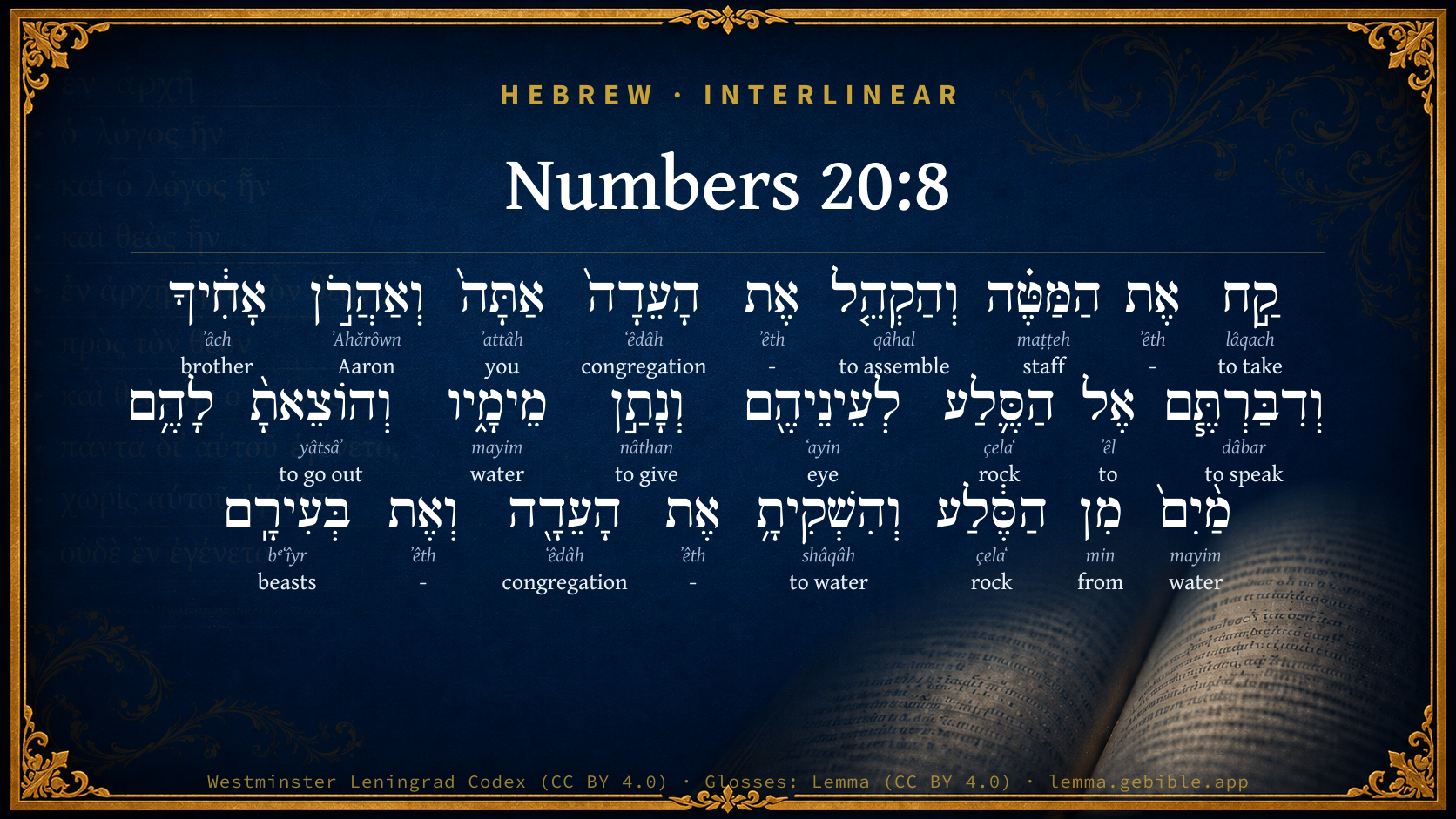
Hebrew (Westminster Leningrad Codex) Numbers 20:8 appears in the Hebrew Old Testament. The text above is from the Westminster Leningrad Codex. Each word links to its Strong’s number, a concise gloss, and parsing drawn from the Open Scriptures Hebrew Bible morphology. Click any word for its full Brown-Driver-Briggs (BDB) entry.
Download image
Cite this verse

Numbers 20:8 (World English Bible). Public Domain. Lemma interlinear Bible study tool, https://lemma.gebible.app/v/numbers/20/8.

Show BibTeX & RIS
BibTeX
RIS
English Translation
Take the rod, and assemble the congregation, you, and Aaron your brother, and speak you to the rock before their eyes, that it give forth its water; and you shall bring forth to them water out of the rock; so you shall give the congregation and their cattle drink.
World English Bible · Public Domain
Highlights
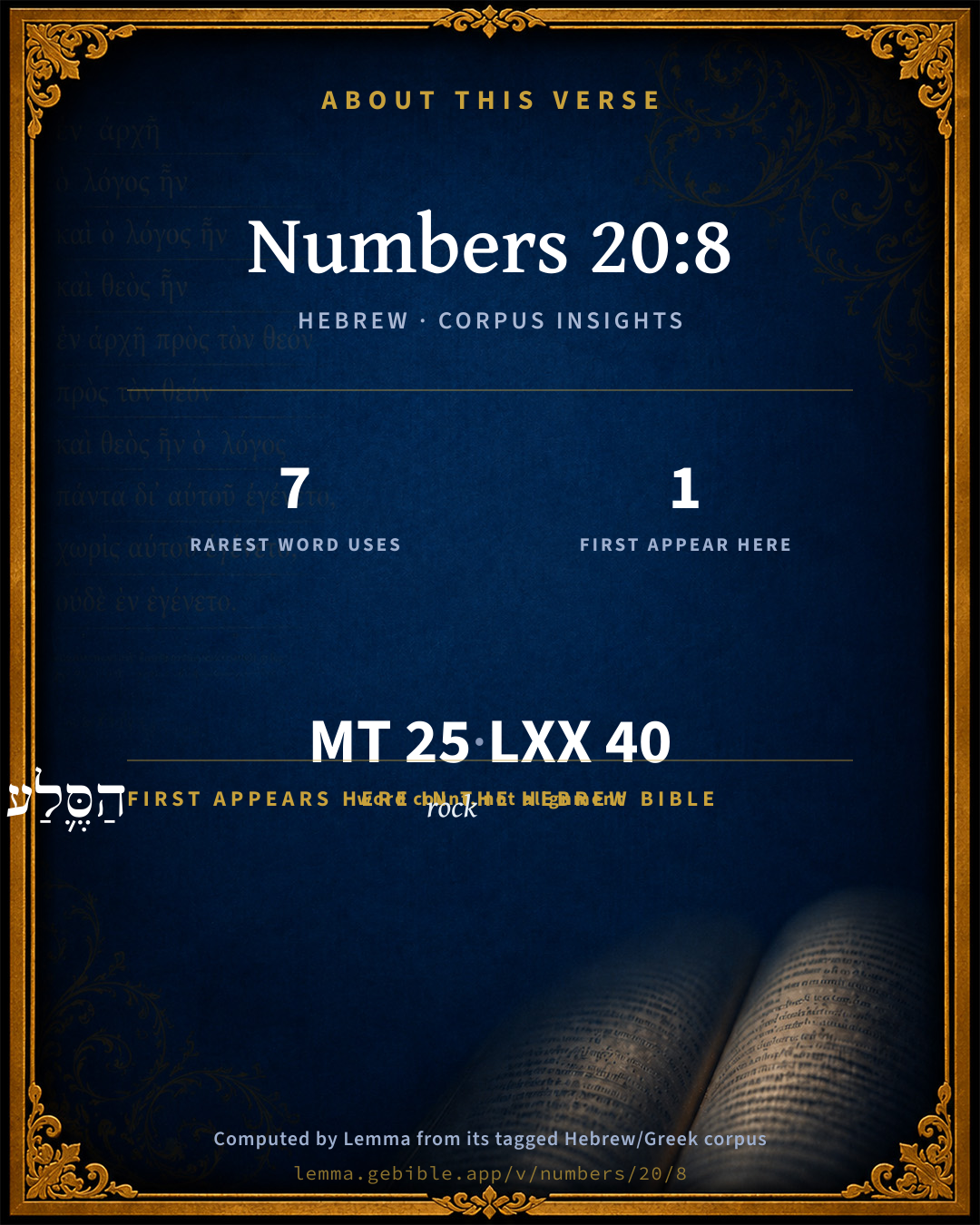
  • 1 first appearance in the Hebrew Bible
Full analysis ↓
Download a study sheet

One document with this verse’s original text, its word-by-word gloss line, the meaning frame, cross-references with their text, attributed commentary, and full source and license credits — printable, and it pastes into notes with its structure intact.

This verse Autodidact and up

Study sheet (.html) Plain text (.txt)

A passage Seminary Student

Up to 50 verses in one chapter. A passage sheet keeps up to 6 commentary sources and 12 cross-references per verse, in the order this page ranks them, and says so on the sheet whenever that leaves anything out. Ask for a single verse and you get the Autodidact verse sheet above.

Everything on this page stays free to read, with no account — the sheet is a download of what is already on screen, not access to it.

Want to remove ads? Support Godless Engineer
Compare translations 3

The same verse in 3 English versions, stacked beneath the original-language interlinear above. Click any original word for its lexicon entry.

Each is an independent rendering of the whole verse — the interlinear is not word-aligned to these translations.

Highlighted words mark where these versions differ — a whole-verse word diff, not a word-by-word alignment.

  • World English Bible Public Domain
    Take the rod, and assemble the congregation, you, and Aaron your brother, and speak you to the rock before their eyes, that it give forth its water; and you shall bring forth to them water out of the rock; so you shall give the congregation and their cattle drink.
  • King James Version Public Domain
    Take the rod, and gather thou the assembly together, thou, and Aaron thy brother, and speak ye unto the rock before their eyes; and it shall give forth his water, and thou shalt bring forth to them water out of the rock: so thou shalt give the congregation and their beasts drink.
  • unfoldingWord Literal Text CC BY-SA 4.0
    “Take the staff and assemble the congregation, you and Aaron your brother, and you shall speak to the rock to their eyes, and it will give its water. And you shall bring out for them water from the rock, and you shall make the congregation and their livestock drink.”

unfoldingWord Literal Text — © unfoldingWord, licensed CC BY-SA 4.0. Word-aligned USFM3 via Door43 (git.door43.org/unfoldingWord/en_ult).

Versions to compare (up to 4)

3 of 4 selected

Show all 18 translations

Every available English version of this verse, each an independent rendering of the whole verse.

  • World English Bible Public Domain
    Take the rod, and assemble the congregation, you, and Aaron your brother, and speak you to the rock before their eyes, that it give forth its water; and you shall bring forth to them water out of the rock; so you shall give the congregation and their cattle drink.
  • Berean Standard Bible Public Domain
    “Take the staff and assemble the congregation. You and your brother Aaron are to speak to the rock while they watch, and it will pour out its water. You will bring out water from the rock and provide drink for the congregation and their livestock.”
  • Majority Standard Bible Public Domain
    “Take the staff and assemble the congregation. You and your brother Aaron are to speak to the rock while they watch, and it will pour out its water. You will bring out water from the rock and provide drink for the congregation and their livestock.”
  • King James Version Public Domain
    Take the rod, and gather thou the assembly together, thou, and Aaron thy brother, and speak ye unto the rock before their eyes; and it shall give forth his water, and thou shalt bring forth to them water out of the rock: so thou shalt give the congregation and their beasts drink.
  • American Standard Version (1901) Public Domain
    Take the rod, and assemble the congregation, thou, and Aaron thy brother, and speak ye unto the rock before their eyes, that it give forth its water; and thou shalt bring forth to them water out of the rock; so thou shalt give the congregation and their cattle drink.
  • Revised Version (1885) Public Domain
    Take the rod, and assemble the congregation, thou, and Aaron thy brother, and speak ye unto the rock before their eyes, that it give forth its water; and thou shalt bring forth to them water out of the rock: so thou shalt give the congregation and their cattle drink.
  • Geneva Bible (1599) Public Domain
    Take the rod, and gather thou and thy brother Aaron the Congregation together, and speake yee vnto the rocke before their eyes, and it shall giue foorth his water, and thou shalt bring them water out of the rocke: so thou shalt giue the Congregation, and their beastes drinke.
  • Douay-Rheims (1899) Public Domain
    Take the rod, and assemble the people together, thou and Aaron thy brother, and speak to the rock before them, and it shall yield waters. And when thou hast brought forth water out of the rock, all the multitude and their cattle shall drink.
  • Young's Literal Translation Public Domain
    `Take the rod, and assemble the company, thou and Aaron thy brother; and ye have spoken unto the rock before their eyes, and it hath given its water, and thou hast brought out to them water from the rock, and hast watered the company, and their beasts.'
  • Literal Standard Version CC BY-SA 4.0
    “Take the rod and assemble the congregation—you and your brother Aaron—and you have spoken to the rock before their eyes, and it has given its water, and you have brought out water to them from the rock, and have watered the congregation and their beasts.”
  • Unlocked Literal Bible CC BY-SA 4.0
    “Take the staff and assemble the community, you, and Aaron your brother. Speak to the rock before their eyes, and command it to flow with water. You will produce water for them out of that rock, and you must give it to the community and their cattle to drink.”
  • unfoldingWord Literal Text CC BY-SA 4.0
    “Take the staff and assemble the congregation, you and Aaron your brother, and you shall speak to the rock to their eyes, and it will give its water. And you shall bring out for them water from the rock, and you shall make the congregation and their livestock drink.”
  • Darby Bible Public Domain
    Take the staff, and gather the assembly together, thou, and Aaron thy brother, and speak ye unto the rock before their eyes, and it shall give its water; and thou shalt bring forth to them water out of the rock, and shalt give the assembly and their beasts drink.
  • World Messianic Bible Public Domain
    “Take the rod, and assemble the congregation, you, and Aaron your brother, and speak to the rock before their eyes, that it pour out its water. You shall bring water to them out of the rock; so you shall give the congregation and their livestock drink.”
  • Webster's Bible Public Domain
    Take the rod, and convene thou the assembly, thou, and Aaron thy brother, and speak ye to the rock before their eyes; and it shall give forth its water, and thou shalt bring forth to them water out of the rock: so thou shalt give drink to the congregation and their beasts.
  • Free Bible Version CC BY-SA 4.0
    “Take the walking stick and have the people gather around you. As they watch, you and your brother Aaron will order the rock and it will pour out water. You will bring water from the rock so the people and their livestock can drink.”
  • Bible in Basic English Public Domain
    Take the rod, you and Aaron, your brother, and make all the people come together, and before their eyes give orders to the rock to give out its water; and so make water come out of the rock for them, and give the people and their cattle drink.
  • JPS Tanakh (1917) Public Domain
    'Take the rod, and assemble the congregation, thou, and Aaron thy brother, and speak ye unto the rock before their eyes, that it give forth its water; and thou shalt bring forth to them water out of the rock; so thou shalt give the congregation and their cattle drink.'

Literal Standard Version (2020), Covenant Press — licensed CC BY-SA 4.0. Text via the HelloAO Bible API (eBible.org). Unlocked Literal Bible (unfoldingWord) — licensed CC BY-SA 4.0. Text via the HelloAO Bible API (eBible.org). unfoldingWord Literal Text — © unfoldingWord, licensed CC BY-SA 4.0. Word-aligned USFM3 via Door43 (git.door43.org/unfoldingWord/en_ult). Free Bible Version, Dr. Jonathan Gallagher — licensed CC BY-SA 4.0. Text via the HelloAO Bible API (eBible.org).

Word by word

More ways to search: Search by grammar → Find every occurrence → Compare this word →

Practice this passage: Drill this verse → Learn its vocabulary →

בְּעִירָֽם
bᵉʻîyr
H1165
“beasts · their”
Noun, Common, Masculine, Singular, Construct + Suffix, Personal, 3rd Person, Masculine, Plural
Part of Speech
Noun
Type
Common
Gender
Masculine
Number
Singular
State
Construct
Full BDB Definition

Origin: from H1197 (in the sense of eating)

TWOT: 264a

beasts, cattle
  1. קַ֣ח lâqach H3947 “take” Verb, Qal, Imperative, 2nd Person, Masculine, Singular
  2. אֶת ʼêth H853 “-” Particle, Direct Object
  3. הַמַּטֶּ֗ה maṭṭeh H4294 “the · staff” Particle, Definite Article + Noun, Common, Masculine, Singular, Absolute
  4. וְהַקְהֵ֤ל qâhal H6950 “and · assemble” Conjunction + Verb, Hiphil, Imperative, 2nd Person, Masculine, Singular
  5. אֶת ʼêth H853 “-” Particle, Direct Object
  6. הָעֵדָה֙ ʻêdâh H5712 “the · congregation” Particle, Definite Article + Noun, Common, Feminine, Singular, Absolute
  7. אַתָּה֙ ʼattâh H859 “you” Pronoun, Personal, 2nd Person, Masculine, Singular
  8. וְאַהֲרֹ֣ן ʼAhărôwn H175 “and · Aaron” Conjunction + Noun, Proper
  9. אָחִ֔יךָ ʼâch H251 “brother · your” Noun, Common, Masculine, Singular, Construct + Suffix, Personal, 2nd Person, Masculine, Singular
  10. וְדִבַּרְתֶּ֧ם dâbar H1696 “and · to speak” Conjunction + Verb, Piel, Sequential Perfect, 2nd Person, Masculine, Plural
  11. אֶל ʼêl H413 “to” Preposition
  12. הַסֶּ֛לַע çelaʻ H5553 “the · rock” Particle, Definite Article + Noun, Common, Masculine, Singular, Absolute
  13. לְעֵינֵיהֶ֖ם ʻayin H5869 “to/for · eyes · their” Preposition + Noun, Common, Both, Dual, Construct + Suffix, Personal, 3rd Person, Masculine, Plural
  14. וְנָתַ֣ן nâthan H5414 “and · to give” Conjunction + Verb, Qal, Sequential Perfect, 3rd Person, Masculine, Singular
  15. מֵימָ֑יו mayim H4325 “water(s) · his” Noun, Common, Masculine, Plural, Construct + Suffix, Personal, 3rd Person, Masculine, Singular
  16. וְהוֹצֵאתָ֨ yâtsâʼ H3318 “and · to go out” Conjunction + Verb, Hiphil, Sequential Perfect, 2nd Person, Masculine, Singular
  17. מַ֨יִם֙ mayim H4325 “water(s)” Noun, Common, Masculine, Plural, Absolute
  18. מִן min H4480 “from” Preposition
  19. הַסֶּ֔לַע çelaʻ H5553 “the · rock” Particle, Definite Article + Noun, Common, Masculine, Singular, Absolute
  20. וְהִשְׁקִיתָ֥ shâqâh H8248 “and · to water” Conjunction + Verb, Hiphil, Sequential Perfect, 2nd Person, Masculine, Singular
  21. אֶת ʼêth H853 “-” Particle, Direct Object
  22. הָעֵדָ֖ה ʻêdâh H5712 “the · congregation” Particle, Definite Article + Noun, Common, Feminine, Singular, Absolute
  23. וְאֶת ʼêth H853 “and · -” Conjunction + Particle, Direct Object

About this verse

These counts appear in no published source. They are computed here, from the morphology-tagged text and Lemma’s own curated glosses. What Lemma adds →

25
words
18
distinct lemmas
Pentateuch
section

Notable vocabulary

The rarest word here is בְּעִירָֽם beasts H1165 — appearing just 7 times in the whole Hebrew Bible.

First appearance in Scripture

This word makes its first canonical appearance in the Hebrew Bible here:

  • הַסֶּ֛לַע rock H5553

Shared distinctive vocabulary

בְּעִירָֽם beasts H1165 occurs in 6 verses of the Hebrew Bible. Also found in:

Grammatical profile

  • 6 verbs
  • 11 nouns
  • 1 pronoun
  • 3 prepositions
  • 4 particles

Verb forms

  • קַ֣ח Qal · Imperative
  • וְהַקְהֵ֤ל Hiphil · Imperative
  • וְדִבַּרְתֶּ֧ם Piel · Sequential Perfect
  • וְנָתַ֣ן Qal · Sequential Perfect
  • וְהוֹצֵאתָ֨ Hiphil · Sequential Perfect
  • וְהִשְׁקִיתָ֥ Hiphil · Sequential Perfect

Repetition

Words recur within this verse — often emphatic in Hebrew:

  • הָעֵדָה֙ congregation H5712 ×2
  • הַסֶּ֛לַע rock H5553 ×2
  • מֵימָ֑יו water H4325 ×2

Hebrew & Septuagint length

In English translation the verse runs 49 words from the Hebrew and 48 from the Septuagint (LXX English) — closely comparable.

A rough comparison of the two English renderings, which tokenize alike — not a word-level alignment.

Word counts can differ between the Hebrew and the Greek without any difference in meaning — e.g. the Hebrew direct-object marker אֵת has no separate Greek word, and Greek often adds the article ὁ.

In the original languages it is 25 Hebrew tokens and 40 Greek tokens — but the two are counted differently (Hebrew bundles its prefixes and suffixes into one token; the Greek is in lemma form), so that isn’t a like-for-like length.

Cross-references

30

Topical passages linked to Numbers 20:8 in the Treasury of Scripture Knowledge — connected by theme and wording, ordered by reader-vote popularity; previews shown in the World English Bible.

  • Exodus 4:17 You shall take this rod in your hand, with which you shall do the signs."
  • Isaiah 43:20 The animals of the field shall honor me, the jackals and the ostriches; because I give waters in the wilderness, and rivers in the desert, to give drink to my people, my chosen,
  • John 16:24 Until now, you have asked nothing in my name. Ask, and you will receive, that your joy may be made full.
  • Acts 2:1–4 Now when the day of Pentecost had come, they were all with one accord in one place.
  • Revelation 22:17 The Spirit and the bride say, "Come!" He who hears, let him say, "Come!" He who is thirsty, let him come. He who desires, let him take the water of life freely.
  • Genesis 18:14 Is anything too hard for Yahweh? At the set time I will return to you, when the season comes round, and Sarah will have a son."
  • Exodus 4:2 Yahweh said to him, "What is that in your hand?" He said, "A rod."
  • Exodus 4:20 Moses took his wife and his sons, and set them on a donkey, and he returned to the land of Egypt. Moses took God's rod in his hand.
  • Exodus 7:20 Moses and Aaron did so, as Yahweh commanded; and he lifted up the rod, and struck the waters that were in the river, in the sight of Pharaoh, and in the sight of his servants; and all the waters that were in the river were turned to blood.
  • Exodus 14:16 Lift up your rod, and stretch out your hand over the sea, and divide it: and the children of Israel shall go into the midst of the sea on dry ground.
  • Exodus 17:5–6 Yahweh said to Moses, "Walk on before the people, and take the elders of Israel with you, and take the rod in your hand with which you struck the Nile, and go.
  • Exodus 17:9 Moses said to Joshua, "Choose men for us, and go out, fight with Amalek. Tomorrow I will stand on the top of the hill with God's rod in my hand."
  • Numbers 20:11 Moses lifted up his hand, and struck the rock with his rod twice: and water came forth abundantly, and the congregation drank, and their cattle.
  • Numbers 21:15 The slope of the valleys That inclines toward the dwelling of Ar, Leans on the border of Moab.
  • Numbers 21:18 The well, which the princes dug, Which the nobles of the people dug, With the scepter, [and] with their poles. From the wilderness [they traveled] to Mattanah;
  • Joshua 6:5 It shall be that when they make a long blast with the ram's horn, and when you hear the sound of the trumpet, all the people shall shout with a great shout; and the wall of the city shall fall down flat, and the people shall go up every man straight before him.
  • Joshua 6:20 So the people shouted, and [the priests] blew the trumpets; and it happened, when the people heard the sound of the trumpet, that the people shouted with a great shout, and the wall fell down flat, so that the people went up into the city, every man straight before him, and they took the city.
  • Nehemiah 9:15 and gave them bread from the sky for their hunger, and brought forth water for them out of the rock for their thirst, and commanded those who they should go in to possess the land which you had sworn to give them.
  • Psalms 33:9 For he spoke, and it was done. He commanded, and it stood firm.
  • Psalms 78:15–16 He split rocks in the wilderness, And gave them drink abundantly as out of the depths.
  • Psalms 105:41 He opened the rock, and waters gushed out. They ran as a river in the dry places.
  • Psalms 114:8 Who turned the rock into a pool of water, The flint into a spring of waters.
  • Isaiah 41:17–18 The poor and needy seek water, and there is none, and their tongue fails for thirst; I, Yahweh, will answer them, I, the God of Israel, will not forsake them.
  • Isaiah 48:21 They didn't thirst when he led them through the deserts; he caused the waters to flow out of the rock for them; he split the rock also, and the waters gushed out.
  • Mark 11:22–24 Jesus answered them, "Have faith in God.
  • Luke 11:13 If you then, being evil, know how to give good gifts to your children, how much more will your heavenly Father give the Holy Spirit to those who ask him?"
  • John 4:10–14 Jesus answered her, "If you knew the gift of God, and who it is who says to you, 'Give me a drink,' you would have asked him, and he would have given you living water."
  • Revelation 22:1 He showed me a river of water of life, clear as crystal, proceeding out of the throne of God and of the Lamb,
  • Matthew 21:21 Jesus answered them, "Most assuredly I tell you, if you have faith, and don't doubt, you will not only do what is done to the fig tree, but even if you told this mountain, 'Be taken up and cast into the sea,' it would be done.
  • Acts 1:14 All these with one accord continued steadfastly in prayer and supplication, along with the women, and Mary the mother of Jesus, and with his brothers.

Cross-references courtesy of OpenBible.info (CC BY 4.0).

Hebrew and Greek witnesses Masoretic Hebrew ↔ Greek Septuagint

The same verse in the two great witnesses to the Old Testament, shown verse-for-verse.

These are two independent witnesses, not word-aligned to each other, and the Septuagint is shown in lemma (dictionary) form.

Hebrew Numbers 20:8 Masoretic · Westminster Leningrad Codex

קַ֣ח אֶת הַמַּטֶּ֗ה וְהַקְהֵ֤ל אֶת הָעֵדָה֙ אַתָּה֙ וְאַהֲרֹ֣ן אָחִ֔יךָ וְדִבַּרְתֶּ֧ם אֶל הַסֶּ֛לַע לְעֵינֵיהֶ֖ם וְנָתַ֣ן מֵימָ֑יו וְהוֹצֵאתָ֨ לָהֶ֥ם מַ֨יִם֙ מִן הַסֶּ֔לַע וְהִשְׁקִיתָ֥ אֶת הָעֵדָ֖ה וְאֶת בְּעִירָֽם

Take the rod, and assemble the congregation, you, and Aaron your brother, and speak you to the rock before their eyes, that it give forth its water; and you shall bring forth to them water out of the rock; so you shall give the congregation and their cattle drink.

World English Bible · Public Domain

Greek LXX Numbers 20:8 Septuagint · lemma form

λαμβάνω ὁ ῥάβδος καί ἐκκλησιάζω ὁ συναγωγή σύ καί ἀαρών ὁ ἀδελφός σύ καί λαλέω πρός ὁ πέτρα ἔναντι αὐτός καί δίδωμι ὁ ὕδωρ αὐτός καί ἐκφέρω αὐτός ὕδωρ ἐκ ὁ πέτρα καί ποτίζω ὁ συναγωγή καί ὁ κτῆνος αὐτός

Take your rod, and call the assembly, you and Aaron your brother, and speak you⌃ to the rock before them, and it shall give forth its waters; and you⌃ shall bring forth for them water out of the rock, and give drink to the congregation and their cattle.

LXX2012 (modern English Septuagint) · Public Domain

On this verse, The Cambridge Bible for Schools and Colleges discusses the Septuagint’s reading. Read the note in Commentary ↓

Hebrew: Westminster Leningrad Codex (CC BY 4.0). Greek: Septuagint (public domain); English from LXX2012 (modern English Septuagint) (Public Domain). How the Septuagint differs from the Hebrew →

Targum (Aramaic paraphrase)

2

The Targum is the ancient Jewish Aramaic paraphrase of the Hebrew Scriptures — an interpretive translation, not the Hebrew text itself. Onkelos (literal) and Pseudo-Jonathan (expansive) render the Torah, and Jonathan the Prophets. Coverage is partial: where no permissively-licensed English translation exists for a verse, only the Aramaic is shown. This is verse-level text, not a word-by-word alignment to the Hebrew.

  1. Targum Onkelos Torah (Genesis–Deuteronomy)
    סַב יָת חוּטְרָא וְאַכְנֵשׁ יָת כְּנִשְׁתָּא אַתְּ וְאַהֲרֹן אָחוּךְ וּתְמַלְלוּן עִם כֵּיפָא לְעֵינֵיהוֹן וְיִתֵּן מוֹהִי וְתַפֵּיק לְהוֹן מַיָא מִן כֵּיפָא וְתַשְׁקֵי יָת כְּנִשְׁתָּא וְיָת בְּעִירְהוֹן

    (no public-domain English translation for this verse)

    Targum Onkelos — Aramaic: “Onkelos Genesis” (public domain); “Onkelos Exodus” (public domain); “Onkelos Leviticus” (public domain); “Onkelos Numbers” (public domain); “Onkelos Deuteronomy” (public domain). English: “Sefaria Community Translation” (CC0 1.0 (public-domain dedication)); “J.W. Etheridge. The Targums of Onkelos and Jonathan Ben Uzziel on the Pentateuch. London: Longmans, Green, 1862” (public domain). Text via Sefaria.

  2. Targum Pseudo-Jonathan Torah (Genesis–Deuteronomy)
    סַב יַת חוֹטֶר נִיסַיָא וּכְנַשׁ יַת כְּנִישְׁתָּא אַנְתְּ וְאַהֲרן אָחוּךְ וְתוּמוּן תְּרֵיכוֹן יַת כֵּיפָא בִּשְׁמָא רַבָּא וּמְפַרְשָׁא כַּד הִינוּן חַמְיָין וְיִתֵּן מוֹהִי וְאִין יְסָרֵב לְאַפּוֹקֵי מָחֵי אַנְתְּ לְחוֹדָךְ בֵּיהּ בְּחוּטְרָא דְבִידָךְ וּתְהַנְפֵּק לְהוֹן מַיָא מִן כֵּיפָא וְתַשְׁקֵי יַת כְּנִישְׁתָּא וְיַת בְּעִירֵיהוֹן

    Take the rod of the miracles, and gather the congregation, thou, and Aharon thy brother, and both of you adjure the rock, by the Great and manifested Name, while they look on, and it shall give forth its waters: but if it refuse to bring forth, smite thou it once with the rod that is in thy hand, and thou wilt bring out water for them from the rock, that the congregation and their cattle may drink.

    Targum Pseudo-Jonathan — Aramaic: “Targum Jonathan on Genesis” (public domain); “Targum Jonathan on Exodus” (public domain); “Targum Jonathan on Leviticus” (public domain); “Targum Jonathan on Numbers” (public domain); “Targum Jonathan on Deuteronomy” (public domain). English: “The Targum of Jonathan ben Uzziel, trans. J. W. Etheridge, London, 1862” (public domain). Text via Sefaria.

Commentary

Notes on Numbers 20:8 from classic Christian and Jewish commentators (each source and its license shown beneath its notes). The classic Christian expositions comment on the surrounding passage and are grouped to its opening verse, so a note may address several verses; the Jewish commentaries on the Tanakh (Rashi and others) are per-verse, so they appear only where the commentator wrote on this verse.

Lemma curates 59 commentaries, every one of them public domain or Creative Commons licensed, each selected and text-cleaned for this edition rather than reprinted as found. About our sources →

Trapp's Complete Commentary

John Trapp

Num 20:8 Take the rod, and gather thou the assembly together, thou, and Aaron thy brother, and speak ye unto the rock before their eyes; and it shall give forth his water, and thou shalt bring forth to them water out of the rock: so thou shalt give the congregation and their beasts drink.

Ver. 8. Take the rod.] God puts off their rebellion, and satisfies their thirst by a miracle.

Speak unto the rock.] He is not bidden now to smite it; as once in Exo 17:6, which because he did unbidden, God was deeply displeased, as some are of opinion.

John Trapp, A Commentary or Exposition upon All the Books of the Old and New Testament (1647–1656) — public domain. Text from a community e-Sword module.

Joseph Benson's Commentary

Num 20:8-9. Take the rod — That which was laid up before the Lord in the tabernacle; whether it was Aaron’s rod, which was laid up there, (Num 17:10,) or Moses’s rod, by which he wrought so many miracles. For it is likely that wonder-working rod was laid up in some part of the tabernacle, though not in or near the ark, where Aaron’s blossoming rod was put. From before the Lord — Out of the tabernacle.

Joseph Benson's Commentary on the Old and New Testaments (1811–1818) — public domain. Text from a community e-Sword module.

Tyndale Open Study Notes

Tyndale Open Resources

20:8-9 The staff was kept before the Ark of the Covenant to prevent the Israelites from complaining (cp. 17:10); it represented God’s authority in the hands of Moses and Aaron. The instructions that God gives his representatives are very precise and must be followed exactly (cp. Jas 3:1; see also 2 Tim 2:24-26).

Tyndale Open Study Notes — © Tyndale Open Resources, licensed CC BY-SA 4.0. Text via the HelloAO Bible API.

Geneva Bible (1599)

Geneva Bible translators

Wherewith thou diddest miracles in Egypt, and didst divide the sea.

Geneva Bible (1599) marginal notes — public domain. Text via Bolls.life.

Jamieson, Fausset & Brown

Robert Jamieson, A. R. Fausset & David Brown

Take the rod--which had been deposited in the tabernacle (Num 17:10), the wonder-working rod by which so many miracles had been performed, sometimes called "the rod of God" (Exo 4:20), sometimes Moses' (Num 20:11) or Aaron's rod (Exo 7:12).

Jamieson, Fausset & Brown — Commentary Critical and Explanatory on the Whole Bible (1871) — public domain (CC PDM 1.0). Text via the HelloAO Bible API.

Ellicott's Commentary for English Readers

(8) Take the rod.—It has been supposed by some, from the fact that the rod is represented as being taken “from before the Lord” (Num_20:9), that the reference is to the rod of Aaron which was kept “before the testimony” (Num_17:10). On the other hand, the natural presumption that the rod was the same as that with which some of the previous miracles in Egypt and those at the Red Sea and at Rephidim had been wrought is confirmed by the facts that the name of Aaron is not mentioned in this verse until after the mention of the rod, and that Moses is said, in Num_20:11, to have smitten the rock “with his rod.”

A Bible Commentary for English Readers, edited by Charles John Ellicott (1878–1897) — public domain. Text from a community e-Sword module.

The Cambridge Bible for Schools and Colleges

gen. ed. J. J. S. Perowne

8. Take the staff] Moses here receives no directions as to what he is to do with the staff: perhaps some clauses which originally contained them have been lost. ‘The staff’ is spoken of as a definite well-known object. In E Moses is represented as using a staff given him by God (Exo_4:17; Exo_4:20); but in P the staff is always Aaron’s (Exo_7:9; Exo_7:12; Exo_7:19-20 &c.). In Num_20:11 (below), according to the Heb. text, Moses struck the rock with ‘his rod’; but LXX. has ‘the rod.’ במטהו is probably a late scribal error for במטה.

the rock] There is at Kadesh (the modern ‘Ain-el-Ḳadîs) a ‘large single mass, or a small hill, of solid rock’ described by Trumbull (Kadesh-Barnea, 272–4), who established the identity of the place.

The Cambridge Bible for Schools and Colleges (gen. ed. J. J. S. Perowne; Cambridge University Press, 1878–1918) — public domain. Text from a community e-Sword module.

John Gill's Exposition

And Moses took the rod from before the Lord..... Which was laid up somewhere in the sanctuary, as well as the rod of Aaron, Num 17:7,

as he commanded him; being always faithful and obedient to him that appointed him.

John Gill's Exposition of the Whole Bible (1746–1763) — public domain (CC PDM 1.0). Text via the HelloAO Bible API.

Albert Barnes' Notes on the Bible

Take the rod - That with which the miracles in Egypt had been performed (Exo 7:8 ff; Exo 7:19 ff; Exo 8:5 ff, etc.), and which had been used on a similar occasion at Rephidim (Exo 17:5 following). This rod, as the memorial of so many divine interpositions, was naturally laid up in the tabernacle, and is accordingly Num 20:9 described now as taken by Moses “from before the Lord.”

Albert Barnes' Notes on the Bible (1834–1885) — public domain. Text from a community e-Sword/MySword module.

Haydock's Catholic Bible Commentary

The rod, with which Moses had wrought so many miracles, and which was placed in the tabernacle, ver. 9. It is called his rod, in the Hebrews v. 11. We do not find that the rod of Aaron, which budded, was used to work miracles. --- Thou. Septuagint, "you." Both Moses and Aaron concurred in the action, (ver. 12,) but Moses was the chief agent. (Calmet)

George Leo Haydock (1774–1849), Haydock's Catholic Family Bible and Commentary, 1859 edition — public domain. Excludes Psalms (Douay-Rheims chapter numbering differs from Protestant) and Deuterocanonical books (Catholic canon only).

Matthew Poole's English Annotations

The rod; that rod which was laid up before the Lord in the tabernacle, as appears from Num 20:9. But whether it was Aaron’s rod, which was undoubtedly laid up there, Num 17:10, or Moses’s rod, by which he wrought so many miracles, it is not considerable; or whether it was not one and the same rod, which was commonly called Moses’s rod, as here, Num 20:11, and elsewhere, and sometimes Aaron’s rod, as Exo 7:12, which may seem most probable. For it is likely, though not related elsewhere in Scripture, that wonder-working rod, called the rod of God, Exo 4:20, was laid up in some part of the tabernacle, though not in or near the ark, where Aaron’s blossoming rod for a particular reason was put. Speak ye unto the rock, which will sooner hear and obey my commands than these sottish and stubborn people.

Matthew Poole's English Annotations on the Holy Bible (1683–1685) — public domain. Text from a community e-Sword/MySword module.

Whedon's Commentary on the Bible

Daniel D. Whedon

8. Take the rod — The wonder-working staff with which the miracles in Egypt were wrought. There is no doubt that the fabled thyrsus of Bacchus, and the caduceus of Mercury, the instrument of his mythic marvels, are distorted traditions of this rod of Moses.

Speak ye unto the rock — There is no command to strike. The only human action which is authorized is, that Moses take the rod, and, probably, stretch it out toward the rock, and that both the brothers speak to it. It is remarkable that the Hebrew for rock is sela, or cliff, and not tzur, as the rock at Rephidim is called. Exo_17:6. From this Stanley argues that Kadesh is ancient Petra, or Sela, the wonderful rock city, “the basin of which is known by the Arabs by no other name than the Valley of Moses.” — Sinai and Pal., p. 95.

Before their eyes — These words indicate some conspicuous rock, such as Dr. Robinson sought for but did not find at Ain-el-Weibeh, which he supposes to be Kadesh.

Thou shalt bring forth… water — As the agent, and not the efficient cause. Did not the fault of Moses, in part, consist in forgetting this distinction?

Daniel D. Whedon (gen. ed.), Commentary on the Old and New Testaments (1874–1909) — public domain. Text from a community e-Sword module.

The Pulpit Commentary

Take the rod. The rabdov , or staff of office, with which Moses and Aaron had worked wonders before Pharaoh, (Exo_7:9 sq. ) and with which Moses had smitten the rock in Rephidim. (Exo_17:6) This rod had not been mentioned, nor perhaps used, since then; but we might certainly have supposed that the instrument of so many miracles would be reverently laid up in the tabernacle "before the Lord," and, this we find from the next verse to have been the case. Gather thou the assembly together, i.e., by their representatives. Speak ye unto the rock before their eyes. The word used for the rock in this narrative is lSh instead of rWXh, as in Ex 17. It does not seem that any certain distinction of meaning can be drawn between the words, which are obviously interchanged in Jud_1:6:20, 21, and are both translated petra by the Septuagint; but the careful use of different terms in the two narratives serves to distinguish them, just as the use of kofinouv and spuridav by St. Mark (Mar_6:43 8:8 19, 20) helps to distinguish the two miracles of feeding the multitude.

The Pulpit Commentary (1880–1919), ed. H.D.M. Spence-Jones & Joseph S. Exell — public domain. Text from a community e-Sword module.

John Wesley's Explanatory Notes

The rod - That which was laid up before the Lord in the tabernacle; whether it was Aaron's rod, which was laid up there, chap. xvii, 10, or Moses's rod by which he wrought so many miracles. For it is likely, that wonder-working rod, was laid up in some part of the tabernacle, though not in or near the ark, where Aaron's blossoming rod was put.

John Wesley, Explanatory Notes Upon the Whole Bible (1754–1765) — public domain. Text via the GEBible commentary corpus.

Scofield Reference Notes

C. I. Scofield

speak ye unto the rock before their eyes

See Exo 17:5. (See Scofield "Exo 17:5").

The rock (Christ) 1Co 10:4 once smitten, needs not to be smitten (crucified) again. Moses’ act exalted himself Num 20:10 and implied (in type) that the one sacrifice was ineffectual, thus denying the eternal efficacy of the blood; Heb 9:25; Heb 9:26; Heb 10:3; Heb 10:11; Heb 10:12. The abundant water (grace reaching the need of the people, despite the error of their leader) tells of refreshing and power through the Spirit.

The Scofield Reference Bible (1917 edition), notes by C. I. Scofield — public domain. Text from a community e-Sword module.

Rashi

Rabbi Shlomo Yitzchaki (Rashi)

ואת בעירם [SO SHALT THOU GIVE THE CONGREGATION] AND THEIR BEASTS [TO DRINK] From this we may see that the Holy One, blessed be He, has regard for the possessions of Israel (Menachot 76b; Midrash Tanchuma, Chukat 9).

Rashi on the Tanakh — English translations: “The Judaica Press complete Tanach with Rashi, translated by A. J. Rosenberg” (CC BY 4.0); “Pentateuch with Rashi's commentary by M. Rosenbaum and A.M. Silbermann, 1929-1934” (public domain); “The Metsudah Tanach series, Lakewood, N.J” (CC BY 4.0); and “The Book of Joshua, Metsudah Publications, 1997” (CC BY 4.0). Text via Sefaria.

Ramban (Nachmanides)

Rabbi Moshe ben Nachman (Ramban / Nachmanides)

The sin of Moses and Aaron in the [matter of the] waters of Meribah is not clearly expressed in Scripture. Rashi explains that [their sin consisted of hitting the rock], because He had commanded them, and speak ye unto the rock, and did not say “and ye shall strike it.” For had they spoken [to the rock and it had brought forth water] the Holy One, blessed be He, would have been sanctified before the whole congregation, since the people would have said: “If [even] this rock, which does not hear and does not speak, nonetheless obeys the command of the Holy One, blessed be He, how much more so should we [obey His commands]!” These words are [in the nature of] a homiletic interpretation, but they do not clarify [the matter]. For since G-d had commanded Moses: Take the rod, it implied that he should smite [the rock] with it, for had He only wanted that he should speak to it, what was [the point of] this rod in his hand? Similarly, in the [case of the] plagues of Egypt where He said, and the rod which was turned to a serpent shalt thou take in thy hand it was in order to smite with it;, Verse 17: I will smite with the rod that is in my hand upon the waters which are in the river. and sometimes He said, Stretch forth thy hand [with thy rod], 8:1. when the meaning is: “to smite with the rod,” since Scripture writes briefly when the subject-matter is self-understood. Moreover, the miracle [involved in the rock giving forth water] is no greater if [accomplished] by speech than by smiting, for as far as the rock is concerned both are equal. Furthermore [if the sin consisted of smiting the rock], why did He say about this: ye [Moses and Aaron] trespassed against Me? [It cannot be because they failed to speak to the rock], for the [fulfillment of the] command to [Moses to] speak to the rock is indeed [also] mentioned at the occurrence [of the event]! Thus He commanded [Moses and Aaron] to say whilst the rock “listens” that G-d will bring forth water out of this rock, similar to [that which Joshua said about a stone which he put up as a witness to the covenant which he made with the people], for ‘it hath heard’ all the words of the Eternal. And they [Moses and Aaron] indeed did so, as Scripture states, And Moses and Aaron gathered the assembly together before the rock, and he said unto them etc. Thus the rock did “hear” when he [Moses] spoke these words to all the people!Now Rabbi Abraham ibn Ezra has already refuted many claims of the commentators in [their explanations of the nature of] this sin. But the secret to which he alluded is also incorrect. For if Moses lost his concentration of mind because of the strife of the people, and [therefore] did not speak to the rock, so that the water did not come forth [when he smote the rock] the first time, and only when he hit the rock again, a second time, with concentration of cleaving unto [the Creator of] all, did the water come forth [as Ibn Ezra explains] — then they [indeed] sinned the first time, but it was not such [a sin] about which He would say: ye believed not in Me, to sanctify Me, since there was no lack of “faith” here at all!Now Rabbeinu Rabbi Moshe [ben Maimon] advanced the following reasoning, (The Eight Chapters), Chapter 4. These chapters are Maimonides’ introduction to the Tractate Aboth, which contains the roots of ethical and moral teachings of the Rabbis of the Mishnah. and explained “that the sin of Moses our teacher, of blessed memory, consisted of tending towards anger, when he said, Hear now ye rebels, and G-d, blessed be He, treated this as a failing, that a man like him should show anger in front of the congregation of Israel, in a situation in which anger was not warranted. All similar actions of such a man are treated as a profanation of G-d’s Name, because the people take an example from all his [Moses’] movements and words, hoping thereby to achieve successes in this world and the World to Come. How could he [permit himself to] appear angry, since it [anger] is an evil trait, and is derived only from a bad characteristic of the features of the soul! But when He said of this sin: ye trespassed against Me, [the meaning thereof] is as I shall explain. Moses was not speaking to simpletons, nor to those of insignificant status, for the least important of their women was [equal in prophetic vision] to [the prophet] Ezekiel the son of Buzi, as the Sages have mentioned. Thus whatever Moses said or did the people would examine, so that when they saw him becoming angry, they said that he — may his memory be blessed — did not lack moral perfection, and therefore ‘unless he knew that G-d was angry with us for demanding water, and that we have aroused His anger, blessed be He, Moses also would not have been angry with us.’ But we do not find that G-d, praised be He, was angry [with the people] when He spoke to Moses on this matter. But [instead] He said: Take the rod, and assemble the congregation, thou, and Aaron thy brother, and speak ye unto the rock before their eyes, that it give forth its water; and thou shalt bring forth to them water out of the rock; so thou shalt give the congregation and their cattle drink. [This statement does not indicate that G-d was angry with the people for having demanded water, and hence Moses’ anger was unjustified.] Thus we have solved one of the most difficult problems in the Torah, concerning which many things have been said, and which has been asked many times, namely: ‘what was the sin which Moses committed?’ Consider what has been said [by others] about it, and what we ourselves have explained, and let the truth prevail.” These are the words of Rabbi Moshe [ben Maimon] of blessed memory.He has added vanity upon vanities! For Scripture says ye trespassed against Me, meaning that they transgressed His command, and He [further] stated, ye believed not in Me, meaning that they lacked faith in Him, [and if so] the punishment [of Moses] was not because he showed anger! [Were this to be his sin], Moses would have deserved punishment [not so much here as] when he was wroth with the officers of the host for no reason. Moreover, Scripture [here] does not mention anything about him being angry, for the expression Hear now, ye rebels is [merely a form of] rebuke, similar to that which he [Moses] said: Ye have been rebellious against the Eternal. Furthermore, Aaron never in his life became angry, for he always walked in peace and uprightness. Besides, it is impossible [to suggest, as Rambam does], that G-d was not very angry with them [the people] for their strife with Moses! For throughout all their [previous] trials in the wilderness, their greatest sin was when they said, wherefore hast thou brought us up out of Egypt? and they preferred to be slaves to their enemies doing rigorous work, rather than to be G-d’s [people], like a son who serves his father. Thus Scripture says: because that ye have rejected the Eternal Who is among you, and have troubled Him with weeping, saying: ‘Why, now, came we forth out of Egypt?’ On the first occasion they said even less than this, [namely], Wherefore hast thou brought us up out of Egypt, to kill us and our children and our cattle with thirst? and yet there was great [Divine] wrath against them, and [it was considered] a great sin, just as it is said, And the name of the place was called Massah [Trying] and Meribah [Strife], because of the striving of the children of Israel etc. And here it says expressly, These are the waters of Meribah [Strife], where the children of Israel strove with the Eternal!, and this is not so according to Maimonides’ explanation, as Ramban continues. What greater transgression can there be than this! Woe unto him that striveth with his Maker! And Moses said, Also the Eternal was angry with me for your sakes, saying: ‘Thou also shalt not go in thither.’ If so, it was they [the people] who sinned and brought about all this misfortune! But according to the explanation of the Rabbi [Moshe ben Maimon], they did not commit any transgression and sin at all in this whole affair! And as for that which Rabbi Moshe said: “We do not find that G-d, praised be He, was angry [with the people when He spoke to Moses on this matter], but instead He said: Take the rod etc.” — know that whenever the people needed something for their sustenance, even though they murmured and transgressed [in asking] for it, He, being full of compassion, forgiveth iniquity … and does not stir up all His wrath, nor does He hold [their sin against them], but He gives them their request., 106:15. Similarly in the [case of the] first [request for] water He said in a peaceful manner, Pass on before the people etc., even though there was trial and strife there, such that He warned them [not to try G-d] in future generations [using it as an example].. (See also “The Commandments,” Vol. II, pp. 63-64). So also in connection with the manna [He said], Behold, I will cause to rain bread from heaven for you, in a phrase indicating love and affection. Only at the end, in the second communication, He said, I have heard the murmurings of the children of Israel, Verse 12. merely in order to tell them that they had sinned. But [it is only] when they complained for no [good] reason, that He poured upon them the fury of His anger. And here there is an additional allusion to great wrath, and [the people] being liable to a plague, as it is said, and the glory of the Eternal appeared unto them. [The expression unto them] refers to the assembly mentioned [in the first part of the verse], which indicates “the hand of the Eternal” that is present in plagues, as you may note in [incidents of] the spies, the day of Korach’s punishment, 16:19: and the glory of the Eternal appeared … The destruction of Korach and his company followed, as related ibid., (Verses 31-33). and the following day., 17:7: and the glory of the Eternal appeared … This was followed by a plague, as related there in Verses 11-14. And one must [moreover] wonder at the Rabbi [Moshe ben Maimon, who wrote that the people committed no sin in this affair] since the verse explicitly states, They angered Him also at the waters of Meribah, and it went ill with Moses because of them! And the verse [there] counts this sin amongst the great trials with which they [the people] tested G-d in the wilderness!The most likely explanation amongst all those that have been said about this matter, and the one best suited to answer a questioner, is that of Rabbeinu Chananel, Note 48. who wrote [in his commentary] that the sin consisted of their saying, are ‘we’ to bring you forth water out of this rock? They should [not have said “are we”, but] “shall the Eternal bring you forth water?” just as they had said when ‘the Eternal shall give’ you in the evening flesh to eat etc., and similarly in [the case of all the] miracles they [Moses and Aaron] informed them that the Eternal would do wonders for them. And [since they did not say so here], perhaps the people thought that Moses and Aaron brought forth the water for them out of the rock through their own wisdom [and that it was not a Divine miracle]. This is [what G-d referred to in saying], ye sanctified Me not. Now in the case of the first episode with the rock, He said, Behold, I will stand before thee there upon the rock in Horeb, and the seventy elders saw the pillar of the cloud, 13:21. hovering over the rock, and thus it was made apparent to all that the miracle was the deed of the Great G-d. But here, since the people saw nothing, they misunderstood the words of Moses and Aaron [as explained above]. It is possible that He said ‘m’altem bi’ (ye ‘trespassed’ against Me), because if one derives benefit from a sacred object, it is called me’ilah.? In a way, then, Moses and Aaron thereby “derived benefit” from a sanctified matter. Similarly, He said ‘m’rithem pi’ (ye rebelled against My commandment) because He had commanded them to speak unto the rock before their eyes, in order that I should become sanctified in their eyes. Or [it may be that m’rithem pi means] “you have ‘changed’ My commandment,” related to the expression ‘vatemer’ (and she changed) My ordinances, since I did not command you to speak in this manner [are ‘we’ to bring you forth water out of this rock?]. And [according to Rabbeinu Chananel’s explanation, the criticism that] lo he’emantem bi (ye believed not in Me) refers [not to Moses and Aaron themselves lacking in belief, but] to the children of Israel [i.e., it does not mean, as it is generally translated, “ye believed not in Me,” but “‘ye did not cause the children of Israel to believe in Me’ because you did not attribute to Me the bringing forth of the water from the rock”]. Or [the word he’emantem] may mean “strengthening,” as if to say: “you did not strengthen yourselves to sanctify Me in their eyes,” related to these expressions: ‘va’amanah’ (and a ‘sure’ ordinance) concerning the singers; the peg that was fastened ‘bimkom ne’eman’ (in a ‘sure’ place). The Truth [Cabalistic explanation] is that this subject [i.e., the nature of Moses’ sin in the incident of the waters of Meribah] is one of the great secrets amongst the mysteries of the Torah. For on the first [occasion with the rock] He said to Moses, Behold, I will stand before thee there upon the rock in Horeb; and thou shalt smite the rock, meaning to say: “My Great Name will be upon the rock in Horeb,” which is the Glory of the Eternal, the devouring fire on the top of the mount.. Therefore he only hit it there once, and a great amount of water came forth. But here He did not tell him so, and so both of them [Moses and Aaron] agreed that they would smite the rock twice — and that was their sin. Therefore He said, lo he’emantem bi, “you did not put faith in My Name [when you should have known] that by faith [alone] the miracle will be done.” It states, ‘m’rithem pi’ (ye rebelled against My commandment), because they rebelled against His holy spirit, which is always called pi Hashem (the commandment of the Eternal). Therefore He said, ‘m’altem’ bi, and the term me’ilah always denotes “untruth.” Thus the sin [of Moses and Aaron] is clearly expressed in Scripture. And so did the Psalmist say, [Tremble thou earth …] at the presence of the G-d of Jacob; Who turneth the rock into a pool of water. And you can understand this from Moses’ prayer, when he said, O G-d Eternal, Thou hast begun, pleading before the Glorious Name, 28:58. to forgive him.And in the opinion of our Rabbis 157. who mention Moses’ anger [as a factor in his sin], it is possible that he hit the rock but [only] a few drops came forth as a result of the diminution in his concentration because of his anger, and they both [Moses and Aaron] were astonished at this, and decided to hit the rock a second time, as I have mentioned, and that was the sin of both of them.In my opinion, the meaning of the phrase, and speak ye ‘el’ (unto) the rock is like ‘al’ (concerning) the rock. Similarly, Thus saith the Eternal of hosts ‘el’ the pillars, and concerning the sea, and concerning the bases … they shall be carried unto Babylon. Thus He commanded them [Moses and Aaron] to say in the presence of the congregation, when they are all gathered together, that G-d will bring them forth water out of the rock, as He indeed did. Now do not find a difficulty means “to” the rock, and the rock will listen, then the following word l’eineihem (before their eyes) fits in perfectly. The speaking by Moses and Aaron with the rock listening, is to be done before “the eyes” of the people. But if as we now explain speak ye ‘el’ the rock as meaning ‘al’ the rock [“concerning” the rock] while the people are to listen, how is the word l’eineihem in accord with the thought, since people do not listen with “their eyes?” Hence Ramban proceeds to remove this difficulty by pointing out that the word l’eineihem is Scripturally not always used in a literal sense and here it means “in their presence.” in the verse, and ‘speak’ ye unto the rock ‘before their eyes,’ for the meaning thereof is like “in their presence”, so that they should all hear it. Similarly [we find]: And Hananiah ‘spoke before the eyes of’ [which means: “in the presence of”] all the people, saying: ‘Thus saith the Eternal: Even so will I break the yoke of Nebuchadnezzar king of Babylon etc.’ There are many cases like this. Or the meaning of the word l’eineihem (before their eyes) here may be that [Moses’] speaking [to the rock] should be when the people are all gathered there, and the rock is before their eyes, as it says when the event [actually took place], And Moses and Aaron gathered the assembly together ‘before the rock’. For when they had gathered together there and saw the rock face to face, they [Moses and Aaron] said, are we to bring you forth water out of this rock? — as the Sages have mentioned 6. — so that they should not say that there were springs [hidden at that place]. It is possible that the verse is to be [interpreted] as if it were transposed, meaning: “assemble the congregation unto the rock, and speak ye before their eyes, that it give forth water.”

THAT IT GIVE FORTH ITS WATER. The meaning thereof is that a large amount of water should immediately spring forth, just as it is said, and water came forth abundantly, for the term “giving” denotes abundance, as in [the verses]: and the Land shall ‘give’ her produce, and the trees of the field shall ‘give’ their fruit; For as the seed of peace, the vine shall ‘give’ her fruit, and the Land shall ‘give’ her increase, and the heavens shall ‘give’ their dew. In all these [verses] He was promising them abundance. And so, it is written, [Behold, He smote the rock, that waters gushed out], and streams overflowed. Now the meaning of ‘its’ water [that it give forth ‘its’ water] is not like [the Land] shall give ‘her’ produce, and [the trees] shall give ‘their’ fruit, since it is not in the nature of a rock to have water in it. But its meaning is [that it will give forth] the water which will come out of it, for when G-d turns the flint into a fountain of waters, 114:8. so that they are [contained] in it and come forth out of it, the waters may [indeed] be called ‘its’ water. Similarly, and He will bless ‘thy’ bread, and ‘thy’ water; ‘his’ bread shall be given, ‘his’ waters shall be sure. He stated it in this way [that it give forth ‘its’ water] in order to inform us that the waters will come forth from the very rock itself, not from the ground beneath it, as occurs naturally in the case of many fountains; but [these waters] will come forth from the middle of the rock. And so it is written, Who turneth the rock into a pool of water, the flint into a fountain of waters., 114:8. He repeated a second time [in this verse], and thou shalt bring forth to them water, meaning that “while you [Moses] are still there, you should bring them forth water from the rock, so that they should all see it gushing forth.” SO THOU SHALT GIVE THE CONGREGATION AND THEIR CATTLE DRINK. [This means] that “you should command them to drink from it in your presence.” All this was for the purpose of publicizing the miracle. In the actual event, [however], it is not mentioned that “he gave the congregation and their cattle to drink;” instead, it says, and the congregation drank, and their cattle, because owing to their great thirst, as soon as they saw water gushing out in abundance, they fell upon the river and drank.Now according to the opinion of our Rabbis about Miriam’s Well, this rock [in Kadesh] is the same flint which was in Horeb; therefore they explain [that the expression] ‘its’ water [in that it give forth ‘its’ water] refers to the water which it used to give, for now as a result of Miriam’s death the fountain ceased [and was only restored in the merit of Moses and Aaron]. For when our Rabbis speak of Miriam’s Well, they mean that there was always a miraculous well, a fountain of living waters, flowing wherever it was His Will. Thus He caused it to come up for Ishmael in the wilderness of Beer-sheba. It was this rock which became cleft in Horeb, and throughout their travels [water] flowed from the rock wherever they encamped. But when the righteous one [Miriam] died, the fountain stopped, and now it continued through [the merit of] Moses to be a fountain opened for him from that very same rock [which had been in Horeb], this being the meaning of the phrase, and speak ye unto ‘haselah’ (‘the’ rock) — the known rock. According to the plain meaning of Scripture, [however], there was a rock near the camp, and He commanded “and speak ye unto the rock which is before you” [hence the phrase ‘the’ rock]. One can also explain it as “and speak ye unto the rock which is before their eyes,” meaning to say “the first rock that they will see.”

Ramban (Nachmanides) on the Tanakh — English translation: “Commentary on the Torah by Ramban (Nachmanides). Translated and annotated by Charles B. Chavel. New York, Shilo Pub. House, 1971-1976” (CC BY 4.0). Text via Sefaria.

Lesson kit

Teaching starters — assembled from the data on this page, not authored interpretation. Every prompt links to the verse data it draws on. Edit before teaching.

Numbers, in the Pentateuch, opens this verse with 25 words (18 distinct Hebrew lemmas). Its most distinctive word is bᵉʻîyr (“beasts”). A historical commentator’s framing appears above. Read the whole chapter for the surrounding context.

Discussion questions

  1. The word bᵉʻîyr carries the sense “beasts.” How does it shape the verse?
  2. The word “rock” first appears here in Scripture. What is being introduced at this debut?
  3. Genesis 45:17 shares the word «beasts» with this verse. How do the two illuminate each other?
  4. “congregation” occurs 2× in this one verse. What is the effect of the repetition?
  5. These translations render this verse differently. What is at stake in choosing one wording over another?
  6. The verb «קַ֣ח» is Qal Imperative. How does its form color the action?
  7. Reading how Trapp's Complete Commentary and Joseph Benson's Commentary read this verse, where do the two commentators agree and where do they part?

Things to notice

Reading settings

Reading text

Shown beneath each verse's original-language words.

Old Testament
Old Testament edition

Read the OT as the Masoretic Hebrew (MT) or the Greek Septuagint (LXX).

English shown for the Greek Septuagint (in the Hebrew ↔ Greek comparison).

Comparing translations? Open the Compare panel on any verse page to stack up to four side by side.