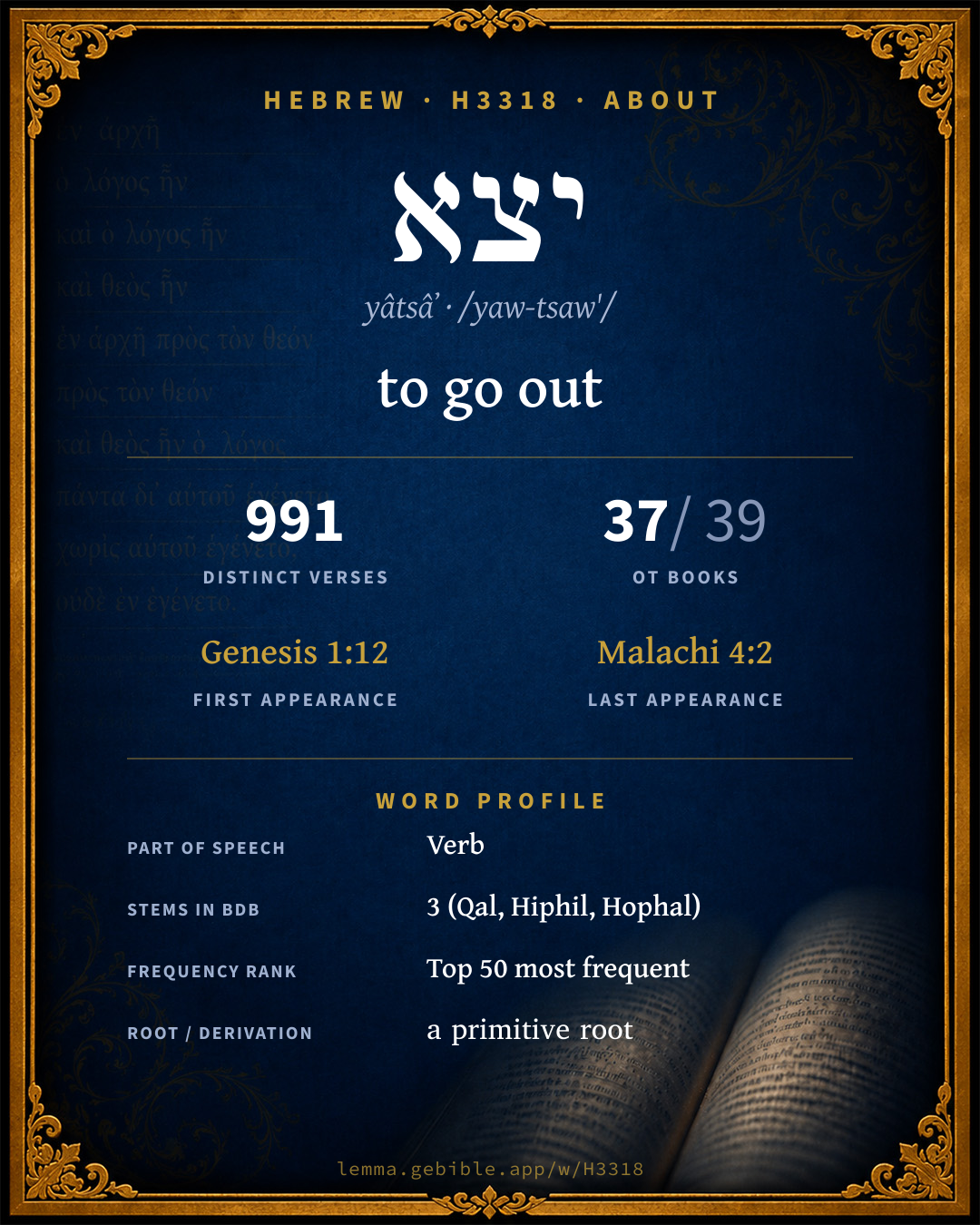
יָצָא
to go out
also: come out, exit, go forth fuller range ↓
Full lexicon entry — Brown-Driver-Briggs (BDB)
From Brown-Driver-Briggs (BDB)
Where this word appears
See every Qal verb in the Hebrew Bible →
Grammar key — what these labels mean
Part of speech
- Verb
- An action or state-of-being word.
Stem
- Qal
- The basic, simple active stem — the plain form of the verb (“he wrote”). Here: ‘go or come out or forth’
- Hiphil
- The causative active stem (“he caused / brought about”). Here: ‘cause to go or come out’
- Hophal
- The passive counterpart of the Hiphil (“he was caused to…”).
Form
- Sequential Imperfect
- An imperfect with prefixed waw — the standard past-narrative form (waw-consecutive imperfect).
- Imperfect
- An incomplete, ongoing, or future action (“he will / would write”).
- Perfect
- A completed action or state — Hebrew marks aspect (completeness) more than strict tense (“he wrote”).
- Sequential Perfect
- A perfect with prefixed waw continuing a preceding imperfect or command (waw-consecutive perfect).
- Participle Active
- A verbal adjective expressing ongoing or characteristic action (“writing / one who writes”).
- Infinitive Construct
- A bound verbal noun, frequently with prepositions (“to write / in writing”).
- Imperative
- A direct command (“write!”).
- Infinitive Absolute
- An unbound verbal noun, often intensifying or standing in for a finite verb.
- Jussive
- A third- or second-person volitional form expressing wish or command (“let him write”).
- Cohortative
- A first-person volitional form expressing wish or resolve (“let me / let us write”).
- Participle Passive
- A verbal adjective expressing action received (“written”).
State
- Absolute
- The independent form of a noun, not bound to a following word.
- Construct
- A noun bound to a following noun in a possessive / “of” relationship (the construct chain).
Person
- 3rd Person
- The one spoken about (“he / she / it / they”).
- 2nd Person
- The one addressed (“you”).
- 1st Person
- The speaker (“I / we”).
Gender
- Masculine
- Grammatically masculine.
- Common
- Either gender — not distinguished for this form.
- Feminine
- Grammatically feminine.
Number
- Singular
- One.
- Plural
- More than one (in Hebrew, generally three or more).
7 verses where H3318 appears in the Qal stem in the Book of Micah. Filtered view — show all forms. Click any verse to open its interlinear word-by-word view. Verse text shown in the World English Bible for context — . Each verse’s Hebrew form is shown with its reference; the English is not keyword-highlighted, since the data carries no word-level English alignment. Use “Compare translations” on any verse to read it across multiple English versions. This concordance covers the Hebrew Bible; Septuagint (Greek Old Testament) occurrences are not indexed here.
Micah
- Micah 1:3 יֹצֵ֣א Qal ptcp.act ms For, behold, Yahweh comes forth out of his place, And will come down and tread on the high places of the earth.
- Micah 1:11 יָֽצְאָה֙ Qal pf 3fs Pass on, inhabitant of Shaphir, in nakedness and shame. The inhabitant of Zaanan won't come out. The wailing of Beth Ezel will take from you his protection.
- Micah 2:13 וַ/יֵּ֣צְאוּ conj + Qal wimpf 3mp He who breaks open the way goes up before them. They break through the gate, and go out. And their king passes on before them, With Yahweh at their head."
- Micah 4:2 תֵּצֵ֣א Qal impf 3fs Many nations will go and say, "Come, and let us go up to the mountain of Yahweh, And to the house of the God of Jacob; And he will teach us of his ways, And we will walk in his paths." For out of Zion will go forth the law, And the word of Yahweh from Jerusalem;
- Micah 4:10 תֵצְאִ֨י Qal impf 2fs Be in pain, and labor to bring forth, daughter of Zion, Like a woman in travail; For now you will go forth out of the city, And will dwell in the field, And will come even to Babylon. There you will be rescued. There Yahweh will redeem you from the hand of your enemies.
- Micah 5:2 יֵצֵ֔א Qal impf 3ms But you, Bethlehem Ephrathah, Being small among the clans of Judah, Out of you one will come forth to me that is to be ruler in Israel; Whose goings forth are from of old, from everlasting.
- Micah 7:15 צֵאתְ/ךָ֖ Qal inf.cs + sfx pers 2ms "As in the days of your coming forth out of the land of Egypt, I will show them marvelous things."
About this entry
At a glance — auto-summarized from this page’s data, not written by a person. Every figure links to its source below. This summary describes the numbers; it doesn’t interpret them.
“to go out” is the headline sense of the Hebrew verb יצא (yâtsâʼ). One archaism survives in the King James Version — “went forth” — where modern Bibles read “went out”; see the renderings breakdown. The Hebrew Bible uses it across 991 verses — among the most common. Its earliest occurrence is Genesis 1:12. Different stems carry different senses — BDB groups them under 3 stems, among them Qal and Hiphil. The sections below give every sense, occurrence, and version rendering.
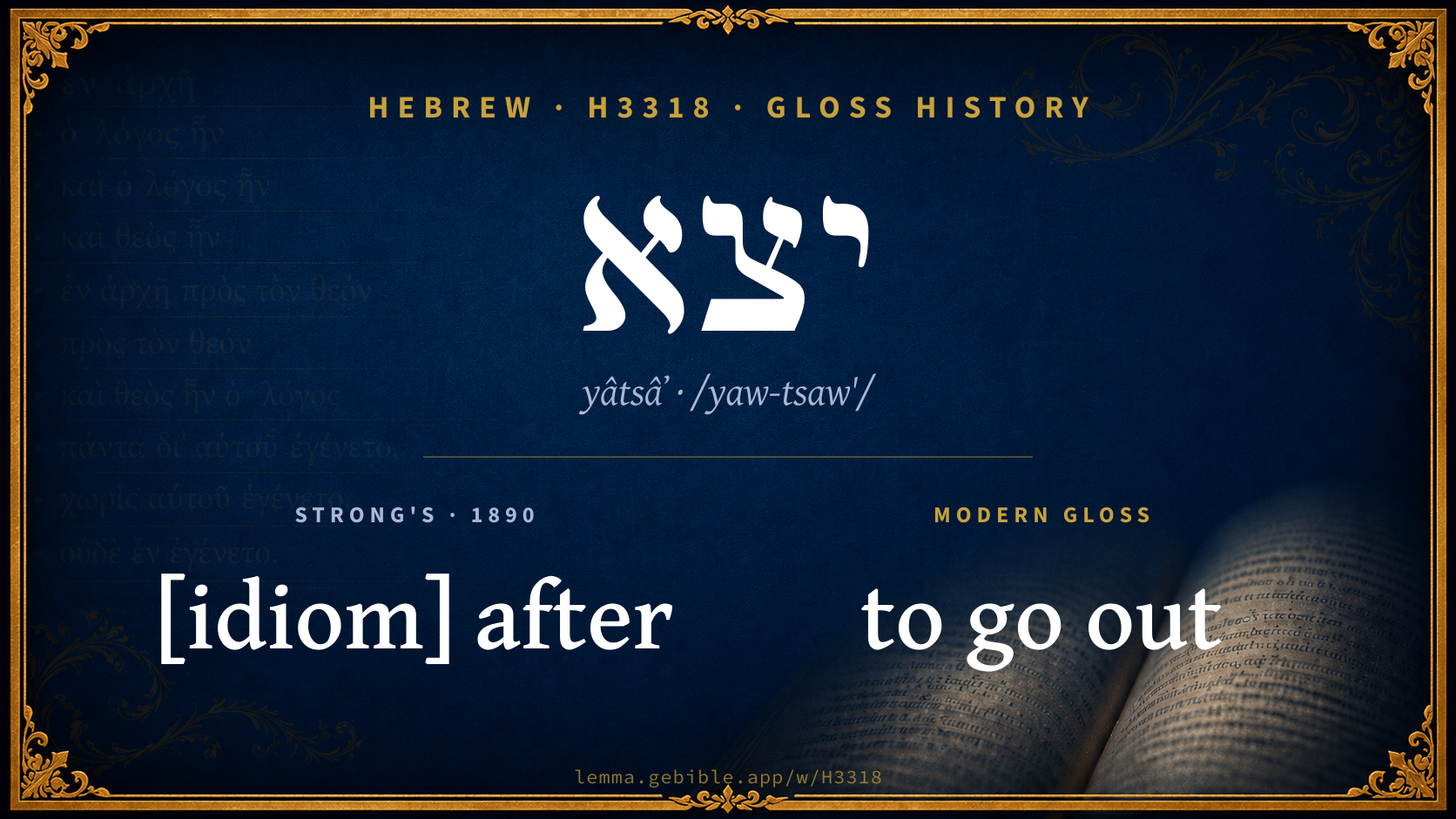
Gloss history
Strong's 1890 vs modern scholarship
About this word
Strong's H3318 catalogs a Hebrew word from the Hebrew Old Testament.
These counts are not copied from any lexicon or concordance. They are computed here, from the morphology-tagged Hebrew Old Testament. What Lemma adds →
- 991
- distinct verses
- The word appears in 991 distinct verses.
- 37 / 39
- OT books
- The word appears in 37 of 39 Old Testament books.
- #37
- by frequency
- Top 50 most frequent Hebrew words (rank 37 of 8,640 Hebrew words by occurrence).
View all 991 occurrences in the concordance →
By section of the Old Testament
By traditional corpus
Conventional, traditional groupings — biblical authorship is debated, so this is a traditional corpus grouping, not an authorship claim. Each share is this word’s portion of its verses in that division of the Hebrew canon. Each figure is a share of the word’s 991 distinct verses.
- Prophets (Nevi'im) 475 verses · 48%
- Torah (Pentateuch) 331 verses · 33%
- Writings (Ketuvim) 185 verses · 19%
How translations render this word
Counts come from each version’s own published word-to-Strong’s tagging or interlinear alignment — an approximate guide to how each version renders this word, not a word-level alignment the data otherwise carries. Because each total is that version’s own tagged count, the per-version totals vary from one another and need not match the appearance or distinct-verse counts above. These counts may also differ from a printed concordance because Lemma counts each distinctly tagged rendering and does not collapse phrase taggings into a single head-word total. This is a fixed set of word-tagged versions (KJV, ASV, BSB, ULT) and does not change with the reading translation you choose elsewhere. Each version’s license is shown beside its name below (and on Sources).
- King James Version: Went out 115×, Came out 43×, Went forth 38×
- American Standard Version: Went out 110×, Went forth 37×, Came out 32×
- Berean Standard Bible: Went out 73×, Came out 46×, Go out 32×
- unfoldingWord Literal Text: Went out 134×, And 118×, Go out 75×
King James Version Public Domain
Renders H3318 across 1,075 tagged occurrences — most commonly:
Plus other, less common renderings. Plus 351 renderings that appear only once — usually multi-word phrases or single function words the recovered tagging swept in, not distinct renderings. Not rendered by a distinct English word in 1 further occurrence.
American Standard Version Public Domain
Renders H3318 across 1,094 tagged occurrences — most commonly:
Plus other, less common renderings. Plus 380 renderings that appear only once — usually multi-word phrases or single function words the recovered tagging swept in, not distinct renderings.
Berean Standard Bible Public Domain
Renders H3318 across 1,032 tagged occurrences — most commonly:
Plus other, less common renderings. Plus 372 renderings that appear only once — usually multi-word phrases or single function words the recovered tagging swept in, not distinct renderings. Not rendered by a distinct English word in 34 further occurrences.
unfoldingWord Literal Text CC BY-SA 4.0
Renders H3318 across 1,295 tagged occurrences — most commonly:
Plus other, less common renderings. Plus 190 renderings that appear only once — usually multi-word phrases or single function words the recovered tagging swept in, not distinct renderings.
40 senses and sub-senses in the full BDB
Hebrew verbs can shift meaning by stem (binyan): Qal is the basic action, Niphal is often passive or reflexive, Piel often intensifies or makes it factitive, and Hiphil is typically causative. The senses below are grouped under the stem BDB assigns to each. This entry also uses Hophal (the passive of Hiphil).
What do BDB’s symbols mean?
BDB uses these scholarly abbreviations:
| Symbol | Meaning |
|---|---|
| 𝔊 | the Septuagint (the ancient Greek translation, LXX) |
| 𝔙 | the Vulgate (the Latin translation) |
| 𝔖 | the Syriac version (the Peshitta) |
| 𝔗 | the Targum (the Aramaic translation) |
| ψ | the Psalms |
| √ | root (the underlying root or stem) |
| ‖ | parallel passage (a synonymous or contrasted parallel) |
| † | the dagger: every passage where the word occurs is cited |
The 40 senses and sub-senses the full Brown-Driver-Briggs lexicon distinguishes for this word, in lexicon order (not ranked by frequency), with BDB’s own verbatim wording and sub-sense lettering. Shown in Hebrew script with BDB’s own scholarly abbreviations. The condensed entry is in the Lexicon Entry tab. See also the Forms in the corpus table below.
Qal
- Pf. יָצָא Gn 10:11 + 92 times; 3 fs. יָצְֽאָה Nu 16:35 + 13 times; יָצָ֑אָה Is 28:29; 2 ms. יָצָאתָ Gn 24:5 + 7 times; 2 fs. וְיָצָאת Je 31:4; 2 mpl. יְצָאתֶם Ex 13:3 Dt 11:10; וִיצָאתֶם Ju 21:21 Mal 3:20; 3 pl. sf. יְצָאֻנִי Je 10:20, etc.; Impf. יֵצֵא Gn 15:4 + 64 times; וַיֵּצֵא 4:16 + 132 times; 3 fs. תֵּצֵא Ex 21:7 + 22 times; וַתֵּצֵא Gn 30:16 + 14 times; 2 ms. תֵּצֵא Dt 20:1 + 16 times; 3 pl. יֵצְאוּ Gn 15:14 +; יֵצֵ֑אוּ 17:6 +; 3 fpl. וַתֵּצֶ֫אנָה 1 S 18:6 2 K 2:24; וַתֵּצֶאןָ Ex 15:20; 2 fpl. תֵּצֶ֫אנָה Am 4:3 etc.; Imv. צֵא Gn 8:16 + 15 times; וָצֵ֑אָה Ju 9:29; fs. צְאִי Ct 1:8; mpl. צְאוּ Gn 19:14 + 11 times; צֵ֑אוּ Is 49:9; Ez 9:7 + Je 50:8 Qr (Kt יֵצֵ֑אוּ) צְאֶינָה Ct 3:11; Inf. abs. יָצוֹא Gn 8:7 + 2 times; יָצֹא 27:30 + 3 times; Inf. cstr. צֵאת 24:11 + 31 times; sf. צֵאתִי Ex 9:29 + 3 times; צֵאתֵנוּ Jos 9:12; צֵאתְךָ Dt 16:3 + 10 times, etc.; Pt. (יוֹצֵא) יֹצֵא Gn 2:10 + 62 times; fs. שֶׁיֹּצָא Ec 10:5; (יו׳) יֹצֵאת Gn 24:15 + 11 times; יֹצֵת Dt 28:57, etc.;— e.g. Genesis 10:11
- 1. go or come out or forth:
- a. from (מִן) a place, e.g. a tent Gn 31:33 (E; opp. בּוֹא בְ), מִפֶּתַח אֹהֶל מוֹעֵד Lv 8:33; 10:7 (P), cf. מִן־הַמִּקְדָּשׁ 21:12 (H); from a house 2 S 11:8, the doors (דלתי) of a house Jos 2:19 (JE), Ju 11:31; מִפֶּתַח ביתו Ex 12:22 (JE), from a camp 1 S 13:17; 2 K 7:12, a city Gn 19:14 (J), 12:4 (P), 1 K 11:29; 20:17; Mi 4:10 a cave 1 S 24:9, the ark Gn 9:18 (J), 8:16, 19 (both P); out of vineyards Ju 21:21; sq. acc. אֶת־הָעִיר Gn 44:4 (E), Ex 9:29 (J); c. בְּ also, of gate Je 17:19 Ne 2:13; sq. acc. local. לֹא אֵצֵא פָ֑תַח Jb 31:34; pt. cstr. יֹצְאֵי הַתֵּבָה Gn 9:10 (P), יֹצְאֵי שַׁעַר עִירוֹ 34:24 (P); abs. Jos 2:5 (JE), Ju 3:24 Ex 34:34 (P), Nu 33:3 (P; Israel going out [from Egypt]), 2 Ch 26:20 +; specif., of going out (מִן) from a land (of emigration) Gn 10:11, 14; 24:5 (all J); partic. of coming forth from (the land of) Egypt (the Exodus) Ex 12:41 (J), 13:3, 8; 23:15; 34:18 (JE), Nu 1:1 (P) 11:20; 22:5 (JE), and especially D, Dt 4:45, 46; 9:7; 11:10; 16:3(×2), 6; 23:5; 24:9; 25:17; Jos 2:10; 5:4, 5, 6 (all D), Nu 33:1 (P), 1 K 6:1; 8:9 = 2 Ch 5:10, 2 K 21:15; Je 7:25; Hg 2:5; ψ 114:1. e.g. Genesis 31:33
- b. go forth from (the presence of) a person: Ex 8:26; 9:23; 10:6 (all sq. מֵעִם), Gn 44:28 Ex 5:20 Jer 2:37 (מֵאֵת), Ju 3:19 (מֵעָלָיו); sq. מִלִּפְנֵי Gn 4:16 (J), 41:46; 47:10; Est 8:15; Ec 10:5; sq. מֵעִם פְּנֵי Jb 1:12, מֵאֵת פְּנֵי 2:7; sq. sf. יְצָאֻנִי Je 10:20 (v. De Ec 7:18). e.g. Exodus 8:26
- c. in technical senses: abs. go forth, of emancipation Ex 21:2, 3(×2), 4, 5, 7(×3), 11 (all JE), cf. יצא מִתַּחַת יַד־אֲרָם 2 K 13:5; of release in the year of jubilee, land, etc. Lv 25:28, 30, 31, 33 (all H), 27:21 (P); also of a debtor-slave 25:54 (H); of divorce וְיָצְֽאָה מִבֵּיתוֹ Dt 24:2; of condemnation בְּהִשָּֽׁפְטוֹ יֵצֵא רָשָׁע ψ 109:7 when he is judged let him go out as a criminal, i.e. be condemned; of bowels (מֵעִים) falling out by reason of disease 2 Ch 21:15, 19. e.g. Exodus 21:2
- d. of flight, involving escape: sq. הַחוּ֫צָה, ‖ נוּס, flee Gn 39:12, 15 (J), כִּי נָצֹא תֵצֵא Je 48:9; opp. taken (by lot) 1 S 14:41; רָעָה אֲשֶׁר לֹא־יוּכְלוּ לָצֵאת מִמֶּ֑נָּה Je 11:11 calamity from which they shall not be able to escape; perhaps also יְרֵא אֱלֹהִים יֵצֵא אֶת־כֻּלָּ֗ם Ec 7:18 he that feareth God shall escape (or be freed from, v. De Hi-Now Mishn.) all of them (see VB),—on acc. with יצא v. De. e.g. Genesis 39:12
- e. depart בְּצֵאת נַפְשָׁהּ Gn 35:18 i.e. when she was expiring; so תֵּצֵא רוּחוֹ ψ 146:4; בְּצֵאת הַיַּיִן מִנָּבָל 1 S 25:37 i.e. when Nabal became sober; also fig. וַיֵּצֵא לִבָּם Gn 42:28 (E) i.e. their heart failed (‖ וַיֶּחֶרְדוּ); rust from (מִן) caldron Ez 24:16 (v. Co Ez 12:5); of glory of י׳ 10:18; וַיֵּצֵא מִן בַּת־צִיּוֹן כָּל־הֲדָרָהּ La 1:6; hence inf. = exit, end בְּצֵאת הַשָּׁנָה Ex 23:16 (JE), and, redundantly, כְּעֵת צֵאת הַקֵּץ לְיָמִים שְׁנַיִם 2 Ch 21:19 i.e. at the end of two years. e.g. Genesis 35:18
- f. of inanimate things: river out of Eden Gn 2:10 (J), water out of rock Ex 17:6 (E), Nu 20:11 (JE), from Leḥi Ju 15:19; of molten calf out of fire Ex 32:24 (E); of gold (after refining) Jb 23:10 (abs., in sim.); in prophecy of fountain from house of י׳ Ez 47:1, 8, 12 Zc 14:8 Jo 4:18; of seed (semen virile) from man Lv 15:16, 32 (P), 22:4 (H); of weapon which has pierced body 2 S 2:23 (מֵאַחֲרָיו), 2 K 9:24 (מִלִּבּוֹ), Jb 20:25 (מִגֵּוָה); וַתֵּצֵא אַחֲרָיו מַשְׂאַת הַמֶּלֶךְ 2 S 11:8 and there went out (= was sent out) after him the king’s portion (i.e. the food given by the king); idiomatically of expenditure of money 2 K 12:13 (abs., cf. Hiph. v 12); of swift movement of arrow from bow Zc 9:14 (like lightning), of lightning out of fire Ez 1:13; abs. of sunrise (subj. שֶׁמֶשׁ) Ju 5:31 (in sim.), Gn 19:23, cf. Is 13:10 (so Assyrian, e.g. ultu ṣît šanši adi êrib šanši COT Gn 19:23); of rising of stars (כּוֹכָבִים) Ne 4:15; of sentence of judge Hb 1:4(×2) ψ 17:2; of judgment, or right appearing (with sim. of light) Hos 6:5 (read וּמִשְׁפָּטִי כָאוֹר יֵצֵא), Is 62:1; of a lot וַיֵּצֵא הַגּוֹרָל לִבְנֵי יוֹסֵף Jos 16:1 (JE), and especially P, Nu 33:54 Jos 19:1, 17, 24, 32, 40; 21:4, cf. also ויצא גְּבוּל גּוֹרָלָם 18:11 (P). e.g. Genesis 2:10
- g. with especial emphasis on idea of origin, source: hyssop out of the wall 1 K 5:13; מיהוה יצא הדבר Gn 24:50 (J) from י׳ has the thing proceeded, of a providential arrangement, so מֵעִם י׳ Is 28:29; מֵרְשָׁעִים יֵצֵא רֶשַׁע 1 S 24:14 (an ancient proverb); of pollution proceeding from (מֵאֵת) prophets Je 23:15; of fire from Heshbon Nu 21:28 (JE) Je 48:45, cf. Ju 9:15, 20(×2); of fire מִלִּפְנֵי י׳ Lv 9:24; 10:2, מֵאֵת י׳ Nu 16:35 (all P); in theophany יצא רֶשֶׁף לְרַגְליו Hb 3:5; iniquity from unreceptive heart ψ 73:7 (v. i. חֵלֶב 1); wrath מִלִּפְנֵי י׳ Nu 17:11 (P); abs. Je 4:4 = 21:12, 23:19 = 30:23; so salvation Is 51:5; וְנִשְׁמַת־מִי יָצְֽאָה מִמֶּךָּ Jb 26:4; of words going forth from mouth of speaker (of solemn or formal speech) לֹא יֵצֵא מִפִּיכֶם דָּבָר Jos 6:10 (JE), Ju 11:36 1 S 2:3 Je 44:17 Jb 37:2 Est 7:8, also Nu 30:3; 32:24 (both P); of י׳’s words going forth from his mouth, or from him Is 45:23; 48:3; 51:4; 55:11 Ez 33:30; of י׳’s words, instruction, command, etc., going forth Is 2:3 = Mi 4:2 (from Jerusalem), Dn 9:23; of human commandment Est 1:19, cf. v 17. e.g. 1 Kings 5:13
- h. of children as going forth from loins (of father) מִמֵּעִים 2 S 7:12; 16:11; מֵחֲלָצִים Gn 35:11 (P), 1 K 8:19 = 2 Ch 6:9; sq. מִן alone 2 K 20:18 = Is 39:7; also יֹצְאֵי יְרֵכוֹ Ju 8:30 Gn 46:26 Ex 1:5 (both P); also of birth מֵרֶחֶם (אִמּוֹ) Nu 12:12 (JE), Je 1:5; 20:18 Jb 3:11; fig. of sea 38:8, of ice v 29; מִבֶּטֶן אִמּוֹ Jb 1:21 Ec 5:14; lit., source not expr., Gn 25:25, 26; 38:28, 29, 30 (all J); of untimely birth Ex 21:22 (JE); cf. הַיּוֹצֵ֯ת מִבֵּין רַגְלֶיהָ Dt 28:57 (‖ תֵּלֵד); of family or race connexion (sq. מִן) Na 1:11 Is 48:1 1 Ch 1:12; 2:53; יצא also of produce of vine (מִגֶּפֶן) Ju 13:14, cf. הַיֹּצֵא הַשָּׂדֶה Dt 14:22 (read יצא Sam., v. Di); אֶרֶץ מִמֶּנָּה יצא לֶחֶם Jb 28:5; of viper proceeding from serpent’s root Is 14:29; further, with idea of unfolding, growth Jb 8:16; 14:2; 31:40; וְיָצָא חֹטֶר מִגֶּזַע יִשָׁ֑י Is 11:1; of the little horn Dn 8:9; so of branches of candlestick in tabernacle Ex 25:32, 33, 35; 37:18, 19, 21 (all P); then simply project (tower from wall) Ne 3:25, 26, 27; of measuring-line going forth (abs.) in a particular direction Je 31:39; of a boundary(-line) going out (abs.) so as then to turn and make an angle Nu 34:4, 9 Jos 15:3, 4, 9, 11(×2); 16:2, 6, 7; 18:15(×2), 17(×2); 19:12, 13, 27, 34, 47. e.g. 2 Samuel 7:12
- 2.
- a. go forth to a place Gn 27:3 (J), Je 14:18 Ez 3:22 Zc 6:6(×2), 7 +; so וַיֵּצֵא הַפַּרְשְׁדֹ֫נָה Ju 3:22 (see VB); go forth in surrender 1 S 11:3 (sq. אֶל pers.), 2 K 18:31 = Is 36:16, Je 38:17, 21; אֵין פֶּרֶץ וְאֵין יוֹצֵאת ψ 144:14; into captivity לֹא יָֽצְאוּ אִתְּכֶם בַּגּוֹלָה Je 29:16, cf. 48:7 Zc 14:2; to work Ru 2:22 also יָצָא מִן־הַמָּקוֹם הַזֶּה Je 22:11, cf. בָּנַי יְצָאֻנִי 10:20. e.g. Genesis 27:3
- b. proceed to or toward something, fig., מֵרָעָה אֶל־רָעָה יָצָ֑אוּ Je 9:2 from evil to evil they go on; in like manner 2 S 20:8 si vera l., but read rather וְהִיא יָצְֽאָה and it (i.e. the sword) came out (of the sheath) and fell 𝔊 We Dr Kit Bu. e.g. Jeremiah 9:2
- c. come or go forth, with especially ref. to purpose or result: וְיָצָאתִי אַחֲרָיו וְהִכִּתִיו 1 S 17:35, cf. 24:15; יָצָא שָׁאוּל לְבַקֵּשׁ נַפְשׁוֹ 23:15, cf. 26:20, further 2 S 2:13; 18:4 1 K 20:18(×2), 19, 39 2 K 5:2 Mi 1:11 Je 37:5 Zc 14:3 Dn 11:11, 44 +; of an adulteress Pr 7:15; of an angel Nu 22:32 (JE), Dn 9:22; for יֵצֵא … אִתְּכֶם 1 S 22:3 (let my father etc. go forth [to be] with you, cf. Klo) read perhaps יֵשְׁבוּ as 𝔖 𝔙 Kit, v. also Dr; of army marching out to form battle line יֹצֵא אֶל־הַמַּעֲרָכָה 1 S 17:20 (c. art., MT, בְּכֹל אֲשֶׁר יָצְֽאוּ Ju 2:15 in all to which they went forth, יָצָא לפני 1 S 8:20 of king going out at the head of his soldiers; so of י׳ before his people Ju 4:14 2 S 5:24 ψ 68:8, cf. 108:12 1 Ch 14:15; of י׳ going out from Seir Ju 5:14, cf. Hb 3:13; of the hand of י׳, in hostility יָֽצְאָה בִי יַד־י׳ Ru 1:13; abs. of fire breaking out Ex 22:5 (JE). e.g. 1 Samuel 17:35
- 3. of combinations, note especially: יָצוֹא וָשׁוֹב (inf. abs.) Gn 8:7 going out and returning, nearly = to and fro; אִישׁ יוֹצֵא … יֹצֵא יָצוֹא וּמְקַלֵּל 2 S 16:5 = coming forth, cursing as he came; יצא ובא, lit. אֵין יוֹצֵא וְאֵין בָּא Jos 6:1 none went out and none came in, i.e. there was no free egress or ingress (of besieged city), cf. 1 K 15:17 = 2 Ch 16:1, 2 Ch 15:5; to go out and come in before, of leader in war Nu 27:17 1 S 18:16, cf. 29:6; fig. Dt 28:6 blesssed shalt thou be בבואך ובצאתך, i.e. when thou completest and beginnest any undertaking, so v 19; 31:2 לא אוכל לצאת ולבוא, i.e. I can no more engage in active undertakings; similarly Jos 14:11 1 K 3:7 Is 37:28 (+ שִׁבְתְּךָ) = 2 K 19:27, ψ 121:8. e.g. Genesis 8:7
Hiphil
- Pf. הוֹצִיא Gn 14:18 +; וְהוֹצִא consec. Dt 22:14; הוֹצֵאתָ Ex 32:11 + 7 times; וְהוֹצֵאתָ֫ Nu 20:8 + 3 times; 2 fs. וְהוֹצֵאת 1 K 17:13; sf. הוֹצִיאַ֫נִי Ez 42:15; הוֹצִיאָ֫נוּ Ex 13:14 + 2 times; הוֹצִיאֲךָ Dt 6:12; 16:1, הוֹצִאֲךָ Ex 13:9 Dt 7:19; הוֹצִיאָם Ex 32:12 + 2 times, etc.; Impf. (יֹצִא) יוֹצִיא Lv 16:27 + 9 times; (וַיֹּצֵא) וַיּוֹצֵא Gn 15:5 + 23 times; (וַיֹּצִא) וַיּוֹצִא Dt 4:20 + 4 times; sf. יוֹצִיאֵנִי Mi 7:9; וַיּוֹצִאֲךָ Dt 4:37; 5:15; וַיּוֹצִאָהּ Ex 4:6, 7; 3 fs. תּוֹצִיא Is 61:11 Hg 1:11; juss. תּוֹצֵא Gn 1:24; וַתּוֹצֵא v 12 Ru 2:18; 2 ms. תּוֹצִיא Ex 12:46 + 5 times; הֲתֹצִיא Jb 38:32, וַתֹּצֵא Je 32:21; (וַיֹּצִאוּ) וַיּוֹצִיאוּ Lv 24:23 +; sf. וַיּוֹצִיאֻהוּ 2 K 12:12; וַיֹּצִאֻהוּ Gn 19:16; וַיֹּצִיאֻהוּ 1 K 21:13; יוֹצִיאוּם 1 Ch 9:28, etc.; Imv. הוֹצֵא Gn 19:12 + 5 times + 8:17 Kt (Qr הַיְצֵא); הוֹצִיא Is 43:8; הוֹצִ֫יאָה ψ 142:8; sf. הוֹצִיאֵנִי 25:17 1 K 22:34, etc.; Inf. cstr. הוֹצִיא Ex 6:13 +; sf. (הוֹצִאִי) הוֹצִיאִי Ex 16:32 +; לְהוֹצִאֵהוּ Je 39:14, anom. (Köi. 642), etc.; Pt. מוֹצִיא Ex 6:7 + 11 times; מוֹצֵא ψ 135:7; sf. מוֹצִיאִי 2 S 22:49, מוֹצִיאֲךָ Dt 8:14; 13:11, etc.;— e.g. Genesis 14:18
- 1. cause to go or come out, bring out, lead out:
- a. a person from a place, + מִן loc., out of prison, etc. Gn 40:14 (E), Je 20:3, 52:31 (not ‖ 2 K 25:27); so with the servant of י׳ subj. Is 42:7; out of house Jos 6:22 (JE), a city Gn 19:12 (J), Ez 14:22 (so 𝔊 𝔖 𝔙 Co VB; MT Hoph.); of י׳ bringing people of Jerusalem out of city to deliver them to enemy Ez 11:7 (MT (one) shall bring, but read i s., see VB), v 9; from a land Je 26:23; especially of Moses bringing Israelites out of Egypt Ex 3:10, 11, 12 (E), 14:11 (J); of Moses and Aaron 6:13, 26, 27 (P); of י׳ bringing Israelites out of (מִן) Egypt Ex 18:1; 20:2 Jos 24:6 (all E), Ex 13:3, 9, 14, 16; 32:11 Nu 20:16; 23:22; 24:8 (all JE), Dt 1:27; 4:20, 37; 5:6, 15; 6:12, 21, 23; 8:14; 9:12, 26, 28; 13:6, 11; 16:1; 26:8 (all D), Lv 19:36; 22:33; 23:43; 25:38, 42, 55; 26:13, 45 (all H), Ex 6:6, 7 (מִתַּחַת סִבְלֹת מצרים), 7:4, 5; 12:17, 42, 51; 16:6, 32; 29:46 Nu 15:41 (all P), Ju 2:12; 6:8 1 S 12:8; 1 K 8:16 = 2 Ch 6:5, 1 K 8:21, 51, 53; 9:9; Je 7:22; 11:4; 31:32; 32:21; 34:13 Ez 20:6, 10, cf. v 9 (del. Co), 2 Ch 7:22 ψ 136:11 Dn 9:15; abs., same sense, Jos 24:5 (E), Dt 7:8, 19 Ez 20:14, 22 ψ 105:37, 43; of י׳ bringing Israelites out of exile (sq. מִן) Ez 20:34, 41; 34:13; obj. rebels (out of, מִן, land) Ez 20:38; of charioteer bringing Ahab out of battle 1 K 22:34 = 2 Ch 18:33; of Joseph’s bringing out his sons from between Jacob’s knees Gn 48:12 (E). e.g. Genesis 40:14
- b. of bringing from a place for a particular purpose (human subj.) Ex 19:17 (מִן); also (point of departure not expr., and purpose sometimes only implied) Gn 38:24 (J), Jos 2:3; 6:23(×2) Ju 6:30 2 S 12:31 = 1 Ch 20:3, 2 K 11:12 = 2 Ch 23:11, 2 Ch 23:14 Is 43:8; י׳ subj., of bringing Israelites out of Egypt to slay them Ex 32:16 (JE), Dt 9:28, 29; obj. Gog Ez 38:4; subj. יַד י׳ Ez 37:1. e.g. Exodus 19:17
- c. lead out as an army 2 S 10:16 = 1 Ch 19:16, so of י׳ Is 43:17; hence with הֵבִיא, of a ruler’s function to lead people out and in 2 S 5:2 = 1 Ch 11:2, Nu 27:17 (P). e.g. 2 Samuel 10:16
- d. הוֹצִיא מֵרֶחֶם of God’s agency in birth Jb 10:18. e.g. Job 10:18
- e. = remove (from a person’s presence) הוֹצִיאוּ כָל־אִישׁ מֵעָלָ֑י Gn 45:1 2 S 13:9; without ‖ מעל v 18. e.g. Genesis 45:1
- f. of putting away wives and children Ezr 10:3, 19 (opp. הוֹשִׁיב v 2, cf. יצאה מביתו Dt 24:2). e.g. Ezra 10:3
- g. bring out person unto (אֶל) a place (human subj.) Jos 10:22, 23 (JE), Dt 17:5; 22:21, 24 (all D), Lv 24:14, 23 (H), Nu 15:36 (P; all אֶל־מִחוּץ), 1 K 21:10, 13 (מִחוּץ of motion to), 2 K 11:15 = 2 Ch 23:14; לְהוֹצִאֵהוּ אֶל־הַבָּ֑יִת Je 39:14; subj. angels in form of men Gn 19:16, 17 (J), Ez 42:1, 15; 46:21; 47:2; also Gn 15:5 (JE; י׳ subj.); for a specific purpose Ex 16:3 (P). e.g. Joshua 10:22
- h. unto a person Gn 43:23 (J), with purpose expressed or implied Ho 9:13 Gn 19:5, 8 (J), Ju 19:22, 24; Jos 10:24 (JE), Je 38:23 Ezr 8:17 (c. על) Kt (but read Qr אֲצַוֶּה). e.g. Genesis 43:23
- i. unto a place and a person Jos 10:22, 23 (JE), Dt 21:19 Ju 19:25. e.g. Joshua 10:22
- 2. fig., obj. persons, bring out of (מִן) distress, etc. ψ 25:17; 68:7; 107:14, 28; 142:8; 143:11; deliver from enemies 2 S 22:49 (but ‖ ψ 18:49 מְפַלְּטִי) one’s feet out of net ψ 25:15; 31:5; bring out into a large place 2 S 22:20 = ψ 18:20, cf. ψ 66:12. e.g. Psalms 25:17
- 3. bring out animals: horses out of Egypt 1 K 10:29 = 2 Ch 1:17 (but read Qal יֵצְאוּ 𝔊 Klo Kmp in KauAT), 2 Ch 1:17; 9:28; animals (from ark, no מן) Gn 8:17 (P) for sacrifice, to a place Nu 19:3. e.g. 1 Kings 10:29
- 4. inanimate obj.:
- a. carry or bring out (with and without מִן) Ex 12:39 (E) Am 6:10 2 S 12:30 = 1 Ch 20:2, 2 K 10:26; 23:4, 6; 24:13 1 Ch 9:28 2 Ch 29:5, 16(×2); 34:14 Je 8:1; 17:22; 50:25 (subj. י׳), Ez 12:4, 7 (in v 5, 6, 7b, 12 read Qal, cf. v 4b, so Co), also 24:6 (Co 24:10); obj. הָאֶבֶן הָרֹאשָׁה Zc 4:7; Lv 26:10 (H), Ezr 1:7(×2), 8. e.g. Exodus 12:39
- b. take or draw out (from one’s person or luggage) Gn 24:53 (J); draw out hand from one’s bosom Ex 4:6, 7 (J), cf. Ru 2:18 (food from one’s cupboard). e.g. Genesis 24:53
- c. = draw חַרְבִּי מִתַּעְרָ֑הּ Ez 21:8, 10 (subj. י׳). e.g. Ezekiel 21:8
- d. bring out to a place Dt 28:38 Lv 4:12, 21; 6:4; 14:45; 16:27 Ez 46:20, cf. Dt 14:28. e.g. Deuteronomy 28:38
- e. bring out to (or for) a person Gn 14:18 Ju 6:19 cf. v 18, 1 K 17:13 2 K 10:22(×2). e.g. Genesis 14:18
- f. bring out from (מִן) a place to people Nu 17:24 (P). e.g. Numbers 17:24
- g. bring out in payment, pay (money, tribute, etc.) 2 K 12:12; 15:20 (עַל = in behalf of: or put it forth, imposed it, on Israel). e.g. 2 Kings 12:12
- h. bring forth (= cause to rise or appear) the heavenly bodies Is 40:26 Jb 38:32; see also וְתַעֲלֻמָה יֹצִא אוֹר 28:11 and hidden things he (the miner) bringeth forth to light. e.g. Isaiah 40:26
- i. bring forth by miracle: Moses, water out of rock Nu 20:8, 10 (JE); י׳, id. Dt 8:15 Ne 9:15 ψ 78:16. e.g. Numbers 20:8
- j. = produce, generate, bring into being: of magicians trying to produce lice Ex 8:14 (P); a smith producing weapon Is 54:16; see the threefold הוציא Pr 30:33(×3); of י׳ causing לֶחֶם to proceed out of (מִן) earth ψ 104:14; elsewhere of earth as producing Gn 1:12, 24 (both P), Is 61:11 Hg 1:11; of Aaron’s rod bringing forth blossoms Nu 17:23 (P). k. bring forth words (out of mouth, etc.), i.e. speak Jb 8:10; 15:13 Pr 10:18; 29:11 Ne 6:19 Is 48:20 (‖ הגיד, השׁמיע); abs. Ec 5:1; of publishing a report הו׳ עָלֶיהָ שֵׁם רָ֑ע Dt 22:14 (‖ שָׂם לָתּ עֲלִילֹת דְּבָרִים), cf. v 19; הו׳ דִּבַּת הָאָרֶץ (רָעָה) Nu 13:32; 14:37; so 14:36 (דִּבָּה עַל־הָאָרֶץ). e.g. Exodus 8:14
- 5. fig., subj. י׳, bring forth from (מִן) Bel’s mouth what he has swallowed Je 51:44; wind, out of treasuries 10:13; 51:16 ψ 135:7; fire, out of Tyre Ez 28:18; curse, over the land Zc 5:4; of Jeremiah, אִם תּוֹצִיא יָקָר מִזּוֹלֵל Je 15:19 if thou bring forth the precious from (Gie without) the base, i.e if thou free that which is pure in thee from base admixture (Gf; Gie if thou produce the noble without the base); bring forth, i.e. exhibit, righteousness (innocence Che) ψ 37:6 Je 51:10 (cf. Qal 1 f end); וַיֹּצֵא לָאוֹר צַלְמָוֶת Jb 12:22, cf. Mi 7:9; subj. servant of י׳, of publishing מִשְׁפָּט (i.e. religion) to the world Is 42:1, 3. e.g. Jeremiah 51:44
Hophal
- Pf. 3 fs. הוּצָ֑אָה Ez 38:8 (del. Co); Pt. fs. מוּצֵאת Gn 38:25; m.pl. מוּצָאִים Ez 14:22; 47:8 (but v. infr.); f.pl. מוּצָאוֹת Je 38:22;—be brought forth Gn 38:25 (J; of Tamar); of women as captives Je 38:22; remnant out of Jerusalem Ez 14:22 MT (but read Hiph., v. supr.); exiles, from among the peoples 38:8 (om. 𝔖 Co); of waters, אֶל־הַיָּ֫מָּה הַמּוּצָאִים Ez 47:8 which are caused to flow into the sea (but 𝔖 Co אֶל־הַמַּיִם הַחֲמוּצִים into the sour (bitter, salt) waters, see Field VB). e.g. Ezekiel 38:8
Senses from the full Brown-Driver-Briggs lexicon (Brown, Driver, Briggs; Oxford 1906 — public domain), digitized via Sefaria, supplemented by the OpenScriptures HebrewLexicon (CC BY 4.0). Full attribution on Sources.
Word origin
vb. go or come out (NH id.; Aramaic יְעָא; Ethiopic ወፅአ, ወጽአ Assyrian âṣû DlHWB 237, all = go out, forth; Syriac ܝܺܥܳܐ go forth (in sense of germinate), grow; Ph. יצא march out; cf. SI5 המוצא the source (of water); Sab. וצֿא go out, DHM in MV; Arabic وَضُؤَ is be or become fair, beautiful, neat, clean, cf. Nö ZMG 1886, 725)—
— Brown-Driver-Briggs (Oxford 1906, public domain), digitized via Sefaria, supplemented by the OpenScriptures HebrewLexicon (CC BY 4.0). See Sources.
Origin: a primitive root
Jastrow Dictionary
A second Hebrew/Aramaic lexicon for comparison, covering Aramaic and post-biblical (Talmudic, Targumic, Midrashic) usage that the biblical-Hebrew BDB does not. Matched by lemma rather than by Strong’s number, so a lemma may carry more than one Jastrow headword (shown separately below), and the entries cover usage well beyond the Bible.
יָצָא
- (b. h.)
- 1. to go forth; to rise (of the sun); to go out. Gen. R. s. 39 אֵצֵא ויהיו וכ׳ I shall leave (my father’s house), and they may desecrate &c. Ib. י׳ לו מוניטון a medal was issued in his memory, v. מוֹנִיטוֹן. Gen. R. s. 6 בשעה שהוא יוצא when he (the sun) rises; בשעה שהיא יוֹצֵאת when she (the moon) rises. Snh. 52ᵃ ארור שיָצָאת זו מחלציו (v. Rabb. D. S. a. l. note) cursed is he from whose loins this woman went forth.—Sabb. V, 1 במה … יוֹצְאָה what is an animal permitted to wear on going out (on the Sabbath)? Ib. VI, 1 לא תֵצֵא וכ׳ a woman must not wear on going out &c.; a. v. fr.
- 2. to end; to go to the end of, to live through. Y. Ber. VIII, 12ᵇ bot. כיון שיָצָת שבת when the Sabbath ended. Y. Shebi. VI, 36ᶜ top אינו יוצא שבתו ולא יָ׳ וכ׳ he shall not live to the end of this week, and he did not arrive at the end of the week before he was dead; (Erub. 63ᵃ הוציא שנתו, v. infra); a. e.
- 3. to be expended. Num. R. s. 14, end, v. הוֹצָאָה.
- 4. to be excluded; exempt; (rarely) to exclude, deduct. Y. Ned. II, beg. 37ᵇ י׳ דבר של איסור this is to exclude a vow concerning a forbidden act; Bab. Ned. 17ᵃ י׳ נשבע לבטל וכ׳ this excludes the case of one who makes oath that he will disregard a law. Y. Yeb. I, 2ᶜ top אשר תלד יָצְתָה זו וכ׳ ‘whom she may bear’ (Deut. XXV, 6), herewith is excluded she (the אַיְילוֹנִית) who &c.; a. v. fr.—Y. Ḥag. I, 76ᶜ top צֵא מהם שני ימים deduct from them two days; ib. צא שבת מהם deduct the Sabbath day.—Esp. idiomatic uses: a) י׳ בן חורין, י׳ לחירות, or only י׳ to be freed. Peah III, 8; Gitt. 42ᵃ. Kidd. 24ᵃ יוצאבשן וכ׳ he is freed, when his master caused his loss of a tooth or an eye; a. v. fr.—b) (of a wife) to be sent away, to be divorced. Keth. VII, 6 ואלו יוֹצְאוֹת שלא בכתובה the following wives have to leave without receiving their K’thubah. Ib. 7 תֵּצֵא she must leave. Ib. X, 5; a. v. fr.—c) י׳ ידי (or מִידֵי) to go out of the power of; to be released; to do justice to, be justified before. Shek. III, 2 … לפי שאדם צריך לָצֵאת ידי הבריות לָצֵאת ידי המקום because man must appear justified before men as well as before God; Ex. R. s. 51; a. fr.—י׳ ידי חובתו, or י׳ to comply with the requirements of the law. Ber. 8ᵇ. Ib. II, 1 אם כיון לבו י׳ if he read with attention, he has done his duty (which requires the reading of the Sh’ma). Y. Shek. III, 47ᵇ bot. מהו לצאת וכ׳ is the law complied with when one uses wine &c.?—Mekh. Bo, Pisḥa, s. 6; a. v. fr.—Gen. R. s. 39 לא יָצָאתָה ידי השבועה thou hast not redeemed thy oath; ib. s. 49; Lev. R. s. 10, beg.—Makhsh. VI, 5; Tosef. Toh. X, 3 י׳ מידי שמן, v. מוֹחַל.—י׳ מידי פשוטו, v. מִקְרָא.—d) י׳ מן הכלל or י׳ to be taken out of the general rule, to be specified (although being implied in the general rule). Sifra, introd. כל דבר שהיה בכלל וי׳ … לא ללמד על עצמו י׳ וכ׳ whatever would have been implied in the general law and yet is specified again (in the Biblical text) in order to teach (something not mentioned before), has been specified not only to teach something new concerning the specific case, but to teach it concerning the whole class. Ib. י׳ לטעון, v. טָעַן I. Tem. I, 6 ולמה י׳ and for what purpose are tithes especially mentioned (Lev. XXVII, 30, sq.)?; a. fr.—e) כַּיּוֹצֵא ב־ like that which passes with it (in the same class), similar; in a similar way. Pes. III, 2 אם יש כי׳ בו שהחמיץ if there is a similar dough (started simultaneously with the one in question) which has begun to ferment. Ber. 59ᵇ, sq. ואין לו כי׳ בו when he has no house like it; כי׳ בהם garments like them. Zeb. V, 6 המורם מהם כי׳ בהם what is taken of them for the priest, is like them (subject to the same laws). M. Kat. 16ᵇ כי׳ בדבר אתה אומר וכ׳ in a similar way (as something coming under the same category) you read &c. Sifré Num. 32; a. v. fr.—f) י׳ שכרו בהפסדו its benefit is lost in its disadvantage; i.e. benefit and disadvantage are counterbalanced. Ab. V, 11, sq.—g) (euphem.) to retire for human needs (v. Toh. X, 2). Ber. 62ᵃ השכם וצֵא וכ׳ go out early in the morning &c. Ex. R. s. 9 ואינו יוצא לנקביו and has no human needs. Ib. לא היה יוצא אלא וכ׳ he used to go out only to the water (to make believe he was a superhuman being); a. fr.—h) to be proved, identified. Keth. II, 3 היה כתב ידם יוצא ממקום אחר if their signature can be identified otherwise (than by their own declaration); a. e. e.g. Deuteronomy 25:6
- 1. to take out, to lead forth, bring forth; to release, discharge, send off. Ber. VI, 1 before eating bread one says, המוֹצִיא לחם וכ׳ (blessed be thou, O Lord) who hast brought forth bread out of the earth (v. ib. 38ᵃ as to המוציא or מוציא); ib. 37ᵇ; a. fr.—Ab. Zar. 41ᵇ, a. fr. אין ספק מוציא וכ׳, v. וַדַּאי. B. Mets. 37ᵇ לא זו הדרך מוֹצִיאָתוֹ מידי עבירה עד וכ׳ this is not the way that relieves him from sin (this is no full atonement), (he is not relieved) until he pays &c.; Yeb. XV, 7. Ib. 6, sq. אין זו דרך מוֹצִיאָתָהּ וכ׳ she is not relieved from the possibility of sin, unless she is not permitted to marry again and forbidden to partake of T’rumah.—Ib. 36ᵇ יוֹצִיא (יוֹצִיאָהּ) בגט he dismisses her with a letter of divorce. Ib. ואם נשא יוציא and if he married her (against the law), he must dismiss her (divorce her); a. fr.—Ab. II, 11, a. fr. מוֹצִיאִין את האדם מן העולם take a man out of the world, i.e. cause him to lose the true enjoyment of life.
- 2. to exclude. Y. Yeb. I, 2ᶜ top איילונית מטעם אחר הוֹצֵאתָהּ the aylonith thou dost (the law does) exclude for another reason (v. supra). Num. R. s. 14, end אוֹצִיא את ישראל let me exclude the Israelites, א׳ את הזקנים the elders; a. fr.—להוֹצִיא (= ch. לאפוקי, v. אַפֵּק, or למעוטי, v. מעט) to the exclusion of. Succ. 28ᵃ; Kidd. 34ᵃ האזרח לה׳ את הנשים ‘the native’ (Lev. XXIII, 42) intimates the exemption of women (from the duty of dwelling in booths); a. v. fr. e.g. Leviticus 23:42
- 3. to lead to the end, to live through. Erub. 63ᵃ, v. supra.—4) to produce, present. Keth. XIII, 8 המוציא שטר חוב … והלה ה׳ וכ׳ if one produces a note of indebtedness against his neighbor, and the latter produces evidence that the claimant sold him a field (and paid him, which he would not have done, if he had a claim). Ib. 9. Ib. IX, 9 הוֹצִיאָה גט if she produces a letter of divorce; a. v. fr.—5) to spend, lay out. Ib. VIII, 5, v. הוֹצָאָה; a. fr.—Esp. idiomatic uses: a) ה׳ ידי חוב־ or ה׳ (v. supra) to be the instrument of a person’s complying with the law, e.g. to read a prayer and thus cause the listener to perform his duty as though he read it himself; to act in another’s behalf effectively. R. Hash. III, 5 אין מוֹצִיאִין את הרבים ידי חובתן they cannot act (blow the Shofar) in behalf of the assembled congregation. Ib. 29ᵃ אע"פ שיצא מוציא although he has done his duty (has read the prayer for himself), he may act in behalf of others. Ib. ולעצמו מוציא and can he (the half-slave and half-freedman) act in his own behalf?; a. fr.—b) to collect, to claim. Keth. VIII, 1 הבעל מוציא מיד הלקוחות the husband can reclaim the property from those who bought it. B. Kam. III, 11 המוציא מחבירו עליו הראייה the claimant must produce evidence; a. v. fr.—c) to utter. Arakh. 5ᵃ, a. fr. אין אדם מוציא דבריו לבטלה no man utters his words for no purpose (he must have meant something).—ה׳ לעז to slander, discredit. Sabb. 97ᵃ, a. fr., v. לַעַז.—d) to carry an object (on the Sabbath) out of a private to a public place, or from one private place to another, v. רָשׁוּת. Sabb. VII, 2, sq.; a. fr.—e) to secrete. Sifré Num. 88 יש לך … שאין מוציא וכ׳ is there a woman-born being that does not discharge the food he eats?; a. e.—f) ה׳ שבת to dismiss the Sabbath with prayer, opp. הכניס. Sabb. 118ᵇ מוֹצִיאֵי שבת וכ׳ those who dismiss the Sabbath at Sepphoris.
יצָא
- to end, only in Shaf. שֵׁיצֵא q. v.
A Dictionary of the Targumim, the Talmud Babli and Yerushalmi, and the Midrashic Literature (Marcus Jastrow; London, Luzac, 1903) — Public Domain. Digitized via Sefaria. Digitized via Sefaria. Full attribution on Sources.
Forms in the corpus
The 571 distinct written forms H3318 takes in the Hebrew Bible, most frequent first — each parse links to that stem’s occurrences in the concordance. Hebrew forms include their vowel points and cantillation, so a single lemma takes many written forms.
The 60 most common forms are shown; 511 rarer forms follow in the full concordance.
Same root — word family
Other BDB entries built from the same root as H3318, grouped by Strong’s listed origin. These share a root / origin per the lexicon — not necessarily a shared meaning. Each links to that word’s own entry.
Derived from this word
- יצא yᵉtsâʼ H3319 to finish
- יציא yâtsîyʼ H3329 offspring
- מוצא môwtsâʼ H4161 going forth
- צאה tsâʼâh H6627 filth
- צאצא tseʼĕtsâʼ H6631 offspring
- תוצאה tôwtsâʼâh H8444 outgoing
Compare all same-root words → Showing 4 of 7 — not the complete family. They share a root, not necessarily a meaning.
Septuagint verse parallels
This word appears in 952 verses that also exist in the Greek Old Testament (Septuagint), out of the 991 Hebrew verses it occurs in. You can read those verses in Greek by switching the Old Testament edition to the Septuagint.
Read these verses in the Septuagint
- Genesis 1:12
- Exodus 1:5
- Leviticus 4:12
- Numbers 1:1
- Deuteronomy 1:27
- Joshua 2:3
- Judges 1:24
- Ruth 1:7
- 1 Samuel 2:3
- 2 Samuel 2:12
- 1 Kings 2:30
- 2 Kings 2:3
This is a verse-level parallel only — the same verses exist in both the Hebrew and Greek Old Testaments. No word-level Hebrew↔Greek correspondence is claimed: the data carries no such alignment, so no Greek word is shown as this Hebrew word’s translation. Coverage is not total — the Septuagint omits the deuterocanon and renumbers the Psalms, so some Hebrew verses have no direct Greek parallel.