
Ezekiel 44:3

Hebrew (Westminster Leningrad Codex) Ezekiel 44:3 appears in the Hebrew Old Testament. The text above is from the Westminster Leningrad Codex. Each word links to its Strong’s number, a concise gloss, and parsing drawn from the Open Scriptures Hebrew Bible morphology. Click any word for its full Brown-Driver-Briggs (BDB) entry.
Download image
Cite this verse

Ezekiel 44:3 (World English Bible). Public Domain. Lemma interlinear Bible study tool, https://lemma.gebible.app/v/ezekiel/44/3.

Show BibTeX & RIS
BibTeX
RIS
English Translation
As for the prince, he shall sit therein as prince to eat bread before Yahweh; he shall enter by the way of the porch of the gate, and shall go out by the way of the same.
World English Bible · Public Domain
Download a study sheet

One document with this verse’s original text, its word-by-word gloss line, the meaning frame, cross-references with their text, attributed commentary, and full source and license credits — printable, and it pastes into notes with its structure intact.

This verse Autodidact and up

Study sheet (.html) Plain text (.txt)

A passage Seminary Student

Up to 50 verses in one chapter. A passage sheet keeps up to 6 commentary sources and 12 cross-references per verse, in the order this page ranks them, and says so on the sheet whenever that leaves anything out. Ask for a single verse and you get the Autodidact verse sheet above.

Everything on this page stays free to read, with no account — the sheet is a download of what is already on screen, not access to it.

Want to remove ads? Support Godless Engineer
Compare translations 3

The same verse in 3 English versions, stacked beneath the original-language interlinear above. Click any original word for its lexicon entry.

Each is an independent rendering of the whole verse — the interlinear is not word-aligned to these translations.

Highlighted words mark where these versions differ — a whole-verse word diff, not a word-by-word alignment.

  • World English Bible Public Domain
    As for the prince, he shall sit therein as prince to eat bread before Yahweh; he shall enter by the way of the porch of the gate, and shall go out by the way of the same.
  • King James Version Public Domain
    It is for the prince; the prince, he shall sit in it to eat bread before the LORD; he shall enter by the way of the porch of that gate, and shall go out by the way of the same.
  • unfoldingWord Literal Text CC BY-SA 4.0
    The ruler of Israel will sit in it to eat food before Yahweh. He will enter by way of the gate’s portico and go out the same way.”

unfoldingWord Literal Text — © unfoldingWord, licensed CC BY-SA 4.0. Word-aligned USFM3 via Door43 (git.door43.org/unfoldingWord/en_ult).

Versions to compare (up to 4)

3 of 4 selected

Show all 18 translations

Every available English version of this verse, each an independent rendering of the whole verse.

  • World English Bible Public Domain
    As for the prince, he shall sit therein as prince to eat bread before Yahweh; he shall enter by the way of the porch of the gate, and shall go out by the way of the same.
  • Berean Standard Bible Public Domain
    Only the prince himself may sit inside the gateway to eat in the presence of the LORD. He must enter by way of the portico of the gateway and go out the same way.”
  • Majority Standard Bible Public Domain
    Only the prince himself may sit inside the gateway to eat in the presence of the LORD. He must enter by way of the portico of the gateway and go out the same way.”
  • King James Version Public Domain
    It is for the prince; the prince, he shall sit in it to eat bread before the LORD; he shall enter by the way of the porch of that gate, and shall go out by the way of the same.
  • American Standard Version (1901) Public Domain
    As for the prince, he shall sit therein as prince to eat bread before Jehovah; he shall enter by the way of the porch of the gate, and shall go out by the way of the same.
  • Revised Version (1885) Public Domain
    As for the prince, he shall sit therein as prince to eat bread before the LORD; he shall enter by the way of the porch of the gate, and shall go out by the way of the same.
  • Geneva Bible (1599) Public Domain
    It appertaineth to the Prince: the Prince himselfe shall sit in it to eate bread before the Lord: he shall enter by the way of the porche of that gate, and shall go out by the way of the same.
  • Douay-Rheims (1899) Public Domain
    For the prince. The prince himself shall sit in it, to eat bread before the Lord: he shall enter in by the way of the porch of the gate, and shall go out by the same way.
  • Young's Literal Translation Public Domain
    The prince, who `is' prince, he sitteth by it to eat bread before Jehovah, by the way of the porch of the gate he cometh in, and by its way he goeth out.'
  • Literal Standard Version CC BY-SA 4.0
    The prince, who [is] prince, he sits by it to eat bread before YHWH, he comes in by the way of the porch of the gate, and by its way he goes out.”
  • Unlocked Literal Bible CC BY-SA 4.0
    The ruler of Israel will sit in it to eat food before Yahweh. He will enter by way of the gate's portico and go out the same way.”
  • unfoldingWord Literal Text CC BY-SA 4.0
    The ruler of Israel will sit in it to eat food before Yahweh. He will enter by way of the gate’s portico and go out the same way.”
  • Darby Bible Public Domain
    As for the prince, he, the prince, shall sit in it to eat bread before Jehovah: he shall enter by the way of the porch of the gate, and shall go out by the way of the same.
  • World Messianic Bible Public Domain
    As for the prince, he shall sit in it as prince to eat bread before the LORD. He shall enter by the way of the porch of the gate, and shall go out the same way.”
  • Webster's Bible Public Domain
    It is for the prince; the prince, he shall sit in it to eat bread before the LORD; he shall enter by the way of the porch of that gate, and shall go out by the way of the same.
  • Free Bible Version CC BY-SA 4.0
    The prince himself is permitted to come and sit inside the gateway to eat in the presence of the Lord. He is to come in through the gateway's porch and leave the same way.”
  • Bible in Basic English Public Domain
    But the ruler will be seated there to take his food before the Lord; he will go in by the covered way to the door, and will come out by the same way.
  • JPS Tanakh (1917) Public Domain
    As for the prince, being a prince, he shall sit therein to eat bread before the LORD; he shall enter by the way of the porch of the gate, and shall go out by the way of the same.'

Literal Standard Version (2020), Covenant Press — licensed CC BY-SA 4.0. Text via the HelloAO Bible API (eBible.org). Unlocked Literal Bible (unfoldingWord) — licensed CC BY-SA 4.0. Text via the HelloAO Bible API (eBible.org). unfoldingWord Literal Text — © unfoldingWord, licensed CC BY-SA 4.0. Word-aligned USFM3 via Door43 (git.door43.org/unfoldingWord/en_ult). Free Bible Version, Dr. Jonathan Gallagher — licensed CC BY-SA 4.0. Text via the HelloAO Bible API (eBible.org).

Word by word

More ways to search: Search by grammar → Find every occurrence → Compare this word →

Practice this passage: Drill this verse → Learn its vocabulary →

אֻלָ֤ם
ʼûwlâm
H197
“porch of”
Noun, Common, Masculine, Singular, Construct
Part of Speech
Noun
Type
Common
Gender
Masculine
Number
Singular
State
Construct
Full BDB Definition

Origin: from H481 (in the sense of tying)

TWOT: 45c

porch - in Solomon's temple - in Solomon's palace - in temple of Ezekiel's vision
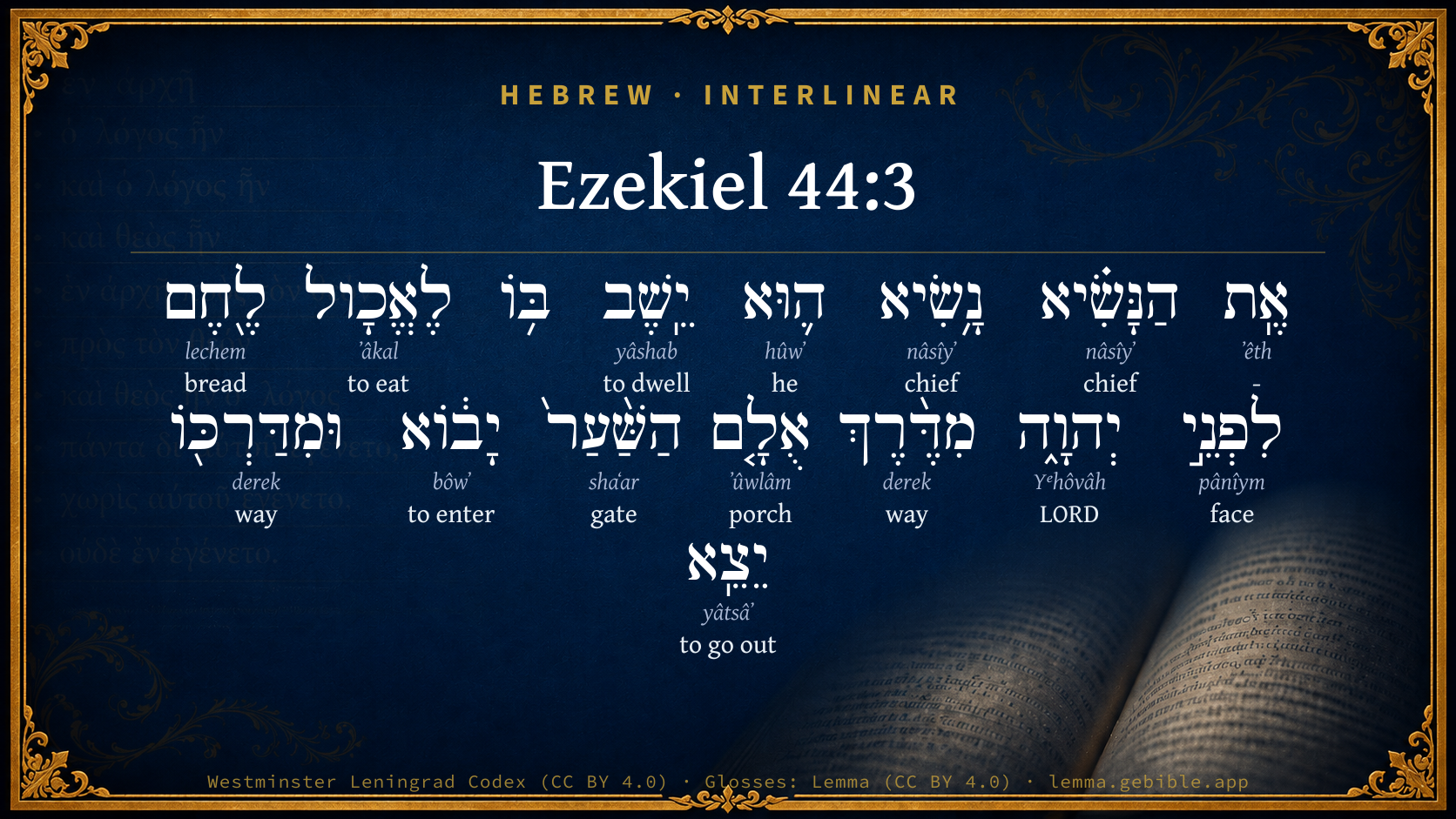
  1. אֶֽת ʼêth H853 “-” Particle, Direct Object
  2. הַנָּשִׂ֗יא nâsîyʼ H5387 “the · chief” Particle, Definite Article + Noun, Common, Masculine, Singular, Absolute
  3. נָ֥שִׂיא nâsîyʼ H5387 “chief” Noun, Common, Masculine, Singular, Absolute
  4. ה֛וּא hûwʼ H1931 “he” Pronoun, Personal, 3rd Person, Masculine, Singular
  5. יֵֽשֶׁב yâshab H3427 “to dwell” Verb, Qal, Imperfect, 3rd Person, Masculine, Singular
  6. לֶאֱכָול ʼâkal H398 “to eat” Preposition + Verb, Qal, Infinitive Construct
  7. לֶ֖חֶם lechem H3899 “bread” Noun, Common, Both, Singular, Absolute
  8. לִפְנֵ֣י pânîym H6440 “to/for · face(s) of” Preposition + Noun, Common, Both, Plural, Construct
  9. יְהוָ֑ה Yᵉhôvâh H3068 “LORD” Noun, Proper
  10. מִדֶּ֨רֶךְ derek H1870 “from · way of” Preposition + Noun, Common, Both, Singular, Construct
  11. הַשַּׁ֨עַר֙ shaʻar H8179 “the · gate” Particle, Definite Article + Noun, Common, Masculine, Singular, Absolute
  12. יָב֔וֹא bôwʼ H935 “to enter” Verb, Qal, Imperfect, 3rd Person, Masculine, Singular
  13. וּמִדַּרְכּ֖וֹ derek H1870 “and · from · way · his” Conjunction + Preposition + Noun, Common, Both, Singular, Construct + Suffix, Personal, 3rd Person, Masculine, Singular
  14. יֵצֵֽא yâtsâʼ H3318 “to go out” Verb, Qal, Imperfect, 3rd Person, Masculine, Singular

About this verse

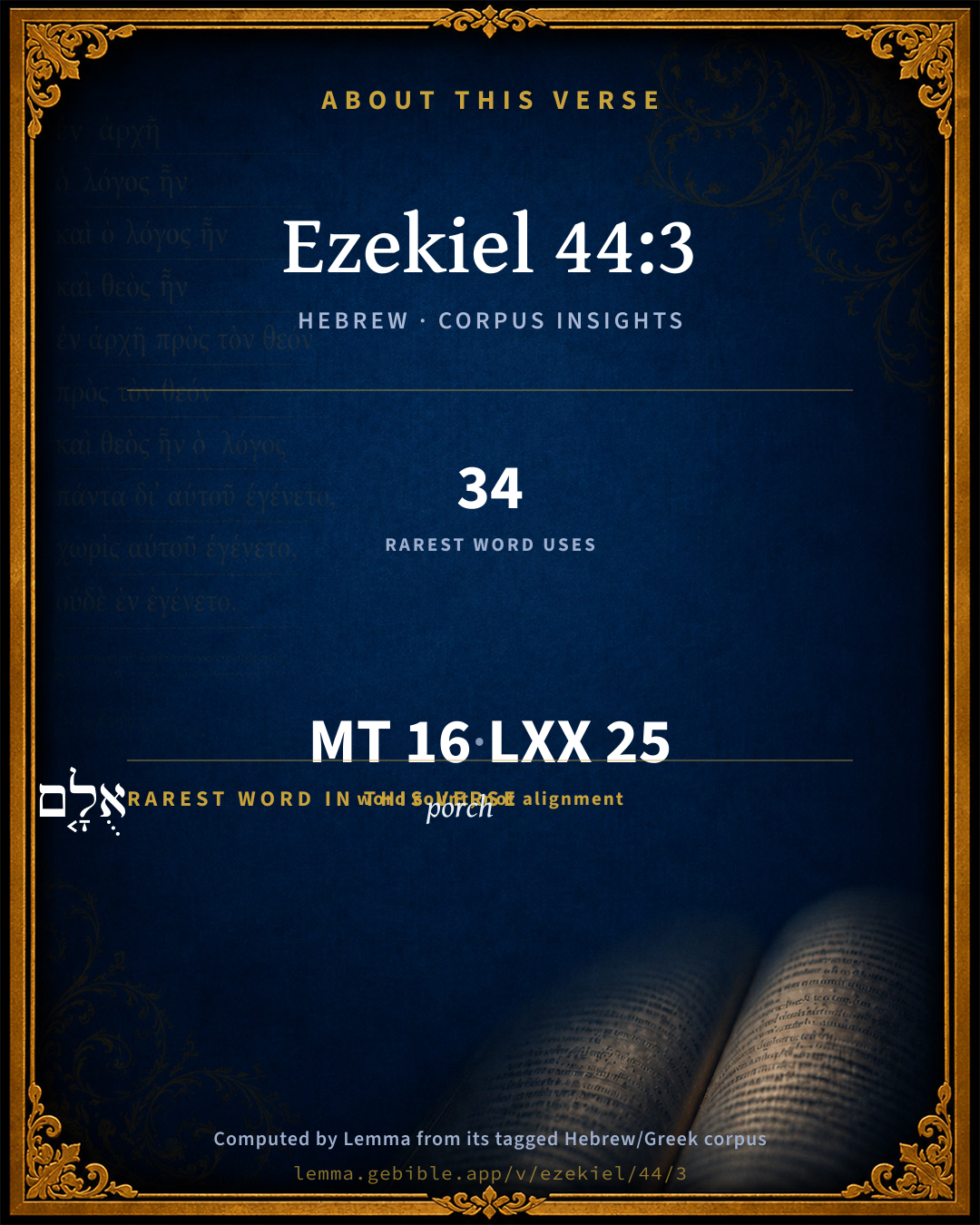
These counts appear in no published source. They are computed here, from the morphology-tagged text and Lemma’s own curated glosses. What Lemma adds →

16
words
13
distinct lemmas
Prophets
section

Shared distinctive vocabulary

אֻלָ֤ם porch H197 occurs in 29 verses of the Hebrew Bible. Also found in:

Grammatical profile

  • 4 verbs
  • 9 nouns
  • 1 pronoun
  • 1 preposition
  • 1 particle

Verb forms

  • יֵֽשֶׁב Qal · Imperfect
  • לֶאֱכָול Qal · Infinitive Construct
  • יָב֔וֹא Qal · Imperfect
  • יֵצֵֽא Qal · Imperfect

Repetition

Words recur within this verse — often emphatic in Hebrew:

  • הַנָּשִׂ֗יא chief H5387 ×2
  • מִדֶּ֨רֶךְ way H1870 ×2

Hebrew & Septuagint length

In English translation the verse runs 37 words from the Hebrew and 37 from the Septuagint (LXX English) — the same length.

A rough comparison of the two English renderings, which tokenize alike — not a word-level alignment.

Word counts can differ between the Hebrew and the Greek without any difference in meaning — e.g. the Hebrew direct-object marker אֵת has no separate Greek word, and Greek often adds the article ὁ.

In the original languages it is 16 Hebrew tokens and 25 Greek tokens — but the two are counted differently (Hebrew bundles its prefixes and suffixes into one token; the Greek is in lemma form), so that isn’t a like-for-like length.

Cross-references

16

Topical passages linked to Ezekiel 44:3 in the Treasury of Scripture Knowledge — connected by theme and wording, ordered by reader-vote popularity; previews shown in the World English Bible.

  • Ezekiel 46:2 The prince shall enter by the way of the porch of the gate outside, and shall stand by the post of the gate; and the priests shall prepare his burnt-offering and his peace-offerings, and he shall worship at the threshold of the gate: then he shall go forth; but the gate shall not be shut until the evening.
  • Ezekiel 37:25 They shall dwell in the land that I have given to Jacob my servant, in which your fathers lived; and they shall dwell therein, they, and their children, and their children's children, forever: and David my servant shall be their prince for ever.
  • Genesis 31:54 Jacob offered a sacrifice in the mountain, and called his relatives to eat bread. They ate bread, and stayed all night in the mountain.
  • Ezekiel 34:24 I, Yahweh, will be their God, and my servant David prince among them; I, Yahweh, have spoken it.
  • 1 Corinthians 10:18–33 Consider Israel after the flesh. Don't those who eat the sacrifices have communion with the altar?
  • Ezekiel 40:9 Then measured he the porch of the gate, eight cubits; and the posts of it, two cubits; and the porch of the gate was toward the house.
  • Ezekiel 46:8–10 When the prince shall enter, he shall go in by the way of the porch of the gate, and he shall go forth by the way of it.
  • Exodus 24:9–11 Then Moses, Aaron, Nadab, Abihu, and seventy of the elders of Israel went up.
  • 2 Chronicles 34:31 The king stood in his place, and made a covenant before Yahweh, to walk after Yahweh, and to keep his commandments, and his testimonies, and his statutes, with all his heart, and with all his soul, to perform the words of the covenant that were written in this book.
  • Zechariah 6:12–13 and speak to him, saying, 'Thus says Yahweh of Hosts, "Behold, the man whose name is the Branch: and he shall grow up out of his place; and he shall build the temple of Yahweh;
  • Revelation 3:20 Behold, I stand at the door and knock. If anyone hears my voice and opens the door, then I will come in to him, and will dine with him, and he with me.
  • Deuteronomy 12:7 and there you shall eat before Yahweh your God, and you shall rejoice in all that you put your hand to, you and your households, in which Yahweh your God has blessed you.
  • Deuteronomy 12:17–18 You may not eat within your gates the tithe of your grain, or of your new wine, or of your oil, or the firstborn of your herd or of your flock, nor any of your vows which you vow, nor your freewill-offerings, nor the heave-offering of your hand;
  • 2 Chronicles 23:13 and she looked, and, behold, the king stood by his pillar at the entrance, and the captains and the trumpets by the king; and all the people of the land rejoiced, and blew trumpets; the singers also [played] on instruments of music, and led the singing of praise. Then Athaliah tore her clothes, and said, Treason! treason!
  • Isaiah 23:18 Her merchandise and her hire shall be holiness to Yahweh: it shall not be treasured nor laid up; for her merchandise shall be for those who dwell before Yahweh, to eat sufficiently, and for durable clothing.
  • Isaiah 62:9 but those who have garnered it shall eat it, and praise Yahweh; and those who have gathered it shall drink it in the courts of my sanctuary.

Cross-references courtesy of OpenBible.info (CC BY 4.0).

Hebrew and Greek witnesses Masoretic Hebrew ↔ Greek Septuagint

The same verse in the two great witnesses to the Old Testament, shown verse-for-verse.

These are two independent witnesses, not word-aligned to each other, and the Septuagint is shown in lemma (dictionary) form.

Hebrew Ezekiel 44:3 Masoretic · Westminster Leningrad Codex

אֶֽת הַנָּשִׂ֗יא נָ֥שִׂיא ה֛וּא יֵֽשֶׁב בּ֥וֹ לֶאֱכָול לֶ֖חֶם לִפְנֵ֣י יְהוָ֑ה מִדֶּ֨רֶךְ אֻלָ֤ם הַשַּׁ֨עַר֙ יָב֔וֹא וּמִדַּרְכּ֖וֹ יֵצֵֽא

As for the prince, he shall sit therein as prince to eat bread before Yahweh; he shall enter by the way of the porch of the gate, and shall go out by the way of the same.

World English Bible · Public Domain

Greek LXX Ezekiel 44:3 Septuagint · lemma form

διότι ὁ ἡγέομαι οὗτος καταἵημι ἐν αὐτός ὁ ἐσθίω ἄρτος ἐναντίον κύριος κατά ὁ ὁδός αιλαμ ὁ πύλη εἰςἔρχομαι καί κατά ὁ ὁδός αὐτός ἐκἔρχομαι

For the prince, he shall sit in it, to eat bread before the Lord; he shall go in by the way of the porch of the gate, and shall go forth by the way of the same.

LXX2012 (modern English Septuagint) · Public Domain

Hebrew: Westminster Leningrad Codex (CC BY 4.0). Greek: Septuagint (public domain); English from LXX2012 (modern English Septuagint) (Public Domain). How the Septuagint differs from the Hebrew →

Targum (Aramaic paraphrase)

1

The Targum is the ancient Jewish Aramaic paraphrase of the Hebrew Scriptures — an interpretive translation, not the Hebrew text itself. Onkelos (literal) and Pseudo-Jonathan (expansive) render the Torah, and Jonathan the Prophets. Coverage is partial: where no permissively-licensed English translation exists for a verse, only the Aramaic is shown. This is verse-level text, not a word-by-word alignment to the Hebrew.

  1. Targum Jonathan Prophets (Joshua–Malachi)
    לְרַבָּא יְהֵי רַבָּא הוּא יְתֵיב בֵּיהּ לְמֵיכַל לַחְמָא קֳדָם יְיָ מֵאוֹרַח אוּלֵמָא דְתַרְעָא יֵעוֹל וּמֵאוֹרְחֵיהּ יִפּוֹק:

    (no public-domain English translation for this verse)

    Targum Jonathan — Aramaic: “Mikraot Gedolot” (public domain). English: “Sefaria Community Translation” (CC0 1.0 (public-domain dedication)); “London "Chaldee Paraphrase," 1871” (public domain). Text via Sefaria.

Commentary

Notes on Ezekiel 44:3 from classic Christian and Jewish commentators (each source and its license shown beneath its notes). The classic Christian expositions comment on the surrounding passage and are grouped to its opening verse, so a note may address several verses; the Jewish commentaries on the Tanakh (Rashi and others) are per-verse, so they appear only where the commentator wrote on this verse.

Lemma curates 59 commentaries, every one of them public domain or Creative Commons licensed, each selected and text-cleaned for this edition rather than reprinted as found. About our sources →

Trapp's Complete Commentary

John Trapp

Eze 44:3 [It is] for the prince; the prince, he shall sit in it to eat bread before the LORD; he shall enter by the way of the porch of [that] gate, and shall go out by the way of the same.

Ver. 3. It is for the prince.] For "Messiah the Prince"; so Christ is called in Dan 9:25; or for the chief priest, who, as he had a singular privilege herein above other priests, so hath Christ, the high priest of the Church Christian, singular privileges above all his brethren.

He shall sit in it to eat bread.] He shall sit at the right hand of the majesty on high, and enjoy heaven’s happiness, which is oft compared to a feast, as Mat 8:11; Mat 22:1-2 Isa 53:11. He shall ascend up into heaven, and therehence come again to judge the quick and the dead. {Act 1:11 Heb 9:28} Some by "prince" here understand the ruler of the people, {see Eze 46:1-2} who is peculiarly licensed to enter in at the east gate, and there to sit, and eat and drink his part of the peace offering. Compare Exo 24:11. It is not meant of Peter the apostle, to be sure, much less of the Pope, his pretended successor, as some of his parasites would have it.

John Trapp, A Commentary or Exposition upon All the Books of the Old and New Testament (1647–1656) — public domain. Text from a community e-Sword module.

Joseph Benson's Commentary

Eze 44:3. It is for the prince — The words, It is, are not in the Hebrew, which is only, For the prince; and therefore the meaning seems to be, that this gate should, in general, be shut for, or to the prince, as well as to private persons; even he should not have the liberty of entering in at it, except at certain seasons. Dr. Waterland translates the clause thus: As to the prince, since he is prince, he shall sit, &c. The kings of Judah had a distinguished place in the temple; a kind of tribunal placed opposite the eastern gate: see Eze 46:12; 2Ch 6:12-13. By the prince here is probably meant the chief governor of the Jews after the captivity, such as were Zerubbabel and Nehemiah, for Sheshbazzar, or Zerubbabel, is called the prince of Judah, Ezr 1:8. The prince, he shall sit in it to eat bread before the Lord — To eat part of the peace-offerings which were provided at his charge: see chap, Eze 46:2. Bread stands for all sorts of entertainments, and particularly for a religious feast made of the remainder of a sacrifice: see the margin.

Joseph Benson's Commentary on the Old and New Testaments (1811–1818) — public domain. Text from a community e-Sword module.

Tyndale Open Study Notes

Tyndale Open Resources

44:3 Though the prince had the significant privilege of being the only one allowed to feast in the Lord’s presence inside the east outer gateway, he was restricted to entering and leaving the portico from the outer court. He was not to enter from outside the Temple complex by going through the gate, as the Lord had; the earthly ruler is a man, not God, and he must submit to God. The prince must also never forget that the Temple is God’s palace, not his own private chapel.

Tyndale Open Study Notes — © Tyndale Open Resources, licensed CC BY-SA 4.0. Text via the HelloAO Bible API.

Jamieson, Fausset & Brown

Robert Jamieson, A. R. Fausset & David Brown

the prince--not King Messiah, as He never would offer a burnt offering for Himself, as the prince is to do (Eze 46:4). The prince must mean the civil ruler under Messiah. His connection with the east gate (by which the Lord had returned to His temple) implies, that, as ruling under God, he is to stand in a place of peculiar nearness to God. He represents Messiah, who entered heaven, the true sanctuary, by a way that none other could, namely, by His own holiness; all others must enter as sinners by faith in His blood, through grace.

eat bread before the Lord--a custom connected with sacrifices (Gen 31:54; Exo 18:12; Exo 24:11; Co1 10:18).

Jamieson, Fausset & Brown — Commentary Critical and Explanatory on the Whole Bible (1871) — public domain (CC PDM 1.0). Text via the HelloAO Bible API.

Ellicott's Commentary for English Readers

(3) The prince.—The Rabbis understood this to refer to the Messiah, and unquestionably the same person must be meant as by David in Eze_34:23-24; Eze_37:24. This gives another and a conclusive reason for regarding the sacrificial worship of Ezekiel 46 as symbolical.

To eat bread before the Lord.—This is the common scriptural expression for partaking of the sacrifices (see Gen_31:54; Exo_18:12), and there is no reason for restricting it to the shew-bread and other unbloody offerings. The eating of the latter was an exclusively priestly prerogative, and the “prince” of Ezekiel, though greatly distinguished, is not in any way endued with priestly functions. He is to partake of his sacrificial meals within this highly-honoured gate, while the people eat in the outer court. There has been much discussion as to whether the prince was to go in and out by this gateway, or only, having entered by one of the others, to eat in this. The language here seems sufficiently plain, and if there could be any doubt, it would be removed by Eze_46:1-2; Eze_46:8; Eze_46:10; Eze_46:12. It appears there that the prince is always to enter and leave by this gate except “in the solemn feasts;” then he is to enter in the midst of the people, by either the north or the south gate, and go out by the opposite one.

A Bible Commentary for English Readers, edited by Charles John Ellicott (1878–1897) — public domain. Text from a community e-Sword module.

The Cambridge Bible for Schools and Colleges

gen. ed. J. J. S. Perowne

3. The only exception is in favour of the prince. He shall eat bread in this gate, i.e. partake of the sacrificial meal there. Though not expressly stated it is implied that the meal shall be partaken of in the porch of the gate, which looked into the outer court. The statements in ch. 46 make it probable that even the prince did not enter through the E. gate from the outside, but passed into the outer court through some other gate, and entered the porch from the court.

Eze_44:4-9. The former practice of employing uncircumcised foreigners to minister and to keep the charge of the house shall absolutely cease.

The Cambridge Bible for Schools and Colleges (gen. ed. J. J. S. Perowne; Cambridge University Press, 1878–1918) — public domain. Text from a community e-Sword module.

John Gill's Exposition

It is for the prince: the prince shall sit in it to eat bread before the Lord,.... Or, "as for the prince, the prince shall sit in it" (e); in the gate which is shut to others: not the high priest, as Jarchi, though he might have a particular seat in the temple, as Eli had in the tabernacle, Sa1 1:9, where he might eat the bread and flesh of holy things: nor the political prince, the king of Israel, though he might have a place in the temple peculiar to himself; see Ch2 6:12, Ch2 24:31, and the Jews say only the kings of the house of David were allowed to sit in the sanctuary: but the King Messiah, as Kimchi and Ben Melech rightly interpret it, is here meant; who before, in this prophecy, is called David a Prince, Eze 34:24, he who is the Prince of peace; Michael the great Prince; the Prince of life, and the Prince of the kings of the earth; the Messiah the Prince. Such who interpret the gate of the gate of heaven understand this of Christ's sitting down there at his Father's right hand, on the same throne with him, having done his work, and being at ease, and in honour; and of his enjoyment of glory there, as the heavenly glory is sometimes signified by a feast, by sitting down at a table, and eating bread in the kingdom of God, Mat 8:11, and so it may intend his being in the presence of God with the utmost delight and joy; having that glory he had with him before the world was, and all power in heaven and in earth; dispensing gifts and grace to men, and receiving honour and glory from them, and seeing the travail of his soul with satisfaction: but why may it not be understood, more consistent with the scope of the vision, of his sitting in his church, at his table there with his saints, eating with them, and they with him, in his word and ordinances before the Lord? see Sol 1:12,

he shall enter by the way of the porch of that gate, and shall go out by the way of the same; which some explain of Christ's ascension to heaven, and descent from thence in the same way; he went up to heaven in the eastern part of the world, from the mount of Olives, to the east of Jerusalem; and in like manner shall he descend, and his feet shall stand on that mount, Act 1:11, but it may be interpreted of his going in and out of his church at his will and pleasure; and affording his gracious presence and fellowship with himself in his house and ordinances,

(e) "veruntamen ad principem quod attinet, princeps ipse inquam", &c. Piscator; "quantum ad principem"; "princeps sedebit in ea", Noldius, Ebr. Part. Concord. p. 120.

John Gill's Exposition of the Whole Bible (1746–1763) — public domain (CC PDM 1.0). Text via the HelloAO Bible API.

Albert Barnes' Notes on the Bible

The prince - Foretold under the name of David Eze 34:24. The rabbis understood this to be the Messiah.

To eat bread - See Lev 2:3; Lev 24:9; according to the old Law these feasts belonged only to the priests; none of the rest of the congregation, not even the king, might partake of them. The new system gives to the “prince” a privilege which he did not before possess; the prince, as the representative of the Messiah, standing in a higher position than the kings of old. “To eat bread” may also include participation in the animals sacrificed, portions of which were reserved for those of the people who offered them.

Albert Barnes' Notes on the Bible (1834–1885) — public domain. Text from a community e-Sword/MySword module.

Matthew Poole's English Annotations

For the prince; for the king, say some; if so, then the door shut was the door, not of the temple, but of the east gate of the priests’ court. The high priest, and the second priest, say others, and indeed this is most likely.

He shall sit: the king might sit before the Lord, others might not, and the priests stood ministering, as Heb 10:11. Perhaps the high priest might have some privilege to sit, when others might not.

To eat bread: if understood of the king, it was his eating of the sacrifice, that part of it which was allowed to the offerer. If this prince be the high priest, this bread was the show-bread, which it seems he might sit and eat in or near the porch of the gate, whereas other priests were bound to eat in the common refectory, as appears, Eze 42:13.

He shall enter; he may, it is his privilege; or he shall, that is, it is his duty to enter at this, and to come out at it, that the people may know which way to look, when they would see their high priest enter to make atonement: which may be mystical, and include our looking to the great High Priest.

Matthew Poole's English Annotations on the Holy Bible (1683–1685) — public domain. Text from a community e-Sword/MySword module.

The Pulpit Commentary

It is for the prince conveys an erroneous impression, as if the edict, excluding all from passing through the east outer gate, did not apply to the prince; but even for him the gate was not to serve as a mode of entrance into the temple, or, if so, only on exceptional occasions, (see on Eze_46:2) but merely as a place to sit in. The Revised Version accurately renders the words, As for the prince, he shall sit therein as prince, etc. That the "prince" here alluded to (ayciGh) could not have been the Prince David, i.e. the Messiah already spoken of, (Eze_34:23, 24 37:24) but must have denoted the civic authorities of the new community of Israel, "the civil head of the theocracy," Havernick infers Eze_45:8, Eze_45:9, where the coming "prince" is contrasted with Israel"s previous rulers who oppressed their subjects, from the absence of some such characteristic predicate as "shepherd" or "king," which would, he thinks, have been attached to the word "prince" had it been intended to designate Messiah, from the prince"s offering for himself a sin offering, (Eze_45:22) from the allusion to his sons, (Eze_46:16) and from what is recorded about his behavior in worship; (Eze_46:2) but none of these statements concerning the "prince" forbids his identification with Messiah, unless on the supposition that it was already understood Messiah should be a Divine-human Personage. This, however, had not then been so distinctly revealed as to be widely and accurately known. Hence it seems enough to say that while the "prince" would have his highest antitype in the Messiah, he would also have, though in a lower and lesser degree, an antitype in every righteous ruler (if ever there should be such) who might subsequently preside over Israel. (see on Eze_37:25) The phrase, to eat bread before the Lord, while referring in the first instance to those sacrificial meals which, under the Law, commonly accompanied unbloody offerings, as the meat offerings, (Lev_2:3) the showbread, (Lev_24:9) and the unleavened leaves of the Passover (Exo_12:18 Lev_23:6 Num_28:17; Deu_16:3) and could only be partaken of by the priests, in the second instance signified to partake of sacrificial meals in general, even of such as consisted of the portions of flesh which were eaten in connection with ordinary bloody offerings. (Gen_31:54; Exo_18:12) If, after Kliefoth, the former be adopted as the import of the phrase here, then the thought will be that in the new cultus the prince should enjoy a privilege which under the old was not possessed even by the king; if, after Keil, the second view be preferred, the sense will amount to this, that under the regulations of the future the prince should have the favor accorded him "of holding his sacrificial meals in the gate," whereas the people should only be permitted to hold theirs "in the court," or "in the vicinity of the sacrificial kitchens." The way of the porch is mentioned as the ingress and egress for the prince; which implies that he should obtain access to the outer court by either the north or the south gate, since the outer door of the east gate was shut. This renders it probable that Ezekiel was himself standing on the outside of the east gate (see on ver. 1).

The Pulpit Commentary (1880–1919), ed. H.D.M. Spence-Jones & Joseph S. Exell — public domain. Text from a community e-Sword module.

John Wesley's Explanatory Notes

He - The king might sit before the Lord, others might not. Bread - That part of the sacrifice, which was allowed to the offerer.

John Wesley, Explanatory Notes Upon the Whole Bible (1754–1765) — public domain. Text via the GEBible commentary corpus.

Rashi

Rabbi Shlomo Yitzchaki (Rashi)

The prince [I permit]; he is a prince, etc. The prince I give permission. He is a prince, and is esteemed, and it is not fitting for him to sit and eat with the rest of the priests in the chambers.

he shall sit therein in its space.

by way of the hall of the gate he shall come When he enters the Inner Court in order to enter this small gate to eat therein, he shall enter by way of the hall of the Court’s eastern gate and leave the same way. Now since it states below (46:9), concerning: “But when the people of the land come before the Lord on the Festivals, he who enters by way of, etc.” Scripture commanded making the Court a shortcut since that entry was [made] for the sake of appearing [before God]. He must therefore be well seen [i.e., throughout the entire Court]. It was necessary to specify here concerning visits during the rest of the year that he should not make it a shortcut because this visit is not for the sake of appearing, as is that of the Pilgrimage Festivals. This matter is corroborated many more times in this account.

The prince The High Priest is a prince, and because of his importance he will be permitted to eat the meat and bread of hallowed status in that gate, which is opened for him at the time of his eating.

by way of the hall of the gate he shall come By way of the hall of the Eastern Gate he shall enter the Court and come up to that wicket to eat his bread therein.

and by the same way he shall leave For this is not fit for a shortcut, as are the rest of the gates. Throughout the day, when not during the time of the prince’s eating, it shall be closed.

Rashi on the Tanakh — English translations: “The Judaica Press complete Tanach with Rashi, translated by A. J. Rosenberg” (CC BY 4.0); “Pentateuch with Rashi's commentary by M. Rosenbaum and A.M. Silbermann, 1929-1934” (public domain); “The Metsudah Tanach series, Lakewood, N.J” (CC BY 4.0); and “The Book of Joshua, Metsudah Publications, 1997” (CC BY 4.0). Text via Sefaria.

Lesson kit

Teaching starters — assembled from the data on this page, not authored interpretation. Every prompt links to the verse data it draws on. Edit before teaching.

Ezekiel, in the Prophets, opens this verse with 16 words (13 distinct Hebrew lemmas). Its most distinctive word is ʼûwlâm (“porch”). A historical commentator’s framing appears above. Read the whole chapter for the surrounding context.

Discussion questions

  1. How does “porch” (ʼûwlâm) shape what this verse is saying?
  2. 1 Kings 6:3 shares the word «porch» with this verse. How do the two illuminate each other?
  3. “chief” occurs 2× in this one verse. What is the effect of the repetition?
  4. These translations render this verse differently. What is at stake in choosing one wording over another?
  5. The verb «יֵֽשֶׁב» is Qal Imperfect. How does its form color the action?
  6. Reading how Trapp's Complete Commentary and Joseph Benson's Commentary read this verse, where do the two commentators agree and where do they part?

Things to notice

Reading settings

Reading text

Shown beneath each verse's original-language words.

Old Testament
Old Testament edition

Read the OT as the Masoretic Hebrew (MT) or the Greek Septuagint (LXX).

English shown for the Greek Septuagint (in the Hebrew ↔ Greek comparison).

Comparing translations? Open the Compare panel on any verse page to stack up to four side by side.