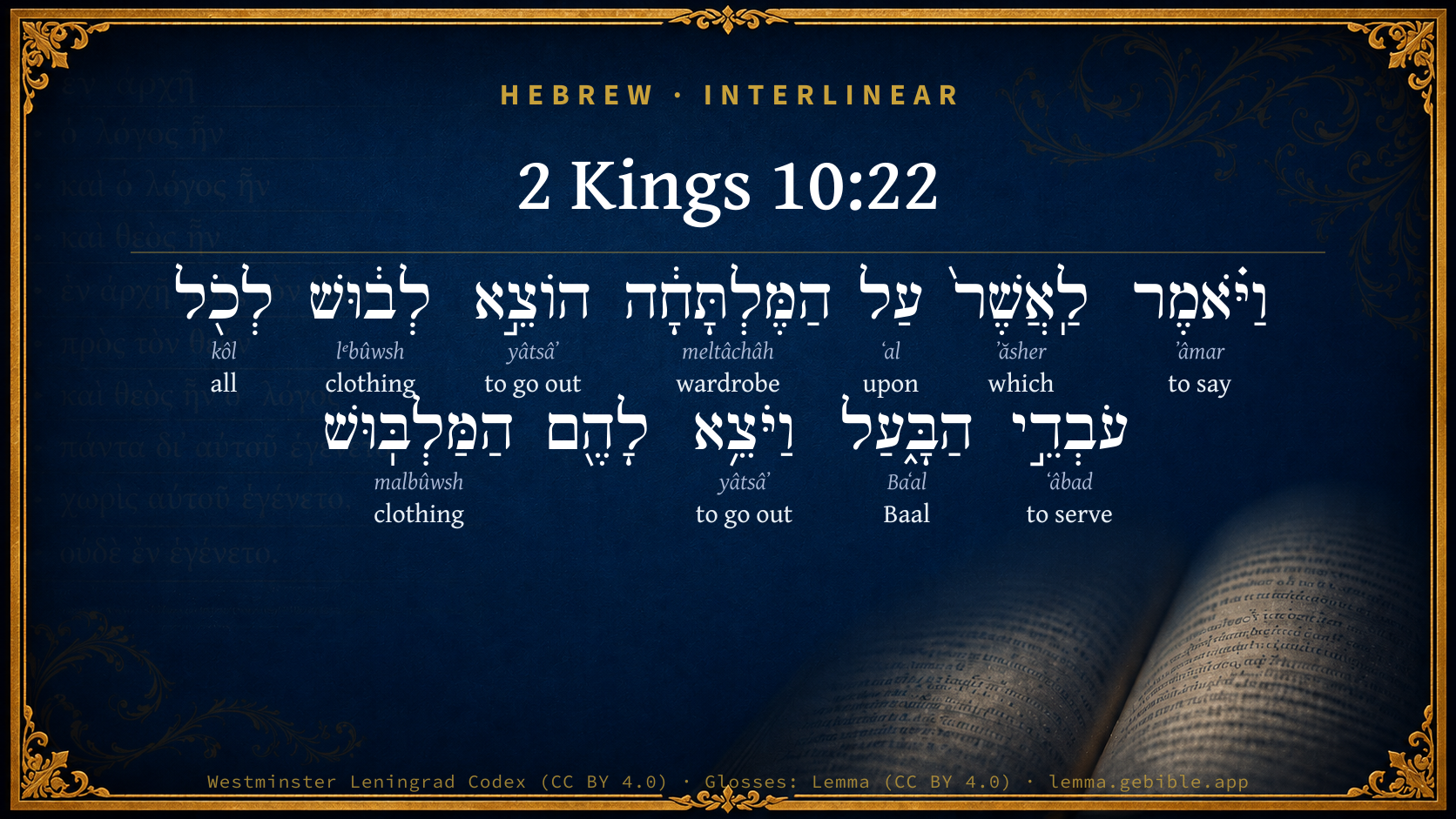
2 Kings 10:22

Hebrew (Westminster Leningrad Codex) 2 Kings 10:22 appears in the Hebrew Old Testament. The text above is from the Westminster Leningrad Codex. Each word links to its Strong’s number, a concise gloss, and parsing drawn from the Open Scriptures Hebrew Bible morphology. Click any word for its full Brown-Driver-Briggs (BDB) entry.
Download image
Cite this verse

2 Kings 10:22 (World English Bible). Public Domain. Lemma interlinear Bible study tool, https://lemma.gebible.app/v/2-kings/10/22.

Show BibTeX & RIS
BibTeX
RIS
English Translation
He said to him who was over the vestry, Bring forth vestments for all the worshippers of Baal. He brought them forth vestments.
World English Bible · Public Domain
Highlights Full analysis ↓
Download a study sheet

One document with this verse’s original text, its word-by-word gloss line, the meaning frame, cross-references with their text, attributed commentary, and full source and license credits — printable, and it pastes into notes with its structure intact.

This verse Autodidact and up

Study sheet (.html) Plain text (.txt)

A passage Seminary Student

Up to 50 verses in one chapter. A passage sheet keeps up to 6 commentary sources and 12 cross-references per verse, in the order this page ranks them, and says so on the sheet whenever that leaves anything out. Ask for a single verse and you get the Autodidact verse sheet above.

Everything on this page stays free to read, with no account — the sheet is a download of what is already on screen, not access to it.

Want to remove ads? Support Godless Engineer
Compare translations 3

The same verse in 3 English versions, stacked beneath the original-language interlinear above. Click any original word for its lexicon entry.

Each is an independent rendering of the whole verse — the interlinear is not word-aligned to these translations.

Highlighted words mark where these versions differ — a whole-verse word diff, not a word-by-word alignment.

  • World English Bible Public Domain
    He said to him who was over the vestry, Bring forth vestments for all the worshippers of Baal. He brought them forth vestments.
  • King James Version Public Domain
    And he said unto him that was over the vestry, Bring forth vestments for all the worshippers of Baal. And he brought them forth vestments.
  • unfoldingWord Literal Text CC BY-SA 4.0
    And he said to him who over the wardrobe, “Bring out clothing for all of the servants of Baal.” And he brought out to them the vestment.

unfoldingWord Literal Text — © unfoldingWord, licensed CC BY-SA 4.0. Word-aligned USFM3 via Door43 (git.door43.org/unfoldingWord/en_ult).

Versions to compare (up to 4)

3 of 4 selected

Show all 18 translations

Every available English version of this verse, each an independent rendering of the whole verse.

  • World English Bible Public Domain
    He said to him who was over the vestry, Bring forth vestments for all the worshippers of Baal. He brought them forth vestments.
  • Berean Standard Bible Public Domain
    And Jehu said to the keeper of the wardrobe, “Bring out garments for all the servants of Baal.” So he brought out garments for them.
  • Majority Standard Bible Public Domain
    And Jehu said to the keeper of the wardrobe, “Bring out garments for all the servants of Baal.” So he brought out garments for them.
  • King James Version Public Domain
    And he said unto him that was over the vestry, Bring forth vestments for all the worshippers of Baal. And he brought them forth vestments.
  • American Standard Version (1901) Public Domain
    And he said unto him that was over the vestry, Bring forth vestments for all the worshippers of Baal. And he brought them forth vestments.
  • Revised Version (1885) Public Domain
    And he said unto him that was over the vestry, Bring forth vestments for all the worshippers of Baal. And he brought them forth vestments.
  • Geneva Bible (1599) Public Domain
    Then he said vnto him that had the charge of the vestrie, Bring forth vestments for al the seruants of Baal. And he brought the out vestments.
  • Douay-Rheims (1899) Public Domain
    And he said to them that were over the wardrobe: Bring forth garments for all the servants of Baal. And they brought them forth garments.
  • Young's Literal Translation Public Domain
    And he saith to him who `is' over the wardrobe, `Bring out clothing to all servants of Baal;' and he bringeth out to them the clothing.
  • Literal Standard Version CC BY-SA 4.0
    And he says to him who [is] over the wardrobe, “Bring out clothing for all those serving Ba‘al”; and he brings out the clothing to them.
  • Unlocked Literal Bible CC BY-SA 4.0
    Jehu said to the man who kept the priest's wardrobe, “Bring out robes for all the worshipers of Baal.” So the man brought out robes to them.
  • unfoldingWord Literal Text CC BY-SA 4.0
    And he said to him who over the wardrobe, “Bring out clothing for all of the servants of Baal.” And he brought out to them the vestment.
  • Darby Bible Public Domain
    And he said to him that was over the wardrobe, Bring forth vestments for all the servants of Baal. And he brought them forth vestments.
  • World Messianic Bible Public Domain
    He said to him who kept the wardrobe, “Bring out robes for all the worshipers of Baal!” So he brought robes out to them.
  • Webster's Bible Public Domain
    And he said to him that was over the vestry, Bring forth vestments for all the worshipers of Baal. And he brought them forth vestments.
  • Free Bible Version CC BY-SA 4.0
    Jehu said to the keeper of the wardrobe, “Distribute clothes for all the servants of Baal.” So he brought out clothes for them.
  • Bible in Basic English Public Domain
    And Jehu said to him who kept the robes, Get out robes for all the servants of Baal. So he got out robes for them.
  • JPS Tanakh (1917) Public Domain
    And he said unto him that was over the vestry: 'Bring forth vestments for all the worshippers of Baal.' And he brought them forth vestments.

Literal Standard Version (2020), Covenant Press — licensed CC BY-SA 4.0. Text via the HelloAO Bible API (eBible.org). Unlocked Literal Bible (unfoldingWord) — licensed CC BY-SA 4.0. Text via the HelloAO Bible API (eBible.org). unfoldingWord Literal Text — © unfoldingWord, licensed CC BY-SA 4.0. Word-aligned USFM3 via Door43 (git.door43.org/unfoldingWord/en_ult). Free Bible Version, Dr. Jonathan Gallagher — licensed CC BY-SA 4.0. Text via the HelloAO Bible API (eBible.org).

Word by word

More ways to search: Search by grammar → Find every occurrence → Compare this word →

Practice this passage: Drill this verse → Learn its vocabulary →

הַמֶּלְתָּחָ֔ה
meltâchâh
H4458
“the · wardrobe”
Particle, Definite Article + Noun, Common, Feminine, Singular, Absolute
Part of Speech
Particle + Noun
Type
Common
Gender
Feminine
Number
Singular
State
Absolute
Full BDB Definition

Origin: from an unused root meaning to spread out

TWOT: 1132a

wardrobe, wearing apparel, vestment
  1. וַיֹּ֗אמֶר ʼâmar H559 “and · to say” Conjunction + Verb, Qal, Sequential Imperfect, 3rd Person, Masculine, Singular
  2. לַֽאֲשֶׁר֙ ʼăsher H834 “to/for · which” Preposition + Particle, Relative
  3. עַל ʻal H5921 “upon” Preposition
  4. הוֹצֵ֣א yâtsâʼ H3318 “go out” Verb, Hiphil, Imperative, 2nd Person, Masculine, Singular
  5. לְב֔וּשׁ lᵉbûwsh H3830 “clothing” Noun, Common, Masculine, Singular, Absolute
  6. לְכֹ֖ל kôl H3605 “to/for · all of” Preposition + Noun, Common, Masculine, Singular, Construct
  7. עֹבְדֵ֣י ʻâbad H5647 “serving” Verb, Qal, Participle Active, Masculine, Plural, Construct
  8. הַבָּ֑עַל Baʻal H1168 “the · Baal” Particle, Definite Article + Noun, Proper
  9. וַיֹּצֵ֥א yâtsâʼ H3318 “and · to go out” Conjunction + Verb, Hiphil, Sequential Imperfect, 3rd Person, Masculine, Singular
  10. הַמַּלְבּֽוּשׁ malbûwsh H4403 “the · clothing” Particle, Definite Article + Noun, Common, Masculine, Singular, Absolute

About this verse

These counts appear in no published source. They are computed here, from the morphology-tagged text and Lemma’s own curated glosses. What Lemma adds →

12
words
10
distinct lemmas
Historical
section

Notable vocabulary

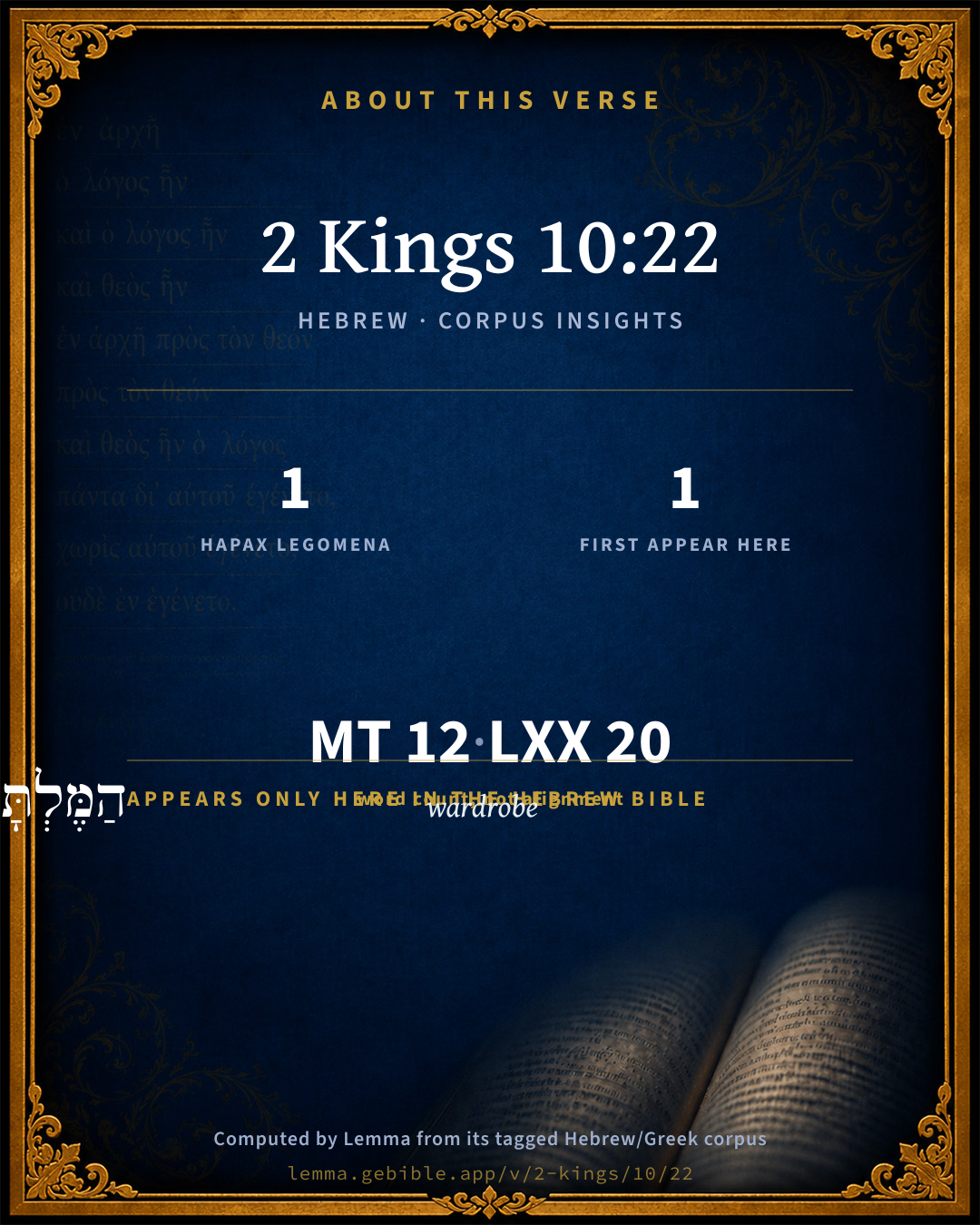
1 hapax legomenon — a word that appears only here in the entire Hebrew Bible:

  • הַמֶּלְתָּחָ֔ה wardrobe H4458

First appearance in Scripture

This word makes its first canonical appearance in the Hebrew Bible here:

  • הַמֶּלְתָּחָ֔ה wardrobe H4458

Shared distinctive vocabulary

הַמַּלְבּֽוּשׁ clothing H4403 occurs in 7 verses of the Hebrew Bible. Also found in:

Grammatical profile

  • 4 verbs
  • 5 nouns
  • 2 prepositions
  • 1 particle

Verb forms

  • וַיֹּ֗אמֶר Qal · Sequential Imperfect
  • הוֹצֵ֣א Hiphil · Imperative
  • עֹבְדֵ֣י Qal · Participle Active
  • וַיֹּצֵ֥א Hiphil · Sequential Imperfect

Repetition

A word recurs within this verse — often emphatic in Hebrew:

  • הוֹצֵ֣א to go out H3318 ×2

Hebrew & Septuagint length

In English translation the verse runs 23 words from the Hebrew and 34 from the Septuagint (LXX English) — the Septuagint runs noticeably longer here. See the side-by-side →

A rough comparison of the two English renderings, which tokenize alike — not a word-level alignment.

Word counts can differ between the Hebrew and the Greek without any difference in meaning — e.g. the Hebrew direct-object marker אֵת has no separate Greek word, and Greek often adds the article ὁ.

In the original languages it is 12 Hebrew tokens and 20 Greek tokens — but the two are counted differently (Hebrew bundles its prefixes and suffixes into one token; the Greek is in lemma form), so that isn’t a like-for-like length.

Cross-references

2

Topical passages linked to 2 Kings 10:22 in the Treasury of Scripture Knowledge — connected by theme and wording, ordered by reader-vote popularity; previews shown in the World English Bible.

  • Exodus 28:2 You shall make holy garments for Aaron your brother, for glory and for beauty.
  • Matthew 22:11–12 But when the king came in to see the guests, he saw there a man who didn't have on wedding clothing,

Cross-references courtesy of OpenBible.info (CC BY 4.0).

Hebrew and Greek witnesses Masoretic Hebrew ↔ Greek Septuagint

The same verse in the two great witnesses to the Old Testament, shown verse-for-verse.

Here the Septuagint runs noticeably longer than the Hebrew — LXX2012 (modern English Septuagint) 34 words vs World English Bible 23. A rough length comparison of the two English translations, not a word-level alignment — read both below.

These are two independent witnesses, not word-aligned to each other, and the Septuagint is shown in lemma (dictionary) form.

Hebrew 2 Kings 10:22 Masoretic · Westminster Leningrad Codex

וַיֹּ֗אמֶר לַֽאֲשֶׁר֙ עַל הַמֶּלְתָּחָ֔ה הוֹצֵ֣א לְב֔וּשׁ לְכֹ֖ל עֹבְדֵ֣י הַבָּ֑עַל וַיֹּצֵ֥א לָהֶ֖ם הַמַּלְבּֽוּשׁ

He said to him who was over the vestry, Bring forth vestments for all the worshippers of Baal. He brought them forth vestments.

World English Bible · Public Domain

Greek LXX 2 Kings 10:22 Septuagint · lemma form

καί εἶπον ιου ὁ ἐπί ὁ οἶκος μεσθααλ ἐκἄγω ἔνδυμα πᾶς ὁ δοῦλος ὁ βααλ καί ἐκφέρω αὐτός ὁ στολιστής

And he said to the man who was over the house of the wardrobe, Bring forth a robe for all the servants of Baal. And the keeper of the robes brought forth to them.

LXX2012 (modern English Septuagint) · Public Domain

On this verse, Ellicott's Commentary for English Readers discusses the Septuagint’s reading. Read the note in Commentary ↓

Hebrew: Westminster Leningrad Codex (CC BY 4.0). Greek: Septuagint (public domain); English from LXX2012 (modern English Septuagint) (Public Domain). How the Septuagint differs from the Hebrew →

Targum (Aramaic paraphrase)

1

The Targum is the ancient Jewish Aramaic paraphrase of the Hebrew Scriptures — an interpretive translation, not the Hebrew text itself. Onkelos (literal) and Pseudo-Jonathan (expansive) render the Torah, and Jonathan the Prophets. Coverage is partial: where no permissively-licensed English translation exists for a verse, only the Aramaic is shown. This is verse-level text, not a word-by-word alignment to the Hebrew.

  1. Targum Jonathan Prophets (Joshua–Malachi)
    וַאֲמַר לְדִמְמַנָא עַל קוּמְטְרַיָא אַפֵיק לְבוּשָׁא לְכָל פַּלְחֵי בְעָלָא וְאַפֵּיק לְהוֹן לְבוּשָׁא:

    (no public-domain English translation for this verse)

    Targum Jonathan — Aramaic: “Mikraot Gedolot” (public domain). English: “Sefaria Community Translation” (CC0 1.0 (public-domain dedication)); “London "Chaldee Paraphrase," 1871” (public domain). Text via Sefaria.

Commentary

Notes on 2 Kings 10:22 from classic Christian and Jewish commentators (each source and its license shown beneath its notes). The classic Christian expositions comment on the surrounding passage and are grouped to its opening verse, so a note may address several verses; the Jewish commentaries on the Tanakh (Rashi and others) are per-verse, so they appear only where the commentator wrote on this verse.

Lemma curates 59 commentaries, every one of them public domain or Creative Commons licensed, each selected and text-cleaned for this edition rather than reprinted as found. About our sources →

Trapp's Complete Commentary

John Trapp

2Ki 10:22 And he said unto him that [was] over the vestry, Bring forth vestments for all the worshippers of Baal. And he brought them forth vestments.

Ver. 22. Bring forth vestments.] See on 2Ki 10:19.

John Trapp, A Commentary or Exposition upon All the Books of the Old and New Testament (1647–1656) — public domain. Text from a community e-Sword module.

Joseph Benson's Commentary

2Ki 10:22. He said, Bring forth vestments — Sacred garments, such as were used by the priests, and others of God’s ministers in his service; whence idolaters borrowed the custom of using such garments in the worship of their false gods. For all the worshippers of Baal — It can hardly be supposed, that absolutely all the people that worshipped Baal, and were now assembled, are included here, and had vestments brought them; because the people in general wore no distinct garments in their worship, whether of Jehovah or Baal, but the priests and other ministers only.

Joseph Benson's Commentary on the Old and New Testaments (1811–1818) — public domain. Text from a community e-Sword module.

Jamieson, Fausset & Brown

Robert Jamieson, A. R. Fausset & David Brown

Bring forth vestments for all the worshippers of Baal--The priests of Baal were clad, probably, in robes of white byssus while they were engaged in the functions of their office, and these were kept under the care of an officer in a particular wardrobe of Baal's temple. This treacherous massacre, and the means taken to accomplish it, are paralleled by the slaughter of the Janissaries and other terrible tragedies in the modern history of the East.

Jamieson, Fausset & Brown — Commentary Critical and Explanatory on the Whole Bible (1871) — public domain (CC PDM 1.0). Text via the HelloAO Bible API.

Adam Clarke's Commentary

Verse 22. He said unto him that was over the vestry] The word vestry comes from vestiarium, and that from vestes, garments, from vestio, I clothe; and signifies properly the place where the sacerdotal robes and pontifical ornaments are kept. The priests of Baal had their robes as well as the priests of the Lord; but the garments were such that one could be easily distinguished from the other.

Adam Clarke's Commentary on the Bible (1810–1826) — public domain. Text from a community e-Sword/MySword module.

Ellicott's Commentary for English Readers

(22) The vestry.—The word (meltâhâh) occurs here only. The Targum has chests (qumtrayyâ—i.e., κάμπτραι, “caskets”; comp. Latin, capsa). The LXX. does not translate the word.

The Syriac has, “And he said to the treasurer” (gizbârâ). The Vulg., “And he said to those who were over the vestments.” Thenius thinks the word merely means “cell” or “storechamber,” like lishkâh, the root of which may be cognate (1Ch_28:12). It is said that there is an Ethiopie word, meaning “linen robe,” which is connected with this curious term. Thus it would be literally “vestry.”

Brought them forth vestments.—Literally, the vestments—viz., those which were customary on such occasions. Thenius supposes that festival attire from Jehu’s palace is meant, rather than from the wardrobe of the Baal temple. But it seems more natural to understand that Jehu simply gives directions that all the priests and prophets should be careful to wear their distinctive dress at the festival, which was to be a specially great one. (Comp. Herod. v. 5; Sil. Ital. iii. 24 seq.)

A Bible Commentary for English Readers, edited by Charles John Ellicott (1878–1897) — public domain. Text from a community e-Sword module.

The Cambridge Bible for Schools and Colleges

gen. ed. J. J. S. Perowne

22. he said unto him that was over the vestry] The vestry must have belonged to the house of Baal; we cannot suppose that the king’s wardrobe-keeper had a stock of robes to supply such a multitude of worshippers. Probably because of the control which had been exercised there by the house of Ahab, Jehu could give orders in Baal’s temple and have them obeyed. It appears from the narrative that vestments were not used only by the priests, but by all the worshippers as well. Perhaps there was some distinction between the character and material of the robes.

The Cambridge Bible for Schools and Colleges (gen. ed. J. J. S. Perowne; Cambridge University Press, 1878–1918) — public domain. Text from a community e-Sword module.

John Gill's Exposition

And he said unto him that was over the vestry,.... That had the care of the garments, in which the priests of Baal ministered:

bring forth vestments for all the worshippers of Baal; not for the priests only, but for all that worshipped; and this he ordered for the greater solemnity of this service, as he would have it thought; but, in truth, that the worshippers of Baal might be separated, and distinguished from the worshippers of the Lord, that not one of them might be among them:

and he brought them forth vestments; out of the chamber or wardrobe in which they were, and they put them on.

John Gill's Exposition of the Whole Bible (1746–1763) — public domain (CC PDM 1.0). Text via the HelloAO Bible API.

Albert Barnes' Notes on the Bible

The vestry - The sacred robes of the Baal priests seem to have been of linen, and were probably white. The vestry here mentioned may, probably, be the robe-chamber of the royal palace, from which the king gave a festal garment to each worshipper.

Albert Barnes' Notes on the Bible (1834–1885) — public domain. Text from a community e-Sword/MySword module.

Haydock's Catholic Bible Commentary

Wardrobe, of vestments used in the service of Baal. The worship chiefly consisted in such outward pomp. The priests were probably adorned like those at the pillars of Hercules, who were from the same country. Sil. Ital. iii., velantur corpora lino, &c.

George Leo Haydock (1774–1849), Haydock's Catholic Family Bible and Commentary, 1859 edition — public domain. Excludes Psalms (Douay-Rheims chapter numbering differs from Protestant) and Deuterocanonical books (Catholic canon only).

Matthew Poole's English Annotations

Vestments; sacred garments; such as were used by the priests and others of the Lord’s ministry in God’s worship; and from thence the devil borrowed this custom in his worship.

Matthew Poole's English Annotations on the Holy Bible (1683–1685) — public domain. Text from a community e-Sword/MySword module.

Whedon's Commentary on the Bible

Daniel D. Whedon

22. Him that was over the vestry — The officer having charge of the sacred vestments, and the apartments in which they were kept.

Bring forth vestments — These were the priestly robes in which the ministers of Baal officiated. Jehu would have them perish in their sacred robes.

Daniel D. Whedon (gen. ed.), Commentary on the Old and New Testaments (1874–1909) — public domain. Text from a community e-Sword module.

The Pulpit Commentary

And he said unto him that was over the vestry. The word translated "vestry" (hjTlm) occurs only in this place; but its meaning is sufficiently ascertained, first, from the context, and secondly, from the cognate Ethiopic altah, which means "a linen garment." Linen garments were regarded as especially pure, and were generally affected by the priests of ancient religions, and preferred by the worshippers. Heathen temples had almost always "vestries" or "wardrobes" attached to them, where garments considered suitable were laid up in store. Bring forth vestments for all the worshippers of Baal. It may be doubted whether "all the worshippers of Baal" could have been supplied with robes out of the temple vestry, which would ordinarily contain only vestments for the priests. But Jehu may have had the supply kept up from the robe-room of the palace, which would be practically inexhaustible. The gift of garments to all comers, which was certainly not usual, must have been intended to render the festival as attractive as possible. And he brought them forth vestments. The keeper of the wardrobe obeyed the order given him, and supplied vestments to all the worshippers.

The Pulpit Commentary (1880–1919), ed. H.D.M. Spence-Jones & Joseph S. Exell — public domain. Text from a community e-Sword module.

Keil & Delitzsch

C. F. Keil & F. Delitzsch

על־המּלתּחה אשׁר is the keeper of the wardrobe (Arab. praefectus vestium), for the ἁπ. λεγ. מלתּחה signifies vestiarium (Ges. Thes. p. 764). The reference is not to the wardrobe of the king's palace, out of which Jehu had every one who took part in the feast supplied with a festal dress or new caftan (Deres., Then., etc.), but the wardrobe of the temple of Baal, since the priests of Baal had their own sacred dresses like the priests of almost all religions (as Silius has expressly shown in his Ital. iii. 24-27, of the priests of the Gadetanic Hercules). These dresses were only worn at the time of worship, and were kept in a wardrobe in the temple.

Keil & Delitzsch — Biblical Commentary on the Old Testament (1861–1891) — public domain (CC PDM 1.0). Text via the HelloAO Bible API. (Old Testament only.)

Rashi

Rabbi Shlomo Yitzchaki (Rashi)

Of the wardrobe. [Targum] Yonoson rendered, “לְדִמְמָנָא עַל קוֹמַטְרַיָּא [=to the one appointed over the wardrobe],” chests and boxes in which they wrap and store the ceremonial garments of the Baal worshipers.

Rashi on the Tanakh — English translations: “The Judaica Press complete Tanach with Rashi, translated by A. J. Rosenberg” (CC BY 4.0); “Pentateuch with Rashi's commentary by M. Rosenbaum and A.M. Silbermann, 1929-1934” (public domain); “The Metsudah Tanach series, Lakewood, N.J” (CC BY 4.0); and “The Book of Joshua, Metsudah Publications, 1997” (CC BY 4.0). Text via Sefaria.

Lesson kit

Teaching starters — assembled from the data on this page, not authored interpretation. Every prompt links to the verse data it draws on. Edit before teaching.

2 Kings, in the Historical, opens this verse with 12 words (10 distinct Hebrew lemmas). Its most distinctive word is meltâchâh (“wardrobe”). The Greek Septuagint runs longer here. A historical commentator’s framing appears above. Read the whole chapter for the surrounding context.

Discussion questions

  1. What does “wardrobe” (meltâchâh) contribute to the verse as a whole?
  2. 1 word here appears nowhere else in the Hebrew Bible. Why might the author reach for such rare wording?
  3. This is the first place “wardrobe” appears in Scripture (first appears here). What does its debut here establish?
  4. How does 1 Kings 10:5, which shares the word «clothing», read alongside this verse?
  5. What does the repetition of “to go out” (2× in this one verse) do in this verse?
  6. The Septuagint runs longer here than the Hebrew. What might account for the difference?
  7. These translations render this verse differently; the difference is in the English rendering, not the original. What questions does that raise?
  8. «וַיֹּ֗אמֶר» is a Qal Sequential Imperfect verb. How does that grammatical form shape the action described?

Things to notice

  • 1 word in this verse appears nowhere else in the Hebrew Bible.
  • 1 word makes its first canonical appearance in Scripture here.
  • This verse counts 12 Hebrew ↔ 20 Greek words.
  • These translations choose different wording for 10 words in this verse.
  • “to go out” occurs 2× in this single verse.

Reading settings

Reading text

Shown beneath each verse's original-language words.

Old Testament
Old Testament edition

Read the OT as the Masoretic Hebrew (MT) or the Greek Septuagint (LXX).

English shown for the Greek Septuagint (in the Hebrew ↔ Greek comparison).

Comparing translations? Open the Compare panel on any verse page to stack up to four side by side.