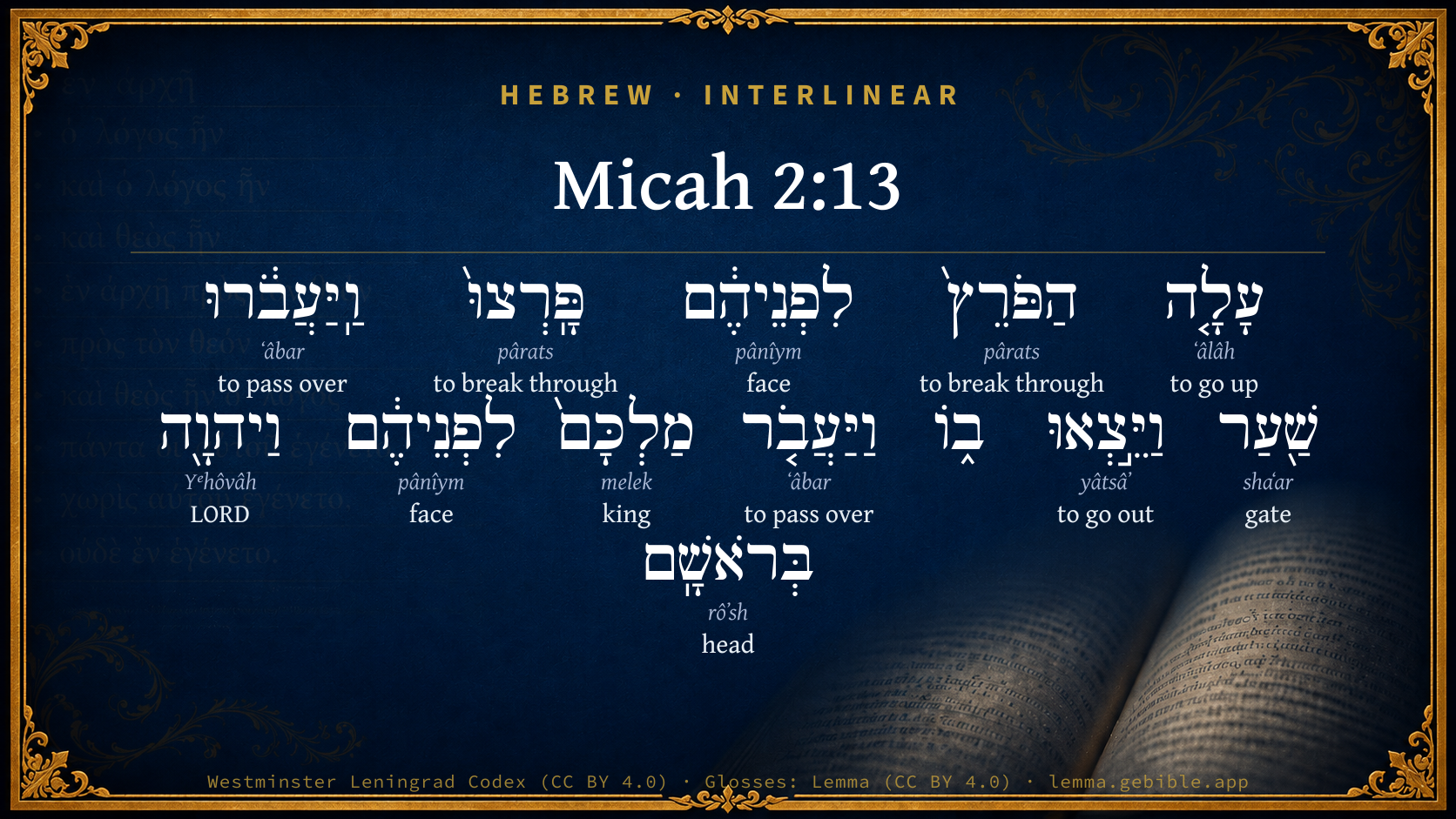
Micah 2:13

Hebrew (Westminster Leningrad Codex) Micah 2:13 appears in the Hebrew Old Testament. The text above is from the Westminster Leningrad Codex. Each word links to its Strong’s number, a concise gloss, and parsing drawn from the Open Scriptures Hebrew Bible morphology. Click any word for its full Brown-Driver-Briggs (BDB) entry.
Download image
Cite this verse

Micah 2:13 (World English Bible). Public Domain. Lemma interlinear Bible study tool, https://lemma.gebible.app/v/micah/2/13.

Show BibTeX & RIS
BibTeX
RIS
English Translation
He who breaks open the way goes up before them. They break through the gate, and go out. And their king passes on before them, With Yahweh at their head."
World English Bible · Public Domain
Download a study sheet

One document with this verse’s original text, its word-by-word gloss line, the meaning frame, cross-references with their text, attributed commentary, and full source and license credits — printable, and it pastes into notes with its structure intact.

This verse Autodidact and up

Study sheet (.html) Plain text (.txt)

A passage Seminary Student

Up to 50 verses in one chapter. A passage sheet keeps up to 6 commentary sources and 12 cross-references per verse, in the order this page ranks them, and says so on the sheet whenever that leaves anything out. Ask for a single verse and you get the Autodidact verse sheet above.

Everything on this page stays free to read, with no account — the sheet is a download of what is already on screen, not access to it.

Want to remove ads? Support Godless Engineer
Compare translations 3

The same verse in 3 English versions, stacked beneath the original-language interlinear above. Click any original word for its lexicon entry.

Each is an independent rendering of the whole verse — the interlinear is not word-aligned to these translations.

Highlighted words mark where these versions differ — a whole-verse word diff, not a word-by-word alignment.

  • World English Bible Public Domain
    He who breaks open the way goes up before them. They break through the gate, and go out. And their king passes on before them, With Yahweh at their head."
  • King James Version Public Domain
    The breaker is come up before them: they have broken up, and have passed through the gate, and are gone out by it: and their king shall pass before them, and the LORD on the head of them.
  • unfoldingWord Literal Text CC BY-SA 4.0
    The breaker has gone up to the face of them. They have broken through and passed through the gate and gone out through it. And their king has passed on to the face of them, and Yahweh at their head.

unfoldingWord Literal Text — © unfoldingWord, licensed CC BY-SA 4.0. Word-aligned USFM3 via Door43 (git.door43.org/unfoldingWord/en_ult).

Versions to compare (up to 4)

3 of 4 selected

Show all 18 translations

Every available English version of this verse, each an independent rendering of the whole verse.

  • World English Bible Public Domain
    He who breaks open the way goes up before them. They break through the gate, and go out. And their king passes on before them, With Yahweh at their head."
  • Berean Standard Bible Public Domain
    One who breaks open the way will go up before them; they will break through the gate, and go out by it. Their King will pass through before them, the LORD as their leader.
  • Majority Standard Bible Public Domain
    One who breaks open the way will go up before them; they will break through the gate, and go out by it. Their King will pass through before them, the LORD as their leader.
  • King James Version Public Domain
    The breaker is come up before them: they have broken up, and have passed through the gate, and are gone out by it: and their king shall pass before them, and the LORD on the head of them.
  • American Standard Version (1901) Public Domain
    The breaker is gone up before them: they have broken forth and passed on to the gate, and are gone out thereat; and their king is passed on before them, and Jehovah at the head of them.
  • Revised Version (1885) Public Domain
    The breaker is gone up before them: they have broken forth and passed on to the gate, and are gone out thereat: and their king is passed on before them, and the LORD at the head of them.
  • Geneva Bible (1599) Public Domain
    The breaker vp shall come vp before them: they shall breake out, and passe by the gate, and goe out by it, and their King shall goe before them, and the Lord shalbe vpon their heades.
  • Douay-Rheims (1899) Public Domain
    For he shall go up that shall open the way before them: they shall divide, and pass through the gate, and shall come in by it: and their king shall pass before them, and the Lord at the head of them.
  • Young's Literal Translation Public Domain
    Gone up hath the breaker before them, They have broken through, Yea, they pass through the gate, Yea, they go out through it, And pass on doth their king before them, And Jehovah at their head!
  • Literal Standard Version CC BY-SA 4.0
    The breaker has gone up before them, || They have broken through, || Indeed, they pass through the gate, || Indeed, they go out through it, || And their king passes on before them, || And YHWH at their head!”
  • Unlocked Literal Bible CC BY-SA 4.0
    Someone who breaks open their way for them will go ahead of them. They break through the gate and go out; their king will pass on before them. Yahweh will be at their head.
  • unfoldingWord Literal Text CC BY-SA 4.0
    The breaker has gone up to the face of them. They have broken through and passed through the gate and gone out through it. And their king has passed on to the face of them, and Yahweh at their head.
  • Darby Bible Public Domain
    One that breaketh through is gone up before them: they have broken forth, and have passed on to the gate, and are gone out by it; and their king passeth on before them, and Jehovah at the head of them.
  • World Messianic Bible Public Domain
    He who breaks open the way goes up before them. They break through the gate, and go out. Their king passes on before them, with the LORD at their head.
  • Webster's Bible Public Domain
    The breaker is come up before them: they have broken up, and have passed through the gate, and have gone out by it; and their king shall pass before them, and the LORD on the head of them.
  • Free Bible Version CC BY-SA 4.0
    The One who opens the way for them will lead them, breaking through the gate and going out. Their King will lead them; the Lord himself will be at their head.
  • Bible in Basic English Public Domain
    The opener of the way will go up before them: forcing their way out they will go on to the doorway and out through it: their king will go on before them, and the Lord at their head.
  • JPS Tanakh (1917) Public Domain
    The breaker is gone up before them; they have broken forth and passed on, by the gate, and are gone out thereat; and their king is passed on before them, and the LORD at the head of them.

Literal Standard Version (2020), Covenant Press — licensed CC BY-SA 4.0. Text via the HelloAO Bible API (eBible.org). Unlocked Literal Bible (unfoldingWord) — licensed CC BY-SA 4.0. Text via the HelloAO Bible API (eBible.org). unfoldingWord Literal Text — © unfoldingWord, licensed CC BY-SA 4.0. Word-aligned USFM3 via Door43 (git.door43.org/unfoldingWord/en_ult). Free Bible Version, Dr. Jonathan Gallagher — licensed CC BY-SA 4.0. Text via the HelloAO Bible API (eBible.org).

Word by word

More ways to search: Search by grammar → Find every occurrence → Compare this word →

Practice this passage: Drill this verse → Learn its vocabulary →

הַפֹּרֵץ֙
pârats
H6555
“the · breaking through”
Particle, Definite Article + Verb, Qal, Participle Active, Masculine, Singular, Absolute
Part of Speech
Particle + Verb
Stem
Qal
Form
Participle Active
Gender
Masculine
Number
Singular
State
Absolute
Full BDB Definition

Origin: a primitive root

TWOT: 1826

to break through or down or over, burst, breach - (Qal) - to break or burst out (from womb or enclosure) - to break through or down, make a breach in - to break into - to break open - to break up, break in pieces - to break out (violently) upon - to break over (limits), increase - to use violence - to burst open - to spread, distribute - (Niphal) to be broken through - (Pual) to be broken down - (Hithpael) to break away
  1. עָלָ֤ה ʻâlâh H5927 “to go up” Verb, Qal, Perfect, 3rd Person, Masculine, Singular
  2. לִפְנֵיהֶ֔ם pânîym H6440 “to/for · face(s) · their” Preposition + Noun, Common, Both, Plural, Construct + Suffix, Personal, 3rd Person, Masculine, Plural
  3. פָּֽרְצוּ֙ pârats H6555 “to break through” Verb, Qal, Perfect, 3rd Person, Common, Plural
  4. וַֽיַּעֲבֹ֔רוּ ʻâbar H5674 “and · to pass over” Conjunction + Verb, Qal, Sequential Imperfect, 3rd Person, Masculine, Plural
  5. שַׁ֖עַר shaʻar H8179 “gate” Noun, Common, Masculine, Singular, Absolute
  6. וַיֵּ֣צְאוּ yâtsâʼ H3318 “and · to go out” Conjunction + Verb, Qal, Sequential Imperfect, 3rd Person, Masculine, Plural
  7. וַיַּעֲבֹ֤ר ʻâbar H5674 “and · to pass over” Conjunction + Verb, Qal, Sequential Imperfect, 3rd Person, Masculine, Singular
  8. מַלְכָּם֙ melek H4428 “king · their” Noun, Common, Masculine, Singular, Construct + Suffix, Personal, 3rd Person, Masculine, Plural
  9. לִפְנֵיהֶ֔ם pânîym H6440 “to/for · face(s) · their” Preposition + Noun, Common, Both, Plural, Construct + Suffix, Personal, 3rd Person, Masculine, Plural
  10. וַיהוָ֖ה Yᵉhôvâh H3068 “and · LORD” Conjunction + Noun, Proper
  11. בְּרֹאשָֽׁם rôʼsh H7218 “in/at · head · their” Preposition + Noun, Common, Masculine, Singular, Construct + Suffix, Personal, 3rd Person, Masculine, Plural

About this verse

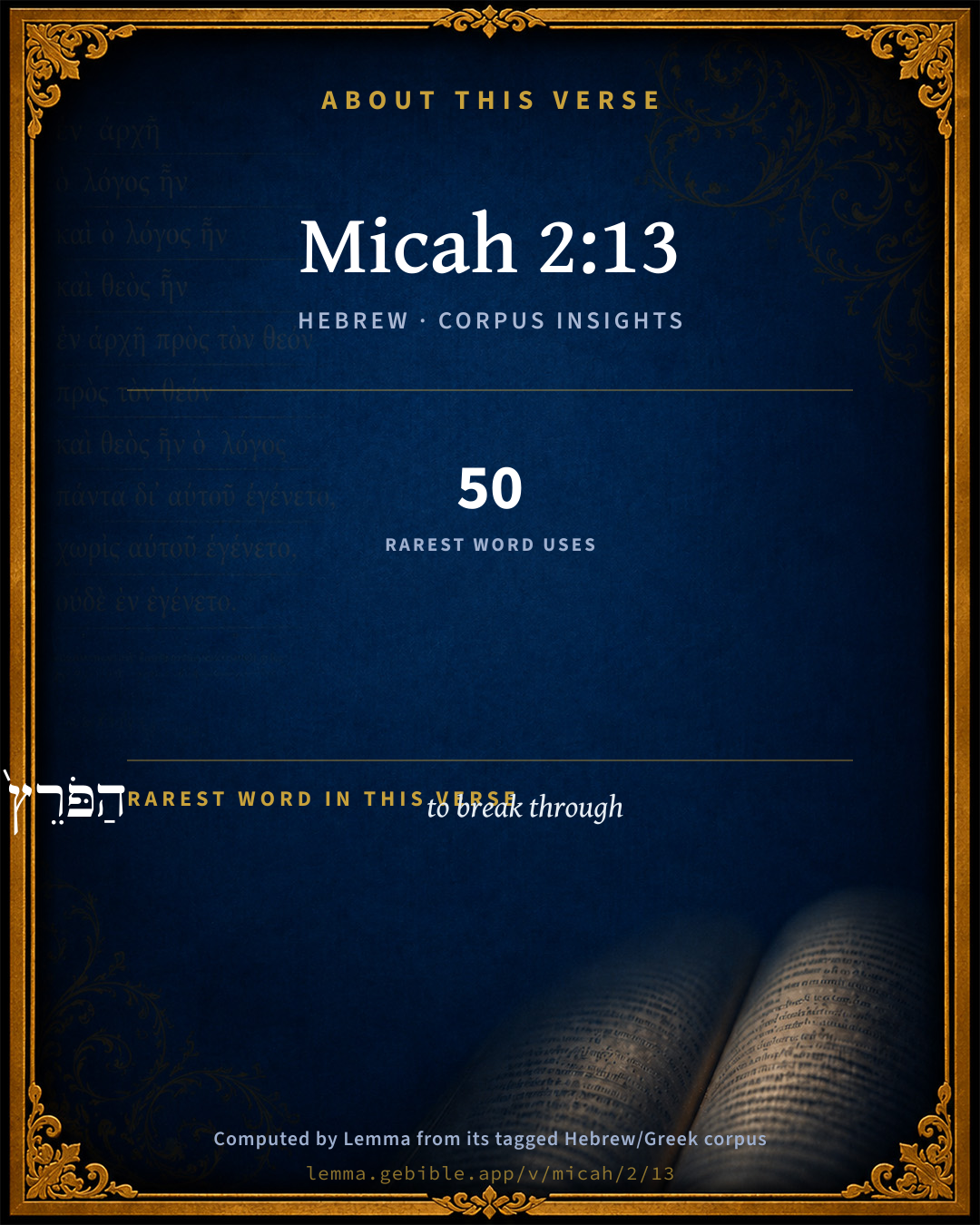
These counts appear in no published source. They are computed here, from the morphology-tagged text and Lemma’s own curated glosses. What Lemma adds →

13
words
9
distinct lemmas
Prophets
section

Shared distinctive vocabulary

הַפֹּרֵץ֙ to break through H6555 occurs in 48 verses of the Hebrew Bible. Also found in:

Grammatical profile

  • 6 verbs
  • 6 nouns
  • 1 preposition

Verb forms

  • עָלָ֤ה Qal · Perfect
  • הַפֹּרֵץ֙ Qal · Participle Active
  • פָּֽרְצוּ֙ Qal · Perfect
  • וַֽיַּעֲבֹ֔רוּ Qal · Sequential Imperfect
  • וַיֵּ֣צְאוּ Qal · Sequential Imperfect
  • וַיַּעֲבֹ֤ר Qal · Sequential Imperfect

Repetition

Words recur within this verse — often emphatic in Hebrew:

  • הַפֹּרֵץ֙ to break through H6555 ×2
  • לִפְנֵיהֶ֔ם face H6440 ×2
  • וַֽיַּעֲבֹ֔רוּ to pass over H5674 ×2

Hebrew & Septuagint length

In English translation the verse runs 30 words from the Hebrew and 27 from the Septuagint (LXX English) — closely comparable.

A rough comparison of the two English renderings, which tokenize alike — not a word-level alignment.

Word counts can differ between the Hebrew and the Greek without any difference in meaning — e.g. the Hebrew direct-object marker אֵת has no separate Greek word, and Greek often adds the article ὁ.

Cross-references

30

Topical passages linked to Micah 2:13 in the Treasury of Scripture Knowledge — connected by theme and wording, ordered by reader-vote popularity; previews shown in the World English Bible.

  • Isaiah 52:12 For you shall not go out in haste, neither shall you go by flight: for Yahweh will go before you; and the God of Israel will be your rearward.
  • Isaiah 45:1–2 Thus says Yahweh to his anointed, to Cyrus, whose right hand I have held, to subdue nations before him, and I will loose the loins of kings; to open the doors before him, and the gates shall not be shut:
  • Zechariah 9:14–15 Yahweh will be seen over them; And his arrow will go flash like lightning; And the Lord Yahweh will blow the trumpet, And will go with whirlwinds of the south.
  • John 10:27–30 My sheep hear my voice, and I know them, and they follow me.
  • Hebrews 2:14–15 Since then the children have shared in flesh and blood, he also himself in like manner partook of the same, that through death he might bring to nothing him who had the power of death, that is, the devil,
  • Revelation 7:17 for the Lamb who is in the midst of the throne shepherds them, and leads them to springs of waters of life. And God will wipe away every tear from their eyes."
  • Zechariah 10:12 I will strengthen them in Yahweh; And they will walk up and down in his name," says Yahweh.
  • Hebrews 6:20 where as a forerunner Jesus entered for us, having become a high priest forever after the order of Melchizedek.
  • Revelation 17:14 These will war against the Lamb, and the Lamb will overcome them, for he is Lord of lords, and King of kings. They also will overcome who are with him, called and chosen and faithful."
  • Daniel 2:44 In the days of those kings shall the God of heaven set up a kingdom which shall never be destroyed, nor shall the sovereignty of it be left to another people; but it shall break in pieces and consume all these kingdoms, and it shall stand forever.
  • Hosea 1:11 The children of Judah and the children of Israel will be gathered together, and they will appoint themselves one head, and will go up from the land; for great will be the day of Jezreel.
  • Isaiah 42:13–16 Yahweh will go forth as a mighty man; he will stir up [his] zeal like a man of war: he will cry, yes, he will shout aloud; he will do mightily against his enemies.
  • Isaiah 49:9–10 saying to those who are bound, Go forth; to those who are in darkness, Show yourselves. They shall feed in the ways, and on all bare heights shall be their pasture.
  • Isaiah 49:24–25 Shall the prey be taken from the mighty, or the lawful captives be delivered?
  • Isaiah 51:9–10 Awake, awake, put on strength, arm of Yahweh; awake, as in the days of old, the generations of ancient times. Isn't it you who did cut Rahab in pieces, who pierced the monster?
  • Isaiah 55:4 Behold, I have given him for a witness to the peoples, a leader and commander to the peoples.
  • Isaiah 59:16–19 He saw that there was no man, and wondered that there was no intercessor: therefore his own arm brought salvation to him; and his righteousness, it upheld him.
  • Jeremiah 51:20–24 You are my battle-axe and weapons of war: and with you will I break in pieces the nations; and with you will I destroy kingdoms;
  • Ezekiel 34:23–24 I will set up one shepherd over them, and he shall feed them, even my servant David; he shall feed them, and he shall be their shepherd.
  • Zechariah 10:5–7 They shall be as mighty men, Treading down muddy streets in the battle; And they shall fight, because Yahweh is with them; And the riders on horses will be confounded.
  • Zechariah 12:3–8 It will happen in that day, that I will make Jerusalem a burdensome stone for all the peoples. All who burden themselves with it will be severely wounded, and all the nations of the earth will be gathered together against it.
  • Isaiah 42:7 to open the blind eyes, to bring out the prisoners from the dungeon, and those who sit in darkness out of the prison-house.
  • Isaiah 51:12 I, even I, am he who comforts you: who are you, that you are afraid of man who shall die, and of the son of man who shall be made as grass;
  • Jeremiah 23:5–6 Behold, the days come, says Yahweh, that I will raise to David a righteous Branch, and he shall reign as king and deal wisely, and shall execute justice and righteousness in the land.
  • Daniel 2:34–35 You saw until a stone was cut out without hands, which struck the image on its feet that were of iron and clay, and broke them in pieces.
  • Hosea 3:5 Afterward the children of Israel shall return, and seek Yahweh their God, and David their king, and shall come with trembling to Yahweh and to his blessings in the last days.
  • Hosea 13:14 I will ransom them from the power of Sheol. I will redeem them from death! Death, where are your plagues? Sheol, where is your destruction? Compassion will be hidden from my eyes.
  • 1 Corinthians 15:21–26 For since death came by man, the resurrection of the dead also came by man.
  • Hebrews 2:9–10 But we see him who has been made a little lower than the angels, Jesus, because of the suffering of death crowned with glory and honor, that by the grace of God he should taste of death for everyone.
  • Revelation 19:13–17 He is clothed in a garment sprinkled with blood. His name is called "The Word of God."

Cross-references courtesy of OpenBible.info (CC BY 4.0).

Hebrew and Greek witnesses Masoretic Hebrew ↔ Greek Septuagint

The same verse in the two great witnesses to the Old Testament, shown verse-for-verse.

These are two independent witnesses, not word-aligned to each other, and the Septuagint is shown in lemma (dictionary) form.

Hebrew Micah 2:13 Masoretic · Westminster Leningrad Codex

עָלָ֤ה הַפֹּרֵץ֙ לִפְנֵיהֶ֔ם פָּֽרְצוּ֙ וַֽיַּעֲבֹ֔רוּ שַׁ֖עַר וַיֵּ֣צְאוּ ב֑וֹ וַיַּעֲבֹ֤ר מַלְכָּם֙ לִפְנֵיהֶ֔ם וַיהוָ֖ה בְּרֹאשָֽׁם

He who breaks open the way goes up before them. They break through the gate, and go out. And their king passes on before them, With Yahweh at their head."

World English Bible · Public Domain

Greek LXX Micah 2:13 Septuagint · lemma form

διά ὁ διακοπή πρό πρόσωπον αὐτός διακόπτω καί διαἔρχομαι πύλη καί ἐκἔρχομαι διά αὐτός καί ἐκἔρχομαι ὁ βασιλεύς αὐτός πρό πρόσωπον αὐτός ὁ δέ κύριος ἡγέομαι αὐτός

they have broken through, and passed the gate, and gone out by it: and their king has gone out before them, and the Lord shall lead them.

LXX2012 (modern English Septuagint) · Public Domain

Hebrew: Westminster Leningrad Codex (CC BY 4.0). Greek: Septuagint (public domain); English from LXX2012 (modern English Septuagint) (Public Domain). How the Septuagint differs from the Hebrew →

Targum (Aramaic paraphrase)

1

The Targum is the ancient Jewish Aramaic paraphrase of the Hebrew Scriptures — an interpretive translation, not the Hebrew text itself. Onkelos (literal) and Pseudo-Jonathan (expansive) render the Torah, and Jonathan the Prophets. Coverage is partial: where no permissively-licensed English translation exists for a verse, only the Aramaic is shown. This is verse-level text, not a word-by-word alignment to the Hebrew.

  1. Targum Jonathan Prophets (Joshua–Malachi)
    יִסְגוּן מְשֵׁיזְבִין כַּד בְּקַדְמֵיתָא וְיִסַק מֶלֶךְ מְדַבֵּר בְּרֵישֵׁיהוֹן וְיִתְּבַר בַּעֲלֵי דְבָבָא דִמְעִיק לְהוֹן וְיַכְבֵּישׁ כְּרַכִּין תַּקִיפִין קִרְוֵי עַמְמַיָא יַחְסְנוּנוּן וִיהֵי מַלְכֵיהוֹן מְדַבֵּר בְּרֵישֵׁיהוֹן וּמֵימְרָא דַייָ בְּסַעְדְהוֹן:

    (no public-domain English translation for this verse)

    Targum Jonathan — Aramaic: “Mikraot Gedolot” (public domain). English: “Sefaria Community Translation” (CC0 1.0 (public-domain dedication)); “London "Chaldee Paraphrase," 1871” (public domain). Text via Sefaria.

Commentary

Notes on Micah 2:13 from classic Christian and Jewish commentators (each source and its license shown beneath its notes). The classic Christian expositions comment on the surrounding passage and are grouped to its opening verse, so a note may address several verses; the Jewish commentaries on the Tanakh (Rashi and others) are per-verse, so they appear only where the commentator wrote on this verse.

Lemma curates 59 commentaries, every one of them public domain or Creative Commons licensed, each selected and text-cleaned for this edition rather than reprinted as found. About our sources →

Trapp's Complete Commentary

John Trapp

Mic 2:13 The breaker is come up before them: they have broken up, and have passed through the gate, and are gone out by it: and their king shall pass before them, and the LORD on the head of them.

Ver. 13. The breaker is come up before them] The πτολιπορθος, τειχεσιπλητης, breach maker shall handle them hardly and cruelly, as galley slaves, or men condemned to the mine pits.

“ Una salus victis nullam sperare salutem. ”

They have broken up] Made havoc, and laid heaps upon heaps.

And their king shall pass before them] Not only fex populi, the dregs of the people, but Rex ipse, the king himself shall be carried captive, as were Hoshea and Zedekiah, the city being broken up, Jer 52:7.

And the Lord on the head of them] Jehovah, that man of war, Exo 15:3, going before them, as captain of the enemies’ forces, to avenge the quarrel of his covenant, Lev 26:25.

John Trapp, A Commentary or Exposition upon All the Books of the Old and New Testament (1647–1656) — public domain. Text from a community e-Sword module.

Albert Barnes' Notes on the Bible

The Breaker is come up - (gone up) before them; they have broken up (Broken through) and have passed the gate, and have gone forth The image is not of conquest, but of deliverance. They “break through,” not to enter in but to “pass through the gate and go forth.” The wall of the city is ordinarily broken through, in order to make an entrance Psa 80:13; Psa 89:41; Isa 5:5; Neh 2:13, or to secure to a conqueror the power of entering in Pro 25:28; 2Ki 14:13; 2Ch 25:23; 2Ch 26:6 at any time, or by age and decay 2Ch 32:5. But here the object is expressed, to go forth. Plainly then, they were confined before, as in a prison; and the gate of the prison was burst open, to set them free. It is then the same image as when God says by Isaiah; “I will say to the North, give up; and to the South, Hold not back” Isa 43:6, or, “Go ye forth of Babylon, Say ye, the Lord hath redeemed His servant Jacob” Isa 48:20; or, with the same reminiscence of God’s visible leading of His people out of Egypt “Depart ye, depart ye; for ye shall not go out with haste, nor yet by flight, for the Lord God shall go before you, and the God of Israel will be your reward;” or as Hosea describes their restoration (Hos 1:11, (Hos 2:2, Hebrew)); “Then shall the children of Judah and the children of Israel be gathered together and appoint themselves one Head, and they shall go up out of the land”. Elsewhere, in Isaiah, the spiritual meaning of the deliverance from the prison is more distinctly brought out, as the work of our Redeemer. “I will give Thee for a covenant of the people, for a light of the Gentiles, to open the blind eyes, to bring out the prisoners from the prison, them that sit in darkness out of the prison-house” Isa 42:6-7; and, “the Spirit of the Lord God is upon Me, because the Lord hath anointed Me to proclaim liberty to the captives, and the opening of the prison to them that are bound” Isa 61:1.

From this passage, the “Breaker-through” was one of the titles of the Christ, known to the Jews , as One who should be “from below and from above” also; and from it they believed that “captives should come up from Gehenna, and the Sheehinah,” or the Presence of God, “at their head.” : “He then, who shall break the way, the King and Lord who shall go up before them, shall be the Good Shepherd, who puts them together in the fold. And this He doth when, as He saith, ‘He putieth forth His own sheep, and He goeth before them, and the sheep follow Him, for they know His Voice’ Joh 10:4. How doth He go befree them but by suffering for them, leaving them an example of suffering, and opening the entrance of Paradise? The Good Shepherd goeth up to time Cross Joh 10:15; Joh 12:32, and is lifted up from the earth, laying down His Life for His sheep, to draw all men unto Him. He goeth up, trampling on death by His resurrection; He goeth up above the heaven of heavens, and sitteth on the Right Hand of the Father, opening the way before them, so that the flock, in their lowliness, may arrive where the Shepherd went before in His Majesty. And when He thus breaketh through and openeth the road, they also ‘break through and pass through the gate and go out by it,’ by that Gate, namely, whereof the Psalmist saith, ‘This is the Gate of the Lord; the righteous shall enter into It’ Psa 118:20.

What other is this Gate than that same Passion of Christ, beside which there is no gate, no way whereby any can enter into life? Through that open portal, which the lance of the soldier made in His Side when crucified, and ‘there came thereout Blood and Water, they shall pass and go through,’ even as the children of Israel passed through the Red Sea, which divided before them, when Pharaoh, his chariots and horsemen, were drowned.’” Dionysius: “He will be in their hearts, and will teach and lead them; He will shew them the way of Salvation, ‘guiding their feet into the way of peace’ Luk 1:79, and they shall pass through the strait and narrow gate which leadeth unto life; of which it is written, ‘Enter ye in at the strait gate; because strait is the gate and narrow is the way which leadeth unto life, and few there be that find it. And their King shall pass before them’ Mat 7:13-14, as He did, of old, in the figure of the cloud, of which Moses said, ‘If Thy Presence go not, carry us not up hence; and wherein shall it be known that I have found grace in Thy sight, I and Thy people, is it not in that Thou goest up with us?’ Exo 33:15-16, and as He then did when He passed out of this world to the Father.” “And the Lord on (that is, at) the head of them,” as of His army.

Rup.: “For the Lord is His Name, and He is the Head, they the members; He the King, they the people; He the Shepherd, they the sheep of His pasture. And of this passing through He spake, ‘By Me if any man enter in, he shall be saved, and shall go in and out and find pasture’ Joh 10:9. For a man entereth in, when, receiving the faith, he becomes a sheep of this Shepherd, and goeth out, when he closeth this present life, and then findeth the pastures of unfading, everlasting life” ; “passing from this pilgrimage to his home, from faith to sight, from labor to reward.” Again, as describing the Christian’s life here, it speaks of progress. Jerome: “Whoso shall have entered in, must not remain in the state wherein he entered, but must go forth into the pasture; so that, in entering in should be the beginning, in going forth and finding pasture, the perfecting of graces. He who entereth in, is contained within the bounds of the world; he who goeth forth, goes, as it were, beyond all created things, and, counting as nothing all things seen, shall find pasture above the Heavens, and shall feed upon the Word of God, and say, “The Lord is my Shepherd” Psa 23:1, (and feedeth me,) I can lack nothing.

But this going forth can only be through Christ; as it followeth, ‘and the Lord at the head of them.’” Nor, again, is this in itself easy, or done for us without any effort of our own. All is of Christ. The words express the closeness of the relation between the Head and the members; and what He, our King and Lord, doth, they do, because He who did it for them, doth it in them. The same words are used of both, shewing that what they do, they do by virtue of His Might, treading in His steps, walking where He has made the way plain, and by His Spirit. What they do, they do, as belonging to Him. He “breaketh through,” or, rather, in all is “the Breaker-through.” They, having broken through, pass on, because He “passeth before them.” He will Isa 45:2 break in pieces the gates of brass, and cut in sunder the bars of iron. He “breaketh through” whatever would hold us back or oppose us, all might of sin and death and Satan, as Moses opened the Red Sea, for “a way for the ransomed to pass over” Isa 51:10; and so He saith, “I will go before thee, I will break in pieces the gates of brass, and cut in sunder the bars of iron, and I will give thee the treasures of darkness, and hidden riches of secret places” Isa 45:2-3.

So then Christians, following Him, the Captain of their salvation, strengthened by His grace, must burst the bars of the flesh and of the world, the chains and bonds of evil passions and habits, force themselves through the narrow way and narrow gate, do violence to themselves 2Ti 2:3, endure hardness, as good soldiers of Jesus Christ. The title of our Lord, the Breaker-through, and the saying, “they break through,” together express the same as the New Testament doth in regard to our being partakers of the sufferings of Christ Rom 8:17. Joint heirs with Christ, if so be that we suffer with Him, that we may be also glorified together 2Ti 2:11-12. If we be dead with Him, we shall also live with Him; if we suffer, we shall also reign with Him 1Pe 4:1. Forasmuch then as Christ hath suffered for us in the flesh - arm yourselves likewise with the same mind.

The words may include also the removal of the souls of the just, who had believed in Christ before His Coming, into Heaven after His Resurrection, and will be fully completed when, in the end, He shall cause His faithful servants, in body and soul, to enter into the joy of their Lord.

Albert Barnes' Notes on the Bible (1834–1885) — public domain. Text from a community e-Sword/MySword module.

The Biblical Illustrator

Joseph S. Exell

Mic_2:13

The breaker is come up before them: they have broken up, and have passed through the gate, and are gone out by it

Christ, as the Breaker, opening all passes to glory that were impassable

It is agreed not only by Christian, but even by some Jewish interpreters, that these words have a principal and ultimate view unto the glorious Messiah, and the great work of salvation that lie was to accomplish in the fulness of time.

The prophet here prophesies that Christ should rid the way, and clear the passage, and make mountains as a plain.

I. The way of the Lords ransomed opened up by the great Redeemer. The breaker is come up before them.

1. The designation given to the glorious Messiah. The breaker. Cyrus was an instrument in the hand of God for breaking the Babylonish yoke. Herein he was a type of Christ, by whom the yoke of our spiritual captivity under sin and Satan is broken.

2. We have the courageous appearance of the glorious Redeemer in His breaking work. He comes up, He appears upon the field with an undaunted and heroic courage.

3. The party that He heads, or those in whose quarrel this Breaker appears. Enquire upon what account Christ is called the Breaker.

(1) In general, because of the great opposition He had to break through.

(2) He breaks up a new and living way, by which we have access to God and glory.

(3) He breaks through the storms of Divine wrath, the rage of men and devils, in order to accomplish our redemption.

(4) In a day of power He breaks the enmity of our hearts against Him.

(5) Those who will not bow unto His royal authority He breaks in pieces.

6. He may be called a Breaker because of the breaking trials He brings on His own people, and the judgments and calamities that He brings on an offending Church or nation.

II. The upcoming of Christ as the Breaker. Understand of His coming up to avenge the quarrel of His children and people. Like a mighty champion He takes the field. Tell of some seasonable upcomings.

1. He appeared in our quarrel in the council of peace.

2. He came seasonably immediately after the fall of man.

3. Really and personally in His incarnation.

4. In the power of His Spirit in the dispensation of the Gospel.

5. In the outward dispensation of His providence.

6. When He revives His own work in a backsliding land and church.

7. In every display of His grace and love to a particular believer; when He seasonably interposes for the relief of a poor soul sinking under the burden of sin, temptation, affliction, and desertion.

8. At death.

Question--In what manner doth He Come up in our quarrel, to the help of the weak against the mighty?

1. All His appearances for the help and relief of His people have been well-timed.

2. He comes up solitarily. He alone comes up. It is His own arm brings salvation.

3. With the greatest alacrity and cheerfulness.

4. Speedily, with no lingering or tarrying.

5. Courageously.

6. Victoriously.

7. His coming to His breaking work is irresistible. And--

8. It is with much awful greatness and majesty.

III. What is implied in His coming up before them?

1. It imports that He has them and their case deeply at heart.

2. It implies that their way is hard and difficult.

3. It implies His authority to rule and govern them.

4. It implies strength and ability to support authority.

5. It implies their inability to break up their own way.

6. As the Breaker is gone up before them, it implies that He has paved the road, and travelled the way before them. He goes before His people in obedience, in suffering, in going through death into glory.

7. It implies His routing and discomfiting all the enemies that stood in the way of our salvation: Satan, sin, the world, death.

8. It implies that the way to heaven is patent.

9. It implies that, whatever dangers, difficulties, or opposition be in their way, they are in absolute safety under His conduct.

IV. The grounds and reasons of this dispensation, or why doth Christ break up the way to His people?

1. Because they were gifted to Him of the Father, as a heritage and possession.

2. Because they are the purchase of His blood.

3. Because His faithfulness is engaged to lead them in their way.

4. Because He has to give an account of them to the Father.

5. Because they cannot break up their own way.

6. Because they trust in Him as Leader and Commander.

7. Because of the near and dear relation that He has come under unto them. (E. Erskine.)

The Breaker

Micah lived near the time of the Babylonish Captivity. It is a prominent subject in the prophetic writings. Resembling, as it did, the spiritual captivity of Gods people, it is made the groundwork of many glorious predictions relating to the Lord Jesus Christ and His salvation. In this light commentators regard the prediction of the text. It has a reference to the captive Jews, and their liberator Cyrus; but it looks further. In Christ and His ransomed people it has its real, complete fulfilment. It sets forth the Lord Jesus--

I. As interposing for His people in a peculiar character. The breaker. The demolisher. One who beats down before them all barriers and impediments that obstruct their way. The figure places us where we really are, far off from God and His kingdom, with many obstructions lying in between Gods kingdom and us; with more than distance to be got over--with barriers and obstacles to be surmounted. What are these? Some of them lie out of us, some within us. Out of us is--

1. The judicial displeasure of God. It is our guilt which has subjected us to His wrath.

2. The opposition of Satan. By Satan is meant, not one being, but a numerous host of beings in the spiritual world opposed to our happiness. Through this difficulty Christ breaks. Not, as we might have supposed, by exterminating these enemies of our salvation, scattering them out of our path; but in first making His own way to heaven in mans form through them, and then by communicating strength to His people to do as He has done--withstand these enemies, force their way through them, and tread them down. Within His people, what is there to impede them in their way to heaven? We may say that everything within them is an impediment to them in their way. There is nothing within fallen man, naturally, that does not tend to carry him away from God, rather than to lead him to God.

See--

1. The natural self-sufficiency and pride of heart, which we may call self-righteousness. But Christ comes, and touches the proud heart of man, and this barrier in it falls down.

2. There is the unGodliness of the heart. Almost as stiff a barrier in the way of our salvation as its pride. Here too the heavenly Breaker comes in. He opens the sinners heart, communicates to it a holy principle; and this principle, warring against the unholiness in him, gradually breaks its strength, masters and dethrones it.

3. The unbelief of our hearts. This leads to hesitation and delay, under one excuse after another.

II. The escape of Gods Israel in consequence of Christs interposition for them. Two remarks.

1. A great change has taken place in the spiritual condition of Christs people, in consequence of what He has done for them.

2. The people really delivered by Christ cooperate with Him in their deliverance. You must be warned against imagining that you have one particle of spiritual ability or strength of your own. But you must be warned as earnestly against taking up with what may be termed a passive religion.

III. The high privilege of these escaped liberated men after their escape. Their king shall pass before them, and the Lord on the head of them. This is more than saying we shall have the Lord for us, we shall have Him with us. It indicates not merely the presence, but the near presence of the Lord. It may be a figure taken from the cloudy Pillar hanging over Israel, overshadowing them. It is an assurance at once of discipline and of safety on our way to heaven. (Charles Bradley, M. A.)

The Breaker

Names appropriate to the offices which He was afterwards to fill were bestowed upon the promised Messiah. This is one of them. The name answers to what we call a pioneer, one who clears the way before an army in its march.

1. It is appropriate to the Lord Jesus, because it was through His agency alone that the power of sin was broken. Our redeemed broke the strength of the law, by obeying its rigid requirements in our stead.

2. This title marks the character and office of the Messiah when, by His death, the destruction between Jews and Gentiles was forever removed.

3. The title is appropriate, since by His death Christ destroyed death, and by His triumphant resurrection He has given an earnest of what He will one day accomplish for all who fall asleep in Him.

4. Appropriate also when we notice the steady inroads which His kingdom has made upon the widespread dominions of the Prince of Darkness. In vain does infidelity attempt to account for the improvement in morality and refinement by attributing them to the advance of civilisation alone. Stubborn facts, drawn from the history of nations, contradict the assertion. Civilisation, unless animated and directed by the religion of Christ, has uniformly corrupted and deteriorated public morals. We must look to a higher source than the wisdom or ingenuity or strength of man for the agency which has vanquished the powers of darkness, and redeemed the world from bondage; and we need not look for it in vain. (John N. Norton, D. D.)

The Breaker

I. In what respects may Jesus Christ be called a Breaker? Because of the great opposition He had to break through in the work of our redemption. Because He breaks up a new and living way, by which we may have access to God and glory. Because He breaks the enmity of our hearts against Him. Because of the breaking judgments He brings on the world, and the breaking trials on His people.

II. In what respects may He be said to come up? When our first parents sinned, He came up in the promise. He came up really and personally in the incarnation, etc. In the chariots of a preached Gospel. In every display of His grace and love to such as believe.

III. What may be implied in His coming up before them? He comes before them as a Shepherd, as a General, as a King. It imports that the way to heaven is patent.

IV. The escape of the ransomed by this way. They have broken up, etc., out of darkness into light, out of bond age into liberty. They have passed through the law gate of conviction, and the gospel-gate of conversion. (T. Hannam.)

The Lord Jesus as the Leader of His people

I. The Lord Jesus in the character of a Breaker. By breaker understand one who burst through all obstacles.

1. What are the difficulties to be broken through?

2. Jesus, as the Breaker, has burst through every difficulty.

II. His people following in His steps. Allusion is to the entrance of a victorious captain, with his troops following. Every act of Christ was done for His Church. How great will be the final glory of the Saviour! How blessed is the lot of the people of God! How awful it must be to be a stranger to Christ. (J. G. Breay, B. A.)

The matchless beauty of Jesus

Apply the words to the spiritual and eternal salvation of the Israel of God. Consider--

I. The captivity, implied in the promise of deliverance. The people are described as sheep, but their salvation is spoken of in language which implies they are captives, and such captives that no other than the Lord Jehovah can effect their freedom. It is a captivity to sin. It is a willing captivity. They have sold themselves.

II. Their glorious redemption. Who is it that undertakes their cause, and as their Redeemer is mighty to set them free?

III. The making effectual of the redemption thus obtained in the release and liberty of the captives. They break through their unbelief; they break through the barriers of sin, guilt, and death, and lay hold on eternal life. They break, also, from their sins, from the world, from its ungodly ways, and from whatever would withstand them in their following their glorious Lord and King, who goes before them, and whom they obey as their Leader and Commander. A threefold application.

1. Warning to such as go on still in their trespasses.

2. Encouragement to all that are sensible of their sins, and concerned about their souls.

3. Comfort for all such as are following after the Lord. (J. T. Parker, M. A.)

Christ the Breaker

I. The great work of our Divine Redeemer, by which He has broken for the captives the prison house of their bondage. Many of us know not the bondage in which we are held. We are chained by sin, chained by the habit of evil with a strength of which you never know till you try to shake off.

II. Jesus Christ as the Opener, and the Path, to God. Our condition is not only one of bondage to evil, but also one of separation from God. We do not know God as He is, except by Jesus Christ. It is only the God manifest in Jesus Christ that draws mens hearts to Him. That God that is in Christ is the only God that humanity ever loved. He, by the fact of His Cross and Passion, has borne and borne away the impediments of our own sin and transgression which rise forever between us and Him, unless He shall sweep them out of the way.

III. Christ is the Breaker as the Captain of our lifes march. When He putteth forth His sheep, He goeth before them.

IV. He is the Breaker for us of the bands of death. Christs resurrection is the only solid proof of a future life. It is not possible that we should be holden of the impotent chains that He has broken. (A. Maclaren, D. D.)

.

The Biblical Illustrator, edited by Joseph S. Exell (c. 1880s–1900s) — public domain. Text from a community e-Sword module.

MacLaren's Expositions of Holy Scripture

Alexander MacLaren

Micah

CHRIST THE BREAKER

Mic 2:13.

Micah was contemporary with Isaiah. The two prophets stand, to a large extent, on the same level of prophetic knowledge. Characteristic of both of them is the increasing clearness of the figure of the personal Messiah, and the increasing fulness of detail with which His functions are described. Characteristic of both of them is the presentation which we find in this text of that Messiah’s work as being the gathering together of the scattered captive people and the leading them back in triumph into the blessed land.

Such is the image which underlies my text. Of course I have nothing to do now with questions as to any narrower and nearer historical fulfilment, because I believe that all these Messianic prophecies which were susceptible of, and many of which obtained, a historical and approximate fulfilment in the restoration of the Jews from the Babylonish captivity, have a higher and broader and more real accomplishment in that great deliverance wrought by Jesus Christ, of which all these earlier and partial and outward manifestations were themselves prophecies and shadows.

So I make no apology for taking the words before us as having their only real accomplishment in the office and working of Jesus Christ. He is ‘the Breaker which is come up before us.’ He it is that has broken out the path on which we may travel, and in whom, in a manner which the Prophet dreamed not of, ‘the Lord is at the head’ of us, and our King goes before us. So that my object is simply to take that great name, the Breaker, and to see the manifold ways in which in Scripture it is applied to the various work of Jesus Christ in our redemption.

I. I follow entirely the lead of corresponding passages in other portions of Scripture, and to begin with, I ask you to think of that great work of our Divine Redeemer by which He has broken for the captives the prison-house of their bondage.

The image that is here before us is either that of some foreign land in which the scattered exiles were bound in iron captivity, or more probably some dark and gloomy prison, with high walls, massive gates, and barred windows, wherein they were held; and to them sitting hopeless in the shadow of death, and bound in affliction and iron, there comes one mysterious figure whom the Prophet could not describe more particularly, and at His coming the gates flew apart, and the chains dropped from their hands; and the captives had heart put into them, and gathering themselves together into a triumphant band, they went out with songs and everlasting joy upon their heads; freemen, and on the march to the home of their fathers. ‘The Breaker is gone up before them; they have broken, and passed through the gate, and are gone out by it.’

And is not that our condition? Many of us know not the bondage in which we are held. We are held in it all the more really and sadly because we conceit ourselves to be free. Those poor, light-hearted people in the dreadful days of the French Revolution, used to keep up some ghastly mockery of society and cheerfulness in their prisons; and festooned the bars with flowers, and made believe to be carrying on their life freely as they used to do; but for all that, day after day the tumbrils came to the gates, and morning after morning the jailer stood at the door of the dungeons with the fatal list in his hand, and one after another of the triflers was dragged away to death. And so men and women are living a life which they fancy is free, and all the while they are in bondage, held in a prison-house. You, my brother! are chained by guilt; you are chained by sin, you are chained by the habit of evil with a strength of which you never know till you try to shake it off.

And there comes to each of us a mighty Deliverer, who breaks the gates of brass, and who cuts the bars of iron in sunder. Christ comes to us. By His death He has borne away the guilt; by His living Spirit He will bear away the dominion of sin from our hearts; and if the Son will make us free we shall be free indeed. Oh! ponder that deep truth, I pray you, which the Lord Christ has spoken in words that carry conviction in their very simplicity to every conscience: ‘He that committeth sin is the slave of sin.’ And as you feel sometimes-and you all feel sometimes-the catch of the fetter on your wrists when you would fain stretch out your hands to good, listen as to a true gospel to this old word which, in its picturesque imagery, carries a truth that should be life. To us all ‘the Breaker is gone up before us,’ the prison gates are open. Follow His steps, and take the freedom which He gives; and be sure that you ‘stand fast in the liberty wherewith Christ hath made you free, and be not entangled again with any yoke of bondage.’

Men and women! Some of you are the slaves of your own lusts. Some of you are the slaves of the world’s maxims. Some of you are held in bondage by some habit that you abominate, but cannot get away from. Here is freedom for you. The dark walls of the prison are round us all. ‘The Scripture hath shut up all in sin, that He might have mercy upon all.’ Blessed be His name! As the angel came to the sleeping Apostle, and to his light touch the iron gates swung obedient on their hinges, and Roman soldiers who ought to have watched their prey were lulled to sleep, and fetters that held the limbs dropped as if melted; so, silently, in His meek and merciful strength, the Christ comes to us all, and the iron gate which leadeth out into freedom opens of its own accord at His touch, and the fetters fall from our limbs, and we go forth free men. ‘The Breaker is gone up before us.’

II. Again, take another application of this same figure found in Scripture, which sets forth Jesus Christ as being the Opener of the path to God.

‘I am the Way and the Truth and the Life, no man cometh to the Father but by Me,’ said He. And again, ‘By a new and living way which He hath opened for us through the veil’ {that is to say, His flesh}, we can have free access ‘with confidence by the faith of Him.’ That is to say, if we rightly understand our natural condition, it is not only one of bondage to evil, but it is one of separation from God. Parts of the divine character are always beautiful and sweet to every human heart when it thinks about them. Parts of the divine character stand frowning before a man who knows himself for what he is; and conscience tells us that between God and us there is a mountain of impediment piled up by our own evil. To us Christ comes, the Path-finder and the Path; the Pioneer who breaks the way for us through all the hindrances, and leads us up to the presence of God.

For we do not know God as He is except by Jesus Christ. We see fragments, and often distorted fragments, of the divine nature and character apart from Jesus, but the real divine nature as it is, and as it is in its relation to me, a sinner, is only made known to me in the face of Jesus Christ. When we see Him we see God; Christ’s tears are God’s pity, Christ’s gentleness is God’s meekness, Christ’s tender, drawing love is not only a revelation of a most pure and sweet Brother’s heart, but a manifestation through that Brother’s heart of the deepest depths of the divine nature. Christ is the heart of God. Apart from Him, we come to the God of our own consciences and we tremble; we come to the God of our own fancies and we presume; we come to the God dimly guessed at and pieced together from out of the hints and indications of His works, and He is little more than a dead name to us. Apart from Christ we come to a peradventure which we call a God; a shadow through which you can see the stars shining. But we know the Father when we believe in Christ. And so all the clouds rising from our own hearts and consciences and fancies and misconceptions, which we have piled together between God and ourselves, Christ clears away; and thus He opens the path to God.

And He opens it in another way too, on which I cannot dwell. It is only the God manifest in Jesus Christ that draws men’s hearts to Him. The attractive power of the divine nature is ail in Him who has said, ‘I, if I be lifted up, will draw all men unto Me.’ The God whom men know, or think they know, outside of the revelation of divinity in Jesus Christ, is a God before whom they sometimes tremble, who is far more often their terror than their love, who is their ‘ghastliest doubt’ still more frequently than He is their ‘dearest faith.’ But the God that is in Christ woos and wins men to Him, and from His great sweetness there streams out, as it were, a magnetic influence that draws hearts to Him. The God that is in Christ is the only God that humanity ever loved. Other gods they may have worshipped with cowering terror and with far-off lip reverence, but this God has a heart, and wins hearts because He has. So Christ opens the way to Him.

And still further, in a yet higher fashion, that Saviour is the Path-breaker to the Divine Presence, in that He not only makes God known to us, and not only makes Him so known to us as to draw us to Him, but in that likewise He, by the fact of His Cross and passion, has borne and borne away the impediments of our own sin and transgression which rise for ever between us and Him, unless He shall sweep them out of the way. He has made ‘the rough places plain and the crooked things straight’; levelled the mountains and raised the valleys, and cast up across all the wilderness of the world a highway along which ‘the wayfaring man though a fool’ may travel. Narrow understandings may know, and selfish hearts may love, and low-pitched confessions may reach the ear of the God who comes near to us in Christ, that we in Christ may come near to Him. The Breaker is gone up before us; ‘having therefore, brethren, boldness to enter into the holiest of all . . . by a new and living way, which He hath consecrated for us . . . let us draw near with true hearts’

III. Then still further, another modification of this figure is found in the frequent representations of Scripture, by which our Lord is the Breaker, going up before us in the sense that He is the Captain of our life’s march.

We have, in the words of my text, the image of the gladly-gathered people flocking after the Leader. ‘They have broken up, and have passed through the gate, and are gone out by it; and their King shall pass before them, and the Lord on the head of them.’ The Prophet knew not that the Lord their King, of whom it is enigmatically said that He too, as well as ‘the Breaker,’ is to go before them, was in mysterious fashion to dwell in that Breaker; and that those two, whom He sees separately, are yet in a deep and mysterious sense one. The host of the captives, returning in triumphant march through the wilderness and to the promised land, is, in the Prophet’s words, headed both by the Breaker and by the Lord. We know that the Breaker is the Lord, the Angel of the Covenant in whom is the name of Jehovah.

And so we connect with all these words of my text such words as designate our Saviour as the Captain of our salvation; such words as His own in which He says, ‘When He putteth forth His sheep He goeth before them’-such words as His Apostle used when he said, ‘Leaving us an ensample that we should follow in His steps.’ And by all there is suggested this-that Christ, who breaks the prison of our sins, and leads us forth on the path to God, marches at the head of our life’s journey, and is our Example and Commander; and Himself present with us through all life’s changes and its sorrows.

Here is the great blessing and peculiarity of Christian morals that they are all brought down to that sweet obligation: ‘Do as I did.’ Here is the great blessing and strength for the Christian life in all its difficulties-you can never go where you cannot see in the desert the footprints, haply spotted with blood, that your Master left there before you, and planting your trembling feet in the prints, as a child might imitate his father’s strides, may learn to recognise that all duty comes to this: ‘Follow Me’; and that all sorrow is calmed, ennobled, made tolerable, and glorified, by the thought that He has borne it.

The Roman matron of the legend struck the knife into her bosom, and handed it to her husband with the words, ‘It is not painful!’ Christ has gone before us in all the dreary solitude, and in all the agony and pains of life. He has hallowed them all, and has taken the bitterness and the pain out of each of them for them that love Him. If we feel that the Breaker is before us, and that we are marching behind Him, then whithersoever He leads us we may follow, and whatsoever He has passed through we may pass through. We carry In His life the all-sufficing pattern of duty. We have in His companionship the all-strengthening consolation. Let us leave the direction of our road in His hands, who never says ‘Go!’ but always ‘Come!’ This General marches in the midst of His battalions and sets His soldiers on no enterprises or forlorn hopes which He has not Himself dared and overcome.

So Christ goes as our Companion before us, the true pillar of fire and cloud in which the present Deity abode, and He is with us in real companionship. Our joyful march through the wilderness is directed, patterned, protected, companioned by Him, and when He ‘putteth forth His own sheep,’ blessed be His name, ‘He goeth before them.’

IV. And now, lastly, there is a final application of this figure which sets forth our Lord as the Breaker for us of the bands of death, and the Forerunner ‘entered for us into the heavens.’

Christ’s resurrection is the only solid proof of a future life. Christ’s present resurrection life is the power by partaking in which, ‘though we were dead, yet shall we live.’

He has trodden that path, too, before us. He has entered into the great prison-house into which the generations of men have been hounded and hurried; and where they lie in their graves, as in their narrow cells. He has entered there; with one blow He has struck the gates from their hinges, and has passed out, and no soul can any longer be shut in as for ever into that ruined and opened prison. Like Samson, He has taken the gates which from of old barred its entrance, and borne them on His strong shoulders to the city on the hill, and now Death’s darts are blunted, his fetters are broken, and his gaol has its doors wide open, and there is nothing for him to do now but to fall upon his sword and to kill himself, for his prisoners are free. ‘Oh, death! I will be thy plague; oh, grave! I will be thy destruction.’ ‘The Breaker has gone up before us’; therefore it is not possible that we should be holden of the impotent chains that He has broken.

The Forerunner is for us entered and passed through the heavens, and entered into the holiest of all. We are too closely knit to Him, if we love Him and trust Him, to make it possible that we shall be where He is not, or that He shall be where we are not. Where He has gone we shall go. In heaven, blessed be His name! He will still be the leader of our progress and the captain at the head of our march. For He crowns all His other work by this, that having broken the prison-house of our sins, and opened for us the way to God, and been the leader and the captain of our march through all the pilgrimage of life, and the opener of the gate of the grave for our joyful resurrection, and the opener of the gate of heaven for our triumphal entrance, He will still as the Lamb that is in the midst of the Throne, go before us, and lead us into green pastures and by the still waters, and this shall be the description of the growing blessedness and power of the saints’ life above, ‘These are they which follow the Lamb whithersoever He goeth.’

Alexander MacLaren, Expositions of Holy Scripture (1904–1910) — public domain. Text from a community e-Sword module.

Tyndale Open Study Notes

Tyndale Open Resources

2:13 The Lord did lead Israel out of exile, foreshadowing the even greater freedom from slavery that the Messiah, Jesus Christ, would later bring.

Tyndale Open Study Notes — © Tyndale Open Resources, licensed CC BY-SA 4.0. Text via the HelloAO Bible API.

Geneva Bible (1599)

Geneva Bible translators

To drive them forward, and to help their enemies.

The enemy shall break their gates and walls, and lead them into Chaldea.

Geneva Bible (1599) marginal notes — public domain. Text via Bolls.life.

Jamieson, Fausset & Brown

Robert Jamieson, A. R. Fausset & David Brown

The breaker--Jehovah-Messiah, who breaks through every obstacle in the way of their restoration: not as formerly breaking forth to destroy them for transgression (Exo 19:22; Jdg 21:15), but breaking a way for them through their enemies.

they--the returning Israelites and Jews.

passed through the gate--that is, through the gate of the foe's city in which they had been captives. So the image of the resurrection (Hos 13:14) represents Israel's restoration.

their king--"the Breaker," peculiarly "their king" (Hos 3:5; Mat 27:37).

pass before them--as He did when they went up out of Egypt (Exo 13:21; Deu 1:30, Deu 1:33).

the Lord on the head of them--Jehovah at their head (Isa 52:12). Messiah, the second person, is meant (compare Exo 23:20; Exo 33:14; Isa 63:9).

Next: Micah Chapter 3

Jamieson, Fausset & Brown — Commentary Critical and Explanatory on the Whole Bible (1871) — public domain (CC PDM 1.0). Text via the HelloAO Bible API.

Adam Clarke's Commentary

Verse 13. The breaker is come up] He who is to give them deliverance, and lead them out on the way of their return. He who takes down the hurdles, or makes a gap in the wall or hedge, to permit them to pass through. This may apply to those human agents that shall permit and order their return. And Jehovah being at their head, may refer to their final restoration, when the Lord Jesus shall become their leader, they having returned unto him as the shepherd and bishop of their souls; and they and the Gentiles forming one fold under one shepherd, to go no more out into captivity for ever. Lord, hasten the time!

Adam Clarke's Commentary on the Bible (1810–1826) — public domain. Text from a community e-Sword/MySword module.

John Calvin's Commentaries

It follows, Ascend shall a breaker before them; that is, they shall be led in confusion; and the gate shall also be broken, that they may go forth together; for the passage would not be large enough, were they, as is usually done, to go forth in regular order; but the gates of cities shall be broken, that they may pass through in great numbers and in confusion. By these words the Prophet intimates, that all would be quickly taken away into exile. And they shall go forth, he says through the gate, and their king shall pass on before if them The Prophet means here, that the king would be made captive; and this was the saddest spectacle: for some hope remained, when the dregs of the people had been led into Chaldea; but when the king himself was led away a captive, and cast into prison, and his eyes pulled out, and his children slain, it was the greatest of misery. They were wont to take pride in their king, for they thought that their kingdom could not but continue perpetually, since God had so promised. But God might for a time overturn that kingdom, that he might afterwards raise it anew, according to what has been done by Christ, and according to what had been also predicted by the Prophets. “Crosswise, crosswise, crosswise, (transversa) let the crown be, until its lawful possessor comes.” We then see that this, which the Prophet mentions respecting their king, has been added for the sake of amplifying.

He afterwards adds, Jehovah shall be at the head of them; that is, He will be nigh them, to oppress and wholly to overwhelm them. Some consider something to be understood, and of this kind, that Jehovah was wont formerly to rule over them, but that now he would cease to do so: but this is too strained; and the meaning which I have stated seems sufficiently clear, and that is, — that God himself would be the doer, when they should be driven into exile, and that he would add courage to tyrants and their attendants, in pursuing the accursed people, in order to urge on more and more and aggravate their calamities and thus to show that their destruction vault happen through his righteous judgment. We now then understand the real meaning of the Prophet. Now follows —

John Calvin's Commentaries (1540-1563) — public domain. Text from the Calvin Translation Society English edition (1840s-50s) via the Christian Classics Ethereal Library (ccel.org). Calvin's coverage is partial (roughly two-thirds of the Bible); uncommented books and verses are honest gaps, never fabricated. The 19th-century editor's footnotes and remarks are omitted so the notes are faithfully Calvin's own voice.

Ellicott's Commentary for English Readers

(13) The breaker.—“This Breaker is, by the confession of the Jews, the title of the Messias. . . . The same appeareth by that saying of Moses Haddershan in Bereshith Rabba: The plantation from above is Messias; as it is written, the Breaker is come up before them’” (Pearson, On the Creed, Art. 6, note).

A Bible Commentary for English Readers, edited by Charles John Ellicott (1878–1897) — public domain. Text from a community e-Sword module.

The Cambridge Bible for Schools and Colleges

gen. ed. J. J. S. Perowne

13. The breaker is come up, &c.] Rather, ‘One that breaketh through is gone up before them; they have broken through, and passed on by the gate, and are gone out thereat; and their king is passed on before them, and Jehovah at their head. ‘One that breaketh through’—i.e. through the prison in which the people are confined—is the epithet of a conqueror, not Jehovah, but a human leader, analogous to Moses and Joshua of old. We need not rack our brains as to who this conqueror is; in the light of other prophecies he can be no other than the Messiah. But Jehovah (‘our king,’ Isa_33:22) is not absent from His people; He leads the van of the host, as of yore at the Exodus (Isa_52:12; comp. Exo_13:21).

is come up … have broken up] The verbs in the perfect tense picturesquely describe the irresistible progress of the hosts.

The Cambridge Bible for Schools and Colleges (gen. ed. J. J. S. Perowne; Cambridge University Press, 1878–1918) — public domain. Text from a community e-Sword module.

John Gill's Exposition

The breaker up is come up before them,.... Not the enemy, either the Assyrian or Chaldean army, or any part thereof, going up before the rest, breaking down the walls of the city, either of Samaria or Jerusalem, so making way for entrance therein; nor Zedekiah, as Joseph Kimchi, who made his escape through the wall broken down; nor the Maccabees, who were instruments of great salvation and deliverance to the Jews after the captivity, and before the coming of Christ. Kimchi makes mention of an exposition, which interprets "the breaker" of Elijah, that was to come before the Messiah; "and their king", in the latter part of the text, of the branch the son of David; that is, the Messiah; which sense Mr. Pocock thinks may be admitted of, provided by Elijah we understand John the Baptist, the forerunner of Christ, who is the true Elijah that was to come; who broke, prepared, and cleared the way for Christ by his doctrine and baptism see Luk 1:16; but it is best to interpret "the breaker" of Christ himself; and so I find it explained (a) by the Jews also, to whom this and all the rest of the characters in the text agree; and who may be so called with respect to his incarnation, being the firstborn that opened the womb, and broke forth into the world in a very extraordinary manner; his birth being of a virgin, who was so both before and after the birth; thus Pharez had his name, which is from the same root, and is of a similar sound with Phorez here, from his breaking forth before his brother, unawares, and contrary to expectation, Gen 38:29; this agrees with Christ, with respect to his death, when he broke through and vanquished all enemies, sin, Satan, the world, and death; broke through all the troops of hell, and spoiled principalities and powers; and through all difficulties that lay in the way of the salvation of his people; he broke down the middle wall of partition, the ceremonial law which was between Jew and Gentile; and broke off the yoke of sin, Satan, and the law, under which they were, and set them at liberty; and at his resurrection he broke asunder the cords of death, as Samson did his withs as a thread of tow; and at his ascension he broke his way through the regions of the air, and legions of devils there, leading captivity captive, and entered into heaven; and was "pandens iter", as the Vulgate Latin version here renders it, "opening the way" for his people into it; by the ministry of the word, he broke his way into the Gentile world, conquering and to conquer, which was mighty, through God, for the pulling down of strong holds, and reducing multitudes to his obedience; at the conversion of every sinner he breaks open the everlasting doors of their hearts, and enters in; he breaks their rocky hearts in pieces, and then binds up what he has broken; and in the latter day he will break in pieces all his enemies as a potter's vessel; yea, he will break in pieces and consume all the kingdoms of the earth, which will become like the chaff of the summer threshingfloors: and now he is ascended, or "gone up" to heaven to his Father there, and "before them" his sheep, his people, said to be assembled, gathered and put together; he is ascended as the forerunner of them, to receive gifts for them, and bestow them on them, and to prepare heaven for them, and to make intercession on their behalf; and, as sure as he is gone up, so sure shall they also follow:

they have broken up, and have passed through the gate, and are gone out by it; not either the Assyrians or Chaldeans; nor the people that fled with Zedekiah; but the sheep of Christ following him their Shepherd; who, in the strength of Christ, and the power of his grace, break out of their prison houses; and break off the yokes and fetters in which they have been detained, and all allegiance to former lords; and break through their enemies, and become more than conquerors through him that has loved them; and "pass through him the gate"; the strait gate, and narrow way, that leads to the Father, and to the enjoyment of all the blessings of grace; and into the sheepfold, the church, and the privileges of it; and even into heaven itself, eternal life and happiness: and by which also they "go out", for he is a door of escape unto them out of the hands of all their enemies, and from wrath to come; and he is a door of hope of all good things unto them, and which leads to green pastures, and by which they go in and out, and find pasture:

and their King shall pass before them, and the Lord on the head of them; not the king of Assyria or Babylon, before their respective armies, the Lord God himself being in a providential way at the head of them, and succeeding them; nor Hoshea or Zedekiah, going before their people into captivity, the Lord having forsaken them; but the King Messiah, who is King of Zion, King of saints, that goes before his people as a king before his subjects, and as a shepherd before his flock; and who is the true Jehovah, the Lord our righteousness, who is at the head, and is the Head of his church; the Captain of their salvation, that is at the head of his armies, his chosen and faithful ones, they following and marching after him, Rev 17:14.

(a) In Mattanot Cehunah in Bereshit Rabba, parash. 85. fol. 75. 2. Vid. Galatia. Arcan. Cathol. Ver. l. 3. c. 30.

Next: Micah Chapter 3

John Gill's Exposition of the Whole Bible (1746–1763) — public domain (CC PDM 1.0). Text via the HelloAO Bible API.

Haydock's Catholic Bible Commentary

Open. Hebrew, "break down." (Haydock) --- Divide. Hebrew, "make a breach." They shall return boldly, and in triumph. (Calmet)

George Leo Haydock (1774–1849), Haydock's Catholic Family Bible and Commentary, 1859 edition — public domain. Excludes Psalms (Douay-Rheims chapter numbering differs from Protestant) and Deuterocanonical books (Catholic canon only).

Matthew Poole's English Annotations

In the opinion of those who account the 12th verse to be part of the flattering discourse of false prophets, this verse is the prophet Micah’s reply to those false teachers; so far is it from truth that God will restore the remnant, and establish them, that he assures them the contrary will surely and suddenly befall them; and these do in the same manner expound the words as they of the third opinion, mentioned Mic 2:12, thus:

The breaker; the Assyrian with his mighty host, i.e. Shalmaneser and his army.

Is come up; the present put (after the style of the prophets) for the future, because the thing was near, and very certain.

Before them; the people of Israel might see them, would they open their eyes; the preparations for this expedition are visible to all that will observe what is doing abroad. The mighty army of the Assyrian king shall ere long approach the confines, enter the land, invest the cities, yea, the metropolis of Israel.

They have broken up; no frontiers shall be strong enough to keep them out of the land.

Have passed through the gate; no cities so strong with walls and gates, which the Assyrian shall not take and possess, and enter in through the gates, as of his own cities.

And are gone out by it; and securely go out too.

Their king, Shalmaneser,

shall pass before, in triumphant manner,

them, his own army, and the captive Jacob.

And the Lord, offended with the Jews,

on the head of them; leading and succeeding the Assyrians in this war.

Matthew Poole's English Annotations on the Holy Bible (1683–1685) — public domain. Text from a community e-Sword/MySword module.

The Pulpit Commentary

The breaker is come (gone) up before them. Micah depicts Israel"s redemption under the figure of release from captivity. The passage is clearly Messianic, and can neither be considered an interpolation nor tortured into a declaration of the siege and ruin of Samaria or Jerusalem. "One that breaketh" is a liberator, a leader that overcomes all obstacles which oppose Israel"s return. There may be an allusion in the first instance to a human leader, such as Zerubbabel, in analogy with Moses and Joshua in old time, but the real conqueror intended is generally regarded as Messiah. The Breaker up is supposed to be a title of the Messiah well known to the Jews (see Pusey; and Pearson, "Exposition of the Creed," art. 7., note y). This interpretation is rejected by Professor Driver (Expositor, April 1887), who considers the "breaker up" to be "either a leader or a detachment of men, whose duty it was to break up walls or other obstacles opposing the progress of an army." But is not this to introduce an agency unknown to these times? Was there any special body of men trained and maintained for this particular duty? This "breaker up," according to Dr. Driver"s conception, "advances before them, breaking through the gates of the prison in which the people are confined; they follow, marching forth triumphantly through this open way; their king, with Jehovah at his side, (Psa_110:5) heads the victorious procession? (Exo_13:21 Isa_52:12) They have broken up; broken forth, or through. The captives cooperate with their leader. Have passed through the gate, etc. The prophet speaks of a solemn, regular removal, like the Exodus from Egypt, which no human power can oppose. Their king. The same as Jehovah in the next clause. (Isa_33:22) He shall lead the host, as he headed the Israelites when they left the house of bondage. (Exo_13:21) The prediction may look forward to the final gathering of Israel, which St. Paul seems to contemplate when he writes, "And so all Israel shall be saved". (Rom_11:26)

The Breaker. In these words the prophet represents the Messiah as going before his people, removing every barrier, overcoming every obstruction, preparing the way for them, and bringing them through every difficulty. This representation was frequently made by the Jewish prophets, and the title, "The Breaker through" was familiar to the Jews as one of the titles of the Messiah.

I THIS TITLE HAS ITS APPLICATION TO THE MESSIAH IN HIS RELATIONSHIP TO THE UNIVERSAL CHURCH. The ultimate victory and glory of the Church of God is assured. Such is God"s eternal purpose, and which by his sovereign power he will eventually accomplish. Obstacles to the fulfilment of this purpose are continually arising. Impediments are placed in the way. Active opposition has been offered to the advancement of the kingdom of truth and righteousness. "The kings of the earth set themselves," etc. (Psa_2:2) Or when not thus actively engaged against the truth they have often taken such measures in the interests of their own worldly policy as have seriously impeded the progress of truth. Hoary systems of idolatry also have long held sway over millions of the human race, and the glory due unto the Lord has been given to "graven images." Yet "the counsel of the Lord standeth sure," and the purpose he has purposed shall be accomplished. And with respect to its accomplishment the Messiah is "the Breaker through. " He, "the Leader and Commander of his people," shall go before them, casting down the imaginations and frustrating the designs of the evil, "opening the blind eyes, bringing out the prisoners from the prison, and them that sit in darkness out of the prison house." Every mountain shall become a plain before him. He shall go on conquering and to conquer, until at last there shall rise the cry of victory, "The kingdoms of this world," etc. (Rev_11:15)

II THIS TITLE HAS ITS APPLICATION TO THE MESSIAH ALSO IN THE RELATIONSHIP HE SUSTAINS TO HIS SERVANTS INDVIDUALLY. It is a title which may be accounted precious, not only to the Church of God as a whole, but also to each servant of the Lord. It is interesting to notice how that Christ, in one of his memorable discourses, associated this thought, of his going before his servants with a view to their being brought through every difficulty, with his references to himself as "the good Shepherd;" so that in the recorded words of Jesus (Joh_10:3, Joh_10:4) we find the very same association of figures of speech which were here employed by Micah; for Christ said of himself as the Shepherd, "He calleth his own sheep by name, and leadeth them out; He goeth before them, and they follow him. " And may not the writer of the Epistle to the Hebrews have had the words Micah here employed, and the words of Christ alluded to, in mind when he wrote of the Saviour as being "the Forerunner" of his people? (Heb_6:20) Christ has gone before his servants, and has gained the victory over their spiritual foes. He has conquered the evil one . In his life he conquered, for not once did the adversary gain the ascendancy over him; and in his death he conquered, for then "he spoiled principalities and powers, and made a show of them," etc. (Col_2:15) He has conquered the world, and could say to his disciples," I have overcome the world." And he has conquered death and the grave, fulfilling the triumphant declaration, "O death! I will be thy plagues! O grave! I will be thy destruction". (Hos_13:14 Isa_25:8) Thus he is, in the interests of each of his servants, the Breaker. " By his victory he has so weakened the strength of our spiritual adversaries as to render the conflict comparatively easy to us. We have to encounter foes already defeated by our Lord. We have to face enemies already dispirited by failure, and who know assuredly that the time of their triumphing is short. Beautiful representation of the Messiah this! "The Breaker," who removes all difficulty out of the way of his servants; who has gone before them to clear the ground, to cast down every obstruction, to make "the crooked things straight, and the rough places plain," that "the glory of the Lord may be revealed." Let us hear his voice saying to us, as he thus leads us on, "Follow me;" and be it ours

(1) cheerfully,

(2) trustingly,

(3) and courageously to obey the great Captain"s call, and to enter through him into honour, glory, and immortality!

God the great Bond breaker.

There is a marked contrast between the tone of vers. 10, 11 and that of vers. 12, 13. God delights in such contrasts. He loves to turn from threats to promises. Judgment is his strange work; mercy is his delight. The dispersion of his people is a painful necessity, their restoration is a joy to him. Hence the jubilant tone of the concluding verses of this chapter. The great Bond breaker is God himself. Apply

I TO THE BREAKING OF THE BABYLONISH BONDAGE. Cyrus was a bond breaker. In a certain sense the words are applicable to him. (Ezr_1:2 Ezr_1:4, etc.) But above him was the greater Deliverer, whom Cyrus himself recognized, who had long before predicted deliverance, (Isa_45:1-6) and who now puts it into the heart of the Persian monarch to act as his servant. Before God interposed, the captives were but as a flock of sheep (ver. 12) whom a fold, not to say a fortress, could restrain. Till the seventy years of destined captivity were fulfilled no breaker could release that flock; but then "the man that executeth my counsel from a far country" appeared. (Isa_46:9-11) When God broke through, it was an easy thing, even for those timid sheep, to pass through or to break through any gate (like Peter passing the iron gate of his prison). As they streamed forth from Babylon, Zerubbabel, "the Prince of Judah", (Eze_1:8) led them. But there was another invisible Leader, of a nobler royalty than Zerubbabel King," who went before them. (Isa_49:8-10 Isa_52:12) See Exo_13:21: there the symbol was visible; now the invisible King was seen by the eye of prophetic faith. Learn to recognize the Divine hand in all national deliverances; as did, (2Sa_5:20) and Queen Elizabeth at the destruction of the Armada (medal and its inscription, "Afflavit Deus, et dissipuntur"), and godly monarchs in later days.

II TO DELIVERANCE FROM THE BONDAGE OF SIN. "The Word" was the Divine Deliverer of Israel from Babylon, (Isa_63:9) and is so of us. The Jews recognized "the Breaker" as a title of Messiah their Prince. In this work of spiritual deliverance he was foretold, and now is revealed as:

1. A Bond breaker. (Isa_42:7 Isa_49:8, Isa_49:9, Isa_49:24, Isa_49:25)

2. A Leader and Commander. (Isa_55:4)

3. A Redeemer at the cost of conflict. (Isa_63:1-6)

4. A Shepherd-King; (Eze_34:23, Eze_34:24) who gains supremacy by dying for the flock he seeks to deliver. (Joh_10:11, 27-30 Heb_2:9-15)

5. A Savior from foes within as well as oppressors without. (Tit_2:14) Who shall save all Israel at last. (Isa_59:20, 21 Rom_11:26) In both these deliverances the redeemed have their appointed work. Israel was hidden to humble themselves in repentance, (Lev_26:40-42) to pray in faith, (Jer_29:12, Jer_29:13) and to accept the Lord as their Redeemer and Leader. (Hos_1:11) And we, too, are commanded to repent, to "believe in the Name of his Son Jesus Christ", (Act_17:30 1Jn_3:23) and thus to work "the work of God". (Joh_6:29) Then Christ our Bond breaker will, for us, break through the power of evil habit, of this present evil world, and of the infernal oppressor of our souls.

"The world, with sin and Satan, In vain our march opposes; By faith we shall break through them all, And sing the song of Moses. E.S.P.

The Pulpit Commentary (1880–1919), ed. H.D.M. Spence-Jones & Joseph S. Exell — public domain. Text from a community e-Sword module.

John Wesley's Explanatory Notes

The breaker - To break down all opposition. The gate - The door of escape out of their captivity. No cities so strong, which the Assyrians shall not take and possess, and enter in through the gates. The Lord - Even Jehovah, as he was at the head of Israel, when he brought them out of Egypt.

John Wesley, Explanatory Notes Upon the Whole Bible (1754–1765) — public domain. Text via the GEBible commentary corpus.

Rashi

Rabbi Shlomo Yitzchaki (Rashi)

The breaker has gone up—Their savior, who breaks the fences of thorns and the hedges of briers, to straighten the road before them.

Rashi on the Tanakh — English translations: “The Judaica Press complete Tanach with Rashi, translated by A. J. Rosenberg” (CC BY 4.0); “Pentateuch with Rashi's commentary by M. Rosenbaum and A.M. Silbermann, 1929-1934” (public domain); “The Metsudah Tanach series, Lakewood, N.J” (CC BY 4.0); and “The Book of Joshua, Metsudah Publications, 1997” (CC BY 4.0). Text via Sefaria.

Lesson kit

Teaching starters — assembled from the data on this page, not authored interpretation. Every prompt links to the verse data it draws on. Edit before teaching.

Micah, in the Prophets, opens this verse with 13 words (9 distinct Hebrew lemmas). Its most distinctive word is pârats (“to break through”). A historical commentator’s framing appears above. Read the whole chapter for the surrounding context.

Discussion questions

  1. The word pârats carries the sense “to break through.” How does it shape the verse?
  2. Genesis 28:14 shares the word «to break through» with this verse. How do the two illuminate each other?
  3. “to break through” occurs 2× in this one verse. What is the effect of the repetition?
  4. These translations render this verse differently; the difference is in the English rendering, not the original. What questions does that raise?
  5. The verb «עָלָ֤ה» is Qal Perfect. How does its form color the action?
  6. Reading how Trapp's Complete Commentary and Albert Barnes' Notes on the Bible read this verse, where do the two commentators agree and where do they part?

Things to notice

  • These translations choose different wording for 21 words in this verse.
  • “to break through” occurs 2× in this single verse.
  • 9 distinct Hebrew lemmas span 13 words in this verse.

Reading settings

Reading text

Shown beneath each verse's original-language words.

Old Testament
Old Testament edition

Read the OT as the Masoretic Hebrew (MT) or the Greek Septuagint (LXX).

English shown for the Greek Septuagint (in the Hebrew ↔ Greek comparison).

Comparing translations? Open the Compare panel on any verse page to stack up to four side by side.