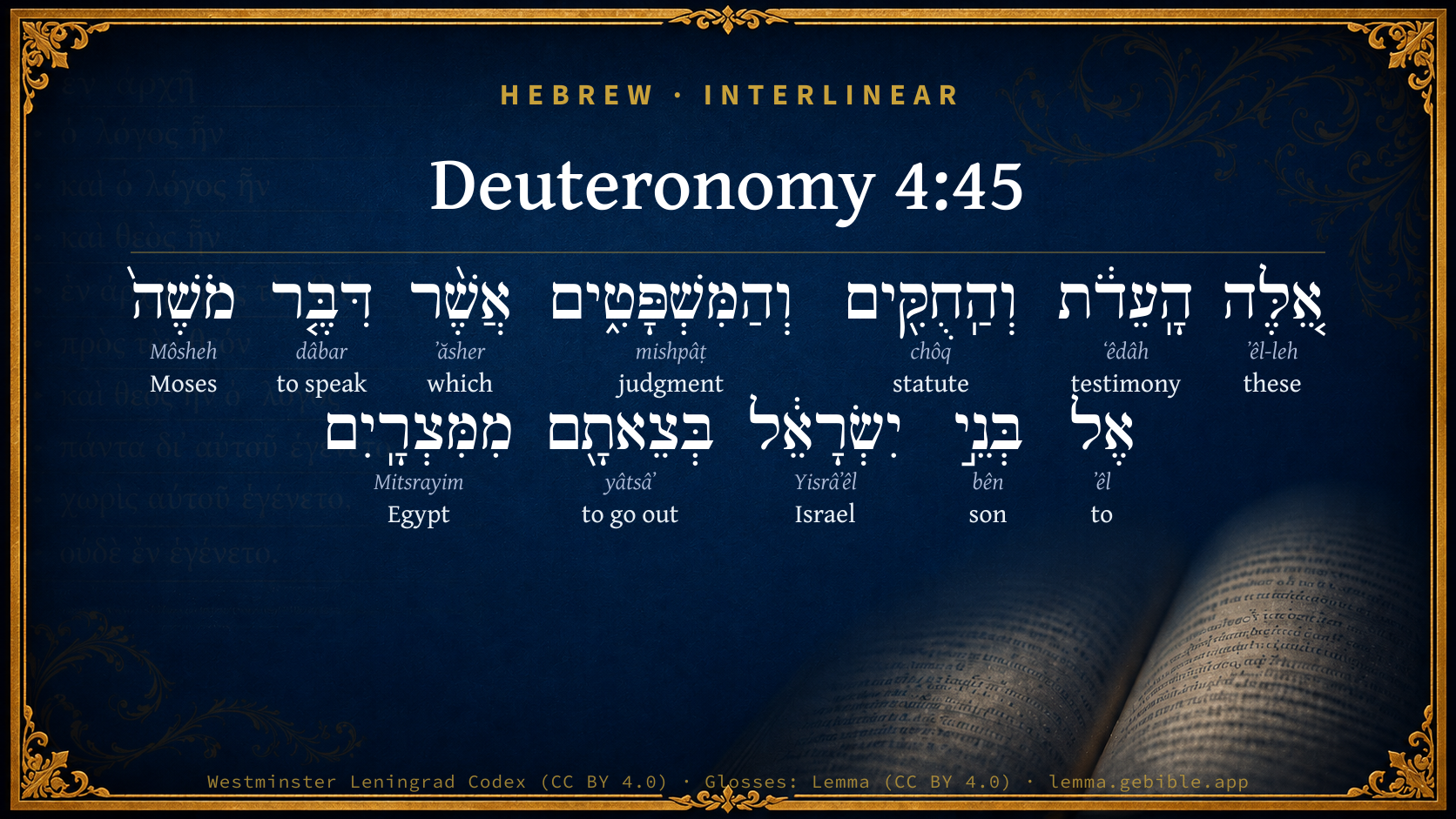
Deuteronomy 4:45

Hebrew (Westminster Leningrad Codex) Deuteronomy 4:45 appears in the Hebrew Old Testament. The text above is from the Westminster Leningrad Codex. Each word links to its Strong’s number, a concise gloss, and parsing drawn from the Open Scriptures Hebrew Bible morphology. Click any word for its full Brown-Driver-Briggs (BDB) entry.
Download image
Cite this verse

Deuteronomy 4:45 (World English Bible). Public Domain. Lemma interlinear Bible study tool, https://lemma.gebible.app/v/deuteronomy/4/45.

Show BibTeX & RIS
BibTeX
RIS
English Translation
these are the testimonies, and the statutes, and the ordinances, which Moses spoke to the children of Israel, when they came forth out of Egypt,
World English Bible · Public Domain
Download a study sheet

One document with this verse’s original text, its word-by-word gloss line, the meaning frame, cross-references with their text, attributed commentary, and full source and license credits — printable, and it pastes into notes with its structure intact.

This verse Autodidact and up

Study sheet (.html) Plain text (.txt)

A passage Seminary Student

Up to 50 verses in one chapter. A passage sheet keeps up to 6 commentary sources and 12 cross-references per verse, in the order this page ranks them, and says so on the sheet whenever that leaves anything out. Ask for a single verse and you get the Autodidact verse sheet above.

Everything on this page stays free to read, with no account — the sheet is a download of what is already on screen, not access to it.

Want to remove ads? Support Godless Engineer
Compare translations 3

The same verse in 3 English versions, stacked beneath the original-language interlinear above. Click any original word for its lexicon entry.

Each is an independent rendering of the whole verse — the interlinear is not word-aligned to these translations.

Highlighted words mark where these versions differ — a whole-verse word diff, not a word-by-word alignment.

  • World English Bible Public Domain
    these are the testimonies, and the statutes, and the ordinances, which Moses spoke to the children of Israel, when they came forth out of Egypt,
  • King James Version Public Domain
    These are the testimonies, and the statutes, and the judgments, which Moses spake unto the children of Israel, after they came forth out of Egypt.
  • unfoldingWord Literal Text CC BY-SA 4.0
    These the testimonies and the statutes and the judgments that Moses spoke to the sons of Israel when they came out from Egypt,

unfoldingWord Literal Text — © unfoldingWord, licensed CC BY-SA 4.0. Word-aligned USFM3 via Door43 (git.door43.org/unfoldingWord/en_ult).

Versions to compare (up to 4)

3 of 4 selected

Show all 18 translations

Every available English version of this verse, each an independent rendering of the whole verse.

  • World English Bible Public Domain
    these are the testimonies, and the statutes, and the ordinances, which Moses spoke to the children of Israel, when they came forth out of Egypt,
  • Berean Standard Bible Public Domain
    These are the testimonies, statutes, and ordinances that Moses proclaimed to them after they had come out of Egypt,
  • Majority Standard Bible Public Domain
    These are the testimonies, statutes, and ordinances that Moses proclaimed to them after they had come out of Egypt,
  • King James Version Public Domain
    These are the testimonies, and the statutes, and the judgments, which Moses spake unto the children of Israel, after they came forth out of Egypt.
  • American Standard Version (1901) Public Domain
    these are the testimonies, and the statutes, and the ordinances, which Moses spake unto the children of Israel, when they came forth out of Egypt,
  • Revised Version (1885) Public Domain
    these are the testimonies, and the statutes, and the judgments, which Moses spake unto the children of Israel, when they came forth out of Egypt;
  • Geneva Bible (1599) Public Domain
    These are the witnesses, and the ordinances, and the lawes which Moses declared to the children of Israel after they came out of Egypt,
  • Douay-Rheims (1899) Public Domain
    And these are the testimonies and ceremonies and judgments, which he spoke to the children of Israel, when they came out of Egypt,
  • Young's Literal Translation Public Domain
    these `are' the testimonies, and the statutes, and the judgments, which Moses hath spoken unto the sons of Israel, in their coming out of Egypt,
  • Literal Standard Version CC BY-SA 4.0
    these [are] the testimonies, and the statutes, and the judgments, which Moses has spoken to the sons of Israel in their coming out of Egypt,
  • Unlocked Literal Bible CC BY-SA 4.0
    these are the covenant decrees, laws, and other decrees that he spoke to the people of Israel when they came out of Egypt,
  • unfoldingWord Literal Text CC BY-SA 4.0
    These the testimonies and the statutes and the judgments that Moses spoke to the sons of Israel when they came out from Egypt,
  • Darby Bible Public Domain
    these are the testimonies, and the statutes, and the ordinances that Moses declared to the children of Israel, when they came out of Egypt,
  • World Messianic Bible Public Domain
    These are the testimonies, and the statutes, and the ordinances which Moses spoke to the children of Israel when they came out of Egypt,
  • Webster's Bible Public Domain
    These are the testimonies, and the statutes, and the judgments, which Moses spoke to the children of Israel, after they came forth from Egypt,
  • Free Bible Version CC BY-SA 4.0
    These are the laws, rules, and regulations Moses gave them after they had come out of Egypt.
  • Bible in Basic English Public Domain
    These are the rules and the laws and the decisions which Moses gave to the children of Israel after they came out of Egypt;
  • JPS Tanakh (1917) Public Domain
    these are the testimonies, and the statutes, and the ordinances, which Moses spoke unto the children of Israel, when they came forth out of Egypt;

Literal Standard Version (2020), Covenant Press — licensed CC BY-SA 4.0. Text via the HelloAO Bible API (eBible.org). Unlocked Literal Bible (unfoldingWord) — licensed CC BY-SA 4.0. Text via the HelloAO Bible API (eBible.org). unfoldingWord Literal Text — © unfoldingWord, licensed CC BY-SA 4.0. Word-aligned USFM3 via Door43 (git.door43.org/unfoldingWord/en_ult). Free Bible Version, Dr. Jonathan Gallagher — licensed CC BY-SA 4.0. Text via the HelloAO Bible API (eBible.org).

Word by word

More ways to search: Search by grammar → Find every occurrence → Compare this word →

Practice this passage: Drill this verse → Learn its vocabulary →

הָֽעֵדֹ֔ת
ʻêdâh
H5713
“the · testimonies”
Particle, Definite Article + Noun, Common, Feminine, Plural, Absolute
Part of Speech
Particle + Noun
Type
Common
Gender
Feminine
Number
Plural
State
Absolute
Full BDB Definition

Origin: from H5707 in its technical sense

TWOT: 1576c , 1576e

testimony, witness - always plural and always of laws as divine testimonies
  1. אֵ֚לֶּה ʼêl-leh H428 “these” Pronoun, Demonstrative, Common, Plural
  2. וְהַֽחֻקִּ֖ים chôq H2706 “and · the · statutes” Conjunction + Particle, Definite Article + Noun, Common, Masculine, Plural, Absolute
  3. וְהַמִּשְׁפָּטִ֑ים mishpâṭ H4941 “and · the · judgments” Conjunction + Particle, Definite Article + Noun, Common, Masculine, Plural, Absolute
  4. אֲשֶׁ֨ר ʼăsher H834 “which” Particle, Relative
  5. דִּבֶּ֤ר dâbar H1696 “to speak” Verb, Piel, Perfect, 3rd Person, Masculine, Singular
  6. מֹשֶׁה֙ Môsheh H4872 “Moses” Noun, Proper
  7. אֶל ʼêl H413 “to” Preposition
  8. בְּנֵ֣י bên H1121 “sons of” Noun, Common, Masculine, Plural, Construct
  9. יִשְׂרָאֵ֔ל Yisrâʼêl H3478 “Israel” Noun, Proper
  10. בְּצֵאתָ֖ם yâtsâʼ H3318 “in/at · to go out · them” Preposition + Verb, Qal, Infinitive Construct + Suffix, Personal, 3rd Person, Masculine, Plural
  11. מִמִּצְרָֽיִם Mitsrayim H4714 “from · Egypt” Preposition + Noun, Proper

About this verse

These counts appear in no published source. They are computed here, from the morphology-tagged text and Lemma’s own curated glosses. What Lemma adds →

12
words
12
distinct lemmas
Pentateuch
section

Shared distinctive vocabulary

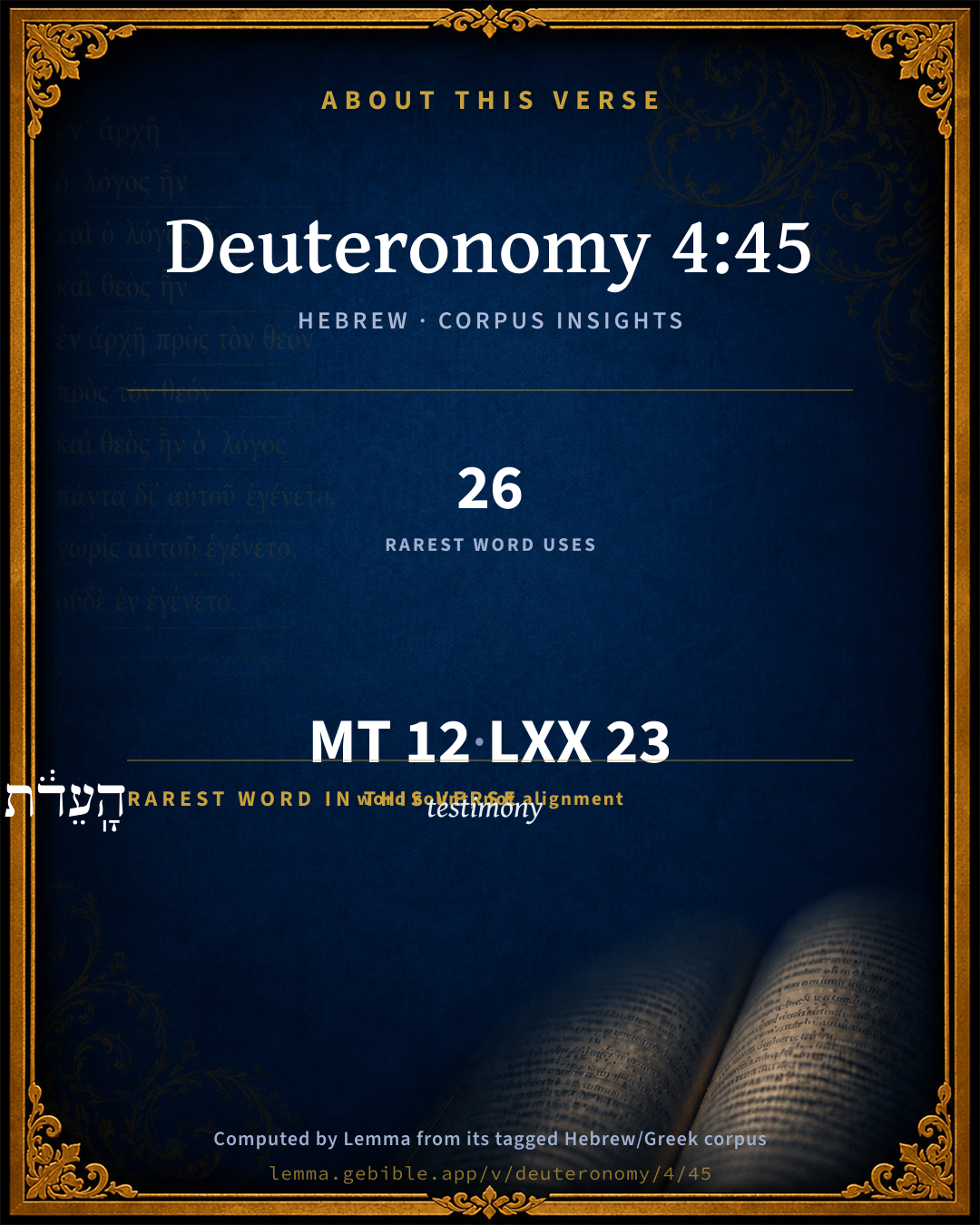
הָֽעֵדֹ֔ת testimony H5713 occurs in 25 verses of the Hebrew Bible. Also found in:

Grammatical profile

  • 2 verbs
  • 7 nouns
  • 1 pronoun
  • 1 preposition
  • 1 particle

Verb forms

  • דִּבֶּ֤ר Piel · Perfect
  • בְּצֵאתָ֖ם Qal · Infinitive Construct

Hebrew & Septuagint length

In English translation the verse runs 25 words from the Hebrew and 27 from the Septuagint (LXX English) — closely comparable.

A rough comparison of the two English renderings, which tokenize alike — not a word-level alignment.

Word counts can differ between the Hebrew and the Greek without any difference in meaning — e.g. the Hebrew direct-object marker אֵת has no separate Greek word, and Greek often adds the article ὁ.

In the original languages it is 12 Hebrew tokens and 23 Greek tokens — but the two are counted differently (Hebrew bundles its prefixes and suffixes into one token; the Greek is in lemma form), so that isn’t a like-for-like length.

Cross-references

11

Topical passages linked to Deuteronomy 4:45 in the Treasury of Scripture Knowledge — connected by theme and wording, ordered by reader-vote popularity; previews shown in the World English Bible.

  • Deuteronomy 4:1 Now, Israel, listen to the statutes and to the ordinances, which I teach you, to do them; that you may live, and go in and possess the land which Yahweh, the God of your fathers, gives you.
  • Deuteronomy 6:17 You shall diligently keep the commandments of Yahweh your God, and his testimonies, and his statutes, which he has commanded you.
  • Deuteronomy 6:20 When your son asks you in time to come, saying, What mean the testimonies, and the statutes, and the ordinances, which Yahweh our God has commanded you?
  • 1 Kings 2:3 and keep the charge of Yahweh your God, to walk in his ways, to keep his statutes, [and] his commandments, and his ordinances, and his testimonies, according to that which is written in the law of Moses, that you may prosper in all that you do, and wherever you turn yourself.
  • Psalms 119:2 Blessed are those who keep his statutes, Who seek him with their whole heart.
  • Psalms 119:5 Oh that my ways were steadfast To obey your statutes!
  • Psalms 119:7 I will give thanks to you with uprightness of heart, When I learn your righteous judgments.
  • Psalms 119:14 I have rejoiced in the way of your testimonies, As much as in all riches.
  • Psalms 119:22 Take reproach and contempt away from me, For I have kept your statutes.
  • Psalms 119:24 Indeed your statutes are my delight, And my counselors.
  • Psalms 119:111 I have taken your testimonies as a heritage forever, For they are the joy of my heart.

Cross-references courtesy of OpenBible.info (CC BY 4.0).

Hebrew and Greek witnesses Masoretic Hebrew ↔ Greek Septuagint

The same verse in the two great witnesses to the Old Testament, shown verse-for-verse.

These are two independent witnesses, not word-aligned to each other, and the Septuagint is shown in lemma (dictionary) form.

Hebrew Deuteronomy 4:45 Masoretic · Westminster Leningrad Codex

אֵ֚לֶּה הָֽעֵדֹ֔ת וְהַֽחֻקִּ֖ים וְהַמִּשְׁפָּטִ֑ים אֲשֶׁ֨ר דִּבֶּ֤ר מֹשֶׁה֙ אֶל בְּנֵ֣י יִשְׂרָאֵ֔ל בְּצֵאתָ֖ם מִמִּצְרָֽיִם

these are the testimonies, and the statutes, and the ordinances, which Moses spoke to the children of Israel, when they came forth out of Egypt,

World English Bible · Public Domain

Greek LXX Deuteronomy 4:45 Septuagint · lemma form

οὗτος ὁ μαρτύριον καί ὁ δικαίωμα καί ὁ κρίμα ὅσος λαλέω μωυσῆς ὁ υἱός ἰσραήλ ἐν ὁ ἔρημος ἐκἔρχομαι αὐτός ἐκ γῆ αἴγυπτος

These are the testimonies, and the ordinances, and the judgments, which Moses spoke to the sons of Israel, when they came out of the land of Egypt:

LXX2012 (modern English Septuagint) · Public Domain

Hebrew: Westminster Leningrad Codex (CC BY 4.0). Greek: Septuagint (public domain); English from LXX2012 (modern English Septuagint) (Public Domain). How the Septuagint differs from the Hebrew →

Targum (Aramaic paraphrase)

2

The Targum is the ancient Jewish Aramaic paraphrase of the Hebrew Scriptures — an interpretive translation, not the Hebrew text itself. Onkelos (literal) and Pseudo-Jonathan (expansive) render the Torah, and Jonathan the Prophets. Coverage is partial: where no permissively-licensed English translation exists for a verse, only the Aramaic is shown. This is verse-level text, not a word-by-word alignment to the Hebrew.

  1. Targum Onkelos Torah (Genesis–Deuteronomy)
    אִלֵין סָהֶדְוָתָא וּקְיָמַיָא וְדִינַיָא דִי מַלִיל מֹשֶׁה עִם בְּנֵי יִשְׂרָאֵל בְּמִפָּקְהוֹן מִמִצְרָיִם

    (no public-domain English translation for this verse)

    Targum Onkelos — Aramaic: “Onkelos Genesis” (public domain); “Onkelos Exodus” (public domain); “Onkelos Leviticus” (public domain); “Onkelos Numbers” (public domain); “Onkelos Deuteronomy” (public domain). English: “Sefaria Community Translation” (CC0 1.0 (public-domain dedication)); “J.W. Etheridge. The Targums of Onkelos and Jonathan Ben Uzziel on the Pentateuch. London: Longmans, Green, 1862” (public domain). Text via Sefaria.

  2. Targum Pseudo-Jonathan Torah (Genesis–Deuteronomy)
    אִלֵין סָהִידְוָותָא וּקְיָמַיָא וְדִינַיָא דְמַלֵיל משֶׁה עִם בְּנֵי יִשְרָאֵל בִּזְמַן מִפַּקְהוֹן מִמִּצְרָיִם

    and the statutes and judgments which Mosheh spake with the sons of Israel at the time when they had come out of Mizraim.

    Targum Pseudo-Jonathan — Aramaic: “Targum Jonathan on Genesis” (public domain); “Targum Jonathan on Exodus” (public domain); “Targum Jonathan on Leviticus” (public domain); “Targum Jonathan on Numbers” (public domain); “Targum Jonathan on Deuteronomy” (public domain). English: “The Targum of Jonathan ben Uzziel, trans. J. W. Etheridge, London, 1862” (public domain). Text via Sefaria.

Commentary

Notes on Deuteronomy 4:45 from classic Christian and Jewish commentators (each source and its license shown beneath its notes). The classic Christian expositions comment on the surrounding passage and are grouped to its opening verse, so a note may address several verses; the Jewish commentaries on the Tanakh (Rashi and others) are per-verse, so they appear only where the commentator wrote on this verse.

Lemma curates 59 commentaries, every one of them public domain or Creative Commons licensed, each selected and text-cleaned for this edition rather than reprinted as found. About our sources →

The Cambridge Bible for Schools and Colleges

gen. ed. J. J. S. Perowne

45. the testimonies] An unsatisfactory translation of Heb. ‘çdoth. As the kindred verb signifies to solemnly affirm, attest, protest and warn, ‘edôth may mean either (1) decrees or edicts, or (2) solemn exhortations. Its association with statutes and judgements, here and again in Deu_6:20, and with commandments and statutes in Deu_6:17, where it stands not before but between these two legal terms, favours the former alternative. Similarly P uses the related form ‘edûth for the Decalogue. Steuernagel’s opinion that ‘edôth here covers the following hortatory discourses is therefore, while possible, less probable. Bertholet, limiting the reference of Deu_4:45-49 to ch. 5 (see introd. to this section), suggests that ‘edôth means the Decalogue in ch. 5.

statutes, and the judgements] See Deu_4:1.

children of Israel] See Deu_4:44.

when they came forth out of Egypt] An illustration of the writer’s late perspective. For thus to date legislation given in Moab forty years after the actual Exodus, was not possible for Moses himself or for a writer contemporary or nearly contemporary with him; but only for one viewing the whole progress of Israel from Egypt to the Promised Land from a very distant standpoint.

The Cambridge Bible for Schools and Colleges (gen. ed. J. J. S. Perowne; Cambridge University Press, 1878–1918) — public domain. Text from a community e-Sword module.

Geneva Bible (1599)

Geneva Bible translators

The articles and points of the covenant.

Geneva Bible (1599) marginal notes — public domain. Text via Bolls.life.

John Gill's Exposition

On this side Jordan, in the valley, over against Bethpeor,.... Where the Israelites abode some time; see Deu 3:29,

in the land of Sihon king of the Amorites, who dwelt at Heshbon; which was now conquered, and in the hands of the Israelites:

whom Moses and the children of Israel smote, after they came out of Egypt; not as soon as, or quickly after they came from thence; for it was but a few months ago since this conquest was made, whereas it was near forty years since they came out of Egypt.

John Gill's Exposition of the Whole Bible (1746–1763) — public domain (CC PDM 1.0). Text via the HelloAO Bible API.

The Pulpit Commentary

Testimonies; ordinances attested and confirmed by God; the word used here (twOde, plu. of hde) occurs only in Deuteronomy (here Deu_6:17, Deu_6:20) and in the Psalms. Statutes and judgments (cf. Deu_4:1) After they came forth out of Egypt; "i.e. not immediately after their exit, But, as ver. 46 shows, when they were already beyond Jordan" (Herxheimer); literally, in their coming out: i.e. during the process of their passing from Egypt to Canaan; more exactly defined by what follows.

The Pulpit Commentary (1880–1919), ed. H.D.M. Spence-Jones & Joseph S. Exell — public domain. Text from a community e-Sword module.

Rashi

Rabbi Shlomo Yitzchaki (Rashi)

אלה העדות … אשר דבר THESE ARE THE TESTIMONIES … WHICH [MOSES] SPAKE — Those are the very same testimonies which he spoke when they came forth from Egypt; and he again repeated it (this law) to them in the plains of Moab.

Rashi on the Tanakh — English translations: “The Judaica Press complete Tanach with Rashi, translated by A. J. Rosenberg” (CC BY 4.0); “Pentateuch with Rashi's commentary by M. Rosenbaum and A.M. Silbermann, 1929-1934” (public domain); “The Metsudah Tanach series, Lakewood, N.J” (CC BY 4.0); and “The Book of Joshua, Metsudah Publications, 1997” (CC BY 4.0). Text via Sefaria.

Lesson kit

Teaching starters — assembled from the data on this page, not authored interpretation. Every prompt links to the verse data it draws on. Edit before teaching.

Deuteronomy, in the Pentateuch, opens this verse with 12 words (12 distinct Hebrew lemmas). Its most distinctive word is ʻêdâh (“testimony”). A historical commentator’s framing appears above. Read the whole chapter for the surrounding context.

Discussion questions

  1. The word ʻêdâh carries the sense “testimony.” How does it shape the verse?
  2. Genesis 21:30 shares the word «testimony» with this verse. How do the two illuminate each other?
  3. These translations render this verse differently. What is at stake in choosing one wording over another?
  4. The verb «דִּבֶּ֤ר» is Piel Perfect. How does its form color the action?
  5. Reading how The Cambridge Bible for Schools and Colleges and Geneva Bible (1599) read this verse, where do the two commentators agree and where do they part?

Things to notice

Reading settings

Reading text

Shown beneath each verse's original-language words.

Old Testament
Old Testament edition

Read the OT as the Masoretic Hebrew (MT) or the Greek Septuagint (LXX).

English shown for the Greek Septuagint (in the Hebrew ↔ Greek comparison).

Comparing translations? Open the Compare panel on any verse page to stack up to four side by side.