
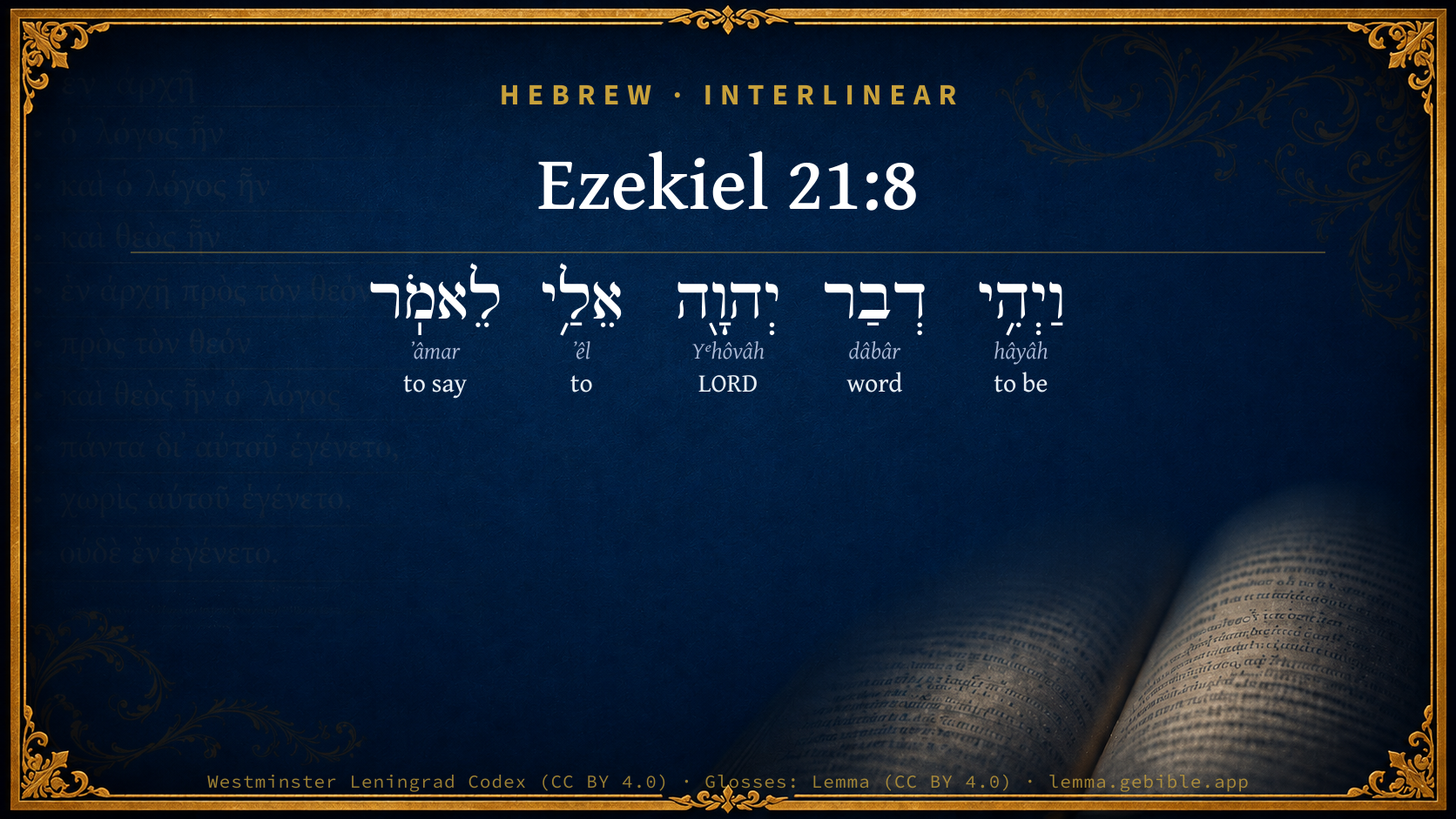
Ezekiel 21:8

Hebrew (Westminster Leningrad Codex) Ezekiel 21:8 appears in the Hebrew Old Testament. The text above is from the Westminster Leningrad Codex. Each word links to its Strong’s number, a concise gloss, and parsing drawn from the Open Scriptures Hebrew Bible morphology. Click any word for its full Brown-Driver-Briggs (BDB) entry.
Download image
Cite this verse

Ezekiel 21:8 (World English Bible). Public Domain. Lemma interlinear Bible study tool, https://lemma.gebible.app/v/ezekiel/21/8.

Show BibTeX & RIS
BibTeX
RIS
English Translation
The word of Yahweh came to me, saying,
World English Bible · Public Domain
Download a study sheet

One document with this verse’s original text, its word-by-word gloss line, the meaning frame, cross-references with their text, attributed commentary, and full source and license credits — printable, and it pastes into notes with its structure intact.

This verse Autodidact and up

Study sheet (.html) Plain text (.txt)

A passage Seminary Student

Up to 50 verses in one chapter. A passage sheet keeps up to 6 commentary sources and 12 cross-references per verse, in the order this page ranks them, and says so on the sheet whenever that leaves anything out. Ask for a single verse and you get the Autodidact verse sheet above.

Everything on this page stays free to read, with no account — the sheet is a download of what is already on screen, not access to it.

Want to remove ads? Support Godless Engineer
Compare translations 3

The same verse in 3 English versions, stacked beneath the original-language interlinear above. Click any original word for its lexicon entry.

Each is an independent rendering of the whole verse — the interlinear is not word-aligned to these translations.

Highlighted words mark where these versions differ — a whole-verse word diff, not a word-by-word alignment.

  • World English Bible Public Domain
    The word of Yahweh came to me, saying,
  • King James Version Public Domain
    Again the word of the LORD came unto me, saying,
  • unfoldingWord Literal Text CC BY-SA 4.0
    Then the word of Yahweh came to me, saying,

unfoldingWord Literal Text — © unfoldingWord, licensed CC BY-SA 4.0. Word-aligned USFM3 via Door43 (git.door43.org/unfoldingWord/en_ult).

Versions to compare (up to 4)

3 of 4 selected

Show all 18 translations

Every available English version of this verse, each an independent rendering of the whole verse.

  • World English Bible Public Domain
    The word of Yahweh came to me, saying,
  • Berean Standard Bible Public Domain
    Again the word of the LORD came to me, saying,
  • Majority Standard Bible Public Domain
    Again the word of the LORD came to me, saying,
  • King James Version Public Domain
    Again the word of the LORD came unto me, saying,
  • American Standard Version (1901) Public Domain
    And the word of Jehovah came unto me, saying,
  • Revised Version (1885) Public Domain
    And the word of the LORD came unto me, saying,
  • Geneva Bible (1599) Public Domain
    Againe, the word of the Lord came vnto me, saying,
  • Douay-Rheims (1899) Public Domain
    And the word of the Lord came to me, saying:
  • Young's Literal Translation Public Domain
    And there is a word of Jehovah unto me, saying,
  • Literal Standard Version CC BY-SA 4.0
    And there is a word of YHWH to me, saying,
  • Unlocked Literal Bible CC BY-SA 4.0
    Then the word of Yahweh came to me, saying,
  • unfoldingWord Literal Text CC BY-SA 4.0
    Then the word of Yahweh came to me, saying,
  • Darby Bible Public Domain
    And the word of Jehovah came unto me, saying,
  • World Messianic Bible Public Domain
    The LORD’s word came to me, saying,
  • Webster's Bible Public Domain
    Again the word of the LORD came to me, saying,
  • Free Bible Version CC BY-SA 4.0
    Another message from the Lord came to me, saying,
  • Bible in Basic English Public Domain
    And the word of the Lord came to me, saying,
  • JPS Tanakh (1917) Public Domain
    (21-13) And the word of the LORD came unto me, saying:

Literal Standard Version (2020), Covenant Press — licensed CC BY-SA 4.0. Text via the HelloAO Bible API (eBible.org). Unlocked Literal Bible (unfoldingWord) — licensed CC BY-SA 4.0. Text via the HelloAO Bible API (eBible.org). unfoldingWord Literal Text — © unfoldingWord, licensed CC BY-SA 4.0. Word-aligned USFM3 via Door43 (git.door43.org/unfoldingWord/en_ult). Free Bible Version, Dr. Jonathan Gallagher — licensed CC BY-SA 4.0. Text via the HelloAO Bible API (eBible.org).

Word by word

More ways to search: Search by grammar → Find every occurrence → Compare this word →

Practice this passage: Drill this verse → Learn its vocabulary →

About this verse

These counts appear in no published source. They are computed here, from the morphology-tagged text and Lemma’s own curated glosses. What Lemma adds →

5
words
5
distinct lemmas
Prophets
section

Grammatical profile

  • 2 verbs
  • 2 nouns
  • 1 preposition

Verb forms

  • וַיְהִ֥י Qal · Sequential Imperfect
  • לֵאמֹֽר Qal · Infinitive Construct

Hebrew & Septuagint length

In English translation the verse runs 8 words from the Hebrew and 10 from the Septuagint (LXX English) — closely comparable.

A rough comparison of the two English renderings, which tokenize alike — not a word-level alignment.

Word counts can differ between the Hebrew and the Greek without any difference in meaning — e.g. the Hebrew direct-object marker אֵת has no separate Greek word, and Greek often adds the article ὁ.

Hebrew and Greek witnesses Masoretic Hebrew ↔ Greek Septuagint

The same verse in the two great witnesses to the Old Testament, shown verse-for-verse.

These are two independent witnesses, not word-aligned to each other, and the Septuagint is shown in lemma (dictionary) form.

Hebrew Ezekiel 21:8 Masoretic · Westminster Leningrad Codex

וַיְהִ֥י דְבַר יְהוָ֖ה אֵלַ֥י לֵאמֹֽר

The word of Yahweh came to me, saying,

World English Bible · Public Domain

Greek LXX Ezekiel 21:8 Septuagint · lemma form

καί εἶπον πρός ὁ γῆ ὁ ἰσραήλ ἰδού ἐγώ πρός σύ καί ἐκσπάω ὁ ἐγχειρίδιον ἐγώ ἐκ ὁ κολεός αὐτός καί ἐκὀλεθρεύω ἐκ σύ ἄδικος καί ἄνομος

And the word of the Lord came to me, saying,

LXX2012 (modern English Septuagint) · Public Domain

On this verse, Fairbairn on Ezekiel, Jonah & the Pastoral Epistles discusses the Septuagint’s reading. Read the note in Commentary ↓

Hebrew: Westminster Leningrad Codex (CC BY 4.0). Greek: Septuagint (public domain); English from LXX2012 (modern English Septuagint) (Public Domain). How the Septuagint differs from the Hebrew →

Targum (Aramaic paraphrase)

1

The Targum is the ancient Jewish Aramaic paraphrase of the Hebrew Scriptures — an interpretive translation, not the Hebrew text itself. Onkelos (literal) and Pseudo-Jonathan (expansive) render the Torah, and Jonathan the Prophets. Coverage is partial: where no permissively-licensed English translation exists for a verse, only the Aramaic is shown. This is verse-level text, not a word-by-word alignment to the Hebrew.

  1. Targum Jonathan Prophets (Joshua–Malachi)
    וְתֵימַר לְאַרְעָא דְיִשְׂרָאֵל כִּדְנַן אֲמַר יְיָ הָא אֲנָא שְׁלַח רוּגְזִי עֲלָךְ וְאַפֵּיק חַרְבִּי מִלִדְנָהּ וְאַגְלֵי מִנִיךְ זַכָּאָךְ בְּדִיל לְשֵׁיצָאָה חַיָבָךְ:

    (no public-domain English translation for this verse)

    Targum Jonathan — Aramaic: “Mikraot Gedolot” (public domain). English: “Sefaria Community Translation” (CC0 1.0 (public-domain dedication)); “London "Chaldee Paraphrase," 1871” (public domain). Text via Sefaria.

Commentary

Notes on Ezekiel 21:8 from classic Christian and Jewish commentators (each source and its license shown beneath its notes). The classic Christian expositions comment on the surrounding passage and are grouped to its opening verse, so a note may address several verses; the Jewish commentaries on the Tanakh (Rashi and others) are per-verse, so they appear only where the commentator wrote on this verse.

Lemma curates 59 commentaries, every one of them public domain or Creative Commons licensed, each selected and text-cleaned for this edition rather than reprinted as found. About our sources →

Ellicott's Commentary for English Readers

(8-17) This second prophecy is an expansion of the last, Eze_21:8-13 corresponding to 2-5, and Eze_21:14-17 to Eze_21:6-7. In several of its clauses modern criticism has been able to improve the translation, and make it clearer.

A Bible Commentary for English Readers, edited by Charles John Ellicott (1878–1897) — public domain. Text from a community e-Sword module.

Trapp's Complete Commentary

John Trapp

Eze 21:8 Again the word of the LORD came unto me, saying,

Ver. 8. Again the word.] See on Eze 18:1.

John Trapp, A Commentary or Exposition upon All the Books of the Old and New Testament (1647–1656) — public domain. Text from a community e-Sword module.

The Preacher's Complete Homiletical Commentary

Joseph S. Exell (gen. ed.)

EXEGETICAL NOTES. (Eze_21:8-17.) The sword is sharpened for slaying. As they are a people who refuse to understand, the judgment is announced in the plainest terms.

Eze_21:9. “And also furbished.” As if the sword so long unused had rusted in its sheath. “The repetition—a sword, a sword, is not without effect—definitely pointing to the destructive weapon to be employed in the war. To augment the terror which the announcement was calculated to inspire, the sword is described as sharpened, prepared to do execution, and also polished. The glittering of a highly-polished sword, wielded in the sun, is truly terrific (Deu_32:41; Job_20:25”).—(Henderson.)

Eze_21:10. It is sharpened to make a sore slaughter. Heb. That slaying it may slay. It is made ready not for display, but for its terrible work of judgment. It is furbished that it may glitter. Heb. Have lightning, Comp. Eze_21:28. This is the sword spoken of in Deu_32:41, where the expression, “My glittering sword “is literally” the lightning of My sword.” Such also is the sword wielded by the Cherubim (Eze_1:13-14), and by those who were the avengers of God’s broken Law. (Exo_19:16). “Should we then make mirth?” Nothing could be worse-timed than to make light of these judgments. “It contemneth the rod of My son, as every tree.” “My son,” is the same as “My people,” in Eze_21:12. The expression, the rod of My son, is the genitive of object—i e., the instrument employed in punishing My son. In accordance with this is the rendering of the Revised Version, “The rod of My son, it contemneth every tree.” The sword of Nebuchadnezzar was the rod which punished God’s people, and that rod of the universal conqueror set at nought all others.

Eze_21:11. “And He hath given it to be furbished that it may be handled.” “He hath given,” used impersonally for and it is given, according to an idiom common in Hebrew. “The instrument of destruction was quite prepared, and only required to be employed by Jehovah against His apostate people.”—(Henderson.)

Eze_21:12. “For it shall be upon My people.” The object of the Chaldean expedition is here clearly pointed out. The Jews were not to delude themselves with the idea that it was Egypt or any other neighbouring nation that was to come under the judgment of God’s avenging sword. The punishment would fall upon themselves.

Eze_21:13. “Because it is a trial.” “These words point with the utmost brevity to the character of the impending time, which presented itself in rosy hues to the politically excited people. Trial is a terrible word to a people that suffers the deepest calamities. When the trial comes, nothing remains undisclosed, nothing unrequited; every varnish disappears, and all glitter vanishes.”—(Hengstenberg). “And what if the sword contemn even the rod? it shall be no more, saith the Lord God.” “With a view to the sanguine imaginations by which the people sought to banish the thought of the hardness of the times, the prophet then asks, ‘And how? should the despising rod (the punishment that far outstrips all other punishments, Eze_21:10) not be?’ And the answer to this question he gives in the names of God, which utter a loud no to these illusions.”—(Hengstenberg.) “If Nebuchadnezzar should really despise the resistance made by the Jewish state, which he did (Eze_21:10)—what was to be expected as the consequence? That state must necessarily come to an end, it shall not be. Such I regard as the meaning of this most difficult verse.”—(Henderson.) The general idea of the text is, what if, under this terrible judgment, Judah’s temporal power and royalty shall cease to exist? And in Eze_21:27, we are told that this result shall certainly come to pass. But the kingdom shall be restored by One whose sceptre of righteousness despises every earthly power.

Eze_21:14. “And let the sword be doubled the third time.” “These words are designed to express the tremendous size and power of the sword to be employed. It was no ordinary foe that was to attack the Jews. All hopes of escape were vain. It was a sword that had been well tried, and proved successful in many a battle,—the sword of the slain.”—(Henderson.) “Which entereth into their privy chambers.” It will invade the sanctity of their houses (Deu_32:25). There may be some reference also to its penetrating into their secret “chambers of imagery” (Eze_8:12).

Eze_21:15. “I have set the point of the sword against all their gates.” The gates of their city are to be besieged by the naked sword. “And their ruins be multiplied.” Heb., And the fallen be numerous in all their gates. “Wrapped up for the slaughter.” Rather, made keen, or sharpened, for the slaughter.

Eze_21:16. “Go thee one way or other, either on the right hand or on the left, whithersoever thy face is set.” The address is to the sword, as if it were an army. The “right” and “left” show how wide is the area over which God shall execute His judgments; so wide that it embraces not only Judea, but a whole group of peoples. The word “whithersoever” seems to imply the idea of direction by the “living creatures” (Eze_1:9; Eze_1:12).

Eze_21:17. “I will also smite Mine hands together.” “By a strong anthropopathy Jehovah declares He will do what He had commanded the prophet to do (Eze_21:14). Smiting the hands together is an indication of violent grief. “I will cause My fury to rest” signifies, not the forbearing to pour it out in judgment, but the full and permanent infliction of it” (Henderson.) The fury of God is said to “rest” when it reaches its object, thus abiding upon it. “Jehovah will smite His hands together and cool His wrath upon them” (Keil).

HOMILETICS

THE SACRED, TERRIBLE SWORD-SONG

The prophets doubtless treated politics both on their outward and inward side, but only the politics of the kingdom of God (Eze_21:9). God shows us the sword, and waves it over our heads, so that we should be duly and profitably alarmed. He can use every creature as His sword; it is always prepared to execute His command. War as a divine judgment, therefore, for the punishment of evil doers; but it is also a preaching of repentance, when God sharpens the sword and makes it glitter. He who will not submit to the sword of God’s word (Heb_4:12) will be overtaken by the sword of the enemy. God Himself takes the offering which men will not give Him voluntarily (Eze_21:10). There can be joy amid the deepest sufferings, but not over another’s suffering, especially when it is punishment for sin. The sin of the people presses the sword into the hand for war (Eze_21:11). Sin was also interwoven with the conquering chaplets of the victors, as the dew upon these chaplets was innumerable tears and drops of blood. This must ever be remembered amid songs of triumph! Fortune of war, as men call it, what a sad fortune! God is the judge behind and in the conqueror. “Upon all the princes of Israel” (Eze_21:12.) Even the great have no privilege to sin. Trial is a terrible word to a people that suffers the deepest calamities. A tried sword is a dreadful thing when it turns against a people whom God has given up to judgment. One day an end will be made of all despisers of God and man. The history of the world as the fulfiment of prophecy (Eze_21:14). Symbolical prophecy—the emblems of punishment. Some must prophesy judgment who would so willingly speak of redemption, and redemption alone; men will not have the blessing, and therefore the curse must be exhibited. God’s sword draws not back from human elevation; it reaches the dwellers in the valley, and those also who sit on lofty seats. No earthly throne is a protection from the sword of God; the history of the world is filled with proofs of this. The last mighty pierced-through one is Antichrist. Alas, who can hide from the wrath of God!—(Lange.)

(Eze_21:13)

“Because it is a trial.” We may consider Eze_21:12-13 as thus understood: There is cause thou shouldst cry, howl, smite upon thy thigh, because the sword shall be a trial; and what also if it shall not be a despising rod? If it be a trying rod, there is cause enough to mourn, but it shall be a despising rod, and so there is more cause to mourn. If this rod make them not try their ways, repent, and turn, it shall be a rod to despise the stoutest of them and to destroy them.

1. That the judgments of God are trials. They discover and make known what people are. The fire tries the metals, and declares what is good silver, good gold and what is reprobate. God kept the children of Israel forty years in the wilderness, to prove them, and know what was in their hearts (Deu_8:8). The hard things they met with there discovered some to be murmurers, some idolaters, some fornicators, some backsliders. “It shall come to pass that when they shall be hungry, they shall fret themselves, and curse their king and their God” (Isa_8:21). When evil was upon them, then their wickedness appeared. So Jehoram said, “This evil is of the Lord, why should I wait for the Lord any longer?” His vileness came out in the time of his distress. When great winds are abroad, they discover what trees are sound or rotten.

2. God tries before he destroys. Rods of trial came before rods of destruction. When the sword is drawn, furbished, and whet, the Lord tries men thereby, whether they will consider their ways, repent and turn to Him, before He cut and destroy therewith. Tidings and terrors of the sword precede the strokes of it. God tries His people by threatenings, by bringing judgments near unto them, by inflicting lesser judgments upon them, before He makes an utter destruction of them; that they may learn righteousness, humble themselves, and so either prevent the judgments, or have them turned into mercies.

3. When rods of trial do us no good, then follow rods of destruction. When the trying rod hath been despised, then comes the rod that will not regard high or low, prince or people. At first God did lightly afflict Zebulun and Napthali, but that being in vain, afterwards He afflicts them more grievously (Isa_9:1). When Dimon profited not by her first strokes, God laid more upon her (Isa_15:9). When smiting the lintel of the door, and shaking the posts, did not prevail, then did the Lord cut and slay with the sword (Amo_9:1). If fear work not, He hath a pit; if that do it not, He hath a snare (Isa_24:17-18). When paternal chastisements profit not, God hath destroying judgments. He will deal then with men, not as erring children, but as open enemies.—(Greenhill.)

The Preacher's Complete Homiletical Commentary (gen. ed. Joseph S. Exell; Funk & Wagnalls, c. 1892) — public domain (pre-1929). A full-Bible homiletical/sermon-outline anthology covering 65 of 66 books (2 John is absent from the source module). Text from a community e-Sword module.

Keil & Delitzsch

C. F. Keil & F. Delitzsch

The Sword is Sharpened for Slaying

Eze 21:8. And the word of Jehovah came to me, saying, Eze 21:9. Son of man, prophesy, and say, Thus saith Jehovah, A sword, a sword sharpened and also polished: Eze 21:10. That it may effect a slaughter is it sharpened; that it may flash is it polished: or shall we rejoice (saying), the sceptre of my son despiseth all wood? Eze 21:11. But it has been given to be polished, to take it in the hand; it is sharpened, the sword, and it is polished, to give it into the hand of the slayer. Eze 21:12. Cry and howl, son of man, for it goeth over my people, it goeth over all the princes of Israel: they have fallen by the sword along with my people: therefore smite upon the thigh. Eze 21:13. For the trial is made, and what if the despising sceptre shall not come? is the saying of the Lord Jehovah. Eze 21:14. And thou, son of man, prophesy and smite the hands together, and the sword shall double itself into threefold, the sword of the pierced: it is the sword of a pierced one, of the great one, which encircles them. Eze 21:15. That the heart may be dissolved, and stumbling-blocks may be multiplied, I have set the drawing of the sword against all their gates: Alas! it is made into flashing, drawn for slaying. Eze 21:16. Gather thyself up to the right hand, turn to the left, whithersoever thine edge is intended. Eze 21:17. And I also will smite my hands together, and quiet my wrath: I, Jehovah, have spoken it. - The description of the sword is thrown into a lyrical form (Eze 21:8-13), - a kind of sword-song, commemorating the terrible devastation to be effected by the sword of the Lord. The repetition of חרב in Eze 21:9 is emphatic. הוּחדּה is the perfect Hophal of חדד, to sharpen. מרוּטה is the passive participle of מרט, to polish; מרטּה (Eze 21:10), the participle Pual, with מ dropped, and Dagesh euphon. היה, a rare form of the infinitive for היות. The polishing gives to the sword a flashing brilliancy, which renders the sharpness of its edge still more terrible. The very obscure words, 'או נשׂישׂ וגו, I agree with Schmieder and Kliefoth in regarding as a protest, interposed by the prophet in the name of the people against the divine threat of the sword of vengeance, on the ground of the promises which had been given to the tribe of Judah. או, or perhaps; introducing an opposite case, or an exception to what has been said. The words 'שׁבט are to be taken as an objection, so that לאמר is to be supplied in thought. The objection is taken from the promise given in Jacob's blessing to the tribe of Judah: "the sceptre will not depart from Judah" (Gen 49:10). שׁבט בּני points unquestionably to this. בּני is taken from Eze 21:9, where the patriarch addresses Judah, whom he compares to a young lion, as בּני. Consequently the sceptre of my son is the command which the patriarch holds out to view before the tribe of Judah. This sceptre despises all wood, i.e., every other ruler's staff, as bad wood. This view is not rendered a doubtful one by the fact that שׁבט is construed as a feminine here, whereas it is construed as a masculine in every other case; for this construction is unquestionable in Eze 21:7 (12), and has many analogies in its favour. All the other explanations that have been proposed are hardly worth mentioning, to say nothing of refuting, as they amount to nothing more than arbitrary conjectures; whereas the assumption that the words are to be explained from Gen 49:10 is naturally suggested by the unquestionable allusion to the prophecy in that passage, which we find in Eze 21:27 of the present chapter. ויּתּן in Eze 21:11 is to be taken adversatively, "but he gave it (the sword) to be sharpened." The subject to ויּתּן is not Jehovah, but is indefinite, "one" (man, Angl. they), although it is actually God who has prepared the sword for the slaughter of Israel. The train of thought is the following: Do not think we have no reason to fear the sharply-ground sword of Jehovah, because Judah has received the promise that the sceptre shall not depart from it; and this promise will certainly be fulfilled, and Judah be victorious over every hostile power. The promise will not help you in this instance. The sword is given to be ground, not that it may be put into the scabbard, but that it may be taken in the hand by a slayer, and smite all the people and all its princes. In the phrase היא הוּחדּה חרב, חרב is in apposition to the subject היא, and is introduced to give emphasis to the words. It is not till Eze 21:19 that it is stated who the slayer is; but the hearers of the prophecy could be in no doubt. Consequently - this is the connection with Eze 21:12 - there is no ground for rejoicing from a felling of security and pride, but rather an occasion for painful lamentation.

This is the meaning contained in the command to the prophet to cry and howl. For the sword will come upon the nation and its princes. It is the simplest rendering to take היא as referring to הרב, היה ב, to be at a person, to fasten to him, to come upon him, as in Sa1 24:14; Sa2 24:17. מגוּרי, not from גּוּר, but the passive participle of מגר in the Pual, to overthrow, cast down (Psa 89:45): "fallen by the sword have they (the princes) become, along with my people." The perfects are prophetic, representing that which will speedily take place as having already occurred. - Smiting upon the thigh is a sign of alarm and horror (Jer 31:19). בּחן, perfect Pual, is used impersonally: the trial is made. The words allude to the victories gained already by Nebuchadnezzar, which have furnished tests of the sharpness of his sword. The question which follows וּמה contains an aposiopesis: and what? Even if the despising sceptre shall not come, what will be the case then? שׁבט מאסת, according to Eze 21:10, is the sceptre of Judah, which despises all other sceptres as bad wood. יהיה, in this instance, is not "to be," in the sense of to remain, but to become, to happen, to come (come to pass), to enter. The meaning is, if the sceptre of Judah shall not display, or prove itself to possess, the strength expected of it. - With Eze 21:14 the address takes a new start, for the purpose of depicting still further the operations of the sword. Smiting the hands together (smiting hand in hand) is a gesture expressive of violent emotion (cf. Eze 6:11; Num 24:10). The sword is to double, i.e., multiply itself, into threefold (שׁלישׁתה, adverbial), namely, in its strength, or its edge. Of course this is not to be taken arithmetically, as it has been by Hitzig, but is a bold paradoxical statement concerning the terrible effect produced by the sword. It is not even to be understood as referring to three attacks made at different times by the Chaldeans upon Jerusalem, as many of the commentators suppose. The sword is called חבב חללים, sword of pierced ones, because it produces the pierced or slain. The following words are rendered by Hitzig and Kliefoth: the great sword of the slain. But apart from the tautology which this occasions, the rendering can hardly be defended on grammatical grounds. For, in the first place, we cannot see why the singular חלל should have been chosen, when the expression was repeated, instead of the plural חללים; and secondly, חגּדול cannot be an adjective agreeing with חרב, for חרב is a noun of the feminine gender, and is construed here as a feminine, as החדרת clearly shows. הגּדול is in apposition to חלל, "sword of a pierced man, the great one;" and the great man pierced is the king, as Ewald admits, in agreement with Hengstenberg and Hvernick. The words therefore affirm that the sword will not only slay the mass of the people, but pierce the king himself. (See also the comm. on Eze 21:25.) - Eze 21:15 is not dependent upon what precedes, but introduces a new thought, viz., for what purpose the sword is sharpened. God has placed the flashing sword before all the gates of the Israelites, in order that (למען, pleonastic for למען) the heart may dissolve, the inhabitants may lose all their courage for defence, and to multiply offendicula, i.e., occasions to fall by the sword. The ἁπ. λεγ. אבחת signifies the rapid motion or turning about of the sword (cf. Gen 3:24); אבח, related to הפך, in the Mishna אפך. The ἁπ. λεγ. מעטּה, fem. of מעט, does not mean smooth, i.e., sharpened, synonymous with מרט, but, according to the Arabic m̀t, eduxit e vagina gladium, drawn (from the scabbard). In Eze 21:16 the sword is addressed, and commanded to smite right and left. התאחדי, gather thyself up, i.e., turn with all thy might toward the right (Tanchum). To the verb השׂימוּ it is easy to supply פּניך, from the context, "direct thine edge toward the left." אנה, whither, without an interrogative, as in Jos 2:5 and Neh 2:16. מעדות, from יעד, intended, ordered; not, directed, turned. The feminine form may be accounted for from a construction ad sensum, the gender regulating itself according to the חרב addressed in פּניך. The command to the sword is strengthened by the explanation given by Jehovah in Eze 21:17, that He also (like the prophet, Eze 21:14) will smite His hands together and cool His wrath upon them (cf. Eze 5:13).

Keil & Delitzsch — Biblical Commentary on the Old Testament (1861–1891) — public domain (CC PDM 1.0). Text via the HelloAO Bible API. (Old Testament only.)

Fairbairn on Ezekiel, Jonah & the Pastoral Epistles

Patrick Fairbairn

Eze 21:8. And the word of the Lord came to me, sayinng,

Eze 21:9. Son of man, prophesy and say, Thus saith Jehovah, Say a sword, a sword sharpened, and also furbished!

Eze 21:10. Sharpened in order that it may kill, kill; furbished in order that it may glitter as lightning. (Literally, that the lightning-flash may belong to it. It was to look terrible, as well as to execute fearful desolations. The language evidently has respect to Deu 32:41, where the Lord also speaks of “whetting his glittering sword, and his hand taking hold of judgment.”) Perchance the sceptre of my son rejoiceth; it (the sword) despiseth every tree. (We have here only a choice of difficulties. The sentence is so enigmatical, that the greater part of commentators have supposed the text to be corrupted, and suggest alterations of various kinds. The LXX. express an entirely different sense from what can be made out by any construction from the present text. But the arbitrary change made at Eze 21:3 clearly shows that the Greek translator was not scrupulous in making a plain sense when he thought the original did not afford it. He renders here, σφάζε, ἐξουδένει ἀπόθον πᾶν ξύλον, slay, set at nought, despise every tree. Jerome notices this strange rendering of the LXX., and himself translates with more regard to the Hebrew, but still with some licence, qui moves sceptrum filii mei, succidisti omne lignum,—thou that shakest the sceptre of my son, hast felled all wood. The modern versions are endlessly varied. Of those which take the text as it stands, perhaps the nearest to our authorized version is De Wette’s,—“or shall we rejoice ourselves? the rod of my son despises all wood;” a rendering, however, which is grammatically inadmissible, and, besides, makes no very intelligible sense. Hävernick translates, “or shall, on the other hand, my son’s sceptre bear itself proudly, else despising every wood?” not only coupling the masculine שֵׁבֵט with the feminine מֹאֶסֶת but giving also a quite arbitrary meaning to נָשִׂישׂ. The meaning I have given has, at least, the merit of doing no violence to the existing text, or to the received import of the words: “perchance (a quite common meaning of אוֹ) the sceptre (rod) of my son rejoiceth,” or is glad—spoken, as I take it, ironically, as if the king of Judah, proudly presuming on being God’s son (2Sa 7:12; 2Sa 7:14), could afford to exult at the display of God’s sword, because either expecting it to be drawn on behalf of his throne, or so, at least, as not to overthrow it. But the vain confidence is dispelled as soon as conceived. It (the sword, חֶרֶב, the only feminine nominative in the preceding context to agree with מִאֶסֶת) despises every tree, or all wood. It has no respect to the rod or sceptre of Judah, no more than if it were a piece of ordinary wood. And accordingly he goes on to say, that it is to be used against both the princes and the people of Judah.)

Eze 21:11. And it is given to be furbished, that it may be taken into the hand; it is a sword sharpened and furbished, that it may be put into the hand of the destroyer.

Eze 21:12. Cry and howl, son of man; for it shall be upon my people, upon all the princes of Israel, who are given up (The word מְגוּרֵי, as is now commonly admitted, is the participle from מָגַר, to fall to, or throw. The princes of Israel were thrown to the sword, or given up to it.) to the sword with my people; therefore smite upon thy thigh.

Eze 21:13. For it makes trial (or impersonally, trial is made), and what if it (the sword) despise also the sceptre? It (the sceptre) shall not be (i.e. shall cease to exist), saith the Lord Jehovah. (Here, again, the expression is very abrupt and difficult. Numberless modes of solution have been proposed, which it is needless to recount. The rendering adopted above is at once the simplest and the most easily understood. According to it, the prophet represents the sword of the Lord as the instrument by which all were to be subjected to a stern ordeal; such an ordeal as would not respect the very sceptre of the king, and hence would bring it to nothing. This, no more than other things, could stand the severe process of judgment, but should be made to disappear.)

Eze 21:14. And thou, son of man, prophesy, and let hand strike against hand, and the sword shall be doubled threefold; (I have simply given the literal rendering of the passage; but it is hard to say what is meant by the doubling of the sword threefold. De Wette gives, “Let it be repeated for the third time;” and Häv., “Let it be multiplied into threefold.” But כּפַל occurs elsewhere only in the sense of doubling (Exo 26:9; Exo 28:16), etc. Perhaps it maybe taken as a pregnant construction,—The sword shall be doubled, shall even go into threefold, שְּׁלִישִׁתָה—the ה indicating motion towards, the tendency in this direction: into twofold, as far even as threefold, according to the works of judgment to be executed.) it is the sword of the pierced-through, it is the sword of one pierced through, even of the mighty (the singular, pointing more especially to the king), that penetrates to them. (So the older Hebrew interpreters substantially understood the expression, הַתֹדֶרֶה לָהֶם. They took the verb as a denominative from חֶדֶר, penetralia, or inner chamber; hence gave it the meaning of penetrating into, or reaching within. The explanation has recently been somewhat modified from the Aramaic, where the noun has the import of a shut in, an enclosed place; and so Ewald, and after him Häv., Hitzig, render the expression in the text, “that encloses them.” The other seems to me to be more natural, both as suiting the fierce action of the sword, and also because of the preposition ל, which seems to denote motion of some sort towards, up to.)

Eze 21:15. In order that the heart may faint, and that ruins (literally, stumbling-blocks) may be multi plied, against all their gates do I appoint the glance (or whirl) of the sword; (The expression אִבְחַת־חָרֶב is the glance or whirl of the sword. It occurs nowhere else. But אִבְחַת is understood to be = אִבְכַת, from אָבַךְ, to turn, or involve itself. It may indicate either the whirling glance, or the whirling motion of the sword, as going to be presented at all the gates. The one shade of meaning is preferred by some, and the other by others.) ah, it is made for flashing, prepared for the slaughter. (The only ascertained meaning of עָטַה is to veil or cover; hence לְטָבַה מְעֻמָּה should be covered for the slaughter. Häv. gives from the Arabic, “drawn for slaughter.” The LXX. have εὖ γέγονεν. It seems to be used in some secondary sense, denoting fitness or preparation for the terrible work.)

Eze 21:15. Concentrate thyself (addressing the sword) on the right, set thyself on the left, whither soever thy face is directed.

Eze 21:17. I also will strike my hands together, and I will cause my fury to rest; I Jehovah have said it.

While these verses abound with critical difficulties, there is very little that calls for special remark in respect to the train of thought. The passage, as a whole, is descriptive of the fearful devastation that was to be made by the Lord’s sword of vengeance, and of the painful and agitated feelings thence produced in the bosom of the prophet. The coming judgment is represented as a sweeping calamity, taking the circuit of the whole land, and reaching even to the highest personages within it, its king and princes. And as if the desolation were already proceeding under the eye of the prophet, he is called upon to howl and strike his hands together the natural indications of excessive and violent grief. But in this he acted only as the representative of God, and so Jehovah himself is spoken of as in like manner striking his hands together, on account of the mournful desolations that had taken place; while still there was no excess of evil, when viewed in respect to the occasion that called it forth, all was needed in order to make the Lord’s fury, or his indignation on account of sin, to cease.

The prophet now proceeds to indicate more expressly the nature of the visitation which was to be employed as the Lord’s sword of vengeance. And the connection in this respect, as well in regard to the subsequent as to the preceding context, is so justly stated by Hävernick, that we shall here simply translate his words: “The question might now naturally arise, Whither shall the sword of Jehovah turn itself? Shall the punishment be altogether confined to the theocracy? Shall the enemies of this escape? An opportunity was thus furnished to the prophet for drawing a parallel between Judah and Ammon. This parallel exhibits the punishment in respect to its more internal and profound meaning, by discovering wherein these two nations resembled each other, and wherein they differed: Judah has, like Ammon, become an enemy of God, therefore the same judgment alights on both. Nay, the apostate covenant-people first fall under the stroke of the Divine sword. By God’s command, Nebuchadnezzar, the instrument of Jehovah’s anger, must first be sent against Jerusalem, and then against Ammon. Both fall through the hand of one slayer. A sword lights upon their head that had long been destined to this end by God. Again, both similarly despised the threatening judgment, held God’s hand to be mere delusion and vanity (Eze 21:23 and Eze 21:29); they show themselves after the same manner, sinners and daring rebels against God. Judah’s sin is brought into remembrance even by the Chaldean monarch; for Ammon, the theocracy is an object only of scorn and emnity (Eze 21:23, Eze 21:28, and Eze 21:30). So that in both alike the measure of iniquity is full: the end must come to them. But this very end is what also marks the great difference between the two. The theocracy is devoted to the sword, robbed of its splendour and its king; but still the old promises do not on that account perish. Through the awful process of deep humiliation and indescribable misery, Judah reaches the consummation of its height and glory. But the end of Ammon stands in sharp contrast to this; it perishes without hope; its end is an end of terrors, out of which no new state arises; it is devoted to absolute destruction.”

Patrick Fairbairn — An Exposition of Ezekiel (1851), Jonah (1849), and The Pastoral Epistles (1874) — public domain. Text from a community e-Sword module.

Tyndale Open Study Notes

Tyndale Open Resources

21:8-11 a sword is being sharpened and polished: These processes prepared a weapon for deadly effectiveness; once it was prepared, it would be handed over to the executioner, who would use it against God’s people.

Tyndale Open Study Notes — © Tyndale Open Resources, licensed CC BY-SA 4.0. Text via the HelloAO Bible API.

Matthew Henry's Commentary

Here is another prophecy of the sword, which is delivered in a very affecting manner; the expressions here used are somewhat intricate, and perplex interpreters. The sword was unsheathed in the foregoing verses; here it is fitted up to do execution, which the prophet is commanded to lament. Observe,

I. How the sword is here described. 1. It is sharpened, that it may cut and wound, and make a sore slaughter. The wrath of God will put an edge upon it; and, whatever instruments God shall please to make use of in executing his judgments, he will fill them with strength, courage, and fury, according to the service they are employed in. Out of the mouth of Christ goes a sharp sword, Rev 19:15. 2. It is furbished, that it may glitter, to the terror of those against whom it is drawn. It shall be a kind of flaming sword. If it have rusted in the scabbard for want of use, it shall be rubbed and brightened; for though the glory of God's justice may seem to have been eclipsed for a while, during the day of his patience and the delay of his judgments, yet it will shine out again and be made to glitter. 3. It is a victorious sword, nothing shall stand before it (Eze 21:10): It contemneth the rod of my son as every tree. Israel, said God once, is my son, my first-born. The government of that people was called a rod, a strong rod; we read (Eze 19:11) of the strong rods they had for sceptres. But when the sword of God's justice is drawn it contemns this rod, makes nothing of it; though it be a strong rod, and the rod of his son, it is no more than any other tree. When God's professing people have revolted from him, and are in rebellion against him, his sword despises them. What are they to him more than another people? The marginal reading gives another notion of this sword: It is the rod of my son; and we know of whom God has said (Psa 2:7), Thou art my Son, this day have I begotten thee, and (Eze 21:9) Thou shalt break them with a rod of iron. This sword is that rod of iron which contemns every tree and will bear it down. Or, This sword is the rod of my son, a correcting rod, for the chastening of the transgression of God's people (Sa2 7:14), not to cut them off from being a people. It is a sword to others, a rod to my son.

II. How the sword is here put into the hand of the executioners: "It is the rod of my Son, and he has given it that it may be handled (Eze 21:11), that it may be made use of for the end for which it was drawn. It is given into the hand, not of the fencer to be played with, but of the slayer to do execution with. The sword of war my Son makes use of as a sword of justice, and to him all judgment is committed. It is made bright (Eze 21:15), it is wrapped up, that it may be kept safe, and clean, and sharp for the slaughter, not as Goliath's sword was wrapped up in a cloth only for a memorial," Sa1 21:9.

III. How the sword is directed, and against whom it is sent (Eze 21:12): It shall be upon my people; they shall fall by this sword. It is repeated again, as that which is scarcely credible, that the sword of the heathen shall be upon God's own people; nay, it shall be upon all the princes of Israel; their dignity and power as princes shall be no more their security than their profession of religion as princes of Israel. But, if the sword be at any time upon God's people, have they not comfort within sufficient to arm them against every thing in it that is frightful? Yes, they have, while they conduct themselves as becomes his people; but these had not done so, and therefore terrors, by reason of the sword, shall be upon those that call themselves my people. Note, While good men are quiet, not only from evil, but from the fear of it, wicked men are disturbed not only with the sword, but with the terrors of it, arising from a consciousness of their own guilt. This sword is directed particularly against the great men, for they had been the greatest sinners among them; they had altogether broken the yoke and burst the bonds (Jer 5:5), and therefore with them in a special manner God's controversy is, who had been the ringleaders in sin. The sword of the slain is the sword of the great men that are slain, Eze 21:14. Though they have furnished themselves with places of retirement, places of concealment, where they flatter themselves with hopes that they shall be safe, they will find that the sword will enter into their privy chambers, and find them out there, as the frogs, when they were one of Egypt's plagues, found admission into the chambers of their kings. The sword, the point of this sword, is directed against their gates, against all their gates (Eze 21:15), against all those things with which they thought to keep it out and fortify themselves against it. Note, The strongest gates, though they be gates of brass, ever so well barred, ever so well guarded, are no fence against the point of the sword of God's judgments. But when that is pointed against sinners, 1. They are ready to fear the worst; their hearts faint, so that they are not able to make any resistance. 2. The worst comes; whatever resistance they make, it is to no purpose, but they are ruined, and their ruins are multiplied. But what need have we to observe the particular directions of this sword when it has a general commission, is sent with a running warrant? (Eze 21:16): "Go thee, one way or other, which way thou wilt, turn to the right hand or to the left, thou wilt find those that are obnoxious, for there are none free from guilt; and thou hast authority against them, for there are none exempt from punishment; and therefore, whithersoever thy face is set, that way do thou proceed, and, like Jonathan's sword, from the blood of the slain, from the fat of the mighty, thou shalt never return empty," Sa2 1:22. Note, So full is the world of wicked people that, which way soever God's judgments go forth, they will find work, will find matter to work upon. That fire will never go out on this earth for want of fuel. And such various methods God has of meeting with sinners that the sword of his justice is still as it was at first when it flamed in the hand of the cherubim: it turns every way, Gen 3:24.

IV. What is the nature of this sword, and what are the intentions and limitations of it as to the people of God, Eze 21:13. It is a correction; it is designed to be so; the sword to others is a rod to them. This is a comfortable word which comes in in the midst of these terrible ones, though it be expressed somewhat obscurely. 1. The people of God begin to be afraid that the sword will contemn even the rod, that the sword will go on with such fury that it will despise its commission to be a rod only, will forget its bounds and become a sword indeed, even to God's own people. They fear lest the Chaldeans' sword, which is the rod of God's anger, contemn its being called a rod, and become as the axe that boasts itself against him that heweth therewith or the staff that lifts up itself as if it were no wood, Isa 10:15. Or, "What if the sword contemn even the rod? that is, what if this sword make the former rods, as that or Sennacherib, to be contemned as nothing to this? What if this should prove not a correcting rod, but a destroying sword, to make a full end of our church and nation?" This is that which the thinking, but timorous, few are apprehensive of. Note, When threatening judgments are abroad it is good to suppose the worst that may be the consequences of them, that we may provide accordingly. What if the sword contemn the tribe or sceptre? namely, that of Judah and the house of David (so some think Shebet here signifies); what if it should aim at the ruin of our government? If it do, the Lord is righteous and will be gracious notwithstanding. But, 2. These fears are silenced with an assurance that it is not so; the sword shall not forget itself, nor the errand on which it is sent: It is a trial, and it is no more than a trial. He that sends it makes what use of it, and sets what bounds to it, he pleases. Here shall its proud waves be stayed. Note, It is matter of comfort to the people of God, when his judgments are abroad, and they are ready to tremble for fear of them, that, whatever they are to others, to them they are but trials; and, when they are tried, they shall come forth as gold, and the proving of their faith shall be the improving of it.

V. Here the prophet and the people must show themselves affected with these judgments threatened. 1. The prophet must be very serious in denouncing these judgments. He must say, A sword! a sword! Eze 21:9. Let him not study for fine words, and a variety of quaint expressions; when the town is on fire people do not so give notice of it, but cry, with a frightful doleful voice, Fire! fire! So must the prophet cry, A sword! a sword! and (Eze 21:14), Let the sword be doubled the third time in thy preaching. God speaks once, yea, twice, yea, thrice; it were well if men, after all, would perceive and regard it. It shall be doubled the third time in God's providence; for it was Nebuchadnezzar's third descent upon Jerusalem that made a full end of it. Ruin comes gradually, but at last comes effectually, upon a provoking people. Yet this is not all: the prophet is not only as a herald at arms to proclaim war, and to cry, A sword! a sword! once and again, and a third time, but, as a person nearly concerned, he must cry and howl (Eze 21:12), must sadly lament the desolations that the sword would make, as one that did himself not only sympathize with the sufferers, but feel from the sufferings. Again (Eze 21:14), Prophesy, and smite thy hands together, wring thy hands, as lamenting the desolation, or clap thy hands, as by thy prophecy instigating and encouraging those that were to be the instruments of it, or as one standing amazed at the suddenness and severity of the judgment. The prophet must smite his hands together; for (says God) I will also smite my hands together, Eze 21:17. God is in earnest in pronouncing this sentence upon them, and therefore the prophet must show himself in earnest in publishing it. God's smiting his hands together, as well as the prophet's smiting, is in token of a holy indignation at their wickedness, which was really very astonishing. When Balak's anger was kindled against Balaam he smote his hands together, Num 24:10. Note, God and his ministers are justly angry at those who might be saved and yet will be ruined. Some make it an expression of triumph and exultation, agreeing with that (Isa 1:24), Ah! I will ease me of my adversaries; and that (Pro 1:26), I also will laugh at their calamity. And so it follows here, I will cause my fury to rest, not only it shall be perfected, but it shall be pleased. And observe with what solemnity, with what authority, this sentence is ratified: "I the Lord have said it, who can and will make good what I have said. I have said it, and will never unsay it. I have said it, and who can gainsay it?" 2. The people must be very serious in the prospect of these judgments. An intimation of this comes in in a parenthesis (Eze 21:10): Should we then make mirth? Seeing God has drawn the sword, and the prophet sighs and cries, Should we then make mirth? The prophet seems to give this as a reason why he sighs; as Neh 2:3, Why should not my countenance be sad, when Jerusalem lies waste? Note, Before we allow ourselves to be merry, we ought to consider whether we should be merry or no. Should we make mirth, we who are sentenced to the sword, who lie under the wrath and curse of God? Shall we make mirth as other people, who have gone a whoring from our God? Hos 9:1. Should we now make mirth, when the hand of God has gone out against us, when God's judgments are abroad in the land and he by them calls to weeping and mourning? Isa 22:11, Isa 22:13. Shall we now make mirth as the king and Haman, when the church is in perplexity (Est 3:15), when we should be grieving for the affliction of Joseph? Amo 6:6.

Matthew Henry's Commentary on the Whole Bible (1708–1710) — public domain (CC PDM 1.0). Text via the HelloAO Bible API.

The Cambridge Bible for Schools and Colleges

gen. ed. J. J. S. Perowne

8–17. The destroying sword of the Lord. The violent agitation of the prophet at the thought of the coming destruction finds expression in a wild and irregular ode upon the sword of the Lord. The general sense of the poem is discernible, but as in ch. 7 the text is in several places very obscure (e.g. Eze_21:10; Eze_21:13). There appear to be four divisions:—

Eze_21:9-11. A sword is furbished that it may glitter terribly in the eyes of men (cf. Eze_32:10); it is sharpened for the slaughter—furbished and sharpened to give it into the hand of the slayer.

Eze_21:12-13. The prophet must cry and howl and smite in wild excitement on his thigh, for the princes of Israel and the people are delivered over to the sword. His agitation is but the reflexion of the carnage which shall be witnessed.

Eze_21:14-15. The sword is doubled and tripled; universal shall be the carnage.

Eze_21:16-17. Wild apostrophe to the sword to execute its task in all directions. Sympathy of Jehovah with the terrible work.

The Cambridge Bible for Schools and Colleges (gen. ed. J. J. S. Perowne; Cambridge University Press, 1878–1918) — public domain. Text from a community e-Sword module.

John Gill's Exposition

It is sharpened to make a sore slaughter,.... To cut easily, and wound deeply, and make a slaughter of men, like beasts for sacrifice; a sacrifice to the justice of God for their sins, and so acceptable to him; and it is he indeed that sharpens it, or prepares the instruments of his vengeance, whether Chaldeans, or Romans, or both; and gives them might and courage to execute his will with great keenness of wrath and fury:

it is furbished that it may glitter; and so strike terror on those against whom it is drawn, and for whom it is prepared, as glittering armour does:

should we then make mirth? sing, and dance, and feast, and indulge ourselves in all kind of mirth and jollity, when this is the case, a drawn, sharp, glittering sword hangs over our heads? no, surely! there is good reason for you to lament and sigh, as I do; you ask me the reason of it, this is it; is there not a cause? there is; it is not a season for mirth; but for weeping and lamentation. The words may be rendered, "or let us rejoice" (r); that is, if we can, ironically spoken.

It contemneth the rod of my son, as every tree; thus says the Lord God, this sword so sharpened and brightened despises the rod or sceptre (for so the word signifies) of Israel my son, my firstborn, and makes no more of it than a common stick, and cuts it to pieces, and destroys it; signifying hereby the easy destruction of the sceptre and kingdom of Judah by the sword of the Chaldeans or Romans. Some understand it of Christ the Son of God. The words may be rendered, "it is the rod of my son, it despiseth every tree" (s); this sword, prepared, is no other than the rod of iron, which the Son of God makes use of to rule his enemies with, and break them in pieces; and no tree, high and low, can stand before it; it cuts down all, and destroys them, be they what they will; see Psa 2:7. Cocceius interprets the former clause, "or we shall make merry" (t), of the Father and of the Son, and of their delight and pleasure, while wrath was executed on their enemies.

(r) "laetemar", Castalio; "gaudeamus", Glassius. (s) "virga est filii me ilia spernit, vel quae spermit omne lignum", Tigurine, version, Piscator, the margin of our Bibles. (t) "Aut hilarabimur", Cocceius.

John Gill's Exposition of the Whole Bible (1746–1763) — public domain (CC PDM 1.0). Text via the HelloAO Bible API.

Albert Barnes' Notes on the Bible

The second word of judgment: the glittering and destroying sword. The passage may be called the “Lay of the Sword;” it is written in the form of Hebrew poetry, with its characteristic parallelism.

Eze 21:10

It contemneth the rod of my son, as every tree - The rod is the scepter of dominion, assigned to Judah Gen 49:10. The destroying sword of Babylon despises the scepter of Judah; it despises every tree. Others render the verse, “Shall we make mirth” (saying), “the rod of my son,” (the rod which corrects my people) “contemneth” (treats with scorn, utterly confounds) “every tree” (every other nation); or, the scepter of my people “contemneth” (proudly despises) every other nation. Proud as the people are, they shall be brought to sorrow.

Eze 21:12

Terrors - Better as in the margin.

Smite upon thy thigh - A token of mourning (compare the marginal reference note).

Eze 21:13

Or,

For it is put to the proof, and if it contemneth even the rod, What shall not be? saith the Lord

i. e., What horrors will not arise when the sword shall cut down without regard the ruling scepter of Judah!

Eze 21:14

Doubled the third time - i. e., “thrice doubled” to express its violence and force.

The sword of the slain - The sword whereby men are to be slain.

Of the great men ... - Or, The sword of the mighty slain, which presseth hard upon them.

Eze 21:15

The point of the sword - The threatening sword or terror; as in Gen 3:24, “the flaming sword.”

And their ruins be multiplied - literally, “to the multiplication of stumblingblocks,” that is, so that the causes of their fall may be more numerous. Compare Jer 46:16.

Made bright ... - Or,

Ah! It is prepared for a lightning-flash, Drawn for slaughter.

Eze 21:16

The prophet addresses the sword,

Gather thyself up, O sword, to the right or to the left.

Another rendering is: “Turn thee backwards! get thee to the right! Set thee forwards (?)!get thee to the left! O whither is thy face appointed?

Eze 21:17

The Lord smites together His hands in anger (marginal reference), man in consternation.

Albert Barnes' Notes on the Bible (1834–1885) — public domain. Text from a community e-Sword/MySword module.

Matthew Poole's English Annotations

This I suppose is a further explication of what was said already of the sword God draweth out against them; with a further direction or command how the prophet should note out the nearness of the evil; he is bade to speak plainly, and tell them they may see it.

Matthew Poole's English Annotations on the Holy Bible (1683–1685) — public domain. Text from a community e-Sword/MySword module.

The Pulpit Commentary

Vers. 8, 9. A sword, a sword, etc. The new section (vers. 9-17) rises out of the thought of the unsheathed sword in ver. 3. More than most other portions of Ezekiel"s writings, it assumes a distinctly lyrical character, and might be headed, "The Lay of the Sword of Jehovah." The opening words are probably an echo of Deu_32:41. The dazzling brightness of the sword is added to its sharpness as a fresh element of terror.

Vers. 8-17. The sword.

Among the great powers that have affected human history must be reckoned the sword. As the emblem of physical force, of the superiority of the great of the world, it has special significance for the student of human affairs. The vision of the sword revealed to Ezekiel the impending doom of the land of Israel, and particularly of the inhabitants of Jerusalem. When he saw in imagination the glittering blade and the keen edge, his mind anticipated the awful fate which was about to overtake his afflicted and sinful fellow countrymen.

I THE SWORD IS THE IMPLEMENT OF HUMAN AMBITION AND VENGEANCE.

II THE SWORD IS THE WEAPON OF DIVINE RETRIBUTION UPON THE NATIONS. Whilst it is unquestionable that wars and fightings come from human lusts, it is to the religious man, to the student of Scripture, equally plain that a Divine Providence overrules all the conflicts of the nations to accomplish wise purposes, and even purposes of. benevolence. The Assyrian power directed its forces against the land of Israel, under the influence, doubtless, of human passions and purposes by which those passions were suggested. But Assyria, Egypt, Persia, and Rome were pewees which the God of Israel employed to bring about the ends fixed upon by his own wisdom and faithfulness. As an instrument by which punishment was inflicted upon the idolatrous and rebellious, the sword was not only the sword of Nebuchadnezzar, but the sword of the Lord of hosts.

III THE SWORD IS A SUMMONS TO HUMILIATION AND REPENTANCE. Ezekiel himself evidently regarded it in this light. He was directed to cry and howl, to smite upon his thigh, to smite his bands together, when he beheld in vision the weapon which was about to chastise his rebellious countrymen. There are minds which need to face the consequences of sin in order that they may admit the awfulness of sin itself. When the displeasure of the Almighty is revealed against the iniquities of men, they are sometimes roused to reflection and inquiry, and so it may be to repentance.

IV THE SWORD IS THE SYMBOL OF THE POWER BY WHICH SIN IS SLAIN. The sons of Israel were not alone in the practice of sin, in ingratitude, and disobedience. Men in every age and in every place are found guilty of rebellion against the holy and. righteous God. Well is it when they turn against their own sins the edge of the spiritual sword, when they attack their vices, their follies, their crimes, as the enemies of God, and, by slaying with the Divine weapon the rebellious forces, avoid the otherwise inevitable judgment and retribution which overtake the impenitent. T.

HOMILIES BY W. JONES Vers. 8-17. The sacred song of the sword.

the word of the Lord came unto me, saying, Son of man, prophesy, and say, Thus saith the Lord; Say, A sword, a sword is sharpened," etc.

The passage before us is written in the form of Hebrew poetry. The poem does not present any new truths or ideas, but is chiefly an amplification of the preceding twelve verses. There are in this song some words and phrases of considerable difficulty, in the interpretation of which a wide diversity of opinion exists. The chief features of the poem may be noticed homiletically in the following order.

I THE PREPARATION OF THE SWORD FOR SLAUGHTER.

1. It was sharpened for daughter. "A sword is sharpened, it is sharpened to make a sore slaughter." In the providence of God, Nebuchadnezzar and the Chaldean forces had become ready for their dread work at Jerusalem and among its inhabitants.

2. It was furbished for terror. "And also furbished,it is furbished that it may glitter." The sword was burnished, that by its glittering it might dismay those against whom it was drawn. (cf. Deu_32:41) The truth thus taught seems to be that the actual attack of the Chaldeans would strike terror into the hearts of the people of Jerusalem. Says Greenhill, "When God is bringing judgments upon a people, he will fit instruments for accomplishing of the same, and that to purpose. He will make that which is blunt, sharp; that which is rusty, glittering; and those who are spiritless, full of spirit; he can make one to chase ten, ten a hundred, and a hundred a thousand. His works shall never fail for want of instruments.

II THE PRESENTATION OF THE SWORD TO THE SLAYER. "He hath given it to be furbished, that it may be handled: this sword is sharpened, and it is furbished, to give it into the hand of the slayer." The sword was not prepared for nought. It was, as it were, given by the Lord into the hand of Nebuchadnezzar to be used by him. That monarch could not have slain one of the sons of Israel unless permission had been given him by the Supreme; and that permission would not have been given to him but for the heinous and long continued sins of Israel. So also Pilate had no power against our Lord save what was given to him from above. (Joh_19:11) The mightiest sovereign or government can do nothing without the permission of the great God.

III THE VICTIMS OF THE SWORD IN SLAUGHTER.

1. It was to wage war against the chosen people. "It is upon my people." (We have frequently noticed this point; e.g. on Eze_20:46, and ver. 3.)

2. It was to wage war against the most eminent of the chosen people. "It shall be upon all the princes of Israel." These princes were strong advocates of the alliance with Egypt, and of resistance to the authority of Nebuchadnezzar. They did this in defiance of the word of the Lord by Jeremiah and Ezekiel, and against the judgment of the weak minded King Zedekiah, when he was in his better moods (cf. Jeremiah 37, and 38.). By this course of action they hastened the destruction of Jerusalem. It was fitting that, when the sword came, they should not escape its terrible strokes. And King Zedekiah is probably referred to by the prophet. "It is the sword of the great one that is deadly wounded, which entereth into their chambers" (ver. 14, Revised Version); or, "that pierces into them" (Hengstenberg); "that penetrates to them" (Schroder). His sons were slain before his eyes; then his eyes were put out; then, bound in fetters, he was carried to Babylon, and there in prison he died; (Jer_52:8-11) surely the glittering sword pierced him. This sharp sword recognized no distinction of rank or riches, of place or power.

3. It was to destroy the national existence of the chosen people. "It contemneth the rod of my son, as every tree And what if the sword contemn even the rod? it shall be no more, saith the Lord God." The view of these difficult clauses which is taken by the "Speaker"s Commentary" seems to us correct. "The rod is the sceptre of dominion assigned to Judah. (Gen_49:10) The destroying sword of Babylon despises the sceptre of Judah; it despises every tree." (comp. Eze_20:47 Eze_21:4; also Eze_17:24) And on ver. 13, "The Karlsruhe translator of the Bible gives the best explanation: "What horrors will not arise when the sword shall cut down without regard the ruling sceptre of Judah?

IV THE EXECUTION OF THE SWORD IN SLAYING. Several things in this poem are indicative of this. The thrice-doubled sword (ver. 14) points to the dread violence of the slaughter, or to "the earnestness and energy of the Divine punishment." The sword set against all their gates, and the multiplication of their stumblings (ver. 15, Revised Version), refer to the fierce conflicts by the gates of the city and the bodies of the slain there, over which the living would stumble. And two of the directions addressed to the sword in ver. 16 suggest the terrible work it was commissioned to accomplish. Revised Version, "Gather thee together;" margin, "Make thyself one;" Hengstenberg, "Unite thyself." The allusion is "to the thrice-doubled sword in ver. 14. In reality, the terrible weight is designated with which the Divine judgment falls on him whom it is to strike." Very similar in its signification is the direction, "Set thyself in array" (ver. 16, Revised Version); It denotes the determination and zeal with which the Divine judgment would be executed. All these things point to the terrible sufferings and the fierce slaughter of the guilty people of Jerusalem by the Chaldean hosts.

V THE FEELINGS EVOKED BY THE SLAUGHTER OF THE SWORD.

1. The sorrow of the prophet in anticipation of the slaughter. "Cry and howl, son of man: for it is upon my people, it is upon all the princes of Israel: terrors by reason of the sword shall be upon my people: smite therefore upon thy thigh." Smiting upon the thigh was a token of intense grief, corresponding to smiting upon the breast. (cf. Jer_31:19; Luk_23:48) And the prophet was to do this, and to cry and howl, not simply to express his own grief, but to indicate the anguish which would wring the hearts of the people.

2. The dismay of the people because of the slaughter. "That their heart may faint," or "melt" (ver. 15; cf. ver. 7, and see our remarks thereon).

CONCLUSION. This terrible judgment was the expression of the righteous anger of the Lord God, because of the persistent and aggravated sins of the people. And when it was thus expressed, it rested. It was satisfied with the vindication of the holy Law, which had been so basely set at naught.

1. Let no man, let no community, presume upon the patience and mercy of God. He is a Being of awful justice and of terrible wrath.

2. Let no one persist in sin. Such a course must meet with the stern judgment of the Most High. W.J.

The Pulpit Commentary (1880–1919), ed. H.D.M. Spence-Jones & Joseph S. Exell — public domain. Text from a community e-Sword module.

unfoldingWord translationNotes

Door43 World Missions Community

the word of Yahweh came

This is an idiom that is used to introduce something that God told his prophets or his people. See how you translated this in Ezekiel 3:16. AT: "Yahweh spoke this message" or "Yahweh spoke these words" (See: Idiom)

A sword! A sword! It will be sharpened and polished!

This passage describes the sword of Yahweh which is a metaphor for an enemy army that Yahweh will use to attack Jerusalem. This metaphor begins here and continues through Ezekiel 21:17. (See: Metaphor)

It will be sharpened and polished

This phrase indicates that the sword is ready for someone to use it. This can be stated in active form. AT: "It is sharp and polished" (See: Active or Passive)

polished

Someone made the sword smooth, shiny, and clean by rubbing it with a rough material.

translationWords

prophet

lord

sword

unfoldingWord translationNotes — © Distant Shores Media and the Door43 World Missions Community, licensed CC BY-SA 4.0. Source: git.door43.org/Door43/en_tn.

Rashi

Rabbi Shlomo Yitzchaki (Rashi)

righteous and wicked That is “the moist and the dry.”

Rashi on the Tanakh — English translations: “The Judaica Press complete Tanach with Rashi, translated by A. J. Rosenberg” (CC BY 4.0); “Pentateuch with Rashi's commentary by M. Rosenbaum and A.M. Silbermann, 1929-1934” (public domain); “The Metsudah Tanach series, Lakewood, N.J” (CC BY 4.0); and “The Book of Joshua, Metsudah Publications, 1997” (CC BY 4.0). Text via Sefaria.

Lesson kit

Teaching starters — assembled from the data on this page, not authored interpretation. Every prompt links to the verse data it draws on. Edit before teaching.

Ezekiel, in the Prophets, opens this verse with 5 words (5 distinct Hebrew lemmas). Its most distinctive word is dâbâr (“word”). A historical commentator’s framing appears above. Read the whole chapter for the surrounding context.

Discussion questions

  1. How does “word” (dâbâr) shape what this verse is saying?
  2. The translations on this page render this verse differently — a whole-verse word diff, not a word-by-word alignment. What might account for the different wordings?
  3. The verb «וַיְהִ֥י» is Qal Sequential Imperfect. How does its form color the action?
  4. Reading how Ellicott's Commentary for English Readers and Trapp's Complete Commentary read this verse, where do the two commentators agree and where do they part?

Things to notice

Reading settings

Reading text

Shown beneath each verse's original-language words.

Old Testament
Old Testament edition

Read the OT as the Masoretic Hebrew (MT) or the Greek Septuagint (LXX).

English shown for the Greek Septuagint (in the Hebrew ↔ Greek comparison).

Comparing translations? Open the Compare panel on any verse page to stack up to four side by side.