
Joshua 2:3

Hebrew (Westminster Leningrad Codex) Joshua 2:3 appears in the Hebrew Old Testament. The text above is from the Westminster Leningrad Codex. Each word links to its Strong’s number, a concise gloss, and parsing drawn from the Open Scriptures Hebrew Bible morphology. Click any word for its full Brown-Driver-Briggs (BDB) entry.
Download image
Cite this verse

Joshua 2:3 (World English Bible). Public Domain. Lemma interlinear Bible study tool, https://lemma.gebible.app/v/joshua/2/3.

Show BibTeX & RIS
BibTeX
RIS
English Translation
The king of Jericho sent to Rahab, saying, Bring forth the men who are come to you, who have entered into your house; for they have come to search out all the land.
World English Bible · Public Domain
Download a study sheet

One document with this verse’s original text, its word-by-word gloss line, the meaning frame, cross-references with their text, attributed commentary, and full source and license credits — printable, and it pastes into notes with its structure intact.

This verse Autodidact and up

Study sheet (.html) Plain text (.txt)

A passage Seminary Student

Up to 50 verses in one chapter. A passage sheet keeps up to 6 commentary sources and 12 cross-references per verse, in the order this page ranks them, and says so on the sheet whenever that leaves anything out. Ask for a single verse and you get the Autodidact verse sheet above.

Everything on this page stays free to read, with no account — the sheet is a download of what is already on screen, not access to it.

Want to remove ads? Support Godless Engineer
Compare translations 3

The same verse in 3 English versions, stacked beneath the original-language interlinear above. Click any original word for its lexicon entry.

Each is an independent rendering of the whole verse — the interlinear is not word-aligned to these translations.

Highlighted words mark where these versions differ — a whole-verse word diff, not a word-by-word alignment.

  • World English Bible Public Domain
    The king of Jericho sent to Rahab, saying, Bring forth the men who are come to you, who have entered into your house; for they have come to search out all the land.
  • King James Version Public Domain
    And the king of Jericho sent unto Rahab, saying, Bring forth the men that are come to thee, which are entered into thine house: for they be come to search out all the country.
  • unfoldingWord Literal Text CC BY-SA 4.0
    Then the king of Jericho sent to Rahab, saying, “Bring out the men, the ones coming to you, who came to your house, because they have come to search out all of the land.”

unfoldingWord Literal Text — © unfoldingWord, licensed CC BY-SA 4.0. Word-aligned USFM3 via Door43 (git.door43.org/unfoldingWord/en_ult).

Versions to compare (up to 4)

3 of 4 selected

Show all 18 translations

Every available English version of this verse, each an independent rendering of the whole verse.

  • World English Bible Public Domain
    The king of Jericho sent to Rahab, saying, Bring forth the men who are come to you, who have entered into your house; for they have come to search out all the land.
  • Berean Standard Bible Public Domain
    So the king of Jericho sent to Rahab and said, “Bring out the men who came to you and entered your house, for they have come to spy out the whole land.”
  • Majority Standard Bible Public Domain
    So the king of Jericho sent to Rahab and said, “Bring out the men who came to you and entered your house, for they have come to spy out the whole land.”
  • King James Version Public Domain
    And the king of Jericho sent unto Rahab, saying, Bring forth the men that are come to thee, which are entered into thine house: for they be come to search out all the country.
  • American Standard Version (1901) Public Domain
    And the king of Jericho sent unto Rahab, saying, Bring forth the men that are come to thee, that are entered into thy house; for they are come to search out all the land.
  • Revised Version (1885) Public Domain
    And the king of Jericho sent unto Rahab, saying, Bring forth the men that are come to thee, which are entered into thine house: for they be come to search out all the land.
  • Geneva Bible (1599) Public Domain
    And the King of Iericho sent vnto Rahab, saying, Bring foorth the men that are come to thee, and which are entred into thine house: for they be come to search out all the land.
  • Douay-Rheims (1899) Public Domain
    And the king of Jericho sent to Rahab, saying: Bring forth the men that came to thee, and are entered into thy house: for they are spies, and are come to view all the land.
  • Young's Literal Translation Public Domain
    And the king of Jericho sendeth unto Rahab, saying, `Bring out the men who are coming in unto thee, who have come into thy house, for to search the whole of the land they have come in.
  • Literal Standard Version CC BY-SA 4.0
    And the king of Jericho sends to Rahab, saying, “Bring out the men who are coming to you, who have come into your house, for they have come to search the entirety of the land.”
  • Unlocked Literal Bible CC BY-SA 4.0
    The king of Jericho sent word to Rahab and said, “Bring out the men who have come to you who entered your house, for they have come to spy on the whole land.”
  • unfoldingWord Literal Text CC BY-SA 4.0
    Then the king of Jericho sent to Rahab, saying, “Bring out the men, the ones coming to you, who came to your house, because they have come to search out all of the land.”
  • Darby Bible Public Domain
    And the king of Jericho sent to Rahab, saying, Bring forth the men that have come to thee, who have come into thy house: for they have come to search out all the land.
  • World Messianic Bible Public Domain
    Jericho’s king sent to Rahab, saying, “Bring out the men who have come to you, who have entered into your house; for they have come to spy out all the land.”
  • Webster's Bible Public Domain
    And the king of Jericho sent to Rahab, saying, Bring forth the men that have come to thee, who have entered into thy house: for they have come to search out all the country.
  • Free Bible Version CC BY-SA 4.0
    So the king of Jericho sent orders to Rahab, telling her, “Hand over the men who came to visit you and stay in your house, for they've come to spy out our whole country.”
  • Bible in Basic English Public Domain
    Then the king of Jericho sent to Rahab, saying, Send out the men who have come to you and are in your house; for they have come with the purpose of searching out all the land.
  • JPS Tanakh (1917) Public Domain
    And the king of Jericho sent unto Rahab, saying: 'Bring forth the men that are come to thee, that are entered into thy house; for they are come to search out all the land.'

Literal Standard Version (2020), Covenant Press — licensed CC BY-SA 4.0. Text via the HelloAO Bible API (eBible.org). Unlocked Literal Bible (unfoldingWord) — licensed CC BY-SA 4.0. Text via the HelloAO Bible API (eBible.org). unfoldingWord Literal Text — © unfoldingWord, licensed CC BY-SA 4.0. Word-aligned USFM3 via Door43 (git.door43.org/unfoldingWord/en_ult). Free Bible Version, Dr. Jonathan Gallagher — licensed CC BY-SA 4.0. Text via the HelloAO Bible API (eBible.org).

Word by word

More ways to search: Search by grammar → Find every occurrence → Compare this word →

Practice this passage: Drill this verse → Learn its vocabulary →

רָחָ֖ב
Râchâb
H7343
“Rahab”
Noun, Proper
Part of Speech
Noun
Type
Proper
Full BDB Definition

Origin: the same as H7342

TWOT: None

Rahab = "wide" - a harlot of Jericho who aided the spies to escape; saved from the destruction of Jericho; married Salmon, an ancestor of David and of Christ; commended for her faith in the book of James
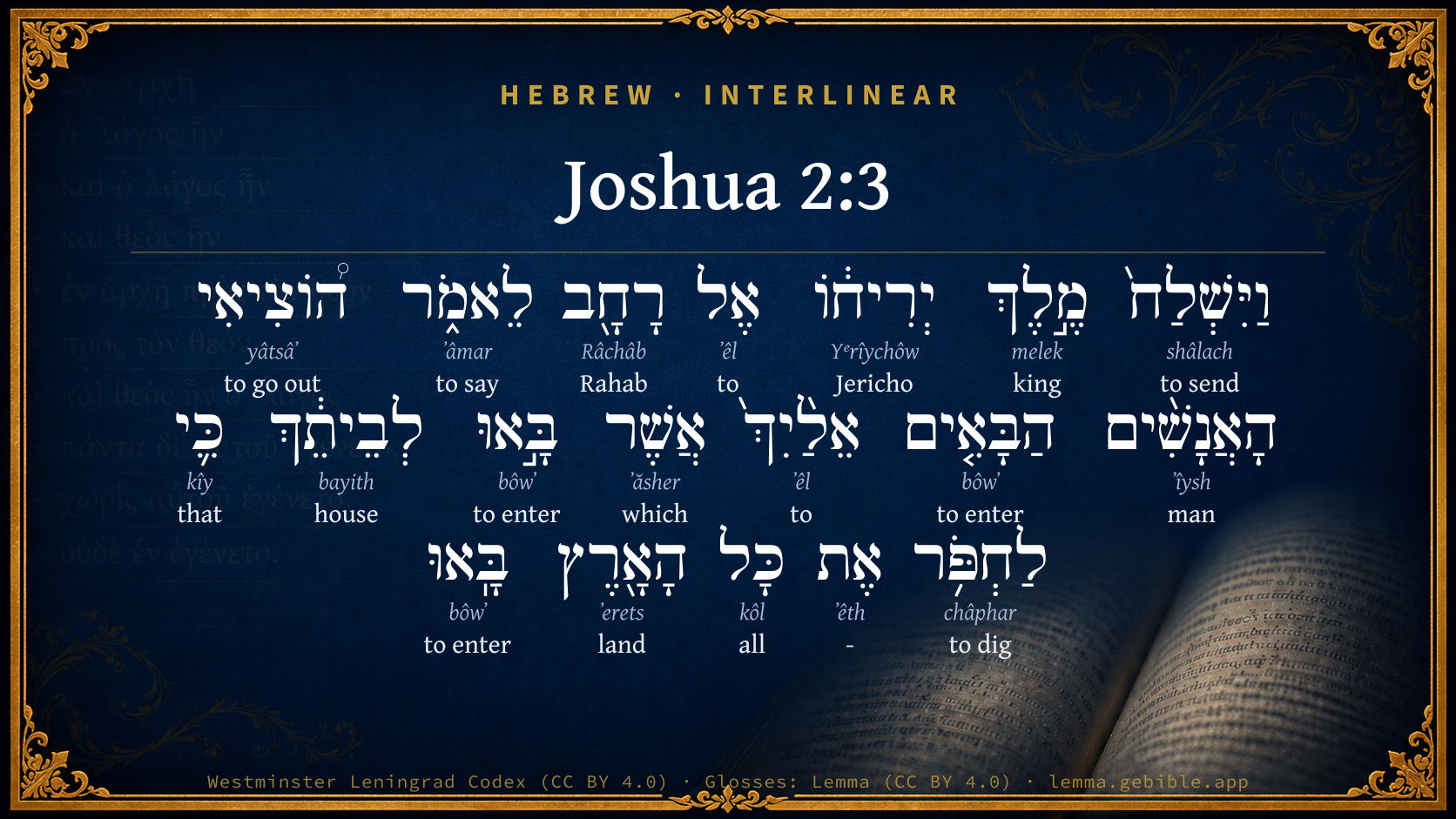
  1. וַיִּשְׁלַח֙ shâlach H7971 “and · to send” Conjunction + Verb, Qal, Sequential Imperfect, 3rd Person, Masculine, Singular
  2. מֶ֣לֶךְ melek H4428 “king of” Noun, Common, Masculine, Singular, Construct
  3. יְרִיח֔וֹ Yᵉrîychôw H3405 “Jericho” Noun, Proper
  4. אֶל ʼêl H413 “to” Preposition
  5. לֵאמֹ֑ר ʼâmar H559 “to say” Preposition + Verb, Qal, Infinitive Construct
  6. ה֠וֹצִיאִי yâtsâʼ H3318 “go out” Verb, Hiphil, Imperative, 2nd Person, Feminine, Singular
  7. הָאֲנָשִׁ֨ים ʼîysh H376 “the · men” Particle, Definite Article + Noun, Common, Masculine, Plural, Absolute
  8. הַבָּאִ֤ים bôwʼ H935 “the · entering” Particle, Definite Article + Verb, Qal, Participle Active, Masculine, Plural, Absolute
  9. אֵלַ֨יִךְ֙ ʼêl H413 “to · you” Preposition + Suffix, Personal, 2nd Person, Feminine, Singular
  10. אֲשֶׁר ʼăsher H834 “which” Particle, Relative
  11. בָּ֣אוּ bôwʼ H935 “to enter” Verb, Qal, Perfect, 3rd Person, Common, Plural
  12. לְבֵיתֵ֔ךְ bayith H1004 “to/for · house · your” Preposition + Noun, Common, Masculine, Singular, Construct + Suffix, Personal, 2nd Person, Feminine, Singular
  13. כִּ֛י kîy H3588 “that” Conjunction
  14. לַחְפֹּ֥ר châphar H2658 “to dig” Preposition + Verb, Qal, Infinitive Construct
  15. אֶת ʼêth H853 “-” Particle, Direct Object
  16. כָּל kôl H3605 “all of” Noun, Common, Masculine, Singular, Construct
  17. הָאָ֖רֶץ ʼerets H776 “the · land” Particle, Definite Article + Noun, Common, Both, Singular, Absolute
  18. בָּֽאוּ bôwʼ H935 “to enter” Verb, Qal, Perfect, 3rd Person, Common, Plural

About this verse

These counts appear in no published source. They are computed here, from the morphology-tagged text and Lemma’s own curated glosses. What Lemma adds →

19
words
16
distinct lemmas
Historical
section

Notable vocabulary

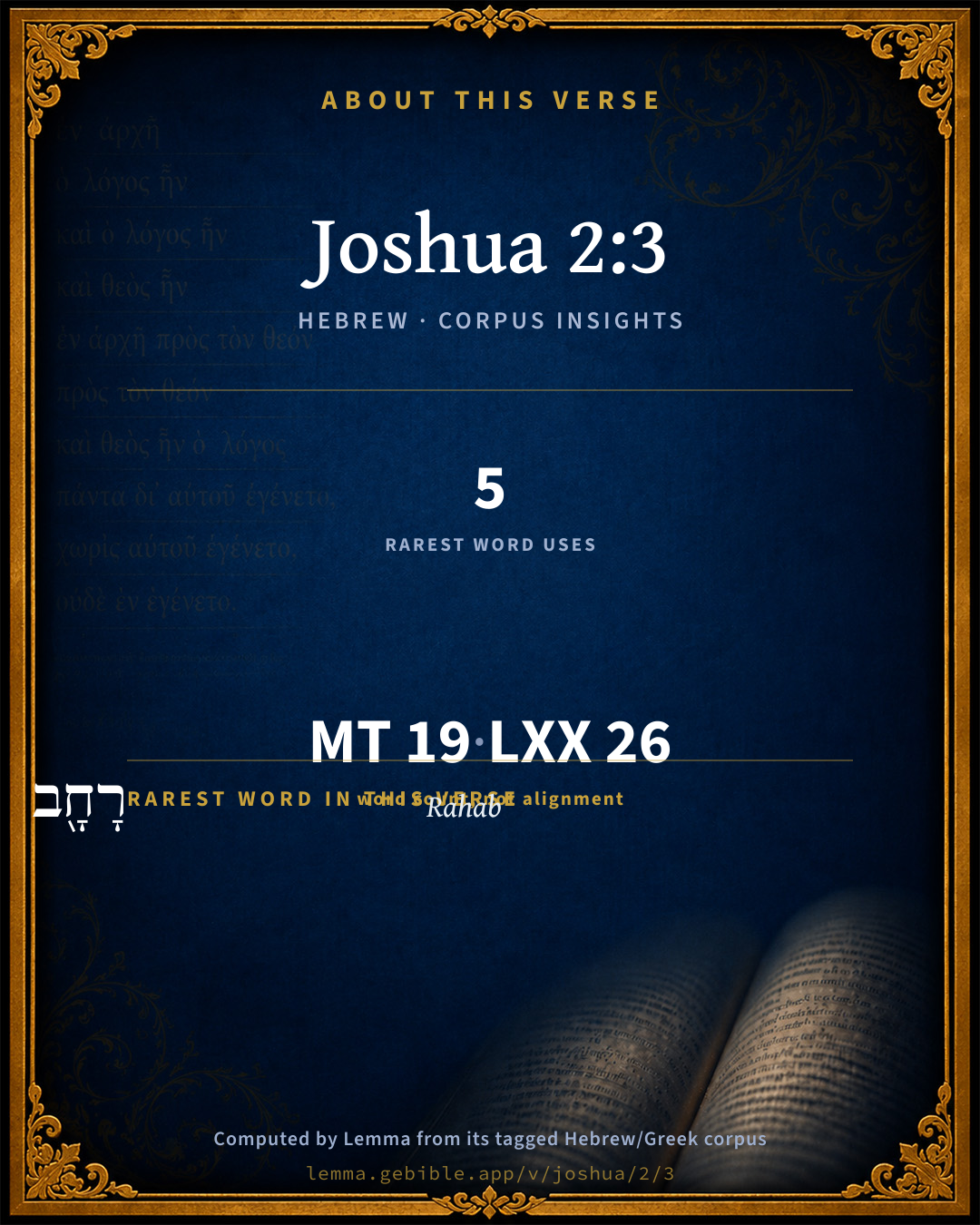
The rarest word here is רָחָ֖ב Rahab H7343 — appearing just 5 times in the whole Hebrew Bible.

Shared distinctive vocabulary

רָחָ֖ב Rahab H7343 occurs in 5 verses of the Hebrew Bible. Also found in:

Grammatical profile

  • 7 verbs
  • 7 nouns
  • 2 prepositions
  • 1 conjunction
  • 2 particles

Verb forms

  • וַיִּשְׁלַח֙ Qal · Sequential Imperfect
  • לֵאמֹ֑ר Qal · Infinitive Construct
  • ה֠וֹצִיאִי Hiphil · Imperative
  • הַבָּאִ֤ים Qal · Participle Active
  • בָּ֣אוּ Qal · Perfect
  • לַחְפֹּ֥ר Qal · Infinitive Construct
  • בָּֽאוּ Qal · Perfect

Repetition

Words recur within this verse — often emphatic in Hebrew:

  • הַבָּאִ֤ים to enter H935 ×3
  • אֶל to H413 ×2

Hebrew & Septuagint length

In English translation the verse runs 33 words from the Hebrew and 31 from the Septuagint (LXX English) — closely comparable.

A rough comparison of the two English renderings, which tokenize alike — not a word-level alignment.

Word counts can differ between the Hebrew and the Greek without any difference in meaning — e.g. the Hebrew direct-object marker אֵת has no separate Greek word, and Greek often adds the article ὁ.

In the original languages it is 19 Hebrew tokens and 26 Greek tokens — but the two are counted differently (Hebrew bundles its prefixes and suffixes into one token; the Greek is in lemma form), so that isn’t a like-for-like length.

Cross-references

11

Topical passages linked to Joshua 2:3 in the Treasury of Scripture Knowledge — connected by theme and wording, ordered by reader-vote popularity; previews shown in the World English Bible.

  • 2 Samuel 10:3 But the princes of the children of Ammon said to Hanun their lord, Do you think that David honors your father, in that he has sent comforters to you? Hasn't David sent his servants to you to search the city, and to spy it out, and to overthrow it?
  • Genesis 38:24 It happened about three months later, that it was told Judah, saying, "Tamar, your daughter-in-law, has played the prostitute; and moreover, behold, she is with child by prostitution." Judah said, "Bring her forth, and let her be burnt."
  • Genesis 42:9–12 Joseph remembered the dreams which he dreamed about them, and said to them, "You are spies! You have come to see the nakedness of the land."
  • Genesis 42:31 We said to him, 'We are honest men. We are no spies.
  • Leviticus 24:14 "Bring out of the camp him who cursed; and let all who heard him lay their hands on his head, and let all the congregation stone him.
  • Joshua 10:23 They did so, and brought forth those five kings to him out of the cave, the king of Jerusalem, the king of Hebron, the king of Jarmuth, the king of Lachish, the king of Eglon.
  • 1 Chronicles 19:3 But the princes of the children of Ammon said to Hanun, Think you that David does honor your father, in that he has sent comforters to you? Aren't his servants come to you to search, and to overthrow, and to spy out the land?
  • Job 21:30 That the evil man is reserved to the day of calamity? That they are led forth to the day of wrath?
  • John 19:4 Then Pilate went out again, and said to them, "Behold, I bring him out to you, that you may know that I find no basis for a charge against him."
  • Acts 12:4 When he had arrested him, he put him in prison, and delivered him to four squads of four soldiers each to guard him, intending to bring him out to the people after the Passover.
  • Acts 12:6 The same night when Herod was about to bring him out, Peter was sleeping between two soldiers, bound with two chains. Guards in front of the door kept the prison.

Cross-references courtesy of OpenBible.info (CC BY 4.0).

Hebrew and Greek witnesses Masoretic Hebrew ↔ Greek Septuagint

The same verse in the two great witnesses to the Old Testament, shown verse-for-verse.

These are two independent witnesses, not word-aligned to each other, and the Septuagint is shown in lemma (dictionary) form.

Hebrew Joshua 2:3 Masoretic · Westminster Leningrad Codex

וַיִּשְׁלַח֙ מֶ֣לֶךְ יְרִיח֔וֹ אֶל רָחָ֖ב לֵאמֹ֑ר ה֠וֹצִיאִי הָאֲנָשִׁ֨ים הַבָּאִ֤ים אֵלַ֨יִךְ֙ אֲשֶׁר בָּ֣אוּ לְבֵיתֵ֔ךְ כִּ֛י לַחְפֹּ֥ר אֶת כָּל הָאָ֖רֶץ בָּֽאוּ

The king of Jericho sent to Rahab, saying, Bring forth the men who are come to you, who have entered into your house; for they have come to search out all the land.

World English Bible · Public Domain

Greek LXX Joshua 2:3 Septuagint · lemma form

καί ἀποστέλλω ὁ βασιλεύς ιεριχω καί εἶπον πρός ρααβ λέγω ἐκἄγω ὁ ἀνήρ ὁ εἰςπορεύομαι εἰς ὁ οἰκία σύ ὁ νύξ κατασκοπεύω γάρ ὁ γῆ ἥκω

And the king of Jericho sent and spoke to Raab, saying, Bring out the men that entered into your house this night; for they are come to spy out the land.

LXX2012 (modern English Septuagint) · Public Domain

Hebrew: Westminster Leningrad Codex (CC BY 4.0). Greek: Septuagint (public domain); English from LXX2012 (modern English Septuagint) (Public Domain). How the Septuagint differs from the Hebrew →

Targum (Aramaic paraphrase)

1

The Targum is the ancient Jewish Aramaic paraphrase of the Hebrew Scriptures — an interpretive translation, not the Hebrew text itself. Onkelos (literal) and Pseudo-Jonathan (expansive) render the Torah, and Jonathan the Prophets. Coverage is partial: where no permissively-licensed English translation exists for a verse, only the Aramaic is shown. This is verse-level text, not a word-by-word alignment to the Hebrew.

  1. Targum Jonathan Prophets (Joshua–Malachi)
    וּשְׁלַח מַלְכָּא דִירִיחוֹ לְוַת רָחָב לְמֵימָר אַפִיקִי גֻבְרַיָא דַאֲתוֹ לְוָתִיךְ דַעֲלוּ לְבֵיתֵיךְ אֲרֵי לְאַלָלָא יַת כָּל אַרְעָא אֲתוֹ:

    (no public-domain English translation for this verse)

    Targum Jonathan — Aramaic: “Mikraot Gedolot” (public domain). English: “Sefaria Community Translation” (CC0 1.0 (public-domain dedication)); “London "Chaldee Paraphrase," 1871” (public domain). Text via Sefaria.

Commentary

Notes on Joshua 2:3 from classic Christian and Jewish commentators (each source and its license shown beneath its notes). The classic Christian expositions comment on the surrounding passage and are grouped to its opening verse, so a note may address several verses; the Jewish commentaries on the Tanakh (Rashi and others) are per-verse, so they appear only where the commentator wrote on this verse.

Lemma curates 59 commentaries, every one of them public domain or Creative Commons licensed, each selected and text-cleaned for this edition rather than reprinted as found. About our sources →

Trapp's Complete Commentary

John Trapp

Jos 2:3 And the king of Jericho sent unto Rahab, saying, Bring forth the men that are come to thee, which are entered into thine house: for they be come to search out all the country.

Ver. 3. For they be come to search out all the country.] "To see the nakedness of the land," as Gen 42:9. {See Trapp on "Jos 2:2"}

John Trapp, A Commentary or Exposition upon All the Books of the Old and New Testament (1647–1656) — public domain. Text from a community e-Sword module.

Tyndale Open Study Notes

Tyndale Open Resources

2:3 Jericho’s king assumed Rahab was both loyal to the city and unaware of the men’s mission.

Tyndale Open Study Notes — © Tyndale Open Resources, licensed CC BY-SA 4.0. Text via the HelloAO Bible API.

Geneva Bible (1599)

Geneva Bible translators

Though the wicked see the hand of God upon them, yet they repent not, but seek how they may by their power and policy resist his working.

Geneva Bible (1599) marginal notes — public domain. Text via Bolls.life.

Adam Clarke's Commentary

Verse 3. The king of Jericho sent unto Rahab] This appears to be a proof of the preceding opinion: had she been a prostitute or a person of ill fame he could at once have sent officers to have seized the persons lodged with her as vagabonds; but if she kept a house of entertainment, the persons under her roof were sacred, according to the universal custom of the Asiatics, and could not be molested on any trifling grounds. A guest or a friend is sacred in whatever house he may be received, in every part of the east to the present day.

Adam Clarke's Commentary on the Bible (1810–1826) — public domain. Text from a community e-Sword/MySword module.

The Cambridge Bible for Schools and Colleges

gen. ed. J. J. S. Perowne

3. sent unto Rahab] “In modern Europe the officers of the government would have entered the house without wasting the previous time in parley. But formerly, as now, in the East, the privacy of a woman was respected, even to a degree that might be called superstitious, and no one will enter the house in which she lives, or the part of the house she occupies, until her consent has been obtained, if, indeed, such consent be ever demanded. In this case it was not asked. Rahab was required not to let the messengers in, but to bring out the foreigners she harboured.” Kitto’s Bible Illustrations, ii. 243.

The Cambridge Bible for Schools and Colleges (gen. ed. J. J. S. Perowne; Cambridge University Press, 1878–1918) — public domain. Text from a community e-Sword module.

John Gill's Exposition

And the king of Jericho sent unto Rahab,.... Not merely because she kept a public house, or being a prostitute had often strangers in it, and so conjectured that the men he had notice of might be there; but he sent upon certain information that they were seen to go in there, as it follows:

saying, bring forth the men that are come to thee; not to commit lewdness with her, though this is the sense some Jewish commentators give; but this neither agrees with the character of the men Joshua had chosen for this purpose, nor answers any end of the king to suggest; nor can it be thought that Rahab would so openly and freely own this, as in Jos 2:4, but what is meant by the phrase is explained in the following clause:

which are entered into thine house: in order to lodge there that night:

for they be come to search out all the country; so it was suspected, nor was the suspicion groundless.

John Gill's Exposition of the Whole Bible (1746–1763) — public domain (CC PDM 1.0). Text via the HelloAO Bible API.

Haydock's Catholic Bible Commentary

House. She spoke to them through a window. The messengers did not enter into her house; whence Serarius infers, that Rahab was a person consecrated to some impure deity, and therefore held in some estimation among the people of Jericho, as this was a city of the moon, in whose honour such consecrations were generally made. But these arguments are not very convincing. (Calmet)

George Leo Haydock (1774–1849), Haydock's Catholic Family Bible and Commentary, 1859 edition — public domain. Excludes Psalms (Douay-Rheims chapter numbering differs from Protestant) and Deuterocanonical books (Catholic canon only).

Whedon's Commentary on the Bible

Daniel D. Whedon

3. Sent unto Rahab — The spies had been traced to the harlot’s house, and possibly Rahab had also, by open avowal of her belief in the approaching triumph of the Hebrews, already drawn suspicion on herself.

Daniel D. Whedon (gen. ed.), Commentary on the Old and New Testaments (1874–1909) — public domain. Text from a community e-Sword module.

John Wesley's Explanatory Notes

Probably Israel had but one friend in all Jericho: and God directed them to her! Thus what seems to be most accidental, is often over-ruled, to serve the great ends of providence. And those that acknowledge God in their ways, he will guide them with his eye.

John Wesley, Explanatory Notes Upon the Whole Bible (1754–1765) — public domain. Text via the GEBible commentary corpus.

Lesson kit

Teaching starters — assembled from the data on this page, not authored interpretation. Every prompt links to the verse data it draws on. Edit before teaching.

Joshua, in the Historical, opens this verse with 19 words (16 distinct Hebrew lemmas). Its most distinctive word is Râchâb (“Rahab”). A historical commentator’s framing appears above. Read the whole chapter for the surrounding context.

Discussion questions

  1. The word Râchâb carries the sense “Rahab.” How does it shape the verse?
  2. How does Joshua 2:1, which shares the word «Rahab», read alongside this verse?
  3. What does the repetition of “to enter” (3× in this one verse) do in this verse?
  4. The translations on this page render this verse differently — a whole-verse word diff, not a word-by-word alignment. What might account for the different wordings?
  5. «וַיִּשְׁלַח֙» is a Qal Sequential Imperfect verb. How does that grammatical form shape the action described?
  6. Compare how Trapp's Complete Commentary and Tyndale Open Study Notes read this verse. Where do they agree or differ?

Things to notice

Reading settings

Reading text

Shown beneath each verse's original-language words.

Old Testament
Old Testament edition

Read the OT as the Masoretic Hebrew (MT) or the Greek Septuagint (LXX).

English shown for the Greek Septuagint (in the Hebrew ↔ Greek comparison).

Comparing translations? Open the Compare panel on any verse page to stack up to four side by side.