
Ezekiel 46:10

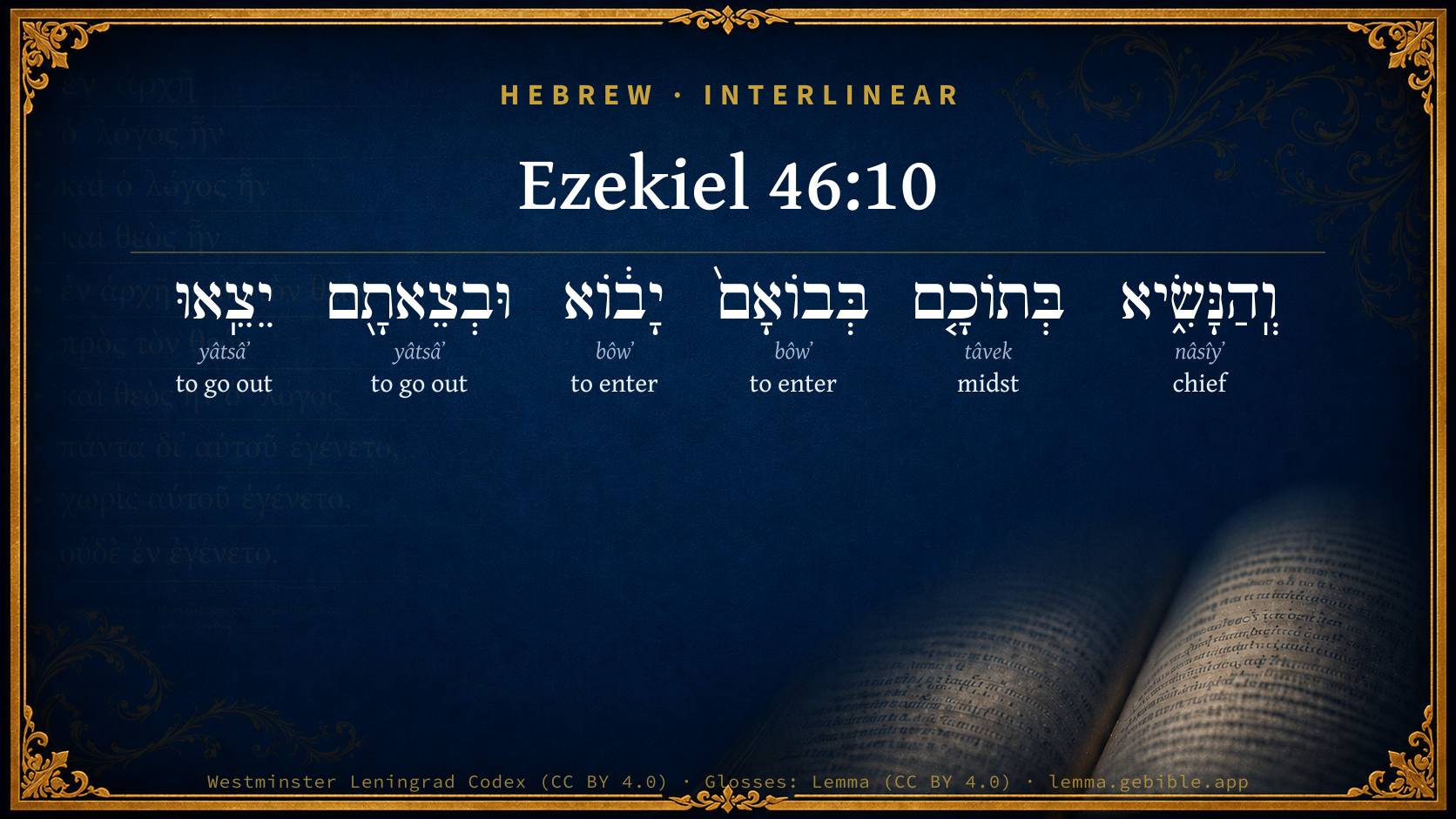
Hebrew (Westminster Leningrad Codex) Ezekiel 46:10 appears in the Hebrew Old Testament. The text above is from the Westminster Leningrad Codex. Each word links to its Strong’s number, a concise gloss, and parsing drawn from the Open Scriptures Hebrew Bible morphology. Click any word for its full Brown-Driver-Briggs (BDB) entry.
Download image
Cite this verse

Ezekiel 46:10 (World English Bible). Public Domain. Lemma interlinear Bible study tool, https://lemma.gebible.app/v/ezekiel/46/10.

Show BibTeX & RIS
BibTeX
RIS
English Translation
The prince, when they go in, shall go in with of them; and when they go out, he shall go out.
World English Bible · Public Domain
Download a study sheet

One document with this verse’s original text, its word-by-word gloss line, the meaning frame, cross-references with their text, attributed commentary, and full source and license credits — printable, and it pastes into notes with its structure intact.

This verse Autodidact and up

Study sheet (.html) Plain text (.txt)

A passage Seminary Student

Up to 50 verses in one chapter. A passage sheet keeps up to 6 commentary sources and 12 cross-references per verse, in the order this page ranks them, and says so on the sheet whenever that leaves anything out. Ask for a single verse and you get the Autodidact verse sheet above.

Everything on this page stays free to read, with no account — the sheet is a download of what is already on screen, not access to it.

Want to remove ads? Support Godless Engineer
Compare translations 3

The same verse in 3 English versions, stacked beneath the original-language interlinear above. Click any original word for its lexicon entry.

Each is an independent rendering of the whole verse — the interlinear is not word-aligned to these translations.

Highlighted words mark where these versions differ — a whole-verse word diff, not a word-by-word alignment.

  • World English Bible Public Domain
    The prince, when they go in, shall go in with of them; and when they go out, he shall go out.
  • King James Version Public Domain
    And the prince in the midst of them, when they go in, shall go in; and when they go forth, shall go forth.
  • unfoldingWord Literal Text CC BY-SA 4.0
    The prince must be in their midst; when they go in, he must go in, and when they leave, he must leave.

unfoldingWord Literal Text — © unfoldingWord, licensed CC BY-SA 4.0. Word-aligned USFM3 via Door43 (git.door43.org/unfoldingWord/en_ult).

Versions to compare (up to 4)

3 of 4 selected

Show all 18 translations

Every available English version of this verse, each an independent rendering of the whole verse.

  • World English Bible Public Domain
    The prince, when they go in, shall go in with of them; and when they go out, he shall go out.
  • Berean Standard Bible Public Domain
    When the people enter, the prince shall go in with them, and when they leave, he shall leave.
  • Majority Standard Bible Public Domain
    When the people enter, the prince shall go in with them, and when they leave, he shall leave.
  • King James Version Public Domain
    And the prince in the midst of them, when they go in, shall go in; and when they go forth, shall go forth.
  • American Standard Version (1901) Public Domain
    And the prince, when they go in, shall go in in the midst of them; and when they go forth, they shall go forth `together'.
  • Revised Version (1885) Public Domain
    And the prince, when they go in, shall go in in the midst of them; and when they go forth, they shall go forth together.
  • Geneva Bible (1599) Public Domain
    And the prince shall be in the middes of them: hee shall go in when they goe in, and when they goe forth, they shall goe forth together.
  • Douay-Rheims (1899) Public Domain
    And the prince in the midst of them, shall go in when they go in, and go out when they go out.
  • Young's Literal Translation Public Domain
    And the prince in their midst in their coming in cometh in, and in their going out he goeth out.
  • Literal Standard Version CC BY-SA 4.0
    And in their coming in the prince in their midst comes in, and in their going out he goes out.
  • Unlocked Literal Bible CC BY-SA 4.0
    The prince must be in their midst; when they go in, he must go in, and when they leave, he must leave.
  • unfoldingWord Literal Text CC BY-SA 4.0
    The prince must be in their midst; when they go in, he must go in, and when they leave, he must leave.
  • Darby Bible Public Domain
    And the prince shall come in in the midst of them, when they come in; and when they go out, they shall go out [together].
  • World Messianic Bible Public Domain
    The prince shall go in with them when they go in. When they go out, he shall go out.
  • Webster's Bible Public Domain
    And the prince in the midst of them, when they go in, shall go in; and when they go forth, shall go forth.
  • Free Bible Version CC BY-SA 4.0
    The prince is to enter when the people do; and leave when they leave.
  • Bible in Basic English Public Domain
    And the ruler, when they come in, is to come among them, and is to go out when they go out.
  • JPS Tanakh (1917) Public Domain
    And the prince, when they go in, shall go in in the midst of them; and when they go forth, they shall go forth together.

Literal Standard Version (2020), Covenant Press — licensed CC BY-SA 4.0. Text via the HelloAO Bible API (eBible.org). Unlocked Literal Bible (unfoldingWord) — licensed CC BY-SA 4.0. Text via the HelloAO Bible API (eBible.org). unfoldingWord Literal Text — © unfoldingWord, licensed CC BY-SA 4.0. Word-aligned USFM3 via Door43 (git.door43.org/unfoldingWord/en_ult). Free Bible Version, Dr. Jonathan Gallagher — licensed CC BY-SA 4.0. Text via the HelloAO Bible API (eBible.org).

Word by word

More ways to search: Search by grammar → Find every occurrence → Compare this word →

Practice this passage: Drill this verse → Learn its vocabulary →

וְֽהַנָּשִׂ֑יא
nâsîyʼ
H5387
“and · the · chief”
Conjunction + Particle, Definite Article + Noun, Common, Masculine, Singular, Absolute
Part of Speech
Conjunction + Particle + Noun
Type
Common
Gender
Masculine
Number
Singular
State
Absolute
Full BDB Definition

Origin: from H5375

TWOT: 1421b , 1421c

one lifted up, chief, prince, captain, leader - rising mist, vapour
  1. בְּתוֹכָ֤ם tâvek H8432 “in/at · midst · their” Preposition + Noun, Common, Masculine, Singular, Construct + Suffix, Personal, 3rd Person, Masculine, Plural
  2. בְּבוֹאָם֙ bôwʼ H935 “in/at · to enter · them” Preposition + Verb, Qal, Infinitive Construct + Suffix, Personal, 3rd Person, Masculine, Plural
  3. יָב֔וֹא bôwʼ H935 “to enter” Verb, Qal, Imperfect, 3rd Person, Masculine, Singular
  4. וּבְצֵאתָ֖ם yâtsâʼ H3318 “and · in/at · to go out · them” Conjunction + Preposition + Verb, Qal, Infinitive Construct + Suffix, Personal, 3rd Person, Masculine, Plural
  5. יֵצֵֽאוּ yâtsâʼ H3318 “to go out” Verb, Qal, Imperfect, 3rd Person, Masculine, Plural

About this verse

These counts appear in no published source. They are computed here, from the morphology-tagged text and Lemma’s own curated glosses. What Lemma adds →

6
words
4
distinct lemmas
Prophets
section

Grammatical profile

  • 4 verbs
  • 2 nouns

Verb forms

  • בְּבוֹאָם֙ Qal · Infinitive Construct
  • יָב֔וֹא Qal · Imperfect
  • וּבְצֵאתָ֖ם Qal · Infinitive Construct
  • יֵצֵֽאוּ Qal · Imperfect

Repetition

Words recur within this verse — often emphatic in Hebrew:

  • בְּבוֹאָם֙ to enter H935 ×2
  • וּבְצֵאתָ֖ם to go out H3318 ×2

Hebrew & Septuagint length

In English translation the verse runs 21 words from the Hebrew and 25 from the Septuagint (LXX English) — closely comparable.

A rough comparison of the two English renderings, which tokenize alike — not a word-level alignment.

Word counts can differ between the Hebrew and the Greek without any difference in meaning — e.g. the Hebrew direct-object marker אֵת has no separate Greek word, and Greek often adds the article ὁ.

Cross-references

16

Topical passages linked to Ezekiel 46:10 in the Treasury of Scripture Knowledge — connected by theme and wording, ordered by reader-vote popularity; previews shown in the World English Bible.

  • Psalms 42:4 These things I remember, and pour out my soul within me, How I used to go with the crowd, and led them to the house of God, With the voice of joy and praise, a multitude keeping a holy day.
  • 1 Chronicles 29:20 David said to all the assembly, Now bless Yahweh your God. All the assembly blessed Yahweh, the God of their fathers, and bowed down their heads, and worshiped Yahweh, and the king.
  • 1 Chronicles 29:22 and ate and drink before Yahweh on that day with great gladness. They made Solomon the son of David king the second time, and anointed him to Yahweh to be prince, and Zadok to be priest.
  • 2 Samuel 6:14–19 David danced before Yahweh with all his might; and David was girded with a linen ephod.
  • 2 Chronicles 6:2–4 But I have built you a house of habitation, and a place for you to dwell in forever.
  • 2 Chronicles 7:4–5 Then the king and all the people offered sacrifice before Yahweh.
  • 2 Chronicles 20:27–28 Then they returned, every man of Judah and Jerusalem, and Jehoshaphat in the forefront of them, to go again to Jerusalem with joy; for Yahweh had made them to rejoice over their enemies.
  • 2 Chronicles 29:28–29 All the assembly worshiped, and the singers sang, and the trumpeters sounded; all this [continued] until the burnt offering was finished.
  • 2 Chronicles 34:30–31 The king went up to the house of Yahweh, and all the men of Judah and the inhabitants of Jerusalem, and the priests, and the Levites, and all the people, both great and small: and he read in their ears all the words of the book of the covenant that was found in the house of Yahweh.
  • Nehemiah 8:8–9 They read in the book, in the law of God, distinctly; and they gave the sense, so that they understood the reading.
  • Psalms 122:1–4 I was glad when they said to me, "Let's go to Yahweh's house!"
  • Matthew 18:20 For where two or three are gathered together in my name, there I am in the midst of them."
  • Matthew 28:20 teaching them to observe all things that I commanded you. Behold, I am with you always, even to the end of the age." Amen.
  • Hebrews 3:6 but Christ is faithful as a Son over his house; whose house we are, if we hold fast our confidence and the glorying of our hope firm to the end.
  • Hebrews 4:14–16 Having then a great high priest, who has passed through the heavens, Jesus, the Son of God, let us hold tightly to our confession.
  • Revelation 2:1 To the angel of the assembly in Ephesus write: "He who holds the seven stars in his right hand, he who walks among the seven golden lampstands says these things:

Cross-references courtesy of OpenBible.info (CC BY 4.0).

Hebrew and Greek witnesses Masoretic Hebrew ↔ Greek Septuagint

The same verse in the two great witnesses to the Old Testament, shown verse-for-verse.

These are two independent witnesses, not word-aligned to each other, and the Septuagint is shown in lemma (dictionary) form.

Hebrew Ezekiel 46:10 Masoretic · Westminster Leningrad Codex

וְֽהַנָּשִׂ֑יא בְּתוֹכָ֤ם בְּבוֹאָם֙ יָב֔וֹא וּבְצֵאתָ֖ם יֵצֵֽאוּ

The prince, when they go in, shall go in with of them; and when they go out, he shall go out.

World English Bible · Public Domain

Greek LXX Ezekiel 46:10 Septuagint · lemma form

καί ὁ ἀποἡγέομαι ἐν μέσος αὐτός ἐν ὁ εἰςπορεύομαι αὐτός εἰςἔρχομαι μετά αὐτός καί ἐν ὁ ἐκπορεύομαι αὐτός ἐκἔρχομαι

And the prince shall enter with them in the midst of them when they go in; and when they go forth, he shall go forth.

LXX2012 (modern English Septuagint) · Public Domain

Hebrew: Westminster Leningrad Codex (CC BY 4.0). Greek: Septuagint (public domain); English from LXX2012 (modern English Septuagint) (Public Domain). How the Septuagint differs from the Hebrew →

Targum (Aramaic paraphrase)

1

The Targum is the ancient Jewish Aramaic paraphrase of the Hebrew Scriptures — an interpretive translation, not the Hebrew text itself. Onkelos (literal) and Pseudo-Jonathan (expansive) render the Torah, and Jonathan the Prophets. Coverage is partial: where no permissively-licensed English translation exists for a verse, only the Aramaic is shown. This is verse-level text, not a word-by-word alignment to the Hebrew.

  1. Targum Jonathan Prophets (Joshua–Malachi)
    וְרַבָּא בֵּינֵיהוֹן בְּמֵיעַלְהוֹן יֵיעוֹל וּבְמִפַקְהוֹן יִפְקוּן:

    (no public-domain English translation for this verse)

    Targum Jonathan — Aramaic: “Mikraot Gedolot” (public domain). English: “Sefaria Community Translation” (CC0 1.0 (public-domain dedication)); “London "Chaldee Paraphrase," 1871” (public domain). Text via Sefaria.

Commentary

Notes on Ezekiel 46:10 from classic Christian and Jewish commentators (each source and its license shown beneath its notes). The classic Christian expositions comment on the surrounding passage and are grouped to its opening verse, so a note may address several verses; the Jewish commentaries on the Tanakh (Rashi and others) are per-verse, so they appear only where the commentator wrote on this verse.

Lemma curates 59 commentaries, every one of them public domain or Creative Commons licensed, each selected and text-cleaned for this edition rather than reprinted as found. About our sources →

Trapp's Complete Commentary

John Trapp

Eze 46:10 And the prince in the midst of them, when they go in, shall go in; and when they go forth, shall go forth.

Ver. 10. And the prince in the midst of them, &c.] For example sake, Vita Principis censura est, and to see that all things be rightly carried in God’s service. And although the prince hath many weighty occasions, yet he is to be at the public assemblies with the first, and to stay till the last.

John Trapp, A Commentary or Exposition upon All the Books of the Old and New Testament (1647–1656) — public domain. Text from a community e-Sword module.

The Biblical Illustrator

Joseph S. Exell

Eze_46:10

The prince in the midst of them, when they go in, shall go in; and when they go forth, shall go forth.

The Prince in the midst

The Prince shall mean to us the man Christ Jesus, whom God has exalted to be a Prince and a Saviour. Isaiah calls Him the Prince of Peace; and Peter, the Prince of Life. I dont know where the Princes central palace is, nor where He holds His court. It is in the far country which no human eye has ever explored; somewhere beyond the unknown seas which no embodied soul can navigate, and from which no traveller has come back to tell the tale. But I live in hope, the hope that stirs many another eager heart, that on some fair morning I shall see this King in His beauty, in the land that wont be far off then! But this verse tells us something quite good enough and bright enough for us to know: The Prince is in the midst of them. It is not often that the royalties of earth occupy a place like that; some of them are shut up in splendid seclusion. Most men know only the names of the great and noble; all of them are removed from the society of the poor. But our Prince has no preference, no selection, no priority. He is in the midst of His people, and His light and smile are always to be seen. The gifts of His bounty are as free to the man who is lowly, to the sons of poverty, as to the sons of wealth. But it is not everybody who recognises the presence of the Prince when He is here. He may smile as royally as the sunlight, and yet you may be so insensible as never to know He is near. Do you acknowledge His rule? Do you submit to His authority? Do you obey His command? A prince has laws,--do you honour them? A prince has reverence,--do you reverence Him? This Prince covets your affections,--do you love Him? I knew a Christian woman who was always found early in the sanctuary. She was quite deaf, and heard neither song nor sermon. I asked her why she came and whether she was the better for it, and her answer is worth recording: The communion of saints is sweet in itself, and a neighbour always finds the lessons and the text for me, and the Lord speaks to me, and His voice is very sweet to me. You see that her loyalty brought her into the presence of royalty. The Prince was there to speak, touch, and smile to her. And the Prince in the midst of them when they go in shall go in with them. You see that the loyal hearts that honour Christ bring Him with them. They cross the threshold together with Christ, and sit together with Him in the pew. I am afraid that there is too little of this with us. We should seek to be prepared for the house of prayer beforehand, that we and the Prince may come there hand in hand. When they go forth. That is the best test of any sanctuary service. Do we carry with us the companion, the guest who says to us as we go forth from the house of God, what He said to Zacchaeus when He called that publican, I must abide at thy house, thy house. Always understand that where the Princes subjects are, those who are loyal to Him, in whose hearts He reigns--ruling in the life,--that the Prince is always with them. He does not part company with them at morning prayer; He does not breathe a benediction on them at the family gathering, and then retire to the throne of His glory. But He takes His place, too, in the tram, the bus, or the train. He cheers and gives the strength and power to the ordinary doings of the day. If we would but remember to realise this, what a grand and noble business the daily round and common task would be! Dont you think the company and oversight of our Prince is to be desired? I do believe in a religion that has to do with every five minutes of our time. Sure am I that your burdens would be lighter, your cares lessened, your hands strengthened, and your hearts cheered, if you could but feel that your Prince was present to smooth your path and to dwell within prayerful reach of you all the time; and oh! what a defence that would be against the continuity of temptations that assail us through life. I remember reading of a lad who was tempted to steal his masters goods by one of his fellow workmen. John, you can do so-and-so now; the master has gone now; the master is not in. No, said the lad, my Master is always in. Well done, John! that is the true principle of life. His Master was the Prince. Christ had gone into the shop with him. I want you to see that my text is especially grandly and beautifully true in the days of our suffering and trial. If you yourself are called on to drop your tool, to lay down your pen, to retire awhile from actual life, and to prepare for illness, the Prince, when you go in, shall go in too; for there, more than ever, He is near to comfort and to bless. His voice is then so gentle, His touch so tender, and His companionship so sweet. He makes the sick chamber the house of God, and the gate of heaven. And my text says a little more than that. The Prince in the midst of them when they go forth shall go forth too. This is a promise for the traveller. We travel much nowadays; travel rapidly and in a good deal of peril. What a promise for the traveller when he goes forth. He shall go forth too! What a promise for the emigrant as he says Good-bye to his friends. Good-bye, my lad, said an old man whom I knew, to a young fellow, there is one thing that keeps my heart from breaking and that is that the Lord is with thee, lad. Christ was going forth with the boy! What a promise that is for the youth leaving the parental roof! Or for the evangelist going out to proclaim the Gospel. The Prince is in the midst of them; when they go forth He shall go forth. Is not that a grand promise for us in view of our departure from earth? Our last exit, our going forth from the brief life which is here our portion, will come, perhaps, soon. At the bedside of the dying, Christ enters, and He shall not leave us alone then. I think the record of the goings forth from life of Christians is most encouraging. Rutherford was glorying in God when his very feet were on the shore, and he said , as he went, I have gotten the victory, and Christ, my Savior, is holding out both arms to embrace me. Why is death called the dark valley, for it grows brighter and brighter, and it is now so bright I have to shut my eyes. His lips parted in a smile. So he went forth, and the Prince went forth with him. Then his eyes were opened, to be shut no more. An English lady visiting the great Exhibition in Paris, was seized with sudden illness. But she longed to be loyal to the Prince whom she had long ago crowned with her heart. In her last moments her speech left her, but she managed to utter a simple word--Bring. Her friends offered her a drink of water, and she said again--Bring. Then they moistened her lips, and prayed. Then they thought she must desire to see some absent friend, and they whispered in her ear that he should be sent for, and she said, with a last effort, Bring forth the royal diadem, and crown Him Lord of all. And when the Prince, who was in the midst, when she went forth, went--yes, the two went forth together--Christ and the saved soul went forth into the silence of the great unknown. (J. J. Wray.)

Christ among His people

I. Christ the Prince.

1. His right.

(1) By virtue of Fatherhood, Son of the Highest.

(2) By appointment (Psa_2:6).

2. His character. Grace not only poured into Christs lips, but is His distinction and beauty in all respects. Purity supreme; forbearance and tenderness distinguish His dealings; unspeakable condescension and love the spirit of His life.

3. His dominion, Prince of the kings of the earth. His rule is spiritual. Casts down moral opposition, overcomes enmity, unbelief, thoughts that exalt themselves against God, and brings into captivity to Divine will.

II. Christ in the midst of His Church.

1. As a Ruler among His subjects.

2. As a Teacher among His disciples.

3. As a Shepherd among His flock.

4. As a Physician among His patients.

5. As a Husbandman in His vineyard.

III. The intimacy of Christs fellowship.

1. When do we go in?

(1) At seasons of devotional retirement. Legends of saints sometimes speak of an angel as visible. The reality, though unseen, is more. Christ is with us. Prayer should be very precious; much exercised.

(2) When we worship in the sanctuary. Praise. Meditation. Adoration.

(3) When afflicted. Christ comforts agitated thoughts, sustains under distressing feelings, lifts mind to things above. To hearts despairing His voice is like a falling star--It is I, be not afraid.

2. When do we go forth?

(1) To business. Lay our plans in Him. Know His eye is on us.

(2) To manifold temptations. Greater is He who is with us.

(3) To all the forms and methods of Christian duty. Lo, I am with you alway. (G. MMichael, B. A.)

The Biblical Illustrator, edited by Joseph S. Exell (c. 1880s–1900s) — public domain. Text from a community e-Sword module.

Jamieson, Fausset & Brown

Robert Jamieson, A. R. Fausset & David Brown

prince in the midst--not isolated as at other times, but joining the great throng of worshippers, at their head, after the example of David (Psa 42:4, "I had gone with the multitude . . . to the house of God, with the voice of joy and praise, with a multitude that kept holy day"); the highest in rank animating the devotions of the rest by his presence and example.

Jamieson, Fausset & Brown — Commentary Critical and Explanatory on the Whole Bible (1871) — public domain (CC PDM 1.0). Text via the HelloAO Bible API.

Adam Clarke's Commentary

Verse 10. And the prince in the midst of them] Even he shall act in the same way: he must also go straight forward, and never turn his back to go out at the same gate by which he entered. The prince and the people were to begin and end their worship at the same time.

Adam Clarke's Commentary on the Bible (1810–1826) — public domain. Text from a community e-Sword/MySword module.

Ellicott's Commentary for English Readers

(10) The prince in the midst of them.—On occasion of these yearly feasts, it was no longer necessary that the prince should represent the people, they being themselves present. He, therefore, now worships in their midst, entering with them at the north or south gate, and going out by the opposite one.

A Bible Commentary for English Readers, edited by Charles John Ellicott (1878–1897) — public domain. Text from a community e-Sword module.

The Cambridge Bible for Schools and Colleges

gen. ed. J. J. S. Perowne

10. shall so forth] Go must be read, the prince being subject. Heb. text reads: when they go forth they shall go forth (i.e. prince and people; R.V. to make this plain supplies together). This is a very unnatural reading. Read in either way the words mean that the prince and people come in and go out simultaneously. This would suggest that the worshipping of the prince and people was contemporaneous with the act of the priests in offering, and that when this act was over the people dispersed and the prince departed. The Syr. followed by Corn. reads: but the prince in their midst, by the gate at which he came in shall he go out—finding a repetition of Eze_46:8, giving a freedom to the prince denied to the people (Eze_46:9).

The Cambridge Bible for Schools and Colleges (gen. ed. J. J. S. Perowne; Cambridge University Press, 1878–1918) — public domain. Text from a community e-Sword module.

John Gill's Exposition

And in the feasts, and in the solemnities,.... Or, "appointed times" (l); for public worship, for the ministration of the word and ordinances, which are feasts and solemn seasons; See Gill on Eze 45:15. Kimchi observes a difference between these two; and that though all feasts are called solemnities, or fixed seasons, Lev 23:4, yet there are some solemnities that are not feasts, Gen 1:14,

the meat offering shall be an ephah to a bullock, and to the lambs as he is able to give, and an hin of oil to an ephah; the same to be done on all feasts and solemnities as on the sabbath day; See Gill on Eze 46:5.

(l) "et statis temporibus", Cocceius, Starckius.

John Gill's Exposition of the Whole Bible (1746–1763) — public domain (CC PDM 1.0). Text via the HelloAO Bible API.

Haydock's Catholic Bible Commentary

Out. The prince went in and out by the same gate, (ver. 8.) and might order that on the east to be opened when he had to offer a voluntary sacrifice. In other respects he was like a simple Israelite, and was to attend the temple and use the same gates as the rest. Before, the kings had a gate on the west leading to their palace. But this was no longer to subsist, and the palace was to be far removed, chap. xlviii. 21.

George Leo Haydock (1774–1849), Haydock's Catholic Family Bible and Commentary, 1859 edition — public domain. Excludes Psalms (Douay-Rheims chapter numbering differs from Protestant) and Deuterocanonical books (Catholic canon only).

Matthew Poole's English Annotations

The prince and people must meet together at the same time, and when it is the time for offering the morning or evening sacrifice, be ready to present their prayers to the Lord. And when they offer any particular oblations, on account whereof they go any whit nearer than at other times, both prince and people shall do it at the same time.

Matthew Poole's English Annotations on the Holy Bible (1683–1685) — public domain. Text from a community e-Sword/MySword module.

The Pulpit Commentary

And the prince in the midst of them, when they go in, shall go in, etc. Schroder, but without reason, would restrict this regulation to the celebrations of the first and seventh days of the first month; (Eze_45:18, Eze_45:20) Hengstenberg would confine it to the high festivals; (Eze_45:21, Eze_45:25) Kliefoth, Keil, and commentators generally apply it to all the statutory feasts or appointed seasons and times for united sacrificial worship. The regulation seems to teach that in such observances at least the prince should stand on a level with the people, and both enter and retire by the same door as they.

The Prince in the midst of them.

The center of the glory of restored Israel was to be found in her prince. No prince appeared, however, who was able to accomplish the expectations of prophecy until the advent of Jesus Christ. He is "the Prince in the midst of his people.

I CHRIST IS THE PRINCE OF HIS PEOPLE.

1. He is one of them. The Jew"s Prince was a Jew, not a foreigner. Christ is "the Firstborn among many brethren." He is a true Man, the Son of man. He has been over the Christian course, and has himself lived the pattern Christian life.

2. He is their Head. Christ stoops to save, but he rises again to rule. Even during his earthly humiliation he plainly took the lead among his disciples. Now he is seated on his throne in heaven, reigning over his Church.

II CHRIST IS IN THE MIDST OF HIS PEOPLE. During his earthly ministry he dwelt among men. Unlike John the Baptist, who retired to the solitude of the wilderness and to whom people had to come by leaving their homes, Jesus went about through the towns and villages of Israel, eating and drinking with all sorts and conditions of men. Although he is no longer visible, we have his assurance that he will be always with his true disciples. (Mat_28:20) Christ does not simply visit his people in moments of great need; he is always with them. He does not select some choice followers for his companionship, to the neglect of the great body of his people, like a prince who enjoys himself with his courtiers and takes little or no notice of the bulk of the nation. Jesus is in the midst of his people, right in the center of the population of the kingdom of heaven.

III CHRIST ENTERS INTO HIS PEOPLE"S WORSHIP. When the people go in, i.e. to the temple, the Prince shall go in. The Prince must worship with his people. Prince and peasant must bow together before their common Lord. Every purely human prince needs to confess his sins as a penitent and to utter the publican"s prayer, "God be merciful to me a sinner!" Christ the sinless cannot take part in our confession except by sympathy. But he is with us throughout our worship. Christian worship at its highest is communion with Christ. In that most sacred act of worship, the Lord"s Supper, we seek especially for the living presence of Christ. For surely every Protestant must admit that there is a real Presence not in the bread or wine but in the hearts of Christ"s worshipping people.

IV CHRIST GOES WITH HIS PEOPLE INTO THE WORLD. When the people go forth their Prince is to accompany them. It would be sad if Christ only met his people in their worship. He is more needed in work, in temptation, in trouble. Christ is with us in the world as well as in the Church. He does not confine his sympathy to ecclesiastical circles. But when we have some hard task to accomplish or some severe trial to face his presence may be especially looked for. The good leader will be in the thick of the fight, cheering his soldiers just where the battle is hottest. Our Captain of salvation accompanies us in the holy war against sin. If courage fails, this should be our cheering thought the Prince is in the midst of us!

The Pulpit Commentary (1880–1919), ed. H.D.M. Spence-Jones & Joseph S. Exell — public domain. Text from a community e-Sword module.

Rashi

Rabbi Shlomo Yitzchaki (Rashi)

The prince When he enters the Temple Court through the southern wicket of the Heichal to prostrate himself, he too must make the Temple Court a short-cut. He shall enter by way of the northern gate and leave by way of the southern gate with the rest of the people of the land. This is the meaning of “enters in their midst when they go in, and when they go out, they go out”all of them, the prince with the rest of the people. And he shall not enter by way of the eastern gate as he regularly does on the New Moon and on the Sabbath of Creation, for the eastern gate has no gate opposite it in the west.

Rashi on the Tanakh — English translations: “The Judaica Press complete Tanach with Rashi, translated by A. J. Rosenberg” (CC BY 4.0); “Pentateuch with Rashi's commentary by M. Rosenbaum and A.M. Silbermann, 1929-1934” (public domain); “The Metsudah Tanach series, Lakewood, N.J” (CC BY 4.0); and “The Book of Joshua, Metsudah Publications, 1997” (CC BY 4.0). Text via Sefaria.

Lesson kit

Teaching starters — assembled from the data on this page, not authored interpretation. Every prompt links to the verse data it draws on. Edit before teaching.

Ezekiel, in the Prophets, opens this verse with 6 words (4 distinct Hebrew lemmas). Its most distinctive word is nâsîyʼ (“chief”). A historical commentator’s framing appears above. Read the whole chapter for the surrounding context.

Discussion questions

  1. What does “chief” (nâsîyʼ) contribute to the verse as a whole?
  2. Psalms 42:4 shares this passage’s theme. How do the two illuminate each other?
  3. “to enter” occurs 2× in this one verse. What is the effect of the repetition?
  4. The translations on this page render this verse differently — a whole-verse word diff, not a word-by-word alignment. What might account for the different wordings?
  5. The verb «בְּבוֹאָם֙» is Qal Infinitive Construct. How does its form color the action?
  6. Reading how Trapp's Complete Commentary and The Biblical Illustrator read this verse, where do the two commentators agree and where do they part?

Things to notice

  • These translations choose different wording for 6 words in this verse.
  • “to enter” occurs 2× in this single verse.
  • 4 distinct Hebrew lemmas span 6 words in this verse.

Reading settings

Reading text

Shown beneath each verse's original-language words.

Old Testament
Old Testament edition

Read the OT as the Masoretic Hebrew (MT) or the Greek Septuagint (LXX).

English shown for the Greek Septuagint (in the Hebrew ↔ Greek comparison).

Comparing translations? Open the Compare panel on any verse page to stack up to four side by side.