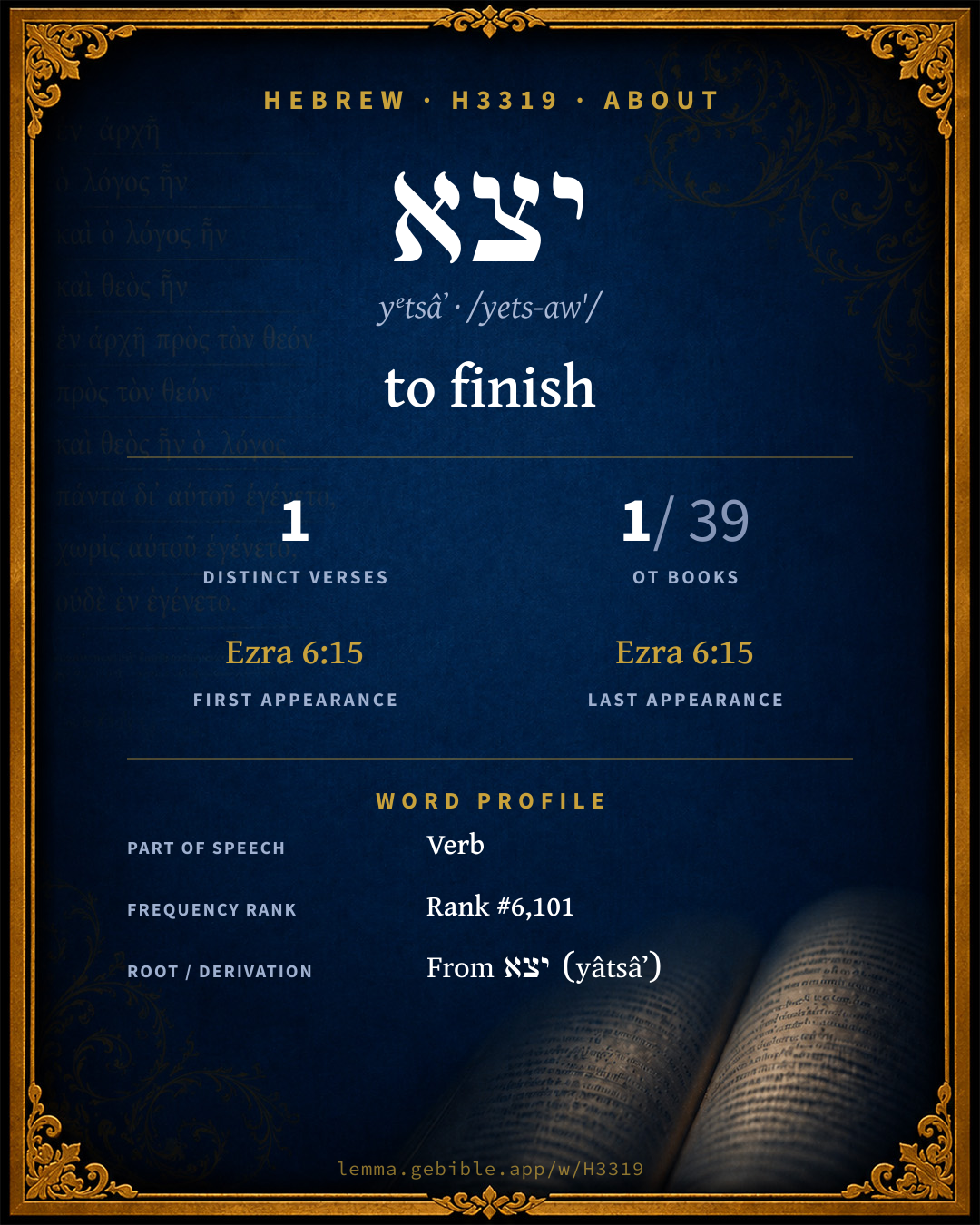
יצא
to finish
Full lexicon entry — Brown-Driver-Briggs (BDB)
From Brown-Driver-Briggs (BDB)
Where this word appears
Grammar key — what these labels mean
Form
- Perfect
- A completed action or state — Hebrew marks aspect (completeness) more than strict tense (“he wrote”).
Person
- 3rd Person
- The one spoken about (“he / she / it / they”).
Gender
- Masculine
- Grammatically masculine.
Number
- Singular
- One.
Every verse where H3319 appears — 1 distinct verse across 1 book. Click any verse to open its interlinear word-by-word view. Verse text shown in the World English Bible for context — . Each verse’s Hebrew form is shown with its reference; the English is not keyword-highlighted, since the data carries no word-level English alignment. Use “Compare translations” on any verse to read it across multiple English versions. This concordance covers the Hebrew Bible; Septuagint (Greek Old Testament) occurrences are not indexed here.
Ezra 1 verse
About this entry
At a glance — auto-summarized from this page’s data, not written by a person. Every figure links to its source below. This summary describes the numbers; it doesn’t interpret them.
At its core, יצא (yᵉtsâʼ) means “to finish.” It occurs a mere 1 verse across Scripture. The word gravitates to Ezra (100%). Its lone occurrence is Ezra 6:15. It clusters with יצא, יציא and מוצא under a shared root. Dig into 1-verse concordance and the renderings breakdown below.
Gloss history
Strong's 1890 vs modern scholarship
About this word
Strong's H3319 catalogs a Hebrew word from the Hebrew Old Testament.
These counts are not copied from any lexicon or concordance. They are computed here, from the morphology-tagged Hebrew Old Testament. What Lemma adds →
- 1
- distinct verses
- The word appears in 1 distinct verse.
- 1 / 39
- OT books
- The word appears in 1 of 39 Old Testament books.
- #6,101
- by frequency
- Rank #6,101 (rank 6,101 of 8,640 Hebrew words by occurrence).
View all 1 occurrence in the concordance →
Most concentrated in
- Ezra 1 verse 100%
By section of the Old Testament
By traditional corpus
Conventional, traditional groupings — biblical authorship is debated, so this is a traditional corpus grouping, not an authorship claim. Each share is this word’s portion of its verses in that division of the Hebrew canon. Each figure is a share of the word’s 1 distinct verse.
- Writings (Ketuvim) 1 verse · 100%
How translations render this word
Counts come from each version’s own published word-to-Strong’s tagging or interlinear alignment — an approximate guide to how each version renders this word, not a word-level alignment the data otherwise carries. Because each total is that version’s own tagged count, the per-version totals vary from one another and need not match the appearance or distinct-verse counts above. These counts may also differ from a printed concordance because Lemma counts each distinctly tagged rendering and does not collapse phrase taggings into a single head-word total. This is a fixed set of word-tagged versions (KJV, ASV, BSB, ULT) and does not change with the reading translation you choose elsewhere. Each version’s license is shown beside its name below (and on Sources).
- King James Version: Was finished 1×
- American Standard Version: Was finished 1×
- Berean Standard Bible: Was completed 1×
- unfoldingWord Literal Text: And 1×, Was done 1×
King James Version Public Domain
Renders H3319 across 1 tagged occurrence — most commonly:
American Standard Version Public Domain
Renders H3319 across 1 tagged occurrence — most commonly:
Berean Standard Bible Public Domain
Renders H3319 across 1 tagged occurrence — most commonly:
unfoldingWord Literal Text CC BY-SA 4.0
Renders H3319 across 2 tagged occurrences — most commonly:
Senses in BDB
The 1 sense BDB distinguishes for this word, in lexicon order (not ranked by frequency or importance). The full entry — with sub-senses — is in the Lexicon Entry tab.
- (Shaphel) to bring to an end, finish, bring out to an end
Word origin
שׁיציא Kt, שֵׁיצִי Qr vb. bring out (to an end), finish;— Ezr 6:15
— Brown-Driver-Briggs (Oxford 1906, public domain), digitized via Sefaria, supplemented by the OpenScriptures HebrewLexicon (CC BY 4.0). See Sources.
Derived from יצא (yâtsâʼ) (H3318) — to go out.
Jastrow Dictionary
A second Hebrew/Aramaic lexicon for comparison, covering Aramaic and post-biblical (Talmudic, Targumic, Midrashic) usage that the biblical-Hebrew BDB does not. Matched by lemma rather than by Strong’s number, so a lemma may carry more than one Jastrow headword (shown separately below), and the entries cover usage well beyond the Bible.
יָצָא
- (b. h.)
- 1. to go forth; to rise (of the sun); to go out. Gen. R. s. 39 אֵצֵא ויהיו וכ׳ I shall leave (my father’s house), and they may desecrate &c. Ib. י׳ לו מוניטון a medal was issued in his memory, v. מוֹנִיטוֹן. Gen. R. s. 6 בשעה שהוא יוצא when he (the sun) rises; בשעה שהיא יוֹצֵאת when she (the moon) rises. Snh. 52ᵃ ארור שיָצָאת זו מחלציו (v. Rabb. D. S. a. l. note) cursed is he from whose loins this woman went forth.—Sabb. V, 1 במה … יוֹצְאָה what is an animal permitted to wear on going out (on the Sabbath)? Ib. VI, 1 לא תֵצֵא וכ׳ a woman must not wear on going out &c.; a. v. fr.
- 2. to end; to go to the end of, to live through. Y. Ber. VIII, 12ᵇ bot. כיון שיָצָת שבת when the Sabbath ended. Y. Shebi. VI, 36ᶜ top אינו יוצא שבתו ולא יָ׳ וכ׳ he shall not live to the end of this week, and he did not arrive at the end of the week before he was dead; (Erub. 63ᵃ הוציא שנתו, v. infra); a. e.
- 3. to be expended. Num. R. s. 14, end, v. הוֹצָאָה.
- 4. to be excluded; exempt; (rarely) to exclude, deduct. Y. Ned. II, beg. 37ᵇ י׳ דבר של איסור this is to exclude a vow concerning a forbidden act; Bab. Ned. 17ᵃ י׳ נשבע לבטל וכ׳ this excludes the case of one who makes oath that he will disregard a law. Y. Yeb. I, 2ᶜ top אשר תלד יָצְתָה זו וכ׳ ‘whom she may bear’ (Deut. XXV, 6), herewith is excluded she (the אַיְילוֹנִית) who &c.; a. v. fr.—Y. Ḥag. I, 76ᶜ top צֵא מהם שני ימים deduct from them two days; ib. צא שבת מהם deduct the Sabbath day.—Esp. idiomatic uses: a) י׳ בן חורין, י׳ לחירות, or only י׳ to be freed. Peah III, 8; Gitt. 42ᵃ. Kidd. 24ᵃ יוצאבשן וכ׳ he is freed, when his master caused his loss of a tooth or an eye; a. v. fr.—b) (of a wife) to be sent away, to be divorced. Keth. VII, 6 ואלו יוֹצְאוֹת שלא בכתובה the following wives have to leave without receiving their K’thubah. Ib. 7 תֵּצֵא she must leave. Ib. X, 5; a. v. fr.—c) י׳ ידי (or מִידֵי) to go out of the power of; to be released; to do justice to, be justified before. Shek. III, 2 … לפי שאדם צריך לָצֵאת ידי הבריות לָצֵאת ידי המקום because man must appear justified before men as well as before God; Ex. R. s. 51; a. fr.—י׳ ידי חובתו, or י׳ to comply with the requirements of the law. Ber. 8ᵇ. Ib. II, 1 אם כיון לבו י׳ if he read with attention, he has done his duty (which requires the reading of the Sh’ma). Y. Shek. III, 47ᵇ bot. מהו לצאת וכ׳ is the law complied with when one uses wine &c.?—Mekh. Bo, Pisḥa, s. 6; a. v. fr.—Gen. R. s. 39 לא יָצָאתָה ידי השבועה thou hast not redeemed thy oath; ib. s. 49; Lev. R. s. 10, beg.—Makhsh. VI, 5; Tosef. Toh. X, 3 י׳ מידי שמן, v. מוֹחַל.—י׳ מידי פשוטו, v. מִקְרָא.—d) י׳ מן הכלל or י׳ to be taken out of the general rule, to be specified (although being implied in the general rule). Sifra, introd. כל דבר שהיה בכלל וי׳ … לא ללמד על עצמו י׳ וכ׳ whatever would have been implied in the general law and yet is specified again (in the Biblical text) in order to teach (something not mentioned before), has been specified not only to teach something new concerning the specific case, but to teach it concerning the whole class. Ib. י׳ לטעון, v. טָעַן I. Tem. I, 6 ולמה י׳ and for what purpose are tithes especially mentioned (Lev. XXVII, 30, sq.)?; a. fr.—e) כַּיּוֹצֵא ב־ like that which passes with it (in the same class), similar; in a similar way. Pes. III, 2 אם יש כי׳ בו שהחמיץ if there is a similar dough (started simultaneously with the one in question) which has begun to ferment. Ber. 59ᵇ, sq. ואין לו כי׳ בו when he has no house like it; כי׳ בהם garments like them. Zeb. V, 6 המורם מהם כי׳ בהם what is taken of them for the priest, is like them (subject to the same laws). M. Kat. 16ᵇ כי׳ בדבר אתה אומר וכ׳ in a similar way (as something coming under the same category) you read &c. Sifré Num. 32; a. v. fr.—f) י׳ שכרו בהפסדו its benefit is lost in its disadvantage; i.e. benefit and disadvantage are counterbalanced. Ab. V, 11, sq.—g) (euphem.) to retire for human needs (v. Toh. X, 2). Ber. 62ᵃ השכם וצֵא וכ׳ go out early in the morning &c. Ex. R. s. 9 ואינו יוצא לנקביו and has no human needs. Ib. לא היה יוצא אלא וכ׳ he used to go out only to the water (to make believe he was a superhuman being); a. fr.—h) to be proved, identified. Keth. II, 3 היה כתב ידם יוצא ממקום אחר if their signature can be identified otherwise (than by their own declaration); a. e. e.g. Deuteronomy 25:6
- 1. to take out, to lead forth, bring forth; to release, discharge, send off. Ber. VI, 1 before eating bread one says, המוֹצִיא לחם וכ׳ (blessed be thou, O Lord) who hast brought forth bread out of the earth (v. ib. 38ᵃ as to המוציא or מוציא); ib. 37ᵇ; a. fr.—Ab. Zar. 41ᵇ, a. fr. אין ספק מוציא וכ׳, v. וַדַּאי. B. Mets. 37ᵇ לא זו הדרך מוֹצִיאָתוֹ מידי עבירה עד וכ׳ this is not the way that relieves him from sin (this is no full atonement), (he is not relieved) until he pays &c.; Yeb. XV, 7. Ib. 6, sq. אין זו דרך מוֹצִיאָתָהּ וכ׳ she is not relieved from the possibility of sin, unless she is not permitted to marry again and forbidden to partake of T’rumah.—Ib. 36ᵇ יוֹצִיא (יוֹצִיאָהּ) בגט he dismisses her with a letter of divorce. Ib. ואם נשא יוציא and if he married her (against the law), he must dismiss her (divorce her); a. fr.—Ab. II, 11, a. fr. מוֹצִיאִין את האדם מן העולם take a man out of the world, i.e. cause him to lose the true enjoyment of life.
- 2. to exclude. Y. Yeb. I, 2ᶜ top איילונית מטעם אחר הוֹצֵאתָהּ the aylonith thou dost (the law does) exclude for another reason (v. supra). Num. R. s. 14, end אוֹצִיא את ישראל let me exclude the Israelites, א׳ את הזקנים the elders; a. fr.—להוֹצִיא (= ch. לאפוקי, v. אַפֵּק, or למעוטי, v. מעט) to the exclusion of. Succ. 28ᵃ; Kidd. 34ᵃ האזרח לה׳ את הנשים ‘the native’ (Lev. XXIII, 42) intimates the exemption of women (from the duty of dwelling in booths); a. v. fr. e.g. Leviticus 23:42
- 3. to lead to the end, to live through. Erub. 63ᵃ, v. supra.—4) to produce, present. Keth. XIII, 8 המוציא שטר חוב … והלה ה׳ וכ׳ if one produces a note of indebtedness against his neighbor, and the latter produces evidence that the claimant sold him a field (and paid him, which he would not have done, if he had a claim). Ib. 9. Ib. IX, 9 הוֹצִיאָה גט if she produces a letter of divorce; a. v. fr.—5) to spend, lay out. Ib. VIII, 5, v. הוֹצָאָה; a. fr.—Esp. idiomatic uses: a) ה׳ ידי חוב־ or ה׳ (v. supra) to be the instrument of a person’s complying with the law, e.g. to read a prayer and thus cause the listener to perform his duty as though he read it himself; to act in another’s behalf effectively. R. Hash. III, 5 אין מוֹצִיאִין את הרבים ידי חובתן they cannot act (blow the Shofar) in behalf of the assembled congregation. Ib. 29ᵃ אע"פ שיצא מוציא although he has done his duty (has read the prayer for himself), he may act in behalf of others. Ib. ולעצמו מוציא and can he (the half-slave and half-freedman) act in his own behalf?; a. fr.—b) to collect, to claim. Keth. VIII, 1 הבעל מוציא מיד הלקוחות the husband can reclaim the property from those who bought it. B. Kam. III, 11 המוציא מחבירו עליו הראייה the claimant must produce evidence; a. v. fr.—c) to utter. Arakh. 5ᵃ, a. fr. אין אדם מוציא דבריו לבטלה no man utters his words for no purpose (he must have meant something).—ה׳ לעז to slander, discredit. Sabb. 97ᵃ, a. fr., v. לַעַז.—d) to carry an object (on the Sabbath) out of a private to a public place, or from one private place to another, v. רָשׁוּת. Sabb. VII, 2, sq.; a. fr.—e) to secrete. Sifré Num. 88 יש לך … שאין מוציא וכ׳ is there a woman-born being that does not discharge the food he eats?; a. e.—f) ה׳ שבת to dismiss the Sabbath with prayer, opp. הכניס. Sabb. 118ᵇ מוֹצִיאֵי שבת וכ׳ those who dismiss the Sabbath at Sepphoris.
יצָא
- to end, only in Shaf. שֵׁיצֵא q. v.
A Dictionary of the Targumim, the Talmud Babli and Yerushalmi, and the Midrashic Literature (Marcus Jastrow; London, Luzac, 1903) — Public Domain. Digitized via Sefaria. Digitized via Sefaria. Full attribution on Sources.
Same root — word family
Other BDB entries built from the same root as H3319, grouped by Strong’s listed origin. These share a root / origin per the lexicon — not necessarily a shared meaning. Each links to that word’s own entry.
Derives from
Shares the same root
- יציא yâtsîyʼ H3329 offspring
- מוצא môwtsâʼ H4161 going forth
- צאה tsâʼâh H6627 filth
- צאצא tseʼĕtsâʼ H6631 offspring
- תוצאה tôwtsâʼâh H8444 outgoing
Compare all same-root words → Showing 4 of 7 — not the complete family. They share a root, not necessarily a meaning.
Septuagint verse parallels
This word appears in 1 verse that also exists in the Greek Old Testament (Septuagint), out of the 1 Hebrew verse it occurs in. You can read those verses in Greek by switching the Old Testament edition to the Septuagint.
Read these verses in the Septuagint
This is a verse-level parallel only — the same verses exist in both the Hebrew and Greek Old Testaments. No word-level Hebrew↔Greek correspondence is claimed: the data carries no such alignment, so no Greek word is shown as this Hebrew word’s translation. Coverage is not total — the Septuagint omits the deuterocanon and renumbers the Psalms, so some Hebrew verses have no direct Greek parallel.