
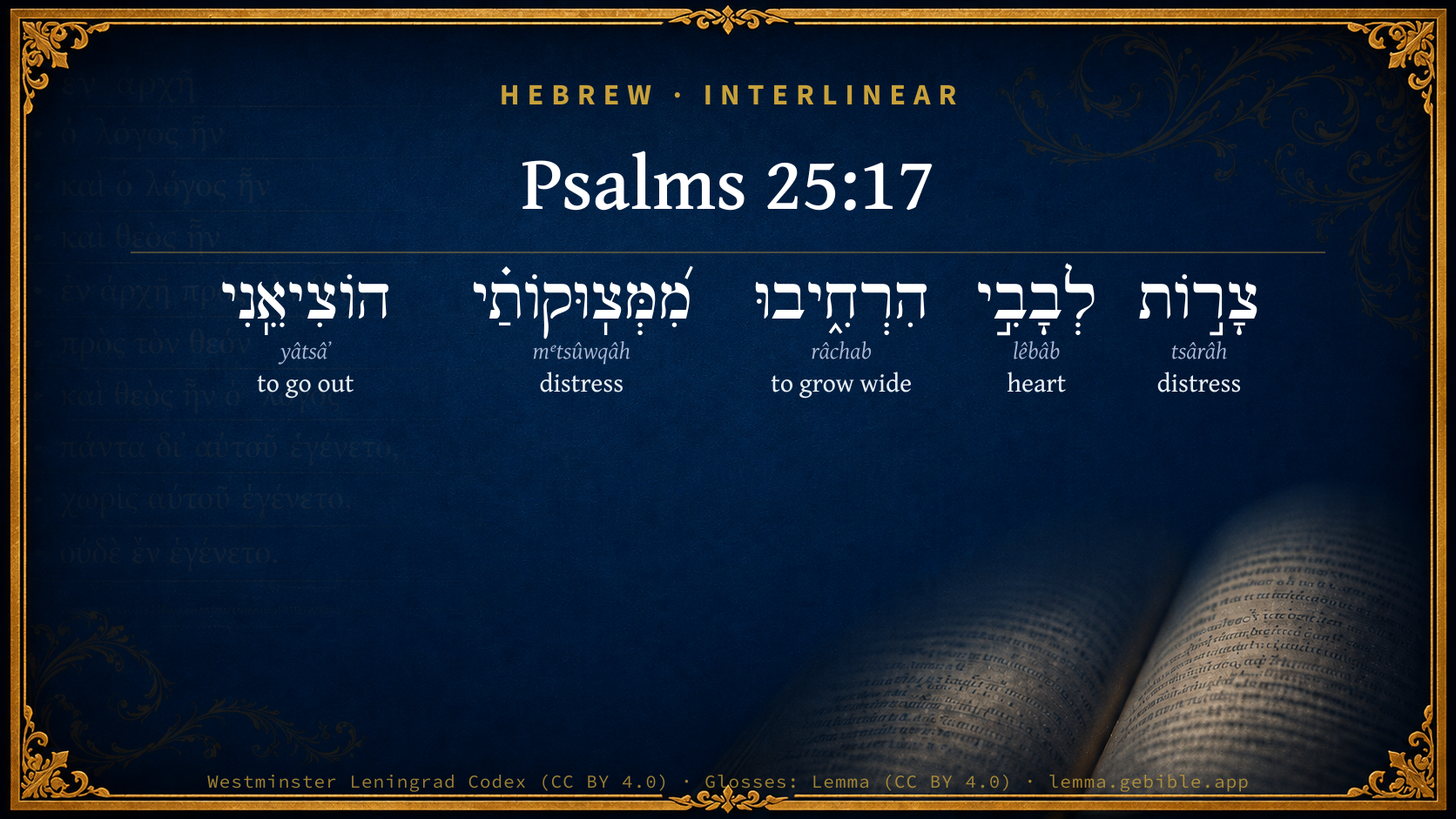
Psalms 25:17

Hebrew (Westminster Leningrad Codex) Psalms 25:17 appears in the Hebrew Old Testament. The text above is from the Westminster Leningrad Codex. Each word links to its Strong’s number, a concise gloss, and parsing drawn from the Open Scriptures Hebrew Bible morphology. Click any word for its full Brown-Driver-Briggs (BDB) entry.
Download image
Cite this verse

Psalms 25:17 (World English Bible). Public Domain. Lemma interlinear Bible study tool, https://lemma.gebible.app/v/psalms/25/17.

Show BibTeX & RIS
BibTeX
RIS
English Translation
The troubles of my heart are enlarged. Oh bring me out of my distresses.
World English Bible · Public Domain
Download a study sheet

One document with this verse’s original text, its word-by-word gloss line, the meaning frame, cross-references with their text, attributed commentary, and full source and license credits — printable, and it pastes into notes with its structure intact.

This verse Autodidact and up

Study sheet (.html) Plain text (.txt)

A passage Seminary Student

Up to 50 verses in one chapter. A passage sheet keeps up to 6 commentary sources and 12 cross-references per verse, in the order this page ranks them, and says so on the sheet whenever that leaves anything out. Ask for a single verse and you get the Autodidact verse sheet above.

Everything on this page stays free to read, with no account — the sheet is a download of what is already on screen, not access to it.

Want to remove ads? Support Godless Engineer
Compare translations 3

The same verse in 3 English versions, stacked beneath the original-language interlinear above. Click any original word for its lexicon entry.

Each is an independent rendering of the whole verse — the interlinear is not word-aligned to these translations.

Highlighted words mark where these versions differ — a whole-verse word diff, not a word-by-word alignment.

  • World English Bible Public Domain
    The troubles of my heart are enlarged. Oh bring me out of my distresses.
  • King James Version Public Domain
    The troubles of my heart are enlarged: O bring thou me out of my distresses.
  • unfoldingWord Literal Text CC BY-SA 4.0
    The troubles of my heart are enlarged; bring me out of my distresses.

unfoldingWord Literal Text — © unfoldingWord, licensed CC BY-SA 4.0. Word-aligned USFM3 via Door43 (git.door43.org/unfoldingWord/en_ult).

Versions to compare (up to 4)

3 of 4 selected

Show all 18 translations

Every available English version of this verse, each an independent rendering of the whole verse.

  • World English Bible Public Domain
    The troubles of my heart are enlarged. Oh bring me out of my distresses.
  • Berean Standard Bible Public Domain
    The troubles of my heart increase; free me from my distress.
  • Majority Standard Bible Public Domain
    The troubles of my heart increase; free me from my distress.
  • King James Version Public Domain
    The troubles of my heart are enlarged: O bring thou me out of my distresses.
  • American Standard Version (1901) Public Domain
    The troubles of my heart are enlarged: Oh bring thou me out of my distresses.
  • Revised Version (1885) Public Domain
    The troubles of my heart are enlarged: O bring thou me out of my distresses.
  • Geneva Bible (1599) Public Domain
    The sorowes of mine heart are enlarged: drawe me out of my troubles.
  • Douay-Rheims (1899) Public Domain
    The troubles of my heart are multiplied: deliver me from my necessities.
  • Young's Literal Translation Public Domain
    The distresses of my heart have enlarged themselves, From my distresses bring me out.
  • Literal Standard Version CC BY-SA 4.0
    The distresses of my heart have enlarged themselves, || Bring me out from my distresses.
  • Unlocked Literal Bible CC BY-SA 4.0
    The troubles of my heart are enlarged; draw me out from my distress!
  • unfoldingWord Literal Text CC BY-SA 4.0
    The troubles of my heart are enlarged; bring me out of my distresses.
  • Darby Bible Public Domain
    The troubles of my heart are increased: bring me out of my distresses;
  • World Messianic Bible Public Domain
    The troubles of my heart are enlarged. Oh bring me out of my distresses.
  • Webster's Bible Public Domain
    The troubles of my heart are enlarged: O bring thou me out of my distresses.
  • Free Bible Version CC BY-SA 4.0
    My problems get bigger and bigger. Please save me from all I'm going through.
  • Bible in Basic English Public Domain
    The troubles of my heart are increased: O take me out of my sorrows.
  • JPS Tanakh (1917) Public Domain
    The troubles of my heart are enlarged; O bring Thou me out of my distresses.

Literal Standard Version (2020), Covenant Press — licensed CC BY-SA 4.0. Text via the HelloAO Bible API (eBible.org). Unlocked Literal Bible (unfoldingWord) — licensed CC BY-SA 4.0. Text via the HelloAO Bible API (eBible.org). unfoldingWord Literal Text — © unfoldingWord, licensed CC BY-SA 4.0. Word-aligned USFM3 via Door43 (git.door43.org/unfoldingWord/en_ult). Free Bible Version, Dr. Jonathan Gallagher — licensed CC BY-SA 4.0. Text via the HelloAO Bible API (eBible.org).

Word by word

More ways to search: Search by grammar → Find every occurrence → Compare this word →

Practice this passage: Drill this verse → Learn its vocabulary →

About this verse

These counts appear in no published source. They are computed here, from the morphology-tagged text and Lemma’s own curated glosses. What Lemma adds →

5
words
5
distinct lemmas
Wisdom
section

Notable vocabulary

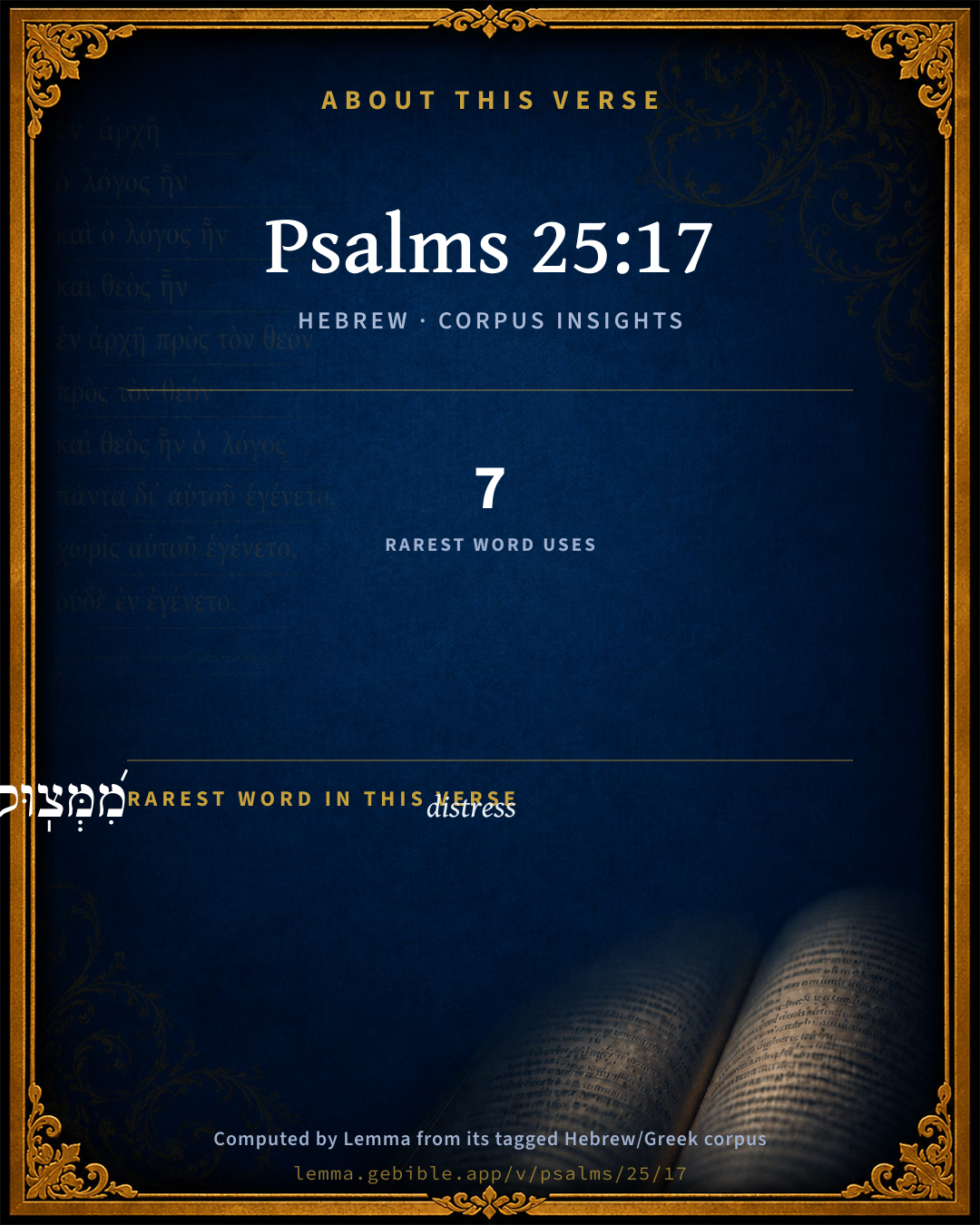
The rarest word here is מִ֝מְּצֽוּקוֹתַ֗י distress H4691 — appearing just 7 times in the whole Hebrew Bible.

Shared distinctive vocabulary

מִ֝מְּצֽוּקוֹתַ֗י distress H4691 occurs in 7 verses of the Hebrew Bible. Also found in:

Grammatical profile

  • 2 verbs
  • 3 nouns

Verb forms

  • הִרְחִ֑יבוּ Hiphil · Perfect
  • הוֹצִיאֵֽנִי Hiphil · Imperative

Hebrew & Septuagint length

In English translation the verse runs 14 words from the Hebrew and 13 from the Septuagint (LXX English) — closely comparable.

A rough comparison of the two English renderings, which tokenize alike — not a word-level alignment.

Word counts can differ between the Hebrew and the Greek without any difference in meaning — e.g. the Hebrew direct-object marker אֵת has no separate Greek word, and Greek often adds the article ὁ.

Cross-references

8

Topical passages linked to Psalms 25:17 in the Treasury of Scripture Knowledge — connected by theme and wording, ordered by reader-vote popularity; previews shown in the World English Bible.

  • Psalms 107:6 Then they cried to Yahweh in their trouble, And he delivered them out of their distresses,
  • Psalms 34:19 Many are the afflictions of the righteous, But Yahweh delivers him out of them all.
  • 2 Corinthians 4:8–9 We are pressed on every side, yet not crushed; perplexed, yet not to despair;
  • Psalms 38:1–8 Yahweh, don't rebuke me in your wrath, Neither chasten me in your hot displeasure.
  • Psalms 42:7 Deep calls to deep at the noise of your waterfalls. All your waves and your billows have swept over me.
  • Psalms 77:2–4 In the day of my trouble I sought the Lord. My hand was stretched out in the night, and didn't get tired. My soul refused to be comforted.
  • Habakkuk 3:17–19 For though the fig tree doesn't flourish, Nor fruit be in the vines; The labor of the olive fails, The fields yield no food; The flocks are cut off from the fold, And there is no herd in the stalls:
  • 1 Corinthians 4:11–13 Even to this present hour we hunger, thirst, are naked, are beaten, and have no certain dwelling place.

Cross-references courtesy of OpenBible.info (CC BY 4.0).

Hebrew and Greek witnesses Masoretic Hebrew ↔ Greek Septuagint

The same verse in the two great witnesses to the Old Testament, shown verse-for-verse.

You’re reading Greek Psalm 24 (Hebrew Psalm 25). The Septuagint counts the superscription, so verse numbers can differ from the Hebrew — chapter-level alignment, not verse-by-verse. Numbering follows Rahlfs.

These are two independent witnesses, not word-aligned to each other, and the Septuagint is shown in lemma (dictionary) form.

Hebrew Psalms 25:17 Masoretic · Westminster Leningrad Codex

צָר֣וֹת לְבָבִ֣י הִרְחִ֑יבוּ מִ֝מְּצֽוּקוֹתַ֗י הוֹצִיאֵֽנִי

The troubles of my heart are enlarged. Oh bring me out of my distresses.

World English Bible · Public Domain

Greek LXX Greek Psalm 24:17 Septuagint · lemma form

ὁ θλῖψις ὁ καρδία ἐγώ πλατύνω ἐκ ὁ ἀνάγκη ἐγώ ἐκἄγω ἐγώ

The afflictions of my heart have been multiplied; deliver me from my distresses.

LXX2012 (modern English Septuagint) · Public Domain

On this verse, Keil & Delitzsch discusses the Septuagint’s reading. Read the note in Commentary ↓

Hebrew: Westminster Leningrad Codex (CC BY 4.0). Greek: Septuagint (public domain); English from LXX2012 (modern English Septuagint) (Public Domain). How the Septuagint differs from the Hebrew →

Commentary

Notes on Psalms 25:17 from classic Christian and Jewish commentators (each source and its license shown beneath its notes). The classic Christian expositions comment on the surrounding passage and are grouped to its opening verse, so a note may address several verses; the Jewish commentaries on the Tanakh (Rashi and others) are per-verse, so they appear only where the commentator wrote on this verse.

Lemma curates 59 commentaries, every one of them public domain or Creative Commons licensed, each selected and text-cleaned for this edition rather than reprinted as found. About our sources →

Trapp's Complete Commentary

John Trapp

Psa 25:17 The troubles of my heart are enlarged: [O] bring thou me out of my distresses.

Ver. 17. The troubles of my heart are enlarged] Whereby my heart is sorely straitened, so that I can hardly breathe: Oh, "hide not thine ear at my breathing," at my cry, Lam 3:56. En patet in curas area lata meas; all afflictions enter into mine heart, as by a wide gate (R. Obad.). Cor vix capax tribulationum mearum (Vat.).

Out of my distresses] Wherewith I am pent up and pinched; as afterwards Paul was pricked with the messenger of Satan.

John Trapp, A Commentary or Exposition upon All the Books of the Old and New Testament (1647–1656) — public domain. Text from a community e-Sword module.

Joseph Benson's Commentary

Psa 25:17-20. The troubles of my heart are enlarged — My outward troubles are accompanied with grievous distresses of my mind and heart for my sins, which have procured them, and for thy great displeasure manifested in them. Look upon mine affliction — With compassion, as Exo 3:7-8; Psa 31:7; Psa 106:44. And forgive all my sins — The procuring and continuing causes of my trouble. “David joins this petition to the foregoing one, because he considered, whatever afflictions and crosses were brought upon him, how just soever they might be, with respect to his enemies, who were the apparent causes of them; yet that, according to God’s appointment, or permission, they might be the effects and punishment of his sins.” — Dodd. O keep my soul — Myself, or my life, as that word is commonly taken: for his soul was out of his enemies’ reach, who could only kill his body, Luk 12:4.

Joseph Benson's Commentary on the Old and New Testaments (1811–1818) — public domain. Text from a community e-Sword module.

Tyndale Open Study Notes

Tyndale Open Resources

25:17-18 The psalmist can find no relief (see 4:1; 13:1-2) as his problems go from bad to worse. He associates his anguish with sin, but he does not elaborate on the nature of his sin (see 25:7, 11).

Tyndale Open Study Notes — © Tyndale Open Resources, licensed CC BY-SA 4.0. Text via the HelloAO Bible API.

Geneva Bible (1599)

Geneva Bible translators

My grief is increased because of mine enemies’ cruelty.

Geneva Bible (1599) marginal notes — public domain. Text via Bolls.life.

Adam Clarke's Commentary

Verse 17. The troubles of may heart are enlarged] The evils of our captive state, instead of lessening, seem to multiply, and each to be extended.

Adam Clarke's Commentary on the Bible (1810–1826) — public domain. Text from a community e-Sword/MySword module.

John Calvin's Commentaries

17. The troubles of my heart are enlarged. In this verse he acknowledges not only that he had to contend outwardly with his enemies and the troubles which they occasioned him, but that he was also afflicted inwardly with sorrow and anguish of heart. It is also necessary to observe the manner of expression which he here employs, and by which he intimates that the weight and number of his trials had accumulated to such an extent that they filled his whole heart, even as a flood of waters bursting every barrier, and extending far and wide, covers a whole country. Now, when we see that the heart of David had sometimes been wholly filled with anguish, we need no longer wonder if at times the violence of temptation overwhelm us; but let us ask with David, that even whilst we are as it were at the point of despair, God would succor us.

John Calvin's Commentaries (1540-1563) — public domain. Text from the Calvin Translation Society English edition (1840s-50s) via the Christian Classics Ethereal Library (ccel.org). Calvin's coverage is partial (roughly two-thirds of the Bible); uncommented books and verses are honest gaps, never fabricated. The 19th-century editor's footnotes and remarks are omitted so the notes are faithfully Calvin's own voice.

Ellicott's Commentary for English Readers

(17) The troubles.—The consensus of commentators is for a different division of the Hebrew words.

. . . “Relieve my sore heart,

And release me from my distress.”

A Bible Commentary for English Readers, edited by Charles John Ellicott (1878–1897) — public domain. Text from a community e-Sword module.

The Cambridge Bible for Schools and Colleges

gen. ed. J. J. S. Perowne

17. The verb rendered are enlarged cannot mean ‘augmented.’ It is all but certain that the consonants should be divided and vocalised differently, giving the appropriate sense, The straitnesses of my heart enlarge thou, and bring me &c.: i.e. relieve my distress. Cp. Psa_18:36; Psa_119:32.

The Cambridge Bible for Schools and Colleges (gen. ed. J. J. S. Perowne; Cambridge University Press, 1878–1918) — public domain. Text from a community e-Sword module.

John Gill's Exposition

The troubles of my heart are enlarged,.... His enemies being increased, which troubled him; the floods of ungodly men made him afraid; the waters of affliction were come into his soul, and spread themselves, and threatened to overwhelm him: or it may be rendered, as by some, "troubles have enlarged my heart" (h); made him wiser, increased his knowledge and experience; see Psa 119:67; but the former seems better to agree with what follows;

O bring thou me out of my distresses; or "straits" (i); for the enlargement of his troubles was the straitening of his heart; and therefore he applies to the Lord to bring him out of his afflicted circumstances, in which he was penned up, as in a strait place, on every side, and which were such that he could not free himself from; but he knew that God could deliver him.

(h) "dilataverunt cor meum", Vatablus; "reddiderunt cor meum latius", Gussetius, p. 786. (i) "ab angustiis meis", Pagninus, Junius & Tremellius; so Musculus, Piscator, Michaelis.

John Gill's Exposition of the Whole Bible (1746–1763) — public domain (CC PDM 1.0). Text via the HelloAO Bible API.

Albert Barnes' Notes on the Bible

The troubles of my heart - The sorrows which spring upon the heart - particularly from the recollections of sin.

Are enlarged - Have become great. They increased the more he reflected on the sins of his life.

O bring thou me out of my distresses - Alike from my sins, and from the dangers which surround me. These two things, external trouble and the inward consciousness of guilt, are not infrequently combined. Outward trouble has a tendency to bring up the remembrance of past transgressions, and to suggest the inquiry whether the affliction is not a divine visitation for sin. Any one source of sorrow may draw along numerous others in its train. The laws of association are such that when the mind rests on one source of joy, and is made cheerful by that, numerous other blessings will be suggested to increase the joy; and when one great sorrow has taken possession of the soul, all the lesser sorrows of the past life cluster around it, so that we seem to ourselves to be wholly abandoned by God and by man.

Albert Barnes' Notes on the Bible (1834–1885) — public domain. Text from a community e-Sword/MySword module.

Matthew Poole's English Annotations

The troubles of my heart; my outward troubles are accompanied with grievous torments of my mind and heart for my sins, which have procured them, and thy great displeasure manifested in them.

Matthew Poole's English Annotations on the Holy Bible (1683–1685) — public domain. Text from a community e-Sword/MySword module.

The Treasury of David

Charles H. Spurgeon

Ver. 17. The troubles of my heart are enlarged. When trouble penetrates the heart it is trouble indeed. In the case before us, the heart was swollen with grief like a lake surcharged with water by enormous floods; this is used as an argument for deliverance, and it is a potent one. When the darkest hour of the night arrives we may expect the dawn; when the sea is at its lowest ebb the tide must surely turn; and when our troubles are enlarged to the greatest degree, then we may hopefully pray, O bring thou me out of my distresses.

Ver. 17. The troubles of my heart are enlarged. Let no good man be surprised that his affliction is great, and to him of an unaccountable character. It has always been so with God's people. The road to heaven is soaked with the tears and blood of the saints. William S. Plumer.

Ver. 17. O bring thou me out of my distresses. We may not complain of God, but we may complain to God. With submission to his holy will we may earnestly cry for help and deliverance. William S. Plumer.

Ver. 17. Special seasons of trouble and special resort to prayer for special deliverance.

Psalms 25:18*

Charles H. Spurgeon's The Treasury of David (1869–1885) — public domain. Psalms only. Text from a community e-Sword/MySword module.

The Pulpit Commentary

Vers. 17, 18. The troubles of my heart are enlarged: O bring thou me out of my distresses. Look upon mine affliction and my pain; and forgive all my sins. The affliction, of whatever kind it may have been, was regarded by David as a punishment sent on him for his sins. Of his sins he was at this time deeply conscious (vers. 7, 11) and deeply repentant. Probably they included his great sin (see the comment on ver. 11).

The Pulpit Commentary (1880–1919), ed. H.D.M. Spence-Jones & Joseph S. Exell — public domain. Text from a community e-Sword module.

Keil & Delitzsch

C. F. Keil & F. Delitzsch

The Hiph. הרחיב signifies to make broad, and as a transitive denominative applied to the mind and heart: to make a broad space = to expand one's self (cf. as to the idea, Lam 2:13, "great as the sea is thy misfortune"), lxx ἐπληθύνθησαν, perhaps originally it was ἐπλατηύνθησαν. Accordingly הרחיבוּ is admissible so far as language is concerned; but since it gives only a poor antithesis to צרות it is to be suspected. The original text undoubtedly was הרחיב וממצוקותי (הרחיב, as in Psa 77:2, or הרחיב, as e.g., in Kg2 8:6): the straits of my heart do Thou enlarge (cf. Psa 119:32; Co2 6:11) and bring me out of my distresses (Hitzig and others).

Keil & Delitzsch — Biblical Commentary on the Old Testament (1861–1891) — public domain (CC PDM 1.0). Text via the HelloAO Bible API. (Old Testament only.)

J. A. Alexander on Psalms

Joseph Addison Alexander

17. The troubles of my heart have they enlarged; from my distresses do thou bring me out. The plural of the first clause is indefinite, equivalent to a passive construction in English, are enlarged. (Compare the common version of Luk 12:20.) It does not refer even to his enemies specifically, but to all others, as distinguished from his lonely self, and from his sole deliverer.

Joseph Addison Alexander, The Psalms Translated and Explained (1850) — public domain. Text from a community e-Sword module.

unfoldingWord translationNotes

Door43 World Missions Community

The troubles of my heart are enlarged

Here "heart" represents a person's emotions. AT: "I feel more and more troubled" (See: Metonymy)

draw me out from my distress

"bring me out of my distress." This speaks of distress as if it were a place that a person can be brought out of. AT: "rescue me from my distress" or "relieve me of my distress" (See: Metaphor)

my distress

The word "distress" is an abstract noun. AT: "the things that distress me" or "the things that cause me to be afraid" (See: Abstract Nouns)

See my affliction

"Notice my affliction"

my affliction

The abstract noun "affliction" can be stated as a verb. AT: "the things that afflict me" or "how afflicted I am" (See: Abstract Nouns)

my toils

The word "toils" is an abstract noun. AT: "the things that trouble me" (See: Abstract Nouns)

they hate me with cruel hatred

"they hate me cruelly" or "they hate me fiercely"

translationWords

heart

forgive

sin

unfoldingWord translationNotes — © Distant Shores Media and the Door43 World Missions Community, licensed CC BY-SA 4.0. Source: git.door43.org/Door43/en_tn.

Lesson kit

Teaching starters — assembled from the data on this page, not authored interpretation. Every prompt links to the verse data it draws on. Edit before teaching.

Psalms, in the Wisdom, opens this verse with 5 words (5 distinct Hebrew lemmas). Its most distinctive word is mᵉtsûwqâh (“distress”). A historical commentator’s framing appears above. Read the whole chapter for the surrounding context.

Discussion questions

  1. The word mᵉtsûwqâh carries the sense “distress.” How does it shape the verse?
  2. How does Job 15:24, which shares the word «distress», read alongside this verse?
  3. These translations render this verse differently. What is at stake in choosing one wording over another?
  4. «הִרְחִ֑יבוּ» is a Hiphil Perfect verb. How does that grammatical form shape the action described?
  5. Compare how Trapp's Complete Commentary and Joseph Benson's Commentary read this verse. Where do they agree or differ?

Things to notice

Reading settings

Reading text

Shown beneath each verse's original-language words.

Old Testament
Old Testament edition

Read the OT as the Masoretic Hebrew (MT) or the Greek Septuagint (LXX).

English shown for the Greek Septuagint (in the Hebrew ↔ Greek comparison).

Comparing translations? Open the Compare panel on any verse page to stack up to four side by side.