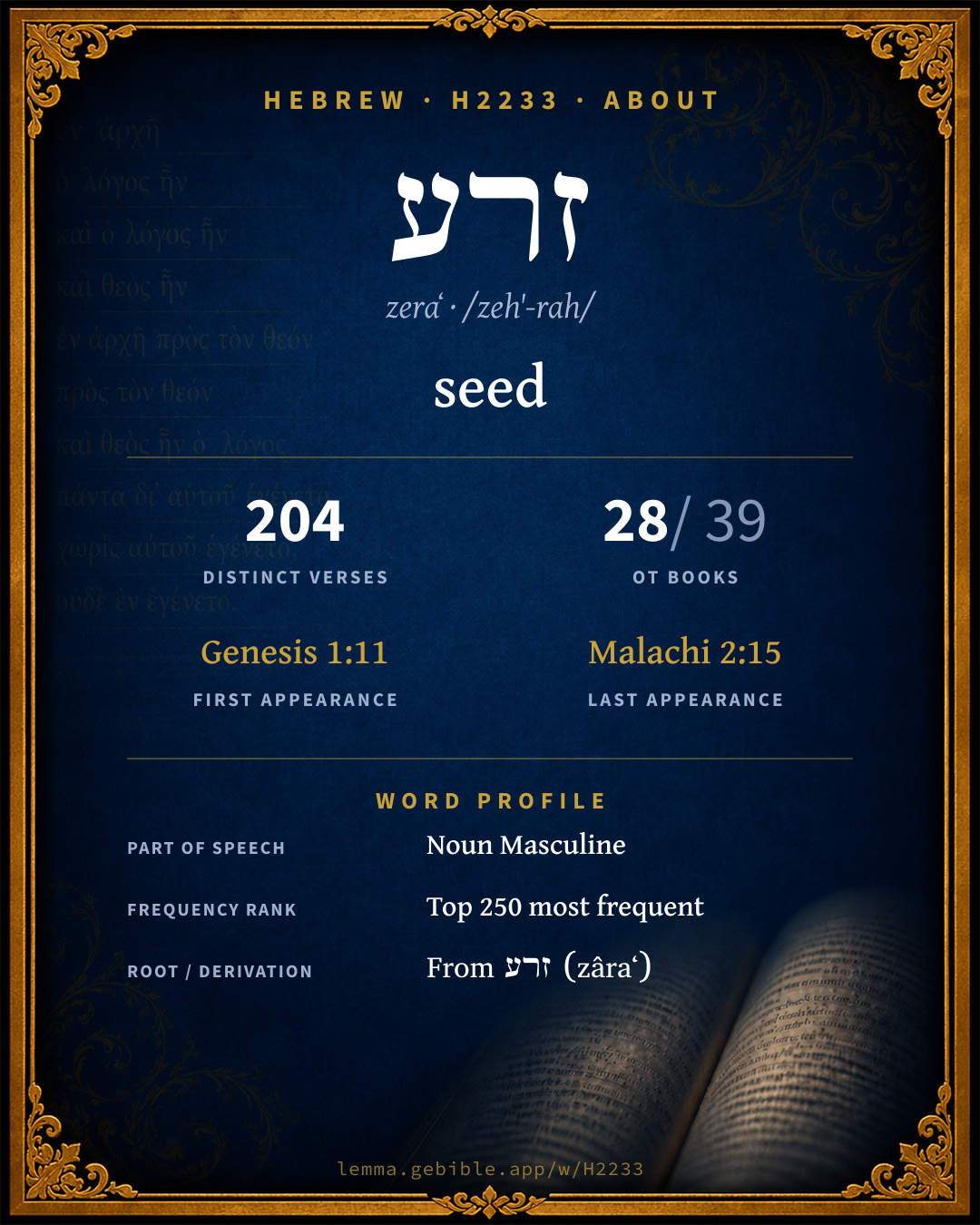
זֶ֫רַע
seed
also: sowing, offspring fuller range ↓
Full lexicon entry — Brown-Driver-Briggs (BDB)
From Brown-Driver-Briggs (BDB)
Where this word appears
See every Construct-state word in the Hebrew Bible →
Grammar key — what these labels mean
Part of speech
- Noun
- A naming word — a person, place, thing, or idea.
Noun type
- Common
- A common noun — a general class of person, place, or thing (“king,” “city,” “water”), not a specific name.
State
- Absolute
- The independent form of a noun, not bound to a following word.
- Construct
- A noun bound to a following noun in a possessive / “of” relationship (the construct chain).
Gender
- Masculine
- Grammatically masculine.
Number
- Singular
- One.
- Plural
- More than one (in Hebrew, generally three or more).
Every verse where H2233 appears in the Book of Leviticus — 22 distinct verses. Click any verse to open its interlinear word-by-word view. Verse text shown in the World English Bible for context — . Each verse’s Hebrew form is shown with its reference; the English is not keyword-highlighted, since the data carries no word-level English alignment. Use “Compare translations” on any verse to read it across multiple English versions. This concordance covers the Hebrew Bible; Septuagint (Greek Old Testament) occurrences are not indexed here.
Leviticus
- Leviticus 11:37 זֶ֥רַע n c ms If part of their carcass falls on any sowing seed which is to be sown, it is clean.
- Leviticus 11:38 זֶ֔רַע n c ms But if water is put on the seed, and part of their carcass falls on it, it is unclean to you.
- Leviticus 15:16 זָ֑רַע n c ms "'If any man has an emission of semen, then he shall bathe all his flesh in water, and be unclean until the evening.
- Leviticus 15:17 זָ֑רַע n c ms Every garment, and every skin, whereon the semen is, shall be washed with water, and be unclean until the evening.
- Leviticus 15:18 זָ֑רַע n c ms If a man lies with a woman and there is an emission of semen, they shall both bathe themselves in water, and be unclean until the evening.
- Leviticus 15:32 זֶ֖רַע n c ms This is the law of him who has a discharge, and of him who has an emission of semen, so that he is unclean thereby;
- Leviticus 18:20 לְ/זָ֑רַע prep + n c ms "'You shall not lie carnally with your neighbor's wife, and defile yourself with her.
- Leviticus 18:21 וּ/מִֽ/זַּרְעֲ/ךָ֥ conj + prep + n c ms cs + sfx pers 2ms "'You shall not give any of your children to sacrifice to Molech; neither shall you profane the name of your God: I am Yahweh.
- Leviticus 19:20 זֶ֗רַע n c ms "'If a man lies carnally with a woman who is a slave girl, pledged to be married to another man, and not ransomed, or given her freedom; they shall be punished. They shall not be put to death, because she was not free.
- Leviticus 20:2 מִ/זַּרְע֛/וֹ prep + n c ms cs + sfx pers 3ms "Moreover, you shall tell the children of Israel, 'Anyone of the children of Israel, or of the strangers who live as foreigners in Israel, who gives any of his seed to Molech; he shall surely be put to death. The people of the land shall stone him with stones.
- Leviticus 20:3 מִ/זַּרְע/וֹ֙ prep + n c ms cs + sfx pers 3ms I also will set my face against that person, and will cut him off from among his people because he has given of his seed to Molech, to defile my sanctuary, and to profane my holy name.
- Leviticus 20:4 מִ/זַּרְע֖/וֹ prep + n c ms cs + sfx pers 3ms If the people of the land all hide their eyes from that person, when he gives of his seed to Molech, and don't put him to death;
- Leviticus 21:15 זַרְע֖/וֹ n c ms cs + sfx pers 3ms He shall not profane his seed among his people: for I am Yahweh who sanctifies him.'"
- Leviticus 21:17 מִֽ/זַּרְעֲ/ךָ֞ prep + n c ms cs + sfx pers 2ms "Say to Aaron, 'None of your seed throughout their generations who has a blemish, may approach to offer the bread of his God.
- Leviticus 21:21 מִ/זֶּ֨רַע֙ prep + n c ms cs no man of the seed of Aaron the priest, who has a blemish, shall come near to offer the offerings of Yahweh made by fire. Since has a blemish, he shall not come near to offer the bread of his God.
- Leviticus 22:3 זַרְעֲ/כֶ֗ם n c ms cs + sfx pers 2mp Tell them, 'If anyone of all your seed throughout your generations approaches the holy things, which the children of Israel make holy to Yahweh, having his uncleanness on him, that soul shall be cut off from before me. I am Yahweh.
- Leviticus 22:4 מִ/זֶּ֣רַע זָֽרַע prep + n c ms cs n c ms "'Whoever of the seed of Aaron is a leper or has an issue; he shall not eat of the holy things, until he is clean. Whoever touches anything that is unclean by the dead, or a man whose seed goes from him;
- Leviticus 22:13 וְ/זֶרַע֮ conj + n c ms But if a priest's daughter is a widow, or divorced, and has no child, and has returned to her father's house, as in her youth, she may eat of her father's bread: but no stranger shall eat any of it.
- Leviticus 26:5 זָ֑רַע n c ms Your threshing shall reach to the vintage, and the vintage shall reach to the sowing time; and you shall eat your bread to the full, and dwell in your land safely.
- Leviticus 26:16 זַרְעֲ/כֶ֔ם n c ms cs + sfx pers 2mp I also will do this to you: I will appoint terror over you, even consumption and fever, that shall consume the eyes, and make the soul to pine away; and you will sow your seed in vain, for your enemies will eat it.
- Leviticus 27:16 זַרְע֑/וֹ זֶ֚רַע n c ms cs + sfx pers 3ms n c ms cs "'If a man dedicates to Yahweh part of the field of his possession, then your valuation shall be according to the seed for it: the sowing of a homer of barley shall be valued at fifty shekels of silver.
- Leviticus 27:30 מִ/זֶּ֤רַע prep + n c ms cs "'All the tithe of the land, whether of the seed of the land or of the fruit of the trees, is Yahweh's. It is holy to Yahweh.
About this entry
At a glance — auto-summarized from this page’s data, not written by a person. Every figure links to its source below. This summary describes the numbers; it doesn’t interpret them.
At its core, זרע (zeraʻ) means “seed.” Its English rendering has broadened — “seed” classically, “descendants” (Berean Standard Bible) in modern versions; see the renderings breakdown. Spanning 204 verses in 28 books, it ranks among the common words of the Hebrew Bible. It first appears in Genesis 1:11. Beyond its headline sense, its full sense range takes in “sowing” and “offspring”. Dig into 204-verse concordance and the renderings breakdown below.
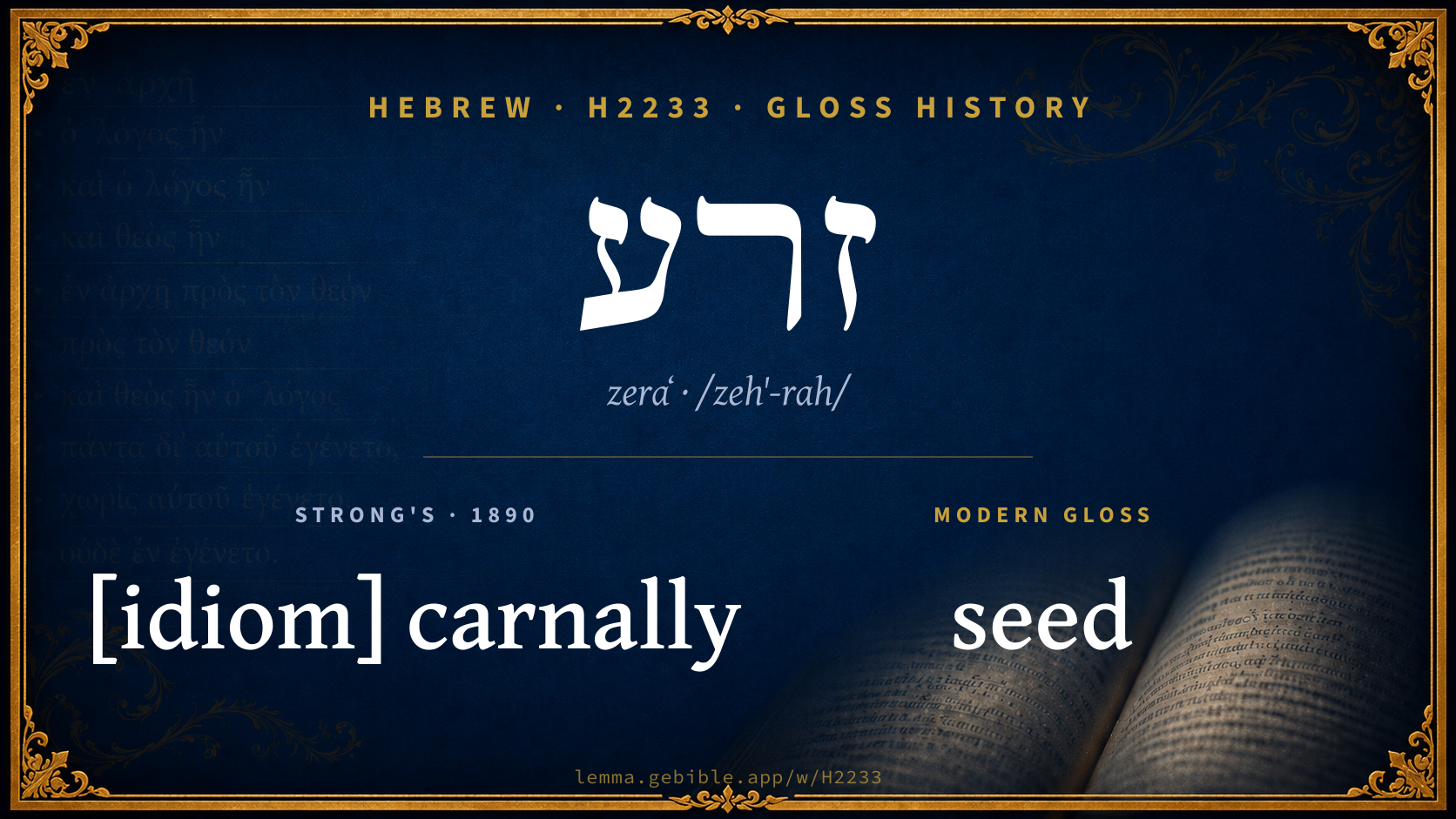
Gloss history
Strong's 1890 vs modern scholarship
About this word
Strong's H2233 catalogs a Hebrew word from the Hebrew Old Testament.
These counts are not copied from any lexicon or concordance. They are computed here, from the morphology-tagged Hebrew Old Testament. What Lemma adds →
- 204
- distinct verses
- The word appears in 204 distinct verses.
- 28 / 39
- OT books
- The word appears in 28 of 39 Old Testament books.
- #207
- by frequency
- Top 250 most frequent Hebrew words (rank 207 of 8,640 Hebrew words by occurrence).
View all 204 occurrences in the concordance →
By section of the Old Testament
By traditional corpus
Conventional, traditional groupings — biblical authorship is debated, so this is a traditional corpus grouping, not an authorship claim. Each share is this word’s portion of its verses in that division of the Hebrew canon. Each figure is a share of the word’s 204 distinct verses.
- Torah (Pentateuch) 98 verses · 48%
- Prophets (Nevi'im) 67 verses · 33%
- Writings (Ketuvim) 39 verses · 19%
How translations render this word
Counts come from each version’s own published word-to-Strong’s tagging or interlinear alignment — an approximate guide to how each version renders this word, not a word-level alignment the data otherwise carries. Because each total is that version’s own tagged count, the per-version totals vary from one another and need not match the appearance or distinct-verse counts above. These counts may also differ from a printed concordance because Lemma counts each distinctly tagged rendering and does not collapse phrase taggings into a single head-word total. This is a fixed set of word-tagged versions (KJV, ASV, BSB, ULT) and does not change with the reading translation you choose elsewhere. Each version’s license is shown beside its name below (and on Sources).
- King James Version: Seed 163×, All the seed 4×, Thee and to thy seed 4×
- American Standard Version: Seed 143×, All the seed 4×, 's seed 3×
- Berean Standard Bible: Descendants 76×, Offspring 40×, Seed 32×
- unfoldingWord Literal Text: Seed 105×, Offspring 48×, Seed of 34×
King James Version Public Domain
Renders H2233 across 228 tagged occurrences — most commonly:
Plus 39 renderings that appear only once — usually multi-word phrases or single function words the recovered tagging swept in, not distinct renderings. Not rendered by a distinct English word in 1 further occurrence.
American Standard Version Public Domain
Renders H2233 across 228 tagged occurrences — most commonly:
Plus 62 renderings that appear only once — usually multi-word phrases or single function words the recovered tagging swept in, not distinct renderings. Not rendered by a distinct English word in 1 further occurrence.
Berean Standard Bible Public Domain
Renders H2233 across 220 tagged occurrences — most commonly:
Plus other, less common renderings. Plus 34 renderings that appear only once — usually multi-word phrases or single function words the recovered tagging swept in, not distinct renderings. Not rendered by a distinct English word in 8 further occurrences.
unfoldingWord Literal Text CC BY-SA 4.0
Renders H2233 across 219 tagged occurrences — most commonly:
Plus 20 renderings that appear only once — usually multi-word phrases or single function words the recovered tagging swept in, not distinct renderings.
19 senses and sub-senses in the full BDB
What do BDB’s symbols mean?
BDB uses these scholarly abbreviations:
| Symbol | Meaning |
|---|---|
| 𝔊 | the Septuagint (the ancient Greek translation, LXX) |
| 𝔙 | the Vulgate (the Latin translation) |
| 𝔖 | the Syriac version (the Peshitta) |
| 𝔗 | the Targum (the Aramaic translation) |
| ψ | the Psalms |
| √ | root (the underlying root or stem) |
| ‖ | parallel passage (a synonymous or contrasted parallel) |
| † | the dagger: every passage where the word occurs is cited |
The 19 senses and sub-senses the full Brown-Driver-Briggs lexicon distinguishes for this word, in lexicon order (not ranked by frequency), with BDB’s own verbatim wording and sub-sense lettering. Shown in Hebrew script with BDB’s own scholarly abbreviations. The condensed entry is in the Lexicon Entry tab. See also the Forms in the corpus table below.
- 1. lit.:
- a. a sowing לְז׳ הַשָּׂדֶה Gn 47:24 (J; + אָכְלְכֶם; otherwise Lv 27:16 b, v. infr. 2 c); לֹא מְקוֹם ז׳ Nu 20:5 no place for sowing (JE; + וּתְאֵנָה וְגֶפֶן וְרִמּוֹן); cf. שְׂדֵה ז׳ Ez 17:5 a field suitable for sowing; hence e.g. Genesis 47:24
- b. sowing as regularly recurring at its season Gn 8:22 (J; ‖ קָצִיר, + קֹר וָחֹם וְקַיִץ וָחֹרֶף וְיוֹם וָלַיְלָה), Lv 26:5 (H; ‖ דַּיִשׁ, בָּצִיר;—cf. Am 9:13 infr. 2 a). e.g. Genesis 8:22
- 2. seed:
- a. lit., sown, to raise crops for food, usually corn (wheat, barley, etc.) Gn 47:19, 23 (J; cf. v 14 f.), Nu 24:7 (JE); נָתַן ז׳ לַזֹּרֵעַ Is 55:10 (‖ לֶחֶם), Dt 28:38 (ז׳ רַב), Lv 26:16 (H; c. זָרַע), 27:16a, ז׳ חֹמֶר שְׂעֹרִים v 16b (both P), cf. Is 5:10. e.g. Genesis 47:19
- b. fig., of idolatry of Judah Is 17:11 (‖ קציר); of fortunes of Zion מֶשֶׁךְ הַזּ׳ ψ 126:6 the dropping of seed, i.e. the proper quantity for sowing (opp. אֲלֻמֹּת); Je 35:7 (c. זָרַע, ‖ כֶּרֶם לֹא תִטָּ֔עוּ), cf. v 9 (‖ כרם, שׂדה); מְטַר ז׳ Is 30:23 (c. זָרַע ‖ לֶחֶם תְּבוּאַת הָאֲדָמָה); also Dt 11:10 (c. זָרַע), Ec 11:6 (c. id.); ז׳ זֵרוּעַ Lv 11:37, cf. v 38 (both P); as yielding the crop תְּבוּאַת זַרְעֶ֑ךָ Dt 14:22 the product of thy seed, cf. d infr.; וְנִגַּשׁ חוֹרֵשׁ בַּקּוֹצֵר וְדֹרֵךְ עֲנָבִים בְּמשֵׁךְ הַזּ׳ Am 9:13, in fig. of rapid and plentiful growth in the coming time; ז׳ הָאָרֶץ producing a vine Ez 17:5, of growth and prosperity of Isr.; הַזּ׳ Mal 2:3, read perhaps הַזְּרֹעַ (cf. VB). e.g. Isaiah 17:11
- c. seed as product; the manna is comp. with ז׳ גַּד, coriander seed in Nu 11:7 (JE), Ex 16:31 (P); seed of herbs and trees Gn 1:11(×2), 12(×2), 29(×2) (all P). Especially e.g. Numbers 11:7
- d. seed as 3, so (although not quite clearly) Dt 22:9 (c. זָרַע; ‖ תְּבוּאַת הַכָּ֑רֶם); pl. 1 S 8:15 (perhaps better arable lands, cf. supr. As zêru; ‖ כרמים), ז׳ הָאָרֶץ Lv 27:30 (‖ פְּרִי־עֵץ; otherwise Gn 47:24, cf. supr. 1 a); ז׳ שִׁחֹר Is 23:3 (‖ קְצִיר יְאוֹר); הַעוֹד הַזּ׳ בַּמְּגוּרָה Hg 2:19 (‖ גֶּפֶן, תְּאֵנָה, רִמּוֹן, עֵץ הַזַּיִת); יָשִׁו֯ב זַרְעֶ֑ךָ וְגָרְנְךָ יֶאֱסֹף Jb 39:12 (of harvest); so perhaps כְּבֵית סָאתַיִם ז׳ 1 K 18:32. e.g. Deuteronomy 22:9
- e. זֶרַע הַשָּׁלוֹם הַגֶּפֶן Zc 8:12, read perhaps הַזּ׳ שׁלוֹם the crop is security (=secure), so 𝔖 Or al.; > Ew Hi al. who transl. ז׳ הַשּׁ׳ the growth of peace, making הַגֶּפֶן appos.—Vbs. used c. ז׳ in these senses are:—usually זָרַע Gn 1:11 Lv 26:16 Je 35:7 +; הִפְרִיחַ Is 17:11; נָתַן בְּ=plant, sow Ez 17:5; נָתַן yield Is 55:10; מָשַׁךְ Am 9:13. e.g. Zechariah 8:12
- 3. seed=semen virile, וְנִזְרְעָה זָ֑רַע Nu 5:28, and she shall be made pregnant with seed; usually שִׁכְבַת־ז׳, flow of semen Lv 22:4 (H), Lv 15:16, 32 (P; all c. תֵּצֵא) 15:17 (P; c. הָיָה); as acc. modi שׁכב את־אִשָּׁה שׁ׳ ז׳ Lv 19:20 (H), 15:18 Nu 5:13 (both P); so also נתן שְׁכָבְתּוֹ לְזרע Lv 18:20 (לְ genitiv.); cf. ז׳ אָדָם וז׳ בְּהֵמָה Je 31:27 (as 2nd acc. after זָרַע q.v. 3 b). e.g. Numbers 5:28
- 4. seed = off spring:
- a. rarely of animals, coll. Gn 3:15; 7:3 (both J). Usually e.g. Genesis 3:15
- b. of mankind, coll. =descendants, posterity; seed of the woman Gn 3:15 (J); seed of the patriarchs (especially Abr.) 12:17; 13:15, 16(×2); 16:10; 22:17(×2), 18; 24:7; 26:3, 4(×3), 24; 28:13, 14(×2); 32:13 (all J), 15:13, 18 Ex 32:13(×2); 33:1 (all JE), Gn 21:12 Jos 24:3 (both E; in both promised seed of Abr. restricted to line of Isaac), Dt 11:9; 34:4 Ne 9:8; = a son as involving posterity Gn 15:3, 5 (JE) cf. infr.; phr. זַרְעָם אַחֲרֵיהֶם Dt 1:8, cf. 4:37; 10:15, so P, Gn 17:7(×2), 8, 9, 10, 19; 35:12; 48:4; זַרְעֲךָ אִתָּךְ Gn 28:4 (P; cf. Nu 18:19); v. also infr. c. e.g. Genesis 3:15
- c. seed(= posterity) of other individuals Gn 21:13 (E; of Ishmael) 24:60; 48:19 (both J), Nu 14:24 (JE), Lv 21:21; 22:3, 4 (all H), Nu 17:5 (P), 1 S 20:42(×2) 24:22 2 S 4:8 1 K 2:33(×2) 11:39 2 K 5:27 Je 29:32 Ez 43:19 Jb 5:25 (‖ צֶאֱצָאֶיךָ), 21:8 (‖ id.); especially of seed of David as anointed to reign ψ 18:51 = 2 S 22:51 (‖ לִמְשִׁיחוֹ), as sitting on throne Je 33:21, cf. v 22, 26, ψ 89:5, 30, 37; of Jehoiachin Je 22:28, 30, Jehoiakim 36:31 (cf. v 30); of child (son) as involving posterity Gn 38:8, 9(×2) (of Er’s seed by Onan), 48:11 (all J), cf. 19:32, 34 (J), 2 S 7:12 Ru 4:12 Lv 21:15 (H); phr. זַרְעָם אַחֲרֵיהֶם of seed of Noah and his sons Gn 9:9; of Aaron Ex 28:43; of Phinehas Nu 25:13 (all P); of David 1 Ch 17:11; לְזַרְעוֹ לְדֹרֹתָם Ex 30:21 (P), cf. Lv 21:17 (H; both of Aaron), v. also b supr. ז׳, of seed of righteous, especially ψψ:—ψ 25:13; 37:25, 26; 69:37; 102:29 (‖ בָּנִים), 112:2 (‖ דּוֹר ישׁרים), cf. 22:31 (on text v. Che); of wicked ψ 21:11; 37:28. e.g. Genesis 21:13
- d. specif. of a particular child (son) ז׳ אַחֵר Gn 4:25 (J); ז׳ אֲנָשִׁים 1 S 1:11; of children Lv 18:21; 20:2, 3, 4; 22:13 (all H), 1 S 2:20 (cf. בָּנִים, בָּנוֹת v 21); children and grandchildren Gn 46:6, 7 (P). e.g. Genesis 4:25
- e. = family Gn 17:12 (P; cf. Assyrian zêr bit abišu Asrb.Annals iii. 10); note especially of royal family ז׳ הַמֶּלֶךְ 1 K 11:14; ז׳ הַמַּמְלָכָה 2 K 11:1 = 2 Ch 22:10; ז׳ הַמְּלוּכָה 2 K 25:25 = Je 41:1, Ez 17:13 Dn 1:3; = pedigree בית אבותם וְזַרְעָם Ezr 2:59 = Ne 7:61; = one’s nation, as of same blood Est 10:3 (‖ עַם).—Some vbs. used c. ז׳ in these senses are:—נָתַן, God subj. Gn 15:3 Ru 4:12 (sq. מִן of woman); שִׂים 1 S 2:20; c. man as subj. נתן Gn 38:9; הֵקִים v 8; חִיָּה ז׳, keep alive, or give life to, of animals Gn 7:3; of woman 19:32, 34 (sq. מִן of man). e.g. Genesis 17:12
- f. especially as name for people of Isr., seed of Abr. Is 41:8 2 Ch 20:7 (‖ עַמְּךָ יִשְׂרָאֵל), Je 33:26 ψ 105:6 (‖ בְּנֵי יעקב); of Isr. or Jacob 2 K 17:20 Ne 9:2 (‖ בני ישׂראל v 1), Is 43:5; 45:19, 25 Je 31:36, 37; 33:26 ψ 22:24(×2) 1 Ch 16:13 (‖ בני יעקב); so ז׳ בֵּית ישׂראל Je 23:8 Ez 44:22 (𝔖 𝔊 codd. Co del. בית); ז׳ בית יעקב Ez 20:5; in Est. ז׳ הַיְהוּדִים Est 6:13; so of Edom (seed of Esau) Je 49:10, cf. מִזֶּרע מָדַי Dn 9:1. e.g. Isaiah 41:8
- g. seed of Isr. (or Jacob, or the people), is used also, by (later) prophets, of future generations, in addressing the people:—Dt 28:46, 59; 30:6, 19; 31:21, cf. Nu 18:19 (P; לְזַרְעֲךָ אִתָּ֑ךְ, ‖ וּלְבָנֶיךָ וְלִבְנוֹתֶיךָ), Je 30:10 = 46:27 (Jacob and Isr. here = people), ψ 106:27; ‖ צֶאֱצָא(יך) Is 44:3 (Jacob and Jeshurun), 48:19, cf. 61:9; also Je 7:15 Is 54:3; 66:22 (‖ שִׁמְכֶם); מִפִּי וַרְעֲךָ וּמִפִּי זֶרַע זַרְעֲךָ Is 59:21; of Jews (יהודים) Est 9:27, 28, 31. e.g. Deuteronomy 28:46
- 5. seed as marked by moral quality = persons (or community) of such a quality; transition to this through such cases as those of ז׳ בְּרוּכֵי י׳ Is 65:23 (‖ צֶאֱצָאִים), cf. 61:9; 65:9; ז׳ הַקֹּדֶשׁ Ezr 9:2 (of Isr.),0 cf. Is 53:10; note, in good sense ז׳ צַדִּיקִים Pr 11:21 (opp. רַע); ז׳ אֱמֶת Je 2:21 (‖ שׂוֹרֵק); ז׳ אלהים Mal 2:15;—ז׳ קֹדֶשׁ Is 6:13 is a gloss;—in bad sense ז׳ מְרֵעִים Is 1:4 2 (‖ גּוֹי־חֹטֵא, עַם כֶּבֶד עָוֹן, בָּנִים מַשְׁחִיתִים), 14:20; ז׳ מְנָאֵף 57:3 (‖ בני עֹנֲנָה); ז׳־שָׁ֑קֶר v 4 (‖ יִלְדֵי־פֶשַׁע). e.g. Isaiah 65:23
Senses from the full Brown-Driver-Briggs lexicon (Brown, Driver, Briggs; Oxford 1906 — public domain), digitized via Sefaria, supplemented by the OpenScriptures HebrewLexicon (CC BY 4.0). Full attribution on Sources.
Word origin
n.m. Dt. 28:38 sowing, seed, offspring (NH id., Aramaic זְרַע, ܙܪܰܥ; Ph. זרע; Zinj. id.; Arabic زَرْعٌ 2 Ethiopic ዘርእ; Assyrian zêru, cultivated land, BelserBAS ii. 130, cf. Arabic زَرْعَةٌ )—abs. ז׳ Gn 47:23 +; זָ֑רַע Gn 1:29 +; cstr. זֶרַע Is 5:10 +; זְרַע־ Nu 11:7; sf. זַרְעִי 1 S 20:42; 24:22; זַרְעֲךָ Dt 11:10 +; זַרְעֶ֑ךָ Ec 11:6 +, etc.; pl. sf. זַרְעֵיכֶם 1 S 8:15;—
— Brown-Driver-Briggs (Oxford 1906, public domain), digitized via Sefaria, supplemented by the OpenScriptures HebrewLexicon (CC BY 4.0). See Sources.
Derived from זרע (zâraʻ) (H2232) — to sow.
Jastrow Dictionary
A second Hebrew/Aramaic lexicon for comparison, covering Aramaic and post-biblical (Talmudic, Targumic, Midrashic) usage that the biblical-Hebrew BDB does not. Matched by lemma rather than by Strong’s number, so a lemma may carry more than one Jastrow headword (shown separately below), and the entries cover usage well beyond the Bible.
זָרַע
- to strew, sow. Kil. I, 9. Ib. II, 3 אֶזְרַע, v. אָפַךְ; a. fr.—Part. pass. זָרוּעַ, f. זְרוּעָה; pl. זְרוּעִים &c. Ib. ז׳ חטים sown with wheat; a. fr.—Y. Sot. I, 17ᵇ top כשם … בנותיהן זרועות וכ׳ as well as their vineyards are sown with mixed seeds, so are their daughters &c. (faithless wives).
- to be sown, to be stocked with seed. Gen. R. s. 83, end, a. e. בשבילי נִזְרְעָה וכ׳ the field has been sown for my sake. Shebi. IV, 2 תִּזָרֵעַ may be sown; a. fr.
- to emit semen(also used of women emitting a secretion at coition). Ber. 60ᵃ, a. e. איש מַזְרִיעַ תחלה when the male is the first to emit semen; אשה מַזְרַעַת וכ׳ when the female is the first &c.; a. fr.
זְרַע I
- Targ. Jud. VI, 3; a. fr.—Part. זָרֵעַ, (זְרִיעַ) זָרֵיעַ. Targ. Prov. XI, 18; a. fr.—Targ. Is. XXVIII, 25 זָרְעֵי. Ib. XXXII, 20 זָרְעִין.—R. Hash. 16ᵃ לִיזְרַע חרפא let him sow early seed (barley &c.). Y. Peah VII, 20ᵇ top הוה ז׳ חקלא וכ׳ planted carrots on his field; a. fr.
- as preced. Nif. Targ. O. Deut. XXIX, 22; a. e.—Y. Peah l. c. אִזְדַּרְעוּן they have been planted.
- as preced. Hif. Y. Kil. I, 27ᵃ bot. ומַזְרְעִין and they copulated.
זֶרַע
- preced.) seed; animalic semen (mostly שִׁכְבַת ז׳). Gen. R. s. 73 נעשו המים ז׳ וכ׳ the water in their bellies turned into semen. Y. Kil. I, 27ᵃ bot. נוטל הימנו ז׳ he may take seed thereof. Shebi. II, 8 שזרעו לז׳ which he planted for the sake of obtaining seed, opp. לירק for using it as vegetable; a. fr.—Trnsf. issue, descent. Gen. R. s. 23; s. 51 אותו ז׳ שהוא וכ׳ that issue which was to come from a foreign place (Moab). Ber. 31ᵇ ז׳ שמושח וכ׳ a descendant who will anoint two men; a. fr.—Pl. זְרָעִים. Peah II, 3 הכל מפסיק לז׳ all of them form a partition with regard to seeds (making each field separately subject to Peah), opp. to trees. Kil. III, 2 כל מין ז׳ all kinds of seeds (small vegetable), opp. ירקות large beans &c.; a. fr.—Y. Shebi. II, 34ᵃ top ששה זְרָעִין six sowing seasons during a Sabbatical period.—סֶרֶר ז׳ or ז׳ Order of Seeds, Z’raim, the first of the six orders of the Mishnah a. Tosefta. Sabb. 31ᵃ. Esth. R. to I, 2.
זְרַע II
- Targ. O. Gen. I, 11; a. fr. בר ז׳ that which is fit for propagation, seed-capsule, v. בִּיזְרָא. Targ. Prov. XI, 21; a. fr.—Targ. Ps. XXXVII, 26 Ms. (ed. דרעיה, v. דְּרַע II).—Y. Snh. VII, end, 25ᵈ ז׳ דכיתן flax-seed.
A Dictionary of the Targumim, the Talmud Babli and Yerushalmi, and the Midrashic Literature (Marcus Jastrow; London, Luzac, 1903) — Public Domain. Digitized via Sefaria. Digitized via Sefaria. Full attribution on Sources.
Forms in the corpus
The 117 distinct written forms H2233 takes in the Hebrew Bible, most frequent first — each parse links to that state’s occurrences in the concordance. Hebrew forms include their vowel points and cantillation, so a single lemma takes many written forms.
The 60 most common forms are shown; 57 rarer forms follow in the full concordance.
Same root — word family
Other BDB entries built from the same root as H2233, grouped by Strong’s listed origin. These share a root / origin per the lexicon — not necessarily a shared meaning. Each links to that word’s own entry.
Derives from
Shares the same root
Derived from this word
Proper names from this root
People and places named from this root — a name, not an additional meaning of the word.
Compare all same-root words → Showing 4 of 8 — not the complete family. 1 of the same-root words is a proper name (a person or place). They share a root, not necessarily a meaning.
Septuagint verse parallels
This word appears in 183 verses that also exist in the Greek Old Testament (Septuagint), out of the 204 Hebrew verses it occurs in. You can read those verses in Greek by switching the Old Testament edition to the Septuagint.
Read these verses in the Septuagint
- Genesis 1:11
- Exodus 16:31
- Leviticus 11:37
- Numbers 5:13
- Deuteronomy 1:8
- Joshua 24:3
- Ruth 4:12
- 1 Samuel 1:11
- 2 Samuel 4:8
- 1 Kings 2:33
- 2 Kings 5:27
- 1 Chronicles 16:13
This is a verse-level parallel only — the same verses exist in both the Hebrew and Greek Old Testaments. No word-level Hebrew↔Greek correspondence is claimed: the data carries no such alignment, so no Greek word is shown as this Hebrew word’s translation. Coverage is not total — the Septuagint omits the deuterocanon and renumbers the Psalms, so some Hebrew verses have no direct Greek parallel.