
1 Kings 11:39

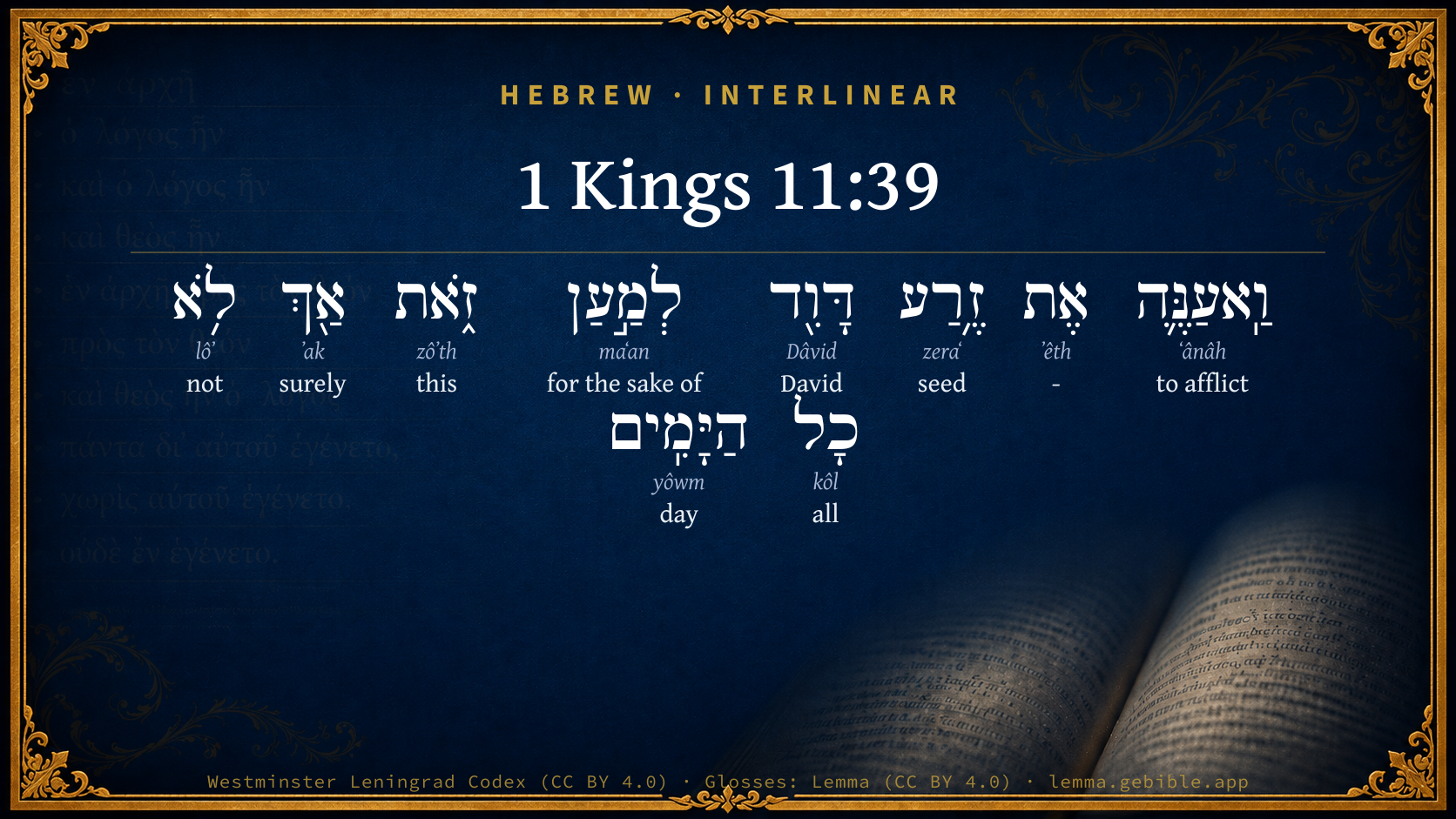
Hebrew (Westminster Leningrad Codex) 1 Kings 11:39 appears in the Hebrew Old Testament. The text above is from the Westminster Leningrad Codex. Each word links to its Strong’s number, a concise gloss, and parsing drawn from the Open Scriptures Hebrew Bible morphology. Click any word for its full Brown-Driver-Briggs (BDB) entry.
Download image
Cite this verse

1 Kings 11:39 (World English Bible). Public Domain. Lemma interlinear Bible study tool, https://lemma.gebible.app/v/1-kings/11/39.

Show BibTeX & RIS
BibTeX
RIS
English Translation
I will for this afflict the seed of David, but not forever.
World English Bible · Public Domain
Download a study sheet

One document with this verse’s original text, its word-by-word gloss line, the meaning frame, cross-references with their text, attributed commentary, and full source and license credits — printable, and it pastes into notes with its structure intact.

This verse Autodidact and up

Study sheet (.html) Plain text (.txt)

A passage Seminary Student

Up to 50 verses in one chapter. A passage sheet keeps up to 6 commentary sources and 12 cross-references per verse, in the order this page ranks them, and says so on the sheet whenever that leaves anything out. Ask for a single verse and you get the Autodidact verse sheet above.

Everything on this page stays free to read, with no account — the sheet is a download of what is already on screen, not access to it.

Want to remove ads? Support Godless Engineer
Compare translations 3

The same verse in 3 English versions, stacked beneath the original-language interlinear above. Click any original word for its lexicon entry.

Each is an independent rendering of the whole verse — the interlinear is not word-aligned to these translations.

Highlighted words mark where these versions differ — a whole-verse word diff, not a word-by-word alignment.

  • World English Bible Public Domain
    I will for this afflict the seed of David, but not forever.
  • King James Version Public Domain
    And I will for this afflict the seed of David, but not for ever.
  • unfoldingWord Literal Text CC BY-SA 4.0
    And I will afflict the seed of David on account of this, only not all of the days.’”

unfoldingWord Literal Text — © unfoldingWord, licensed CC BY-SA 4.0. Word-aligned USFM3 via Door43 (git.door43.org/unfoldingWord/en_ult).

Versions to compare (up to 4)

3 of 4 selected

Show all 18 translations

Every available English version of this verse, each an independent rendering of the whole verse.

  • World English Bible Public Domain
    I will for this afflict the seed of David, but not forever.
  • Berean Standard Bible Public Domain
    Because of this, I will humble David’s descendants—but not forever.’”
  • Majority Standard Bible Public Domain
    Because of this, I will humble David’s descendants—but not forever.’”
  • King James Version Public Domain
    And I will for this afflict the seed of David, but not for ever.
  • American Standard Version (1901) Public Domain
    And I will for this afflict the seed of David, but not for ever.
  • Revised Version (1885) Public Domain
    And I will for this afflict the seed of David, but not for over.
  • Geneva Bible (1599) Public Domain
    And I will for this afflict the seede of Dauid, but not for euer.
  • Douay-Rheims (1899) Public Domain
    And I will for this afflict the seed of David, but yet not for ever.
  • Young's Literal Translation Public Domain
    and I humble the seed of David for this; only, not all the days.'
  • Literal Standard Version CC BY-SA 4.0
    and I humble the seed of David for this; only, not [for] all the days.”
  • Unlocked Literal Bible CC BY-SA 4.0
    I will punish the descendants of David, but not forever.'”
  • unfoldingWord Literal Text CC BY-SA 4.0
    And I will afflict the seed of David on account of this, only not all of the days.’”
  • Darby Bible Public Domain
    And I will for this afflict the seed of David, but not for ever.
  • World Messianic Bible Public Domain
    I will afflict the offspring of David for this, but not forever.’”
  • Webster's Bible Public Domain
    And I will for this afflict the seed of David, but not for ever.
  • Free Bible Version CC BY-SA 4.0
    I will punish David's descendants because of this, but not forever.’”
  • Bible in Basic English Public Domain
    (So that I may send trouble for this on the seed of David, but not for ever.)
  • JPS Tanakh (1917) Public Domain
    And I will for this afflict the seed of David, but not for ever.'

Literal Standard Version (2020), Covenant Press — licensed CC BY-SA 4.0. Text via the HelloAO Bible API (eBible.org). Unlocked Literal Bible (unfoldingWord) — licensed CC BY-SA 4.0. Text via the HelloAO Bible API (eBible.org). unfoldingWord Literal Text — © unfoldingWord, licensed CC BY-SA 4.0. Word-aligned USFM3 via Door43 (git.door43.org/unfoldingWord/en_ult). Free Bible Version, Dr. Jonathan Gallagher — licensed CC BY-SA 4.0. Text via the HelloAO Bible API (eBible.org).

Word by word

More ways to search: Search by grammar → Find every occurrence → Compare this word →

Practice this passage: Drill this verse → Learn its vocabulary →

וַֽאעַנֶּ֛ה
ʻânâh
H6031
“and · to afflict”
Conjunction + Verb, Piel, Imperfect, 1st Person, Common, Singular
Part of Speech
Conjunction + Verb
Stem
Piel
Form
Imperfect
Person
1st Person
Gender
Common
Number
Singular
Full BDB Definition

Origin: a primitive root [possibly rather ident. with H6030 through the idea of looking down or browbeating]

TWOT: 1651 , 1652

(Qal) to be occupied, be busied with - to afflict, oppress, humble, be afflicted, be bowed down - (Qal) - to be put down, become low - to be depressed, be downcast - to be afflicted - to stoop - (Niphal) - to humble oneself, bow down - to be afflicted, be humbled - (Piel) - to humble, mishandle, afflict - to humble, be humiliated - to afflict - to humble, weaken oneself - (Pual) - to be afflicted - to be humbled - (Hiphil) to afflict - (Hithpael) - to humble oneself - to be afflicted
  1. אֶת ʼêth H853 “-” Particle, Direct Object
  2. זֶ֥רַע zeraʻ H2233 “seed of” Noun, Common, Masculine, Singular, Construct
  3. דָּוִ֖ד Dâvid H1732 “David” Noun, Proper
  4. לְמַ֣עַן maʻan H4616 “for the sake of” Preposition
  5. זֹ֑את zôʼth H2063 “this” Pronoun, Demonstrative, Feminine, Singular
  6. אַ֖ךְ ʼak H389 “surely” Particle, Accusative
  7. לֹ֥א lôʼ H3808 “not” Particle, Negative
  8. כָל kôl H3605 “all of” Noun, Common, Masculine, Singular, Construct
  9. הַיָּמִֽים yôwm H3117 “the · days” Particle, Definite Article + Noun, Common, Masculine, Plural, Absolute

About this verse

These counts appear in no published source. They are computed here, from the morphology-tagged text and Lemma’s own curated glosses. What Lemma adds →

10
words
10
distinct lemmas
Historical
section

Grammatical profile

  • 1 verb
  • 4 nouns
  • 1 pronoun
  • 1 preposition
  • 3 particles

Verb forms

  • וַֽאעַנֶּ֛ה Piel · Imperfect

Cross-references

15

Topical passages linked to 1 Kings 11:39 in the Treasury of Scripture Knowledge — connected by theme and wording, ordered by reader-vote popularity; previews shown in the World English Bible.

  • Isaiah 9:7 Of the increase of his government and of peace there shall be no end, on the throne of David, and on his kingdom, to establish it, and to uphold it with justice and with righteousness from henceforth even forever. The zeal of Yahweh of Hosts will perform this.
  • Isaiah 11:1–10 There shall come forth a shoot out of the stock of Jesse, and a branch out of his roots shall bear fruit.
  • Luke 1:32–33 He will be great, and will be called the Son of the Most High. The Lord God will give him the throne of his father, David,
  • Luke 2:11 For there is born to you, this day, in the city of David, a Savior, who is Christ the Lord.
  • 1 Kings 11:36 To his son will I give one tribe, that David my servant may have a lamp always before me in Jerusalem, the city which I have chosen me to put my name there.
  • 1 Kings 12:16 When all Israel saw that the king didn't listen to them, the people answered the king, saying, What portion have we in David? neither have we inheritance in the son of Jesse: to your tents, Israel: now see to your own house, David. So Israel departed to their tents.
  • 1 Kings 14:8 and tore the kingdom away from the house of David, and gave it you; and yet you have not been as my servant David, who kept my commandments, and who followed me with all his heart, to do that only which was right in my eyes,
  • 1 Kings 14:25–26 It happened in the fifth year of king Rehoboam, that Shishak king of Egypt came up against Jerusalem;
  • Psalms 89:30–34 If his children forsake my law, And don't walk in my ordinances;
  • Psalms 89:38–45 But you have rejected and spurned. You have been angry with your anointed.
  • Psalms 89:49–51 Lord, where are your former loving kindnesses, Which you swore to David in your faithfulness?
  • Isaiah 7:14 Therefore the Lord himself will give you a sign. Behold, the virgin will conceive, and bear a son, and shall call his name Immanuel.
  • Jeremiah 23:5–6 Behold, the days come, says Yahweh, that I will raise to David a righteous Branch, and he shall reign as king and deal wisely, and shall execute justice and righteousness in the land.
  • Lamentations 3:31–32 For the Lord will not cast off forever.
  • Luke 2:4 Joseph also went up from Galilee, out of the city of Nazareth, into Judea, to the city of David, which is called Bethlehem, because he was of the house and family of David;

Cross-references courtesy of OpenBible.info (CC BY 4.0).

Hebrew and Greek witnesses Masoretic Hebrew ↔ Greek Septuagint

The same verse in the two great witnesses to the Old Testament, shown verse-for-verse.

These are two independent witnesses, not word-aligned to each other, and the Septuagint is shown in lemma (dictionary) form.

Hebrew 1 Kings 11:39 Masoretic · Westminster Leningrad Codex

וַֽאעַנֶּ֛ה אֶת זֶ֥רַע דָּוִ֖ד לְמַ֣עַן זֹ֑את אַ֖ךְ לֹ֥א כָל הַיָּמִֽים

I will for this afflict the seed of David, but not forever.

World English Bible · Public Domain

Hebrew: Westminster Leningrad Codex (CC BY 4.0). Greek: Septuagint (public domain); English from a public-domain English Septuagint. How the Septuagint differs from the Hebrew →

Targum (Aramaic paraphrase)

1

The Targum is the ancient Jewish Aramaic paraphrase of the Hebrew Scriptures — an interpretive translation, not the Hebrew text itself. Onkelos (literal) and Pseudo-Jonathan (expansive) render the Torah, and Jonathan the Prophets. Coverage is partial: where no permissively-licensed English translation exists for a verse, only the Aramaic is shown. This is verse-level text, not a word-by-word alignment to the Hebrew.

  1. Targum Jonathan Prophets (Joshua–Malachi)
    וְאַעֲנֵי יַת זַרְעָא דְדָוִד בְּדִיל דָא בְּרַם לָא כָל יוֹמַיָא:

    (no public-domain English translation for this verse)

    Targum Jonathan — Aramaic: “Mikraot Gedolot” (public domain). English: “Sefaria Community Translation” (CC0 1.0 (public-domain dedication)); “London "Chaldee Paraphrase," 1871” (public domain). Text via Sefaria.

Commentary

Notes on 1 Kings 11:39 from classic Christian and Jewish commentators (each source and its license shown beneath its notes). The classic Christian expositions comment on the surrounding passage and are grouped to its opening verse, so a note may address several verses; the Jewish commentaries on the Tanakh (Rashi and others) are per-verse, so they appear only where the commentator wrote on this verse.

Lemma curates 59 commentaries, every one of them public domain or Creative Commons licensed, each selected and text-cleaned for this edition rather than reprinted as found. About our sources →

Trapp's Complete Commentary

John Trapp

1Ki 11:39 And I will for this afflict the seed of David, but not for ever.

Ver. 39. But not for ever.] For some kings of Judah - as Asa, Hezekiah, Josiah - grew very great; but especially is this to be understood of Christ, in whom the glory was restored to David’s house, such as never any mortal king had.

John Trapp, A Commentary or Exposition upon All the Books of the Old and New Testament (1647–1656) — public domain. Text from a community e-Sword module.

Joseph Benson's Commentary

1Ki 11:39. I will for this — For Solomon’s sin, mentioned 1Ki 11:33; afflict the seed of David — By rending the greatest part of the kingdom from them; but not for ever — A time shall come when the seed of David shall not be thus molested by the kingdom of Israel, but shall flourish again in great power and prosperity; which it did in many illustrious kings of Judah, who reigned in glory when Jeroboam’s family was extirpated. And at last the Messiah came, who united together the broken sticks of Judah and Joseph, and rules over Jews and Gentiles also.

Joseph Benson's Commentary on the Old and New Testaments (1811–1818) — public domain. Text from a community e-Sword module.

Tyndale Open Study Notes

Tyndale Open Resources

11:39 David’s descendant, Jesus, would later inherit his rightful throne, as stipulated in God’s promises to David (2 Sam 7:13, 16-19; Ps 89:35-37), Abraham (Gen 17:1-8; Luke 1:67-79), and Judah (Gen 49:10). He has established a new covenant with God’s people, and he will reign forever (Jer 31:31-36; Ezek 37:22-28; 2 Cor 3:6).

Tyndale Open Study Notes — © Tyndale Open Resources, licensed CC BY-SA 4.0. Text via the HelloAO Bible API.

Geneva Bible (1599)

Geneva Bible translators

For the whole spiritual kingdom was restored in Messiah.

For this idolatry that Solomon hath committed.

Geneva Bible (1599) marginal notes — public domain. Text via Bolls.life.

Adam Clarke's Commentary

Verse 39. But not for ever.] They shall be in affliction and distress till the Messiah come, who shall sit on the throne of David to order it and establish it in judgment and justice for ever. Jarchi says, on this verse, "When the Messiah comes, the kingdom shall be restored to the house of David."

Adam Clarke's Commentary on the Bible (1810–1826) — public domain. Text from a community e-Sword/MySword module.

The Cambridge Bible for Schools and Colleges

gen. ed. J. J. S. Perowne

39. but not for ever] The glorious promises made to David’s line were not to be withdrawn, and in the Messiah were abundantly fulfilled.

The Cambridge Bible for Schools and Colleges (gen. ed. J. J. S. Perowne; Cambridge University Press, 1878–1918) — public domain. Text from a community e-Sword module.

John Gill's Exposition

And Solomon slept with his fathers,.... Died as they did:

and was buried in the city of David his father; not in Bethlehem, but Zion, Kg1 2:10.

and Rehoboam his son reigned in his stead; of whom more in the following chapter. Though nothing is said of Solomon's repentance, there is no doubt but he was a good man, repented of his sins, and was saved; as may be concluded from the commendations of him after his death, Ch2 11:17 from the promise of God that he made, that his mercy should not depart from him, though he chastised him, Sa2 7:14 from his being an inspired writer, who were all holy men, Pe2 1:20, and especially from his writing the book of Ecclesiastes after his fall, which contains a full acknowledgment of all his evils, a recantation of them, and repentance for them. Abulpharagius (b), an Arabic writer, rashly asserts that he died without repentance.

(b) Hist. Dynast. Dyn. 3. p. 55.

Next: 1 Kings Chapter 12

John Gill's Exposition of the Whole Bible (1746–1763) — public domain (CC PDM 1.0). Text via the HelloAO Bible API.

Albert Barnes' Notes on the Bible

But not forever - David had been distinctly promised that God should never fail his seed, whatever their shortcomings Psa 89:28-37. The fulfillment of these promises was seen, partly in the Providence which maintained David’s family in a royal position until Zerubbabel, but mainly in the preservation of his seed to the time fixed for the coming of Christ, and in the birth of Christ - the Eternal King - from one of David’s descendants.

Albert Barnes' Notes on the Bible (1834–1885) — public domain. Text from a community e-Sword/MySword module.

Haydock's Catholic Bible Commentary

For this infidelity of Solomon, (Haydock) afflict, by raising up a rival. (Menochius) --- For ever. Notwithstanding the wickedness of many of its princes, this family was to subsist, in a distinguished rank, till the coming of the Messias; that the completion of the promises might be more observable. (Calmet) --- After 250 years, the throne of Israel was subverted. (Menochius)

George Leo Haydock (1774–1849), Haydock's Catholic Family Bible and Commentary, 1859 edition — public domain. Excludes Psalms (Douay-Rheims chapter numbering differs from Protestant) and Deuterocanonical books (Catholic canon only).

Matthew Poole's English Annotations

For this; for this cause, which I mentioned 1Ki 11:33.

But not for ever; there shall a time come when the seed of David shall not be thus molested by the kingdom of Israel, but that kingdom shall be destroyed, and the kings of the house of David shall be uppermost, as it was in the days of Asa Hezekiah, and Josiah. And at last the Messiah shall come, who shall unite together the broken sticks of Judah and Joseph, and rule over all the Jews and Gentiles too.

Matthew Poole's English Annotations on the Holy Bible (1683–1685) — public domain. Text from a community e-Sword/MySword module.

Whedon's Commentary on the Bible

Daniel D. Whedon

39. But not for ever — Literally, only not all the days. Here breaks in another ray of promise to the house of David, whose sons, though chastened and smitten with the rod of men, (compare 2Sa_7:14,) were to be the human line of fathers to that Great Son, who “shall reign over the house of Jacob forever; and of his kingdom there shall be no end.” Luk_1:33. The Rabbins say: “When Messiah comes, the kingdom shall be restored to the house of David.”

Daniel D. Whedon (gen. ed.), Commentary on the Old and New Testaments (1874–1909) — public domain. Text from a community e-Sword module.

The Pulpit Commentary

And I will for this i.e. , the defection just described afflict the seed of David, but not forever Heb. all the days. Cf. Psa_89:28, Psa_89:33, Psa_89:36. This limitation, "not forever." would seem to apply to the kingdom, for it was through the loss of their kingdom that the seed of David was afflicted. And if so, it promises, if not a restoration of the kingdom to the house of David, at any rate a renewal or continuance of God"s favour. We may perhaps regard the promise as fulfilled in the subsequent history of the kings of Judah. Not only did the kingdom last for nearly 500 years, but the royal house of David maintained its position to the time of Zerubbabel. Nor is it to be overlooked that He "of whose kingdom there shall be no end" (Luk_1:33) was the son of David.

The Pulpit Commentary (1880–1919), ed. H.D.M. Spence-Jones & Joseph S. Exell — public domain. Text from a community e-Sword module.

John Wesley's Explanatory Notes

For this - For this cause, which I mentioned ver. 33. Not forever - There shall a time come when the seed of David shall not be molested by the kingdom of Israel, but that kingdom shall be destroyed, and the kings of the house of David shall be uppermost, as it was in the days of Asa, Hezekiah and Judah. And at last the Messiah shall come, who shall unite together the broken sticks of Judah and Joseph, and rule over all the Jews and Gentiles too.

John Wesley, Explanatory Notes Upon the Whole Bible (1754–1765) — public domain. Text via the GEBible commentary corpus.

Rashi

Rabbi Shlomo Yitzchaki (Rashi)

But not for all the days. For in the days of the Mashiach, the kingdom will be restored to him. In Seder Olam I found: “I shall afflict Dovid’s descendants because of this,” corresponding to the thirty-six years that Shlomo was married to Pharaoh’s daughter. For he married her during the fourth year of his reign, and corresponding to this, the decree was promulgated on the kingdom of the House of Dovid to be divided. The kingdom should have been restored, in Asa’s time, in the sixteenth year of his reign. However, he sinned by sending a bribe to the king of Aram, and did not depend on the Holy One Blessed Is He. This is [the meaning] of what is stated in Divrei Hayomim, “In the thirty-sixth year of Asa’s reign, etc., Baasha built the high place.” This is impossible, because Asa buried Baasha in the twenty-seventh year of his reign. Rather, the sixteenth year of his reign, Scripture calls “the thirty-sixth,” for they are the end of thirty-six years since the division of the kingdom, and Scripture tells us that in that year Asa sinned, “but not for all the days,” only for thirty-six years.

Rashi on the Tanakh — English translations: “The Judaica Press complete Tanach with Rashi, translated by A. J. Rosenberg” (CC BY 4.0); “Pentateuch with Rashi's commentary by M. Rosenbaum and A.M. Silbermann, 1929-1934” (public domain); “The Metsudah Tanach series, Lakewood, N.J” (CC BY 4.0); and “The Book of Joshua, Metsudah Publications, 1997” (CC BY 4.0). Text via Sefaria.

Lesson kit

Teaching starters — assembled from the data on this page, not authored interpretation. Every prompt links to the verse data it draws on. Edit before teaching.

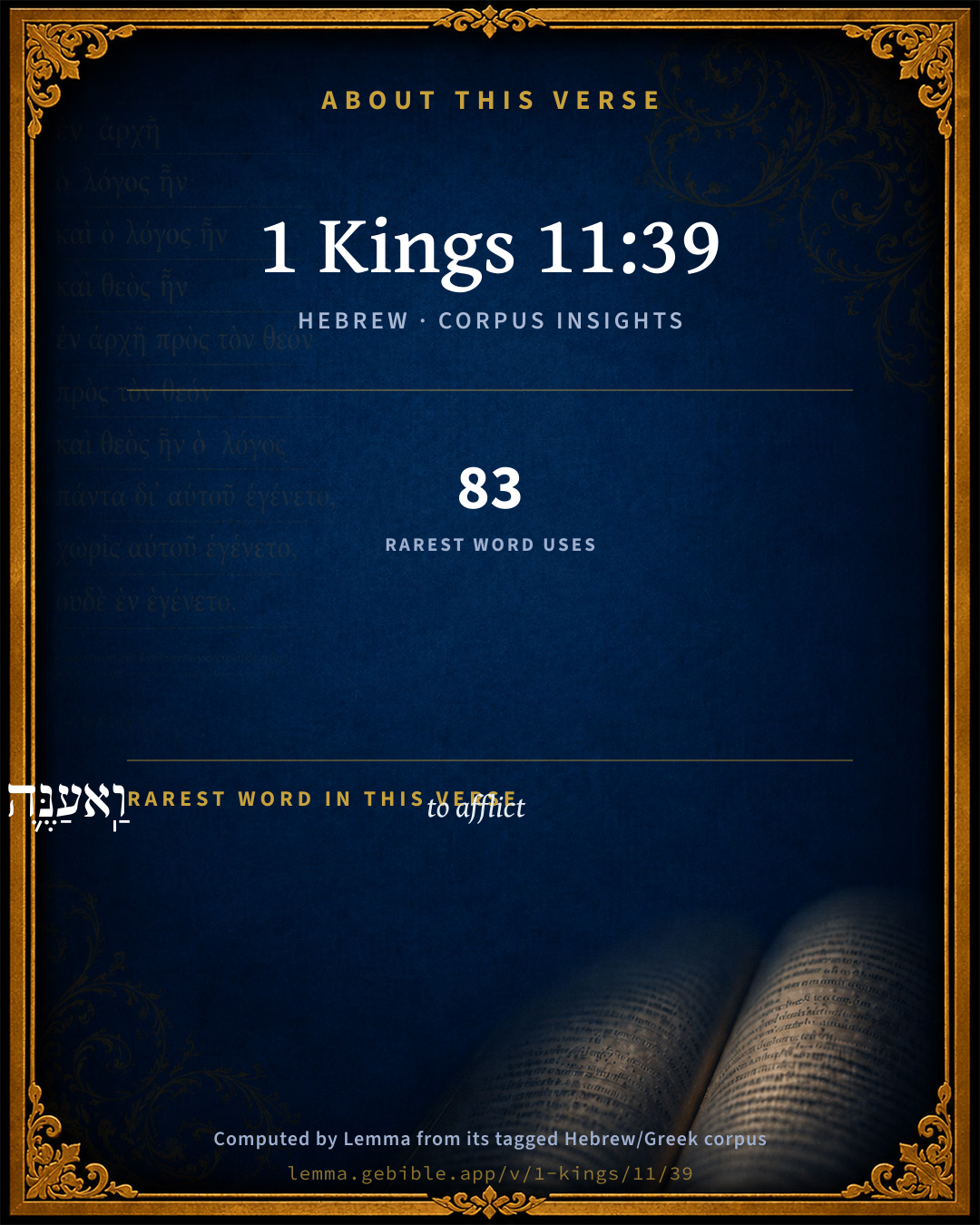
1 Kings, in the Historical, opens this verse with 10 words (10 distinct Hebrew lemmas). Its most distinctive word is ʻânâh (“to afflict”). A historical commentator’s framing appears above. Read the whole chapter for the surrounding context.

Discussion questions

  1. The word ʻânâh carries the sense “to afflict.” How does it shape the verse?
  2. How does Isaiah 9:7, which shares this passage’s theme, read alongside this verse?
  3. The translations on this page render this verse differently — a whole-verse word diff, not a word-by-word alignment. What might account for the different wordings?
  4. «וַֽאעַנֶּ֛ה» is a Piel Imperfect verb. How does that grammatical form shape the action described?
  5. Compare how Trapp's Complete Commentary and Joseph Benson's Commentary read this verse. Where do they agree or differ?

Things to notice

Reading settings

Reading text

Shown beneath each verse's original-language words.

Old Testament
Old Testament edition

Read the OT as the Masoretic Hebrew (MT) or the Greek Septuagint (LXX).

English shown for the Greek Septuagint (in the Hebrew ↔ Greek comparison).

Comparing translations? Open the Compare panel on any verse page to stack up to four side by side.