Isaiah 65:23

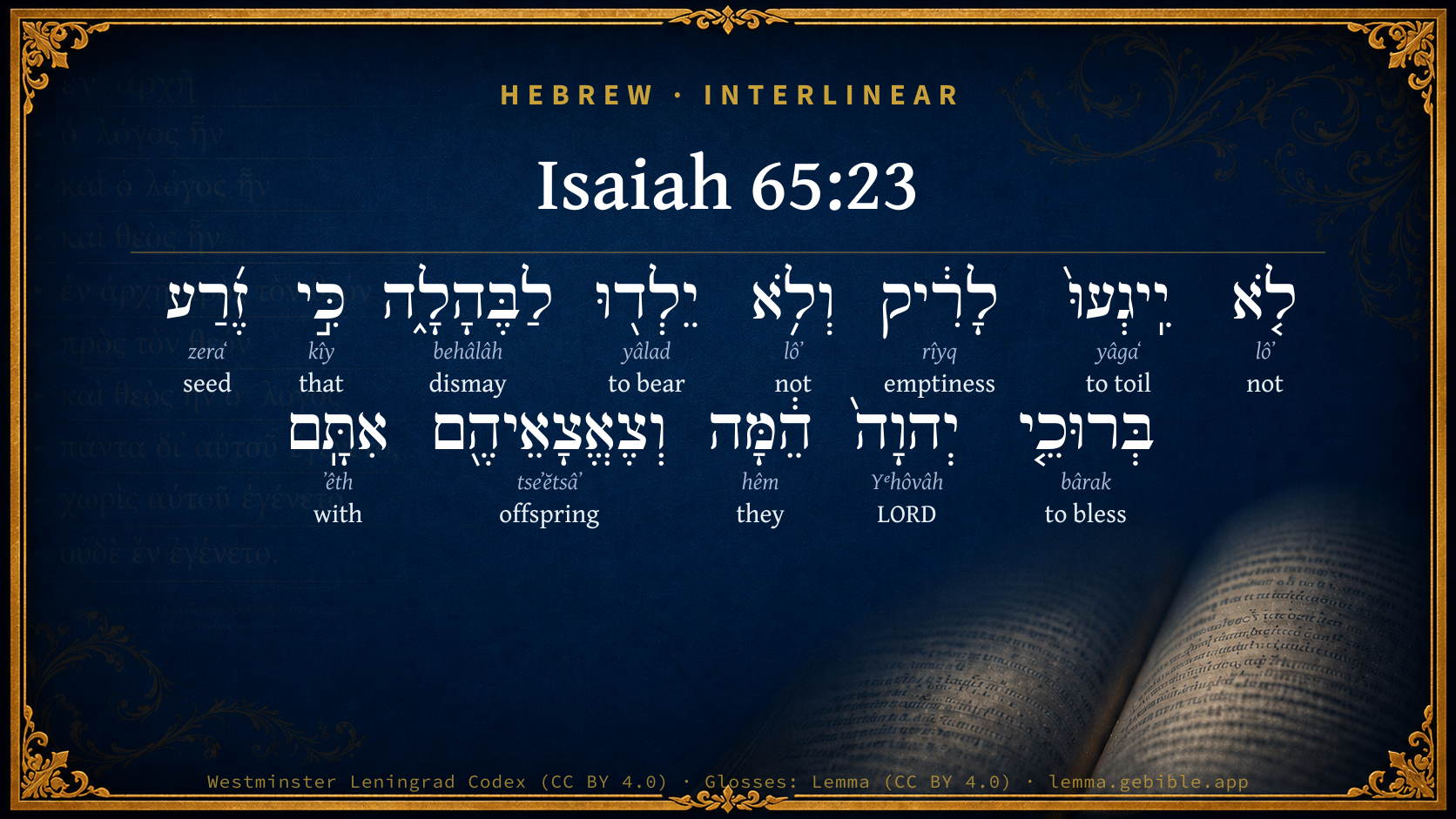
Hebrew (Westminster Leningrad Codex) Isaiah 65:23 appears in the Hebrew Old Testament. The text above is from the Westminster Leningrad Codex. Each word links to its Strong’s number, a concise gloss, and parsing drawn from the Open Scriptures Hebrew Bible morphology. Click any word for its full Brown-Driver-Briggs (BDB) entry.
Download image
Cite this verse

Isaiah 65:23 (World English Bible). Public Domain. Lemma interlinear Bible study tool, https://lemma.gebible.app/v/isaiah/65/23.

Show BibTeX & RIS
BibTeX
RIS
English Translation
They shall not labor in vain, nor bring forth for calamity; for they are the seed of the blessed of Yahweh, and their offspring with them.
World English Bible · Public Domain
Download a study sheet

One document with this verse’s original text, its word-by-word gloss line, the meaning frame, cross-references with their text, attributed commentary, and full source and license credits — printable, and it pastes into notes with its structure intact.

This verse Autodidact and up

Study sheet (.html) Plain text (.txt)

A passage Seminary Student

Up to 50 verses in one chapter. A passage sheet keeps up to 6 commentary sources and 12 cross-references per verse, in the order this page ranks them, and says so on the sheet whenever that leaves anything out. Ask for a single verse and you get the Autodidact verse sheet above.

Everything on this page stays free to read, with no account — the sheet is a download of what is already on screen, not access to it.

Want to remove ads? Support Godless Engineer
Compare translations 3

The same verse in 3 English versions, stacked beneath the original-language interlinear above. Click any original word for its lexicon entry.

Each is an independent rendering of the whole verse — the interlinear is not word-aligned to these translations.

Highlighted words mark where these versions differ — a whole-verse word diff, not a word-by-word alignment.

  • World English Bible Public Domain
    They shall not labor in vain, nor bring forth for calamity; for they are the seed of the blessed of Yahweh, and their offspring with them.
  • King James Version Public Domain
    They shall not labour in vain, nor bring forth for trouble; for they are the seed of the blessed of the LORD, and their offspring with them.
  • unfoldingWord Literal Text CC BY-SA 4.0
    They will not labor for worthlessness, and they will not birth for terror, for they the seed of the blessed of Yahweh, and their offspring with them.

unfoldingWord Literal Text — © unfoldingWord, licensed CC BY-SA 4.0. Word-aligned USFM3 via Door43 (git.door43.org/unfoldingWord/en_ult).

Versions to compare (up to 4)

3 of 4 selected

Show all 18 translations

Every available English version of this verse, each an independent rendering of the whole verse.

  • World English Bible Public Domain
    They shall not labor in vain, nor bring forth for calamity; for they are the seed of the blessed of Yahweh, and their offspring with them.
  • Berean Standard Bible Public Domain
    They will not labor in vain or bear children doomed to disaster; for they will be a people blessed by the LORD—they and their descendants with them.
  • Majority Standard Bible Public Domain
    They will not labor in vain or bear children doomed to disaster; for they will be a people blessed by the LORD—they and their descendants with them.
  • King James Version Public Domain
    They shall not labour in vain, nor bring forth for trouble; for they are the seed of the blessed of the LORD, and their offspring with them.
  • American Standard Version (1901) Public Domain
    They shall not labor in vain, nor bring forth for calamity; for they are the seed of the blessed of Jehovah, and their offspring with them.
  • Revised Version (1885) Public Domain
    They shall not labour in vain, nor bring forth for calamity; for they are the seed of the blessed of the LORD, and their offspring with them.
  • Geneva Bible (1599) Public Domain
    They shall not labour in vaine, nor bring forth in feare: for they are the seede of the blessed of the Lord, and their buds with them.
  • Douay-Rheims (1899) Public Domain
    My elect shall not labour in vain, nor bring forth in trouble; for they are the seed of the blessed of the Lord, and their posterity with them.
  • Young's Literal Translation Public Domain
    They labour not for a vain thing, Nor do they bring forth for trouble, For the seed of the blessed of Jehovah `are' they, And their offspring with them.
  • Literal Standard Version CC BY-SA 4.0
    They do not labor for a vain thing, || Nor do they bring forth for trouble, || For they [are] the seed of the blessed of YHWH, || And their offspring with them.
  • Unlocked Literal Bible CC BY-SA 4.0
    They will not labor in vain, nor give birth to dismay. For they are the children of those blessed by Yahweh, and their descendants with them.
  • unfoldingWord Literal Text CC BY-SA 4.0
    They will not labor for worthlessness, and they will not birth for terror, for they the seed of the blessed of Yahweh, and their offspring with them.
  • Darby Bible Public Domain
    They shall not labour in vain, nor bring forth for terror; for they are the seed of the blessed of Jehovah, and their offspring with them.
  • World Messianic Bible Public Domain
    They will not labor in vain nor give birth for calamity; for they are the offspring of the LORD’s blessed and their descendants with them.
  • Webster's Bible Public Domain
    They shall not labor in vain, nor bring forth for trouble; for they are the seed of the blessed of the LORD, and their offspring with them.
  • Free Bible Version CC BY-SA 4.0
    They won't work for nothing, and they won't have children destined for disaster. For they are people living under the blessing of the Lord, and their children will be too.
  • Bible in Basic English Public Domain
    Their work will not be for nothing, and they will not give birth to children for destruction; for they are a seed to whom the Lord has given his blessing, and their offspring will be with them.
  • JPS Tanakh (1917) Public Domain
    They shall not labour in vain, nor bring forth for terror; for they are the seed blessed of the LORD, and their offspring with them.

Literal Standard Version (2020), Covenant Press — licensed CC BY-SA 4.0. Text via the HelloAO Bible API (eBible.org). Unlocked Literal Bible (unfoldingWord) — licensed CC BY-SA 4.0. Text via the HelloAO Bible API (eBible.org). unfoldingWord Literal Text — © unfoldingWord, licensed CC BY-SA 4.0. Word-aligned USFM3 via Door43 (git.door43.org/unfoldingWord/en_ult). Free Bible Version, Dr. Jonathan Gallagher — licensed CC BY-SA 4.0. Text via the HelloAO Bible API (eBible.org).

Word by word

More ways to search: Search by grammar → Find every occurrence → Compare this word →

Practice this passage: Drill this verse → Learn its vocabulary →

לַבֶּהָלָ֑ה
behâlâh
H928
“to/for the · dismay”
Preposition, Determined + Noun, Common, Feminine, Singular, Absolute
Part of Speech
Preposition + Noun
Type
Common
Gender
Feminine
Number
Singular
State
Absolute
Full BDB Definition

Origin: from H926

TWOT: 207a

dismay, sudden terror or ruin, alarm
  1. לֹ֤א lôʼ H3808 “not” Particle, Negative
  2. יִֽיגְעוּ֙ yâgaʻ H3021 “to toil” Verb, Qal, Imperfect, 3rd Person, Masculine, Plural
  3. לָרִ֔יק rîyq H7385 “to/for the · emptiness” Preposition, Determined + Noun, Common, Masculine, Singular, Absolute
  4. וְלֹ֥א lôʼ H3808 “and · not” Conjunction + Particle, Negative
  5. יֵלְד֖וּ yâlad H3205 “to bear” Verb, Qal, Imperfect, 3rd Person, Masculine, Plural
  6. כִּ֣י kîy H3588 “that” Conjunction
  7. זֶ֜רַע zeraʻ H2233 “seed of” Noun, Common, Masculine, Singular, Construct
  8. בְּרוּכֵ֤י bârak H1288 “blessed” Verb, Qal, Participle Passive, Masculine, Plural, Construct
  9. יְהוָה֙ Yᵉhôvâh H3068 “LORD” Noun, Proper
  10. הֵ֔מָּה hêm H1992 “they” Pronoun, Personal, 3rd Person, Masculine, Plural
  11. וְצֶאֱצָאֵיהֶ֖ם tseʼĕtsâʼ H6631 “and · offspring · their” Conjunction + Noun, Common, Masculine, Plural, Construct + Suffix, Personal, 3rd Person, Masculine, Plural
  12. אִתָּֽם ʼêth H854 “with · them” Preposition + Suffix, Personal, 3rd Person, Masculine, Plural

About this verse

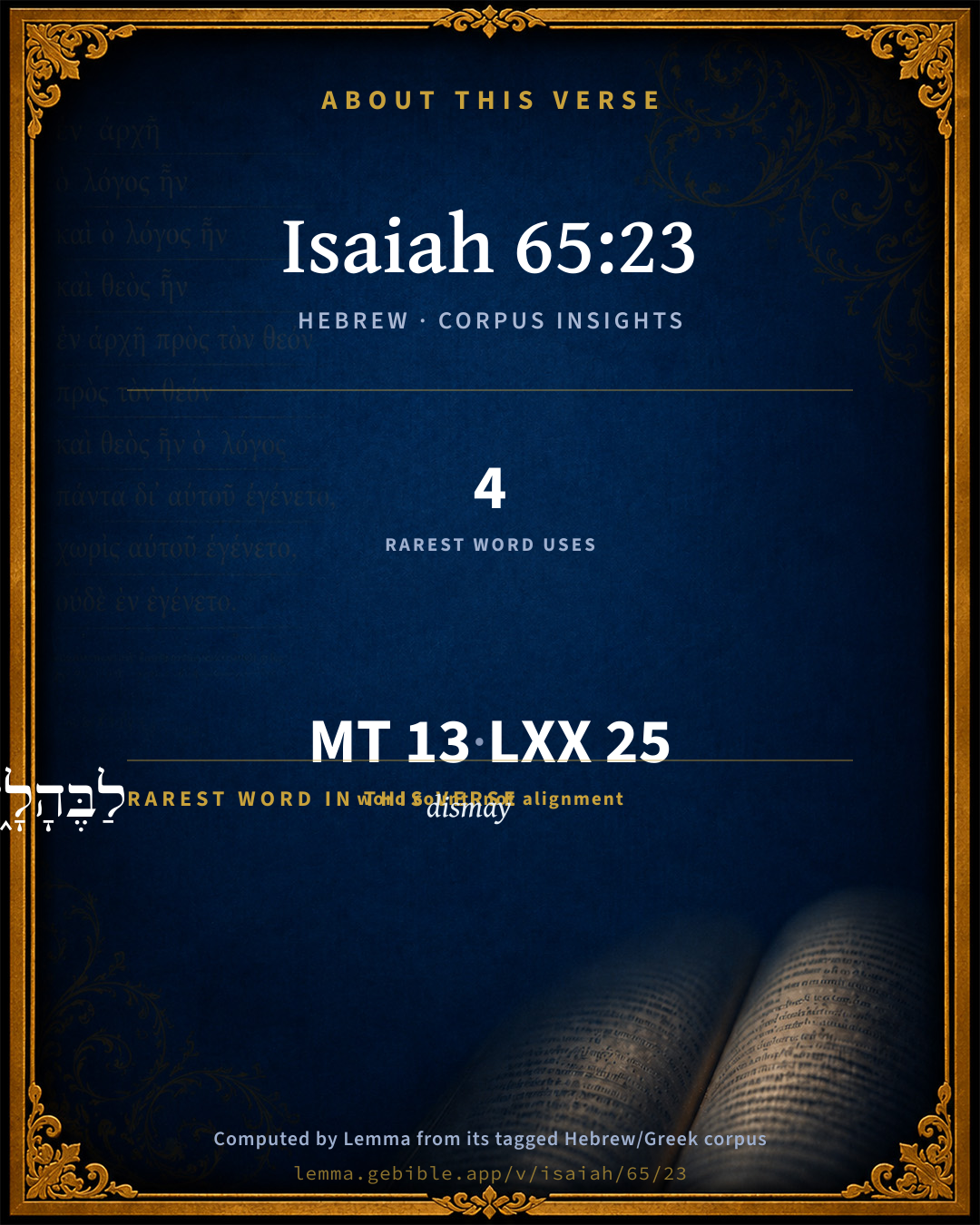
These counts appear in no published source. They are computed here, from the morphology-tagged text and Lemma’s own curated glosses. What Lemma adds →

13
words
12
distinct lemmas
Prophets
section

Notable vocabulary

The rarest word here is לַבֶּהָלָ֑ה dismay H928 — appearing just 4 times in the whole Hebrew Bible.

Shared distinctive vocabulary

לַבֶּהָלָ֑ה dismay H928 occurs in 4 verses of the Hebrew Bible. Also found in:

Grammatical profile

  • 3 verbs
  • 5 nouns
  • 1 pronoun
  • 1 preposition
  • 1 conjunction
  • 2 particles

Verb forms

  • יִֽיגְעוּ֙ Qal · Imperfect
  • יֵלְד֖וּ Qal · Imperfect
  • בְּרוּכֵ֤י Qal · Participle Passive

Repetition

A word recurs within this verse — often emphatic in Hebrew:

Hebrew & Septuagint length

In English translation the verse runs 26 words from the Hebrew and 28 from the Septuagint (LXX English) — closely comparable.

A rough comparison of the two English renderings, which tokenize alike — not a word-level alignment.

Word counts can differ between the Hebrew and the Greek without any difference in meaning — e.g. the Hebrew direct-object marker אֵת has no separate Greek word, and Greek often adds the article ὁ.

In the original languages it is 13 Hebrew tokens and 25 Greek tokens — but the two are counted differently (Hebrew bundles its prefixes and suffixes into one token; the Greek is in lemma form), so that isn’t a like-for-like length.

Cross-references

24

Topical passages linked to Isaiah 65:23 in the Treasury of Scripture Knowledge — connected by theme and wording, ordered by reader-vote popularity; previews shown in the World English Bible.

  • Isaiah 61:9 Their seed shall be known among the nations, and their offspring among the peoples; all who see them shall acknowledge them, that they are the seed which Yahweh has blessed.
  • Jeremiah 32:38–39 and they shall be my people, and I will be their God:
  • Deuteronomy 28:3–12 Blessed shall you be in the city, and blessed shall you be in the field.
  • Psalms 115:14–15 May Yahweh increase you more and more, You and your children.
  • Acts 2:39 For to you is the promise, and to your children, and to all who are far off, even as many as the Lord our God will call to himself."
  • Isaiah 49:4 But I said, I have labored in vain, I have spent my strength for nothing and vanity; yet surely the justice [due] to me is with Yahweh, and my recompense with my God.
  • Isaiah 55:2 Why do you spend money for that which is not bread? and your labor for that which doesn't satisfy? listen diligently to me, and eat you that which is good, and let your soul delight itself in fatness.
  • Romans 9:7–8 Neither, because they are Abraham's seed, are they all children. But, "In Isaac will your seed be called."
  • Genesis 12:2 I will make of you a great nation. I will bless you, and make your name great. You will be a blessing.
  • Genesis 17:7 I will establish my covenant between me and you and your seed after you throughout their generations for an everlasting covenant, to be a God to you and to your seed after you.
  • Leviticus 26:3–10 "'If you walk in my statutes, and keep my commandments, and do them;
  • Haggai 2:19 Is the seed yet in the barn? Yes, the vine, the fig tree, the pomegranate, and the olive tree haven't brought forth. From this day will I bless you.'"
  • Zechariah 10:8–9 I will signal for them, and gather them; For I have redeemed them; And they will increase as they have increased.
  • Leviticus 26:20 and your strength will be spent in vain; for your land won't yield its increase, neither will the trees of the land yield their fruit.
  • Leviticus 26:22 I will send the wild animals among you, which will rob you of your children, destroy your cattle, and make you few in number; and your roads will become desolate.
  • Leviticus 26:29 You will eat the flesh of your sons, and you will eat the flesh of your daughters.
  • Deuteronomy 28:38–42 You shall carry much seed out into the field, and shall gather little in; for the locust shall consume it.
  • Hosea 9:11–14 As for Ephraim, their glory will fly away like a bird. There will be no birth, none with child, and no conception.
  • Haggai 1:6 You have sown much, and bring in little. You eat, but you don't have enough. You drink, but you aren't filled with drink. You clothe yourselves, but no one is warm, and he who earns wages earns wages to put them into a bag with holes in it."
  • Malachi 3:10 Bring the whole tithe into the store-house, that there may be food in my house, and test me now in this," says Yahweh of hosts, "if I will not open you the windows of heaven, and pour you out a blessing, that there shall not be room enough for.
  • Romans 4:16 For this cause it is of faith, that it may be according to grace, to the end that the promise may be sure to all the seed, not to that only which is of the law, but to that also which is of the faith of Abraham, who is the father of us all.
  • 1 Corinthians 15:58 Therefore, my beloved brothers, be steadfast, immovable, always abounding in the Lord's work, because you know that your labor is not in vain in the Lord.
  • Acts 3:25–26 You are the children of the prophets, and of the covenant which God made with our fathers, saying to Abraham, 'In your seed will all the families of the earth be blessed.'
  • Galatians 3:29 If you are Christ's, then you are Abraham's seed and heirs according to promise.

Cross-references courtesy of OpenBible.info (CC BY 4.0).

Hebrew and Greek witnesses Masoretic Hebrew ↔ Greek Septuagint

The same verse in the two great witnesses to the Old Testament, shown verse-for-verse.

These are two independent witnesses, not word-aligned to each other, and the Septuagint is shown in lemma (dictionary) form.

Hebrew Isaiah 65:23 Masoretic · Westminster Leningrad Codex

לֹ֤א יִֽיגְעוּ֙ לָרִ֔יק וְלֹ֥א יֵלְד֖וּ לַבֶּהָלָ֑ה כִּ֣י זֶ֜רַע בְּרוּכֵ֤י יְהוָה֙ הֵ֔מָּה וְצֶאֱצָאֵיהֶ֖ם אִתָּֽם

They shall not labor in vain, nor bring forth for calamity; for they are the seed of the blessed of Yahweh, and their offspring with them.

World English Bible · Public Domain

Greek LXX Isaiah 65:23 Septuagint · lemma form

ὁ δέ ἐκλεκτός ἐγώ οὐ κοπιάω εἰς κενός οὐδέ τεκνοποιέω εἰς κατάρα ὅτι σπέρμα εὐλογέω ὑπό θεός εἰμί καί ὁ ἔκγονος αὐτός μετά αὐτός εἰμί

My chosen shall not toil in vain, neither shall they beget children to be cursed; for they are a seed blessed of God, and their offspring with them.

LXX2012 (modern English Septuagint) · Public Domain

On this verse, Adam Clarke's Commentary discusses the Septuagint’s reading. Read the note in Commentary ↓

Hebrew: Westminster Leningrad Codex (CC BY 4.0). Greek: Septuagint (public domain); English from LXX2012 (modern English Septuagint) (Public Domain). How the Septuagint differs from the Hebrew →

Targum (Aramaic paraphrase)

1

The Targum is the ancient Jewish Aramaic paraphrase of the Hebrew Scriptures — an interpretive translation, not the Hebrew text itself. Onkelos (literal) and Pseudo-Jonathan (expansive) render the Torah, and Jonathan the Prophets. Coverage is partial: where no permissively-licensed English translation exists for a verse, only the Aramaic is shown. This is verse-level text, not a word-by-word alignment to the Hebrew.

  1. Targum Jonathan Prophets (Joshua–Malachi)
    לָא יֶחְלוּן לְרֵיקָן וְלָא יִרְבּוּן לְמוֹתָא אֲרֵי זַרְעָא דְבָרְכֵיהּ יְיָ אִינוּן וּבְנֵי בְנֵיהוֹן עִמְהוֹן:

    They shall not labour in vain, neither shall they rear up children for death, for they shall be the seed which the Lord has blessed, and the children of their children with them.

    Targum Jonathan — Aramaic: “Mikraot Gedolot” (public domain). English: “Sefaria Community Translation” (CC0 1.0 (public-domain dedication)); “London "Chaldee Paraphrase," 1871” (public domain). Text via Sefaria.

Commentary

Notes on Isaiah 65:23 from classic Christian and Jewish commentators (each source and its license shown beneath its notes). The classic Christian expositions comment on the surrounding passage and are grouped to its opening verse, so a note may address several verses; the Jewish commentaries on the Tanakh (Rashi and others) are per-verse, so they appear only where the commentator wrote on this verse.

Lemma curates 59 commentaries, every one of them public domain or Creative Commons licensed, each selected and text-cleaned for this edition rather than reprinted as found. About our sources →

Trapp's Complete Commentary

John Trapp

Isa 65:23 They shall not labour in vain, nor bring forth for trouble; for they [are] the seed of the blessed of the LORD, and their offspring with them.

Ver. 23. They shall not labour in vain.] As wicked men shall. {Lev 26:14-20 Deu 28:15-68 Hag 1:6; {See Trapp on "Hag 1:6"}

Nor bring forth for trouble.] Bring forth children to the murderer, {Hos 9:13} to the great grief and trouble of their poor parents.

John Trapp, A Commentary or Exposition upon All the Books of the Old and New Testament (1647–1656) — public domain. Text from a community e-Sword module.

Jamieson, Fausset & Brown

Robert Jamieson, A. R. Fausset & David Brown

bring forth for trouble--literally, "for terror," that is, "They shall not bring forth children for a sudden death" (Lev 26:16; Jer 15:8).

seed . . . blessed-- (Isa 61:9).

offspring with them-- (Hos 9:12). "Their offspring shall be with themselves" [MAURER]; not "brought forth" only to be cut off by "sudden death" (see the parallel clause).

Jamieson, Fausset & Brown — Commentary Critical and Explanatory on the Whole Bible (1871) — public domain (CC PDM 1.0). Text via the HelloAO Bible API.

Adam Clarke's Commentary

Verse 23. They shall not labour in vain - "My chosen shall not labour in vain"] I remove בחירי bechirai, my elect, from the end of the twenty-second to the beginning of the twenty-third verse, on the authority of the Septuagint, Syriac, and Vulgate, and a MS.; contrary to the division in the Masoretic text. - L. The Septuagint is beautiful: My chosen shall not labour in vain, neither shall they beget children for the curse; for the seed is blessed of the Lord, and their posterity with them."

Nor bring forth for trouble - "Neither shall they generate a short-lived race"] לבהלה labbehalah, in festinationem, "what shall soon hasten away." Εις καταραν for a curse, Sept. They seem to have read לאלה lealah. - Grotius. But Ps 78:33 both justifies and explains the word here: -

ימיהם בהבל ויכל

yemeyhem bahebel vayechal

בבהלה ושנותם

babbehalah ushenotham

"And he consumed their days in vanity;

And their years in haste."

μετα σπουδης, say the Septuagint. Jerome on this place of Isaiah explains it to the same purpose: "εις ανυπαρξιαν, hoc est, ut esse desistant."

Adam Clarke's Commentary on the Bible (1810–1826) — public domain. Text from a community e-Sword/MySword module.

Ellicott's Commentary for English Readers

(23) Their offspring with them . . .—The picture presented is that of a patriarchal family, including many generations, fathers no longer outliving their children and mourning for their death, as Jacob did (Gen_37:35; Gen_42:38), and as men had often done in the times of war, famine, and pestilence, through which Isaiah had lived.

A Bible Commentary for English Readers, edited by Charles John Ellicott (1878–1897) — public domain. Text from a community e-Sword module.

The Cambridge Bible for Schools and Colleges

gen. ed. J. J. S. Perowne

23. They shall not weary themselves for vanity] ch. Isa_49:4; Hab_2:13; because God’s blessing rests on them.

nor bring forth (sc. children) for sudden destruction] Jer_15:8; Psa_78:33.

and their offspring with them] Better perhaps as a complete sentence: and their offspring shall be with them (R.V. marg.); many generations living together. Cf. Job_21:8.

The Cambridge Bible for Schools and Colleges (gen. ed. J. J. S. Perowne; Cambridge University Press, 1878–1918) — public domain. Text from a community e-Sword module.

John Gill's Exposition

They shall not labour in vain,.... As they do, who build houses, and enemies come and turn them out of them, and dwell in them themselves; or who plant vineyards, and sow their fields, and strangers come and devour them; or they are smitten with blasting and mildew:

nor bring forth for trouble; for death, as the Targum; or for a curse, as the Septuagint: the tense is, they shall not beget and bring forth children, that shall immediately die by some distemper or another, or be taken off by famine, sword, or pestilence, to the great grief and trouble of their parents; but these shall live, and outlive their parents, so that their death will never be a trouble to them:

for they are the seed of the blessed of the Lord, and their offspring with them; or, "they are a seed, the blessed of the Lord" (i); or, "they are the seed blessed of God", or "the Lord", as the Septuagint, Syriac, and Arabic versions; or, as the Targum,

"a seed whom the Lord hath blessed;''

a spiritual seed of the church, a seed raised up to serve the Lord, whom he blesses with temporal and spiritual blessings; and their offspring also, being made a spiritual seed by the grace of God, and succeeding them in the church, and treading in their steps.

(i) "quia sunt semens, benedicti Domini ipsi"; which tension is most agreeable to the accents.

John Gill's Exposition of the Whole Bible (1746–1763) — public domain (CC PDM 1.0). Text via the HelloAO Bible API.

Albert Barnes' Notes on the Bible

They shall not labor in vain - That is, either because their land shall be unfruitful, or because others shall plunder them.

Nor bring forth for trouble - Lowth renders this, ‘Neither shall they generate a short-lived race.’ Noyes, ‘Nor bring forth children for an early death.’ The Septuagint renders it, Οὐδὲ τεκνοποιήσουσιν εἰς κατάραν Oude teknopoiēsousin eis kataran - ‘Nor shall they bring forth children for a curse.’ The Chaldee, ‘Nor shall they nourish them for death.’ There can be no doubt that this refers to their posterity, and that the sense is, that they should not be the parents of children who would be subject to an early death or to a curse. The word rendered here ‘bring forth’ (ילדוּ yēledû) is a word that uniformly means to bear, to bring forth as a mother, or to beget as a father. And the promise here is, that which would be so grateful to parental feelings, that their posterity would be long-lived and respected. The word rendered here ‘trouble’ (בהלה behâlâh) means properly “terror,” and then the effect of terror, or that which causes terror, sudden destruction. It is derived from בהל bâhal, to trouble, to shake, to be in trepidation, to flee, and then to punish suddenly; and the connection here seems to require the sense that their children should not be devoted to sudden destruction.

For they are the seed of the blessed of the Lord - (See the notes at Isa 59:21).

Albert Barnes' Notes on the Bible (1834–1885) — public domain. Text from a community e-Sword/MySword module.

Haydock's Catholic Bible Commentary

In. Hebrew, "for trouble." Chaldean, "death." Septuagint, "malediction." The children shall not be cut off; and baptism shall secure their salvation.

George Leo Haydock (1774–1849), Haydock's Catholic Family Bible and Commentary, 1859 edition — public domain. Excludes Psalms (Douay-Rheims chapter numbering differs from Protestant) and Deuterocanonical books (Catholic canon only).

Matthew Poole's English Annotations

And not only a blessing to them, but also to their offspring. But what is here promised which wicked men do not ofttimes enjoy, and God’s people ofttimes want?

Answ. 1. Wicked men may have them for their good parents’ sake, and good men may sometimes want them for evil parents’ sake.

2. Bad men may have some of these things, but they cannot expect them; good men may at present want them, but they may expect them from the hand of God if they be good for them.

3. Bad men may have them in wrath; the blessing of God gives them to good men, and adds no sorrow therewith.

Matthew Poole's English Annotations on the Holy Bible (1683–1685) — public domain. Text from a community e-Sword/MySword module.

Whedon's Commentary on the Bible

Daniel D. Whedon

23. They shall not labour in vain — Another figure denoting permanent enjoyment. No certain wearying for an uncertain good. They shall be blessed of the Lord with prosperity temporal and spiritual, and their offspring with them.

Daniel D. Whedon (gen. ed.), Commentary on the Old and New Testaments (1874–1909) — public domain. Text from a community e-Sword module.

The Pulpit Commentary

They shall not... bring forth for trouble. Their women shall not bear children to see them carried off after a few days, or months, or years, by disease, or accident, or famine, or the sword of the invader. There shall be an end of such "troubles," and, God"s blessing resting upon those who are his children, their children shall, as a general rule, "be with them;" i.e. remain to them during their lifetime, and not be lost to them by a premature decease.

HOMILIES BY W.M. STATHAM Ver. 23. Requited toil.

"They shall not labour in vain." This is God"s comfort to all his faithful servants. Success is not to be measured by our sight, or by the statistics and seemings of superficial men.

I HARVESTS ARE SOMETIMES LONG DELAYED. It has been so in our foreign mission fields, and it is so often here at home in our Christian Churches, and it is so in our families. But the Divine seed only "slumbers;" it does not "perish." Harvests often sprout in greenness and wave in golden glory over men"s graves.

II HARVESTS ARE NOT TO BE MEASURED BY THEIR FIRSTFRUITS. There, in a school or a church, some Henry Martyn, some Wilberforce, some Heber, some Livingstone, is brought into Christ"s fold. Perhaps that soul is the only one soul we can make estimate of in a whole year"s toil. We may, perhaps, feel disappointed only one; but that one soul may be, under God, the means of giving spiritual life to a new continent. We must wait and work, and never weary, for Christ must reign. And the sower shall in due season reap, if he faint not. W.M.S.

The Pulpit Commentary (1880–1919), ed. H.D.M. Spence-Jones & Joseph S. Exell — public domain. Text from a community e-Sword module.

John Wesley's Explanatory Notes

With them - Is blessed with them.

John Wesley, Explanatory Notes Upon the Whole Bible (1754–1765) — public domain. Text via the GEBible commentary corpus.

J. A. Alexander on Isaiah

Joseph Addison Alexander

“They shall not labor in vain, and they shall not bring forth for terror; for the seed of the blessed of Jehovah are they, and their offspring with them.” The sense of sudden destruction given to Behalah by some modern writers, is a mere conjecture from the context, and no more correct than the translation ‘curse’, which others derive from an Arabic analogy. The Hebrew word properly denotes extreme agitation and alarm, and the meaning of the clause is that they shall not bring forth children merely to be subjects of distressing solicitude.

Joseph Addison Alexander, The Prophecies of Isaiah (1846–1847; New York: Scribner, 1870–1878) — public domain. Text from a community e-Sword module.

Ibn Ezra

Rabbi Abraham ibn Ezra

Nor bring forth for trouble, etc. Their children will not die, for God has blessed the parents, and has blessed the children to remain with them.

Ibn Ezra on the Tanakh — English translations: “Sefaria Community Translation” (CC0 1.0 (public-domain dedication)); “Yalkut, Sifsei Chachomim Chumash, Metsudah Publications, 2009” (CC BY 4.0); and “Commentary of Ibn Ezra on Isaiah - trans. by M. Friedlander, 1873” (public domain). Text via Sefaria.

Lesson kit

Teaching starters — assembled from the data on this page, not authored interpretation. Every prompt links to the verse data it draws on. Edit before teaching.

Isaiah, in the Prophets, opens this verse with 13 words (12 distinct Hebrew lemmas). Its most distinctive word is behâlâh (“dismay”). A historical commentator’s framing appears above. Read the whole chapter for the surrounding context.

Discussion questions

  1. The word behâlâh carries the sense “dismay.” How does it shape the verse?
  2. How does Leviticus 26:16, which shares the word «dismay», read alongside this verse?
  3. What does the repetition of “not” (2× in this one verse) do in this verse?
  4. These translations render this verse differently; the difference is in the English rendering, not the original. What questions does that raise?
  5. «יִֽיגְעוּ֙» is a Qal Imperfect verb. How does that grammatical form shape the action described?
  6. Compare how Trapp's Complete Commentary and Jamieson, Fausset & Brown read this verse. Where do they agree or differ?

Things to notice

Reading settings

Reading text

Shown beneath each verse's original-language words.

Old Testament
Old Testament edition

Read the OT as the Masoretic Hebrew (MT) or the Greek Septuagint (LXX).

English shown for the Greek Septuagint (in the Hebrew ↔ Greek comparison).

Comparing translations? Open the Compare panel on any verse page to stack up to four side by side.