Malachi 2:3

Hebrew (Westminster Leningrad Codex) Malachi 2:3 appears in the Hebrew Old Testament. The text above is from the Westminster Leningrad Codex. Each word links to its Strong’s number, a concise gloss, and parsing drawn from the Open Scriptures Hebrew Bible morphology. Click any word for its full Brown-Driver-Briggs (BDB) entry.
Download image
Cite this verse

Malachi 2:3 (World English Bible). Public Domain. Lemma interlinear Bible study tool, https://lemma.gebible.app/v/malachi/2/3.

Show BibTeX & RIS
BibTeX
RIS
English Translation
Behold, I will rebuke your seed, and will spread dung on your faces, even the dung of your feasts; and you will be taken away with it.
World English Bible · Public Domain
Download a study sheet

One document with this verse’s original text, its word-by-word gloss line, the meaning frame, cross-references with their text, attributed commentary, and full source and license credits — printable, and it pastes into notes with its structure intact.

This verse Autodidact and up

Study sheet (.html) Plain text (.txt)

A passage Seminary Student

Up to 50 verses in one chapter. A passage sheet keeps up to 6 commentary sources and 12 cross-references per verse, in the order this page ranks them, and says so on the sheet whenever that leaves anything out. Ask for a single verse and you get the Autodidact verse sheet above.

Everything on this page stays free to read, with no account — the sheet is a download of what is already on screen, not access to it.

Want to remove ads? Support Godless Engineer
Compare translations 3

The same verse in 3 English versions, stacked beneath the original-language interlinear above. Click any original word for its lexicon entry.

Each is an independent rendering of the whole verse — the interlinear is not word-aligned to these translations.

Highlighted words mark where these versions differ — a whole-verse word diff, not a word-by-word alignment.

  • World English Bible Public Domain
    Behold, I will rebuke your seed, and will spread dung on your faces, even the dung of your feasts; and you will be taken away with it.
  • King James Version Public Domain
    Behold, I will corrupt your seed, and spread dung upon your faces, even the dung of your solemn feasts; and one shall take you away with it.
  • unfoldingWord Literal Text CC BY-SA 4.0
    Behold me, rebuking the seed to you, and I will spread dung on your faces, the dung of your festivals, and one will take you away with it.

unfoldingWord Literal Text — © unfoldingWord, licensed CC BY-SA 4.0. Word-aligned USFM3 via Door43 (git.door43.org/unfoldingWord/en_ult).

Versions to compare (up to 4)

3 of 4 selected

Show all 18 translations

Every available English version of this verse, each an independent rendering of the whole verse.

  • World English Bible Public Domain
    Behold, I will rebuke your seed, and will spread dung on your faces, even the dung of your feasts; and you will be taken away with it.
  • Berean Standard Bible Public Domain
    Behold, I will rebuke your descendants, and I will spread dung on your faces, the waste from your feasts, and you will be carried off with it.
  • Majority Standard Bible Public Domain
    Behold, I will rebuke your descendants, and I will spread dung on your faces, the waste from your feasts, and you will be carried off with it.
  • King James Version Public Domain
    Behold, I will corrupt your seed, and spread dung upon your faces, even the dung of your solemn feasts; and one shall take you away with it.
  • American Standard Version (1901) Public Domain
    Behold, I will rebuke your seed, and will spread dung upon your faces, even the dung of your feasts; and ye shall be taken away with it.
  • Revised Version (1885) Public Domain
    Behold, I will rebuke the seed for your sake, and will spread dung upon your faces, even the dung of your sacrifices; and ye shall be taken away with it.
  • Geneva Bible (1599) Public Domain
    Behold, I wil corrupt your seede, and cast dongue vpon your faces, euen the dongue of your solemne feastes, and you shall be like vnto it.
  • Douay-Rheims (1899) Public Domain
    Behold, I will cast the shoulder to you, and I will scatter upon your face the dung of your solemnities, and it shall take you away with it.
  • Young's Literal Translation Public Domain
    Lo, I am pushing away before you the seed, And have scattered dung before your faces, Dung of your festivals, And it hath taken you away with it.
  • Literal Standard Version CC BY-SA 4.0
    Behold, I am pushing away the seed before you, || And have scattered dung before your faces, || Dung of your festivals, || And it has taken you away with it.
  • Unlocked Literal Bible CC BY-SA 4.0
    See, I am about to rebuke your descendants, and I will spread dung on your faces, the dung from your festivals, and he will take you away with it.
  • unfoldingWord Literal Text CC BY-SA 4.0
    Behold me, rebuking the seed to you, and I will spread dung on your faces, the dung of your festivals, and one will take you away with it.
  • Darby Bible Public Domain
    Behold, I will rebuke your seed, and spread dung upon your faces, the dung of your feasts; and they shall take you away with it.
  • World Messianic Bible Public Domain
    Behold, I will rebuke your offspring, and will spread dung on your faces, even the dung of your feasts; and you will be taken away with it.
  • Webster's Bible Public Domain
    Behold, I will corrupt your seed, and spread dung upon your faces, even the dung of your solemn feasts; and one shall take you away with it.
  • Free Bible Version CC BY-SA 4.0
    Watch out! I am going to penalize your descendants. I will spread manure on your faces from the animals you sacrifice, the manure from your religious festivals, and you will be thrown out with it.
  • Bible in Basic English Public Domain
    See, I will have your arm cut off, and will put waste on your faces, even the waste from your feasts; and you will be taken away with it.
  • JPS Tanakh (1917) Public Domain
    Behold, I will rebuke the seed for your hurt, and will spread dung upon your faces, even the dung of your sacrifices; and ye shall be taken away unto it.

Literal Standard Version (2020), Covenant Press — licensed CC BY-SA 4.0. Text via the HelloAO Bible API (eBible.org). Unlocked Literal Bible (unfoldingWord) — licensed CC BY-SA 4.0. Text via the HelloAO Bible API (eBible.org). unfoldingWord Literal Text — © unfoldingWord, licensed CC BY-SA 4.0. Word-aligned USFM3 via Door43 (git.door43.org/unfoldingWord/en_ult). Free Bible Version, Dr. Jonathan Gallagher — licensed CC BY-SA 4.0. Text via the HelloAO Bible API (eBible.org).

Word by word

More ways to search: Search by grammar → Find every occurrence → Compare this word →

Practice this passage: Drill this verse → Learn its vocabulary →

פֶ֨רֶשׁ֙
peresh
H6569
“dung”
Noun, Common, Masculine, Singular, Absolute
Part of Speech
Noun
Type
Common
Gender
Masculine
Number
Singular
State
Absolute
Full BDB Definition

Origin: from H6567

TWOT: 1835a

faecal matter, dung, offal
  1. הִנְנִ֨י hên H2005 “behold · me” Particle, Demonstrative + Suffix, Personal, 1st Person, Common, Singular
  2. גֹעֵ֤ר gâʻar H1605 “rebuking” Verb, Qal, Participle Active, Masculine, Singular, Absolute
  3. אֶת ʼêth H853 “-” Particle, Direct Object
  4. הַזֶּ֔רַע zeraʻ H2233 “the · seed” Particle, Definite Article + Noun, Common, Masculine, Singular, Absolute
  5. וְזֵרִ֤יתִי zârâh H2219 “and · to scatter” Conjunction + Verb, Piel, Sequential Perfect, 1st Person, Common, Singular
  6. עַל ʻal H5921 “upon” Preposition
  7. פְּנֵיכֶ֔ם pânîym H6440 “face(s) · your” Noun, Common, Both, Plural, Construct + Suffix, Personal, 2nd Person, Masculine, Plural
  8. פֶּ֖רֶשׁ peresh H6569 “dung of” Noun, Common, Masculine, Singular, Construct
  9. חַגֵּיכֶ֑ם chag H2282 “feasts · your” Noun, Common, Masculine, Plural, Construct + Suffix, Personal, 2nd Person, Masculine, Plural
  10. וְנָשָׂ֥א nâsâʼ H5375 “and · to lift” Conjunction + Verb, Qal, Sequential Perfect, 3rd Person, Masculine, Singular
  11. אֶתְכֶ֖ם ʼêth H853 “- · you” Particle, Direct Object + Suffix, Personal, 2nd Person, Masculine, Plural
  12. אֵלָֽיו ʼêl H413 “to · him” Preposition + Suffix, Personal, 3rd Person, Masculine, Singular

About this verse

These counts appear in no published source. They are computed here, from the morphology-tagged text and Lemma’s own curated glosses. What Lemma adds →

14
words
11
distinct lemmas
Prophets
section

Notable vocabulary

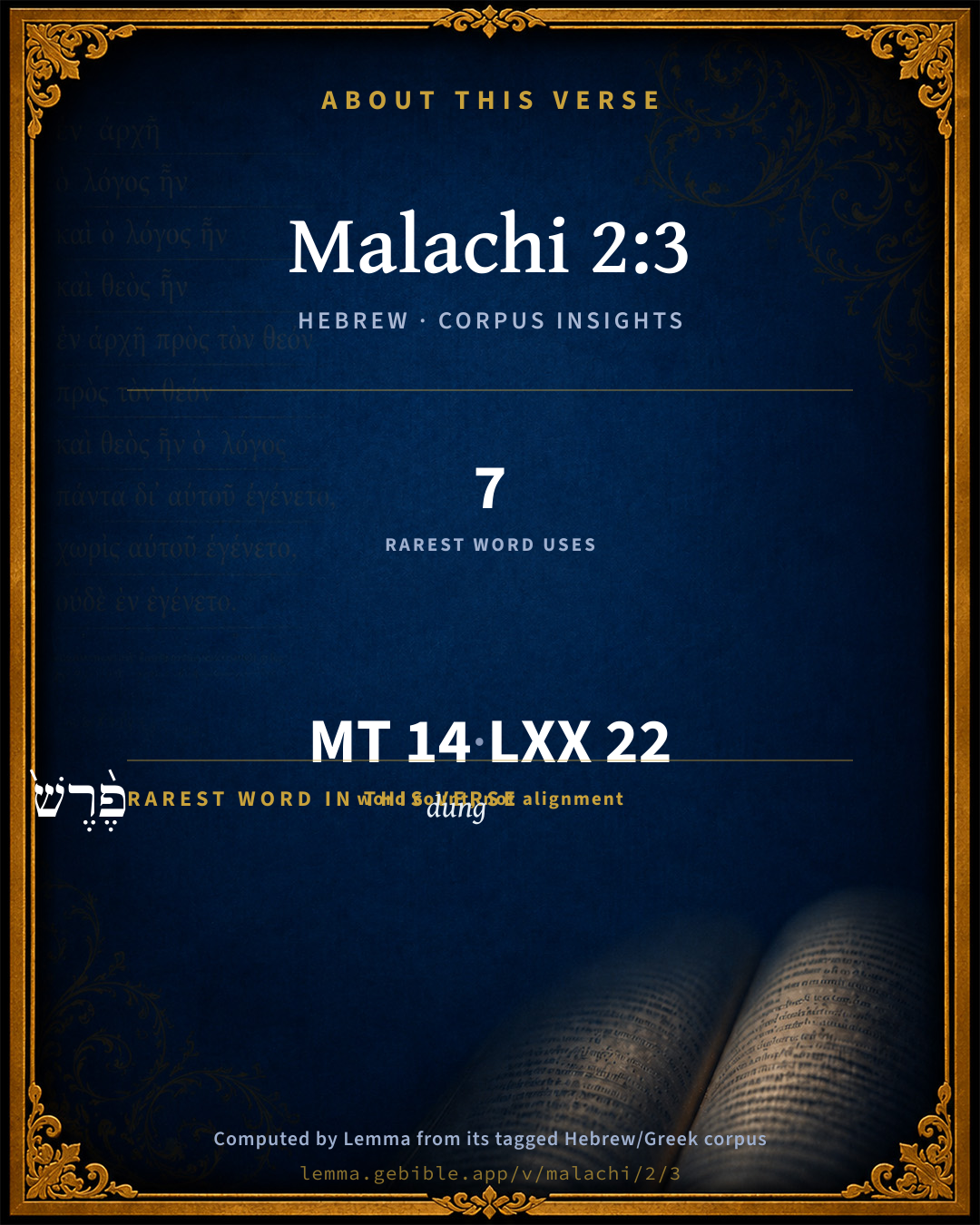
The rarest word here is פֶ֨רֶשׁ֙ dung H6569 — appearing just 7 times in the whole Hebrew Bible.

Shared distinctive vocabulary

פֶ֨רֶשׁ֙ dung H6569 occurs in 6 verses of the Hebrew Bible. Also found in:

Grammatical profile

  • 3 verbs
  • 5 nouns
  • 3 prepositions
  • 3 particles

Verb forms

  • גֹעֵ֤ר Qal · Participle Active
  • וְזֵרִ֤יתִי Piel · Sequential Perfect
  • וְנָשָׂ֥א Qal · Sequential Perfect

Repetition

A word recurs within this verse — often emphatic in Hebrew:

  • פֶ֨רֶשׁ֙ dung H6569 ×2

Hebrew & Septuagint length

In English translation the verse runs 27 words from the Hebrew and 30 from the Septuagint (LXX English) — closely comparable.

A rough comparison of the two English renderings, which tokenize alike — not a word-level alignment.

Word counts can differ between the Hebrew and the Greek without any difference in meaning — e.g. the Hebrew direct-object marker אֵת has no separate Greek word, and Greek often adds the article ὁ.

In the original languages it is 14 Hebrew tokens and 22 Greek tokens — but the two are counted differently (Hebrew bundles its prefixes and suffixes into one token; the Greek is in lemma form), so that isn’t a like-for-like length.

Cross-references

12

Topical passages linked to Malachi 2:3 in the Treasury of Scripture Knowledge — connected by theme and wording, ordered by reader-vote popularity; previews shown in the World English Bible.

  • Nahum 3:6 I will throw abominable filth on you, and make you vile, and will set you a spectacle.
  • Malachi 2:9 "Therefore I have also made you contemptible and base before all the people, according to the way you have not kept my ways, but have had respect for persons in the law.
  • Exodus 29:14 But the flesh of the bull, and its skin, and its dung, you shall burn with fire outside of the camp: it is a sin-offering.
  • 1 Kings 14:10 therefore, behold, I will bring evil on the house of Jeroboam, and will cut off from Jeroboam every man-child, him who is shut up and him who is left at large in Israel, and will utterly sweep away the house of Jeroboam, as a man sweeps away dung, until it be all gone.
  • Job 20:7 Yet he shall perish forever like his own dung, Those who have seen him shall say, 'Where is he?'
  • Joel 1:17 The seeds rot under their clods. The granaries are laid desolate. The barns are broken down, for the grain has withered.
  • 1 Samuel 2:29–30 Why kick you at my sacrifice and at my offering, which I have commanded in [my] habitation, and honor your sons above me, to make yourselves fat with the best of all the offerings of Israel my people?
  • 2 Kings 9:36–37 Therefore they came back, and told him. He said, This is the word of Yahweh, which he spoke by his servant Elijah the Tishbite, saying, In the portion of Jezreel shall the dogs eat the flesh of Jezebel;
  • Psalms 83:10 Who perished at Endor, Who became as dung for the earth.
  • Jeremiah 8:2 and they shall spread them before the sun, and the moon, and all the host of the sky, which they have loved, and which they have served, and after which they have walked, and which they have sought, and which they have worshiped: they shall not be gathered, nor be buried, they shall be for dung on the surface of the earth.
  • Luke 14:35 It is fit neither for the soil nor for the manure pile. It is thrown out. He who has ears to hear, let him hear."
  • 1 Corinthians 4:13 Being defamed, we entreat. We are made as the filth of the world, the dirt wiped off by all, even until now.

Cross-references courtesy of OpenBible.info (CC BY 4.0).

Hebrew and Greek witnesses Masoretic Hebrew ↔ Greek Septuagint

The same verse in the two great witnesses to the Old Testament, shown verse-for-verse.

These are two independent witnesses, not word-aligned to each other, and the Septuagint is shown in lemma (dictionary) form.

Hebrew Malachi 2:3 Masoretic · Westminster Leningrad Codex

הִנְנִ֨י גֹעֵ֤ר לָכֶם֙ אֶת הַזֶּ֔רַע וְזֵרִ֤יתִי פֶ֨רֶשׁ֙ עַל פְּנֵיכֶ֔ם פֶּ֖רֶשׁ חַגֵּיכֶ֑ם וְנָשָׂ֥א אֶתְכֶ֖ם אֵלָֽיו

Behold, I will rebuke your seed, and will spread dung on your faces, even the dung of your feasts; and you will be taken away with it.

World English Bible · Public Domain

Greek LXX Malachi 2:3 Septuagint · lemma form

ἰδού ἐγώ ἀποὁρίζω σύ ὁ ὦμος καί σκορπίζω ἤνυστρον ἐπί ὁ πρόσωπον σύ ἤνυστρον ἑορτή σύ καί λαμβάνω σύ εἰς ὁ αὐτός

Behold, I turn my back upon you, and I will scatter dung upon your faces, the dung of your feasts, and I will carry you away at the same time.

LXX2012 (modern English Septuagint) · Public Domain

On this verse, Ellicott's Commentary for English Readers discusses the Septuagint’s reading. Read the note in Commentary ↓

Hebrew: Westminster Leningrad Codex (CC BY 4.0). Greek: Septuagint (public domain); English from LXX2012 (modern English Septuagint) (Public Domain). How the Septuagint differs from the Hebrew →

Targum (Aramaic paraphrase)

1

The Targum is the ancient Jewish Aramaic paraphrase of the Hebrew Scriptures — an interpretive translation, not the Hebrew text itself. Onkelos (literal) and Pseudo-Jonathan (expansive) render the Torah, and Jonathan the Prophets. Coverage is partial: where no permissively-licensed English translation exists for a verse, only the Aramaic is shown. This is verse-level text, not a word-by-word alignment to the Hebrew.

  1. Targum Jonathan Prophets (Joshua–Malachi)
    הָא אֲנָא נְזֵיף לְכוֹן בְּעַלְלַת בַּר זַרְעָא וַאֲגִלֵי בַּהֲתַת חוֹבֵיכוֹן עַל אַפֵּיכוֹן וַאֲבַטֵל רְבוּת חַגֵיכוֹן וְיִתְמְנַע חוּלָקְכוֹן מִנֵיהּ:

    (no public-domain English translation for this verse)

    Targum Jonathan — Aramaic: “Mikraot Gedolot” (public domain). English: “Sefaria Community Translation” (CC0 1.0 (public-domain dedication)); “London "Chaldee Paraphrase," 1871” (public domain). Text via Sefaria.

Commentary

Notes on Malachi 2:3 from classic Christian and Jewish commentators (each source and its license shown beneath its notes). The classic Christian expositions comment on the surrounding passage and are grouped to its opening verse, so a note may address several verses; the Jewish commentaries on the Tanakh (Rashi and others) are per-verse, so they appear only where the commentator wrote on this verse.

Lemma curates 59 commentaries, every one of them public domain or Creative Commons licensed, each selected and text-cleaned for this edition rather than reprinted as found. About our sources →

Trapp's Complete Commentary

John Trapp

Mal 2:3 Behold, I will corrupt your seed, and spread dung upon your faces, [even] the dung of your solemn feasts; and [one] shall take you away with it.

Ver. 3. Behold, I will corrupt your seed] And so mar your hopes of a harvest; I will bring famine upon you, that sore judgment, worse than that of the sword, Lam 4:9, which yet is the slaughter house of mankind, and the very hell of this present world. By this scourge God will tame his prodigals, and starve their bodies; who, by the contempt of his ordinances, starve their own souls, Hag 1:4. Either by immoderate drought God can cause a famine, Joe 1:10, or by immoderate moisture, Joe 1:17 "The seed rotting under the clods," &c., to revenge the quarrel of his covenant. Israel was plagued with famine for breaking their faith with the Gibeonites, 2Sa 21:1. What may they expect that keep not in touch with God? David knew that the natural cause of that famine was drought; but he inquired (though it were long first) after the supernatural. As Jacob inquired who stood on the top of the ladder and sent the angels to and fro? Gen 28:13; so must we, in case of public calamities, ascend to the top of them, and see who sends them, and what is the cause of them, that we may cast the traitor’s head over the wall, and he may return and repent, and leave a blessing behind him. For till then we may look that he should cut off our provision and victuals, as wise princes use to do from their rebels whom they have gotten up into a walled town.

And spread dung upon your faces] Cast contempt upon you, and cover you with confusion; make you to stink above ground, so that men shall shun and abhor your company. This is another fruit of sin, and piece of the curse; and many wicked men are more afraid of it than of the sin that causeth it; as Chaereas, in Terence, not ashamed to deflour a virgin, was yet ashamed to be seen in a eunuch’s clothes, the sign of that sin. True it is, that the best may have dung cast into their faces, as St Paul and his precious companions had, 1Co 4:13 "We are," saith he, "the filth of the world, and the offscouring of all things" (περιψημα). The latter word signifieth the dung cart, that goes through the city, into which every one brings and casts his filth; to note that every fool had some filth to cast upon those worthies of whom the world was not worthy. And truly, all public persons that are faithful to their trust had need carry a spare handkerchief to wipe off dirt and drivel; which yet many times will hardly stick, as dirt will not upon marble, though it will upon a mud wall. "The wise shall inherit glory: when shame shall be the promotion of fools," Pro 3:35. A fair promotion; but good enough for them, unless they were better. If "the precious sons of Zion, comparable to fine gold, be at any time esteemed as earthen pitchers," as Lam 4:2, or trodden in the dirt by the fat bulls of Bashan, God will in due time make all his, that have lain sullied and slurred among the pots, to become as "the wings of a dove covered with silver, and her feathers with pure gold," Psa 68:13. In the meanwhile, they have the commendation of a good conscience, which is better than the world’s applause. But profane and profligate persons, with their spiritual nastiness and superfluity of naughtiness, stink worse than these cities of the plain in the nostrils of God and all good men, while they live (according to that, "The name of the wicked shall rot," and again, "He that perverteth his ways shall be known," Pro 10:7; Pro 10:9). And when they die they shall be carried through the dung gate of death, to the town ditch of utter destruction. At which time that in Job shall be verified of them, "Though his excellence mount up to the heavens, and his head reach unto the clouds; yet be shall perish for ever like his own dung; they which have seen him" (in his flourish) "shall say, Where is he?" Job 20:6-7. Let those dehonestamenta Cleri disgraceful clergy look to this; all idle and evil ministers, who, as unsavoury salt, are fit for no place but the dunghill, even to be buried in a dunghill, as Bishop Bonner was, and meanwhile to be trodden underfoot, which is a thing not only calamitous, but extremely ignominious, Mat 5:13.

Even the dung of your solemn feasts] i.e. For the iniquity of your most solemn services, which you have slubbered over, and made to stink, I will make you also abject and abominable; as the dung of sacrifices, offered in great number on festival days, was carried into some bycorner, and set out of sight. And here it is remarkable that God calleth the solemn feasts their solemn feasts, as if they had been none of his; he would not own them. So Jer 7:21, in scorn he calls their sacrifices flesh, ordinary flesh, such as was bought and sold in the meat markets. And Hos 9:4, he calleth the same sacrifices "their bread for their soul," or for their natural sustenance, and saith, "it shall not come into his house." And yet he speaks there of that meat offering, Lev 2:5, appointed by God himself for a spiritual use, which is nevertheless called the bread for their life, or livelihood; because God esteemed it none other than common meat. In a like sense it was, that after the people of Israel had set up the golden calf, God would own them no longer, but fathers them upon Moses: Behold thy people, saith he to Moses, whom thou broughtest out of Egypt, &c., Exo 32:7. David, also, when he had sinned in numbering the people, was counted and called but plain David "Go and say to David," &c., 2Sa 24:12 whereas before that, when he purposed to build the Lord a temple, &c., then it was, "Go tell my servant David," &c., 2Sa 7:5. The saints themselves, when they sin against God, are in a sort suspended from the covenant. Therefore it is usual with them, when they seek the Lord for any special mercy, to begin with humbling themselves, and taking pains with their own hearts, as David, Daniel, Ezra.

John Trapp, A Commentary or Exposition upon All the Books of the Old and New Testament (1647–1656) — public domain. Text from a community e-Sword module.

Geneva Bible (1599)

Geneva Bible translators

Your seed sown shall come to no profit.

You boast of your holiness, sacrifices and feasts, but they shall turn to your shame and be as vile as dung.

Geneva Bible (1599) marginal notes — public domain. Text via Bolls.life.

Jamieson, Fausset & Brown

Robert Jamieson, A. R. Fausset & David Brown

corrupt, &c.--literally, "rebuke," answering to the opposite prophecy of blessing (Mal 3:11), "I will rebuke the devourer." To rebuke the seed is to forbid its growing.

your--literally, "for you"; that is, to your hurt.

dung of . . . solemn feasts--The dung in the maw of the victims sacrificed on the feast days; the maw was the perquisite of the priests (Deu 18:3), which gives peculiar point to the threat here. You shall get the dung of the maw as your perquisite, instead of the maw.

one shall take you away with it--that is, ye shall be taken away with it; it shall cleave to you wherever ye go [MOORE]. Dung shall be thrown on your faces, and ye shall be taken away as dung would be, dung-begrimed as ye shall be (Kg1 14:10; compare Jer 16:4; Jer 22:19).

Jamieson, Fausset & Brown — Commentary Critical and Explanatory on the Whole Bible (1871) — public domain (CC PDM 1.0). Text via the HelloAO Bible API.

Adam Clarke's Commentary

Verse 3. Behold, I will corrupt your seed] So as to render it unfruitful. Newcome translates, - "I will take away from you the shoulder." This was the part that belonged to the priest, Le 7:32; De 18:3.

Spread dung upon your faces] Instead of receiving a sacrifice at your hands, I will throw your offerings back into your faces. Here God shows his contempt for them and their offerings.

Adam Clarke's Commentary on the Bible (1810–1826) — public domain. Text from a community e-Sword/MySword module.

John Calvin's Commentaries

He confirms here again what he had said in the last verse, — that they would perceive God’s curse in want and poverty. The curse of God is any kind of calamity; for as God declares especially his favor by a liberal support, so the sterility of the land and defective produce most clearly evidence the curse of God. The Prophet then shows, by mentioning one thing, what sort of curse was nigh the Jews, — that God would destroy their seed. Some read, but improperly, “I will destroy you and the seed.” I wonder how learned men make such puerile mistakes, when there is nothing ambiguous in the Prophet’s words. I will destroy then for you the seed; that is, “Sow as much as you please, I will yet destroy your seed, so that it shall produce no fruit.” In short, he threatens the Jews with want and famine; for the land would produce nothing when cursed by God.

But as the Jews flattered themselves on account of their descent, and ever boasted of their fathers, and as that preeminence with which God had favored them proved to them an occasion of haughtiness and pride, the Prophet here ridicules this foolish confidence, I will scatter dung, he says, on your faces: “Ye are a holy nation, ye are the chosen seed of Abraham, ye are a royal priesthood; these are your boastings; but the Lord will render your faces filthy with dung; this will be your nobility and preeminence! there is then no reason for you to think yourselves exempt from punishments because God has adopted you; for as ye have abused his benefits and profaned his name, so ye shall also find in your turn, that he will cover you with everything disgraceful and ignominious, so as to make you wholly filthy: ye shall then be covered all over with dung, and shall not be the holy seed of Abraham.”

But as they might have again raised a clamor and say, “Have we then in vain so diligently served God? Why has he bidden a temple to be built for him by us and promised to dwell there? God then has deceived us, or at least his promises avail nothing.” — The Prophet gives this answer, “God will overwhelm you with disgrace and also your sacrifices.” But he calls them the dung of solemnities, as though he had said, “I will cover you with reproach on account of your impiety, which is seen in your sacrifices.” Had the Jews any holiness they derived it from their sacrifices, by which they expiated their sins and reconciled themselves to God: but the Prophet says that it was their special ill-savor which offended God, and which he abominated, because they vitiated their sacrifices. Nor is that to be disapproved which some of the rabbins have said, that the Prophet alludes to the oxen, calves, and rams; for when the Jews from various places brought their sacrifices, there must have been much dung from all that vast number. There is then here a striking allusion to the victims themselves, as though he had said, “Ye think that I can be pacified by your sacrifices, as though loads of dung were pleasing to me; for when ye bring such a vast number, even the place itself, the area before the temple, throws an ill-savor on account of the dung that is there. Ye are then, forsooth! holy, and all your filth is cleansed away by means of this dung. Begone then together with the dung of your solemnities; for I will cast this very dung on your heads.”

We now perceive what the Prophet means: and emphatical are the words, Behold I; for God by these single words cuts off all those pretences by which the Jews deceived themselves, and thought that their vices were concealed from God: “I myself,” he says, “am present, to whom ye think your sacrifices to be acceptable; I then will destroy your seed, and I will also cast dung on your faces; all the dignity which ye pretend shall be abolished, for ye think that ye are defended by a sort of privilege, when ye boast yourselves to be the seed of Abraham: it is dung, it is dung,” he says. He afterwards shows what was especially the dung and the filth: for when they objected and said, “What! have our sacrifices availed nothing?” he answers, “Nay, I will cast that dung upon you, because the chief pollution is in your sacrifices, for ye vitiate and adulterate my service: and what else is your sacrifice but profanation only? ye are sacrilegious in all your empty pomps. Since then all your victims have an ill-savor and displease me, and as I nauseate them, (as it is also said in the first and last chapter of Isaiah,) I will heap the dung on your own heads, because ye think it to be your chief expiation.”

He adds at last, It shall take you to itself; that is, “Ye shall be dung altogether; and thus all your boastings, that ye are descended from the holy Patriarch Abraham, shall be wholly useless; though I made a covenant and promised that you should be to me a royal priesthood, yet the dung shall take you to itself, and thus whatever dignity I have hitherto conferred on you shall be taken away.” Let us proceed

John Calvin's Commentaries (1540-1563) — public domain. Text from the Calvin Translation Society English edition (1840s-50s) via the Christian Classics Ethereal Library (ccel.org). Calvin's coverage is partial (roughly two-thirds of the Bible); uncommented books and verses are honest gaps, never fabricated. The 19th-century editor's footnotes and remarks are omitted so the notes are faithfully Calvin's own voice.

Ellicott's Commentary for English Readers

(3) I will corrupt your seed.—Better, I will destroy for you the seed—viz., of the crops. It must be remembered that because the people neglected to pay the tithes, the Levites were obliged to go and till the fields (Neh_13:10). The LXX. for “seed” reads “corn.”

Dung of your solemn feasts.—Or rather, of your festival sacrifices. (Comp. Exo_23:18; Psa_118:27.) The dung of the sacrificial animals was to be carried to an unclean place outside the camp, and burnt there. The priests, because they had profaned God’s Name by offering unfit animals in sacrifice, were to be treated in the most ignominious manner.

And one shall take you away with it—i.e., according to a Hebrew idiom, and ye shall be carried away to it (comp. Isa_8:4):—ye shall be treated like it.

A Bible Commentary for English Readers, edited by Charles John Ellicott (1878–1897) — public domain. Text from a community e-Sword module.

The Cambridge Bible for Schools and Colleges

gen. ed. J. J. S. Perowne

3. corrupt] Rather, reprove, margin A.V.; or rebuke, R.V. Comp. ch. Mal_3:11 : “I will rebuke (the same word) the devourer.” God will wither with His rebuke the seed so that it shall not germinate, or shall not come to maturity. Thus the priests would suffer both in tithes and in offerings (Joe_1:2-13).

The LXX. (reading זְרוֹצַ for זֶרַצ) render, ἀφορίζω ὑμῖν τὸν ὦμον, “I set apart for you the shoulder,” that being the part of the victim reserved for the priest. Lev_7:34. Ewald, “I will rebuke your (the priests’) arm.”

of your solemn feasts] If this rendering be retained, it will of course mean the dung of the sacrifices offered at such feasts. The R.V. has feasts in the margin, but sacrifices in the text.

The figure is very forcible. It is as though Jehovah sees nothing in the droves of diseased and blemished animals that are brought to His altar on some great Festival, but the mass of filth and offal that necessarily accompanies the sacrifice. It is all one vast abomination! Flinging back in holy indignation the polluted offerings into the faces of the unworthy priests, He overwhelms them beneath the fœtid heap, and thus they are swept forth with it from the sacred precincts. Comp. Exo_29:14, 1Ki_14:10.

one shall take you] It is more in accordance with our English idiom to render, with R.V., ye shall be taken. Comp. Isa_9:5 : “His name shall be called”; lit. “he (one) shall call His name”.

The Cambridge Bible for Schools and Colleges (gen. ed. J. J. S. Perowne; Cambridge University Press, 1878–1918) — public domain. Text from a community e-Sword module.

John Gill's Exposition

Behold, I will corrupt your seed,.... Or, "the seed for you" (r); that is, for your sake, as Kimchi and Ben Melech explain it; meaning the seed they cast into the earth, which the Lord threatens to corrupt and destroy; so that it should not spring up again, and bring forth any increase: or, "rebuke" (s) it, as the word sometimes signifies; and so the Targum,

"behold, I will rebuke you in the increase, the fruit (son) of the seed.''

The sense is the same; corrupting the seed being a rebuke to them; and rebuking the seed being a corruption of that, or hindering it from growing up. It is a threatening of a sore famine that should be in the Jewish nation; and which Cocceius thinks was that which happened in the days of Claudius Caesar, Act 11:28. The Septuagint version renders it, "behold, I separate to you the shoulder"; the Arabic version, "the right hand", or arm; and the Vulgate Latin is, "behold, I will cast forth to you the arm"; the right shoulder of the sacrifice, which was given to the priests, and here threatened to be cast to them with indignation, Lev 7:32 but the former sense is best:

and spread dung upon your faces, even the dung of your solemn feasts; that is, the dung of their beasts which were slain for sacrifice at their solemn feasts: so this word is used for a beast offered for sacrifice at a festival, Psa 118:27. The sense is, that their sacrifices and solemn feasts were so far from being acceptable to God, that he would reject both them and their persons, and would cast the very dung of the creatures brought for sacrifice into their faces, and spread it over them: a phrase expressive of the utmost contempt of them, and of exposing them to the greatest shame and confusion for their sins. So the Targum,

"I will make manifest the shame of your sins upon your faces; and will cause to cease the magnificence of your feasts.''

The Septuagint render it, the ventricle, or "maw"; which was given to the priests, Deu 18:3 and in which the dung was contained:

and one shall take you away with it; with the dung spread upon them; they looking like a heap of dung, being covered with it, and had in no more account than that: or "to it" (t); that is, as Jarchi explains it, to the dung of the beasts of your sacrifices they shall carry you; or you shall be carried to it, that ye may be rejected and despised as that. Kimchi's note is

"the iniquity (you are guilty of) shall carry you to this contempt; measure for measure; you have despised me, and ye shall be despised:''

or "with him", or "to himself" (u); meaning he, or it that shall take them away; either the wind or dung; or the enemy, as Aben Ezra interprets it; by whom the Romans may be designed, who took them away out of their own land, and carried them captive. According to the Septuagint, Syriac, and Arabic versions, this is to be understood of God, who render the words, "I will take you together", or "with it".

(r) "propter vos", Munster, Drusius. (s) "increpabo", Tigurine version; "increpo", Drusius, Cocceius; "increpans", Burkius. (t) , Sept.; "ad istud", so some in Vatablus, De Dieu. (u) "Ad se", Pagninus, Montanus, Munster, Tigurine version: Junius & Tremellius, Piscator, Drusius, Calvin, Burkius.

John Gill's Exposition of the Whole Bible (1746–1763) — public domain (CC PDM 1.0). Text via the HelloAO Bible API.

Albert Barnes' Notes on the Bible

Lo, I will rebuke the seed for your sake - o, i. e., that it should not grow. He who worketh by His sustaining will all the operations of nature, would at His will withhold them. Neither priests nor Levites cultivated the soil; yet, since the tithes were assigned to them, the diminution of the harvest affected them. The meal-offering too was a requisite part of the sacrifice. (See also Joe 1:13; Joe 2:14.)

And spread dung upon your phaces, the dung o of your solemn feasts - , or, “of your sacrifices.” It was by the law carried without the camp and burned with the animal itself. They had brought before the face of God maimed, unfitting sacrifices; they should have them cast back, with their refuse, upon them; “as a lord that rejecteth a gift, brought to him by his servant, casts it back in his time.” “Of your sacrifices, not of Mine, for I am not worshiped in them: ye seek to please, not Me, but yourselves.” So God said of Eli 1Sa 2:30, “them that honor Me I will honor, and they that despise Me shall be lightly esteemed.”

And one shall take you away with it - , literally “to it.” They should be swept away, as if they were an appendage to it, as God said 1Ki 14:10, “I will take away the remnant of the house of Jeroboam, as a man taketh away dung, until all be gone.” As are the offerings, so shall it be with the offerers.

Albert Barnes' Notes on the Bible (1834–1885) — public domain. Text from a community e-Sword/MySword module.

Haydock's Catholic Bible Commentary

Shoulder. I will cast away the shoulder, which in the law was appointed to be your portion, and fling it at you in my anger: and will reject both you and your festivals like dung. (Challoner) --- Hebrew now reads for shoulder, zerah, "grain," or seed. (Calmet) --- "I will menace you with the shoulder, and will spread dirt on your faces, even the dirt of your feasts," (Aquila) or "the ventricle of your festivals." (Septuagint) (Haydock)

George Leo Haydock (1774–1849), Haydock's Catholic Family Bible and Commentary, 1859 edition — public domain. Excludes Psalms (Douay-Rheims chapter numbering differs from Protestant) and Deuterocanonical books (Catholic canon only).

Matthew Poole's English Annotations

Behold; note it well, and consider.

I will corrupt your seed; take away the prolific virtue and strength of it, that it shall bring forth none or little fruit: your seed you make plentiful, but you cannot make your harvest so, nor will I, till you give me the glory I contend for, and will have ere I have done. I will rebuke or check your seed, which will surcease to grow thereupon: though your vices checked thrive still, your seed for harvest cannot grow up under my checks.

Spread dung upon your faces: it is an expression of greatest contempt cast upon a person; it is a token of utmost undervalue and scorn: so I will expose you, as you have exposed my name to contempt.

The dung of your solemn feasts; your most solemn days and feasts, which are by you accounted most holy, and in which you think you offer the most holy and acceptable sacrifices, shall be as loathsome to me as dung, and shall make you, who offer them illegally, as polluted, unclean, and loathsome as if I had thrown the dung of those sacrifices into your faces.

One shall take you away with it; you shall be taken away with it, removed as unclean as the dung itself, as unfit as that to be in the temple, as fit to be cast out to the dunghill; so contemptible shall you be, if you lay it not to heart.

Matthew Poole's English Annotations on the Holy Bible (1683–1685) — public domain. Text from a community e-Sword/MySword module.

The Pulpit Commentary

I will corrupt your seed. Henderson, "I will rebuke the seed to your hurt." God would mar the promise of their crops; but, as the priests did not concern themselves with agriculture, such a threat would have had no particular application to them. It is best, therefore, to take the pointing of some of the versions, and to translate, I will rebuke your arm; i.e. I will take from you the power of performing, or, I will neutralize your official duties, the arm being the instrument of labour, offering, and blessing. Others consider the threat to be that they should be deprived of their allotted portion of the sacrifice the breast and shoulder, (Lev_7:31, Lev_7:32) or the shoulder, the two cheeks, and the maw. (Deu_18:3) Septuagint, Aforizw umin to , "I take from you the shoulder;" Vulgate, Ego projiciam vobis brachium. Orelli takes "seed" in the sense of posterity, seeing here a reversal of such promises as Jer_33:18, Jer_33:22. Spread dung upon your faces. God will deliver them over to shameful treatment, which shall cover them with contempt. The idea is derived from the filth left in the courts by the victims (see the following clause). Your solemn feasts (chaggim); ie. the animals slain at the sacrificial feasts. God calls them "your," not "my," because they were not celebrated really in his honor, but after their own self-will and pleasure. The dung of the sacrificial animals was by the Law carried forth and bunted without the comp. (Exo_29:14 Lev_4:12 Lev_16:27) One shall take you away with it. They shall be treated as filth, and cast away in some foul spot. (comp. 1Ki_14:10)

The Pulpit Commentary (1880–1919), ed. H.D.M. Spence-Jones & Joseph S. Exell — public domain. Text from a community e-Sword module.

John Wesley's Explanatory Notes

I will corrupt - I will take away the prolific virtue and strength of it, that it shall bring forth no fruit. Spread dung - It is an expression of the greatest contempt. Of your solemn feasts - Your most solemn days and feasts, shall be as loathsome to me as dung, and shall make you, who offer them as unclean, and loathsome, as if I had thrown the dung of those sacrifices into your faces. Take you away - You shall be taken away with it, removed as equally unclean with the dung itself, equally fit to be cast out to the dunghill.

John Wesley, Explanatory Notes Upon the Whole Bible (1754–1765) — public domain. Text via the GEBible commentary corpus.

unfoldingWord translationNotes

Door43 World Missions Community

I will spread dung on your faces

Here "dung on your faces" stands for disgrace. AT: "I will most certainly put you in deep disgrace; it will be as bad as if I had spread dung on your faces" (See: Metaphor)

the dung from your festivals

Here "festivals" stands for the animals that the priests offered in sacrifice at the Israelite festivals. "The dung" probably refers both to the dung that was produced by the animals just before they were slaughtered for sacrifice, and to the dung that was found inside the animals when their bodies were cut apart before being sacrificed. Temple workers had to transport this dung to a place outside of the temple, and probably outside of Jerusalem. (See: Metonymy)

he will take you away with it

This difficult expression can be translated as "God will take you away with it," that is, with the dung. This expression continues the same metaphor of slaughtering animals for sacrifice, and it can be put in active form. AT: "they will throw you on the dung pile; God will make sure that they take you away when they remove all the dung" (See: Active or Passive)

he will take you away with it

Possible meanings of this expression are 1) God will punish the unfaithful priests by killing them and causing their bodies to be carried away on the piles of animal dung, or 2) God will punish the unfaithful priests in such a horrible way that it will be as if their bodies had been carried away with the animal dung. (See: Metaphor)

Levi

Here Levi represents his descendants, the tribe of Levi. AT: "so that my covenant may be with you, the descendants of Levi" (See: Metonymy)

translationWords

rebuke

descend

dung

sacrifice

command

covenant

Levi

Yahweh of hosts

unfoldingWord translationNotes — © Distant Shores Media and the Door43 World Missions Community, licensed CC BY-SA 4.0. Source: git.door43.org/Door43/en_tn.

Rashi

Rabbi Shlomo Yitzchaki (Rashi)

and I will scatter dung of the animals of your festive sacrifices; that is to say, you will not receive reward from Me, but [you will receive a curse] for harm and shame. And I will rebuke the seed of the field because of you.

and it shall take you to itself The dung of your sacrificial animals will take you to itself to [make you] cheap and despised, as it is.

Rashi on the Tanakh — English translations: “The Judaica Press complete Tanach with Rashi, translated by A. J. Rosenberg” (CC BY 4.0); “Pentateuch with Rashi's commentary by M. Rosenbaum and A.M. Silbermann, 1929-1934” (public domain); “The Metsudah Tanach series, Lakewood, N.J” (CC BY 4.0); and “The Book of Joshua, Metsudah Publications, 1997” (CC BY 4.0). Text via Sefaria.

Lesson kit

Teaching starters — assembled from the data on this page, not authored interpretation. Every prompt links to the verse data it draws on. Edit before teaching.

Malachi, in the Prophets, opens this verse with 14 words (11 distinct Hebrew lemmas). Its most distinctive word is peresh (“dung”). A historical commentator’s framing appears above. Read the whole chapter for the surrounding context.

Discussion questions

  1. What does “dung” (peresh) contribute to the verse as a whole?
  2. Exodus 29:14 shares the word «dung» with this verse. How do the two illuminate each other?
  3. “dung” occurs 2× in this one verse. What is the effect of the repetition?
  4. These translations render this verse differently. What is at stake in choosing one wording over another?
  5. The verb «גֹעֵ֤ר» is Qal Participle Active. How does its form color the action?
  6. Reading how Trapp's Complete Commentary and Geneva Bible (1599) read this verse, where do the two commentators agree and where do they part?

Things to notice

Reading settings

Reading text

Shown beneath each verse's original-language words.

Old Testament
Old Testament edition

Read the OT as the Masoretic Hebrew (MT) or the Greek Septuagint (LXX).

English shown for the Greek Septuagint (in the Hebrew ↔ Greek comparison).

Comparing translations? Open the Compare panel on any verse page to stack up to four side by side.