
Numbers 25:13

Hebrew (Westminster Leningrad Codex) Numbers 25:13 appears in the Hebrew Old Testament. The text above is from the Westminster Leningrad Codex. Each word links to its Strong’s number, a concise gloss, and parsing drawn from the Open Scriptures Hebrew Bible morphology. Click any word for its full Brown-Driver-Briggs (BDB) entry.
Download image
Cite this verse

Numbers 25:13 (World English Bible). Public Domain. Lemma interlinear Bible study tool, https://lemma.gebible.app/v/numbers/25/13.

Show BibTeX & RIS
BibTeX
RIS
English Translation
and it shall be to him, and to his seed after him, the covenant of an everlasting priesthood; because he was jealous for his God, and made atonement for the children of Israel.
World English Bible · Public Domain
Download a study sheet

One document with this verse’s original text, its word-by-word gloss line, the meaning frame, cross-references with their text, attributed commentary, and full source and license credits — printable, and it pastes into notes with its structure intact.

This verse Autodidact and up

Study sheet (.html) Plain text (.txt)

A passage Seminary Student

Up to 50 verses in one chapter. A passage sheet keeps up to 6 commentary sources and 12 cross-references per verse, in the order this page ranks them, and says so on the sheet whenever that leaves anything out. Ask for a single verse and you get the Autodidact verse sheet above.

Everything on this page stays free to read, with no account — the sheet is a download of what is already on screen, not access to it.

Want to remove ads? Support Godless Engineer
Compare translations 3

The same verse in 3 English versions, stacked beneath the original-language interlinear above. Click any original word for its lexicon entry.

Each is an independent rendering of the whole verse — the interlinear is not word-aligned to these translations.

Highlighted words mark where these versions differ — a whole-verse word diff, not a word-by-word alignment.

  • World English Bible Public Domain
    and it shall be to him, and to his seed after him, the covenant of an everlasting priesthood; because he was jealous for his God, and made atonement for the children of Israel.
  • King James Version Public Domain
    And he shall have it, and his seed after him, even the covenant of an everlasting priesthood; because he was zealous for his God, and made an atonement for the children of Israel.
  • unfoldingWord Literal Text CC BY-SA 4.0
    And it will be a covenant of a priesthood of eternity for him and for his seed after him, because he was zealous for his God and he made atonement for the sons of Israel.’”

unfoldingWord Literal Text — © unfoldingWord, licensed CC BY-SA 4.0. Word-aligned USFM3 via Door43 (git.door43.org/unfoldingWord/en_ult).

Versions to compare (up to 4)

3 of 4 selected

Show all 18 translations

Every available English version of this verse, each an independent rendering of the whole verse.

  • World English Bible Public Domain
    and it shall be to him, and to his seed after him, the covenant of an everlasting priesthood; because he was jealous for his God, and made atonement for the children of Israel.
  • Berean Standard Bible Public Domain
    It will be a covenant of permanent priesthood for him and his descendants, because he was zealous for his God and made atonement for the Israelites.”
  • Majority Standard Bible Public Domain
    It will be a covenant of permanent priesthood for him and his descendants, because he was zealous for his God and made atonement for the Israelites.”
  • King James Version Public Domain
    And he shall have it, and his seed after him, even the covenant of an everlasting priesthood; because he was zealous for his God, and made an atonement for the children of Israel.
  • American Standard Version (1901) Public Domain
    and it shall be unto him, and to his seed after him, the covenant of an everlasting priesthood; because he was jealous for his God, and made atonement for the children of Israel.
  • Revised Version (1885) Public Domain
    and it shall be unto him, and to his seed after him, the covenant of an everlasting priesthood; because he was jealous for his God, and made atonement for the children of Israel.
  • Geneva Bible (1599) Public Domain
    And he shall haue it, and his seede after him, euen the couenant of the priestes office for euer, because he was zealous for his God, and hath made an atonement for the children of Israel.
  • Douay-Rheims (1899) Public Domain
    And the covenant of the priesthood for ever shall be both to him and his seed, because he hath been zealous for his God, and hath made atonement for the wickedness of the children of Israel.
  • Young's Literal Translation Public Domain
    and it hath been to him and to his seed after him a covenant of a priesthood age-during, because that he hath been zealous for his God, and doth make atonement for the sons of Israel.'
  • Literal Standard Version CC BY-SA 4.0
    and it has been to him and to his seed after him [for] a covenant of a continuous priesthood, because that he has been zealous for his God, and makes atonement for the sons of Israel.”
  • Unlocked Literal Bible CC BY-SA 4.0
    For him and his descendants after him, it will be a covenant of an everlasting priesthood because he was zealous for me, his God. He has atoned for the people of Israel.”'”
  • unfoldingWord Literal Text CC BY-SA 4.0
    And it will be a covenant of a priesthood of eternity for him and for his seed after him, because he was zealous for his God and he made atonement for the sons of Israel.’”
  • Darby Bible Public Domain
    And he shall have it, and his seed after him, the covenant of an everlasting priesthood; because he was jealous for his God, and made atonement for the children of Israel.
  • World Messianic Bible Public Domain
    It shall be to him, and to his offspring after him, the covenant of an everlasting priesthood, because he was jealous for his God, and made atonement for the children of Israel.’”
  • Webster's Bible Public Domain
    And he shall have it, and his seed after him, even the covenant of an everlasting priesthood; because he was zealous for his God, and made an atonement for the children of Israel.
  • Free Bible Version CC BY-SA 4.0
    It will be an agreement that ensures a permanent priesthood for him and his descendants, because he was passionately dedicated to his God and set the Israelites right.”
  • Bible in Basic English Public Domain
    And by this agreement, he and his sons after him have the right to be priests for ever; because, by his care for the honour of his God, he took away the sin of the children of Israel.
  • JPS Tanakh (1917) Public Domain
    and it shall be unto him, and to his seed after him, the covenant of an everlasting priesthood; because he was jealous for his God, and made atonement for the children of Israel.'

Literal Standard Version (2020), Covenant Press — licensed CC BY-SA 4.0. Text via the HelloAO Bible API (eBible.org). Unlocked Literal Bible (unfoldingWord) — licensed CC BY-SA 4.0. Text via the HelloAO Bible API (eBible.org). unfoldingWord Literal Text — © unfoldingWord, licensed CC BY-SA 4.0. Word-aligned USFM3 via Door43 (git.door43.org/unfoldingWord/en_ult). Free Bible Version, Dr. Jonathan Gallagher — licensed CC BY-SA 4.0. Text via the HelloAO Bible API (eBible.org).

Word by word

More ways to search: Search by grammar → Find every occurrence → Compare this word →

Practice this passage: Drill this verse → Learn its vocabulary →

כְּהֻנַּ֣ת
kᵉhunnâh
H3550
“priesthood of”
Noun, Common, Feminine, Singular, Construct
Part of Speech
Noun
Type
Common
Gender
Feminine
Number
Singular
State
Construct
Full BDB Definition

Origin: from H3547

TWOT: 959b

priesthood
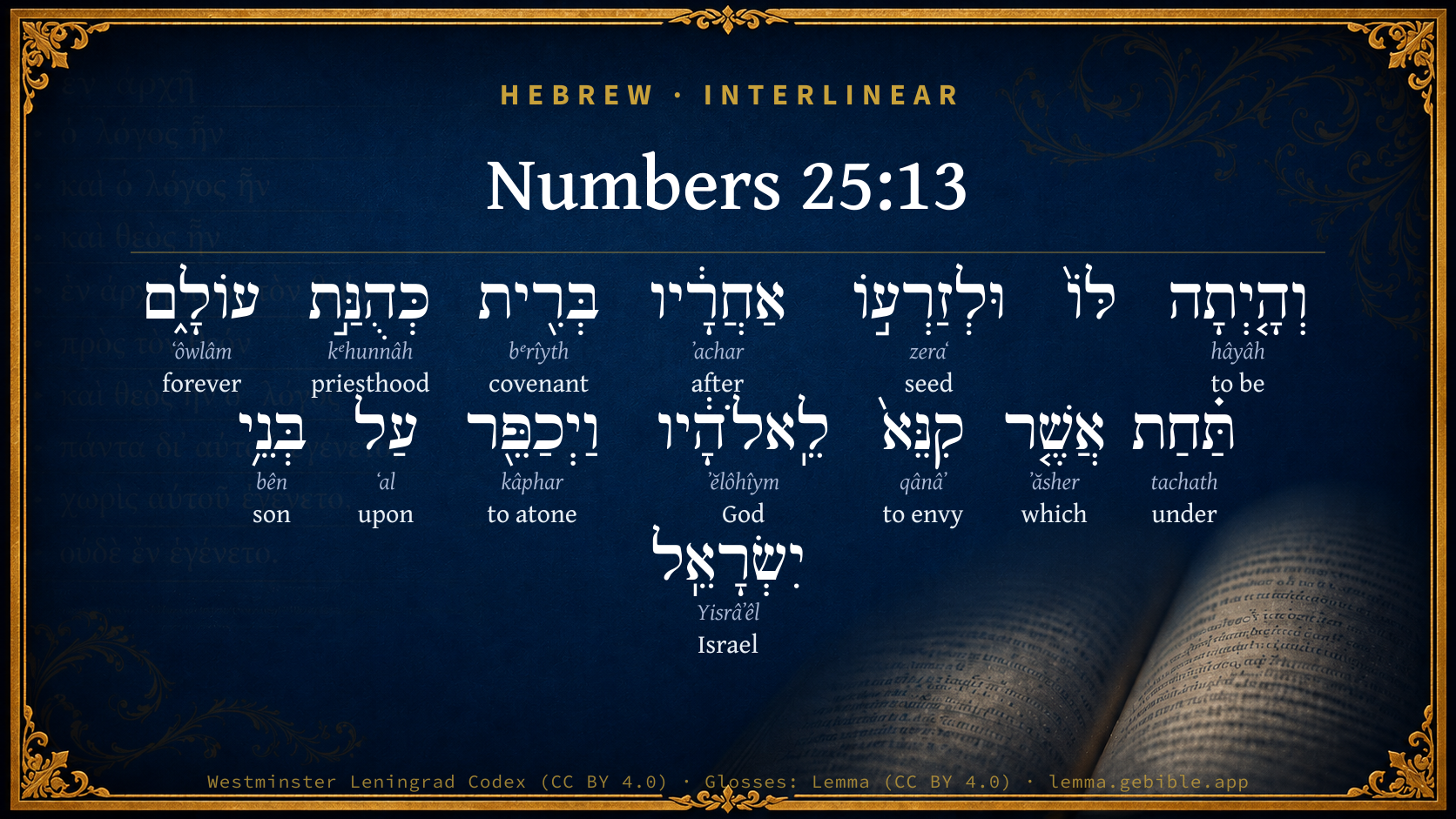
  1. וְהָ֤יְתָה hâyâh H1961 “and · to be” Conjunction + Verb, Qal, Sequential Perfect, 3rd Person, Feminine, Singular
  2. וּלְזַרְע֣וֹ zeraʻ H2233 “and · to/for · seed · his” Conjunction + Preposition + Noun, Common, Masculine, Singular, Construct + Suffix, Personal, 3rd Person, Masculine, Singular
  3. אַחֲרָ֔יו ʼachar H310 “after · him” Preposition + Suffix, Personal, 3rd Person, Masculine, Singular
  4. בְּרִ֖ית bᵉrîyth H1285 “covenant of” Noun, Common, Feminine, Singular, Construct
  5. עוֹלָ֑ם ʻôwlâm H5769 “forever” Noun, Common, Masculine, Singular, Absolute
  6. תַּ֗חַת tachath H8478 “under” Preposition
  7. אֲשֶׁ֤ר ʼăsher H834 “which” Particle, Relative
  8. קִנֵּא֙ qânâʼ H7065 “to envy” Verb, Piel, Perfect, 3rd Person, Masculine, Singular
  9. לֵֽאלֹהָ֔יו ʼĕlôhîym H430 “to/for · God(s) · his” Preposition + Noun, Common, Masculine, Plural, Construct + Suffix, Personal, 3rd Person, Masculine, Singular
  10. וַיְכַפֵּ֖ר kâphar H3722 “and · to atone” Conjunction + Verb, Piel, Sequential Imperfect, 3rd Person, Masculine, Singular
  11. עַל ʻal H5921 “upon” Preposition
  12. בְּנֵ֥י bên H1121 “sons of” Noun, Common, Masculine, Plural, Construct
  13. יִשְׂרָאֵֽל Yisrâʼêl H3478 “Israel” Noun, Proper

About this verse

These counts appear in no published source. They are computed here, from the morphology-tagged text and Lemma’s own curated glosses. What Lemma adds →

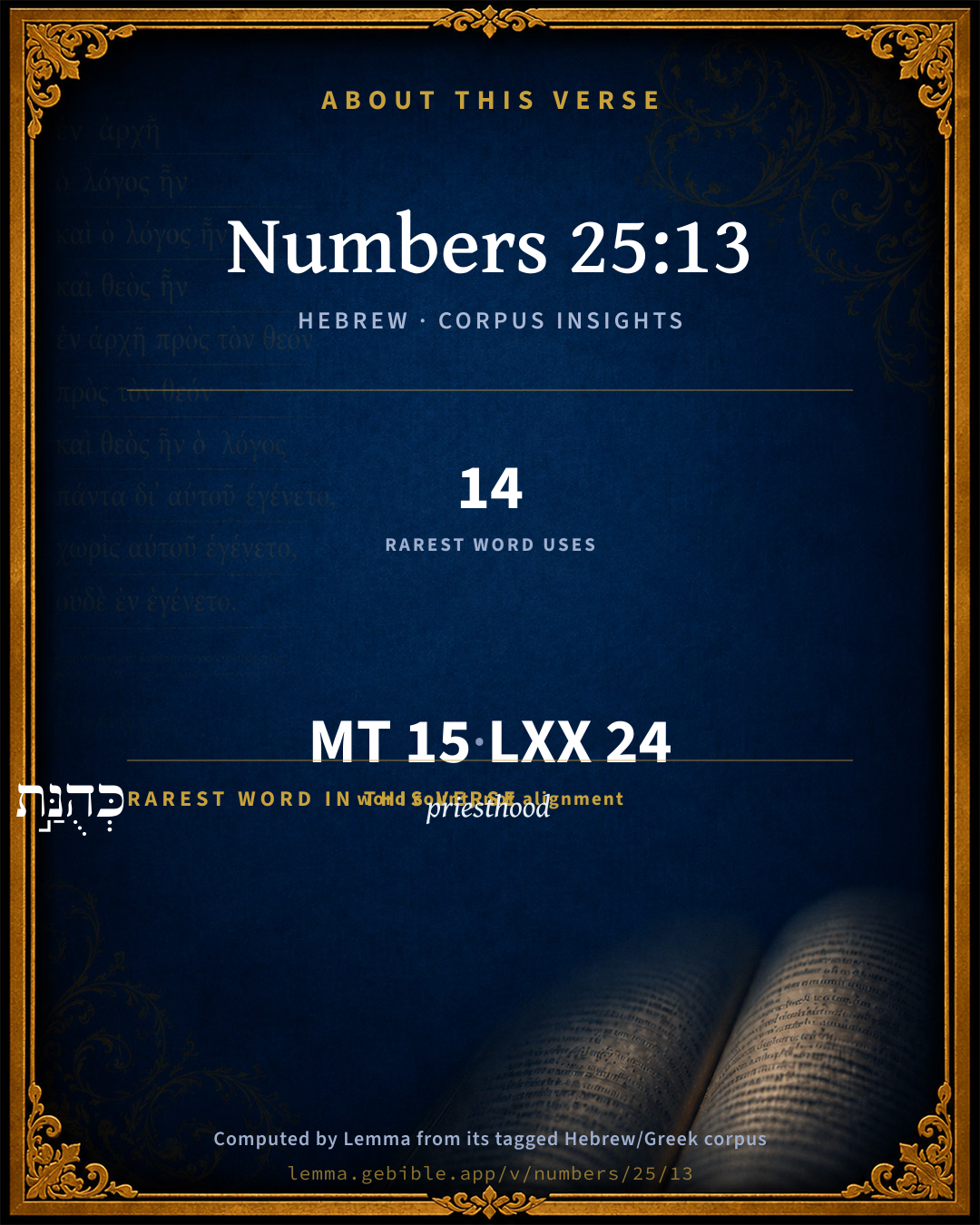
15
words
14
distinct lemmas
Pentateuch
section

Notable vocabulary

The rarest word here is כְּהֻנַּ֣ת priesthood H3550 — appearing just 14 times in the whole Hebrew Bible.

Shared distinctive vocabulary

כְּהֻנַּ֣ת priesthood H3550 occurs in 12 verses of the Hebrew Bible. Also found in:

Grammatical profile

  • 3 verbs
  • 7 nouns
  • 4 prepositions
  • 1 particle

Verb forms

  • וְהָ֤יְתָה Qal · Sequential Perfect
  • קִנֵּא֙ Piel · Perfect
  • וַיְכַפֵּ֖ר Piel · Sequential Imperfect

Hebrew & Septuagint length

In English translation the verse runs 33 words from the Hebrew and 29 from the Septuagint (LXX English) — closely comparable.

A rough comparison of the two English renderings, which tokenize alike — not a word-level alignment.

Word counts can differ between the Hebrew and the Greek without any difference in meaning — e.g. the Hebrew direct-object marker אֵת has no separate Greek word, and Greek often adds the article ὁ.

In the original languages it is 15 Hebrew tokens and 24 Greek tokens — but the two are counted differently (Hebrew bundles its prefixes and suffixes into one token; the Greek is in lemma form), so that isn’t a like-for-like length.

Cross-references

28

Topical passages linked to Numbers 25:13 in the Treasury of Scripture Knowledge — connected by theme and wording, ordered by reader-vote popularity; previews shown in the World English Bible.

  • Hebrews 2:17 Therefore he was obligated in all things to be made like his brothers, that he might become a merciful and faithful high priest in things pertaining to God, to make atonement for the sins of the people.
  • Exodus 40:15 You shall anoint them, as you anointed their father, that they may minister to me in the priest's office. Their anointing shall be to them for an everlasting priesthood throughout their generations.
  • 1 Chronicles 6:4–15 Eleazar became the father of Phinehas, Phinehas became the father of Abishua,
  • Psalms 106:31 That was credited to him for righteousness, For all generations to come.
  • Jeremiah 33:18 neither shall the priests the Levites want a man before me to offer burnt offerings, and to burn meal-offerings, and to do sacrifice continually.
  • Jeremiah 33:22 As the host of the sky can't be numbered, neither the sand of the sea measured; so will I multiply the seed of David my servant, and the Levites who minister to me.
  • Romans 10:2–4 For I testify about them that they have a zeal for God, but not according to knowledge.
  • 1 Peter 2:5 You also, as living stones, are built up as a spiritual house, to be a holy priesthood, to offer up spiritual sacrifices, acceptable to God through Jesus Christ.
  • Exodus 32:30 It happened on the next day, that Moses said to the people, "You have sinned a great sin. Now I will go up to Yahweh. Perhaps I shall make atonement for your sin."
  • 1 Kings 19:10 He said, I have been very jealous for Yahweh, the God of hosts; for the children of Israel have forsaken your covenant, thrown down your altars, and slain your prophets with the sword: and I, even I only, am left; and they seek my life, to take it away.
  • 1 Kings 19:14 He said, I have been very jealous for Yahweh, the God of hosts; for the children of Israel have forsaken your covenant, thrown down your altars, and slain your prophets with the sword; and I, even I only, am left; and they seek my life, to take it away.
  • 1 Chronicles 6:50–53 These are the sons of Aaron: Eleazar his son, Phinehas his son, Abishua his son,
  • Psalms 69:9 For the zeal of your house consumes me. The reproaches of those who reproach you have fallen on me.
  • Isaiah 61:6 But you shall be named the priests of Yahweh; men shall call you the ministers of our God: you shall eat the wealth of the nations, and in their glory shall you boast yourselves.
  • John 2:17 His disciples remembered that it was written, "Zeal for your house will eat me up."
  • Hebrews 7:17–18 for it is testified, "You are a priest forever, According to the order of Melchizedek."
  • 1 Peter 2:9 But you are a chosen race, a royal priesthood, a holy nation, a people for God's own possession, that you may show forth the excellencies of him who called you out of darkness into his marvelous light:
  • 1 John 2:2 And he is the atoning sacrifice for our sins, and not for ours only, but also for the whole world.
  • Revelation 1:6 and he made us to be a Kingdom, priests to his God and Father; to him be the glory and the dominion forever and ever. Amen.
  • Exodus 29:9 You shall dress them with belts, Aaron and his sons, and bind headbands on them: and they shall have the priesthood by a perpetual statute: and you shall consecrate Aaron and his sons.
  • Numbers 16:46 Moses said to Aaron, Take your censer, and put fire therein from off the altar, and lay incense thereon, and carry it quickly to the congregation, and make atonement for them: for there is wrath gone out from Yahweh; the plague is begun.
  • Joshua 7:12 Therefore the children of Israel can't stand before their enemies; they turn their backs before their enemies, because they are become accursed: I will not be with you any more, except you destroy the devoted thing from among you.
  • 1 Samuel 2:30 Therefore Yahweh, the God of Israel, says, I said indeed that your house, and the house of your father, should walk before me forever: but now Yahweh says, Be it far from me; for those who honor me I will honor, and those who despise me shall be lightly esteemed.
  • 2 Samuel 21:3 and David said to the Gibeonites, What shall I do for you? And with what shall I make atonement, that you may bless the inheritance of Yahweh?
  • Acts 22:3–5 "I am indeed a Jew, born in Tarsus of Cilicia, but brought up in this city at the feet of Gamaliel, instructed according to the strict manner of the law of our fathers, being zealous for God, even as you all are this day.
  • Hebrews 7:11 Now if there was perfection through the Levitical priesthood (for under it the people have received the law), what further need was there for another priest to arise after the order of Melchizedek, and not be called after the order of Aaron?
  • 1 Kings 2:27 So Solomon thrust out Abiathar from being priest to Yahweh, that he might fulfill the word of Yahweh, which he spoke concerning the house of Eli in Shiloh.
  • Psalms 119:139 My zeal wears me out, Because my enemies ignore your words.

Cross-references courtesy of OpenBible.info (CC BY 4.0).

Hebrew and Greek witnesses Masoretic Hebrew ↔ Greek Septuagint

The same verse in the two great witnesses to the Old Testament, shown verse-for-verse.

These are two independent witnesses, not word-aligned to each other, and the Septuagint is shown in lemma (dictionary) form.

Hebrew Numbers 25:13 Masoretic · Westminster Leningrad Codex

וְהָ֤יְתָה לּוֹ֙ וּלְזַרְע֣וֹ אַחֲרָ֔יו בְּרִ֖ית כְּהֻנַּ֣ת עוֹלָ֑ם תַּ֗חַת אֲשֶׁ֤ר קִנֵּא֙ לֵֽאלֹהָ֔יו וַיְכַפֵּ֖ר עַל בְּנֵ֥י יִשְׂרָאֵֽל

and it shall be to him, and to his seed after him, the covenant of an everlasting priesthood; because he was jealous for his God, and made atonement for the children of Israel.

World English Bible · Public Domain

Greek LXX Numbers 25:13 Septuagint · lemma form

καί εἰμί αὐτός καί ὁ σπέρμα αὐτός μετά αὐτός διαθήκη ἱερατεία αἰώνιος ἀντί ὅς ζηλόω ὁ θεός αὐτός καί ἐκἱλάσκομαι περί ὁ υἱός ἰσραήλ

and he and his seed after him shall have a perpetual covenant of priesthood, because he was zealous for his God, and made atonement for the children of Israel.

LXX2012 (modern English Septuagint) · Public Domain

Hebrew: Westminster Leningrad Codex (CC BY 4.0). Greek: Septuagint (public domain); English from LXX2012 (modern English Septuagint) (Public Domain). How the Septuagint differs from the Hebrew →

Targum (Aramaic paraphrase)

2

The Targum is the ancient Jewish Aramaic paraphrase of the Hebrew Scriptures — an interpretive translation, not the Hebrew text itself. Onkelos (literal) and Pseudo-Jonathan (expansive) render the Torah, and Jonathan the Prophets. Coverage is partial: where no permissively-licensed English translation exists for a verse, only the Aramaic is shown. This is verse-level text, not a word-by-word alignment to the Hebrew.

  1. Targum Onkelos Torah (Genesis–Deuteronomy)
    וּתְהֵי לֵיהּ וְלִבְנוֹהִי בַּתְרוֹהִי קְיַם כְּהֻנַת עֲלָם חֲלַף דִי קַנֵי קֳדָם אֱלָהֵהּ וְכַפֵּר עַל בְּנֵי יִשְׂרָאֵל

    (no public-domain English translation for this verse)

    Targum Onkelos — Aramaic: “Onkelos Genesis” (public domain); “Onkelos Exodus” (public domain); “Onkelos Leviticus” (public domain); “Onkelos Numbers” (public domain); “Onkelos Deuteronomy” (public domain). English: “Sefaria Community Translation” (CC0 1.0 (public-domain dedication)); “J.W. Etheridge. The Targums of Onkelos and Jonathan Ben Uzziel on the Pentateuch. London: Longmans, Green, 1862” (public domain). Text via Sefaria.

  2. Targum Pseudo-Jonathan Torah (Genesis–Deuteronomy)
    וְחוֹלַף דְחַסְדוֹהִי לְמֵימָר הֲלָא בַּר פּוּטִי מִדְיָנָאָה הוּא הָא אֲנָא מְיַחְסִינֵיהּ לִכְהוּנְתָּא רַבְּתָא וְחוֹלַף דְאָחַד רוּמְחָא בִּדְרָעֵיהּ וּמְחָא לְמִדְיָנֵיתָא לְבֵית בַּהֲתַת קֵיבְתָהּ וְצַלֵי בְּפוּמֵיהּ עַל עַמָא בֵּית יִשְרָאֵל יִזְכּוּן כַּהֲנַיָא לִתְלַת מַתְּנָן דְרוֹעָא וְלָעָא וְקֵיבְתָא וּתְהֵי לֵיהּ וְלִבְנוֹי בַּתְרוֹי קְיַים רְבוּת עֲלָם חוֹלַף דְקַנֵי לֶאֱלָהֵיהּ וְכַפֵּר עַל בְּנֵי יִשְרָאֵל

    And because they defamed him, saying, Is he not the son of Phuti, the Midianite? behold, I will make him to possess the high priesthood; and because he took the lance with his arm, and struck the Midianitess in her body, and prayed with his mouth for the people of the house of Israel, the priests shall be held worthy of the three gifts of the shoulder, the cheek-bone, and the inwards; and it shall be to him, and to his sons after him, an everlasting covenant of consecration, because he was zealous for the Lord, and propitiated for the children of Israel.

    Targum Pseudo-Jonathan — Aramaic: “Targum Jonathan on Genesis” (public domain); “Targum Jonathan on Exodus” (public domain); “Targum Jonathan on Leviticus” (public domain); “Targum Jonathan on Numbers” (public domain); “Targum Jonathan on Deuteronomy” (public domain). English: “The Targum of Jonathan ben Uzziel, trans. J. W. Etheridge, London, 1862” (public domain). Text via Sefaria.

Commentary

Notes on Numbers 25:13 from classic Christian and Jewish commentators (each source and its license shown beneath its notes). The classic Christian expositions comment on the surrounding passage and are grouped to its opening verse, so a note may address several verses; the Jewish commentaries on the Tanakh (Rashi and others) are per-verse, so they appear only where the commentator wrote on this verse.

Lemma curates 59 commentaries, every one of them public domain or Creative Commons licensed, each selected and text-cleaned for this edition rather than reprinted as found. About our sources →

Trapp's Complete Commentary

John Trapp

Num 25:13 And he shall have it, and his seed after him, [even] the covenant of an everlasting priesthood; because he was zealous for his God, and made an atonement for the children of Israel.

Ver. 13. Because he was zealous for his God.] Enraged, as a jealous man, with a holy hatred of sin, and inflamed with love to God, Quem aliter amare non didicerat, as Chrysostom speaks of Basil. Non amat, qui non zelat, saith Augustine. {a} He is no friend to God that is not zealous for him. To one that desired to know what kind of man Basil was, there was presented in a dream, saith the history, a pillar of fire, with this motto, Talis est Basilius, Basil is such a one, all on a light fire for God.

{a} Contra Adamant., cap. 13.

John Trapp, A Commentary or Exposition upon All the Books of the Old and New Testament (1647–1656) — public domain. Text from a community e-Sword module.

Joseph Benson's Commentary

Num 25:13-14. An everlasting priesthood — To continue as long as the law and commonwealth of the Jews did. But this promise was conditional, and therefore might be made void by the miscarriages of Phinehas’s sons, as it seems it was, and thereupon a like promise was made to Eli, of the line of Ithamar, that he and his should walk before the Lord, namely, in the office of high-priest, for ever, which also for his and their sins was made void, 1Sa 2:30. And the priesthood returned to Phinehas’s line in the time of Solomon, 1Ki 2:26-27; 1Ki 2:34. Because he was zealous for his God — God, who searches the heart, saw that this emotion proceeded not from private passion, but from just indignation against such infamous lewdness, and a truly pious zeal for the honour of God. And made an atonement for Israel — Procured pardon and peace for them from God. Zimri, a prince of a chief house — This is mentioned to do honour to Phinehas, who in this brave act feared not the dignity of a man of so great interest in his tribe.

Joseph Benson's Commentary on the Old and New Testaments (1811–1818) — public domain. Text from a community e-Sword module.

Tyndale Open Study Notes

Tyndale Open Resources

25:13 The deaths of Zimri and Cozbi helped to purify Israel from its sin; Phinehas’s act had atoning value (see study note on Lev 1:4).

Tyndale Open Study Notes — © Tyndale Open Resources, licensed CC BY-SA 4.0. Text via the HelloAO Bible API.

Geneva Bible (1599)

Geneva Bible translators

He hath pacified God’s wrath.

Geneva Bible (1599) marginal notes — public domain. Text via Bolls.life.

Ellicott's Commentary for English Readers

(13) And he shall have it, and his seed after him.—The covenant of peace, which was made by the blood of the Cross, and all the blessings which belong to that covenant, stand fast with Christ, and are secured to His spiritual seed. (Comp. Psa_89:28-29.)

Even the covenant of an everlasting priesthood.—Phinehas succeeded his father Eleazar as high priest (Jdg_20:28). After a temporary interruption in the succession, which existed in the time of Eli, and continued until the time of David, when there appears to have been a joint high-priesthood, the office was restored by Solomon to Zadok, the descendant of Phinehas, and so continued until the gradual dissolution of the Jewish state. Christ’s priesthood is “an unchangeable priesthood” (Heb_7:24): “Thou art a priest for ever after the order of Melchisedec” (Heb_7:17).

A Bible Commentary for English Readers, edited by Charles John Ellicott (1878–1897) — public domain. Text from a community e-Sword module.

The Cambridge Bible for Schools and Colleges

gen. ed. J. J. S. Perowne

13. the covenant of an everlasting priesthood]. This passage expressly confines the priesthood to the line of Aaron. In Jer_33:21, Mal_2:4 f., 8 the covenant is given to the whole tribe of Levi. Other covenants spoken of in the O.T. are those given to Abram (with the sign of circumcision), to Noah (with the sign of the rainbow), to Israel at Sinai, and to David. See the writer’s Exodus, pp. 150–4.

The Cambridge Bible for Schools and Colleges (gen. ed. J. J. S. Perowne; Cambridge University Press, 1878–1918) — public domain. Text from a community e-Sword module.

John Gill's Exposition

Now the name of the Israelite that was slain,.... By Phinehas, as before related:

even that was slain with the Midianitish woman; who was slain also, both together with one thrust:

was Zimri, the son of Sela, a prince of a chief house among the Simeonites; or a prince of his father's house, or family; there were five families of the Simeonites, and this man was a prince of one of them, see Num 26:12 though Josephus (h), and so the Samaritan Chronicle (i), make him to be a prince of the tribe of Simeon. His name is mentioned partly to the reproach of him, and partly for the honour of Phinehas, whose zeal and courage were such, that he feared not to take away the life of a person of such figure, authority, and interest among the people.

(h) Antiqu. l. 4. c. 6. sect. 10. (i) Apud Hottinger, Smegma Oriental, l. 1. c. 8. p. 448.

John Gill's Exposition of the Whole Bible (1746–1763) — public domain (CC PDM 1.0). Text via the HelloAO Bible API.

Haydock's Catholic Bible Commentary

Seed. A short interruption of 150 years (from Heli to Abiathar, of the race of Ithamar) may be accounted trifling in a duration of so many ages, during which the posterity of Phinees enjoyed this dignity. Phinees succeeded Eleazar and had for his successors, Abiezer Bocci, and Elsi. (Calmet) --- Some add Zararias, Meraioth, and Amarias, upon whose death, 1157 years before Christ, Heli got possession, by some means, and was followed by Achitob, Achielech, and Abiathar, of the same family, till David joined Sadoc with the latter, and he was acknowledged sole pontiff on the rebellion of Abiathar, B.C. 1014. See Lenglet’s tables. (Haydock) --- We have no proof that the succeeding high priests were of a different family, (Calmet) till our Saviour’s time, who re-united in his person the right both to his priesthood and to the kingdom of Israel for ever. See St. Augustine, City of God xvii. 6. (Haydock) --- God did not promise that no interruption should take place. He only granted a perpetual right to the family of Phinees, (Cajetan) which they might forfeit by their misconduct. (Tirinus) --- He was certainly always disposed to comply with his promise, and really granted the effects of it to the posterity of Phinees, at least for almost 1000 years, even if we grant that the Machabees were not his lineal descendants, of which there is no positive proof either way. Thus, for ever, often denotes a long duration. Though Phinees was entitled already to the high priesthood, in quality of the eldest son of Eleazar, he had before no assurance of surviving him, nor of having a succession of children who might be capable of the high office, and free from every blemish; (Calmet) so that the promise made to him was not only a ratification of his title, but a new and real benefit. (Haydock) --- Zealous. The Jews allow any person to kill one who publicly, or in the presence of ten people, commits idolatry, sacrilege, fornication with a strange woman, and also a priest who, being unclean, approaches to the altar. This they call the judgment of zeal. (Selden, Jur. iv. 4.; Grotius, ii. 20.) This practice they authorize by the example of Phinees, Mathathias, &c. (1 Machabees ii. 24.) Such liberty was carried to a great excess, by the Zealots, in the last siege of Jerusalem; and it would be very criminal, where such a law is not in force. (Calmet) --- Phinees was, however, either one of the judges, and thus gave an example of just severity to his fellow magistrates, or he was inspired by God to resent the public injury done to his name. It is never lawful to kill by private authority. (Roman Catechism p. 3., chap. vi. 5.; St. Thomas Aquinas, [Summa Theologiae] ii. 2, q. lx. 6.) (Worthington) --- Those who act under the influence of inspiration must be very careful not to give in to any delusion; and the examples of holy persons who are mentioned, with applause, in Scripture, for having been the instruments of God’s vengeance, will not authorize us to do the like, unless we can produce the like testimony. (Haydock) --- Atonement, by averting the scourge of God, (ver. 8, 11,) and by putting a stop to the corruption of the people, which might otherwise have greatly increased, if Zambri had escaped with impunity. (Calmet)

George Leo Haydock (1774–1849), Haydock's Catholic Family Bible and Commentary, 1859 edition — public domain. Excludes Psalms (Douay-Rheims chapter numbering differs from Protestant) and Deuterocanonical books (Catholic canon only).

Matthew Poole's English Annotations

And his seed after him.

Quest. What advantage had he by this promise, seeing the thing here promised was due to him by birth?

Answ. 1. The same blessing may be ofttimes promised, as the kingdom was to David; and the renewing of this promise might seem convenient here, To signify that bloodshed was so far from polluting him, and thereby casting him out of the priesthood, that it was a mean to confirm him in it.

2. This promise secured him and his against divers contingencies, which otherwise might have befallen him or them; as that he should live longer than his father, else he could not have been the high priest; that he should be preserved from those blemishes which might have rendered him incapable of the priesthood, which were many; that he should have a seed, and they such as were fit for that office.

An everlasting priesthood, i.e. to continue as long as the law and commonwealth of the Jews did.

Quest. How was this verified, seeing the priesthood went from Eleazar’s to Ithamar’s line in Eli and three or four of his successors? Answ. 1. This promise, as others of the like nature, was conditional, and therefore might be made void, and of none effect, by the miscarriages of Phinehas’s sons, as it seems it was; and thereupon a like promise was made to Eli of the line of Ithamar, that he and his should walk before the Lord, to wit, in the office of high priest, for ever, which also for his and their sins was made void, 1Sa 2:30.

Answ. 2. That was but a short interruption, and not considerable in so long a succession, for the priesthood returned to Phinehas’s line in the time of Solomon, 1Ki 2:26,27,35; 1Ch 24:3; and continued in that line till the captivity of Babylon, as is evident, and afterward too, 1Ch 6:4; Ezr 7:1,5, even until Christ’s time, for any thing which appears to the contrary.

Matthew Poole's English Annotations on the Holy Bible (1683–1685) — public domain. Text from a community e-Sword/MySword module.

John Wesley's Explanatory Notes

At everlasting priesthood - To continue as long as the law and common-wealth of the Jews did. But this promise was conditional, and therefore might be made void, by the miscarriages of Phinehas's sons, as it seems it was, and thereupon a like promise was made to Eli of the line of Ithamar, that he and his should walk before the Lord, namely, in the office of high- priest, forever, which also for his and their sins was made void, 1 Sam. ii, 30. And the the priesthood returned to Phinehas's line in the time of Solomon, 1 Kings ii, 26, 27, 34.

John Wesley, Explanatory Notes Upon the Whole Bible (1754–1765) — public domain. Text via the GEBible commentary corpus.

Scofield Reference Notes

C. I. Scofield

atonement

(See Scofield "Exo 29:33").

The Scofield Reference Bible (1917 edition), notes by C. I. Scofield — public domain. Text from a community e-Sword module.

Rashi

Rabbi Shlomo Yitzchaki (Rashi)

והיתה לו AND IT SHALL BE UNTO HIM — this covenant of Mine shall be unto him —

‎ברית כהנת עולם A COVENANT OF AN EVERLASTING PRIESTHOOD — for although the priesthood had already been given to Aaron’s descendants (cf. Exodus 28:40-41), it was given only to Aaron and his sons who had been anointed together with him and to their offspring whom they might beget after they had been anointed. But Phineas who had been born prior to that and had not been anointed, had not as yet attained the status of priesthood until now. So, too, do we read in Zevachim 101b: Phineas did not become a priest until he had slain Zimri.

לאלהיו means [HE WAS ZEALOUS] FOR THE SAKE OF HIS GOD, just as, (Numbers 11:29) “Are you zealous for My sake (לי)?” and (Zechariah 8:2) “I am zealous לציון", i.e., for Zion’s sake.

Rashi on the Tanakh — English translations: “The Judaica Press complete Tanach with Rashi, translated by A. J. Rosenberg” (CC BY 4.0); “Pentateuch with Rashi's commentary by M. Rosenbaum and A.M. Silbermann, 1929-1934” (public domain); “The Metsudah Tanach series, Lakewood, N.J” (CC BY 4.0); and “The Book of Joshua, Metsudah Publications, 1997” (CC BY 4.0). Text via Sefaria.

Lesson kit

Teaching starters — assembled from the data on this page, not authored interpretation. Every prompt links to the verse data it draws on. Edit before teaching.

Numbers, in the Pentateuch, opens this verse with 15 words (14 distinct Hebrew lemmas). Its most distinctive word is kᵉhunnâh (“priesthood”). A historical commentator’s framing appears above. Read the whole chapter for the surrounding context.

Discussion questions

  1. What does “priesthood” (kᵉhunnâh) contribute to the verse as a whole?
  2. How does Exodus 29:9, which shares the word «priesthood», read alongside this verse?
  3. The translations on this page render this verse differently — a whole-verse word diff, not a word-by-word alignment. What might account for the different wordings?
  4. «וְהָ֤יְתָה» is a Qal Sequential Perfect verb. How does that grammatical form shape the action described?
  5. Compare how Trapp's Complete Commentary and Joseph Benson's Commentary read this verse. Where do they agree or differ?

Things to notice

Reading settings

Reading text

Shown beneath each verse's original-language words.

Old Testament
Old Testament edition

Read the OT as the Masoretic Hebrew (MT) or the Greek Septuagint (LXX).

English shown for the Greek Septuagint (in the Hebrew ↔ Greek comparison).

Comparing translations? Open the Compare panel on any verse page to stack up to four side by side.