
Isaiah 5:10

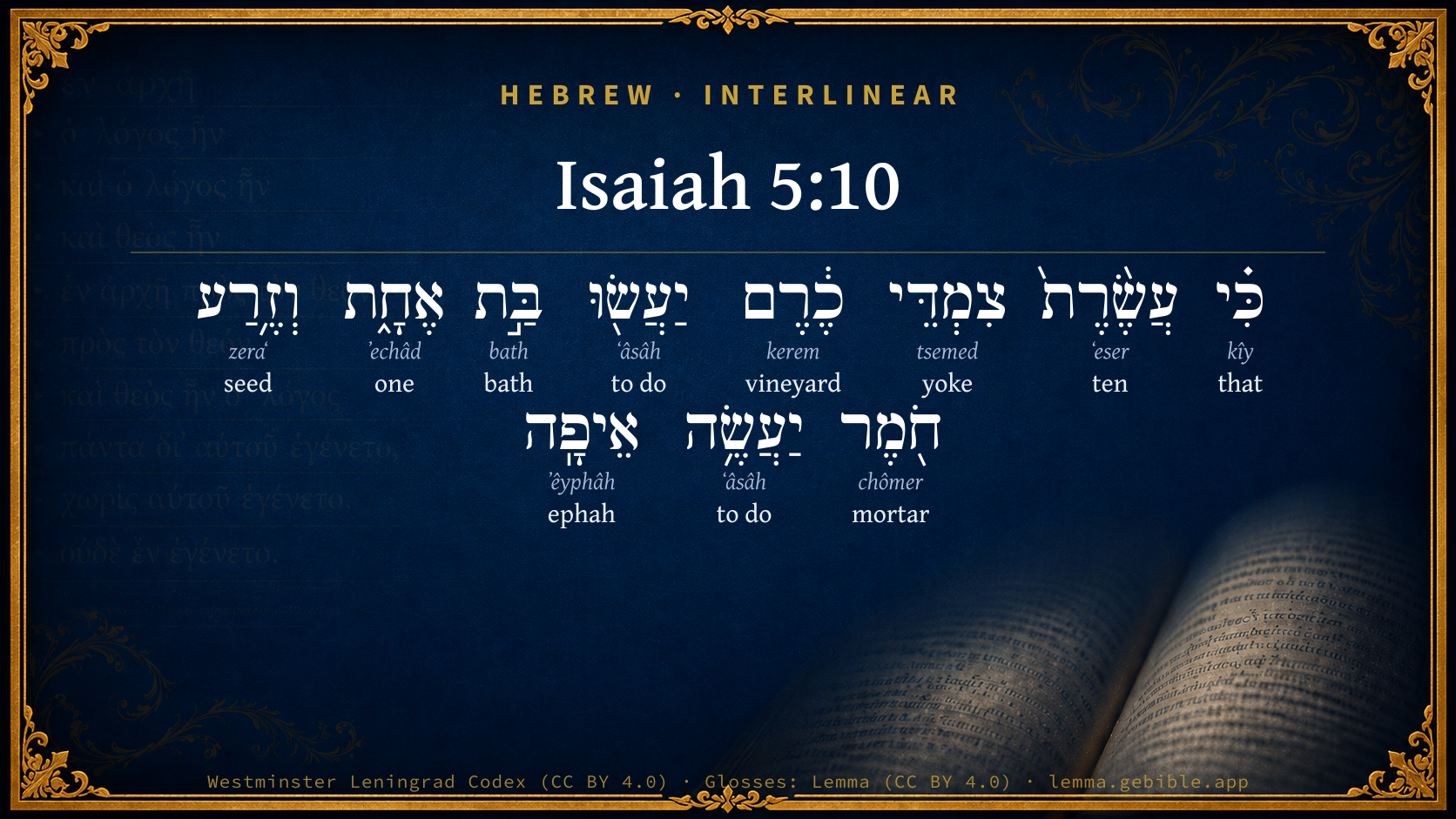
Hebrew (Westminster Leningrad Codex) Isaiah 5:10 appears in the Hebrew Old Testament. The text above is from the Westminster Leningrad Codex. Each word links to its Strong’s number, a concise gloss, and parsing drawn from the Open Scriptures Hebrew Bible morphology. Click any word for its full Brown-Driver-Briggs (BDB) entry.
Download image
Cite this verse

Isaiah 5:10 (World English Bible). Public Domain. Lemma interlinear Bible study tool, https://lemma.gebible.app/v/isaiah/5/10.

Show BibTeX & RIS
BibTeX
RIS
English Translation
For ten acres of vineyard shall yield one bath, And a homer of seed shall yield an ephah."
World English Bible · Public Domain
Download a study sheet

One document with this verse’s original text, its word-by-word gloss line, the meaning frame, cross-references with their text, attributed commentary, and full source and license credits — printable, and it pastes into notes with its structure intact.

This verse Autodidact and up

Study sheet (.html) Plain text (.txt)

A passage Seminary Student

Up to 50 verses in one chapter. A passage sheet keeps up to 6 commentary sources and 12 cross-references per verse, in the order this page ranks them, and says so on the sheet whenever that leaves anything out. Ask for a single verse and you get the Autodidact verse sheet above.

Everything on this page stays free to read, with no account — the sheet is a download of what is already on screen, not access to it.

Want to remove ads? Support Godless Engineer
Compare translations 3

The same verse in 3 English versions, stacked beneath the original-language interlinear above. Click any original word for its lexicon entry.

Each is an independent rendering of the whole verse — the interlinear is not word-aligned to these translations.

Highlighted words mark where these versions differ — a whole-verse word diff, not a word-by-word alignment.

  • World English Bible Public Domain
    For ten acres of vineyard shall yield one bath, And a homer of seed shall yield an ephah."
  • King James Version Public Domain
    Yea, ten acres of vineyard shall yield one bath, and the seed of an homer shall yield an ephah.
  • unfoldingWord Literal Text CC BY-SA 4.0
    For ten of yokes of a vineyard will produce one bath, and seed of a homer will produce an ephah.” q1

unfoldingWord Literal Text — © unfoldingWord, licensed CC BY-SA 4.0. Word-aligned USFM3 via Door43 (git.door43.org/unfoldingWord/en_ult).

Versions to compare (up to 4)

3 of 4 selected

Show all 17 translations

Every available English version of this verse, each an independent rendering of the whole verse.

  • World English Bible Public Domain
    For ten acres of vineyard shall yield one bath, And a homer of seed shall yield an ephah."
  • Berean Standard Bible Public Domain
    For ten acres of vineyard will yield but a bath of wine, and a homer of seed only an ephah of grain.”
  • Majority Standard Bible Public Domain
    For ten acres of vineyard will yield but a bath of wine, and a homer of seed only an ephah of grain.”
  • King James Version Public Domain
    Yea, ten acres of vineyard shall yield one bath, and the seed of an homer shall yield an ephah.
  • American Standard Version (1901) Public Domain
    For ten acres of vineyard shall yield one bath, and a homer of seed shall yield `but' an ephah.
  • Revised Version (1885) Public Domain
    For ten acres of vineyard shall yield one bath, and a homer of seed shall yield but an ephah.
  • Geneva Bible (1599) Public Domain
    For ten acres of vines shall yelde one bath, and the seede of an homer shall yelde an ephah.
  • Young's Literal Translation Public Domain
    For ten acres of vineyard do yield one bath, And an homer of seed yieldeth an ephah.
  • Literal Standard Version CC BY-SA 4.0
    For ten acres of vineyard yield one bath, || And a homer of seed yields an ephah.
  • Unlocked Literal Bible CC BY-SA 4.0
    For a ten-yoke vineyard will yield only one bath, and one homer of seed will yield only an ephah.
  • unfoldingWord Literal Text CC BY-SA 4.0
    For ten of yokes of a vineyard will produce one bath, and seed of a homer will produce an ephah.” q1
  • Darby Bible Public Domain
    Yea, ten acres of vineyard shall yield one bath, and a homer of seed shall yield an ephah.
  • World Messianic Bible Public Domain
    For ten acres of vineyard shall yield one bath, and a homer of seed shall yield an efah.”
  • Webster's Bible Public Domain
    Yes, ten acres of vineyard shall yield one bath, and the seed of a homer shall yield an ephah.
  • Free Bible Version CC BY-SA 4.0
    Ten acres of vineyard will only produce six gallons of wine, and a measure of seed only a tenth of that in grain.
  • Bible in Basic English Public Domain
    For ten fields of vines will only give one measure of wine, and a great amount of seed will only give a small measure of grain.
  • JPS Tanakh (1917) Public Domain
    For ten acres of vineyard shall yield one bath, and the seed of a homer shall yield an ephah.

Literal Standard Version (2020), Covenant Press — licensed CC BY-SA 4.0. Text via the HelloAO Bible API (eBible.org). Unlocked Literal Bible (unfoldingWord) — licensed CC BY-SA 4.0. Text via the HelloAO Bible API (eBible.org). unfoldingWord Literal Text — © unfoldingWord, licensed CC BY-SA 4.0. Word-aligned USFM3 via Door43 (git.door43.org/unfoldingWord/en_ult). Free Bible Version, Dr. Jonathan Gallagher — licensed CC BY-SA 4.0. Text via the HelloAO Bible API (eBible.org).

Word by word

More ways to search: Search by grammar → Find every occurrence → Compare this word →

Practice this passage: Drill this verse → Learn its vocabulary →

About this verse

These counts appear in no published source. They are computed here, from the morphology-tagged text and Lemma’s own curated glosses. What Lemma adds →

11
words
10
distinct lemmas
Prophets
section

Notable vocabulary

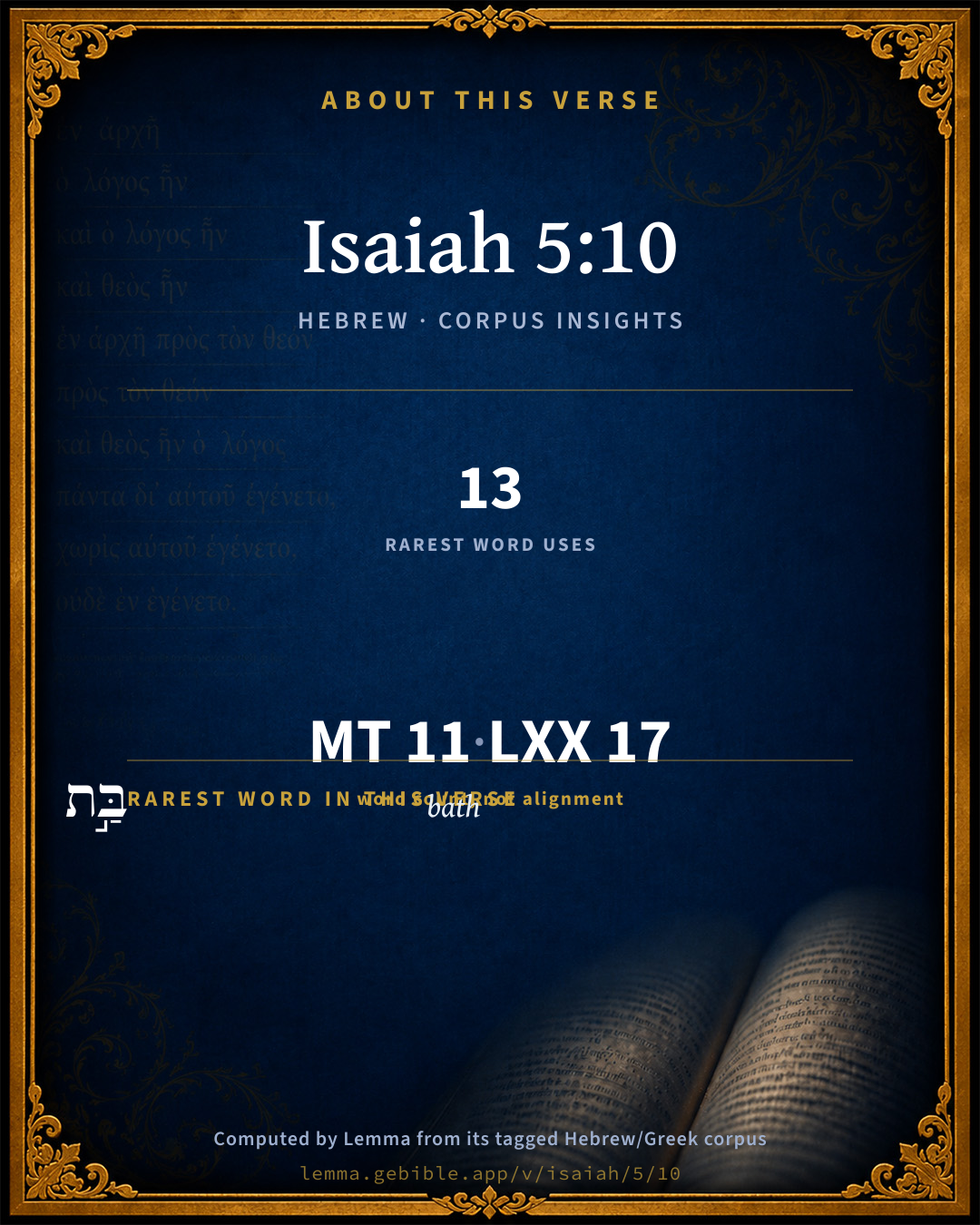
The rarest word here is בַּ֣ת bath H1324 — appearing just 13 times in the whole Hebrew Bible.

Shared distinctive vocabulary

בַּ֣ת bath H1324 occurs in 8 verses of the Hebrew Bible. Also found in:

Grammatical profile

  • 2 verbs
  • 6 nouns
  • 2 adjectives
  • 1 conjunction

Verb forms

  • יַעֲשׂ֖וּ Qal · Imperfect
  • יַעֲשֶׂ֥ה Qal · Imperfect

Repetition

A word recurs within this verse — often emphatic in Hebrew:

  • יַעֲשׂ֖וּ to do H6213 ×2

Hebrew & Septuagint length

In English translation the verse runs 18 words from the Hebrew and 22 from the Septuagint (LXX English) — closely comparable.

A rough comparison of the two English renderings, which tokenize alike — not a word-level alignment.

Word counts can differ between the Hebrew and the Greek without any difference in meaning — e.g. the Hebrew direct-object marker אֵת has no separate Greek word, and Greek often adds the article ὁ.

In the original languages it is 11 Hebrew tokens and 17 Greek tokens — but the two are counted differently (Hebrew bundles its prefixes and suffixes into one token; the Greek is in lemma form), so that isn’t a like-for-like length.

Cross-references

7

Topical passages linked to Isaiah 5:10 in the Treasury of Scripture Knowledge — connected by theme and wording, ordered by reader-vote popularity; previews shown in the World English Bible.

  • Leviticus 26:26 When I break your staff of bread, ten women shall bake your bread in one oven, and they shall deliver your bread again by weight: and you shall eat, and not be satisfied.
  • Haggai 1:6 You have sown much, and bring in little. You eat, but you don't have enough. You drink, but you aren't filled with drink. You clothe yourselves, but no one is warm, and he who earns wages earns wages to put them into a bag with holes in it."
  • Haggai 2:16 Through all that time, when one came to a heap of twenty measures, there were only ten. When one came to the wine vat to draw out fifty, there were only twenty.
  • Haggai 1:9–11 "You looked for much, and, behold, it came to little; and when you brought it home, I blew it away. Why?" says Yahweh of Hosts, "Because of my house that lies waste, while each of you is busy with his own house.
  • Leviticus 27:16 "'If a man dedicates to Yahweh part of the field of his possession, then your valuation shall be according to the seed for it: the sowing of a homer of barley shall be valued at fifty shekels of silver.
  • Ezekiel 45:10–11 You shall have just balances, and a just ephah, and a just bath.
  • Joel 1:17 The seeds rot under their clods. The granaries are laid desolate. The barns are broken down, for the grain has withered.

Cross-references courtesy of OpenBible.info (CC BY 4.0).

Hebrew and Greek witnesses Masoretic Hebrew ↔ Greek Septuagint

The same verse in the two great witnesses to the Old Testament, shown verse-for-verse.

These are two independent witnesses, not word-aligned to each other, and the Septuagint is shown in lemma (dictionary) form.

Hebrew Isaiah 5:10 Masoretic · Westminster Leningrad Codex

כִּ֗י עֲשֶׂ֨רֶת֙ צִמְדֵּי כֶ֔רֶם יַעֲשׂ֖וּ בַּ֣ת אֶחָ֑ת וְזֶ֥רַע חֹ֖מֶר יַעֲשֶׂ֥ה אֵיפָֽה

For ten acres of vineyard shall yield one bath, And a homer of seed shall yield an ephah."

World English Bible · Public Domain

Greek LXX Isaiah 5:10 Septuagint · lemma form

οὗ γάρ ἐργάζομαι δέκα ζεῦγος βοῦς ποιέω κεράμιον εἷς καί ὁ σπείρω ἀρτάβη ἕξ ποιέω μέτρον τρεῖς

For where ten yoke of oxen plow the land shall yield one, and he that sows six homers shall produce three measures.

LXX2012 (modern English Septuagint) · Public Domain

On this verse, John Gill's Exposition discusses the Septuagint’s reading. Read the note in Commentary ↓

Hebrew: Westminster Leningrad Codex (CC BY 4.0). Greek: Septuagint (public domain); English from LXX2012 (modern English Septuagint) (Public Domain). How the Septuagint differs from the Hebrew →

Targum (Aramaic paraphrase)

1

The Targum is the ancient Jewish Aramaic paraphrase of the Hebrew Scriptures — an interpretive translation, not the Hebrew text itself. Onkelos (literal) and Pseudo-Jonathan (expansive) render the Torah, and Jonathan the Prophets. Coverage is partial: where no permissively-licensed English translation exists for a verse, only the Aramaic is shown. This is verse-level text, not a word-by-word alignment to the Hebrew.

  1. Targum Jonathan Prophets (Joshua–Malachi)
    אֲרֵי בְחוֹבָא דְלָא יְהָבוּ מַעֲשְׂרַיָא בֵּית עֲסַר אַשְׁכְּרִין דִכְרַם יַעְבְּדוּן בֵּיתָא חֲדָא וּבֵית כּוֹר זֶרַע יַעְבֵּיד תְּלַת סָאִין:

    Because of the sin of not giving tithes, the place of ten acres of vineyard shall produce one bath; and the place where a cor of seed was sown shall produce three measures.

    Targum Jonathan — Aramaic: “Mikraot Gedolot” (public domain). English: “Sefaria Community Translation” (CC0 1.0 (public-domain dedication)); “London "Chaldee Paraphrase," 1871” (public domain). Text via Sefaria.

Commentary

Notes on Isaiah 5:10 from classic Christian and Jewish commentators (each source and its license shown beneath its notes). The classic Christian expositions comment on the surrounding passage and are grouped to its opening verse, so a note may address several verses; the Jewish commentaries on the Tanakh (Rashi and others) are per-verse, so they appear only where the commentator wrote on this verse.

Lemma curates 59 commentaries, every one of them public domain or Creative Commons licensed, each selected and text-cleaned for this edition rather than reprinted as found. About our sources →

Trapp's Complete Commentary

John Trapp

Isa 5:10 Yea, ten acres of vineyard shall yield one bath, and the seed of an homer shall yield an ephah.

Ver. 10. Yea, ten acres of vineyard shall yield one bath,] viz., Of wine; a poor proportion - not a gallon of wine for an acre of ground planted with vines.

And the seed of an homer shall yield an ephah.] And no more. The earth shall yield but the tenth part of what was sown; so little joy shall you have either of your enlarged houses, or fields laid to fields by evil arts. Et signanter decem ponit iugera, saith Oecolampadius here; neither is it for nothing that the prophet saith ten acres of vineyard, &c., and that they shall have but the tithe of their seed again, to teach them how angry God is with such as through covetousness refuse to pay their tithes duly and truly, &c.

John Trapp, A Commentary or Exposition upon All the Books of the Old and New Testament (1647–1656) — public domain. Text from a community e-Sword module.

Tyndale Open Study Notes

Tyndale Open Resources

5:10 As with drought (5:5-6), the reduction of crops was at times a divine judgment (see Hag 1:6, 9; 2:16).

Tyndale Open Study Notes — © Tyndale Open Resources, licensed CC BY-SA 4.0. Text via the HelloAO Bible API.

Geneva Bible (1599)

Geneva Bible translators

Which containeth about ten pottels: so that every acre should but yield one pottel.

Which containeth an hundred pottels.

An Ephah containeth ten pottels and is in dry things as much as Bath is in liquors.

Geneva Bible (1599) marginal notes — public domain. Text via Bolls.life.

Jamieson, Fausset & Brown

Robert Jamieson, A. R. Fausset & David Brown

acres--literally, "yokes"; as much as one yoke of oxen could plow in a day.

one--only.

bath--of wine; seven and a half gallons.

homer . . . ephah--Eight bushels of seed would yield only three pecks of produce (Eze 45:11). The ephah and bath, one-tenth of an homer.

Jamieson, Fausset & Brown — Commentary Critical and Explanatory on the Whole Bible (1871) — public domain (CC PDM 1.0). Text via the HelloAO Bible API.

Ellicott's Commentary for English Readers

(10) Ten acres.—The disproportion was as great as that which we have seen in recent times in vine countries suffering from the Phylloxera or the oidium, or in the potato failures of Ireland. The bath was equal to seventy-two Roman sextarii (Jos. Ant. viii. 2-9), about seven and a half gallons, and this was to be the whole produce of ten acres, from which an average yield of 500 baths might have been expected. The Hebrew word for “acre” means primarily the ground that could be ploughed in a day by a yoke of oxen.

The seed of an homer shall yield an ephah.—Here also there is an all but total failure. The homer was a dry measure of thirty-two pecks, and the ephah was equal to one-tenth of a homer (Eze_45:11; Exo_16:36). This scanty crop—Ruth’s gleanings for a single day (Rth_2:17)—one-tenth of the seed sown, was to take the place of the “thirtyfold, sixty, and a hundredfold” (Gen_26:12; Mat_13:8) of average or prosperous years.

A Bible Commentary for English Readers, edited by Charles John Ellicott (1878–1897) — public domain. Text from a community e-Sword module.

The Cambridge Bible for Schools and Colleges

gen. ed. J. J. S. Perowne

10. The land shall be smitten with the curse of barrenness; Jehovah’s remedy for land-grabbing.

ten acres] lit. ten yoke; a yoke of land being

“As much as two stout oxen

Could plough from morn till night.”

one bath] (of wine),—about 8 gallons.

seed of a homer … ephah] The ephah is a dry measure of the same capacity as the bath; the homer is ten ephahs (Eze_45:11).

The Cambridge Bible for Schools and Colleges (gen. ed. J. J. S. Perowne; Cambridge University Press, 1878–1918) — public domain. Text from a community e-Sword module.

John Gill's Exposition

Yea, ten acres of vineyard shall yield one bath,.... They shall get nothing by laying field to field, for their fields shall be barren and unfruitful; though Jarchi and Kimchi take this to be a reason why their houses should be desolate, and without inhabitants, because there would be a famine, rendering the words, "for ten acres", &c. The Targum makes this barrenness to be the punishment of their sin, in not paying tithes; paraphrasing the words thus,

"for because of the sin of not giving tithes, the place of ten acres of vineyard shall produce one bath.''

The word signifies "yokes", and is used of yokes of oxen; hence the Septuagint and Arabic versions render the words thus, "for where ten yoke of oxen work", or "plough, it shall make one flagon"; and so Kimchi explains them, the place in a vineyard, which ten yoke of oxen plough in one day, shall yield no more wine than one bath. A bath is a measure for liquids; according to Godwin (a), it held four gallons and a half; a small quantity indeed, to be produced out of ten acres of ground; an acre, according to our English measure, being a quantity of land containing four square roods, or one hundred sixty square poles or perches:

and the seed of an homer shall yield an ephah: that is, as much seed as an "homer" would hold, which was a dry measure, and which, according to the above writer, contained five bushels and five gallons, should yield only an ephah, which was the tenth part of an homer, Eze 45:11 so that it would only produce a tenth part of the seed sown.

(a) Moses and Aaron, l. 6. c. 9.

John Gill's Exposition of the Whole Bible (1746–1763) — public domain (CC PDM 1.0). Text via the HelloAO Bible API.

Albert Barnes' Notes on the Bible

Yea, ten acres - In this verse a reason is rendered why the houses mentioned in the previous verse should become desolate. The reason is, that the land would become sterile and barren, as a divine judgment for their oppression. To what particular time the prophet refers, here, is not apparent. It is certain, however, that the land of Canaan was frequently given up to sterility. The withholding of the early and latter rains, or the neglect of cultivation from any cause, would produce this. At present, this formerly fertile country is among the most unproductive on the face of the earth.

Ten acres - An “acre,” among the Hebrews, was what could be plowed by one yoke of oxen in a day. It did not differ materially from our acre.

Shall yield one bath - One bath of wine. The “bath” was a Jewish measure for liquids, containing about seven gallons and a half. To say that “ten acres” should produce no more wine than this; was the same as to say that it would produce almost nothing.

And the seed of an homer - An “homer” was a Hebrew measure for grain, containing about eight bushels.

An ephah - The “ephah” contained about three pecks. Of course, to say that an homer of seed should produce about three pecks, would be the same as saying that it would produce almost nothing.

Albert Barnes' Notes on the Bible (1834–1885) — public domain. Text from a community e-Sword/MySword module.

Haydock's Catholic Bible Commentary

Measure. Hebrew, "both." --- Thirty. Hebrew, "a chomer shall yield an epha."

George Leo Haydock (1774–1849), Haydock's Catholic Family Bible and Commentary, 1859 edition — public domain. Excludes Psalms (Douay-Rheims chapter numbering differs from Protestant) and Deuterocanonical books (Catholic canon only).

Matthew Poole's English Annotations

Ten acres of vineyard shall yield one bath, to wit, of wine. The bath contained about eight gallons. Thus an acre did yield one gallon.

The seed of an homer shall yield an ephah which was of the same quantity with the bath, only the bath was the measure of liquid things, the ephah of dry and an ephah was the tenth part of an homer, Eze 45:11. So instead of that great increase which that fruitful land commonly yielded, they should lose nine parts of their seed. Thus a fruitful land was made barren for their wickedness, according to God’s threatening, Psa 107:34; and they had as little comfort in their lands as in their houses; which were the two kinds of their purchases, Isa 5:8.

Matthew Poole's English Annotations on the Holy Bible (1683–1685) — public domain. Text from a community e-Sword/MySword module.

The Pulpit Commentary

Yea, ten acres of vineyard shall yield one bath. The greed of adding field to field will he punished by the curse of barrenness, which God will send upon the laud. Dr. Kay-calculates that ten acres (Roman) of vineyard ought to yield upon the average five hundred baths (or four thousand gallons) instead of one bath (eight gallons). A homer... an ephah. The "ephah" was the tenth-part of a "homer". (Eze_45:11) Corn lands should return only one-tenth part of the seed sown in them.

The Pulpit Commentary (1880–1919), ed. H.D.M. Spence-Jones & Joseph S. Exell — public domain. Text from a community e-Sword module.

John Wesley's Explanatory Notes

One bath - Of wine. The bath contained about eight gallons. Thus an acre did not yield one gallon. An ephah - Which was of the same quantity with the bath, only the bath was the measure of liquid things, the ephah of dry things; and a ephah was the tenth part of an homer. So instead of the increase which that fruitful land commonly yielded, they should loose nine parts of their seed.

John Wesley, Explanatory Notes Upon the Whole Bible (1754–1765) — public domain. Text via the GEBible commentary corpus.

J. A. Alexander on Isaiah

Joseph Addison Alexander

As the sin related both to lands and houses, so both are mentioned in denouncing punishment. The desolation of the houses was in fact to arise from the unproductiveness of the lands. Ruinous failure of crops and a near approach to absolute sterility are threatened as a condign punishment of those who added field to field and house to house. The meaning of this verse depends, not on the absolute value of the measures mentioned, but on their proportions. The last clause threatens that the seed sown, instead of being multiplied, should be reduced nine tenths; and a similar idea is no doubt expressed by the analogous terms of the preceding clause. “For ten acres of vineyard shall make (produce) one bath,” a liquid measure here put for a very small quantity of wine to be yielded by so large a quantity of land, and “the seed of a homer,” (i.e., seed to the amount of a homer, or in our idiom, a homer of seed), “shall produce an ephah,” a dry measure equal to the liquid bath, and constituting one tenth of a homer, as we learn from (Eze 45:11-14).

Joseph Addison Alexander, The Prophecies of Isaiah (1846–1847; New York: Scribner, 1870–1878) — public domain. Text from a community e-Sword module.

Rashi

Rabbi Shlomo Yitzchaki (Rashi)

For ten acres of vineyard And, because of the famine, the inhabitants of the house will be exiled, leaving no one dwelling in them. This, too, will be for your payment in kind for bringing one field near to the other field, for you have stolen the share of the Omnipresent in the tithe of the land.

ten acres of vineyard arpent in French, and I say that the amount of land requiring the work of one day with a yoke of oxen is called צֶמֶד, a yoke.

will produce one bath One measure of wine. A bath is three se’ah.

and the seed of a homer A place where a kur, which is thirty se’ah of grain, is usually produced, will produce an ephah three se’ah.

Rashi on the Tanakh — English translations: “The Judaica Press complete Tanach with Rashi, translated by A. J. Rosenberg” (CC BY 4.0); “Pentateuch with Rashi's commentary by M. Rosenbaum and A.M. Silbermann, 1929-1934” (public domain); “The Metsudah Tanach series, Lakewood, N.J” (CC BY 4.0); and “The Book of Joshua, Metsudah Publications, 1997” (CC BY 4.0). Text via Sefaria.

Ibn Ezra

Rabbi Abraham ibn Ezra

Ten. A round number, meaning many.

צמדי כרם Pairs of vineyards. They have removed the boundaries, and many vineyards were thus coupled together (נצמדים), combined into one.

בת Bath. A measure. חמר Homer; the same as ten pairs of vineyards. Bath and Epha are likewise equal.

Ibn Ezra on the Tanakh — English translations: “Sefaria Community Translation” (CC0 1.0 (public-domain dedication)); “Yalkut, Sifsei Chachomim Chumash, Metsudah Publications, 2009” (CC BY 4.0); and “Commentary of Ibn Ezra on Isaiah - trans. by M. Friedlander, 1873” (public domain). Text via Sefaria.

Lesson kit

Teaching starters — assembled from the data on this page, not authored interpretation. Every prompt links to the verse data it draws on. Edit before teaching.

Isaiah, in the Prophets, opens this verse with 11 words (10 distinct Hebrew lemmas). Its most distinctive word is bath (“bath”). A historical commentator’s framing appears above. Read the whole chapter for the surrounding context.

Discussion questions

  1. The word bath carries the sense “bath.” How does it shape the verse?
  2. How does 1 Kings 7:26, which shares the word «bath», read alongside this verse?
  3. What does the repetition of “to do” (2× in this one verse) do in this verse?
  4. These translations render this verse differently; the difference is in the English rendering, not the original. What questions does that raise?
  5. «יַעֲשׂ֖וּ» is a Qal Imperfect verb. How does that grammatical form shape the action described?
  6. Compare how Trapp's Complete Commentary and Tyndale Open Study Notes read this verse. Where do they agree or differ?

Things to notice

Reading settings

Reading text

Shown beneath each verse's original-language words.

Old Testament
Old Testament edition

Read the OT as the Masoretic Hebrew (MT) or the Greek Septuagint (LXX).

English shown for the Greek Septuagint (in the Hebrew ↔ Greek comparison).

Comparing translations? Open the Compare panel on any verse page to stack up to four side by side.