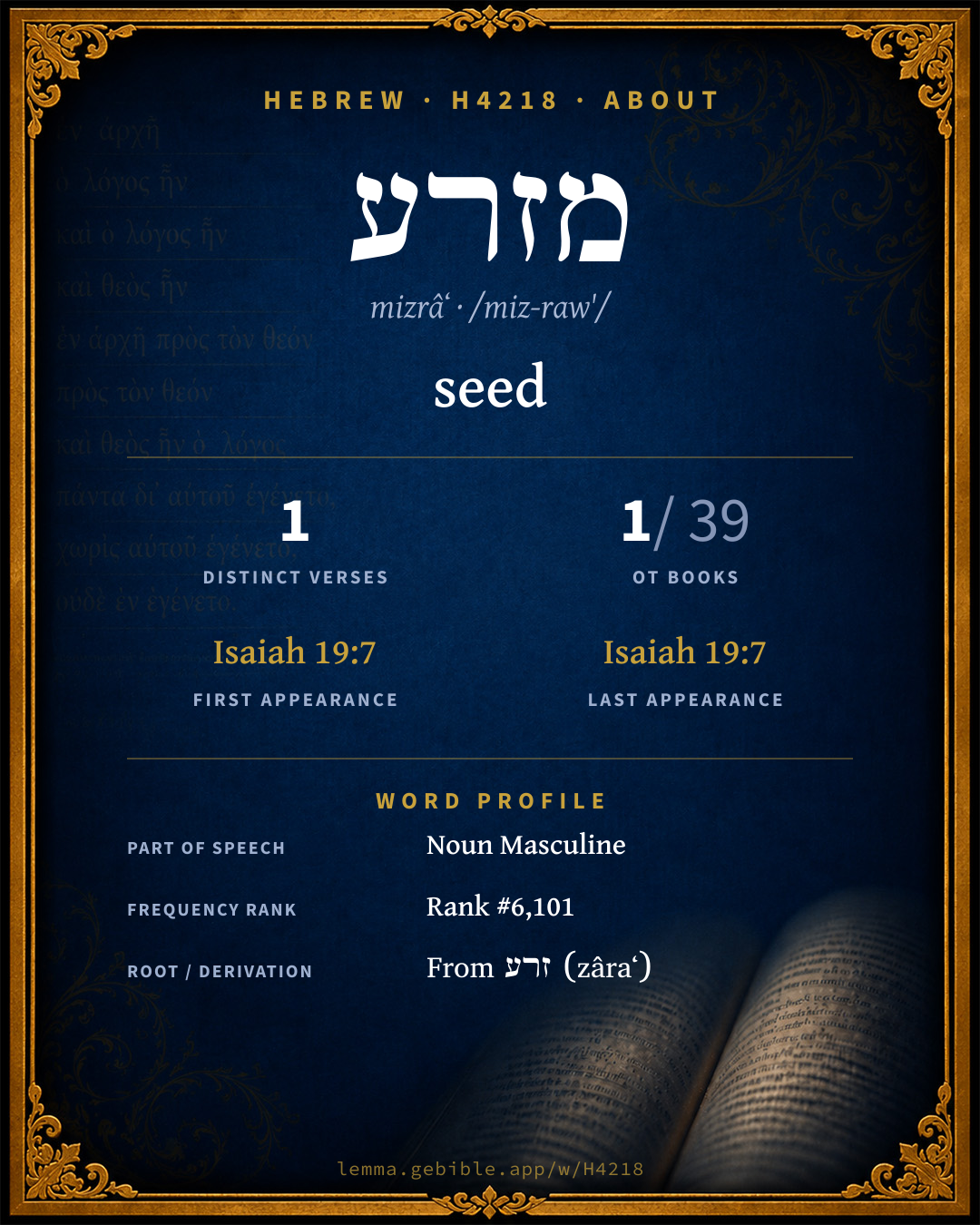
מִזְרָע
seed
Full lexicon entry — Brown-Driver-Briggs (BDB)
From Brown-Driver-Briggs (BDB)
Where this word appears
Grammar key — what these labels mean
Part of speech
- Noun
- A naming word — a person, place, thing, or idea.
Noun type
- Common
- A common noun — a general class of person, place, or thing (“king,” “city,” “water”), not a specific name.
State
- Construct
- A noun bound to a following noun in a possessive / “of” relationship (the construct chain).
Gender
- Masculine
- Grammatically masculine.
Number
- Singular
- One.
Every verse where H4218 appears — 1 distinct verse across 1 book. Click any verse to open its interlinear word-by-word view. Verse text shown in the World English Bible for context — . Each verse’s Hebrew form is shown with its reference; the English is not keyword-highlighted, since the data carries no word-level English alignment. Use “Compare translations” on any verse to read it across multiple English versions. This concordance covers the Hebrew Bible; Septuagint (Greek Old Testament) occurrences are not indexed here.
Isaiah 1 verse
About this entry
At a glance — auto-summarized from this page’s data, not written by a person. Every figure links to its source below. This summary describes the numbers; it doesn’t interpret them.
מזרע — transliterated mizrâʻ — is a Hebrew noun carrying the sense “seed.” With only 1 verse it sits in the long tail of Hebrew Bible vocabulary. Its uses cluster heavily in Isaiah (100% of all occurrences). It occurs only once, in Isaiah 19:7. Sharing its root, it stands alongside זרע, זרוע and זרוע. Each statement above links to its evidence; the full detail follows below.
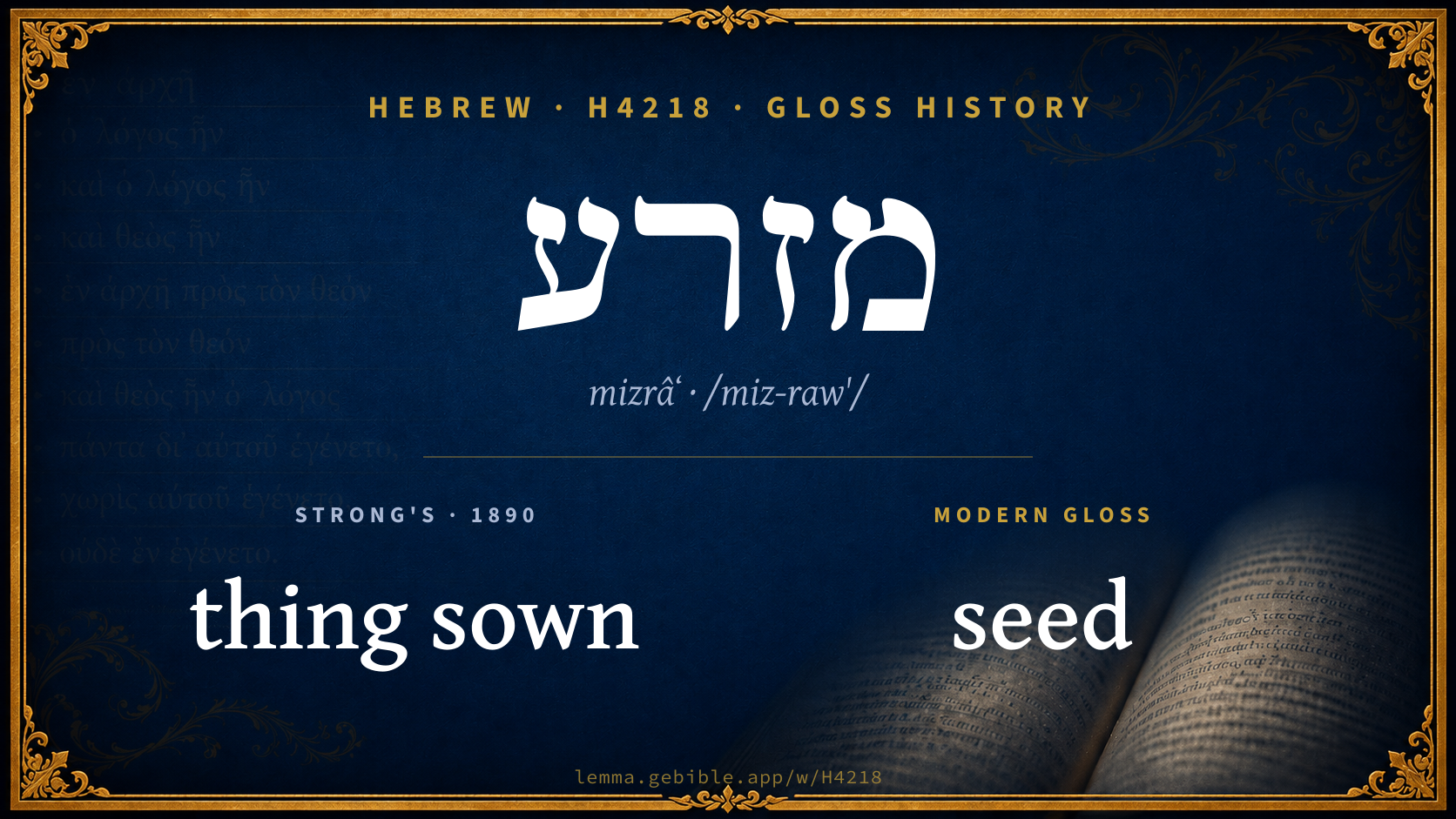
Gloss history
Strong's 1890 vs modern scholarship
About this word
Strong's H4218 catalogs a Hebrew word from the Hebrew Old Testament.
These counts are not copied from any lexicon or concordance. They are computed here, from the morphology-tagged Hebrew Old Testament. What Lemma adds →
- 1
- distinct verses
- The word appears in 1 distinct verse.
- 1 / 39
- OT books
- The word appears in 1 of 39 Old Testament books.
- #6,101
- by frequency
- Rank #6,101 (rank 6,101 of 8,640 Hebrew words by occurrence).
View all 1 occurrence in the concordance →
Most concentrated in
- Isaiah 1 verse 100%
By section of the Old Testament
By traditional corpus
Conventional, traditional groupings — biblical authorship is debated, so this is a traditional corpus grouping, not an authorship claim. Each share is this word’s portion of its verses in that division of the Hebrew canon. Each figure is a share of the word’s 1 distinct verse.
- Prophets (Nevi'im) 1 verse · 100%
How translations render this word
Counts come from each version’s own published word-to-Strong’s tagging or interlinear alignment — an approximate guide to how each version renders this word, not a word-level alignment the data otherwise carries. Because each total is that version’s own tagged count, the per-version totals vary from one another and need not match the appearance or distinct-verse counts above. These counts may also differ from a printed concordance because Lemma counts each distinctly tagged rendering and does not collapse phrase taggings into a single head-word total. This is a fixed set of word-tagged versions (KJV, ASV, BSB, ULT) and does not change with the reading translation you choose elsewhere. Each version’s license is shown beside its name below (and on Sources).
- King James Version: Every thing sown 1×
- American Standard Version: All the sown 1×
- Berean Standard Bible: Fields sown 1×
- unfoldingWord Literal Text: Sown thing of 1×
King James Version Public Domain
Renders H4218 across 1 tagged occurrence — most commonly:
American Standard Version Public Domain
Renders H4218 across 1 tagged occurrence — most commonly:
Berean Standard Bible Public Domain
Renders H4218 across 1 tagged occurrence — most commonly:
unfoldingWord Literal Text CC BY-SA 4.0
Renders H4218 across 1 tagged occurrence — most commonly:
Senses in BDB
The 1 sense BDB distinguishes for this word, in lexicon order (not ranked by frequency or importance). The full entry — with sub-senses — is in the Lexicon Entry tab.
- seed-land, place of sowing
Word origin
n.[m.] place of sowing, seedland, only cstr. כֹּל מִזְרַע יְאוֹר Is 19:7 (‖ עָרוֹת יְאוֹר); > Du who tr. seed (cf. מאכל etc.) on acc. of foll. vb. נִדַּף.
— Brown-Driver-Briggs (Oxford 1906, public domain), digitized via Sefaria, supplemented by the OpenScriptures HebrewLexicon (CC BY 4.0). See Sources.
Derived from זרע (zâraʻ) (H2232) — to sow.
Jastrow Dictionary
A second Hebrew/Aramaic lexicon for comparison, covering Aramaic and post-biblical (Talmudic, Targumic, Midrashic) usage that the biblical-Hebrew BDB does not. Matched by lemma rather than by Strong’s number, so a lemma may carry more than one Jastrow headword (shown separately below), and the entries cover usage well beyond the Bible.
זָרַע
- to strew, sow. Kil. I, 9. Ib. II, 3 אֶזְרַע, v. אָפַךְ; a. fr.—Part. pass. זָרוּעַ, f. זְרוּעָה; pl. זְרוּעִים &c. Ib. ז׳ חטים sown with wheat; a. fr.—Y. Sot. I, 17ᵇ top כשם … בנותיהן זרועות וכ׳ as well as their vineyards are sown with mixed seeds, so are their daughters &c. (faithless wives).
- to be sown, to be stocked with seed. Gen. R. s. 83, end, a. e. בשבילי נִזְרְעָה וכ׳ the field has been sown for my sake. Shebi. IV, 2 תִּזָרֵעַ may be sown; a. fr.
- to emit semen(also used of women emitting a secretion at coition). Ber. 60ᵃ, a. e. איש מַזְרִיעַ תחלה when the male is the first to emit semen; אשה מַזְרַעַת וכ׳ when the female is the first &c.; a. fr.
זְרַע I
- Targ. Jud. VI, 3; a. fr.—Part. זָרֵעַ, (זְרִיעַ) זָרֵיעַ. Targ. Prov. XI, 18; a. fr.—Targ. Is. XXVIII, 25 זָרְעֵי. Ib. XXXII, 20 זָרְעִין.—R. Hash. 16ᵃ לִיזְרַע חרפא let him sow early seed (barley &c.). Y. Peah VII, 20ᵇ top הוה ז׳ חקלא וכ׳ planted carrots on his field; a. fr.
- as preced. Nif. Targ. O. Deut. XXIX, 22; a. e.—Y. Peah l. c. אִזְדַּרְעוּן they have been planted.
- as preced. Hif. Y. Kil. I, 27ᵃ bot. ומַזְרְעִין and they copulated.
זֶרַע
- preced.) seed; animalic semen (mostly שִׁכְבַת ז׳). Gen. R. s. 73 נעשו המים ז׳ וכ׳ the water in their bellies turned into semen. Y. Kil. I, 27ᵃ bot. נוטל הימנו ז׳ he may take seed thereof. Shebi. II, 8 שזרעו לז׳ which he planted for the sake of obtaining seed, opp. לירק for using it as vegetable; a. fr.—Trnsf. issue, descent. Gen. R. s. 23; s. 51 אותו ז׳ שהוא וכ׳ that issue which was to come from a foreign place (Moab). Ber. 31ᵇ ז׳ שמושח וכ׳ a descendant who will anoint two men; a. fr.—Pl. זְרָעִים. Peah II, 3 הכל מפסיק לז׳ all of them form a partition with regard to seeds (making each field separately subject to Peah), opp. to trees. Kil. III, 2 כל מין ז׳ all kinds of seeds (small vegetable), opp. ירקות large beans &c.; a. fr.—Y. Shebi. II, 34ᵃ top ששה זְרָעִין six sowing seasons during a Sabbatical period.—סֶרֶר ז׳ or ז׳ Order of Seeds, Z’raim, the first of the six orders of the Mishnah a. Tosefta. Sabb. 31ᵃ. Esth. R. to I, 2.
זְרַע II
- Targ. O. Gen. I, 11; a. fr. בר ז׳ that which is fit for propagation, seed-capsule, v. בִּיזְרָא. Targ. Prov. XI, 21; a. fr.—Targ. Ps. XXXVII, 26 Ms. (ed. דרעיה, v. דְּרַע II).—Y. Snh. VII, end, 25ᵈ ז׳ דכיתן flax-seed.
A Dictionary of the Targumim, the Talmud Babli and Yerushalmi, and the Midrashic Literature (Marcus Jastrow; London, Luzac, 1903) — Public Domain. Digitized via Sefaria. Digitized via Sefaria. Full attribution on Sources.
Same root — word family
Other BDB entries built from the same root as H4218, grouped by Strong’s listed origin. These share a root / origin per the lexicon — not necessarily a shared meaning. Each links to that word’s own entry.
Derives from
Shares the same root
Proper names from this root
People and places named from this root — a name, not an additional meaning of the word.
Compare all same-root words → Showing 4 of 7 — not the complete family. 1 of the same-root words is a proper name (a person or place). They share a root, not necessarily a meaning.
Septuagint verse parallels
This word appears in 1 verse that also exists in the Greek Old Testament (Septuagint), out of the 1 Hebrew verse it occurs in. You can read those verses in Greek by switching the Old Testament edition to the Septuagint.
Read these verses in the Septuagint
This is a verse-level parallel only — the same verses exist in both the Hebrew and Greek Old Testaments. No word-level Hebrew↔Greek correspondence is claimed: the data carries no such alignment, so no Greek word is shown as this Hebrew word’s translation. Coverage is not total — the Septuagint omits the deuterocanon and renumbers the Psalms, so some Hebrew verses have no direct Greek parallel.