
Leviticus 18:20

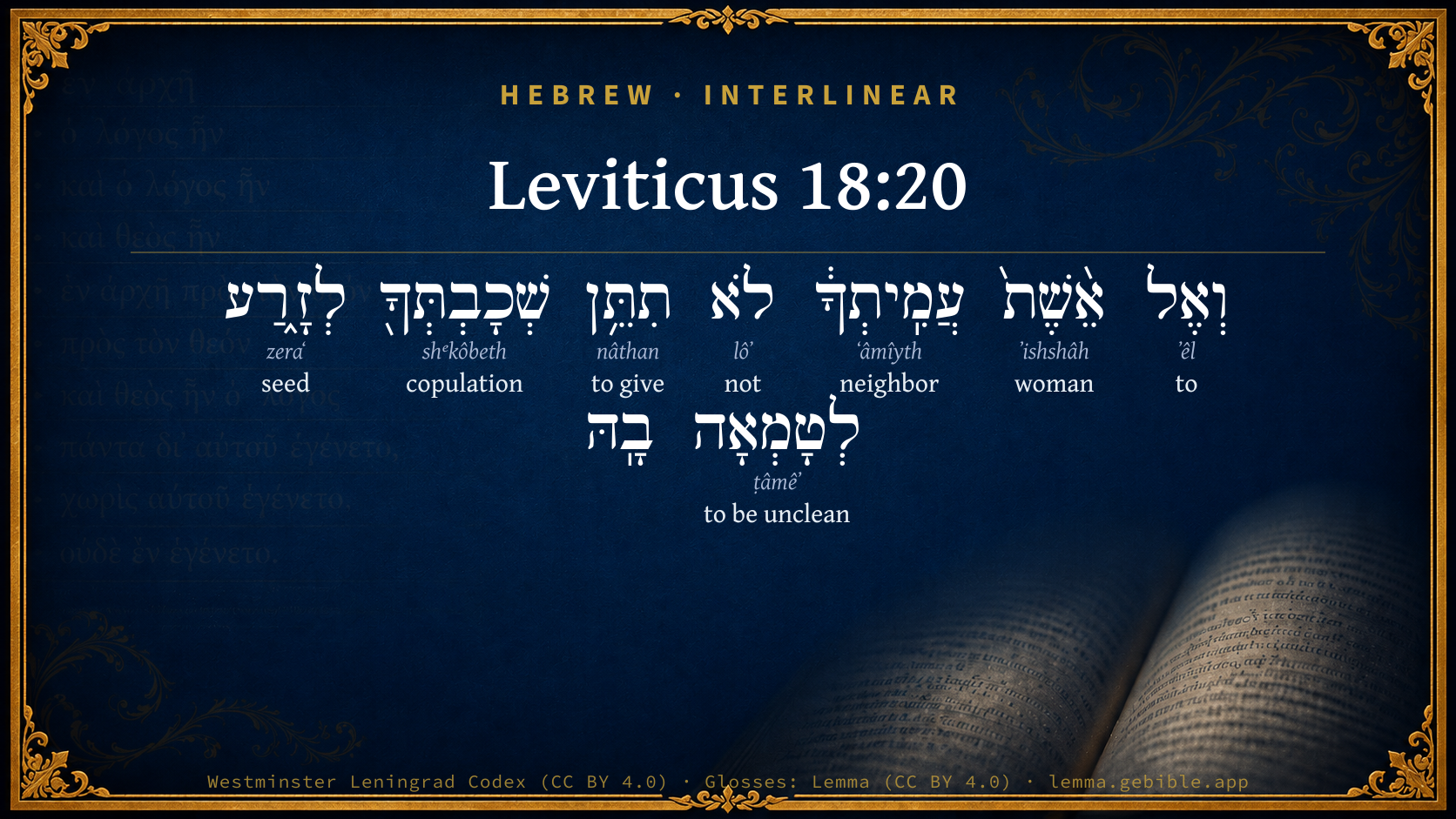
Hebrew (Westminster Leningrad Codex) Leviticus 18:20 appears in the Hebrew Old Testament. The text above is from the Westminster Leningrad Codex. Each word links to its Strong’s number, a concise gloss, and parsing drawn from the Open Scriptures Hebrew Bible morphology. Click any word for its full Brown-Driver-Briggs (BDB) entry.
Download image
Cite this verse

Leviticus 18:20 (World English Bible). Public Domain. Lemma interlinear Bible study tool, https://lemma.gebible.app/v/leviticus/18/20.

Show BibTeX & RIS
BibTeX
RIS
English Translation
"'You shall not lie carnally with your neighbor's wife, and defile yourself with her.
World English Bible · Public Domain
Highlights
  • 1 first appearance in the Hebrew Bible
Full analysis ↓
Download a study sheet

One document with this verse’s original text, its word-by-word gloss line, the meaning frame, cross-references with their text, attributed commentary, and full source and license credits — printable, and it pastes into notes with its structure intact.

This verse Autodidact and up

Study sheet (.html) Plain text (.txt)

A passage Seminary Student

Up to 50 verses in one chapter. A passage sheet keeps up to 6 commentary sources and 12 cross-references per verse, in the order this page ranks them, and says so on the sheet whenever that leaves anything out. Ask for a single verse and you get the Autodidact verse sheet above.

Everything on this page stays free to read, with no account — the sheet is a download of what is already on screen, not access to it.

Want to remove ads? Support Godless Engineer
Compare translations 3

The same verse in 3 English versions, stacked beneath the original-language interlinear above. Click any original word for its lexicon entry.

Each is an independent rendering of the whole verse — the interlinear is not word-aligned to these translations.

Highlighted words mark where these versions differ — a whole-verse word diff, not a word-by-word alignment.

  • World English Bible Public Domain
    "'You shall not lie carnally with your neighbor's wife, and defile yourself with her.
  • King James Version Public Domain
    Moreover thou shalt not lie carnally with thy neighbor's wife, to defile thyself with her.
  • unfoldingWord Literal Text CC BY-SA 4.0
    And to the wife of your fellow citizen, you shall not give your lying of seed to become unclean with her.

unfoldingWord Literal Text — © unfoldingWord, licensed CC BY-SA 4.0. Word-aligned USFM3 via Door43 (git.door43.org/unfoldingWord/en_ult).

Versions to compare (up to 4)

3 of 4 selected

Show all 18 translations

Every available English version of this verse, each an independent rendering of the whole verse.

  • World English Bible Public Domain
    "'You shall not lie carnally with your neighbor's wife, and defile yourself with her.
  • Berean Standard Bible Public Domain
    You must not lie carnally with your neighbor’s wife and thus defile yourself with her.
  • Majority Standard Bible Public Domain
    You must not lie carnally with your neighbor’s wife and thus defile yourself with her.
  • King James Version Public Domain
    Moreover thou shalt not lie carnally with thy neighbor's wife, to defile thyself with her.
  • American Standard Version (1901) Public Domain
    And thou shalt not lie carnally with thy neighbor's wife, to defile thyself with her.
  • Revised Version (1885) Public Domain
    And thou shalt not lie carnally with thy neighbour’s wife, to defile thyself with her.
  • Geneva Bible (1599) Public Domain
    Moreouer, thou shalt not giue thy selfe to thy neighbours wife by carnall copulation, to be defiled with her.
  • Douay-Rheims (1899) Public Domain
    Thou shalt not lie with thy neighbour's wife, nor be defiled with mingling of seed.
  • Young's Literal Translation Public Domain
    `And unto the wife of thy fellow thou dost not give thy seed of copulation, for uncleanness with her.
  • Literal Standard Version CC BY-SA 4.0
    And you do not give your seed [from] intercourse to the wife of your fellow, to become unclean with her.
  • Unlocked Literal Bible CC BY-SA 4.0
    Do not sleep with your neighbor's wife and defile yourself with her in this way.
  • unfoldingWord Literal Text CC BY-SA 4.0
    And to the wife of your fellow citizen, you shall not give your lying of seed to become unclean with her.
  • Darby Bible Public Domain
    And thou shalt not lie carnally with thy neighbour's wife, to become unclean with her.
  • World Messianic Bible Public Domain
    “‘You shall not lie carnally with your neighbor’s wife, and defile yourself with her.
  • Webster's Bible Public Domain
    Moreover, thou shalt not lie carnally with thy neighbor's wife, to defile thyself with her.
  • Free Bible Version CC BY-SA 4.0
    Don't commit any sex act with any other man's wife. This would pollute you and make you unclean.
  • Bible in Basic English Public Domain
    And you may not have sex relations with your neighbour's wife, making yourself unclean with her.
  • JPS Tanakh (1917) Public Domain
    And thou shalt not lie carnally with thy neighbour's wife, to defile thyself with her.

Literal Standard Version (2020), Covenant Press — licensed CC BY-SA 4.0. Text via the HelloAO Bible API (eBible.org). Unlocked Literal Bible (unfoldingWord) — licensed CC BY-SA 4.0. Text via the HelloAO Bible API (eBible.org). unfoldingWord Literal Text — © unfoldingWord, licensed CC BY-SA 4.0. Word-aligned USFM3 via Door43 (git.door43.org/unfoldingWord/en_ult). Free Bible Version, Dr. Jonathan Gallagher — licensed CC BY-SA 4.0. Text via the HelloAO Bible API (eBible.org).

Word by word

More ways to search: Search by grammar → Find every occurrence → Compare this word →

Practice this passage: Drill this verse → Learn its vocabulary →

About this verse

These counts appear in no published source. They are computed here, from the morphology-tagged text and Lemma’s own curated glosses. What Lemma adds →

9
words
8
distinct lemmas
Pentateuch
section

Notable vocabulary

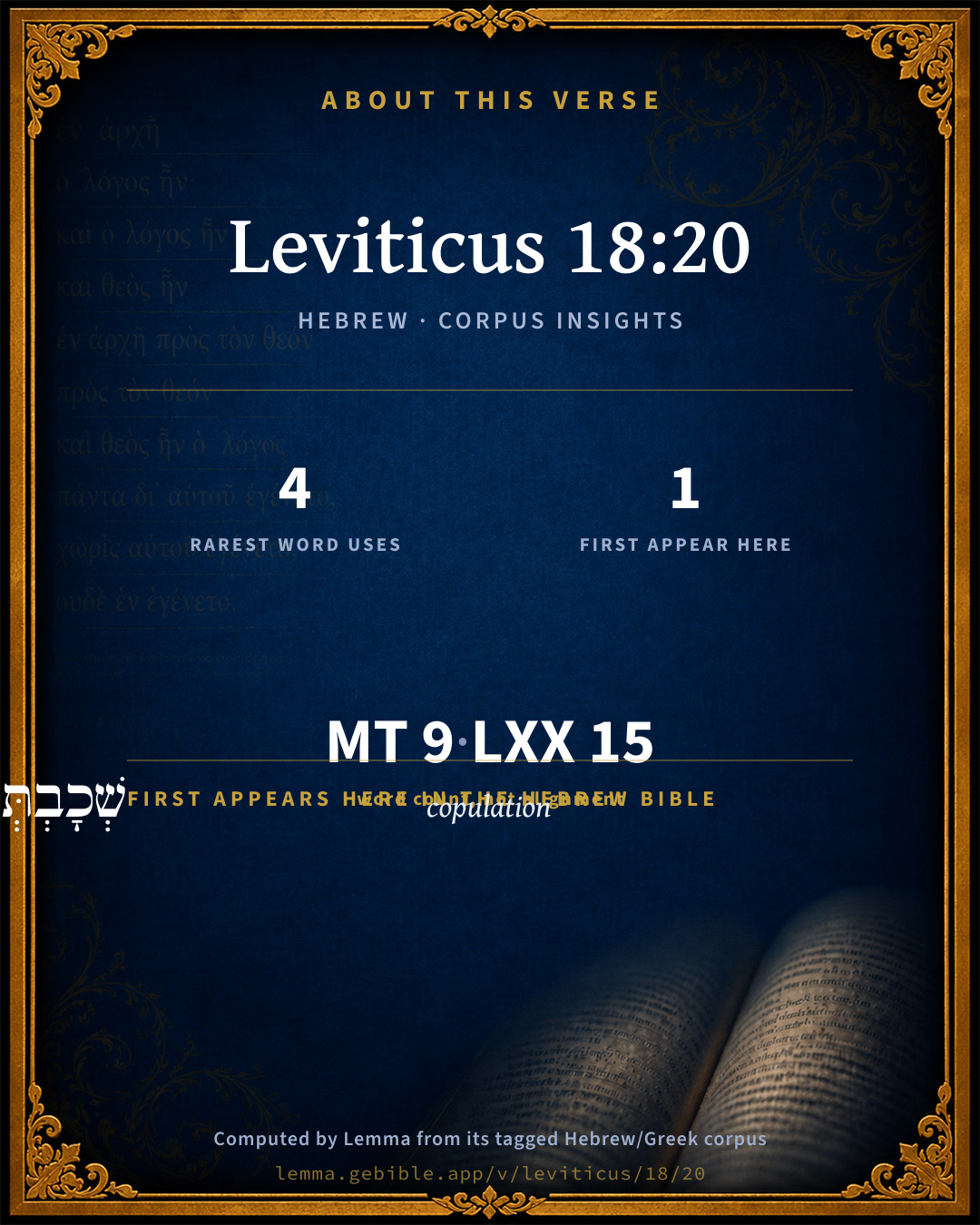
The rarest word here is שְׁכָבְתְּךָ֖ copulation H7903 — appearing just 4 times in the whole Hebrew Bible.

First appearance in Scripture

This word makes its first canonical appearance in the Hebrew Bible here:

  • שְׁכָבְתְּךָ֖ copulation H7903

Shared distinctive vocabulary

שְׁכָבְתְּךָ֖ copulation H7903 occurs in 4 verses of the Hebrew Bible. Also found in:

Grammatical profile

  • 2 verbs
  • 4 nouns
  • 2 prepositions
  • 1 particle

Verb forms

  • תִתֵּ֥ן Qal · Imperfect
  • לְטָמְאָה Qal · Infinitive Construct

Hebrew & Septuagint length

In English translation the verse runs 14 words from the Hebrew and 14 from the Septuagint (LXX English) — the same length.

A rough comparison of the two English renderings, which tokenize alike — not a word-level alignment.

Word counts can differ between the Hebrew and the Greek without any difference in meaning — e.g. the Hebrew direct-object marker אֵת has no separate Greek word, and Greek often adds the article ὁ.

In the original languages it is 9 Hebrew tokens and 15 Greek tokens — but the two are counted differently (Hebrew bundles its prefixes and suffixes into one token; the Greek is in lemma form), so that isn’t a like-for-like length.

Cross-references

15

Topical passages linked to Leviticus 18:20 in the Treasury of Scripture Knowledge — connected by theme and wording, ordered by reader-vote popularity; previews shown in the World English Bible.

  • Exodus 20:14 "You shall not commit adultery.
  • Leviticus 20:10 "'The man who commits adultery with another man's wife, even he who commits adultery with his neighbor's wife, the adulterer and the adulteress shall surely be put to death.
  • Matthew 5:27–28 "You have heard that it was said, 'You shall not commit adultery;'
  • 1 Corinthians 6:9 Or don't you know that the unrighteous will not inherit the Kingdom of God? Don't be deceived. Neither the sexually immoral, nor idolaters, nor adulterers, nor male prostitutes, nor homosexuals,
  • Hebrews 13:4 Let marriage be held in honor among all, and let the bed be undefiled: but God will judge the sexually immoral and adulterers.
  • Deuteronomy 5:18 "Neither shall you commit adultery.
  • 2 Samuel 11:3–4 David send and inquired after the woman. One said, Is not this Bathsheba, the daughter of Eliam, the wife of Uriah the Hittite?
  • Proverbs 6:25 Don't lust after her beauty in your heart, Neither let her captivate you with her eyelids.
  • Deuteronomy 22:22 If a man be found lying with a woman married to a husband, then they shall both of them die, the man who lay with the woman, and the woman: so shall you put away the evil from Israel.
  • Deuteronomy 22:25 But if the man find the lady who is pledged to be married in the field, and the man force her, and lie with her; then the man only who lay with her shall die:
  • 2 Samuel 11:27 When the mourning was past, David sent and took her home to his house, and she became his wife, and bore him a son. But the thing that David had done displeased Yahweh.
  • Proverbs 6:29–33 So is he who goes in to his neighbor's wife. Whoever touches her will not be unpunished.
  • Malachi 3:5 I will come near to you to judgment; and I will be a swift witness against the sorcerers, and against the adulterers, and against the perjurers, and against those who oppress the hireling in his wages, the widow, and the fatherless, and who deprive the foreigner of justice, and don't fear me," says Yahweh of Hosts.
  • Romans 2:22 You who say a man shouldn't commit adultery, do you commit adultery? You who abhor idols, do you rob temples?
  • Galatians 5:19 Now the works of the flesh are obvious, which are: adultery, sexual immorality, uncleanness, lustfulness,

Cross-references courtesy of OpenBible.info (CC BY 4.0).

Hebrew and Greek witnesses Masoretic Hebrew ↔ Greek Septuagint

The same verse in the two great witnesses to the Old Testament, shown verse-for-verse.

These are two independent witnesses, not word-aligned to each other, and the Septuagint is shown in lemma (dictionary) form.

Hebrew Leviticus 18:20 Masoretic · Westminster Leningrad Codex

וְאֶל אֵ֨שֶׁת֙ עֲמִֽיתְךָ֔ לֹא תִתֵּ֥ן שְׁכָבְתְּךָ֖ לְזָ֑רַע לְטָמְאָה בָֽהּ

"'You shall not lie carnally with your neighbor's wife, and defile yourself with her.

World English Bible · Public Domain

Greek LXX Leviticus 18:20 Septuagint · lemma form

καί πρός ὁ γυνή ὁ πλησίον σύ οὐ δίδωμι κοίτη σπέρμα σύ ἐκμιαίνω πρός αὐτός

And you shall not lie with your neighbor's wife, to defile yourself with her.

LXX2012 (modern English Septuagint) · Public Domain

Hebrew: Westminster Leningrad Codex (CC BY 4.0). Greek: Septuagint (public domain); English from LXX2012 (modern English Septuagint) (Public Domain). How the Septuagint differs from the Hebrew →

Targum (Aramaic paraphrase)

2

The Targum is the ancient Jewish Aramaic paraphrase of the Hebrew Scriptures — an interpretive translation, not the Hebrew text itself. Onkelos (literal) and Pseudo-Jonathan (expansive) render the Torah, and Jonathan the Prophets. Coverage is partial: where no permissively-licensed English translation exists for a verse, only the Aramaic is shown. This is verse-level text, not a word-by-word alignment to the Hebrew.

  1. Targum Onkelos Torah (Genesis–Deuteronomy)
    וּבְאִתַּת חַבְרָךְ לָא תִתֵּן שְׁכֻבְתָּךְ לְזַרְעָא לְאִסְתָּאָבָא בָהּ

    (no public-domain English translation for this verse)

    Targum Onkelos — Aramaic: “Onkelos Genesis” (public domain); “Onkelos Exodus” (public domain); “Onkelos Leviticus” (public domain); “Onkelos Numbers” (public domain); “Onkelos Deuteronomy” (public domain). English: “Sefaria Community Translation” (CC0 1.0 (public-domain dedication)); “J.W. Etheridge. The Targums of Onkelos and Jonathan Ben Uzziel on the Pentateuch. London: Longmans, Green, 1862” (public domain). Text via Sefaria.

  2. Targum Pseudo-Jonathan Torah (Genesis–Deuteronomy)
    וּלְצֵיד אִתַּת חַבְרָךְ לָא תִתֵּן תַּשְׁמִישָׁךְ לְזַרְעָא לְאִסְתָּאֲבָא בָהּ

    Nor unto the side of thy neighbour's wife shalt thou come to defile her.

    Targum Pseudo-Jonathan — Aramaic: “Targum Jonathan on Genesis” (public domain); “Targum Jonathan on Exodus” (public domain); “Targum Jonathan on Leviticus” (public domain); “Targum Jonathan on Numbers” (public domain); “Targum Jonathan on Deuteronomy” (public domain). English: “The Targum of Jonathan ben Uzziel, trans. J. W. Etheridge, London, 1862” (public domain). Text via Sefaria.

Commentary

Notes on Leviticus 18:20 from classic Christian and Jewish commentators (each source and its license shown beneath its notes). The classic Christian expositions comment on the surrounding passage and are grouped to its opening verse, so a note may address several verses; the Jewish commentaries on the Tanakh (Rashi and others) are per-verse, so they appear only where the commentator wrote on this verse.

Lemma curates 59 commentaries, every one of them public domain or Creative Commons licensed, each selected and text-cleaned for this edition rather than reprinted as found. About our sources →

Trapp's Complete Commentary

John Trapp

Lev 18:20 Moreover thou shalt not lie carnally with thy neighbour’s wife, to defile thyself with her.

Ver. 20. To defile thyself.] As David, how did he embroil himself with Bathsheba, and chased away that pure Spirit. {Psa 51:10-12} Casta Deus mens est.

John Trapp, A Commentary or Exposition upon All the Books of the Old and New Testament (1647–1656) — public domain. Text from a community e-Sword module.

Tyndale Open Study Notes

Tyndale Open Resources

18:20 The Hebrew word translated defile yourself could be more literally translated to become ceremonially unclean. • Sexual intercourse with a neighbor’s wife or any married woman defined adultery in the Old Testament. Breaking this law was punishable by death (Deut 22:22). Like incest, adultery threatened the integrity and security of the home and family. In this case, it violated the covenant of marriage and divided the adulterer’s affection between his spouse and his mistress.

Tyndale Open Study Notes — © Tyndale Open Resources, licensed CC BY-SA 4.0. Text via the HelloAO Bible API.

Adam Clarke's Commentary

Verse 20. Thy neighbour's wife] See Clarke on Ex 20:14.

Adam Clarke's Commentary on the Bible (1810–1826) — public domain. Text from a community e-Sword/MySword module.

Ellicott's Commentary for English Readers

(20) Thy neighbour’s wife.—For committing adultery, which is here branded as a defilement, whether with a betrothed or married woman, both guilty parties incurred the penalty of death by stoning. (See Lev_20:10; Deu_22:22; Eze_16:38; Eze_16:40; Joh_8:5.) In Egypt the adulterer received a thousand strokes with a stick, and the guilty woman had her nose cut off, and to this day the criminal wife among the Bedouins is executed by her husband, father, or brother, without any mercy. Both criminals were also punished with death among other Eastern nations.

A Bible Commentary for English Readers, edited by Charles John Ellicott (1878–1897) — public domain. Text from a community e-Sword module.

John Gill's Exposition

Moreover, thou shalt not lie carnally with thy neighbour's wife,.... Which is adultery, and a breach of the seventh command, Exo 20:14,

to defile thyself with her; not only adultery is a defiling a man's wife, as it is sometimes called, but the adulterer defiles himself: all sin is of a defiling nature, but especially this, which defiles a man both in soul and body, and brings a blot and stain upon his character, which shall not be wiped off, Pro 6:32.

John Gill's Exposition of the Whole Bible (1746–1763) — public domain (CC PDM 1.0). Text via the HelloAO Bible API.

Haydock's Catholic Bible Commentary

Wife. This crime is to be punished like the rest, ver. 29.

George Leo Haydock (1774–1849), Haydock's Catholic Family Bible and Commentary, 1859 edition — public domain. Excludes Psalms (Douay-Rheims chapter numbering differs from Protestant) and Deuterocanonical books (Catholic canon only).

Whedon's Commentary on the Bible

Daniel D. Whedon

20. Thy neighbour’s wife — This is a repetition of the seventh commandment, in another form, for the purpose of emphasis and of completing the enumeration of abominations prevalent in Egypt and Canaan. This verse prohibits not only adultery proper, or double adultery, as some laws define this crime, in two married persons, (see Exo_20:14, note,) but also one species of single adultery.

Defile thyself — This is moral and ceremonial pollution.

Daniel D. Whedon (gen. ed.), Commentary on the Old and New Testaments (1874–1909) — public domain. Text from a community e-Sword module.

The Pulpit Commentary

The second prohibition is, Thou shalt not lie carnally with thy neighbour"s wife a prohibition already made in other words in the ten commandments. The punishment for adultery is death by stoning (Lev_20:10 Deu_22:22Jo Deu_9:5) a more severe penalty than was usually inflicted in other nations.

The Pulpit Commentary (1880–1919), ed. H.D.M. Spence-Jones & Joseph S. Exell — public domain. Text from a community e-Sword module.

Ramban (Nachmanides)

Rabbi Moshe ben Nachman (Ramban / Nachmanides)

AND THOU SHALT NOT LIE CARNALLY WITH THY NEIGHBOR’S WIFE. Rabbi Abraham ibn Ezra commented: “For there is a threefold purpose to sexual intercourse: one is to beget children, a second is to relieve the body of its fluids, and the third is for passion, which is likened to that of the animals. Now when Scripture said l’zara, it means ‘even l’zara’ [i.e., even for the purpose of begetting children], and thus it prohibited [having intercourse with another man’s wife] altogether.” It is possible that He said l’zara in order to mention the reason for the prohibition, since it will not be known to whom “the child” belongs, and as a result, great and wicked abominations might be done by both. Now Scripture did not mention [this expression l’zara further on when it speaks] of the punishment [for this sin],. because even for intimacy of the first stage without emitting seed, he is already liable to punishment. It is for this reason that [in the case of a suspected adulteress] Scripture states, and a man lie with her carnally, literally means “a lying of seed.” for it is on account of the zera that he suspects her. Similarly in the case of a betrothed bondswoman it also says, lieth carnally, which literally means “a lying of seed.” with her, because the prohibition is on account of the child that he will beget from a bondwoman [who is betrothed to a Hebrew servant]. The correct interpretation appears to me to be that since another man’s wife is completely forbidden to one, whosoever toucheth her shall not go unpunished, therefore Scripture had to say here l’zara. For had it said only: “and thou shalt not lie with thy neighbor’s wife,” it would have appeared that it forbids [by punishment of excision] even lying with her just for embracing and kissing, since here [in this section] it speaks only of those forbidden relations that are punishable with excision. Therefore it was necessary to mention that the intimacy was l’zara, in order to explain that He is prohibiting here sexual intercourse. This is also the reason for the expression in the case of the betrothed bondswoman, which literally means “a lying of seed.” because she is like another man’s wife. Similarly it states in the case of another man’s wife, And the man that committeth adultery with another man’s wife, and it does not state “lieth,” for it is not mere lying with her that He prohibits [under punishment of death]. He does not state here [in the verse before us forbidding intercourse with another man’s wife], “to uncover her nakedness,” for He only mentions this expression with reference to the next of kin and a menstruant, since the prohibition there is because of the uncovering, just as He said, for he hath made naked his near kin.

Ramban (Nachmanides) on the Tanakh — English translation: “Commentary on the Torah by Ramban (Nachmanides). Translated and annotated by Charles B. Chavel. New York, Shilo Pub. House, 1971-1976” (CC BY 4.0). Text via Sefaria.

Lesson kit

Teaching starters — assembled from the data on this page, not authored interpretation. Every prompt links to the verse data it draws on. Edit before teaching.

Leviticus, in the Pentateuch, opens this verse with 9 words (8 distinct Hebrew lemmas). Its most distinctive word is shᵉkôbeth (“copulation”). A historical commentator’s framing appears above. Read the whole chapter for the surrounding context.

Discussion questions

  1. What does “copulation” (shᵉkôbeth) contribute to the verse as a whole?
  2. This is the first place “copulation” appears in Scripture (first appears here). What does its debut here establish?
  3. How does Leviticus 18:23, which shares the word «copulation», read alongside this verse?
  4. These translations render this verse differently. What is at stake in choosing one wording over another?
  5. «תִתֵּ֥ן» is a Qal Imperfect verb. How does that grammatical form shape the action described?
  6. Compare how Trapp's Complete Commentary and Tyndale Open Study Notes read this verse. Where do they agree or differ?

Things to notice

Reading settings

Reading text

Shown beneath each verse's original-language words.

Old Testament
Old Testament edition

Read the OT as the Masoretic Hebrew (MT) or the Greek Septuagint (LXX).

English shown for the Greek Septuagint (in the Hebrew ↔ Greek comparison).

Comparing translations? Open the Compare panel on any verse page to stack up to four side by side.