Genesis 17:9

Hebrew (Westminster Leningrad Codex) Genesis 17:9 appears in the Hebrew Old Testament. The text above is from the Westminster Leningrad Codex. Each word links to its Strong’s number, a concise gloss, and parsing drawn from the Open Scriptures Hebrew Bible morphology. Click any word for its full Brown-Driver-Briggs (BDB) entry.
Download image
Cite this verse

Genesis 17:9 (World English Bible). Public Domain. Lemma interlinear Bible study tool, https://lemma.gebible.app/v/genesis/17/9.

Show BibTeX & RIS
BibTeX
RIS
English Translation
God said to Abraham, "As for you, you will keep my covenant, you and your seed after you throughout their generations.
World English Bible · Public Domain
Download a study sheet

One document with this verse’s original text, its word-by-word gloss line, the meaning frame, cross-references with their text, attributed commentary, and full source and license credits — printable, and it pastes into notes with its structure intact.

This verse Autodidact and up

Study sheet (.html) Plain text (.txt)

A passage Seminary Student

Up to 50 verses in one chapter. A passage sheet keeps up to 6 commentary sources and 12 cross-references per verse, in the order this page ranks them, and says so on the sheet whenever that leaves anything out. Ask for a single verse and you get the Autodidact verse sheet above.

Everything on this page stays free to read, with no account — the sheet is a download of what is already on screen, not access to it.

Want to remove ads? Support Godless Engineer
Compare translations 3

The same verse in 3 English versions, stacked beneath the original-language interlinear above. Click any original word for its lexicon entry.

Each is an independent rendering of the whole verse — the interlinear is not word-aligned to these translations.

Highlighted words mark where these versions differ — a whole-verse word diff, not a word-by-word alignment.

  • World English Bible Public Domain
    God said to Abraham, "As for you, you will keep my covenant, you and your seed after you throughout their generations.
  • King James Version Public Domain
    And God said unto Abraham, Thou shalt keep my covenant therefore, thou, and thy seed after thee in their generations.
  • unfoldingWord Literal Text CC BY-SA 4.0
    Then God said to Abraham, “And you, you must keep my covenant, you and your offspring after you throughout their generations.

unfoldingWord Literal Text — © unfoldingWord, licensed CC BY-SA 4.0. Word-aligned USFM3 via Door43 (git.door43.org/unfoldingWord/en_ult).

Versions to compare (up to 4)

3 of 4 selected

Show all 18 translations

Every available English version of this verse, each an independent rendering of the whole verse.

  • World English Bible Public Domain
    God said to Abraham, "As for you, you will keep my covenant, you and your seed after you throughout their generations.
  • Berean Standard Bible Public Domain
    God also said to Abraham, “You must keep My covenant—you and your descendants in the generations after you.
  • Majority Standard Bible Public Domain
    God also said to Abraham, “You must keep My covenant—you and your descendants in the generations after you.
  • King James Version Public Domain
    And God said unto Abraham, Thou shalt keep my covenant therefore, thou, and thy seed after thee in their generations.
  • American Standard Version (1901) Public Domain
    And God said unto Abraham, And as for thee, thou shalt keep my covenant, thou, and thy seed after thee throughout their generations.
  • Revised Version (1885) Public Domain
    And God said unto Abraham, And as for thee, thou shalt keep my covenant, thou, and thy seed after thee throughout their generations.
  • Geneva Bible (1599) Public Domain
    Againe God said vnto Abraham, Thou also shalt keepe my couenant, thou, and thy seede after thee in their generations.
  • Douay-Rheims (1899) Public Domain
    Again God said to Abraham: And thou therefore shalt keep my covenant, and thy seed after thee in their generations.
  • Young's Literal Translation Public Domain
    And God saith unto Abraham, `And thou dost keep My covenant, thou and thy seed after thee, to their generations;
  • Literal Standard Version CC BY-SA 4.0
    And God says to Abraham, “And you keep My covenant, you and your seed after you, throughout their generations;
  • Unlocked Literal Bible CC BY-SA 4.0
    Then God said to Abraham, “As for you, you must keep my covenant, you and your descendants after you throughout their generations.
  • unfoldingWord Literal Text CC BY-SA 4.0
    Then God said to Abraham, “And you, you must keep my covenant, you and your offspring after you throughout their generations.
  • Darby Bible Public Domain
    And God said to Abraham, And [as for] thee, thou shalt keep my covenant, thou and thy seed after thee in their generations.
  • World Messianic Bible Public Domain
    God said to Abraham, “As for you, you shall keep my covenant, you and your offspring after you throughout their generations.
  • Webster's Bible Public Domain
    And God said to Abraham, Thou shalt keep my covenant therefore, thou, and thy seed after thee, in their generations.
  • Free Bible Version CC BY-SA 4.0
    Then God told Abraham, “Your part is to keep my agreement—you and your descendants for generations to come.
  • Bible in Basic English Public Domain
    And God said to Abraham, On your side, you are to keep the agreement, you and your seed after you through all generations.
  • JPS Tanakh (1917) Public Domain
    And God said unto Abraham: 'And as for thee, thou shalt keep My covenant, thou, and thy seed after thee throughout their generations.

Literal Standard Version (2020), Covenant Press — licensed CC BY-SA 4.0. Text via the HelloAO Bible API (eBible.org). Unlocked Literal Bible (unfoldingWord) — licensed CC BY-SA 4.0. Text via the HelloAO Bible API (eBible.org). unfoldingWord Literal Text — © unfoldingWord, licensed CC BY-SA 4.0. Word-aligned USFM3 via Door43 (git.door43.org/unfoldingWord/en_ult). Free Bible Version, Dr. Jonathan Gallagher — licensed CC BY-SA 4.0. Text via the HelloAO Bible API (eBible.org).

Word by word

More ways to search: Search by grammar → Find every occurrence → Compare this word →

Practice this passage: Drill this verse → Learn its vocabulary →

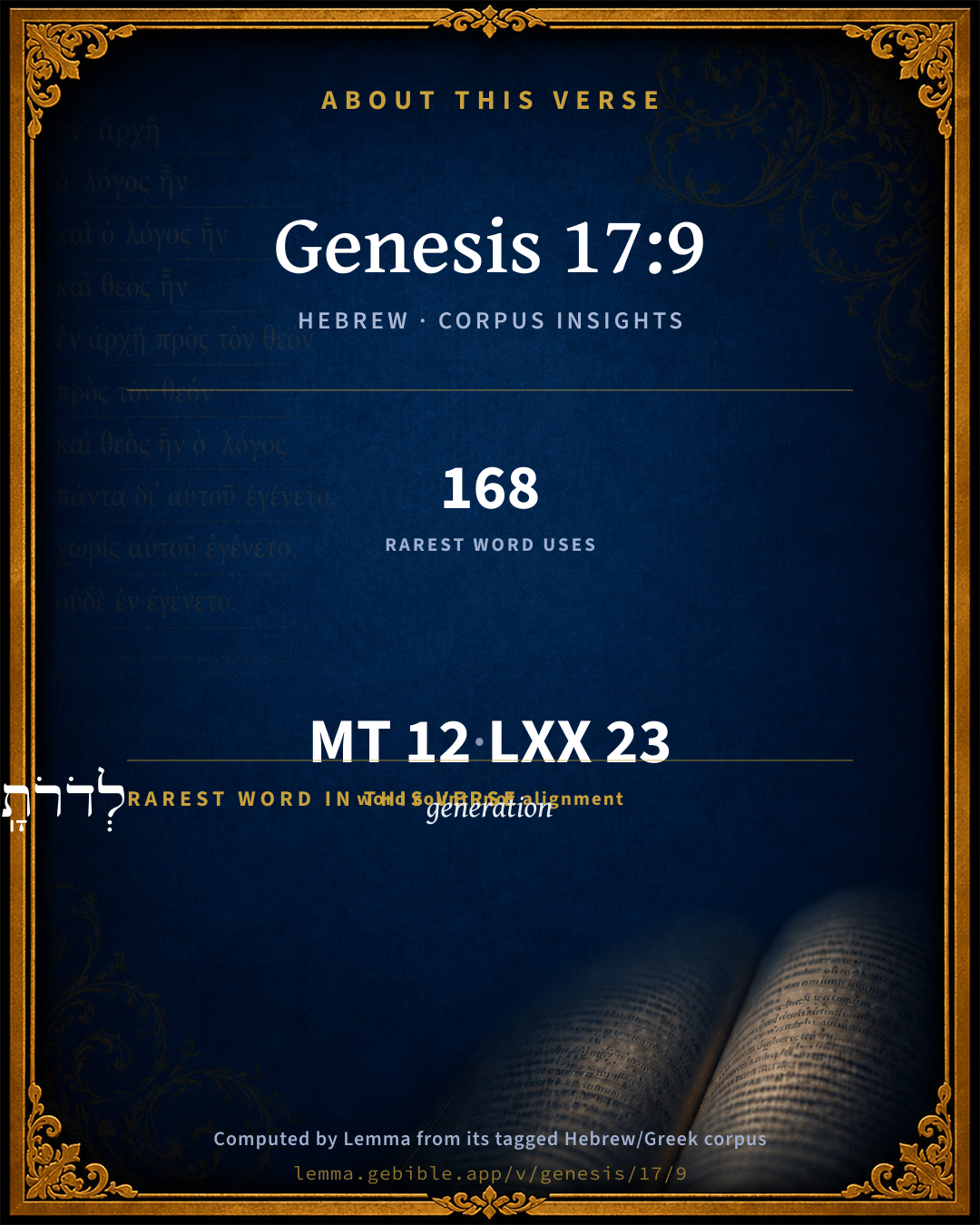
לְדֹרֹתָֽם
dôwr
H1755
“to/for · generations · their”
Preposition + Noun, Common, Masculine, Plural, Construct + Suffix, Personal, 3rd Person, Masculine, Plural
Part of Speech
Preposition + Noun
Type
Common
Gender
Masculine
Number
Plural
State
Construct
Full BDB Definition

Origin: from H1752

TWOT: 418b

period, generation, habitation, dwelling - period, age, generation (period of time) - generation (those living during a period) - generation (characterised by quality, condition, class of men) - dwelling-place, habitation
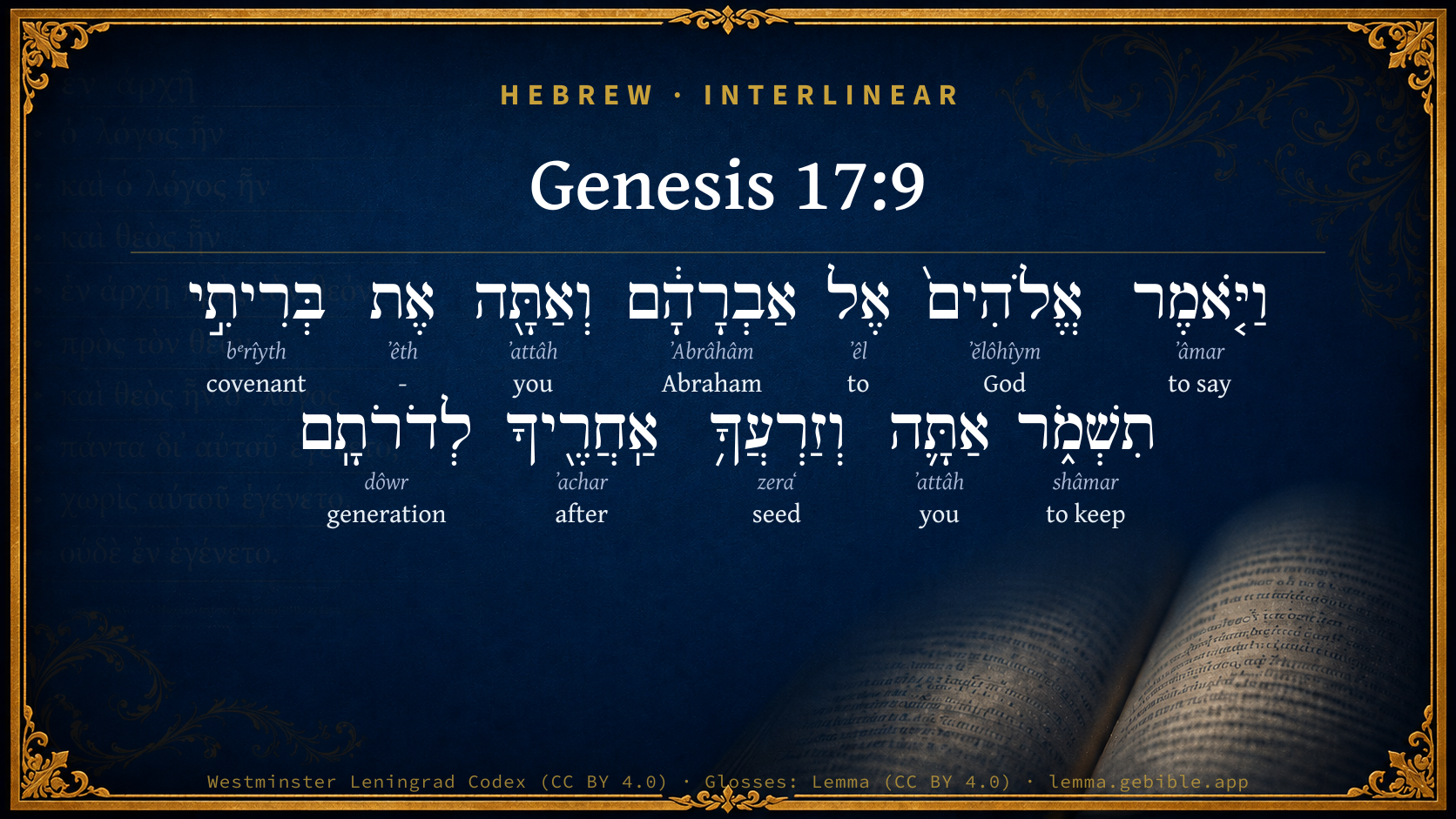
  1. וַיֹּ֤אמֶר ʼâmar H559 “and · to say” Conjunction + Verb, Qal, Sequential Imperfect, 3rd Person, Masculine, Singular
  2. אֱלֹהִים֙ ʼĕlôhîym H430 “God(s)” Noun, Common, Masculine, Plural, Absolute
  3. אֶל ʼêl H413 “to” Preposition
  4. אַבְרָהָ֔ם ʼAbrâhâm H85 “Abraham” Noun, Proper
  5. וְאַתָּ֖ה ʼattâh H859 “and · you” Conjunction + Pronoun, Personal, 2nd Person, Masculine, Singular
  6. אֶת ʼêth H853 “-” Particle, Direct Object
  7. בְּרִיתִ֣י bᵉrîyth H1285 “covenant · my” Noun, Common, Feminine, Singular, Construct + Suffix, Personal, 1st Person, Common, Singular
  8. תִשְׁמֹ֑ר shâmar H8104 “to keep” Verb, Qal, Imperfect, 2nd Person, Masculine, Singular
  9. אַתָּ֛ה ʼattâh H859 “you” Pronoun, Personal, 2nd Person, Masculine, Singular
  10. וְזַרְעֲךָ֥ zeraʻ H2233 “and · seed · your” Conjunction + Noun, Common, Masculine, Singular, Construct + Suffix, Personal, 2nd Person, Masculine, Singular
  11. אַֽחֲרֶ֖יךָ ʼachar H310 “after · you” Preposition + Suffix, Personal, 2nd Person, Masculine, Singular

About this verse

These counts appear in no published source. They are computed here, from the morphology-tagged text and Lemma’s own curated glosses. What Lemma adds →

12
words
11
distinct lemmas
Pentateuch
section

Grammatical profile

  • 2 verbs
  • 5 nouns
  • 2 pronouns
  • 2 prepositions
  • 1 particle

Verb forms

  • וַיֹּ֤אמֶר Qal · Sequential Imperfect
  • תִשְׁמֹ֑ר Qal · Imperfect

Repetition

A word recurs within this verse — often emphatic in Hebrew:

  • וְאַתָּ֖ה you H859 ×2

Hebrew & Septuagint length

In English translation the verse runs 21 words from the Hebrew and 21 from the Septuagint (LXX English) — the same length.

A rough comparison of the two English renderings, which tokenize alike — not a word-level alignment.

Word counts can differ between the Hebrew and the Greek without any difference in meaning — e.g. the Hebrew direct-object marker אֵת has no separate Greek word, and Greek often adds the article ὁ.

In the original languages it is 12 Hebrew tokens and 23 Greek tokens — but the two are counted differently (Hebrew bundles its prefixes and suffixes into one token; the Greek is in lemma form), so that isn’t a like-for-like length.

Cross-references

3

Topical passages linked to Genesis 17:9 in the Treasury of Scripture Knowledge — connected by theme and wording, ordered by reader-vote popularity; previews shown in the World English Bible.

  • Psalms 25:10 All the paths of Yahweh are loving kindness and truth To such as keep his covenant and his testimonies.
  • Psalms 103:18 To those who keep his covenant, To those who remember to obey his precepts.
  • Isaiah 56:4–5 For thus says Yahweh of the eunuchs who keep my Sabbaths, and choose the things that please me, and hold fast my covenant:

Cross-references courtesy of OpenBible.info (CC BY 4.0).

Hebrew and Greek witnesses Masoretic Hebrew ↔ Greek Septuagint

The same verse in the two great witnesses to the Old Testament, shown verse-for-verse.

These are two independent witnesses, not word-aligned to each other, and the Septuagint is shown in lemma (dictionary) form.

Hebrew Genesis 17:9 Masoretic · Westminster Leningrad Codex

וַיֹּ֤אמֶר אֱלֹהִים֙ אֶל אַבְרָהָ֔ם וְאַתָּ֖ה אֶת בְּרִיתִ֣י תִשְׁמֹ֑ר אַתָּ֛ה וְזַרְעֲךָ֥ אַֽחֲרֶ֖יךָ לְדֹרֹתָֽם

God said to Abraham, "As for you, you will keep my covenant, you and your seed after you throughout their generations.

World English Bible · Public Domain

Greek LXX Genesis 17:9 Septuagint · lemma form

καί εἶπον ὁ θεός πρός αβρααμ σύ δέ ὁ διαθήκη ἐγώ διατηρέω σύ καί ὁ σπέρμα σύ μετά σύ εἰς ὁ γενεά αὐτός

And God said to Abraam, You also shall fully keep my covenant, you and your seed after you for their generations.

LXX2012 (modern English Septuagint) · Public Domain

Hebrew: Westminster Leningrad Codex (CC BY 4.0). Greek: Septuagint (public domain); English from LXX2012 (modern English Septuagint) (Public Domain). How the Septuagint differs from the Hebrew →

Targum (Aramaic paraphrase)

2

The Targum is the ancient Jewish Aramaic paraphrase of the Hebrew Scriptures — an interpretive translation, not the Hebrew text itself. Onkelos (literal) and Pseudo-Jonathan (expansive) render the Torah, and Jonathan the Prophets. Coverage is partial: where no permissively-licensed English translation exists for a verse, only the Aramaic is shown. This is verse-level text, not a word-by-word alignment to the Hebrew.

  1. Targum Onkelos Torah (Genesis–Deuteronomy)
    וַאֲמַר יְיָ לְאַבְרָהָם וְאַתְּ יָת קְיָמִי תִטָר אַתְּ וּבְנָךְ בַּתְרָךְ לְדָרֵיהוֹן

    (no public-domain English translation for this verse)

    Targum Onkelos — Aramaic: “Onkelos Genesis” (public domain); “Onkelos Exodus” (public domain); “Onkelos Leviticus” (public domain); “Onkelos Numbers” (public domain); “Onkelos Deuteronomy” (public domain). English: “Sefaria Community Translation” (CC0 1.0 (public-domain dedication)); “J.W. Etheridge. The Targums of Onkelos and Jonathan Ben Uzziel on the Pentateuch. London: Longmans, Green, 1862” (public domain). Text via Sefaria.

  2. Targum Pseudo-Jonathan Torah (Genesis–Deuteronomy)
    וַאֲמַר יְיָ לְאַבְרָהָם וְאַנְתְּ יַת קְיָימִי תִּיטוֹר אַנְתְּ וּבְנָךְ בַּתְרָךְ לְדָרֵיהוֹן

    And the Lord said to Abraham, And thou shalt observe my covenant, thou and thy sons after thee in their generations.

    Targum Pseudo-Jonathan — Aramaic: “Targum Jonathan on Genesis” (public domain); “Targum Jonathan on Exodus” (public domain); “Targum Jonathan on Leviticus” (public domain); “Targum Jonathan on Numbers” (public domain); “Targum Jonathan on Deuteronomy” (public domain). English: “The Targum of Jonathan ben Uzziel, trans. J. W. Etheridge, London, 1862” (public domain). Text via Sefaria.

Commentary

Notes on Genesis 17:9 from classic Christian and Jewish commentators (each source and its license shown beneath its notes). The classic Christian expositions comment on the surrounding passage and are grouped to its opening verse, so a note may address several verses; the Jewish commentaries on the Tanakh (Rashi and others) are per-verse, so they appear only where the commentator wrote on this verse.

Lemma curates 59 commentaries, every one of them public domain or Creative Commons licensed, each selected and text-cleaned for this edition rather than reprinted as found. About our sources →

Trapp's Complete Commentary

John Trapp

Gen 17:9 And God said unto Abraham, Thou shalt keep my covenant therefore, thou, and thy seed after thee in their generations.

Ver. 9. Thou shalt keep my covenant.] This is the stipulation on Abraham’s part, by receiving the sacrament of circumcision, to "avouch God to be his God". {Deu 26:17} Now to the making the Lord to be our God, it is required, that with highest estimations, most vigorous affections, and utmost endeavours we bestow ourselves upon him. Thus, if we choose God for our God, {Psa 73:25} we shall be assured that he hath chosen and avouched us for his people. {1Jn 4:19}

John Trapp, A Commentary or Exposition upon All the Books of the Old and New Testament (1647–1656) — public domain. Text from a community e-Sword module.

The Biblical Illustrator

Joseph S. Exell

Gen_17:9-14

Every man child among you shall be circumcised

The covenant seal

I.

ITS SPIRITUAL SIGNIFICANCE.

1. It taught the natural depravity of man.

2. It taught the necessity of purification.

3. It taught regeneration.

4. It taught that Gods people are to be distinguished from the children of this world.

5. It taught dedication to God.

6. It pointed to Christ, who does not come by natural generation. He was the promised seed. His human nature was pure from its source. Thus circumcision preaches the whole doctrine of salvation, its necessity, and the means by which it is brought about. It proclaims the souls need--of the mortification of the flesh, of repentance, of a Saviour from sin.

II. ITS SUBJECTS. The rite of circumcision was enjoined not only upon Abraham and his seed, but also upon all his servants or slaves, and upon all born of them in his house. Everyone connected with him by social or domestic ties must submit to this outward sign of the covenant. In his capacity as a father and as a master he had to see that this rite was administered.

1. The principle of human responsibility.

2. That a man is accountable for the souls of those who are connected with him by social or domestic ties.

3. That the covenants of God are not narrow in their range.

4. That in our duty to others there is an element of hope and encouragement.

III. ITS OBLIGATION.

1. Because God commanded it.

2. Because Gods commands were hedged about by sanctions. (T. H.Leale.)

The sign of the covenant

It is only in proportion as we know the spiritual meaning of circumcision that we can enter into the joyous appropriation of the friendship of God. But if we are willing, our Lord and Saviour is both able and willing to effect in us this blessed spiritual result.

I. SEPARATION. Abraham and his seed were marked out by this rite as a separated people. And it is only as such that any of us can be admitted into the friendship of God. Bloodshedding and death--the cross and the grave--must lie between us and our own past life; yea, between us and allcomplicity with evil.

II. PURITY (Col_2:11). There is hardly a single grace dearer to God than this: to keep lily-white amid the defiling atmosphere. Purity can only be attained by the special grace of the Holy Spirit, and by doing two things: first, by our turning instantly from paragraphs in papers, or pictures on the walls, and all things else, which excite impure imaginations; secondly, by our seeking immediate forgiveness, when we are conscious of having yielded, even for a moment, to the deadly and insidious fascinations of the flesh.

III. OBEDIENCE. Ye are My friends, if ye do whatsoever I command you. We do not obey in order to become friends; but having become friends, we hasten to obey. Love is more inexorable than law. And for the love of Him who calls us by so dear a title we are glad to undertake and accomplish what Sinai with all its thunders would fail to nerve us to attempt. (F. B. Meyer, B. A.)

The seat of the covenant

I. THE PROMISE OF THE COVENANT.

1. The renewal of the promise.

2. The fulness of the promise.

3. The wide range of the promise.

II. THE OBLIGATION OF THE COVENANT. Divine promise is connected with human duty.

III. THE SIGN OF THE COVENANT. Circumcision reminded those who used it as a religious rite, ordained of God, of three things--

1. Separation from the world. So baptism is the token of a new life given by God.

2. Consecration to God.

3. Family religion.

(1) Children, servants, all the household, were to come under the covenant.

(2) It was to be handed down from one generation to another.

Conclusion: See, then, in this narrative not merely a history of what took place so long ago, but lessons for us now: lessons as to Divine grace; as to human responsibility; and as to appointed outward ordinances which serve to join together the thought of what God gives, and of the service we ought to render. Such ordinances, used in a faithful, humble, earnest spirit, are seals and channels of covenanted blessing. (W. S. Smith, B. D.)

Circumcision instituted

All benefited, whether slave or master.

I. A PAINFUL CEREMONY. Full of meaning, and suggesting then what the New Testament teaches now, Your bodies are the temple, etc.

II. ADMINISTERED TO CHILD WHO COULD KNOW NOTHING EXCEPT PAIN. What good? Unreasonable? Cruel? Following our own reason, no child would have been circumcised. But Gods command far outstrips mans reason (Gen_17:14). And Col_2:11-12, shows that baptism now answers thereto. And is equally for babes. A week old. Parents ought to do as this tells them. Do you so. And then look for a blessing, if only you will teach and train them as Christians--day by day--every day. (G. Venables.)

Circumcision--the seal of the covenant

I. AS TO THE TIME OF THE APPOINTMENT of this ordinance, it is important to observe, that Abraham is now about to become a father, not according to his own will merely, but according to the will of God; he is to be, in a remarkable manner, the founder of a family or house.

II. THE RITE ITSELF now instituted, the sacramental act, is not an unmeaning form or ceremony. It is significant of the great leading fact in the covenant of which it is the seal--the extraordinary and miraculous birth of Him who is preeminently and emphatically the seed of Abraham, the holy child Jesus.

III. Hence it appears that it is strictly and properly to THE COVENANT OF GRACE THAT CIRCUMCISION, AS INSTITUTED ON THIS OCCASION, HAS RESPECT. It is true that under the Mosaic economy it served a farther purpose. It became a national badge or mark of distinction--the pledge of the national covenant in terms of which God governed the nation of Israel. Even then, however, it did not lose its primary and original significancy. To a spiritually-minded Jew--to one who was an Israelite indeed--it was still the token of the better covenant, and the seal of the righteousness that is by faith. And as at first ordained for Abraham, it had absolutely no other meaning at all. It could have no other. For, in the first place, there is no limitation or restriction of it to the Jewish nation in particular. It is enjoined on Abraham, as the father of many nations; and on all, generally, who are of his house, or may be embraced, by whatever right, even the right of purchase, within it (Gen_17:9-13). And, secondly, the covenant with which it stands associated is not temporal and national, but spiritual and universal. It is the everlasting covenant, in the one seed of Abraham, which is Christ.

IV. THE CHILD, EIGHT DAYS OLD, WAS TO BE CIRCUMCISED. And are the children of Gods people now to be placed on a worse footing than in the days of old? Is there any evidence of a change in this respect? On the contrary, did not the Lord specially distinguish little children as the objects of His love, taking them into His arms, and affectionately blessing them? And do not the apostles proceed all along on the principle that the visible Church is to embrace not only all the faithful, but their children also? Thus Act_8:39) speaks of the promise being to believers and to their children. Paul also (1Co_7:14) founds an argument on the assumption that the children of a believing parent are, not unclean or common, but holy. And, accordingly, we read in the Book of Acts Act_16:33, etc.) of entire households being baptized; the expressions used being such as to render it very unlikely that the little children were excluded.

V. On very much the same principle on which this intiatory rite is administered to the children of Gods people, IT IS DECLARED TO BE OF INDISPENSABLE OBLIGATION, and the neglect of it is made a ground of exclusion from the visible Church (verse 14). So is it also with the sacraments, the signs and seals of grace. No liberty of discretionary choice is left in regard to their observance; it is not merely my precious privilege, but my bounden duty, to receive them. (R. S. Candlish, D. D.)

Circumcision

It is impossible to arrive at a clear idea of this remarkable rite, and of its true meaning in the Mosaic system, without pursuing its origin and history more clearly than is generally done. We distinguish four chief periods.

1. Circumcision seems to have been first practised by the Ethiopians and other nations of Southern Africa. The question arises, What was the origin of this singular custom? It must evidently have a general cause, inherent either in the human mind or in the human frame, since it was in use among so different nations, possessing no mutual intercourse. Now, a religious motive seems to be out of the question; for some of the nations alluded to are not only strangers to all religious ceremonies, but are destitute of all moral feelings. Philo distinctly observes, that it prevents the painful and often incurable disease of carbuncle; it, further, obviates some fearful disorders; modern travellers testify that it precludes great physical inconvenience among the Bushmen; and the Christian missionaries who exerted themselves for its abolition in Abyssinia were, by the dangerous physical consequences, compelled to desist from their plans. If we hereto add, that among nearly all those tribes the operation is performed not in infancy, but at the approach of puberty, it becomes evident that the burning temperature of their southern climes, in many cases combined with a peculiar bodily structure of those races, gave rise to the custom of circumcision.

2. From the south, it spread northward into Egypt. Many parts of this country were colonized by emigrants from Ethiopia; and thus many primitive customs of the south were transplanted into the land of the Pharaohs. The intercourse with Ethiopia was both constant and animated. Now, the same complaints to which we have referred as frequent in Ethiopia may, in many instances, have appeared in Egypt also; and circumcision may, therefore, as a matter of precaution, have been gradually adopted by all Egyptians. But it recommended itself to this people from another consideration also, in their views of the highest importance: that of cleanliness. The examination of the mummies; the fact that the Colchians, who were Egyptian settlers belonging to the army of Sesostris, performed the ceremony; and the accounts of Herodotus and Diodorus Siculus, Philo and Strabo, concur to prove that circumcision was a general and national institution among the Egyptians. Now, the great authority and exceeding reputation for superior wisdom which they possessed in the ancient world induced many nations to adopt from them, among other institutions, the practice of circumcision also. Thus, it was performed by the Arabians and Edomites, by the Ammonites and Moabites, by the Phoenicians and Syrians about Thermodon and the river Parthenius; and in this instance, not merely blind veneration, but a regard for health and cleanliness, assisted in spreading the custom.

3. It was natural that the wise men of Egypt should connect some higher religious or philosophical notions with the rite of circumcision, especially since it had become entirely their own. Now, it is well known that a great part of the Egyptian religion consisted in the deification of the powers of nature, and especially of generation; this idea is chiefly represented by their two principal deities, Osiris and Isis, who presided both over fertility and fruitfulness. In Egypt a chief part of the festival of Bacchus was the public procession of the phallus, performed in an obscene manner amidst the wild songs of women; and the same rites in honour of Bacchus were from Egypt introduced into Greece. It was, further, generally believed that circumcision enhances prolificness; and the Egyptians ascribed their increasing population, in a great measure, to the same custom, although it was, besides, considered to be attributable to the purity of the air and the quality of the water of the Nile. It seems evident, therefore, that the Egyptian priests connected circumcision with the very centre of their religion; that they regarded it as a part of the system by which they endeavoured to penetrate into the secret working of nature; and that, by dedicating the prepuce to their gods, they ascribed to them the wonderful powers of generation.

4. Among the nations which derived the custom of circumcision from the Egyptians were undoubtedly the Hebrews. But did Mosaism blindly adopt a heathen ceremony? And here we have arrived at the culminating point of this deduction. In no other institution, perhaps, do we see with greater force and distinctness that fundamental principle which pervades the whole legislative part of the Old Testament, and without regard to which it will ever be impossible to comprehend its full spiritual meaning, and to balance its exact historical value . . . By connecting the rite of circumcision with the purest ideas of resignation and piety, Mosaism laid a sure foundation for moral conduct; licentiousness, stimulated by the fiery temperament of the Oriental, was checked; the passions were restrained; and if sinful ideas or vicious imaginations arose within him, he was reminded by the covenant sealed on his flesh that he had promised holiness of life and innocence of the heart. Hence the word uncircumcised was in the Hebrew language generally used in a purely figurative sense; and phrases like uncircumcised of heart or of ear prove that the rite here discussed was indeed conceived as a type of some of those inward virtues which constitute the chief end of religion. The blood of circumcision confirmed the personal covenant; hence the boy was, on the day when that rite was performed, called a bridegroom of blood (Exo_4:25); and the resected foreskin, which was considered unclean, typified both the abnegation of lasciviousness, and, like the offering of the firstlings, the acknowledgment of Gods sovereignty. Thus a custom of the basest sensuality was converted into a rite of morality; worship of nature into reverence of God; and hierarchy into theocracy. Therefore, to sum up our opinion on circumcision, Mosaism was compelled to retain it on account of the ignominy with which its neglect was regarded by neighbouring nations, and, in consequence, by the Hebrews themselves; but it reformed it from a physical expedient or superstitious rite into a symbol of holiness and of alliance between God and man. (M. M. Kalisch, Ph. D.)

Notes on circumcision

Originally circumcision was performed with a stone knife, to prevent inflammation (see note on Exo_4:25), but at present it is safely done with a steel knife, except on boys who die before the eighth day from their birth, when the ancient custom is followed, as is the case in all instances among the Abyssinian Christians. Sons of Hebrew mothers and heathen fathers were admitted, but not compelled, to circumcision. The operation was generally performed by the father himself, but any Israelite was allowed to act in his stead; heathens alone were excluded. In cases of emergency women even were admitted. But as practice is required to prevent danger, pious persons devoted themselves to that office, which they exercised gratuitously, finding their reward in the consciousness of having introduced the children into the holy covenant. The boy generally received his name on the day of circumcision. And hence we may derive another collateral reason why Abrahams name was changed when that ceremony was commanded to him. There is no historical difficulty in the supposition that circumcision was already introduced in Abrahams time, though it can scarcely be doubted that it received its deeper and internal development only since the diffusion of Mosaism; for it was long generally neglected, and Joshua first carried it out in its full extent (Jos_5:2-9); but from that period it seems, on the whole, to have been faithfully observed; the epithet uncircumcised was deemed the greatest insult and ignominy; and the strictures of the prophets are not directed against its omission, but against the uncircumcised circumcised people who observe the external ritual, but are nevertheless uncircumcised in heart; and in this sense even circumcised nations seem sometimes to have been simply called uncircumcised ones, a proof how clearly the internal purity was regarded as the only aim of this rite. Among the Israelites, therefore, circumcision took, in the course of time, deeper root, while it gradually fell into disuse among the Egyptian people--a natural consequence of the fact proved above, that the one regarded it as a matter of religion, the others of expediency. Although it was by no means an exclusive characteristic of the Israelites, since they shared it with many other nations, and though it was not even original among them, its sacredness was, indeed, peculiar almost to them alone; and hence heathen conquerors, as Antiochus Epiphanes and other enemies, often rigorously interdicted it as one of the surest means of weakening among them the faith of their ancestors; but they never succeeded; it was practised in secret till they were again permitted to perform it without restriction. (M. M.Kalisch, Ph. D.)

Significance of circumcision

In its heathen significance it was certainly saturated with that worship of the forces of the physical world in which probably polytheism took its rise, and with polytheism nearly all the religions and mythologies of antiquity. It bore very directly on the deification of the generative or reproductive virtue in nature--the foul source of much that was cruel and nearly all that was obscene in the mysteries of paganism. Transferred to holy soil, and attached to a covenant of grace, it implied an acknowledgment that God, who is above nature, and not any natural force whatever, is the true Author of physical life and its increase; the sovereign Giver of fertility; above all, the only Quickener of a holy or consecrated life. It taught that what is born of the flesh can only be flesh. It suggested that it is by the painful renunciation of fleshly desire and natural self-confidence man must be surrendered to Gods service as His fit instrument for gracious ends. Finally, it served to point forward to one pure and superhuman birth, through which alone the fatal chain that links in one the sinful generations of mankind could be severed, and a new fountain of salvation and blessing opened for the fallen race. (J. O. Dykes, D. D.)

Circumcision

The Rev. Henry Ward Beecher says: If there was one thing which the Jews set above another, as they do still, it was circumcision. It not only was a patriotic ordinance, but it had come down to them as a race peculiarity, a symbol of which they were proud, and they ran along the line of that observance clear back to Abraham himself. While I was in the West, I came across a Rabbi who told me that a man had travelled over six hundred miles with a child in order to have him circumcised. I admit, he said, that the people may not have been moral, and may not have been religious, but they wanted the child circumcised anyhow. That feeling existed in the time of the Apostle Paul to the last degree. The Jews felt about that as you feel about baptism and the Lords Supper. Paul says: Neither circumcision availeth anything, nor uncircumcision, but a new creature.

The baptism of infants founded on this covenant

Mark how this renewal of the covenant turns upon the consecration of children. Hitherto we have to do with grown-up people, but now we are brought face to face with little ones. We have hardly had a child at all as yet in this long history. One wonders what notice God will take of young life; will He say, Suffer the little children to come unto Me, or will He shut them out of His view until they become great men? Is a child beneath Gods notice? Listen to the covenant: He that is eight days old shall be circumcised among you. What an oversight on the part of the Lord not to observe that a child eight days old could not understand what it was about! What a waste of piety to baptize an infant of days when it cannot understand what you are doing to it! It cries, poor thing; therefore, how ridiculous to baptize it! It plucks the preachers gown, or chuckles and coos in the preachers arms; therefore, how absurd to admit it into the covenant! For myself, let me say that when I baptize a child I baptize life--human life--life redeemed by the Son of God. The infant is something more than an infant, it is humanity; it is an heir of Christs immortality. If there be anyone who can laugh at an infant and mock its weakness, they have no right to baptize and consecrate it, and give so mean a thing to God. God Himself baptizes only the great trees; does He ever baptize a daisy? He enriches Lebanon and Bashan with rain, but did He ever hang the dew of the morning upon the shrinking rose? Account for it as you please, God did appoint circumcision for the child eight days old! Christian baptism is founded upon this very covenant. Abraham was ninety-and-nine years old when he was circumcised; Ishmael, his son, was thirteen years old; and then came the infant men-children. So in heathen countries the man is baptized, and the woman, and the child of days. We plead Divine precedent. Whatever objections stand against baptism stand against circumcision, and, therefore, stand against God. The child does not understand the alphabet, do not teach it; the child does not understand language, do not teach it; the child does not understand the Lords Prayer, do not teach it. You say the child will understand by and by; exactly so; that answer is good; and by and by the child will understand that it was baptized in the name of the Father, and of the Son, and of the Holy Ghost, three persons in one God. Beautiful, too, is Christian baptism when regarded as the expansion of the idea of circumcision. It well befits a tenderer law; circumcision was severe; baptism is gentle: circumcision was limited to men-children; baptism is administered to all: circumcision was established in one tribe, or family, or line of descent; baptism is the universal rite--Go ye, therefore, and teach all nations, baptizing them in the name of the Father, and of the Son, and of the Holy Ghost. So we go from law to grace; from Moses to the Lamb; from the mount that might be touched, and that burned with fire, to the quiet and holy Zion. (J. Parker, D. D.)

The Biblical Illustrator, edited by Joseph S. Exell (c. 1880s–1900s) — public domain. Text from a community e-Sword module.

The Preacher's Complete Homiletical Commentary

Joseph S. Exell (gen. ed.)

CRITICAL NOTES.—

Gen_17:10. My Covenant.] The outward sign is here called the Covenant, for it is the seal set upon the Covenant. The same mode of expression is used in Act_7:8. Also, in the Lord’s Supper the Cup is called the New Testament in Jesus’ blood. (Luk_22:19-20). Circumcised. Heb. Shall be cut round about, i.e., there shall be an excision of the prepuce or foreskin of the flesh of all the males. Herodotus speaks of this as a custom ancient in his time, and existing among several nations, chiefly the Egyptians and Ethiopians.

Gen_17:11. The flesh of your foreskin.] The Heb. for foreskin signifies that which is “superfluous or redundant,” not in itself, but in relation to the ordinance. The same word is applied figuratively to other parts, as to the lips (Exo_6:20); to the ear. (Jer_6:10); to the heart (Lev_26:41; Isa_6:10). St. James plainly alludes to this (Jas_1:21) “superfluity of naughtiness.”

Gen_17:12. Eight days old.] Heb. Son of eight days. This rite was administered on the eighth day, even though it should happen to be a Sabbath. It was a Jewish maxim that “circumcision drives away the Sabbath.” This maxim was acted upon in Our Lord’s time. (Joh_7:22-23). Delayed till the eighth day, because all creatures newly born were reckoned unclean for seven days, and might not sooner be offered to God. (Lev_12:2-3). No animal could be presented as an oblation before it was eight days old. (Lev_22:27). Born in the house, or bought with money of any stranger, which is not of thy seed.] “Here the rite is enjoined in case of household servants or slaves who were ‘born in the house’—a class so often described (Gen_17:13). The last phrase qualifies the whole foregoing. The Heb. reads, ‘And a son of eight days shall be circumcised to you. Every man child in your generations—the one born in the house—and the purchase of (silver) money—of every son of a stranger who is not of thy seed’—showing that those ‘born in the house’ refer to such as were not their own children, but ‘of strangers’ ” (Jacobus).

Gen_17:14. That soul.] Heb. That person. Cut off from his people. “This phrase, first of all, means exclusion from the Covenant membership and treatment as a Gentile or alien. This was sometimes accompanied with the sentence of death” (Exo_31:14). (Jacobus.) “We believe the true sense of the phrase to be that the individual who transgresses the condition or sign of the Covenant thereby resigns his connection with the Hebrew community, and ceases to belong to it” (Kalisch). Knobel, Murphy, and others, hold this view.

MAIN HOMILETICS OF THE PARAGRAPH.—Gen_17:9-14

THE COVENANT SEAL

The Covenant with Abraham, which had been renewed, is now ratified by the additional confirmation of a sacramental pledge. The seal is now affixed. That outward sign does not make the blessings of the Covenant, but only declares them—taking for granted the validity of the previous transaction. It is the closing act of the whole negotiation of the believer’s peace and fellowship with God.

I. Its spiritual significance. Abraham was now to become a father, not by his own will but according to the will of God. His carnal policy had failed, better hopes were raised within him. A prospect was before him, bright and important beyond all his former expectation. He was to be the human source of a sacred and gifted society—the Church of God. By the presence and the acknowledgement of a Divine guidance and authority, and by sacramental pledges, this Church must ever be distinct from the world. God now sets His seal upon this epoch which marks the founding of the visible Church. Circumcision had an important meaning considered as a seal. It authenticated God’s signature to the Covenant, and executed it on His part. It was an instrument by which blessings were conveyed to those who in faith set their hands to this seal. It was a sign which parents put upon their children to show that they were devoted to God. It was the distinguishing mark of a holy and elect nation. But, besides all this, circumcision had a spiritual meaning. It taught, in a most impressive manner, certain deep truths about the soul and its relation to God.

1. It taught the natural depravity of man. Man was evil in the sight of God, not possessed any longer of that innocence and constancy in goodness which would secure the Divine favour. A new race, representing a regenerated people, was to be propagated; and therefore it was necessary that there should be this sign of holiness in the fountain head. Like baptism, circumcision teaches the uncleanness of the flesh, i.e., of human nature.

2. It taught the necessity of purification. Human nature must be cleansed at its origin and source. The elect of God must separate themselves from evil.

3. It taught regeneration. A kingdom was to be set up, and men could not enter it by right of natural birth. They must be born again, and thus be made naturalised subjects of that kingdom. They enter it by miraculous means—by the favour of a new creation. Hence even the Old Testament dwells upon the necessity for the circumcision of the heart. A new heart can alone ensure a holy life. The stream cannot be pure as long as the fountain is polluted.

4. It taught that God’s people are to be distinguished from the children of this world. The Israelites were distinguished from other nations by this outward mark on the flesh. That pointed to a vital distinction in the spiritual condition of men. This sign of the Covenant spoke of faith in God, who was to guarantee that the blessings it set forth would be bestowed. And faith—in the gospel usage of the term—is still the most real and conspicuous difference between man and man. This is the surest touchstone of the innermost nature of the heart. The Covenant of Promise is only for the children of faith. They who possess faith feel that they belong to a race having wider prospects, a nobler calling, and higher aspirations than the rest of mankind. They are marked off as the seed of promise.

5. It taught dedication to God. All who received this sign of the Covenant were bound to give themselves up to God. They were no longer their own. Each one bore in his body the marks of a heavenly calling, the sign of a perpetual obligation to serve God.

6. It pointed to Christ, who does not come by natural generation. The true bringer in of salvation was the Lord Jesus Christ. He was the promised seed. His human nature was pure from its source. Thus circumcision preaches the whole doctrine of salvation, its necessity, and the means by which it is brought about. It proclaims the soul’s need—of the mortification of the flesh—of repentance—of a Saviour from sin.

II. Its subjects. The rite of circumcision was enjoined not only upon Abraham and his seed, but also upon all his servants or slaves, and upon all born of them in his house. Everyone connected with him by social or domestic ties must submit to this outward sign of the Covenant. In his capacity as a father and as a master he had to see that this rite was administered. Great principles and facts are involved in this description of the nature and extent of this duty.

1. The principle of human responsibility. God’s blessings are not to be received passively by us without any thought or concern. We have to acknowledge, in God’s own appointed way, that these good gifts bind us to the performance of duties. God originates Covenant mercies from His own free goodness, but we have to take our part in reference to them. We have to accept our obligation.

2. That a man is accountable for the souls of those who are connected with him by social or domestic ties. Abraham had to submit his servants and their offspring to this rite (Gen_17:12-13). The employers of labour should remember that their duties to those who are under them do not end with mere considerations of work and wages. Their humble dependents are something more than dumb machines. They have souls which are capable of receiving impressions for good or evil. They have spiritual interests of a surpassing nature which may be affected for weal or woe by the conduct of those whom Providence has placed over them. This is too often forgotten, as we may see by the confessions of human language which describes the employed as “hands.” Men speak in a most careless manner in this regard, and do not consider the separate individuality of souls. Property and influence have their privileges, but they have also important duties. No differences of social position can discharge us from the duty of paying profound respect to the image of God in man. With religious men, all duty has reference to God and His purposes concerning the human race.

3. That the Covenants of God are not narrow in their range. The promised blessings were not only for Abraham and his seed, but also for all who were associated with him, even for “strangers.” The area over which the Covenant mercy was to show itself was thus made very wide. This pointed to the wide charity and universality of the provisions of the Gospel.

4. That in our duty to others there is an element of hope and encouragement. When Abraham imparted the sign of the Covenant to his children and servants, he would see that God had designed blessings for them. His duty would not be performed from a dry sense of obligation, but have an element of gladness in it arising from the thought of the blessings which it would convey to others. He who labours for the highest good of mankind is encouraged by the light of hope. The picture of Abraham’s vast posterity was rendered bright and grateful to him by the thought that they, too, would receive the blessings of the Divine favour.

III. Its obligation. The Covenant rite was not a thing indifferent, to be performed or neglected at pleasure. It was binding on all to whom it was committed.

1. Because God commanded it. No one was free to refuse it on the ground that it was unnecessary, and had no real connection with the promised blessings. God commanded, and that was enough. He knows the reason why. God knows what is good for man, and what outward signs he requires to aid him in the apprehension of things spiritual

2. Because God’s commands were hedged about by sanctions. God gives more than mere advice to His creatures. He gives law, which draws after it penalties. An appeal is made not only to our sense of what is reasonable, but also to our sense of fear. We have to consider that we are incurring danger by neglecting God’s plain commands. What God has instituted and made binding upon us cannot be lightly set aside; for this implies contempt for the authority by which it was ordained, and of the grace of which it was the seal.

CIRCUMCISION AND CHRISTIAN BAPTISM

Abraham is circumcised on the eve of his becoming the father of the Messiah—when the holy seed is to spring from him; and all the faithful are to be circumcised till the holy seed is come. Hence one reason why this introductory seal of the Covenant is superseded, and another sacrament has been ordained in its place. Circumcision significantly pointed to the future birth of Christ, who was to be of the seed of Abraham. The birth being accomplished, the propriety of circumcision as a sacrament ceases. Any corresponding rite now must be not prospective, but retrospective; not looking forward to the beginning of the Messiah’s work, as the righteousness of God, when in His birth He was shown to be His Holy One, and His Son by His miraculous conception in the Virgin’s womb—but looking back to the end of His work, in His burial, when He was declared to be the Son of God with power, by His resurrection from the grave.

Such a rite, accordingly, is Baptism, as explained by the Apostle when he says, “We are buried with Him by baptism into death: that like as Christ was raised up from the dead by the glory of the Father, even so we also should walk in newness of life” (Rom_6:4). Our baptism signifies our engrafting into Christ, as not merely born, but buried and risen again. It refers not to His entrance into the world, but to His leaving it. It is the symbol, not of His pure and holy birth merely, but of the purifying and cleansing efficacy of His precious blood shed upon the cross, and the power of His resurrection to life and glory. Abraham and the faithful of old were circumcised into His birth, His redemption being yet future; we are baptised into His death, His redemption being now past. The one sacrament was an emblem of purity, connected with a Saviour to be born; the other is an emblem of purity connected with a Saviour who liveth and was dead, and behold! is alive for evermore! Both circumcision and baptism denote the purging of the conscience from dead works, or from the condemnation and corruption of the old nature, through the real and living union of the believer with Christ—with Christ about to come in the flesh, in the one case; with Christ already come, in the other.—(Candlish.)

SUGGESTIVE COMMENTS ON THE VERSES

Gen_17:9. Blessings imply obligations. God turns to man as the other party to the Covenant to remind him of his duty.

My Covenant. The Apostle informs us of the true nature of this ordinance, and thus of a sacrament, as such, that it is a sign and seal, in the passage in Romans which refers to this transaction. “And he received the sign of circumcision, the seal of the righteousness of the faith which he had, being yet uncircumcised” (Rom_4:11). It is an outward sign of an inward grace, and a seal also, whereby the signature is formally attested and authenticated. As in a deed or instrument of conveyance, there is first the signature, and then the seal which confirms it, and in so far executes the instrument. But it needs also beyond that to be delivered. And this calls for the hand of faith.—(Jacobus.)

Gen_17:10. Circumcision, as the rainbow, might have been in existence before it was adopted as the token of a Covenant. The sign of the Covenant with Noah was a purely natural phenomenon, and therefore entirely independent of man. That of the Abrahamic Covenant was an artificial process, and therefore, though prescribed by God, was dependent on the voluntary agency of man. The former marked the sovereignty of God in ratifying the Covenant, and ensuring its fulfilment, notwithstanding the mutability of man; the latter indicates the responsibility of man, the trust he places in the word of promise, and the assent he gives to the terms of the Divine mercy. The rainbow was the appropriate natural emblem of preservation from a flood, and the removal of the foreskin was the fit symbol of that removal of the old man and renewal of nature which qualified Abraham to be the parent of a holy seed. And as the former sign foreshadows an incorruptible inheritance, so the latter prepares the way for a holy seed, by which the holiness and the heritage will at length be universally extended.—(Murphy.)

Under the old covenant, as everything pointed forward to Christ the God-man—Son of Man—so every offering was to be a male, and every covenant rite was properly enough confined to the males. The females were regarded as acting in them, and represented by them. Under the New Testament this distinction is not appropriate. It is not “male and female” (Gal_3:28; Col_3:11).—Jacobus.

The appointment of this rite suited well with God’s promise to multiply the seed of Abraham. This outward badge would serve for the attestation of that promise.

All who by Divine Providence are thrown into the midst of the family of God are bound to receive the Covenant sign. Hence the propriety of Christian baptism. The privileges of the Church are also duties. Men must be brought to acknowledge that they are not their own, and that their lives should be dedicated to God. They must be reminded whose they are, and whom they are bound to serve. Sacraments may be neglected, and many may prove unworthy of the grace they seal; yet that obligation which they signify still remains.

Gen_17:11. As a sign placed upon the foreskin, it designates still more definitely on the one side, that the corruption is one which has especially fallen upon or centres in the propagation of the race, and has an essential source of support in it, as, on the other side, it is a sign and seal that man is called to a new life, and also, that for this new life the conception and procreation should be consecrated and sanctified (Joh_1:13-14).—Lange.

Sacramental Signs.

1. Are outward and visible. They impress the senses.

2. They teach spiritual truths. Circumcision was a teaching ordinance; so are baptism and the Lord’s Supper.

3. They are the appointed channels of spiritual blessings. Though God is not tied to them, yet He promises grace to the worthy in their use.

4. They serve as perpetual reminders of God’s grace, and of our own duty and responsibility.

Gen_17:12-13. It is worthy of remark that in circumcision, after Abraham himself, the parent is the voluntary imponent, and the child merely the passive recipient of the sign of the Covenant. This is the first formal step in a godly education, in which the parent acknowledges his obligation to perform all the rest. It is also, on the command of God, the formal admission of the believing parents’ offspring into the privileges of the Covenant, and therefore cheers the heart of the parent in entering upon the parental task. This admission cannot be reversed but by the deliberate rebellion of the child. The sign of the Covenant is also to be applied to every male in the household of Abraham. This indicates that the servant or serf stands in the relation of a child to his master or owner, who is therefore accountable for the soul of his serf, as for that of his son. It points out the applicability of the Covenant to others, as well as to the children of Abraham, and therefore its capability of universal extension when the fulness of time should come. It also intimates the very plain but often forgotten truth, that our obligation to obey God is not cancelled by our unwillingness. The serf is bound to have his child circumcised as long as God requires it, though he may be unwilling to comply with the Divine commandments.—(Murphy).

The fact that Abraham was bound to administer this rite, either to those who were unconscious of its meaning or to those who might be unwilling to receive it, shows that the acceptance of religious privileges is compulsory. Children born of Christian parents are compelled to become Christians, and in after life God holds them responsible for the right use of the privileges implied in that sacred name. They may complain of the appointment by which such things are thrust upon them—that others have chosen for them, but they cannot get rid of this law imposed on their nature, by which they are obliged to accept responsibility. They might as well try to abolish the law of gravitation, which also, in its way, may sometimes prove a tyranny. To everyone brought within the influence of religious privileges, is committed an uncontrollable destiny—the destiny of accountableness, the fate of being free, the unalienable prerogative of choosing between life and death.

We have to accept our religious privileges as we have to accept the fact of our birth. We can no more discharge ourselves from the one than we can annul the other.

It has pleased God to perpetuate religion by means of the family relation. Some amongst mankind shall be born to religious privileges which convey inalienable rights and obligations.

If the visible Church were a mere voluntary association, to make me a member of such a body in my infancy, and without my consent, might be held to be an unwarrantable infringement on my freedom of choice. But if the visible Church be God’s ordinance, and not a mere contrivance or expedient of man, there is no absurdity and no injustice in the arrangement. If, while yet unconscious and incapable of consenting, I am enrolled and registered, and sealed as one of the household of God—if I am marked out from the womb as peculiarly His, by privilege, by promise, and by obligation—no wrong is done to me, nor is any restriction put upon me. If God makes me, by birth, the scion of a noble stock, the child and heir of an illustrious house, then, by my birth, I am necessarily invested with certain rights, and am bound to certain duties. I may refuse, in after life, to take the place assigned to me; I may never avail myself of its advantages; I may never realise my rank, or imbibe the spirit and enter into the high aims of my honourable calling. Still, if I live not according to my birth, the fault is my own. Whether I take advantage of it or not, my birth—in the plan and purpose of God’s providence—had a meaning which might have actually stood me in good stead, if I had so chosen and willed it. So in regard to circumcision or baptism. If God makes me—by such a seal and pledge of grace imparted to me in infancy—a member of that society on earth which bears His name, I may never be in reality what that rite should signify to me. But not the less on that account has the rite a significancy, as implying a spiritual title and spiritual benefits, which are in themselves intended and fitted for my good. And if afterwards I wilfully refuse them, with the badge of them upon my person, it is with aggravated guilt, and at my own increased peril.—(Candlish.)

The privileges of a parent and of a master bring obligations with them to perform the duties implied in those relations. We should care for the eternal as well as the temporal interests of those committed to our charge; for all such duty should have reference to God who commands, and to the immortal nature of those on whom it is exercised.

The wide charity of the Gospel reveals itself even in what appears to be the exclusive dealings of God with mankind. Here is a provision for strangers to be admitted into the family of God. The privileges of the kingdom of God are not intended for a favoured few, but for all who are willing to receive them.

The rite of circumcision, though stated to be of eternal obligation, was yet destined to pass away when the better Covenant was established. Yet the grace signified, entering the hearts and purifying the lives of believers, would remain for ever. The essential part of God’s Covenant abides. They have an enduring substance.

Gen_17:14. However it is to be understood, the threatening is a severe one, and shows conclusively with what reverence God would have His own ordinances regarded, especially those that bear so directly upon our spiritual interests. Having ordained that the sign and the promise should go together, it was at anyone’s peril that he presumed to sunder them. Yet as God desireth mercy and not sacrifice, so the sickness or weakness of an infant might warrant the delay of the ceremony; and if one chanced to die before the eighth day, it was not to be supposed that this circumstance prejudiced its prospects of future happiness. The same remarks are, in their spirit, applicable to the ordinance of baptism. It is the avowed contempt of the ordinance, and not the providential exclusion from it, that makes us objects of God’s displeasure. The directions here given are to be understood as not only addressed to Abraham personally, but in him to his natural seed in all generations. The reason assigned for this severe edict is, “He hath broken my Covenant”—i.e., hath made prostrate, broken down, demolished, in opposition to the phrase, to establish, to make firm a covenant.—(Bush.)

Such is uniformly the Lord’s manner of dealing with His people. When, in terms of the everlasting Covenant, He freely dispenses the richest spiritual blessings, He places His gift on the footing not of a privilege merely, but of a peremptory order. He not merely permits, and encourages, and invites; He straitly charges and authoritatively commands.—(Candlish.)

God does not propose His laws and ordinances for our consideration and acceptance at our own convenience. He still maintains His dignity as Lord; and while He seeks to win us by His gracious favour, at the same time demands our obedience.

The obligation of sacraments.

1. They are means of grace. They are for the strengthening of our soul—an aid to our minds in conceiving of spiritual things—they afford a greater security for our belief. We should not despise what is so freely offered for our benefit, and so graciously accommodated to our weakness.

2. They are commanded by God. His authority is paramount, and we should yield to it implicit obedience. God knows all the reasons of His appointments. Our business is to observe and do.

3. The wilful neglect of them is visited with God’s displeasure. The culpable neglect of circumcision excluded men from the family of God’s ancient Church. So the contempt and disregard of the Christian sacraments now expose men to the like danger. Every Christian ought not only to use the sacraments as means of grace, but also as occasions for making a public confession of religion, and distinguishing him from those who are strangers to the covenant of promise.

The Preacher's Complete Homiletical Commentary (gen. ed. Joseph S. Exell; Funk & Wagnalls, c. 1892) — public domain (pre-1929). A full-Bible homiletical/sermon-outline anthology covering 65 of 66 books (2 John is absent from the source module). Text from a community e-Sword module.

Keil & Delitzsch

C. F. Keil & F. Delitzsch

On the part of Abraham (ואתּה thou, the antithesis to אני, as for me, Gen 17:4) God required that he and his descendants in all generations should keep the covenant, and that as a sign he should circumcise himself and every male in his house. המּול Niph. of מוּל, and נמלתּם perf. Niph. for נמלּתם, from מלל = מוּל. As the sign of the covenant, circumcision is called in Gen 17:13, "the covenant in the flesh," so far as the nature of the covenant was manifested in the flesh. It was to be extended not only to the seed, the lineal descendants of Abraham, but to all the males in his house, even to every foreign slave not belonging to the seed of Abram, whether born in the house or acquired (i.e., bought) with money, and to the "son of eight days," i.e., the male child eight days old; with the threat that the uncircumcised should be exterminated from his people, because by neglecting circumcision he had broken the covenant with God. The form of speech ההיא הנּפשׁ נכרתה, by which many of the laws are enforced (cf. Exo 12:15, Exo 12:19; Lev 7:20-21, Lev 7:25, etc.), denotes not rejection from the nation, or banishment, but death, whether by a direct judgment from God, an untimely death at the hand of God, or by the punishment of death inflicted by the congregation or the magistrates, and that whether יוּמת מות is added, as in Exo 31:14, etc., or not. This is very evident from Lev 17:9-10, where the extermination to be effected by the authorities is distinguished from that to be executed by God Himself (see my biblische Archologie ii. 153, 1). In this sense we sometimes find, in the place of the earlier expression "from his people," i.e., his nation, such expressions as "from among his people" (Lev 17:4, Lev 17:10; Num 15:30), "from Israel" (Exo 12:15; Num 19:13), "from the congregation of Israel" (Exo 12:19); and instead of "that soul," in Lev 17:4, Lev 17:9 (cf. Exo 30:33, Exo 30:38), we find "that man."

Keil & Delitzsch — Biblical Commentary on the Old Testament (1861–1891) — public domain (CC PDM 1.0). Text via the HelloAO Bible API. (Old Testament only.)

Tyndale Open Study Notes

Tyndale Open Resources

17:9-14 God gave circumcision as a confirming sign that reminded all households of loyalty to the covenant.

Tyndale Open Study Notes — © Tyndale Open Resources, licensed CC BY-SA 4.0. Text via the HelloAO Bible API.

John Calvin's Commentaries

9. Thou shalt keep my covenant As formerly, covenants were not only committed to public records, but were also wont to be engraven in brass, or sculptured on stones, in order that the memory of them might be more fully recorded, and more highly celebrated; so in the present instance, God inscribes his covenant in the flesh of Abraham. For circumcision was as a solemn memorial of that adoption, by which the family of Abraham had been elected to be the peculiar people of God. The pious had previously possessed other ceremonies which confirmed to them the certainty of the grace of God; but now the Lord attests the new covenant with a new kind of symbol. But the reason why He suffered the human race to be without this testimony of his grace, during so many ages, is concealed from us; except that we see it was instituted at the time when he chose a certain nation to himself; which thing itself depends on his secret counsel. Moreover, although it would, perhaps, be more suitable for the purpose of instruction, were we to give a summary of those things which are to be said concerning circumcision; I will yet follow the order of the text, which I think more appropriate to the office of an interpreter. In the first place; since circumcision is called by Moses, the covenant of God, we thence infer that the promise of grace was included in it. For had it been only a mark or token of external profession among men, the name of covenant would be by no means suitable, for a covenant is not otherwise confirmed, than as faith answers to it. And it is common to all sacraments to have the word of God annexed to them, by which he testifies that he is propitious to us, and calls us to the hope of salvation; yea, a sacrament is nothing else than a visible word, or sculpture and image of that grace of God, which the word more fully illustrates. If, then, there is a mutual relation between the word and faith; it follows, that the proposed end and use of sacraments is to help, promote and confirm faith. But they who deny that sacraments are supports to faith, or that they aid the word in strengthening faith, must of necessity expunge the name of covenant; because, either God there offers himself as a Promiser, in mockery and falsely, or else, faith there finds that on which it may support itself, and from which it may confirm its own assurance. And although we must maintain the distinction between the word and the sign; yet let us know, that as soon as the sign itself meets our eyes, the word ought to sound in our ears. Therefore, while, in this place, Abraham is commanded to keep the covenant, God does not enjoin upon him the bare use of the ceremony, but chiefly designs that he should regard the end; and certainly, since the promise is the very soul of the sign, whenever it is torn away from the sign, nothing remains but a lifeless and vain phantom. This is the reason why we say, that sacraments are abolished by the Papists; because, the voice of God having become extinct, nothing remains with them, except the residuum of mute figures. Truly frivolous is their boasts that their magical exorcisms stand in the place of the word. For nothing can be called a covenants but what is perceived by us to be clearly revealed, so that it may edify our faith; these actors, who by gesture alone, or by a confused murmuring, play as on pipes, have nothing like this.

We now consider how the covenant is rightly kept; namely, when the word precedes, and we embrace the sign as a testimony and pledge of grace; for as God binds himself to keep the promise given to us; so the consent of faith and of obedience is demanded from us. What follows further on this subject is worthy of notice.

Between me and you Whereby we are taught that a sacrament has not respect only to the external confession, but is an intervening pledge between God and the conscience of man. And, therefore, whosoever is not directed to God through the sacraments, profanes their use. But by the figure metonymy, the name of covenant is transferred to circumcision which is so conjoined with the word, that it could not be separated from it.

John Calvin's Commentaries (1540-1563) — public domain. Text from the Calvin Translation Society English edition (1840s-50s) via the Christian Classics Ethereal Library (ccel.org). Calvin's coverage is partial (roughly two-thirds of the Bible); uncommented books and verses are honest gaps, never fabricated. The 19th-century editor's footnotes and remarks are omitted so the notes are faithfully Calvin's own voice.

The Cambridge Bible for Schools and Colleges

gen. ed. J. J. S. Perowne

9–14. Circumcision the Token of the Covenant

9. thou shalt keep] “Keep” in the sense of “observe”: the reverse is to “break” (Gen_17:14) the covenant. Notice the sing, “thou,” and the plur. “ye shall keep” in Gen_17:10; cf. the interchange of plur. and sing. in Gen_17:11-13.

The Cambridge Bible for Schools and Colleges (gen. ed. J. J. S. Perowne; Cambridge University Press, 1878–1918) — public domain. Text from a community e-Sword module.

John Gill's Exposition

And God said unto Abraham, thou shalt keep my covenant therefore,.... Observe the sign or token of it, circumcision, in the manner after related:

thou, and thy seed after thee, in their generations; in successive ages until the Messiah come, the end of the law for righteousness.

John Gill's Exposition of the Whole Bible (1746–1763) — public domain (CC PDM 1.0). Text via the HelloAO Bible API.

Matthew Poole's English Annotations

The agreement is mutual: my part was expressed before; now follows thy part, and the condition to which my promise and blessing is annexed.

Matthew Poole's English Annotations on the Holy Bible (1683–1685) — public domain. Text from a community e-Sword/MySword module.

Whedon's Commentary on the Bible

Daniel D. Whedon

9. Thou shalt keep — God has now said what he for his part will do; here he directs Abraham’s part of observing the covenant. Comp. Gen_17:4, note.

Daniel D. Whedon (gen. ed.), Commentary on the Old and New Testaments (1874–1909) — public domain. Text from a community e-Sword module.

The Pulpit Commentary

And God said unto Abraham, Thou literally, and thou, the other party to the covenant, the antithesis to I (ver. 4)shalt keep my covenant literally, my covenant thou shalt keeptherefore, thou, and thy seed after thee in their generations.

The Pulpit Commentary (1880–1919), ed. H.D.M. Spence-Jones & Joseph S. Exell — public domain. Text from a community e-Sword module.

Kretzmann's Popular Commentary

Paul E. Kretzmann

Circumcision Instituted

v. 9. And God said unto Abraham, Thou shalt keep My covenant, therefore, thou and thy seed after thee in their generations. The promise of goodness and mercy on the part of God imposes an obligation on man to keep the provisions of His covenant.

v. 10. This is My covenant, which ye shall keep between Me and you and thy seed after thee: Every man child among you shall be circumcised. So circumcision, the operation by which the foreskin of the flesh is removed, is not a mere hygienic measure, but a religious rite, a part of God’s covenant, a sacrament of His mercy.

v. 11. And ye shall circumcise the flesh of your foreskin; and it shall be a token of the covenant betwixt Me and you.

v. 12. And he that is eight days old shall be circumcised among you, every man child in your generations, he that is born in the house, or bought with money of any stranger, which is not of thy seed.

v. 13. He that is born in thy house, and he that in bought with thy money, must needs be circumcised; and My covenant shall be in your flesh for an everlasting covenant.

v. 14. And the uncircumcised man child whose flesh of his foreskin is not circumcised, that soul shall be cut oft from his people; he hath broken My covenant. Thus circumcision was a sacrament, a means of grace, in the Old Testament, a rite through which the Lord transmitted the blessings of His covenant to the children of Abraham. Its provisions were simple, the act itself being plainly indicated, the purpose being the sign of the covenant, the time being eight days, or the eighth day after birth, the extent making it include not only male children, but also slaves, both those born in the master’s home and those bought elsewhere, and the inviolability of the act being such as to cause every male that had not submitted to this provision of the covenant to be cutoff by an act of divine judgment or by an early death. The significance of the sacrament consisted in this, that the descendants of Abraham were to circumcise the foreskin of their hearts, be a holy people unto the Lord, Deu 10:16. But above all, circumcision was the seal of the righteousness of faith, Rom 4:11, and a type of Holy Baptism, the corresponding sacrament of the New Testament. Through the water of Baptism, as an external sign, the righteousness of God, the forgiveness of sins, is sealed unto us.

Paul E. Kretzmann, Popular Commentary of the Bible (1921–1924) — public domain. Text from a community e-Sword module.

unfoldingWord translationNotes

Door43 World Missions Community

As for you

God uses this phrase to introduce what Abram would have to do as part of God's covenant with him.

keep my covenant

"observe my covenant" or "honor my covenant" or "obey my covenant"

This is my covenant

"This is a requirement of my covenant" or "This is part of my covenant." This sentence introduces the part of the covenant that Abram must do.

Every male among you must be circumcised

This can be stated in an active form. AT: "You must circumcise every male among you" (See: Active or Passive)

Every male

This refers to human males.

You must be circumcised in the flesh of your foreskin

Some communities may prefer a less descriptive expression such as "You must be circumcised." If your translation of "be circumcised" already includes the word for "foreskin", you do not need to repeat it. This can be made active. AT: "You must circumcise every male among you" (See: Euphemism and Active or Passive)

the sign of the covenant

"the sign that shows that the covenant exists"

the sign

Possible meanings are 1) "the sign" or 2) "a sign." The first means that there was one sign, and the second means that there may have been more than one sign. Here the word "sign" means a reminder of something that God had promised.

translationWords

covenant

descend

generation

circumcise

sign

unfoldingWord translationNotes — © Distant Shores Media and the Door43 World Missions Community, licensed CC BY-SA 4.0. Source: git.door43.org/Door43/en_tn.

Rashi

Rabbi Shlomo Yitzchaki (Rashi)

ואתה AND AS FOR THEE — This ו (of ואתה) connects this verse with the preceding matter (v. Gensis 17:4, thus setting ואתה of here in contrast with the ואני of there): “As for Me, behold My covenant is with thee” — “and as for thee, thou shalt be careful to keep it”. And what constitutes the “keeping” of it? THIS IS MY COVENANT WHICH YE SHALL KEEP… EVERY MALE AMONGST YOU [SHALL BE CIRCUMCISED].

Rashi on the Tanakh — English translations: “The Judaica Press complete Tanach with Rashi, translated by A. J. Rosenberg” (CC BY 4.0); “Pentateuch with Rashi's commentary by M. Rosenbaum and A.M. Silbermann, 1929-1934” (public domain); “The Metsudah Tanach series, Lakewood, N.J” (CC BY 4.0); and “The Book of Joshua, Metsudah Publications, 1997” (CC BY 4.0). Text via Sefaria.

Ramban (Nachmanides)

Rabbi Moshe ben Nachman (Ramban / Nachmanides)

‘VE’ATAH’ (AND AS FOR THEE), THOU SHALT KEEP MY COVENANT. Rashi commented, “The vav of ve’atah connects the verse with the preceding matter [in Verse 4]: ‘As for Me behold My covenant is with thee, and as for thee, thou shalt be careful to keep it.’ And what constitutes this ‘keeping’ of it? This is My covenant, which you shall keep, between Me and you — this applies to those who were then alive; and thy seed after thee — this applies to those who are yet to be born.” The Rabbi is correct in his interpretation of the plain meaning of the verse.Now they have said concerning the reason for the commandment of circumcision that He has thereby placed a reminder in the organ of lust, which is the source of much trouble and sin, in order that it should not be used excepting where it is commandatory and permissible.By way of truth, Note 63. the meaning of the verse, Behold, My covenant is with thee, is similar in meaning to the verses: Behold, I am with thee; And He said, Certainly, I will be with thee; The Eternal our G-d be with us. He is thus saying that the covenant will be with him, and therefore he will be fruitful and multiply. After that He commanded that Abraham keep this covenant, and the circumcision will be as a sign of the covenant. Thus it is that this “sign” is as “the sign” of the Sabbath,. (Exodus 31:17.) and therefore circumcision sets aside the Sabbath. Understand this.

Ramban (Nachmanides) on the Tanakh — English translation: “Commentary on the Torah by Ramban (Nachmanides). Translated and annotated by Charles B. Chavel. New York, Shilo Pub. House, 1971-1976” (CC BY 4.0). Text via Sefaria.

Radak

Rabbi David Kimhi (Radak)

ויאמר אלוקים אל אברהם, once G'd had changed Avram's name Moses never again spelled in the former way. Our sages have gone so far as to describe anyone referring to Avraham as Avram as having violated a positive as well as a negative commandment. (Bereshit Rabbah 46,8) They base this on the wording "your name shall not be called Avram, but your name shall be Avraham." (verse 5) Many people question this, pointing out that in Nechemya 9,7 we read אתה הוא ה' האלוקים אשר בחרת באברם, "you are the Lord G'd Who has chosen Avram." The answer is that perhaps what Nechemya meant was that G'd had chosen Avraham to be Avraham at a time when he was still known as Avram. According to the plain meaning of the text, the wording of the Torah is only a warning not to call Avraham by this former name, it is not part of the 613 commandments

ואתה את בריתי תשמר, G'd makes plain that the overriding condition upon which this covenant is based is the meticulous observance by Avraham and his descendants of the terms of this covenant. Avraham is to pass on this condition to his offspring as well as to his household.

Radak on the Tanakh — English translations: “Sefaria Community Translation” (CC0 1.0 (public-domain dedication)); “Eliyahu Munk, HaChut Hameshulash” (CC BY 4.0); “Rabbi Mike Feuer, Jerusalem Anthology” (CC BY 4.0); and “R. David Kimhi on the first book of Psalms, Translated by R.G. Finch, London, 1919” (public domain). Text via Sefaria.

Lesson kit

Teaching starters — assembled from the data on this page, not authored interpretation. Every prompt links to the verse data it draws on. Edit before teaching.

Genesis, in the Pentateuch, opens this verse with 12 words (11 distinct Hebrew lemmas). Its most distinctive word is dôwr (“generation”). A historical commentator’s framing appears above. Read the whole chapter for the surrounding context.

Discussion questions

  1. What does “generation” (dôwr) contribute to the verse as a whole?
  2. How does Psalms 25:10, which shares this passage’s theme, read alongside this verse?
  3. What does the repetition of “you” (2× in this one verse) do in this verse?
  4. These translations render this verse differently; the difference is in the English rendering, not the original. What questions does that raise?
  5. «וַיֹּ֤אמֶר» is a Qal Sequential Imperfect verb. How does that grammatical form shape the action described?
  6. Compare how Trapp's Complete Commentary and The Biblical Illustrator read this verse. Where do they agree or differ?

Things to notice

Reading settings

Reading text

Shown beneath each verse's original-language words.

Old Testament
Old Testament edition

Read the OT as the Masoretic Hebrew (MT) or the Greek Septuagint (LXX).

English shown for the Greek Septuagint (in the Hebrew ↔ Greek comparison).

Comparing translations? Open the Compare panel on any verse page to stack up to four side by side.