
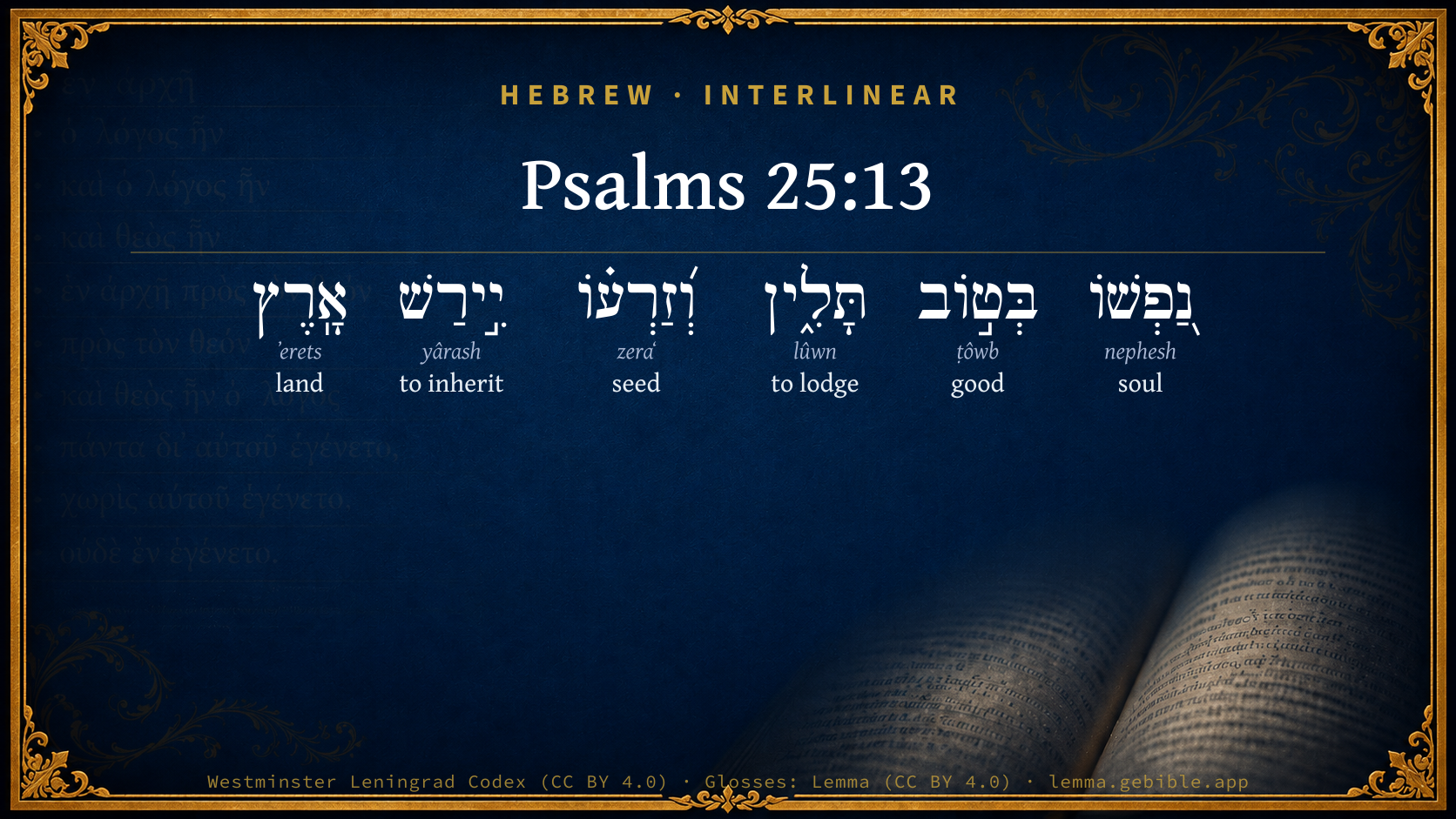
Psalms 25:13

Hebrew (Westminster Leningrad Codex) Psalms 25:13 appears in the Hebrew Old Testament. The text above is from the Westminster Leningrad Codex. Each word links to its Strong’s number, a concise gloss, and parsing drawn from the Open Scriptures Hebrew Bible morphology. Click any word for its full Brown-Driver-Briggs (BDB) entry.
Download image
Cite this verse

Psalms 25:13 (World English Bible). Public Domain. Lemma interlinear Bible study tool, https://lemma.gebible.app/v/psalms/25/13.

Show BibTeX & RIS
BibTeX
RIS
English Translation
His soul shall dwell at ease. His seed shall inherit the land.
World English Bible · Public Domain
Download a study sheet

One document with this verse’s original text, its word-by-word gloss line, the meaning frame, cross-references with their text, attributed commentary, and full source and license credits — printable, and it pastes into notes with its structure intact.

This verse Autodidact and up

Study sheet (.html) Plain text (.txt)

A passage Seminary Student

Up to 50 verses in one chapter. A passage sheet keeps up to 6 commentary sources and 12 cross-references per verse, in the order this page ranks them, and says so on the sheet whenever that leaves anything out. Ask for a single verse and you get the Autodidact verse sheet above.

Everything on this page stays free to read, with no account — the sheet is a download of what is already on screen, not access to it.

Want to remove ads? Support Godless Engineer
Compare translations 3

The same verse in 3 English versions, stacked beneath the original-language interlinear above. Click any original word for its lexicon entry.

Each is an independent rendering of the whole verse — the interlinear is not word-aligned to these translations.

Highlighted words mark where these versions differ — a whole-verse word diff, not a word-by-word alignment.

  • World English Bible Public Domain
    His soul shall dwell at ease. His seed shall inherit the land.
  • King James Version Public Domain
    His soul shall dwell at ease; and his seed shall inherit the earth.
  • unfoldingWord Literal Text CC BY-SA 4.0
    His soul will remain in good, and his seed will inherit the earth.

unfoldingWord Literal Text — © unfoldingWord, licensed CC BY-SA 4.0. Word-aligned USFM3 via Door43 (git.door43.org/unfoldingWord/en_ult).

Versions to compare (up to 4)

3 of 4 selected

Show all 18 translations

Every available English version of this verse, each an independent rendering of the whole verse.

  • World English Bible Public Domain
    His soul shall dwell at ease. His seed shall inherit the land.
  • Berean Standard Bible Public Domain
    His soul will dwell in prosperity, and his descendants will inherit the land.
  • Majority Standard Bible Public Domain
    His soul will dwell in prosperity, and his descendants will inherit the land.
  • King James Version Public Domain
    His soul shall dwell at ease; and his seed shall inherit the earth.
  • American Standard Version (1901) Public Domain
    His soul shall dwell at ease; And his seed shall inherit the land.
  • Revised Version (1885) Public Domain
    His soul shall dwell at ease; and his seed shall inherit the land.
  • Geneva Bible (1599) Public Domain
    His soule shall dwell at ease, and his seede shall inherite the land.
  • Douay-Rheims (1899) Public Domain
    His soul shall dwell in good things: and his seed shall inherit the land.
  • Young's Literal Translation Public Domain
    His soul in good doth remain, And his seed doth possess the land.
  • Literal Standard Version CC BY-SA 4.0
    His soul remains in good, || And his seed possesses the land.
  • Unlocked Literal Bible CC BY-SA 4.0
    His life will go along in goodness; and his descendants will inherit the land.
  • unfoldingWord Literal Text CC BY-SA 4.0
    His soul will remain in good, and his seed will inherit the earth.
  • Darby Bible Public Domain
    His soul shall dwell in prosperity, and his seed shall inherit the earth.
  • World Messianic Bible Public Domain
    His soul will dwell at ease. His offspring will inherit the land.
  • Webster's Bible Public Domain
    His soul shall dwell at ease; and his seed shall inherit the earth.
  • Free Bible Version CC BY-SA 4.0
    They will continue to be prosperous, and their descendants will inherit the land.
  • Bible in Basic English Public Domain
    His soul will be full of good things, and his seed will have the earth for its heritage.
  • JPS Tanakh (1917) Public Domain
    His soul shall abide in prosperity; and his seed shall inherit the land.

Literal Standard Version (2020), Covenant Press — licensed CC BY-SA 4.0. Text via the HelloAO Bible API (eBible.org). Unlocked Literal Bible (unfoldingWord) — licensed CC BY-SA 4.0. Text via the HelloAO Bible API (eBible.org). unfoldingWord Literal Text — © unfoldingWord, licensed CC BY-SA 4.0. Word-aligned USFM3 via Door43 (git.door43.org/unfoldingWord/en_ult). Free Bible Version, Dr. Jonathan Gallagher — licensed CC BY-SA 4.0. Text via the HelloAO Bible API (eBible.org).

Word by word

More ways to search: Search by grammar → Find every occurrence → Compare this word →

Practice this passage: Drill this verse → Learn its vocabulary →

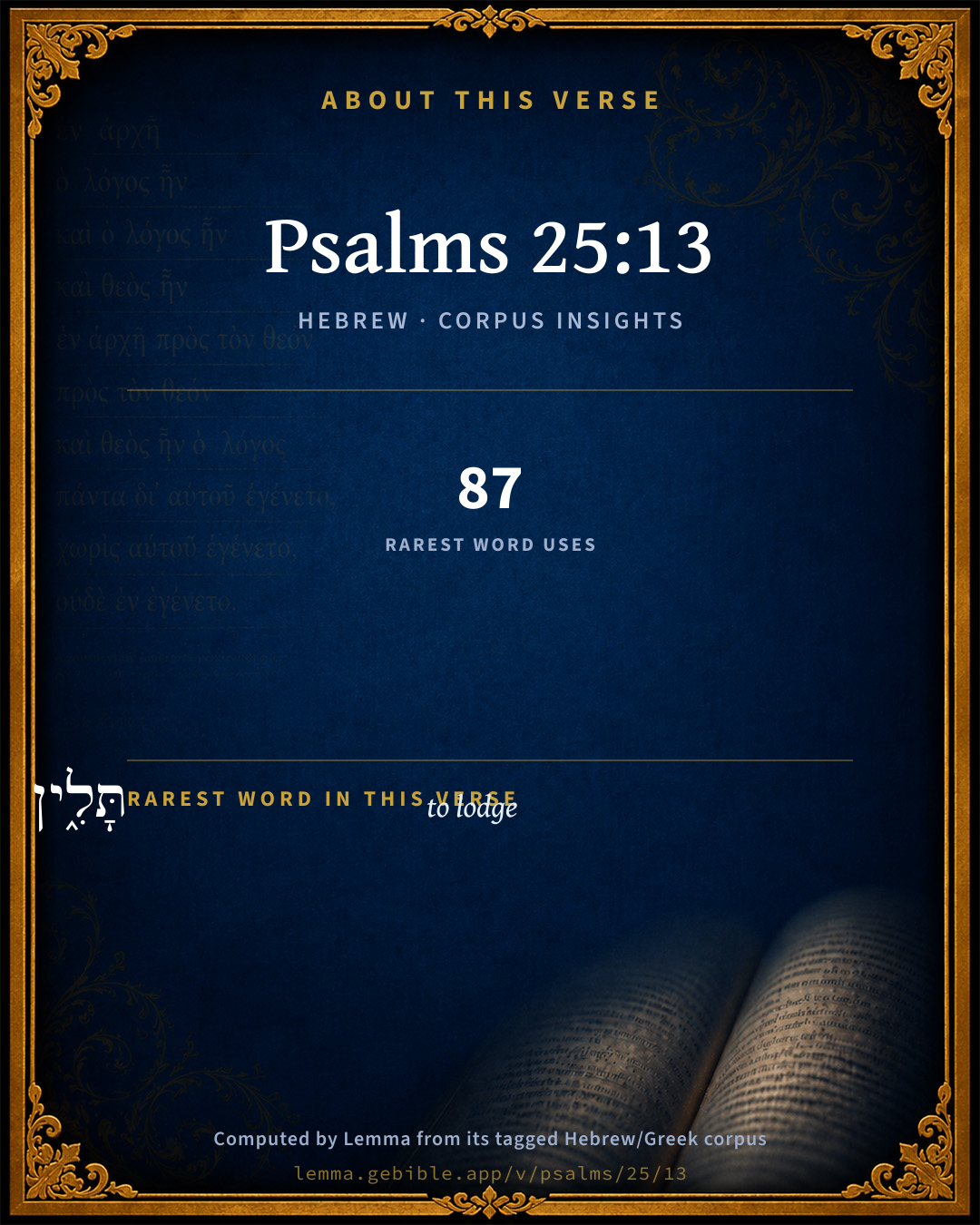
About this verse

These counts appear in no published source. They are computed here, from the morphology-tagged text and Lemma’s own curated glosses. What Lemma adds →

6
words
6
distinct lemmas
Wisdom
section

Grammatical profile

  • 2 verbs
  • 3 nouns
  • 1 adjective

Verb forms

  • תָּלִ֑ין Qal · Imperfect
  • יִ֣ירַשׁ Qal · Imperfect

Hebrew & Septuagint length

In English translation the verse runs 12 words from the Hebrew and 13 from the Septuagint (LXX English) — closely comparable.

A rough comparison of the two English renderings, which tokenize alike — not a word-level alignment.

Word counts can differ between the Hebrew and the Greek without any difference in meaning — e.g. the Hebrew direct-object marker אֵת has no separate Greek word, and Greek often adds the article ὁ.

Cross-references

30

Topical passages linked to Psalms 25:13 in the Treasury of Scripture Knowledge — connected by theme and wording, ordered by reader-vote popularity; previews shown in the World English Bible.

  • Psalms 37:11 But the humble shall inherit the land, And shall delight themselves in the abundance of peace.
  • Proverbs 1:33 But whoever listens to me will dwell securely, And will be at ease, without fear of harm."
  • Proverbs 19:23 The fear of Yahweh leads to life, then contentment; He rests and will not be touched by trouble.
  • Psalms 37:26 All day long he deals graciously, and lends. His seed is blessed.
  • Isaiah 65:23 They shall not labor in vain, nor bring forth for calamity; for they are the seed of the blessed of Yahweh, and their offspring with them.
  • Zephaniah 3:17 Yahweh, your God, is in the midst of you, a mighty one who will save. He will rejoice over you with joy. He will rest in his love. He will rejoice over you with singing.
  • Acts 2:39 For to you is the promise, and to your children, and to all who are far off, even as many as the Lord our God will call to himself."
  • Psalms 69:36 The children also of his servants shall inherit it. Those who love his name shall dwell therein.
  • Psalms 112:2 His seed will be mighty in the land. The generation of the upright will be blessed.
  • Proverbs 29:25 The fear of man proves to be a snare, But whoever puts his trust in Yahweh is kept safe.
  • Jeremiah 32:39 and I will give them one heart and one way, that they may fear me forever, for the good of them, and of their children after them:
  • Ezekiel 34:25–28 I will make with them a covenant of peace, and will cause evil animals to cease out of the land; and they shall dwell securely in the wilderness, and sleep in the woods.
  • Matthew 5:5 Blessed are the gentle, For they shall inherit the earth.
  • Genesis 17:7–10 I will establish my covenant between me and you and your seed after you throughout their generations for an everlasting covenant, to be a God to you and to your seed after you.
  • Deuteronomy 33:26–29 There is none like God, Jeshurun, Who rides on the heavens for your help, In his excellency on the skies.
  • Philippians 4:19 My God will supply every need of yours according to his riches in glory in Christ Jesus.
  • 1 Peter 3:10 For, "He who would love life, And see good days, Let him keep his tongue from evil, And his lips from speaking deceit.
  • Deuteronomy 33:12 Of Benjamin he said, The beloved of Yahweh shall dwell in safety by him; He covers him all the day long, He dwells between his shoulders.
  • Proverbs 20:7 A righteous man walks in integrity. Blessed are his children after him.
  • Isaiah 66:10–14 Rejoice you with Jerusalem, and be glad for her, all you who love her: rejoice for joy with her, all you who mourn over her;
  • Jeremiah 31:12–14 They shall come and sing in the height of Zion, and shall flow to the goodness of Yahweh, to the grain, and to the new wine, and to the oil, and to the young of the flock and of the herd: and their soul shall be as a watered garden; and they shall not sorrow any more at all.
  • Zechariah 9:17 For how great is his goodness, And how great is his beauty! Grain will make the young men flourish, And new wine the virgins.
  • Matthew 11:28–29 "Come to me, all you who labor and are heavily burdened, and I will give you rest.
  • Psalms 31:19 Oh how great is your goodness, Which you have laid up for those who fear you, Which you have worked for those who take refuge in you, Before the sons of men!
  • Psalms 36:8 They shall be abundantly satisfied with the abundance of your house. You will make them drink of the river of your pleasures.
  • Psalms 37:22 For such as are blessed by him shall inherit the land. Those who are cursed by him shall be cut off.
  • Psalms 37:29 The righteous shall inherit the land, And live in it forever.
  • Psalms 63:5 My soul shall be satisfied as with the richest food. My mouth shall praise you with joyful lips,
  • 2 Peter 3:13 But, according to his promise, we look for new heavens and a new earth, in which dwells righteousness.
  • Ezekiel 33:24–26 Son of man, they who inhabit those waste places in the land of Israel speak, saying, Abraham was one, and he inherited the land: but we are many; the land is given us for inheritance.

Cross-references courtesy of OpenBible.info (CC BY 4.0).

Hebrew and Greek witnesses Masoretic Hebrew ↔ Greek Septuagint

The same verse in the two great witnesses to the Old Testament, shown verse-for-verse.

You’re reading Greek Psalm 24 (Hebrew Psalm 25). The Septuagint counts the superscription, so verse numbers can differ from the Hebrew — chapter-level alignment, not verse-by-verse. Numbering follows Rahlfs.

These are two independent witnesses, not word-aligned to each other, and the Septuagint is shown in lemma (dictionary) form.

Hebrew Psalms 25:13 Masoretic · Westminster Leningrad Codex

נַ֭פְשׁוֹ בְּט֣וֹב תָּלִ֑ין וְ֝זַרְע֗וֹ יִ֣ירַשׁ אָֽרֶץ

His soul shall dwell at ease. His seed shall inherit the land.

World English Bible · Public Domain

Greek LXX Greek Psalm 24:13 Septuagint · lemma form

ὁ ψυχή αὐτός ἐν ἀγαθός αὐλίζω καί ὁ σπέρμα αὐτός κληρονομέω γῆ

His soul shall dwell in prosperity; and his seed shall inherit the earth.

LXX2012 (modern English Septuagint) · Public Domain

Hebrew: Westminster Leningrad Codex (CC BY 4.0). Greek: Septuagint (public domain); English from LXX2012 (modern English Septuagint) (Public Domain). How the Septuagint differs from the Hebrew →

Commentary

Notes on Psalms 25:13 from classic Christian and Jewish commentators (each source and its license shown beneath its notes). The classic Christian expositions comment on the surrounding passage and are grouped to its opening verse, so a note may address several verses; the Jewish commentaries on the Tanakh (Rashi and others) are per-verse, so they appear only where the commentator wrote on this verse.

Lemma curates 59 commentaries, every one of them public domain or Creative Commons licensed, each selected and text-cleaned for this edition rather than reprinted as found. About our sources →

Trapp's Complete Commentary

John Trapp

Psa 25:13 His soul shall dwell at ease; and his seed shall inherit the earth.

Ver. 13. His soul shall dwell at ease] Heb. shall lodge in good, even then when his body haply is tossing on his sick bed, and at great unrest, Conquiescet quemadmodum de nocte quiesci solet (Trcmel.). One being asked how he did? answered, My body is weak, my soul is well. He shall be freed from the devil of discontent, and have a blessed self sufficiency; such, and better than he had whom Horace describeth, Epod. 2, Beatus ille qui procul negotiis, &c.; blessed is that man who is far from trouble, such as good Jacob had, when he said, I have enough, my brother, &c. Godliness only hath such a contentedness, 1Ti 6:6.

And his seed shall inherit the earth] God’s love dieth not with the parents; but reviveth in their posterity, 2Sa 7:12.

Eυσεβεων παιδεσσι τα λωια, δυσσεβεων δ ου.

It would be a great stay of mind to us, if God should say of our children, as once David did of Mephibosheth, and afterwards of Chimham, I will take care of them, and see them well provided for. He doth upon the matter say as much and more to every believer.

John Trapp, A Commentary or Exposition upon All the Books of the Old and New Testament (1647–1656) — public domain. Text from a community e-Sword module.

Tyndale Open Study Notes

Tyndale Open Resources

25:13 prosperity: See 23:6. • inherit the land: Unlike the wicked, who will perish (1:6), the godly have a secure future. In the end, God will bless them, and their blessings will endure (see 37:9, 11, 22, 29, 34; Isa 57:13; Matt 5:5).

Tyndale Open Study Notes — © Tyndale Open Resources, licensed CC BY-SA 4.0. Text via the HelloAO Bible API.

Geneva Bible (1599)

Geneva Bible translators

He shall prosper both in spiritual and corporal things.

Geneva Bible (1599) marginal notes — public domain. Text via Bolls.life.

Jamieson, Fausset & Brown

Robert Jamieson, A. R. Fausset & David Brown

inherit the earth--(compare Mat 5:5). The phrase, alluding to the promise of Canaan, expresses all the blessings included in that promise, temporal as well as spiritual.

Jamieson, Fausset & Brown — Commentary Critical and Explanatory on the Whole Bible (1871) — public domain (CC PDM 1.0). Text via the HelloAO Bible API.

Adam Clarke's Commentary

Verse 13. His soul shall dwell at ease] בטוב תלין betob talin, "shall lodge in goodness;" this is the marginal reading in our version; and is preferable to that in the text.

His seed shall inherit] His posterity shall be blessed. For them many prayers have been sent up to God by their pious fathers; and God has registered these prayers in their behalf.

Adam Clarke's Commentary on the Bible (1810–1826) — public domain. Text from a community e-Sword/MySword module.

John Calvin's Commentaries

13. His soul shall dwell in good. If the supreme felicity of man consists in undertaking or attempting nothing except by the warrant of God, it follows that it is also a high and incomparable benefit to have him for our conductor and guide through life, that we may never go astray. But, in addition to this, an earthly blessing is here promised, in which the fruit of the preceding grace is distinctly shown, as Paul also teaches,

“Godliness is profitable unto all things, having promise of the life that now is, and of that which is to come.” (1 Timothy 4:8,)

The sum is, that those who truly serve God are not only blessed as to spiritual things, but are also blessed by him as to their condition in the present life. It is indeed true, that God does not always deal with them according to their desires, and that the blessings which they would wish do not always flow in a certain and uniform manner. On the contrary, it often happens that they are tossed with sickness and trouble, whilst the wicked enjoy prosperity. But we must know, that as often as God withdraws his blessing from his own people, it is for the purpose of awakening them to a sense of their condition, and discovering to them how far removed they still are from the perfect fear of God. And yet, in so far as it is expedient for them, they now enjoy the blessings of God, so that, in comparison of worldly men, and the despisers of God, they are truly happy and blessed, because, even in their greatest poverty, they never lose the assurance that God is present with them; and being sustained by this consolation, they enjoy peace and tranquillity of mind. It is indeed true, that all our miseries proceed from this one source — that by our sins we prevent the divine blessing from flowing down in a uniform course upon us; and yet, amidst such a state of confusion, his grace never ceases to shine forth, so that the condition of the godly is always better than that of others: for although they are not satiated with good things, yet they are continually made to experience a sense of the fatherly favor of God. And to this I am willing to refer the word soul, namely, that, in the reception of the gifts of God, they do not devour them without feeling a sense of their sweetness, but really relish them, so that the smallest competency is of more avail to satisfy them than the greatest abundance is to satisfy the ungodly. Thus, according as every man is contented with his condition, and cheerfully cherishes a spirit of patience and tranquillity, his soul is said to dwell in good. Some interpreters apply this word to dwell or abide to the time of death; but this interpretation is more subtle than solid. The inspired penman rather speaks, as we have already said, of the condition of the present life. Horsley refers the words to the blessedness of a future state. He reads, “His soul shall rest in bliss;” and has the following note: — “תליך, pernoctavit. The words seem to allude to the happy state of the good man’s departed soul, while his posterity prosper in the present world.” That is, the land of Canaan, which God promised to perpetuate to the obedient Israelites and their posterity. “It was promised and given,” says Poole, “as an earnest of the whole covenant of grace and all his promises, and, therefore, is synecdochically put for all of them. The sense is, his seed shall be blessed.”

John Calvin's Commentaries (1540-1563) — public domain. Text from the Calvin Translation Society English edition (1840s-50s) via the Christian Classics Ethereal Library (ccel.org). Calvin's coverage is partial (roughly two-thirds of the Bible); uncommented books and verses are honest gaps, never fabricated. The 19th-century editor's footnotes and remarks are omitted so the notes are faithfully Calvin's own voice.

Ellicott's Commentary for English Readers

(13) Shall dwell.—Literally, shall lodge the night (comp. margin); but here, as in Psa_49:12, with added sense of permanency.

A Bible Commentary for English Readers, edited by Charles John Ellicott (1878–1897) — public domain. Text from a community e-Sword module.

The Cambridge Bible for Schools and Colleges

gen. ed. J. J. S. Perowne

13. Temporal blessings are in store for him. He himself shall continue in prosperity; and his posterity after him shall inherit the land (R.V.), in accordance with the promise to Abraham (Gen_15:7-8), and Israel (Exo_20:12; Lev_26:3 ff.; Deu_4:1; Deu_4:40; &c.). Cp. Psa_37:11; Pro_2:21-22; and the N.T. counterpart, Mat_5:5.

The Cambridge Bible for Schools and Colleges (gen. ed. J. J. S. Perowne; Cambridge University Press, 1878–1918) — public domain. Text from a community e-Sword module.

John Gill's Exposition

His soul shall dwell at ease,.... Or in "goodness" (f), enjoying an affluence of good things, of spiritual blessings in Christ, in whom he dwells by faith; and where he has peace and safety, amidst all the troubles, afflictions, and exercises, he meets with; and where with godliness he has contentment, which is great gain indeed; for, though he may seem to have nothing, he possesses all things; and has all things given him richly to enjoy, even all things pertaining to life and godliness; and at death, when his soul is separated from his body, it shall enter into rest, and be in perfect peace; it shall lie in Abraham's bosom, and in the arms of Jesus, during the night of the grave, until the resurrection morn, when the body will be raised and united to it, and both will dwell in perfect happiness to all eternity;

and his seed shall inherit the earth; that is, those who tread in the same steps, and fear the Lord as he does; these shall possess the good things of this world, which is theirs, in a comfortable way, as their Father's gift, as covenant mercies, and in love; though it may be but a small portion that they have of them; or rather they shall inherit the new heavens and earth, wherein will dwell only righteous persons, meek ones, and such as fear the Lord, Mat 5:5; and this they shall inherit for a thousand years, and afterwards the land afar off, the better country, the ultimate glory to all eternity.

(f) "in bono", Pagninus, Montanus, Musculus, Junius & Tremellius, &c. so Ainsworth.

John Gill's Exposition of the Whole Bible (1746–1763) — public domain (CC PDM 1.0). Text via the HelloAO Bible API.

Albert Barnes' Notes on the Bible

His soul shall dwell at ease - Margin: “shall lodge in goodness.” So the Hebrew. The idea is that of one “at home;” one who finds a comfortable and safe resting place; one who is not a wanderer or a vagrant. The word rendered in the text “at ease,” and in the margin “goodness,” means “good;” and the idea is that of a good or safe condition as compared with that of one who wanders abroad without a shelter, or of one who has lost his way, and has no one to guide him. As contrasted with such an one, he who fears God, and who seeks his guidance and direction, will be like a man in his own comfortable and quiet home. The one is a condition of safety and of ease; the other, a condition of anxiety, doubt, trouble. Nothing could better describe the calmness, peace, and conscious security of the man who has found the truth and who serves God - as compared with the state of that man who has no religion, no fear of God, no hope of heaven.

And his seed - His posterity; his family. “Shall inherit the earth.” Originally this promise referred to the land of Canaan, as a promise connected with obeying the law of God: Exo 20:12. It came then to be synonymous with outward worldly prosperity; with length of days, and happiness in the earth. See it explained in the notes at Mat 5:5.

Albert Barnes' Notes on the Bible (1834–1885) — public domain. Text from a community e-Sword/MySword module.

Matthew Poole's English Annotations

Shall dwell, Heb. shall lodge, i.e. continue, as this word signifies, Job 17:2; Pro 19:23. It notes the constancy and stability of his happiness, both whilst he lives, and when he is dead; which the next clause seems to suppose.

At ease, Heb. in good, i.e. in the possession and enjoyment of the true good.

The earth, or, the land, to wit, Canaan; which was promised and given, as an earnest of the whole covenant of grace, and all its promises, and therefore is synecdochically put for all of them. The sense is, his seed shall be blessed.

Matthew Poole's English Annotations on the Holy Bible (1683–1685) — public domain. Text from a community e-Sword/MySword module.

The Treasury of David

Charles H. Spurgeon

Ver. 13. He who fears God has nothing else to fear. His soul shall dwell at ease. He shall lodge in the chamber of content. One may sleep as soundly in the little bed in the corner as in the Great Bed of Ware; it is not abundance but content that gives true ease. Even here, having learned by grace both to abound and be empty, the believer dwells at ease; but how profound will be the ease of his soul for ever! There he will enjoy the otium cum dignitate; ease and glory shall go together. Like a warrior whose battles are over, or a husbandman whose barns are full, his soul shall take its ease, and be merry for ever. His seed shall inherit the earth. God remembers Isaac for the sake of Abraham, and Jacob for the sake of Isaac. Good men's sons have a goodly portion to begin the world with, but many of them, alas! turn a father's blessing into a curse. The promise is not broken because in some instances men wilfully refuse to receive it; moreover, it is in its spiritual meaning that it now holds good; our spiritual seed do inherit all that was meant by "the earth, "or Canaan; they receive the blessing of the new covenant. May the Lord make us the joyful parents of many spiritual children, and we shall have no fears about their maintenance, for the Lord will make each one of them princes in all the earth.

Ver. 13. His soul shall dwell at ease; and his seed shall inherit the earth. The holy fear of God shall destroy all sinful fears of men, even as Moses' serpent devoured all those serpents of the magicians. The fear of God hath this good effect, that it makes other things not to be feared; so that the soul of him that feareth the Lord doth dwell, as in rest, so in goodness; as in peace, so in patience, till this moment of time be swallowed up in the fulness of eternity, and he change his earthly dwelling for an heavenly mansion, and his spiritual peace for an everlasting blessedness. Robert Mossom.

Ver. 13. His soul shall dwell at ease. Shall tarry in good things, as it is in the Vulgate. Unlike the soul of Adam, who, being put into possession of the delights of paradise, tarried there but a few days or hours. Gerhohus, quoted by J. M. Neale.

Ver. 13. His soul shall dwell at ease. He expresses with great sweetness spiritual delectation, when he says, "His soul shall tarry in good things." For whatever is carnally sweet yields without doubt a delectation for the time to such as enjoy it, but cannot tarry long with them; because, while by its taste it provokes appetite, by its transit it cheats desire. But spiritual delights, which neither pass away as they are tasted, nor decrease while they refresh, nor cloy while they satiate, can tarry for ever with their possessors. Hugo Victorinus (1130), quoted by J. M. Neale.

Ver. 13 (first clause). In the reception of the gifts of God, they do not devour them without feeling a sense of their sweetness, but really relish them, so that the smallest competency is of more avail to satisfy them that the greatest abundance is to satisfy the ungodly. Thus, according as every man is contented with his condition, and cheerfully cherishes a spirit of patience and tranquillity, his soul is said to dwell in good. John Calvin.

Ver. 13. "The earth, "or the land, to wit Canaan; which was promised and given, as an earnest of the whole covenant of grace, and all its promises, and therefore it is synecdochically put for all of them. The sense is, his seed shall be blessed. Matthew Poole.

Ver. 13. A man at ease for time and eternity.

Psalms 25:14*

Charles H. Spurgeon's The Treasury of David (1869–1885) — public domain. Psalms only. Text from a community e-Sword/MySword module.

Whedon's Commentary on the Bible

Daniel D. Whedon

13. His soul shall dwell at ease—Literally, his soul shall abide, or dwell, in goodness, or blessedness. If this does not directly relate to immortal blessedness, as many Jewish and Christian interpreters have supposed, it certainly implies it, for, by the connexion and subject, the goodness or blessedness, which is the reward of “fearing God,” must be as enduring as that “fear;” and goodness, (tobh,) in such connexions as in the text, is the standing word for that blessedness which is the end and design of man’s being. Besides, in the parallelism, “abiding in blessedness” and “inheriting the earth” are in contrast, both as to state and time; while the righteous are in blessedness, their seed shall inherit the earth.

Daniel D. Whedon (gen. ed.), Commentary on the Old and New Testaments (1874–1909) — public domain. Text from a community e-Sword module.

The Pulpit Commentary

His soul shall dwell at case; rather, his soul shall dwell in bliss; i.e. he shall enjoy, while on earth, blessings of every kind. And his seed shall inherit the earth. His posterity after him shall be continued upon the earth, and shall prosper. (comp. Psa_37:11, Psa_37:22, Psa_37:29) There is a tendency in righteousness to "inherit the earth," only held in check by accidental and (it may be) temporary circumstances (see Butler"s" Analogy," pt. 1. ch. 3, pp. 78, 79).

The Pulpit Commentary (1880–1919), ed. H.D.M. Spence-Jones & Joseph S. Exell — public domain. Text from a community e-Sword module.

John Wesley's Explanatory Notes

At ease - Hebrew. in Good; in the possession and enjoyment of the true good. The land - Canaan; which was given as an earnest of the whole Covenant of Grace, and all its promises.

John Wesley, Explanatory Notes Upon the Whole Bible (1754–1765) — public domain. Text via the GEBible commentary corpus.

Keil & Delitzsch

C. F. Keil & F. Delitzsch

The verb לין (לוּן), probably equivalent to ליל (from ליל) signifies to tarry the night, to lodge. Good, i.e., inward and outward prosperity, is like the place where such an one turns in and finds shelter and protection. And in his posterity will be fulfilled what was promised to the patriarchs and to the people delivered from Egypt, viz., possession of the land, or as this promise runs in the New Testament, of the earth, Mat 5:5 (cf. Psa 37:11), Rev 5:10.

Keil & Delitzsch — Biblical Commentary on the Old Testament (1861–1891) — public domain (CC PDM 1.0). Text via the HelloAO Bible API. (Old Testament only.)

J. A. Alexander on Psalms

Joseph Addison Alexander

13. His soul in good shall lodge, and his seed shall possess the land. The parallelism between soul and seed seems to shew that by his soul we are to understand himself, for which the Hebrew has no appropriate expression. The promise, then, includes both himself and his posterity. To lodge, to be at home, to dwell at ease, and by implication, to abide or continue undisturbed. In good, not goodness, but good fortune or prosperity. The verb, translated shall possess, denotes specifically to inherit, or possess as an inheritance, i. e. from generation to generation, in perpetual succession. The land, to wit, the land of Canaan; and as this was the standing promise of the law, uttered even in the decalogue (Exo 20:12), it became a formula for all the blessings implicitly embraced in the promise of Canaan to the ancient Israel, and is so used even by our Lord himself, (Mat 5:5.)

Joseph Addison Alexander, The Psalms Translated and Explained (1850) — public domain. Text from a community e-Sword module.

Rashi

Rabbi Shlomo Yitzchaki (Rashi)

His soul shall abide in prosperity When he abides in the grave, his soul shall abide in prosperity.

Rashi on the Tanakh — English translations: “The Judaica Press complete Tanach with Rashi, translated by A. J. Rosenberg” (CC BY 4.0); “Pentateuch with Rashi's commentary by M. Rosenbaum and A.M. Silbermann, 1929-1934” (public domain); “The Metsudah Tanach series, Lakewood, N.J” (CC BY 4.0); and “The Book of Joshua, Metsudah Publications, 1997” (CC BY 4.0). Text via Sefaria.

Lesson kit

Teaching starters — assembled from the data on this page, not authored interpretation. Every prompt links to the verse data it draws on. Edit before teaching.

Psalms, in the Wisdom, opens this verse with 6 words (6 distinct Hebrew lemmas). Its most distinctive word is lûwn (“to lodge”). A historical commentator’s framing appears above. Read the whole chapter for the surrounding context.

Discussion questions

  1. The word lûwn carries the sense “to lodge.” How does it shape the verse?
  2. How does Psalms 37:11, which shares this passage’s theme, read alongside this verse?
  3. These translations render this verse differently; the difference is in the English rendering, not the original. What questions does that raise?
  4. «תָּלִ֑ין» is a Qal Imperfect verb. How does that grammatical form shape the action described?
  5. Compare how Trapp's Complete Commentary and Tyndale Open Study Notes read this verse. Where do they agree or differ?

Things to notice

Reading settings

Reading text

Shown beneath each verse's original-language words.

Old Testament
Old Testament edition

Read the OT as the Masoretic Hebrew (MT) or the Greek Septuagint (LXX).

English shown for the Greek Septuagint (in the Hebrew ↔ Greek comparison).

Comparing translations? Open the Compare panel on any verse page to stack up to four side by side.