
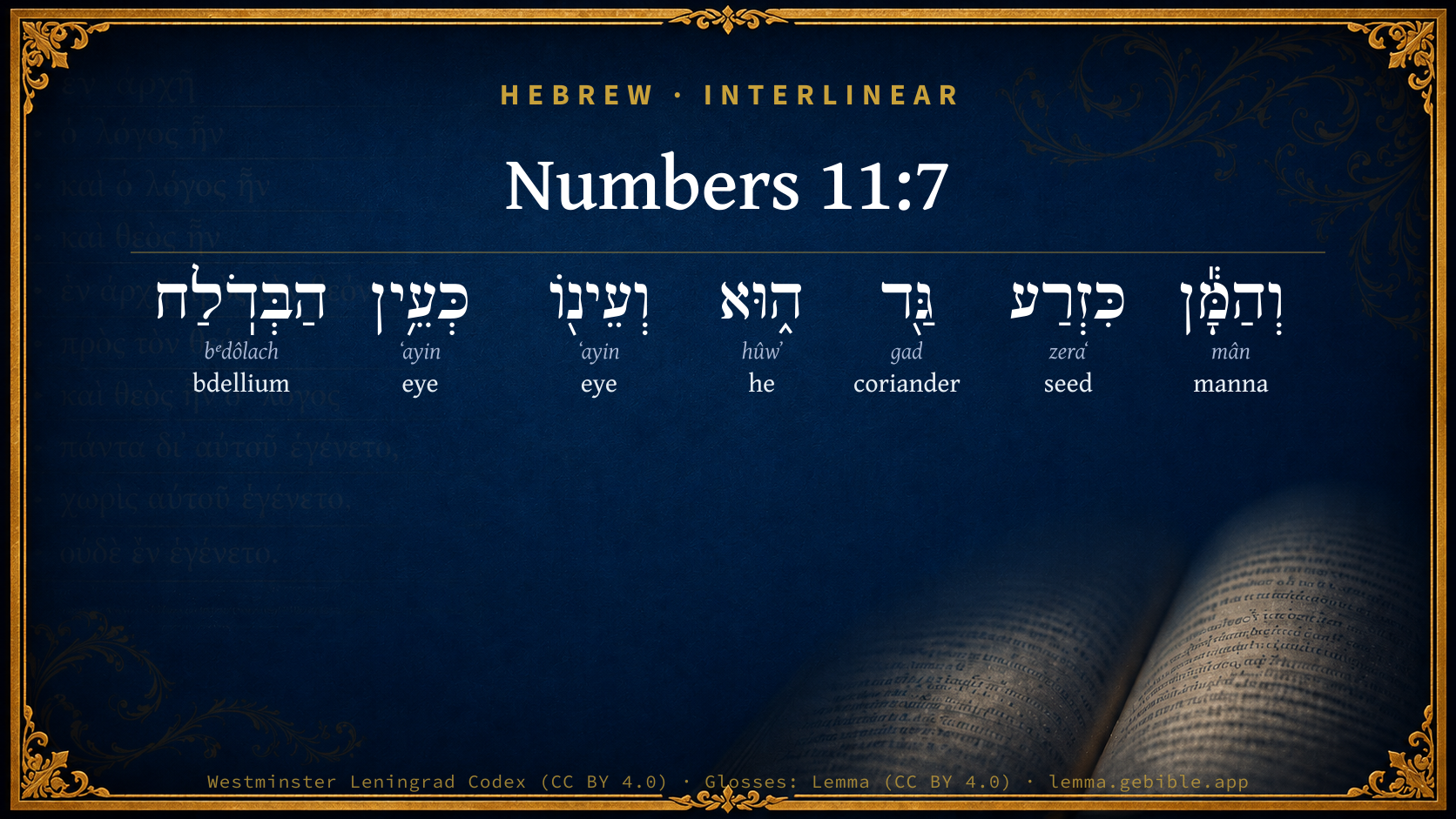
Numbers 11:7

Hebrew (Westminster Leningrad Codex) Numbers 11:7 appears in the Hebrew Old Testament. The text above is from the Westminster Leningrad Codex. Each word links to its Strong’s number, a concise gloss, and parsing drawn from the Open Scriptures Hebrew Bible morphology. Click any word for its full Brown-Driver-Briggs (BDB) entry.
Download image
Cite this verse

Numbers 11:7 (World English Bible). Public Domain. Lemma interlinear Bible study tool, https://lemma.gebible.app/v/numbers/11/7.

Show BibTeX & RIS
BibTeX
RIS
English Translation
The manna was like coriander seed, and the appearance of it as the appearance of bdellium.
World English Bible · Public Domain
Download a study sheet

One document with this verse’s original text, its word-by-word gloss line, the meaning frame, cross-references with their text, attributed commentary, and full source and license credits — printable, and it pastes into notes with its structure intact.

This verse Autodidact and up

Study sheet (.html) Plain text (.txt)

A passage Seminary Student

Up to 50 verses in one chapter. A passage sheet keeps up to 6 commentary sources and 12 cross-references per verse, in the order this page ranks them, and says so on the sheet whenever that leaves anything out. Ask for a single verse and you get the Autodidact verse sheet above.

Everything on this page stays free to read, with no account — the sheet is a download of what is already on screen, not access to it.

Want to remove ads? Support Godless Engineer
Compare translations 3

The same verse in 3 English versions, stacked beneath the original-language interlinear above. Click any original word for its lexicon entry.

Each is an independent rendering of the whole verse — the interlinear is not word-aligned to these translations.

Highlighted words mark where these versions differ — a whole-verse word diff, not a word-by-word alignment.

  • World English Bible Public Domain
    The manna was like coriander seed, and the appearance of it as the appearance of bdellium.
  • King James Version Public Domain
    And the manna was as coriander seed, and the color thereof as the color of bdellium.
  • unfoldingWord Literal Text CC BY-SA 4.0
    And the manna, it like the seed of coriander, and its eye like the eye of bdellium.

unfoldingWord Literal Text — © unfoldingWord, licensed CC BY-SA 4.0. Word-aligned USFM3 via Door43 (git.door43.org/unfoldingWord/en_ult).

Versions to compare (up to 4)

3 of 4 selected

Show all 18 translations

Every available English version of this verse, each an independent rendering of the whole verse.

  • World English Bible Public Domain
    The manna was like coriander seed, and the appearance of it as the appearance of bdellium.
  • Berean Standard Bible Public Domain
    Now the manna resembled coriander seed, and its appearance was like that of gum resin.
  • Majority Standard Bible Public Domain
    Now the manna resembled coriander seed, and its appearance was like that of gum resin.
  • King James Version Public Domain
    And the manna was as coriander seed, and the color thereof as the color of bdellium.
  • American Standard Version (1901) Public Domain
    And the manna was like coriander seed, and the appearance thereof as the appearance of bdellium.
  • Revised Version (1885) Public Domain
    And the manna was like coriander seed, and the appearance thereof as the appearance of bdellium.
  • Geneva Bible (1599) Public Domain
    (The Man also was as coriander seede, and his colour like the colour of bdelium.
  • Douay-Rheims (1899) Public Domain
    A Now the manna was like coriander seed, of the colour of bdellium.
  • Young's Literal Translation Public Domain
    And the manna is as coriander seed, and its aspect as the aspect of bdolach;
  • Literal Standard Version CC BY-SA 4.0
    And the manna is as coriander seed, and its aspect as the aspect of bdellium;
  • Unlocked Literal Bible CC BY-SA 4.0
    Manna was like coriander seed. It looked like resin.
  • unfoldingWord Literal Text CC BY-SA 4.0
    And the manna, it like the seed of coriander, and its eye like the eye of bdellium.
  • Darby Bible Public Domain
    And the manna was as coriander seed, and its appearance as the appearance of bdellium.
  • World Messianic Bible Public Domain
    The manna was like coriander seed, and it looked like bdellium.
  • Webster's Bible Public Domain
    And the manna was as coriander-seed, and the color of it as the color of bdellium.
  • Free Bible Version CC BY-SA 4.0
    Manna looked like coriander seeds, light in color like gum resin.
  • Bible in Basic English Public Domain
    Now the manna was like a seed of grain, like small clear drops.
  • JPS Tanakh (1917) Public Domain
    Now the manna was like coriander seed, and the appearance thereof as the appearance of bdellium.

Literal Standard Version (2020), Covenant Press — licensed CC BY-SA 4.0. Text via the HelloAO Bible API (eBible.org). Unlocked Literal Bible (unfoldingWord) — licensed CC BY-SA 4.0. Text via the HelloAO Bible API (eBible.org). unfoldingWord Literal Text — © unfoldingWord, licensed CC BY-SA 4.0. Word-aligned USFM3 via Door43 (git.door43.org/unfoldingWord/en_ult). Free Bible Version, Dr. Jonathan Gallagher — licensed CC BY-SA 4.0. Text via the HelloAO Bible API (eBible.org).

Word by word

More ways to search: Search by grammar → Find every occurrence → Compare this word →

Practice this passage: Drill this verse → Learn its vocabulary →

About this verse

These counts appear in no published source. They are computed here, from the morphology-tagged text and Lemma’s own curated glosses. What Lemma adds →

7
words
6
distinct lemmas
Pentateuch
section

Notable vocabulary

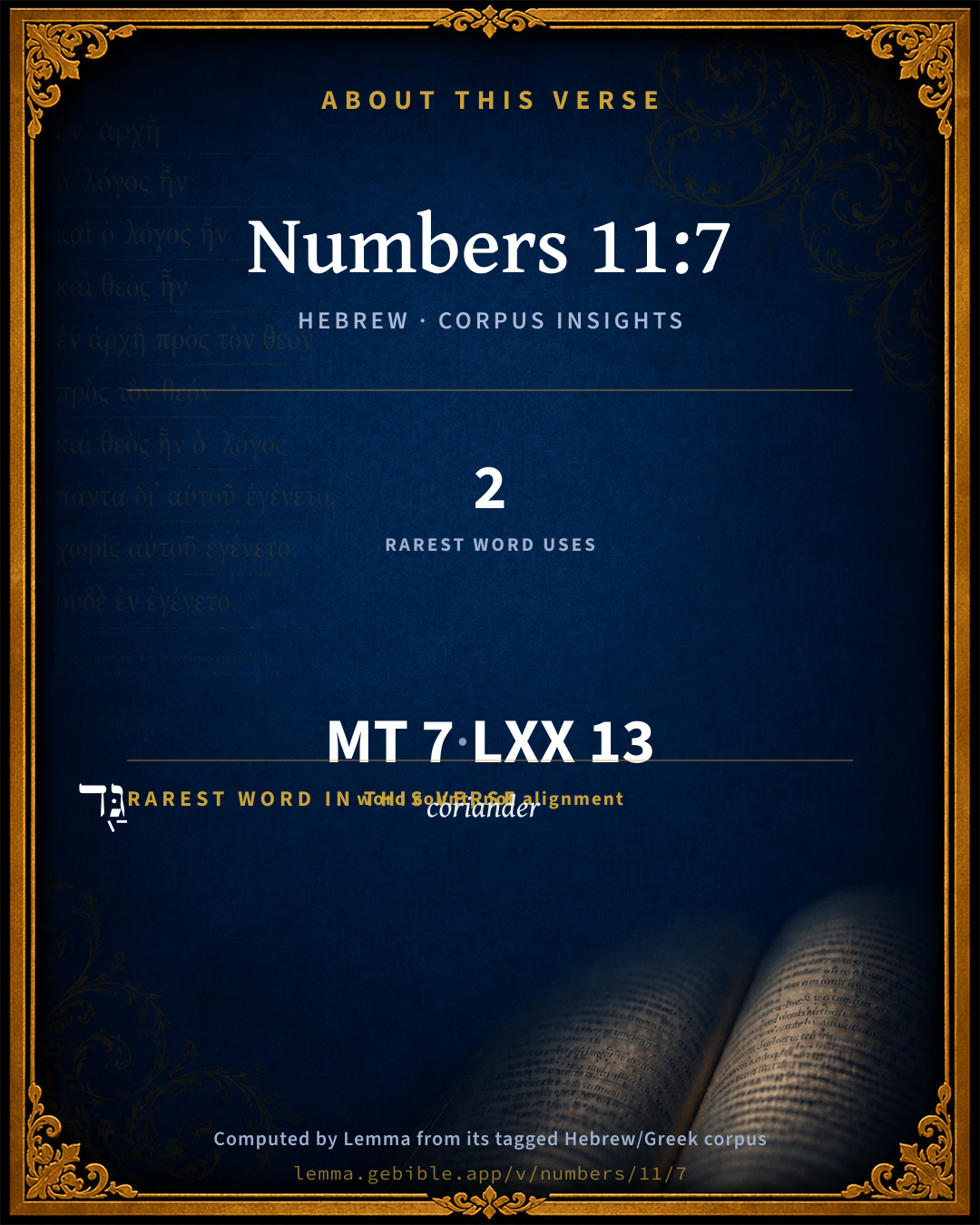
The rarest word here is גַּ֖ד coriander H1407 — appearing just 2 times in the whole Hebrew Bible.

Shared distinctive vocabulary

גַּ֖ד coriander H1407 occurs in 2 verses of the Hebrew Bible. Also found in:

Grammatical profile

  • 6 nouns
  • 1 pronoun

Repetition

A word recurs within this verse — often emphatic in Hebrew:

  • וְעֵינ֖וֹ eye H5869 ×2

Hebrew & Septuagint length

In English translation the verse runs 16 words from the Hebrew and 16 from the Septuagint (LXX English) — the same length.

A rough comparison of the two English renderings, which tokenize alike — not a word-level alignment.

Word counts can differ between the Hebrew and the Greek without any difference in meaning — e.g. the Hebrew direct-object marker אֵת has no separate Greek word, and Greek often adds the article ὁ.

In the original languages it is 7 Hebrew tokens and 13 Greek tokens — but the two are counted differently (Hebrew bundles its prefixes and suffixes into one token; the Greek is in lemma form), so that isn’t a like-for-like length.

Cross-references

5

Topical passages linked to Numbers 11:7 in the Treasury of Scripture Knowledge — connected by theme and wording, ordered by reader-vote popularity; previews shown in the World English Bible.

  • Exodus 16:31 The house of Israel called the name of it Manna, and it was like coriander seed, white; and its taste was like wafers with honey.
  • Genesis 2:12 and the gold of that land is good. There is aromatic resin and the onyx stone.
  • Exodus 16:14–15 When the dew that lay had gone, behold, on the surface of the wilderness was a small round thing, small as the hoar-frost on the ground.
  • 1 Corinthians 1:23–24 but we preach Christ crucified; a stumbling block to Jews, and foolishness to Greeks,
  • Revelation 2:17 He who has an ear, let him hear what the Spirit says to the assemblies. To him who overcomes, to him I will give of the hidden manna, and I will give him a white stone, and on the stone a new name written, which no one knows but he who receives it.

Cross-references courtesy of OpenBible.info (CC BY 4.0).

Hebrew and Greek witnesses Masoretic Hebrew ↔ Greek Septuagint

The same verse in the two great witnesses to the Old Testament, shown verse-for-verse.

These are two independent witnesses, not word-aligned to each other, and the Septuagint is shown in lemma (dictionary) form.

Hebrew Numbers 11:7 Masoretic · Westminster Leningrad Codex

וְהַמָּ֕ן כִּזְרַע גַּ֖ד ה֑וּא וְעֵינ֖וֹ כְּעֵ֥ין הַבְּדֹֽלַח

The manna was like coriander seed, and the appearance of it as the appearance of bdellium.

World English Bible · Public Domain

Greek LXX Numbers 11:7 Septuagint · lemma form

ὁ δέ μαννα ὡσεί σπέρμα κόριον εἰμί καί ὁ εἶδος αὐτός εἶδος κρύσταλλος

And the manna is as coriander seed, and the appearance of it the appearance of hoarfrost.

LXX2012 (modern English Septuagint) · Public Domain

On this verse, Whedon's Commentary on the Bible discusses the Septuagint’s reading. Read the note in Commentary ↓

Hebrew: Westminster Leningrad Codex (CC BY 4.0). Greek: Septuagint (public domain); English from LXX2012 (modern English Septuagint) (Public Domain). How the Septuagint differs from the Hebrew →

Targum (Aramaic paraphrase)

2

The Targum is the ancient Jewish Aramaic paraphrase of the Hebrew Scriptures — an interpretive translation, not the Hebrew text itself. Onkelos (literal) and Pseudo-Jonathan (expansive) render the Torah, and Jonathan the Prophets. Coverage is partial: where no permissively-licensed English translation exists for a verse, only the Aramaic is shown. This is verse-level text, not a word-by-word alignment to the Hebrew.

  1. Targum Onkelos Torah (Genesis–Deuteronomy)
    וּמַנָא כְּבַר זְרַע גִדָא הוּא וְחֶזְוֵהּ כְּחֵזוּ בְדֹלְחָא

    (no public-domain English translation for this verse)

    Targum Onkelos — Aramaic: “Onkelos Genesis” (public domain); “Onkelos Exodus” (public domain); “Onkelos Leviticus” (public domain); “Onkelos Numbers” (public domain); “Onkelos Deuteronomy” (public domain). English: “Sefaria Community Translation” (CC0 1.0 (public-domain dedication)); “J.W. Etheridge. The Targums of Onkelos and Jonathan Ben Uzziel on the Pentateuch. London: Longmans, Green, 1862” (public domain). Text via Sefaria.

  2. Targum Pseudo-Jonathan Torah (Genesis–Deuteronomy)
    חֲבַל עַל עַמָא דְמֵיכְלֵיהוֹן לְחֵים שְׁמַיָא וּמִתְרַעֲמִין דְמַנָא דְמוּיֵהּ כִּזְרַע כּוּסְבַּר חֲזוֹר כַּד נָחִית מִן שְׁמַיָא וְכַד הֲוָה קַדִישׁ חֵיזְוֵיהּ הֵי כְּחֵיזוּ בִּידַלְחָא

    Alas for the people whose food is bread from the heavens! And so murmured they, because the manna was like coriander-seed, round, when it came down from the heavens, and when it had been sanctified its appearance was as the likeness of Bedilcha.

    Targum Pseudo-Jonathan — Aramaic: “Targum Jonathan on Genesis” (public domain); “Targum Jonathan on Exodus” (public domain); “Targum Jonathan on Leviticus” (public domain); “Targum Jonathan on Numbers” (public domain); “Targum Jonathan on Deuteronomy” (public domain). English: “The Targum of Jonathan ben Uzziel, trans. J. W. Etheridge, London, 1862” (public domain). Text via Sefaria.

Commentary

Notes on Numbers 11:7 from classic Christian and Jewish commentators (each source and its license shown beneath its notes). The classic Christian expositions comment on the surrounding passage and are grouped to its opening verse, so a note may address several verses; the Jewish commentaries on the Tanakh (Rashi and others) are per-verse, so they appear only where the commentator wrote on this verse.

Lemma curates 59 commentaries, every one of them public domain or Creative Commons licensed, each selected and text-cleaned for this edition rather than reprinted as found. About our sources →

Trapp's Complete Commentary

John Trapp

Num 11:7 And the manna [was] as coriander seed, and the colour thereof as the colour of bdellium.

Ver. 7. And the manna.] {See Trapp on "Exo 16:14"} {See Trapp on "Exo 16:31"} There was therefore no such cause they should so loathe it.

Was as coriander seed.] Small, but full of sweetness and nourishment. This might be some cause of Moses’ undecayedness. {Deu 34:7}

As the colour of bdellium.] A kind of transparent and precious gum.

John Trapp, A Commentary or Exposition upon All the Books of the Old and New Testament (1647–1656) — public domain. Text from a community e-Sword module.

Joseph Benson's Commentary

Num 11:7-8. As coriander-seed — Not for colour, for that is black, but for shape and figure. Bdellium — Is either the gum of a tree, of a white and bright colour, or rather a gem or precious stone, as the Hebrew doctors take it; and particularly a pearl, wherewith the manna manifestly agrees both in its colour, which is white, (Exo 16:14,) and in its figure, which is round. Fresh oil — Or, of the most excellent oil; or, of cakes made with the best oil, the word cakes being easily supplied out of the foregoing member of the verse; or, which is not much different, like wafers made with honey, as it is said, Exo 16:31. The nature and use of manna are here thus particularly described, to show the greatness of their sin in despising such excellent food.

Joseph Benson's Commentary on the Old and New Testaments (1811–1818) — public domain. Text from a community e-Sword module.

Tyndale Open Study Notes

Tyndale Open Resources

11:7-9 The manna has often been explained as one of various edible substances that occur naturally (but see Deut 8:3); even so, its quantity and duration were miraculous.

Tyndale Open Study Notes — © Tyndale Open Resources, licensed CC BY-SA 4.0. Text via the HelloAO Bible API.

Geneva Bible (1599)

Geneva Bible translators

Which is a white pearl, or precious stone.

Geneva Bible (1599) marginal notes — public domain. Text via Bolls.life.

Adam Clarke's Commentary

Verse 7. The manna was as coriander seed] Probably this short description is added to show the iniquity of the people in murmuring, while they had so adequate a provision. But the baseness of their minds appears in every part of their conduct.

About the bdellium of the ancients the learned are not agreed; and I shall not trouble the reader with conjectures. See Clarke on Ge 2:12. Concerning the manna, see the notes on Ex 16:1-36.

Adam Clarke's Commentary on the Bible (1810–1826) — public domain. Text from a community e-Sword/MySword module.

Ellicott's Commentary for English Readers

(7) And the manna was . . . —The design of the description of the manna in this place (comp. Exo_16:14; Exo_16:31, and Notes in loc.; also Article Manna, in “Smith’s Dictionary of the Bible”) was probably to exhibit in its just light the sinfulness of the Israelites in repining at the merciful provision which God had made for the supply of their wants. The dissatisfaction of the Israelites with the sweet bread of heaven, and their craving after the more savoury and more stimulating food of Egypt may be regarded as typical of man’s natural repugnance to the spiritual food which is provided in the Gospel, and his restless cravings after the pleasures of the world.

A Bible Commentary for English Readers, edited by Charles John Ellicott (1878–1897) — public domain. Text from a community e-Sword module.

The Cambridge Bible for Schools and Colleges

gen. ed. J. J. S. Perowne

7. coriander seed] It is rather the fruit of the coriander, which is about the size of a pepper-corn. Cf. Exo_16:14; Exo_16:31. In the former of these verses it is described as ‘a small scale-like thing, small as the hoar frost.’

bdellium] A resinous substance of a pale yellowish colour. In Exod. the manna is ‘white.’

7–9. A parenthetical description of the manna.

The Cambridge Bible for Schools and Colleges (gen. ed. J. J. S. Perowne; Cambridge University Press, 1878–1918) — public domain. Text from a community e-Sword module.

John Gill's Exposition

And the manna was as coriander seed,.... Not in colour, for that is black or darkish, whereas the manna was white, as is generally observed; of which See Gill on Exo 16:31; however it might be like the coriander, because of its form and figure, being round, and because of its quantity, being small, Exo 16:14; Some think the mustard seed is meant, as Aben Ezra observes, which is the least of all seeds; it seems that the manna fell in small round grains, like to such seed. This, with what follows, is observed, to expose the folly and ingratitude of the Israelites, that having such bread from heaven, angels food, that they should slight it, and hanker after other food:

and the colour thereof as the colour of bdellium; not an aromatic gum, which Pliny (k) speaks of, which is clear as wax, for that is black or blackish, and not white as the manna; besides, this should be read, not "bdellium", but "bdeloah", and is a precious stone, and, according to Bochart, the pearl; so Ben Melech observes, that it is a precious stone; some say the diamond, and others a round white stone, which they bore and join stones together, and make a chain of, he doubtless means a pearl necklace; though Jarchi says it is the crystal, and so the Jewish writers commonly; See Gill on Gen 2:12; hence it appears the manna was very pleasant to look at, being of a round form, and of a pearl or crystal colour.

(k) Nat. Hist. l. 12. c. 9.

John Gill's Exposition of the Whole Bible (1746–1763) — public domain (CC PDM 1.0). Text via the HelloAO Bible API.

Haydock's Catholic Bible Commentary

Bdellium. Bdellium, according to Pliny, ([Natural History?] lib. xxi. chap. 9,) was of the colour of a man’s nail, white and bright; (Challoner) or like wax, ([Natural History?] lib. xii. 9,) between white and yellow. It might resemble a tarnished pearl or ivory in colour, and coriander-seed in shape.

George Leo Haydock (1774–1849), Haydock's Catholic Family Bible and Commentary, 1859 edition — public domain. Excludes Psalms (Douay-Rheims chapter numbering differs from Protestant) and Deuterocanonical books (Catholic canon only).

Matthew Poole's English Annotations

As coriander seed; not for colour, for that is black, but for shape and figure.

Bdellium is either,

1. The gum of a tree, of a white and bright colour; or rather,

2. A gem or precious stone, as the Hebrew doctors take it; and particularly a pearl, as some render it, wherewith the manna doth manifestly agree both in its colour, which is white, Exo 16:14, and in its figure, which is round. See more on Gen 2:12.

Matthew Poole's English Annotations on the Holy Bible (1683–1685) — public domain. Text from a community e-Sword/MySword module.

Whedon's Commentary on the Bible

Daniel D. Whedon

7. Manna — See Exo_16:14-15, and Jos_5:12, notes. The coriander is found in Egypt, Persia, and India. It has a round, tall stalk, white or reddish flowers, and grayish, spicy seeds used by confectioners and druggists. It grows wild in Egypt and Palestine. Tristram found it in the valley of the Jordan. It is a spice to bread in the East, and an aroma to sweetmeats. Bdellium occurs only here and in Gen_2:12. It is impossible to say whether it is a mineral, (beryl or crystal, as in the Septuagint,) animal, as pearl, for which some of the Jewish doctors contend, or vegetable, as an aromatic exudation.

Daniel D. Whedon (gen. ed.), Commentary on the Old and New Testaments (1874–1909) — public domain. Text from a community e-Sword module.

The Pulpit Commentary

The manna was as coriander seed. On the name and the nature of the manna see Exo_16:31. It is commonly supposed that the brief description here inserted was intended to show the unreasonableness of the popular complaints. There is no trace whatever of any such purpose. So far as the description conveys fresh information, it was simply suggested by the occurrence of the word "manna," according to the artless style of the narrative. If any moral purpose must be assigned to this digression, it would rather be to suggest that the people had some real temptation to complain. It is often forgotten that, although the manna was supernatural, at least as to the amount and regularity of its supply, yet as an article of food it contained no supernatural elements. If we had to live upon nothing but cakes flavored with honey or with olive oil, it is certain that we should soon find them pall upon our appetite. To the eye of the Psalmist the manna appeared as angels" food; (Psa_78:25) but then the Psalmist had not lived on manna every day for a year. We have to remember, in this as in many other cases, that the Israelites would not be "our ensamples" (tupoi hmwn , 1Co_10:6) if they had not succumbed to real temptations. As the colour of bdellium. See on Gen_2:12. As no one knows anything at all about bdellium, this adds nothing to our knowledge of the manna. The Septuagint has here eidov krustallou , "the appearance of ice," or perhaps "of hoar-frost." As it translates bdellium in Gen_2:12 by anyrax (carbuncle), it is probable that the comparison to ice here is due to some tradition about the manna. Taking this passage in connection with Exo_16:31, we may reasonably conjecture that it was of an opalescent white, the same colour probably which is mentioned in connection with manna in Rev_2:17.

The Pulpit Commentary (1880–1919), ed. H.D.M. Spence-Jones & Joseph S. Exell — public domain. Text from a community e-Sword module.

John Wesley's Explanatory Notes

As coriander-seed - Not for colour, for that is black, but for shape and figure. Bdellium - Is either the gum of a tree, of a white and bright colour, or rather a gem or precious stone, as the Hebrew doctors take it; and particularly a pearl wherewith the Manna manifestly agrees both in its colour, which is white, Exod. xvi, 14, and in its figure which is round.

John Wesley, Explanatory Notes Upon the Whole Bible (1754–1765) — public domain. Text via the GEBible commentary corpus.

unfoldingWord translationNotes

Door43 World Missions Community

coriander seed

Coriander is also known as cilantro. This seed serves as a spice when dried.

resin

This is a sticky substance with a pale yellow color.

translationWords

olive

oil

unfoldingWord translationNotes — © Distant Shores Media and the Door43 World Missions Community, licensed CC BY-SA 4.0. Source: git.door43.org/Door43/en_tn.

Rashi

Rabbi Shlomo Yitzchaki (Rashi)

והמן כזרע גד AND THE MANNA WAS AS CORIANDER SEED — He who said that (the previous verse) did not say this: Israel said, “our eyes are only on this manna”, but the Holy One, blessed be He had it written in the Torah, and the manna was like coriander seed” — as much as to say “See, ye people of the world, about what My sons were complaining, whilst as a matter of fact the manna is excellent in so many different ways!” (Sifrei Bamidbar 88).

כזרע גד i.e. it was round like גד, coriander-seed in O. F.

הבדלח is the name of a precious stone. BEDELLIUM. (Some editions add the O. F. קרישטל crystal).

Rashi on the Tanakh — English translations: “The Judaica Press complete Tanach with Rashi, translated by A. J. Rosenberg” (CC BY 4.0); “Pentateuch with Rashi's commentary by M. Rosenbaum and A.M. Silbermann, 1929-1934” (public domain); “The Metsudah Tanach series, Lakewood, N.J” (CC BY 4.0); and “The Book of Joshua, Metsudah Publications, 1997” (CC BY 4.0). Text via Sefaria.

Lesson kit

Teaching starters — assembled from the data on this page, not authored interpretation. Every prompt links to the verse data it draws on. Edit before teaching.

Numbers, in the Pentateuch, opens this verse with 7 words (6 distinct Hebrew lemmas). Its most distinctive word is gad (“coriander”). A historical commentator’s framing appears above. Read the whole chapter for the surrounding context.

Discussion questions

  1. How does “coriander” (gad) shape what this verse is saying?
  2. How does Exodus 16:31, which shares the word «coriander», read alongside this verse?
  3. What does the repetition of “eye” (2× in this one verse) do in this verse?
  4. These translations render this verse differently; the difference is in the English rendering, not the original. What questions does that raise?
  5. Compare how Trapp's Complete Commentary and Joseph Benson's Commentary read this verse. Where do they agree or differ?

Things to notice

Reading settings

Reading text

Shown beneath each verse's original-language words.

Old Testament
Old Testament edition

Read the OT as the Masoretic Hebrew (MT) or the Greek Septuagint (LXX).

English shown for the Greek Septuagint (in the Hebrew ↔ Greek comparison).

Comparing translations? Open the Compare panel on any verse page to stack up to four side by side.