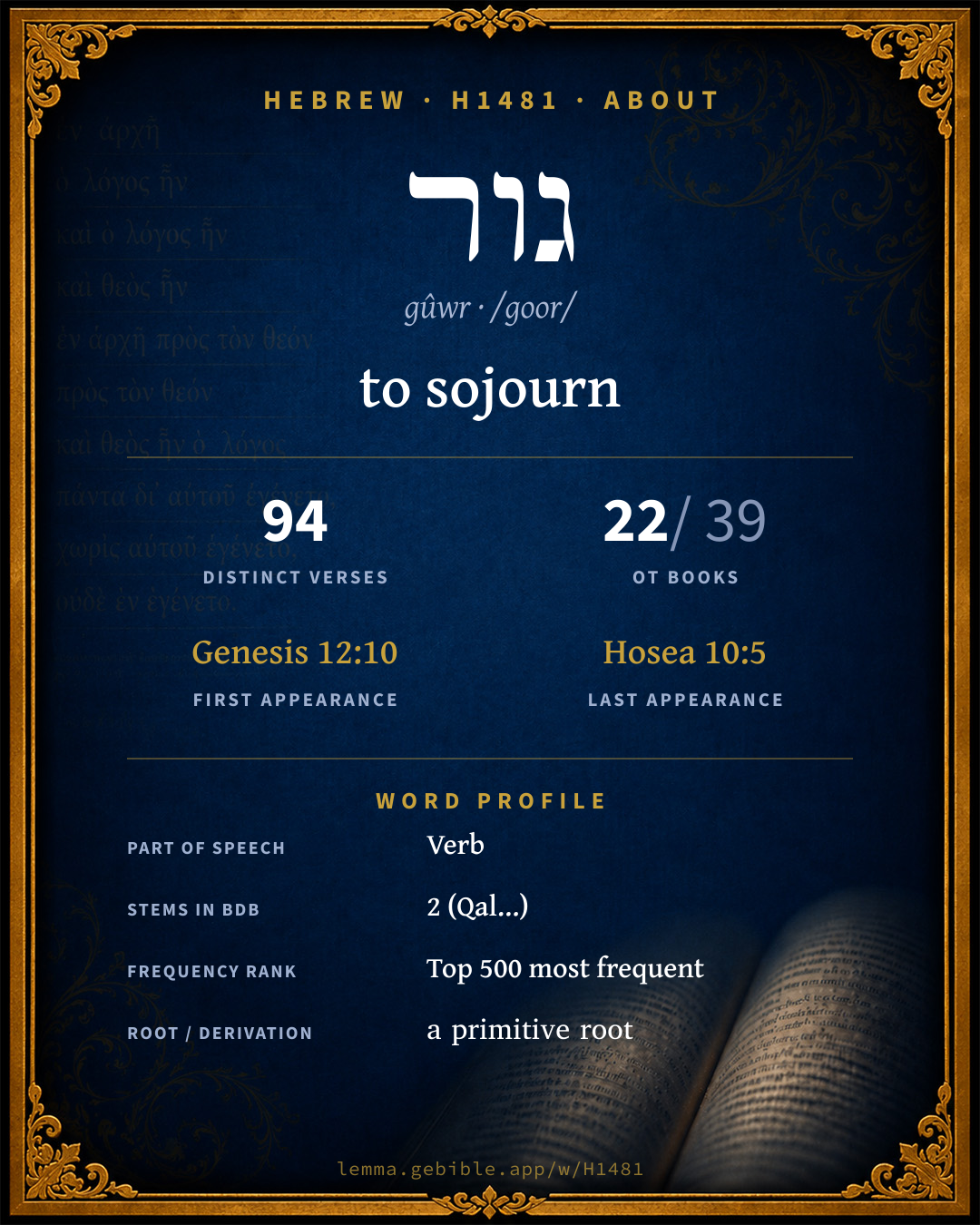
גּוּר
to sojourn
also: abide, dwell in, dwell with, remain fuller range ↓
Full lexicon entry — Brown-Driver-Briggs (BDB)
From Brown-Driver-Briggs (BDB)
Where this word appears
See every Qal verb in the Hebrew Bible →
Grammar key — what these labels mean
Part of speech
- Verb
- An action or state-of-being word.
Stem
- Qal
- The basic, simple active stem — the plain form of the verb (“he wrote”). Here: ‘sojourn’
- Hithpolel
- The reflexive counterpart of the Polel.
Form
- Infinitive Construct
- A bound verbal noun, frequently with prepositions (“to write / in writing”).
- Participle Active
- A verbal adjective expressing ongoing or characteristic action (“writing / one who writes”).
- Imperfect
- An incomplete, ongoing, or future action (“he will / would write”).
- Sequential Imperfect
- An imperfect with prefixed waw — the standard past-narrative form (waw-consecutive imperfect).
- Perfect
- A completed action or state — Hebrew marks aspect (completeness) more than strict tense (“he wrote”).
- Sequential Perfect
- A perfect with prefixed waw continuing a preceding imperfect or command (waw-consecutive perfect).
- Imperative
- A direct command (“write!”).
- Infinitive Absolute
- An unbound verbal noun, often intensifying or standing in for a finite verb.
- Cohortative
- A first-person volitional form expressing wish or resolve (“let me / let us write”).
State
- Absolute
- The independent form of a noun, not bound to a following word.
- Construct
- A noun bound to a following noun in a possessive / “of” relationship (the construct chain).
Person
- 3rd Person
- The one spoken about (“he / she / it / they”).
- 1st Person
- The speaker (“I / we”).
- 2nd Person
- The one addressed (“you”).
Gender
- Masculine
- Grammatically masculine.
- Common
- Either gender — not distinguished for this form.
- Feminine
- Grammatically feminine.
Number
- Singular
- One.
- Plural
- More than one (in Hebrew, generally three or more).
Grammatical forms 25 distinct
- Verb, Qal, Participle Active, Masculine, Singular, Absolute 21 times (21%)
- Verb, Qal, Infinitive Construct 18 times (18%)
- Verb, Qal, Imperfect, 3rd Person, Masculine, Singular 15 times (15%)
- Verb, Qal, Participle Active, Masculine, Plural, Absolute 9 times (9%)
- Verb, Qal, Imperfect, 3rd Person, Masculine, Plural 7 times (7%)
- Verb, Qal, Sequential Imperfect, 3rd Person, Masculine, Singular 5 times (5%)
- Verb, Qal, Perfect, 3rd Person, Masculine, Singular 3 times (3%)
- Verb, Qal, Perfect, 1st Person, Common, Singular 2 times (2%)
+17 more forms (18 occurrences)
Parsed forms decoded from the imported morphology (morphhb / Westminster Leningrad Codex — WLC text public domain, morphhb tagging CC BY 4.0), counted across 98 parsed occurrences — not distinct verses.
Every verse where H1481 appears — 94 distinct verses across 22 books. Click any verse to open its interlinear word-by-word view. Verse text shown in the World English Bible for context — . Each verse’s Hebrew form is shown with its reference; the English is not keyword-highlighted, since the data carries no word-level English alignment. Use “Compare translations” on any verse to read it across multiple English versions. This concordance covers the Hebrew Bible; Septuagint (Greek Old Testament) occurrences are not indexed here.
Genesis 9 verses
- Genesis 12:10 לָ/ג֣וּר prep + Qal inf.cs There was a famine in the land. Abram went down into Egypt to live as a foreigner there, for the famine was sore in the land.
- Genesis 19:9 לָ/גוּר֙ prep + Qal inf.cs They said, "Stand back!" They said, "This one fellow came in to live as a foreigner, and he appoints himself a judge. Now will we deal worse with you, than with them!" They pressed hard on the man, even Lot, and drew near to break the door.
- Genesis 20:1 וַ/יָּ֖גָר conj + Qal wimpf 3ms Abraham traveled from there toward the land of the South, and lived between Kadesh and Shur. He lived as a foriegner in Gerar.
- Genesis 21:23 גַּ֥רְתָּה Qal pf 2ms Now therefore swear to me here by God that you will not deal falsely with me, nor with my son, nor with my son's son. But according to the kindness that I have done to you, you shall do to me, and to the land in which you have lived as a foreigner."
- Genesis 21:34 וַ/יָּ֧גָר conj + Qal wimpf 3ms Abraham lived as a foreigner in the land of the Philistines many days.
- Genesis 26:3 גּ֚וּר Qal impv 2ms Sojourn in this land, and I will be with you, and will bless you. For to you, and to your seed, I will give all these lands, and I will establish the oath which I swore to Abraham your father.
- Genesis 32:4 גַּ֔רְתִּי Qal pf 1cs He commanded them, saying, "This is what you shall tell my lord, Esau: 'This is what your servant, Jacob, says. I have lived as a foreigner with Laban, and stayed until now.
- Genesis 35:27 גָּֽר Qal pf 3ms Jacob came to Isaac his father, to Mamre, to Kiriath Arba (the same is Hebron), where Abraham and Isaac lived as foreigners.
- Genesis 47:4 לָ/ג֣וּר prep + Qal inf.cs They said to Pharaoh, "We have come to live as foreigners in the land, for there is no pasture for your servants' flocks. For the famine is severe in the land of Canaan. Now therefore, please let your servants dwell in the land of Goshen."
Exodus 4 verses
- Exodus 3:22 וּ/מִ/גָּרַ֣ת conj + prep + Qal ptcp.act fs cs But every woman shall ask of her neighbor, and of her who visits her house, jewels of silver, jewels of gold, and clothing; and you shall put them on your sons, and on your daughters. You shall despoil the Egyptians.
- Exodus 6:4 גָּ֥רוּ Qal pf 3cp I have also established my covenant with them, to give them the land of Canaan, the land of their travels, in which they lived as aliens.
- Exodus 12:48 יָג֨וּר Qal impf 3ms When a stranger shall live as a foreigner with you, and will keep the Passover to Yahweh, let all his males be circumcised, and then let him come near and keep it; and he shall be as one who is born in the land: but no uncircumcised person shall eat of it.
- Exodus 12:49 הַ/גָּ֥ר ptcl def.art + Qal ptcp.act ms One law shall be to him who is born at home, and to the stranger who lives as a foreigner among you."
Leviticus 11 verses
- Leviticus 16:29 הַ/גָּ֥ר ptcl def.art + Qal ptcp.act ms "It shall be a statute to you forever: in the seventh month, on the tenth day of the month, you shall afflict your souls, and shall do no manner of work, the native-born, or the stranger who lives as a foreigner among you:
- Leviticus 17:8 יָג֣וּר Qal impf 3ms "You shall say to them, 'Any man there is of the house of Israel, or of the strangers who live as foreigners among them, who offers a burnt offering or sacrifice,
- Leviticus 17:10 הַ/גָּ֣ר ptcl def.art + Qal ptcp.act ms "'Any man of the house of Israel, or of the strangers who live as foreigners among them, who eats any kind of blood, I will set my face against that soul who eats blood, and will cut him off from among his people.
- Leviticus 17:12 הַ/גָּ֥ר ptcl def.art + Qal ptcp.act ms Therefore I have said to the children of Israel, "No person among you shall eat blood, neither shall any stranger who lives as a foreigner among you eat blood."
- Leviticus 17:13 הַ/גָּ֣ר ptcl def.art + Qal ptcp.act ms "'Whatever man there is of the children of Israel, or of the strangers who live as foreigners among them, who takes in hunting any animal or bird that may be eaten; he shall pour out its blood, and cover it with dust.
- Leviticus 18:26 הַ/גָּ֥ר ptcl def.art + Qal ptcp.act ms You therefore shall keep my statutes and my ordinances, and shall not do any of these abominations; neither the native-born, nor the stranger who lives as a foreigner among you;
- Leviticus 19:33 יָג֧וּר Qal impf 3ms "'If a stranger lives as a foreigner with you in your land, you shall not do him wrong.
- Leviticus 19:34 הַ/גָּ֣ר ptcl def.art + Qal ptcp.act ms The stranger who lives as a foreigner with you shall be to you as the native-born among you, and you shall love him as yourself; for you lived as foreigners in the land of Egypt. I am Yahweh your God.
- Leviticus 20:2 הַ/גָּ֣ר ptcl def.art + Qal ptcp.act ms "Moreover, you shall tell the children of Israel, 'Anyone of the children of Israel, or of the strangers who live as foreigners in Israel, who gives any of his seed to Molech; he shall surely be put to death. The people of the land shall stone him with stones.
- Leviticus 25:6 הַ/גָּרִ֖ים ptcl def.art + Qal ptcp.act mp The Sabbath of the land shall be for food for you; for yourself, for your servant, for your maid, for your hired servant, and for your stranger, who lives as a foreigner with you.
- Leviticus 25:45 הַ/גָּרִ֤ים ptcl def.art + Qal ptcp.act mp Moreover of the children of the strangers who sojourn among you, of them you may buy, and of their families who are with you, which they have conceived in your land; and they will be your property.
Numbers 8 verses
- Numbers 9:14 יָג֨וּר Qal impf 3ms If a foreigner lives among you, and desires to keep the Passover to Yahweh; according to the statute of the Passover, and according to its ordinance, so shall he do. You shall have one statute, both for the foreigner, and for him who is born in the land.'"
- Numbers 15:14 יָגוּר֩ Qal impf 3ms If a stranger lives as a foreigner with you, or whoever may be among you throughout your generations, and will offer an offering made by fire, of a sweet savor to Yahweh; as you do, so he shall do.
- Numbers 15:15 הַ/גָּ֑ר ptcl def.art + Qal ptcp.act ms For the assembly, there shall be one statute for you, and for the stranger who lives as a foreigner [with you], a statute forever throughout your generations: as you are, so shall the foreigner be before Yahweh.
- Numbers 15:16 הַ/גָּ֥ר ptcl def.art + Qal ptcp.act ms One law and one ordinance shall be for you, and for the stranger who lives as a foreigner with you.
- Numbers 15:26 הַ/גָּ֣ר ptcl def.art + Qal ptcp.act ms and all the congregation of the children of Israel shall be forgiven, and the stranger who lives as a foreigner among them; for in respect of all the people it was done unwittingly.
- Numbers 15:29 הַ/גָּ֣ר ptcl def.art + Qal ptcp.act ms You shall have one law for him who does anything unwittingly, for him who is home-born among the children of Israel, and for the stranger who lives as a foreigner among them.
- Numbers 19:10 הַ/גָּ֥ר ptcl def.art + Qal ptcp.act ms He who gathers the ashes of the heifer shall wash his clothes, and be unclean until the even: and it shall be to the children of Israel, and to the stranger who lives as a foreigner among them, for a statute forever.
- Numbers 22:3 וַ/יָּ֨גָר conj + Qal wimpf 3ms Moab was sore afraid of the people, because they were many: and Moab was distressed because of the children of Israel.
Deuteronomy 5 verses
- Deuteronomy 1:17 תָג֨וּרוּ֙ Qal impf 2mp You shall not show partiality in judgment; you shall hear the small and the great alike; you shall not be afraid of the face of man; for the judgment is God's: and the cause that is too hard for you, you shall bring to me, and I will hear it.
- Deuteronomy 18:6 גָּ֣ר Qal ptcp.act ms If a Levite comes from any of your gates out of all Israel, where he lives as a foreigner, and comes with all the desire of his soul to the place which Yahweh shall choose;
- Deuteronomy 18:22 תָג֖וּר Qal impf 2ms when a prophet speaks in the name of Yahweh, if the thing doesn't follow, nor happen, that is the thing which Yahweh has not spoken: the prophet has spoken it presumptuously, you shall not be afraid of him.
- Deuteronomy 26:5 וַ/יָּ֥גָר conj + Qal wimpf 3ms You shall answer and say before Yahweh your God, A Syrian ready to perish was my father; and he went down into Egypt, and sojourned there, few in number; and he became there a nation, great, mighty, and populous.
- Deuteronomy 32:27 אָג֔וּר Qal impf 1cs Were it not that I feared the provocation of the enemy, Lest their adversaries should judge wrongly, Lest they should say, Our hand is exalted, Yahweh has not done all this.
Joshua 1 verse
Judges 6 verses
- Judges 5:17 יָג֖וּר Qal impf 3ms Gilead abode beyond the Jordan: Dan, why did he remain in ships? Asher sat still at the haven of the sea, Abode by his creeks.
- Judges 17:7 גָֽר Qal ptcp.act ms There was a young man out of Bethlehem Judah, of the family of Judah, who was a Levite; and he sojourned there.
- Judges 17:8 לָ/ג֖וּר prep + Qal inf.cs The man departed out of the city, out of Bethlehem Judah, to sojourn where he could find [a place], and he came to the hill-country of Ephraim to the house of Micah, as he traveled.
- Judges 17:9 לָ/ג֖וּר prep + Qal inf.cs Micah said to him, Whence come you? He said to him, I am a Levite of Bethlehem Judah, and I go to sojourn where I may find [a place].
- Judges 19:1 גָּ֚ר Qal ptcp.act ms It happened in those days, when there was no king in Israel, that there was a certain Levite sojourning on the farther side of the hill-country of Ephraim, who took to him a concubine out of Bethlehem Judah.
- Judges 19:16 גָ֖ר Qal ptcp.act ms Behold, there came an old man from his work out of the field at even: now the man was of the hill-country of Ephraim, and he sojourned in Gibeah; but the men of the place were Benjamites.
Ruth 1 verse
1 Samuel 1 verse
2 Samuel 1 verse
1 Kings 1 verse
2 Kings 2 verses
- 2 Kings 8:1 וְ/ג֖וּרִי תָּג֑וּרִי conj + Qal impv 2fs Qal impf 2fs Now Elisha had spoken to the woman, whose son he had restored to life, saying, Arise, and go you and your household, and sojourn wherever you can sojourn: for Yahweh has called for a famine; and it shall also come on the land seven years.
- 2 Kings 8:2 וַ/תָּ֥גָר conj + Qal wimpf 3fs The woman arose, and did according to the word of the man of God; and she went with her household, and sojourned in the land of the Philistines seven years.
1 Chronicles 1 verse
2 Chronicles 1 verse
Ezra 1 verse
Job 4 verses
- Job 19:15 גָּ֘רֵ֤י Qal ptcp.act mp cs Those who dwell in my house, and my maids, count me for a stranger. I am an alien in their sight.
- Job 19:29 גּ֤וּרוּ Qal impv 2mp Be afraid of the sword, For wrath brings the punishments of the sword, That you may know there is a judgment."
- Job 28:4 גָּ֗ר Qal ptcp.act ms He breaks open a shaft away from where people live. They are forgotten by the foot. They hang far from men, they swing back and forth.
- Job 41:25 יָג֣וּרוּ Qal impf 3mp When he raises himself up, the mighty are afraid. They retreat before his thrashing.
Psalms 11 verses
- Psalms 5:4 יְגֻרְ/ךָ֣ Qal impf 3ms + sfx pers 2ms For you are not a God who has pleasure in wickedness. Evil can't live with you.
- Psalms 15:1 יָג֣וּר Qal impf 3ms Yahweh, who shall dwell in your sanctuary? Who shall live on your holy hill?
- Psalms 22:23 וְ/ג֥וּרוּ conj + Qal impv 2mp You who fear Yahweh, praise him! All you descendants of Jacob, glorify him! Stand in awe of him, all you descendants of Israel!
- Psalms 33:8 יָ֝ג֗וּרוּ Qal impf 3mp Let all the earth fear Yahweh. Let all the inhabitants of the world stand in awe of him.
- Psalms 56:6 יָג֤וּרוּ Qal impf 3mp They conspire and lurk, Watching my steps, they are eager to take my life.
- Psalms 59:3 יָג֣וּרוּ Qal impf 3mp For, behold, they lie in wait for my soul. The mighty gather themselves together against me, Not for my disobedience, nor for my sin, Yahweh.
- Psalms 61:4 אָג֣וּרָה Qal coh 1cs I will dwell in your tent forever. I will take refuge in the shelter of your wings. Selah.
- Psalms 105:12 וְ/גָרִ֥ים conj + Qal ptcp.act mp When they were but a few men in number, Yes, very few, and foreigners in it.
- Psalms 105:23 גָּ֣ר Qal pf 3ms Israel also came into Egypt. Jacob sojourned in the land of Ham.
- Psalms 120:5 גַ֣רְתִּי Qal pf 1cs Woe is me, that I live in Meshech, That I dwell among the tents of Kedar!
- Psalms 140:2 יָג֥וּרוּ Qal impf 3mp Those who devise mischief in their hearts. They continually gather themselves together for war.
Isaiah 7 verses
- Isaiah 5:17 גָּרִ֥ים Qal ptcp.act mp Then the lambs will graze as in their pasture, And strangers will eat the ruins of the rich.
- Isaiah 11:6 וְ/גָ֤ר conj + Qal wpf 3ms The wolf shall dwell with the lamb, and the leopard shall lie down with the kid; and the calf and the young lion and the fattened calf together; and a little child shall lead them.
- Isaiah 16:4 יָג֤וּרוּ Qal impf 3mp Let my outcasts dwell with you; as for Moab, be a covert to him from the face of the destroyer. For the extortioner is brought to nothing, destruction ceases, the oppressors are consumed out of the land.
- Isaiah 23:7 לָ/גֽוּר prep + Qal inf.cs Is this your joyous [city], whose antiquity is of ancient days, whose feet carried her afar off to sojourn?
- Isaiah 33:14 יָג֣וּר יָג֥וּר Qal impf 3ms Qal impf 3ms The sinners in Zion are afraid; trembling has seized the godless ones: Who among us can dwell with the devouring fire? who among us can dwell with everlasting burning?
- Isaiah 52:4 לָ/ג֣וּר prep + Qal inf.cs For thus says the Lord Yahweh, My people went down at the first into Egypt to sojourn there: and the Assyrian has oppressed them without cause.
- Isaiah 54:15 גּ֥וֹר יָג֛וּר גָ֥ר Qal inf.abs Qal impf 3ms Qal ptcp.act ms Behold, they may gather together, but not by me: whoever shall gather together against you shall fall because of you.
Jeremiah 13 verses
- Jeremiah 35:7 גָּרִ֥ים Qal ptcp.act mp neither shall you build house, nor sow seed, nor plant vineyard, nor have any; but all your days you shall dwell in tents; that you may live many days in the land in which you sojourn.
- Jeremiah 42:15 לָ/ג֥וּר prep + Qal inf.cs now therefore hear you the word of Yahweh, O remnant of Judah: Thus says Yahweh of Hosts, the God of Israel, If you indeed set your faces to enter into Egypt, and go to sojourn there;
- Jeremiah 42:17 לָ/ג֣וּר prep + Qal inf.cs So shall it be with all the men who set their faces to go into Egypt to sojourn there: they shall die by the sword, by the famine, and by the pestilence; and none of them shall remain or escape from the evil that I will bring on them.
- Jeremiah 42:22 לָ/ג֥וּר prep + Qal inf.cs Now therefore know certainly that you shall die by the sword, by the famine, and by the pestilence, in the place where you desire to go to sojourn there.
- Jeremiah 43:2 לָ/ג֥וּר prep + Qal inf.cs then spoke Azariah the son of Hoshaiah, and Johanan the son of Kareah, and all the proud men, saying to Jeremiah, You speak falsely: Yahweh our God has not sent you to say, You shall not go into Egypt to sojourn there;
- Jeremiah 43:5 לָ/ג֖וּר prep + Qal inf.cs But Johanan the son of Kareah, and all the captains of the forces, took all the remnant of Judah, who were returned from all the nations where they had been driven, to sojourn in the land of Judah;
- Jeremiah 44:8 לָ/ג֣וּר prep + Qal inf.cs in that you provoke me to anger with the works of your hands, burning incense to other gods in the land of Egypt, where you are gone to sojourn; that you may be cut off, and that you may be a curse and a reproach among all the nations of the earth?
- Jeremiah 44:12 לָ/ג֣וּר prep + Qal inf.cs I will take the remnant of Judah, that have set their faces to go into the land of Egypt to sojourn there, and they shall all be consumed; in the land of Egypt shall they fall; they shall be consumed by the sword and by the famine; they shall die, from the least even to the greatest, by the sword and by the famine; and they shall be an object of horror, [and] an astonishment, and a curse, and a reproach.
- Jeremiah 44:14 לָ/גֽוּר prep + Qal inf.cs so that none of the remnant of Judah, who have gone into the land of Egypt to sojourn there, shall escape or be left, to return into the land of Judah, to which they have a desire to return to dwell there: for none shall return save such as shall escape.
- Jeremiah 44:28 לָ/ג֣וּר prep + Qal inf.cs Those who escape the sword shall return out of the land of Egypt into the land of Judah, few in number; and all the remnant of Judah, who have gone into the land of Egypt to sojourn there, shall know whose word shall stand, mine, or theirs.
- Jeremiah 49:18 יָג֥וּר Qal impf 3ms As in the overthrow of Sodom and Gomorrah and the neighbor cities of it, says Yahweh, no man shall dwell there, neither shall any son of man sojourn therein.
- Jeremiah 49:33 יָג֥וּר Qal impf 3ms Hazor shall be a dwelling-place of jackals, a desolation forever: no man shall dwell there, neither shall any son of man sojourn therein.
- Jeremiah 50:40 יָג֥וּר Qal impf 3ms As when God overthrew Sodom and Gomorrah and the neighbor cities of it, says Yahweh, so shall no man dwell there, neither shall any son of man sojourn therein.
Lamentations 1 verse
Ezekiel 3 verses
- Ezekiel 14:7 יָג֣וּר Qal impf 3ms For everyone of the house of Israel, or of the strangers who sojourn in Israel, who separates himself from me, and takes his idols into his heart, and puts the stumbling block of his iniquity before his face, and comes to the prophet to inquire for himself of me; I Yahweh will answer him by myself:
- Ezekiel 47:22 הַ/גָּרִ֣ים ptcl def.art + Qal ptcp.act mp It shall happen, that you shall divide it by lot for an inheritance to you and to the strangers who sojourn among you, who shall father children among you; and they shall be to you as the home-born among the children of Israel; they shall have inheritance with you among the tribes of Israel.
- Ezekiel 47:23 גָּ֥ר Qal pf 3ms It shall happen, that in what tribe the stranger sojourns, there shall you give him his inheritance, says the Lord Yahweh.
Hosea 2 verses
- Hosea 7:14 יִתְגּוֹרָ֖רוּ Hithpolel impf 3mp They haven't cried to me with their heart, But they howl on their beds. They assemble themselves for grain and new wine. They turn away from me.
- Hosea 10:5 יָג֖וּרוּ Qal impf 3mp The inhabitants of Samaria will be in terror for the calves of Beth Aven; For its people will mourn over it, Along with its priests who rejoiced over it, For its glory, because it has departed from it.
About this entry
At a glance — auto-summarized from this page’s data, not written by a person. Every figure links to its source below. This summary describes the numbers; it doesn’t interpret them.
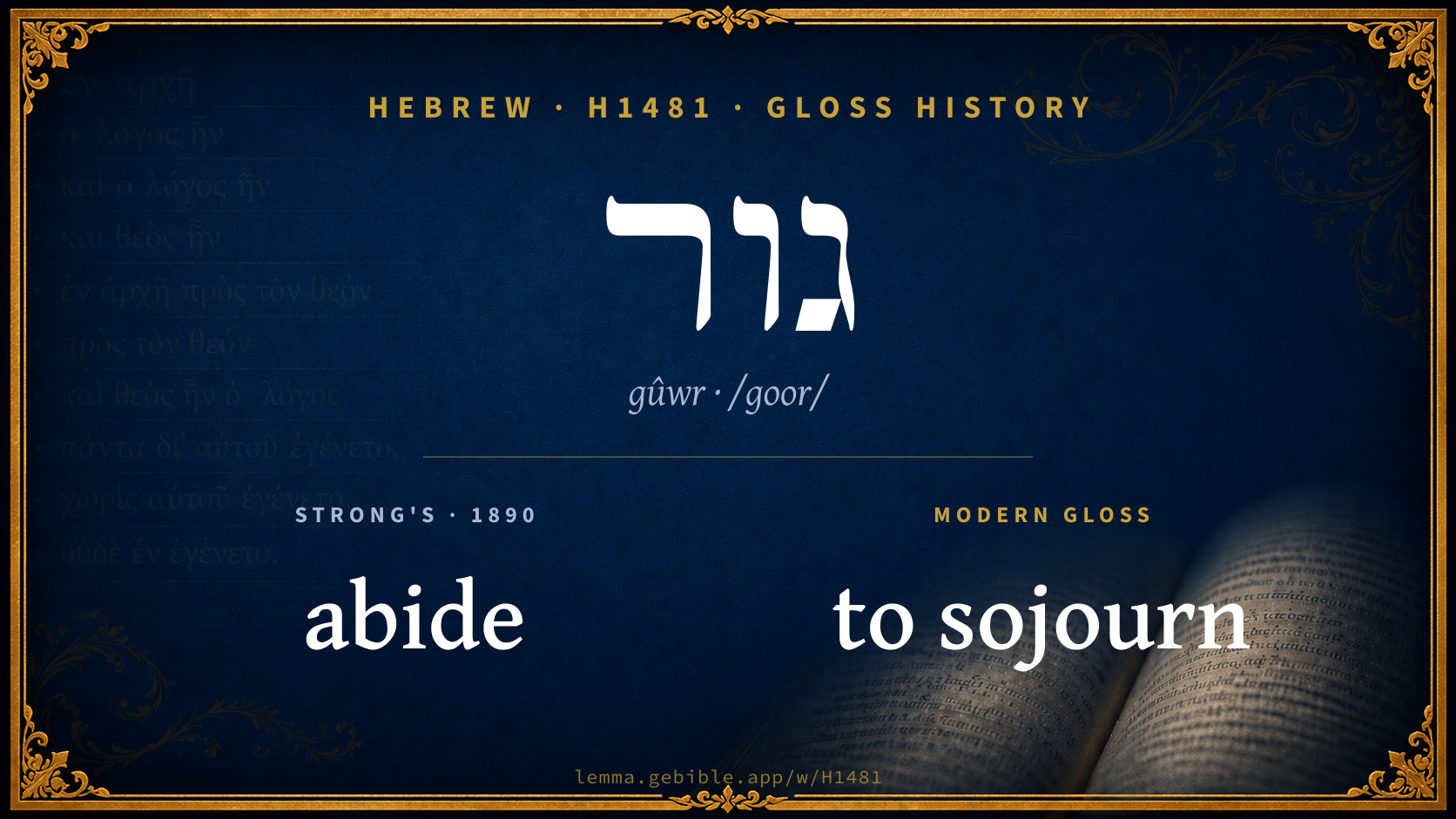
גור (gûwr) is a Hebrew verb most often rendered “to sojourn.” Where the King James Version says “sojourn,” newer translations reach for “living” (Berean Standard Bible) and “one sojourning” (unfoldingWord Literal Text); the renderings breakdown has the detail. The Hebrew Bible uses it across 94 verses — moderately common. Debuting at Genesis 12:10, it then recurs through the corpus. It also covers “abide”, “dwell in”, and “dwell with”, alongside “to sojourn” — see its full sense range. The sections below give every sense, occurrence, and version rendering.
Gloss history
Strong's 1890 vs modern scholarship
About this word
Strong's H1481 catalogs a Hebrew word from the Hebrew Old Testament.
These counts are not copied from any lexicon or concordance. They are computed here, from the morphology-tagged Hebrew Old Testament. What Lemma adds →
- 94
- distinct verses
- The word appears in 94 distinct verses.
- 22 / 39
- OT books
- The word appears in 22 of 39 Old Testament books.
- #429
- by frequency
- Top 500 most frequent Hebrew words (rank 429 of 8,640 Hebrew words by occurrence).
View all 94 occurrences in the concordance →
By section of the Old Testament
By traditional corpus
Conventional, traditional groupings — biblical authorship is debated, so this is a traditional corpus grouping, not an authorship claim. Each share is this word’s portion of its verses in that division of the Hebrew canon. Each figure is a share of the word’s 94 distinct verses.
- Torah (Pentateuch) 37 verses · 39%
- Prophets (Nevi'im) 37 verses · 39%
- Writings (Ketuvim) 20 verses · 21%
How translations render this word
Counts come from each version’s own published word-to-Strong’s tagging or interlinear alignment — an approximate guide to how each version renders this word, not a word-level alignment the data otherwise carries. Because each total is that version’s own tagged count, the per-version totals vary from one another and need not match the appearance or distinct-verse counts above. These counts may also differ from a printed concordance because Lemma counts each distinctly tagged rendering and does not collapse phrase taggings into a single head-word total. This is a fixed set of word-tagged versions (KJV, ASV, BSB, ULT) and does not change with the reading translation you choose elsewhere. Each version’s license is shown beside its name below (and on Sources).
BDB lists this Strong’s number as 5 distinct words (homographs). Each count above pools all of them and is not split by sense — see the Senses section below. A low-frequency rendering may belong to a different one of those words, not the primary meaning.
- King James Version†: Sojourn 25×, Sojourneth 14×, Dwell 7×
- American Standard Version†: Sojourn 24×, Sojourneth 11×, Sojourned 6×
- Berean Standard Bible†: Living 6×, Residing 6×, Reside 5×
- unfoldingWord Literal Text†: One sojourning 11×, Sojourn 11×, Sojourned 4×
King James Version Public Domain
Renders H1481 across 98† tagged occurrences — most commonly:
Plus 36 renderings that appear only once — usually multi-word phrases or single function words the recovered tagging swept in, not distinct renderings.
American Standard Version Public Domain
Renders H1481 across 97† tagged occurrences — most commonly:
Plus 44 renderings that appear only once — usually multi-word phrases or single function words the recovered tagging swept in, not distinct renderings.
Berean Standard Bible Public Domain
Renders H1481 across 88† tagged occurrences — most commonly:
Plus other, less common renderings. Plus 46 renderings that appear only once — usually multi-word phrases or single function words the recovered tagging swept in, not distinct renderings. Not rendered by a distinct English word in 10 further occurrences.
unfoldingWord Literal Text CC BY-SA 4.0
Renders H1481 across 95† tagged occurrences — most commonly:
Plus other, less common renderings. Plus 41 renderings that appear only once — usually multi-word phrases or single function words the recovered tagging swept in, not distinct renderings.
12 senses and sub-senses in the full BDB
Hebrew verbs can shift meaning by stem (binyan): Qal is the basic action, Niphal is often passive or reflexive, Piel often intensifies or makes it factitive, and Hiphil is typically causative. The senses below are grouped under the stem BDB assigns to each. This entry also uses one or more reduplicated stems (the Pōlēl/Pilpēl type), which for hollow or geminate roots behave much like Piel — often intensive or iterative.
What do BDB’s symbols mean?
BDB uses these scholarly abbreviations:
| Symbol | Meaning |
|---|---|
| 𝔊 | the Septuagint (the ancient Greek translation, LXX) |
| 𝔙 | the Vulgate (the Latin translation) |
| 𝔖 | the Syriac version (the Peshitta) |
| 𝔗 | the Targum (the Aramaic translation) |
| ψ | the Psalms |
| √ | root (the underlying root or stem) |
| ‖ | parallel passage (a synonymous or contrasted parallel) |
| † | the dagger: every passage where the word occurs is cited |
The 12 senses and sub-senses the full Brown-Driver-Briggs lexicon distinguishes for this word, in lexicon order (not ranked by frequency), with BDB’s own verbatim wording and sub-sense lettering. Shown in Hebrew script with BDB’s own scholarly abbreviations. The condensed entry is in the Lexicon Entry tab. See also the Forms in the corpus table below.
גור I sojourn (cf. Arabic جَارَ turn aside, tarry
Qal
- Pf. גָּר Gn 35:27 + 3 times, וְגָר consec. Is 11:6; גַּרְתָּה Gn 21:23; גַּרְתִּי Gn 32:5 ψ 120:5; גָּרוּ Ex 6:4; Impf. יָגוּר Ex 12:48 + 12 times, וַיָּ֫גָר Gn 20:1 + 2 times, sf. יְגֻרְךָ ψ 5:5; 3 fs. וַתָּ֫גָר 2 K 8:2; 2 fs. תָּגוּרִי 2 K 8:1; cohort. אָגוּ֑רָה ψ 61:5, יָגוּרוּ Is 16:4; Imv. גּוּר Gn 26:3, גּוּ֫רִי 2 K 8:1; Inf. cstr. גּוּר Gn 12:10 + 17 times; Pt. גָּר Dt 18:6 Ju 17:7 + 17 times; f. cstr. גָּרַת Ex 3:22; pl. גָּרִים Lv 25:6 + 8 times; cstr. גָּרֵי Jb 19:15;— e.g. Genesis 35:27
- 1. sojourn, dwell for a (definite or indef.) time, dwell as a new-comer (cf. גֵּר) without original rights, v. especially Gn 19:9 (J) Dt 18:6 & cf. Ju 17:7, 8, 9; 19:1; also Gn 12:10; 20:1; 21:23, 24; 32:5; 47:4 (all JE); of patriarchs in Canaan Gn 26:3 (J) 35:27 Ex 6:4 (both P) cf. ψ 105:12 = 1 Ch 16:19, Ju 19:16 2 S 4:3 2 K 8:1(×2), 2 (seven years) Is 16:4 Ru 1:1 Ezr 1:4 (in exile); cf. further Ex 3:22 (E) גָּרַת בַּיִת of a woman in another’s house as lodger or guest (v. Di), גָּרֵי בַיִת Jb 19:15; so (poet.) of worshipper in Yahweh’s house ψ 15:1; 61:5 cf. Is 33:14(×2); fig. of evil לֹא יְגֻֽרְךָ רָ֑ע ψ 5:5 evil cannot be a guest of thine (Che; sq. acc., as in Arabic جاوره iii); particularly of the גֵּר (q.v.) in Israel Ex 12:48, 49 Lv 16:29 (all P) 17:8, 10, 12, 13; 18:26; 19:33, 34; 20:2; 25:6, 45 (all H) Nu 9:14; 15:14, 15, 16, 26, 29; 19:10 Jos 20:9 (all P) Ez 14:7; 47:22, 23; of Ephraim and Manasseh sojourning with Judah and Benjamin 2 Ch 15:9; of Rechabites sojourning in Judah Je 35:7; of Israelites sojourning in Egypt Dt 26:5 Is 52:4 ψ 105:23; so of Judah, to escape from under Babylonian power Je 42:15, 17, 22; 43:2; 44:8, 12, 14, 28. e.g. Genesis 19:9
- 2. abide, nearly or quite = dwell Je 43:5 cf. La 4:15, Je 49:18, 33; 50:40, also Jb 28:4; of wolf dwelling with lamb Is 11:6; stay (inactive) Ju 5:17;—in Is 5:7 read perhaps, for גָּרִים, גְּדָיִם or כָּרִים cf. 𝔊 Lo Ew Di & Che crit. n. (> Stu גֵּרִים). e.g. Jeremiah 43:5
Hithpol
- Pt. מִתְגּוֹרֵר 1 K 17:20 seek hospitality with, sq. עִם (cf. Arabic x); יִתְגּוֹרָ֖רוּ Ho 7:14 is dub. (cf. II. גור); AE Ki Thes Wü AV RV they assemble themselves, but text prob. error, v. גדד. e.g. 1 Kings 17:20
גור II loc. (sojourning, dwelling) 2 K 9
גור III stir up strife, quarrel (cf. גרה)
Qal
- Pf. גָּר Is 54:15; Impf. יָגוּר v 15, יָגוּרוּ ψ 56:7; 59:4; 140:3 (on all cf. infr.); Inf. abs. גּוֹר Is 54:15;— e.g. Isaiah 54:15
- 1. stir up strife, abs. גּוֹר יָגוּר Is 54:15; cf. ψ 56:7 (but AE Che read יָגוֹדּוּ attack, v. גדד); sq. עַל־ ψ 59:4 (but Che id.; cf. ψ 94:21, wh. however Ol would emend by 56:7; 59:4); sq. acc. מִלְחָמוֹת ψ 140:3 (Hup Che read יְגָרוּ Pi. Impf. of גרה). e.g. Isaiah 54:15
- 2. quarrel, sq. אֶת־ with Is 54:15. Here also Hithpoʿl. Impf. Ho 7:14 יִתְגּוֹרָ֖רוּ (cf. I. גור), according to Ew, they excite themselves, but unlikely; v. גדד. e.g. Isaiah 54:15
גור IV
- 1. lion’s whelps, fig. of Judah Gn 49:9; of Dan Dt 33:22; of Assyrian (prince?) Na 2:12; fig. of Israelites Ez 19:2, 3, 5 (‖ כְּפִיר). e.g. Genesis 49:9
- 2. young of jackals (תַּנִּין) La 4:3. e.g. Lamentations 4:3
גור V dread (cf. יָגֹר)
Qal
- Impf. וַיָּגָר Nu 22:3 1 S 18:15; 2 ms. תָּגוּר Dt 18:22; אָגוּר Dt 32:27; pl. יָגוּרוּ ψ 33:8; Jb 41:17 + Ho 10:5, תָּגוּרוּ Dt 1:17; Imv. גּוּרוּ ψ 22:24 Jb 19:29;— e.g. Numbers 22:3
- 1. be afraid of, sq. מִפְּנֵי Nu 22:3 Dt 1:17 1 S 18:15, גּוּרוּ לָכֶם מִפְּנֵי Jb 19:29; c. מִן 41:17 Dt 18:22; c. acc. Dt 32:27 (poet.) Ho 10:5 read prob. ינודו lament (‖ אבל, used c. לְ e.g. Na 3:7 Je 15:5 al.; cf. Che). e.g. Numbers 22:3
- 2. stand in awe of, sq. מִן ψ 22:24; 33:8 (‖ יָרֵא). e.g. Psalms 22:24
Senses from the full Brown-Driver-Briggs lexicon (Brown, Driver, Briggs; Oxford 1906 — public domain), digitized via Sefaria, supplemented by the OpenScriptures HebrewLexicon (CC BY 4.0). Full attribution on Sources.
Word origin
I. vb. sojourn (cf. Arabic جَارَ turn aside, tarry; v. especially iii. iv. viii. x; Aramaic ܓܳܪ, Ethiopic in der.)—
II. n.pr.loc. (sojourning, dwelling) 2 K 9:27 מַעֲלֵה־ג׳ אשׁר את־יִבְלְעָם, otherwise unknown.
III. vb. stir up strife, quarrel (cf. גרה)—so Ew Che Di RVm (Is 54:15); gather together Ges De Br cf. 𝔗 𝔙, so AV RV;—
IV. n.m. Ez 19:3, 5 whelp, young—cstr. גּוּר(אַרְיֵה) Gn 49:9 + 2 times; sf. גּוּרֶיהָ Ez 19:2, גֻּרֶיהָ Ez 19:3, 5, גּוּרֵיהֶן La 4:3;—
V. vb. dread (cf. יָגֹר)—
— Brown-Driver-Briggs (Oxford 1906, public domain), digitized via Sefaria, supplemented by the OpenScriptures HebrewLexicon (CC BY 4.0). See Sources.
Origin: a primitive root
Jastrow Dictionary
A second Hebrew/Aramaic lexicon for comparison, covering Aramaic and post-biblical (Talmudic, Targumic, Midrashic) usage that the biblical-Hebrew BDB does not. Matched by lemma rather than by Strong’s number, so a lemma may carry more than one Jastrow headword (shown separately below), and the entries cover usage well beyond the Bible.
גּוּר I
- (b. h.) [to move around (cmp. סחר),] to be a stranger, sojourn, dwell. Sot. 36ᵇ גֹרֹא שגָֹּרֹ וכ׳ he is named Gera (Gen. XLVI, 21), because he (Joseph) dwells in exile; Gen. R. s. 94. Yeb. 96ᵇ is it possible לָגּוּר וכ׳ בשני to dwell (simultaneously) in two worlds? Sabb. 104ᵃ, v. ג"ר. Sifré Deut. 301 (ref. to Deut. XXVI, 5) מלמד … להשתקע אלא לָגוּר שם it proves that he (Jacob) did not go down to be permanently settled, but only to sojourn there; a. fr.—Denom. גֵּר. e.g. Genesis 46:21
- (denom. of גֵּר) to make a proselyte, to initiate into the Jewish faith. Gen. R. s. 39 (ref. to Gen. XII, 5 ‘the souls which they had made’) אלו הגרים שגִּיְּירוּ that means the proselytes they had made. Ib. כל מי שמקרב … ומְגַיְּירוֹ וכ׳ whoever befriends a gentile and effects his conversion, is considered as though he had created him. Sabb. 31ᵃ גַּיְּירֵנִי וכ׳ make me a Jew with the condition &c.; a. fr. [For גִּיֵּיר to dress with lime, v. גִּיר.] e.g. Genesis 12:5
- , Nithpa. נִתְגַּיֵּיר to become a proselyte. Ber. 57ᵇ עתידים להִתְגַּיֵּיר they will adopt the Jewish faith. Yeb. 47ᵇ גר שבא להתג׳ if a stranger comes (appears before Jewish authorities) desirous to become a Jew. Ab. Zar. 3ᵇ מִתְגַּיְּירִין shall ask to be admitted &c.; a. fr.
גּוּר
- Taan. 25ᵃ גָרֵי (גָּרוּ) בך גירי Ar., ed. Ven. a. oth. (v. Rabb. D. S. a. l. note 1, ed. גָּיְרֵי) proselytes shall dwell with thee (in heaven); (for oth. vers. v. גִּיר III).
- to convert. Targ. Y. Gen. XII, 5, v. preced. Targ. Y. Ex. XVIII, 7; 27; a. e.—Sabb. 31ᵃ גַּיְּירֵיה he accepted him for initiation. Yeb. 76ᵃ גּיּיוּרֵי גַּיְּירָהּ he made her an Israelite. Gen. R. s. 76, end לאו גַּיַּירְתֵּיה would she not have converted him?; a. e.
- 1. to reside as a stranger. Targ. Lev. XVI, 29; a. fr.
- 2. to become a Jew, to embrace the Israelitish faith, to be converted. Targ. Y. Ex. XVIII, 6. Targ. Ps. LXVIII, 19; 32; a. e.
גּוּר II
- (euphem., cmp. גּוּף ch.) to have illegitimate intercourse;(also as act. v.) to seduce. Targ. Job XXXVI, 20 תגור Ms. (ed. תְגַיֵּר). Targ. Y. Lev. XX, 10 (O. גוף); a. e.—Part. גָּיֵר, גָּיְרָא. Lev. R. s. 3; Koh. R. to IV, 6 ג׳ בחזורין Ar. (ed. גָּיְפָא), v. גּוּף ch.—Ab. Zar. 10ᵇ הוה ליה ההיא ברתא דשמה גירא וכ׳ he (the emperor) had a daughter whose name was Gira (Ar. גילא), and who did wrong (was seduced); he sent to him (Rabbi) גרגירא (Ar. גרגילא) a gargira (rocket, play on גירא).
- to seduce. Targ. Job XXVI, 20, v. supra. Targ. Prov. VI, 32 דגַיֵּיר איתתא Ar. (ed. דגָיֵיר בא׳).
גּוּר III
- כרוך אחריו Ḥull. 78ᵇ) young animal, whelp, cub. Yalk. Job 926 עלה ג׳ אחד וכ׳ a young (R’êm) appeared in Palestine; Gen. R. s. 31 גורא א׳ (corr. acc.).—Pl. גּוּרִים. Ib. גּוּרָיו וכ׳ his (the R’êm’s) whelps went into the ark. Gen. R. s. 98 גבורה של … של גוריו the strength of the lion and the daring of his whelps.—גּוּר אַרְיֵה pr. n. m., v. גּוּרְיָא II.
גּוּר ²
- Lev. R. s. 19 (prov.) ג׳ טב מכלב ביש וכ׳ raise not a gentle cub of a vicious dog, much less a vicious cub &c.—[Pl. גּוּרֵי. Y. B. Bath. II, 13ᵇ bot. מן קל ג׳, prob. גִּירֵי, v. גִּיר III.]
A Dictionary of the Targumim, the Talmud Babli and Yerushalmi, and the Midrashic Literature (Marcus Jastrow; London, Luzac, 1903) — Public Domain. Digitized via Sefaria. Digitized via Sefaria. Full attribution on Sources.
Forms in the corpus
The 60 distinct written forms H1481 takes in the Hebrew Bible, most frequent first — each parse links to that stem’s occurrences in the concordance. Hebrew forms include their vowel points and cantillation, so a single lemma takes many written forms.
Same root — word family
Other BDB entries built from the same root as H1481, grouped by Strong’s listed origin. These share a root / origin per the lexicon — not necessarily a shared meaning. Each links to that word’s own entry.
Derived from this word
- גור gûwr H1482 cub
- גר gêr H1616 sojourner
- גרות gêrûwth H1628 lodging place
- מגור mâgôwr H4032 fear
- מגור mâgûwr H4033 dwelling place
Proper names from this root
People and places named from this root — a name, not an additional meaning of the word.
Compare all same-root words → Showing 4 of 8 — not the complete family. 2 of the same-root words are proper names (people or places). They share a root, not necessarily a meaning.
Septuagint verse parallels
This word appears in 88 verses that also exist in the Greek Old Testament (Septuagint), out of the 94 Hebrew verses it occurs in. You can read those verses in Greek by switching the Old Testament edition to the Septuagint.
Read these verses in the Septuagint
- Genesis 12:10
- Exodus 3:22
- Leviticus 16:29
- Numbers 9:14
- Deuteronomy 1:17
- Judges 5:17
- Ruth 1:1
- 1 Samuel 18:15
- 2 Samuel 4:3
- 1 Kings 17:20
- 2 Kings 8:1
- 1 Chronicles 16:19
This is a verse-level parallel only — the same verses exist in both the Hebrew and Greek Old Testaments. No word-level Hebrew↔Greek correspondence is claimed: the data carries no such alignment, so no Greek word is shown as this Hebrew word’s translation. Coverage is not total — the Septuagint omits the deuterocanon and renumbers the Psalms, so some Hebrew verses have no direct Greek parallel.