Lamentations 4:3

Hebrew (Westminster Leningrad Codex) Lamentations 4:3 appears in the Hebrew Old Testament. The text above is from the Westminster Leningrad Codex. Each word links to its Strong’s number, a concise gloss, and parsing drawn from the Open Scriptures Hebrew Bible morphology. Click any word for its full Brown-Driver-Briggs (BDB) entry.
Download image
Cite this verse

Lamentations 4:3 (World English Bible). Public Domain. Lemma interlinear Bible study tool, https://lemma.gebible.app/v/lamentations/4/3.

Show BibTeX & RIS
BibTeX
RIS
English Translation
Even the jackals draw out the breast, they give suck to their young ones: The daughter of my people is become cruel, like the ostriches in the wilderness.
World English Bible · Public Domain
Highlights
  • 2 first appearances in the Hebrew Bible
Full analysis ↓
Download a study sheet

One document with this verse’s original text, its word-by-word gloss line, the meaning frame, cross-references with their text, attributed commentary, and full source and license credits — printable, and it pastes into notes with its structure intact.

This verse Autodidact and up

Study sheet (.html) Plain text (.txt)

A passage Seminary Student

Up to 50 verses in one chapter. A passage sheet keeps up to 6 commentary sources and 12 cross-references per verse, in the order this page ranks them, and says so on the sheet whenever that leaves anything out. Ask for a single verse and you get the Autodidact verse sheet above.

Everything on this page stays free to read, with no account — the sheet is a download of what is already on screen, not access to it.

Want to remove ads? Support Godless Engineer
Compare translations 3

The same verse in 3 English versions, stacked beneath the original-language interlinear above. Click any original word for its lexicon entry.

Each is an independent rendering of the whole verse — the interlinear is not word-aligned to these translations.

Highlighted words mark where these versions differ — a whole-verse word diff, not a word-by-word alignment.

  • World English Bible Public Domain
    Even the jackals draw out the breast, they give suck to their young ones: The daughter of my people is become cruel, like the ostriches in the wilderness.
  • King James Version Public Domain
    Even the sea monsters draw out the breast, they give suck to their young ones: the daughter of my people is become cruel, like the ostriches in the wilderness.
  • unfoldingWord Literal Text CC BY-SA 4.0
    Even jackals offer the breast; they nurse their young. the daughter of my people become cruel, like ostriches in the wilderness. DALETH

unfoldingWord Literal Text — © unfoldingWord, licensed CC BY-SA 4.0. Word-aligned USFM3 via Door43 (git.door43.org/unfoldingWord/en_ult).

Versions to compare (up to 4)

3 of 4 selected

Show all 18 translations

Every available English version of this verse, each an independent rendering of the whole verse.

  • World English Bible Public Domain
    Even the jackals draw out the breast, they give suck to their young ones: The daughter of my people is become cruel, like the ostriches in the wilderness.
  • Berean Standard Bible Public Domain
    Even jackals offer their breasts to nurse their young, but the daughter of my people has become cruel, like an ostrich in the wilderness.
  • Majority Standard Bible Public Domain
    Even jackals offer their breasts to nurse their young, but the daughter of my people has become cruel, like an ostrich in the wilderness.
  • King James Version Public Domain
    Even the sea monsters draw out the breast, they give suck to their young ones: the daughter of my people is become cruel, like the ostriches in the wilderness.
  • American Standard Version (1901) Public Domain
    Even the jackals draw out the breast, they give suck to their young ones: The daughter of my people is become cruel, like the ostriches in the wilderness.
  • Revised Version (1885) Public Domain
    Even the jackals draw out the breast, they give suck to their young ones: the daughter of my people is become cruel, like the ostriches in the wilderness.
  • Geneva Bible (1599) Public Domain
    Euen the dragons draw out the breastes, and giue sucke to their yong, but the daughter of my people is become cruell like the ostriches in the wildernesse.
  • Douay-Rheims (1899) Public Domain
    Ghimel. Even the sea monsters have drawn out the breast, they have given suck to their young: the daughter of my people is cruel, like the ostrich in the desert.
  • Young's Literal Translation Public Domain
    Even dragons have drawn out the breast, They have suckled their young ones, The daughter of my people is become cruel, Like the ostriches in a wilderness.
  • Literal Standard Version CC BY-SA 4.0
    Even dragons have drawn out the breast, || They have suckled their young ones, || The daughter of my people has become cruel, || Like the ostriches in a wilderness.
  • Unlocked Literal Bible CC BY-SA 4.0
    Even the jackals offer the breast to nurse their cubs, but the daughter of my people has become cruel, like the ostriches in the desert.
  • unfoldingWord Literal Text CC BY-SA 4.0
    Even jackals offer the breast; they nurse their young. the daughter of my people become cruel, like ostriches in the wilderness. DALETH
  • Darby Bible Public Domain
    Even the jackals offer the breast, they give suck to their young; the daughter of my people is become cruel, like the ostriches in the wilderness.
  • World Messianic Bible Public Domain
    Even the jackals offer their breast. They nurse their young ones. But the daughter of my people has become cruel, like the ostriches in the wilderness.
  • Webster's Bible Public Domain
    Even the sea-monsters draw out the breast, they nurse their young ones: the daughter of my people is become cruel, like the ostriches in the wilderness.
  • Free Bible Version CC BY-SA 4.0
    Even jackals nurse their young at their breasts, but the women of my people have become cruel, like an ostrich in the desert.
  • Bible in Basic English Public Domain
    Even the beasts of the waste land have full breasts, they give milk to their young ones: the daughter of my people has become cruel like the ostriches in the waste land.
  • JPS Tanakh (1917) Public Domain
    Even the jackals draw out the breast, they give suck to their young ones; the daughter of my people is become cruel, like the ostriches in the wilderness.

Literal Standard Version (2020), Covenant Press — licensed CC BY-SA 4.0. Text via the HelloAO Bible API (eBible.org). Unlocked Literal Bible (unfoldingWord) — licensed CC BY-SA 4.0. Text via the HelloAO Bible API (eBible.org). unfoldingWord Literal Text — © unfoldingWord, licensed CC BY-SA 4.0. Word-aligned USFM3 via Door43 (git.door43.org/unfoldingWord/en_ult). Free Bible Version, Dr. Jonathan Gallagher — licensed CC BY-SA 4.0. Text via the HelloAO Bible API (eBible.org).

Word by word

More ways to search: Search by grammar → Find every occurrence → Compare this word →

Practice this passage: Drill this verse → Learn its vocabulary →

ענים
yâʻên
H3283
“ostriches”
Noun, Common, Masculine, Plural, Absolute
Part of Speech
Noun
Type
Common
Gender
Masculine
Number
Plural
State
Absolute
Full BDB Definition

Origin: from the same as H3282

TWOT: 884a

ostrich - ceremonially unclean animal
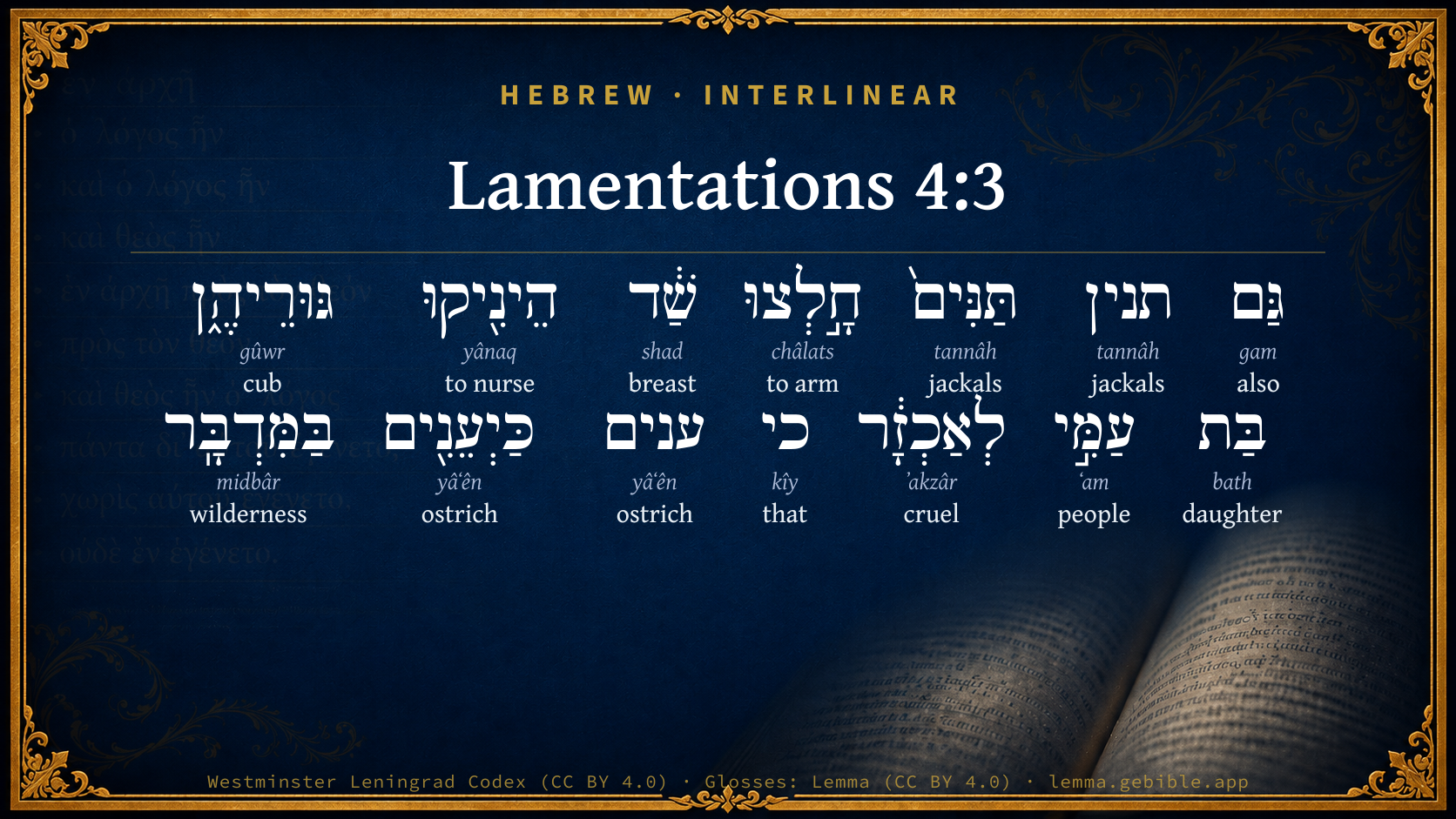
  1. גַּם gam H1571 “also” Particle, Accusative
  2. תנין tannâh H8568 “jackals” Noun, Common, Both, Plural, Absolute
  3. תַּנִּים֙ tannâh H8568 “jackals” Noun, Common, Both, Plural, Absolute
  4. חָ֣לְצוּ châlats H2502 “to arm” Verb, Qal, Perfect, 3rd Person, Common, Plural
  5. שַׁ֔ד shad H7699 “breast” Noun, Common, Masculine, Singular, Absolute
  6. הֵינִ֖יקוּ yânaq H3243 “to nurse” Verb, Hiphil, Perfect, 3rd Person, Common, Plural
  7. גּוּרֵיהֶ֑ן gûwr H1482 “cubs · their” Noun, Common, Masculine, Plural, Construct + Suffix, Personal, 3rd Person, Feminine, Plural
  8. בַּת bath H1323 “daughter of” Noun, Common, Feminine, Singular, Construct
  9. עַמִּ֣י ʻam H5971 “people · my” Noun, Common, Masculine, Singular, Construct + Suffix, Personal, 1st Person, Common, Singular
  10. לְאַכְזָ֔ר ʼakzâr H393 “to/for · cruel” Preposition + Adjective, Adjective, Masculine, Singular, Absolute
  11. כי kîy H3588 “that” Conjunction
  12. כַּיְעֵנִ֖ים yâʻên H3283 “like/as the · ostriches” Preposition, Determined + Noun, Common, Masculine, Plural, Absolute
  13. בַּמִּדְבָּֽר midbâr H4057 “in/at the · wilderness” Preposition, Determined + Noun, Common, Masculine, Singular, Absolute

About this verse

These counts appear in no published source. They are computed here, from the morphology-tagged text and Lemma’s own curated glosses. What Lemma adds →

14
words
12
distinct lemmas
Prophets
section

Notable vocabulary

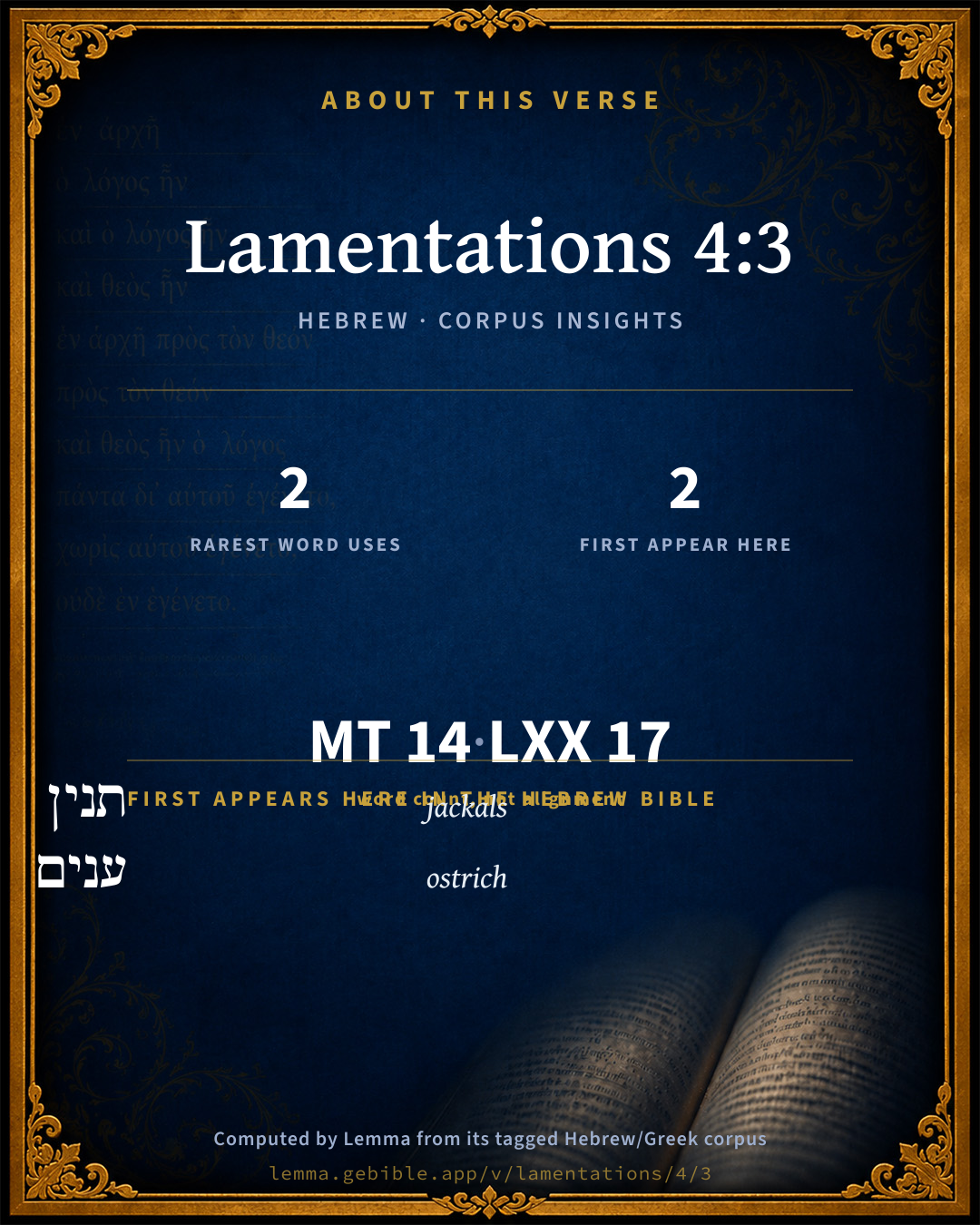
The rarest word here is ענים ostrich H3283 — appearing just 2 times in the whole Hebrew Bible.

First appearance in Scripture

These words make their first canonical appearance in the Hebrew Bible here:

Grammatical profile

  • 2 verbs
  • 9 nouns
  • 1 adjective
  • 1 conjunction
  • 1 particle

Verb forms

  • חָ֣לְצוּ Qal · Perfect
  • הֵינִ֖יקוּ Hiphil · Perfect

Repetition

Words recur within this verse — often emphatic in Hebrew:

  • תנין jackals H8568 ×2
  • ענים ostrich H3283 ×2

Hebrew & Septuagint length

In English translation the verse runs 28 words from the Hebrew and 28 from the Septuagint (LXX English) — the same length.

A rough comparison of the two English renderings, which tokenize alike — not a word-level alignment.

Word counts can differ between the Hebrew and the Greek without any difference in meaning — e.g. the Hebrew direct-object marker אֵת has no separate Greek word, and Greek often adds the article ὁ.

In the original languages it is 14 Hebrew tokens and 17 Greek tokens — but the two are counted differently (Hebrew bundles its prefixes and suffixes into one token; the Greek is in lemma form), so that isn’t a like-for-like length.

Cross-references

11

Topical passages linked to Lamentations 4:3 in the Treasury of Scripture Knowledge — connected by theme and wording, ordered by reader-vote popularity; previews shown in the World English Bible.

  • Ezekiel 5:10 Therefore the fathers shall eat the sons in the midst of you, and the sons shall eat their fathers; and I will execute judgments on you; and the whole remnant of you will I scatter to all the winds.
  • Luke 23:28–29 But Jesus, turning to them, said, "Daughters of Jerusalem, don't weep for me, but weep for yourselves and for your children.
  • Lamentations 2:20 Look, Yahweh, and see to whom you have done thus! Shall the women eat their fruit, the children that are dandled in the hands? Shall the priest and the prophet be killed in the sanctuary of the Lord?
  • Lamentations 4:10 The hands of the pitiful women have boiled their own children; They were their food in the destruction of the daughter of my people.
  • Leviticus 26:29 You will eat the flesh of your sons, and you will eat the flesh of your daughters.
  • Deuteronomy 28:52–57 They shall besiege you in all your gates, until your high and fortified walls come down, in which you trusted, throughout all your land; and they shall besiege you in all your gates throughout all your land, which Yahweh your God has given you.
  • 2 Kings 6:26–29 As the king of Israel was passing by on the wall, there cried a woman to him, saying, Help, my lord, O king.
  • Job 39:13–16 "The wings of the ostrich wave proudly; But are they the feathers and plumage of love?
  • Jeremiah 19:9 I will cause them to eat the flesh of their sons and the flesh of their daughters; and they shall eat everyone the flesh of his friend, in the siege and in the distress, with which their enemies, and those who seek their life, shall distress them.
  • Isaiah 49:15 Can a woman forget her sucking child, that she should not have compassion on the son of her womb? yes, these may forget, yet I will not forget you.
  • Romans 1:31 without understanding, covenant-breakers, without natural affection, unforgiving, unmerciful;

Cross-references courtesy of OpenBible.info (CC BY 4.0).

Hebrew and Greek witnesses Masoretic Hebrew ↔ Greek Septuagint

The same verse in the two great witnesses to the Old Testament, shown verse-for-verse.

These are two independent witnesses, not word-aligned to each other, and the Septuagint is shown in lemma (dictionary) form.

Hebrew Lamentations 4:3 Masoretic · Westminster Leningrad Codex

גַּם תנין תַּנִּים֙ חָ֣לְצוּ שַׁ֔ד הֵינִ֖יקוּ גּוּרֵיהֶ֑ן בַּת עַמִּ֣י לְאַכְזָ֔ר כי ענים כַּיְעֵנִ֖ים בַּמִּדְבָּֽר

Even the jackals draw out the breast, they give suck to their young ones: The daughter of my people is become cruel, like the ostriches in the wilderness.

World English Bible · Public Domain

Greek LXX Lamentations 4:3 Septuagint · lemma form

καί γέ δράκων ἐκδύω μαστός θηλάζω σκύμνος αὐτός θυγάτηρ λαός ἐγώ εἰς ἀνίατος ὡς στρουθίον ἐν ἐρῆμος

GIMEL. Nay, serpents have drawn out the breasts, they give suck to their young, the daughters of my people are incurably cruel, as an ostrich in a desert.

LXX2012 (modern English Septuagint) · Public Domain

On this verse, Haydock's Catholic Bible Commentary discusses the Septuagint’s reading. Read the note in Commentary ↓

Hebrew: Westminster Leningrad Codex (CC BY 4.0). Greek: Septuagint (public domain); English from LXX2012 (modern English Septuagint) (Public Domain). How the Septuagint differs from the Hebrew →

Commentary

Notes on Lamentations 4:3 from classic Christian and Jewish commentators (each source and its license shown beneath its notes). The classic Christian expositions comment on the surrounding passage and are grouped to its opening verse, so a note may address several verses; the Jewish commentaries on the Tanakh (Rashi and others) are per-verse, so they appear only where the commentator wrote on this verse.

Lemma curates 59 commentaries, every one of them public domain or Creative Commons licensed, each selected and text-cleaned for this edition rather than reprinted as found. About our sources →

Trapp's Complete Commentary

John Trapp

Lam 4:3 Even the sea monsters draw out the breast, they give suck to their young ones: the daughter of my people [is become] cruel, like the ostriches in the wilderness.

Ver. 3. Even the sea monsters.] {a} Heb., Whales or seals, which, being amphibii, have both a willingness and a place convenient to suckle their whelps.

The daughter of my people is become cruel.] She is so perforce, being destitute of milk for want of food, but much more by feeding upon them. {Lam 4:10; Lam 2:20} Oh, what a mercy is it to have meat! and how inexcusable are those unnatural mothers that neglect to nurse their children, not out of want, but wantonness! Surely as there is a blessing of the womb to bring forth, so of the breasts to give suck; {Gen 49:25} and the dry breasts and barren womb have been taken for a curse, {Hos 9:14} as some interpret that text.

{a} Lamiae. - Vulg.

John Trapp, A Commentary or Exposition upon All the Books of the Old and New Testament (1647–1656) — public domain. Text from a community e-Sword module.

Joseph Benson's Commentary

Lam 4:3-5. Even the sea-monsters draw out the breast — The very dragons have drawn out the breast: so Blaney. Even these fierce and destructive animals are not so unnatural as to neglect the care of their young ones; whereas the women of Jerusalem have been reduced to that miserable necessity as to disregard their children, as the ostrich does her eggs. The tongue of the sucking child, &c. — Such was the scarcity of food, that the women had not nourishment sufficient to produce milk to enable them to give suck to their infants, and when the children begged for bread the parents had none to give them. They that did feed delicately embrace dunghills — Lie down on dunghills, and seek about them in hopes to pick up something to eat.

Joseph Benson's Commentary on the Old and New Testaments (1811–1818) — public domain. Text from a community e-Sword module.

The Preacher's Complete Homiletical Commentary

Joseph S. Exell (gen. ed.)

EXEGETICAL NOTES.—

(ג). Lam_4:3. Beasts of prey show affection for their brood. Even the jackals draw out—present—the breast; a familiar fact testifying that they were true to their instincts, they suckle their whelps; but in miserable contrariety to this, the daughter of my people has become otherwise; unwilling to give nourishment to their babes, they show themselves cruel, like ostriches in the desert. This arraignment of the wild birds is according to ideas current at the time, and reported in the Book of Job. She leaveth her eggs on the earth … she is hardened against her young ones, as if they were not hers (Job_39:14; Job_39:16). Later observations require some modification of this account of the habits of the ostrich; but the writers of the Sacred Scriptures had not a knowledge of Nature beyond their times.

This fearful, unnatural result of the extreme trials of the Israelites had its correlated feature.

(ד). Lam_4:4. The tongue of the sucking child cleaveth to the roof of his mouth, because of getting no milk. The young children ask bread, and no one divides to them the cakes in which form it was made.

(ה) Lam_4:5. Adults also are distressed. They that did feed delicately, in the fastidiousness of luxury, are desolate in the streets, with no one to serve them, with no means to satisfy hunger, perishing. They that were brought up in scarlet, those of the wealthy classes, accustomed to use the most expensive cloth, lay themselves, in sheer despair, on the dirt-heaps which have accumulated in the ruined city. Like Dives, clothed in purple and fine linen, faring sumptuously every day, they too are in darkness—only they in the visible, he in the invisible world.

(ו) Lam_4:6. Those awful distresses were due to the way in which the people had lived. The crying wickedness of Sodom is again and again denounced by prophets as a warning to the Israelites. Here that wickedness is minified, and, from the long drawn out sufferings of the latter, it is implied that the iniquity—not the punishment of the iniquity, a translation which has not been established from the usage of the two corresponding Hebrew words elsewhere—of the daughter of my people is greater than the sin of Sodom. The Cities of the Plain had not the advantage which the Jews had, who were intrusted with the oracles of God, and their guilt was less. The supreme authority of Jesus Christ stands behind the declaration that it would be more tolerable for Sodom and Gomorrah in the day of judgment than for those who refused the light of life. Moreover, Sodom was destroyed by a sudden stroke—no protracted sufferings, no starved, wailing children, no mothers eating their own infants, overthrown as in a moment, and by forces in which no human agency had any part; hands did not encircle her. No enemies brandished their swords against her inhabitants, investing her on every side. God can paralyse all industries and destroy a community without man’s aid. The ground of this preference of Sodom is that a trouble direct from God is more bearable than one inflicted by man, and was expressed by King David, Let me fall into the hand of Jehovah … let me not fall into the hand of man (1Ch_21:13).

(ז) Lam_4:7. Men under religious vows could not have been so numerous as to form a conspicuous element in the population. Nor is there any reason to suppose that they were noted for a fine physique. Besides, the Hebrew word is not confined to those who are professed Nazarites, but applies to such as were distinguished from others. So Joseph, in Jacob’s dying forecasts, is described as him that was nazin, separate from [marg. that it prince among] his brethren (Gen_49:26). Her nobles were purer than snow, &c. Still another feature characterised them, they were more ruddy in body than rubies. “The white and red are to be understood as mixed, and shading into one another, as our popular poetry speaks of cheeks which ‘like milk and purple shine’ ” (Delitzsch); My beloved is white and ruddy (Son_5:10); “My love is like the red, red rose” (Scottish song). Sapphire was their polishing [lit. figure]. The comparison, however, can only be with the brilliancy of the gem, not with its shape. The appearance of the nobles, as here described, indicates that their faces were not bronzed and seamed by exposure to all kinds of weather; no engrained dust from toiling day after day darkened their complexion. They looked as those who live delicately in king’s courts. But now—

(ח) Lam_4:8. Darker than blackness is their visage; they are not recognised in the streets as members of the aristocracy; nothing marks them off from the labouring classes. Their skin cleaveth to their bones, they are emaciated and shrivelled through hunger and anguish, and the skin is become dry as wood.

(ט) Lam_4:9. One melancholy contrast suggests another, i.e., between those who are dead and those who are tortured by want. Better are the slain by the sword than the slain by hunger. The next clause is more descriptive of the condition of the former than of the latter. The advantage of less prolonged and gnawing pains is with those who pine away [lit. flow away, as sinking from loss of blood gushing from ghastly wounds], pierced through at a time when there was no lack of food from the fruits of the field.

(י) Lam_4:10. A more dreadful fact is related in regard to the little ones than that in Lam_4:3-4. The hands of tender-hearted women—not servants or hirelings, but themselves—have boiled their own children; they became meat for them in that climax of sufferings, the destruction of the daughter of my people. Moral duty is sacrificed, and unnatural crimes committed at the shrine of physical cravings.

HOMILETICS

THE EXTREMITY OF SUFFERING

(Lam_4:3-10)

I. Deadens natural affection (Lam_4:3-4). Maternal instincts are demoralised in the straitness of the siege. Little children are left to perish, without any effort to relieve their wants or soothe their sufferings. In vain they ask for bread; no attempt is made to allay their hunger and thirst. Absorbed in their own intolerable miseries, the wretched mothers sink below the instincts of the wild beasts, for even the jackals suckle their young. They are become like the cruel crocodile, which, after laying its eggs in the sand, abandons them without further care. The infants pine to death, unheeded and unmourned. Excessive suffering denaturalises man and woman.

II. Drags down all classes to one level (Lam_4:5). The wealthy are now even as the poor. They who fared sumptuously, and whose tastes were pampered with the most delicate viands, are now sullenly starving to death with the crowd. They who were clothed in scarlet, and accustomed to every refinement from their infancy, are now content to stretch themselves on the dirt-heaps of the city, and eager to devour any offal they may pick up amid the general scramble for food. All men find a universal communism in suffering. Human extremity knows no distinction in ranks and titles. Hunger drags every one to the same level.

III. Prefers a swift to a lingering punishment (Lam_4:6). The destruction of Sodom, which filled a large space in the Jewish mind as an example of the terrible judgment of Heaven on extreme iniquity, was regarded as light compared with the sufferings of Jerusalem. The punishment of Sodom was sudden, and came direct from God; but the punishment of Judah was by the hands of the Chaldeans, and was slow and lingering. David preferred to be dealt with directly from God, and chose pestilence rather than injuries inflicted by human hands (2Sa_24:14). But the iniquity of Judah was greater than the sin of Sodom, and the punishment was therefore more severe. There is a point in suffering when we yearn for a speedy release; when death is welcome.

IV. Reduces the healthiest from beauty to hideousness (Lam_4:7-8). The Nazarites, because of their temperance, were remarkable for health and personal beauty, and were held in veneration because of their religious devotion (comp. Numbers 6). Their complexion was ruddy as coral, and the beauty of their physical form was as exact and faultless as is the cutting of a sapphire. But the most distinguished of the population, whether Nazarites or of the aristocracy, are involved in the general calamity, and suffer with the rest. Their rosebud complexion is turned to blackness, their frame is shrunk and distorted, and their skin is shrivelled and dry. Famine plays havoc with beauty, and brings the strongest down to helplessness.

V. Recoils not from the most horrible means of appeasing the irresistible pangs of hunger (Lam_4:9-10). Such were the sufferings of the famished, that they who were slain with the sword were deemed happier than those who were pierced with the dart of unappeased hunger. So extreme was the famine, that cannibalism became common, and women who were known as tender-hearted mothers actually boiled and ate their own children (comp. 2Ki_6:28-29; Lev_26:29; Deu_28:56-57; Josephus’s “Wars,” cap. 10:9). It is a fearful experience when the animal in human nature gains the mastery over every other instinct.

LESSONS.—

1. Extremity makes strange revelations of human nature.

2. The restraints of civilisation are very superficial.

3. Sin acquaints the soul with the lowest depths of degradation.

GERM NOTES ON THE VERSES

Lam_4:3-10. The rigour of war. I. Demoralises maternal affection (Lam_4:1). II. Involves innocent children in suffering (Lam_4:2). III. Reduces all classes to poverty and distress (Lam_4:5; Lam_4:7-8). IV. Prolongs the misery of its victims (Lam_4:6). V. Is attended with the worst results of famine (Lam_4:9-10).

Lam_4:6. Graduated punishment.

I. Is proportioned to the character and degree of the sin committed. II. Its severity implies the enormity of the offence. III. Cannot be charged with injustice.

Lam_4:7-10. The horrors of famine. I. Changes strength into feebleness and beauty into deformity (Lam_4:7-8). II. Is more cruel than the sword (Lam_4:9). III. Debases the most refined into cannibals (Lam_4:10).

ILLUSTRATIONS.—Degradation. Is it not wonderful that base desires should so extinguish in men the sense of their own excellency, as to make them willing that their souls should be like to the souls of beasts, mortal and corruptible with their bodies?—Hooker.

There have been those—

“Who, in the dark dissolving human heart,

And hallowed secrets of this microcosm,

Dabbling, with shameless jest, a shameful band,

Encarnalised their spirits.”

Importance of food. Temperature has less influence in inciting the migration of birds than failure of food; for a few even of the regular migrants will linger throughout the winter at sheltered localities, where food remains accessible, safely daring the severest cold. Hunger means loss of heat and life, and it is this the birds primarily flee. No attraction to Christians like spiritual food. “Tie them up by the teeth,” as Mr. Spurgeon says.

Necessity a teacher. “Life and the necessities of life are the best philosophers, if we will only listen honestly to what they say to us; and dislike the lesson as we may, it is cowardice which refuses to hear it.”—Froude.

—The wife of a certain chieftain who had fallen upon idle habits, one day lifted the dish-cover at dinner, and revealed a pair of spurs; a sign that he must ride and hunt for his next meal.

Help in extremity. In the Magdalen Islands, off the Newfoundland coast, the means of livelihood is almost entirely found in the fisheries, and if these fail, life becomes a burden. In 1883 a famine occurred which came near to decimating the population. The fisheries failed; the ship which was expected to bring the winter’s supply before the ice formed foundered in a storm. By the time spring came, starvation stared the people in the face. Many must have died had not a large ship filled with produce been wrecked off Coffin Island. The news spread like wildfire. The population turned out, and from the cargo of a shipwrecked vessel drew a new lease of life.

Man’s extremity is God’s opportunity. It is a current saying, “That the darkest cloud precedes the dawn,” and that “Every dark cloud has a silver lining.” Early risers tell us that the lowest temperature immediately precedes the sun-rising. These things serve to illustrate God’s kingdom of grace. “Before honour is humility.” “Thou has lifted me up and cast me down.” “How long, O Lord, how long?”

The Preacher's Complete Homiletical Commentary (gen. ed. Joseph S. Exell; Funk & Wagnalls, c. 1892) — public domain (pre-1929). A full-Bible homiletical/sermon-outline anthology covering 65 of 66 books (2 John is absent from the source module). Text from a community e-Sword module.

Tyndale Open Study Notes

Tyndale Open Resources

4:3 like ostriches: See also Job 39:13-16.

Tyndale Open Study Notes — © Tyndale Open Resources, licensed CC BY-SA 4.0. Text via the HelloAO Bible API.

Geneva Bible (1599)

Geneva Bible translators

Though the dragons be cruel, yet they pity their young, and nourish them, which things Jerusalem doth not.

The women forsake their children, as the ostrich doth her eggs, Job 39:17.

Geneva Bible (1599) marginal notes — public domain. Text via Bolls.life.

Jamieson, Fausset & Brown

Robert Jamieson, A. R. Fausset & David Brown

sea monsters . . . breast--Whales and other cetaceous monsters are mammalian. Even they suckle their young; but the Jewish women in the siege, so desperate was their misery, ate theirs (Lam 4:10; Lam 2:20). Others translate, "jackals."

ostriches--see on Job 39:14; Job 39:16, on their forsaking their young.

Jamieson, Fausset & Brown — Commentary Critical and Explanatory on the Whole Bible (1871) — public domain (CC PDM 1.0). Text via the HelloAO Bible API.

Adam Clarke's Commentary

Verse 3. Even the sea monsters draw out the breast] The whales give suck to their young ones. The word תנין tannin, signifies all large and cruel creatures, whether aquatic or terrestrial; and need not here be restrained to the former sort. My Old MS. Bible translates curiously: Bot and the cruel bestis that ben clepid Lamya, and thei nakeden ther tetis, geve ther whelpis souken.

Like the ostriches in the wilderness.] For her carelessness about her eggs, and her inattention to her young, the ostrich is proverbial.

Adam Clarke's Commentary on the Bible (1810–1826) — public domain. Text from a community e-Sword/MySword module.

John Calvin's Commentaries

This verse is harshly explained by many, for they think that the daughter of the people is called cruel, because she acted towards her children as serpents do to their young ones. But this meaning is not suitable, for the word בת, beth, is well known to be feminine. He says that the daughter of the people had come to a savage or cruel one, the latter word is masculine. Then the Prophet seems to mean that the whelps (such is the word) of serpents are more kindly dealt with than the Jews. Serpents are void of all humanity, yet they nourish their brood and give them the breast,. Hence the Prophet by this comparison amplifies the miseries of the people, that their condition was worse than that of serpents, for the tender brood are nourished by their mothers; but the people were without any help, so that they in vain implored the protection of their mother and of others. ‘We now see the real meaning of the Prophet.

The particle גם, gam, is emphatical; for had he spoken of animals, such as are careful to nourish their young, it would not have been so wonderful; but so great seems to be the savageness and barbarity of serpents, that they might be expected to east away their brood. Now he says that even serpents draw out the breast The Jews say that the breasts of serpents are covered with scales, as though they were hidden; but this is one of their figments. It is a common phrase, taken from t common practice; for a woman draws out the breast when she gives suck to her infant; so serpents are said to draw out the breast when they give suck to their whelps; for גורים, gurim, are the whelps of lions or of bears; but in this place the word is applied to serpents. The daughter, then, of my people has come to the cruel one, for the people had to do with nothing but cruelty, there being no one to bring them help or to succor them in their miseries. He, then, does not accuse the people of cruelty, that they did not nourish their children, but on the contrary he means that they were given up to cruel enemies.

As the ostriches, or the owls, he says, in the wilderness. If we understand the ostrich to be intended, we know that bird to be very stupid; for as soon as she lays an egg, she forgets and leaves it. The comparison, then, would be suitable, were the daughter of the people said to be cruel, because she neglected her children; but the Prophet, as I think, means, on the contrary, that the Jews were so destitute of every help, as though they were banished into solitary places beyond the sight of men; for birds in solitude in vain seek the help of others. As, then, the ostrich Or the owl has in the desert no one to bring it help, and is without its own mother, so the Prophet intimates that there was no one to stretch forth a hand to the distressed people to relieve their extreme miseries. It follows, —

John Calvin's Commentaries (1540-1563) — public domain. Text from the Calvin Translation Society English edition (1840s-50s) via the Christian Classics Ethereal Library (ccel.org). Calvin's coverage is partial (roughly two-thirds of the Bible); uncommented books and verses are honest gaps, never fabricated. The 19th-century editor's footnotes and remarks are omitted so the notes are faithfully Calvin's own voice.

Ellicott's Commentary for English Readers

(3) Even the sea monsters . . .—Better, jackals. The Authorised Version is intended apparently to apply to cetaceous mammals; elsewhere (Jer_14:6) the word is rendered “dragons.” “Jackals,” it may be noted, are combined with “owls” or “ostriches,” as they are here, in Job_30:29; Isa_13:21. A like reference to the seeming want of maternal instinct in the ostrich is found in Job_39:16. The comparison was obviously suggested by facts like those referred to in Lam_2:20.

A Bible Commentary for English Readers, edited by Charles John Ellicott (1878–1897) — public domain. Text from a community e-Sword module.

The Cambridge Bible for Schools and Colleges

gen. ed. J. J. S. Perowne

3. the jackals] See on Jer_9:11; Jer_51:34.

like the ostriches in the wilderness] Cp. C.B. (Davidson) on Job_39:15 f. for “the popular belief that the ostrich did not brood but left her eggs to be hatched in the sun.… The belief is not sustained by observation, except to this extent, that the bird does not brood till her complement of eggs (thirty in number) be laid, and that during the earlier part of incubation she often leaves the nest by day to go in search of food. It is also said that she lays a number of eggs outside the nest, which are not incubated but serve as food for the poults when they are hatched.”

The Cambridge Bible for Schools and Colleges (gen. ed. J. J. S. Perowne; Cambridge University Press, 1878–1918) — public domain. Text from a community e-Sword module.

John Gill's Exposition

Even the sea monsters draw out the breast,.... Which some interpret of dragons; others of seals, or sea calves; but it is best to understand it of whales, as the word is rendered in Gen 1:21; and elsewhere: and Bochart (d) has proved, out of various writers, that these have breasts and milk; but that their breasts, or however their paps, are not manifest, but are hid as in cases, and must be drawn out: and so Jarchi observes that they draw their breasts out of a case, for their breasts have a covering, which they uncover: so Ben Melech. Aristotle (e) says, that whales, as the dolphin, sea calf, and balaena, have breasts or paps, and milk, which he makes to be certain species of the whale; and each of these, he elsewhere says, have milk, and suckle their young: the dolphin and sturgeon, he observes (f) have milk, and are sucked; and so the sea calf, he says (g), lets out milk as a sheep, and has two breasts, and is sucked by its young, as four footed beasts are. Agreeably to which Aelianus (h) relates, that the female dolphins have paps like women, and suckle their young, with great plenty of milk; and the balaena, he says (i), is a creature like a dolphin, and has milk. And Pliny, speaking of the dolphins, observes (k), that they bring forth their "whelps", and so the young of this creature are called here in the next clause in the Hebrew text (l), and nourish them with their breasts, as the balaena; and of the sea calves the same writer says (m) they feed their young with their paps; but the paps of these creatures are not manifest, as those of four footed beasts, as Aristotle observes; but are like two channels or pipes, out of which the milk flows, and the young are suckled;

they give suck to their young ones; as they do, when they are hungry; which is mentioned, as an aggravation of the case of the Jewish women, with respect to their behaviour towards their children, by reason of the famine, during the siege of Jerusalem; which here, and in the following verses, is described in the sad effects of it; and which had a further accomplishment at the destruction of the same city by the Romans: now, though the monsters suckled their young when hungry, yet these women did not suckle theirs;

the daughter of my people is become cruel; or, is "unto a cruel one" (n): that is, is changed unto a cruel one, or is like unto one, and behaves as such, though of force and necessity: the meaning is, that the Jewish women, though before tenderhearted mothers, yet, by reason of the famine, having no milk in their breasts, could give none to their children, and so acted as if they were cruel to them; nay, in fact, instead of feeding them, they fed upon them, Lam 4:10;

like the ostriches in the wilderness; which lay their eggs, and leave them in places easily to be crushed and broken; and when they have any young ones, they are hardened against them, as if they were none of theirs, Job 39:13; and this seemed now to be the case of these women; or, "like the owls", as the word is sometimes rendered; and which also leave their eggs, and for want of food will eat their young, as those women did. So Ben Melech says, it is a bird which dwells in the wilderness, and causes a voice of hooping to be heard.

(d) Hierozoic. l. 1. c. 7. p. 46. (e) Hist. Animal. l. 3. c. 20. (f) Ib. l. 6. c. 12. (g) lbid. (h) Hist. de Animal. 1. 10. c. 8. (i) Ib. l. 5. c. 4. (k) Nat. Hist. l. 9. c. 8. (l) "catulos suos", Pagninus, Montanus, Junius & Tremellius, Piscator, Cocceius. (m) Nat. Hist. l. 9. c. 13. (n) "in crudelem", Montanus; "sub. mutata fuit", Piscator; "similis est crudeli", Munster.

John Gill's Exposition of the Whole Bible (1746–1763) — public domain (CC PDM 1.0). Text via the HelloAO Bible API.

Albert Barnes' Notes on the Bible

Sea monsters - Rather, jackals.

Their young ones - “Their” whelps. The term is applied only to the young of dogs, lions, and the like.

Albert Barnes' Notes on the Bible (1834–1885) — public domain. Text from a community e-Sword/MySword module.

Haydock's Catholic Bible Commentary

Sea-monsters. Literally, Lamia. Hebrew Tannim. (Haydock) --- The lamia has a face like a woman, and a body like beasts; and is cruel, yet feeds its young. (Worthington) --- The fabulous lamia is supposed to destroy all children, (Diod. Sic. xx.; Ovid, Fast. vi.) and cannot be meant. But the sea dog, though most cruel will not neglect its young ones. (Calmet) --- Ostrich. Hebrew henim, (Haydock) "swans," Isaias xiii. 21., and Job xxix. 14. The ostrich is said to break some of its eggs. (Elian iv. 37.) -- Swans do the like, and devour their young; for which reason they are hated by the Indians. (Elian xiv. 3.) --- Septuagint, "their young (drajohs) have suckled the daughters of my people, so that they can find no remedy, like," &c. (Haydock) --- Though the ostrich has wings it never flies, but dwells in desert places. Such is the condition of the Israelites. (Theodoret) --- The ostrich forsakes its eggs. (Worthington) --- All are solicitous for themselves.

George Leo Haydock (1774–1849), Haydock's Catholic Family Bible and Commentary, 1859 edition — public domain. Excludes Psalms (Douay-Rheims chapter numbering differs from Protestant) and Deuterocanonical books (Catholic canon only).

Matthew Poole's English Annotations

The learned author of our English Annotations well observeth, that whatever creature is here intended by the word translated sea-monsters, yet our translation is not proper, the text speaking of creatures of God’s making, monsters properly signifying such as have something beyond their natural bulk and proportion. What creatures are signified by the Hebrew term, whether sea-calves, or dragons, or serpents, or whales, is very hard to say, the Hebrew word signifying some creatures, occurring so rarely as it is not easy to determine the species, from the word used to express it. He certainly speaks of some brute beasts, and those that are most savage. He saith there are none such but by a natural instinct feed and nourish their young ones; but the Jewish women were become cruel to their children, either forced to appear so, having through the famine no milk to give them, nor any thing to relieve them, or were indeed so, killing them to make food for themselves, as Lam 2:20.

Like the ostriches in the wilderness; like ostriches, that lay their eggs and leave them in the sand, and are hardened against their young ones, as Job 39:14-16. Some think a kind of owls are intended, which for want of meat eat up their young ones, as the Jewish women now did. See Lam 4:10.

Matthew Poole's English Annotations on the Holy Bible (1683–1685) — public domain. Text from a community e-Sword/MySword module.

Whedon's Commentary on the Bible

Daniel D. Whedon

3. Sea monsters — The original here has been mistaken in our Version. It is not tannim, “sea monsters” but tannin — jackals; and this harmonizes with the mention of ostriches in the last clause of the verse.

Cruel, like the ostriches — Which fowl is, in Job_39:13-17, used as “nature’s type of unmotherhood.” This popular belief, that the ostrich treats her young as if they were not hers, comes of the fact that her eggs are sometimes left to be hatched in the sand by the heat of the sun, and not by the warmth of her own body.

Daniel D. Whedon (gen. ed.), Commentary on the Old and New Testaments (1874–1909) — public domain. Text from a community e-Sword module.

The Pulpit Commentary

The sea monsters; rather, the jackals (tannin, the Aramaic form of the plural for tannim). Cruel, like the ostriches in the wilderness. So in Job (Job_39:14-16) it is said of the ostrich that she "leaveth her eggs in the earth, and warmeth them in dust, and forgetteth that the foot may crush them, or that the wild beast may break them. She is hardened against her young ones, as though they were not hers." The description is literally true, if we add a detail not mentioned by the sacred poet. The eggs destined for hatching are deposited in a nest hole scratched in the sand, but there are other eggs laid, not in the sand, but near it, to all appearance forsaken. These eggs, however, are not exposed in simple stupidity, though they do often fall victims to violence. "They are intended for the nourishment of the newly hatched young ones, which in barren districts would at first find difficulty in procuring food" (Houghton, "Natural History of the Ancients," p. 198).

Vers. 3, 4. The violation of maternal instincts.

I MATERNAL INSTINCTS ARE AMONG THE MOST WIDESPREAD AND DEEP-SEATED ORDINANCES OF PROVIDENCE.

1. Widespread. They are shared by the lower animals as well as by human beings. The fiercest monsters are careful of their cubs. The most stupid know how to tend and rear their offspring. Roaming jackals of the desert have their lairs where they give suck to their little ones. The varied fields of animal life all bear evidence to this wonderful instinct. It is seen among all races of men. Brutal degraded classes, untrained savages, fierce warlike people, all possess it.

2. Deep-seated. These instincts are far deeper than any merely social tendency. They are strong and vital as appetites. The mother feels for her child as for part of herself. Many desires and habits will be abandoned before these instincts will fail. They outlive virtue and principle and dwell still in the vicious.

II THE VIOLATION OF MATERIAL INSTINCTS IS ONE OF THE MOST HORRIBLE EVENTS.

1. In proportion to the profound and almost universal character of these instincts is the outrage on nature itself that the violation of them involves. We judge of an influence by the forces it has to overcome. It must be very strong if it can conquer great resistance. To conquer such resistance as that offered by the maternal instincts the evil influence must be powerful indeed. Therefore the violation of these instincts must be a proof of a most exceptionally energetic force of evil. Lady Macbeth must have sold herself to a very demon of ambition before she could unsex herself enough to say"I have given suck, and know How tender "tis to love the babe that milks me: I would, while it was smiling in my face, Have pluck"d my nipple from his boneless gums, And dash"d the brains out, had I so sworn, etc.

2. Moreover, the fatal effect of the violation of maternal instincts is another proof of the terrible evils of the corruption that can make it possible. These instincts are essential to the very continuance of life on our globe. Creatures that come into the world with so much feebleness as is the case with human beings would perish were they not protected in infancy by the wonderful passionate care of maternity.

III THAT MUST BE A FRIGHTFUL CALAMITY WHICH CAN LEAD TO THE VIOLATION OF MATERNAL INSTINCTS. Such was the calamity of the siege of Jerusalem. Then hunger and despair led parents to neglect their children. The worst mad violation of maternal instincts had been anticipated in a siege of Samaria, when a mother devoured her own. (2Ki_6:24-29) Such things have been done since. They force us to realize the barbarous cruelty of war which some would hide beneath its foolish pomp and pageantry. They also make us see the evil of extreme misery. There is a point beyond which suffering ceases to be beneficial. It then becomes a positive curse. It tears up the very roots of the most precious growths of nature. It drives to worse moral degradation than luxury tempts to, though in the eyes of a merciful God the guilt cannot be regarded with so much wrath where the misery that urges to it is so pitiable. Therefore it should be the work of the Christian philanthropist to remove physical wretchedness, not only for its own sake, but also as one of the first means for preventing crime and vice.

Vers. 3-5. The horrors of famine.

A more graphic, a more terrible picture than this of the misery of a captured, starved, and desolated city, no pencil could paint. If the circumstances of the famine-stricken population of Jerusalem are portrayed with too literal a skill and with too sickening an effect, it must be borne in mind that the description is not that of an artist, but of a prophet, and that the aim is not merely to horrify, but to instruct, and especially to represent the frightful consequences involved in a nation"s sin and apostasy.

I PHYSICAL SUFFERINGS ARE DESCRIBED. If the condition of the wretched citizens be examined, they are seen to be afflicted with all physical evils, e.g. with hunger and want, with emaciation and feebleness of body, with homelessness, squalor, and filth, with pestilence and death.

II MORAL DEGRADATION IS DENOUNCED. A siege, the sack of a city, have sometimes called out exalted self-sacrifice and heroism; but they have sometimes been the occasion of the bursting forth into flame of the vilest passions of avarice, cruelty, selfishness, and lust. In this passage we observe an atrocious exhibition of selfish indifference to the pains and necessities of others, and especially a display of cruelty towards children which contrasts with the parental instincts and tenderness of the brutes. To so low a level does sin bring human nature.

PRACTICAL LESSONS.

1. In plenty and peace let men cherish gratitude.

2. Let those who are prosperous commiserate the famine-stricken and the victims of war.

3. Let generous provision be made for the wants of the destitute. T.

Vers. 3, 4. Natural affection gone.

I NOTE AN UNFAVORABLE CONTRAST WITH THE LOWER CREATION. Everything is to be estimated according to its nature. It matters little what the sea-monster here stands for. It is sufficient to know that some fierce destructive creature is thought of. Truly there is a vast difference between the brutes whose very nature it is to destroy in order that they may live, and man who never looks more worthy of his position in the scale of being than when he is doing his very best to preserve life, risking even his own life for this end. And yet even in the most savage brutes there is natural affection. To stoop to a very common sight, what is more suggestive of some of the deep mysteries of existence than to see a cat one moment patiently suckling its own young, and the next moment stealthily and silently making its way to spring on some defenceless bird? If, then, it is put into the nature of these fierce creatures thus to care for their young, what care is it not right to expect from man, the highest creature whom we know? There is hardly any limit to what he can do for his offspring in the way of guarding its weakness and developing its power; and yet how negligent he can become! The lower creation puts him to shame. Jeremiah here speaks of cruelty, but we do well to remember that there is a thoughtlessness, an indolence, and a selfishness which are productive of as bad effects as any cruelty can produce. More evil, it has been truly said, is wrought from want of thought than from want of heart.

II WHAT IT IS THAT PRODUCES THIS CONTRADICTION TO NATURE? Generally stated, it is the stress of circumstances that does it. "The daughter of my people" would not have become cruel if her life had gone on in its ordinary way. But all at once the supplies that have been so regular become uncertain, and at last virtually stop. The cruelty, if in such circumstances it may be truly called so, is an involuntary one. And yet it is not involuntary in this sense, that the state of things was altogether unpreventable. The famine came from disobedience to God. We are not left to make a superstitious inference as to this connection. It is stated on authority. It were presuming far too much to trace a connection between particular suffering and particular wrong doing, but where the connection between particular wrong doing and particular suffering is made perfectly plain, we shall be very foolish if we do not take heed to it. Whatever wrong thing we do will have some evil consequences, and we know not hew soon they may come, how widely they may spread, and how much suffering and difficulty they may bring to the innocent. Y.

The Pulpit Commentary (1880–1919), ed. H.D.M. Spence-Jones & Joseph S. Exell — public domain. Text from a community e-Sword module.

John Wesley's Explanatory Notes

Cruel - The Jewish women are become cruel to their children, or forced to appear so, having through the famine no milk to give them, nor any thing to relieve them. Ostriches - Like ostriches that lay their eggs, and leave them in the sand.

John Wesley, Explanatory Notes Upon the Whole Bible (1754–1765) — public domain. Text via the GEBible commentary corpus.

unfoldingWord translationNotes

Door43 World Missions Community

General Information:

Because of the lack of food in the city, the people of Jerusalem do not give their children all they need.

the jackals offer the breast to nurse their cubs

This means that mother jackals feed their baby jackals.

jackals

fierce wild dogs

the daughter of my people ... like the ostriches in the desert

The people in Jerusalem are compared to ostriches because they are cruel to their children. (See: Simile)

the daughter of my people has

This is a poetic name for Jerusalem, which is spoken of here as if it were a woman. See how you translated this in Lamentations 2:11. AT: "my people have" (See: Metonymy and Personification)

ostriches

large birds that abandon some of their eggs

translationWords

people group

desert

unfoldingWord translationNotes — © Distant Shores Media and the Door43 World Missions Community, licensed CC BY-SA 4.0. Source: git.door43.org/Door43/en_tn.

Rashi

Rabbi Shlomo Yitzchaki (Rashi)

Even the sea-monsters Even though it is cruel, it offers the breast. When it sees its hungry offspring coming from afar, it uncovers its breasts from their sheath, for it has a cover over its breasts, and draws them out so that its offspring should not see them covered up and retreat. And then they suckle their young.

the daughter of my people has become cruel They see their children crying for bread, and they do not break it for them, for their own lives come before their children’s lives because of the hunger.

Rashi on the Tanakh — English translations: “The Judaica Press complete Tanach with Rashi, translated by A. J. Rosenberg” (CC BY 4.0); “Pentateuch with Rashi's commentary by M. Rosenbaum and A.M. Silbermann, 1929-1934” (public domain); “The Metsudah Tanach series, Lakewood, N.J” (CC BY 4.0); and “The Book of Joshua, Metsudah Publications, 1997” (CC BY 4.0). Text via Sefaria.

Lesson kit

Teaching starters — assembled from the data on this page, not authored interpretation. Every prompt links to the verse data it draws on. Edit before teaching.

Lamentations, in the Prophets, opens this verse with 14 words (12 distinct Hebrew lemmas). Its most distinctive word is yâʻên (“ostrich”). A historical commentator’s framing appears above. Read the whole chapter for the surrounding context.

Discussion questions

  1. What does “ostrich” (yâʻên) contribute to the verse as a whole?
  2. 2 words here appear for the first time in Scripture. What is being introduced at this debut?
  3. Ezekiel 5:10 shares this passage’s theme. How do the two illuminate each other?
  4. “jackals” occurs 2× in this one verse. What is the effect of the repetition?
  5. These translations render this verse differently; the difference is in the English rendering, not the original. What questions does that raise?
  6. The verb «חָ֣לְצוּ» is Qal Perfect. How does its form color the action?
  7. Reading how Trapp's Complete Commentary and Joseph Benson's Commentary read this verse, where do the two commentators agree and where do they part?

Things to notice

Reading settings

Reading text

Shown beneath each verse's original-language words.

Old Testament
Old Testament edition

Read the OT as the Masoretic Hebrew (MT) or the Greek Septuagint (LXX).

English shown for the Greek Septuagint (in the Hebrew ↔ Greek comparison).

Comparing translations? Open the Compare panel on any verse page to stack up to four side by side.