
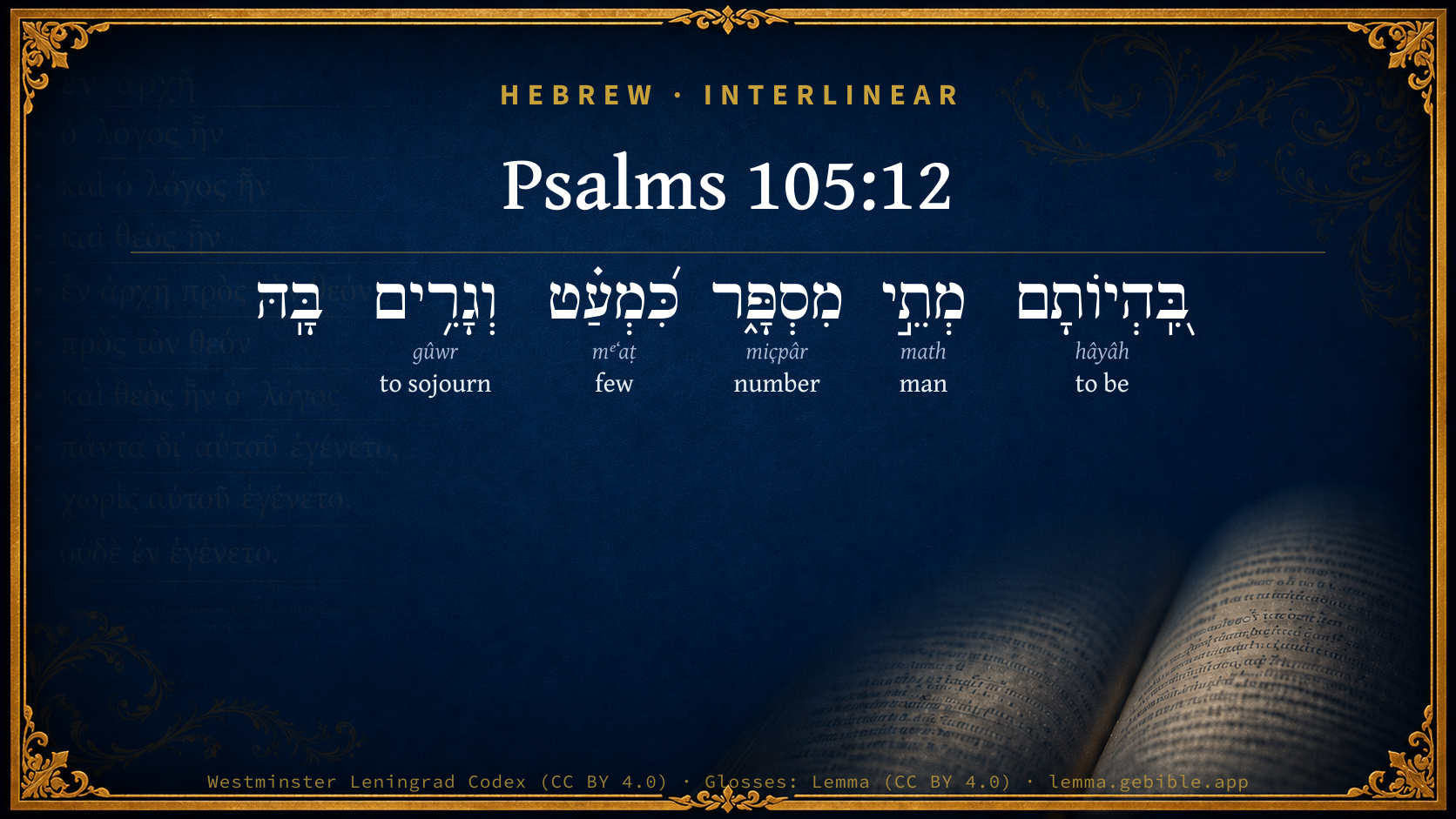
Psalms 105:12

Hebrew (Westminster Leningrad Codex) Psalms 105:12 appears in the Hebrew Old Testament. The text above is from the Westminster Leningrad Codex. Each word links to its Strong’s number, a concise gloss, and parsing drawn from the Open Scriptures Hebrew Bible morphology. Click any word for its full Brown-Driver-Briggs (BDB) entry.
Download image
Cite this verse

Psalms 105:12 (World English Bible). Public Domain. Lemma interlinear Bible study tool, https://lemma.gebible.app/v/psalms/105/12.

Show BibTeX & RIS
BibTeX
RIS
English Translation
When they were but a few men in number, Yes, very few, and foreigners in it.
World English Bible · Public Domain
Download a study sheet

One document with this verse’s original text, its word-by-word gloss line, the meaning frame, cross-references with their text, attributed commentary, and full source and license credits — printable, and it pastes into notes with its structure intact.

This verse Autodidact and up

Study sheet (.html) Plain text (.txt)

A passage Seminary Student

Up to 50 verses in one chapter. A passage sheet keeps up to 6 commentary sources and 12 cross-references per verse, in the order this page ranks them, and says so on the sheet whenever that leaves anything out. Ask for a single verse and you get the Autodidact verse sheet above.

Everything on this page stays free to read, with no account — the sheet is a download of what is already on screen, not access to it.

Want to remove ads? Support Godless Engineer
Compare translations 3

The same verse in 3 English versions, stacked beneath the original-language interlinear above. Click any original word for its lexicon entry.

Each is an independent rendering of the whole verse — the interlinear is not word-aligned to these translations.

Highlighted words mark where these versions differ — a whole-verse word diff, not a word-by-word alignment.

  • World English Bible Public Domain
    When they were but a few men in number, Yes, very few, and foreigners in it.
  • King James Version Public Domain
    When they were but a few men in number; yea, very few, and strangers in it.
  • unfoldingWord Literal Text CC BY-SA 4.0
    when they were few in number, very few, and strangers in it.

unfoldingWord Literal Text — © unfoldingWord, licensed CC BY-SA 4.0. Word-aligned USFM3 via Door43 (git.door43.org/unfoldingWord/en_ult).

Versions to compare (up to 4)

3 of 4 selected

Show all 18 translations

Every available English version of this verse, each an independent rendering of the whole verse.

  • World English Bible Public Domain
    When they were but a few men in number, Yes, very few, and foreigners in it.
  • Berean Standard Bible Public Domain
    When they were few in number, few indeed, and strangers in the land,
  • Majority Standard Bible Public Domain
    When they were few in number, few indeed, and strangers in the land,
  • King James Version Public Domain
    When they were but a few men in number; yea, very few, and strangers in it.
  • American Standard Version (1901) Public Domain
    When they were but a few men in number, Yea, very few, and sojourners in it.
  • Revised Version (1885) Public Domain
    When they were but a few men in number; yea, very few, and sojourners in it;
  • Geneva Bible (1599) Public Domain
    Albeit they were fewe in nomber, yea, very fewe, and strangers in the land,
  • Douay-Rheims (1899) Public Domain
    When they were but a small number: yea very few, and sojourners therein:
  • Young's Literal Translation Public Domain
    In their being few in number, But a few, and sojourners in it.
  • Literal Standard Version CC BY-SA 4.0
    In their being few in number, || But a few, and sojourners in it.
  • Unlocked Literal Bible CC BY-SA 4.0
    He said this when they were only few in number, so very few, and were strangers in the land.
  • unfoldingWord Literal Text CC BY-SA 4.0
    when they were few in number, very few, and strangers in it.
  • Darby Bible Public Domain
    When they were a few men in number, of small account, and strangers in it.
  • World Messianic Bible Public Domain
    when they were but a few men in number, yes, very few, and foreigners in it.
  • Webster's Bible Public Domain
    When they were a few men in number; yes, very few, and strangers in it.
  • Free Bible Version CC BY-SA 4.0
    He said this when they were only a few, just a small group of foreigners in the land.
  • Bible in Basic English Public Domain
    When they were still small in number, and strange in the land;
  • JPS Tanakh (1917) Public Domain
    When they were but a few men in number. Yea, very few, and sojourners in it,

Literal Standard Version (2020), Covenant Press — licensed CC BY-SA 4.0. Text via the HelloAO Bible API (eBible.org). Unlocked Literal Bible (unfoldingWord) — licensed CC BY-SA 4.0. Text via the HelloAO Bible API (eBible.org). unfoldingWord Literal Text — © unfoldingWord, licensed CC BY-SA 4.0. Word-aligned USFM3 via Door43 (git.door43.org/unfoldingWord/en_ult). Free Bible Version, Dr. Jonathan Gallagher — licensed CC BY-SA 4.0. Text via the HelloAO Bible API (eBible.org).

Word by word

More ways to search: Search by grammar → Find every occurrence → Compare this word →

Practice this passage: Drill this verse → Learn its vocabulary →

About this verse

These counts appear in no published source. They are computed here, from the morphology-tagged text and Lemma’s own curated glosses. What Lemma adds →

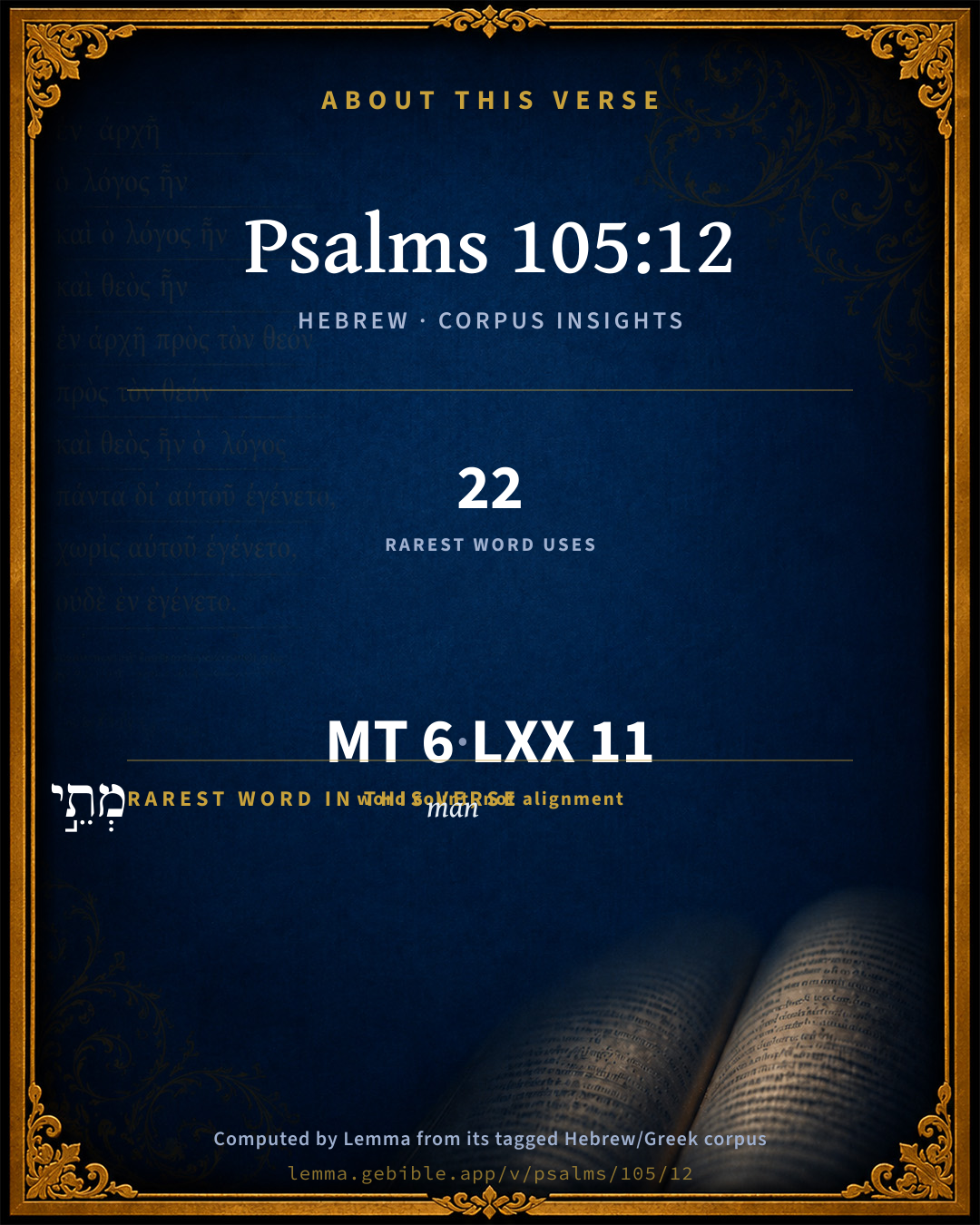
6
words
5
distinct lemmas
Wisdom
section

Notable vocabulary

The rarest word here is מְתֵ֣י man H4962 — appearing just 22 times in the whole Hebrew Bible.

Shared distinctive vocabulary

מְתֵ֣י man H4962 occurs in 21 verses of the Hebrew Bible. Also found in:

Grammatical profile

  • 2 verbs
  • 3 nouns
  • 1 preposition

Verb forms

  • בִּֽ֭הְיוֹתָם Qal · Infinitive Construct
  • וְגָרִ֥ים Qal · Participle Active

Hebrew & Septuagint length

In English translation the verse runs 16 words from the Hebrew and 12 from the Septuagint (LXX English) — closely comparable.

A rough comparison of the two English renderings, which tokenize alike — not a word-level alignment.

Word counts can differ between the Hebrew and the Greek without any difference in meaning — e.g. the Hebrew direct-object marker אֵת has no separate Greek word, and Greek often adds the article ὁ.

In the original languages it is 6 Hebrew tokens and 11 Greek tokens — but the two are counted differently (Hebrew bundles its prefixes and suffixes into one token; the Greek is in lemma form), so that isn’t a like-for-like length.

Cross-references

10

Topical passages linked to Psalms 105:12 in the Treasury of Scripture Knowledge — connected by theme and wording, ordered by reader-vote popularity; previews shown in the World English Bible.

  • Genesis 34:30 Jacob said to Simeon and Levi, "You have troubled me, to make me odious to the inhabitants of the land, among the Canaanites and the Perizzites. I am few in number. They will gather themselves together against me and strike me, and I will be destroyed, I and my house."
  • Deuteronomy 7:7 Yahweh didn't set his love on you, nor choose you, because you were more in number than any people; for you were the fewest of all peoples:
  • Hebrews 11:9 By faith, he lived as an alien in the land of promise, as in a land not his own, dwelling in tents, with Isaac and Jacob, the heirs with him of the same promise.
  • Genesis 23:4 "I am a stranger and a foreigner living with you. Give me a possession of a burying-place with you, that I may bury my dead out of my sight."
  • Deuteronomy 26:5 You shall answer and say before Yahweh your God, A Syrian ready to perish was my father; and he went down into Egypt, and sojourned there, few in number; and he became there a nation, great, mighty, and populous.
  • Genesis 17:8 I will give to you, and to your seed after you, the land where you are traveling, all the land of Canaan, for an everlasting possession. I will be their God."
  • Isaiah 51:2 Look to Abraham your father, and to Sarah who bore you; for when he was but one I called him, and I blessed him, and made him many.
  • Ezekiel 33:24–33 Son of man, they who inhabit those waste places in the land of Israel speak, saying, Abraham was one, and he inherited the land: but we are many; the land is given us for inheritance.
  • Acts 7:5 He gave him no inheritance in it, no, not so much as to set his foot on. He promised that he would give it to him for a possession, and to his seed after him, when he still had no child.
  • Hebrews 11:12 Therefore as many as the stars of the sky in multitude, and as innumerable as the sand which is by the sea shore, were fathered by one man, and him as good as dead.

Cross-references courtesy of OpenBible.info (CC BY 4.0).

Hebrew and Greek witnesses Masoretic Hebrew ↔ Greek Septuagint

The same verse in the two great witnesses to the Old Testament, shown verse-for-verse.

You’re reading Greek Psalm 104 (Hebrew Psalm 105). The Septuagint counts the superscription, so verse numbers can differ from the Hebrew — chapter-level alignment, not verse-by-verse. Numbering follows Rahlfs.

These are two independent witnesses, not word-aligned to each other, and the Septuagint is shown in lemma (dictionary) form.

Hebrew Psalms 105:12 Masoretic · Westminster Leningrad Codex

בִּֽ֭הְיוֹתָם מְתֵ֣י מִסְפָּ֑ר כִּ֝מְעַ֗ט וְגָרִ֥ים בָּֽהּ

When they were but a few men in number, Yes, very few, and foreigners in it.

World English Bible · Public Domain

Greek LXX Greek Psalm 104:12 Septuagint · lemma form

ἐν ὁ εἰμί αὐτός ἀριθμός βραχύς ὀλιγοστός καί πάροικος ἐν αὐτός

when they were few in number, very few, and sojourners in it.

LXX2012 (modern English Septuagint) · Public Domain

Hebrew: Westminster Leningrad Codex (CC BY 4.0). Greek: Septuagint (public domain); English from LXX2012 (modern English Septuagint) (Public Domain). How the Septuagint differs from the Hebrew →

Commentary

Notes on Psalms 105:12 from classic Christian and Jewish commentators (each source and its license shown beneath its notes). The classic Christian expositions comment on the surrounding passage and are grouped to its opening verse, so a note may address several verses; the Jewish commentaries on the Tanakh (Rashi and others) are per-verse, so they appear only where the commentator wrote on this verse.

Lemma curates 59 commentaries, every one of them public domain or Creative Commons licensed, each selected and text-cleaned for this edition rather than reprinted as found. About our sources →

Trapp's Complete Commentary

John Trapp

Psa 105:12 When they were [but] a few men in number; yea, very few, and strangers in it.

Ver. 12. When they were but a few men in number] Seventy souls at their going down into Egypt, which yet (say the Hebrews truly) were more worth than the seventy nations of the whole world besides. Howbeit, God chose them not for their worth or number, but loved them merely because he loved them, Deu 6:7-8.

John Trapp, A Commentary or Exposition upon All the Books of the Old and New Testament (1647–1656) — public domain. Text from a community e-Sword module.

Joseph Benson's Commentary

Psa 105:12-15. When they were but few in number — Hebrew, מתי מספר, methee mispar, men of number, so few as easily to be numbered, in opposition to what their posterity afterward were, as the sand of the sea without number: yea, very few — The word כמעשׂ, chimgnat, thus rendered, signifies either small as to number, or as to regard and esteem. The meaning probably is, that they were insignificant and inconsiderable as to power, the fewness of their number being mentioned just before. And strangers in it — Such were the patriarchs in the land of Canaan. They went from one nation to another — Both in Canaan, where there were seven nations, and in Egypt. He reproved kings for their sakes — Both verbally, and by his judgments. Saying, Touch not — Hurt not, as the word נגע, nagang, is often used; mine anointed — My prophets, Abraham, Isaac, and Jacob, who are called God’s anointed, because they were eminently blessed of God, replenished with the gifts and graces of the Holy Spirit, in respect of which many persons are said, in the Scriptures, to be anointed, who never had any material oil applied to them; and because they were thus consecrated to be his peculiar people, and to be kings and priests in their families. And they are called prophets, because God familiarly conversed with them, and revealed his will to them, and by them to others.

Joseph Benson's Commentary on the Old and New Testaments (1811–1818) — public domain. Text from a community e-Sword module.

Whedon's Commentary on the Bible

Daniel D. Whedon

12. In Psa_105:12-24, the psalmist touches the salient points of Hebrew history from the patriarchs to Moses.

Few—The Hebrews, in the times of the patriarchs, numbered less than any of the seven nations who held possession of Canaan. Deu_7:7; Deu_26:5; Gen_34:30.

Strangers—Same as sojourners, Psa_105:23; Gen_35:27

Daniel D. Whedon (gen. ed.), Commentary on the Old and New Testaments (1874–1909) — public domain. Text from a community e-Sword module.

Keil & Delitzsch

C. F. Keil & F. Delitzsch

The poet now celebrates the divine preservation which had sway over the small beginnings of Israel, when it made the patriarchs proof against harm on their wanderings. "Men of number" are such as can be easily counted, vid., the confessions in Gen 34:30; Deu 26:5; ויּתהלּכוּ places the claim upon the hospitality at one time of this people and at another time of that people in the connection with it of cause and effect. כּמעט, as a small number, only such a small number, signifies, as being virtually an adjective: inconsiderable, insignificant, worthless (Pro 10:20). בּהּ refers to Canaan. In Psa 105:13 the way in which the words גּוי and עם alternate is instructive: the former signifies the nation, bound together by a common origin, language, country, and descent; the latter the people, bound together by unity of government.

(Note: For this reason a king says עמּי, not גּויי; and גּוי only occurs twice with a suffix, which refers to Jahve (Psa 106:5; Zep 2:9); for this reason גּוי, frequently side by side with עם, is the nobler word, e.g., in Deu 32:21; Jer 2:11; for this reason עם is frequently added to גּוי as a dignitative predicate, Exo 33:13; Deu 4:6; and for this reason גּוים and עם ה are used antithetically.)

The apodosis does not begin until Psa 105:14. It is different in connection with בּהיותכם in the text of the chronicler, and in this passage in the Psalter of the Syriac version, according to which Psa 105:12 ought to be jointed to the preceding group. The variation ומממלכה instead of מממלכה is of no consequence; but לאישׁ (to any one whomsoever) instead of אדם, in connection with הניח, restores the current mode of expression (Ecc 5:11; Sa2 16:11; Hos 4:17) instead of one which is without support elsewhere, but which follows the model of נתן, נטשׁ, Gen 31:28 (cf. supra p. 171); whilst on the other hand ובנביאי instead of ולנביאי substitutes an expression that cannot be supported for the current one (Gen 19:9; Rut 1:21). In Psa 105:14 the poet has the three histories of the preservation of the wives of the patriarchs in his mind, viz., of Sarah in Egypt (Gen. 12), and of Sarah and of Rebekah both in Philistia (Psa 20:1-9, Psa 26:1-12, cf. especially Psa 26:11). In the second instance God declares the patriarch to be a "prophet" (Psa 20:7). The one mention has reference to this and the other to Gen. 17, where Abram is set apart to be the father of peoples and kings, and Sarai to be a princess. They are called משׁיהים (a passive form) as eing God-chosen princes, and נביאים (an intensive active form, from נבא, root נב, to divulge), not as being inspired ones (Hupfeld), but as being God's spokesmen (cf. Exo 7:1. with Exo 4:15.), therefore as being the recipients and mediators of a divine revelation.

Keil & Delitzsch — Biblical Commentary on the Old Testament (1861–1891) — public domain (CC PDM 1.0). Text via the HelloAO Bible API. (Old Testament only.)

J. A. Alexander on Psalms

Joseph Addison Alexander

12. (Psa 105:12) When as yet they could be numbered—very few, and strangers in it. The first clause involves an antithetical allusion to the promise, afterwards fulfilled, that they should be innumerable as the stars, or as the sand upon the shore, Gen. xxii. 17. The form of the original is highly idiomatic, in their being men of number, like a little, or like littleness itself. See above, on Psa 68:2, and compare Isa 1:9 (50:9). Strangers, sojourners, living on the lands of others, at their will, or by their sufferance. See above, on Psa 39:12. In it, the land of Canaan, mentioned in the preceding verse. The whole verse qualifies the previous account of the patriarchal covenant, which was not made with Israel when already a great nation, but with their ancestors when few in number and without a settled home. The parallel passage (1Ch 16:19) has when ye were. See Gen 34:30, and compare Deu 33:6, Isa 10:19.

Joseph Addison Alexander, The Psalms Translated and Explained (1850) — public domain. Text from a community e-Sword module.

Tyndale Open Study Notes

Tyndale Open Resources

105:12-15 The Lord protected Israel’s patriarchs.

Tyndale Open Study Notes — © Tyndale Open Resources, licensed CC BY-SA 4.0. Text via the HelloAO Bible API.

Adam Clarke's Commentary

Verse 12. But a few men] When all appearances were against them, and nothing but the arm of God could have brought them through their difficulties, and given them a settlement in the promised land.

Adam Clarke's Commentary on the Bible (1810–1826) — public domain. Text from a community e-Sword/MySword module.

John Calvin's Commentaries

12. When they were but very few in number The prophet here recounts the benefits which God had conferred upon the holy fathers from the commencement, to manifest that even long before the deliverance from Egypt, the covenant was not ineffectual. The great object aimed at in this recital, is to show that ever since God took Abraham under his protection, he cherished him in a wonderful manner, and also that his fatherly love and care were displayed in maintaining and defending the other two patriarchs. When it is said, that they were but very few in number, the power of God by this circumstance is not only magnified, but the cause why he was so beneficent towards them is also pointed out. We must then, in the first place, attend to this, that the prophet, lest the Jews should arrogate anything to themselves, expressly declares, that their fathers had experienced the divine favor, even when they were feeble and despised, wandering from place to place, in every respect poor and miserable according to the flesh. Thus also Moses reproaches them,

“The Lord did not set his love upon you, nor choose you, because ye were more in number than any people; for ye were the fewest of all people; but because the Lord loved you.” Deuteronomy 7:7, 8,

In short, in the choosing of this people, no regard was had either to number, or to any excellence whatever. There was only the house of Abraham, and yet it was barren. Isaac was compelled to banish to a distance from him one of his two sons, and he saw the other cut off from his family. The house of Jacob was indeed more fruitful, but it was nevertheless of a low condition. Besides, they were not only ignoble and despised when sojourning in a strange land, but famine, and the want of other things also, compelled them frequently to go from one place to another. All these things being taken into view, the consideration of human worth falls to the ground, and it is clearly seen, that all the blessings which God had bestowed upon them flowed from no other fountain than his own free love. And the cause of this love is not to be sought for out of himself. If the Holy Spirit is so careful in magnifying the grace of God in these earthly blessings, how much more must he observe this rule, when the subject of which he speaks is the heavenly inheritance! When it is said, that they walked about from nation to nation, this intimates the more plainly how wonderfully the divine protection was displayed in preserving them. Had they found any quiet nest in which to repose, such comfort would have been a notable sign of the divine goodness; but when they were as exiles in divers countries, and were driven from one place to another with bitter scorn, as chaff is driven about by the wind, the guardianship which God exercised over them shone forth much more conspicuously. Since their life everywhere hung only by a thread, and the changing of their place of sojourn exposed them from time to time to fresh injuries, it is evident that it was the divine power alone which preserved them in safety.

John Calvin's Commentaries (1540-1563) — public domain. Text from the Calvin Translation Society English edition (1840s-50s) via the Christian Classics Ethereal Library (ccel.org). Calvin's coverage is partial (roughly two-thirds of the Bible); uncommented books and verses are honest gaps, never fabricated. The 19th-century editor's footnotes and remarks are omitted so the notes are faithfully Calvin's own voice.

The Cambridge Bible for Schools and Colleges

gen. ed. J. J. S. Perowne

12. The Psalmist emphasises the marvellousness of the Divine promise by pointing out that it was made when the patriarchs were but an insignificant clan of protected aliens, and it seemed utterly improbable that they would ever become the owners of the land.

but a few men in number] Lit. men of number: a handful of men, easily counted. Jacob uses the same phrase of his family in Gen_34:30.

yea, very few] The word may mean few in number, or little worth; here probably the former. Cp. Deu_7:7; Deu_26:5.

strangers] sojourners, foreigners under the protection of the owners of the country, without rights of citizenship. Cp. Gen_21:23; Gen_23:4.

The Cambridge Bible for Schools and Colleges (gen. ed. J. J. S. Perowne; Cambridge University Press, 1878–1918) — public domain. Text from a community e-Sword module.

John Gill's Exposition

When they were but a few men in number,.... Or "men of number" (d), that might easily be numbered; see Gen 34:30, when this covenant, promise, and oath, were first made to Abraham, he was alone, and had no child; and when his posterity were increased in Jacob's time, and sojourned in Egypt, they were but few, though greatly enlarged when they came out of it: in comparison of other nations, they were the fewest of all people, and therefore had this grant of Canaan, not for their numbers any more than their goodness. And this circumstance is mentioned to show the unmerited goodness of God unto them; see Deu 7:6. And so the Lord's people, to whom he gives the kingdom of heaven, are a little flock; they are only a few that find the way to eternal life, Luk 12:32.

Yea, very few; or "as a little thing" (e): so were the people of Israel a little contemptible body of men in the eyes of others, and in comparison of them. And such are the saints in this world; "the filth of it", and the "offscouring of all things";

yea, things that are not; that scarce deserve, in the opinion of men, to be reckoned entities or beings. And strangers in it; as Abraham, Isaac, and Jacob, were, Heb 11:9, and so are the people of God, who are the heirs of the heavenly Canaan. These are strangers to the men of the world, who know them not; and the men of the world to them; with whom they have no conversation and fellowship in things sinful and criminal; for which they late despised by the world: yet these are the fellow citizens of heaven, and of the household of God, which shows his discriminating grace.

(d) "viros numeri", Montanus; so Vatablus, Gejerus, Michaelis. (e) "sicut parum", Montanus; so Vatablus; "aut exile aliquid", Gejerus; so Gussetius, p. 477.

John Gill's Exposition of the Whole Bible (1746–1763) — public domain (CC PDM 1.0). Text via the HelloAO Bible API.

Albert Barnes' Notes on the Bible

When they were but a few men in number - literally, “In their being people of number, very little.” That is, They could then be easily numbered, and they were so few that they could not take possession of it themselves. This is in contrast with the promise then made to them that they should be in number as the stars, and as the sand on the sea shore.

And strangers in it - Foreigners. They were mere sojourners. They did not become incorporated with the people of the land. They did not acquire property there. They were regarded and treated as belonging to a foreign people. See the notes at Heb 11:9.

Albert Barnes' Notes on the Bible (1834–1885) — public domain. Text from a community e-Sword/MySword module.

Matthew Poole's English Annotations

A few men in number, Heb. men of number, i.e. few, who could easily be numbered,

very few, as the next words explain it.

Matthew Poole's English Annotations on the Holy Bible (1683–1685) — public domain. Text from a community e-Sword/MySword module.

The Treasury of David

Charles H. Spurgeon

Ver. 12. When they were but a few men in number. bpom ytm. Literally, "homines numeri", men of number; so few as easily to be numbered: in opposition to what their posterity afterwards were, as the sand of the sea, without number. Samuel Chandler.

Ver. 12. One would think that all the world would have been upon them; but here was the protection, God has a negative voice, "He suffered no man to do them wrong." Many had (as we say) an aching tooth at the people of God, their finger itched to be dealing with them, and the text shows four advantages the world had against them. First, "They were few." Secondly, "very few." Thirdly, "strangers." Fourthly, unsettled. What hindered their enemies? It was the Lord's negative voice. "He reproved kings for their sakes; saying, Touch not mine anointed, and do my prophets no harm." We see an instance of this (Ge 35:5). When Jacob and his family journeyed, "the terror of God was upon the cities that were round about them, and they did not pursue after the sons of Jacob." They had a mind to pursue after them, to revenge the slaughter of the Shechemites; but God said, Pursue not, and then they could not pursue, they must stay at home. And when his people the Jews were safe in Canaan he encourages them to come up freely to worship at Jerusalem, by this assurance, "No man shall desire the land, when thou shalt go up to appear before the Lord thy God, thrice in the year" (Ex 34:24). God can stop not only hands from spoiling, but hearts from desiring. Joseph Caryl.

Ver. 12. Comfort to the few. The typical and spiritual Israel few at first. A few in the ark peopled the world. Small companies have done wonders. Christ's presence is promised to two or three. God saith not by many or by few, etc.

Psalms 105:13*

Charles H. Spurgeon's The Treasury of David (1869–1885) — public domain. Psalms only. Text from a community e-Sword/MySword module.

The Pulpit Commentary

When they were but a few men in number; literally, when they were men of number; i.e. when they could be easily counted. A few scores at the utmost, or, with their entire households, a few hundreds. (Gen_14:14 Gen_33:1) Yea, very few, and strangers in it; i.e. "in the land of Canaan". (comp. Exo_6:4)

"When they were but a few.

If we look back to the beginnings of all great enterprises and movements amongst men, this is what might have been said of them all. There was a time when those who were associated with them "were but a few." So was it after the Deluge. (1Pe_3:20; cf. also Neh_2:12) And see the beginnings of the Christian Church. Small like a grain of mustard seed. Now we are prone to be much discouraged when we see only a few caring for the things of God; and we are much elated when we see crowds of people, multitudes, uniting themselves with the professing Church. We may be wrong in both cases. Certainly we are when the fact of mere fewness casts us down. Let such despondents remember

I THAT IT IS QUALITY, NOT QUANTITY, THAT IS TO BE CONSIDERED. A living dog is better than a dead lion. Bigness is not strength. See the composition of the Bible. What great space is given to a little insignificant people, and the stories of their ancestors a people who inhabited a mere shred and corner of the world, and who were just nothing at all compared with the vast empires that stretched themselves out on all sides of them! But it was because in this little handful of people the Divine life had its home, and that in them, under God, the kingdom of God on earth depended, that, therefore, their history is all-important, and a special providence watched over them. And do not we know, in our experiences, the blessed force which a few, and even less than a few, thorough and wholly consecrated Christians exert, compared with what a crowd of the common sort ever accomplish?

II FEWNESS MAKES NO DIFFERENCE TO GOD. (Cf. 2Ch_14:11 1Co_1:27, 1Co_1:28) How many were the men who "turned the world upside down"? (Act_17:6)

III THE REALIZATION OF OUR OWN WEAKNESS, WHICH COMES TO US WHEN THERE ARE BUT A FEW, IS ONE OF THE CONDITIONS OF GOD"S WORKING. Our Lord had to make Peter feel what a poor creature he was before he could be used as an apostle; and hence came Peter"s fall.

IV A FEW BECOME A HOST IF GOD LEAD. We may be but a row of ciphers; but if God stand at our head, then they are no longer mere ciphers. And this is not a mere figure of speech, but an actual fact demonstrated over and over again. (cf. the vision, 2Ki_6:17)

V HIS SPECIAL PROMISES ARE FOR THE FEW. "Where two or three are gathered," etc. (Mat_18:20) And that promise has constantly been fulfilled.

VI THE FEW ARE HIS ESPECIAL CARE. (See vers. 12-15) And in the history of missions, the little handful who have gone to this country and that, though persecuted, and their ranks thinned by disease and death, yet have they been strengthened to hold on until they have won the battle God sent them to wage. What may not one God filled soul do? Read the history of Gideon to show this. And a company of them. If, then, "where there were but a few," there was no failure in the purpose and promise of God, let us rest assured that in like circumstances now there will be no failure. And let us stir ourselves up to lay hold on God. S.C.

The Pulpit Commentary (1880–1919), ed. H.D.M. Spence-Jones & Joseph S. Exell — public domain. Text from a community e-Sword module.

unfoldingWord translationNotes

Door43 World Missions Community

Connecting Statement:

The psalmist is writing about Israel.

when they were only few in number

The word "they" refers to the Israelites.

were strangers in the land

It is implied that "the land" refers to Canaan. AT: "were foreigners in the land of Canaan" (See: Assumed Knowledge and Implicit Information)

They went from

"They continued to wander"

from nation to nation and from one kingdom to another

These two phrases have similar meanings and are used together for emphasis. (See: Parallelism)

translationWords

nation

kingdom

unfoldingWord translationNotes — © Distant Shores Media and the Door43 World Missions Community, licensed CC BY-SA 4.0. Source: git.door43.org/Door43/en_tn.

Lesson kit

Teaching starters — assembled from the data on this page, not authored interpretation. Every prompt links to the verse data it draws on. Edit before teaching.

Psalms, in the Wisdom, opens this verse with 6 words (5 distinct Hebrew lemmas). Its most distinctive word is math (“man”). A historical commentator’s framing appears above. Read the whole chapter for the surrounding context.

Discussion questions

  1. The word math carries the sense “man.” How does it shape the verse?
  2. How does Genesis 34:30, which shares the word «man», read alongside this verse?
  3. These translations render this verse differently; the difference is in the English rendering, not the original. What questions does that raise?
  4. «בִּֽ֭הְיוֹתָם» is a Qal Infinitive Construct verb. How does that grammatical form shape the action described?
  5. Compare how Trapp's Complete Commentary and Joseph Benson's Commentary read this verse. Where do they agree or differ?

Things to notice

Reading settings

Reading text

Shown beneath each verse's original-language words.

Old Testament
Old Testament edition

Read the OT as the Masoretic Hebrew (MT) or the Greek Septuagint (LXX).

English shown for the Greek Septuagint (in the Hebrew ↔ Greek comparison).

Comparing translations? Open the Compare panel on any verse page to stack up to four side by side.