

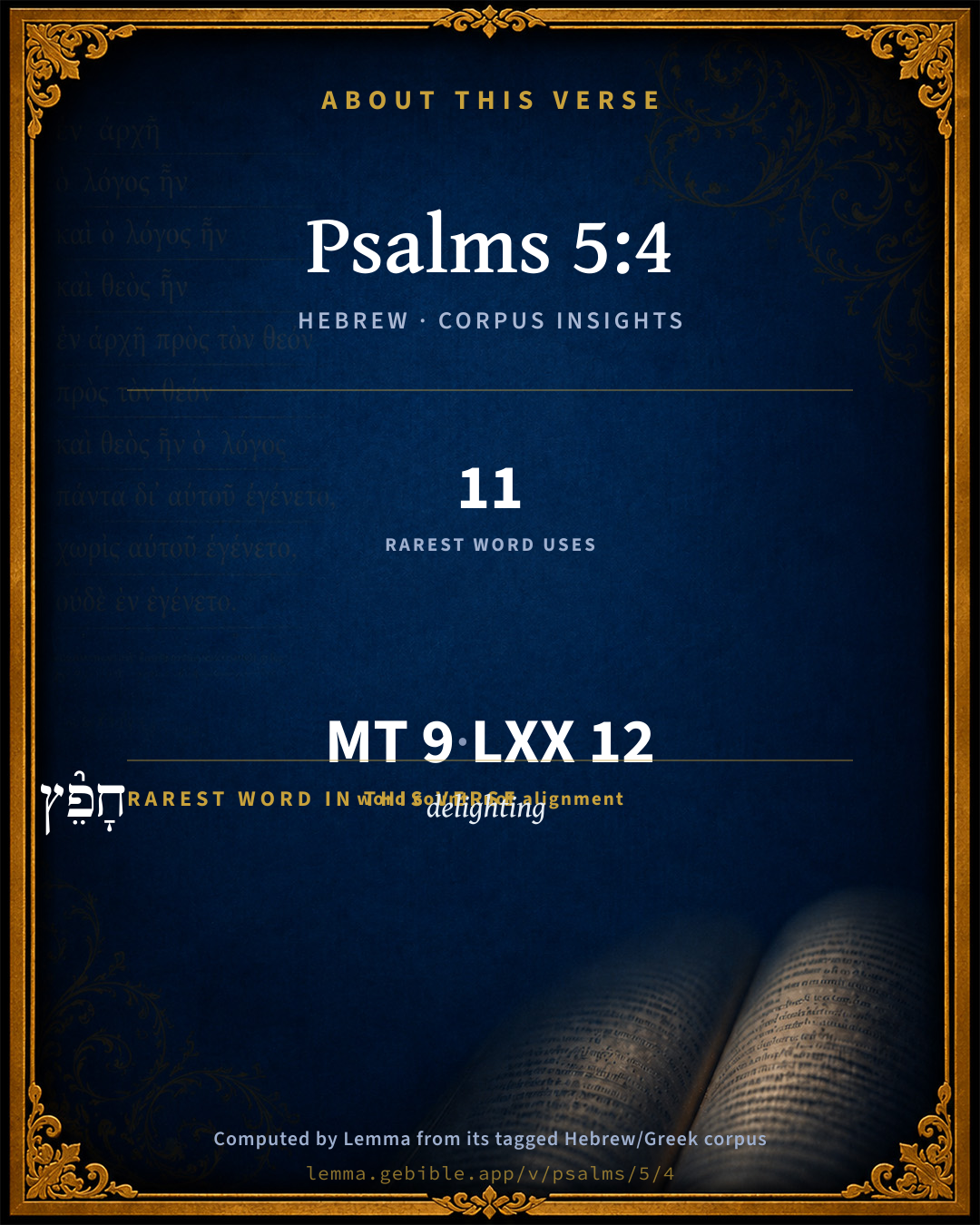
Psalms 5:4

Hebrew (Westminster Leningrad Codex) Psalms 5:4 appears in the Hebrew Old Testament. The text above is from the Westminster Leningrad Codex. Each word links to its Strong’s number, a concise gloss, and parsing drawn from the Open Scriptures Hebrew Bible morphology. Click any word for its full Brown-Driver-Briggs (BDB) entry.
Download image
Cite this verse

Psalms 5:4 (World English Bible). Public Domain. Lemma interlinear Bible study tool, https://lemma.gebible.app/v/psalms/5/4.

Show BibTeX & RIS
BibTeX
RIS
English Translation
For you are not a God who has pleasure in wickedness. Evil can't live with you.
World English Bible · Public Domain
Download a study sheet

One document with this verse’s original text, its word-by-word gloss line, the meaning frame, cross-references with their text, attributed commentary, and full source and license credits — printable, and it pastes into notes with its structure intact.

This verse Autodidact and up

Study sheet (.html) Plain text (.txt)

A passage Seminary Student

Up to 50 verses in one chapter. A passage sheet keeps up to 6 commentary sources and 12 cross-references per verse, in the order this page ranks them, and says so on the sheet whenever that leaves anything out. Ask for a single verse and you get the Autodidact verse sheet above.

Everything on this page stays free to read, with no account — the sheet is a download of what is already on screen, not access to it.

Want to remove ads? Support Godless Engineer
Compare translations 3

The same verse in 3 English versions, stacked beneath the original-language interlinear above. Click any original word for its lexicon entry.

Each is an independent rendering of the whole verse — the interlinear is not word-aligned to these translations.

Highlighted words mark where these versions differ — a whole-verse word diff, not a word-by-word alignment.

  • World English Bible Public Domain
    For you are not a God who has pleasure in wickedness. Evil can't live with you.
  • King James Version Public Domain
    For thou art not a God that hath pleasure in wickedness: neither shall evil dwell with thee.
  • unfoldingWord Literal Text CC BY-SA 4.0
    For you are not a god pleased with wickedness; evil ones will not sojourn with you.

unfoldingWord Literal Text — © unfoldingWord, licensed CC BY-SA 4.0. Word-aligned USFM3 via Door43 (git.door43.org/unfoldingWord/en_ult).

Versions to compare (up to 4)

3 of 4 selected

Show all 18 translations

Every available English version of this verse, each an independent rendering of the whole verse.

  • World English Bible Public Domain
    For you are not a God who has pleasure in wickedness. Evil can't live with you.
  • Berean Standard Bible Public Domain
    For You are not a God who delights in wickedness; no evil can dwell with You.
  • Majority Standard Bible Public Domain
    For You are not a God who delights in wickedness; no evil can dwell with You.
  • King James Version Public Domain
    For thou art not a God that hath pleasure in wickedness: neither shall evil dwell with thee.
  • American Standard Version (1901) Public Domain
    For thou art not a God that hath pleasure in wickedness: Evil shall not sojourn with thee.
  • Revised Version (1885) Public Domain
    For thou art not a God that hath pleasure in wickedness: evil shall not sojourn with thee.
  • Geneva Bible (1599) Public Domain
    For thou art not a God that loueth wickednes: neither shall euill dwell with thee.
  • Douay-Rheims (1899) Public Domain
    For to thee will I pray: O Lord, in the morning thou shalt hear my voice.
  • Young's Literal Translation Public Domain
    For not a God desiring wickedness `art' Thou, Evil inhabiteth Thee not.
  • Literal Standard Version CC BY-SA 4.0
    For You [are] not a God desiring wickedness, || Evil does not inhabit You.
  • Unlocked Literal Bible CC BY-SA 4.0
    Certainly you are not a God who approves of evil; evil people will not be your guests.
  • unfoldingWord Literal Text CC BY-SA 4.0
    For you are not a god pleased with wickedness; evil ones will not sojourn with you.
  • Darby Bible Public Domain
    For thou art not a ùGod that hath pleasure in wickedness; evil shall not sojourn with thee.
  • World Messianic Bible Public Domain
    For you are not a God who has pleasure in wickedness. Evil can’t live with you.
  • Webster's Bible Public Domain
    \\5:3\\My voice shalt thou hear in the morning, O LORD; in the morning will I direct my prayer to thee, and will look up.
  • Free Bible Version CC BY-SA 4.0
    For you are not a God who has any pleasure in wickedness; evil has no place with you.
  • Bible in Basic English Public Domain
    For you are not a God who takes pleasure in wrongdoing; there is no evil with you.
  • JPS Tanakh (1917) Public Domain
    (5-5) For Thou art not a God that hath pleasure in wickedness; evil shall not sojourn with Thee.

Literal Standard Version (2020), Covenant Press — licensed CC BY-SA 4.0. Text via the HelloAO Bible API (eBible.org). Unlocked Literal Bible (unfoldingWord) — licensed CC BY-SA 4.0. Text via the HelloAO Bible API (eBible.org). unfoldingWord Literal Text — © unfoldingWord, licensed CC BY-SA 4.0. Word-aligned USFM3 via Door43 (git.door43.org/unfoldingWord/en_ult). Free Bible Version, Dr. Jonathan Gallagher — licensed CC BY-SA 4.0. Text via the HelloAO Bible API (eBible.org).

Word by word

More ways to search: Search by grammar → Find every occurrence → Compare this word →

Practice this passage: Drill this verse → Learn its vocabulary →

About this verse

These counts appear in no published source. They are computed here, from the morphology-tagged text and Lemma’s own curated glosses. What Lemma adds →

9
words
8
distinct lemmas
Wisdom
section

Notable vocabulary

The rarest word here is חָפֵ֘ץ delighting H2655 — appearing just 11 times in the whole Hebrew Bible.

Shared distinctive vocabulary

חָפֵ֘ץ delighting H2655 occurs in 10 verses of the Hebrew Bible. Also found in:

Grammatical profile

  • 1 verb
  • 2 nouns
  • 2 adjectives
  • 1 pronoun
  • 1 conjunction
  • 2 particles

Verb forms

  • יְגֻרְךָ֣ Qal · Imperfect

Repetition

A word recurs within this verse — often emphatic in Hebrew:

Hebrew & Septuagint length

In English translation the verse runs 16 words from the Hebrew and 18 from the Septuagint (LXX English) — closely comparable.

A rough comparison of the two English renderings, which tokenize alike — not a word-level alignment.

Word counts can differ between the Hebrew and the Greek without any difference in meaning — e.g. the Hebrew direct-object marker אֵת has no separate Greek word, and Greek often adds the article ὁ.

In the original languages it is 9 Hebrew tokens and 12 Greek tokens — but the two are counted differently (Hebrew bundles its prefixes and suffixes into one token; the Greek is in lemma form), so that isn’t a like-for-like length.

Cross-references

14

Topical passages linked to Psalms 5:4 in the Treasury of Scripture Knowledge — connected by theme and wording, ordered by reader-vote popularity; previews shown in the World English Bible.

  • Psalms 11:5 Yahweh examines the righteous, But the wicked and him who loves violence his soul hates.
  • Hebrews 12:14 Follow after peace with all men, and the sanctification without which no man will see the Lord,
  • Malachi 2:17 You have wearied Yahweh with your words. Yet you say, 'How have we wearied him?' In that you say, 'Everyone who does evil is good in the sight of Yahweh, and he delights in them;' or 'Where is the God of justice?'
  • Psalms 50:21 You have done these things, and I kept silent. You thought that the "I AM" was just like you. I will rebuke you, and accuse you in front of your eyes.
  • Revelation 21:27 There will in no way enter into it anything profane, or one who causes an abomination or a lie, but only those who are written in the Lamb's book of life.
  • Psalms 92:15 To show that Yahweh is upright. He is my rock, And there is no unrighteousness in him.
  • Psalms 101:7 He who practices deceit won't dwell within my house. He who speaks falsehood won't be established before my eyes.
  • Psalms 140:13 Surely the righteous will give thanks to your name. The upright will dwell in your presence.
  • Habakkuk 1:13 You who have purer eyes than to see evil, and who cannot look on perversity, why do you tolerate those who deal treacherously, and keep silent when the wicked swallows up the man who is more righteous than he,
  • 2 Peter 3:13 But, according to his promise, we look for new heavens and a new earth, in which dwells righteousness.
  • Psalms 94:20 Shall the throne of wickedness have fellowship with you, Which brings about mischief by statute?
  • John 14:23 Jesus answered him, "If a man loves me, he will keep my word. My Father will love him, and we will come to him, and make our home with him.
  • Revelation 21:23 The city has no need for the sun, neither of the moon, to shine, for the very glory of God illuminated it, and its lamp is the Lamb.
  • 1 Chronicles 29:17 I know also, my God, that you try the heart, and have pleasure in uprightness. As for me, in the uprightness of my heart I have willingly offered all these things: and now have I seen with joy your people, that are present here, offer willingly to you.

Cross-references courtesy of OpenBible.info (CC BY 4.0).

Hebrew and Greek witnesses Masoretic Hebrew ↔ Greek Septuagint

The same verse in the two great witnesses to the Old Testament, shown verse-for-verse.

You’re reading Greek Psalm 5 (Hebrew Psalm 5). The Septuagint counts the superscription, so verse numbers can differ from the Hebrew — chapter-level alignment, not verse-by-verse. Numbering follows Rahlfs.

These are two independent witnesses, not word-aligned to each other, and the Septuagint is shown in lemma (dictionary) form.

Hebrew Psalms 5:4 Masoretic · Westminster Leningrad Codex

כִּ֤י לֹ֤א אֵֽל חָפֵ֘ץ רֶ֥שַׁע אָ֑תָּה לֹ֖א יְגֻרְךָ֣ רָֽע

For you are not a God who has pleasure in wickedness. Evil can't live with you.

World English Bible · Public Domain

Greek LXX Greek Psalm 5:4 Septuagint · lemma form

ὁ πρωΐ εἰςἀκούω ὁ φωνή ἐγώ ὁ πρωΐ παραἵστημι σύ καί ἐπιὁράω

For you are not a god that desires iniquity; neither shall the worker of wickedness dwell with you.

LXX2012 (modern English Septuagint) · Public Domain

On this verse, The Cambridge Bible for Schools and Colleges discusses the Septuagint’s reading. Read the note in Commentary ↓

Hebrew: Westminster Leningrad Codex (CC BY 4.0). Greek: Septuagint (public domain); English from LXX2012 (modern English Septuagint) (Public Domain). How the Septuagint differs from the Hebrew →

Commentary

Notes on Psalms 5:4 from classic Christian and Jewish commentators (each source and its license shown beneath its notes). The classic Christian expositions comment on the surrounding passage and are grouped to its opening verse, so a note may address several verses; the Jewish commentaries on the Tanakh (Rashi and others) are per-verse, so they appear only where the commentator wrote on this verse.

Lemma curates 59 commentaries, every one of them public domain or Creative Commons licensed, each selected and text-cleaned for this edition rather than reprinted as found. About our sources →

Trapp's Complete Commentary

John Trapp

Psa 5:4 For thou [art] not a God that hath pleasure in wickedness: neither shall evil dwell with thee.

Ver. 4. For thou art not a God that hath pleasure in wickedness] As the kings of the earth have, saith R. Solomon. Alexander the Great, promising a crown of one hundred and eighty pounds to those of his guests that drank most, caused forty one to kill themselves with drinking for that crown. King Charles IX of France gave one Albertus Tudius, a huckster’s son, six hundred thousand crowns to teach him to swear with a grace (Camera. Med. Histor.). But God perfectly hateth wickedness and wicked persons. There were more remarkable expressions of God’s anger upon man’s sin, in the dead body of a man, than of a beast, Num 11:31-34. The one made unclean but till the evening, the other seven days. God hateth sin worse than he doth the devil, for he hateth the devil for sin’s sake, and not sin for the devil’s sake. He hateth sin naturally in whomsoever, like as we hate poison, whether it be in a toad or in a prince’s cabinet. We read of antipathies in nature between the elephant and the boar, the lion and the cock, the horse and the stone taraxippe, &c., but nothing so great as between God, the chiefest good, and sin, the utmost evil. Let us be like affected to our heavenly Father, as dear children, abhorring that which is evil, Rom 12:9, hating it as we do hell itself, so the Greek word there signifieth, abandoning it, and abstaining from all appearance of it, as it is offensivum Dei, et aversivum a Deo, an offence against God, and a breach of his law.

Neither shall evil dwell with thee] Heb. sojourn with thee, or be harboured as a guest, much less as a home dweller. Peter Martyr, out of Nathan’s parable, observeth, that lust was but a stranger to David, that lodged with him for a night only, 2Sa 12:4. Though corruption may intrude upon us, and enter, yet it may not be harboured, and dwell with us; lest the traveller become the man of the house.

John Trapp, A Commentary or Exposition upon All the Books of the Old and New Testament (1647–1656) — public domain. Text from a community e-Sword module.

The Biblical Illustrator

Joseph S. Exell

Psa_5:4-5

Thou art not a God that hath pleasure in wickedness.

The great matters of religion

If we inquire how it comes to pass that man is fallen under Gods displeasure, the text resolves it all into wickedness. This is that which makes all the breach between God and us. This is that which bath wrought all the mischief and disorder that ever hath been in the creation of God from the beginning. This is that which hath so sunk and debased the nature of man, and made it so unlike the Divine nature. Whosoever is in love with evil, cannot be in love with the ways of goodness and righteousness. Whosoever consents to iniquity, does voluntarily part with God, and God leaves him. Atheists make the prosperity of wicked men an argument against Divine Providence. To make a man a wicked person in the sense of Scripture, there must be either gross carelessness and neglect of God and religion: voluntary consent to known iniquity, known hypocrisy, or great apostasy, in matters of doctrine, or in matters of practice. Those that are wicked cannot have to do with God; they stand at a great distance from Him, and are banished from His throne. We best know God by imitation and resemblance of Him. We cannot build upon any report concerning God, which a bad man makes; for if he should speak right of God, he would condemn himself. Goodness, which is Gods perfection, and wickedness, which is mans acquisition, can no more consist together than light and darkness, health and sickness, soundness and rottenness. Persons of naughty minds have no true thoughts either of God or man. What, then, are the great matters of religion, and what are those things that will consist with it? To reverence and acknowledge the Deity. To live in love, and bear goodwill towards one another. To deal justly, equally, and fairly in all our transactions and dealings each with other. To use moderation and government of ourselves, in the respect of the necessaries and conveniences of this state. The following things are matters of offence, and of the creatures ruin. Things contrary to the due respect and regard which we ought to bear towards God. Things that are contrary to the general love and goodwill which ought to run through the whole creation of God. Things contrary to that fairness, justice, righteousness, and equal dealing which ought to be among fellow servants, among fellow creatures. Things contrary to the sobriety, chastity, temperance, and due moderation of ourselves Two things concerning repentance.

1. It doth alter the very temper of the sinner.

2. It is a motive with God, and doth affect Him. It doth procure atonement in respect of God. (B. Whichcote, D. D.)

Gods hatred of sin

1. Some of the grounds of that displeasure which God cherishes towards sin. The justice of God must lead Him to view with displeasure that evil and abominable thing. The love--the service which God requires, is love and obedience. To withhold this service is to act unjustly towards Him. The benevolence of God must ever lead Him to regard sin with abhorrence. What is sin but a soul going away from its Maker, from the great Fountain of living waters? As the great Lawgiver of the universe, God must look with deep displeasure on sin. The law is holy, and just and good. When we act in opposition to this law, we, in fact, lift up our testimony against the law. Further, God is the Author of all our mercies, and as such must look with deep displeasure on the workers of iniquity. How great is the debt and obligation under which we are laid to Him by the load of His providential bounty! There has not been a moment of our lives in which the God who made us has not been doing something for us. What must He think of that evil thing which leads to such ingratitude for these blessings? And God must look with displeasure on sin, because it is opposed to all those great schemes, all these grand schemes, which we read in the Scriptures, of Jehovah having imparted; such as creation, providence, redemption.

2. Manifestations of the existence and the extent of that hatred of iniquity which God habitually cherishes. We find many such manifestations. Illustration--Angels that lost their first estate. Loss of Eden. Story of Sodom, etc. (James Marshall, A. M.)

Thou hatest all workers of iniquity.

Gods hatred of sinners

Here is a plain declaration.

I. That God does hate the persons of impenitent sinners. It is often said that God hates sin, but not sinners. The point now to prove is, that God hates sinners themselves, as vile and odious creatures. It is allowed that God loves all that love Him, and it is equally true that He hates those who hate Him. The Old Testament abounds with passages in which God expresses His displeasure, His wrath, and His indignation towards sinners.

II. Why does God hate the persons of sinners? Many consider sin in the abstract, and God as hating it in the abstract. But who can conceive of sin without a sinner? Or of sin that no person ever committed? Every sin is a transgression of the law, and renders the transgressor both criminal and hateful. The transgression cannot be separated from the transgressor, any more than his reason, or conscience, or any other property or quality of his mind can be separated from him. The apostle represents sin as corrupting all the powers and faculties of sinners. This moral corruption of sinners he represents as rendering them vile and hateful, even in their own sight. Their evil hearts render their persons morally evil and hateful in the sight of God. It is holiness of heart that makes saints lovely, and the reverse is equally true of sinners.

III. How Gods hating the persons of sinners is consistent with His loving them. Some have attempted to evade this difficulty by supposing that all the Scripture says about the displeasure, the hatred, the wrath and anger of God, is to be understood figuratively; and that no such exercises or emotions of heart can exist in the mind of an absolutely perfect and immutable being. But to suppose that God does not really hate sinners is evading rather than solving the difficulty. Others say that God loves sinners themselves, and only hates their sins. But it is abundantly evident from Scripture that God does really and literally love and hate sinners at the same time. What kind of love does God exercise towards sinners? They are not proper objects of approbation or complacence, but of disapprobation and hatred. It is only the love of benevolence that God exercises towards totally depraved sinners. He loves all His creatures, whether rational or irrational. If He loves them with the love of benevolence, He cannot love them with the love of complacence. Benevolence hates selfish and sinful creatures, as much as it loves holy and virtuous creatures. Holiness in the Deity produces love to the holy, and hatred to the unholy. There are two things in sinners which render them objects of both love and hatred. Their capacity to enjoy happiness and suffer misery renders them proper objects of benevolence, and their sinful character renders them proper objects of displeasure, disapprobation, and hatred. God views them in both lights. His love towards them is benevolent love, and His hatred towards them is benevolent hatred. Improvement.

1. If Gods hatred of impenitent sinners is consistent with His love of benevolence towards them, then it is consistent with His benevolence to hate them as long as they continue impenitent.

2. If God loves and hates sinners in this world at all, then He loves and hates them more than any other being does in the universe.

3. If impenitent sinners themselves are as much the objects of Gods hatred as of His love, then it is very important that they should be made sensible of it.

4. If it be consistent with the benevolence of God towards sinners to hate them, then it is consistent with His benevolence to express His hatred towards them.

5. If Gods hatred of impenitent sinners flows from His benevolence, then His punishing them must flow from His benevolence.

6. If it be the benevolence of God that disposes Him to hate and punish impenitent sinners forever, then it is extremely absurd and dangerous for sinners to rely on His mere benevolence to save them in the eleventh and dying hour. This subject calls on all to inquire and determine whether they are saints or sinners. (N. Emmons, D. D)

The relation of the righteous God to wicked men

In the second century, Celsus, a celebrated adversary of Christianity, distorting our Lords words, complained, Jesus Christ came into the world to make the most horrible and dreadful society; for He calls sinners and not the righteous; so that the body He came to assemble is a body of profligates, separated from good men, among whom they before were mixed. He has rejected all the good and collected all the bad. True, said Origen in reply, our Jesus came to call sinners--but--to repentance. He assembled wicked--but to convert them into new men, or rather to change them into angels. We come to Him covetous, He makes us liberal; lascivious, He makes us chaste; violent, He makes us meek; impious, He makes us religious.

The Biblical Illustrator, edited by Joseph S. Exell (c. 1880s–1900s) — public domain. Text from a community e-Sword module.

Whedon's Commentary on the Bible

Daniel D. Whedon

4. For—Because. He now states the ground or cause of his trusting in prayer, which he gives in Psa_5:4-6, namely, the fact that God cannot approve or allow wickedness, and that he is “my God and my King,” (Psa_5:2.)

Neither shall evil dwell with thee—Shall not inhabit or abide with thee. Evil men shall not live with God in the same house, (Psa_15:1,) nor in any relations of favour or friendliness. In Psa_5:4-6 seven designations are given to the wicked, all abhorrent to God. In the wicked God does not delight. There is no agreeableness in them. The evil man shall not dwell with him.

Daniel D. Whedon (gen. ed.), Commentary on the Old and New Testaments (1874–1909) — public domain. Text from a community e-Sword module.

Geneva Bible (1599)

Geneva Bible translators

Seeing that God of nature hateth wickedness, he must needs punish the wicked, and save the godly.

Geneva Bible (1599) marginal notes — public domain. Text via Bolls.life.

Jamieson, Fausset & Brown

Robert Jamieson, A. R. Fausset & David Brown

For, &c.--God only regards sincere worshippers.

evil--or, "the evil man."

dwell--lodge, remain under protection.

Jamieson, Fausset & Brown — Commentary Critical and Explanatory on the Whole Bible (1871) — public domain (CC PDM 1.0). Text via the HelloAO Bible API.

Adam Clarke's Commentary

Verse 4. Neither shall evil dwell with thee.] As thou art holy, so thou hast pleasure only in holiness; and as to evil men, they shall never enter into thy glory; לא יגרך רע lo yegurecha ra, "the evil man shall not even sojourn with thee."

Adam Clarke's Commentary on the Bible (1810–1826) — public domain. Text from a community e-Sword/MySword module.

John Calvin's Commentaries

Here David makes the malice and wickedness of his enemies an argument to enforce his prayer for the divine favor towards him. The language is indeed abrupt, as the saints in prayer will often stammer; but this stammering is more acceptable to God than all the figures of rhetoric, be they ever so fine and glittering. Besides, the great object which David has in view, is to show, that since the cruelty and treachery of his enemies had reached their utmost height, it was impossible but that God would soon arrest them in their course. His reasoning is grounded upon the nature of God. Since righteousness and upright dealing are pleasing to him, David, from this, concludes that he will take vengeance on all the unjust and wicked. And how is it possible for them to escape from his hand unpunished, seeing he is the judge of the world? The passage is worthy of our most special attention. For we know how greatly we are discouraged by the unbounded insolence of the wicked. If God does not immediately restrain it, we are either stupified and dismayed, or cast down into despair. But David, from this, rather finds matter of encouragement and confi-dence. The greater the lawlessness with which his enemies proceeded against him, the more earnestly did he supplicate preservation from God, whose office it is to destroy all the wicked, because he hates all wickedness. Let all the godly, therefore, learn, as often as they have to contend against violence, deceit, and injustice, to raise their thoughts to God in order to encourage themselves in the certain hope of deliverance, according as Paul also exhorts them in 2 Thessalonians 1:5, “Which is,” says he, “a manifest token of the righteous judgment of God, that ye may be counted worthy of the kingdom of God, for which ye also suffer: seeing it is a righteous thing with God to recompense tribulation to them that trouble you; and to you who are troubled, rest with us.” And assuredly he would not be the judge of the world if there were not laid up in store with him a recompense for all the ungodly. One use, then, which may be made of this doctrine is this, — when we see the wicked indulging themselves in their lusts, and when, in consequence, doubts steal into our minds as to whether God takes any care of us, we should learn to satisfy ourselves with the consideration that God, who hates and abhors all iniquity, will not permit them to pass unpunished, and although he bear with them for a time, he will at length ascend into the judgment-seat, and show himself an avenger, as he is the protector and defender of his people. “Comme il est protecteur et defenseur des siens.” — Fr.

In the 4th verse some take רע, ra, in the masculine gender, for a wicked man; but I understand it rather of wickedness itself David declares simply, that there is no agreement between God and unrighteousness. He immediately after proceeds to speak of the men themselves, saying, the foolish shall not stand in thy sight; and it is a very just inference from this, that iniquity its hateful to God, and that, therefore, he will execute just punishment upon all the wicked. He calls those fools, according to a frequent use of the term in Scripture, who, impelled by blind passion, rush headlong into sin. Nothing is more foolish, than for the ungodly to cast away the fear of God, and suffer the desire of doing mischief to be their ruling principle; yea, there is no madness worse than the contempt of God, under the influence of which men pervert all right. David sets this truth before himself for his own comfort; but we also may draw from it doctrine very useful in training us to the fear of God; for the Holy Spirit, by declaring God to be the avenger of wickedness, puts a bridle upon us, to restrain us from committing sin, in the vain hope of escaping with impunity.

John Calvin's Commentaries (1540-1563) — public domain. Text from the Calvin Translation Society English edition (1840s-50s) via the Christian Classics Ethereal Library (ccel.org). Calvin's coverage is partial (roughly two-thirds of the Bible); uncommented books and verses are honest gaps, never fabricated. The 19th-century editor's footnotes and remarks are omitted so the notes are faithfully Calvin's own voice.

Ellicott's Commentary for English Readers

(4) Neither shall evil.—Better, the wicked man is not thy guest. For the same thought, see Psalms 15; and for the opposite, of God coming to dwell with the godly, Isa_57:15.

A Bible Commentary for English Readers, edited by Charles John Ellicott (1878–1897) — public domain. Text from a community e-Sword module.

The Cambridge Bible for Schools and Colleges

gen. ed. J. J. S. Perowne

4. a God] El, not Elohim. If the fundamental idea of this name for God is that of power[3], its use here is significant. Power without goodness is the fetishistic conception of deity, to which human nature is prone (Psa_50:21).

[3] Attractive but questionable is Lagarde’s explanation of the name El as ‘the Being to Whom man turns,’ the aim and end of all human longing and effort.

neither shall evil dwell with thee] Rather, as R.V. marg., with the LXX, Vulg. and Jerome, The evil man shall not sojourn with thee. He cannot be (so to speak) God’s guest, and enjoy the hospitality and protection which Oriental custom prescribes. See on Psa_15:1, and cp. Psa_61:4. To sinners the divine holiness is a consuming fire which they cannot endure (Isa_33:14).

4–6. The ground of the Psalmist’s confident expectation of an answer is the holiness of God, who will tolerate no evil. Comp. the ideal of an earthly king’s court in Psalms 101.

The Cambridge Bible for Schools and Colleges (gen. ed. J. J. S. Perowne; Cambridge University Press, 1878–1918) — public domain. Text from a community e-Sword module.

John Gill's Exposition

For thou art not a God that hath pleasure in wickedness,.... Sin, ungodliness; it is contrary to his nature, who is holy, just, and good; and to his will revealed in his law, which is the same with his nature; and sin is a transgression of it. God is so far from taking pleasure in sin, that it is the abominable thing which his righteous soul hates; though this hinders not his voluntary permission of sin, or his decree of it; which he has willed, though he does not delight in it, in order to magnify the riches of his grace and mercy in the salvation of his people: nor is this contrary to the delight and pleasure which he takes in the persons of his elect in Christ, though they are sinners in themselves, and were so when he so loved them as to give his Son for them, and who died for them while they were yet sinners; and when he sends his Spirit to regenerate and sanctify them, and are after conversion guilty of many sins: for, though he delights in their persons, he has no pleasure in their sins; nor is it consistent with the holiness of his nature to take pleasure in wickedness, let it be committed by whomsoever;

neither shall evil dwell with thee; that is, the evil man, who continues in a course of wickedness, and lives and dies in his sins. He has no communion with God here, nor shall he dwell with him hereafter; but shall be bid to depart from him, whether he be a profane sinner openly, or secretly a wicked professor of religion. The sense of the psalmist is, that since they were evil and wicked men, that were risen up against him, and gave him trouble, he entertained a strong confidence that God would hear him, for himself and his friends, whose cause was righteous; and appear against his enemies, who were wicked and ungodly men; and this he grounded upon the purity and holiness of God.

John Gill's Exposition of the Whole Bible (1746–1763) — public domain (CC PDM 1.0). Text via the HelloAO Bible API.

Albert Barnes' Notes on the Bible

For thou art not a God that hath pleasure in wickedness - The psalmist here refers to a well-known and well-understood characteristic of the Divine Being, that he was holy and pure, and that he could not have any pleasure in furthering the designs of wicked men. This is said with reference to his enemies, who were thus wicked; and the idea is that God would not, and could not, consistently with his nature, further their designs. This is the ground of encouragement which he had to pray - that he was conscious that his own aims were right, and that his cause was just, and that God could not favor the cause of the ungodly. This is still, and always will be, a ground of encouragement in prayer. If we know that our cause is right, we may look to God to favor it; if a cause is wrong, we cannot look to him to interpose to advance it. Good men, therefore, pray; wicked men do not.

Neither shall evil dwell with thee - The same idea is here expressed in another form. If God should show favor to the wicked, it would seem as if he admitted them to his habitation, as we do our friends and those in whom we delight. But as God would not do this, the psalmist feels that it was proper for him to call upon Him to deliver him from wicked people.

Albert Barnes' Notes on the Bible (1834–1885) — public domain. Text from a community e-Sword/MySword module.

Matthew Poole's English Annotations

For; or, but; or, surely.

In wickedness; or, in wicked men. Thou dost not approve of nor delight in them, or in their prayers, but dost hate and wilt destroy them, as it here follows: compare Pro 17:15. And this he saith partly for the conviction and discouragement of his enemies, who were such; and partly for his own vindication, to show that he was not such a wicked man as they falsely and maliciously represented him.

Dwell with thee, i.e. have any friendship, or fellowship, or quiet abode with thee, as those that dwell together usually have one with another.

Matthew Poole's English Annotations on the Holy Bible (1683–1685) — public domain. Text from a community e-Sword/MySword module.

The Pulpit Commentary

For thou art not a God that hath pleasure in wickedness. Thou wilt listen to the prayer of a righteous man, (Psa_4:1) since thou dost not delight in wickedness, but in goodness. Neither shall evil dwell with thee. Light has no fellowship with darkness. Evil men can obtain no support from thee, who art All-holy. They will scarcely venture to ask thy aid.

Vers. 4, 5. God"s hatred of sin.

"Thou art not a God that hath pleasure in wickedness," etc. It needs courage to preach the severe side of Bible truth. Time was when preaching could not be too severe. Men loved to hear the thunder and see the fire of Sinai. Now it cannot be too flattering and soothing. A view of Divine love is current, not to say fashionable, which tends to reduce it to an easy-going apathetic tolerance, taking little account of the difference between moral good and evil. We need reminding that in God"s judgment the opposition is irreconcilable, infinite, eternal. These verses strongly set forth God"s hatred of sin.

I GOD"S HATRED OF SIN IS INSEPARABLE FROM HIS HOLINESS. Having "no pleasure in wickedness" stands here for abhorrence, unchangeable opposition. Were it possible to conceive "a God that hath pleasure in wickedness," this would be the most terrible, hateful, and hideous of all imaginations an Omnipotent Fiend I Even a wicked man must see that such a thought is monstrous. But if all sympathy with evil is thus abhorrent to the Divine character, the very thought revolting, it follows that sin must be infinitely hateful to God. Not to hate sin is characteristic of a bad man; (Psa_36:4) he finds in himself no standard by which to test and hate it. "Ye that love the Lord, hate evil!". (Psa_97:10)

II GOD"S HATRED OF SIN DOES NOT CONTRADICT HIS LOVE, but is inseparable from it. Because "God is love," he must desire the happiness of his creatures. But men are created to be happy through holiness. Sin poisons the very source of human happiness; fills the world with strife, injustice, cruelty, vice, disease, want, pain, tears, death. Where would Divine love be if our Maker calm]y looked upon the destruction of all that is best in his creatures, and the wholesale wreck of human happiness? Again, because "God is love," he must desire the love of his children. Love asks love. Sin robs God of his children"s love; robs them of the very power of loving him, and of all the joy that can spring only from his love. Because "God is love," he must desire men to know him and converse with him; and in this communion grow up to their true spiritual stature. (Eph_4:13) Sin tends to banish the knowledge of God from earth; to dry and choke the channel of communion with God. (Joh_17:3 Rom_1:20, Rom_1:21, 28 Eph_4:18)

III How CAN HATRED OF EVIL BE RECONCILED WITH LOVE TO THE WRONG-DOER? How separate sin from sinners the sinner from his sins? The gospel is the answer. By the atonement of the Son of God, and by the renewing power of the Holy Ghost. (Rom_5:8 Tit_3:5, 6 1Co_6:11) The Old Testament Scriptures contain abundant promises of pardon to the penitent; and one wonderful example in King Manasseh. (Exo_34:6, 7 Ps 32 2Ch_33:12, 2Ch_33:13) But Law, and fear of punishment, were necessarily predominant till "grace and truth came by Jesus Christ." On the other hand, never forget that if the sinner will not and cannot separated from his sin, the New Testament is fully as severe as the Old. (Mat_7:23 Mat_13:49, 50 Rom_2:8, Rom_2:9) The cross, which reveals God"s love to sinners, is at the same time the most tremendous of all witnesses against sin. (Rom_8:3, Rom_8:4)

The Pulpit Commentary (1880–1919), ed. H.D.M. Spence-Jones & Joseph S. Exell — public domain. Text from a community e-Sword module.

John Wesley's Explanatory Notes

Surely - Thou dost not approve of, nor delight in them, or in their prayers. Dwelt - Have any fellowship with thee.

John Wesley, Explanatory Notes Upon the Whole Bible (1754–1765) — public domain. Text via the GEBible commentary corpus.

Keil & Delitzsch

C. F. Keil & F. Delitzsch

(Heb.: 5:5-7) The basing of the prayer on God's holiness. The verbal adjective חפץ (coming from the primitive signification of adhering firmly which is still preserved in Arab. chfd, fut. i.) is in the sing. always (Psa 34:13; Psa 35:27) joined with the accusative. רע is conceived as a person, for although גּוּר may have a material object, it cannot well have a material subject. יגרך is used for brevity of expression instead of יגוּר עמּך (Ges. 121, 4). The verb גּוּר (to turn in, to take up one's abode with or near any one) frequently has an accusative object, Psa 120:5, Jdg 5:17, and Isa 33:14 according to which the light of the divine holiness is to sinners a consuming fire, which they cannot endure. Now there follow specific designations of the wicked. הוללים part. Kal = hōlalim, or even Poal = hôlalim (= מהוללים),

(Note: On the rule, according to which here, as in שׁוררי Psa 5:9 and the like, a simple Sheb mobile goes over into Chateph pathach with Gaja preceding it, vid., the observations on giving a faithful representation of the O.T. text according to the Masora in the Luther Zeitschr. 1863. S. 411. The Babylonian Ben-Naphtali (about 940) prefers the simple Sheb in such cases, as also in others; Ben-Asher of the school of Tiberias, whom the Masora follows, and whom consequently our Masoretic text ought to follow, prefers the Chateph, vid., Psalter ii. 460-467.)

are the foolish, and more especially foolish boasters; the primary notion of the verb is not that of being hollow, but that of sounding, then of loud boisterous, non-sensical behaviour. Of such it is said, that they are not able to maintain their position when they become manifest before the eye of God (לנגד as in Psa 101:7 manifest before any one, from נגד to come forward, be visible far off, be distinctly visible). פעלי און are those who work (οἱ ἐργαζόμενοι Mat 7:23) iniquity; און breath (ἄνεμος) is sometimes trouble, in connection with which one pants, sometimes wickedness, in which there is not even a trace of any thing noble, true, or pure. Such men Jahve hates; for if He did not hate evil (Psa 11:5), His love would not be a holy love. In דּברי כזב, דּברי is the usual form in combination when the plur. is used, instead of מדבּרי. It is the same in Psa 58:4. The style of expression is also Davidic in other respects, viz., אישׁ דּמים וּמרמה as in Ps 55:24, and אבּד as in Psa 9:6, cf. Psa 21:11. תּעב (in Amos, Amo 6:8 תּאב) appears to be a secondary formation from עוּב, like תּאב to desire, from אבה, and therefore to be of a cognate root with the Aram. עיּב to despise, treat with indignity, and the Arabic ‛aib a stain (cf. on Lam 2:1). The fact that, as Hengstenberg has observed, wickedness and the wicked are described in a sevenfold manner is perhaps merely accidental.

Keil & Delitzsch — Biblical Commentary on the Old Testament (1861–1891) — public domain (CC PDM 1.0). Text via the HelloAO Bible API. (Old Testament only.)

J. A. Alexander on Psalms

Joseph Addison Alexander

4. O Lord, Jehovah, (in) the morning thou shalt hear my voice. This is not so much a request to be heard as a resolution to persist in prayer. The reference may be either to stated hours of prayer or to early devotion as a proof of earnestness and faith. See Psa 55:18; Psa 88:14. (In) the morning I will set (my prayer) in order, to (or for) thee. There is here a beautiful allusion to the Mosaic ritual, which is unavoidably lost in a translation. The Hebrew verb is the technical term used in the Old Testament to signify the act of arranging the wood upon the altar (Gen 22:9, Lev 1:7, 1Ki 18:33), and the shewbread on the table (Exo 40:23, Lev 24:6; Lev 24:8). It would therefore necessarily suggest the idea of prayer as an oblation, here described as a kind of morning sacrifice to God. And I will look out, or watch, for an answer to my prayers. The image presented is that of one looking from a wall or tower in anxious expectation of approaching succour. A similar use of the same verb occurs in Hab 2:1, and Mic 7:7. True faith is not contented with the act of supplication, but displays itself in eager expectation of an answer.

Joseph Addison Alexander, The Psalms Translated and Explained (1850) — public domain. Text from a community e-Sword module.

unfoldingWord translationNotes

Door43 World Missions Community

Yahweh despises violent and deceitful men

Since David is speaking to God in this psalm, this sentence can be stated with the word "you." AT: "Yahweh, you despise violent and deceitful men" or "Yahweh, you hate men who do violent acts and deceive others" (See: First, Second, or Third Person)

translationWords

evil

arrogant

deceive

unfoldingWord translationNotes — © Distant Shores Media and the Door43 World Missions Community, licensed CC BY-SA 4.0. Source: git.door43.org/Door43/en_tn.

Rashi

Rabbi Shlomo Yitzchaki (Rashi)

in the morning You shall hearken to my voice In the morning, I call out to You about them, because it is a time of judgment for the wicked, as it is stated (below 101:8): “Morning by morning will I destroy all the wicked of the land”; (Isa: 33:2), “Be their arm every morning”; (ibid. 28:19), “for every morning it shall pass.”

in the morning I shall arrange to You my prayer concerning this. [The word]: אערך is an expression of arrangement (מערכה). Menachem (p. 138) classifies it in this manner.

and I shall look forward that You execute justice upon them.

Rashi on the Tanakh — English translations: “The Judaica Press complete Tanach with Rashi, translated by A. J. Rosenberg” (CC BY 4.0); “Pentateuch with Rashi's commentary by M. Rosenbaum and A.M. Silbermann, 1929-1934” (public domain); “The Metsudah Tanach series, Lakewood, N.J” (CC BY 4.0); and “The Book of Joshua, Metsudah Publications, 1997” (CC BY 4.0). Text via Sefaria.

Radak

Rabbi David Kimhi (Radak)

O Lord, in the morning shalt Thou hear my voice: – for in the morning is the time for prayer, before a man engages himself in the business of the world.

In the morning will I order unto Thee – my prayer

and will keep watch: – and I will wait for Thee to grant me my request and petition.

Radak on the Tanakh — English translations: “Sefaria Community Translation” (CC0 1.0 (public-domain dedication)); “Eliyahu Munk, HaChut Hameshulash” (CC BY 4.0); “Rabbi Mike Feuer, Jerusalem Anthology” (CC BY 4.0); and “R. David Kimhi on the first book of Psalms, Translated by R.G. Finch, London, 1919” (public domain). Text via Sefaria.

Ibn Ezra

Rabbi Abraham ibn Ezra

Ad-nai [at daybreak] (ה' - Ad-nai): The meaning of at daybreak (boker) is every morning (kol boker). Similar to (Lamentations 3:23): "[they are] new every morning" (chadashim la-b'karim).

And [regarding] the verb I plead before You (אֶעֱרָךְ־לְךָ - e’eroch lecha, lit. "I will arrange/set in order for You"): The object is missing/lacking (chaser). It is as if he said, "I will arrange/set in order my prayer (tefillati) before You," as I explained previously [cf. Ibn Ezra on Psalms 3:8]. For the power/concept of nouns is [implicit] in verbs. [Like] "And He blessed (u-varekh), and I cannot reverse it" (Numbers 23:20) - [implying He bestowed a] blessing (berakhah). And similarly, "In the multitude of counselors, [counsel] is established ([etzah] takum)" [cf. (Proverbs 15:22)]. [These examples use] future/imperfect verbs. It is as if it were written above [in v. 3]: "For unto You I will pray my prayer." And the phrase before You (lecha) [associated] with "at daybreak I plead before You" (boker e'eroch lecha) pulls itself [forward] and another [word] with it [applying also to the next verb]. Similar [is the construction in (Proverbs 21:14)]: "[A gift in secret] pacifies anger (yechapeh af)" [where the action implicitly affects the anger]. And behold, it [the meaning here] is: "and I wait for You" (ve-atzappeh lecha).

Ibn Ezra on the Tanakh — English translations: “Sefaria Community Translation” (CC0 1.0 (public-domain dedication)); “Yalkut, Sifsei Chachomim Chumash, Metsudah Publications, 2009” (CC BY 4.0); and “Commentary of Ibn Ezra on Isaiah - trans. by M. Friedlander, 1873” (public domain). Text via Sefaria.

Lesson kit

Teaching starters — assembled from the data on this page, not authored interpretation. Every prompt links to the verse data it draws on. Edit before teaching.

Psalms, in the Wisdom, opens this verse with 9 words (8 distinct Hebrew lemmas). Its most distinctive word is châphêts (“delighting”). A historical commentator’s framing appears above. Read the whole chapter for the surrounding context.

Discussion questions

  1. How does “delighting” (châphêts) shape what this verse is saying?
  2. How does 1 Kings 13:33, which shares the word «delighting», read alongside this verse?
  3. What does the repetition of “not” (2× in this one verse) do in this verse?
  4. These translations render this verse differently. What is at stake in choosing one wording over another?
  5. «יְגֻרְךָ֣» is a Qal Imperfect verb. How does that grammatical form shape the action described?
  6. Compare how Trapp's Complete Commentary and The Biblical Illustrator read this verse. Where do they agree or differ?

Things to notice

Reading settings

Reading text

Shown beneath each verse's original-language words.

Old Testament
Old Testament edition

Read the OT as the Masoretic Hebrew (MT) or the Greek Septuagint (LXX).

English shown for the Greek Septuagint (in the Hebrew ↔ Greek comparison).

Comparing translations? Open the Compare panel on any verse page to stack up to four side by side.