Psalms 22:23

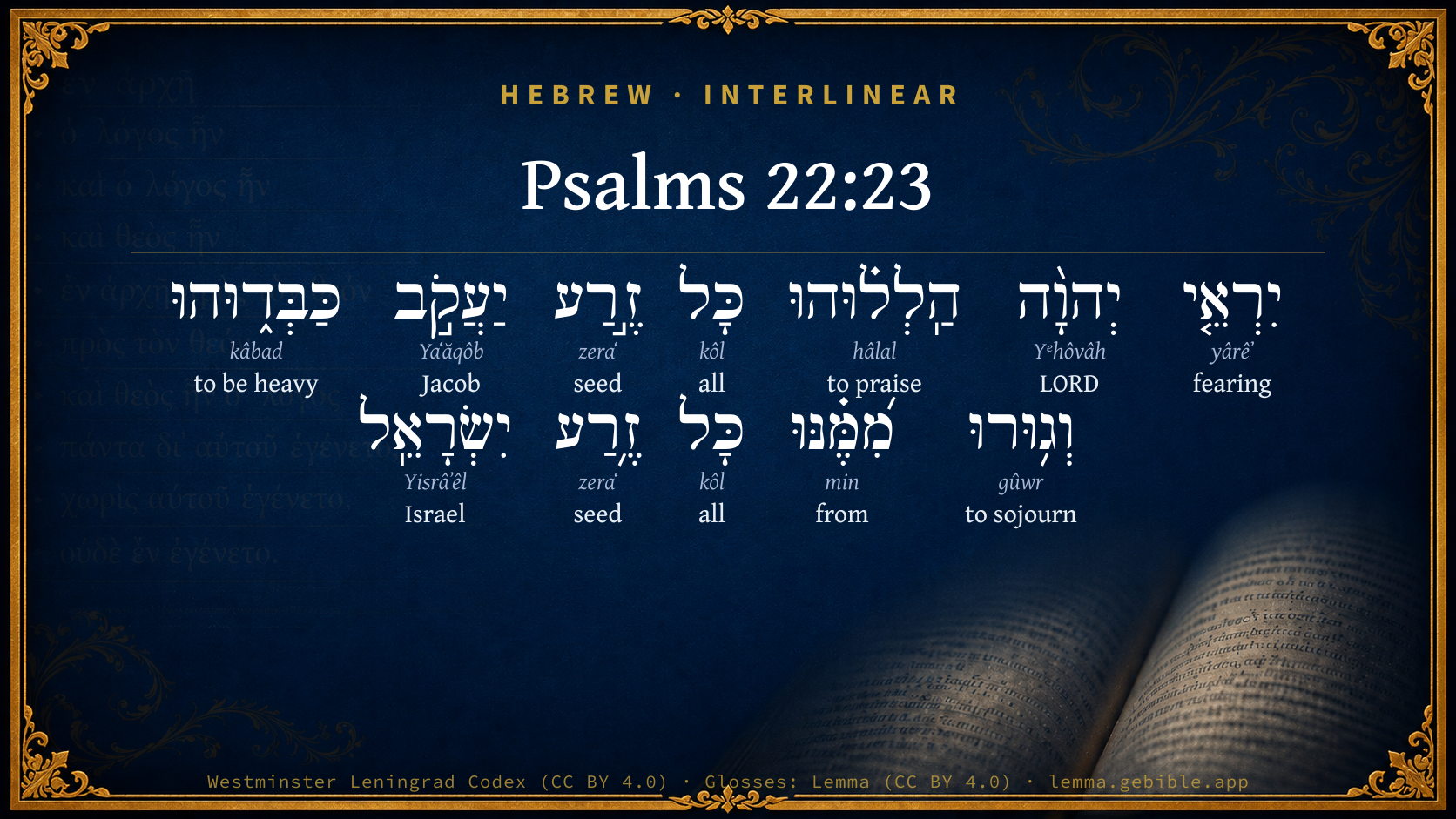
Hebrew (Westminster Leningrad Codex) Psalms 22:23 appears in the Hebrew Old Testament. The text above is from the Westminster Leningrad Codex. Each word links to its Strong’s number, a concise gloss, and parsing drawn from the Open Scriptures Hebrew Bible morphology. Click any word for its full Brown-Driver-Briggs (BDB) entry.
Download image
Cite this verse

Psalms 22:23 (World English Bible). Public Domain. Lemma interlinear Bible study tool, https://lemma.gebible.app/v/psalms/22/23.

Show BibTeX & RIS
BibTeX
RIS
English Translation
You who fear Yahweh, praise him! All you descendants of Jacob, glorify him! Stand in awe of him, all you descendants of Israel!
World English Bible · Public Domain
Download a study sheet

One document with this verse’s original text, its word-by-word gloss line, the meaning frame, cross-references with their text, attributed commentary, and full source and license credits — printable, and it pastes into notes with its structure intact.

This verse Autodidact and up

Study sheet (.html) Plain text (.txt)

A passage Seminary Student

Up to 50 verses in one chapter. A passage sheet keeps up to 6 commentary sources and 12 cross-references per verse, in the order this page ranks them, and says so on the sheet whenever that leaves anything out. Ask for a single verse and you get the Autodidact verse sheet above.

Everything on this page stays free to read, with no account — the sheet is a download of what is already on screen, not access to it.

Want to remove ads? Support Godless Engineer
Compare translations 3

The same verse in 3 English versions, stacked beneath the original-language interlinear above. Click any original word for its lexicon entry.

Each is an independent rendering of the whole verse — the interlinear is not word-aligned to these translations.

Highlighted words mark where these versions differ — a whole-verse word diff, not a word-by-word alignment.

  • World English Bible Public Domain
    You who fear Yahweh, praise him! All you descendants of Jacob, glorify him! Stand in awe of him, all you descendants of Israel!
  • King James Version Public Domain
    Ye that fear the LORD, praise him; all ye the seed of Jacob, glorify him; and fear him, all ye the seed of Israel.
  • unfoldingWord Literal Text CC BY-SA 4.0
    You who fear Yahweh, praise him! All of the seed of Jacob, honor him, and be terrified from him, all of the seed of Israel!

unfoldingWord Literal Text — © unfoldingWord, licensed CC BY-SA 4.0. Word-aligned USFM3 via Door43 (git.door43.org/unfoldingWord/en_ult).

Versions to compare (up to 4)

3 of 4 selected

Show all 18 translations

Every available English version of this verse, each an independent rendering of the whole verse.

  • World English Bible Public Domain
    You who fear Yahweh, praise him! All you descendants of Jacob, glorify him! Stand in awe of him, all you descendants of Israel!
  • Berean Standard Bible Public Domain
    You who fear the LORD, praise Him! All descendants of Jacob, honor Him! All offspring of Israel, revere Him!
  • Majority Standard Bible Public Domain
    You who fear the LORD, praise Him! All descendants of Jacob, honor Him! All offspring of Israel, revere Him!
  • King James Version Public Domain
    Ye that fear the LORD, praise him; all ye the seed of Jacob, glorify him; and fear him, all ye the seed of Israel.
  • American Standard Version (1901) Public Domain
    Ye that fear Jehovah, praise him; All ye the seed of Jacob, glorify him; And stand in awe of him, all ye the seed of Israel.
  • Revised Version (1885) Public Domain
    Ye that fear the LORD, praise him; all ye the seed of Jacob, glorify him; and stand in awe of him, all ye the seed of Israel.
  • Geneva Bible (1599) Public Domain
    Prayse the Lord, ye that feare him: magnifie ye him, all the seede of Iaakob, and feare ye him, all the seede of Israel.
  • Douay-Rheims (1899) Public Domain
    I will declare thy name to my brethren: in the midst of the church will I praise thee.
  • Young's Literal Translation Public Domain
    Ye who fear Jehovah, praise ye Him, All the seed of Jacob, honour ye Him, And be afraid of Him, all ye seed of Israel.
  • Literal Standard Version CC BY-SA 4.0
    You who fear YHWH, praise Him, || All the seed of Jacob, honor Him, || And be afraid of Him, all you seed of Israel.
  • Unlocked Literal Bible CC BY-SA 4.0
    You who fear Yahweh, praise him! All you descendants of Jacob, honor him! Stand in awe of him, all you descendants of Israel!
  • unfoldingWord Literal Text CC BY-SA 4.0
    You who fear Yahweh, praise him! All of the seed of Jacob, honor him, and be terrified from him, all of the seed of Israel!
  • Darby Bible Public Domain
    Ye that fear Jehovah, praise him; all ye the seed of Jacob, glorify him; and revere him, all ye the seed of Israel.
  • World Messianic Bible Public Domain
    You who fear the LORD, praise him! All you descendants of Jacob, glorify him! Stand in awe of him, all you descendants of Israel!
  • Webster's Bible Public Domain
    \\22:22\\I will declare thy name to my brethren: in the midst of the congregation will I praise thee.
  • Free Bible Version CC BY-SA 4.0
    Praise the Lord, all who worship him! Honor him, every descendant of Jacob! Be in awe of him, every descendant of Israel!
  • Bible in Basic English Public Domain
    You who have fear of the Lord, give him praise; all you seed of Jacob, give him glory; go in fear of him, all you seed of Israel.
  • JPS Tanakh (1917) Public Domain
    (22-24) 'Ye that fear the LORD, praise Him; all ye the seed of Jacob, glorify Him; and stand in awe of Him, all ye the seed of Israel.

Literal Standard Version (2020), Covenant Press — licensed CC BY-SA 4.0. Text via the HelloAO Bible API (eBible.org). Unlocked Literal Bible (unfoldingWord) — licensed CC BY-SA 4.0. Text via the HelloAO Bible API (eBible.org). unfoldingWord Literal Text — © unfoldingWord, licensed CC BY-SA 4.0. Word-aligned USFM3 via Door43 (git.door43.org/unfoldingWord/en_ult). Free Bible Version, Dr. Jonathan Gallagher — licensed CC BY-SA 4.0. Text via the HelloAO Bible API (eBible.org).

Word by word

More ways to search: Search by grammar → Find every occurrence → Compare this word →

Practice this passage: Drill this verse → Learn its vocabulary →

יִרְאֵ֤י
yârêʼ
H3373
“fearing of”
Adjective, Adjective, Masculine, Plural, Construct
Part of Speech
Adjective
Type
Adjective
Gender
Masculine
Number
Plural
State
Construct
Full BDB Definition

Origin: from H3372

TWOT: 907a

fearing, reverent, afraid
  1. יְהוָ֨ה Yᵉhôvâh H3068 “LORD” Noun, Proper
  2. הַֽלְל֗וּהוּ hâlal H1984 “praise · him” Verb, Piel, Imperative, 2nd Person, Masculine, Plural + Suffix, Personal, 3rd Person, Masculine, Singular
  3. כָּל kôl H3605 “all of” Noun, Common, Masculine, Singular, Construct
  4. זֶ֣רַע zeraʻ H2233 “seed of” Noun, Common, Masculine, Singular, Construct
  5. יַעֲקֹ֣ב Yaʻăqôb H3290 “Jacob” Noun, Proper
  6. כַּבְּד֑וּהוּ kâbad H3513 “be heavy · him” Verb, Piel, Imperative, 2nd Person, Masculine, Plural + Suffix, Personal, 3rd Person, Masculine, Singular
  7. וְג֥וּרוּ gûwr H1481 “and · sojourn” Conjunction + Verb, Qal, Imperative, 2nd Person, Masculine, Plural
  8. מִ֝מֶּ֗נּוּ min H4480 “from · us” Preposition + Suffix, Personal, 1st Person, Common, Plural
  9. כָּל kôl H3605 “all of” Noun, Common, Masculine, Singular, Construct
  10. זֶ֥רַע zeraʻ H2233 “seed of” Noun, Common, Masculine, Singular, Construct
  11. יִשְׂרָאֵֽל Yisrâʼêl H3478 “Israel” Noun, Proper

About this verse

These counts appear in no published source. They are computed here, from the morphology-tagged text and Lemma’s own curated glosses. What Lemma adds →

12
words
10
distinct lemmas
Wisdom
section

Shared distinctive vocabulary

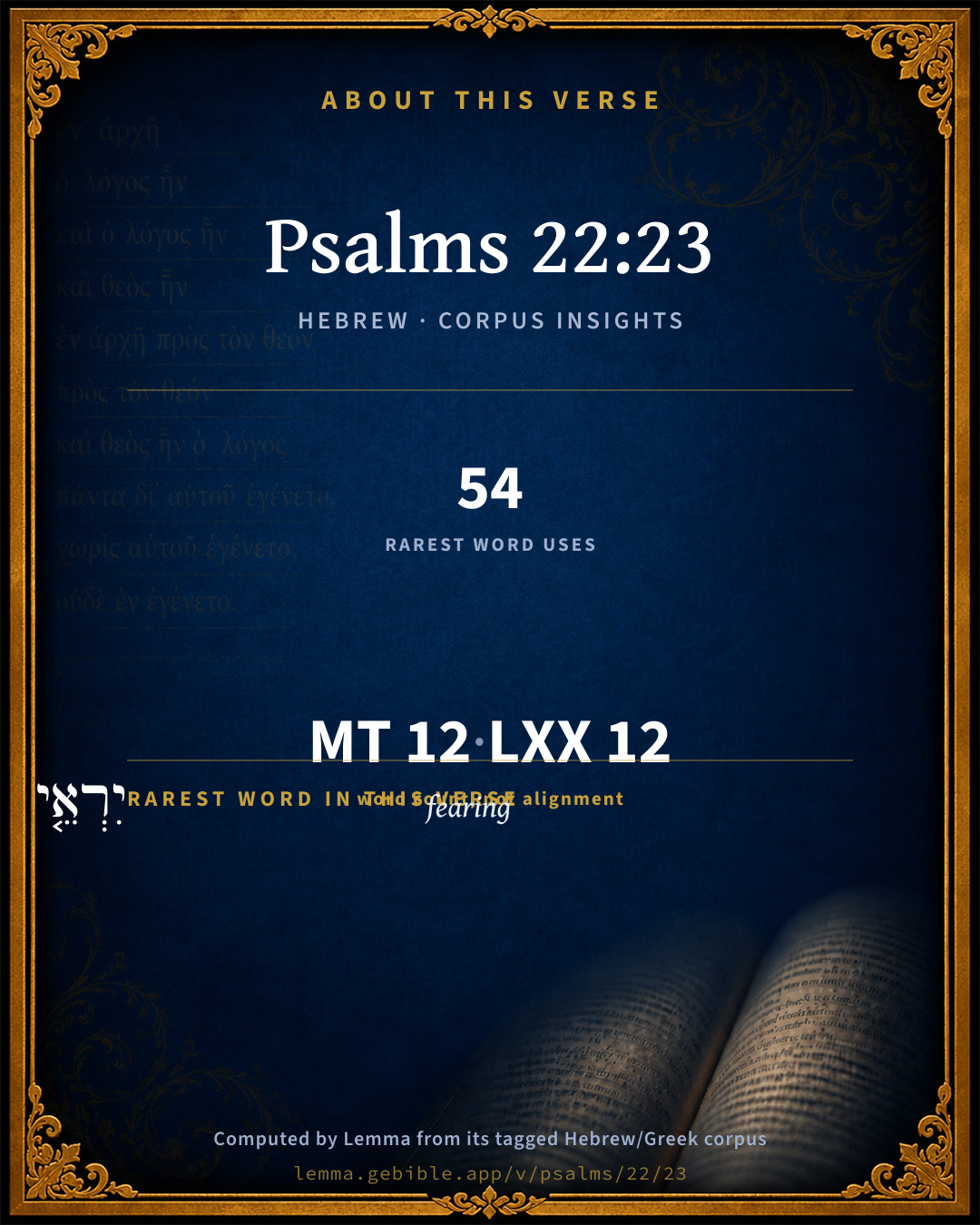
יִרְאֵ֤י fearing H3373 occurs in 54 verses of the Hebrew Bible. Also found in:

Grammatical profile

  • 3 verbs
  • 7 nouns
  • 1 adjective
  • 1 preposition

Verb forms

  • הַֽלְל֗וּהוּ Piel · Imperative
  • כַּבְּד֑וּהוּ Piel · Imperative
  • וְג֥וּרוּ Qal · Imperative

Repetition

Words recur within this verse — often emphatic in Hebrew:

  • כָּל all H3605 ×2
  • זֶ֣רַע seed H2233 ×2

Hebrew & Septuagint length

In English translation the verse runs 23 words from the Hebrew and 22 from the Septuagint (LXX English) — closely comparable.

A rough comparison of the two English renderings, which tokenize alike — not a word-level alignment.

Word counts can differ between the Hebrew and the Greek without any difference in meaning — e.g. the Hebrew direct-object marker אֵת has no separate Greek word, and Greek often adds the article ὁ.

In the original languages it is 12 Hebrew tokens and 12 Greek tokens — but the two are counted differently (Hebrew bundles its prefixes and suffixes into one token; the Greek is in lemma form), so that isn’t a like-for-like length.

Cross-references

18

Topical passages linked to Psalms 22:23 in the Treasury of Scripture Knowledge — connected by theme and wording, ordered by reader-vote popularity; previews shown in the World English Bible.

  • Psalms 135:19–20 House of Israel, praise Yahweh! House of Aaron, praise Yahweh!
  • Revelation 15:4 Who wouldn't fear you, Lord, And glorify your name? For you only are holy. For all the nations will come and worship before you. For your righteous acts have been revealed."
  • Psalms 107:1–2 Give thanks to Yahweh, For he is good, For his loving kindness endures forever.
  • Luke 1:50 His mercy is for generations of generations on those who fear him.
  • Psalms 50:23 Whoever offers the sacrifice of thanksgiving glorifies me, And prepares his way so that I will show God's salvation to him."
  • Psalms 115:11 You who fear Yahweh, trust in Yahweh! He is their help and their shield.
  • 1 Corinthians 6:19–20 Or don't you know that your body is a temple of the Holy Spirit which is in you, which you have from God? You are not your own,
  • 1 Chronicles 16:8–13 Oh give thanks to Yahweh, call on his name; Make known his doings among the peoples.
  • Psalms 22:30 Posterity shall serve him. Future generations shall be told about the Lord.
  • Psalms 33:8 Let all the earth fear Yahweh. Let all the inhabitants of the world stand in awe of him.
  • Psalms 86:12 I will praise you, Lord my God, with my whole heart. I will glorify your name forevermore.
  • Psalms 105:3–7 Glory in his holy name. Let the heart of those who seek Yahweh rejoice.
  • Psalms 106:5 That I may see the prosperity of your chosen, That I may rejoice in the gladness of your nation, That I may glory with your inheritance.
  • Psalms 115:13 He will bless those who fear Yahweh, Both small and great.
  • Psalms 145:19 He will fulfill the desire of those who fear him. He also will hear their cry, and will save them.
  • Isaiah 25:3 Therefore shall a strong people glorify you; a city of awesome nations shall fear you.
  • Luke 2:20 The shepherds returned, glorifying and praising God for all the things that they had heard and seen, just as it was told them.
  • 1 Corinthians 10:31 Whether therefore you eat, or drink, or whatever you do, do all to the glory of God.

Cross-references courtesy of OpenBible.info (CC BY 4.0).

Hebrew and Greek witnesses Masoretic Hebrew ↔ Greek Septuagint

The same verse in the two great witnesses to the Old Testament, shown verse-for-verse.

You’re reading Greek Psalm 21 (Hebrew Psalm 22). The Septuagint counts the superscription, so verse numbers can differ from the Hebrew — chapter-level alignment, not verse-by-verse. Numbering follows Rahlfs.

These are two independent witnesses, not word-aligned to each other, and the Septuagint is shown in lemma (dictionary) form.

Hebrew Psalms 22:23 Masoretic · Westminster Leningrad Codex

יִרְאֵ֤י יְהוָ֨ה הַֽלְל֗וּהוּ כָּל זֶ֣רַע יַעֲקֹ֣ב כַּבְּד֑וּהוּ וְג֥וּרוּ מִ֝מֶּ֗נּוּ כָּל זֶ֥רַע יִשְׂרָאֵֽל

You who fear Yahweh, praise him! All you descendants of Jacob, glorify him! Stand in awe of him, all you descendants of Israel!

World English Bible · Public Domain

Greek LXX Greek Psalm 21:23 Septuagint · lemma form

διαἡγέομαι ὁ ὄνομα σύ ὁ ἀδελφός ἐγώ ἐν μέσος ἐκκλησία ὑμνέω σύ

You⌃ that fear the Lord, praise him; all you⌃ seed of Jacob, glorify him: let all the seed of Israel fear him.

LXX2012 (modern English Septuagint) · Public Domain

Hebrew: Westminster Leningrad Codex (CC BY 4.0). Greek: Septuagint (public domain); English from LXX2012 (modern English Septuagint) (Public Domain). How the Septuagint differs from the Hebrew →

Commentary

Notes on Psalms 22:23 from classic Christian and Jewish commentators (each source and its license shown beneath its notes). The classic Christian expositions comment on the surrounding passage and are grouped to its opening verse, so a note may address several verses; the Jewish commentaries on the Tanakh (Rashi and others) are per-verse, so they appear only where the commentator wrote on this verse.

Lemma curates 59 commentaries, every one of them public domain or Creative Commons licensed, each selected and text-cleaned for this edition rather than reprinted as found. About our sources →

Trapp's Complete Commentary

John Trapp

Psa 22:23 Ye that fear the LORD, praise him; all ye the seed of Jacob, glorify him; and fear him, all ye the seed of Israel.

Ver. 23. Ye that fear the Lord, praise him] viz. For your redemption by Christ’s death and resurrection. Neither are any fit for such a purpose but such as fear the Lord. Excellent words become not a fool’s mouth, saith Solomon; Christ would not suffer the devil to confess him. To be praised by a praiseless person is no praise, saith Seneca.

All ye seed of Jacob] i.e. Illi qui diligunt eum.

All ye the seed of Israel] Qui timent, sed adhuc non diligunt, saith R. David; but I like not his distinction; for none do truly fear God but those that love him, Hos 3:5.

John Trapp, A Commentary or Exposition upon All the Books of the Old and New Testament (1647–1656) — public domain. Text from a community e-Sword module.

Joseph Benson's Commentary

Psa 22:23-25. Ye that fear the Lord, praise him — Not only for my sake, (they are the words of the risen and exalted Saviour,) but chiefly for your own benefit, received through my deliverance from death, and exaltation to God’s right hand, by which I am made head over all things, for the good of my church and people. All ye seed of Jacob, &c. — He first addresses himself to his ancient people, to whom the gospel was first to be preached. How long, O Lord, holy and true, shall thy once highly favoured nation continue deaf to this gracious call of thine? For he hath not despised thee, &c. — He hath not rejected, but graciously accepted, my humiliation and sufferings, as a propitiation and sacrifice for the sins of the world, which acceptance is testified by my resurrection from the dead: inasmuch as the discharge of the surety proves the payment of the debt. This is the great subject of praise and thanksgiving in the church of Christ. My praise shall be of thee in the great congregation — In the universal church, made up of Jews and Gentiles, as the following verses explain it. I will pay my vows before them that fear him — Those praises and services which, in my distress, I vowed to return unto thee when thou didst deliver me. “The vow of Christ was to build and consecrate to Jehovah a spiritual temple, in which the spiritual sacrifices of prayer and praise should be continually offered. This vow he performed, after his resurrection, by the hands of his apostles, and still continues to perform, by those of his ministers, carrying on the work of edification in the great congregation of the Gentile Christian Church. The vows of Christ cannot fail of being performed. Happy are they whom he vouchsafeth to use as his instruments in the performance of them.” — Horne.

Joseph Benson's Commentary on the Old and New Testaments (1811–1818) — public domain. Text from a community e-Sword module.

Whedon's Commentary on the Bible

Daniel D. Whedon

23. Ye that fear the Lord—The call is to spiritual Israel. Psa_22:23-24, as Bishop Lowth suggests, contain the praise song of the preceding verse, which the psalmist now puts into the mouth of the Church.

Daniel D. Whedon (gen. ed.), Commentary on the Old and New Testaments (1874–1909) — public domain. Text from a community e-Sword module.

J. A. Alexander on Psalms

Joseph Addison Alexander

24. (Psa 22:23). Fearers of Jehovah, praise him! All the seed of Jacob, glorify him! And be afraid of him, all the seed of Israel! These words are uttered, as it were, in the midst of the ideal congregation mentioned in the verse preceding. That the call, though formally addressed to the whole race, was really intended for the spiritual Israel, excluding wicked Israelites and including the righteous of whatever name or nation, is indicated by the words of the first clause, while the last shews that the praise required is not familiar, but in the highest degree reverential.

Joseph Addison Alexander, The Psalms Translated and Explained (1850) — public domain. Text from a community e-Sword module.

Tyndale Open Study Notes

Tyndale Open Resources

22:23 The godly respond with awe (see 22:25).

Tyndale Open Study Notes — © Tyndale Open Resources, licensed CC BY-SA 4.0. Text via the HelloAO Bible API.

Geneva Bible (1599)

Geneva Bible translators

He promiseth to exhort the Church that they by his example might praise the Lord.

Geneva Bible (1599) marginal notes — public domain. Text via Bolls.life.

Adam Clarke's Commentary

Verse 23. Ye that fear the Lord] This is an exhortation to the Jews particularly, to profit by the preaching of the Gospel. Perhaps, by them that fear him, the Gentiles, and particularly the proselytes, may be intended. The Jews are mentioned by name: Glorify him, all ye seed of Jacob; fear him, all ye seed of Israel.

Adam Clarke's Commentary on the Bible (1810–1826) — public domain. Text from a community e-Sword/MySword module.

John Calvin's Commentaries

23. Ye who fear Jehovah. Here, again, the Psalmist expresses more distinctly the fruit of public and solemn thanksgiving, of which I have spoken before, declaring, that by engaging in this exercise, every man in his own place invites and stirs up the church by his example to praise God. He tells us, that the end for which he will praise the name of God in the public assembly is to encourage his brethren to do the same. But as hypocrites commonly thrust themselves into the church, and as on the barn-floor of the Lord the chaff is mingled with the wheat, he addresses himself expressly to the godly, and those who fear God. Impure and wicked men may sing the praises of God with open mouth, but assuredly, they do nothing else than pollute and profane his holy name. It were, indeed, an object much to be desired, that men of all conditions in the world would, with one accord, join in holy melody to the Lord. But as the chief and most essential part of this harmony proceeds from a sincere and pure affection of heart, none will ever, in a right manner, celebrate the glory of God, except the man who worships him under the influence of holy fear. David names, a little after, the seed of Jacob and Israel, having a reference to the common calling of the people; and certainly, he put no obstacle in the way to hinder even all the children of Abraham from praising God with one accord. But as he saw that many of the Israelites were bastard and degenerate, he distinguishes true and sincere Israelites from them; and at the same time shows that God’s name is not duly celebrated, unless where there is true piety and the inward fear of God. Accordingly, in his exhortation he again joins together the praises of God and reverence towards him. — Fear him, ye seed of Israel, says he; for all the fair faces which hypocrites put on in this matter are nothing but pure mockery. The fear which he recommends is not, however, such as would frighten the faithful from approaching God, but that which will bring them truly humbled into his sanctuary, as has been stated in the fifth psalm. Some may be surprised to find David addressing an exhortation to praise God, It is “praise God,” both in the Latin and French versions; but the train of thought seems to require that it should be “fear God.”

John Calvin's Commentaries (1540-1563) — public domain. Text from the Calvin Translation Society English edition (1840s-50s) via the Christian Classics Ethereal Library (ccel.org). Calvin's coverage is partial (roughly two-thirds of the Bible); uncommented books and verses are honest gaps, never fabricated. The 19th-century editor's footnotes and remarks are omitted so the notes are faithfully Calvin's own voice.

Ellicott's Commentary for English Readers

(23, 24) These verses contain the substance of the poet’s joyful announcement.

A Bible Commentary for English Readers, edited by Charles John Ellicott (1878–1897) — public domain. Text from a community e-Sword module.

The Cambridge Bible for Schools and Colleges

gen. ed. J. J. S. Perowne

23. ye that fear the Lord] Possibly coextensive with the seed of Jacob, but pointing rather to the inner circle of true believers who are in fullest sympathy with the Psalmist. See note on Psa_115:11.

seed of Jacob … seed of Israel] Cp. Isa_45:19; Isa_45:25.

fear him] R.V., stand in awe of Him (Psa_33:8).

23, 24. Already he can imagine himself standing ‘in the great congregation.’ These are the words in which he summons them to praise.

The Cambridge Bible for Schools and Colleges (gen. ed. J. J. S. Perowne; Cambridge University Press, 1878–1918) — public domain. Text from a community e-Sword module.

John Gill's Exposition

Ye that fear the Lord, praise him,.... By whom are meant, not the proselytes among the Gentiles, as distinct from the Jews, which is the sense of some Jewish interpreters (n); but all the people of God, whether Jews or Gentiles, who have the grace of filial and godly fear put into their hearts, with which they worship God, and walk before him in all holy conversation; which is not a fear of wrath, or a distrust of divine goodness; but is a reverential affection for God, and is consistent with the greatest degree of faith, the strongest expressions of spiritual joy and holy courage: it includes the whole worship of God, internal and external; and such who have it in their hearts, and before their eyes, are called upon by Christ to praise the Lord for him, for the unspeakable gift of his love; that he has not spared his son, but delivered him up for them, to undergo so much sorrow, and such sufferings as before related, to obtain salvation for them; and that he has delivered him out of them, raised him from the dead, and has given him glory;

all ye the seed of Jacob, glorify him; not the natural, but spiritual seed of Jacob, who walk in the steps of the faith of that man of God; these are exhorted to glorify the Lord with their bodies and spirits, which are his, being redeemed with the precious blood of Christ; by believing in him, glorying in him, and offering praise unto him;

and fear him, all ye the seed of Israel; who are the same with the seed of Jacob, Jacob and Israel being two names of the same person; and design not Israel according to the flesh, but according to the Spirit; the whole Israel of God, the all spiritual seed of Israel, who are justified in Christ, and are saved in him; they are the same with them that fear the Lord, and are here stirred up to exercise the grace of fear upon him; to fear him only, and not men, though ever so mighty and powerful, as before described in Psa 22:12; and that not only because of his power and greatness; but because of his grace and goodness, as shown forth in Christ Jesus.

(n) Midrash Tillim, Jarchi & Aben Ezra, in loc.

John Gill's Exposition of the Whole Bible (1746–1763) — public domain (CC PDM 1.0). Text via the HelloAO Bible API.

Albert Barnes' Notes on the Bible

Ye that fear the Lord - A phrase denoting those who are pious.

Praise him - This is language which may be supposed to be addressed by the speaker in the great congregation. In the previous verse he had said that he would praise God “in the midst of the congregation;” he here speaks as if he were in that congregation, and addressing them. He, therefore, calls on them to praise and honor God.

All ye the seed of Jacob, glorify him - The descendants of Jacob; that is, all who are true worshippers of God.

And fear him - Honour him, worship him. See the notes at Psa 5:7.

All ye the seed of Israel - Another name for Jacob Gen 32:28, and designed to denote also all who are true worshippers of Yahweh.

Albert Barnes' Notes on the Bible (1834–1885) — public domain. Text from a community e-Sword/MySword module.

Matthew Poole's English Annotations

Praise him; partly for my sake, and chiefly for your own benefit received by my deliverance.

All ye the seed of Israel: the two universal particles seem to intimate that he speaks not only of the carnal, but also of the spiritual seed; which also is more than probable, by comparing this with Psa 22:27,28.

Matthew Poole's English Annotations on the Holy Bible (1683–1685) — public domain. Text from a community e-Sword/MySword module.

The Treasury of David

Charles H. Spurgeon

Ver. 23. Ye that fear the Lord praise him. The reader must imagine the Saviour as addressing the congregation of the saints. He exhorts the faithful to unite with him in thanksgiving. The description of "fearing the Lord" is very frequent and very instructive; it is the beginning of wisdom, and is an essential sign of grace. "I am a Hebrew and I fear God" was Jonah's confession of faith. Humble awe of God is so necessary a preparation for praising him that none are fit to sing to his honour but such as reverence his word; but this fear is consistent with the highest joy, and is not to be confounded with legal bondage, which is a fear which perfect love casteth out. Holy fear should always keep the key of the singing pew. Where Jesus leads the tune none but holy lips may dare to sing.

All ye the seed of Jacob glorify him. The genius of the gospel is praise. Jew and Gentile saved by sovereign grace should be eager in the blessed work of magnifying the God of our salvation. All saints should unite in the song; no tongue may be silent, no heart may be cold. Christ calls us to glorify God, and can we refuse?

And fear him, all ye the seed of Israel. The spiritual Israel all do this, and we hope the day will come when Israel after the flesh will be brought to the same mind. The more we praise God the more reverently shall we fear him, and the deeper our reverence the sweeter our songs. So much does Jesus value praise that we have it here under his dying hand and seal that all the saints must glorify the Lord.

None.

Ver. 23. A threefold duty, "praise him, ""glorify him; ""fear him; "towards one object, "the Lord; " for three characters, "ye that fear him, seed of Jacob, seed of Israel", which are but one person.

Ver. 23. Glory to God the fruit of the tree on which Jesus died.

Psalms 22:24*

Charles H. Spurgeon's The Treasury of David (1869–1885) — public domain. Psalms only. Text from a community e-Sword/MySword module.

The Pulpit Commentary

Ye that fear the Lord, praise him; all ye the seed of Jacob, glorify him; and fear him, all ye the seed of Israel. "All Israel:" all the people of God are called upon to join in the praise which the Sea will henceforth offer to the Father through eternity. The praise of God is to be joined with the fear of God, according to the universal teaching of Scripture.

The Pulpit Commentary (1880–1919), ed. H.D.M. Spence-Jones & Joseph S. Exell — public domain. Text from a community e-Sword module.

Scofield Reference Notes

C. I. Scofield

fear

(See Scofield "Psa 19:9").

The Scofield Reference Bible (1917 edition), notes by C. I. Scofield — public domain. Text from a community e-Sword module.

Rashi

Rabbi Shlomo Yitzchaki (Rashi)

I will tell Your name to my brothers when any of my assemblies gathers, and so I will say to them, “You who fear the Lord, praise Him.” This refers to the proselytes, and “all the seed of Jacob.”

Rashi on the Tanakh — English translations: “The Judaica Press complete Tanach with Rashi, translated by A. J. Rosenberg” (CC BY 4.0); “Pentateuch with Rashi's commentary by M. Rosenbaum and A.M. Silbermann, 1929-1934” (public domain); “The Metsudah Tanach series, Lakewood, N.J” (CC BY 4.0); and “The Book of Joshua, Metsudah Publications, 1997” (CC BY 4.0). Text via Sefaria.

Radak

Rabbi David Kimhi (Radak)

I will declare Thy name to my brethren: In the midst of the congregation will I praise Thee. – When Thou shalt deliver me from the lion's mouth and from the horns of the wild oxen, when Thou dost bring me out of exile, then I will declare Thy name to my brethren, I will praise Thee in the midst of the congregation. My brethren are the children of Edom, amongst whom we are in exile. So also the children of Ishmael and the children of Keturah, for all are the children of our father Abraham. Or its interpretation may be: We who are in exile will declare the miracles and wonders God has wrought for us in our exile to the Ten Tribes who are in exile, in refreshment and union, and upon whom the hand of the nations has not pressed heavily as upon us.

Radak on the Tanakh — English translations: “Sefaria Community Translation” (CC0 1.0 (public-domain dedication)); “Eliyahu Munk, HaChut Hameshulash” (CC BY 4.0); “Rabbi Mike Feuer, Jerusalem Anthology” (CC BY 4.0); and “R. David Kimhi on the first book of Psalms, Translated by R.G. Finch, London, 1919” (public domain). Text via Sefaria.

Lesson kit

Teaching starters — assembled from the data on this page, not authored interpretation. Every prompt links to the verse data it draws on. Edit before teaching.

Psalms, in the Wisdom, opens this verse with 12 words (10 distinct Hebrew lemmas). Its most distinctive word is yârêʼ (“fearing”). A historical commentator’s framing appears above. Read the whole chapter for the surrounding context.

Discussion questions

  1. How does “fearing” (yârêʼ) shape what this verse is saying?
  2. How does Genesis 22:12, which shares the word «fearing», read alongside this verse?
  3. What does the repetition of “all” (2× in this one verse) do in this verse?
  4. These translations render this verse differently; the difference is in the English rendering, not the original. What questions does that raise?
  5. «הַֽלְל֗וּהוּ» is a Piel Imperative verb. How does that grammatical form shape the action described?
  6. Compare how Trapp's Complete Commentary and Joseph Benson's Commentary read this verse. Where do they agree or differ?

Things to notice

Reading settings

Reading text

Shown beneath each verse's original-language words.

Old Testament
Old Testament edition

Read the OT as the Masoretic Hebrew (MT) or the Greek Septuagint (LXX).

English shown for the Greek Septuagint (in the Hebrew ↔ Greek comparison).

Comparing translations? Open the Compare panel on any verse page to stack up to four side by side.