
Psalms 120:5

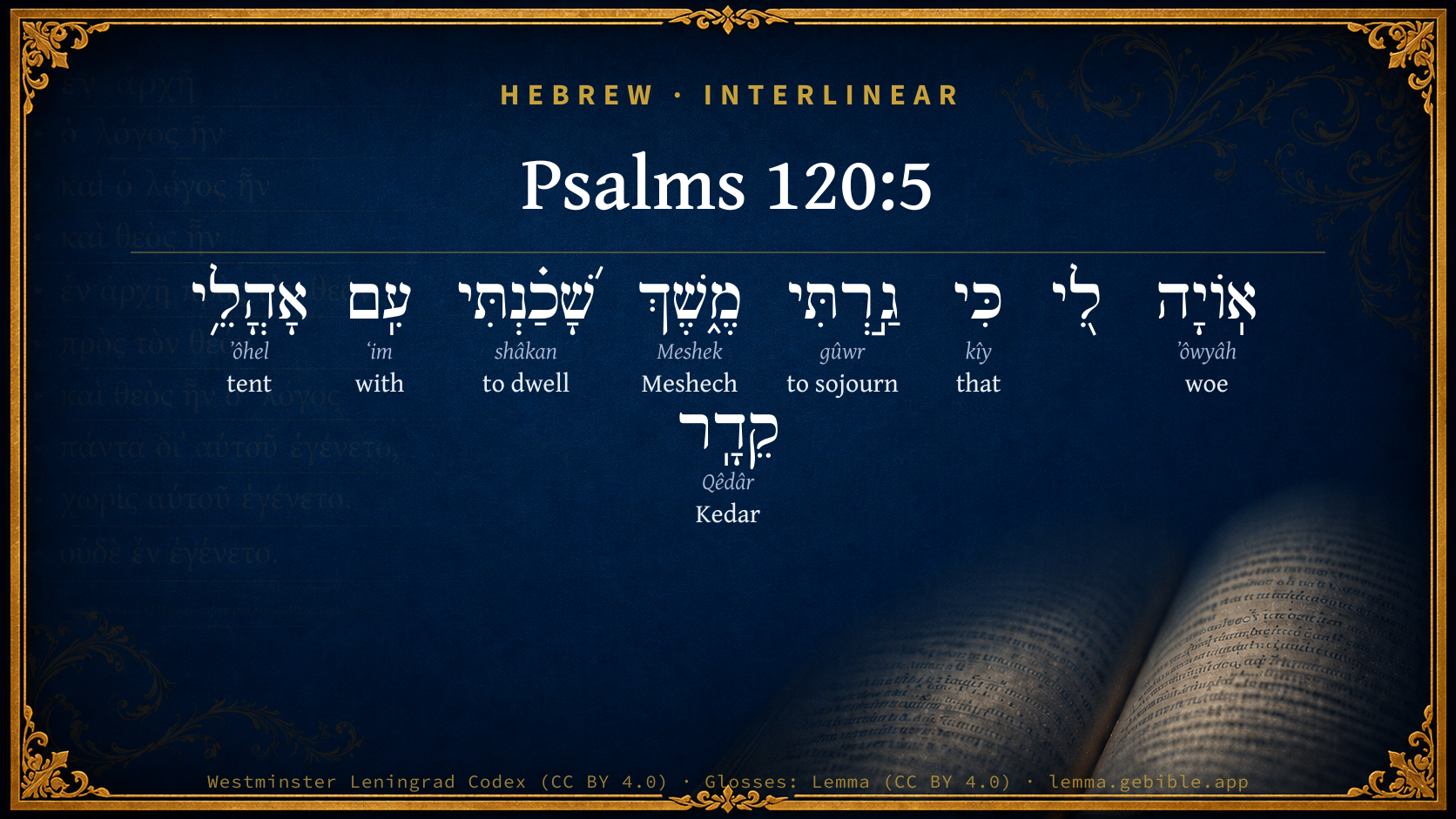
Hebrew (Westminster Leningrad Codex) Psalms 120:5 appears in the Hebrew Old Testament. The text above is from the Westminster Leningrad Codex. Each word links to its Strong’s number, a concise gloss, and parsing drawn from the Open Scriptures Hebrew Bible morphology. Click any word for its full Brown-Driver-Briggs (BDB) entry.
Download image
Cite this verse

Psalms 120:5 (World English Bible). Public Domain. Lemma interlinear Bible study tool, https://lemma.gebible.app/v/psalms/120/5.

Show BibTeX & RIS
BibTeX
RIS
English Translation
Woe is me, that I live in Meshech, That I dwell among the tents of Kedar!
World English Bible · Public Domain
Highlights
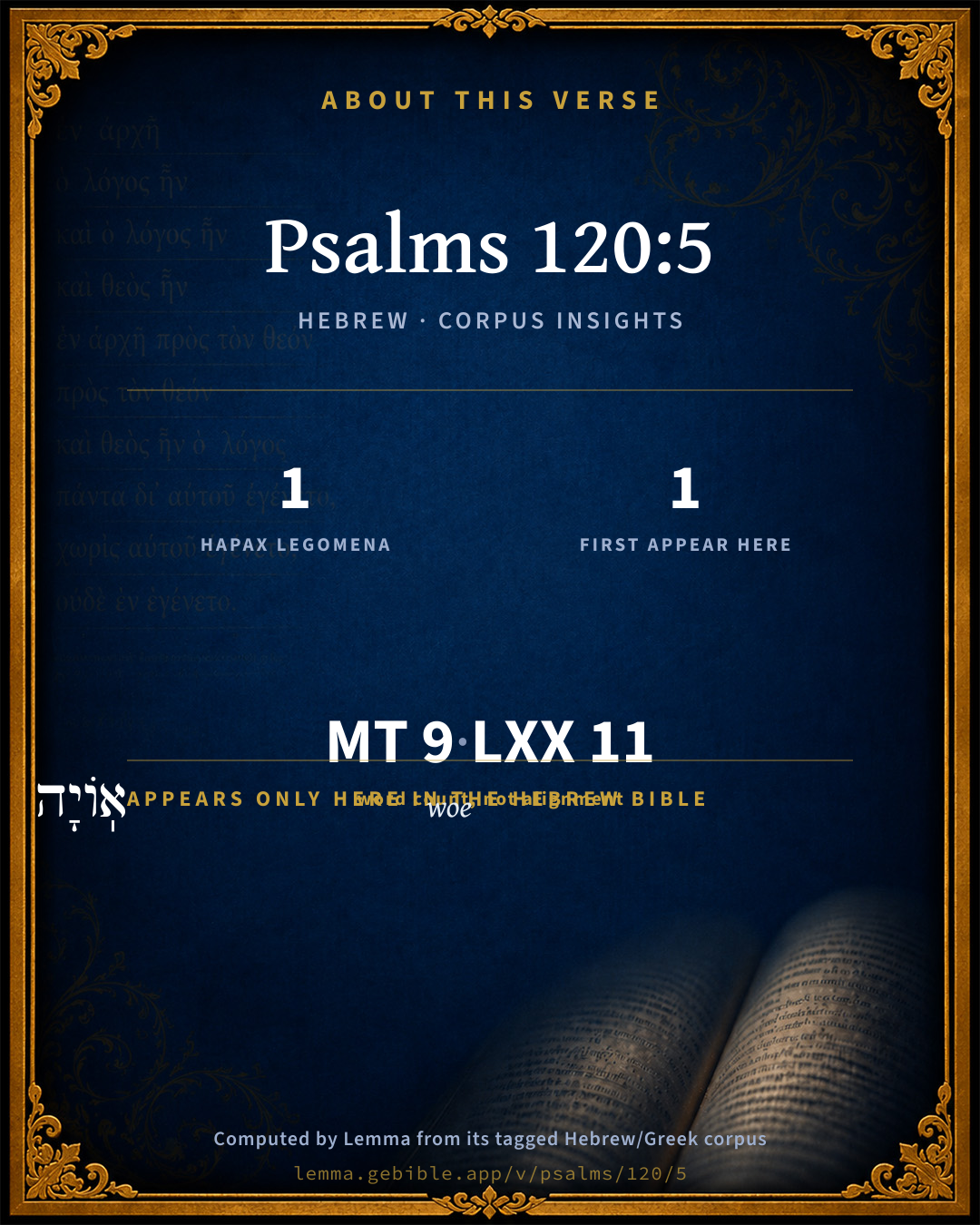
  • 1 hapax legomenon — only here in the Hebrew Bible
  • 1 first appearance in the Hebrew Bible
Full analysis ↓
Download a study sheet

One document with this verse’s original text, its word-by-word gloss line, the meaning frame, cross-references with their text, attributed commentary, and full source and license credits — printable, and it pastes into notes with its structure intact.

This verse Autodidact and up

Study sheet (.html) Plain text (.txt)

A passage Seminary Student

Up to 50 verses in one chapter. A passage sheet keeps up to 6 commentary sources and 12 cross-references per verse, in the order this page ranks them, and says so on the sheet whenever that leaves anything out. Ask for a single verse and you get the Autodidact verse sheet above.

Everything on this page stays free to read, with no account — the sheet is a download of what is already on screen, not access to it.

Want to remove ads? Support Godless Engineer
Compare translations 3

The same verse in 3 English versions, stacked beneath the original-language interlinear above. Click any original word for its lexicon entry.

Each is an independent rendering of the whole verse — the interlinear is not word-aligned to these translations.

Highlighted words mark where these versions differ — a whole-verse word diff, not a word-by-word alignment.

  • World English Bible Public Domain
    Woe is me, that I live in Meshech, That I dwell among the tents of Kedar!
  • King James Version Public Domain
    Woe is me, that I sojourn in Mesech, that I dwell in the tents of Kedar!
  • unfoldingWord Literal Text CC BY-SA 4.0
    Woe to me, for I am sojourning Meshech; I am dwelling with the tents of Kedar.

unfoldingWord Literal Text — © unfoldingWord, licensed CC BY-SA 4.0. Word-aligned USFM3 via Door43 (git.door43.org/unfoldingWord/en_ult).

Versions to compare (up to 4)

3 of 4 selected

Show all 18 translations

Every available English version of this verse, each an independent rendering of the whole verse.

  • World English Bible Public Domain
    Woe is me, that I live in Meshech, That I dwell among the tents of Kedar!
  • Berean Standard Bible Public Domain
    Woe to me that I dwell in Meshech, that I live among the tents of Kedar!
  • Majority Standard Bible Public Domain
    Woe to me that I dwell in Meshech, that I live among the tents of Kedar!
  • King James Version Public Domain
    Woe is me, that I sojourn in Mesech, that I dwell in the tents of Kedar!
  • American Standard Version (1901) Public Domain
    Woe is me, that I sojourn in Meshech, That I dwell among the tents of Kedar!
  • Revised Version (1885) Public Domain
    Woe is me, that I sojourn in Meshech, that I dwell among the tents of Kedar!
  • Geneva Bible (1599) Public Domain
    Woe is to me that I remaine in Meschech, and dwell in the tentes of Kedar.
  • Douay-Rheims (1899) Public Domain
    O! that my ways may be directed to keep thy justifications.
  • Young's Literal Translation Public Domain
    Wo to me, for I have inhabited Mesech, I have dwelt with tents of Kedar.
  • Literal Standard Version CC BY-SA 4.0
    Woe to me, for I have inhabited Mesech, || I have dwelt with tents of Kedar.
  • Unlocked Literal Bible CC BY-SA 4.0
    Woe is me because I temporarily live in Meshech; I lived previously among the tents of Kedar.
  • unfoldingWord Literal Text CC BY-SA 4.0
    Woe to me, for I am sojourning Meshech; I am dwelling with the tents of Kedar.
  • Darby Bible Public Domain
    Woe is me, that I sojourn in Meshech, that I dwell among the tents of Kedar!
  • World Messianic Bible Public Domain
    Woe is me, that I live in Meshech, that I dwell among the tents of Kedar!
  • Webster's Bible Public Domain
    Woe is me, that I sojourn in Mesech, that I dwell in the tents of Kedar!
  • Free Bible Version CC BY-SA 4.0
    I'm sorry for myself, because I live as a foreigner in Meshech, or among the tent-dwellers of Kedar.
  • Bible in Basic English Public Domain
    Sorrow is mine because I am strange in Meshech, and living in the tents of Kedar.
  • JPS Tanakh (1917) Public Domain
    Woe is me, that I sojourn with Meshech, that I dwell beside the tents of Kedar!

Literal Standard Version (2020), Covenant Press — licensed CC BY-SA 4.0. Text via the HelloAO Bible API (eBible.org). Unlocked Literal Bible (unfoldingWord) — licensed CC BY-SA 4.0. Text via the HelloAO Bible API (eBible.org). unfoldingWord Literal Text — © unfoldingWord, licensed CC BY-SA 4.0. Word-aligned USFM3 via Door43 (git.door43.org/unfoldingWord/en_ult). Free Bible Version, Dr. Jonathan Gallagher — licensed CC BY-SA 4.0. Text via the HelloAO Bible API (eBible.org).

Word by word

More ways to search: Search by grammar → Find every occurrence → Compare this word →

Practice this passage: Drill this verse → Learn its vocabulary →

About this verse

These counts appear in no published source. They are computed here, from the morphology-tagged text and Lemma’s own curated glosses. What Lemma adds →

9
words
8
distinct lemmas
Wisdom
section

Notable vocabulary

1 hapax legomenon — a word that appears only here in the entire Hebrew Bible:

  • אֽוֹיָה woe H190

First appearance in Scripture

This word makes its first canonical appearance in the Hebrew Bible here:

  • אֽוֹיָה woe H190

Shared distinctive vocabulary

מֶ֑שֶׁךְ Meshech H4902 occurs in 9 verses of the Hebrew Bible. Also found in:

Grammatical profile

  • 2 verbs
  • 3 nouns
  • 2 prepositions
  • 1 conjunction
  • 1 particle

Verb forms

  • גַ֣רְתִּי Qal · Perfect
  • שָׁ֝כַ֗נְתִּי Qal · Perfect

Hebrew & Septuagint length

In English translation the verse runs 16 words from the Hebrew and 16 from the Septuagint (LXX English) — the same length.

A rough comparison of the two English renderings, which tokenize alike — not a word-level alignment.

Word counts can differ between the Hebrew and the Greek without any difference in meaning — e.g. the Hebrew direct-object marker אֵת has no separate Greek word, and Greek often adds the article ὁ.

In the original languages it is 9 Hebrew tokens and 11 Greek tokens — but the two are counted differently (Hebrew bundles its prefixes and suffixes into one token; the Greek is in lemma form), so that isn’t a like-for-like length.

Cross-references

16

Topical passages linked to Psalms 120:5 in the Treasury of Scripture Knowledge — connected by theme and wording, ordered by reader-vote popularity; previews shown in the World English Bible.

  • Genesis 10:2 The sons of Japheth: Gomer, Magog, Madai, Javan, Tubal, Meshech, and Tiras.
  • Genesis 25:13 These are the names of the sons of Ishmael, by their names, according to the order of their birth: the firstborn of Ishmael, Nebaioth, then Kedar, Adbeel, Mibsam,
  • Ezekiel 27:13 Javan, Tubal, and Meshech, they were your traffickers; they traded the persons of men and vessels of brass for your merchandise.
  • Song of Solomon 1:5 I am dark, but lovely, You daughters of Jerusalem, Like Kedar's tents, Like Solomon's curtains.
  • Isaiah 60:6–7 The multitude of camels shall cover you, the dromedaries of Midian and Ephah; all they from Sheba shall come; they shall bring gold and frankincense, and shall proclaim the praises of Yahweh.
  • Jeremiah 9:2–3 Oh that I had in the wilderness a lodging-place of wayfaring men; that I might leave my people, and go from them! for they are all adulterers, an assembly of treacherous men.
  • Ezekiel 27:21 Arabia, and all the princes of Kedar, they were the merchants of your hand; in lambs, and rams, and goats, in these were they your merchants.
  • Ezekiel 38:2–3 Son of man, set your face toward Gog, of the land of Magog, the prince of Rosh, Meshech, and Tubal, and prophesy against him,
  • Ezekiel 39:1 You, son of man, prophesy against Gog, and say, Thus says the Lord Yahweh: Behold, I am against you, Gog, prince of Rosh, Meshech, and Tubal:
  • Micah 7:1–2 Misery is mine! Indeed, I am like one who gathers the summer fruits, as gleanings of the vinyard: There is no cluster of grapes to eat. My soul desires to eat the early fig.
  • 2 Peter 2:7–8 and delivered righteous Lot, who was very distressed by the lustful life of the wicked
  • Revelation 2:13 "I know your works and where you dwell, where Satan's throne is. You hold firmly to my name, and didn't deny my faith in the days of Antipas my witness, my faithful one, who was killed among you, where Satan dwells.
  • 1 Samuel 25:1 Samuel died; and all Israel gathered themselves together, and lamented him, and buried him in his house at Ramah. David arose, and went down to the wilderness of Paran.
  • Jeremiah 9:6 Your habitation is in the midst of deceit; through deceit they refuse to know me, says Yahweh.
  • Jeremiah 15:10 Woe is me, my mother, that you have borne me a man of strife and a man of contention to the whole earth! I have not lent, neither have men lent to me; [yet] everyone of them does curse me.
  • Jeremiah 49:28–29 Of Kedar, and of the kingdoms of Hazor, which Nebuchadrezzar king of Babylon struck. Thus says Yahweh: Arise you, go up to Kedar, and destroy the children of the east.

Cross-references courtesy of OpenBible.info (CC BY 4.0).

Hebrew and Greek witnesses Masoretic Hebrew ↔ Greek Septuagint

The same verse in the two great witnesses to the Old Testament, shown verse-for-verse.

You’re reading Greek Psalm 119 (Hebrew Psalm 120). The Septuagint counts the superscription, so verse numbers can differ from the Hebrew — chapter-level alignment, not verse-by-verse. Numbering follows Rahlfs.

These are two independent witnesses, not word-aligned to each other, and the Septuagint is shown in lemma (dictionary) form.

Hebrew Psalms 120:5 Masoretic · Westminster Leningrad Codex

אֽוֹיָה לִ֭י כִּי גַ֣רְתִּי מֶ֑שֶׁךְ שָׁ֝כַ֗נְתִּי עִֽם אָהֳלֵ֥י קֵדָֽר

Woe is me, that I live in Meshech, That I dwell among the tents of Kedar!

World English Bible · Public Domain

Greek LXX Greek Psalm 119:5 Septuagint · lemma form

οἴμμοι ὅτι ὁ παροικία ἐγώ μακρύνω κατασκηνόω μετά ὁ σκήνωμα κηδαρ

Woe is me, that my sojourning is prolonged; I have tabernacled among the tents of Kedar.

LXX2012 (modern English Septuagint) · Public Domain

On this verse, John Calvin's Commentaries discusses the Septuagint’s reading. Read the note in Commentary ↓

Hebrew: Westminster Leningrad Codex (CC BY 4.0). Greek: Septuagint (public domain); English from LXX2012 (modern English Septuagint) (Public Domain). How the Septuagint differs from the Hebrew →

Commentary

Notes on Psalms 120:5 from classic Christian and Jewish commentators (each source and its license shown beneath its notes). The classic Christian expositions comment on the surrounding passage and are grouped to its opening verse, so a note may address several verses; the Jewish commentaries on the Tanakh (Rashi and others) are per-verse, so they appear only where the commentator wrote on this verse.

Lemma curates 59 commentaries, every one of them public domain or Creative Commons licensed, each selected and text-cleaned for this edition rather than reprinted as found. About our sources →

Trapp's Complete Commentary

John Trapp

Psa 120:5 Woe is me, that I sojourn in Mesech, [that] I dwell in the tents of Kedar!

Ver. 5. Woe is me, that I sojourn in Mesech] That is, in Muscovio, say some; in Hetruria, say others; in Cappadocia rather, Magog’s country, Eze 38:2-3; anywhere out of the bosom of the true Church; or (as some sense it) in the Church, but among Israelites worse than any Ishmaelites or Pagans.

That I dwell in the tents of Kedar!] With Kedarens or Saracens, as they were afterwards called. Among these David was in danger ne cum lupis ululando tandem et ipse ex ove lupus evaderet. Guilt or grief a good man is sure to get by being in bad company, which maketh him cry, "Oh that I had the wings of a dove," &c.; or if that "Oh" will not set him at liberty, then he taketh up this, "Woe is me," to express his misery. Pia vero est illa tristitia, et si dici potest beata miseria, vitis alienis tribulari, non implicari; dolere contrahi, amore non attrahi, saith Austin. It is hard and happy not to comply with ill company.

John Trapp, A Commentary or Exposition upon All the Books of the Old and New Testament (1647–1656) — public domain. Text from a community e-Sword module.

The Biblical Illustrator

Joseph S. Exell

Psa_120:5

Woe is me, that I sojourn in Mosech.

The sojourn in Mesech

Mesech was the son of Japheth, from whom were descended the men who inhabited that most barbarous of all regions, according to the opinion of the ancients, the northern parts of Muscovy or Moscow, and Russia. The inhabitants of the tents of Kedar were the descendants of one of the sons of Abraham, who had taken to nomadic habits, and were continually wandering about over the deserts; and were, besides, thought, and doubtless were, guilty of plundering travellers, and were by no means the most respectable of mankind. We are to understand, then, by this verse, that the people among whom the psalmist dwelt were, in his esteem, among the most barbarous, the most fierce, the most graceless of men. This has been the cry of the children of God in all ages. You have longed to be far away from this dusky world, so full of sin, and traps, and pitfalls, and everything that makes us stumble in our path, and of nothing that can help us onward towards heaven.

I. First, then, a word or two in justification of the psalmists complaint. I will not say that it is thoroughly commendable, in a Christian man, to long to be away from the place where Gods providence has put him. But I will say, and must say, that it is not only excusable, but scarcely needs an apology.

1. Think how the wicked world slanders the Christian. There is no falsehood too base for men to utter against the follower of Jesus.

2. Besides, the Christian is conscious that evil companionship is damaging to him. If he is not burnt, he is at least blackened by contact with the ungodly.

3. The continual process of temptation which surrounds the Christian who is situated in the midst of men of unclean lips.

II. Having thus spoken a word of justification for the psalmists complaint, I am going, next, to justify the ways of God with us, in having subjected us to this dwelling in the tents of Kedar.

1. It is right and just, and good that God has spared us to be here a little longer; for, in the first place, my brothers and sisters, has not God put us here to dwell in the tents of Kedar, because these, though perilous places, are advantageous posts for service? That was a noble speech of our old English king, at Agincourt, when he was surrounded by multitudes of enemies, Well, be it so. I would not lose so great an honour, or divide my triumph. I would not, said he, have one man the fewer among my enemies, because then there would be a less glorious victory. So, in like manner, let us take heart even from our difficulties. The Lord of hosts is with us; the God of Jacob is our refuge; Jehovah-Nisei is inscribed on our banner.

2. You never will wish, I am sure, to get away from the tents of Kedar if you will recollect that it was through another Christian tarrying here,--when, perhaps, he wanted to be gone ,--that you are this day a Christian. If you were to go to heaven now, perhaps you would go almost alone; but you must stop till there is a companion to go with you.

3. Perhaps our Master keeps us in the tents of Kedar because it will make heaven all the sweeter.

III. A word of comfort to the Christian while placed in these apparently evil circumstances. Well, there is one word in the text that ought to console him in a case like this. Woe is me, that I sojourn--thank God for that word sojourn. Yes, I do not live here for ever; I am only a stranger and a sojourner here, as all my fathers were; and though the next sentence does say, I dwell, yet, thank God, it is a tent I dwell in, and that will come down by and by: I dwell in the tents of Kedar. Ye men of this world, ye may have your day, but your day will soon be over; and I will have my nights, but my nights will soon be over, too. It is not for long, Christian, it is not for long. The end will make amends for all that thou endurest, and thou wilt thank God that He kept thee, and blessed thee, and enabled thee to suffer and endure, and at last brought thee safely home. This, however, is not all the comfort I have for you, because that would look like something at the end, like the child who has the promise of something while it is taking its medicine. No, there is something to comfort you during your trials. Remember that, oven while you are in the tents of Kedar, you have blessed company, for God is with you; and though you sojourn with the sons of Mesech, yet there is Another with whom you sojourn, namely, your blessed Lord and Master. Brethren, ye may be comforted yet again with this sweet thought,--that not only is God with you, but your Master was once in the tents of Kedar; not merely spiritually, but personally, even as you are; and inasmuch as you are here too, this, instead of being painful, should be comforting go you. Have you not received a promise that you shall be like your Head? Thank God that promise has begun to be fulfilled. What more can you want? Is not this a sufficient honour, that the servant is as his Master, and the subject is as his Sovereign? (C. H. Spurgeon.)

Murmuring, its cause and cure

The disposition of which such words as these are the indication is familiar to all of us. We continually observe it. We at least occasionally experience it. It is the disposition to regard ourselves as unfortunate in our circumstances or surroundings, and to fasten upon them the responsibility of our own indolence or failure.

I. Aimlessness is the mother of murmur. Take all the men you know who are always complaining of everything and every one, and I think you will find that they are persons who have no perceptible object in life, and of whose continued appearance upon the stage of this world you can give no account; except that it is not the will of Providence that they should die, and that it is not their own will that they should commit suicide.

II. There is such a thing as spiritual aimlessness, and it is precisely the same in kind as that with which we are all familiar. It is of this that I am about to speak. It, too, is the parent of murmuring. From it springs dissatisfaction with our circumstances, impatience of our position, weariness of our enforced employments, and a general state of feeling leading up to such an exclamation as that of the text.

III. What, then, do i mean by spiritual aimlessness? To make this clear we must understand what is spiritual aim. There are a great many kinds of aim connected with, and even tending towards, religious objects, and yet you may have any or all of them distinctly before you, and be all the while spiritually aimless. There is aim in the conversion of the heathen, the correction of religious error, the building of churches, the government of the Church in general, the improvement of ritual or of worship in some church in particular, the teaching of the young, the visiting of the sick, the comforting of the afflicted. But there is one from which all these ought to spring--one in which they ought all to centre--one to which they ought all to be subservient. That one is the salvation of your own soul. We all need to keep before our minds the end (aim) of our faith even the salvation of our souls. That faith is the substance of things hoped for: the evidence of things not seen. That faith includes--nay, that faith is a belief that all things work together for good to them that love God, to them who are the called according to His purpose--that from His love neither tribulation, nor distress, nor persecution, nor famine, nor nakedness, nor peril, nor sword shall separate us, that, in all these things we are more than conquerors through Him that loved us. And so, in proportion to the reality and constancy of that faith, will be our power to repress each rising murmur, of which I have taken the text as an example.

IV. At the very best such a murmur is the expression of a regret that we cannot do more for God. And so its obvious corrective is the deepening of our conviction that even so He may be--nay, He certainly is--if we really love Him above all things, doing more for us than if He gave us our desire and sent leanness withal into our soul. Perchance we are right in our belief that other positions, companionships, or employments would tend to the fuller development of that part of our constitution--intellectual, moral, or spiritual--to which we feel as towards some favoured child. But are we so sure that the course we should mark out for ourselves would tend to the forming of our characters all round? No. We do not believe in the love of God if we do not believe that He is doing what is best towards such a formation of us; which, after all, is conformity, as far as we can be conformed hero below, to the perfect character of Him whoso name we bear, whose life is our example, whose death is our hope. (J. C. Coghlan, D. D.)

Mesech and Kedar

The language is metaphorical, for the same people could not be in opposite countries remote from each other, and the two races did not intimately mingle in any border land. The implacable people among or near whom the children of the captivity had to work and wait, whether degenerate countrymen, oppressive Chaldeans, or, more probably, malicious Samaritans, were no better than the fathers of the Muscovites or the offspring of Hagar. In the same way we speak of the Goths whom we encounter, Arabs in our streets, and heathens in Christendom. The psalm, passing from figure to fact, explains itself in the concluding verses. My soul hath long dwelt with him that hateth peace. By Mosech and Kedar are meant the disturbers of Israel. The missionary abroad, persecuted by ungrateful pagans, and maligned and hindered by immoral and envious settlers; the evangelist at home, whom Pharisees pronounce a low person, and infidels despise; the Methodist, nicknamed by one party a schismatic, and by another now patted on the back, and then cuffed and kicked; the Christian student, in a class composed mainly of disdainful unbelievers and provoking worldlings; the religious workman hated by intemperate associates for his purity, and cursed by blasphemers among them for his piety; the God-fearing apprentice, under an ill-tempered taskmaster who construes his mistakes into proofs of hypocrisy, and among thoughtless shop-mates who ridicule his habits of devotion and his scrupulous behaviour; the converted youth whose parents are not ashamed of being without sittings in the sanctuary, and whose brothers and sisters are Sabbath breakers; any one of these tried saints of the Lord, and many another sufferer from proud and false tongues, may use the words, Woe is me, etc. (E. J. Robinson.)

Grace independent of ordinances

When there was no rain from heaven, God could cause a mist to arise and water the earth (Gen_2:6); even so, if the Lord should bring us where there be no showers of public ordinances, He can stir up in our souls those holy and heavenly meditations, which shall again drop down like a heavenly dew upon the face of our souls, and keep up a holy verdure and freshness upon the face of our souls. Egypt is said to have no rain; but God makes it fruitful by the overflowing of its own river Nilus. And truly if God bring any true believer into a spiritual Egypt, where the rain of public ordinances doth not fall, He can cause such a flow of holy and heavenly thoughts and meditations as shall make the soul very fruitful in a good and a holy life; and therefore we should oft, in such a condition, believingly remember, that if we do our endeavour, by private prayer, meditation, reading, and such like, God is able, and will, in the want of public ordinances, preserve the life of religion in our souls, by private helps. (J. Jackson, M. A.)

Forced association with the ungodly

Religious people are sometimes forced by the necessity of their lives to associate with those who are worldly and irreligious. Woe is me, that I am constrained to dwell with Mesech, and to have my habitstion among the tents of Kedar. How shall those who have to dwell in the tents of ungodliness keep their souls from being contaminated by bad examples? The following anecdote furnishes a useful hint. A certain nobleman, we are told, was very anxious to see the model from whom Guido painted his lovely female faces. Guido placed his colour-grinder, a big coarse man, in an attitude, and then drew a beautiful Magdalen. My dear Count, he said, the beautiful and pure ideal must be in the mind, and then it is no matter what the model is. He in whose heart and mind is enshrined the beautiful and pure idea of Christ has a model after which to shape his life, and then it is no matter about other models. (Quiver.)

The Biblical Illustrator, edited by Joseph S. Exell (c. 1880s–1900s) — public domain. Text from a community e-Sword module.

Joseph Benson's Commentary

Psa 120:5. Wo is me that I sojourn in Mesech, that I dwell in the tents of Kedar — Mesech and Kedar are two sorts of people often mentioned in Scripture, and reckoned among the barbarous nations. But their names are here to be understood metaphorically, and so he explains himself in the next verse.

Joseph Benson's Commentary on the Old and New Testaments (1811–1818) — public domain. Text from a community e-Sword module.

J. A. Alexander on Psalms

Joseph Addison Alexander

5. (Psa 120:5) Alas for me, that I sojourn (with) Meshech, (and) dwell near the tents of Kedar! The first verb seems elsewhere, in the same construction, to denote the act of dwelling with one, Psa 5:4. The Hebrew preposition in the last clause properly means with, and denotes association and proximity. The English Bible, by twice employing our preposition in, obscures the meaning of both clauses, which is not that the people were in the power or even in the midst of the enemies here mentioned, but compelled to reside near them and to suffer from their neighbourhood. Meshech is the name given in Gen 10:2 to the Moschi, a barbarous people inhabiting the mountains between Colchis, Armenia, and Iberia. Kedar was one of the sons of Ishmael (Gen 25:13), whose name is sometimes used to designate an Arabian tribe (Isa 21:16; Isa 42:11), and in later Hebrew the Arabians generally. As these races, dwelling far off, in the north and south, were never in immediate or continued contact with the Israelites, they are pro bably named as types and representatives of warlike barbarism, just as the names Goths, Vandals, Huns, Turks, Tartars, Cossacks, have at different times been used proverbially in English, to describe those supposed to exhibit the same character, however unconnected or remote in genealogy and local habitation. A slight approach to the same usage was produced among ourselves by the revolutionary war, in reference to the national names, British and Hessian. In the case before us, it is evident from Psa 120:6, that Meshech and Kedar are mere types and representatives of those who hate peace and delight in war. Compare Eze 38:2, where Meshech appears as a chief leader under Gog, the great prophetic representative of heathendom.

Joseph Addison Alexander, The Psalms Translated and Explained (1850) — public domain. Text from a community e-Sword module.

Tyndale Open Study Notes

Tyndale Open Resources

120:5-7 The psalmist feels the anguish of alienation, isolation, and perpetual conflict.

120:5 Meshech was a Japhethite territory far to the north of Canaan. Kedar was an Ishmaelite territory in Arabia. Violent people lived in both locations. Meshech was the home of a famous slave trade (Ezek 27:13; cp. Exod 21:16) and Kedar of renowned warriors (Isa 21:16-17). These places can be understood as representative of the apostate, violent land where the psalmist suffered.

Tyndale Open Study Notes — © Tyndale Open Resources, licensed CC BY-SA 4.0. Text via the HelloAO Bible API.

Geneva Bible (1599)

Geneva Bible translators

That is, of the Ishmaelites.

These were people of Arabia, which came of Japheth, Gen. 10:2.

Geneva Bible (1599) marginal notes — public domain. Text via Bolls.life.

Matthew Henry's Commentary

The psalmist here complains of the bad neighbourhood into which he was driven; and some apply the two foregoing verses to this: "What shall the deceitful tongue give, what shall it do to those that lie open to it? What shall a man get by living among such malicious deceitful men? Nothing but sharp arrows and coals of juniper," all the mischiefs of a false and spiteful tongue, Psa 57:4. Woe is me, says David, that I am forced to dwell among such, that I sojourn in Mesech and Kedar. Not that David dwelt in the country of Mesech or Kedar; we never find him so far off from his own native country; but he dwelt among rude and barbarous people, like the inhabitants of Mesech and Kedar: as, when we would describe an ill neighbourhood, we say, We dwell among Turks and heathens. This made him cry out, Woe is me! 1. He was forced to live at a distance from the ordinances of God. While he was in banishment, he looked upon himself as a sojourner, never at home but when he was near God's altars; and he cries out, "Woe is me that my sojourning is prolonged, that I cannot get home to my resting-place, but am still kept at a distance!" So some read it. Note, A good man cannot think himself at home while he is banished from God's ordinances and has not them within reach. And it is a great grief to all that love God to be without the means of grace and of communion with God: when they are under a force of that kind they cannot but cry out, as David here, Woe to me! 2. He was forced to live among wicked people, who were, upon many accounts, troublesome to him. He dwell in the tents of Kedar, where the shepherds were probably in an ill name for being litigious, like the herdsmen of Abraham and Lot. It is a very grievous burden to a good man to be cast into, and kept in, the company of those whom he hopes to be for ever separated from (like Lot in Sodom; Pe2 2:8); to dwell long with such is grievous indeed, for they are thorns, vexing, and scratching, and tearing, and they will show the old enmity that is in the seed of the serpent against the seed of the woman. Those that David dwelt with were such as not only hated him, but hated peace, and proclaimed war with it, who might write on their weapons of war not Sic sequimur pacem - Thus we aim at peace, but Sic persequimur - Thus we persecute. Perhaps Saul's court was the Mesech and Kedar in which David dwelt, and Saul was the man he meant that hated peace, whom David studied to oblige and could not, but the more service he did him the more exasperated he was against him. See here, (1.) The character of a very good man in David, who could truly say, though he was a man of war, I am for peace; for living peaceably with all men and unpeaceably with none. I peace (so it is in the original); "I love peace and pursue peace; my disposition is to peace and my delight is in it. I pray for peace and strive for peace, will do any thing, submit to any thing, part with any thing, in reason, for peace. I am for peace, and have made it to appear that I am so." The wisdom that is from above is first pure, then peaceable. (2.) The character of the worst of bad men in David's enemies, who would pick quarrels with those that were most peaceably disposed: "When I speak they are for war; and the more forward for war the more they find me inclined to peace." He spoke with all the respect and kindness that could be, proposed methods of accommodation, spoke reason, spoke love; but they would not so much as hear him patiently, but cried out, "To arms! to arms!" so fierce and implacable were they, and so bent to mischief. Such were Christ's enemies: for his love they were his adversaries, and for his good words, and good works, they stoned him. If we meet with such enemies, we must not think it strange, nor love peace the less for our seeking it in vain. Be not overcome of evil, no, not of such evil as this, but, even when thus tried, still try to overcome evil with good.

Matthew Henry's Commentary on the Whole Bible (1708–1710) — public domain (CC PDM 1.0). Text via the HelloAO Bible API.

Adam Clarke's Commentary

Verse 5. That I sojourn in Mesech] The Chaldee has it, "Wo is me that I am a stranger with the Asiatics, (אוסאי useey,) and that I dwell in the tents of the Arabs." Calmet, who understands the Psalm as speaking of the state of the captives in Babylon and its provinces, says, "Meshec was apparently the father of the Mosquians, who dwelt in the mountains that separate Iberia from Armenia, and both from Colchis. These provinces were subjugated by Nebuchadnezzar; and it is evident from 2Kg 17:23-24; 2Kg 18:11; 2Kg 19:12-13, that many of the Jews were held in captivity in those countries. As to Kedar, it extended into Arabia Petraea, and towards the Euphrates; and is the country afterwards known as the country of the Saracens."

Adam Clarke's Commentary on the Bible (1810–1826) — public domain. Text from a community e-Sword/MySword module.

John Calvin's Commentaries

5. Alas for me! that I have been a sojourner in Mesech. David complains that he was doomed to linger for a long time among a perverse people; his condition resembling that of some wretched individual who is compelled to live till he grows old in sorrowful exile. The Mesechites and Kedarenes, as is well known, were Eastern tribes; the former of which derived their original from Japhet, as Moses informs us in Genesis 10:2; and the latter from a son of Ishmael. (Genesis 25:13.) To take the latter for a people of Italy, who were anciently called Hetrurians, is altogether absurd, and without the least color of probability, Some ‘would have the word Mesech to be an appellative noun; and because מש mashak, signifies to draw, to protract, they think that the Prophet bewails his protracted banishment, of the termination of which he saw no prospect. This is the sense in which the word is rendered in most of the ancient versions. Thus the Septuagint has ἡ παροικία μρυ ἐμακρύνθη, “my sojourning is protracted;” and it is followed by the Syriac, Vulgate, and Arabic versions. Aquila has προσηλύτευσα ἐν μακρυσμῷ I was a stranger for a long time;” and Symmachus, παροικῶν παρίλκυσα “I have protracted sojourning.” Bishop Patrick and Dr. Hammond, following these authorities, render משך, mesech, adverbially. But though this is a meaning which the word will bear, yet as Calvin observes, there is little room for doubting that it is here a proper name. The parallelism which enables us in many instances to determine the accurate interpretation of a word in Hebrew poetry when other helps entirely fail, decidedly favors this interpretation. The term corresponding to משך mesech, in the next hemistich, is קרר kedar; and as it is universally admitted that this is the name of a place, it cannot be justly questioned that such is also the case with respect to משך mesech. To render it otherwise is destructive of the poetical structure of the passage. “If,” says Phillips, “the adverbial sense be intended, then the expression should not have been גרתי משך, but something analogous to רבת שכנה in the next verse. Many localities have been mentioned for the geography of Mesech, as Tuscany, Cappadocia, Armenia, etc., which proves that the particular district called by this name is uncertain.” It is however obvious that some barbarous and brutal tribes of Arabs are intended.

A similar mode of speaking is not uncommon in our own day. Thus we are accustomed to call gross and ignorant people Turks and Hottentots.

“D’autant que dcmeurant entre des faux freres et une race bastardc d’Abraham, a tort il est par eux molest4 et tourment( cornroe ainsi soit th’envers eux il se porte en bonne conscience.” — Fr.

John Calvin's Commentaries (1540-1563) — public domain. Text from the Calvin Translation Society English edition (1840s-50s) via the Christian Classics Ethereal Library (ccel.org). Calvin's coverage is partial (roughly two-thirds of the Bible); uncommented books and verses are honest gaps, never fabricated. The 19th-century editor's footnotes and remarks are omitted so the notes are faithfully Calvin's own voice.

Ellicott's Commentary for English Readers

(5) Mesech.—This name is generally identified with Moschi, mentioned by Herodotus (iii. 94), a tribe on the borders of Colchis and Armenia. It appears again in the prophet Eze_27:13; Eze_38:3; Eze_39:1. The only reason for suspecting the accuracy of this identification is the remoteness from Kedar, who were a nomad tribe of Arabia. (See Gen_25:13; Son_1:5.) But in the absence of any other indication of the motive for the mention of these tribes here, this very remoteness affords a sufficiently plausible one; or they may be types of savage life, selected the one from the north, and the other from the south, as poetry dictated. It is quite possible that the circumstances amid which the poet wrote made it necessary for him to veil in this way his allusion to powerful tribes, from whose violence the nation was suffering. At all events, the two concluding verses leave no doubt that some troubled state of affairs, in which the choice of courses was not easy, and affecting the whole nation. not an individual, is here presented.

A Bible Commentary for English Readers, edited by Charles John Ellicott (1878–1897) — public domain. Text from a community e-Sword module.

The Cambridge Bible for Schools and Colleges

gen. ed. J. J. S. Perowne

5. I sojourn … I dwell] The perfect tenses of the Heb. are rightly translated by the present. The experience is not a thing of the past. He has long dwelt and still must dwell among these uncongenial neighbours. P.B.V. (= Great Bible of 1539) Woe is me that I am constrained to dwell with Mesech and to have my habitation among the tents of Kedar is from Münster, Heu mihi quod cum Maesech peregrinari cogor, et habitare cum tabernaculis Kedar. Coverdale’s earlier version was, Wo is me, yt my banishmçt endureth so lôge: I dwell in the tabernacles of the soroufull; derived from the Zürich: “Ach dass mein ellend so lang wäret, ich wonen in den hütten der traurigen.”

Meshech, mentioned in Gen_10:2 as a son of Japheth, was a barbarous people living between the Black Sea and the Caspian, probably the Moschi of Herodotus (iii. 94), and Mushki of the Assyrian inscriptions: Kedar, mentioned in Gen_25:13 as the second son of Ishmael, was one of the wild tribes which roamed through the Arabian desert, “whose hand was against every man” (Gen_16:12). Obviously the Psalmist cannot mean to describe himself as actually living among peoples so remote from one another, but applies these typical names of barbarian tribes to his own compatriots, as we might speak of Turks and Tartars.

in the tents] R.V. among the tents.

5–7. The Psalmist laments that he is compelled to live among neighbours who are as hostile as rude barbarians.

The Cambridge Bible for Schools and Colleges (gen. ed. J. J. S. Perowne; Cambridge University Press, 1878–1918) — public domain. Text from a community e-Sword module.

John Gill's Exposition

My soul hath long dwelt with him that hateth peace. The God of peace, against whom their carnal minds are enmity itself; Christ, the Prince of peace, the Man, the Peace, who has made peace by the blood of his cross, whom the world hates; the sons of peace, the quiet in the land, against whom the wicked devise evil things; the Gospel of peace, which the natural man abhors as foolishness; the way of peace, pardon, and salvation by Christ, which carnal men know not, and do not approve of; and the ordinances of the Gospel, which are paths of peace. In short, some are of such restless, quarrelsome, and contentious spirits, that they hate peace with any; are like the troubled sea, that cannot rest; and cannot sleep, unless they do mischief to their fellow creatures: it is very uncomfortable living, especially living long with such. The Targum is,

"my soul hath long dwelt with Edom, hating peace;''

that is, with the Romans or Christians, who are intended; for the Jews understand this psalm of their present captivity.

John Gill's Exposition of the Whole Bible (1746–1763) — public domain (CC PDM 1.0). Text via the HelloAO Bible API.

Albert Barnes' Notes on the Bible

Woe is me - My lot is a sad and pitiable one, that I am compelled to live in this manner, and to be exposed thus to malignant reproaches. It is like living in Mesech or in Kedar.

That I sojourn - The word used here does not denote a permanent abode, but it usually refers to a temporary lodging, as when one is a traveler, a pilgrim, a stranger, and is under a necessity of passing a night in a strange land on his way to the place of his destination. The trouble or discomfort here referred to is not that which would result from having his home there, or abiding there permanently, but of feeling that he was a stranger, and would be exposed to all the evils and inconveniences of a stranger among such a people. A man who resided in a place permanently might be subject to fewer inconveniences than if he were merely a temporary lodger among strangers.

In Mesech - The Septuagint and Vulgate render this, “that my sojourning is protracted.” The Hebrew word - משׁך meshek - means, properly “drawing,” as of seed “scattered regularly along the furrows” Psa 126:6; and then possession, Job 28:18. The people of Meshech or the Moschi, were a barbarous race inhabiting the Moschian regions between Iberia, Armenia, and Colchis. Meshech was a son of Japheth, Gen 10:2; 1Ch 1:5. The name is connected commonly with “Tubal,” Eze 27:13 : “Tubal and Meshech they were thy merchants.” Eze 39:1 : “I am against ... the chief prince of Meshech and Tubal,” Herodotus (iii. 94; vii. 78) connects them with the Tibarenes. The idea here is, that they were a barbarous, savage, uncivilized people. They dwelt outside of Palestine, beyond what were regarded as the borders of civilization; and the word seems to have had a signification similar to the names Goths, Vandals, Turks, Tartars, Cossacks, in later times. It is not known that they were particularly remarkable for slander or calumny; but the meaning is that they were barbarous and savage - and to dwell among slanderers and revilers seemed to the psalmist to be like dwelling among a people who were strangers to all the rules and principles of civilized society.

That I dwell in the tents of Kedar - The word Kedar means properly dark skin, a darkskinned man. Kedar was a son of Ishmael Gen 25:13, and hence, the name was given to an Arabian tribe descended from him, Isa 42:11; Isa 60:7; Jer 49:28. The idea here also is, that to dwell among slanderers was like dwelling among barbarians and savages.

Albert Barnes' Notes on the Bible (1834–1885) — public domain. Text from a community e-Sword/MySword module.

Matthew Poole's English Annotations

Mesech and

Kedar are two sorts of people, oft mentioned in Scripture, and reckoned amongst the heathen and barbarous nations. But their nurses are not here to be understood properly, (for we do not read that either David or the Israelites in the Babylonish captivity dwelt in their lands,) but only metaphorically, as the ungodly Israelites are called Sodom and Gomorrah, Isa 1:10, and Amorites and Hittithes, Eze 16:3,45, and as in common speech among us, men of an evil character are called Turks or Jews. And so he explains himself in the next verse by this description of them, him or them that hated peace, although David sought peace with them, Psa 120:7. And so he speaks either,

1. Of the Philistines, among whom he sojourned for a time. But he did not seek peace with them, but sought their ruin, as the event showed; nor did they wage war against him, whilst he lived peaceably among them. Or rather,

2. The courtiers and soldiers of Saul, and the generality of the Israelites, who, to curry favour with Saul, sought David’s ruin, and that many times by treachery and pretences of friendship; of which he oft complains in this book; whom as he elsewhere calls heathen, as Psa 9:5; 59:5, it is not strange if he compares them here to the savage Arabians. And amongst such persons David was oft forced to sojourn in Saul’s time, and with them he sought peace by all ways possible; but they hated peace, and the more he pursued peace, the more eagerly did they prosecute the war, as it here follows.

Matthew Poole's English Annotations on the Holy Bible (1683–1685) — public domain. Text from a community e-Sword/MySword module.

The Treasury of David

Charles H. Spurgeon

Ver. 5. Woe is me, that sojourn in Mesech, that I dwell in the tents of Kedar! Gracious men are vexed with the conversation of the wicked. Our poet felt himself to be as ill at ease among lying neighbours as if he had lived among savages and cannibals. The traitors around him were as bad as the unspeakable Turk. He cries "Woe is me!" Their sin appalled him, their enmity galled him. He had some hope from the fact that he was only a sojourner in Mesech; but as years rolled on the time dragged heavily, and he feared that he might call himself a dweller in Kedar. The wandering tribes to whom he refers were constantly at war with one another; it was their habit to travel armed to the teeth; they were a kind of plundering gypsies, with their hand against every man and every man's hand against them; and to these he compared the false hearted ones who had assailed his character. Those who defame the righteous are worse than cannibals; for savages only eat men after they are dead, but these wretches cat them up alive.

"Woe's me that I in Mesech am

A sojourner so long;

That I in tabernacles dwell

To Kedar that belong.

My soul with him that hateth peace

Hath long a dweller been;

I am for peace; but when I speak,

For battle they are keen.

My soul distracted mourns and pines

To reach that peaceful short,

Where all the weary are at rest,

And troublers vex no more".

Ver. 5. Woe is me, that I sojourn in Mesech, that I dwell in the tents of Kedar! Mesech was a son of Japheth; and the name here signifies his descendants, the Mosques, who occupied that wild mountain region which lies between the Caspian Sea and the Black Sea. Kedar, again, was a son of Ishmael; and the name here signifies his descendants, the wandering tribes, whose "hand is against every man, and every man's hand against them." There is no geographical connection between those two nations: the former being upon the north of Palestine, and the latter upon the south. The connection is a moral one. They are mentioned together, because they were fierce and warlike barbarians. David had never lived on the shores of the Caspian Sea, or in the Arabian wilderness; and he means no more than this, that the persons with whom he now dwelt were as savage and quarrelsome as Mesech and Kedar. After a similar fashion, we call rude and troublesome persons Turks, Tartars, and Hottentots. David exclaims, I am just as miserable among these haters of peace, as if I had taken up my abode with those savage and treacherous tribes. N. McMichael.

Ver. 5. Woe is me, that I sojourn in Mesech, etc. David exclaims, Alas for me because, dwelling amongst false brethren and a bastard race of Abraham, he was wrongfully molested and tormented by them, although he had behaved himself towards them in good conscience. Since then, at the present day, in the church of Rome, religion is dishonoured by all manner of disgraceful imputations, faith torn in pieces, light turned into darkness, and the majesty of God exposed to the grossest mockeries, it will certainly be impossible for those who have any feeling of true piety within them to lie in the midst of such pollutions without great anguish of spirit. John Calvin.

Ver. 5. Bad lodgings. Only the wicked can be at home with the wicked. Our dwelling with them is trying, and yet it may be useful

(1) to them,

(2) to us: it tries our graces, reveals our character,

abates our pride, drives us to prayer, and makes us

long to be home.

Ver. 5.

1. None but the wicked enjoy the company of the wicked.

2. None but the worldly enjoy the company of worldlings.

3. None but the righteous enjoy the company of the righteous. G.R.

Psalms 120:6*

Charles H. Spurgeon's The Treasury of David (1869–1885) — public domain. Psalms only. Text from a community e-Sword/MySword module.

Whedon's Commentary on the Bible

Daniel D. Whedon

5. Mesech… Kedar—The Septuagint and Vulgate, following the radical sense of the word, render “Mesech” by prolonged: “Woe is me that my sojourning is prolonged.” But the word is to be taken as a proper name, the patronymic of a people descended from Meshech, son of Japheth, (Gen_10:2,) and known in history as the Moschi, dwelling near the southeastern shore of the Black Sea, north of Armenia. Later, they penetrated southward into Cappadocia, (Jos. Ant. b. i, c. 6, § 1,) and northward beyond the Caucasian mountains, and probably reappear in Europe under the name of Muscovites. They commonly stand associated with the Tibareni, (from Tubal, Gen_10:2,) as in Eze_27:13; Eze_32:26; Eze_38:2-3. (Herod., b. vii, c. 78.) In our psalm the name “Mesech,” or Meshech, is a synonyme for northern barbarians, as “Kedar,” (son of Ishmael, Gen_25:13,) was for Ishmaelites, or southern barbarians. On “Kedar,” as the common title for northern Arabians, see Son_1:5; Isa_21:13; Isa_21:16-17; Eze_27:21. Meshech and Magog had to the Hebrews the same proverbial sense of unsubdued barbarians that Scythian had to the Greeks; and it was but a natural association with “Kedar” in the mind of David, dwelling, as he now was, among these wild desert robbers. See, on his place of abode, 1Sa_25:1

Daniel D. Whedon (gen. ed.), Commentary on the Old and New Testaments (1874–1909) — public domain. Text from a community e-Sword module.

The Pulpit Commentary

Woe is me, that I sojourn in Mesech. This is scarcely to be understood literally. Israel never "sojourned in Mesech," i.e. among the Moschi, who dwelt in Cappadocia, nor dwelt among the tents of Kedar, a people of Northern Arabia. The writer means that he dwells among hostile and barbarous people, who are to him as Kedar and Mesech. Possibly the Samaritans and Ammonites are intended. That I dwell in the tents of Kedar; rather, among the tents (see the Revised Version).

Our uncomfortable surroundings.

"Woe is me, that I sojourn in Mesech!" These names Mesech and Kedar are not to be regarded as literally descriptive. They poetically represent the very trying circumstances and associations in which at the lime the psalmist was placed. The Mesech are only known as a half-barbarous people living towards the north, on the mountains south of Caucasus. (Eze_38:9, Eze_38:15, Eze_38:16) Kedar is a term representing the warrior-tribes of Arabia far to the south-east. (Gen_25:13 Isa_21:17 Eze_27:21) There can be little question that the names are here used typically, because it was not wise to fix in a poem or psalm the actual names of the uncomfortable neighbors.

I WE CANNOT HELP HAVING UNCOMFORTABLE SURROUNDINGS. It is only in a very small sense that a man can be said to choose his own lot. He cannot choose his parents, brothers and sisters, early home, schooling, and many other things. We speak of his making his way in life, but Providence is always overruling things, and putting men in unexpected places. Most men have to say, in looking back over life, "I never could have dreamed of being where I have been, or of doing what I have done." Our culture largely comes through our life-associations, and we cannot help their sometimes being not at all "according to our mind.

II WE CANNOT HELP FEELING OUR UNCOMFORTABLE SURROUNDINGS. It is indeed essential to discipline through them that we should feel them. The misery of trying, unlovely, mischievous neighbors is but like the pain of the surgeon who would heal. God wants us to feel, because he wants to use the feeling. Indeed, keenness to feel may help him to do his gracious work.

III WE CAN HELP BEING MASTERED BY UNCOMFORTABLE SURROUNDINGS. They cannot hurt us unless we allow them to. If feeling is allowed to rule the will, they are sure to master us. If the will be made to rule feeling, they cannot. Just what God"s grace does for us is so to strengthen the will that nothing can unduly or unworthily influence us.

IV WE CAN WIN THE TRIUMPH OF THE GODLY LIFE EVEN AMIDST UNCOMFORTABLE SURROUNDINGS. We can, on the principle of the psalmist, who, out of his distress, persisted in "looking up," crying unto God for help, singing "songs of ascent. R.T.

The Pulpit Commentary (1880–1919), ed. H.D.M. Spence-Jones & Joseph S. Exell — public domain. Text from a community e-Sword module.

John Wesley's Explanatory Notes

Mesech - Mesech and Kedar are two sorts of people often mentioned in scripture, and reckoned amongst the barbarous nations. But their names are here to be understood metaphorically. And so he explains himself in the next verse.

John Wesley, Explanatory Notes Upon the Whole Bible (1754–1765) — public domain. Text via the GEBible commentary corpus.

Keil & Delitzsch

C. F. Keil & F. Delitzsch

Since arrows and broom-fire, with which the evil tongue is requited, even now proceed from the tongue itself, the poet goes on with the deep heaving אויה (only found here). גּוּר with the accusative of that beside which one sojourns, as in Psa 5:5; Isa 33:14; Jdg 5:17. The Moschi (משׁך, the name of which the lxx takes as an appellative in the signification of long continuance; cf. the reverse instance in Isa 66:19 lxx) dwelt between the Black and the Caspian Seas, and it is impossible to dwell among them and the inhabitants of Kedar (vid., Psa 83:7) at one and the same time. Accordingly both these names of peoples are to be understood emblematically, with Saadia, Calvin, Amyraldus, and others, of homines similes ejusmodi barbaris et truculentis nationibus.

(Note: If the Psalm were a Maccabaean Psalm, one might think משׁך, from משׁך, σύρειν, alluded to the Syrians or even to the Jewish apostates with reference to משׁך ערלה, ἐπισπᾶσθαι τὴν ἀκροβυστίαν (Co1 7:18).)

Meshech is reckoned to Magog in Eze 38:2, and the Kedarites are possessed by the lust of possession (Gen 16:12) of the bellum omnium contra omnes. These rough and quarrelsome characters have surrounded the poet (and his fellow-countrymen, with whom he perhaps comprehends himself) too long already. רבּת, abundantly (vid., Psa 65:10), appears, more particularly in Ch2 30:17., as a later prose word. The להּ, which throws the action back upon the subject, gives a pleasant, lively colouring to the declaration, as in Psa 122:3; Psa 123:4. He on his part is peace (cf. Mic 5:5, Psa 119:4; Psa 110:3), inasmuch as the love of peace, willingness to be at peace, and a desire for peace fill his σου; but if he only opens his mouth, they are for war, they are abroad intent on war, their mood and their behaviour become forthwith hostile. Ewald (362, b) construes it (following Saadia): and I - although I speak peace; but if כּי (like עד, Psa 141:10) might even have this position in the clause, yet וכי cannot. שׁלום is not on any account to be supplied in thought to אדבּר, as Hitzig suggests (after Psa 122:8; Psa 28:3; Psa 35:20). With the shrill dissonance of שׁלום and מלחמה the Psalm closes; and the cry for help with which it opens hovers over it, earnestly desiring its removal.

Keil & Delitzsch — Biblical Commentary on the Old Testament (1861–1891) — public domain (CC PDM 1.0). Text via the HelloAO Bible API. (Old Testament only.)

unfoldingWord translationNotes

Door43 World Missions Community

I temporarily live in Meshech; I lived previously among the tents of Kedar

These two places were far away from each other. The writer is likely using the names metaphorically to represent living among cruel and barbaric people. AT: "It is as if I live in Meshech or among the tents of Kedar" (See: Metaphor)

the tents of Kedar

This phrase represents the people of Kedar who live in those tents. AT: "the people who live in Kedar" (See: Metonymy)

I am for peace

"I want peace"

they are for war

"they want war"

translationWords

woe

life

Meshech

tent

Kedar

peace

unfoldingWord translationNotes — © Distant Shores Media and the Door43 World Missions Community, licensed CC BY-SA 4.0. Source: git.door43.org/Door43/en_tn.

Rashi

Rabbi Shlomo Yitzchaki (Rashi)

Woe is to me says the congregation of Israel, for I have already suffered in many exiles. Behold I sojourned in Meshech with the sons of Japheth in the kingdom of Persia, Greece, and Meshech.

Rashi on the Tanakh — English translations: “The Judaica Press complete Tanach with Rashi, translated by A. J. Rosenberg” (CC BY 4.0); “Pentateuch with Rashi's commentary by M. Rosenbaum and A.M. Silbermann, 1929-1934” (public domain); “The Metsudah Tanach series, Lakewood, N.J” (CC BY 4.0); and “The Book of Joshua, Metsudah Publications, 1997” (CC BY 4.0). Text via Sefaria.

Lesson kit

Teaching starters — assembled from the data on this page, not authored interpretation. Every prompt links to the verse data it draws on. Edit before teaching.

Psalms, in the Wisdom, opens this verse with 9 words (8 distinct Hebrew lemmas). Its most distinctive word is ʼôwyâh (“woe”). A historical commentator’s framing appears above. Read the whole chapter for the surrounding context.

Discussion questions

  1. How does “woe” (ʼôwyâh) shape what this verse is saying?
  2. This verse holds 1 word here found nowhere else in the Hebrew Bible. What might the rare word draw attention to?
  3. The word “woe” first appears here in Scripture. What is being introduced at this debut?
  4. Genesis 10:2 shares the word «Meshech» with this verse. How do the two illuminate each other?
  5. These translations render this verse differently. What is at stake in choosing one wording over another?
  6. The verb «גַ֣רְתִּי» is Qal Perfect. How does its form color the action?
  7. Reading how Trapp's Complete Commentary and The Biblical Illustrator read this verse, where do the two commentators agree and where do they part?

Things to notice

Reading settings

Reading text

Shown beneath each verse's original-language words.

Old Testament
Old Testament edition

Read the OT as the Masoretic Hebrew (MT) or the Greek Septuagint (LXX).

English shown for the Greek Septuagint (in the Hebrew ↔ Greek comparison).

Comparing translations? Open the Compare panel on any verse page to stack up to four side by side.