
Numbers 9:14

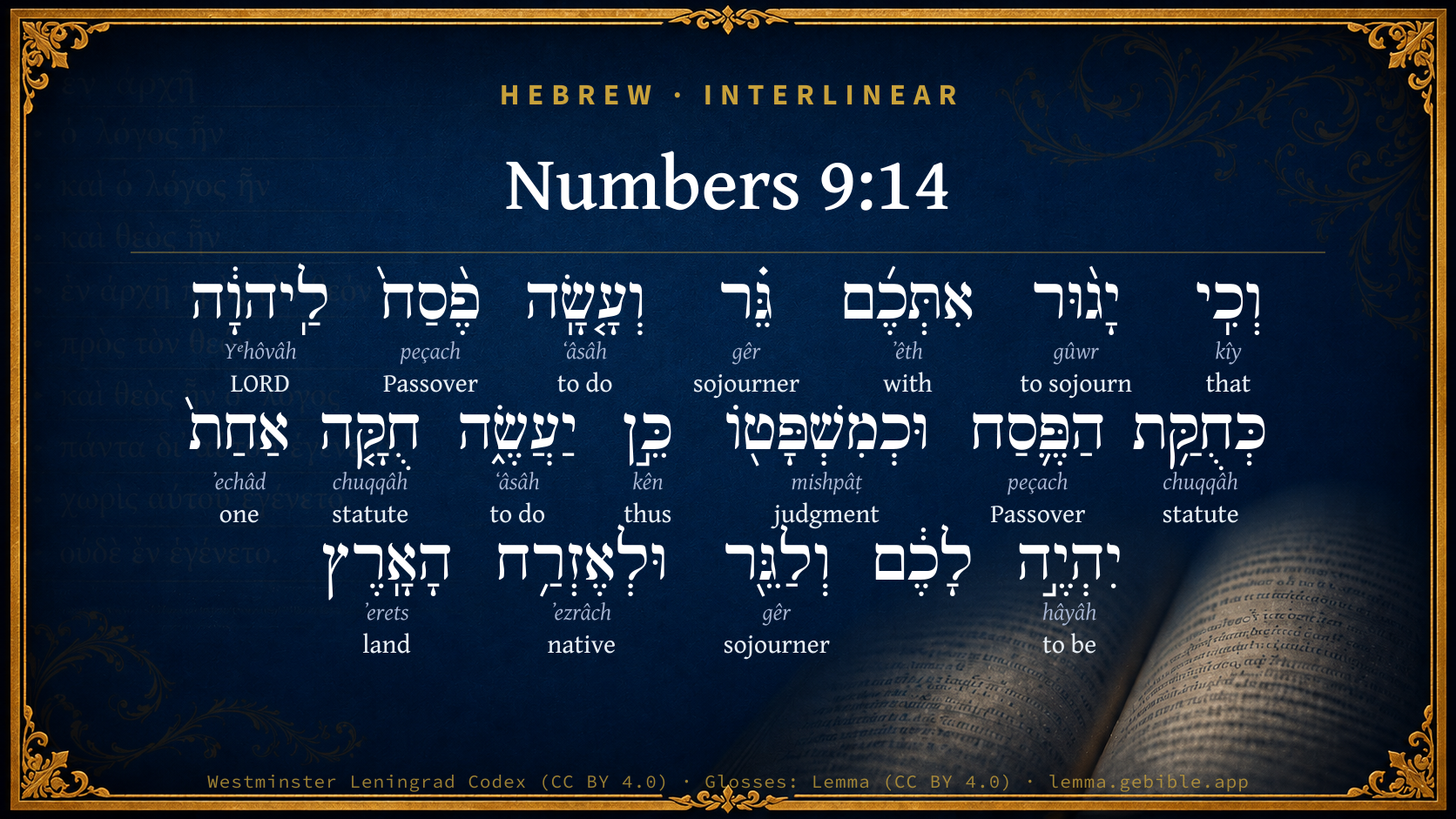
Hebrew (Westminster Leningrad Codex) Numbers 9:14 appears in the Hebrew Old Testament. The text above is from the Westminster Leningrad Codex. Each word links to its Strong’s number, a concise gloss, and parsing drawn from the Open Scriptures Hebrew Bible morphology. Click any word for its full Brown-Driver-Briggs (BDB) entry.
Download image
Cite this verse

Numbers 9:14 (World English Bible). Public Domain. Lemma interlinear Bible study tool, https://lemma.gebible.app/v/numbers/9/14.

Show BibTeX & RIS
BibTeX
RIS
English Translation
If a foreigner lives among you, and desires to keep the Passover to Yahweh; according to the statute of the Passover, and according to its ordinance, so shall he do. You shall have one statute, both for the foreigner, and for him who is born in the land.'"
World English Bible · Public Domain
Download a study sheet

One document with this verse’s original text, its word-by-word gloss line, the meaning frame, cross-references with their text, attributed commentary, and full source and license credits — printable, and it pastes into notes with its structure intact.

This verse Autodidact and up

Study sheet (.html) Plain text (.txt)

A passage Seminary Student

Up to 50 verses in one chapter. A passage sheet keeps up to 6 commentary sources and 12 cross-references per verse, in the order this page ranks them, and says so on the sheet whenever that leaves anything out. Ask for a single verse and you get the Autodidact verse sheet above.

Everything on this page stays free to read, with no account — the sheet is a download of what is already on screen, not access to it.

Want to remove ads? Support Godless Engineer
Compare translations 3

The same verse in 3 English versions, stacked beneath the original-language interlinear above. Click any original word for its lexicon entry.

Each is an independent rendering of the whole verse — the interlinear is not word-aligned to these translations.

Highlighted words mark where these versions differ — a whole-verse word diff, not a word-by-word alignment.

  • World English Bible Public Domain
    If a foreigner lives among you, and desires to keep the Passover to Yahweh; according to the statute of the Passover, and according to its ordinance, so shall he do. You shall have one statute, both for the foreigner, and for him who is born in the land.'"
  • King James Version Public Domain
    And if a stranger shall sojourn among you, and will keep the passover unto the LORD; according to the ordinance of the passover, and according to the manner thereof, so shall he do: ye shall have one ordinance, both for the stranger, and for him that was born in the land.
  • unfoldingWord Literal Text CC BY-SA 4.0
    And if a sojourner sojourns with you and does the Passover to Yahweh according to the statute of the Passover and according to its ordinance, so he shall do. One statute shall be for you and for the sojourner and for the native of the land.’”

unfoldingWord Literal Text — © unfoldingWord, licensed CC BY-SA 4.0. Word-aligned USFM3 via Door43 (git.door43.org/unfoldingWord/en_ult).

Versions to compare (up to 4)

3 of 4 selected

Show all 18 translations

Every available English version of this verse, each an independent rendering of the whole verse.

  • World English Bible Public Domain
    If a foreigner lives among you, and desires to keep the Passover to Yahweh; according to the statute of the Passover, and according to its ordinance, so shall he do. You shall have one statute, both for the foreigner, and for him who is born in the land.'"
  • Berean Standard Bible Public Domain
    If a foreigner dwelling among you wants to observe the Passover to the LORD, he is to do so according to the Passover statute and its ordinances. You are to apply the same statute to both the foreigner and the native of the land.’”
  • Majority Standard Bible Public Domain
    If a foreigner dwelling among you wants to observe the Passover to the LORD, he is to do so according to the Passover statute and its ordinances. You are to apply the same statute to both the foreigner and the native of the land.’”
  • King James Version Public Domain
    And if a stranger shall sojourn among you, and will keep the passover unto the LORD; according to the ordinance of the passover, and according to the manner thereof, so shall he do: ye shall have one ordinance, both for the stranger, and for him that was born in the land.
  • American Standard Version (1901) Public Domain
    And if a stranger shall sojourn among you, and will keep the passover unto Jehovah; according to the statute of the passover, and according to the ordinance thereof, so shall he do: ye shall have one statute, both for the sojourner, and for him that is born in the land.
  • Revised Version (1885) Public Domain
    And if a stranger shall sojourn among you, and will keep the passover unto the LORD; according to the statute of the passover, and according to the ordinance thereof, so shall he do: ye shall have one statute, both for the stranger, and for him that is born in the land.
  • Geneva Bible (1599) Public Domain
    And if a stranger dwell among you, and wil keepe the Passeouer vnto the Lord, as the ordinance of the Passeouer, and as the maner thereof is, so shall he do: ye shall haue one lawe both for the stranger, and for him that was borne in the same lande.
  • Douay-Rheims (1899) Public Domain
    The sojourner also and the stranger if they be among you, shall make the phase to the Lord according to the ceremonies and justifications thereof. The same ordinance shall be with you both for the stranger, and for him that was born in the land.
  • Young's Literal Translation Public Domain
    `And when a sojourner sojourneth with you, then he hath prepared a passover to Jehovah, according to the statute of the passover, and according to its ordinance, so he doth; one statute is to you, even to a sojourner, and to a native of the land.'
  • Literal Standard Version CC BY-SA 4.0
    And when a sojourner sojourns with you, then he has prepared a Passover to YHWH—according to the statute of the Passover and according to its ordinance, so he does; one statute is for you, indeed, for a sojourner and for a native of the land.”
  • Unlocked Literal Bible CC BY-SA 4.0
    If a stranger lives among you and keeps the Passover in Yahweh's honor, he must keep it and do all he commands, keeping the rules of the Passover, and obeying the laws for it. You must have the same law for the foreigner and for all who have been born in the land.”
  • unfoldingWord Literal Text CC BY-SA 4.0
    And if a sojourner sojourns with you and does the Passover to Yahweh according to the statute of the Passover and according to its ordinance, so he shall do. One statute shall be for you and for the sojourner and for the native of the land.’”
  • Darby Bible Public Domain
    And if a stranger shall sojourn among you, and would hold the passover to Jehovah, according to the rite of the passover, and according to the ordinance thereof, so shall he do. Ye shall have one rite, both for the stranger and for him that is born in the land.
  • World Messianic Bible Public Domain
    “‘If a foreigner lives among you and desires to keep the Passover to the LORD, then he shall do so according to the statute of the Passover, and according to its ordinance. You shall have one statute, both for the foreigner and for him who is born in the land.’”
  • Webster's Bible Public Domain
    And if a stranger shall sojourn among you, and will keep the passover to the LORD; according to the ordinance of the passover, and according to the manner of it, so shall he do: ye shall have one ordinance both for the stranger, and for him that was born in the land.
  • Free Bible Version CC BY-SA 4.0
    Any foreigners living among you who want to observe the Lord's Passover can do so following the Passover rules and regulations. The same rules apply to the foreigners as they do to you.’”
  • Bible in Basic English Public Domain
    And if a man from another country is among you and has a desire to keep the Passover to the Lord, let him do as is ordered in the law of the Passover: there is to be the same rule for the man from another nation and for him who had his birth in the land.
  • JPS Tanakh (1917) Public Domain
    And if a stranger shall sojourn among you, and will keep the passover unto the LORD: according to the statute of the passover, and according to the ordinance thereof, so shall he do; ye shall have one statute, both for the stranger, and for him that is born in the land.'

Literal Standard Version (2020), Covenant Press — licensed CC BY-SA 4.0. Text via the HelloAO Bible API (eBible.org). Unlocked Literal Bible (unfoldingWord) — licensed CC BY-SA 4.0. Text via the HelloAO Bible API (eBible.org). unfoldingWord Literal Text — © unfoldingWord, licensed CC BY-SA 4.0. Word-aligned USFM3 via Door43 (git.door43.org/unfoldingWord/en_ult). Free Bible Version, Dr. Jonathan Gallagher — licensed CC BY-SA 4.0. Text via the HelloAO Bible API (eBible.org).

Word by word

More ways to search: Search by grammar → Find every occurrence → Compare this word →

Practice this passage: Drill this verse → Learn its vocabulary →

וּלְאֶזְרַ֥ח
ʼezrâch
H249
“and · to/for · native of”
Conjunction + Preposition + Noun, Common, Masculine, Singular, Construct
Part of Speech
Conjunction + Preposition + Noun
Type
Common
Gender
Masculine
Number
Singular
State
Construct
Full BDB Definition

Origin: from H2224 (in the sense of springing up)

TWOT: 580b

a native (one rising from the soil) - of man, native Israelites - of tree, native (to Israel)
  1. וְכִֽי kîy H3588 “and · that” Conjunction + Conjunction
  2. יָג֨וּר gûwr H1481 “to sojourn” Verb, Qal, Imperfect, 3rd Person, Masculine, Singular
  3. אִתְּכֶ֜ם ʼêth H854 “with · you” Preposition + Suffix, Personal, 2nd Person, Masculine, Plural
  4. גֵּ֗ר gêr H1616 “sojourner” Noun, Common, Masculine, Singular, Absolute
  5. וְעָ֤שָֽׂה ʻâsâh H6213 “and · to do” Conjunction + Verb, Qal, Sequential Perfect, 3rd Person, Masculine, Singular
  6. פֶ֨סַח֙ peçach H6453 “Passover” Noun, Common, Masculine, Singular, Absolute
  7. לַֽיהוָ֔ה Yᵉhôvâh H3068 “to/for · LORD” Preposition + Noun, Proper
  8. כְּחֻקַּ֥ת chuqqâh H2708 “like/as · statute of” Preposition + Noun, Common, Both, Singular, Construct
  9. הַפֶּ֛סַח peçach H6453 “the · Passover” Particle, Definite Article + Noun, Common, Masculine, Singular, Absolute
  10. וּכְמִשְׁפָּט֖וֹ mishpâṭ H4941 “and · like/as · judgment · his” Conjunction + Preposition + Noun, Common, Masculine, Singular, Construct + Suffix, Personal, 3rd Person, Masculine, Singular
  11. כֵּ֣ן kên H3651 “thus” Particle, Demonstrative
  12. יַעֲשֶׂ֑ה ʻâsâh H6213 “to do” Verb, Qal, Imperfect, 3rd Person, Masculine, Singular
  13. חֻקָּ֤ה chuqqâh H2708 “statute” Noun, Common, Both, Singular, Absolute
  14. אַחַת֙ ʼechâd H259 “one” Adjective, Cardinal number, Feminine, Singular, Absolute
  15. יִהְיֶ֣ה hâyâh H1961 “to be” Verb, Qal, Imperfect, 3rd Person, Masculine, Singular
  16. וְלַגֵּ֖ר gêr H1616 “and · to/for the · sojourner” Conjunction + Preposition, Determined + Noun, Common, Masculine, Singular, Absolute
  17. הָאָֽרֶץ ʼerets H776 “the · land” Particle, Definite Article + Noun, Common, Both, Singular, Absolute

About this verse

These counts appear in no published source. They are computed here, from the morphology-tagged text and Lemma’s own curated glosses. What Lemma adds →

19
words
14
distinct lemmas
Pentateuch
section

Notable vocabulary

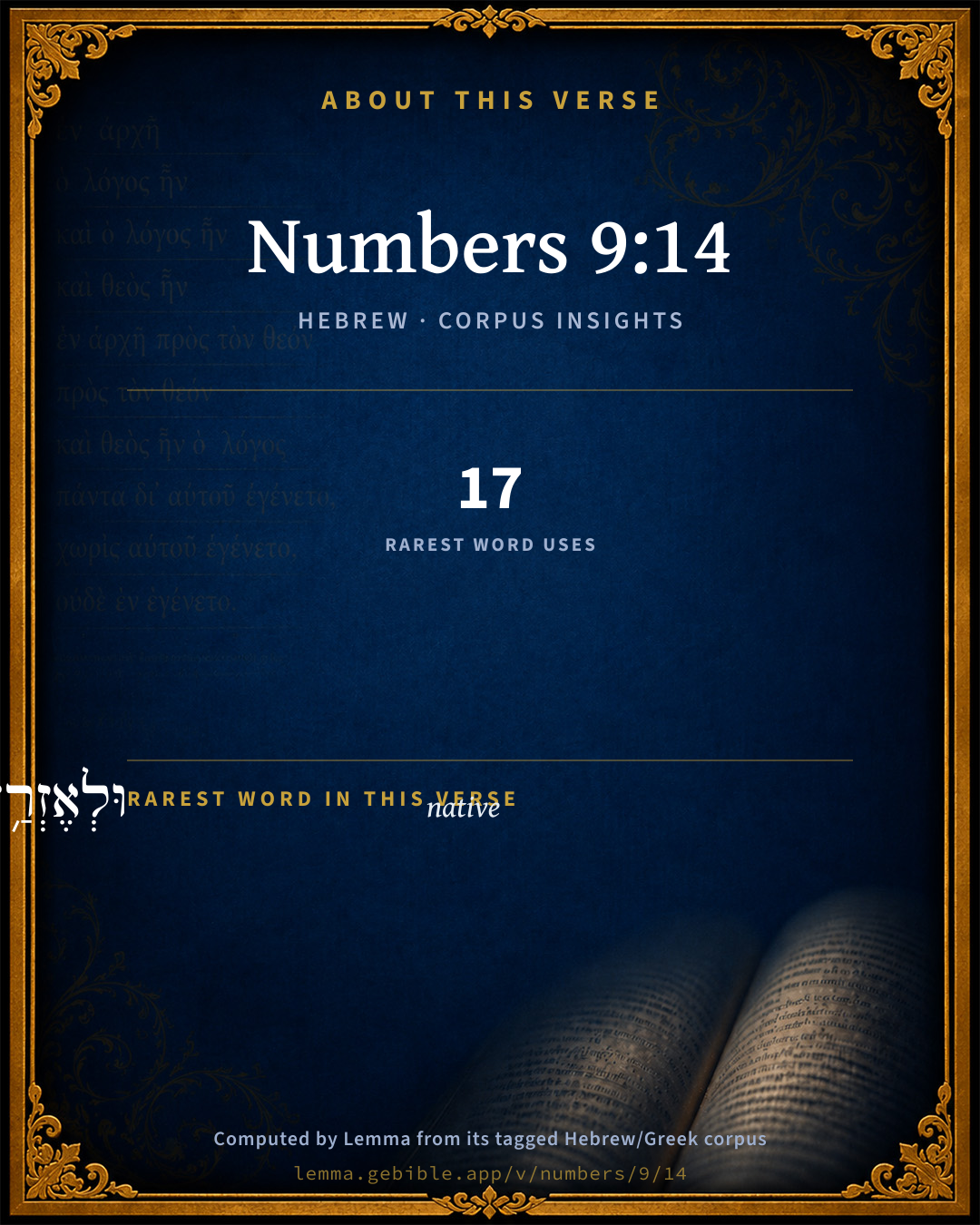
The rarest word here is וּלְאֶזְרַ֥ח native H249 — appearing just 17 times in the whole Hebrew Bible.

Shared distinctive vocabulary

וּלְאֶזְרַ֥ח native H249 occurs in 17 verses of the Hebrew Bible. Also found in:

Grammatical profile

  • 4 verbs
  • 10 nouns
  • 1 adjective
  • 2 prepositions
  • 1 conjunction
  • 1 particle

Verb forms

  • יָג֨וּר Qal · Imperfect
  • וְעָ֤שָֽׂה Qal · Sequential Perfect
  • יַעֲשֶׂ֑ה Qal · Imperfect
  • יִהְיֶ֣ה Qal · Imperfect

Repetition

Words recur within this verse — often emphatic in Hebrew:

  • גֵּ֗ר sojourner H1616 ×2
  • וְעָ֤שָֽׂה to do H6213 ×2
  • פֶ֨סַח֙ Passover H6453 ×2
  • כְּחֻקַּ֥ת statute H2708 ×2

Hebrew & Septuagint length

In English translation the verse runs 48 words from the Hebrew and 54 from the Septuagint (LXX English) — closely comparable.

A rough comparison of the two English renderings, which tokenize alike — not a word-level alignment.

Word counts can differ between the Hebrew and the Greek without any difference in meaning — e.g. the Hebrew direct-object marker אֵת has no separate Greek word, and Greek often adds the article ὁ.

Cross-references

9

Topical passages linked to Numbers 9:14 in the Treasury of Scripture Knowledge — connected by theme and wording, ordered by reader-vote popularity; previews shown in the World English Bible.

  • Exodus 12:48–49 When a stranger shall live as a foreigner with you, and will keep the Passover to Yahweh, let all his males be circumcised, and then let him come near and keep it; and he shall be as one who is born in the land: but no uncircumcised person shall eat of it.
  • Leviticus 24:22 You shall have one kind of law, for the foreigner as well as the native-born: for I am Yahweh your God.'"
  • Isaiah 56:3–7 Neither let the foreigner, who has joined himself to Yahweh, speak, saying, Yahweh will surely separate me from his people; neither let the eunuch say, Behold, I am a dry tree.
  • Ephesians 2:19–22 So then you are no longer strangers and foreigners, but you are fellow citizens with the saints, and of the household of God,
  • Leviticus 19:10 You shall not glean your vineyard, neither shall you gather the fallen grapes of your vineyard; you shall leave them for the poor and for the foreigner. I am Yahweh your God.
  • Leviticus 22:25 Neither from the hand of a foreigner shall you offer the bread of your God of any of these; because their corruption is in them. There is a blemish in them. They shall not be accepted for you.'"
  • Leviticus 25:15 According to the number of years after the Jubilee you shall buy from your neighbor. According to the number of years of the crops he shall sell to you.
  • Deuteronomy 29:11 your little ones, your wives, and your foreigner who is in the midst of your camps, from the one who cuts your wood to the one who draws your water;
  • Deuteronomy 31:12 Assemble the people, the men and the women and the little ones, and your foreigner who is within your gates, that they may hear, and that they may learn, and fear Yahweh your God, and observe to do all the words of this law;

Cross-references courtesy of OpenBible.info (CC BY 4.0).

Hebrew and Greek witnesses Masoretic Hebrew ↔ Greek Septuagint

The same verse in the two great witnesses to the Old Testament, shown verse-for-verse.

These are two independent witnesses, not word-aligned to each other, and the Septuagint is shown in lemma (dictionary) form.

Hebrew Numbers 9:14 Masoretic · Westminster Leningrad Codex

וְכִֽי יָג֨וּר אִתְּכֶ֜ם גֵּ֗ר וְעָ֤שָֽׂה פֶ֨סַח֙ לַֽיהוָ֔ה כְּחֻקַּ֥ת הַפֶּ֛סַח וּכְמִשְׁפָּט֖וֹ כֵּ֣ן יַעֲשֶׂ֑ה חֻקָּ֤ה אַחַת֙ יִהְיֶ֣ה לָכֶ֔ם וְלַגֵּ֖ר וּלְאֶזְרַ֥ח הָאָֽרֶץ

If a foreigner lives among you, and desires to keep the Passover to Yahweh; according to the statute of the Passover, and according to its ordinance, so shall he do. You shall have one statute, both for the foreigner, and for him who is born in the land.'"

World English Bible · Public Domain

Greek LXX Numbers 9:14 Septuagint · lemma form

ἐάν δέ προςἔρχομαι πρός σύ προσήλυτος ἐν ὁ γῆ σύ καί ποιέω ὁ πασχα κύριος κατά ὁ νόμος ὁ πασχα καί κατά ὁ σύνταξις αὐτός ποιέω αὐτός νόμος εἷς εἰμί σύ καί ὁ προσήλυτος καί ὁ αὐτόχθων ὁ γῆ

And if there should come to you a stranger in your land, and should keep the passover to the Lord, he shall keep it according to the law of the passover and according to its ordinance: there shall be one law for you, both for the stranger, and for the native of the land.

LXX2012 (modern English Septuagint) · Public Domain

On this verse, Whedon's Commentary on the Bible discusses the Septuagint’s reading. Read the note in Commentary ↓

Hebrew: Westminster Leningrad Codex (CC BY 4.0). Greek: Septuagint (public domain); English from LXX2012 (modern English Septuagint) (Public Domain). How the Septuagint differs from the Hebrew →

Targum (Aramaic paraphrase)

2

The Targum is the ancient Jewish Aramaic paraphrase of the Hebrew Scriptures — an interpretive translation, not the Hebrew text itself. Onkelos (literal) and Pseudo-Jonathan (expansive) render the Torah, and Jonathan the Prophets. Coverage is partial: where no permissively-licensed English translation exists for a verse, only the Aramaic is shown. This is verse-level text, not a word-by-word alignment to the Hebrew.

  1. Targum Onkelos Torah (Genesis–Deuteronomy)
    וַאֲרֵי יִתְגַיַר עִמְכוֹן גִיוֹרָא וְיַעְבֵּד פִּסְחָא קֳדָם יְיָ כִּגְזֵרַת פִּסְחָא וְכִדְחָזֵי לֵהּ כֵּן יַעְבֵּד קְיָמָא חַד יְהֵי לְכוֹן וּלְגִיוֹרָא וּלְיַצִיבָא דְאַרְעָא

    (no public-domain English translation for this verse)

    Targum Onkelos — Aramaic: “Onkelos Genesis” (public domain); “Onkelos Exodus” (public domain); “Onkelos Leviticus” (public domain); “Onkelos Numbers” (public domain); “Onkelos Deuteronomy” (public domain). English: “Sefaria Community Translation” (CC0 1.0 (public-domain dedication)); “J.W. Etheridge. The Targums of Onkelos and Jonathan Ben Uzziel on the Pentateuch. London: Longmans, Green, 1862” (public domain). Text via Sefaria.

  2. Targum Pseudo-Jonathan Torah (Genesis–Deuteronomy)
    וַאֲרוּם אִין יִתְגַיֵיר עִמְכוֹן גִיוֹרָא וְיַעֲבֵיד פִּסְחָא קֳדָם יְיָ כְּאַחְוָיַית גְזֵירַת פִּסְחָא וְכִדְחָזֵי לֵיהּ הֵיכְדֵין יַעֲבֵיד קְיָמָא חֲדָא יְהֵי לְכוֹן וּלְדִיוֹרָא וּלְיַצִבָא דְאַרְעָא

    And if the stranger who is sojourning with you will perform the Pascha before the Lord, he shall do it after the proper manner of the Paschal decree, according to its form so shall he do it. You shall have one statute, both for the sojourner and for the native of the land.

    Targum Pseudo-Jonathan — Aramaic: “Targum Jonathan on Genesis” (public domain); “Targum Jonathan on Exodus” (public domain); “Targum Jonathan on Leviticus” (public domain); “Targum Jonathan on Numbers” (public domain); “Targum Jonathan on Deuteronomy” (public domain). English: “The Targum of Jonathan ben Uzziel, trans. J. W. Etheridge, London, 1862” (public domain). Text via Sefaria.

Commentary

Notes on Numbers 9:14 from classic Christian and Jewish commentators (each source and its license shown beneath its notes). The classic Christian expositions comment on the surrounding passage and are grouped to its opening verse, so a note may address several verses; the Jewish commentaries on the Tanakh (Rashi and others) are per-verse, so they appear only where the commentator wrote on this verse.

Lemma curates 59 commentaries, every one of them public domain or Creative Commons licensed, each selected and text-cleaned for this edition rather than reprinted as found. About our sources →

Joseph Benson's Commentary

Num 9:14-15. A stranger — Who is a proselyte. Namely, the tent of the testimony — Or, the tabernacle above the tent of the testimony; that is, that part of the tabernacle in which was the testimony, or the ark of the testimony; for there the cloudy pillar stood. This was an evident token of God’s special presence with, and providence over them. And this cloud was easily distinguished from other clouds, both by its peculiar figure, and by its constant residence in that place. Fire — That they might better discern it, and direct themselves and their journeys or stations by it. Had it been a cloud only, it had scarce been visible by night: and had it been a fire only, it would have scarce been discernible by day. But God was pleased to give them sensible demonstrations that he kept them night and day.

Joseph Benson's Commentary on the Old and New Testaments (1811–1818) — public domain. Text from a community e-Sword module.

The Pulpit Commentary

Ye shall have one ordinance. This is repeated from Exo_12:49 as a further warning not to tamper more than absolute necessity required with the unity, either in time or in circumstance, of the great national rite.

The beneficent aspect of the law of Moses towards foreigners.

Judaism, according to the "law given by Moses," was not the exclusive and repulsive system that many have imagined. The gate into Judaism, through circumcision, etc., may seem strait to us; but a thorough separation from the corrupt heathen world was a necessity and a blessing, just as the utter renunciation of Hinduism by breaking caste is now. Laws relating to strangers occupy no inconsiderable place in the legislation of Moses. These laws have a most beneficent aspect, which may suggest lessons regarding our duties as Christians towards aliens, whether of blood or creed. We find precepts recognizing for the strangers

I EQUALITY BEFORE THE LAW. This is taught in our text and in several other passages. (Exo_12:49 Lev_24:22 Num_15:15, Num_15:16, Num_15:29) This is especially noticeable in regard to the laws of the sabbath, (Exo_20:10 Exo_23:12 Deu_5:14) and of the cities of refuge. (Num_35:15) Hence the Israelites were repeatedly warned against oppressing the stranger, (Exo_22:21 Exo_23:9) though he might be a hired servant, at the mercy of his employer, (Deu_24:14, Deu_24:15) or an Egyptian. (Deu_23:7) In administering these laws strict impartiality is demanded of the judges. (Deu_1:16 Deu_24:17) Such equality is recognized under the laws of Christian England, but needs to be most carefully guarded. E.g., in our treatment of coolies or other coloured people in our colonies, foreign sailors in our ports, etc. Oppression of strangers one great crime before the fail of the Jewish monarchy. (Eze_22:7, Eze_22:29) Ill-treatment of non-Christian races outside its borders one of England"s national crimes (Chinese opium traffic; some of our colonial wars, etc.).

II A CLAIM ON BENEVOLENCE. Strangers were not only guarded from oppression, but commended to the love of the Israelites. See precepts in Lev_19:33, 34 Deu_10:18, 19 Lev_25:35, blossoming into the beautiful flower, "Thou shalt love thy neighbour as thyself," which our Lord plucks from its hiding-place in Leviticus and exhibits and enforces on the whole world. Hence follow the precepts requiring that gleanings be left for the strangers, (Lev_19:10 Lev_23:22) and that they should be allowed to share "in every good thing" God bestowed on Israel. (Deu_14:29 Deu_16:11, 14 26:11) God be praised for all the philanthropic agencies of England on behalf of foreigners. Let us see that our personal beneficence is not limited by race or creed. (Isa_58:6-11, etc.)

III INVITATIONS TO NATIONAL AND PERSONAL BLESSINGS, Gentiles were welcomed to all privileges of Judaism through conformity to its laws. They could enter into the covenant, (Deu_29:10-13) offer sacrifices, (Lev_22:18) and keep the passover. (Exo_12:43-49 Num_9:14) And it was required that they be instructed in the law of God. (Deu_31:10-13, read in the light of Jos_8:33-35) Having all these privileges, they were liable to the same punishments as the Israelites. (Lev_17:8, Lev_17:12, 15 24:16, etc.) We need not wonder that the adhesion and conversion of strangers was anticipated. (1Ki_8:41-43 Isa_56:3, etc.) Apply to the missionary work of the Church, which can speak to strangers of "a better covenant," "Christ our passover," "grace and truth by Jesus Christ. P.

The Pulpit Commentary (1880–1919), ed. H.D.M. Spence-Jones & Joseph S. Exell — public domain. Text from a community e-Sword module.

Tyndale Open Study Notes

Tyndale Open Resources

9:14 Foreigners who lived among the Hebrews and wanted to celebrate the Passover could do so by following the same laws, but circumcision was required for males who desired to eat the Passover meal (see also Exod 12:48-49).

Tyndale Open Study Notes — © Tyndale Open Resources, licensed CC BY-SA 4.0. Text via the HelloAO Bible API.

Jamieson, Fausset & Brown

Robert Jamieson, A. R. Fausset & David Brown

if a stranger shall sojourn among you, and will keep the passover--Gentile converts, or proselytes, as they were afterwards called, were admitted, if circumcised, to the same privileges as native Israelites, and were liable to excommunication if they neglected the passover. But circumcision was an indispensable condition; and whoever did not submit to that rite, was prohibited, under the sternest penalties, from eating the passover.

Jamieson, Fausset & Brown — Commentary Critical and Explanatory on the Whole Bible (1871) — public domain (CC PDM 1.0). Text via the HelloAO Bible API.

Ellicott's Commentary for English Readers

(14) And if a stranger . . . —The law respecting the stranger is contained in Exo_12:48-49.

A Bible Commentary for English Readers, edited by Charles John Ellicott (1878–1897) — public domain. Text from a community e-Sword module.

The Cambridge Bible for Schools and Colleges

gen. ed. J. J. S. Perowne

14. a stranger] a sojourner. The Heb. gêr has no exact equivalent in English. He was one who was not an Israelite but who, permanently or for a considerable period, put himself under Israelite protection and became a member of the community. He was sharply distinguished from a foreigner, who was making only a temporary stay in the country (tôshâbh, see Num_35:15). The latter was forbidden to eat the Passover (Exo_12:45).

him that is born in the land] Heb. ’ezrâḥ, a native of the land, i.e. a full-blooded Israelite. R.V. sometimes ‘home-born,’ e.g. Num_15:13; Num_15:30.

The Cambridge Bible for Schools and Colleges (gen. ed. J. J. S. Perowne; Cambridge University Press, 1878–1918) — public domain. Text from a community e-Sword module.

John Gill's Exposition

And on the day that the tabernacle was reared up,.... Which was the first day of the first month in the second year of the people of Israel's coming out of Egypt, Exo 40:1,

the cloud covered the tabernacle, namely, the tent of the testimony; that part of the tabernacle in which the testimony was, that is, where the ark was, in which the law was put, called the testimony; and this was the most holy place; and over the tent or covering of that was this cloud, which settled upon it, as Ben Gersom thinks, after the seven days of the consecration of Aaron and his sons; on the eighth day, when it was said unto the people of Israel, "today will the Lord appear unto you", Lev 9:1; "and the glory of the Lord shall appear unto you", Lev 9:6; and here the Targum of Jonathan calls this cloud the cloud of glory, because of the glory of God in it; of which see Exo 40:34,

and at even there was upon the tabernacle, as it were, the appearance of fire until the morning; the same phenomenon, which looked like a cloud in the daytime, appeared like fire in the same place in the nighttime, throughout the whole of it until morning light, when it was seen as a cloud again: this was a token of the presence of God with the people of Israel, of his protection of them, and being a guide unto them by night and day, while in the wilderness; and was a figure of his being the same to his church and people, in the present state of things; see Isa 4:5.

John Gill's Exposition of the Whole Bible (1746–1763) — public domain (CC PDM 1.0). Text via the HelloAO Bible API.

Haydock's Catholic Bible Commentary

Stranger. Both the Jews who lived at a distance from the promised land, and those of other nations who had embraced their religion, were obliged to observe this law; while the uncircumcised were absolutely excluded. (Calmet)

George Leo Haydock (1774–1849), Haydock's Catholic Family Bible and Commentary, 1859 edition — public domain. Excludes Psalms (Douay-Rheims chapter numbering differs from Protestant) and Deuterocanonical books (Catholic canon only).

Matthew Poole's English Annotations

A stranger, to wit, a proselyte.

Matthew Poole's English Annotations on the Holy Bible (1683–1685) — public domain. Text from a community e-Sword/MySword module.

Whedon's Commentary on the Bible

Daniel D. Whedon

14. If a stranger shall sojourn — “If one shall dwell among you who has been converted unto me.” — Syriac. “If a proselyte come unto you in your land.” — Septuagint. Naturalized and circumcised aliens who have been incorporated into Israel as “proselytes of righteousness” were to partake of the paschal lamb as the native Hebrew. Thus was prefigured the determination of God, “That the Gentiles should be fellow-heirs, and of the same body, and partakers of his promise in Christ by the Gospel.” Eph_3:6.

Daniel D. Whedon (gen. ed.), Commentary on the Old and New Testaments (1874–1909) — public domain. Text from a community e-Sword module.

John Wesley's Explanatory Notes

A stranger - Who is a proselyte.

John Wesley, Explanatory Notes Upon the Whole Bible (1754–1765) — public domain. Text via the GEBible commentary corpus.

Rashi

Rabbi Shlomo Yitzchaki (Rashi)

וכי יגור אתכם גר ועשה פסח AND IF A STRANGER SHALL SOJOURN AMONG YOU, AND WILL KEEP THE PASSOVER [ACCORDING TO THE ORDINANCE OF THE PASSOVER … SO SHALL HE DO] — One might think that this verse implies that anyone who becomes a proselyte (גר) must keep the Passover offering rite immediately after his circumcision (even though it has not taken place just before Passover), therefore Scripture states, “yo shall have one ordinance, [both for the stranger, and for him that was born in the land]” (which implies that just as the native brings the offering on the fourteenth of Nisan, so the proselyte, too, must bring it only on the fourteenth of Nisan; cf. Rashi on Exodus 12:48). What the first part of the verse implies is, therefore, the following: “and if a proselyte will sojourn among you, and comes to celebrate the Passover rite together with his fellows, then according to the ordinance of the Passover and according to the manner thereof shall he do” (i.e. ועשה פסח is not a predicative clause — when he becomes a proselyte then shall he offer the Passover, i. e. offer it immediately — but it is a conditional clause, coordinate to וכי יגור אתכם and the apodosis begins with כחקת הפסח etc.) (Sifrei Bamidbar 71).

Rashi on the Tanakh — English translations: “The Judaica Press complete Tanach with Rashi, translated by A. J. Rosenberg” (CC BY 4.0); “Pentateuch with Rashi's commentary by M. Rosenbaum and A.M. Silbermann, 1929-1934” (public domain); “The Metsudah Tanach series, Lakewood, N.J” (CC BY 4.0); and “The Book of Joshua, Metsudah Publications, 1997” (CC BY 4.0). Text via Sefaria.

Ramban (Nachmanides)

Rabbi Moshe ben Nachman (Ramban / Nachmanides)

AND IF A STRANGER SHALL SOJOURN AMONG YOU. The purpose of this is to command the stranger to bring this Passover-offering in the wilderness just as He commanded the Israelites. It is possible that when He said in Seder ‘Bo El Par’oh’ (Go in unto Pharaoh), And when a stranger shall sojourn with thee and will keep the Passover, 12:48. it refers [only] to the [original] Passover kept in Egypt, for that section was said with reference to the Passover of Egypt, as I have explained there. In that case we might have thought that those strangers who joined us in going out from Egypt, the mixed multitude, Verse 38. should keep the Passover, because they were also included in that miracle [of the exodus], but those who become proselytes afterwards, in the desert or in the Land of Israel, [we might have thought] do not have to bring the Passover-offering, since neither they nor their ancestors were included among [those of whom it is said], and He brought us out from thence; therefore He had to make them liable here to bring the Passover-offering in [subsequent] generations, in the wilderness and in the Land.

Ramban (Nachmanides) on the Tanakh — English translation: “Commentary on the Torah by Ramban (Nachmanides). Translated and annotated by Charles B. Chavel. New York, Shilo Pub. House, 1971-1976” (CC BY 4.0). Text via Sefaria.

Lesson kit

Teaching starters — assembled from the data on this page, not authored interpretation. Every prompt links to the verse data it draws on. Edit before teaching.

Numbers, in the Pentateuch, opens this verse with 19 words (14 distinct Hebrew lemmas). Its most distinctive word is ʼezrâch (“native”). A historical commentator’s framing appears above. Read the whole chapter for the surrounding context.

Discussion questions

  1. The word ʼezrâch carries the sense “native.” How does it shape the verse?
  2. Exodus 12:19 shares the word «native» with this verse. How do the two illuminate each other?
  3. “sojourner” occurs 2× in this one verse. What is the effect of the repetition?
  4. These translations render this verse differently. What is at stake in choosing one wording over another?
  5. The verb «יָג֨וּר» is Qal Imperfect. How does its form color the action?
  6. Reading how Joseph Benson's Commentary and The Pulpit Commentary read this verse, where do the two commentators agree and where do they part?

Things to notice

Reading settings

Reading text

Shown beneath each verse's original-language words.

Old Testament
Old Testament edition

Read the OT as the Masoretic Hebrew (MT) or the Greek Septuagint (LXX).

English shown for the Greek Septuagint (in the Hebrew ↔ Greek comparison).

Comparing translations? Open the Compare panel on any verse page to stack up to four side by side.