Jeremiah 49:33

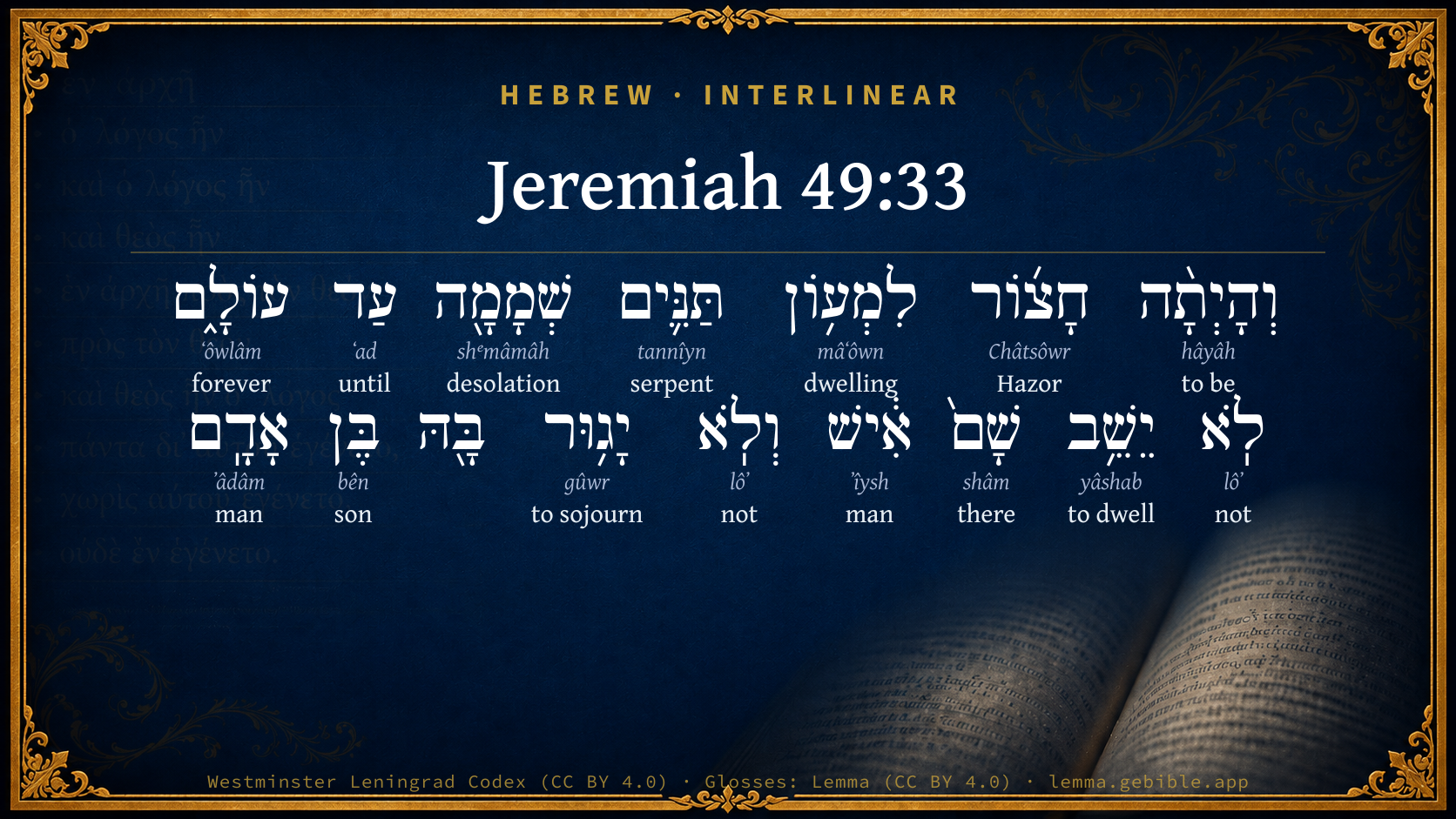
Hebrew (Westminster Leningrad Codex) Jeremiah 49:33 appears in the Hebrew Old Testament. The text above is from the Westminster Leningrad Codex. Each word links to its Strong’s number, a concise gloss, and parsing drawn from the Open Scriptures Hebrew Bible morphology. Click any word for its full Brown-Driver-Briggs (BDB) entry.
Download image
Cite this verse

Jeremiah 49:33 (World English Bible). Public Domain. Lemma interlinear Bible study tool, https://lemma.gebible.app/v/jeremiah/49/33.

Show BibTeX & RIS
BibTeX
RIS
English Translation
Hazor shall be a dwelling-place of jackals, a desolation forever: no man shall dwell there, neither shall any son of man sojourn therein.
World English Bible · Public Domain
Download a study sheet

One document with this verse’s original text, its word-by-word gloss line, the meaning frame, cross-references with their text, attributed commentary, and full source and license credits — printable, and it pastes into notes with its structure intact.

This verse Autodidact and up

Study sheet (.html) Plain text (.txt)

A passage Seminary Student

Up to 50 verses in one chapter. A passage sheet keeps up to 6 commentary sources and 12 cross-references per verse, in the order this page ranks them, and says so on the sheet whenever that leaves anything out. Ask for a single verse and you get the Autodidact verse sheet above.

Everything on this page stays free to read, with no account — the sheet is a download of what is already on screen, not access to it.

Want to remove ads? Support Godless Engineer
Compare translations 3

The same verse in 3 English versions, stacked beneath the original-language interlinear above. Click any original word for its lexicon entry.

Each is an independent rendering of the whole verse — the interlinear is not word-aligned to these translations.

Highlighted words mark where these versions differ — a whole-verse word diff, not a word-by-word alignment.

  • World English Bible Public Domain
    Hazor shall be a dwelling-place of jackals, a desolation forever: no man shall dwell there, neither shall any son of man sojourn therein.
  • King James Version Public Domain
    And Hazor shall be a dwelling for dragons, and a desolation for ever: there shall no man abide there, nor any son of man dwell in it.
  • unfoldingWord Literal Text CC BY-SA 4.0
    Hazor will become a lair of jackals, a permanent wasteland. No one will live there; no human being will stay there.”

unfoldingWord Literal Text — © unfoldingWord, licensed CC BY-SA 4.0. Word-aligned USFM3 via Door43 (git.door43.org/unfoldingWord/en_ult).

Versions to compare (up to 4)

3 of 4 selected

Show all 18 translations

Every available English version of this verse, each an independent rendering of the whole verse.

  • World English Bible Public Domain
    Hazor shall be a dwelling-place of jackals, a desolation forever: no man shall dwell there, neither shall any son of man sojourn therein.
  • Berean Standard Bible Public Domain
    “Hazor will become a haunt for jackals, a desolation forever. No one will dwell there; no man will abide there.”
  • Majority Standard Bible Public Domain
    “Hazor will become a haunt for jackals, a desolation forever. No one will dwell there; no man will abide there.”
  • King James Version Public Domain
    And Hazor shall be a dwelling for dragons, and a desolation for ever: there shall no man abide there, nor any son of man dwell in it.
  • American Standard Version (1901) Public Domain
    And Hazor shall be a dwelling-place of jackals, a desolation for ever: no man shall dwell there, neither shall any son of man sojourn therein.
  • Revised Version (1885) Public Domain
    And Hazor shall be a dwelling place of jackals, a desolation for ever: no man shall dwell there, neither shall any son of man sojourn therein.
  • Geneva Bible (1599) Public Domain
    And Hazor shall be a dwelling for dragons, and desolation for euer: there shall no man dwell there, nor the sonnes of men remaine in it.
  • Douay-Rheims (1899) Public Domain
    And Asor shall be a habitation for dragons, desolate for ever: no man shall abide there, nor son of man inhabit it.
  • Young's Literal Translation Public Domain
    And Hazor hath been for a habitation of dragons, A desolation -- unto the age, No one doth dwell there, nor sojourn in it doth a son of man!'
  • Literal Standard Version CC BY-SA 4.0
    And Hazor has been for a habitation of dragons, || A desolation for all time, || No one dwells there, nor does a son of man sojourn in it!”
  • Unlocked Literal Bible CC BY-SA 4.0
    Hazor will become a lair of jackals, a permanent wasteland. No one will live there; no human being will stay there.”
  • unfoldingWord Literal Text CC BY-SA 4.0
    Hazor will become a lair of jackals, a permanent wasteland. No one will live there; no human being will stay there.”
  • Darby Bible Public Domain
    And Hazor shall be a dwelling-place of jackals, a desolation for ever. No one shall dwell there, neither shall a son of man sojourn therein.
  • World Messianic Bible Public Domain
    Hazor will be a dwelling place of jackals, a desolation forever. No man will dwell there, neither will any son of man live therein.”
  • Webster's Bible Public Domain
    And Hazor shall be a dwelling for dragons, and a desolation for ever: there shall no man abide there, nor any son of man dwell in it.
  • Free Bible Version CC BY-SA 4.0
    Hazor will become a place where jackals live, a place abandoned forever. No one will live there; it will become uninhabited.
  • Bible in Basic English Public Domain
    And Hazor will be a hole for jackals, a waste for ever: no one will be living in it, and no son of man will have a resting-place there.
  • JPS Tanakh (1917) Public Domain
    And Hazor shall be a dwelling-place of jackals, a desolation for ever; no man shall abide there, neither shall any son of man dwell therein.

Literal Standard Version (2020), Covenant Press — licensed CC BY-SA 4.0. Text via the HelloAO Bible API (eBible.org). Unlocked Literal Bible (unfoldingWord) — licensed CC BY-SA 4.0. Text via the HelloAO Bible API (eBible.org). unfoldingWord Literal Text — © unfoldingWord, licensed CC BY-SA 4.0. Word-aligned USFM3 via Door43 (git.door43.org/unfoldingWord/en_ult). Free Bible Version, Dr. Jonathan Gallagher — licensed CC BY-SA 4.0. Text via the HelloAO Bible API (eBible.org).

Word by word

More ways to search: Search by grammar → Find every occurrence → Compare this word →

Practice this passage: Drill this verse → Learn its vocabulary →

לִמְע֥וֹן
mâʻôwn
H4583
“to/for · dwelling of”
Preposition + Noun, Common, Both, Singular, Construct
Part of Speech
Preposition + Noun
Type
Common
Gender
Both
Number
Singular
State
Construct
Full BDB Definition

Origin: from the same as H5772

TWOT: 1581a

dwelling, habitation, refuge - lair, refuge (of jackals) - dwelling
  1. וְהָיְתָ֨ה hâyâh H1961 “and · to be” Conjunction + Verb, Qal, Sequential Perfect, 3rd Person, Feminine, Singular
  2. חָצ֜וֹר Châtsôwr H2674 “Hazor” Noun, Proper
  3. תַּנִּ֛ים tannîyn H8577 “serpents” Noun, Common, Masculine, Plural, Absolute
  4. שְׁמָמָ֖ה shᵉmâmâh H8077 “desolation” Noun, Common, Feminine, Singular, Absolute
  5. עַד ʻad H5704 “until” Preposition
  6. עוֹלָ֑ם ʻôwlâm H5769 “forever” Noun, Common, Masculine, Singular, Absolute
  7. לֹֽא lôʼ H3808 “not” Particle, Negative
  8. יֵשֵׁ֥ב yâshab H3427 “to dwell” Verb, Qal, Imperfect, 3rd Person, Masculine, Singular
  9. שָׁם֙ shâm H8033 “there” Adverb
  10. אִ֔ישׁ ʼîysh H376 “man” Noun, Common, Masculine, Singular, Absolute
  11. וְלֹֽא lôʼ H3808 “and · not” Conjunction + Particle, Negative
  12. יָג֥וּר gûwr H1481 “to sojourn” Verb, Qal, Imperfect, 3rd Person, Masculine, Singular
  13. בֶּן bên H1121 “son of” Noun, Common, Masculine, Singular, Construct
  14. אָדָֽם ʼâdâm H120 “man” Noun, Common, Masculine, Singular, Absolute

About this verse

These counts appear in no published source. They are computed here, from the morphology-tagged text and Lemma’s own curated glosses. What Lemma adds →

16
words
14
distinct lemmas
Prophets
section

Notable vocabulary

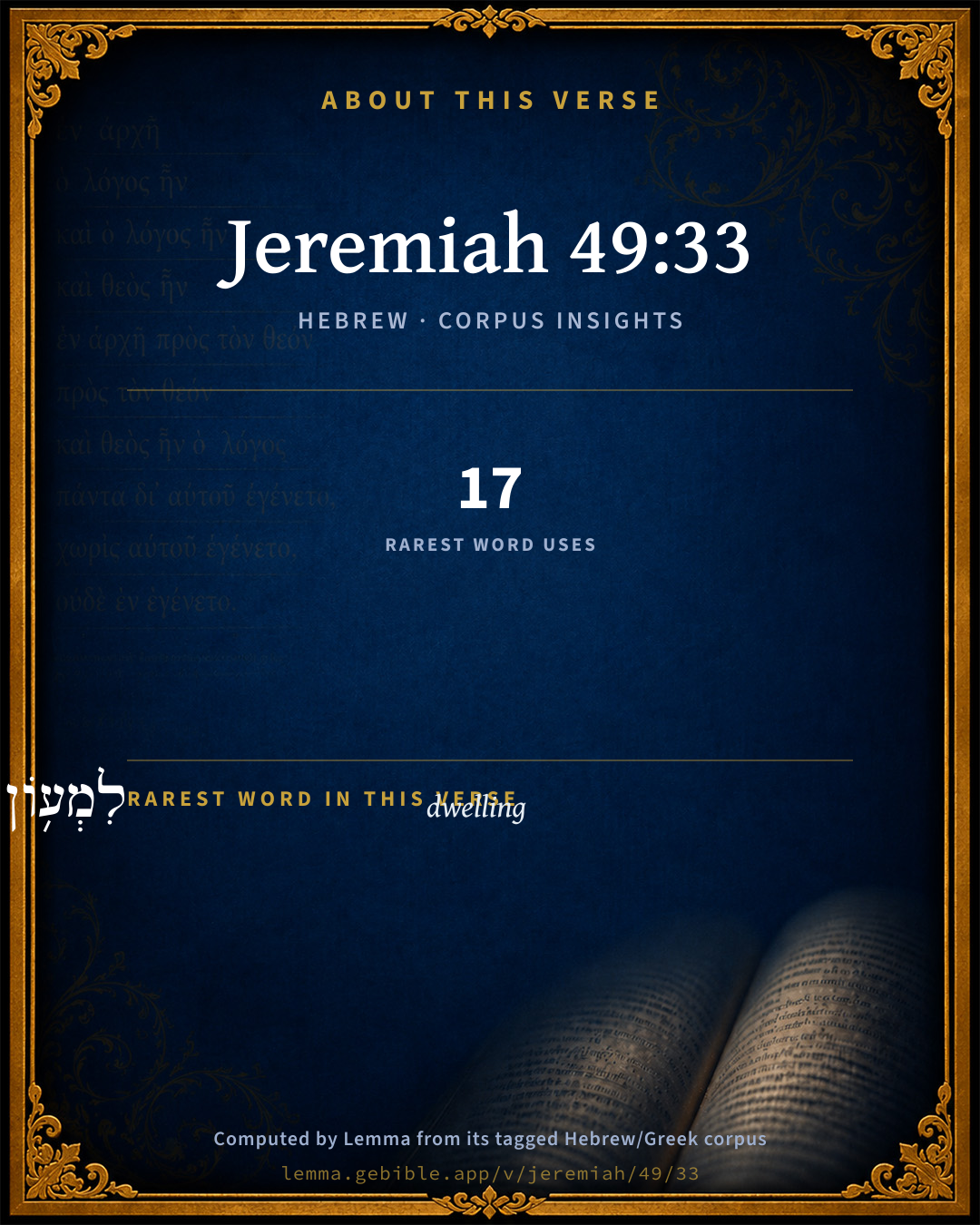
The rarest word here is לִמְע֥וֹן dwelling H4583 — appearing just 17 times in the whole Hebrew Bible.

Shared distinctive vocabulary

לִמְע֥וֹן dwelling H4583 occurs in 17 verses of the Hebrew Bible. Also found in:

Grammatical profile

  • 3 verbs
  • 8 nouns
  • 2 prepositions
  • 1 adverb
  • 2 particles

Verb forms

  • וְהָיְתָ֨ה Qal · Sequential Perfect
  • יֵשֵׁ֥ב Qal · Imperfect
  • יָג֥וּר Qal · Imperfect

Repetition

A word recurs within this verse — often emphatic in Hebrew:

Cross-references

13

Topical passages linked to Jeremiah 49:33 in the Treasury of Scripture Knowledge — connected by theme and wording, ordered by reader-vote popularity; previews shown in the World English Bible.

  • Jeremiah 9:11 I will make Jerusalem heaps, a dwelling-place of jackals; and I will make the cities of Judah a desolation, without inhabitant.
  • Jeremiah 10:22 The voice of news, behold, it comes, and a great commotion out of the north country, to make the cities of Judah a desolation, a dwelling-place of jackals.
  • Jeremiah 51:37 Babylon shall become heaps, a dwelling-place for jackals, an astonishment, and a hissing, without inhabitant.
  • Isaiah 13:20–22 It shall never be inhabited, neither shall it be lived in from generation to generation: neither shall the Arabian pitch tent there; neither shall shepherds make their flocks to lie down there.
  • Zephaniah 2:9 Therefore as I live, says Yahweh of Hosts, the God of Israel, surely Moab will be as Sodom, and the children of Ammon as Gomorrah, a possession of nettles, and salt pits, and a perpetual desolation. The remnant of my people will plunder them, and the survivors of my nation will inherit them.
  • Zephaniah 2:13–15 He will stretch out his hand against the north, destroy Assyria, and will make Nineveh a desolation, and dry like the wilderness.
  • Malachi 1:3 but Esau I hated, and made his mountains a desolation, and gave his heritage to the jackals of the wilderness."
  • Isaiah 14:23 I will also make it a possession for the porcupine, and pools of water: and I will sweep it with the broom of destruction, says Yahweh of Hosts.
  • Isaiah 34:9–17 The streams of [Edom] shall be turned into pitch, and the dust of it into sulfur, and the land of it shall become burning pitch.
  • Jeremiah 49:17–18 Edom shall become an astonishment: everyone who passes by it shall be astonished, and shall hiss at all the plagues of it.
  • Jeremiah 50:39–40 Therefore the wild animals of the desert with the wolves shall dwell there, and the ostriches shall dwell therein: and it shall be no more inhabited forever; neither shall it be lived in from generation to generation.
  • Revelation 18:2 He cried with a mighty voice, saying, "Fallen, fallen is Babylon the great, and she has become a habitation of demons, a prison of every unclean spirit, and a prison of every unclean and hateful bird!
  • Revelation 18:21–22 A mighty angel took up a stone like a great millstone and cast it into the sea, saying, "Thus with violence will Babylon, the great city, be thrown down, and will be found no more at all.

Cross-references courtesy of OpenBible.info (CC BY 4.0).

Hebrew and Greek witnesses Masoretic Hebrew ↔ Greek Septuagint

The same verse in the two great witnesses to the Old Testament, shown verse-for-verse.

These are two independent witnesses, not word-aligned to each other, and the Septuagint is shown in lemma (dictionary) form.

Hebrew Jeremiah 49:33 Masoretic · Westminster Leningrad Codex

וְהָיְתָ֨ה חָצ֜וֹר לִמְע֥וֹן תַּנִּ֛ים שְׁמָמָ֖ה עַד עוֹלָ֑ם לֹֽא יֵשֵׁ֥ב שָׁם֙ אִ֔ישׁ וְלֹֽא יָג֥וּר בָּ֖הּ בֶּן אָדָֽם

Hazor shall be a dwelling-place of jackals, a desolation forever: no man shall dwell there, neither shall any son of man sojourn therein.

World English Bible · Public Domain

Greek LXX Structure differs

In the Septuagint, Jeremiah is about an eighth shorter than the Hebrew and arranges its material differently — the Oracles Against the Nations (Hebrew chapters 46–51) appear in the middle of the Greek book, after 25:13. Because the chapter and verse boundaries do not line up, a verse-for-verse comparison with the Hebrew is not shown.

A verse-for-verse comparison isn’t shown here because the chapters and verses don’t line up. Switch to the LXX edition with the MT / LXX toggle above to read the Greek directly.

Hebrew: Westminster Leningrad Codex (CC BY 4.0). Greek: Septuagint (public domain); English from a public-domain English Septuagint. How the Septuagint differs from the Hebrew →

Targum (Aramaic paraphrase)

1

The Targum is the ancient Jewish Aramaic paraphrase of the Hebrew Scriptures — an interpretive translation, not the Hebrew text itself. Onkelos (literal) and Pseudo-Jonathan (expansive) render the Torah, and Jonathan the Prophets. Coverage is partial: where no permissively-licensed English translation exists for a verse, only the Aramaic is shown. This is verse-level text, not a word-by-word alignment to the Hebrew.

  1. Targum Jonathan Prophets (Joshua–Malachi)
    וּתְהֵי חָצוֹר לִמְדוֹר יְרוֹדִין צָדוּ עַד עַלְמָא לָא יְתֵיב תַּמָן אֱנַשׁ וְלָא יִתְיְתֵיב בָּהּ בַּר אֱנָשׁ:

    (no public-domain English translation for this verse)

    Targum Jonathan — Aramaic: “Mikraot Gedolot” (public domain). English: “Sefaria Community Translation” (CC0 1.0 (public-domain dedication)); “London "Chaldee Paraphrase," 1871” (public domain). Text via Sefaria.

Commentary

Notes on Jeremiah 49:33 from classic Christian and Jewish commentators (each source and its license shown beneath its notes). The classic Christian expositions comment on the surrounding passage and are grouped to its opening verse, so a note may address several verses; the Jewish commentaries on the Tanakh (Rashi and others) are per-verse, so they appear only where the commentator wrote on this verse.

Lemma curates 59 commentaries, every one of them public domain or Creative Commons licensed, each selected and text-cleaned for this edition rather than reprinted as found. About our sources →

Trapp's Complete Commentary

John Trapp

Jer 49:33 And Hazor shall be a dwelling for dragons, [and] a desolation for ever: there shall no man abide there, nor [any] son of man dwell in it.

Ver. 33. And Hazor shall be a dwelling for dragons.] See Jer 9:11; Jer 10:22; Jer 51:37.

John Trapp, A Commentary or Exposition upon All the Books of the Old and New Testament (1647–1656) — public domain. Text from a community e-Sword module.

Jamieson, Fausset & Brown

Robert Jamieson, A. R. Fausset & David Brown

(Mal 1:3).

Jamieson, Fausset & Brown — Commentary Critical and Explanatory on the Whole Bible (1871) — public domain (CC PDM 1.0). Text via the HelloAO Bible API.

Adam Clarke's Commentary

Verse 33. Hazor shall be a dwelling for dragons] Shall be turned into a wilderness.

A desolation for ever] Never to be re-peopled.

There shalt no man abide there] It may occasionally be visited, but never made a permanent abode.

Adam Clarke's Commentary on the Bible (1810–1826) — public domain. Text from a community e-Sword/MySword module.

John Calvin's Commentaries

Here Jeremiah concludes his prophecy concerning the Kedareans; he says that their land would be deserted. The Prophets often make use of this way of speaking, that the land, deserted by its inhabitants, would become the habitation of dragons. And this is more grievous than when the land remains empty; for when dragons succeed men, it is a dreadful thing. Hence, that God’s judgment might produce more impression on men’s feelings, the Prophets often declare that a deserted place would become the dwelling of dragons. He adds what imports the same thing, A waste shall it be for an age: but עולם, oulam, means perpetuity. And it is added, Not dwell there shall a man, nor live there shall a son of man There seems indeed to be a superfluity of words, for it would have been sufficient in one sentence to say, that the land would be deserted and not inhabited. But he first assigns it to dragons: then he adds that it would be a waste or solitude; and lastly, he says that no one would dwell there, and not only so, but having mentioned man, he adds the son of man Some indeed think that by man the nobles are referred to, and that by the son of man, or Adam, we are to understand the common people, the multitude. But as we have said elsewhere, this is too refined. It is a repetition which increases the effect, though in the second clause he speaks more generally and expresses the thing more clearly, as though he had said, that no one of the human race would become an inhabitant of that land. It now follows, —

John Calvin's Commentaries (1540-1563) — public domain. Text from the Calvin Translation Society English edition (1840s-50s) via the Christian Classics Ethereal Library (ccel.org). Calvin's coverage is partial (roughly two-thirds of the Bible); uncommented books and verses are honest gaps, never fabricated. The 19th-century editor's footnotes and remarks are omitted so the notes are faithfully Calvin's own voice.

The Cambridge Bible for Schools and Colleges

gen. ed. J. J. S. Perowne

33. jackals] See on ch. Jer_9:11.

The Cambridge Bible for Schools and Colleges (gen. ed. J. J. S. Perowne; Cambridge University Press, 1878–1918) — public domain. Text from a community e-Sword module.

John Gill's Exposition

And Hazor shall be a dwelling for dragons, and a desolation for ever,.... The city of Hazor, as well as the kingdoms of it; the royal city, where their king and principal men dwelt; even this should be no more inhabited by men, but by dragons, and the wild beasts of the field, and so remain for ever, at least a long time; see Isa 13:20;

there shall no man abide there, nor any son of man dwell in it: signifying the utter desolation of it; See Gill on Jer 49:18.

John Gill's Exposition of the Whole Bible (1746–1763) — public domain (CC PDM 1.0). Text via the HelloAO Bible API.

Albert Barnes' Notes on the Bible

Dragons - i. e., jackals.

Albert Barnes' Notes on the Bible (1834–1885) — public domain. Text from a community e-Sword/MySword module.

Matthew Poole's English Annotations

That is, the whole country subject to the king of Hazor shall be desolate. See Isa 34:13; Jer 9:11.

Matthew Poole's English Annotations on the Holy Bible (1683–1685) — public domain. Text from a community e-Sword/MySword module.

Whedon's Commentary on the Bible

Daniel D. Whedon

33. Hazor represents the settled tribes, as Kedar does the nomadic. These shall become the habitation of jackals, (not dragons.)

Daniel D. Whedon (gen. ed.), Commentary on the Old and New Testaments (1874–1909) — public domain. Text from a community e-Sword module.

The Pulpit Commentary

The same fate predicted for Hazor as for Edom (ver. 18). Dragons; rather, jackals. (see on Jer_10:22)

The Pulpit Commentary (1880–1919), ed. H.D.M. Spence-Jones & Joseph S. Exell — public domain. Text from a community e-Sword module.

Lesson kit

Teaching starters — assembled from the data on this page, not authored interpretation. Every prompt links to the verse data it draws on. Edit before teaching.

Jeremiah, in the Prophets, opens this verse with 16 words (14 distinct Hebrew lemmas). Its most distinctive word is mâʻôwn (“dwelling”). A historical commentator’s framing appears above. Read the whole chapter for the surrounding context.

Discussion questions

  1. How does “dwelling” (mâʻôwn) shape what this verse is saying?
  2. Deuteronomy 26:15 shares the word «dwelling» with this verse. How do the two illuminate each other?
  3. “not” occurs 2× in this one verse. What is the effect of the repetition?
  4. The translations on this page render this verse differently — a whole-verse word diff, not a word-by-word alignment. What might account for the different wordings?
  5. The verb «וְהָיְתָ֨ה» is Qal Sequential Perfect. How does its form color the action?
  6. Reading how Trapp's Complete Commentary and Jamieson, Fausset & Brown read this verse, where do the two commentators agree and where do they part?

Things to notice

Reading settings

Reading text

Shown beneath each verse's original-language words.

Old Testament
Old Testament edition

Read the OT as the Masoretic Hebrew (MT) or the Greek Septuagint (LXX).

English shown for the Greek Septuagint (in the Hebrew ↔ Greek comparison).

Comparing translations? Open the Compare panel on any verse page to stack up to four side by side.