
Psalms 140:2

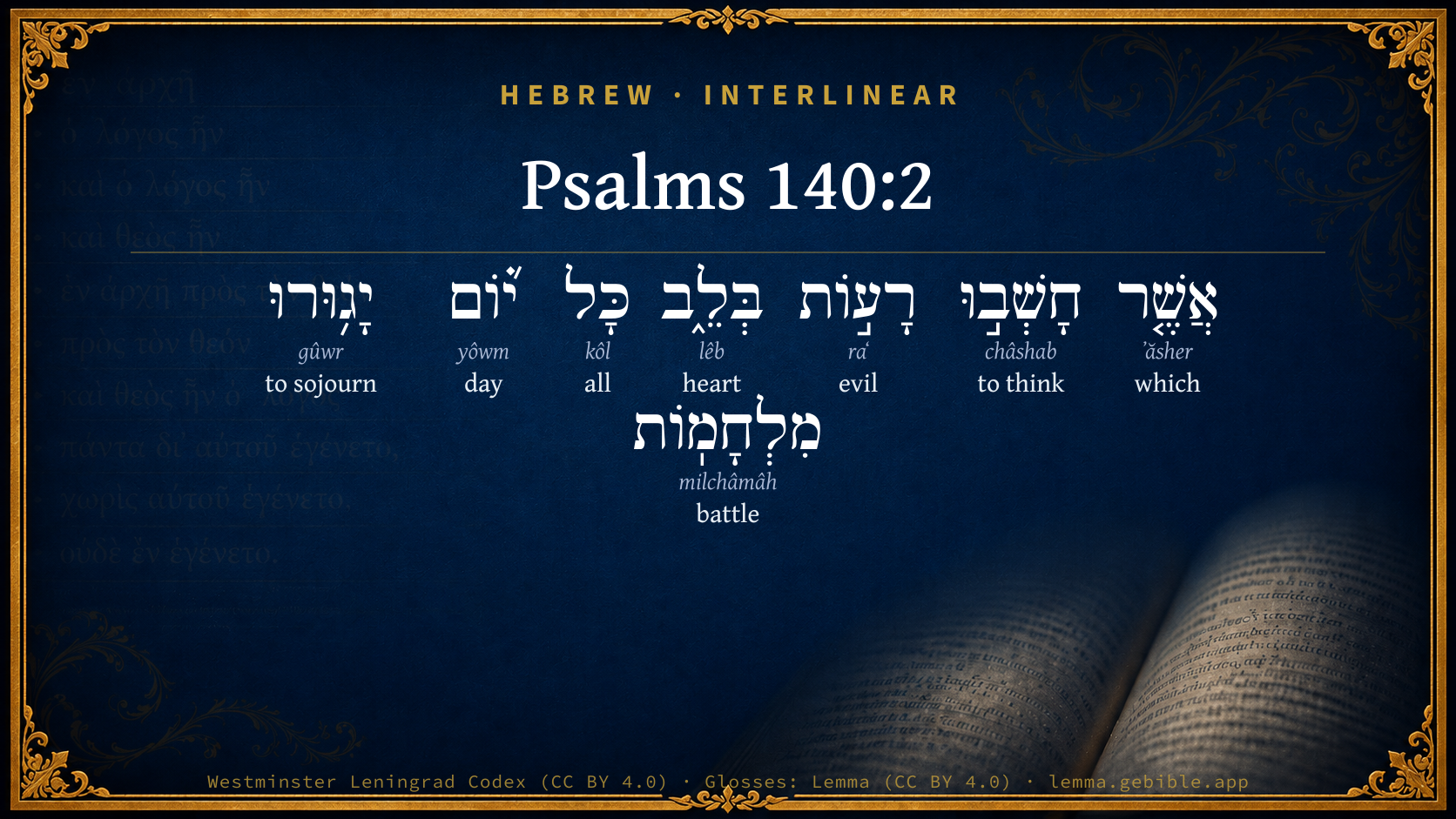
Hebrew (Westminster Leningrad Codex) Psalms 140:2 appears in the Hebrew Old Testament. The text above is from the Westminster Leningrad Codex. Each word links to its Strong’s number, a concise gloss, and parsing drawn from the Open Scriptures Hebrew Bible morphology. Click any word for its full Brown-Driver-Briggs (BDB) entry.
Download image
Cite this verse

Psalms 140:2 (World English Bible). Public Domain. Lemma interlinear Bible study tool, https://lemma.gebible.app/v/psalms/140/2.

Show BibTeX & RIS
BibTeX
RIS
English Translation
Those who devise mischief in their hearts. They continually gather themselves together for war.
World English Bible · Public Domain
Download a study sheet

One document with this verse’s original text, its word-by-word gloss line, the meaning frame, cross-references with their text, attributed commentary, and full source and license credits — printable, and it pastes into notes with its structure intact.

This verse Autodidact and up

Study sheet (.html) Plain text (.txt)

A passage Seminary Student

Up to 50 verses in one chapter. A passage sheet keeps up to 6 commentary sources and 12 cross-references per verse, in the order this page ranks them, and says so on the sheet whenever that leaves anything out. Ask for a single verse and you get the Autodidact verse sheet above.

Everything on this page stays free to read, with no account — the sheet is a download of what is already on screen, not access to it.

Want to remove ads? Support Godless Engineer
Compare translations 3

The same verse in 3 English versions, stacked beneath the original-language interlinear above. Click any original word for its lexicon entry.

Each is an independent rendering of the whole verse — the interlinear is not word-aligned to these translations.

Highlighted words mark where these versions differ — a whole-verse word diff, not a word-by-word alignment.

  • World English Bible Public Domain
    Those who devise mischief in their hearts. They continually gather themselves together for war.
  • King James Version Public Domain
    Which imagine mischiefs in their heart; continually are they gathered together for war.
  • unfoldingWord Literal Text CC BY-SA 4.0
    who plot evil things in the heart; all the day they travel around battles.

unfoldingWord Literal Text — © unfoldingWord, licensed CC BY-SA 4.0. Word-aligned USFM3 via Door43 (git.door43.org/unfoldingWord/en_ult).

Versions to compare (up to 4)

3 of 4 selected

Show all 18 translations

Every available English version of this verse, each an independent rendering of the whole verse.

  • World English Bible Public Domain
    Those who devise mischief in their hearts. They continually gather themselves together for war.
  • Berean Standard Bible Public Domain
    who devise evil in their hearts and stir up war all day long.
  • Majority Standard Bible Public Domain
    who devise evil in their hearts and stir up war all day long.
  • King James Version Public Domain
    Which imagine mischiefs in their heart; continually are they gathered together for war.
  • American Standard Version (1901) Public Domain
    Who devise mischiefs in their heart; Continually do they gather themselves together for war.
  • Revised Version (1885) Public Domain
    Which imagine mischiefs in their heart; continually do they gather themselves together for war.
  • Geneva Bible (1599) Public Domain
    Which imagine euill things in their heart, and make warre continually.
  • Douay-Rheims (1899) Public Domain
    thou hast know my sitting down, and my rising up.
  • Young's Literal Translation Public Domain
    Who have devised evils in the heart, All the day they assemble `for' wars.
  • Literal Standard Version CC BY-SA 4.0
    Who have devised evils in the heart, || All the day they assemble [for] wars.
  • Unlocked Literal Bible CC BY-SA 4.0
    They plan evil in their hearts; they cause battles every day.
  • unfoldingWord Literal Text CC BY-SA 4.0
    who plot evil things in the heart; all the day they travel around battles.
  • Darby Bible Public Domain
    Who devise mischiefs in [their] heart; every day are they banded together for war.
  • World Messianic Bible Public Domain
    those who devise mischief in their hearts. They continually gather themselves together for war.
  • Webster's Bible Public Domain
    \\140:1\\To the chief Musician, A Psalm of David. Deliver me, O LORD, from the evil man: preserve me from the violent man;
  • Free Bible Version CC BY-SA 4.0
    Their minds are busy plotting evil things, stirring up trouble all day long.
  • Bible in Basic English Public Domain
    For their hearts are full of evil designs; and they are ever making ready causes of war.
  • JPS Tanakh (1917) Public Domain
    (140-3) Who devise evil things in their heart; every day do they stir up wars.

Literal Standard Version (2020), Covenant Press — licensed CC BY-SA 4.0. Text via the HelloAO Bible API (eBible.org). Unlocked Literal Bible (unfoldingWord) — licensed CC BY-SA 4.0. Text via the HelloAO Bible API (eBible.org). unfoldingWord Literal Text — © unfoldingWord, licensed CC BY-SA 4.0. Word-aligned USFM3 via Door43 (git.door43.org/unfoldingWord/en_ult). Free Bible Version, Dr. Jonathan Gallagher — licensed CC BY-SA 4.0. Text via the HelloAO Bible API (eBible.org).

Word by word

More ways to search: Search by grammar → Find every occurrence → Compare this word →

Practice this passage: Drill this verse → Learn its vocabulary →

יָג֥וּרוּ
gûwr
H1481
“to sojourn”
Verb, Qal, Imperfect, 3rd Person, Masculine, Plural
Part of Speech
Verb
Stem
Qal
Form
Imperfect
Person
3rd Person
Gender
Masculine
Number
Plural
Full BDB Definition

Origin: a primitive root

TWOT: 330 , 332

to sojourn, abide, dwell in, dwell with, remain, inhabit, be a stranger, be continuing, surely - (Qal) - to sojourn, dwell for a time - to abide, stay, temporarily dwell - (Hithpolel) - to seek hospitality with - to assemble oneself - to stir up trouble, strife, quarrel, gather together - (Qal) - to stir up strife - to quarrel - (Hithpolel) to excite oneself - to dread, fear, stand in awe, be afraid - (Qal) - to fear, be afraid - to be in awe, stand in awe
  1. אֲשֶׁ֤ר ʼăsher H834 “which” Particle, Relative
  2. חָשְׁב֣וּ châshab H2803 “to think” Verb, Qal, Perfect, 3rd Person, Common, Plural
  3. רָע֣וֹת raʻ H7451 “evils” Noun, Common, Feminine, Plural, Absolute
  4. בְּלֵ֑ב lêb H3820 “in/at · heart” Preposition + Noun, Common, Masculine, Singular, Absolute
  5. כָּל kôl H3605 “all of” Noun, Common, Masculine, Singular, Construct
  6. י֝֗וֹם yôwm H3117 “day” Noun, Common, Masculine, Singular, Absolute
  7. מִלְחָמֽוֹת milchâmâh H4421 “battles” Noun, Common, Feminine, Plural, Absolute

About this verse

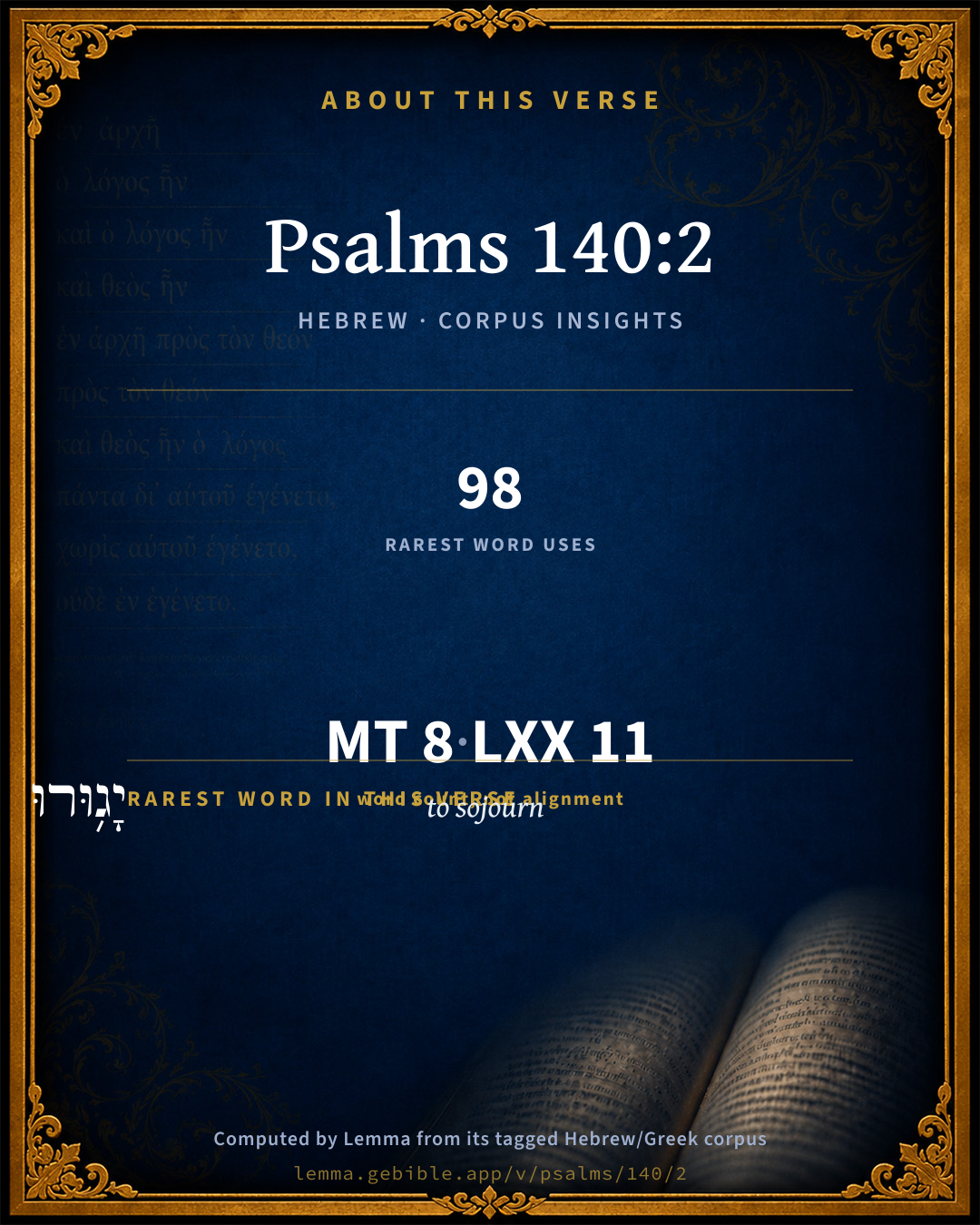
These counts appear in no published source. They are computed here, from the morphology-tagged text and Lemma’s own curated glosses. What Lemma adds →

8
words
8
distinct lemmas
Wisdom
section

Grammatical profile

  • 2 verbs
  • 5 nouns
  • 1 particle

Verb forms

  • חָשְׁב֣וּ Qal · Perfect
  • יָג֥וּרוּ Qal · Imperfect

Hebrew & Septuagint length

In English translation the verse runs 14 words from the Hebrew and 13 from the Septuagint (LXX English) — closely comparable.

A rough comparison of the two English renderings, which tokenize alike — not a word-level alignment.

Word counts can differ between the Hebrew and the Greek without any difference in meaning — e.g. the Hebrew direct-object marker אֵת has no separate Greek word, and Greek often adds the article ὁ.

In the original languages it is 8 Hebrew tokens and 11 Greek tokens — but the two are counted differently (Hebrew bundles its prefixes and suffixes into one token; the Greek is in lemma form), so that isn’t a like-for-like length.

Cross-references

15

Topical passages linked to Psalms 140:2 in the Treasury of Scripture Knowledge — connected by theme and wording, ordered by reader-vote popularity; previews shown in the World English Bible.

  • Psalms 36:4 He plots iniquity on his bed. He sets himself in a way that is not good; He doesn't abhor evil.
  • Psalms 56:6 They conspire and lurk, Watching my steps, they are eager to take my life.
  • Psalms 64:5–6 They encourage themselves in evil plans. They talk about laying snares secretly. They say, "Who will see them?"
  • Psalms 120:7 I am for peace, But when I speak, they are for war.
  • Proverbs 12:20 Deceit is in the heart of those who plot evil, But joy comes to the promoters of peace.
  • Hosea 7:6 For they have made ready their heart like an oven, While they lie in wait. Their baker sleeps all the night. In the morning it burns as a flaming fire.
  • Micah 2:1–3 Woe to those who devise iniquity And work evil on their beds! When the morning is light, they practice it, Because it is in the power of their hand.
  • Nahum 1:11 There is one gone forth out of you, who devises evil against Yahweh, who counsels wickedness.
  • 1 Samuel 23:19–24 Then came up the Ziphites to Saul to Gibeah, saying, Doesn't David hide himself with us in the strongholds in the wood, in the hill of Hachilah, which is on the south of the desert?
  • 1 Samuel 24:11–12 Moreover, my father, behold, yes, see the skirt of your robe in my hand; for in that I cut off the skirt of your robe, and didn't kill you, know you and see that there is neither evil nor disobedience in my hand, and I have not sinned against you, though you hunt after my life to take it.
  • 1 Samuel 26:1–25 The Ziphites came to Saul to Gibeah, saying, Doesn't David hide himself in the hill of Hachilah, which is before the desert?
  • Psalms 2:1–2 Why do the nations rage, And the peoples plot a vain thing?
  • Psalms 21:11 For they intended evil against you. They plotted evil against you which cannot succeed.
  • Psalms 38:12 They also who seek after my life lay snares. Those who seek my hurt speak mischievous things, And meditate deceits all day long.
  • Psalms 62:3 How long will you assault a man, Would all of you throw him down, Like a leaning wall, like a tottering fence?

Cross-references courtesy of OpenBible.info (CC BY 4.0).

Hebrew and Greek witnesses Masoretic Hebrew ↔ Greek Septuagint

The same verse in the two great witnesses to the Old Testament, shown verse-for-verse.

You’re reading Greek Psalm 139 (Hebrew Psalm 140). The Septuagint counts the superscription, so verse numbers can differ from the Hebrew — chapter-level alignment, not verse-by-verse. Numbering follows Rahlfs.

These are two independent witnesses, not word-aligned to each other, and the Septuagint is shown in lemma (dictionary) form.

Hebrew Psalms 140:2 Masoretic · Westminster Leningrad Codex

אֲשֶׁ֤ר חָשְׁב֣וּ רָע֣וֹת בְּלֵ֑ב כָּל י֝֗וֹם יָג֥וּרוּ מִלְחָמֽוֹת

Those who devise mischief in their hearts. They continually gather themselves together for war.

World English Bible · Public Domain

Greek LXX Greek Psalm 139:2 Septuagint · lemma form

ἐκαἱρέω ἐγώ κύριος ἐκ ἄνθρωπος πονηρός ἀπό ἀνήρ ἄδικος ῥύομαι ἐγώ

Who have devised injustice in their hearts; all the day they prepared war.

LXX2012 (modern English Septuagint) · Public Domain

On this verse, Whedon's Commentary on the Bible discusses the Septuagint’s reading. Read the note in Commentary ↓

Hebrew: Westminster Leningrad Codex (CC BY 4.0). Greek: Septuagint (public domain); English from LXX2012 (modern English Septuagint) (Public Domain). How the Septuagint differs from the Hebrew →

Commentary

Notes on Psalms 140:2 from classic Christian and Jewish commentators (each source and its license shown beneath its notes). The classic Christian expositions comment on the surrounding passage and are grouped to its opening verse, so a note may address several verses; the Jewish commentaries on the Tanakh (Rashi and others) are per-verse, so they appear only where the commentator wrote on this verse.

Lemma curates 59 commentaries, every one of them public domain or Creative Commons licensed, each selected and text-cleaned for this edition rather than reprinted as found. About our sources →

Trapp's Complete Commentary

John Trapp

Psa 140:2 Which imagine mischiefs in [their] heart; continually are they gathered together [for] war.

Ver. 2. Which imagine mischief in their heart] Where the devil worketh night and day as a mintman; as a smith in his forge; or an artificer in his shop. A godly man is said to have right thoughts, Pro 12:5, and that his desires are only good, Pro 11:23. An evil man is called a man of wicked devices, Pro 12:2; Pro 14:17, being ingeniose nequam, wittily wicked, as it was once said of Gaius Curio, the Roman lawyer.

They are gathered together for war] Heb. they gather wars, as serpents gather poison to vomit out at others. Coacervant praelia, q.d. sunt tanquam tubae belli.

John Trapp, A Commentary or Exposition upon All the Books of the Old and New Testament (1647–1656) — public domain. Text from a community e-Sword module.

J. A. Alexander on Psalms

Joseph Addison Alexander

3. (Psa 140:2) Who imagine evils in (their) hearts; all the day they gather (for) battles. That the preceding verse, notwithstanding the reference to Saul, is the description of a whole class, is clear from the plural forms in this verse. Think, meditate, devise, imagine. Evils, particularly such as are inflicted on others, well expressed in the common versions, mischiefs. Another construction of the last clause, preferred by some interpreters, is, all the day they dwell with wars (or in wars), i.e. are constantly involved in them and busied with them. This use of the verb is justified by Psa 5:4; Psa 105:23; Psa 125:5. But the analogy of Psa 56:6; Psa 59:3,is decisive in favour of the other explanation. Compare Psa 31:13; Psa 35:15, Isa 54:15.

Joseph Addison Alexander, The Psalms Translated and Explained (1850) — public domain. Text from a community e-Sword module.

Geneva Bible (1599)

Geneva Bible translators

That is, by their false cavillations and lies they kindle the hatred of the wicked against me.

Geneva Bible (1599) marginal notes — public domain. Text via Bolls.life.

Adam Clarke's Commentary

Verse 2. They gathered together] He and his courtiers form plots and cabals against my life.

Adam Clarke's Commentary on the Bible (1810–1826) — public domain. Text from a community e-Sword/MySword module.

John Calvin's Commentaries

2. Who imagine mischief’s in their heart. Here he charges them with inward malignity of heart. And it is plain that the reference is not to one man merely, for he passes to the plural number (in a manner sufficiently common,) reverting from the head to all his associates and copartners in guilt. Indeed what was formerly said in the singular number may be taken indefinitely, as grammarians say. In general he repeats what I have noticed already, that the hostility to which he was subjected arose from no cause of his. From this we learn that the more wickedly our enemies assail us, and the more of treachery and clandestine acts they manifest, the nearer is the promised aid of the Holy Spirit, who himself dictated this form of prayer by the mouth of David. The second clause may be rendered in three ways. Literally it reads, who gather wars, and so some understand it. But it, is well known that the prepositions are often omitted in the Hebrew, and no doubt he means that they stirred up general enmity by their false information’s being as the trumpet which sounds to battle. Some render the verb — to conspire, or plot together, but this is a farfetched and meager sense. He intimates afterwards in what manner they stirred up unjust war by the wicked calumnies which they spread, as they could not crush a good and innocent person by violence, otherwise than by first overwhelming him with calumny.

John Calvin's Commentaries (1540-1563) — public domain. Text from the Calvin Translation Society English edition (1840s-50s) via the Christian Classics Ethereal Library (ccel.org). Calvin's coverage is partial (roughly two-thirds of the Bible); uncommented books and verses are honest gaps, never fabricated. The 19th-century editor's footnotes and remarks are omitted so the notes are faithfully Calvin's own voice.

Ellicott's Commentary for English Readers

(2) Imagine . . .—Or, contrive, plot.

Gathered together.—This translation follows the analogy of Psa_56:6. Others render, “dwell with wars.” But it is preferable to derive from a root meaning to incite: “They are continually stirring up wars.” It is the situation described in Psa_120:7 and frequently; Israel would be at peace, but within and without are those ever trying to involve her in troubles.

A Bible Commentary for English Readers, edited by Charles John Ellicott (1878–1897) — public domain. Text from a community e-Sword module.

The Cambridge Bible for Schools and Colleges

gen. ed. J. J. S. Perowne

2. Who have devised evils in their heart] Secretly and deliberately.

continually &c.] Every day do they stir up strife: lit. wars. They are perpetually trying to pick a quarrel with me.

The Cambridge Bible for Schools and Colleges (gen. ed. J. J. S. Perowne; Cambridge University Press, 1878–1918) — public domain. Text from a community e-Sword module.

John Gill's Exposition

Which imagine mischiefs in their heart,.... This shows that not a single person barely is meant but more, as Saul's courtiers; who were secretly and continually meditating mischief against David, traducing him to Saul, and devising things to take away his life. Such were the Jews to Christ, who were always plotting to entangle him, or contriving to kill him; and so wicked men are ever devising mischief against the quiet in the land, which is very abominable to God; and rightly observed here, to prevail upon the Lord to preserve from them, Psa 2:1;

continually are they gathered together for war; so Saul gathered together three thousand men, and went in pursuit of David, as an enemy, to take him. So Herod and Pontius Pilate joined together, though before enemies, in the prosecution of Christ; and Jews and Gentiles gathered together against him: so the saints, being in a warfare state, have their enemies, who often combine against them, and attack them, and will not suffer them to be at rest and peace; as sin, Satan, the world, and false teachers; see Psa 120:7.

John Gill's Exposition of the Whole Bible (1746–1763) — public domain (CC PDM 1.0). Text via the HelloAO Bible API.

Albert Barnes' Notes on the Bible

Which imagine mischiefs in their heart - Here the language is changed to the plural number in the Hebrew, implying that while there was one man who was eminent in his wickedness and his wrong-doing, there were many others associated with him, acting under his direction. The word “mischiefs” in the Hebrew means “evils; wickednesses.” It was not a single purpose; the plan embraced many forms of evil - doing him wrong in every way possible.

Continually are they gathered together for war - They are organized for this purpose; they are constantly prepared for it. The word rendered “gathered together” properly means to sojourn, to dwell for a time; and it has been proposed by some to render this, “All the day they dwell with wars;” that is, they are constantly involved in them. But the word may mean also “to gather together,” as in Psa 56:6.

Albert Barnes' Notes on the Bible (1834–1885) — public domain. Text from a community e-Sword/MySword module.

Matthew Poole's English Annotations

To execute those bloody enterprises which they had devised in the first clause of this verse.

Matthew Poole's English Annotations on the Holy Bible (1683–1685) — public domain. Text from a community e-Sword/MySword module.

The Treasury of David

Charles H. Spurgeon

Ver. 2. Which imagine mischiefs in their heart. They cannot be happy unless they are plotting and planning, conspiring and contriving. They seem to have but one heart, for they are completely agreed in their malice; and with all their heart and soul they pursue their victim. One piece of mischief is not enough for them; they work in the plural, and prepare many arrows for their bow. What they cannot actually do they nevertheless like to think over, and to rehearse on the stage of their cruel fancy. It is an awful thing to have such a heart disease as this. When the imagination gloats over doing harm to others, it is a sure sign that the entire nature is far gone in wickedness. Continually are they gathered together for war. They are a committee of opposition in permanent session: they never adjourn, but perpetually consider the all absorbing question of how to do the most harm to the man of God. They are a standing army always ready for the fray: they not only go to the wars, but dwell in them. Though they are the worst of company, yet they put up with one another, and are continually in each other's society, confederate for fight. David's enemies were as violent as they were evil, as crafty as they were violent, and as persistent as they were crafty. It is hard dealing with persons who are only in their element when they are at daggers drawn with you. Such a case calls for prayer, and prayer calls on God.

Ver. 2. Continually are they gathered together for war. Literally, this clause reads, who gather wars, and so some understand it. But it is well known that the prepositions are often omitted in the Hebrew, and no doubt he means that they stirred up general enmity by their false information which acted as a trumpet sounding to battle. John Calvin.

Ver. 2-3. The wicked assault the righteous with three weapons: with the heart, by conspiracy; with the tongue, by lying; and with the hand, by violence. John Lorinus, 1569-1634.

Psalms 140:3*

Charles H. Spurgeon's The Treasury of David (1869–1885) — public domain. Psalms only. Text from a community e-Sword/MySword module.

Whedon's Commentary on the Bible

Daniel D. Whedon

2. Mischiefs in their heart—Here is the seat and fountain of all deeds of wrong and violence. Mat_15:18-19. Satan’s workshop and council chamber are in the hearts “of the children of disobedience.” Eph_2:2.

Continually are they gathered together for war—Literally, Every day they gather war, or, All the day they are assembled to excite war. The latter is the probable sense, judging from the use of the word gather, in Psa_56:6; Psa_59:4; Isa_54:15. This also forms a fit parallel to their devising “mischiefs in their heart,” in the previous member. The Septuagint reads, “All the day they prepared war.” The version of the “Common Prayer Book” reads, “They stir up strife all the day long.”

Daniel D. Whedon (gen. ed.), Commentary on the Old and New Testaments (1874–1909) — public domain. Text from a community e-Sword module.

The Pulpit Commentary

Which imagine mischiefs in their heart. (comp. Psa_28:3 Psa_36:4 Psa_62:3) Continually are they gathered together for war; rather, continually do they stir up wars. (comp. Psa_68:30 Psa_120:7)

HOMILIES BY R. TUCK Ver. 2. The mischiefs of evil-disposed men.

"Mischiefs" is a very suggestive and comprehensive term. It is frequently used in the Psalms in the singular form, and always suggests scheming, underhanded plotting, to do some evil. In the plural form there are only two passages in the Scriptures, besides our text, in which the word is employed: Deu_32:23, "I will heap mischiefs upon them; I will spend mine arrows upon them;" Psa_52:2, "Thy tongue deviseth mischiefs; like a sharp razor, working deceitfully.

I REGARD MISCHIEFS AS MALICIOUS INTENTION. "The wicked plotteth against the just, and gnasheth upon him with his teeth;" "How long will ye imagine mischief against a man?" It is the characteristic of the evil-hearted, evil-disposed man, that he "deviseth mischiefs upon his bed." It is his pleasure to plan an injury; he delights in making misery, and ruining reputations. Any man may do a mischief on impulse or by accident. The evil man cherishes malicious intentions.

II REGARD MISCHIEFS AS INJURIOUS SPEECH. "They have sharpened their tongue like a serpent." There is speech that cuts and wounds by its bitterness; that injures by its untruthfulness; that destroys reputations by its slanderings. There is no surer sign of the evil heart than the evident pleasure felt in saying mischievous things.

III REGARD MISCHIEFS AS VIOLENT ACTS. (Vers. 4, 5) It is the peculiarity of evil-disposed men that cherished evil thoughts inspire evil deeds. The good man checks unkind and evil thoughts, lest they should get expression in acts. But the evil man nourishes them, enjoys them, puts himself into their power, and is by them urged on to violent and injurious deeds. Cherish malicious thought, and you put yourself into its power; and it may lead you on to shameful deeds. But the mischiefs of evil men never transcend the Divine limitations. God has his hand on them, and we may be absolutely assured that he says," Hitherto shalt thou come, and no farther; here shall thy proud waves be stayed." And we may even see deeper into the heart of Divine dealing, and say that the mischiefs of evil men become ministries of the Divine purpose of grace concerning God"s people. R.T.

The Pulpit Commentary (1880–1919), ed. H.D.M. Spence-Jones & Joseph S. Exell — public domain. Text from a community e-Sword module.

Lesson kit

Teaching starters — assembled from the data on this page, not authored interpretation. Every prompt links to the verse data it draws on. Edit before teaching.

Psalms, in the Wisdom, opens this verse with 8 words (8 distinct Hebrew lemmas). Its most distinctive word is gûwr (“to sojourn”). A historical commentator’s framing appears above. Read the whole chapter for the surrounding context.

Discussion questions

  1. The word gûwr carries the sense “to sojourn.” How does it shape the verse?
  2. How does Psalms 36:4, which shares this passage’s theme, read alongside this verse?
  3. These translations render this verse differently. What is at stake in choosing one wording over another?
  4. «חָשְׁב֣וּ» is a Qal Perfect verb. How does that grammatical form shape the action described?
  5. Compare how Trapp's Complete Commentary and J. A. Alexander on Psalms read this verse. Where do they agree or differ?

Things to notice

Reading settings

Reading text

Shown beneath each verse's original-language words.

Old Testament
Old Testament edition

Read the OT as the Masoretic Hebrew (MT) or the Greek Septuagint (LXX).

English shown for the Greek Septuagint (in the Hebrew ↔ Greek comparison).

Comparing translations? Open the Compare panel on any verse page to stack up to four side by side.