Jeremiah 42:22

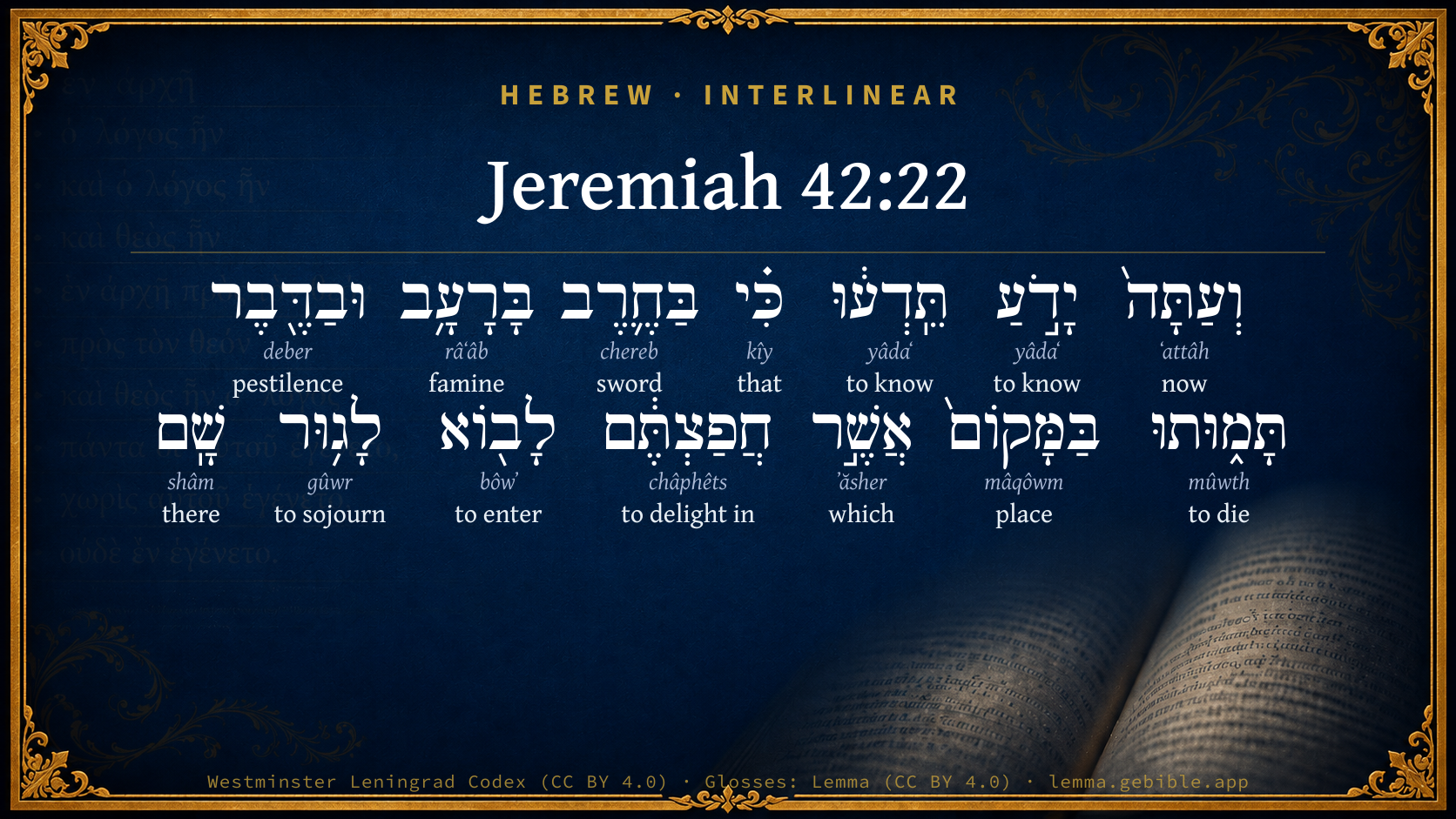
Hebrew (Westminster Leningrad Codex) Jeremiah 42:22 appears in the Hebrew Old Testament. The text above is from the Westminster Leningrad Codex. Each word links to its Strong’s number, a concise gloss, and parsing drawn from the Open Scriptures Hebrew Bible morphology. Click any word for its full Brown-Driver-Briggs (BDB) entry.
Download image
Cite this verse

Jeremiah 42:22 (World English Bible). Public Domain. Lemma interlinear Bible study tool, https://lemma.gebible.app/v/jeremiah/42/22.

Show BibTeX & RIS
BibTeX
RIS
English Translation
Now therefore know certainly that you shall die by the sword, by the famine, and by the pestilence, in the place where you desire to go to sojourn there.
World English Bible · Public Domain
Download a study sheet

One document with this verse’s original text, its word-by-word gloss line, the meaning frame, cross-references with their text, attributed commentary, and full source and license credits — printable, and it pastes into notes with its structure intact.

This verse Autodidact and up

Study sheet (.html) Plain text (.txt)

A passage Seminary Student

Up to 50 verses in one chapter. A passage sheet keeps up to 6 commentary sources and 12 cross-references per verse, in the order this page ranks them, and says so on the sheet whenever that leaves anything out. Ask for a single verse and you get the Autodidact verse sheet above.

Everything on this page stays free to read, with no account — the sheet is a download of what is already on screen, not access to it.

Want to remove ads? Support Godless Engineer
Compare translations 3

The same verse in 3 English versions, stacked beneath the original-language interlinear above. Click any original word for its lexicon entry.

Each is an independent rendering of the whole verse — the interlinear is not word-aligned to these translations.

Highlighted words mark where these versions differ — a whole-verse word diff, not a word-by-word alignment.

  • World English Bible Public Domain
    Now therefore know certainly that you shall die by the sword, by the famine, and by the pestilence, in the place where you desire to go to sojourn there.
  • King James Version Public Domain
    Now therefore know certainly that ye shall die by the sword, by the famine, and by the pestilence, in the place whither ye desire to go and to sojourn.
  • unfoldingWord Literal Text CC BY-SA 4.0
    So now, you should certainly know that you will die by sword, famine, and plague in the place where you desired to go to live.”

unfoldingWord Literal Text — © unfoldingWord, licensed CC BY-SA 4.0. Word-aligned USFM3 via Door43 (git.door43.org/unfoldingWord/en_ult).

Versions to compare (up to 4)

3 of 4 selected

Show all 18 translations

Every available English version of this verse, each an independent rendering of the whole verse.

  • World English Bible Public Domain
    Now therefore know certainly that you shall die by the sword, by the famine, and by the pestilence, in the place where you desire to go to sojourn there.
  • Berean Standard Bible Public Domain
    Now therefore, know for sure that by sword and famine and plague you will die in the place where you desire to go to reside.”
  • Majority Standard Bible Public Domain
    Now therefore, know for sure that by sword and famine and plague you will die in the place where you desire to go to reside.”
  • King James Version Public Domain
    Now therefore know certainly that ye shall die by the sword, by the famine, and by the pestilence, in the place whither ye desire to go and to sojourn.
  • American Standard Version (1901) Public Domain
    Now therefore know certainly that ye shall die by the sword, by the famine, and by the pestilence, in the place whither ye desire to go to sojourn there.
  • Revised Version (1885) Public Domain
    Now therefore know certainly that ye shall die by the sword, by the famine, and by the pestilence, in the place whither ye desire to go to sojourn there.
  • Geneva Bible (1599) Public Domain
    Nowe therefore, knowe certeinely that ye shall die by the sworde, by the famine, and by the pestilence, in the place whither ye desire to goe and dwell.
  • Douay-Rheims (1899) Public Domain
    Now therefore know certainly that you shall die by the sword, and by famine, and by pestilence in the place to which you desire to go to dwell there.
  • Young's Literal Translation Public Domain
    And now, know ye certainly that by sword, by famine, and by pestilence ye die, in the place that ye have desired to go in to sojourn there.'
  • Literal Standard Version CC BY-SA 4.0
    And now, certainly know that by sword, by famine, and by pestilence you die, in the place that you have desired to go to sojourn there.”
  • Unlocked Literal Bible CC BY-SA 4.0
    So now, you should certainly know that you will die by sword, famine, and plague in the place where you desired to go to live.”
  • unfoldingWord Literal Text CC BY-SA 4.0
    So now, you should certainly know that you will die by sword, famine, and plague in the place where you desired to go to live.”
  • Darby Bible Public Domain
    And now know certainly that ye shall die by the sword, by the famine, and by the pestilence, in the place whither ye desire to go to sojourn.
  • World Messianic Bible Public Domain
    Now therefore know certainly that you will die by the sword, by the famine, and by the pestilence in the place where you desire to go to live.”
  • Webster's Bible Public Domain
    Now therefore know certainly that ye shall die by the sword, by the famine, and by the pestilence, in the place whither ye desire to go and to sojourn.
  • Free Bible Version CC BY-SA 4.0
    So you should know that without question you're going to die by war and famine and disease in Egypt where you want to go and live.”
  • Bible in Basic English Public Domain
    And now be certain that you will come to your end by the sword and by being short of food and by disease, in the place to which you are pleased to go for a living-place.
  • JPS Tanakh (1917) Public Domain
    Now therefore know certainly that ye shall die by the sword, by the famine, and by the pestilence, in the place whither ye desire to go to sojourn there.'

Literal Standard Version (2020), Covenant Press — licensed CC BY-SA 4.0. Text via the HelloAO Bible API (eBible.org). Unlocked Literal Bible (unfoldingWord) — licensed CC BY-SA 4.0. Text via the HelloAO Bible API (eBible.org). unfoldingWord Literal Text — © unfoldingWord, licensed CC BY-SA 4.0. Word-aligned USFM3 via Door43 (git.door43.org/unfoldingWord/en_ult). Free Bible Version, Dr. Jonathan Gallagher — licensed CC BY-SA 4.0. Text via the HelloAO Bible API (eBible.org).

Word by word

More ways to search: Search by grammar → Find every occurrence → Compare this word →

Practice this passage: Drill this verse → Learn its vocabulary →

וּבַדֶּ֖בֶר
deber
H1698
“and · in/at the · pestilence”
Conjunction + Preposition, Determined + Noun, Common, Masculine, Singular, Absolute
Part of Speech
Conjunction + Preposition + Noun
Type
Common
Gender
Masculine
Number
Singular
State
Absolute
Full BDB Definition

Origin: from H1696 (in the sense of destroying)

TWOT: 399b

pestilence, plague - murrain, cattle disease, cattle-plague
  1. וְעַתָּה֙ ʻattâh H6258 “and · now” Conjunction + Adverb
  2. יָדֹ֣עַ yâdaʻ H3045 “to know” Verb, Qal, Infinitive Absolute
  3. תֵּֽדְע֔וּ yâdaʻ H3045 “to know” Verb, Qal, Imperfect, 2nd Person, Masculine, Plural
  4. כִּ֗י kîy H3588 “that” Conjunction
  5. בַּחֶ֛רֶב chereb H2719 “in/at the · sword” Preposition, Determined + Noun, Common, Feminine, Singular, Absolute
  6. בָּרָעָ֥ב râʻâb H7458 “in/at the · famine” Preposition, Determined + Noun, Common, Masculine, Singular, Absolute
  7. תָּמ֑וּתוּ mûwth H4191 “to die” Verb, Qal, Imperfect, 2nd Person, Masculine, Plural
  8. בַּמָּקוֹם֙ mâqôwm H4725 “in/at the · place” Preposition, Determined + Noun, Common, Masculine, Singular, Absolute
  9. אֲשֶׁ֣ר ʼăsher H834 “which” Particle, Relative
  10. חֲפַצְתֶּ֔ם châphêts H2654 “to delight in” Verb, Qal, Perfect, 2nd Person, Masculine, Plural
  11. לָב֖וֹא bôwʼ H935 “to enter” Preposition + Verb, Qal, Infinitive Construct
  12. לָג֥וּר gûwr H1481 “to sojourn” Preposition + Verb, Qal, Infinitive Construct
  13. שָֽׁם shâm H8033 “there” Adverb

About this verse

These counts appear in no published source. They are computed here, from the morphology-tagged text and Lemma’s own curated glosses. What Lemma adds →

14
words
13
distinct lemmas
Prophets
section

Shared distinctive vocabulary

וּבַדֶּ֖בֶר pestilence H1698 occurs in 48 verses of the Hebrew Bible. Also found in:

Grammatical profile

  • 6 verbs
  • 4 nouns
  • 1 conjunction
  • 2 adverbs
  • 1 particle

Verb forms

  • יָדֹ֣עַ Qal · Infinitive Absolute
  • תֵּֽדְע֔וּ Qal · Imperfect
  • תָּמ֑וּתוּ Qal · Imperfect
  • חֲפַצְתֶּ֔ם Qal · Perfect
  • לָב֖וֹא Qal · Infinitive Construct
  • לָג֥וּר Qal · Infinitive Construct

Repetition

A word recurs within this verse — often emphatic in Hebrew:

  • יָדֹ֣עַ to know H3045 ×2

Cross-references

5

Topical passages linked to Jeremiah 42:22 in the Treasury of Scripture Knowledge — connected by theme and wording, ordered by reader-vote popularity; previews shown in the World English Bible.

  • Jeremiah 42:17 So shall it be with all the men who set their faces to go into Egypt to sojourn there: they shall die by the sword, by the famine, and by the pestilence; and none of them shall remain or escape from the evil that I will bring on them.
  • Ezekiel 6:11 Thus says the Lord Yahweh: Smite with your hand, and stamp with your foot, and say, Alas! because of all the evil abominations of the house of Israel; for they shall fall by the sword, by the famine, and by the pestilence.
  • Hosea 9:6 For, behold, they have gone away from destruction. Egypt will gather them up. Memphis will bury them. Nettles will possess their pleasant things of silver. Thorns will be in their tents.
  • Jeremiah 43:11 He shall come, and shall strike the land of Egypt; such as are for death [shall be given] to death, and such as are for captivity to captivity, and such as are for the sword to the sword.
  • Ezekiel 5:3–4 You shall take of it a few in number, and bind them in your skirts.

Cross-references courtesy of OpenBible.info (CC BY 4.0).

Hebrew and Greek witnesses Masoretic Hebrew ↔ Greek Septuagint

The same verse in the two great witnesses to the Old Testament, shown verse-for-verse.

These are two independent witnesses, not word-aligned to each other, and the Septuagint is shown in lemma (dictionary) form.

Hebrew Jeremiah 42:22 Masoretic · Westminster Leningrad Codex

וְעַתָּה֙ יָדֹ֣עַ תֵּֽדְע֔וּ כִּ֗י בַּחֶ֛רֶב בָּרָעָ֥ב וּבַדֶּ֖בֶר תָּמ֑וּתוּ בַּמָּקוֹם֙ אֲשֶׁ֣ר חֲפַצְתֶּ֔ם לָב֖וֹא לָג֥וּר שָֽׁם

Now therefore know certainly that you shall die by the sword, by the famine, and by the pestilence, in the place where you desire to go to sojourn there.

World English Bible · Public Domain

Greek LXX Structure differs

In the Septuagint, Jeremiah is about an eighth shorter than the Hebrew and arranges its material differently — the Oracles Against the Nations (Hebrew chapters 46–51) appear in the middle of the Greek book, after 25:13. Because the chapter and verse boundaries do not line up, a verse-for-verse comparison with the Hebrew is not shown.

A verse-for-verse comparison isn’t shown here because the chapters and verses don’t line up. Switch to the LXX edition with the MT / LXX toggle above to read the Greek directly.

Hebrew: Westminster Leningrad Codex (CC BY 4.0). Greek: Septuagint (public domain); English from a public-domain English Septuagint. How the Septuagint differs from the Hebrew →

Targum (Aramaic paraphrase)

1

The Targum is the ancient Jewish Aramaic paraphrase of the Hebrew Scriptures — an interpretive translation, not the Hebrew text itself. Onkelos (literal) and Pseudo-Jonathan (expansive) render the Torah, and Jonathan the Prophets. Coverage is partial: where no permissively-licensed English translation exists for a verse, only the Aramaic is shown. This is verse-level text, not a word-by-word alignment to the Hebrew.

  1. Targum Jonathan Prophets (Joshua–Malachi)
    וּכְעַן מִידַע תֵּדְעוּן אֲרֵי בְּחַרְבָּא בְּכַפְנָא וּבְמוֹתָא תְּמוּתוּן בְּאַתְרָא דְאִתְרְעֵיתוּן לְמֵיעַל לְאִתּוֹתָבָא תַמָן:

    (no public-domain English translation for this verse)

    Targum Jonathan — Aramaic: “Mikraot Gedolot” (public domain). English: “Sefaria Community Translation” (CC0 1.0 (public-domain dedication)); “London "Chaldee Paraphrase," 1871” (public domain). Text via Sefaria.

Commentary

Notes on Jeremiah 42:22 from classic Christian and Jewish commentators (each source and its license shown beneath its notes). The classic Christian expositions comment on the surrounding passage and are grouped to its opening verse, so a note may address several verses; the Jewish commentaries on the Tanakh (Rashi and others) are per-verse, so they appear only where the commentator wrote on this verse.

Lemma curates 59 commentaries, every one of them public domain or Creative Commons licensed, each selected and text-cleaned for this edition rather than reprinted as found. About our sources →

Trapp's Complete Commentary

John Trapp

Jer 42:22 Now therefore know certainly that ye shall die by the sword, by the famine, and by the pestilence, in the place whither ye desire to go [and] to sojourn.

Ver. 22. Now, therefore, know certainly that ye shall die.] In running from death ye shall but run to it, as Jonah did.

“ Quo fugis, Encelade? quaseunque accesseris orss,

Sub Iove semper eris. ”

John Trapp, A Commentary or Exposition upon All the Books of the Old and New Testament (1647–1656) — public domain. Text from a community e-Sword module.

Geneva Bible (1599)

Geneva Bible translators

To wit, in Egypt.

Geneva Bible (1599) marginal notes — public domain. Text via Bolls.life.

Jamieson, Fausset & Brown

Robert Jamieson, A. R. Fausset & David Brown

sojourn--for a time, until they could return to their country. They expected, therefore, to be restored, in spite of God's prediction to the contrary.

Next: Jeremiah Chapter 43

Jamieson, Fausset & Brown — Commentary Critical and Explanatory on the Whole Bible (1871) — public domain (CC PDM 1.0). Text via the HelloAO Bible API.

Adam Clarke's Commentary

Verse 22. Now therefore know certainly] As ye have determined to disobey, God has determined to punish. Ye may now follow the full bent of your wicked devices, and I will follow the requisitions of my justice. Ye shall die by the sword, by the pestilence, and by the famine, in the place whither ye desire to go to sojourn. Thus was their doom sealed.

With such dispositions and with such rebellion of heart, it is strange that they should put themselves to any trouble to inquire of the Lord relative to their future operations. They did not intend to obey; but as a matter of curiosity they would inquire to hear what the prophet might say; and if according to their own inclination, they would obey.

Adam Clarke's Commentary on the Bible (1810–1826) — public domain. Text from a community e-Sword/MySword module.

John Calvin's Commentaries

The Prophet at length concludes his discourse, after having mentioned the reasons why God would deal so severely with them, even because their perfidy, impiety, ingratitude, and obstinate contempt were unsufferable. After having then shewn that they had no reason to expostulate as though God were extremely rigid, he at length declares what end awaited them, even that they should die by the sword, famine, or pestilence, that is, that there would be no hope of safety to them, because if they escaped from the sword, they should be beset with famine, and if they evaded the famine, they should be destroyed by pestilence. It is a common mode of speaking with the Prophets, as it is well known, that when they intimate that the ungodly in vain hope for impunity, they represent God as having at his command all kinds of punishment.

Ye shall then, he says, die in that place which ye seek for your sojourn, he again shews the object of the people, for they did not intend to dwell perpetually in Egypt, but only for a time, until there was liberty to return to their own country. In short, they wished to be restored, as it were, against God’s will; and yet they ceased not falsely to put forward the name of God, as hypocrites, who mock God, always do. Now follows, —

John Calvin's Commentaries (1540-1563) — public domain. Text from the Calvin Translation Society English edition (1840s-50s) via the Christian Classics Ethereal Library (ccel.org). Calvin's coverage is partial (roughly two-thirds of the Bible); uncommented books and verses are honest gaps, never fabricated. The 19th-century editor's footnotes and remarks are omitted so the notes are faithfully Calvin's own voice.

Matthew Poole's English Annotations

The prophet ascertaineth that doom unto them which, Jer 42:15-17, he had threatened them with, in case they were resolved to go into Egypt. We must expect nothing but utmost disappointments upon actions done in disobedience to the revealed will of God: you think to avoid death by going thither for a little time to sojourn, but you shall die there, and that by those very deaths which by going thither you seek to avoid,

Matthew Poole's English Annotations on the Holy Bible (1683–1685) — public domain. Text from a community e-Sword/MySword module.

Lesson kit

Teaching starters — assembled from the data on this page, not authored interpretation. Every prompt links to the verse data it draws on. Edit before teaching.

Jeremiah, in the Prophets, opens this verse with 14 words (13 distinct Hebrew lemmas). Its most distinctive word is deber (“pestilence”). A historical commentator’s framing appears above. Read the whole chapter for the surrounding context.

Discussion questions

  1. The word deber carries the sense “pestilence.” How does it shape the verse?
  2. How does Exodus 5:3, which shares the word «pestilence», read alongside this verse?
  3. What does the repetition of “to know” (2× in this one verse) do in this verse?
  4. These translations render this verse differently. What is at stake in choosing one wording over another?
  5. «יָדֹ֣עַ» is a Qal Infinitive Absolute verb. How does that grammatical form shape the action described?
  6. Compare how Trapp's Complete Commentary and Geneva Bible (1599) read this verse. Where do they agree or differ?

Things to notice

Reading settings

Reading text

Shown beneath each verse's original-language words.

Old Testament
Old Testament edition

Read the OT as the Masoretic Hebrew (MT) or the Greek Septuagint (LXX).

English shown for the Greek Septuagint (in the Hebrew ↔ Greek comparison).

Comparing translations? Open the Compare panel on any verse page to stack up to four side by side.