
2 Kings 8:2

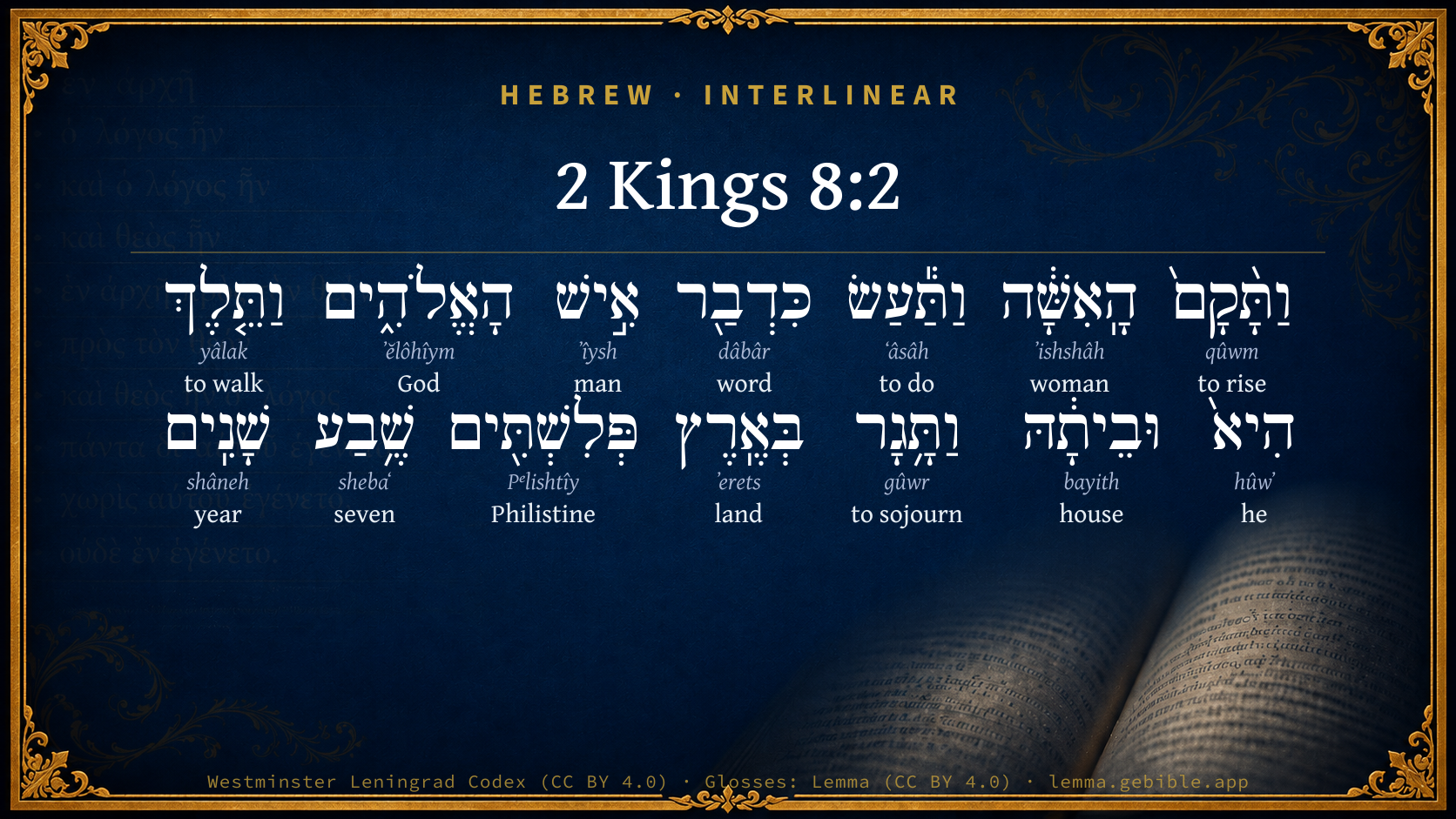
Hebrew (Westminster Leningrad Codex) 2 Kings 8:2 appears in the Hebrew Old Testament. The text above is from the Westminster Leningrad Codex. Each word links to its Strong’s number, a concise gloss, and parsing drawn from the Open Scriptures Hebrew Bible morphology. Click any word for its full Brown-Driver-Briggs (BDB) entry.
Download image
Cite this verse

2 Kings 8:2 (World English Bible). Public Domain. Lemma interlinear Bible study tool, https://lemma.gebible.app/v/2-kings/8/2.

Show BibTeX & RIS
BibTeX
RIS
English Translation
The woman arose, and did according to the word of the man of God; and she went with her household, and sojourned in the land of the Philistines seven years.
World English Bible · Public Domain
Download a study sheet

One document with this verse’s original text, its word-by-word gloss line, the meaning frame, cross-references with their text, attributed commentary, and full source and license credits — printable, and it pastes into notes with its structure intact.

This verse Autodidact and up

Study sheet (.html) Plain text (.txt)

A passage Seminary Student

Up to 50 verses in one chapter. A passage sheet keeps up to 6 commentary sources and 12 cross-references per verse, in the order this page ranks them, and says so on the sheet whenever that leaves anything out. Ask for a single verse and you get the Autodidact verse sheet above.

Everything on this page stays free to read, with no account — the sheet is a download of what is already on screen, not access to it.

Want to remove ads? Support Godless Engineer
Compare translations 3

The same verse in 3 English versions, stacked beneath the original-language interlinear above. Click any original word for its lexicon entry.

Each is an independent rendering of the whole verse — the interlinear is not word-aligned to these translations.

Highlighted words mark where these versions differ — a whole-verse word diff, not a word-by-word alignment.

  • World English Bible Public Domain
    The woman arose, and did according to the word of the man of God; and she went with her household, and sojourned in the land of the Philistines seven years.
  • King James Version Public Domain
    And the woman arose, and did after the saying of the man of God: and she went with her household, and sojourned in the land of the Philistines seven years.
  • unfoldingWord Literal Text CC BY-SA 4.0
    And the woman arose and did according to the word of the man of God. And she went, she and her house, and she sojourned in the land of the Philistines seven years.

unfoldingWord Literal Text — © unfoldingWord, licensed CC BY-SA 4.0. Word-aligned USFM3 via Door43 (git.door43.org/unfoldingWord/en_ult).

Versions to compare (up to 4)

3 of 4 selected

Show all 18 translations

Every available English version of this verse, each an independent rendering of the whole verse.

  • World English Bible Public Domain
    The woman arose, and did according to the word of the man of God; and she went with her household, and sojourned in the land of the Philistines seven years.
  • Berean Standard Bible Public Domain
    So the woman had proceeded to do as the man of God had instructed. And she and her household lived as foreigners for seven years in the land of the Philistines.
  • Majority Standard Bible Public Domain
    So the woman had proceeded to do as the man of God had instructed. And she and her household lived as foreigners for seven years in the land of the Philistines.
  • King James Version Public Domain
    And the woman arose, and did after the saying of the man of God: and she went with her household, and sojourned in the land of the Philistines seven years.
  • American Standard Version (1901) Public Domain
    And the woman arose, and did according to the word of the man of God; and she went with her household, and sojourned in the land of the Philistines seven years.
  • Revised Version (1885) Public Domain
    And the woman arose, and did according to the word of the man of God: and she went with her household, and sojourned in the land of the Philistines seven years.
  • Geneva Bible (1599) Public Domain
    And the woman arose, and did after the saying of the man of God, and went both shee and her housholde and soiourned in the lande of the Philistims seuen yeeres.
  • Douay-Rheims (1899) Public Domain
    And she arose, and did according to the word of the man of God: and going with her household, she sojourned in the land of the Philistines many days.
  • Young's Literal Translation Public Domain
    And the woman riseth, and doth according to the word of the man of God, and goeth, she and her household, and sojourneth in the land of the Philistines seven years.
  • Literal Standard Version CC BY-SA 4.0
    And the woman rises, and does according to the word of the man of God, and goes, she and her household, and sojourns in the land of the Philistines [for] seven years.
  • Unlocked Literal Bible CC BY-SA 4.0
    So the woman arose and she obeyed the word of the man of God. She went with her household and lived in the land of the Philistines seven years.
  • unfoldingWord Literal Text CC BY-SA 4.0
    And the woman arose and did according to the word of the man of God. And she went, she and her house, and she sojourned in the land of the Philistines seven years.
  • Darby Bible Public Domain
    And the woman rose up, and did according to the saying of the man of God, and went, she and her household, and sojourned in the land of the Philistines seven years.
  • World Messianic Bible Public Domain
    The woman arose, and did according to the man of God’s word. She went with her household, and lived in the land of the Philistines for seven years.
  • Webster's Bible Public Domain
    And the woman arose, and did according to the saying of the man of God: and she went with her household, and sojourned in the land of the Philistines seven years.
  • Free Bible Version CC BY-SA 4.0
    The woman packed up and did what the man of God had told her. She and her family went and lived as foreigners for seven years in the country of the Philistines.
  • Bible in Basic English Public Domain
    So the woman got up and did as the man of God said; and she and the people of her house were living in the land of the Philistines for seven years.
  • JPS Tanakh (1917) Public Domain
    And the woman arose, and did according to the word of the man of God; and she went with her household, and sojourned in the land of the Philistines seven years.

Literal Standard Version (2020), Covenant Press — licensed CC BY-SA 4.0. Text via the HelloAO Bible API (eBible.org). Unlocked Literal Bible (unfoldingWord) — licensed CC BY-SA 4.0. Text via the HelloAO Bible API (eBible.org). unfoldingWord Literal Text — © unfoldingWord, licensed CC BY-SA 4.0. Word-aligned USFM3 via Door43 (git.door43.org/unfoldingWord/en_ult). Free Bible Version, Dr. Jonathan Gallagher — licensed CC BY-SA 4.0. Text via the HelloAO Bible API (eBible.org).

Word by word

More ways to search: Search by grammar → Find every occurrence → Compare this word →

Practice this passage: Drill this verse → Learn its vocabulary →

וַתָּ֥גָר
gûwr
H1481
“and · to sojourn”
Conjunction + Verb, Qal, Sequential Imperfect, 3rd Person, Feminine, Singular
Part of Speech
Conjunction + Verb
Stem
Qal
Form
Sequential Imperfect
Person
3rd Person
Gender
Feminine
Number
Singular
Full BDB Definition

Origin: a primitive root

TWOT: 330 , 332

to sojourn, abide, dwell in, dwell with, remain, inhabit, be a stranger, be continuing, surely - (Qal) - to sojourn, dwell for a time - to abide, stay, temporarily dwell - (Hithpolel) - to seek hospitality with - to assemble oneself - to stir up trouble, strife, quarrel, gather together - (Qal) - to stir up strife - to quarrel - (Hithpolel) to excite oneself - to dread, fear, stand in awe, be afraid - (Qal) - to fear, be afraid - to be in awe, stand in awe
  1. וַתָּ֨קָם֙ qûwm H6965 “and · to rise” Conjunction + Verb, Qal, Sequential Imperfect, 3rd Person, Feminine, Singular
  2. הָֽאִשָּׁ֔ה ʼishshâh H802 “the · woman” Particle, Definite Article + Noun, Common, Feminine, Singular, Absolute
  3. וַתַּ֕עַשׂ ʻâsâh H6213 “and · to do” Conjunction + Verb, Qal, Sequential Imperfect, 3rd Person, Feminine, Singular
  4. כִּדְבַ֖ר dâbâr H1697 “like/as · word of” Preposition + Noun, Common, Masculine, Singular, Construct
  5. אִ֣ישׁ ʼîysh H376 “man of” Noun, Common, Masculine, Singular, Construct
  6. הָאֱלֹהִ֑ים ʼĕlôhîym H430 “the · God(s)” Particle, Definite Article + Noun, Common, Masculine, Plural, Absolute
  7. וַתֵּ֤לֶךְ yâlak H3212 “and · to walk” Conjunction + Verb, Qal, Sequential Imperfect, 3rd Person, Feminine, Singular
  8. הִיא֙ hûwʼ H1931 “he” Pronoun, Personal, 3rd Person, Feminine, Singular
  9. וּבֵיתָ֔הּ bayith H1004 “and · house · her” Conjunction + Noun, Common, Masculine, Singular, Construct + Suffix, Personal, 3rd Person, Feminine, Singular
  10. בְּאֶֽרֶץ ʼerets H776 “in/at · land of” Preposition + Noun, Common, Both, Singular, Construct
  11. פְּלִשְׁתִּ֖ים Pᵉlishtîy H6430 “Philistines” Noun, Gentilic, Masculine, Plural, Absolute
  12. שֶׁ֥בַע shebaʻ H7651 “seven” Adjective, Cardinal number, Feminine, Singular, Absolute
  13. שָׁנִֽים shâneh H8141 “years” Noun, Common, Feminine, Plural, Absolute

About this verse

These counts appear in no published source. They are computed here, from the morphology-tagged text and Lemma’s own curated glosses. What Lemma adds →

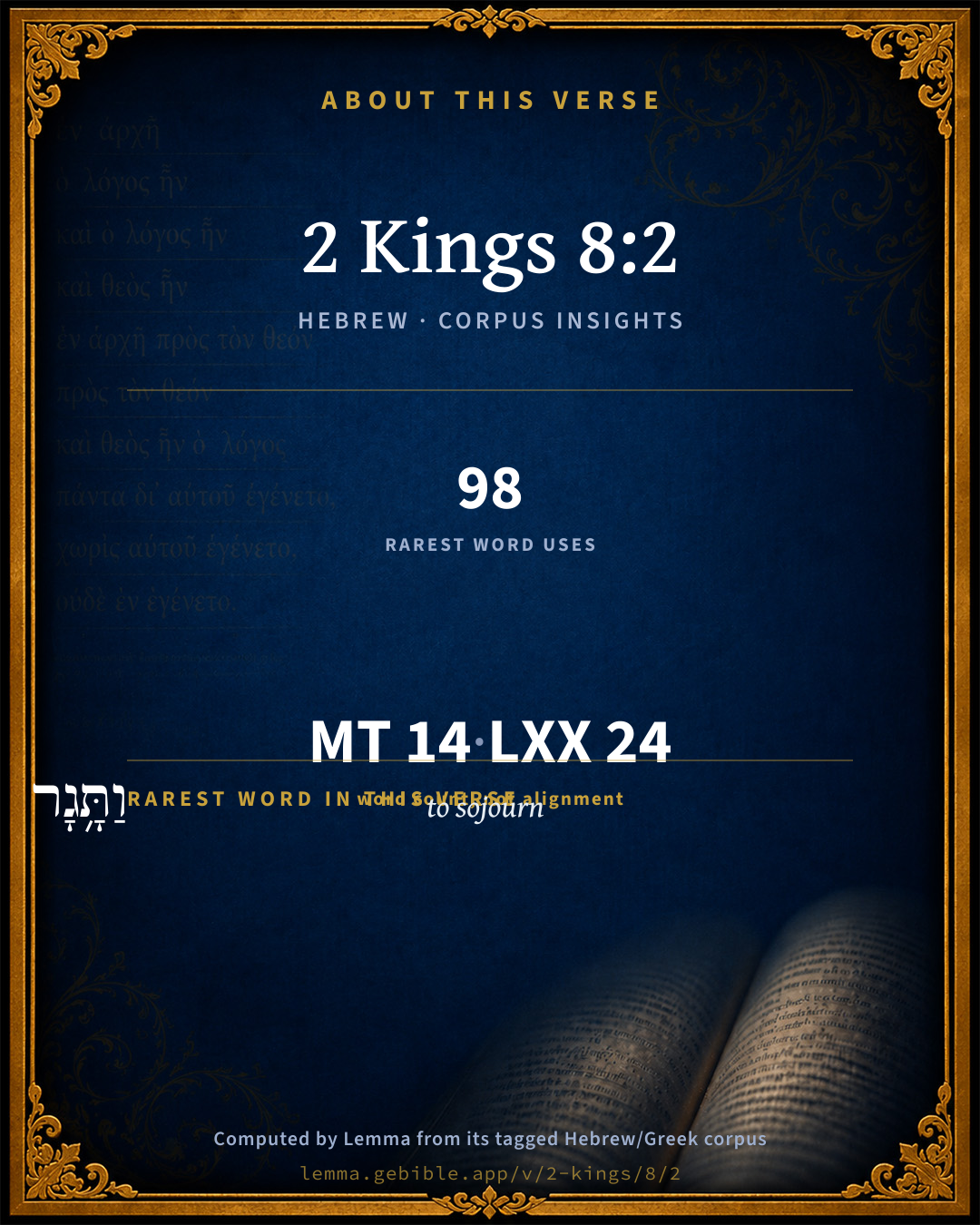
14
words
14
distinct lemmas
Historical
section

Grammatical profile

  • 4 verbs
  • 8 nouns
  • 1 adjective
  • 1 pronoun

Verb forms

  • וַתָּ֨קָם֙ Qal · Sequential Imperfect
  • וַתַּ֕עַשׂ Qal · Sequential Imperfect
  • וַתֵּ֤לֶךְ Qal · Sequential Imperfect
  • וַתָּ֥גָר Qal · Sequential Imperfect

Hebrew & Septuagint length

In English translation the verse runs 30 words from the Hebrew and 28 from the Septuagint (LXX English) — closely comparable.

A rough comparison of the two English renderings, which tokenize alike — not a word-level alignment.

Word counts can differ between the Hebrew and the Greek without any difference in meaning — e.g. the Hebrew direct-object marker אֵת has no separate Greek word, and Greek often adds the article ὁ.

In the original languages it is 14 Hebrew tokens and 24 Greek tokens — but the two are counted differently (Hebrew bundles its prefixes and suffixes into one token; the Greek is in lemma form), so that isn’t a like-for-like length.

Cross-references

3

Topical passages linked to 2 Kings 8:2 in the Treasury of Scripture Knowledge — connected by theme and wording, ordered by reader-vote popularity; previews shown in the World English Bible.

  • 1 Timothy 5:8 But if anyone doesn't provide for his own, and especially his own household, he has denied the faith, and is worse than an unbeliever.
  • Judges 3:3 [namely], the five lords of the Philistines, and all the Canaanites, and the Sidonians, and the Hivites who lived on Mount Lebanon, from Mount Baal Hermon to the entrance of Hamath.
  • 1 Samuel 27:1–3 David said in his heart, I shall now perish one day by the hand of Saul: there is nothing better for me than that I should escape into the land of the Philistines; and Saul will despair of me, to seek me any more in all the borders of Israel: so shall I escape out of his hand.

Cross-references courtesy of OpenBible.info (CC BY 4.0).

Hebrew and Greek witnesses Masoretic Hebrew ↔ Greek Septuagint

The same verse in the two great witnesses to the Old Testament, shown verse-for-verse.

These are two independent witnesses, not word-aligned to each other, and the Septuagint is shown in lemma (dictionary) form.

Hebrew 2 Kings 8:2 Masoretic · Westminster Leningrad Codex

וַתָּ֨קָם֙ הָֽאִשָּׁ֔ה וַתַּ֕עַשׂ כִּדְבַ֖ר אִ֣ישׁ הָאֱלֹהִ֑ים וַתֵּ֤לֶךְ הִיא֙ וּבֵיתָ֔הּ וַתָּ֥גָר בְּאֶֽרֶץ פְּלִשְׁתִּ֖ים שֶׁ֥בַע שָׁנִֽים

The woman arose, and did according to the word of the man of God; and she went with her household, and sojourned in the land of the Philistines seven years.

World English Bible · Public Domain

Greek LXX 2 Kings 8:2 Septuagint · lemma form

καί ἀναἵστημι ὁ γυνή καί ποιέω κατά ὁ ῥῆμα ελισαιε καί πορεύομαι αὐτός καί ὁ οἶκος αὐτός καί παραοἰκέω ἐν γῆ ἀλλόφυλος ἑπτά ἔτος

And the woman arose, and did according to the word of Elisaie, both she and her house; and they sojourned in the land of the Philistines seven years.

LXX2012 (modern English Septuagint) · Public Domain

Hebrew: Westminster Leningrad Codex (CC BY 4.0). Greek: Septuagint (public domain); English from LXX2012 (modern English Septuagint) (Public Domain). How the Septuagint differs from the Hebrew →

Targum (Aramaic paraphrase)

1

The Targum is the ancient Jewish Aramaic paraphrase of the Hebrew Scriptures — an interpretive translation, not the Hebrew text itself. Onkelos (literal) and Pseudo-Jonathan (expansive) render the Torah, and Jonathan the Prophets. Coverage is partial: where no permissively-licensed English translation exists for a verse, only the Aramaic is shown. This is verse-level text, not a word-by-word alignment to the Hebrew.

  1. Targum Jonathan Prophets (Joshua–Malachi)
    וְקָמַת אִתְּתָא וַעֲבָדַת כְּפִתְגָמָא דִנְבִיָא דַייָ וַאֲזָלַת הִיא וֶאֱנַשׁ בֵּיתָהּ וְאִתּוֹתָבַת בְּאַרְעָא פְלִשְׁתָּאֵי שְׁבַע שְׁנִין:

    (no public-domain English translation for this verse)

    Targum Jonathan — Aramaic: “Mikraot Gedolot” (public domain). English: “Sefaria Community Translation” (CC0 1.0 (public-domain dedication)); “London "Chaldee Paraphrase," 1871” (public domain). Text via Sefaria.

Commentary

Notes on 2 Kings 8:2 from classic Christian and Jewish commentators (each source and its license shown beneath its notes). The classic Christian expositions comment on the surrounding passage and are grouped to its opening verse, so a note may address several verses; the Jewish commentaries on the Tanakh (Rashi and others) are per-verse, so they appear only where the commentator wrote on this verse.

Lemma curates 59 commentaries, every one of them public domain or Creative Commons licensed, each selected and text-cleaned for this edition rather than reprinted as found. About our sources →

Trapp's Complete Commentary

John Trapp

2Ki 8:2 And the woman arose, and did after the saying of the man of God: and she went with her household, and sojourned in the land of the Philistines seven years.

Ver. 2. And sojourned in the land of the Philistines.] Their fields flourish, while the soil of Israel yieldeth nothing but weeds and barrenness. Not that Israel was more sinful, but that the sin of Israel was more intolerable, saith a great divine. No pestilence is so contagious as that which hath taken the purest air.

John Trapp, A Commentary or Exposition upon All the Books of the Old and New Testament (1647–1656) — public domain. Text from a community e-Sword module.

Joseph Benson's Commentary

2Ki 8:2. The woman arose, and sojourned in the land of the Philistines — Which, though bordering upon Israel, was free from the famine: by which it appeared, that the special hand of God was in that calamity, and that it was a judgment from him upon the Israelites for their idolatry, and abuse of the means of grace, which they now enjoyed in such abundance through Elisha and many other prophets.

Joseph Benson's Commentary on the Old and New Testaments (1811–1818) — public domain. Text from a community e-Sword module.

Jamieson, Fausset & Brown

Robert Jamieson, A. R. Fausset & David Brown

she . . . sojourned in the land of the Philistines seven years--Their territory was recommended to her from its contiguity to her usual residence; and now that this state had been so greatly reduced, there was less risk than formerly from the seductions of idolatry; and many of the Jews and Israelites were residing there. Besides, an emigration thither was less offensive to the king of Israel than going to sojourn in Judah.

Jamieson, Fausset & Brown — Commentary Critical and Explanatory on the Whole Bible (1871) — public domain (CC PDM 1.0). Text via the HelloAO Bible API.

Ellicott's Commentary for English Readers

(2) After the saying.—According to the word.

In the land of the Philistines.—The lowlands of the coast were not so subject to droughts as the limestone highlands of Israel. (Comp. Gen_12:10; Gen_26:1.) The Philistines, besides, dealt with foreign traders who put in to their shores. (Comp. Joe_3:4-6.)

A Bible Commentary for English Readers, edited by Charles John Ellicott (1878–1897) — public domain. Text from a community e-Sword module.

The Cambridge Bible for Schools and Colleges

gen. ed. J. J. S. Perowne

2. sojourned in the land of the Philistines] As in Jacob’s time, the patriarch with his family was sent into Egypt, an idolatrous land, because of the famine, so the pious Shunammite, for her life’s support, goes forth among the Philistines, and stays there seven years.

The Cambridge Bible for Schools and Colleges (gen. ed. J. J. S. Perowne; Cambridge University Press, 1878–1918) — public domain. Text from a community e-Sword module.

John Gill's Exposition

And the woman arose, and did after the saying of the man of God,.... Whose words she had reason to believe; she having a son given to her according to his word, and this restored to life, when dead, through his intercession:

and she went with her household, and sojourned in the land of the Philistines; which was not far from her native place, and where there was plenty of food, and she could have as free an exercise of her religion as in the idolatrous kingdom of Israel.

John Gill's Exposition of the Whole Bible (1746–1763) — public domain (CC PDM 1.0). Text via the HelloAO Bible API.

Albert Barnes' Notes on the Bible

The country of the Philistines - the rich low grain-growing plain along the seacoast of Judah - was always a land of plenty compared with the highlands of Palestine. Moreover, if food failed there, it was easily imported by sea from the neighboring Egypt.

Albert Barnes' Notes on the Bible (1834–1885) — public domain. Text from a community e-Sword/MySword module.

Matthew Poole's English Annotations

Either because that was near her lands and dwelling, which she thought she might have an eye to, when occasion required; or because there was more plenty than in Judah; or because she knew that her going to dwell in Judah would be very displeasing to the king of Israel, whose favour she was like to need hereafter. Nor was there now that danger of idolatry from the Philistines as there had been formerly, because their power and influence was now grown inconsiderable, and probably many of the Jews and Israelites lived among them. And this land, though bordering upon Israel, was free from this famine, that it might appear that this was a special hand and judgment of God upon the Israelites for their idolatry, and for their unprofitableness under all the means of grace which now they plentifully enjoyed by Elisha and many other prophets; which the Philistines not enjoying, their sin was much less, and therefore their present condition was better.

Matthew Poole's English Annotations on the Holy Bible (1683–1685) — public domain. Text from a community e-Sword/MySword module.

The Pulpit Commentary

And the woman arose, and did after the saying of the man of God. It is a satisfaction to find that there was yet faith in Israel. There were still those to whom the prophet was the mouthpiece of God, who waited on his words, and accepted them as Divine commands whereto they were ready to render immediate and entire obedience. It is conjectured by some that the woman had become a widow, and fallen into comparative poverty; but the narrative gives no indication of this. Even opulent persons have to migrate in times of severe dearth. And she went with her household, and sojourned in the land of the philistines. Philistia was a great grain country, (Jud_1:15:5) and, though not altogether exempt from famine, was less exposed to it than either Judaea or Samaria. The soil was exceedingly fertile, and the vapors from the Mediterranean descended upon it in clews and showers, when their beneficial influence was not felt further inland. The Shunammite may have had other reasons for fixing her residence in the Philistine country; but probably she was chiefly determined in her choice by its proximity and its productiveness. Seven years. As long, i.e. , as the famine lasted (see the last clause of ver. 1).

The Pulpit Commentary (1880–1919), ed. H.D.M. Spence-Jones & Joseph S. Exell — public domain. Text from a community e-Sword module.

Lesson kit

Teaching starters — assembled from the data on this page, not authored interpretation. Every prompt links to the verse data it draws on. Edit before teaching.

2 Kings, in the Historical, opens this verse with 14 words (14 distinct Hebrew lemmas). Its most distinctive word is gûwr (“to sojourn”). A historical commentator’s framing appears above. Read the whole chapter for the surrounding context.

Discussion questions

  1. The word gûwr carries the sense “to sojourn.” How does it shape the verse?
  2. 1 Timothy 5:8 shares this passage’s theme. How do the two illuminate each other?
  3. These translations render this verse differently. What is at stake in choosing one wording over another?
  4. The verb «וַתָּ֨קָם֙» is Qal Sequential Imperfect. How does its form color the action?
  5. Reading how Trapp's Complete Commentary and Joseph Benson's Commentary read this verse, where do the two commentators agree and where do they part?

Things to notice

Reading settings

Reading text

Shown beneath each verse's original-language words.

Old Testament
Old Testament edition

Read the OT as the Masoretic Hebrew (MT) or the Greek Septuagint (LXX).

English shown for the Greek Septuagint (in the Hebrew ↔ Greek comparison).

Comparing translations? Open the Compare panel on any verse page to stack up to four side by side.