Genesis 46:21

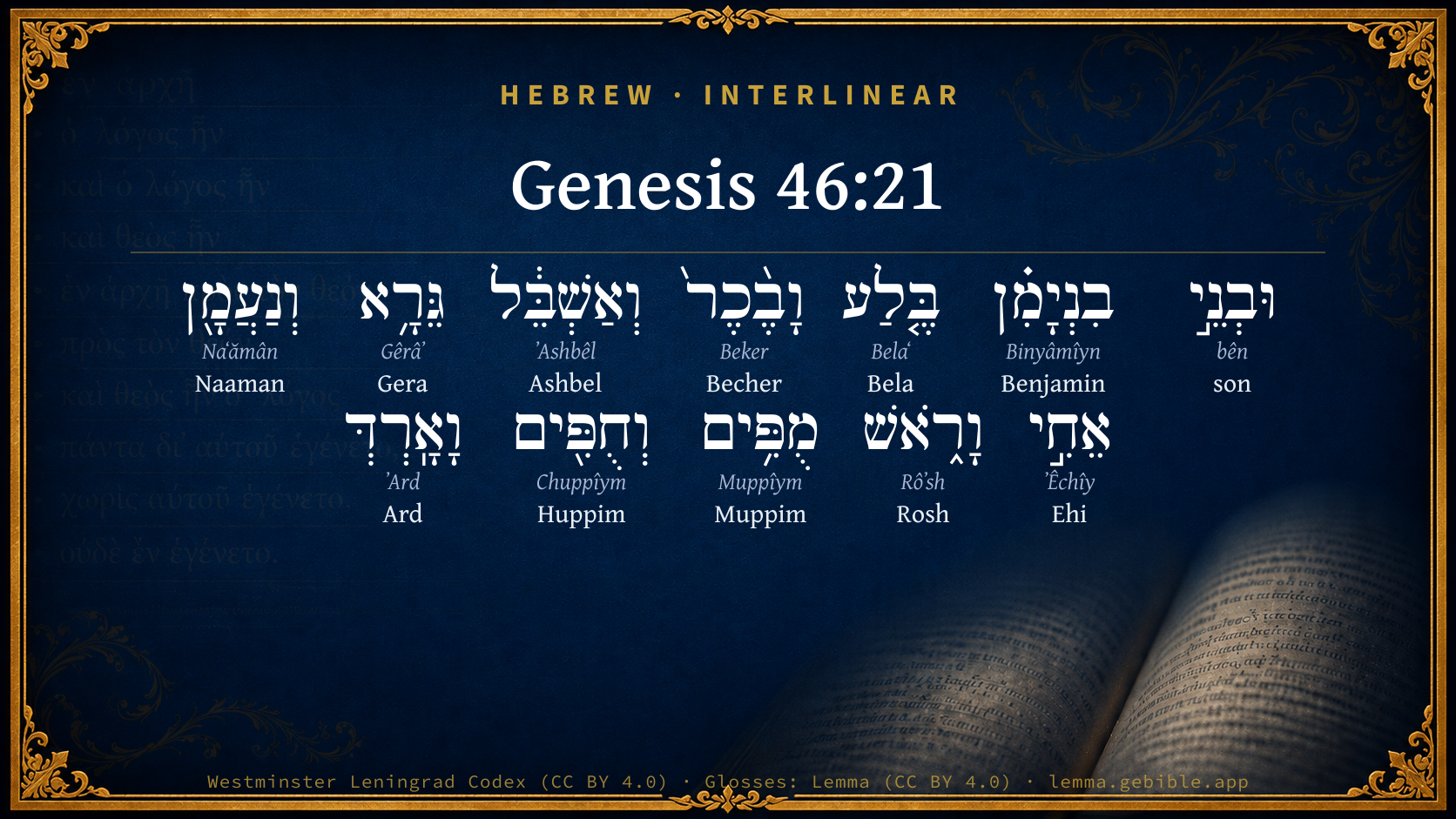
Hebrew (Westminster Leningrad Codex) Genesis 46:21 appears in the Hebrew Old Testament. The text above is from the Westminster Leningrad Codex. Each word links to its Strong’s number, a concise gloss, and parsing drawn from the Open Scriptures Hebrew Bible morphology. Click any word for its full Brown-Driver-Briggs (BDB) entry.
Download image
Cite this verse

Genesis 46:21 (World English Bible). Public Domain. Lemma interlinear Bible study tool, https://lemma.gebible.app/v/genesis/46/21.

Show BibTeX & RIS
BibTeX
RIS
English Translation
The sons of Benjamin: Bela, Becher, Ashbel, Gera, Naaman, Ehi, Rosh, Muppim, Huppim, and Ard.
World English Bible · Public Domain
Highlights Full analysis ↓
Download a study sheet

One document with this verse’s original text, its word-by-word gloss line, the meaning frame, cross-references with their text, attributed commentary, and full source and license credits — printable, and it pastes into notes with its structure intact.

This verse Autodidact and up

Study sheet (.html) Plain text (.txt)

A passage Seminary Student

Up to 50 verses in one chapter. A passage sheet keeps up to 6 commentary sources and 12 cross-references per verse, in the order this page ranks them, and says so on the sheet whenever that leaves anything out. Ask for a single verse and you get the Autodidact verse sheet above.

Everything on this page stays free to read, with no account — the sheet is a download of what is already on screen, not access to it.

Want to remove ads? Support Godless Engineer
Compare translations 3

The same verse in 3 English versions, stacked beneath the original-language interlinear above. Click any original word for its lexicon entry.

Each is an independent rendering of the whole verse — the interlinear is not word-aligned to these translations.

Highlighted words mark where these versions differ — a whole-verse word diff, not a word-by-word alignment.

  • World English Bible Public Domain
    The sons of Benjamin: Bela, Becher, Ashbel, Gera, Naaman, Ehi, Rosh, Muppim, Huppim, and Ard.
  • King James Version Public Domain
    And the sons of Benjamin were Belah, and Becher, and Ashbel, Gera, and Naaman, Ehi, and Rosh, Muppim, and Huppim, and Ard.
  • unfoldingWord Literal Text CC BY-SA 4.0
    And the sons of Benjamin Bela and Beker and Ashbel, Gera and Naaman, Ehi and Rosh, Muppim and Huppim and Ard.

unfoldingWord Literal Text — © unfoldingWord, licensed CC BY-SA 4.0. Word-aligned USFM3 via Door43 (git.door43.org/unfoldingWord/en_ult).

Versions to compare (up to 4)

3 of 4 selected

Show all 18 translations

Every available English version of this verse, each an independent rendering of the whole verse.

  • World English Bible Public Domain
    The sons of Benjamin: Bela, Becher, Ashbel, Gera, Naaman, Ehi, Rosh, Muppim, Huppim, and Ard.
  • Berean Standard Bible Public Domain
    The sons of Benjamin: Bela, Becher, Ashbel, Gera, Naaman, Ehi, Rosh, Muppim, Huppim, and Ard.
  • Majority Standard Bible Public Domain
    The sons of Benjamin: Bela, Becher, Ashbel, Gera, Naaman, Ehi, Rosh, Muppim, Huppim, and Ard.
  • King James Version Public Domain
    And the sons of Benjamin were Belah, and Becher, and Ashbel, Gera, and Naaman, Ehi, and Rosh, Muppim, and Huppim, and Ard.
  • American Standard Version (1901) Public Domain
    And the sons of Benjamin: Bela, and Becher, and Ashbel, Gera, and Naaman, Ehi, and Rosh, Muppim, and Huppim, and Ard.
  • Revised Version (1885) Public Domain
    And the sons of Benjamin; Bela, and Becher, and Ashbel, Gera, and Naaman, Ehi, and Rosh, Muppim, and Huppim, and Ard.
  • Geneva Bible (1599) Public Domain
    Also the sonnes of Beniamin: Belah, and Becher, and Ashbel, Gera, and Naaman, Ehi, and Rosh, Muppim, and Huppim, and Ard.
  • Douay-Rheims (1899) Public Domain
    The sons of Benjamin: Bela and Bechor and Asbel and Gera and Naaman and Echi and Ros and Mophim and Ophim and Ared.
  • Young's Literal Translation Public Domain
    And sons of Benjamin: Belah, and Becher, and Ashbel, Gera, and Naaman, Ehi, and Rosh, Muppim, and Huppim, and Ard.
  • Literal Standard Version CC BY-SA 4.0
    And sons of Benjamin: Belah, and Becher, and Ashbel, Gera, and Naaman, Ehi, and Rosh, Muppim, and Huppim, and Ard.
  • Unlocked Literal Bible CC BY-SA 4.0
    The sons of Benjamin were Bela, Beker, Ashbel, Gera, Naaman, Ehi, Rosh, Muppim, Huppim, and Ard.
  • unfoldingWord Literal Text CC BY-SA 4.0
    And the sons of Benjamin Bela and Beker and Ashbel, Gera and Naaman, Ehi and Rosh, Muppim and Huppim and Ard.
  • Darby Bible Public Domain
    -- And the sons of Benjamin: Belah, and Becher, and Ashbel, Gera and Naaman, Ehi and Rosh, Muppim, and Huppim, and Ard.
  • World Messianic Bible Public Domain
    The sons of Benjamin: Bela, Becher, Ashbel, Gera, Naaman, Ehi, Rosh, Muppim, Huppim, and Ard.
  • Webster's Bible Public Domain
    And the sons of Benjamin were Belah, and Becher, and Ashbel, Gera, and Naaman, Ehi, and Rosh, Muppim, and Huppim, and Ard.
  • Free Bible Version CC BY-SA 4.0
    The sons of Benjamin: Bela, Becher, Ashbel, Gera, Naaman, Ehi, Rosh, Muppim, Huppim, and Ard.
  • Bible in Basic English Public Domain
    And the sons of Benjamin were Belah and Becher and Ashbel, Gera and Naaman, Ehi and Rosh, Muppim and Huppim and Ard.
  • JPS Tanakh (1917) Public Domain
    And the sons of Benjamin: Bela, and Becher, and Ashbel, Gera, and Naaman, Ehi, and Rosh, Muppim, and Huppim, and Ard.

Literal Standard Version (2020), Covenant Press — licensed CC BY-SA 4.0. Text via the HelloAO Bible API (eBible.org). Unlocked Literal Bible (unfoldingWord) — licensed CC BY-SA 4.0. Text via the HelloAO Bible API (eBible.org). unfoldingWord Literal Text — © unfoldingWord, licensed CC BY-SA 4.0. Word-aligned USFM3 via Door43 (git.door43.org/unfoldingWord/en_ult). Free Bible Version, Dr. Jonathan Gallagher — licensed CC BY-SA 4.0. Text via the HelloAO Bible API (eBible.org).

Word by word

More ways to search: Search by grammar → Find every occurrence → Compare this word →

Practice this passage: Drill this verse → Learn its vocabulary →

About this verse

These counts appear in no published source. They are computed here, from the morphology-tagged text and Lemma’s own curated glosses. What Lemma adds →

12
words
12
distinct lemmas
Pentateuch
section

Notable vocabulary

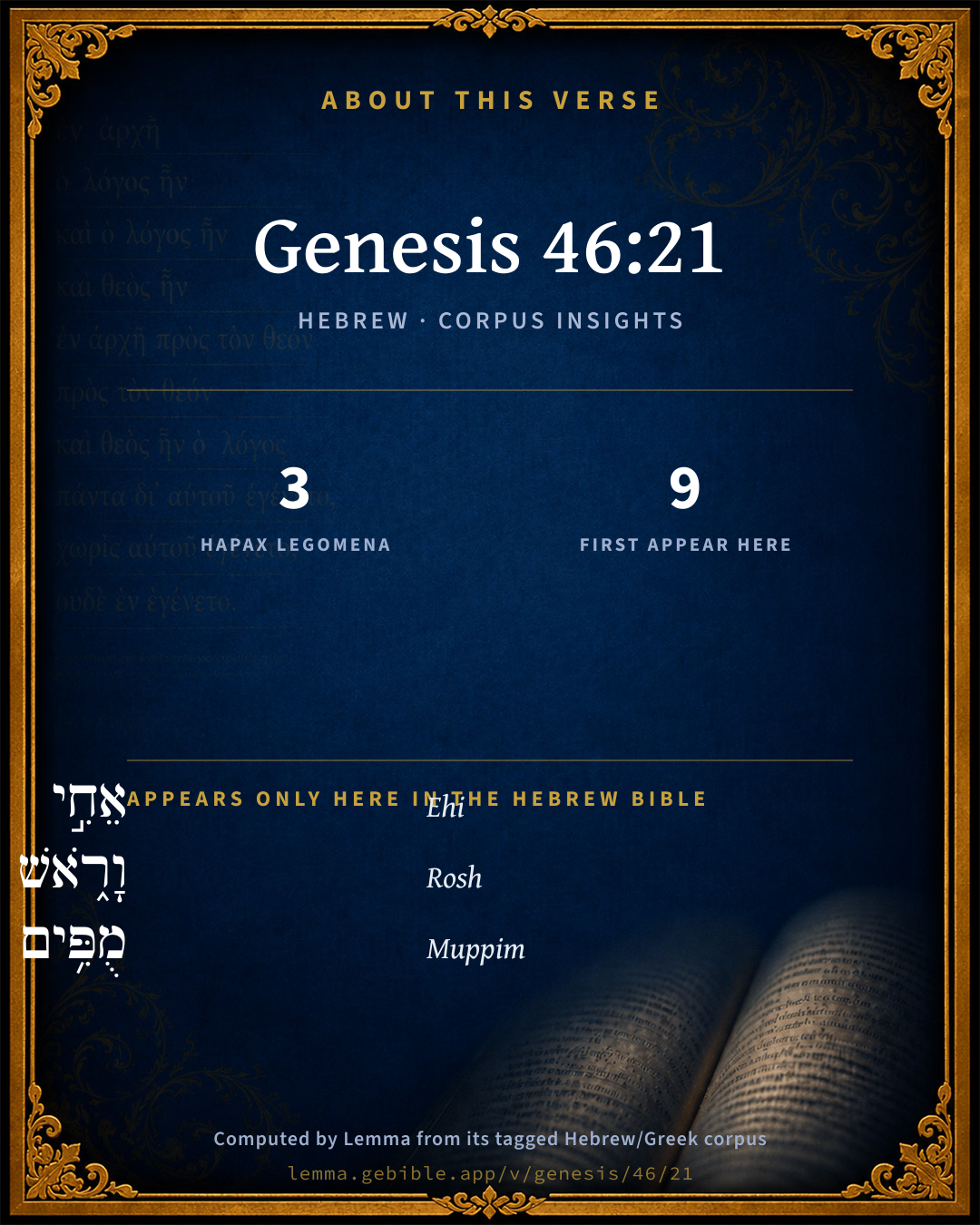
3 hapax legomena — words that appear only here in the entire Hebrew Bible:

  • אֵחִ֣י Ehi H278
  • וָרֹ֑אשׁ Rosh H7220
  • מֻפִּ֥ים Muppim H4649

First appearance in Scripture

These words make their first canonical appearance in the Hebrew Bible here (9 in total — showing 8):

  • וָבֶ֨כֶר֙ Becher H1071
  • וְאַשְׁבֵּ֔ל Ashbel H788
  • גֵּרָ֥א Gera H1617
  • וְנַעֲמָ֖ן Naaman H5283
  • אֵחִ֣י Ehi H278
  • וָרֹ֑אשׁ Rosh H7220
  • מֻפִּ֥ים Muppim H4649
  • וְחֻפִּ֖ים Huppim H2650

Shared distinctive vocabulary

וָאָֽרְדְּ Ard H714 occurs in 2 verses of the Hebrew Bible. Also found in:

Grammatical profile

  • 12 nouns

Hebrew & Septuagint length

In English translation the verse runs 15 words from the Hebrew and 29 from the Septuagint (LXX English) — the Septuagint runs noticeably longer here. See the side-by-side →

A rough comparison of the two English renderings, which tokenize alike — not a word-level alignment.

Word counts can differ between the Hebrew and the Greek without any difference in meaning — e.g. the Hebrew direct-object marker אֵת has no separate Greek word, and Greek often adds the article ὁ.

Cross-references

7

Topical passages linked to Genesis 46:21 in the Treasury of Scripture Knowledge — connected by theme and wording, ordered by reader-vote popularity; previews shown in the World English Bible.

  • 1 Chronicles 7:6–12 [The sons of] Benjamin: Bela, and Becher, and Jediael, three.
  • Genesis 49:27 "Benjamin is a ravenous wolf. In the morning he will devour the prey. At evening he will divide the spoil."
  • Numbers 1:11 Of Benjamin: Abidan the son of Gideoni.
  • Numbers 1:36–37 Of the children of Benjamin, their generations, by their families, by their fathers' houses, according to the number of the names, from twenty years old and upward, all who were able to go out to war;
  • Numbers 26:38–40 The sons of Benjamin after their families: of Bela, the family of the Belaites; of Ashbel, the family of the Ashbelites; of Ahiram, the family of the Ahiramites;
  • Deuteronomy 33:12 Of Benjamin he said, The beloved of Yahweh shall dwell in safety by him; He covers him all the day long, He dwells between his shoulders.
  • 1 Chronicles 8:1–7 Benjamin became the father of Bela his firstborn, Ashbel the second, and Aharah the third,

Cross-references courtesy of OpenBible.info (CC BY 4.0).

Hebrew and Greek witnesses Masoretic Hebrew ↔ Greek Septuagint

The same verse in the two great witnesses to the Old Testament, shown verse-for-verse.

Here the Septuagint runs noticeably longer than the Hebrew — LXX2012 (modern English Septuagint) 29 words vs World English Bible 15. A rough length comparison of the two English translations, not a word-level alignment — read both below.

These are two independent witnesses, not word-aligned to each other, and the Septuagint is shown in lemma (dictionary) form.

Hebrew Genesis 46:21 Masoretic · Westminster Leningrad Codex

וּבְנֵ֣י בִנְיָמִ֗ן בֶּ֤לַע וָבֶ֨כֶר֙ וְאַשְׁבֵּ֔ל גֵּרָ֥א וְנַעֲמָ֖ן אֵחִ֣י וָרֹ֑אשׁ מֻפִּ֥ים וְחֻפִּ֖ים וָאָֽרְדְּ

The sons of Benjamin: Bela, Becher, Ashbel, Gera, Naaman, Ehi, Rosh, Muppim, Huppim, and Ard.

World English Bible · Public Domain

Greek LXX Genesis 46:21 Septuagint · lemma form

υἱός δέ βενιαμίν βαλα καί χοβωρ καί ασβηλ γίγνομαι δέ υἱός βαλα γηρα καί νοεμαν καί αγχις καί ρως καί μαμφιν καί οφιμιν γηρα δέ γεννάω ὁ αραδ

and the sons of Benjamin; Bala, and Bochor, and Asbel. And the sons of Bala were Gera, and Noeman, and Anchis, and Ros, and Mamphim. And Gera begot Arad.

LXX2012 (modern English Septuagint) · Public Domain

On this verse, The Cambridge Bible for Schools and Colleges discusses the Septuagint’s reading. Read the note in Commentary ↓

Hebrew: Westminster Leningrad Codex (CC BY 4.0). Greek: Septuagint (public domain); English from LXX2012 (modern English Septuagint) (Public Domain). How the Septuagint differs from the Hebrew →

Targum (Aramaic paraphrase)

2

The Targum is the ancient Jewish Aramaic paraphrase of the Hebrew Scriptures — an interpretive translation, not the Hebrew text itself. Onkelos (literal) and Pseudo-Jonathan (expansive) render the Torah, and Jonathan the Prophets. Coverage is partial: where no permissively-licensed English translation exists for a verse, only the Aramaic is shown. This is verse-level text, not a word-by-word alignment to the Hebrew.

  1. Targum Onkelos Torah (Genesis–Deuteronomy)
    וּבְנֵי בִנְיָמִן בֶּלַע וָבֶכֶר וְאַשְׁבֵּל גֵּרָא וְנַעֲמָן אֵחִי וָרֹאשׁ מֻפִּים וְחֻפִּים וָאָרְדְּ

    (no public-domain English translation for this verse)

    Targum Onkelos — Aramaic: “Onkelos Genesis” (public domain); “Onkelos Exodus” (public domain); “Onkelos Leviticus” (public domain); “Onkelos Numbers” (public domain); “Onkelos Deuteronomy” (public domain). English: “Sefaria Community Translation” (CC0 1.0 (public-domain dedication)); “J.W. Etheridge. The Targums of Onkelos and Jonathan Ben Uzziel on the Pentateuch. London: Longmans, Green, 1862” (public domain). Text via Sefaria.

  2. Targum Pseudo-Jonathan Torah (Genesis–Deuteronomy)
    וּבְנוֹי דְבִנְיָמִין עַשְרָא וּשׁוּמְהוֹן עַל פְּרִישׁוּתָא דְיוֹסֵף אָחוֹי. בֶּלַע, דְאִתְבְּלַע מִנֵיהּ. וָבֶכֶר, דְהוּא בּוּכְרָא דְאִמֵיהּ. וְאַשְׁבֵּל, דְהַלִיךְ בְּשִׁבְיָיתָא. גֵרָא, דְאִיתְגַר בְּאַרְעָא נוּכְרָאָה. וְנַעֲמָן, דַהֲוָה נָעִים וְיַקִיר. אֵחִי, דְהוּא אָחוֹי בַּר אִימֵיהּ. וָראשׁ, דַהֲוָה רֵישׁ בְּבֵית אָבוֹי. מֻפִּים, דְאִזְדַבֵּן בְּמוֹף. חֻפִּים, דְבִזְמַן דְאִתְפָּרֵשׁ מִינֵיהּ הֲוָה בַּר תַּמְנֵיסַר שְׁנִין וְחָזִי לְכֵילָת הִילוּלָא. וָאָרְד, דְנָחַת לְמִצְרָיִם

    The sons of Benjamin, ten; and their names, according to the interpretation of Joseph his brother: Bela, who was swallowed up from him; Beker, who was the chosen of his mother; Eshbal, who went into captivity; Gera, who became a sojourner in a foreign land; Naaman, who was pleasant and honourable; Achi, who had a (twin) brother, the son of his mother; Rosh, who was a chief in his father's house; Muppim, who was sold into Muph; Chuppim, because at the time that he was separated from him he was the son of eighteen years and was eligible for marriage (Chupha, thalamus nuptialis); and Ared, who descended into Mizraim.

    Targum Pseudo-Jonathan — Aramaic: “Targum Jonathan on Genesis” (public domain); “Targum Jonathan on Exodus” (public domain); “Targum Jonathan on Leviticus” (public domain); “Targum Jonathan on Numbers” (public domain); “Targum Jonathan on Deuteronomy” (public domain). English: “The Targum of Jonathan ben Uzziel, trans. J. W. Etheridge, London, 1862” (public domain). Text via Sefaria.

Commentary

Notes on Genesis 46:21 from classic Christian and Jewish commentators (each source and its license shown beneath its notes). The classic Christian expositions comment on the surrounding passage and are grouped to its opening verse, so a note may address several verses; the Jewish commentaries on the Tanakh (Rashi and others) are per-verse, so they appear only where the commentator wrote on this verse.

Lemma curates 59 commentaries, every one of them public domain or Creative Commons licensed, each selected and text-cleaned for this edition rather than reprinted as found. About our sources →

Ellicott's Commentary for English Readers

(21) Benjamin has ten sons:

Num_26:38-40. 1Ch_7:6. 1Ch_8:1-5.

Belah,Bela,Bela,Bela,Becher,(omitted)Becher,(omitted)Ashbel,Ashbel,Jediael.Ashbel,Gera,(omitted)(given as grandson)Naaman,(given as grandson)do.Ehi,Ahiram,Aharah, Nohah,Rosh,(omitted)Rapha (?)Muppim,Shupham,(given as grandson)Huppim,Hupham,do.Ard,(given as grandson)do.

Thus in Numbers Benjamin has only five sons, but Naaman and Ard are also heads of families, and are described as sons of Bela. In Chronicles Benjamin is first described as having three sons, among whom appears Becher with numerous descendants, though omitted elsewhere, and then as having five sons, one of whom, Nohah, has a name completely different from any of those in the other three documents. And not only is Bela described as the father of Gera, Naaman, Muppim (called Sheplmphan), Huppim (called Huram), and Ard (called Addar): but also of Abihud, Abishua, Ahoah, and another Gera.

A Bible Commentary for English Readers, edited by Charles John Ellicott (1878–1897) — public domain. Text from a community e-Sword module.

The Cambridge Bible for Schools and Colleges

gen. ed. J. J. S. Perowne

21. the sons of Benjamin] The mention of Benjamin’s sons in a list purporting to be a record of those who came with Jacob into Egypt is of course irreconcilable with the narrative. But it illustrates the separate origin of these lists of names (connected with P) from the general narrative preserved by J and E. The difficulty experienced by the ordinary reader was possibly felt in very early times. The LXX gives Benjamin three sons, Bela, Chobor, and Ashbel; six grandsons, sons of Bela, viz. Gera, Naaman, Ehi, Rosh, Muppim, and Huppim; and one great-grandson, Ard, the son of Gera. If this list was the original form of the genealogy, it may have been modified, in order to get rid of the strange statement, that Benjamin’s grandsons and great-grandsons went down with Jacob into Egypt. Another version is given in Num_26:38-40.

Becher] In LXX Χόβωρ. Cf. 2Sa_20:1, Sheba, the Bichrite.

Gera] Omitted in Numbers 26. In Jdg_3:15 the “judge” Ehud, the Benjamite, is the son of Gera; and in 2Sa_16:5 Shimei, of the family of Saul, the Benjamite, is the son of Gera.

Ehi] In Num_26:38, Ahiram, omitting Rosh.

Muppim] In Num_26:39, Shephupham; in 1Ch_7:12, Shuppim. Ehi, Rosh, Muppim are probably textual variations of Ahiram and Shephupham.

Ard] = 1Ch_8:3, Addar. In Num_26:40 Naaman and Ard are “sons of Bela.”

The Cambridge Bible for Schools and Colleges (gen. ed. J. J. S. Perowne; Cambridge University Press, 1878–1918) — public domain. Text from a community e-Sword module.

John Gill's Exposition

These are the sons of Bilhah, which Laban gave unto Rachel his daughter,.... To be her maid, when she was married to Jacob:

and she bare these unto Jacob, all the souls were seven; not that she bare seven sons to Jacob, she bore but two, Dan and Naphtali; but the children of these with them made seven, one of Dan's, and four of Naphtali's, who went down with Jacob into Egypt.

John Gill's Exposition of the Whole Bible (1746–1763) — public domain (CC PDM 1.0). Text via the HelloAO Bible API.

Haydock's Catholic Bible Commentary

Benjamin. Ten in number; though the Septuagint have only nine, and suppose that some of them were his grandchildren. He was 33 (or 24, Menochius) years old. (Calmet) --- Grotius thinks three names have been made out of two; Echi, Ros, and mophim, out of Ahiram and Supham, as we read, Numbers xxvi. 38.

George Leo Haydock (1774–1849), Haydock's Catholic Family Bible and Commentary, 1859 edition — public domain. Excludes Psalms (Douay-Rheims chapter numbering differs from Protestant) and Deuterocanonical books (Catholic canon only).

Matthew Poole's English Annotations

Whereof part seem to be born before his coming to Egypt, and part in Egypt, Benjamin being now but twenty and four years old.

Matthew Poole's English Annotations on the Holy Bible (1683–1685) — public domain. Text from a community e-Sword/MySword module.

Whedon's Commentary on the Bible

Daniel D. Whedon

21. Naaman… Ard — In Num_26:40, these appear as sons of Bela. The most probable explanation of this discrepancy is, the Naaman and Ard here mentioned as sons of Benjamin died in Egypt without issue, and two of their brother Bela’s sons were named after them and substituted in their place, according to levirate law, to perpetuate intact the families of Benjamin.

Daniel D. Whedon (gen. ed.), Commentary on the Old and New Testaments (1874–1909) — public domain. Text from a community e-Sword module.

The Pulpit Commentary

And the sons of Benjamin were Belah, Devouring (Gesenius); the ancient name of Zoar, one of the cities in the Jordan circle (Gen_14:2) and Becher, Young Camel" (Gesenius)and Ashbol, of God" (Gesenius), "Sprout" (Lange), "Short?" (Murphy)Gera, "a Grain" (Gesenius), "Fighter"? (Lange)and Naaman, (Gesenius)Ehi, (Lange, Murphy); = Ehud, "Joining together" (Gesenius), 1Ch_8:6; styled Ahiram (Num_26:38) and Rosh, (Gesenius) Muppim, One" (Lange); = Shupham (Num_26:38) and Shephupham, (1Ch_8:5) "Serpent"? (Gesenius)and Huppim, (Gesenius), or Hupham (Num_26:39) and Ard "Rover" (Murphy), "Ruler"? (Lange). Num_26:40 Naaman and Ard are given as the sons of Bela, and the grandsons of Benjamin; a plausible explanation of which is that Benjamin"s sons died early, and were replaced in the list of heads of families by two of Bela"s sons who had been named after them (Keil, Murphy, Inglis, et alii) In the same table of mishpachoth the names of Becher, Gem, and Rosh have been omitted, and that probably for a similar reason that they died either without issue, or without a number of descendants large enough to form independent families.

The Pulpit Commentary (1880–1919), ed. H.D.M. Spence-Jones & Joseph S. Exell — public domain. Text from a community e-Sword module.

Lesson kit

Teaching starters — assembled from the data on this page, not authored interpretation. Every prompt links to the verse data it draws on. Edit before teaching.

Genesis, in the Pentateuch, opens this verse with 12 words (12 distinct Hebrew lemmas). Its most distinctive word is ʼÊchîy (“Ehi”). The Greek Septuagint runs longer here. A historical commentator’s framing appears above. Read the whole chapter for the surrounding context.

Discussion questions

  1. The word ʼÊchîy carries the sense “Ehi.” How does it shape the verse?
  2. 3 words here appear nowhere else in the Hebrew Bible. Why might the author reach for such rare wording?
  3. 9 words make their first appearance in Scripture here. What does this debut establish?
  4. How does Numbers 26:40, which shares the word «Ard», read alongside this verse?
  5. The Septuagint runs longer here than the Hebrew. What might account for the difference?
  6. These translations render this verse differently; the difference is in the English rendering, not the original. What questions does that raise?
  7. Compare how Ellicott's Commentary for English Readers and The Cambridge Bible for Schools and Colleges read this verse. Where do they agree or differ?

Things to notice

  • 3 words in this verse appear nowhere else in the Hebrew Bible.
  • 9 words make their first canonical appearance in Scripture here.
  • These translations choose different wording for 4 words in this verse.
  • 12 distinct Hebrew lemmas span 12 words in this verse.

Reading settings

Reading text

Shown beneath each verse's original-language words.

Old Testament
Old Testament edition

Read the OT as the Masoretic Hebrew (MT) or the Greek Septuagint (LXX).

English shown for the Greek Septuagint (in the Hebrew ↔ Greek comparison).

Comparing translations? Open the Compare panel on any verse page to stack up to four side by side.