
Leviticus 19:33

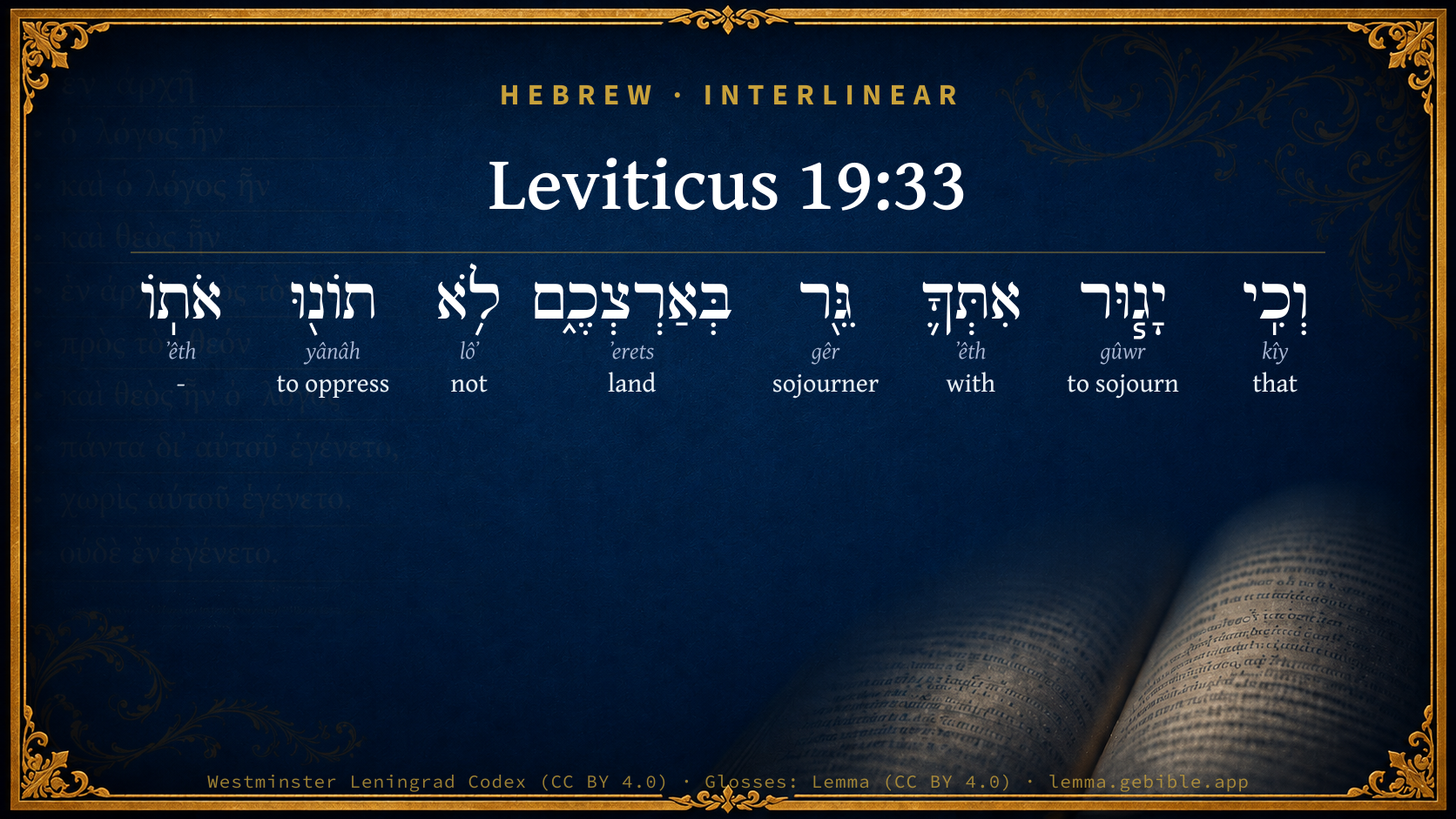
Hebrew (Westminster Leningrad Codex) Leviticus 19:33 appears in the Hebrew Old Testament. The text above is from the Westminster Leningrad Codex. Each word links to its Strong’s number, a concise gloss, and parsing drawn from the Open Scriptures Hebrew Bible morphology. Click any word for its full Brown-Driver-Briggs (BDB) entry.
Download image
Cite this verse

Leviticus 19:33 (World English Bible). Public Domain. Lemma interlinear Bible study tool, https://lemma.gebible.app/v/leviticus/19/33.

Show BibTeX & RIS
BibTeX
RIS
English Translation
"'If a stranger lives as a foreigner with you in your land, you shall not do him wrong.
World English Bible · Public Domain
Download a study sheet

One document with this verse’s original text, its word-by-word gloss line, the meaning frame, cross-references with their text, attributed commentary, and full source and license credits — printable, and it pastes into notes with its structure intact.

This verse Autodidact and up

Study sheet (.html) Plain text (.txt)

A passage Seminary Student

Up to 50 verses in one chapter. A passage sheet keeps up to 6 commentary sources and 12 cross-references per verse, in the order this page ranks them, and says so on the sheet whenever that leaves anything out. Ask for a single verse and you get the Autodidact verse sheet above.

Everything on this page stays free to read, with no account — the sheet is a download of what is already on screen, not access to it.

Want to remove ads? Support Godless Engineer
Compare translations 3

The same verse in 3 English versions, stacked beneath the original-language interlinear above. Click any original word for its lexicon entry.

Each is an independent rendering of the whole verse — the interlinear is not word-aligned to these translations.

Highlighted words mark where these versions differ — a whole-verse word diff, not a word-by-word alignment.

  • World English Bible Public Domain
    "'If a stranger lives as a foreigner with you in your land, you shall not do him wrong.
  • King James Version Public Domain
    And if a stranger sojourn with thee in your land, ye shall not vex him.
  • unfoldingWord Literal Text CC BY-SA 4.0
    And when a sojourner sojourns with you in your land, you shall not oppress him.

unfoldingWord Literal Text — © unfoldingWord, licensed CC BY-SA 4.0. Word-aligned USFM3 via Door43 (git.door43.org/unfoldingWord/en_ult).

Versions to compare (up to 4)

3 of 4 selected

Show all 18 translations

Every available English version of this verse, each an independent rendering of the whole verse.

  • World English Bible Public Domain
    "'If a stranger lives as a foreigner with you in your land, you shall not do him wrong.
  • Berean Standard Bible Public Domain
    When a foreigner resides with you in your land, you must not oppress him.
  • Majority Standard Bible Public Domain
    When a foreigner resides with you in your land, you must not oppress him.
  • King James Version Public Domain
    And if a stranger sojourn with thee in your land, ye shall not vex him.
  • American Standard Version (1901) Public Domain
    And if a stranger sojourn with thee in your land, ye shall not do him wrong.
  • Revised Version (1885) Public Domain
    And if a stranger sojourn with thee in your land, ye shall not do him wrong.
  • Geneva Bible (1599) Public Domain
    And if a stranger soiourne with thee in your lande, ye shall not vexe him.
  • Douay-Rheims (1899) Public Domain
    If a stranger dwell in your land, and abide among you, do not upbraid him:
  • Young's Literal Translation Public Domain
    `And when a sojourner sojourneth with thee in your land, thou dost not oppress him;
  • Literal Standard Version CC BY-SA 4.0
    And when a sojourner sojourns with you in your land, you do not oppress him;
  • Unlocked Literal Bible CC BY-SA 4.0
    If a foreigner lives among you in your land, you must not do him any wrong.
  • unfoldingWord Literal Text CC BY-SA 4.0
    And when a sojourner sojourns with you in your land, you shall not oppress him.
  • Darby Bible Public Domain
    And if a stranger sojourn with thee in your land, ye shall not molest him.
  • World Messianic Bible Public Domain
    “‘If a stranger lives as a foreigner with you in your land, you shall not do him wrong.
  • Webster's Bible Public Domain
    And if a stranger shall sojourn with thee in your land, ye shall not oppress him.
  • Free Bible Version CC BY-SA 4.0
    Don't mistreat foreigners who live in your country.
  • Bible in Basic English Public Domain
    And if a man from another country is living in your land with you, do not make life hard for him;
  • JPS Tanakh (1917) Public Domain
    And if a stranger sojourn with thee in your land, ye shall not do him wrong.

Literal Standard Version (2020), Covenant Press — licensed CC BY-SA 4.0. Text via the HelloAO Bible API (eBible.org). Unlocked Literal Bible (unfoldingWord) — licensed CC BY-SA 4.0. Text via the HelloAO Bible API (eBible.org). unfoldingWord Literal Text — © unfoldingWord, licensed CC BY-SA 4.0. Word-aligned USFM3 via Door43 (git.door43.org/unfoldingWord/en_ult). Free Bible Version, Dr. Jonathan Gallagher — licensed CC BY-SA 4.0. Text via the HelloAO Bible API (eBible.org).

Word by word

More ways to search: Search by grammar → Find every occurrence → Compare this word →

Practice this passage: Drill this verse → Learn its vocabulary →

About this verse

These counts appear in no published source. They are computed here, from the morphology-tagged text and Lemma’s own curated glosses. What Lemma adds →

8
words
8
distinct lemmas
Pentateuch
section

Notable vocabulary

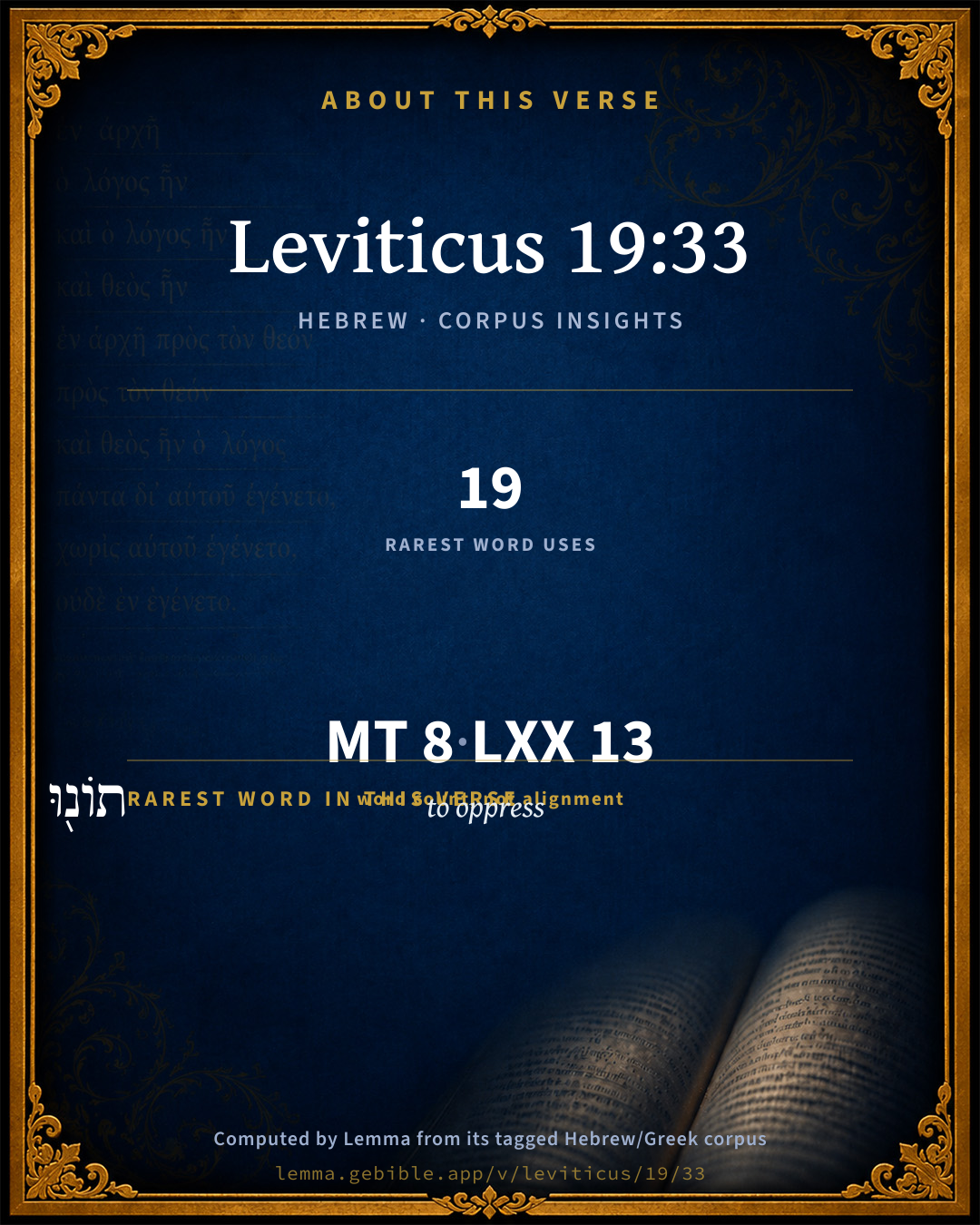
The rarest word here is תוֹנ֖וּ to oppress H3238 — appearing just 19 times in the whole Hebrew Bible.

Shared distinctive vocabulary

תוֹנ֖וּ to oppress H3238 occurs in 19 verses of the Hebrew Bible. Also found in:

Grammatical profile

  • 2 verbs
  • 2 nouns
  • 1 preposition
  • 1 conjunction
  • 2 particles

Verb forms

  • יָג֧וּר Qal · Imperfect
  • תוֹנ֖וּ Hiphil · Imperfect

Hebrew & Septuagint length

In English translation the verse runs 18 words from the Hebrew and 17 from the Septuagint (LXX English) — closely comparable.

A rough comparison of the two English renderings, which tokenize alike — not a word-level alignment.

Word counts can differ between the Hebrew and the Greek without any difference in meaning — e.g. the Hebrew direct-object marker אֵת has no separate Greek word, and Greek often adds the article ὁ.

In the original languages it is 8 Hebrew tokens and 13 Greek tokens — but the two are counted differently (Hebrew bundles its prefixes and suffixes into one token; the Greek is in lemma form), so that isn’t a like-for-like length.

Cross-references

8

Topical passages linked to Leviticus 19:33 in the Treasury of Scripture Knowledge — connected by theme and wording, ordered by reader-vote popularity; previews shown in the World English Bible.

  • Exodus 22:21 "You shall not wrong an alien, neither shall you oppress him, for you were aliens in the land of Egypt.
  • Exodus 23:9 "You shall not oppress an alien, for you know the heart of an alien, seeing you were aliens in the land of Egypt.
  • Deuteronomy 24:14 You shall not oppress a hired servant who is poor and needy, whether he be of your brothers, or of your foreigners who are in your land within your gates:
  • Jeremiah 7:6 if you don't oppress the foreigner, the fatherless, and the widow, and don't shed innocent blood in this place, neither walk after other gods to your own hurt:
  • Malachi 3:5 I will come near to you to judgment; and I will be a swift witness against the sorcerers, and against the adulterers, and against the perjurers, and against those who oppress the hireling in his wages, the widow, and the fatherless, and who deprive the foreigner of justice, and don't fear me," says Yahweh of Hosts.
  • Deuteronomy 10:18–19 He does execute justice for the fatherless and widow, and loves the foreigner, in giving him food and clothing.
  • Ezekiel 22:7 In you have they set light by father and mother; in the midst of you have they dealt by oppression with the foreigner; in you have they wronged the fatherless and the widow.
  • Ezekiel 22:29 The people of the land have used oppression, and exercised robbery; yes, they have vexed the poor and needy, and have oppressed the foreigner wrongfully.

Cross-references courtesy of OpenBible.info (CC BY 4.0).

Hebrew and Greek witnesses Masoretic Hebrew ↔ Greek Septuagint

The same verse in the two great witnesses to the Old Testament, shown verse-for-verse.

These are two independent witnesses, not word-aligned to each other, and the Septuagint is shown in lemma (dictionary) form.

Hebrew Leviticus 19:33 Masoretic · Westminster Leningrad Codex

וְכִֽי יָג֧וּר אִתְּךָ֛ גֵּ֖ר בְּאַרְצְכֶ֑ם לֹ֥א תוֹנ֖וּ אֹתֽוֹ

"'If a stranger lives as a foreigner with you in your land, you shall not do him wrong.

World English Bible · Public Domain

Greek LXX Leviticus 19:33 Septuagint · lemma form

ἐάν δέ τις προςἔρχομαι προσήλυτος σύ ἐν ὁ γῆ σύ οὐ θλίβω αὐτός

And if there should come to you a stranger in your land, you⌃ shall not afflict him.

LXX2012 (modern English Septuagint) · Public Domain

Hebrew: Westminster Leningrad Codex (CC BY 4.0). Greek: Septuagint (public domain); English from LXX2012 (modern English Septuagint) (Public Domain). How the Septuagint differs from the Hebrew →

Targum (Aramaic paraphrase)

2

The Targum is the ancient Jewish Aramaic paraphrase of the Hebrew Scriptures — an interpretive translation, not the Hebrew text itself. Onkelos (literal) and Pseudo-Jonathan (expansive) render the Torah, and Jonathan the Prophets. Coverage is partial: where no permissively-licensed English translation exists for a verse, only the Aramaic is shown. This is verse-level text, not a word-by-word alignment to the Hebrew.

  1. Targum Onkelos Torah (Genesis–Deuteronomy)
    וַאֲרֵי יִתְגַיַר עִמָךְ גִיוֹרָא בְּאַרְעֲכוֹן לָא תוֹנוּן יָתֵהּ

    (no public-domain English translation for this verse)

    Targum Onkelos — Aramaic: “Onkelos Genesis” (public domain); “Onkelos Exodus” (public domain); “Onkelos Leviticus” (public domain); “Onkelos Numbers” (public domain); “Onkelos Deuteronomy” (public domain). English: “Sefaria Community Translation” (CC0 1.0 (public-domain dedication)); “J.W. Etheridge. The Targums of Onkelos and Jonathan Ben Uzziel on the Pentateuch. London: Longmans, Green, 1862” (public domain). Text via Sefaria.

  2. Targum Pseudo-Jonathan Torah (Genesis–Deuteronomy)
    וַאֲרוּם אִין אִיתְגַיֵיר וְאִיתְחַזֵק עִמְכוֹן גִיוֹרָא בְּאַרְעֲכוֹן לָא תוֹנוּ יָתֵיהּ בְּמִילִין קָשִׁין

    And if a stranger becometh a sojourner, and settleth among you in your land, you shall not molest him with hard words:

    Targum Pseudo-Jonathan — Aramaic: “Targum Jonathan on Genesis” (public domain); “Targum Jonathan on Exodus” (public domain); “Targum Jonathan on Leviticus” (public domain); “Targum Jonathan on Numbers” (public domain); “Targum Jonathan on Deuteronomy” (public domain). English: “The Targum of Jonathan ben Uzziel, trans. J. W. Etheridge, London, 1862” (public domain). Text via Sefaria.

Commentary

Notes on Leviticus 19:33 from classic Christian and Jewish commentators (each source and its license shown beneath its notes). The classic Christian expositions comment on the surrounding passage and are grouped to its opening verse, so a note may address several verses; the Jewish commentaries on the Tanakh (Rashi and others) are per-verse, so they appear only where the commentator wrote on this verse.

Lemma curates 59 commentaries, every one of them public domain or Creative Commons licensed, each selected and text-cleaned for this edition rather than reprinted as found. About our sources →

Trapp's Complete Commentary

John Trapp

Lev 19:33 And if a stranger sojourn with thee in your land, ye shall not vex him.

Ver. 33. And if a stranger.] {See Trapp on "Exo 22:21"}

John Trapp, A Commentary or Exposition upon All the Books of the Old and New Testament (1647–1656) — public domain. Text from a community e-Sword module.

The Biblical Illustrator

Joseph S. Exell

Lev_19:33-34

The stranger.

., shall be . . . as one born among you.

Strangers befriended

I. The danger apprehended. The fear was lest they should grow too inclusive and haughty, and begin to despise and oppress the individual foreigners that should remain in the land or might enter it for a settlement. The invitation to the stranger might be like that of the spider to the fly--a sirens voice luring to destruction. This is the very fate that has befallen the Jews in mediaeval and modern Europe. To prevent such usage the command of the text was issued. There arises a clashing of commercial interests; to see foreigners flourishing in the midst whilst home interests suffer, has often led to riot and persecution.

II. The principles oh which the command of the text is raised.

1. There is a recognition of the brotherhood of man. He shall be unto you as one born among you. This doctrine of the unity of the race was brought eminently to light by Jesus Christ.

2. There is a recognition of the royal law of love, both as to its extent and as an instrument of obedience. For

(1) love is not to be centred in self, nor

(2) is the class of neighbours to be restricted, and

(3) to love the stranger is seen to be the only security against inequitable dealing--three important truths.

Without affection, the strictest rules are in vain. To guide the ship by its helm is easier than by any external attachment of ropes. Better is it for a man to be impelled towards the goal by inward desire than to be pushed and dragged by the hands of others, tugging him now on this side, now on that.

3. It is instructive to discern in the law predictions of the gospel. Here are the germs that developed into trees laden with richest fruit.

III. The memories by which observance of the command is enforced.

1. By a remembrance of their own condition in former days. Christians! your time of bondage should make you compassionate to those still in darkness. Will you shun them as evil, or let praying and working on their behalf go hand in band?

2. By a remembrance of their relationship to God. After nearly every precept comes this solemn reminder, I am the Lord thy God. He was the covenant God to whom the Israelites had dedicated themselves, being sprinkled with sacrificial blood. If they entertained a proper sense of the authority of God, they would attend to this particular statute. Stand on the monument, and it is difficult to tell which is the giant and which the dwarf below in the streets. So before the majesty of God all earthly distinctions of race disappear. Love the stranger! God hath made all of one blood. (S. R. Aldridge, B. A.)

Courtesy to strangers

I. We ourselves are strangers on the earth. For ye were strangers in the land (Lev_19:34).

1. Dependent on other care than our own; human and Divine.

2. Transient, soon to leave, resting but a little while on earth. Observe: it is good to see in the case of others an analogy with our own; it will foster sympathy and helpfulness.

II. Courtesy should root itself in generous love. Thou shalt love him as thyself.

1. Acting to the stranger as if the service were being rendered to us. This will teach us what to do, and how to show kindness.

2. Recognising that we may perchance be in the strangers position. As thus needing kindness, let us now exhibit it.

3. Opening our hearts in ungrudging benevolence. Love gives lavishly. Courtesy should not be meagre and superficial.

III. Gratitude to heaven prompts us to generous kindness. Ye were strangers in the land of Egypt; I am the Lord your God.

1. Memory of Gods rescue should constrain us to care for others.

2. Gods relationship to us requires that we illustrate His lovingkindness.

3. His commands to courtesy cannot be evaded with impunity. (W. H. Jellie.)

Unkindness to a stranger

Philip of Macedon, hearing of one in his kingdom that refused most unthankfully to receive a stranger, of whom he had been formerly succoured in a time of extreme need, as having lost all he had by a wreck at sea, caused him to be worthily punished, by branding in his forehead these two letters I. H., i.e., Ingratus Hospes, The Unthankful Guest. Now, if every unthankful man were thus used, there would be many a blistered forehead amongst us. Oh the unthankfulness that we show unto God, who, when we were strangers to Him, shipwrecked even in an ocean of sin, sent His Son Christ Jesus to deliver us, yet we refuse to receive Him, to relieve Him in His distressed members, and to be obedient to His blessed commands I And then our ingratitude to one another is such that though we come off with smooth fronts here in this world, yet such characters of shame and confusion are engraven on our souls that men and angels shall read them with amazement when the books shall be laid open (Dan_7:10). (J. Spencer.)

The Biblical Illustrator, edited by Joseph S. Exell (c. 1880s–1900s) — public domain. Text from a community e-Sword module.

Joseph Benson's Commentary

Lev 19:33. Vex him — Either with opprobrious expressions, or grievous exactions.

Joseph Benson's Commentary on the Old and New Testaments (1811–1818) — public domain. Text from a community e-Sword module.

Keil & Delitzsch

C. F. Keil & F. Delitzsch

A few commandments are added of a judicial character. - Lev 19:33, Lev 19:34. The Israelite was not only not to oppress the foreigner in his land (as had already been commanded in Exo 22:20 and Exo 23:9), but to treat him as a native, and love him as himself.

Keil & Delitzsch — Biblical Commentary on the Old Testament (1861–1891) — public domain (CC PDM 1.0). Text via the HelloAO Bible API. (Old Testament only.)

Tyndale Open Study Notes

Tyndale Open Resources

19:33-34 The Israelites, once foreigners living in . . . Egypt, were to remember their own mistreatment and avoid inflicting similar abuse on others (see Deut 10:19).

Tyndale Open Study Notes — © Tyndale Open Resources, licensed CC BY-SA 4.0. Text via the HelloAO Bible API.

Geneva Bible (1599)

Geneva Bible translators

Or, do him wrong.

Geneva Bible (1599) marginal notes — public domain. Text via Bolls.life.

Jamieson, Fausset & Brown

Robert Jamieson, A. R. Fausset & David Brown

if a stranger sojourn with thee in your land, ye shall not vex him--The Israelites were to hold out encouragement to strangers to settle among them, that they might be brought to the knowledge and worship of the true God; and with this in view, they were enjoined to treat them not as aliens, but as friends, on the ground that they themselves, who were strangers in Egypt, were at first kindly and hospitably received in that country.

Jamieson, Fausset & Brown — Commentary Critical and Explanatory on the Whole Bible (1871) — public domain (CC PDM 1.0). Text via the HelloAO Bible API.

Adam Clarke's Commentary

Verse 33. If a stranger sojourn] This law to protect and comfort the stranger was at once humane and politic. None is so desolate as the stranger, and none needs the offices of benevolence and charity more: and we may add that he who is not affected by the desolate state of the stranger has neither benevolence nor charity. It was politic to encourage strangers, as in consequence many came, not only to sojourn, but to settle among the Jews, and thus their political strength became increased; and many of these settlers became at least proselytes of the gate if not proselytes of the covenant, and thus got their souls saved. Hence humanity, sound policy, and religion said, Vex not the stranger; thou shalt love him as thyself. The apostle makes use of a strong argument to induce men to hospitality towards strangers: Be not forgetful to entertain strangers, for thereby some have entertained angels unawares, Heb 13:2. Moses also uses a powerful motive: Ye were strangers in the land of Egypt. The spirit of the precept here laid down, may be well expressed in our Lord's words: Do unto all men as ye would they should do unto you.

Adam Clarke's Commentary on the Bible (1810–1826) — public domain. Text from a community e-Sword/MySword module.

Ellicott's Commentary for English Readers

(33) And if a stranger sojourn with thee.—The stranger, for whose benefit the legislators enacted so many humane and benign laws, and with regard to whom the book of Leviticus has laid down so many precepts, is one of non-Jewish origin, but who had joined the Jewish faith. He had, therefore, to undergo the rite of circumcision; he had to fast on the great Day of Atonement (Lev_16:29); he had to submit to the regulations about sacrifices (Lev_17:8-9; Lev_22:18); he had to abstain from eating blood and the flesh of animals torn by wild beasts (Lev_22:10; Lev_22:15); he had to practise the laws of chastity (Lev_18:26); like the Israelite by birth, he had to refrain from blasphemy, and obey the moral precepts (Lev_24:16-22). These were some of the conditions of his sojourning in the land.

Ye shall not vex him.—Having once been admitted into the community, the Israelites were forbidden to upbraid him with his nationality or throw at him the fact that he was originally an idolater. They are thus prohibited calling him foreigner or neophyte, a practice which every civilised nation and religious community are prone more or less to indulge in to this day, with regard to aliens and those who have embraced their faith.

A Bible Commentary for English Readers, edited by Charles John Ellicott (1878–1897) — public domain. Text from a community e-Sword module.

The Cambridge Bible for Schools and Colleges

gen. ed. J. J. S. Perowne

33, 34. Cp. Exo_22:21; Exo_23:9; Deu_10:19; cp. Mal_3:5.

The Cambridge Bible for Schools and Colleges (gen. ed. J. J. S. Perowne; Cambridge University Press, 1878–1918) — public domain. Text from a community e-Sword module.

John Gill's Exposition

And if a stranger sojourn with you in your land,.... Ben Gersom, and others, understand this of a proselyte of righteousness, who was circumcised, and in all things conformed to the Jewish religion; but it may be interpreted of a proselyte of the gate, who was not an idolater, since he is described as one sojourning with them, and indeed of any stranger, who for a time was providentially cast among them:

ye shall not vex him: with hard and grievous words, upbraiding him with his former ignorance and idolatry, and saying unto him, as Jarchi observes, yesterday thou wast a worshipper of idols, and now thou comest to learn the law; nor distress him by any means in business, or with law suits; See Gill on Exo 22:21.

John Gill's Exposition of the Whole Bible (1746–1763) — public domain (CC PDM 1.0). Text via the HelloAO Bible API.

Albert Barnes' Notes on the Bible

The stranger - The foreigner. See Lev 16:29 note; Exo 23:9.

Albert Barnes' Notes on the Bible (1834–1885) — public domain. Text from a community e-Sword/MySword module.

Matthew Poole's English Annotations

Either with opprobrious expressions, or grievous exactions.

Matthew Poole's English Annotations on the Holy Bible (1683–1685) — public domain. Text from a community e-Sword/MySword module.

The Pulpit Commentary

Vers. 33, 34. The command already given "neither to vex a stranger, nor oppress him", (Exo_22:21) on the pathetic ground that "ye know the heart of a stranger, seeing ye were strangers in the land of Egypt", (Exo_23:9) is broadened in these verses to the positive law, thou shalt love him as thyself. "The royal law of verse 18 is expressly extended to the stranger, and notwithstanding the national narrowness necessary to preserve the true religion in the world, the general brotherhood of mankind is hereby taught as far as was possible under the circumstances" (Gardiner).

The Pulpit Commentary (1880–1919), ed. H.D.M. Spence-Jones & Joseph S. Exell — public domain. Text from a community e-Sword module.

John Wesley's Explanatory Notes

Vex him - Either with opprobrious expressions, or grievous exactions.

John Wesley, Explanatory Notes Upon the Whole Bible (1754–1765) — public domain. Text via the GEBible commentary corpus.

unfoldingWord translationNotes

Door43 World Missions Community

translationWords

alien

life

Israel

love

Egypt

unfoldingWord translationNotes — © Distant Shores Media and the Door43 World Missions Community, licensed CC BY-SA 4.0. Source: git.door43.org/Door43/en_tn.

Rashi

Rabbi Shlomo Yitzchaki (Rashi)

לא תונו [AND IF A STRANGER SOJOURN WITH THEE IN THY LAND], YE SHALL NOT VEX HIM — This implies vexing him with words (cf. Rashi on Exodus 22:20) — do not say to him, “Yesterday you were an idolator and now you come to study the Torah which was given from the mouth of the Almighty!” (Sifra, Kedoshim, Chapter 8 2; Bava Metzia 58b, 59b.)

Rashi on the Tanakh — English translations: “The Judaica Press complete Tanach with Rashi, translated by A. J. Rosenberg” (CC BY 4.0); “Pentateuch with Rashi's commentary by M. Rosenbaum and A.M. Silbermann, 1929-1934” (public domain); “The Metsudah Tanach series, Lakewood, N.J” (CC BY 4.0); and “The Book of Joshua, Metsudah Publications, 1997” (CC BY 4.0). Text via Sefaria.

Lesson kit

Teaching starters — assembled from the data on this page, not authored interpretation. Every prompt links to the verse data it draws on. Edit before teaching.

Leviticus, in the Pentateuch, opens this verse with 8 words (8 distinct Hebrew lemmas). Its most distinctive word is yânâh (“to oppress”). A historical commentator’s framing appears above. Read the whole chapter for the surrounding context.

Discussion questions

  1. How does “to oppress” (yânâh) shape what this verse is saying?
  2. Exodus 22:21 shares the word «to oppress» with this verse. How do the two illuminate each other?
  3. These translations render this verse differently; the difference is in the English rendering, not the original. What questions does that raise?
  4. The verb «יָג֧וּר» is Qal Imperfect. How does its form color the action?
  5. Reading how Trapp's Complete Commentary and The Biblical Illustrator read this verse, where do the two commentators agree and where do they part?

Things to notice

Reading settings

Reading text

Shown beneath each verse's original-language words.

Old Testament
Old Testament edition

Read the OT as the Masoretic Hebrew (MT) or the Greek Septuagint (LXX).

English shown for the Greek Septuagint (in the Hebrew ↔ Greek comparison).

Comparing translations? Open the Compare panel on any verse page to stack up to four side by side.