
Job 19:15

Hebrew (Westminster Leningrad Codex) Job 19:15 appears in the Hebrew Old Testament. The text above is from the Westminster Leningrad Codex. Each word links to its Strong’s number, a concise gloss, and parsing drawn from the Open Scriptures Hebrew Bible morphology. Click any word for its full Brown-Driver-Briggs (BDB) entry.
Download image
Cite this verse

Job 19:15 (World English Bible). Public Domain. Lemma interlinear Bible study tool, https://lemma.gebible.app/v/job/19/15.

Show BibTeX & RIS
BibTeX
RIS
English Translation
Those who dwell in my house, and my maids, count me for a stranger. I am an alien in their sight.
World English Bible · Public Domain
Download a study sheet

One document with this verse’s original text, its word-by-word gloss line, the meaning frame, cross-references with their text, attributed commentary, and full source and license credits — printable, and it pastes into notes with its structure intact.

This verse Autodidact and up

Study sheet (.html) Plain text (.txt)

A passage Seminary Student

Up to 50 verses in one chapter. A passage sheet keeps up to 6 commentary sources and 12 cross-references per verse, in the order this page ranks them, and says so on the sheet whenever that leaves anything out. Ask for a single verse and you get the Autodidact verse sheet above.

Everything on this page stays free to read, with no account — the sheet is a download of what is already on screen, not access to it.

Want to remove ads? Support Godless Engineer
Compare translations 3

The same verse in 3 English versions, stacked beneath the original-language interlinear above. Click any original word for its lexicon entry.

Each is an independent rendering of the whole verse — the interlinear is not word-aligned to these translations.

Highlighted words mark where these versions differ — a whole-verse word diff, not a word-by-word alignment.

  • World English Bible Public Domain
    Those who dwell in my house, and my maids, count me for a stranger. I am an alien in their sight.
  • King James Version Public Domain
    They that dwell in mine house, and my maids, count me for a stranger: I am an alien in their sight.
  • unfoldingWord Literal Text CC BY-SA 4.0
    Guests of my house and my female servants regard me as a stranger; I have become a foreigner in their eyes.

unfoldingWord Literal Text — © unfoldingWord, licensed CC BY-SA 4.0. Word-aligned USFM3 via Door43 (git.door43.org/unfoldingWord/en_ult).

Versions to compare (up to 4)

3 of 4 selected

Show all 18 translations

Every available English version of this verse, each an independent rendering of the whole verse.

  • World English Bible Public Domain
    Those who dwell in my house, and my maids, count me for a stranger. I am an alien in their sight.
  • Berean Standard Bible Public Domain
    My guests and maidservants count me as a stranger; I am a foreigner in their sight.
  • Majority Standard Bible Public Domain
    My guests and maidservants count me as a stranger; I am a foreigner in their sight.
  • King James Version Public Domain
    They that dwell in mine house, and my maids, count me for a stranger: I am an alien in their sight.
  • American Standard Version (1901) Public Domain
    They that dwell in my house, and my maids, count me for a stranger; I am an alien in their sight.
  • Revised Version (1885) Public Domain
    They that dwell in mine house, and my maids, count me for a stranger: I am an alien in their sight.
  • Geneva Bible (1599) Public Domain
    They that dwel in mine house, and my maydes tooke me for a stranger: for I was a stranger in their sight.
  • Douay-Rheims (1899) Public Domain
    They that dwelt in my house, and my maidservants have counted me a stranger, and I have been like an alien in their eyes.
  • Young's Literal Translation Public Domain
    Sojourners of my house and my maids, For a stranger reckon me: An alien I have been in their eyes.
  • Literal Standard Version CC BY-SA 4.0
    Sojourners of my house and my maids, || Reckon me for a stranger; I have been an alien in their eyes.
  • Unlocked Literal Bible CC BY-SA 4.0
    Those who once stayed as guests in my house and my female servants regard me as a stranger; I am an alien in their sight.
  • unfoldingWord Literal Text CC BY-SA 4.0
    Guests of my house and my female servants regard me as a stranger; I have become a foreigner in their eyes.
  • Darby Bible Public Domain
    The sojourners in my house and my maids count me as a stranger; I am an alien in their sight.
  • World Messianic Bible Public Domain
    Those who dwell in my house and my maids consider me a stranger. I am an alien in their sight.
  • Webster's Bible Public Domain
    They that dwell in my house, and my maids, count me for a stranger: I am an alien in their sight.
  • Free Bible Version CC BY-SA 4.0
    My house guests and my maidservants treat me as a stranger—to them I have become a foreigner.
  • Bible in Basic English Public Domain
    I am strange to my women-servants, and seem to them as one from another country.
  • JPS Tanakh (1917) Public Domain
    They that dwell in my house, and my maids, count me for a stranger; I am become an alien in their sight.

Literal Standard Version (2020), Covenant Press — licensed CC BY-SA 4.0. Text via the HelloAO Bible API (eBible.org). Unlocked Literal Bible (unfoldingWord) — licensed CC BY-SA 4.0. Text via the HelloAO Bible API (eBible.org). unfoldingWord Literal Text — © unfoldingWord, licensed CC BY-SA 4.0. Word-aligned USFM3 via Door43 (git.door43.org/unfoldingWord/en_ult). Free Bible Version, Dr. Jonathan Gallagher — licensed CC BY-SA 4.0. Text via the HelloAO Bible API (eBible.org).

Word by word

More ways to search: Search by grammar → Find every occurrence → Compare this word →

Practice this passage: Drill this verse → Learn its vocabulary →

נָ֝כְרִ֗י
nokrîy
H5237
“foreign”
Adjective, Adjective, Masculine, Singular, Absolute
Part of Speech
Adjective
Type
Adjective
Gender
Masculine
Number
Singular
State
Absolute
Full BDB Definition

Origin: from H5235 (second form)

TWOT: 1368c

foreign, alien - foreign - foreigner (substantive) - foreign woman, harlot - unknown, unfamiliar (figuratively)
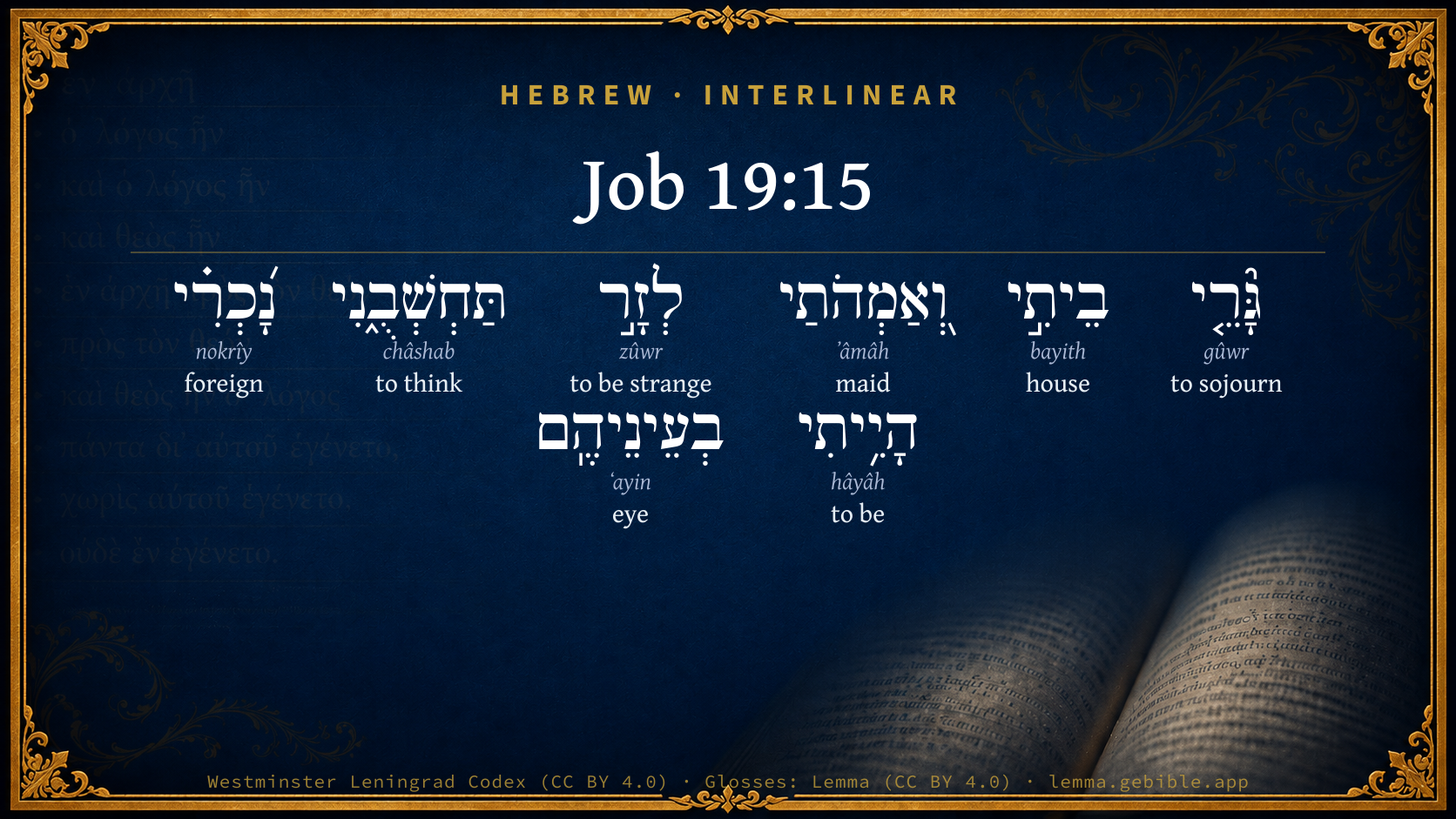
  1. גָּ֘רֵ֤י gûwr H1481 “sojourning” Verb, Qal, Participle Active, Masculine, Plural, Construct
  2. בֵיתִ֣י bayith H1004 “house · my” Noun, Common, Masculine, Singular, Construct + Suffix, Personal, 1st Person, Common, Singular
  3. וְ֭אַמְהֹתַי ʼâmâh H519 “and · maids · my” Conjunction + Noun, Common, Feminine, Plural, Construct + Suffix, Personal, 1st Person, Common, Singular
  4. לְזָ֣ר zûwr H2114 “to/for · strange” Preposition + Adjective, Adjective, Masculine, Singular, Absolute
  5. תַּחְשְׁבֻ֑נִי châshab H2803 “to think · me” Verb, Qal, Imperfect, 3rd Person, Feminine, Plural + Suffix, Personal, 1st Person, Common, Singular
  6. הָיִ֥יתִי hâyâh H1961 “to be” Verb, Qal, Perfect, 1st Person, Common, Singular
  7. בְעֵינֵיהֶֽם ʻayin H5869 “in/at · eyes · their” Preposition + Noun, Common, Both, Dual, Construct + Suffix, Personal, 3rd Person, Masculine, Plural

About this verse

These counts appear in no published source. They are computed here, from the morphology-tagged text and Lemma’s own curated glosses. What Lemma adds →

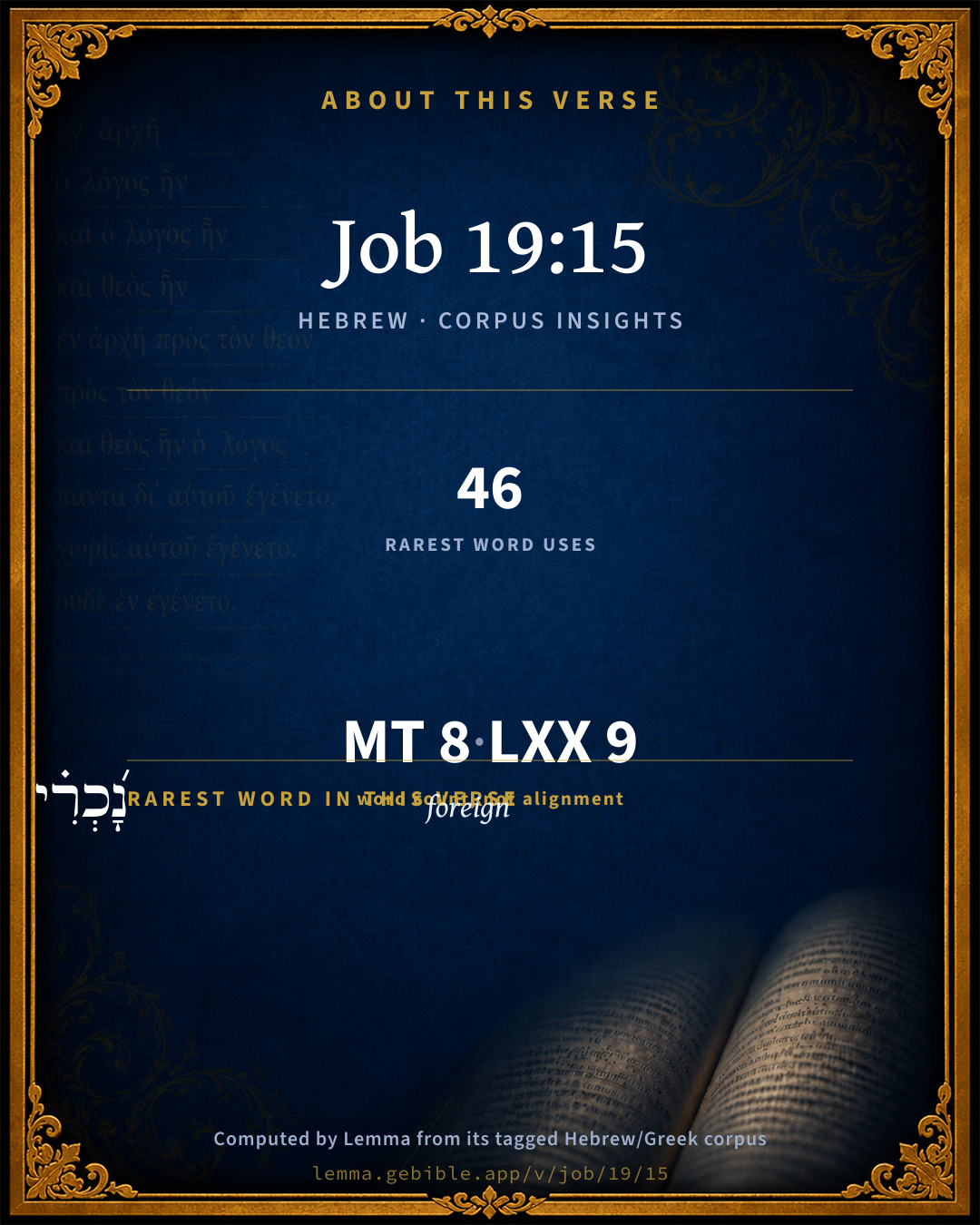
8
words
8
distinct lemmas
Wisdom
section

Shared distinctive vocabulary

נָ֝כְרִ֗י foreign H5237 occurs in 45 verses of the Hebrew Bible. Also found in:

Grammatical profile

  • 3 verbs
  • 3 nouns
  • 2 adjectives

Verb forms

  • גָּ֘רֵ֤י Qal · Participle Active
  • תַּחְשְׁבֻ֑נִי Qal · Imperfect
  • הָיִ֥יתִי Qal · Perfect

Hebrew & Septuagint length

In English translation the verse runs 21 words from the Hebrew and 13 from the Septuagint (LXX English) — the Septuagint runs noticeably shorter here. See the side-by-side →

A rough comparison of the two English renderings, which tokenize alike — not a word-level alignment.

Word counts can differ between the Hebrew and the Greek without any difference in meaning — e.g. the Hebrew direct-object marker אֵת has no separate Greek word, and Greek often adds the article ὁ.

In the original languages it is 8 Hebrew tokens and 9 Greek tokens — but the two are counted differently (Hebrew bundles its prefixes and suffixes into one token; the Greek is in lemma form), so that isn’t a like-for-like length.

Cross-references

2

Topical passages linked to Job 19:15 in the Treasury of Scripture Knowledge — connected by theme and wording, ordered by reader-vote popularity; previews shown in the World English Bible.

  • Job 31:31–32 If the men of my tent have not said, 'Who can find one who has not been filled with his meat?'
  • Psalms 123:3 Have mercy on us, Yahweh, have mercy on us, For we have endured much contempt.

Cross-references courtesy of OpenBible.info (CC BY 4.0).

Hebrew and Greek witnesses Masoretic Hebrew ↔ Greek Septuagint

The same verse in the two great witnesses to the Old Testament, shown verse-for-verse.

Here the Septuagint runs noticeably shorter than the Hebrew — LXX2012 (modern English Septuagint) 13 words vs World English Bible 21. A rough length comparison of the two English translations, not a word-level alignment — read both below.

These are two independent witnesses, not word-aligned to each other, and the Septuagint is shown in lemma (dictionary) form.

Hebrew Job 19:15 Masoretic · Westminster Leningrad Codex

גָּ֘רֵ֤י בֵיתִ֣י וְ֭אַמְהֹתַי לְזָ֣ר תַּחְשְׁבֻ֑נִי נָ֝כְרִ֗י הָיִ֥יתִי בְעֵינֵיהֶֽם

Those who dwell in my house, and my maids, count me for a stranger. I am an alien in their sight.

World English Bible · Public Domain

Greek LXX Job 19:15 Septuagint · lemma form

γείτων οἰκία θεραπαίνα τε ἐγώ ἀλλογενής εἰμί ἐναντίον αὐτός

As for my household, and my maidservants, I was a stranger before them.

LXX2012 (modern English Septuagint) · Public Domain

On this verse, Albert Barnes' Notes on the Bible discusses the Septuagint’s reading. Read the note in Commentary ↓

Hebrew: Westminster Leningrad Codex (CC BY 4.0). Greek: Septuagint (public domain); English from LXX2012 (modern English Septuagint) (Public Domain). How the Septuagint differs from the Hebrew →

Commentary

Notes on Job 19:15 from classic Christian and Jewish commentators (each source and its license shown beneath its notes). The classic Christian expositions comment on the surrounding passage and are grouped to its opening verse, so a note may address several verses; the Jewish commentaries on the Tanakh (Rashi and others) are per-verse, so they appear only where the commentator wrote on this verse.

Lemma curates 59 commentaries, every one of them public domain or Creative Commons licensed, each selected and text-cleaned for this edition rather than reprinted as found. About our sources →

Trapp's Complete Commentary

John Trapp

Job 19:15 They that dwell in mine house, and my maids, count me for a stranger: I am an alien in their sight.

Ver. 15. They that dwell in mine house, and my maids, &c.] My tenants, or my guests, or my sojourners, those widows and orphans haply, whom he kept at his own charge, Job 31:32. More than this, my maidens, those housekeepers, intrusted with the keys of the family, and that are no drudges to wash the feet of other servants, as 1Sa 25:41. And for his servants of the other sex, he was as coarsely used by them too.

John Trapp, A Commentary or Exposition upon All the Books of the Old and New Testament (1647–1656) — public domain. Text from a community e-Sword module.

Joseph Benson's Commentary

Job 19:15-16. They that dwell in my house — Hebrew, גרי ביתי, garei beethei, peregrini domus meæ, the sojourners of my house, that is, those that formerly were kindly entertained at my house, whether strangers, widows, or the fatherless; nay, the people of my family, even my maids, who, by reason of their sex, have commonly more tender and compassionate hearts than men, count me for a stranger — Have forgotten the respect they owe, and were wont to pay to me, and regard my commands and concerns no more than if I were a stranger to whom they had no relation. I called my servant — To do some servile office; and he gave me no answer — He regarded not what I said; no, not when I besought him, as if he had been my master.

Joseph Benson's Commentary on the Old and New Testaments (1811–1818) — public domain. Text from a community e-Sword module.

Geneva Bible (1599)

Geneva Bible translators

Mine household servants: by all these losses Job showeth that touching the flesh he had great occasion to be moved.

Geneva Bible (1599) marginal notes — public domain. Text via Bolls.life.

Jamieson, Fausset & Brown

Robert Jamieson, A. R. Fausset & David Brown

They that dwell, &c.--rather, "sojourn": male servants, sojourning in his house. Mark the contrast. The stranger admitted to sojourn as a dependent treats the master as a stranger in his own house.

Jamieson, Fausset & Brown — Commentary Critical and Explanatory on the Whole Bible (1871) — public domain (CC PDM 1.0). Text via the HelloAO Bible API.

Adam Clarke's Commentary

Verse 15. They that dwell in mine house] In this and the following verses the disregard and contempt usually shown to men who have fallen from affluence and authority into poverty and dependence, are very forcibly described: formerly reverenced by all, now esteemed by none. Pity to those who have fallen into adversity is rarely shown; the rich have many friends, and to him who appears to be gaining worldly substance much court is paid; for many worship the rising sun, who think little of that which is gone down. Some are even reproached with that eminence which they have lost, though not culpable for the loss. A bishop, perhaps Bale, of Ossory, being obliged to leave his country and fly for his life, in the days of bloody Queen Mary, and who never regained his bishopric, was met one morning by one like those whom Job describes, who, intending to be witty at the expense of the venerable prelate, accosted him thus: "Good morrow, BISHOP quondam." To which the bishop smartly replied, "Adieu, KNAVE semper."

Adam Clarke's Commentary on the Bible (1810–1826) — public domain. Text from a community e-Sword/MySword module.

The Cambridge Bible for Schools and Colleges

gen. ed. J. J. S. Perowne

15–16. Then those unrelated to him within his house, the menials and slaves. Those who, as Oriental servants, used to be subservient and observant of the slightest sign from their master (Psa_123:2)—these “ducking observants” now refuse to answer when he calls, and must be besought for their service. Very soon the reflection of one’s fall is thrown from the countenances of those higher in rank down upon the faces of the servants, where it shows itself without any delicacy or reserve. Job_19:16 reads, I call my servant and he giveth me no answer: I must entreat him with my mouth.

The Cambridge Bible for Schools and Colleges (gen. ed. J. J. S. Perowne; Cambridge University Press, 1878–1918) — public domain. Text from a community e-Sword module.

John Gill's Exposition

I called my servant,.... His manservant, whom he had hired into his house, and who waited upon his person, and had been his trusty and faithful servant, and was dear unto him, and he had shown him much respect and kindness in the time of his prosperity; him he called to him, to do this and that and the other thing for him as usual; and of whose assistance and service he might stand in more need, being so greatly afflicted in body as well as in other things; and who ought to have been obedient to his call in all things, and have served him with all readiness and cheerfulness, with all heartiness, sincerity, integrity, and faithfulness; and given him the same honour and reverence as before; but instead of all this, it is observed,

and he gave me no answer; whether he would or would not do what he ordered him to do; he took no notice of him, he turned a deaf ear to him, and his back upon him; he came not near him, but kept his place where he was, or walked off without showing any regard to what he said to him; he neither answered him by words, nor by deeds; neither signified his readiness to do what he was ordered, nor did it. In some cases it is criminal in servants to answer again, when they thwart and contradict their masters, or reply in a saucy, surly, and impudent manner; but when they are spoke to about their master's business, it becomes them to answer in a decent, humble, and respectable way, declaring their readiness to do their master's will and pleasure:

I entreated him with my mouth; which is an aggravation of his insolence and disobedience; such was the low condition Job was reduced unto, and such the humility of his mind under his present circumstances, that he laid aside the authority of a master, and only entreated his servant, and begged it as if it was a favour, to do this or the other for him; nor did he signify this by a look and cast of his eye, or by a nod of his head, or by the direction of his hand; but with his mouth he spake unto him, and let him know what he would have done; and this not in an authoritative, haughty, and imperious manner; but with good words, and in submissive language, as it was something he was beholden to his servant for, rather than obedience to be performed.

John Gill's Exposition of the Whole Bible (1746–1763) — public domain (CC PDM 1.0). Text via the HelloAO Bible API.

Albert Barnes' Notes on the Bible

They that dwell in mine house - The trials came to his very dwelling, and produced a sad estrangement there. The word used here גרי gārēy from גוּר gûr means properly those who “sojourn” in a house for a little time. It may refer to guests, strangers, servants, clients, or tenants. The essential idea is, that they were not “permanent” residents, though for a time they were inmates of the family. Jerome renders the place, “Inquilini domus meoe - the tenants of my house.” The Septuagint, Γείτονες οἰχιάς Geitones oikias - neighbors. Schultens supposes it means “clients,” or those who were taken under the protection of a great man. He quotes from the Arabian poets to show that the word is used in that sense, and particularly a passage from the “Hamasa,” which he thus translates:

Descendite sub alas meas, alasque gentis meae.

Ut sim praesidium vobis quum pugna con seritur.

Namque testamento injunxit mihi pater, ut reciperem vos hospites.

Omnemque oppressorem a vobis propulsarem.

There can be no doubt that Job refers to “dependents,” but whether in the capacity of servants, tenants, or clients, it is not easy to determine, and is not material. Dr. Good renders it “sojourners,” and this is a correct rendering of the word. This would be clearly the sense if the corresponding member of the parallelism were not “maids.” or female servants. “That” requires us to understand here persons who were “somehow” engaged in the service of Job. Perhaps his clients, or those who came for protection, were under obligation to some sort of service as the return of his patronage.

And my maids - Female domestics. The Chaldee, however, renders this לחינתי - “my concubines;” but the correct reference is to female female servants.

I am an alien - That is, to them. They cease to treat me as the head of the family.

Albert Barnes' Notes on the Bible (1834–1885) — public domain. Text from a community e-Sword/MySword module.

Matthew Poole's English Annotations

They that dwell in mine house, Heb. the sojourners of my house, i.e. such as had formerly sojourned with me, whether strangers. widows, and fatherless, whom by the law of charity and hospitality he entertained; or hired servants, who had for a good while their habitation and subsistence in his family.

My maids; who, by reason of their sex, commonly have and should have more tender and compassionate hearts than men. And therefore this is God’s doing, who hath hardened their hearts against me.

Count me for a stranger; regard my commands and concerns no more than a stranger.

I am an alien in their sight; the same thing repeated, through vehemency of passion, because this lay very heavy upon him.

Matthew Poole's English Annotations on the Holy Bible (1683–1685) — public domain. Text from a community e-Sword/MySword module.

Whedon's Commentary on the Bible

Daniel D. Whedon

15. They… dwell in mine house — Delitzsch understands them to be domestics or vassals.

Daniel D. Whedon (gen. ed.), Commentary on the Old and New Testaments (1874–1909) — public domain. Text from a community e-Sword module.

The Pulpit Commentary

They that dwell in mine house, and my maids, count me for a stranger. Even the inmates of his house, male and female, his servants, guards, retainers, handmaids, and the like, looked on him and treated him as if unknown to them. l am an alien in their sight. Nay, not only as if unknown, hut "as an alien," i.e. a foreigner.

The Pulpit Commentary (1880–1919), ed. H.D.M. Spence-Jones & Joseph S. Exell — public domain. Text from a community e-Sword module.

John Wesley's Explanatory Notes

Maids - Who by reason of their sex, commonly have more compassionate hearts than men.

John Wesley, Explanatory Notes Upon the Whole Bible (1754–1765) — public domain. Text via the GEBible commentary corpus.

unfoldingWord translationNotes

Door43 World Missions Community

General Information:

Job continues to speak to his three friends.

regard me

"consider me"

I am an alien in their sight

Job describes how people now think of him as an outsider. Here sight represents judgement or evaluation. AT: "they think of me as a foreigner" (See: Metaphor)

but he gives me no answer

"but he does not respond to me" or "but he does not come to me." The answer is a response to Job's call.

although I entreat him with my mouth

The phrase "my mouth" is a metonym which refers to Job speaking. AT: "even though I speak to him and plead with him" (See: Metonymy)

entreat him

"plead with him"

translationWords

house

call

servant

unfoldingWord translationNotes — © Distant Shores Media and the Door43 World Missions Community, licensed CC BY-SA 4.0. Source: git.door43.org/Door43/en_tn.

Lesson kit

Teaching starters — assembled from the data on this page, not authored interpretation. Every prompt links to the verse data it draws on. Edit before teaching.

Job, in the Wisdom, opens this verse with 8 words (8 distinct Hebrew lemmas). Its most distinctive word is nokrîy (“foreign”). The Greek Septuagint runs shorter here. A historical commentator’s framing appears above. Read the whole chapter for the surrounding context.

Discussion questions

  1. What does “foreign” (nokrîy) contribute to the verse as a whole?
  2. How does Genesis 31:15, which shares the word «foreign», read alongside this verse?
  3. The Septuagint runs shorter here than the Hebrew. What might account for the difference?
  4. The translations on this page render this verse differently — a whole-verse word diff, not a word-by-word alignment. What might account for the different wordings?
  5. «גָּ֘רֵ֤י» is a Qal Participle Active verb. How does that grammatical form shape the action described?
  6. Compare how Trapp's Complete Commentary and Joseph Benson's Commentary read this verse. Where do they agree or differ?

Things to notice

Reading settings

Reading text

Shown beneath each verse's original-language words.

Old Testament
Old Testament edition

Read the OT as the Masoretic Hebrew (MT) or the Greek Septuagint (LXX).

English shown for the Greek Septuagint (in the Hebrew ↔ Greek comparison).

Comparing translations? Open the Compare panel on any verse page to stack up to four side by side.