
Jeremiah 50:40

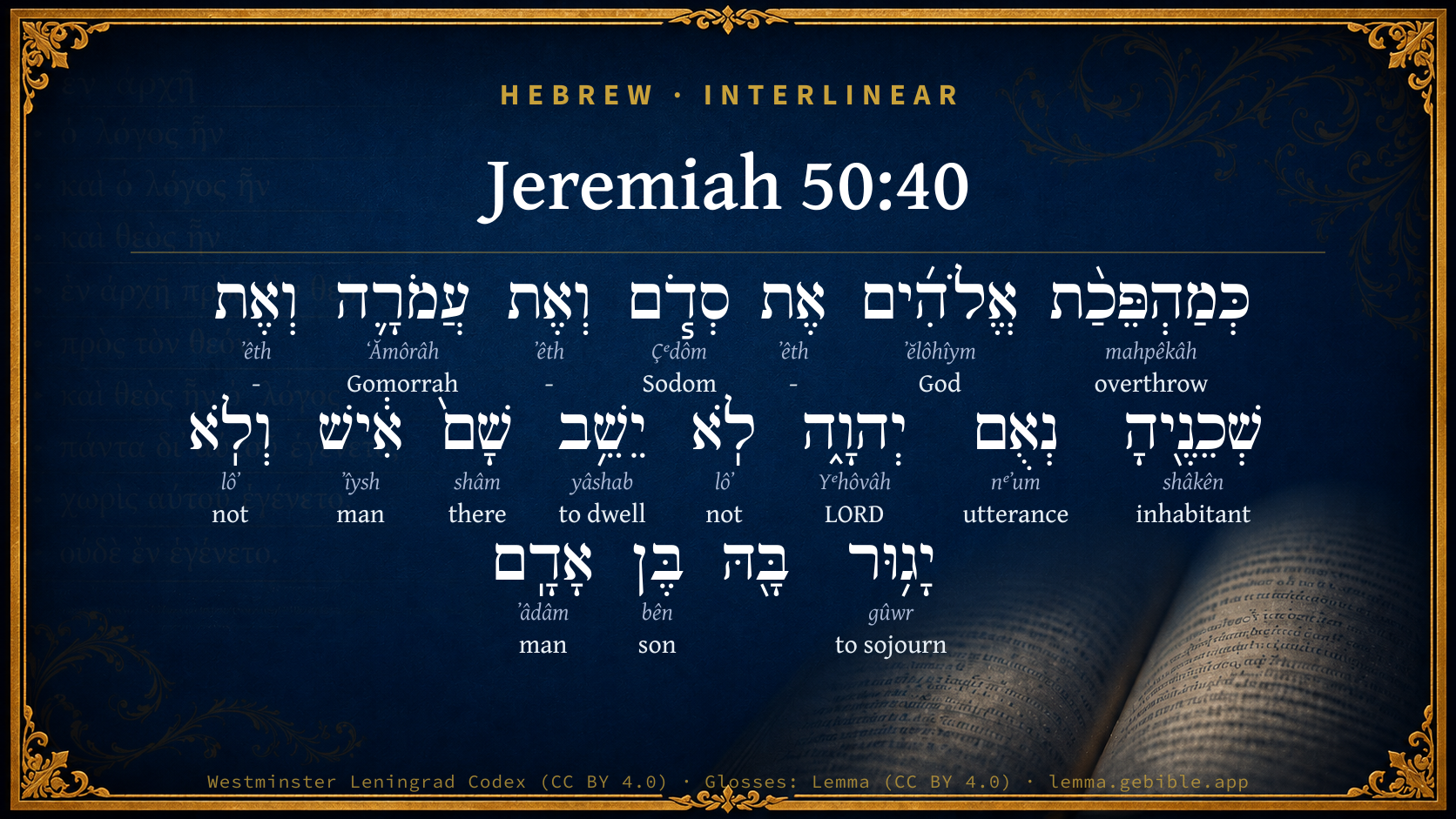
Hebrew (Westminster Leningrad Codex) Jeremiah 50:40 appears in the Hebrew Old Testament. The text above is from the Westminster Leningrad Codex. Each word links to its Strong’s number, a concise gloss, and parsing drawn from the Open Scriptures Hebrew Bible morphology. Click any word for its full Brown-Driver-Briggs (BDB) entry.
Download image
Cite this verse

Jeremiah 50:40 (World English Bible). Public Domain. Lemma interlinear Bible study tool, https://lemma.gebible.app/v/jeremiah/50/40.

Show BibTeX & RIS
BibTeX
RIS
English Translation
As when God overthrew Sodom and Gomorrah and the neighbor cities of it, says Yahweh, so shall no man dwell there, neither shall any son of man sojourn therein.
World English Bible · Public Domain
Download a study sheet

One document with this verse’s original text, its word-by-word gloss line, the meaning frame, cross-references with their text, attributed commentary, and full source and license credits — printable, and it pastes into notes with its structure intact.

This verse Autodidact and up

Study sheet (.html) Plain text (.txt)

A passage Seminary Student

Up to 50 verses in one chapter. A passage sheet keeps up to 6 commentary sources and 12 cross-references per verse, in the order this page ranks them, and says so on the sheet whenever that leaves anything out. Ask for a single verse and you get the Autodidact verse sheet above.

Everything on this page stays free to read, with no account — the sheet is a download of what is already on screen, not access to it.

Want to remove ads? Support Godless Engineer
Compare translations 3

The same verse in 3 English versions, stacked beneath the original-language interlinear above. Click any original word for its lexicon entry.

Each is an independent rendering of the whole verse — the interlinear is not word-aligned to these translations.

Highlighted words mark where these versions differ — a whole-verse word diff, not a word-by-word alignment.

  • World English Bible Public Domain
    As when God overthrew Sodom and Gomorrah and the neighbor cities of it, says Yahweh, so shall no man dwell there, neither shall any son of man sojourn therein.
  • King James Version Public Domain
    As God overthrew Sodom and Gomorrah and the neighbour cities thereof, saith the LORD; so shall no man abide there, neither shall any son of man dwell therein.
  • unfoldingWord Literal Text CC BY-SA 4.0
    Just as God overthrew Sodom and Gomorrah and their neighbors—this is Yahweh’s declaration— no one will live there; no person will stay in her.”

unfoldingWord Literal Text — © unfoldingWord, licensed CC BY-SA 4.0. Word-aligned USFM3 via Door43 (git.door43.org/unfoldingWord/en_ult).

Versions to compare (up to 4)

3 of 4 selected

Show all 18 translations

Every available English version of this verse, each an independent rendering of the whole verse.

  • World English Bible Public Domain
    As when God overthrew Sodom and Gomorrah and the neighbor cities of it, says Yahweh, so shall no man dwell there, neither shall any son of man sojourn therein.
  • Berean Standard Bible Public Domain
    As God overthrew Sodom and Gomorrah along with their neighbors,” declares the LORD, “no one will dwell there; no man will abide there.
  • Majority Standard Bible Public Domain
    As God overthrew Sodom and Gomorrah along with their neighbors,” declares the LORD, “no one will dwell there; no man will abide there.
  • King James Version Public Domain
    As God overthrew Sodom and Gomorrah and the neighbour cities thereof, saith the LORD; so shall no man abide there, neither shall any son of man dwell therein.
  • American Standard Version (1901) Public Domain
    As when God overthrew Sodom and Gomorrah and the neighbor cities thereof, saith Jehovah, so shall no man dwell there, neither shall any son of man sojourn therein.
  • Revised Version (1885) Public Domain
    As when God overthrew Sodom and Gomorrah and the neighbour cities thereof, saith the LORD; so shall no man dwell there, neither shall any son of man sojourn therein.
  • Geneva Bible (1599) Public Domain
    As God destroied Sodom and Gomorah with the places thereof neere about, sayeth the Lord: so shall no man dwell theere, neither shall the sonne of man remaine therein.
  • Douay-Rheims (1899) Public Domain
    As the Lord overthrew Sodom and Gomorrha, and their neighbour cities, saith the Lord: no man shall dwell there, neither shall the son of man inhabit it.
  • Young's Literal Translation Public Domain
    As overthrown by God with Sodom, And with Gomorrah, and with its neighbours, An affirmation of Jehovah, none doth dwell there, Nor sojourn in her doth a son of man.
  • Literal Standard Version CC BY-SA 4.0
    As the overthrow by God of Sodom, || And of Gomorrah, and of its neighbors,” || A declaration of YHWH, || “None dwell there, || Nor does a son of man sojourn in her.
  • Unlocked Literal Bible CC BY-SA 4.0
    Just as God overthrew Sodom and Gomorrah and their neighbors—this is Yahweh's declaration— no one will live there; no person will stay in her.”
  • unfoldingWord Literal Text CC BY-SA 4.0
    Just as God overthrew Sodom and Gomorrah and their neighbors—this is Yahweh’s declaration— no one will live there; no person will stay in her.”
  • Darby Bible Public Domain
    As when God overthrew Sodom and Gomorrah, and their neighbour cities, saith Jehovah, no one shall dwell there, neither shall a son of man sojourn therein.
  • World Messianic Bible Public Domain
    As when God overthrew Sodom and Gomorrah and its neighbor cities,” says the LORD, “so no man will dwell there, neither will any son of man live therein.
  • Webster's Bible Public Domain
    As God overthrew Sodom and Gomorrah and the neighboring cities, saith the LORD; so shall no man abide there, neither shall any son of man dwell therein.
  • Free Bible Version CC BY-SA 4.0
    In the same way that God destroyed Sodom and Gomorrah and their neighboring towns, declares the Lord, no one will live there, no one will stay there.
  • Bible in Basic English Public Domain
    As when Sodom and Gomorrah and their neighbouring towns were overturned by God, says the Lord, so no man will be living in it, and no son of man will have a resting-place there.
  • JPS Tanakh (1917) Public Domain
    As when God overthrew Sodom and Gomorrah and the neighbour cities thereof, saith the LORD; so shall no man abide there, neither shall any son of man dwell therein.

Literal Standard Version (2020), Covenant Press — licensed CC BY-SA 4.0. Text via the HelloAO Bible API (eBible.org). Unlocked Literal Bible (unfoldingWord) — licensed CC BY-SA 4.0. Text via the HelloAO Bible API (eBible.org). unfoldingWord Literal Text — © unfoldingWord, licensed CC BY-SA 4.0. Word-aligned USFM3 via Door43 (git.door43.org/unfoldingWord/en_ult). Free Bible Version, Dr. Jonathan Gallagher — licensed CC BY-SA 4.0. Text via the HelloAO Bible API (eBible.org).

Word by word

More ways to search: Search by grammar → Find every occurrence → Compare this word →

Practice this passage: Drill this verse → Learn its vocabulary →

כְּמַהְפֵּכַ֨ת
mahpêkâh
H4114
“like/as · overthrow of”
Preposition + Noun, Common, Feminine, Singular, Construct
Part of Speech
Preposition + Noun
Type
Common
Gender
Feminine
Number
Singular
State
Construct
Full BDB Definition

Origin: from H2015

TWOT: 512d

overthrow, destruction - always of Sodom and Gomorrah
  1. אֱלֹהִ֜ים ʼĕlôhîym H430 “God(s)” Noun, Common, Masculine, Plural, Absolute
  2. אֶת ʼêth H853 “-” Particle, Direct Object
  3. סְדֹ֧ם Çᵉdôm H5467 “Sodom” Noun, Proper
  4. וְאֶת ʼêth H853 “and · -” Conjunction + Particle, Direct Object
  5. עֲמֹרָ֛ה ʻĂmôrâh H6017 “Gomorrah” Noun, Proper
  6. וְאֶת ʼêth H853 “and · -” Conjunction + Particle, Direct Object
  7. שְׁכֵנֶ֖יהָ shâkên H7934 “inhabitant · her” Adjective, Adjective, Masculine, Plural, Construct + Suffix, Personal, 3rd Person, Feminine, Singular
  8. נְאֻם nᵉʼum H5002 “utterance of” Noun, Common, Masculine, Singular, Construct
  9. יְהוָ֑ה Yᵉhôvâh H3068 “LORD” Noun, Proper
  10. לֹֽא lôʼ H3808 “not” Particle, Negative
  11. יֵשֵׁ֥ב yâshab H3427 “to dwell” Verb, Qal, Imperfect, 3rd Person, Masculine, Singular
  12. שָׁם֙ shâm H8033 “there” Adverb
  13. אִ֔ישׁ ʼîysh H376 “man” Noun, Common, Masculine, Singular, Absolute
  14. וְלֹֽא lôʼ H3808 “and · not” Conjunction + Particle, Negative
  15. יָג֥וּר gûwr H1481 “to sojourn” Verb, Qal, Imperfect, 3rd Person, Masculine, Singular
  16. בֶּן bên H1121 “son of” Noun, Common, Masculine, Singular, Construct
  17. אָדָֽם ʼâdâm H120 “man” Noun, Common, Masculine, Singular, Absolute

About this verse

These counts appear in no published source. They are computed here, from the morphology-tagged text and Lemma’s own curated glosses. What Lemma adds →

19
words
15
distinct lemmas
Prophets
section

Notable vocabulary

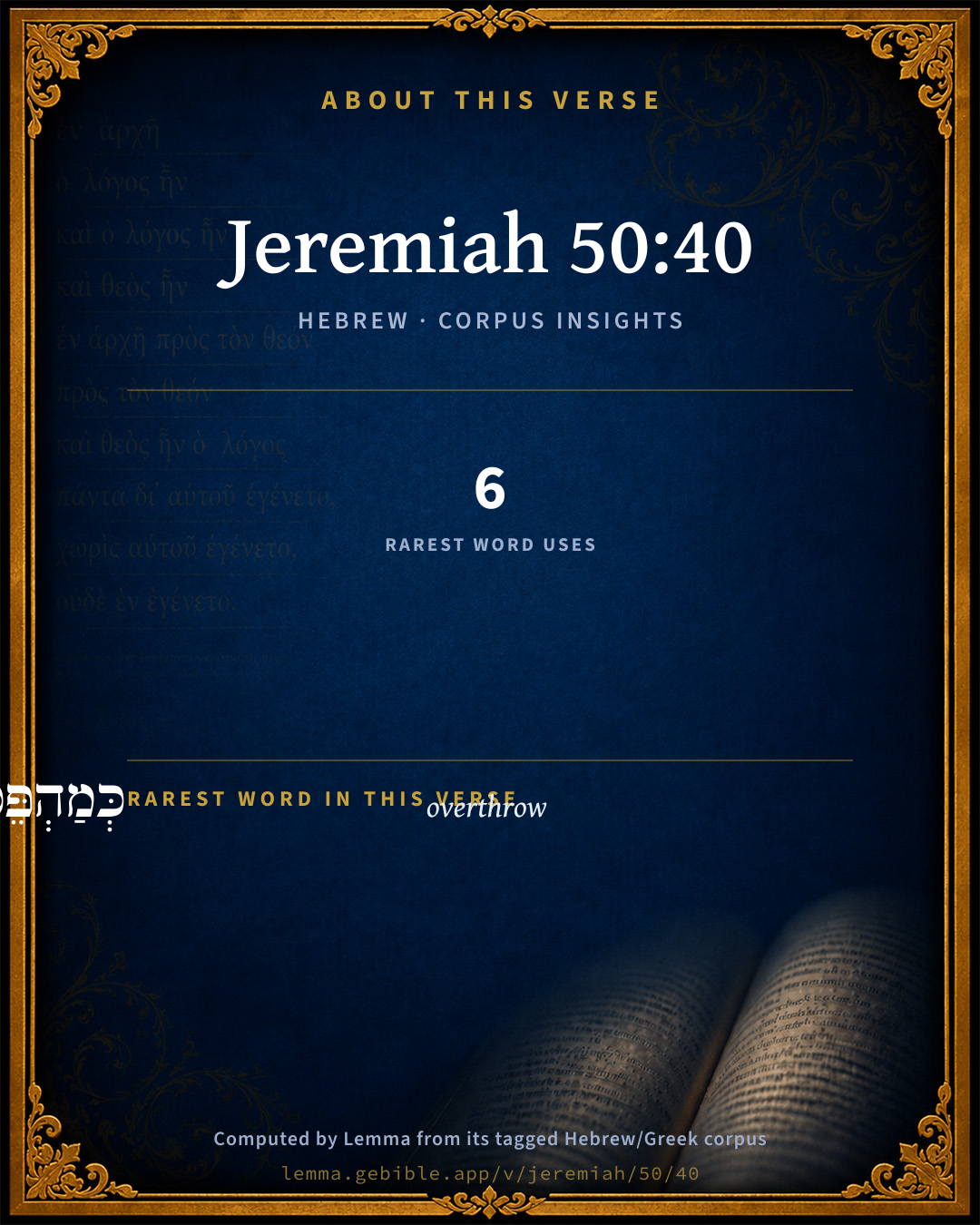
The rarest word here is כְּמַהְפֵּכַ֨ת overthrow H4114 — appearing just 6 times in the whole Hebrew Bible.

Shared distinctive vocabulary

כְּמַהְפֵּכַ֨ת overthrow H4114 occurs in 6 verses of the Hebrew Bible. Also found in:

Grammatical profile

  • 2 verbs
  • 9 nouns
  • 1 adjective
  • 1 preposition
  • 1 adverb
  • 5 particles

Verb forms

  • יֵשֵׁ֥ב Qal · Imperfect
  • יָג֥וּר Qal · Imperfect

Repetition

A word recurs within this verse — often emphatic in Hebrew:

Cross-references

14

Topical passages linked to Jeremiah 50:40 in the Treasury of Scripture Knowledge — connected by theme and wording, ordered by reader-vote popularity; previews shown in the World English Bible.

  • Genesis 19:24–25 Then Yahweh rained on Sodom and on Gomorrah sulfur and fire from Yahweh out of the sky.
  • Isaiah 13:19–20 Babylon, the glory of kingdoms, the beauty of the Chaldeans' pride, shall be as when God overthrew Sodom and Gomorrah.
  • Jeremiah 49:18 As in the overthrow of Sodom and Gomorrah and the neighbor cities of it, says Yahweh, no man shall dwell there, neither shall any son of man sojourn therein.
  • Luke 17:28–30 Likewise, even as it happened in the days of Lot: they ate, they drank, they bought, they sold, they planted, they built;
  • 2 Peter 2:6 and turning the cities of Sodom and Gomorrah into ashes, condemned them to destruction, having made them an example to those who would live ungodly;
  • Jude 1:7 Even as Sodom and Gomorrah, and the cities around them, having, in the same way as these, given themselves over to sexual immorality and gone after strange flesh, are set forth as an example, suffering the punishment of eternal fire.
  • Deuteronomy 29:23 [and that] the whole land of it is sulfur, and salt, [and] a burning, [that] it is not sown, nor bears, nor any grass grows therein, like the overthrow of Sodom and Gomorrah, Admah and Zeboiim, which Yahweh overthrew in his anger, and in his wrath:
  • Isaiah 1:9 Unless Yahweh of hosts had left to us a very small remnant, We would have been as Sodom; We would have been like Gomorrah.
  • Jeremiah 51:26 They shall not take of you a stone for a corner, nor a stone for foundations; but you shall be desolate for ever, says Yahweh.
  • Hosea 11:8–9 "How can I give you up, Ephraim? How can I hand you over, Israel? How can I make you like Admah? How can I make you like Zeboiim? My heart is turned within me, My compassion is aroused.
  • Amos 4:11 "I have overthrown some of you, As when God overthrew Sodom and Gomorrah, And you were like a burning stick plucked out of the fire; Yet you haven't returned to me," says Yahweh.
  • Zephaniah 2:9 Therefore as I live, says Yahweh of Hosts, the God of Israel, surely Moab will be as Sodom, and the children of Ammon as Gomorrah, a possession of nettles, and salt pits, and a perpetual desolation. The remnant of my people will plunder them, and the survivors of my nation will inherit them.
  • Revelation 11:8 Their dead bodies will be in the street of the great city, which spiritually is called Sodom and Egypt, where also their Lord was crucified.
  • Revelation 18:8–9 Therefore in one day her plagues will come: death, mourning, and famine; and she will be utterly burned with fire; for the Lord God who has judged her is strong.

Cross-references courtesy of OpenBible.info (CC BY 4.0).

Hebrew and Greek witnesses Masoretic Hebrew ↔ Greek Septuagint

The same verse in the two great witnesses to the Old Testament, shown verse-for-verse.

These are two independent witnesses, not word-aligned to each other, and the Septuagint is shown in lemma (dictionary) form.

Hebrew Jeremiah 50:40 Masoretic · Westminster Leningrad Codex

כְּמַהְפֵּכַ֨ת אֱלֹהִ֜ים אֶת סְדֹ֧ם וְאֶת עֲמֹרָ֛ה וְאֶת שְׁכֵנֶ֖יהָ נְאֻם יְהוָ֑ה לֹֽא יֵשֵׁ֥ב שָׁם֙ אִ֔ישׁ וְלֹֽא יָג֥וּר בָּ֖הּ בֶּן אָדָֽם

As when God overthrew Sodom and Gomorrah and the neighbor cities of it, says Yahweh, so shall no man dwell there, neither shall any son of man sojourn therein.

World English Bible · Public Domain

Greek LXX Structure differs

In the Septuagint, Jeremiah is about an eighth shorter than the Hebrew and arranges its material differently — the Oracles Against the Nations (Hebrew chapters 46–51) appear in the middle of the Greek book, after 25:13. Because the chapter and verse boundaries do not line up, a verse-for-verse comparison with the Hebrew is not shown.

A verse-for-verse comparison isn’t shown here because the chapters and verses don’t line up. Switch to the LXX edition with the MT / LXX toggle above to read the Greek directly.

Hebrew: Westminster Leningrad Codex (CC BY 4.0). Greek: Septuagint (public domain); English from a public-domain English Septuagint. How the Septuagint differs from the Hebrew →

Targum (Aramaic paraphrase)

1

The Targum is the ancient Jewish Aramaic paraphrase of the Hebrew Scriptures — an interpretive translation, not the Hebrew text itself. Onkelos (literal) and Pseudo-Jonathan (expansive) render the Torah, and Jonathan the Prophets. Coverage is partial: where no permissively-licensed English translation exists for a verse, only the Aramaic is shown. This is verse-level text, not a word-by-word alignment to the Hebrew.

  1. Targum Jonathan Prophets (Joshua–Malachi)
    רָחֵיק מֵימְרִי יַתְכוֹן כְּמָא דְרָחִיק יְיָ יַת סְדוֹם וְיַת עֲמוֹרָה וְקָרִיבָהָא אֲמַר יְיָ לָא יָתֵיב תַּמָן אֱנַשׁ וְלָא יִתּוֹתַב בָּהּ בַּר אֱנַשׁ:

    (no public-domain English translation for this verse)

    Targum Jonathan — Aramaic: “Mikraot Gedolot” (public domain). English: “Sefaria Community Translation” (CC0 1.0 (public-domain dedication)); “London "Chaldee Paraphrase," 1871” (public domain). Text via Sefaria.

Commentary

Notes on Jeremiah 50:40 from classic Christian and Jewish commentators (each source and its license shown beneath its notes). The classic Christian expositions comment on the surrounding passage and are grouped to its opening verse, so a note may address several verses; the Jewish commentaries on the Tanakh (Rashi and others) are per-verse, so they appear only where the commentator wrote on this verse.

Lemma curates 59 commentaries, every one of them public domain or Creative Commons licensed, each selected and text-cleaned for this edition rather than reprinted as found. About our sources →

Trapp's Complete Commentary

John Trapp

Jer 50:40 As God overthrew Sodom and Gomorrah and the neighbour [cities] thereof, saith the LORD; [so] shall no man abide there, neither shall any son of man dwell therein.

Ver. 40. As God overthrew Sodom.] See Isa 13:19 Jer 49:18.

John Trapp, A Commentary or Exposition upon All the Books of the Old and New Testament (1647–1656) — public domain. Text from a community e-Sword module.

Jamieson, Fausset & Brown

Robert Jamieson, A. R. Fausset & David Brown

(Isa 13:19). Repeated from Jer 49:18.

Jamieson, Fausset & Brown — Commentary Critical and Explanatory on the Whole Bible (1871) — public domain (CC PDM 1.0). Text via the HelloAO Bible API.

Adam Clarke's Commentary

Verse 40. As God overthrew Sodom] As the very ground on which these cities stood, with all the plain, now lies under the Dead Sea; so Babylon and the adjacent country shall be rendered totally barren and unfruitful, and utterly incapable of being inhabited. And this is the fact concerning both countries. See Jer 49:18.

Adam Clarke's Commentary on the Bible (1810–1826) — public domain. Text from a community e-Sword/MySword module.

John Calvin's Commentaries

This verse confirms and explains the previous verse. But that the design of the Prophet may be more evident, we must remember what Jude in his epistle (Jude 7) says, that the destruction of Sodom is as it were a mirror in which we behold God’s vengeance on all the ungodly. God overthrew Sodom; but he does not proceed in the same way with other lands and nations; yet the same is the lot of all the unbelieving, of the despisers of God, and reprobates; for they are exposed to his vengeance, which they cannot escape, though it may be for a time suspended. When, therefore, the Prophet says now that Babylon would be overthrown, as Sodom was overthrown, he does not mean that this would be after seventy years, when taken by Cyrus and Darius, nor when retaken after its revolt, nor when taken by Alexander; for it remained a long time after this, even to the reign of Augustus Caesar. As, then, it has been so, it follows that our Prophet does not speak of its first, second, or third assault, but that he had in view what I have already stated, — that when God summons the wicked to judgment, it is a certain prelude of eternal and final destruction. His way with the godly is another; for though God may sink them down to the grave, nay, to the center of the earth, yet hope is still left them; hence their death is never like the destruction of Sodom. And to the same purpose is what we have already quoted from Isaiah,

“Except a seed had been left us, we should have been as Sodom, and like to Gomorrah.” (Isaiah 1:9)

That exception shows the difference between God’s children and the reprobate, even because he often delivers them from ruin.

We now then understand the Prophet’s meaning when he says that Babylon would become desolate and solitary, so that no one would dwell there, nor remain; and that from age to age, or from generation to generation.

Moreover, we learn from what is here said, that the unbelieving are overwhelmed with despair even under the least punishment, because they see nothing but the vengeance of God; for though God does not immediately slay them, yet the least puncture denotes what impends over them; nay, he inflicts a deadly wound when he seems only to touch them lightly. There is then only one consolation, which can sustain us in our miseries, even to know that we are separated from the Sodomites through the mercy of God alone; because we have deserved the same destruction, and the Lord has spared us according to his infinite goodness. This, then, is the meaning, It follows, —

John Calvin's Commentaries (1540-1563) — public domain. Text from the Calvin Translation Society English edition (1840s-50s) via the Christian Classics Ethereal Library (ccel.org). Calvin's coverage is partial (roughly two-thirds of the Bible); uncommented books and verses are honest gaps, never fabricated. The 19th-century editor's footnotes and remarks are omitted so the notes are faithfully Calvin's own voice.

Ellicott's Commentary for English Readers

(40) As God overthrew Sodom . . .—The whole verse is reproduced from Jer_49:18. We enter here, indeed, upon a mosaic of quotations, or at least recollections of other prophecies. Thus Jer_50:41-43 are taken from Jer_6:22-24, “Babylon” being substituted for “Zion,” and “the king of Babylon” for “we;” Jer_50:44-46 from Jer_49:19-21, with the necessary substitutions of “Babylon” for “Edom,” the Chaldeans” for “Teman,” “among the nations” for “in the Red sea.” The reader is referred accordingly to the Notes on those passages. The reproduction in identical terms is probably connected with the thoughts of the retribution, on which the prophet dwells in Jer_50:15. All that she had done Babylon was now to suffer.

A Bible Commentary for English Readers, edited by Charles John Ellicott (1878–1897) — public domain. Text from a community e-Sword module.

John Gill's Exposition

As God overthrew Sodom and Gomorrah, and the neighbour cities thereof, saith the Lord,.... Admah and Zeboim:

so shall no man abide there, neither shall any son of man dwell therein; the same is said concerning Edom; See Gill on Jer 49:18.

John Gill's Exposition of the Whole Bible (1746–1763) — public domain (CC PDM 1.0). Text via the HelloAO Bible API.

Matthew Poole's English Annotations

The substance of both these verses is, that Babylon should be totally ruined, as Sodom and Gomorrah, so as there should be no habitations for men, but wild beasts only of all sorts should inhabit and lodge in it. The fulfilling of this we have not in holy writ, only the beginning of its accomplishment, it being taken by Cyrus, who only made them tributaries, and took away their government. But they rebelling against the emperor of the Medes, Darius Hystaspes, a succeeding emperor, pulled down their walls. And about two hundred and fifty years after Seleucus Nicenor, a Grecian prince, the Medes being before conquered by Alexander the Great, utterly destroyed Babylon, so as in the time of Hadrian the Roman emperor there was nothing left standing of that great city but some pieces of walls.

Matthew Poole's English Annotations on the Holy Bible (1683–1685) — public domain. Text from a community e-Sword/MySword module.

The Pulpit Commentary

A verbal copy of Jer_49:18.

The Pulpit Commentary (1880–1919), ed. H.D.M. Spence-Jones & Joseph S. Exell — public domain. Text from a community e-Sword module.

John Wesley's Explanatory Notes

No man - Cyrus only made them tributaries, and took away their government. But Seleucus Nicanor, a Grecian prince, utterly destroyed Babylon, so that in the time of Adrian the Roman emperor, there was nothing left standing of that great city.

John Wesley, Explanatory Notes Upon the Whole Bible (1754–1765) — public domain. Text via the GEBible commentary corpus.

Lesson kit

Teaching starters — assembled from the data on this page, not authored interpretation. Every prompt links to the verse data it draws on. Edit before teaching.

Jeremiah, in the Prophets, opens this verse with 19 words (15 distinct Hebrew lemmas). Its most distinctive word is mahpêkâh (“overthrow”). A historical commentator’s framing appears above. Read the whole chapter for the surrounding context.

Discussion questions

  1. The word mahpêkâh carries the sense “overthrow.” How does it shape the verse?
  2. Deuteronomy 29:23 shares the word «overthrow» with this verse. How do the two illuminate each other?
  3. “not” occurs 2× in this one verse. What is the effect of the repetition?
  4. These translations render this verse differently. What is at stake in choosing one wording over another?
  5. The verb «יֵשֵׁ֥ב» is Qal Imperfect. How does its form color the action?
  6. Reading how Trapp's Complete Commentary and Jamieson, Fausset & Brown read this verse, where do the two commentators agree and where do they part?

Things to notice

Reading settings

Reading text

Shown beneath each verse's original-language words.

Old Testament
Old Testament edition

Read the OT as the Masoretic Hebrew (MT) or the Greek Septuagint (LXX).

English shown for the Greek Septuagint (in the Hebrew ↔ Greek comparison).

Comparing translations? Open the Compare panel on any verse page to stack up to four side by side.